
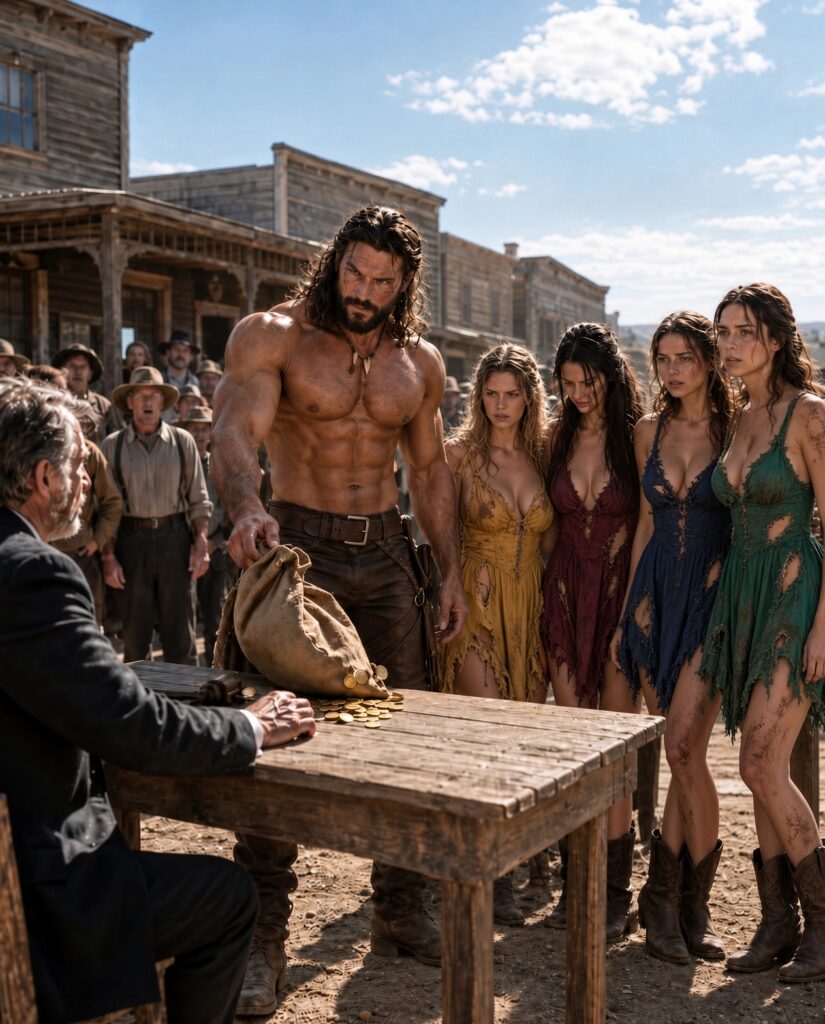
**Four orphaned sisters were put on an auction block to pay their dead father’s debts—until the most feared man in the mountains threw down a bag of gold and made a demand that terrified the entire town.**
Nora Hayes learned the price of a human life at twenty years old.
Twelve dollars.
That was what someone offered for her.
“Twelve!” a man shouted from the crowd. “I’ll take the oldest one!”
Laughter exploded across Red Creek’s town square.
Nora did not look down.
She stared instead at the brick bank building across the road, her jaw locked so tightly it hurt.
Inside her right boot, a small paring knife pressed against her ankle.
If one of those men climbed onto the platform and put his hands on Clara, Maeve, or Josie, Nora had already decided exactly where she would drive the blade.
Two weeks ago, she had been a farmer’s daughter.
Then fever took her mother.
Grief and a failing heart took her father three days later.
And before the dirt over their graves had even settled, Amos Farrow from Red Creek Bank appeared at the Hayes farm carrying a ledger.
Five hundred eighteen dollars.
Seed loans.
Equipment payments.
Medical bills.
Late penalties.
Fees Nora had never heard of.
Their land was seized.
Their livestock was taken.
Their furniture was sold.
And when none of it covered the balance, the town authorities found one final asset belonging to Silas Hayes.
His daughters.
So now Nora stood beneath the brutal September sun beside seventeen-year-old Clara, fourteen-year-old Maeve, and eight-year-old Josie while grown men decided how much each orphan was worth.
Mayor Whitcomb wiped sweat from his neck and continued reading from a paper.
“All four girls are healthy and accustomed to farm labor. Cooking, washing, sewing, poultry care, preserving food—”
“Sounds more useful than my wife!”
The square erupted again.
Nora’s hand curled into a fist.
Josie buried her face against Nora’s skirt.
She had no shoes.
The bank had taken those too.
Clara stood pale and silent, one hand gripping Nora’s arm.
Maeve was different.
Maeve looked ready to murder someone.
A purple bruise circled her wrist where a deputy had grabbed her that morning.
She leaned toward Nora.
“If they split us up, I’m running.”
“They’ll catch you.”
Maeve’s eyes never left the crowd.
“Then I’ll bite through somebody’s hand.”
Despite everything, Nora almost smiled.
Then a new voice came from below.
“Twenty dollars.”
Her blood turned cold.
Ephraim Pike.
A widowed farmer with two hundred acres and the reputation of treating hired children worse than livestock.
Nora had seen one of his former workers once.
A boy of fifteen with scars across his back.
Pike lifted his chin.
“Twenty for the eldest.”
Nora finally looked directly at him.
“No.”
Silence rippled outward.
Mayor Whitcomb stared at her.
“Nora.”
“I said no.”
Pike laughed.
“You’re being auctioned, girl. Nobody asked what you wanted.”
Nora stepped to the edge of the platform.
“We stay together.”
Amos Farrow pushed through the crowd.
The banker was round-faced, clean-coated, and irritated—as though four terrified girls were merely causing a delay in his business schedule.
“That is not part of the arrangement.”
“It is now.”
Farrow’s mouth hardened.
“You have no authority here.”
Nora stared down at him.
“Then climb onto this platform and drag me away yourself.”
Nobody laughed.
Maeve whispered behind her,
“I’d pay to see that.”
Farrow flushed crimson.
The mayor raised both hands.
“Everyone remain calm.”
Then a voice came from somewhere behind the crowd.
Not loud.
It didn’t need to be.
“How much is the debt?”
Every conversation died.
Men near the back turned first.
Then they moved.
Not because anyone ordered them to.
Because nobody wanted to stand in his path.
Gideon Rust walked through the crowd.
Children in Red Creek had nightmares about him.
Adults simply avoided saying his name too loudly.
He lived beyond Black Elk Ridge where winter storms buried cabins to their windows.
He trapped animals when the snow came, felled timber when it melted, and sometimes vanished into the mountains for months.
Some claimed he had killed three men.
Others said six.
No one seemed interested in asking him which number was correct.
He was enormous.
Broad shoulders strained beneath a weather-beaten buckskin coat.
His beard was dark.
His hands were scarred.
And a pale, vicious line began beside his left eye and cut diagonally down his cheek toward his jaw.
Gideon stopped below the platform.
His eyes moved across the sisters.
First Josie’s bare feet.
Then Clara’s torn sleeve.
Then the bruises around Maeve’s wrist.
Finally Nora.
For the first time that morning, a man looked at her without examining her body like livestock.
His eyes remained on her face.
“How much?” Gideon asked.
Farrow cleared his throat.
“Five hundred eighteen dollars, including administrative charges.”
Gideon slowly turned his head.
“What administrative charges?”
Farrow hesitated.
“Processing. Court documentation. Auction expenses.”
The scar on Gideon’s face seemed to sharpen.
“You’re charging four orphaned girls for the cost of selling them?”
Someone in the crowd coughed.
Nobody laughed.
Farrow adjusted his coat.
“The total remains five hundred eighteen.”
“Five hundred.”
“The ledger says—”
“Five hundred.”
Something in Gideon’s voice ended the argument.
Then he stepped onto the platform.
Nora immediately moved in front of her sisters.
Her fingers drifted toward the knife hidden in her boot.
Gideon noticed.
His gaze dropped for half a second.
Then returned to her face.
“If you came for one of us,” Nora said, “you can leave.”
His brow moved slightly.
“I didn’t.”
“We don’t separate.”
“I heard you the first time.”
“Then understand it.”
“I do.”
Gideon reached inside his coat.
Several men below instinctively stepped backward.
But he did not draw a weapon.
He pulled out a thick leather pouch.
Then dropped it onto the auction table.
**THUD.**
The mouth of the pouch opened.
Gold coins spilled across the wood.
Nobody breathed.
Farrow stared.
Mayor Whitcomb stared.
Nora stared.
There was enough money sitting on that table to erase every remaining debt attached to the Hayes name.
Farrow immediately reached for it.
Gideon’s enormous hand came down over the pouch.
The banker froze.
“Not yet.”
Farrow slowly withdrew his fingers.
Gideon looked toward the mayor.
“Bring me every paper.”
“What papers?”
“Every Hayes loan.”
His voice hardened.
“Every lien.”
He pointed toward Farrow.
“Every so-called labor claim.”
Then toward the courthouse.
“Every guardianship document this town is using to justify putting children on an auction platform.”
Maeve’s eyes widened.
Nora felt something unfamiliar twist inside her chest.
Hope.
She hated it instantly.
Hope was dangerous.
Gideon leaned slightly over the table.
“I want everything transferred.”
Farrow frowned.
“To whom?”
“Me.”
Nora’s hope died.
Her hand immediately moved toward her boot again.
Of course.
He was not rescuing them.
He was buying all four.
Farrow’s expression changed slowly.
A thin smile appeared.
“And what exactly does a man living alone in the mountains intend to do with four girls?”
The question hung over the square like smoke.
Gideon stopped moving.
Completely.
The mayor took one cautious step backward.
Nora saw several men suddenly become fascinated with the dirt beneath their boots.
Then Gideon turned toward Farrow.
His voice was quieter than before.
Which somehow made it worse.
“You misunderstood me.”
Farrow’s smile vanished.
Gideon tapped one finger against the contracts.
“I said transfer the debt into my name.”
He looked at Nora.
“Not them.”
Then he turned back toward the banker.
“No ownership papers.”
“No labor contracts.”
“No guardianship rights over the eldest.”
He glanced toward Clara, Maeve, and little Josie.
“And no document anywhere in Red Creek will ever say those girls belong to me.”
Farrow blinked.
“Then why pay five hundred dollars?”
Gideon Rust looked at the four sisters standing barefoot and bruised on the auction platform.
For several seconds, he said nothing.
Then the most feared man in the mountains gave an answer nobody in Red Creek would ever forget.
“Because debt can be bought.”
His scar pulled tight as his eyes returned to Farrow.
“People cannot.”
And somewhere in the crowd, for the first time that morning, nobody had anything left to laugh about.

Nobody spoke.
Not because they agreed.
Not because they understood.
Because every person standing in Red Creek’s square had just witnessed something they had never seen before.
A man with enough money to own almost anything had stood in front of them and refused to own a person.
Gideon Rust picked up the leather pouch.
The gold disappeared back inside.
Then he looked at Mayor Whitcomb.
“Papers.”
The mayor swallowed.
“Mr. Rust—”
“Papers.”
The mayor looked toward the banker.
Amos Farrow’s face had become unreadable.
That worried Nora.
Men like Farrow were never quiet because they had lost.
They were quiet because they were calculating.
The banker adjusted his coat.
“You should think carefully, Mr. Rust.”
Gideon stared at him.
“I have.”
“You are assuming these girls are worth saving.”
The entire square went still.
Nora felt Clara’s hand tighten around hers.
Maeve stepped forward.
But Gideon spoke first.
“No.”
His voice carried across the street.
“I’m assuming you’re not worth listening to.”
A few people looked away.
Farrow’s face reddened.
“You think gold makes you powerful?”
Gideon looked down at the pouch.
“No.”
Then he looked at the crowd.
“Gold just makes men like you stop pretending they have rules.”
The words landed harder than any threat.
Because everyone knew there was truth in them.
The documents took almost an hour.
Every loan.
Every claim.
Every paper that had allowed the bank to seize the Hayes farm.
The mayor brought them reluctantly.
The courthouse clerk brought them nervously.
Amos Farrow brought them angrily.
Nora watched everything from the platform.
She watched Gideon read each page.
Slowly.
Carefully.
He was not a man who rushed.
That surprised her.
She had expected someone feared by an entire town to be reckless.
Violent.
Uncontrolled.
Instead, he read every word like a man who understood exactly how dangerous words could be.
Finally, he looked up.
“The medical expenses.”
Farrow frowned.
“What?”
“You included medical expenses.”
“Yes.”
“For Silas Hayes?”
“For his treatment.”
Nora froze.
Her father’s name.
Gideon tapped the page.
“How much?”
“One hundred twelve dollars.”
“And what treatment?”
Farrow hesitated.
“Doctor visits.”
“Which doctor?”
Nobody answered.
Gideon looked at the clerk.
“Find the receipts.”
The clerk shifted.
“Mr. Rust—”
“Find them.”
Twenty minutes later, the receipts arrived.
Gideon studied them.
Then he looked at Farrow.
“You charged this man for medicine he never received.”
The crowd reacted.
A murmur spread.
Farrow immediately shook his head.
“That’s an accusation.”
“No.”
Gideon placed the papers on the table.
“That’s arithmetic.”
He pointed.
“Same date.”
“Same amount.”
“Same handwriting.”
Then he looked at the crowd.
“The bank charged a dying man for treatment they never provided.”
Nobody laughed now.
Nobody moved.
Because everyone knew what came next.
Questions.
Questions about their own debts.
Their own loans.
Their own papers.
Farrow stepped closer.
“You need to be careful.”
Gideon looked at him.
“Why?”
“Because accusing a bank officer without proof is dangerous.”
Gideon’s expression didn’t change.
“Then it’s fortunate I brought proof.”
He reached into his coat again.
This time, he pulled out a folded packet.
Not gold.
Not a weapon.
Documents.
Nora watched Farrow’s face change.
Only slightly.
But enough.
The banker knew.
Three days later, Amos Farrow was no longer the most powerful man in Red Creek.
The state investigator arrived before sunrise.
Nobody knew who sent the letter.
Some said Gideon.
Others said the courthouse clerk.
A few believed half the town had quietly written their own letters after seeing those documents.
But everyone agreed on one thing:
The auction never happened.
The four Hayes sisters were never sold.
And the bank’s records were investigated.
When the truth came out, it was worse than anyone expected.
Farrow had been adding false charges to struggling farmers’ debts for years.
Processing fees.
Storage fees.
Administrative costs.
Invented penalties.
Small amounts that nobody questioned because everyone was too afraid of losing everything.
Until four orphaned girls stood on a platform and forced everyone to look.
Gideon did not take the sisters to his mountain cabin immediately.
That surprised Nora.
She expected him to.
Instead, he rented rooms at Mrs. Bell’s boarding house in town.
One room for Clara and Maeve.
One room for Nora and Josie.
And he stayed in the small room across the hall.
Nora noticed.
The first night, she woke to find him sitting outside their door.
Not inside.
Outside.
A rifle across his knees.
Watching.
Protecting.
But never entering.
The next morning, she found him there again.
“You didn’t sleep.”
Gideon looked up.
“I did.”
“No, you didn’t.”
“I rested.”
“That isn’t sleeping.”
His eyebrow lifted.
“You sound like my mother.”
Nora froze.
She had never heard him mention family.
“You had one?”
“A mother?”
“A family.”
Gideon looked away.
“Yes.”
“What happened?”
The silence stretched.
Then he said:
“Lost them.”
Nora understood that answer.
She had learned there were some losses too heavy to explain.
Only carry.
A week later, Dr. Halloway examined Josie.
The little girl had been walking strangely.
Nora thought it was hunger.
The doctor discovered an old injury.
A badly healed fracture.
Someone had stepped on her foot years earlier.
Nobody had treated it.
Nora went silent.
Maeve cried.
Clara looked like she wanted to break something.
Gideon simply stood beside the doctor.
“What does she need?”
“Rest.”
“Food.”
“Time.”
“Can she heal?”
The doctor looked at Josie.
“She’s young.”
Then he smiled.
“Yes.”
That night, Gideon returned from somewhere carrying a wooden box.
Inside were small leather shoes.
New ones.
For Josie.
She stared.
“For me?”
Gideon nodded.
She touched them carefully.
“They’re too nice.”
“No.”
“They are.”
Gideon crouched.
For a man who frightened grown men, he looked strangely uncertain around an eight-year-old girl.
“They’re shoes.”
Josie looked at him seriously.
“But nobody ever bought me new ones.”
Something moved across Gideon’s face.
Pain.
Not anger.
Pain.
“Then somebody should have.”
Josie hugged him.
The entire room froze.
Because nobody knew what Gideon Rust would do.
The mountain man who had supposedly killed men.
The man who lived alone.
The man who scared entire towns.
He simply sat there.
Very still.
Then slowly placed one hand on the child’s back.
Like he was afraid she might disappear.
Nora saw that.
And it confused her.
Because monsters did not look afraid of hurting children.
Monsters did not sit outside doors all night.
Monsters did not buy shoes.
So why did everyone call him one?
She asked him three weeks later.
They were outside the boarding house.
Snow had begun falling.
“You’re not what they say.”
Gideon kept chopping wood.
“That usually means people have been saying something.”
“They say you killed men.”
“I have.”
The axe stopped.
Nora stared.
“You admit it?”
Gideon looked at the wood.
“Some men needed stopping.”
That answer should have scared her.
Instead, it made her curious.
“Who?”
He was quiet.
Then:
“A man who hurt my wife.”
Nora stopped.
“You were married?”
“Yes.”
“What happened?”
The axe lowered.
“Her name was Evelyn.”
His voice changed when he said it.
Softer.
“She was kind.”
Nora waited.
“She believed people could become better.”
A sad smile appeared.
“She believed that about me.”
“What happened?”
Gideon looked toward the mountains.
“She was killed.”
Nora’s breath caught.
“By who?”
“A group of men passing through.”
His hand tightened around the axe handle.
“They took everything.”
Nora understood.
Not the details.
The feeling.
Loss.
Anger.
The emptiness afterward.
“You never married again.”
“No.”
“Why?”
Gideon looked at her.
“Because I already had a family.”
Nora frowned.
“What family?”
He looked toward the boarding house.
At Clara.
At Maeve.
At Josie.
Then back at Nora.
“I just didn’t know it yet.”
Winter came early that year.
The Hayes sisters moved to the Barrow Valley ranch Gideon owned.
Not because he ordered them.
Because Nora chose.
That mattered.
Gideon made sure everyone understood.
“You are not workers.”
He told them on the first morning.
“You are not payment.”
“You are not debt.”
“You live here because this house has room.”
Nora crossed her arms.
“And what do you get?”
Gideon looked confused.
“What?”
“You paid our debt.”
“Yes.”
“You protected us.”
“Yes.”
“You bought shoes.”
“Yes.”
“So what do you want?”
The question hung there.
Gideon looked around.
At the empty ranch.
At the old house.
At the four girls standing in front of him.
Then he answered honestly.
“I don’t know.”
That surprised her.
“I don’t know?”
“No.”
He looked away.
“I spent years knowing exactly what I didn’t want.”
The words were quiet.
“I don’t want another empty house.”
Nora felt something tighten in her chest.
Because she understood.
Life at Barrow Valley was strange at first.
Clara learned accounting from Gideon’s old ledgers.
Maeve learned to ride and immediately became convinced she was better than every cowboy in the county.
Josie followed Gideon everywhere.
She called him “Mr. Mountain.”
He pretended to dislike it.
Everyone knew he didn’t.
And Nora?
Nora learned how to stop expecting disaster every morning.
That was the hardest lesson.
Not food.
Not shelter.
Not safety.
Trust.
The first time Gideon left for three days to check traps, Nora barely slept.
When he returned, he found her sitting outside the cabin.
Waiting.
“You thought I wasn’t coming back.”
She looked away.
“No.”
He sat beside her.
“Nora.”
She hated that he could read her.
“I’ve seen people leave.”
Gideon nodded.
“So have I.”
That was all he said.
But somehow it helped.
Spring brought trouble.
Because peace rarely lasted.
A group of men arrived from Red Creek.
Former employees of Farrow.
Angry.
Desperate.
They blamed Gideon for losing their jobs.
The leader was a man named Caleb Voss.
He stood outside the ranch fence.
“You think you’re some kind of hero?”
Gideon stepped outside.
“No.”
“You ruined good men.”
“No.”
“You think those girls make you better?”
Gideon’s expression hardened.
“No.”
Caleb laughed.
“Then what are they?”
Gideon looked toward the house.
At four faces watching from the window.
Then he answered:
“They’re people.”
Caleb smiled.
“Soft answer.”
“No.”
Gideon’s voice became colder.
“It’s the only answer.”
The attack came that night.
They expected a lonely mountain man.
They did not expect a ranch protected by four sisters who had spent months learning survival.
Clara rang the warning bell.
Maeve released the horses.
Josie ran to the safe room exactly as instructed.
Nora loaded the rifle.
Not because Gideon told her.
Because she chose.
When Caleb reached the door, Nora was standing there.
He stopped.
The girl he had seen sold on an auction platform was now holding a rifle steady.
“You won’t shoot.”
Nora stared.
“You sound like my uncle.”
Caleb’s face changed.
Because he knew what that meant.
She had survived worse men than him.
Behind her, Gideon appeared.
“Leave.”
Caleb laughed.
“There’s one of you.”
Gideon looked around.
At Nora.
At Clara.
At Maeve.
At Josie.
“No.”
His voice was quiet.
“There are five.”
Caleb hesitated.
Because he finally understood.
The mountain man had not saved four helpless girls.
He had helped four survivors remember who they were.
The fight ended quickly.
Nobody died.
Gideon made sure of that.
The men were turned over to the marshal.
Caleb Voss eventually admitted Farrow had paid him to frighten Gideon into leaving town.
But by then, Red Creek had changed.
People who once watched four girls get placed on an auction block now watched those same girls ride through town as respected members of the community.
Years passed.
The Hayes sisters grew.
Clara became a teacher.
Maeve became known as the best horse trainer in three counties.
Josie became a doctor’s assistant.
And Nora…
Nora stayed at Barrow Valley.
Not because she had nowhere else to go.
Because it was home.
Many years later, a traveler passing through Red Creek asked an old shopkeeper about the story.
“Is it true?”
“What?”
“That Gideon Rust bought four girls at an auction.”
The old man shook his head.
“No.”
The traveler frowned.
“But everyone says he did.”
The old man smiled.
“That’s not the story.”
“What is?”
He looked toward the mountains.
“The story is that a town tried to sell four children because it thought nobody would fight for them.”
He paused.
“And then one man reminded everyone what a human life was worth.”
The traveler looked confused.
“What happened to the girls?”
The old man smiled wider.
“They became exactly what Gideon hoped they would become.”
“What?”
“Free.”
Nora kept the original auction notice for the rest of her life.
The paper was fragile.
The ink faded.
But she never destroyed it.
Because she wanted to remember.
Not the humiliation.
Not the fear.
Not the men who laughed.
She wanted to remember the moment everything changed.
The moment when a man walked through a crowd that believed four orphaned girls had a price.
A man who placed gold on a table.
A man who could have owned anything.
And chose not to own them.
Years later, when people asked Nora what kind of man Gideon Rust really was, she always gave the same answer.
“He was the first person who ever looked at us and didn’t see what we could do for him.”
She would pause.
“He saw that we were already worth something.”
And that was the truth Red Creek never forgot.
Because the most feared man in the mountains had not become famous for the men he defeated.
He became remembered for the lives he refused to let be destroyed.
Especially four little girls who once stood on an auction block.
And found a home instead.


