
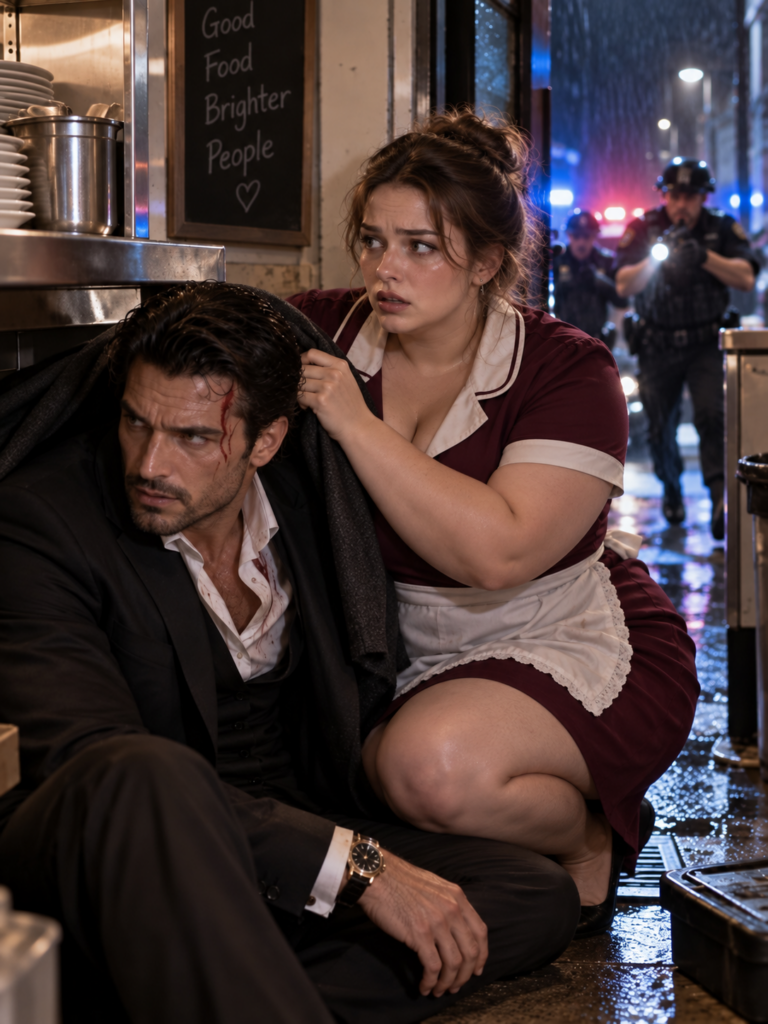
At 2:43 in the morning, Daisy Gallagher was scrubbing old coffee from a diner counter when Chicago’s most feared crime boss stumbled through the door bleeding through a charcoal suit and told her not to call an ambulance.
Thirty seconds later, Detective Harrison Miller—the corrupt cop who had been shaking down businesses on her block for years—pulled into the parking lot with two armed officers and started searching for the wounded man.
Daisy had exactly one place to hide him, and when the rookie officer wrapped his hand around the pantry door where Alessandro Rossi stood in the dark with a gun against his chest, she realized one wrong breath could kill everyone in the building.

PART 1 — THE MAN BEHIND THE PANTRY DOOR
At 2:43 a.m., Higgins Diner smelled like burned coffee, fryer oil, and industrial lemon bleach.
Daisy Gallagher had been awake for nineteen hours.
Her blond hair was twisted into a loose knot, her blue uniform had a dried cherry-pie stain near the waist, and the soles of her shoes had begun separating at the heels. She was twenty-four years old and already understood that exhaustion was not an emergency when medical bills were waiting.
Three more hours.
Then the bus.
Then four hours of sleep if she was lucky.
Then Sterling Care Facility to see Leo.
Her younger brother had been there for nine months after a highway accident damaged his spine. Insurance covered less every month, physical therapy cost more every month, and Daisy had developed the financial strategy of a drowning person: kick, breathe, pay whatever bill was closest to collection.
Rain hammered the diner windows.
The front bell rang.
A gust of November air scattered napkins across the floor.
Daisy looked up.
The man in the doorway did not belong at Higgins.
He was more than six feet tall, dark-haired, broad-shouldered, dressed in a charcoal suit that probably cost more than Daisy earned in a year.
And bleeding.
One hand was clamped against his right side.
Blood had soaked through a white handkerchief and spread across his shirt beneath the jacket.
“Coffee.”
His voice carried a low Italian accent.
Daisy stared.
“You need a hospital.”
“No.”
“You’re bleeding on my floor.”
His eyes lifted to hers.
Dark.
Controlled.
Dangerously awake despite the pallor in his face.
“No police.”
“No ambulance.”
“Black coffee.”
Daisy’s hand drifted beneath the register toward the silent alarm.
Then his coat shifted.
Shoulder holster.
Gun.
Her fingers stopped.
She poured coffee.
The man lowered himself onto a red vinyl stool.
His breathing was shallow.
Daisy slid the mug toward him.
He did not touch it.
Instead, he removed a heavy watch and placed it on the counter.
“Payment.”
“I don’t want your watch.”
“You don’t know what it’s worth.”
“I don’t want to know.”
A humorless smile touched his mouth.
Then red and blue light exploded across the windows.
The man became someone else.
Pain disappeared from his face.
His hand went beneath his jacket.
Daisy looked through the rain.
Her stomach dropped.
Detective Harrison Miller climbed out of an unmarked Crown Victoria.
Daisy knew Miller.
Everyone on Fourth Avenue did.
Restaurants paid him “inspection fees.”
Bars paid him “security retainers.”
Owners who refused developed licensing problems, health-code visits, broken windows, or employees suddenly arrested with drugs nobody remembered seeing before.
Miller was not arriving to make an arrest.
The wounded man understood that too.
“Back door.”
He said quietly.
“Now.”
Daisy looked toward the alley.
Camera above the rear exit.
Miller would see.
And if Miller saw her leaving with this man, Daisy would become the witness nobody could afford.
“No.”
The wounded stranger stared.
Daisy rushed around the counter.
“Get up.”
His eyebrows rose.
“You heard me.”
She dragged his good arm across her shoulders.
He was impossibly heavy.
They staggered behind the counter.
Blood dotted the tile.
Daisy seized a mop and dragged dirty water across it.
Pink streaks disappeared beneath gray detergent.
“Here.”
She shoved him toward the pantry.
The heavy steel door opened into darkness smelling of flour, onions, canned peaches, and cardboard.
“If you make a sound, we both die.”
The man leaned against the shelving.
“If you betray me…”
His voice turned cold.
“…Miller will be the least of your concerns.”
“Charming.”
She slammed the door.
Then ran back to the counter just as Miller entered.
Cold rain followed him.
A nervous young patrol officer came behind.
Miller looked around.
“Slow night?”
“Dead.”
Daisy poured coffee.
He ignored it.
His eyes dropped to the damp floor.
“Why’d you mop?”
“Customer got sick.”
“Where?”
“Right there.”
Miller’s gaze lifted.
“Anybody come in wearing a suit?”
“People with suits don’t eat here.”
The rookie almost smiled.
Miller did not.
He stepped closer.
Daisy smelled cigarettes and wet wool.
“We’re looking for a man.”
“Congratulations.”
Miller’s eyes narrowed.
“Careful.”
Daisy lowered hers.
“Sorry.”
That pleased him.
Weakness often pleased small men.
“Check the back.”
Miller told the rookie.
Daisy’s blood went cold.
The rookie moved down the hallway.
Bathroom door.
Office.
Then the pantry.
He stopped.
“What’s in here?”
“Dry storage.”
The rookie grabbed the handle.
Inside, Alessandro Rossi raised his gun.
Daisy knew because she heard the smallest scrape of metal against shelving.
The rookie pulled.
Once.
Twice.
The old latch caught.
He planted his boot and pulled harder.
And from the other side of the steel door came one quiet, unmistakable click.
A gun being readied in the dark.
PART 2 — THE DEBT HE REFUSED TO LET HER REPAY
“Sticks.”
Daisy said.
The rookie looked back.
“What?”
“The door.”
She forced herself to sound irritated instead of terrified.
“You have to lift the handle first.”
His hand moved.
Inside the pantry, everything went silent.
If he lifted correctly, the door would open.
If the door opened, Alessandro would fire.
Miller would fire.
Daisy would become whatever remained between them.
So she picked up a coffee pot and deliberately let it slip.
Glass shattered.
Hot coffee spread across the floor.
“Damn it.”
She cried.
Miller spun.
The rookie looked over.
Daisy grabbed her wrist.
“Jesus.”
“You burned?”
Miller asked.
“Yeah.”
She turned on the faucet.
The rookie stepped away from the pantry.
Miller swore.
“If Rossi was back there, we’d have blood all the way down the hall.”
He stared at Daisy another long second.
Then:
“Let’s go.”
The rookie followed.
At the door, Miller turned.
“If I learn you lied…”
Daisy kept her eyes lowered.
“What?”
He smiled.
“You’ll learn why people around here answer me the first time.”
The bell rang.
The door closed.
Red lights disappeared into rain.
Daisy waited.
Thirty seconds.
One minute.
Five.
Only then did she walk toward the pantry.
Her hand shook so badly she missed the handle once.
She opened the door.
Alessandro sat on a flour sack.
His gun was pointed directly at her.
For one second neither moved.
Then he lowered it.
“You dropped the coffee.”
“Yes.”
“Deliberately.”
“Yes.”
A breath that might have been laughter escaped him.
“Clever.”
“You need to leave.”
He tried to stand.
Failed.
His shoulder struck a metal rack.
Cans fell.
“Perfect.”
Daisy muttered.
“Exactly what my night needed.”
Alessandro said something in Italian that sounded deeply unfriendly.
“Sit.”
“I’m leaving.”
“You can barely stand.”
“I’ve been in worse condition.”
“Fantastic.”
“Be worse somewhere else after I stop the bleeding.”
That made him look at her.
Actually look.
Maybe no one spoke to Alessandro Rossi that way.
Daisy did not know his name yet.
She only knew he was dying in her pantry and irritating her.
She dragged him into the employee break room.
Industrial first-aid kit.
Scissors.
Gauze.
Antiseptic.
When she cut away enough fabric to examine the wound, she stopped.
Old scars crossed his torso.
White lines.
Knife marks.
A circular scar near his shoulder.
Violence written in a language the body never forgets.
“Bullet passed through.”
He said.
“You a doctor?”
“No.”
“Then shut up.”
She cleaned what she safely could, applied pressure, packed gauze, and wrapped the dressing tightly enough to slow bleeding until he reached actual medical care.
No heroics.
No digging for bullets.
No movie surgery.
“You need a trauma surgeon.”
“I have one.”
“Of course you do.”
His mouth twitched.
When she finished, he stood more carefully.
Then reached for a silver money clip.
He placed several hundred-dollar bills on the table.
“No.”
“You’re in debt.”
Daisy froze.
“How do you know that?”
“I can recognize someone counting every dollar.”
“That’s not an answer.”
“It’s payment.”
“I didn’t save you for money.”
“No?”
“No.”
“Then why?”
She thought of Miller’s face.
Leo asleep in a hospital room.
Higgins docking pay for broken dishes.
“Because Miller would have killed you.”
“And?”
“And then probably me.”
“So self-interest.”
“Mostly.”
Alessandro nodded as though this pleased him.
“What’s your name?”
“No.”
He glanced at her name tag.
DAISY.
“Daisy Gallagher.”
Her stomach tightened.
“Forget it.”
“Men like me rarely forget debts.”
“I don’t want your debt.”
“That isn’t your decision.”
Then he left through the alley.
No dramatic goodbye.
Just darkness swallowing a man who should have died on her floor.
Daisy remained standing for almost a minute.
Then looked at the money.
Leo’s medication refill was due.
She hated herself a little.
She took it.
At six, Higgins arrived.
He complained about bleach.
Then broken glass.
Then missing pie.
Then deducted twenty dollars from her shift because “customers don’t like hospitals.”
Daisy did not argue.
She clocked out.
At the bus stop, the cold morning air felt almost clean.
The bus approached.
Then four black Escalades turned into Higgins’ parking lot.
Daisy stopped.
Every door opened at once.
Men in dark suits emerged.
Not street muscle.
Organized.
Disciplined.
An older man with silver hair stepped from the lead SUV.
Scar across one eyebrow.
He entered the diner.
Daisy should have boarded the bus.
Instead, she turned around.
Because Higgins kept employee records.
Address.
Emergency contacts.
Sterling Care Facility.
Leo.
She walked back.
Through the window, she watched Higgins sign papers with a shaking hand.
A briefcase sat open beside him.
Cash.
Far too much.
Then Higgins ran out the back.
The silver-haired man turned toward the door.
Daisy stepped inside.
Six men looked at her.
Hands moved subtly toward jackets.
The older man raised one hand.
“Miss Gallagher.”
“How do you know me?”
He smiled politely.
“Dominico Moretti.”
“That means nothing to me.”
“It shouldn’t.”
“Good.”
He gestured around.
“This establishment now belongs to you.”
Daisy stared.
“What?”
“My employer purchased it.”
“Cash plus clean transfer.”
“No liens.”
“No Higgins.”
“Renovations can begin tomorrow.”
“No.”
Dominico blinked.
Daisy’s fear suddenly became anger.
“No.”
“You misunderstand.”
“No, I understand perfectly.”
She pointed toward the windows.
“I don’t want a diner purchased by criminals.”
One enforcer looked offended.
Dominico almost smiled.
“My employer expected this.”
“Then your employer is smart enough to hear no.”
“He asked me to tell you loyalty is repaid.”
“I poured coffee.”
“You concealed a wounded man from the detective sent to kill him.”
“I concealed myself too.”
“Still.”
“We’re even.”
Dominico studied her.
Then nodded once.
“Very well.”
Daisy turned.
“Miss Gallagher.”
She looked back.
“Don Rossi said you would refuse the diner.”
“Then why did you buy it?”
Dominico’s smile became strange.
“Because he didn’t buy it for you.”
Daisy frowned.
“He bought it so Miller could never use Higgins to reach you.”
That stopped her.
“What?”
“Go see your brother.”
Dominico said.
Then looked toward the windows.
“You will understand more there.”
Sterling Care Facility usually smelled of cabbage, ammonia, and tired carpet.
Today the lobby smelled like lavender.
Daisy approached reception.
“I’m here to make Leo Gallagher’s payment.”
The receptionist typed.
Then frowned.
“What?”
“He’s no longer in Room 214.”
Daisy’s blood froze.
“What happened?”
“He’s fine.”
“Where is he?”
“Vanguard Wing.”
Daisy almost shouted.
“That’s five thousand dollars a week.”
“Actually closer to six.”
“Who moved him?”
The receptionist smiled.
“Anonymous trust.”
Daisy grabbed the counter.
“What trust?”
“I don’t have a name.”
“Everything is covered.”
“Surgeries.”
“Rehabilitation.”
“Past balance.”
“Future care for two years.”
The elevator ride upstairs felt endless.
Leo’s new room looked like a hotel suite.
Windows.
Private bath.
Advanced rehab bed.
Fresh food.
A physical therapist reviewing a schedule.
Leo looked up.
“Daisy!”
She nearly cried.
“You okay?”
“I’m amazing.”
He grinned.
“They have chocolate pudding that tastes like actual chocolate.”
Then Daisy saw the flowers.
White roses.
Black envelope.
Her name embossed on the front.
She opened it.
Heavy cream card.
One line.
A debt ends when both sides are safe. You are not safe yet. — A.R.
She crushed the card.
That evening she returned to her apartment expecting anger.
Instead, fear.
Somebody had photographed her leaving Sterling Care.
She noticed the same dark sedan twice.
Then a third time near her building.
At 7:30, a knock.
A huge man in a navy suit.
Broken nose.
“Carlo.”
He said.
“Don Rossi sent me.”
“I’m not going.”
“Then you may remain here.”
Daisy blinked.
He continued.
“With two men in the stairwell.”
“Two outside.”
“One on the roof.”
“Your neighbors will eventually ask questions.”
Daisy stared.
“That’s your polite invitation?”
Carlo shrugged.
“My employer is working on tone.”
She almost laughed.
Almost.
“Why does he want me?”
“Because Falcone knows who you are.”
The name meant nothing.
Carlo saw that.
“It will.”
Hawthorne Manor stood above Lake Michigan behind iron gates.
Daisy hated it immediately.
Too beautiful.
Too guarded.
Too quiet.
Alessandro waited in the library.
White shirt.
Sleeves rolled.
Fresh bandage visible beneath fabric.
He stood near the window holding whiskey.
“You look angry.”
“You bought my brother.”
His gaze hardened.
“No.”
“You paid for his care.”
“Yes.”
“Without asking.”
“Yes.”
“That isn’t different.”
“It is.”
“How?”
“Your brother needed surgery his insurer had delayed twice.”
“How do you know that?”
“Because Falcone’s people know it.”
He threw a folder onto the desk.
Photographs.
Daisy leaving work.
Daisy at bus stops.
Daisy entering Sterling Care.
Leo being wheeled into therapy weeks earlier.
Her stomach dropped.
“Who took these?”
“Men working for Lorenzo Falcone.”
“Who is that?”
“The man who ordered Miller to kill me.”
Daisy looked up.
Alessandro’s voice remained calm.
“Falcone knows I entered Higgins.”
“He knows you were alone.”
“He knows Miller searched and left without me.”
“He has two theories.”
“You hid me willingly.”
“Or I forced you.”
“Either makes you useful.”
Daisy whispered:
“To whom?”
“To anyone who wants to hurt me.”
Silence.
Then:
“Why Leo?”
Alessandro’s jaw tightened.
“Because people who study you learn where you are weakest.”
“He isn’t my weakness.”
“No.”
Alessandro looked at the photographs.
“He is what you will die protecting.”
Daisy could not argue.
“Then let me leave Chicago.”
“They’ll follow.”
“Police.”
“Miller was police.”
“Federal authorities.”
“Eventually.”
“Eventually gets people buried.”
“I’m not moving into your house.”
“Temporary.”
“No.”
“Your apartment is compromised.”
“No.”
“Your brother’s location was compromised before I moved him.”
“Stop deciding things for me.”
That finally broke Alessandro’s composure.
He slammed his glass onto the desk.
“I am trying to keep you alive.”
“And I am trying to still own my life when this is over.”
Silence filled the library.
Fire snapped in the hearth.
Alessandro took a breath.
Then another.
When he spoke again, his voice was lower.
“What would make this acceptable?”
The question surprised both of them.
Daisy crossed her arms.
“I choose where I sleep.”
“Agreed.”
“I see Leo whenever I want.”
“Obviously.”
“No obvious.”
She stepped closer.
“Say it.”
“You see your brother whenever you want.”
“My phone stays mine.”
“Yes.”
“No tracking me without telling me.”
A pause.
“Within the estate?”
“Anywhere.”
“Daisy—”
“Then no.”
His jaw tightened.
“Fine.”
“And if I am being targeted because of your war, I get information.”
“You don’t protect me by keeping me stupid.”
Alessandro stared.
Then nodded.
“Fair.”
“One more thing.”
“What?”
“If danger comes…”
She looked at the gun cabinet behind his desk.
“…I refuse to be helpless.”
His eyes narrowed.
“You want a weapon.”
“I want training.”
That night, Daisy moved into the east wing.
Not because she trusted Alessandro.
Because she believed the photographs.
The first week was awful.
Guards.
Cameras.
Rooms too large.
Breakfast served under silver covers.
She missed Higgins Diner’s ugly noise.
She missed riding buses.
She even missed cheap laundry machines banging in her basement.
Most of all, she hated Alessandro’s habit of appearing without sound.
“You do that deliberately.”
She told him one night.
“What?”
“Move like a serial killer.”
“Occupational habit.”
“Terrible occupation.”
“You saved someone in it.”
“Temporary lapse in judgment.”
He smiled.
Little changes began.
He asked before moving Leo’s next appointment.
He stopped sending gifts.
He gave Daisy a written summary of every known threat related to her.
The gesture mattered more than diamonds would have.
Training began with situational awareness.
Doors.
Exits.
Phones.
Emergency words.
First aid.
How to move toward crowds instead of isolated corridors.
How to recognize a vehicle repeating its route.
Then safe firearm handling under a licensed instructor at a private range.
Not Alessandro pressed against her back.
Not romanticized danger.
A retired female instructor named Marisol who had served twenty years in law enforcement and found Daisy’s impatience exhausting.
“Slow.”
Marisol ordered.
“I am slow.”
“You are furious.”
“Different problem.”
“Furious people miss.”
Daisy breathed.
Reset.
Tried again.
The paper target mattered less than what the lesson gave her.
Choice.
Weeks earlier, Miller had entered Higgins and Daisy had possessed nothing but a coffee pot and a lie.
Now she had plans.
Numbers.
Safe routes.
A panic button.
Knowledge.
Alessandro watched from behind the glass once.
Daisy lowered the practice weapon.
“Problem?”
“No.”
“You’re staring.”
“I’m impressed.”
“Dangerous.”
“What?”
“Men like you mistake admiration for ownership.”
His face changed.
“I won’t.”
“Good.”
“Because I’m not yours.”
Alessandro was silent.
Then:
“I know.”
Three weeks after the diner shooting, Dominico brought news.
Falcone would attend the St. Augustine Children’s Foundation charity ball at Palmer House.
So would half Chicago.
Politicians.
Developers.
Judges.
Media.
Falcone had spent years hiding behind legitimate philanthropy.
“You want Daisy there.”
Dominico said.
Alessandro looked at her.
“No.”
Daisy blinked.
“No?”
“He wants to use you.”
Dominico countered.
“He already is.”
“If Miss Gallagher appears beside you publicly, Falcone’s assumptions change.”
“He may believe she knows more than she does.”
“She already does know more.”
Alessandro’s eyes darkened.
“No.”
Daisy slammed her coffee down.
“Stop doing that.”
“Doing what?”
“Talking about me like I’m luggage.”
Dominico suddenly found the ceiling fascinating.
Daisy continued.
“You said information keeps me alive.”
“Now there is a room full of people where Falcone might show himself.”
“And?”
“If I can help expose Miller’s connection to him, I want to.”
Alessandro stared.
“This is not revenge.”
“Yes.”
“It is.”
“Partly.”
“Still no.”
Daisy stepped closer.
“Then all your talk about not owning me was decorative.”
That hit.
Alessandro’s face went still.
Dominico quietly left the room.
Coward.
Daisy folded her arms.
“Your choice.”
Alessandro said after a long silence.
“But if you go, you follow security protocol.”
“I stay beside Carlo if you step away.”
“I leave if your team says leave.”
“And I wear something I can actually walk in.”
His mouth twitched.
“Deal.”
At the ball, Daisy wore midnight-blue silk.
No outrageous necklace.
No mafia queen costume.
A simple diamond pendant borrowed from Hawthorne’s vault because Alessandro argued the dress looked unfinished and Daisy eventually accepted only after he documented it as loaned property.
“You made a receipt?”
She asked.
“You said gifts create obligation.”
“I listened.”
That nearly undid her.
The ballroom glittered.
Falcone arrived at nine.
Blond.
White dinner jacket.
Forty.
Handsome in the polished way venomous animals can be beautiful.
He watched Daisy from across the room.
Smiled.
She looked away.
Alessandro stayed beside her for twenty minutes.
Then an alderman approached regarding emergency dock permits.
Dominico whispered something.
Alessandro’s expression darkened.
“I need five minutes.”
Daisy raised an eyebrow.
“You are asking?”
“Yes.”
“Growth.”
“Carlo is behind the pillar.”
“I see him.”
“Stay—”
“Don’t ruin it.”
Alessandro almost smiled.
Then left.
Daisy stood near a painting.
Falcone appeared behind her.
“You clean up well.”
Her skin went cold.
She turned.
“Do we know each other?”
“Daisy Gallagher.”
His smile widened.
“Former waitress.”
“Current houseguest.”
“You’ve upgraded.”
“I hear you haven’t.”
Falcone laughed.
“Rossi taught you teeth.”
“No.”
“Chicago did.”
His guards stood ten feet behind him.
Carlo shifted nearer.
Falcone leaned casually beside her.
“How is Leo?”
Daisy stopped breathing.
“Room 501 was an improvement.”
Her pulse accelerated.
“I don’t know what you’re talking about.”
“Don’t.”
His smile disappeared.
“I have men moving toward the hospital.”
“Walk with me through the service corridor.”
“Quietly.”
“Your brother stays alive.”
Daisy felt fear rise.
Then training.
Breathe.
Observe.
Do not let the threat control tempo.
“You expect me to believe Alessandro left Leo unguarded?”
Falcone’s eyes sharpened.
“You think Rossi sees everything?”
“No.”
“But Dominico does.”
Falcone’s jaw moved.
Daisy continued.
“And the hospital changed Leo’s secure location yesterday.”
That was true.
Not where.
Not why.
Falcone’s expression altered by one degree.
Enough.
“Call your men.”
She said.
He studied her.
“Why?”
“Because if they’re actually where you think they are, you have nothing to lose.”
Falcone gestured.
One guard dialed.
Waited.
Then his face changed.
Not horror.
Confusion.
“No answer.”
Falcone’s smile disappeared.
A voice behind them:
“They’re in custody.”
Alessandro.
He walked toward them.
No weapon drawn.
Two men accompanied him.
One was Dominico.
The other Daisy recognized from newspapers.
Deputy U.S. Attorney Helen Park.
Falcone went white.
Daisy looked at Alessandro.
He said quietly:
“The hospital attempt triggered the warrants.”
Falcone stared.
“Federal?”
Park stepped forward.
“Mr. Falcone, don’t leave.”
Around the ballroom, plainclothes agents moved.
No shooting.
No public execution.
No body on marble.
Something colder.
Procedure.
Falcone looked toward Daisy.
“You set this up.”
She shook her head.
“You threatened the wrong family.”
Agents arrested two of his guards.
Falcone’s attorney appeared from nowhere, because men like him apparently carried lawyers like inhalers.
As Park read instructions, Falcone looked at Alessandro.
“Miller dies and suddenly the feds care?”
Alessandro’s expression did not change.
“Miller didn’t die.”
Falcone froze.
That was the twist.
Detective Miller had not suffered a mysterious heart attack.
He had survived the original night.
Then, faced with evidence of attempted murder, corruption charges, and federal exposure, he had agreed to cooperate.
His testimony connected Falcone’s network to extortion, unlawful surveillance, dock fraud, and the attempted hit on Alessandro.
Daisy’s diner had not become the scene of Miller’s execution.
It became the first crack in a case investigators had struggled to build for years.
Falcone looked around.
Agents.
Witnesses.
Cameras.
No exit.
Then back at Daisy.
“You think Rossi makes you safe?”
Daisy answered:
“No.”
That surprised him.
“I make decisions that keep me safer.”
She nodded toward Park.
“So do people who still believe badges should mean something.”
Falcone’s face twisted.
Agents led him away.
The ballroom buzzed.
Alessandro approached Daisy.
“Are you hurt?”
“No.”
“You were supposed to stay with Carlo.”
“I did until Falcone came to me.”
“Then you should have left.”
“I knew the hospital transfer was secure.”
“You gambled.”
“Carefully.”
His voice dropped.
“Daisy.”
She stepped closer.
“Do not use fear as an excuse to control me.”
His anger broke.
Underneath it:
Terror.
“I thought I was going to watch him take you.”
The honesty silenced her.
Alessandro looked away.
“I have buried too many people.”
Daisy’s expression softened.
“That doesn’t give you permission to put the living in cages.”
He nodded slowly.
“I know.”
“Do you?”
“Yes.”
Then he did something Daisy had never seen him do.
He stepped back.
Space.
Choice.
Daisy closed the distance herself.
Not a kiss.
Not yet.
She took his hand.
For the first time.
“You did good.”
She said.
His mouth moved.
“High praise.”
“Don’t get used to it.”
The Falcone investigation expanded.
Miller testified.
Several officers were indicted.
City-contract fraud surfaced.
Protection networks collapsed.
Not overnight.
Not cleanly.
Alessandro himself faced scrutiny.
Helen Park made that very clear.
Daisy heard the conversation in Hawthorne’s library.
“Cooperation doesn’t erase your business.”
Park said.
“I know.”
“If we find criminal conduct tied to this investigation—”
“You pursue it.”
Daisy looked at Alessandro.
He meant it.
That unsettled her.
“What happens now?”
She asked after Park left.
“To me?”
“To all of this.”
Alessandro looked toward the fire.
“My father built an empire by making sure every problem required another crime.”
“I inherited it.”
“Do you enjoy it?”
His laugh held no humor.
“Enjoy?”
“Power.”
“Fear.”
“People moving when you enter rooms.”
He thought.
“I used to.”
“And now?”
“I nearly died in Higgins Diner.”
“You hid me behind flour sacks.”
“Duct tape.”
He looked at her.
“I became aware of how ridiculous power looks while you’re bleeding.”
Daisy smiled.
“Very.”
“I’m restructuring parts of the organization.”
“That sounds suspiciously corporate.”
“Dominico hates the phrase.”
“Good.”
Months passed.
Leo improved.
Not magically.
Rehabilitation remained brutal.
Painful.
Some days he made progress.
Some weeks nothing.
But his care continued.
Daisy eventually forced Alessandro to allow an independent trust attorney to restructure the payments.
“What are you doing?”
He asked.
“Removing you as leverage.”
“I never threatened to stop paying.”
“I know.”
“That isn’t the same as knowing you can’t.”
The fund became irrevocable.
Medical care protected regardless of Daisy’s relationship with Alessandro.
When the paperwork finished, Daisy handed him the executed trust copy.
“Now your gift is actually a gift.”
He stared at her.
“You are infuriating.”
“Healthy boundaries often feel that way.”
Higgins Diner reopened too.
Not as a mob-owned vanity project.
Daisy negotiated.
Alessandro sold it to a community-development corporation for one dollar under a binding arrangement preserving its use as a neighborhood restaurant for ten years.
Daisy leased it.
At market rate.
Her own company.
Her own books.
“Why are you making this so complicated?”
Dominico complained.
“Because I want to know what belongs to me.”
On opening morning, new windows caught sunlight.
Same red booths, restored rather than replaced.
Better coffee.
Actual ventilation.
Leo came in a wheelchair and complained the pie recipe had become “fancy.”
Daisy threw a napkin at him.
Alessandro arrived later.
No convoy.
One car.
Carlo outside.
Daisy leaned against the counter.
“Coffee?”
“Black.”
“Predictable.”
He sat on the same stool where he had nearly bled to death.
A faint stain remained in the grout beneath it.
Daisy had ordered the contractors not to replace that tile.
Not sentimentality.
Memory.
He noticed.
“You kept it.”
“Evidence.”
“Of?”
“That expensive suits leak like cheap ones.”
He laughed.
Customers looked over.
Most did not recognize him.
Good.
Their relationship remained undefined.
That was deliberate.
Alessandro stayed at Hawthorne.
Daisy returned to her apartment after Falcone’s arrest and once the threat level decreased.
He hated it.
She did not care.
They had dinner sometimes.
Arguments often.
One night he arrived at the diner after closing.
Rain outside.
Of course.
Daisy counted receipts.
“You’re late.”
“You sound like a wife.”
She looked up.
“Try that sentence again.”
“A business owner with strong scheduling preferences.”
“Better.”
He placed a small box on the counter.
“No.”
“You don’t know what it is.”
“If jewelry, no.”
“It isn’t.”
She opened it.
A brass key.
“What?”
“Hawthorne.”
“I already had a key card.”
“That was security access.”
“This opens the east entrance.”
“Why?”
“Because I changed the locks.”
“Very exciting.”
“Daisy.”
His voice shifted.
“No guards will stop you.”
“No one will record when you arrive.”
“No room is assigned to you.”
“The key means you can come if you want.”
“And leave whenever you want.”
She stared.
That was perhaps the most intimate thing he could have given her.
Not diamonds.
Exit rights.
She closed the box.
“Thank you.”
Alessandro exhaled.
Then:
“I love you.”
Daisy froze.
He did too.
The rain continued.
“You picked a terrible moment.”
“I’ve had several months.”
“You could have scheduled better.”
“I am trying not to manipulate the answer.”
Her eyes burned.
“Good.”
“I don’t need one tonight.”
“Also good.”
“I only needed you to know.”
Daisy looked at the key.
Then at him.
“I’m scared of you sometimes.”
His face tightened.
“I know.”
“Not because I think you’ll hurt me.”
“Because your world is built to make choices disappear.”
He listened.
“I spent my whole life having too few choices.”
“Money.”
“Leo.”
“Higgins.”
“Then you arrived with enough power to solve everything overnight.”
“That is addictive.”
“And dangerous.”
Alessandro nodded.
“So if this becomes something…”
“It already is.”
“Don’t interrupt.”
He actually closed his mouth.
Daisy continued.
“If this becomes something we name…”
“I remain financially independent.”
“Yes.”
“I keep the diner.”
“Yes.”
“Leo’s trust remains independent.”
“Yes.”
“I do not become your public symbol.”
“Yes.”
“And you do not kill people because they annoy me.”
He almost smiled.
“Difficult.”
“Alessandro.”
“Yes.”
She looked at him for a long time.
Then came around the counter.
Took his face between both hands.
Kissed him.
Once.
Soft.
Chosen.
When she pulled back, his eyes had gone completely still.
“That was not an answer to everything.”
“I understand.”
“It was an answer to tonight.”
His hands remained at his sides.
He did not touch her until she nodded.
Then one arm moved around her waist.
Slowly.
Carefully.
Daisy rested her forehead against his chest.
The man who once threatened her from a pantry.
The woman who once lied to a corrupt detective.
Neither had become harmless.
They had become more honest.
A year later, Leo took six steps with braces.
Daisy cried so hard he told her she was embarrassing.
Alessandro stood behind her.
No dramatic applause.
Just one hand near her shoulder.
Waiting.
She leaned back into it.
Later that night, the diner closed early.
Leo demanded milkshakes.
Dominico brought cannoli.
Carlo ate three pieces of pie and denied all evidence.
It almost felt like family.
Almost.
Daisy remained suspicious of words that promised permanence.
Good.
Some suspicion is simply memory with boundaries.
Helen Park’s investigation continued dismantling parts of Falcone’s operation.
Several corrupt officers pleaded guilty.
Falcone himself went to federal trial on racketeering and conspiracy charges.
The case made newspapers.
Daisy’s name appeared only once in sealed filings and never publicly.
Alessandro kept that promise.
He cooperated enough to weaken rivals and protect legitimate businesses under his influence, but not enough to become a saint.
Daisy never pretended he was one.
That mattered too.
Love does not require editing reality until a dangerous man becomes a misunderstood prince.
Alessandro Rossi had done terrible things.
He also began changing things.
Closing illegal gambling operations that preyed on neighborhood debtors.
Separating legitimate logistics businesses from criminal cash.
Removing men who treated civilians as leverage.
Not because Daisy demanded purification.
Because for the first time, someone he respected looked directly at his empire and asked:
Do you even like the man this makes you?
He had not liked the answer.
Two years after the rainy diner night, Daisy stood behind the counter at Higgins—now Gallagher’s—sorting invoices.
The front bell rang.
She looked up.
Alessandro entered.
No bodyguards inside.
Dark coat.
Gray beginning at one temple.
He carried groceries.
“What is that?”
“Dinner.”
“You cook now?”
“I am learning.”
“Why?”
“Leo said your pasta is terrible.”
Daisy gasped.
“Traitor.”
Leo yelled from the corner booth:
“It is.”
He had walked from the door using forearm crutches.
Slowly.
Stubbornly.
Every step his.
Daisy watched.
Her throat tightened.
Alessandro noticed.
Did not comment.
Good man.
Sometimes.
He came behind the counter.
“Need help?”
“No.”
“Obviously.”
He reached for plates anyway.
Daisy slapped his hand.
“Ask.”
His eyes rolled.
“May I help?”
“Yes.”
They worked beside each other.
Coffee machine hissing.
Rain beginning outside.
Customers laughing.
A city moving beyond the glass without knowing that two years earlier blood had covered the tile beneath Stool Seven.
After closing, Leo left with his therapist.
Daisy turned off half the lights.
Alessandro remained near the door.
“Come to Hawthorne tonight?”
She considered.
“Why?”
“Because I want you there.”
“Better answer than ‘because it’s safer.’”
“I learn.”
“Slowly.”
He held out his hand.
Daisy looked at it.
Then beyond him toward the rain.
Once, a wounded man had entered her diner and turned her life into danger.
For a long time, Daisy believed the story of that night was about Alessandro Rossi.
It wasn’t.
It was about the moment she discovered fear did not cancel choice.
She had hidden him because she chose to survive.
She refused the diner because she chose not to be bought.
She demanded information because she chose not to remain helpless.
She returned to her own apartment because safety without freedom had begun to feel too much like another cage.
And now, standing behind a counter that belonged to her because she paid rent, balanced books, hired employees, argued with vendors, and earned every ugly beautiful inch of it, she could choose something else.
Not surrender.
Not debt.
Not obedience.
Company.
Daisy placed her hand in Alessandro’s.
“Your place.”
She said.
“Tonight.”
He nodded.
No victory smile.
No possessive claim.
Just:
“Okay.”
They stepped outside.
Alessandro opened the umbrella.
Daisy immediately took half the handle.
“You’re doing it wrong.”
“I have held umbrellas before.”
“You tilt it toward yourself.”
“I was shot the last time I spent too much time in rain.”
“Extremely manipulative use of medical history.”
He laughed.
They walked.
Side by side.
Behind them, Gallagher’s neon sign reflected red across the wet sidewalk.
Ahead, Chicago disappeared into rain and headlights.
No empire promised safety.
No romance erased blood.
No powerful man had rescued Daisy Gallagher.
He had given her problems.
She had given him limits.
And somewhere between those two truths, they had built something neither of them knew how to name without making it smaller.
At the corner, Alessandro stopped.
“What?”
Daisy asked.
“I never repaid the coffee.”
“You bought the building.”
“Then sold it for a dollar.”
“Your financial judgment is questionable.”
“Dinner tomorrow?”
She smiled.
“Ask me tomorrow.”
He nodded.
No argument.
They kept walking.
And that was how Daisy knew the strangest thing had finally happened.
Alessandro Rossi—the man who once believed a debt ended only when he said it did—had learned how to leave a question unanswered.
The next morning, the bell over Gallagher’s door rang at exactly 6:03.
Daisy looked up from the coffee machine.
Alessandro stood outside holding two paper cups from the rival café across the street.
She narrowed her eyes.
“You bought coffee somewhere else?”
“Theirs is better.”
“Get out.”
Leo burst out laughing from Booth Three.
Alessandro smiled.
Daisy tried not to.
Failed.
And for the first time since that terrible Tuesday at 2:43 in the morning, the man walking through her door was not bleeding, hunted, armed with a threat, or arriving to collect a debt.
He was there because Daisy Gallagher had told him he could come back.
Nothing more.
And nothing in her life had ever felt more powerful than that.


