
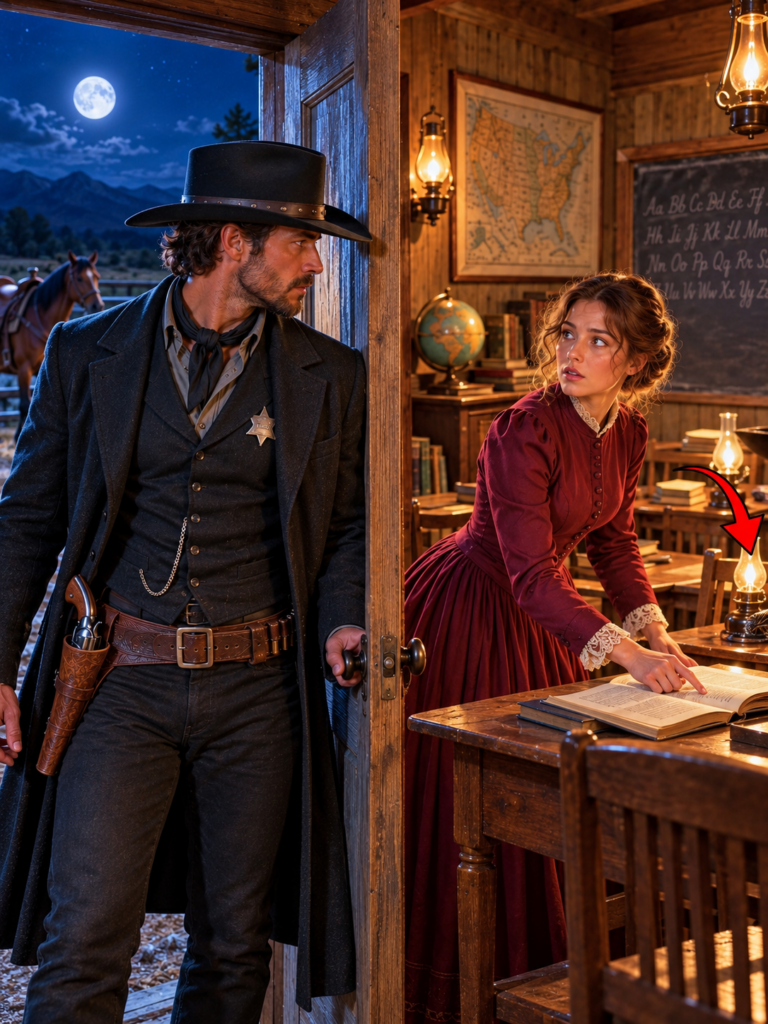
the sheriff saw the schoolhouse lamps burning after midnight—then he opened the door and discovered why six grown townspeople were hiding inside
Part 1
In the autumn of 1887, nobody in Elk Crossing, Colorado, had any respectable reason to be awake after midnight.
The town had fewer than four hundred souls, one main street, one church bell, two saloons, a feed store, a blacksmith, a boardinghouse, and a one-room schoolhouse standing on the northern edge of town where the sagebrush began.
By ten o’clock, the mercantile shutters were closed.
By eleven, even the card games at Martin’s Saloon usually ended.
After that, the only movement on Main Street belonged to wind, stray dogs, and Sheriff Caleb Morgan making his final round on a dark bay horse named Amos.
Caleb had been sheriff for seven years.
He knew every door.
Every alley.
Every family that kept chickens.
Every drunk who needed time to cool off before going home.
Every widow who wanted him to check her barn after a storm.
He knew when the schoolteacher stayed late grading copybooks because the lamp would burn until eight.
Occasionally nine.
Never later.
Then, one Tuesday in October, Caleb rode past the schoolhouse at 12:17 in the morning and saw yellow light glowing behind the curtains.
He slowed Amos.
The schoolhouse stood perhaps fifty yards from the road, a square wooden building painted white ten summers earlier and now weathered gray at the corners. A thin ribbon of smoke rose from its stovepipe.
Caleb watched for a moment.
A shadow crossed one window.
Then another.
He considered investigating.
But Miss Clara Whitcomb, the teacher, was known for working too much, sleeping too little, and refusing advice from anybody old enough to give it.
Caleb decided she was probably preparing lessons.
The following night, the lamp was burning again.
So was the next.
By Saturday, he began deliberately timing his patrol to pass the schoolhouse after midnight.
The curtains remained closed.
More than one shadow moved behind them.
Once he heard a man’s voice.
Slow.
Halting.
Repeating a single sound several times.
Caleb stopped his horse beneath the cottonwoods and listened.
“M.”
Silence.
“M.”
Another voice, Clara’s this time.
“That’s right. Now try the next one.”
Caleb stared at the glowing windows.
The next morning, he saw Clara carrying coal into the school.
She was twenty-nine years old, small, straight-backed, brown-haired, and usually looked as though she had already accomplished half a day’s work before everyone else had finished breakfast.
She had come to Elk Crossing eighteen months earlier from Missouri.
Within two weeks, the children adored her.
Within three, their parents respected her.
Within four, half the men in town had decided she needed marrying.
Clara appeared uninterested in all three developments.
She lodged with Mrs. Abigail Loomis, a sixty-eight-year-old widow who lived two streets behind the church.
Mrs. Loomis complained frequently that Clara refused to sleep.
“She lights that school stove before five,” Abigail told Caleb one morning outside the mercantile. “Then she teaches children all day. Then she grades papers until God himself has gone to bed.”
Caleb leaned against the hitching rail.
“She always been like that?”
“Don’t know.”
“You live with her.”
“I also lived with my husband thirty-nine years. Still didn’t understand half of what that man did.”
Caleb smiled.
Abigail narrowed her eyes.
“You’ve been watching the school.”
“No.”
“Bad liar.”
“I’m sheriff.”
“That’s an occupation, not an exemption.”
Caleb looked toward the schoolhouse.
“Lights have been burning late.”
Abigail’s expression became blank so quickly that it answered more than words would have.
Caleb noticed.
He also noticed that Abigail noticed him noticing.
Neither spoke.
Finally she said, “If there were something wrong, Miss Whitcomb would tell you.”
“Maybe.”
“She would.”
“Then I suppose I have nothing to worry about.”
Abigail sniffed.
“That would make you unique among lawmen.”
She walked away.
That night, the light still burned at 12:30.
Caleb dismounted.
The temperature had fallen below freezing.
His boots sounded loud on the packed earth as he crossed toward the school.
Through the walls came voices.
Not conversation.
Reading.
Painfully slow reading.
Caleb reached the door.
He hesitated.
Then opened it.
Every person inside froze.
Six grown adults sat at desks built for children.
Their knees pressed awkwardly beneath the narrow writing boards.
At the front stood Clara with a piece of chalk in one hand.
Behind her, written in tall white letters across the blackboard, were three words.
DOG.
HOME.
WATER.
The nearest student was Ezekiel Turner, seventy-one years old and one of the last surviving miners from the old Black Star diggings.
He had a white beard, one damaged eye, and hands so scarred that two fingers on the left barely straightened.
Beside him sat Martha Crowley, a widow of fifty-eight who sold eggs, turnips, and jars of beans from a wagon.
At the next desk sat Jonah Pike, owner of the feed store.
Jonah was fifty-two, prosperous by Elk Crossing standards, wore a fine wool vest every Sunday, and served as treasurer of the church.
Behind him sat Elijah Cole, a thirty-six-year-old stable hand big enough to lift a grain sack beneath each arm.
Beside Elijah was Rosa Alvarez, forty-four, who washed clothes for hotel guests and spoke English fluently enough to argue with anybody in town.
The final student was Samuel Byrd, twenty-seven, a mule driver who usually hid nervousness behind jokes.
Nobody made one now.
Caleb closed the door behind him.
The room remained silent.
The little iron stove clicked.
Clara slowly lowered the chalk.
“Sheriff Morgan.”
“Miss Whitcomb.”
“If this is about using school coal, I bought it myself.”
“It isn’t.”
“The lamps?”
“No.”
“Then why are you here?”
Caleb removed his hat.
“I saw the light.”
No one moved.
He glanced at the slates.
Letters covered them.
Uneven.
Backward in places.
Written hard enough to scratch the slate.
Elijah stared at the floor.
Martha’s face had gone pale.
Jonah Pike, a man who negotiated grain contracts with ranchers every week, looked terrified.
Caleb suddenly understood.
Not completely.
But enough.
Ezekiel spoke first.
“You going to tell?”
His voice was rough.
Caleb looked at him.
“Tell who what?”
Ezekiel frowned.
Caleb continued.
“I found Miss Whitcomb teaching after hours.”
Samuel Byrd swallowed.
“That all?”
“That’s all I saw.”
Elijah finally looked up.
“You ain’t going to say who was here?”
Caleb put his hat on the teacher’s desk.
“Seems to me a grown man or woman can attend a lesson without needing permission from the sheriff.”
The tension in the room changed.
Not disappeared.
Changed.
Martha exhaled.
Rosa leaned back.
Jonah Pike covered his eyes briefly with one hand.
Clara watched Caleb carefully.
“You’ll keep it private?”
“If privacy is what they want.”
Ezekiel grunted.
“Best answer I heard from government in sixty years.”
A few people laughed.
Weakly.
But they laughed.
Caleb moved toward the stove.
“You got enough wood?”
Clara blinked.
“For tonight.”
“That wasn’t what I asked.”
“We could use more.”
“I’ll bring some tomorrow.”
“You don’t have to.”
“No.”
He looked around the room.
“But apparently neither do you.”
Clara had no reply to that.
Class continued.
Caleb intended to leave.
Instead Martha Crowley pointed toward an empty desk.
“You going to stand there letting cold in every time you shift your feet?”
Caleb looked at her.
“Ma’am?”
“Sit.”
“I’m not a student.”
“Neither are you furniture.”
He sat.
His knees barely fit.
For the next forty minutes, he watched Ezekiel Turner learn the difference between B and D.
The old miner cursed both letters.
“Who made these things face opposite ways?”
“The alphabet,” Clara said.
“Poor design.”
Rosa laughed.
Clara wrote another word.
BREAD.
Elijah sounded it out.
Slowly.
“B… r… e…”
He stopped.
His neck reddened.
Nobody rushed him.
Caleb noticed that.
Clara never supplied the answer too quickly.
She waited.
Elijah tried again.
“Bread.”
Clara smiled.
“That’s right.”
The big man stared at the word as though he had split a mountain.
“Bread,” he repeated.
When class ended, the adults did not leave together.
They went one at a time, separated by several minutes.
Caleb understood immediately.
Nobody wanted Elk Crossing noticing six respectable adults leaving the children’s school after midnight.
Ezekiel went first.
Rosa second.
Samuel third.
Jonah waited nearly fifteen minutes.
When only Clara and Caleb remained, she erased the blackboard.
The white words disappeared one by one.
Caleb added wood to the stove.
“You’re bad at that.”
“What?”
“Stacking.”
“I have heated a jail for seven winters.”
“Yes. I’ve been inside your jail. That supports my argument.”
He smiled.
Clara did not.
“You haven’t asked why.”
“I figured if you wanted to tell me, you would.”
She stopped erasing.
Most men in Elk Crossing asked questions first and decided whether they deserved answers later.
Caleb was different.
Clara placed the rag on the chalk tray.
“When I was eleven, my father died.”
Caleb waited.
“He worked at a rail depot in Missouri. There was an accident.”
Her voice stayed steady.
“The company sent a letter.”
She stared at the blank board.
“My mother never learned to read.”
Caleb said nothing.
“She gave it to me.”
Clara’s hand tightened around the cloth.
“She said, ‘Read it slowly, Clara.’ So I did.”
Outside, wind scraped branches against the building.
“I read the sentence that said he had been killed. I read the amount of money the company offered. I read instructions for claiming his belongings.”
Clara looked at Caleb.
“My mother cried because her husband was dead.”
Her voice softened.
“Then she cried again because her eleven-year-old daughter had to read the letter telling her.”
Caleb felt something old stir inside him.
He understood more than Clara knew.
“My father couldn’t read either,” he said.
She became still.
Caleb rarely discussed his family.
“When I was fifteen, a cattle buyer brought him a contract.”
He stared at the stove.
“My father could count cattle. Could tell you the weight of a steer within twenty pounds by looking at it. Could repair a plow, shoe a horse, find water in dry country.”
His jaw tightened.
“But letters?”
He shook his head.
“He signed with an X.”
“What happened?”
“The contract transferred grazing rights on eighty acres for almost nothing.”
Clara’s face changed.
“Didn’t he know?”
“Not until I read it.”
Caleb remembered the kitchen.
His father’s rough finger resting beside the line.
Caleb reading each word while understanding, sentence by sentence, that someone had deliberately cheated a man because that man was ashamed to say he could not understand a page.
“He never got over signing that X.”
Clara whispered, “That’s why you became sheriff.”
“Part of why.”
She sat on the edge of a desk.
“When I came here, I started noticing.”
“Elijah?”
“And Martha.”
Clara nodded.
“Jonah too.”
Caleb frowned.
“Jonah Pike handles contracts.”
“He memorizes the shapes.”
Caleb stared.
“He reads prices and numbers. He recognizes names he’s seen before. Anything else, he guesses.”
Clara continued.
“Martha copies labels from other jars. Samuel asks people to read letters because he says his eyes hurt. Ezekiel always says his hands are too stiff to write.”
“And Rosa?”
“She learned to read Spanish as a girl. Never English.”
Clara looked toward the empty desks.
“I asked quietly.”
“Everybody said yes?”
“No. Most said no.”
A faint smile.
“Then some came back.”
“How long have you been doing this?”
“Seven weeks.”
“At midnight?”
“Ten-thirty until twelve-thirty.”
“You teach children all day.”
“Yes.”
“And this all night.”
“Not all night.”
Caleb gave her a look.
Clara sighed.
“Most nights.”
“You sleep?”
“Occasionally.”
“That isn’t an answer.”
“It’s the one you’re getting.”
Caleb stood.
“I’m walking you home.”
“No.”
“Yes.”
“I have walked myself every night since I came here.”
“That was before I discovered you have six people learning the alphabet in secret after midnight.”
“That makes me safer?”
“It makes me more worried.”
“Sheriff—”
“My patrol goes past Mrs. Loomis’s house.”
“No, it doesn’t.”
“It does now.”
For the first time, Clara smiled.
Small.
Reluctant.
But real.
They banked the stove and stepped outside.
Frost glittered beneath the moon.
The town lay dark ahead.
Caleb walked beside her.
Neither hurried.
After several minutes Clara said, “You’re not going to tell me to stop.”
“Would you?”
“No.”
“Then why waste both our time?”
Another smile.
“You’re strange.”
“So I’ve been told.”
At Abigail Loomis’s gate, Caleb stopped.
“Good night, Miss Whitcomb.”
“Good night, Sheriff.”
“Lock your door.”
“You tell everyone that?”
“Only stubborn schoolteachers.”
A curtain moved inside the house.
Clara saw it.
“So did you,” Caleb said.
“The curtain?”
“Yes.”
“Mrs. Loomis is asleep.”
The curtain moved again.
Caleb tipped his hat toward the window.
“Good night, Mrs. Loomis.”
No answer came.
Clara laughed quietly and went inside.
Caleb stood outside longer than necessary.
He looked back toward the schoolhouse.
Its lamps were finally dark.
He had spent years thinking his work involved opening doors.
That night, without understanding it yet, he began learning there were also doors a decent man protected by leaving closed.
Part 2
Caleb did not discuss the night class.
He simply began helping it.
The first change appeared behind the schoolhouse three days later.
Clara arrived before dawn and found nearly half a cord of split pine stacked beneath the eaves.
Straight.
Dry.
Covered with canvas.
A note was pinned to the wood.
FIRE HAZARD REMOVED FROM SHERIFF’S PROPERTY ROOM.
Clara took the note down.
The jail had no property-room firewood.
Everyone knew it.
She folded the paper and put it in her coat pocket.
The following week, the squealing rear hinge on the school door stopped making noise.
Then two cracked lamp chimneys were replaced.
A water barrel appeared beside the stove.
Clara confronted Caleb outside the post office.
“You’re doing things.”
“That is generally how employment works.”
“The school door.”
“Dangerous hinge.”
“The lamps.”
“Fire hazard.”
“The firewood.”
“Evidence.”
She folded her arms.
“What evidence?”
“Can’t discuss an open investigation.”
Despite herself, she smiled.
Caleb smiled back.
Then the smile faded from her face.
“You cannot make this obvious.”
“I know.”
“If people start wondering—”
“I know.”
“They’ll stop coming.”
“I know.”
Clara studied him.
Most men heard a woman’s concern and answered by explaining why she did not need to have it.
Caleb did not.
That unsettled her more than argument would have.
The night students slowly accepted his presence.
At first he stayed near the back.
Then Clara occasionally asked him to help.
Samuel Byrd struggled with handwriting.
Caleb showed him how to loosen his grip on the pencil.
Samuel squinted.
“Your writing looks terrible.”
Caleb looked at his own sample.
“I’m sheriff, not a poet.”
“What if I learn it wrong?”
“Then we’ll both be wrong.”
Samuel laughed.
Ezekiel Turner trusted Caleb least.
The old miner had carried suspicion like another organ for most of his life.
He came to class in an old sheepskin coat, sat at the same desk every night, and complained about everything.
The chalk was too soft.
The slates too small.
The alphabet contained unnecessary letters.
“C and K do the same work half the time,” he announced one evening.
Clara said, “We are not eliminating letters to make your life easier.”
“Why not?”
“Because I don’t control English.”
“Then who does?”
“No one.”
Ezekiel considered.
“That explains plenty.”
One night after everyone else left, he stopped Caleb by the door.
“You really ain’t told nobody?”
“No.”
“Not the judge?”
“No.”
“Deputies?”
“No.”
“Saloon man?”
Caleb stared.
“Why would I tell the saloon man?”
“He knows everything.”
“Because people tell him.”
“Exactly.”
Ezekiel looked toward the desks.
“I worked mines forty-seven years.”
Caleb waited.
“Started at twelve.”
“Too young.”
“Didn’t ask anybody.”
The old man flexed his damaged fingers.
“My mother knew enough letters to read Bible names. Father knew none.”
He stared at his boots.
“When papers came, foreman read ’em.”
“Did you trust him?”
“No.”
“Then why—”
“What choice?”
Ezekiel looked up sharply.
“That’s the whole thing, Sheriff. People ask why a man signs something he can’t read. Why he gives his pay envelope to somebody else. Why he doesn’t learn.”
His face hardened.
“Learn where?”
Caleb said nothing.
“School was twenty miles from the camp. We worked six days. Sunday was washing and church if you had strength.”
He rubbed his thumb across one scarred knuckle.
“Then you get old enough that admitting it feels worse than staying ignorant.”
He looked directly at Caleb.
“Letters look like fence wire to me.”
Caleb nodded.
“My father used to say the same.”
Ezekiel’s expression changed.
“You?”
“My father.”
“Did he learn?”
“No.”
That answer carried more regret than Caleb intended.
Ezekiel put on his hat.
“Then maybe I will.”
By December, winter had settled hard over Elk Crossing.
Snow covered the road edges.
The creek iced along its banks.
Cattle ranchers rode into town wearing buffalo coats.
The schoolhouse burned coal from dawn to midnight.
Clara grew visibly thinner.
Mrs. Loomis complained.
Caleb noticed Clara rubbing her temples between lessons.
The students noticed too.
Nobody said anything until the night she fell asleep standing.
It happened while writing a sentence.
THE HORSE IS IN THE FIELD.
Clara completed THE HORSE IS.
Then stopped.
The chalk remained touching the board.
Her eyes closed.
At first Rosa thought she was thinking.
Then Clara’s knees softened.
Caleb caught her before she fell.
“I’m fine,” she murmured without opening her eyes.
“No.”
“I’m awake.”
“You weren’t thirty seconds ago.”
She opened her eyes.
Six students stared at her.
Clara straightened.
“Back to the sentence.”
“No.”
The voice belonged to Jonah Pike.
Clara looked at him.
“What?”
Jonah stood.
He wore the fine wool coat he always wore at night so if anybody saw him crossing town, he could claim he had been checking feed deliveries.
“No more every night.”
“Mr. Pike—”
“I can read enough now to help Samuel.”
Samuel raised a hand.
“I object to being used as evidence.”
Jonah ignored him.
“Elijah can help Martha.”
Elijah nodded.
Rosa said, “I can teach the sounds I know.”
Clara shook her head.
“You are students.”
“So were you once,” Martha said.
“That’s different.”
“How?”
Clara opened her mouth.
Nothing came.
Ezekiel tapped his slate.
“You taught me C.”
“I regret that every evening.”
“You should.”
A few people laughed.
Then Ezekiel became serious.
“You been holding this room up by yourself.”
He pointed toward the stove.
“House don’t stand on one post.”
Clara looked from face to face.
Caleb stayed quiet.
He badly wanted to agree.
He knew that saying so would make Clara resist.
Finally she looked at Jonah.
“One night.”
“What?”
“Thursday.”
Jonah smiled.
“We take Thursdays.”
“You review only. Nothing new.”
“Yes, teacher.”
“And if anyone gets confused—”
“We wait for Friday.”
Clara glanced toward Caleb.
He remained silent.
Her eyes narrowed.
“You have nothing to say?”
“No.”
“You always have something.”
“I’m learning.”
A smile tugged at Rosa’s mouth.
Martha said, “Who makes sure she sleeps Thursday?”
Everyone looked at Caleb.
He sighed.
“Apparently the sheriff’s department has expanded.”
The first Thursday Clara did not teach, she went home before nine.
Mrs. Loomis prepared tea.
Clara sat beside the parlor stove with a novel she had bought in Denver almost a year earlier.
She read four pages.
Then fell asleep with the book open across her chest.
Abigail covered her with a quilt.
For two hours, the widow sat nearby mending a stocking.
At eleven she looked toward the schoolhouse window glowing in the distance.
“You finally let somebody else carry a bucket,” she whispered.
Clara slept through it.
At the schoolhouse, Jonah Pike stood before the blackboard teaching Samuel the word STORE.
It was an odd sight.
Jonah had spent his entire adult life hiding illiteracy behind confidence.
His feed business prospered because he remembered numbers perfectly.
He recognized customer names.
He kept a clerk to manage correspondence.
When contracts arrived, Jonah studied them theatrically.
He would stroke his beard.
Nod.
Ask questions based on what the other person said.
Then sign.
Once, fifteen years earlier, he had signed a supply agreement with a freight company that contained a penalty clause he could not read.
The mistake cost him almost a year’s profit.
His wife learned the truth.
Nobody else did.
Until Clara.
After one Thursday class, Jonah remained behind with Caleb.
“I’ve dressed better since I started coming here.”
Caleb looked at the fine coat.
“I noticed.”
Jonah laughed without humor.
“Thought if somebody saw me going into school at midnight, maybe the coat would make them think I had business.”
“You do.”
“Not the kind I want them knowing.”
He held a primer.
“Thirty years.”
“What?”
“Thirty years I’ve pretended.”
Caleb waited.
“I can read STORE now.”
“That seems useful for a store owner.”
Jonah smiled.
“And FEED.”
“Also helpful.”
“Because took me two weeks.”
“You proud?”
Jonah stared at the word.
“Yes.”
His voice cracked.
He cleared his throat.
“More than buying the building.”
By January, the night class had changed.
It was still secret.
But less ashamed.
Elijah began arriving first.
He chopped wood before lessons.
Martha brought biscuits.
Rosa brought coffee.
Samuel practiced by reading wanted notices posted outside the sheriff’s office.
Caleb caught him one afternoon.
Samuel pointed at a notice.
“This fellow stole a sorrel mare.”
“He did.”
“Reward fifty dollars.”
“Correct.”
Samuel looked delighted.
“Can I catch him?”
“No.”
“Why not?”
“Because learning to read does not deputize you.”
“Worth asking.”
Ezekiel’s progress remained painfully slow.
Then a letter arrived.
It came from Oregon.
The envelope was addressed to:
MR. EZEKIEL TURNER
ELK CROSSING
COLORADO TERRITORY
The postmaster handed it to him outside the mercantile.
Ezekiel stared at the handwriting.
His daughter, Anna.
He had not seen her in twenty-three years.
After his wife died, Ezekiel had abandoned the small house where they lived because grief made every room unbearable.
Anna was sixteen.
She went to relatives.
Ezekiel told himself he would return when he had money.
Then after one year.
Then after another.
Shame grew.
By the time he tried to write, he could not.
So he did nothing.
Now a letter existed.
Clara offered to read it.
Ezekiel refused.
“No.”
“You don’t know what it says.”
“That’s the point.”
He put it inside his coat.
“I read it.”
“You’re not ready.”
“Then I get ready.”
For three weeks, the envelope traveled everywhere with him.
Its folds softened.
Every night he worked harder.
He learned A.
N.
D.
Dear.
Father.
Come.
Home.
Clara adjusted lessons around the words he needed.
Nobody complained.
Then on a bitter February night, Ezekiel put the envelope on his desk.
His hands shook.
He opened it.
The room grew silent.
His finger touched the first line.
“D.”
He paused.
“E.”
Another pause.
“A.”
His lips trembled.
“R.”
He swallowed.
“Dear.”
Clara covered her mouth.
Ezekiel continued.
“Father.”
His eyes filled.
He stopped.
Nobody told him to keep going.
After a minute he laughed roughly.
“Damned fence wire.”
Then he wiped his face.
“Prettiest fence wire I ever saw.”
He read only three lines that night.
Another three the next.
It took more than a week to finish.
Anna had married a carpenter.
She had two daughters.
One was named Elizabeth after her mother.
The younger one was Clara.
Ezekiel laughed when he reached that.
Clara cried.
The final lines were simple.
I am not writing because I am angry.
I am writing because I am tired of waiting.
If you want to know your granddaughters, come before we are all too old.
Ezekiel read the last sentence twice.
Then folded the letter.
Nobody spoke.
Finally Caleb asked, “What are you going to do?”
The old miner looked toward him.
“Learn to write my damned name.”
Part 3
Trouble arrived wearing polished boots and a courteous expression.
His name was Edwin Harcourt.
He owned the mercantile, chaired the school committee, served as deacon at the church, and considered rules to be useful things because most of them made sense to him.
On the last Monday of February, he visited Clara after the children left.
She was sweeping chalk dust from the floor.
“Miss Whitcomb.”
“Mr. Harcourt.”
“I need a word.”
She set the broom aside.
He removed his hat.
The seriousness of that gesture worried her immediately.
“I’ve received complaints.”
“About the children?”
“No.”
“The stove?”
“No.”
He looked toward the lamp shelf.
“Coal oil.”
Clara became still.
“What about it?”
“The school uses almost three times what it did last year.”
“I buy the extra myself.”
“I know.”
That surprised her.
Harcourt continued.
“You have also requested replacement chimneys, additional stove inspection, and a larger water barrel.”
“Yes.”
“All sensible precautions.”
Clara waited.
“My concern is not money.”
He glanced around.
“This is a wooden building.”
“Yes.”
“Whatever is happening here after dark involves several lamps and a coal stove burning past midnight.”
Clara’s mouth went dry.
“I cannot have the school committee responsible for an unsafe building.”
“It isn’t unsafe.”
“I believe you.”
“Then—”
“I said I believe you. The committee still requires an explanation.”
She said nothing.
Harcourt sighed.
“I have no wish to embarrass you.”
“It isn’t me I’m worried about.”
That sentence came out too quickly.
His eyes sharpened.
“Then others are involved.”
Clara hated herself for the mistake.
Harcourt did not press.
He put on his hat.
“I’ll give you until the March meeting.”
“And if I refuse?”
“The school must close after sundown.”
The front door shut behind him.
Clara remained standing for a long time.
Everything she built now had a deadline.
If she told the board exactly who attended, the secret would spread.
Elk Crossing was not cruel as towns went.
That almost made it worse.
People would pity.
Whisper.
Offer help too loudly.
Ezekiel would never return.
Jonah might leave town.
Elijah would endure jokes at the stable.
Martha would hide behind her wagon.
The class would die.
If Clara refused, the schoolhouse closed at sundown.
The class died anyway.
That evening, Caleb arrived at ten and found her sitting alone.
“No class?”
“They’re coming.”
“What happened?”
She told him.
His jaw hardened.
“I’ll talk to Harcourt.”
“No.”
“He listens to me.”
“No.”
“I can vouch for fire safety.”
“Caleb.”
It was one of the first times she used his first name.
He stopped.
“This is my responsibility.”
“It affects people I’m sworn to protect.”
“From crime.”
“From being cheated.”
“Nobody is being cheated.”
“From humiliation.”
“You cannot arrest humiliation.”
“No.”
He knew the truth of that too well.
Clara rubbed her forehead.
“I have to decide.”
Caleb looked toward the blackboard.
“Then decide.”
She glanced at him.
“You’re not going to tell me what?”
“What good would that do?”
“I thought sheriffs liked telling people what to do.”
“Bad sheriffs.”
The students arrived.
Clara explained everything.
Nobody spoke for almost a minute.
Then Elijah said, “We stop.”
Martha turned.
“What?”
“We stop. She keeps her job.”
“And then what?”
“We got farther than we were.”
Jonah Pike shook his head.
“Not enough.”
Ezekiel held up his letter.
“I can read this now.”
“Yes,” Elijah said.
“You think that’s enough?”
The old miner glared.
“I spent seventy-one years letting other men tell me what words said. I’d like a few years where I don’t.”
Samuel whispered, “People will laugh.”
Rosa looked at him.
“People already laugh at something.”
“What?”
“My accent.”
She shrugged.
“Still talking.”
Samuel stared at his slate.
Clara stepped forward.
“Nobody has to reveal themselves.”
“How?” Martha asked.
“The board needs purpose, not names.”
She looked at everyone.
“We could request official evening classes.”
Jonah laughed.
“They’ll ask who needs them.”
“Then we answer: people.”
Ezekiel grunted.
“That’ll make politicians happy.”
Clara almost smiled.
“We open the school one evening.”
Samuel stiffened.
“No.”
“Listen.”
She continued.
“The shutters open. Lamps lit before dark. Anyone who wishes can attend publicly.”
“What about us?”
“You decide.”
“Each person?”
“Yes.”
“Nobody decides for me?” Martha asked.
“Nobody.”
Martha looked toward Caleb.
“Not even him?”
Clara glanced at Caleb.
“Especially not him.”
Caleb raised both hands.
“I have learned my position.”
A few people laughed.
Then Clara became serious.
“If you stay hidden, I protect that. If you stand up, I stand beside you.”
Samuel asked, “What if nobody comes?”
“Then we tried.”
Jonah looked at Clara.
“What if everybody comes?”
She had no answer.
Two days later Caleb visited Edwin Harcourt.
Clara did not know.
That became a problem.
Harcourt sat in his parlor while Caleb explained only what he believed he had permission to explain.
There was an adult night class.
The students required discretion.
No laws were being broken.
Caleb personally inspected the stove and lamps.
He guaranteed additional fire precautions.
Harcourt listened.
“You’re asking me to approve a secret use of public property.”
“Temporarily.”
“Why secret?”
“I can’t say.”
“That answer is not reassuring from a sheriff.”
“I know.”
Harcourt considered.
“Until the March meeting.”
Caleb nodded.
“Three conditions.”
“What?”
“Fire captain inspection. Water barrel kept full. Two sand buckets at the door.”
“Done.”
“And in March, the board receives an honest explanation of purpose.”
“Without names.”
“Without names.”
Caleb agreed.
He left believing he had helped.
Clara disagreed.
When he told her, she stared at him with a stillness more alarming than anger.
“You negotiated for me.”
“I protected the class.”
“You negotiated for me.”
“Yes.”
“Without asking.”
Caleb realized the problem.
Slowly.
Too slowly.
“I was trying to—”
“I know exactly what you were trying to do.”
Clara’s voice trembled.
“That does not make it yours to do.”
He removed his hat.
“You’re right.”
She had prepared for argument.
The immediate apology threw her off balance.
Caleb continued.
“My father signed away land because another man decided what he needed to understand.”
“That is not the same.”
“No.”
He looked at her.
“But I suppose I just decided I knew what you needed.”
Clara’s anger softened.
Not disappeared.
Softened.
“I spend my life helping people because I cannot stand watching them carry what my mother carried.”
She sat on a desk.
“Sometimes I forget help can become another way of taking control.”
Caleb nodded.
“So do I.”
“Ask next time.”
“I will.”
“Even if asking takes longer.”
“Even then.”
That promise mattered.
More than either understood.
March came wet.
Snow melted into mud.
Ranch roads disappeared beneath brown water.
Lessons continued.
Then one evening, after the students left, Caleb walked Clara home.
Halfway down Main Street, he stopped.
She turned.
“What?”
“This isn’t my patrol.”
“I know.”
He looked surprised.
“You know?”
“Your patrol never passed Mrs. Loomis’s house.”
“That changed months ago.”
“No. You changed it.”
He looked at his boots.
Clara waited.
Caleb had faced armed cattle thieves more comfortably.
Finally he said, “I like walking you home.”
“Yes.”
“And I don’t mean because it’s dark.”
“All right.”
“And I would probably walk you home even if there were no night school.”
Clara looked at him.
The mud road gleamed beneath moonlight.
A wagon creaked somewhere beyond town.
Caleb continued.
“I’m not good at asking things.”
“You arrest people.”
“That doesn’t require much asking.”
“You promised to practice.”
“I remember.”
He took a breath.
“May I call on you Sunday?”
Clara’s face softened.
“In daylight?”
“If necessary.”
“Like an ordinary man?”
“That seems excessive.”
She laughed.
Then nodded.
“Yes.”
Mrs. Loomis saw them from behind the curtain.
Naturally.
Sunday afternoon, Caleb arrived at her house carrying flowers.
Not expensive flowers.
There was nowhere within thirty miles to buy those.
He had picked sprigs of late-blooming rabbitbrush and placed them in a tin cup.
Abigail opened the door.
She looked at the cup.
“Those weeds?”
“They are flowers.”
“Those are weeds in a cup.”
“Is Clara home?”
“Maybe.”
“Mrs. Loomis.”
“She spent six months avoiding half the bachelors in town. I have a responsibility to inspect the one she allowed inside.”
Caleb sighed.
“May I pass inspection?”
“No. But you may enter.”
Clara was laughing in the parlor.
They walked outside before Abigail could interrogate him further.
Up the ridge road, Elk Crossing spread below.
The schoolhouse sat beyond the church.
Smoke rose from chimneys.
Cattle moved like dark dots across distant pasture.
They sat on a flat stone.
Clara asked, “What do you want?”
Caleb looked at her.
“In life.”
“That’s a large question.”
“You took an hour teaching Ezekiel the difference between P and R. You have time.”
He thought.
“I’d like not to spend my whole life standing at the edge of rooms.”
Clara said nothing.
“That’s what lawmen do.”
“Watch.”
“Yes.”
“I built a porch on my house four years ago.”
“I’ve seen it.”
“Never sit there.”
“Why?”
Caleb shrugged.
“No one to sit with.”
Clara looked toward the town.
“And?”
“I’d like someone to notice when I’m late for supper.”
He smiled awkwardly.
“That sounds smaller than I intended.”
“No.”
She looked at him.
“It sounds exactly the right size.”
“What do you want?”
Clara answered immediately.
“A school where nobody has to come after midnight.”
Then she laughed softly.
“That’s probably larger than I can manage.”
“Maybe.”
She reached into her pocket.
The piece of chalk Caleb brought on their walk had broken in half.
She held one piece.
“You carry wood.”
“What?”
“You may carry wood.”
He waited.
“You may fix hinges. Walk me home. Check lamps.”
“All right.”
“But you may not carry the school.”
Caleb smiled.
“Understood.”
She held out her hand.
He took it.
For the first time in years, Sheriff Caleb Morgan was not standing at the edge of anything.
Part 4
The public evening arrived on April 26.
Clara lit the lamps before sunset.
All of them.
She opened every curtain.
For the first time since October, anyone walking Main Street could see directly inside the schoolhouse after dark.
The fire captain inspected the stove.
Water barrel full.
Sand buckets ready.
Edwin Harcourt arrived early and sat in the back row.
His expression revealed nothing.
Clara’s stomach hurt.
Caleb stood outside greeting people.
Families came.
Not many.
Then more.
Mrs. Loomis arrived first, despite already knowing everything.
The blacksmith came.
Two ranch families.
A hotel cook.
Several miners.
Jonah Pike’s wife, Ruth, entered in her Sunday hat.
Jonah was already inside.
He nearly disappeared beneath his desk when he saw her.
She sat beside him.
Said nothing.
Held his hand under the writing board.
Martha Crowley’s granddaughter came.
Elijah’s mother.
Samuel’s older brother.
Rosa’s two adult sons.
Ezekiel Turner sat alone.
His daughter’s letter remained folded inside his coat.
Clara stood at the front.
“Some people in Elk Crossing have spent months learning something most of us were fortunate enough to learn as children.”
The room became quiet.
“They are not foolish.”
She glanced at her students.
“They are not lazy.”
Her voice strengthened.
“Some began working before they were ten. Some grew up too far from schools. Some were taught in another language. Some learned to hide what they didn’t know so well that hiding became easier than asking.”
Nobody looked away.
“Tonight, nobody is required to stand.”
She paused.
“Nobody is required to read.”
Her eyes moved across the room.
“Nobody owes you their shame.”
Caleb felt the sentence land.
Clara continued.
“But anyone who wishes may show you what courage looks like after midnight.”
Martha stood first.
Of course she did.
She carried two wooden vegetable signs.
One old.
One new.
The old sign had been painted by copying another merchant’s lettering.
She held it up.
“FRESH BEENS.”
Several people smiled.
Martha lifted the new one.
“Fresh beans.”
She read it aloud.
“Five cents a bunch.”
Applause began.
Martha raised one hand.
“I ain’t finished.”
People laughed.
She pointed at the old sign.
“I sold beans under that misspelled board for six years.”
More laughter.
“None of you told me.”
A man called, “We thought it was your style.”
Martha laughed too.
Then her eyes filled.
“This one’s mine.”
She held the new sign against her chest.
The applause grew.
Elijah read a paragraph about horses.
Slow.
Steady.
When he finished, his mother covered her face with both hands.
Rosa read an English recipe.
Samuel read a posted notice.
Then Jonah Pike stood.
He carried a feed contract.
A real one.
He looked at his wife.
“I’ve made Ruth read everything sent to my business for twenty-eight years.”
The room shifted.
Jonah swallowed.
“I told people her handwriting was better.”
He looked down.
“Truth is, I couldn’t understand most of it.”
Nobody laughed.
He began reading.
The first paragraph took two minutes.
He stumbled on DELIVERY.
Clara did not help.
Ruth quietly touched his sleeve.
Jonah tried again.
“Delivery.”
He smiled.
Continued.
When he finished, he sat down.
Ruth kissed his cheek.
Then Ezekiel rose.
The old miner walked to the blackboard.
Clara handed him chalk.
His scarred hand trembled.
He stared at the board.
Then began.
E.
The line was crooked.
Z.
Too large.
E.
Smaller.
K.
He stopped.
Erased it.
Tried again.
I.
E.
L.
A full minute passed.
Then:
TURNER.
The R leaned almost sideways.
The final line read:
EZEKIEL TURNER.
The old man stepped back.
He stared at his own name.
Seventy-one years old.
A lifetime of marks.
Thumbprints.
Witnessed Xs.
Tonight, a name.
His.
Ezekiel turned toward Harcourt.
“You wanted to know why lamps burned.”
Harcourt stood.
“Yes.”
Ezekiel pointed with the chalk.
“That’s why.”
Nobody moved.
Then Harcourt began clapping.
Everyone followed.
Ezekiel lowered his head.
His shoulders shook.
Caleb had seen men wounded without crying.
He had seen men bury sons.
He understood tears were not always weakness escaping.
Sometimes they were pressure finally released.
After the gathering, Harcourt remained.
He approached Clara.
“The board meets Monday.”
She waited.
“I will propose a formally funded adult evening school.”
Clara stared.
“With oil?”
“With oil.”
“Coal?”
“Yes.”
“Books?”
He sighed.
“Within reason.”
She smiled.
“And no names required?”
Harcourt looked at the sign Martha had written.
“No names required.”
The vote passed unanimously.
Elk Crossing’s school became one of the first buildings in town intentionally open after dark.
A sign appeared beside the front door.
Martha painted it.
EVENING LESSONS
ALL WELCOME
NO ONE WILL ASK WHY
By June, twelve students attended.
By September, eighteen.
Ranch hands.
Widows.
Immigrants.
A former soldier.
A saloon dishwasher.
A man Caleb once jailed twice for drunkenness who decided he wanted to read temperance pamphlets “to see what all the argument was about.”
Elijah began teaching beginners.
Jonah taught numbers and invoices.
Rosa helped Spanish-speaking newcomers.
Clara no longer carried the whole school.
She slept more.
Not enough.
But more.
Ezekiel left Elk Crossing in June.
He wore a clean shirt and carried one carpetbag.
At the station, Caleb handed him a ticket.
Ezekiel frowned.
“What’s this?”
“Denver to Portland.”
“I can pay.”
“I know.”
“Then why?”
Caleb shrugged.
“Sheriff business.”
“Liar.”
“Yes.”
Ezekiel looked at him.
Then at Clara.
His eyes became wet.
“I wrote Anna.”
Clara smiled.
“Did you?”
“Four pages.”
“Four?”
“Most of it bad spelling.”
“That’s what editing is for.”
“She wrote back.”
He pulled a letter from his pocket.
This one was already opened.
“I read it myself.”
The train whistle sounded.
Ezekiel climbed aboard.
Three weeks later, he returned with a photograph.
A woman in her forties stood beside two girls.
On the back, in Ezekiel’s shaky handwriting, were five words.
MY DAUGHTER AND MY GRANDGIRLS.
He showed everyone.
Even strangers.
Shame, once cracked, sometimes fell apart faster than expected.
Caleb and Clara married in September.
Not in the church.
In the schoolhouse.
Clara insisted.
Desks were pushed against the walls.
Lamps lit before sundown.
Martha brought flowers.
Rosa made food.
Elijah built benches.
Jonah read the marriage notice aloud just because he could.
Ezekiel signed the witness book himself.
Slowly.
Carefully.
Mrs. Loomis cried throughout the ceremony and denied it afterward.
Afterward Clara moved into Caleb’s small house at the end of Cottonwood Street.
Two rooms downstairs.
Two up.
A narrow porch across the front.
On their first morning, she woke before five.
Caleb was already downstairs.
Coffee waited.
So did a blanket.
Two chairs sat on the porch.
“You put out another chair.”
“It seemed time.”
They sat together beneath a sky not yet light.
Clara wrapped the blanket around her shoulders.
Caleb drank coffee.
For twenty minutes they said almost nothing.
That silence became one of their favorite rituals.
Later he walked her to school carrying kindling.
“You remember the rule?” she asked.
“I may carry the wood.”
“And?”
“Not the school.”
“Good.”
Four months later, during the deepest cold of January, Clara asked Caleb to meet her in the schoolhouse after evening lessons.
Everyone else had left.
Every lamp remained lit.
Clara stood before the blackboard.
Caleb closed the door.
“What happened?”
“Nothing.”
“You look nervous.”
“I am.”
“Is the board causing trouble?”
“No.”
“Harcourt?”
“No.”
“Then—”
“August.”
He frowned.
“What about August?”
Clara picked up chalk.
She wrote:
BABY.
Caleb stared.
Then sat down hard in a child’s desk.
His knees nearly touched his chin.
Clara began laughing.
“You look ridiculous.”
“I need a larger chair.”
“You need a larger house.”
Caleb continued staring at the word.
“Are you sure?”
“Yes.”
He stood.
Sat again.
Then laughed.
Then cried.
Clara knelt beside the tiny desk.
They held each other in the room where six frightened adults once sat hiding behind closed curtains.
The child came in late August.
A daughter.
They named her Anna after Ezekiel’s daughter, because Clara said some journeys deserved remembering.
On the night Clara went into labor, Caleb became entirely useless.
Mrs. Loomis informed him of this repeatedly.
“Go somewhere.”
“I live here.”
“Not tonight.”
“Where?”
“I don’t care.”
So Caleb went to the schoolhouse.
He lit one lamp.
Then another.
Eventually all of them.
He sat at the smallest desk.
At midnight the door opened.
Elijah entered.
Then Martha.
Jonah.
Rosa.
Samuel.
Finally Ezekiel, moving slowly with a cane.
Nobody said much.
They sat.
The old night students waited beside Caleb.
At dawn Mrs. Loomis opened the door.
“Sheriff.”
Caleb stood.
“You have a daughter.”
Everyone rose.
“Clara?”
“Exhausted. Angry. Healthy.”
Caleb ran.
As he passed Ezekiel’s desk, he noticed words written on the old man’s slate.
WELCOME, ANNA.
Every letter was correct.
Part 5
Years changed Elk Crossing.
Slowly.
Then all at once.
Rail service improved.
A proper bank opened.
The mercantile doubled in size.
Telephone wires eventually reached the town.
Old miners died.
Children became ranchers, teachers, mothers, merchants, and deputies.
The schoolhouse expanded twice.
First a back room.
Then another classroom.
But the original room remained.
So did the sign.
EVENING LESSONS
ALL WELCOME
NO ONE WILL ASK WHY
Clara and Caleb raised four children.
Anna came first.
Then Thomas.
Then Grace.
Then Benjamin, born during a January snowstorm so severe the doctor arrived behind two draft horses pulling a sleigh.
The children grew up believing schools naturally remained open at night.
They thought everyone’s father checked lamp chimneys before bed.
They thought old men were supposed to sit beside small children practicing handwriting.
They thought it normal for adults to arrive carrying primers after supper.
They did not understand how unusual the room had once been.
That was precisely the point.
One evening in 1896, nine-year-old Anna sat beside Ezekiel.
He was eighty now.
His beard had turned pure white.
His eyesight weakened.
His hands hurt.
His reading improved.
He still hated the letter K.
Anna corrected him.
“That’s backwards.”
Ezekiel glared.
“You’re nine.”
“Yes.”
“I worked silver mines before your father was born.”
“It’s still backwards.”
He stared at the word.
Then erased the letter.
“You have your mother’s tyranny.”
Anna smiled.
“Thank you.”
Ezekiel laughed so loudly Clara had to stop teaching.
Jonah Pike eventually joined the school board.
He became the strongest advocate for adult education in the county.
When a neighboring town mocked the idea of funding evening lessons, Jonah rode there and spoke for nearly an hour.
At the end, he held up his first feed contract.
“I signed this without understanding it.”
Then he held up a later one.
“I read every word of this one.”
He looked at the county officials.
“Education doesn’t become foolish because the student has gray hair.”
The neighboring town funded a class.
Then another did.
Clara began receiving letters from teachers across Colorado asking how to start adult schools without embarrassing the adults who needed them.
Her answer rarely changed.
Do not begin by asking people what they failed to learn.
Begin by making a room where learning costs no dignity.
Elijah Cole became an instructor himself.
Rosa Alvarez eventually read novels in English.
Samuel Byrd married the postmaster’s daughter, an outcome Caleb found amusing considering Samuel once feared written mail.
Martha Crowley’s vegetable signs became famous.
She intentionally left her original misspelled BEENS sign hanging behind her stall.
Whenever someone mentioned it, she pointed toward the corrected sign beside it.
“That one shows where I started.”
Then she pointed toward herself.
“This shows where I finished.”
She lived to eighty-three.
Her granddaughter became a teacher.
Ezekiel lived long enough to see both of his granddaughters marry.
When he died at eighty-six, his daughter Anna traveled to Elk Crossing for the funeral.
She brought a wooden box.
Inside were twenty-six letters.
Every one from Ezekiel.
Some words misspelled.
Some sentences crooked.
All written by his own hand.
His daughter gave the box to Clara.
“He said you gave him back twenty years.”
Clara shook her head.
“No.”
Anna smiled through tears.
“He said you’d say that too.”
Caleb retired as sheriff at fifty-six.
His knees hurt after years in saddles.
A younger man took the badge.
For the first several weeks, Caleb woke before dawn convinced he had forgotten a patrol.
Then he discovered the porch.
Really discovered it.
He began sitting there every evening.
Clara joined him after classes.
Sometimes they spoke.
Sometimes not.
Their children left home one by one.
The house became quieter.
Caleb found he did not hate the quiet as much as he expected.
It was different from loneliness.
Loneliness was silence nobody shared.
This was silence with another chair beside it.
By 1915, electricity reached Elk Crossing.
The school board held a ceremony when electric lights were installed.
Caleb stood beneath one of the new bulbs, suspicious.
“Too bright.”
Clara laughed.
“You sound like Ezekiel.”
“I liked lamps.”
“They smoked.”
“They had character.”
“They caught fire.”
“Occasionally.”
The old oil lamps were removed from the school.
Except one.
Clara kept it on a shelf.
Years passed.
In 1924, Clara retired from day teaching.
She was sixty-six.
The entire county came to the ceremony.
Former students brought children.
Then grandchildren.
Clara accepted flowers.
Speeches.
A silver watch.
Then announced she intended to continue teaching evening classes twice a week.
Caleb stared at her.
“You retired.”
“From children.”
“That sounds selective.”
“They exhaust me.”
“And seventy-year-old cattlemen don’t?”
“They complain less.”
That was a lie.
Everyone knew it.
She taught another eight years.
Her final student was a sixty-two-year-old ranch widow named Helen Mercer who wanted to read the letters her son sent from California.
On Clara’s last night, Helen read one aloud.
When she finished, Clara closed her primer.
“All right.”
Helen blinked.
“That’s it?”
“That’s it.”
“I’m done?”
“No.”
Clara smiled.
“You’ve started.”
At seventy-four, Clara stopped teaching.
Not because she wanted to.
Her eyesight had weakened.
Her hands shook.
Walking to the school during winter became difficult.
Caleb began escorting her again.
“You don’t have to,” she protested.
“My patrol passes here.”
“You haven’t been sheriff in eighteen years.”
“Old habits.”
Their children tried to convince them to move to Denver.
They refused.
Elk Crossing was home.
The schoolhouse was home.
The porch was home.
Each other was home.
Caleb died first.
He was seventy-nine.
No gunfight.
No dramatic final words.
His heart simply stopped one March morning while he sat on the porch holding a coffee cup.
Clara found him.
For several weeks afterward, she could not sit outside.
Two chairs remained there.
One empty.
Then one evening in April, she carried a blanket outside.
She sat in her chair.
Looked at his.
And stayed.
That first evening lasted only five minutes.
The next lasted ten.
Eventually she returned every morning.
The second chair remained.
Nobody removed it.
Clara lived six more years.
Her children visited.
Grandchildren filled the house.
Former students brought pies.
At eighty years old, she still corrected grammar.
At eighty-one, she wrote a short history of Elk Crossing’s evening school.
At eighty-two, she could no longer walk there.
So students came to her.
One winter night, her grandson Thomas asked a question.
“Grandma, were you ever scared?”
“Constantly.”
He looked surprised.
“You never seemed scared.”
“That’s because courage and fear are often sitting in the same chair.”
“Were you scared Grandpa would tell everyone?”
Clara smiled.
“The night he opened that schoolhouse door?”
“Yes.”
“I was terrified.”
“What would you have done?”
“If he had exposed them?”
“Yes.”
Clara thought.
“Probably hated him.”
Thomas laughed.
“Really?”
“Yes.”
“But instead you married him.”
“That is generally considered a different outcome.”
Thomas smiled.
“What did he do right?”
Clara looked toward the porch.
“He understood a secret could belong to somebody else.”
She paused.
“And eventually he learned helping did not mean deciding.”
That spring, Clara asked to visit the school one last time.
Her children carried her in a wheelchair.
The building had changed enormously.
Electric lights.
Larger windows.
Two additions.
New desks.
A telephone.
But the original room remained at the center.
On the wall hung photographs.
Martha with her vegetable signs.
Jonah holding contracts.
Elijah teaching.
Rosa reading.
Samuel beside the post office.
Ezekiel at the blackboard.
Caleb in his sheriff’s coat.
Clara beside him.
The old oil lamp remained on a shelf.
So did the first slate.
Clara asked everyone to leave her alone for a few minutes.
They did.
She sat facing the blackboard.
Someone had written:
WELCOME HOME, MRS. MORGAN.
Clara laughed.
Then cried.
She looked toward the back corner.
That was where Caleb sat the first night.
Too large for the child’s desk.
Hat on the teacher’s table.
Watching.
Not judging.
Not rescuing.
Just staying.
Clara whispered, “You opened the right door.”
When her family returned, she was holding the old piece of chalk Caleb had once brought on their first Sunday walk.
She had saved it for more than fifty years.
Clara Whitcomb Morgan died that autumn at eighty-three.
The evening school did not close.
By then it belonged to Elk Crossing.
Adults still came.
Not because everyone remained unable to read.
Times had changed.
Reasons changed.
Immigrants came to learn English.
Older ranchers learned bookkeeping.
Women who had left school young returned.
Railroad workers studied for examinations.
Veterans learned new trades.
People came because life had denied them something earlier and age had not erased the desire to claim it.
Decades later, when the original school building was preserved as a local historical site, the town debated what story belonged on the plaque outside.
Some wanted the date the school opened.
Others wanted Clara’s name.
Some wanted Caleb’s.
A historian suggested describing the adult education program.
In the end, they chose something simpler.
The bronze plaque read:
IN THIS ROOM, BEGINNING IN 1887, ADULTS OF ELK CROSSING GATHERED AFTER DARK TO LEARN WITHOUT SHAME.
THE FIRST CLASSES WERE HELD IN SECRET.
THEY DID NOT STAY SECRET BECAUSE THE STUDENTS LEARNED THEY HAD NOTHING TO HIDE.
BENEATH it were smaller words.
NO ONE WILL ASK WHY.
One old oil lamp remained in the window.
Every evening, long after electricity made it unnecessary, the caretaker turned it on.
Children asked about it.
Visitors photographed it.
People driving through town noticed the warm yellow glow.
Most did not know the full story.
They did not know about an old miner carrying his daughter’s unopened letter for three weeks.
They did not know about a feed merchant dressing well because he hoped clothing could disguise fear.
They did not know about a vegetable seller copying letters as pictures.
They did not know about a teacher who survived on three hours of sleep because she remembered her mother’s shame more clearly than her father’s funeral.
They did not know about a sheriff whose father lost land because he could not read a contract.
But sometimes a person would enter the restored classroom and sit in one of the little desks.
They would look at the chalkboard.
At the lamp.
At the photographs.
And understand enough.
People can spend a lifetime becoming skilled at hiding what they were never given the chance to learn.
They build excuses.
Bad eyesight.
Forgotten spectacles.
Injured hands.
Too little time.
They memorize shapes.
They nod when others read.
They sign where someone points.
And after enough years, the shame becomes harder to admit than the ignorance itself.
Clara understood that.
Caleb eventually did too.
That was why the lamps mattered.
At first, they burned after midnight so nobody would see who crossed the street.
Later, the shutters opened.
The lamps stayed bright.
People entered through the front door.
That change was larger than reading.
It was dignity returning.
And perhaps that was why, more than a century after Sheriff Caleb Morgan first saw an impossible light in a dark schoolhouse, Elk Crossing still kept one lamp burning in the window.
Not because anyone needed it to read.
Not because the room was occupied.
But because somewhere, on some dark road, there might always be one more person convinced they were too old, too ashamed, too poor, too late, or too forgotten to sit at the desk.
The lamp answered them without asking a single question.
There is still a chair.
Come inside.

