
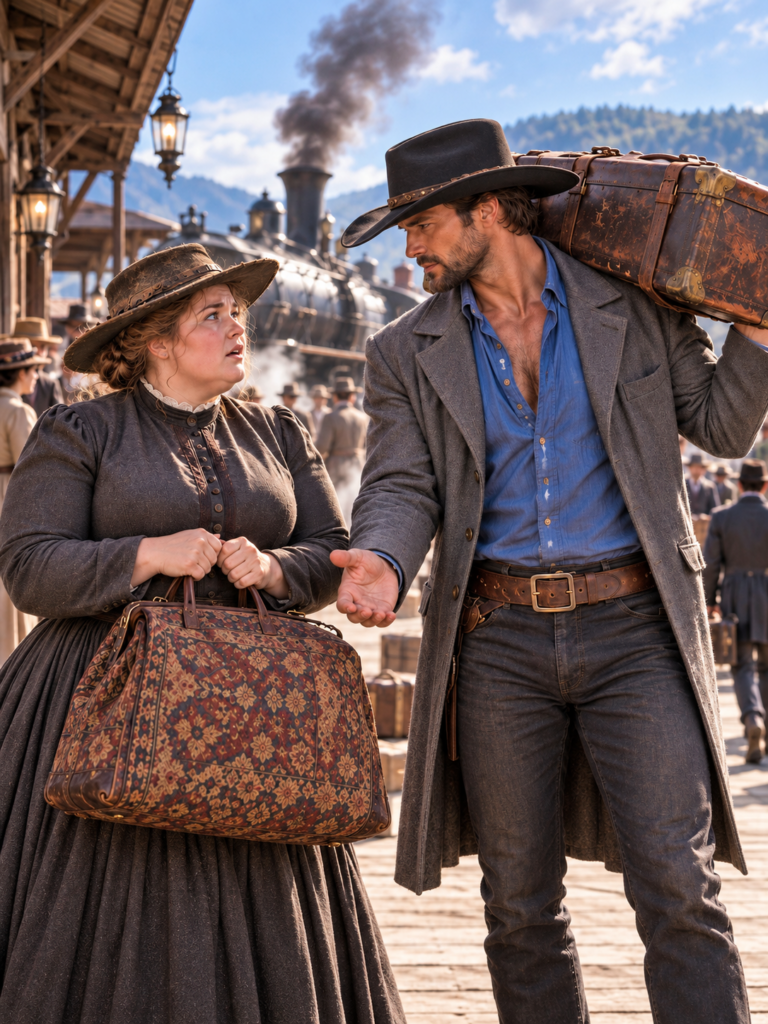
rejected at the station for being too large, she expected to sleep alone that night—until a widowed rancher said his twins needed a woman exactly like her
Part 1
By the time Clementine Ford stepped down from the Union Pacific passenger car at Bitter Creek, Wyoming, she had traveled more than a thousand miles toward a man who had promised her a home.
It took him less than thirty seconds to make her wish she had never come.
Coal smoke hung low over the station platform.
The locomotive hissed behind her.
Travelers moved around trunks and crates while two cowboys argued beside the freight office and a woman in a blue dress tried to keep three children from stepping too close to the tracks.
Clementine stood with one gloved hand around the handle of her carpetbag.
She was twenty-eight years old.
Tall.
Broad.
Heavy through the hips and waist.
Strong enough to move a sewing machine alone and carry two full buckets up boarding-house stairs without stopping.
For most of her adult life, other people had behaved as though those qualities needed apology.
She had tried apologizing once.
It changed nothing.
In Chicago, women whispered in fitting rooms.
Men occasionally made jokes loudly enough for her to hear.
Employers complimented her sewing and then warned her not to stand in the display window because customers preferred a more “delicate image.”
So when Clementine answered an advertisement from a Wyoming hardware merchant seeking a wife, she had been painfully honest.
I am not a small woman, Mr. Miller.
I am broad and sturdy.
I work hard.
I sew professionally, cook well, keep accounts, and have no fear of physical labor.
If you seek a decorative wife, do not waste your postage.
Josiah Miller’s reply had arrived two weeks later.
The West has little use for decorations, Miss Ford.
I seek a capable companion.
For six months they wrote.
His letters were not romantic.
Clementine liked that.
He described Bitter Creek.
His store.
A house he had purchased behind it.
A vegetable garden he wanted planted.
He wrote that loneliness had become tiresome.
She understood loneliness.
When he offered to pay for her train ticket, she accepted.
She sold most of what little furniture she owned.
Packed her sewing tools.
Folded three good dresses into a trunk.
And came west.
Now she searched the platform for the face from the tintype photograph in her pocket.
She found him beside the station office.
Josiah Miller.
Neat dark coat.
Trim mustache.
Parted hair.
Good boots.
He was looking eagerly toward the train.
Clementine’s heart began beating faster.
She took a breath.
“Mr. Miller?”
He turned.
His gaze landed on her face.
Recognition.
Then it traveled downward.
Shoulders.
Waist.
Skirts.
Back to her face.
The warmth in his expression vanished.
“You’re Clementine Ford?”
“Yes.”
He stared as though waiting for another woman to step from behind her.
Clementine tightened her grip on the carpetbag.
“I wrote that I was stout.”
“Stout?”
His voice rose.
Several people nearby turned.
Clementine felt the first warning pressure beneath her ribs.
Josiah removed her photograph from his coat pocket.
The tintype showed only her face and shoulders.
“This is dishonest.”
“No, sir.”
“You deliberately concealed yourself.”
“I described myself plainly.”
“You described yourself as sturdy.”
“I am.”
Josiah laughed once.
It was not amusement.
It was disbelief made cruel.
“I expected a farm woman.”
Clementine’s cheeks burned.
“What exactly do you think I am?”
His eyes moved over her again.
“A humiliation.”
The station seemed to grow quieter.
Clementine heard the locomotive.
A horse stamping beyond the platform.
Somebody coughed.
She wished Josiah had struck her.
A blow would have ended.
Public shame spread.
“I crossed half the country because you proposed marriage,” she said.
“I proposed to the woman I imagined.”
“You proposed to the woman in my letters.”
“No.”
His face reddened.
“I am a businessman in this town.”
“And?”
“People know me.”
Clementine stared.
Understanding came slowly because part of her still resisted believing anyone could be this shallow while standing inside his best coat.
“You are afraid people will see you married to me.”
Josiah lowered his voice.
“You are making this unpleasant.”
“You began it.”
That drew a murmur somewhere behind them.
Josiah’s embarrassment became anger.
“You have three choices, Miss Ford. Return east, find employment here, or marry someone else if anyone is willing.”
Clementine felt something break.
Not her heart.
The last small piece of hope she had carried west.
“I have three dollars.”
“Not my concern.”
“You purchased a one-way fare.”
“I purchased passage for a prospective bride.”
“I am the prospective bride.”
“No.”
The word came quickly.
Coldly.
He stepped back.
“You are not.”
Clementine could feel eyes on her.
She would not cry.
Not there.
Not for him.
She bent toward her trunk.
A gloved hand reached it first.
Large.
Calloused.
A man’s hand.
The stranger lifted the trunk as though it contained blankets instead of nearly everything Clementine owned.
She straightened.
The cowboy beside her was tall enough that she had to raise her chin slightly.
Dusty canvas coat.
Broad shoulders.
Dark beard.
Gray eyes.
There was grief in his face.
Old grief.
Not weakness.
Something weather had hardened rather than erased.
He looked toward Josiah.
“Good.”
Josiah frowned.
“What?”
The stranger shifted Clementine’s trunk onto one shoulder.
“Good that you don’t want her.”
Josiah stared.
The cowboy continued.
“Because my children need a woman exactly like her.”
Clementine forgot the crowd.
Forgot the embarrassment.
Even forgot to breathe for a second.
The stranger’s statement was so absurdly direct that several people laughed.
He did not.
Neither did Clementine.
“You don’t know me,” she said.
“No.”
“Then put down my trunk.”
“You can carry it?”
“Yes.”
“I believe you.”
“Then why are you holding it?”
“Because I’ve got one free hand and you don’t.”
Clementine almost smiled despite herself.
Almost.
Josiah made an irritated sound.
“Wyatt, stay out of this.”
So the stranger had a name.
Wyatt.
The cowboy turned his head.
“Seems finished to me.”
“She came here under false pretenses.”
Clementine’s humiliation flared into anger.
“I did not.”
The cowboy looked at Josiah.
“She said she was stout?”
Josiah’s mouth tightened.
“Yes.”
“Can she work?”
“She claims—”
The cowboy turned to Clementine.
“Can you work?”
“Yes.”
“Cook?”
“Yes.”
“Sew?”
“For twelve years professionally.”
“Read?”
“Obviously.”
“Keep books?”
“Yes.”
“Handle children?”
Clementine hesitated.
“I have never had my own.”
“That wasn’t my question.”
“I looked after my sister’s children until she died.”
The cowboy’s expression changed.
“When?”
“Influenza. Five years ago.”
“I am sorry.”
Unlike Josiah’s letters, there was nothing formal about the sentence.
Clementine believed him.
The cowboy lowered her trunk to the boards.
“My name is Caleb Wyatt.”
He extended his hand.
She looked at it.
Then shook.
His grip was firm without trying to prove anything.
“I run Whispering Pines Ranch ten miles north.”
Josiah laughed.
“Caleb, have you lost your mind?”
Caleb ignored him.
“I have twins.”
Clementine released his hand.
“Boys?”
“Boy and girl.”
“How old?”
“Five.”
“Where is their mother?”
Caleb’s eyes changed.
“Buried on the hill above my house.”
Clementine went quiet.
“She died two winters ago.”
“I am sorry.”
He nodded once.
“The children are Samuel and Clara.”
Caleb glanced toward the wagon road, then back.
“I came into town this morning because my wife’s sister plans to petition for custody.”
Clementine blinked.
“You approached a stranger at a train station because of a custody dispute?”
“Yes.”
“That is perhaps the least romantic proposal any woman has ever received.”
“I’m not offering romance.”
“At least you’re honest.”
“I am offering a legal marriage.”
Clementine stared at him.
The crowd was listening openly now.
Caleb lowered his voice.
“Not here.”
He picked up her trunk again.
Clementine did not stop him this time.
They walked to the far end of the platform.
Caleb set it beside a bench.
“You’re serious,” she said.
“Yes.”
“You haven’t known me ten minutes.”
“I watched what happened.”
“That doesn’t mean you know me.”
“No.”
His answer came without defensiveness.
“But I saw enough to ask.”
“Ask what?”
“If you’ll hear the whole proposition before saying no.”
Clementine crossed her arms.
“All right.”
Caleb removed his hat.
“My wife, Emily, was a good woman.”
His voice softened.
“She hated Wyoming.”
Clementine waited.
“She had been raised near St. Louis. She was small, gentle, educated, and terrified of the isolation after the twins were born.”
Caleb’s eyes dropped toward his hat.
“I was too proud to understand how badly she was struggling.”
“What happened?”
“Winter came hard.”
He swallowed.
“Then fever.”
Clementine did not ask whether he blamed himself.
His face answered.
“The ranch has not recovered,” he continued. “Neither have the children. Neither have I, if we’re being truthful.”
“Who cares for them?”
“A neighbor when she can. Me badly. Emily’s sister Martha when she visits, though the children fear her.”
“Why does she want custody?”
“Partly because she thinks I’m incapable.”
“Is she wrong?”
Caleb looked directly at her.
“Some days?”
The honesty caught Clementine off guard.
“No.”
“What else?”
“She owns property south of Bitter Creek. My ranch controls water along the Pine Fork. Her late husband once tried to purchase part of it.”
“You think she wants the ranch.”
“I think she wants the children and believes the ranch should follow them.”
Clementine sat on the bench.
“This gets worse every minute.”
“Yes.”
“And you believe marrying a woman you met beside a train will improve your case.”
“No.”
She looked up.
“No?”
“I believe bringing home a stranger solely for court would make me look insane.”
“At least we agree.”
He almost smiled.
“I also believe I need help whether Martha exists or not.”
“With the ranch?”
“With the house.”
He paused.
“My children.”
Clementine’s anger softened slightly.
“Why me?”
Caleb put his hat back on.
“Because when that fool insulted you, you didn’t collapse.”
“I nearly did.”
“But you didn’t.”
“That proves very little.”
“You told him he was wrong.”
“Quietly.”
“You reached for your own trunk.”
“It belongs to me.”
“Exactly.”
He studied her.
“I don’t need a fragile woman who will spend three years discovering she hates the life. I need somebody who already understands that living can be heavy.”
Clementine looked away.
The sentence hurt in a way kindness sometimes did.
Caleb continued.
“I will not pretend I know whether we could become husband and wife in the way people mean it when they say those words.”
“That is encouraging.”
“But I can promise this.”
His voice became firm.
“You will never have to earn the right to exist in my house by becoming smaller.”
Clementine looked back at him.
Behind Caleb, Josiah stood near the hardware wagon, pretending not to watch.
Caleb noticed.
“So.”
He extended his hand again.
“Legal marriage. Partnership. My name. A home. Half of whatever Whispering Pines makes while you’re my wife. If we discover after a year that we’ve made a terrible mistake, I’ll arrange property in town for you and you can leave with your dignity and enough money to choose what comes next.”
Clementine’s eyes widened.
“You’ve thought about this.”
“I have spent six months trying to solve three problems with no good answer.”
“Children, house, ranch?”
“Children, grief, and my own stupidity.”
That earned the smile.
Small.
But real.
Caleb saw it and seemed surprised.
Clementine looked down at her hands.
Three dollars.
No return ticket.
No family waiting in Chicago.
No obligation to accept madness simply because another man had behaved cruelly.
She needed to remember that.
“What if I say no?”
“I’ll take your trunk to the hotel, pay for a week, and ask Mrs. Elkins at the dress shop if she needs a seamstress.”
“Why?”
“Because Miller stranded you.”
“That isn’t your responsibility.”
“No.”
“Then why?”
Caleb shrugged.
“Does a thing need to be your fault before you fix what you can?”
Clementine stared at him.
That answer decided more than the proposal.
She stood.
“Where is the magistrate?”
For the first time, Caleb Wyatt smiled.
Not broadly.
Not triumphantly.
Simply like a tired man seeing light through a door he had expected to remain closed.
“Across the street.”
An hour later Clementine Ford became Clementine Wyatt.
It was not the wedding she had dreamed of as a girl.
No church.
No flowers.
No family.
A magistrate named Parker.
Two witnesses from the station office.
A borrowed fountain pen.
Caleb’s steady hand beside hers.
When she signed, Clementine paused over the surname.
Wyatt.
Then wrote it carefully.
Outside, Josiah Miller stood across the street beneath the awning of his hardware store.
Their eyes met.
For one second Clementine wanted him to regret rejecting her.
Then she understood something.
If his approval still mattered, he would still own part of her.
She turned away.
The ten-mile ride to Whispering Pines began in silence.
Clementine sat stiffly on the wagon bench.
Every rut shifted her against Caleb.
Each time, she moved away and apologized.
After the fourth time Caleb said, “Stop.”
She looked at him.
“What?”
“Apologizing.”
“I keep crowding you.”
“You’re sitting.”
“The bench is narrow.”
“The country isn’t.”
She frowned.
Caleb kept his eyes on the road.
“You’ve apologized four times for occupying the space required by your own body.”
Clementine said nothing.
“There is room for you, Clementine.”
The words were simple.
They nearly broke her.
She looked away toward Wyoming.
The country opened around them.
Sagebrush.
Cottonwoods along water.
Distant mountains turning blue in afternoon haze.
Nothing in Chicago had prepared her for so much sky.
After an hour, Caleb pointed.
“Whispering Pines.”
The ranch spread across a broad valley beneath dark timber.
Pasture.
River.
Corrals.
A large house.
Barns.
Beautiful from a distance.
Then they came closer.
Broken porch rail.
Laundry half torn from the line.
A boarded window.
A gate hanging crooked.
Three chickens loose in the yard.
Caleb cleared his throat.
“I warned you.”
“No.”
“I mentioned trouble.”
“You did not mention surrender.”
He almost laughed.
Then the front door burst open.
Two children appeared.
Thin.
Wild-haired.
Mud on their faces.
A boy and girl.
Behind them came a woman in a dark high-collared dress.
Slender.
Sharp-featured.
Perfect posture.
She descended the porch before Caleb had stopped the wagon.
“Where have you been?”
Caleb set the brake.
“Town.”
“I know where.”
Her eyes moved to Clementine.
The contempt was immediate.
“And what exactly is that?”
Clementine felt the old wound open.
Chicago.
Train platform.
Whispers.
Caleb’s voice became cold.
“This is my wife.”
The woman froze.
“What?”
“Martha, meet Clementine Wyatt.”
Martha stared.
“You married her?”
“Yes.”
“Today?”
“Yes.”
Martha looked at Clementine’s body as though assessing damaged livestock.
Then she laughed.
“Oh, Caleb.”
The children flinched.
Clementine noticed.
That mattered more than the insult.
Martha turned toward them.
“Samuel. Clara. Inside.”
The twins did not move.
“I said inside.”
Clara’s face tightened.
Clementine climbed from the wagon.
The ground was uneven.
Her boots struck dirt firmly.
Martha looked up at her.
“You cannot possibly believe this grotesque arrangement will convince a judge you’re fit to raise children.”
Caleb stepped forward.
Clementine raised one hand.
He stopped.
Martha continued.
“My sister would turn in her grave.”
That sentence changed Clementine.
Because Samuel began crying.
Silently.
He looked toward the ground.
Clara pressed against him.
Children should not have to hear their dead mother used like a weapon.
Clementine walked toward the porch.
She did not shout.
She did not insult Martha’s appearance.
She simply stopped between Martha and the twins.
“My name is Clementine Wyatt.”
Martha blinked.
“I heard.”
“Then use it.”
“How dare—”
“And if you intend to speak about their mother, you will do it gently.”
Martha’s mouth opened.
“This is not your concern.”
Clementine looked back at Samuel and Clara.
Then at Martha.
“I became their father’s wife this afternoon.”
She stood straighter.
“So until a court tells me differently, anything that frightens those children inside this house is very much my concern.”
Martha’s face sharpened.
“You think your size makes you intimidating?”
“No.”
Clementine’s voice remained calm.
“My certainty does.”
The wind moved through the pines.
Nobody spoke.
Then Martha stepped aside.
Not because she surrendered.
Because for the first time, she was unsure whether Clementine could be shamed into surrendering first.
As Martha climbed into her buggy, she called back to Caleb.
“You’ll hear from Judge Carter.”
Caleb’s jaw tightened.
Martha pointed toward the house.
“When he sees this place, I’ll have Samuel and Clara before the first heavy snow.”
She drove away.
Dust settled.
Clementine looked at Caleb.
“How long?”
“Until court?”
“Yes.”
“Maybe a month.”
She turned toward the broken railing.
The laundry.
The dirty windows.
Then toward the two wary children.
Clara stared at her.
Samuel did not.
Clementine slowly sat on the lowest porch step.
The wood creaked beneath her.
She did not reach for them.
“My name is Clementine.”
No answer.
“I know this is strange.”
Still nothing.
“I think it’s strange too.”
Clara looked at her.
Clementine continued.
“I can make brown-sugar biscuits.”
Samuel’s eyes flickered upward.
“And,” Clementine added, “I know how to sew a pocket so strong you can fill it with stones without tearing it.”
Clara came one step closer.
“Why would I fill my pocket with stones?”
“I don’t know.”
Clementine looked serious.
“Children do mysterious things.”
Clara took another step.
Then reached out and pressed one tiny hand against Clementine’s forearm.
Clementine held perfectly still.
The girl’s expression changed.
“You’re soft.”
Clementine swallowed.
“Yes.”
Clara pressed again.
“Like my blanket.”
Something in Clementine’s chest gave way.
All her life softness had been described as excess.
Weakness.
Failure.
To this child it meant safety.
Clementine smiled.
“Soft enough for hugs.”
She looked toward Samuel.
“And strong enough to carry firewood.”
Samuel finally looked at her.
“Can you carry more than Pa?”
From behind Clementine, Caleb said, “Let’s not start this.”
For the first time, Samuel smiled.
Only slightly.
But Clementine saw it.
And on the first afternoon of her marriage, standing in the wreckage of another woman’s unfinished life, Clementine understood what Caleb had really brought home from the station.
Not a wife.
Not yet.
He had brought home possibility.
Part 2
Clementine’s first morning at Whispering Pines began at four thirty with a child screaming.
She woke so quickly she struck her knee against the bedside table.
For one confused second she did not know where she was.
Then Clara screamed again.
Clementine threw on her robe and crossed the hall.
The girl sat upright in bed, eyes open but unseeing.
Samuel slept on a pallet nearby.
Caleb appeared in the doorway behind Clementine.
“Night terror.”
“How often?”
“Most weeks.”
“Since her mother died?”
He nodded.
Clementine moved slowly.
“Clara.”
The child did not respond.
Clementine sat beside her.
“Clara, sweetheart.”
The girl turned suddenly and buried herself against Clementine.
The force surprised her.
Clementine wrapped both arms around the child.
Clara’s breathing came in gasps.
“Mama.”
The word tore through the room.
Caleb’s face went pale.
Clementine held Clara tighter.
She did not say, I’m your mother now.
Did not say, Your mother is gone.
She rocked.
“It’s all right.”
Clara cried.
“I want Mama.”
“I know.”
“I want her.”
“I know.”
Clementine looked at Caleb.
He stood motionless.
Unable to come closer.
His own grief had made him afraid of the children’s.
Clementine understood suddenly how Whispering Pines had fallen apart.
Not because Caleb was lazy.
He had survived by working harder at everything that did not require him to feel.
Cattle.
Fences.
Hay.
Horses.
Children could not be repaired with a hammer.
He had not known what to do with them.
So the house had become a place where grief lived unattended.
When Clara finally slept, Clementine followed Caleb downstairs.
He started coffee.
“I’m sorry.”
“For what?”
“You didn’t sign up for that.”
“I married a widower with grieving children.”
“I didn’t tell you how bad it was.”
“No.”
He looked ashamed.
Clementine sat.
“Caleb.”
He turned.
“You cannot keep apologizing for the part of your life I already agreed to enter.”
He almost smiled.
“That sounds familiar.”
She realized it was what he had told her on the wagon.
“Fair.”
He poured coffee.
“There’s something else.”
“Of course there is.”
He handed her a cup.
“My mortgage payment is due in six weeks.”
Clementine closed her eyes.
“You truly saved your best qualities for after the ceremony.”
“I told you the ranch had trouble.”
“You said cattle and children.”
“Cattle are money.”
“How much trouble?”
Caleb sat.
He showed her account books.
Clementine read them for nearly an hour.
Whispering Pines was not bankrupt.
But it was vulnerable.
Emily’s illness had brought medical debt.
Two poor calving seasons followed.
Caleb had borrowed against expected cattle sales.
Feed prices rose.
Then part of the hay crop failed.
The ranch could survive if winter stayed manageable and cattle prices held.
If either went wrong, trouble.
Clementine closed the ledger.
“Martha knows?”
“Enough.”
“And she wants the children.”
“Yes.”
“And possibly access to the ranch’s water rights.”
“Yes.”
“You married me partly because a stable household helps in court.”
“Yes.”
“Do you expect me to be offended?”
“I expect you to know the truth.”
Clementine considered.
“I prefer useful truth to beautiful lies.”
Caleb looked relieved.
“Good.”
“But if I discover you’ve hidden anything else large enough to threaten a roof, child, horse, or bank payment, I will become unpleasant.”
“I believe you.”
She began rebuilding the household that morning.
Not miraculously.
Slowly.
First, food.
The pantry held flour, beans, salt pork, dried apples, coffee, molasses, onions, and enough potatoes to survive a siege if nobody minded scurvy.
Clementine made biscuits.
Clara ate three.
Samuel claimed he disliked them, then stole a fourth when he thought no one watched.
Next came laundry.
Then the kitchen floor.
Then beds.
Then the broken window.
Caleb returned that evening and found Clementine on a stool fitting a pane.
“You know glazing?”
“I lived above a dress shop run by a widow who considered landlords a moral weakness.”
He smiled.
Samuel carried putty.
Clara held nails.
The twins had attached themselves to Clementine cautiously.
Like stray cats pretending they were merely passing through.
She did not force affection.
She gave them work.
Small jobs.
Useful ones.
“Clara, count six potatoes.”
“Samuel, bring three pieces of wood.”
“Both of you shake this rug.”
The children began to understand that Clementine’s attention was dependable.
Not dramatic.
Dependable.
Within a week Samuel stopped hiding biscuits in his pockets.
Within two, Clara stopped asking every morning whether Clementine was leaving.
The third week, a thunderstorm rolled over the mountains.
Clara ran from her bed before the first hard rain.
Samuel followed.
Both climbed into Clementine’s bed without asking.
Clementine looked at Caleb, who had come into the hallway.
He stood holding a candle.
“Well,” Clementine said.
“They’ve chosen.”
“Apparently.”
“Where will you sleep?”
Caleb looked at the occupied bed.
“Barn?”
Clementine laughed.
It was the first full laugh he had heard from her.
He remained in the doorway longer than necessary.
Something had begun changing between them.
Neither named it.
Their marriage remained formally practical.
Caleb slept in the smaller room across the hall.
Clementine occupied the main bedroom with the children whenever nightmares came.
They shared meals.
Work.
Decisions.
Little else.
Yet Clementine found herself noticing him.
The way he bent to listen seriously when Samuel described an imaginary outlaw.
The way his hands shook slightly whenever Emily’s name came unexpectedly.
How he always gave Clementine the warmer side of the wagon without comment.
How he never mentioned her body as a problem.
Once, while she was kneading dough, he came into the kitchen carrying firewood.
“You need anything from town?”
“Thread.”
“What color?”
“Brown.”
“What kind?”
She looked at him.
“You’re asking?”
“I know enough to know there are kinds.”
She smiled.
“Button thread. Strong. Ask Mrs. Elkins.”
He nodded.
Then paused.
“What?”
“Nothing.”
“Caleb.”
He looked almost embarrassed.
“You look happy.”
Clementine’s hands stopped.
“I am working dough.”
“I know.”
“And that looks happy?”
“It looks like you belong where you’re standing.”
The words stayed with her all afternoon.
Martha visited every Sunday.
Never invited.
Always perfectly dressed.
She inspected the house like a government official.
She looked for dirt.
Bruises.
Empty cupboards.
Anything.
On her third visit she found the children sewing buttons onto scrap fabric with Clementine.
“What is this?”
“Practice,” Clara said.
“Girls sew. Samuel does not need that.”
Samuel’s face changed.
Clementine looked up.
“Samuel asked to learn.”
“Boys need ranch skills.”
Caleb entered behind her.
“He also needs buttons.”
Martha ignored him.
She opened a cupboard.
“Interesting.”
Clementine set down her needle.
“Martha.”
“Yes?”
“If you open another cupboard without asking, I will close it with your fingers still inside.”
Caleb coughed.
Martha stared.
“That is a threat.”
“No.”
Clementine smiled sweetly.
“It is household guidance.”
Martha stopped opening cupboards.
But she brought news.
“Judge Carter set the hearing for November third.”
Caleb went still.
Three weeks.
Martha looked around the now-clean kitchen.
“You’ve staged this nicely.”
Clementine’s jaw tightened.
Martha continued.
“But judges understand ranch economics.”
Caleb stepped forward.
“What does that mean?”
“It means children need stability.”
“They have it.”
“Until the bank takes the property.”
Clementine watched Caleb’s face.
Martha knew.
Perhaps not exact figures.
Enough.
“Your payment is late,” she said.
Caleb’s voice cooled.
“Leave.”
Martha smiled.
“See you in court.”
After she drove away, Clementine turned on Caleb.
“Late?”
“Three days.”
“You said due in six weeks.”
“That was the next one.”
Clementine stared.
“Caleb Wyatt.”
“I paid it yesterday.”
“With what?”
“Sold four yearlings.”
“Below market?”
His silence answered.
Clementine closed her eyes.
“You hid it.”
“I solved it.”
“No. You converted livestock into silence.”
His expression hardened.
“It’s my ranch.”
The sentence came before he could stop it.
Both heard it.
Clementine’s face changed.
“Yes.”
“Clementine—”
“It is your ranch.”
“I didn’t mean—”
“You promised partnership.”
“I know.”
“Then either I am your partner when the numbers are ugly, or I am a housekeeper wearing a wedding ring.”
Caleb looked ashamed.
“I’m sorry.”
“Do not apologize.”
Her voice softened but became more dangerous.
“Change.”
He nodded.
“I will.”
That evening he gave her every account book.
Every loan paper.
Every invoice.
Clementine stayed at the kitchen table until after midnight.
The situation was worse than she thought.
Not hopeless.
Tight.
She began cutting unnecessary expenses.
Then she created income.
Her sewing machine came from the trunk.
Within a week, women from Bitter Creek were bringing work.
Alterations.
Winter coats.
Dresses.
Curtains.
Clementine was faster than anyone in town knew.
Better too.
Mrs. Elkins, who ran the existing dress shop, might have resented competition.
Instead she came to the ranch.
“I hear you do men’s heavy coats.”
“Yes.”
“My hands can’t push that canvas anymore.”
They made an agreement.
Mrs. Elkins sent heavy work to Clementine.
Kept a portion.
Everybody earned.
Caleb watched customers arrive.
“You planned this?”
“No.”
“Then how?”
“I possess a skill people require.”
“So simple.”
“Most survival is.”
The extra income did not rescue Whispering Pines.
But it bought groceries.
Nails.
Lamp oil.
It meant Caleb did not have to sell another animal for household cash.
The ranch began breathing.
Then Samuel disappeared.
It happened one cold afternoon.
Clara came screaming from the creek.
“Sam’s gone!”
Caleb was on the south range.
Clementine dropped the dress she was hemming.
“Where?”
“He said he was going to find Mama.”
The world stopped.
“Where does he think she is?”
Clara pointed toward the hill.
Emily’s grave.
Snow had begun.
Light but growing.
Clementine pulled on Caleb’s coat.
Took a rope.
Blanket.
Lantern.
“Stay inside.”
“No!”
“Clara.”
“I want Sam!”
Clementine knelt.
“I will bring him home.”
“You promise?”
Clementine almost said yes.
Then she remembered promises could become lies.
“I promise I will not stop looking.”
That was different.
She followed small footprints uphill.
The snow thickened.
Samuel had reached the grave.
She found his mitten first.
Then footprints continued beyond.
Into timber.
“Samuel!”
No answer.
Wind.
Pines.
Again.
“SAMUEL!”
A faint cry.
Clementine pushed through brush.
The boy had slipped into a shallow ravine.
He sat wedged beside a fallen tree, one ankle trapped beneath a branch.
His face was white.
“Mama didn’t answer.”
Clementine climbed down.
“No, sweetheart.”
“Maybe she can’t hear.”
Clementine swallowed.
She lifted the branch enough to pull his foot free.
Then wrapped him in the blanket.
“I miss her.”
“I know.”
“Do you want me to stop?”
The question broke her heart.
“Stop what?”
“Missing her.”
Clementine pulled him against her.
“No.”
“Because you’re here now.”
“That doesn’t erase her.”
“Are you mad?”
“Never.”
Samuel began crying.
“I don’t remember her face.”
Clementine closed her eyes.
“You don’t have to remember every detail to know she loved you.”
“How do you know?”
“Because people leave marks that memory doesn’t always keep neatly.”
She carried him down the hill.
He was heavy for five.
Clementine did not mind.
Halfway home, Caleb came riding through the snow.
He saw them.
Dismounted before the horse fully stopped.
“Samuel!”
The boy reached.
Caleb took him.
Then looked at Clementine.
Snow covered her hair.
Her skirt was torn.
Hands scratched.
For one terrible second Caleb’s eyes filled with what looked almost like fear.
Not fear of losing Samuel.
That had passed.
Fear of losing Clementine.
He reached for her face.
Stopped before touching.
“You went alone.”
“Yes.”
“You could’ve been hurt.”
“So could he.”
“I know.”
He stared at her.
Then pulled her into him.
Hard.
Clementine froze.
Caleb’s arms wrapped around her completely.
Not politely.
Not as part of an agreement.
He buried his face beside her temple.
“I can’t do this twice.”
She understood.
Emily.
Loss.
Clementine slowly put her arms around him.
“You aren’t.”
From Caleb’s arms, Samuel said, “Can we go home?”
Clementine laughed through sudden tears.
“Yes.”
Home.
The word followed them down the hill.
Part 3
Judge Carter arrived at Whispering Pines two weeks before the hearing.
Unannounced.
Martha brought him.
Clementine saw their buggy and understood immediately.
Inspection.
Judge William Carter was not the corrupt friend Martha had implied.
He was nearly sixty.
Tired eyes.
Gray mustache.
A man who had probably heard fifty families insist God and law were on their side.
Martha entered confidently.
“Judge, as you can see—”
He raised one hand.
“I can see without narration, Mrs. Bell.”
Clementine liked him instantly.
Not because she expected favor.
Because he appeared immune to performance.
He examined the house.
Pantry.
Bedrooms.
Schoolbooks.
Clothing.
Asked Samuel questions.
Asked Clara different questions separately.
Asked Caleb about finances.
Then asked Clementine how long she had known Caleb before marrying.
“Approximately forty minutes.”
The judge removed his spectacles.
Martha smiled triumphantly.
Judge Carter looked at Clementine.
“Forty?”
“Perhaps forty-five.”
“Why?”
“Because the first man I traveled west to marry rejected me at the station.”
Martha’s smile widened.
Clementine continued.
“Caleb needed help. I needed a place to begin. We made an agreement.”
“Love?”
“Not then.”
Caleb looked toward her.
Judge Carter noticed.
“And now?”
Clementine’s face warmed.
“That’s more complicated.”
The judge almost smiled.
Martha interrupted.
“This is absurd. A marriage of convenience arranged publicly after a humiliation—”
Judge Carter turned.
“Mrs. Bell, your sister’s marriage began with a church ceremony and apparently ended with enough unhappiness that every person in this room still carries it.”
Silence.
Martha paled.
He turned back to Clementine.
“Do you consider yourself the twins’ mother?”
Clementine looked at Samuel and Clara.
“No.”
Martha’s eyes brightened.
Judge Carter waited.
Clementine continued.
“They had a mother.”
Caleb looked down.
“Her name was Emily.”
Clementine folded her hands.
“I will never require them to pretend she did not exist in order to make me comfortable.”
Clara crossed the room and took Clementine’s hand.
“But I intend to care for them as long as they allow me.”
Judge Carter looked at Clara’s hand.
Then at Clementine.
He closed the notebook.
“I’ve seen enough for today.”
Outside, Martha hissed, “This is not finished.”
Clementine did not answer.
Martha looked toward the cattle.
“Winter will finish it for me.”
That sentence bothered Clementine.
Not because winter was frightening.
Because Martha seemed certain.
The first missing cattle were discovered six days later.
Eight head.
No broken fence.
No tracks clear enough to follow after wind.
Caleb thought they might have wandered north.
They searched.
Found nothing.
Three days later another six disappeared.
Caleb rode into Bitter Creek to notify Sheriff Dalton.
Cattle theft was not uncommon enough to be unimaginable.
But fourteen animals mattered.
Financially, they were painful.
In court, they were worse.
Martha’s lawyer filed a supplemental statement questioning the ranch’s solvency.
Clementine read it.
“How does she know this quickly?”
Caleb’s jaw tightened.
“I don’t know.”
“Yes, you do.”
He looked toward the window.
“You think she’s involved.”
“I think information reaches her before it should.”
Caleb did not answer.
The next week Josiah Miller came to Whispering Pines.
Clementine saw his wagon.
Every muscle in her body tightened.
He climbed down carrying a small parcel.
Caleb was in the north pasture.
Clementine stayed on the porch.
“What do you want?”
Josiah removed his hat.
“I came to apologize.”
She nearly laughed.
“For which part?”
His face reddened.
“I behaved poorly at the station.”
“You publicly described my existence as humiliating.”
“Yes.”
“That is somewhat beyond poor.”
“I know.”
“Do you?”
He looked at the house.
“I was embarrassed.”
“That has always been obvious.”
“No.”
He stepped closer.
“I mean afterward.”
Clementine’s expression hardened.
“People laughed at me.”
“Because?”
“You married Wyatt.”
“You mean because the woman you rejected found another husband before sundown.”
Josiah’s mouth tightened.
“I was angry.”
“That is not an apology.”
He extended the parcel.
“A peace offering.”
She did not take it.
“What is it?”
“Fabric.”
Clementine almost admired the stupidity.
“You brought a seamstress cloth after insulting her body.”
“I heard you’re taking work.”
“Leave.”
“Clementine.”
“No.”
His politeness cracked.
“You think Wyatt loves you?”
She went still.
“There you are,” she said.
Josiah frowned.
“The man from the station.”
“You don’t know what you’re talking about.”
“I know men.”
“No.”
Clementine stepped down.
“You know pride.”
His face reddened.
“Wyatt married you because he needed someone to clean his house before a custody hearing.”
Clementine’s heart flinched.
Josiah saw.
He smiled slightly.
That smile told her she must never let him know what hurt.
“So?”
He blinked.
“So?”
“Yes.”
She folded her arms.
“That was part of our agreement.”
“He used you.”
“No.”
“He needed you.”
“Yes.”
“And you call that love?”
Clementine looked at him.
“I would rather be needed honestly than admired falsely.”
Josiah had no answer.
She pointed toward the road.
“Go.”
He left the parcel anyway.
Clementine burned it.
That evening Caleb returned.
She told him everything.
His face became dangerous at Josiah’s name.
“Did he touch you?”
“No.”
“Threaten you?”
“No.”
“What did he want?”
“To remind me why I was glad you carried my trunk.”
Caleb’s anger softened.
Clementine looked toward the fire.
“Do you love me?”
The question escaped before she could stop it.
Caleb froze.
She immediately regretted it.
“This is poor timing.”
“No.”
He removed his coat slowly.
“No, it isn’t.”
Clementine waited.
Caleb sat across from her.
“When I proposed, I needed help.”
“I know.”
“I saw strength.”
“I know.”
“I saw someone who could survive here.”
She nodded.
“What I didn’t understand…”
He stopped.
Clementine’s pulse quickened.
Caleb looked toward the stairs where the children slept.
“I didn’t understand that strength could make a house gentle.”
She looked at him.
“You made this place safe without making it weak.”
His voice dropped.
“You gave my children rules without fear.”
He rubbed his hands together.
“You mention Emily without making me feel guilty for missing her.”
Clementine’s throat tightened.
“And every morning when I ride out, I look back at the kitchen window to see if you’re there.”
He finally met her eyes.
“Yes.”
Clementine’s breath caught.
“Yes what?”
“Yes, I love you.”
She had imagined hearing those words her whole life.
She never imagined they would frighten her.
“What if you’re grateful?”
“I am.”
“What if that feels like love because you were desperate?”
“Possible.”
She stared.
Caleb leaned closer.
“You want honesty.”
“Yes.”
“Then I can’t prove the difference with words tonight.”
That answer made her trust him more.
He reached across the table.
Palm up.
Clementine placed her hand in his.
“I love you,” he said again. “If gratitude is mixed into it, I don’t see why love should be ashamed of company.”
Clementine began crying.
Caleb stood.
Walked around the table.
Then stopped in front of her.
“May I?”
She nodded.
He kissed her.
Not violently.
Not theatrically.
Slowly.
Like a man who had learned loss could turn tenderness into something sacred.
Afterward Clementine rested her forehead against his chest.
“I love you too.”
Caleb exhaled.
“Good.”
“That’s all?”
“I’ve been terrified you were going to say we should remain practical.”
She laughed against him.
Their marriage changed that night.
Not because desire suddenly appeared.
Because both stopped pretending it had not.
Yet love did not solve the missing cattle.
Or the bank.
Or Martha.
Two weeks later, Caleb found three missing steers in a narrow box canyon.
Dead.
Not from predators.
Shot.
Sheriff Dalton examined them.
“This isn’t rustling.”
Caleb’s jaw tightened.
“No.”
“Somebody wants you damaged, not robbed.”
Clementine thought of Martha.
Then Josiah.
She said nothing without evidence.
The court hearing was postponed after an early snowstorm closed the pass.
Martha was furious.
Clementine was relieved.
More time.
Then Sheriff Dalton brought different news.
“Found a buyer in Rock Springs who remembers a fellow trying to sell cattle matching your brand.”
Caleb leaned forward.
“Who?”
“Didn’t get a name.”
Clementine asked, “Description?”
Sheriff Dalton looked uncomfortable.
“Town coat. Not ranch clothes.”
“Josiah?”
“Maybe.”
“Proof?”
“No.”
Again.
No proof.
Clementine had spent her life being judged by appearances.
She refused to do the same even to a man she disliked.
“Then we keep watching,” she said.
Caleb looked frustrated.
“Yes.”
Winter approached.
Hay mattered now.
Whispering Pines had one large feed barn containing most of what the cattle would require through snow.
Clementine began checking locks nightly.
She said nothing about fear.
Then, one clear night in late October, Caleb rode north to tend a cow showing signs of early calving.
The twins slept upstairs.
Clementine sat beside the hearth repairing Caleb’s winter coat.
Near midnight, horses began screaming.
Not neighing.
Screaming.
Clementine stood.
Then she smelled smoke.
She reached the window.
The feed barn was burning.
Flames already climbed the west wall.
For half a second panic emptied her mind.
Then training of a different kind took over.
Not formal training.
Life.
Do the next thing.
Wake children.
She ran upstairs.
“Samuel. Clara. Up.”
They woke confused.
“Fire.”
Clara began crying.
“No. Listen.”
Clementine knelt.
“You two go to the root cellar.”
“What about you?”
“I am getting the horses away.”
Samuel grabbed her sleeve.
“Don’t go.”
She held his face.
“I’m coming back.”
She sent them outside through the kitchen and watched until they reached the cellar.
Then she took Caleb’s shotgun from above the mantel.
Not because she intended to shoot anyone.
Because somebody might have started that fire.
Outside, heat struck her.
The feed barn roared.
Horses kicked at the corral fence.
Clementine ran toward the gate.
Then stopped.
A man stood beside it.
Lantern.
Crowbar.
Hat pulled low.
He was working at the latch.
Clementine raised the shotgun.
“Step away.”
The man froze.
Turned.
Josiah Miller.
For one astonishing second they simply stared at each other.
Then Clementine understood.
Not guessed.
Understood.
His boots.
Soot.
Lantern.
Crowbar.
The burning barn behind him.
Josiah dropped the tool.
“Clementine.”
“Hands where I can see them.”
“This isn’t what—”
“Do not insult me again by assuming I’m stupid.”
He stepped backward.
“You don’t understand.”
“Then explain.”
His face twisted.
“This ranch was already failing.”
The words chilled her.
Not denial.
Justification.
“Did Martha send you?”
Josiah’s eyes shifted.
That was answer enough.
Clementine’s stomach turned.
“You burned feed with children in that house.”
“They weren’t in the barn.”
“The fire could spread.”
“It won’t.”
“You don’t know that.”
Josiah’s hand moved toward his coat.
Clementine leveled the shotgun.
“Don’t.”
His hand stopped.
“Do you even know how to use that?”
“No.”
The answer surprised him.
Clementine continued.
“But at this distance, I suspect neither of us wants to discover how much training is necessary.”
Josiah swallowed.
“You wouldn’t shoot.”
“I hope not.”
The barn roof collapsed.
Sparks rose into darkness.
Horses shrieked.
Josiah looked toward the road.
Then reached for the revolver at his belt.
“Stop.”
He drew.
Clementine’s fear became absolute.
Cold.
Clear.
The revolver shook in his hand.
“Put that down,” she said.
“Move away from the gate.”
“No.”
“Clementine.”
“No.”
“I’m warning you.”
She stared at him.
“You mistook humiliation for weakness once.”
Josiah’s breathing grew ragged.
“Don’t do it again.”
Hooves thundered beyond the yard.
Both turned.
Caleb came through smoke at a gallop.
He saw the gun.
Leapt from the saddle.
Hit Josiah before either man was fully balanced.
The revolver fired into dirt.
Clementine flinched.
Caleb drove Josiah down.
The fight lasted seconds.
Josiah was no rancher.
No fighter.
Caleb twisted the weapon away and pinned him.
“You came to my house.”
Josiah gasped.
Caleb struck him once.
Clementine shouted.
“Caleb!”
He stopped.
His fist remained raised.
“Don’t.”
Caleb looked toward her.
She lowered the shotgun.
“Don’t become something we’ll regret.”
His face changed.
He tied Josiah’s hands with leather rein instead.
Then they fought the fire.
That was the real battle.
Not dramatic.
Brutal.
Caleb cut open a gate.
Clementine hauled buckets.
Neighbors arrived after seeing flames.
Sheriff Dalton came.
Men formed a water line.
They saved one section of the barn.
Lost most of the hay.
At dawn, smoke covered Whispering Pines.
Josiah sat handcuffed near the porch.
The twins emerged from the cellar and ran to Clementine.
She dropped to her knees.
Clara collided with her.
Samuel followed.
Clementine held them both.
Caleb stood several feet away, black with soot.
His eyes were red.
The barn behind him smoked.
Winter feed was ruined.
Financially, the ranch faced disaster.
Yet when Clementine looked at Caleb, she did not see defeat.
Neither did he.
Because Josiah had failed to understand the same thing he had misunderstood at the station.
Strength was not the absence of vulnerability.
Strength was deciding what could not be taken from you even after the damage was done.
Part 4
Martha was arrested the following afternoon.
Not because Josiah nobly confessed everything.
Because frightened men facing prison often become less loyal to their conspirators.
Sheriff Dalton questioned him for four hours.
By sunset he had Martha’s letters.
Instructions.
References to the custody hearing.
Discussion of cattle losses.
A promise that Josiah would be repaid after Martha gained financial influence over the children’s property interests.
It was greed dressed as concern.
Judge Carter read the evidence himself.
The custody petition collapsed.
But Whispering Pines still had a problem.
Justice did not replace hay.
The feed barn had contained most of the ranch’s winter supply.
The bank did not care that arson caused the loss.
Snow did not care.
Cattle could not eat moral victory.
Caleb stood in the burned barn the next morning.
Clementine found him staring at blackened rafters.
“We sell.”
Her stomach tightened.
“How many?”
“Enough cattle to carry the rest through.”
“At autumn prices after everyone knows you’re short on feed?”
“Yes.”
“You’ll lose money.”
“Yes.”
“How much?”
“Enough.”
She walked closer.
“Other feed?”
“Too expensive to haul from Cheyenne.”
“Neighbors?”
“Everybody laid up what they need.”
Clementine looked at the ruined hay.
She thought of sewing.
Three dollars.
A kitchen rebuilt one task at a time.
“Then we ask.”
Caleb turned.
“For charity?”
“For prices.”
“Same humiliation.”
“No.”
She folded her arms.
“You helped me because you had strength I did not have at that moment.”
“You needed a trunk carried.”
“And a week in a hotel if I had said no.”
“That was different.”
“Why?”
“It just was.”
Clementine stepped closer.
“You cannot build a life around believing giving is noble and receiving is shameful.”
He looked away.
That sentence struck him hard.
Good.
Sometimes love needed to.
They rode to neighbors.
Not begging.
Asking.
Harper Ranch had twenty tons of hay to spare if Caleb helped repair fence in spring.
The McCalls could sell twelve tons at cost.
Mrs. Baines had alfalfa stacked from a field she no longer ran cattle on.
A ranch twenty miles east offered feed in exchange for grazing rights along Pine Fork after summer runoff.
Not enough.
But close.
Then something happened Clementine had not expected.
Bitter Creek organized a benefit.
Not because Caleb asked.
Because Mrs. Elkins did.
The dressmaker put a jar beside her register.
Sheriff Dalton told the saloon owner.
The church women cooked.
A freight driver offered two wagon loads at no charge.
Even Judge Parker donated.
Clementine walked into town and saw a handwritten sign:
WHISPERING PINES WINTER FEED FUND.
She stopped on the boardwalk.
Mrs. Elkins came outside.
“Don’t start crying.”
“I wasn’t.”
“You were.”
“I absolutely was not.”
Mrs. Elkins hugged her.
Clementine cried.
For years she had believed needing help made people smaller.
Perhaps because the wrong people had used need as permission to insult.
Here, help did not feel like ownership.
It felt like community.
The final surprise came from Josiah’s hardware store.
His business was placed temporarily under a creditor’s control while his criminal case proceeded.
The store manager, Mr. Reeves, appeared at Whispering Pines with a wagon of tools, nails, hinges, and roofing supplies.
Caleb stared.
“We didn’t order this.”
“No.”
“Who paid?”
Reeves scratched his chin.
“Technically, Mr. Miller did.”
Clementine blinked.
“What?”
“He owes half the town.”
Reeves smiled faintly.
“But he also has inventory. Sheriff says property not required as evidence can be sold to cover claims. Mrs. Elkins organized purchases.”
Clementine laughed.
Josiah’s own store was helping rebuild the ranch he had tried to destroy.
She suspected the Almighty had a sense of humor.
Court took place in November.
Martha entered without her usual confidence.
Josiah remained in county custody awaiting trial for arson and livestock theft.
Judge Carter listened to testimony.
Sheriff Dalton.
Caleb.
Clementine.
Even Samuel.
The boy sat with his feet not quite touching the floor.
“Do you want to live with your aunt?”
“No, sir.”
“Why?”
Samuel glanced at Martha.
“She makes Clara cry.”
Martha flinched.
“What about Mrs. Wyatt?”
Samuel looked at Clementine.
“She says Mama’s name.”
Judge Carter paused.
“What do you mean?”
“Aunt Martha says talking about Mama makes Pa weak.”
Samuel’s voice became smaller.
“Clementine says forgetting her would be worse.”
Caleb bowed his head.
Judge Carter asked Clara only one question.
“Where do you feel safe?”
She pointed.
Not at Caleb.
Not at the ranch.
At Clementine.
The judge’s final order was restrained.
Martha’s petition denied.
Caleb retained custody.
Clementine recognized legally as the children’s stepmother and household guardian.
No grand proclamation.
No declaration that Whispering Pines was a model anything.
Just law.
Specific.
Enough.
Outside the courthouse Martha confronted Clementine.
“You think you’ve won.”
Clementine sighed.
“I think the children are going home.”
“You stole my sister’s life.”
“No.”
“You wear her place.”
“No.”
“You sleep in her room.”
Clementine looked at her.
“Martha, I think you loved Emily.”
Martha’s anger faltered.
“I did.”
“I think you were furious that she died.”
Martha’s eyes filled.
“You know nothing.”
“I know grief becomes strange when people refuse to let it be grief.”
Martha shook her head.
“You came here and everyone moved on.”
Clementine finally understood.
This was not only property.
Martha had turned mourning into control because control felt easier than helplessness.
“You think if Caleb loves me, he loves Emily less.”
Martha looked away.
“And if the children love me, they have abandoned her.”
Silence.
Clementine stepped closer.
“They haven’t.”
Martha’s face tightened.
“You don’t get to tell me—”
“No.”
Clementine’s voice softened.
“But neither do you get to make two children suffer so your sister stays important.”
Martha began crying.
Not theatrically.
Quietly.
Clementine did not hug her.
Some distances needed to remain.
Martha left Bitter Creek after Josiah’s trial.
She was convicted of conspiracy but avoided the harshest sentence after cooperating fully and surrendering claims connected to the Wyatt property.
Josiah received prison time.
Clementine never visited him.
She did not need his apology.
The feed barn was rebuilt in spring.
Smaller.
Better placed.
Caleb insisted on wider doors.
Clementine insisted on stone footings.
“Foundation matters,” she told him.
Caleb smiled.
“You planning to remind me of the station forever?”
“Yes.”
The twins turned six.
Then seven.
Clara learned sewing.
Samuel learned too, despite protesting that cowboys did not sew.
Clementine proved otherwise by displaying Caleb’s repaired coat.
Caleb objected.
“Don’t involve me.”
“You’re wearing hand stitching.”
“I regret everything.”
Whispering Pines recovered financially.
Slowly.
Cattle prices improved.
Calving season went well.
Clementine’s sewing income became substantial enough that they converted one room into a proper workroom.
Women came from Bitter Creek.
Then neighboring ranches.
Clementine began employing a young widow named Alice two days a week.
The woman had a baby and no reliable income.
Caleb looked around the workroom one evening.
“You’ve started a business.”
“I already had one.”
“You had a sewing machine.”
“That is how many businesses begin.”
He laughed.
Their marriage deepened.
Not through constant romance.
Through mornings.
Bills.
Sick children.
Arguments over whether Caleb needed a new saddle.
Arguments over Clementine working too late.
Shared coffee.
Quiet touches.
One winter evening Clementine stood before the bedroom mirror.
She wore a new dress she had made.
Dark green.
Fitted properly.
No attempt to disguise her body.
Caleb entered.
Stopped.
Clementine immediately became self-conscious.
Old reflex.
“Too much?”
“No.”
“The waist?”
“No.”
“Then what?”
Caleb walked toward her.
“I was remembering the station.”
She looked down.
“Don’t.”
“Why?”
“I hate that memory.”
“I don’t.”
Clementine stared.
Caleb took her hands.
“That was the worst hour of my life.”
“Why yours?”
“Because I was standing there trying to decide whether to ride home and tell my children I might lose them.”
He smiled.
“Then a train brought you.”
Clementine’s eyes filled.
“You make it sound like Providence.”
“I don’t know what it was.”
His thumbs moved over her fingers.
“But Miller looked at you and saw too much.”
Clementine looked away.
Caleb touched her chin gently.
“I looked at you and saw enough.”
She laughed softly.
“That is not the compliment you think it is.”
“Let me finish.”
He kissed her forehead.
“Then I learned I hadn’t seen half of you.”
Clementine rested against him.
For the first time in years, the station memory did not end with Josiah.
It ended with Caleb lifting her trunk.
That changed everything.
Part 5
Ten years after Clementine arrived in Bitter Creek, the station platform looked smaller than she remembered.
She stood beneath the same wooden awning on an autumn morning holding Clara’s hand.
Except Clara was fifteen now and nearly as tall as Clementine’s shoulder.
Samuel stood beside Caleb pretending not to be nervous.
A train approached from the east.
Steam.
Whistle.
Metal grinding.
They were waiting for a girl named Ruth Ann Mercer.
Sixteen.
Orphaned.
Coming from Nebraska to live with relatives outside Bitter Creek.
The relatives had not come.
A telegram arrived that morning.
Illness.
Delay.
Clementine remembered too well what it meant to step from a train expecting someone.
So she came.
The locomotive stopped.
Passengers descended.
Then a thin girl appeared holding a suitcase with both hands.
She looked around.
No one stepped forward.
Clementine saw panic begin.
She walked across the platform.
“Ruth Ann?”
The girl turned.
“Yes.”
“I am Clementine Wyatt.”
Fear remained.
“Your aunt couldn’t come.”
The girl’s face fell.
Clementine quickly continued.
“She sent word. Nobody has abandoned you.”
Ruth Ann swallowed.
“She didn’t?”
“No.”
Clementine smiled.
“You’ll stay with us until they arrive.”
The girl’s eyes moved over Clementine.
Not judgment.
Assessment.
“Who are you?”
Clara answered before Clementine could.
“My mother.”
The word struck Clementine with old power.
Clara had begun calling her Mama years earlier.
Not because Clementine asked.
One morning it simply happened.
Samuel took longer.
Then followed.
They still spoke about Emily.
Her portrait remained in the parlor.
On her birthday they visited the hill.
Clementine always brought flowers.
Love had expanded.
Nobody had been replaced.
Ruth Ann looked toward Caleb.
He tipped his hat.
“Our wagon’s outside.”
Clementine reached for the girl’s suitcase.
Ruth Ann tightened her grip.
“I can carry it.”
Clementine stopped.
Then smiled.
“I believe you.”
Caleb looked at her.
He remembered.
So did she.
Ruth Ann eventually let Samuel take the other handle.
They carried it together.
On the way home, Clara whispered, “Was this really where

