
the rain that stopped an old farmer from burning sixty years of his neighbors’ living seeds
Part 1
The dairy barn sat across the yard from the house the way it always had, paint peeling in long vertical strips, the south doors sagging on their hinges so that a man had to lift a little when he closed them. Old Farmer Jack stood in the kitchen with a mug of coffee gone cold and watched the first hard frost silver the grass between the house and those doors. He was seventy-eight. His back had started its morning conversation with him before the coffee finished dripping. Outside, the sky was the flat color of an old galvanized washtub.
Jean Prather had rented the loft, the grainery end, and the half-acre garden patch behind the barn since 1989. Forty dollars a month, cash on the first, never late, never short. Jean was a small, neat man who had carried the rural mail through three townships for thirty-five years before he retired. He knew every mailbox, every dog that would or would not bite, every place a gravel road washed out after a hard rain. He never married. He lived in a little white house in town and swept his porch every morning whether it needed it or not. Most evenings in the growing season he puttered out to the garden behind the barn. Jack would see him from the kitchen window and raise a hand. Jean would raise one back. That was the size of their dealings.
Jean died sitting in his chair with the radio on. October, two falls back. Eighty-three years old. They said he went easy, which he had earned. The funeral drew eleven people. Jack was one of them. He stood in the back of the little church and counted the heads and thought it did not seem like much of a crowd for a man who had carried three townships’ worth of words back and forth for half a lifetime. After the service he drove home alone and sat at the kitchen table with the lights off until the dark felt heavier than the empty chair across from him.
It took the better part of a year for the estate to sort itself out. The only family anybody could turn up was a great-niece down in Tulsa. When she finally called, the week before Thanksgiving, her voice was kind and plain at the same time.
“Mister, whatever’s in that barn, you keep it, you sell it, or you burn it. We don’t want it. I’m sorry for the trouble.”
That same week the insurance agent walked the place the way they do now. He opened the dairy barn doors, stood a long minute looking at what was stacked inside, and later sent a letter with the words “fire hazard” printed clear. Clear the barn before winter or the barn came off the policy. Jack needed the barn on the policy. The lean-to on the machine shed had come down in the ice storm two winters back. The bore and the loader tractor had sat out in the weather ever since, rust blooming where good paint used to be. A man cannot leave a loader tractor outside forever and still call himself a farmer.
So there it was: a dead man’s storage, a deadline, and the first hard frosts already showing up on the grass in the mornings.
Monday after Thanksgiving, Jack put on his old canvas coat, the one with the matches still in the pocket from the last time he had needed them, and walked across the yard. He lifted the south doors and stood in the cold smell of old hay and newsprint and dust. Forty years of a careful man’s keeping looked back at him. Newspapers bundled with twine and stacked chest high, gone soft and yellow. Coffee cans of bolts and hinges sorted by size. Jars, flat-folded feed sacks, egg cartons by the hundred. And along the back wall of the grainery, floor to ceiling on shelves Jean had built himself, straight and level as a bank counter, cigar boxes. Hundreds of them. Every one taped shut, squared up like books in a library.
Jack did not look at them close. It was cold. He was seventy-eight. He had a deadline and the great-niece’s blessing still ringing in his ears. To him that day it was all just paper.
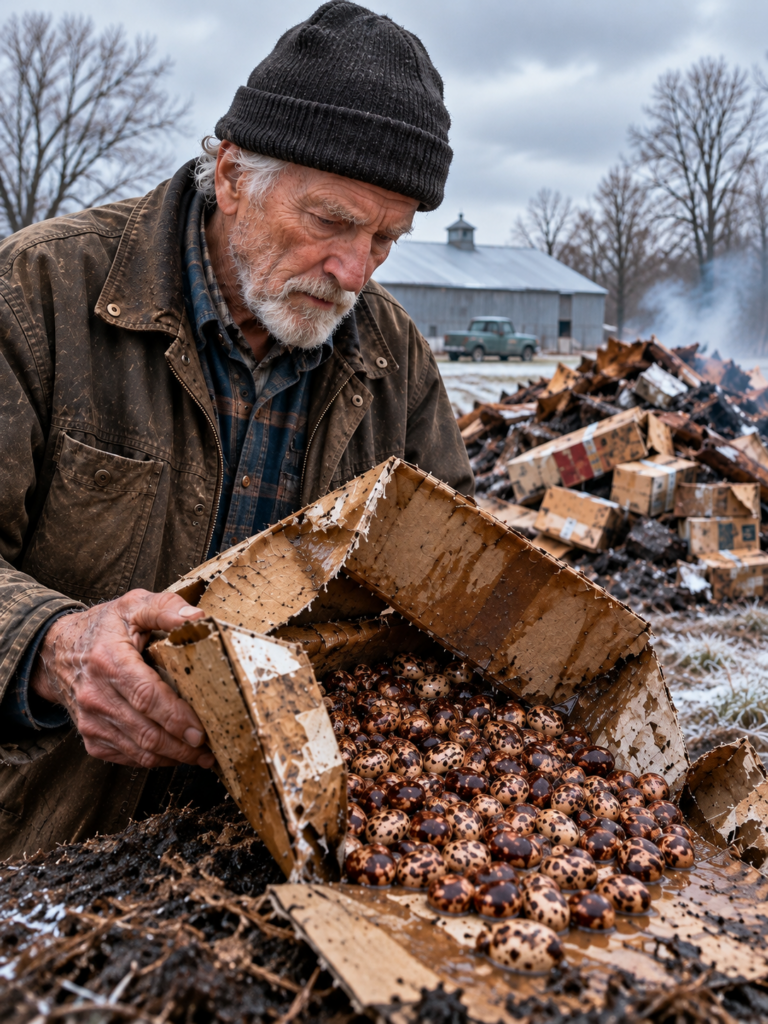
He hauled and burned for two days. The newspapers went first and they went up the way newspapers do, bright and quick. The junk sorted itself. Some to the scrap trailer. Some to the fire. Coffee cans of good hardware went into his own shed because he was not a wasteful man. Friday afternoon he started on the boxes. He loaded the pickup bed with them, load after armload, backed up to the burn pile at the edge of the pasture, and stacked them on. He told himself he would finish Saturday and light the whole works at once. By the time the bed was empty the light was going and his hands had quit before his stubbornness did. The matches stayed in his coat pocket.
That night it rained. It was not in the forecast. It rained slow and steady from midnight until near dawn, the kind of rain a man would have paid money for in August. Jack lay awake and listened to it on the roof and thought about wet burn piles and deadlines and the loader tractor rusting outside. He did not know yet that he would thank that rain every day for the rest of his life.
Part 2
Saturday morning the grass was wet and the air smelled like cold metal. Jack walked out to the burn pile already aggravated. A wet pile meant a week’s delay and the insurance letter was still on the kitchen table under the salt shaker. He stood there working out his cussing when he saw it. Down near the bottom of the stack, one box had taken the water hard and folded open like a dropped pie. Speckled brown beans, a double handful of them, stuck to the wet cardboard. On the lid, in carpenter’s pencil, in the neatest small hand a man ever saw, the words read: Hollis Polebean. Vera Hollis, Route 3, 1968.
Vera Hollis had been gone twenty years. She had kept the best garden in the county for half a century. People drove from two towns over to see her roses. Jack had helped carry her casket. He stood at the pile a long while with the cold seeping through his boots. Then he picked up the next box and peeled the tape. Dutch Creek Butterbean. The Kellerman place. 1971. Inside were envelopes, dated envelopes, one behind another. Seed from ’71 and then the same bean grown fresh and saved again in ’76 and ’81 and ’85, right on up to two summers ago.
Jack let down the tailgate and sat there in the cold opening boxes like a man who had forgotten he was tired. Beans. Corn. Tomato seed dried careful on labeled paper. Squash, okra, cowpeas, lettuce gone to seed, zinnias and four-o’clocks and hollyhocks. Every box one variety. Every lid a name, a place, and a year. The names were not plant names first. They were people. Neighbors. Whole families off Jean’s old mail route. Half of them Jack had helped bury.
The frost came off the grass in slow white curls while he sat there. He carried every box back into the grainery like he was carrying eggs. Later they counted what was left on those shelves. Counted it twice. Three hundred and eleven boxes. On the end shelf, where he had not gotten to yet, he found the notebooks. Pocket notebooks, the kind that ride in a shirt pocket. Sixty-some of them, rubber-banded in bundles by decade, going all the way back to 1963.
That night he sat at the kitchen table under the good light and opened the first one. First page dated April of ’63. Jean Prather was twenty-one years old and two years onto the mail route. One line: Mrs. Aldus’s beans. She is the last one growing them. Somebody ought to keep them.
Jack read that line three times. Then he closed the notebook and set it down careful and put both hands flat on the table because they had started to shake. Twenty-one years old. And then the man had spent the next sixty years being the somebody.
Part 3
The notebooks laid the whole thing open. Every spring, lists in that same carpenter’s pencil. Which boxes came off the shelf. What went into the half-acre behind the barn. What got saved back in fall. What got handed back to the families it came from. Every variety came up for its turn every three or four years, regular as taxes. One corn a year, just one, so the corn would stay true, because corn will cross with its neighbors on the wind. Jean had taught himself hand-pollination out of a government pamphlet he kept folded in the 1974 notebook.
That garden Jack had watched out his kitchen window for thirty-five years had never been a hobby. It was a rotation. The man had been running a library where the books die if you do not read them often enough.
Jack did not sleep much that weekend. He walked the grainery in the dark with a flashlight and read labels until his eyes burned. He thought about the matches still in his coat pocket and about how close he had come. Monday morning he called the university extension office. Tuesday afternoon a young agent named Katie drove out. She was maybe thirty, with a clipboard and boots that had seen mud. Jack expected polite. He expected a pamphlet of his own. She walked into the grainery and went quiet the way people go quiet in churches. She stood in front of that wall of boxes with her mouth a little open and then she said, “Mister, do you know what this is?”
“I’m starting to,” Jack said.
She showed him the paper-towel trick that same afternoon at his kitchen counter. Count out ten seeds. Damp paper towel folded over, into a bread bag, the bread bag onto a warm spot. Top of the refrigerator does fine. Then you wait and you do not peek more than twice a day, which Jack failed at completely.
Inside of a week his kitchen looked like a science fair. Bread bags on the refrigerator, bread bags on the water heater, labels everywhere in his own bad pencil next to Jean’s good pencil. Six days in he unfolded the towel marked Hollis. The box said 1968, but the newest envelope inside said those beans were grown out and saved fresh two summers ago. Eight seeds out of ten had put out little white roots curled like commas. Alive. Vera Hollis’s beans alive on top of his refrigerator twenty years after they buried her.
Not every box woke up. The oldest envelopes, the ones from the sixties that never got regrown, most of those stayed quiet and would stay quiet. That was the nature of it. And the twelve boxes that had ridden the bottom of the burn pile took water. The labels ran. The seed molded before Christmas. Every test a failure. Twelve varieties gone for good, and they had gone on Jack’s truck, off his tailgate, by his own hand. Rain had saved three hundred and eleven. It could not save what he had stacked first. He carried that. He would rather tell a man about it than pretend it did not happen.
Katie made phone calls. Phone calls got made back. There was an outfit, a seed-saving organization, people whose whole working life was keeping old varieties from winking out of the world. In the middle of January they flew a man out. Flew him in January to look at cigar boxes in a Missouri dairy barn. He was a gray-bearded fellow, gentle with things. He went through the grainery shelf by shelf for two days, cross-checking catalogs and collection lists on a laptop that looked too new for the room. On the second evening he sat down at Jack’s kitchen table and told him that more than a dozen of the varieties on that wall could not be found anywhere else. Not in catalogs. Not in collections. Not in the government seed banks. Not rare, he said. Gone everywhere on this earth except Jean Prather’s shelf.
Then he set one box on the table between them, careful as communion. The only box in three hundred and eleven with no family name on it. The lid said, in that same small pencil: Yellow. Mine. Started 1979.
The notebooks told the rest. In 1979 Jean had crossed two of his old tomatoes. Then for fourteen straight years he had grown the offspring and picked the best and saved it and grown it again until it came true. A yellow tomato of his own making. Bred on a rented half-acre by a mail carrier and never named.
The seedman asked what it was called. Jack told him to give him the winter to think about it.
Part 4
The barn question settled itself simpler than Jack had feared. Once the junk and the newspapers were gone, the fire marshal was satisfied. The box wall stayed. The barn stayed on the policy. The bore and the loader tractor went under a roof by Christmas for the first time in two years. The grainery got a proper going-over. Shelves squared. Boxes sorted. Everything dry and cold, which turned out to be exactly how seed likes to sleep.
They worked all winter, Katie and Jack and a slow parade of volunteers she rounded up. Garden-club ladies. A couple of her students. The seed outfit checking in by phone. Every box opened, logged, tested, and put back. Jean’s notebooks copied page by page so the originals could rest. Jack’s kitchen table stayed covered with paper and coffee rings and the smell of damp seed. Some nights he sat there after the others had gone and read the notebooks again by the good light. He learned the names of gardens that no longer existed and the people who had tended them. He learned that Jean had walked his route with a small notebook in his shirt pocket and a quiet question for anybody who still grew something old: “Mind if I save a few?”
Most of them had not minded. Some of them had been glad somebody asked.
In March Jack filled out the form for the yellow tomato the way he decided it ought to read in the catalogs from now on. Prather’s Route Three Yellow. He wrote the words in his own hand first, then typed them clean, then sat looking at both versions for a long time before he put the form in the envelope.
Come April, Jean’s rotation ran again. The half-acre behind the barn went first, plowed and fitted and planted to the varieties the seedman had flagged as most urgent. Then Jack’s own garden. Then Katie’s trial plot at the extension office. Then a dozen volunteer gardens scattered across three townships. By June there was more ground under Jean’s seed than that man had ever had in his whole careful life.
The Hollis pole beans went up strings that summer in Vera Hollis’s granddaughter’s garden on the same ground where her grandmother had grown them. The granddaughter was in her forties, with Vera’s eyes and a different set to her mouth. She cried when Jack handed her the envelope. Then she planted every last seed in it, which was the correct response. Jack stood at the edge of the garden with his hat in his hands and watched her mark the rows with sticks and string and did not say much because there was not much that needed saying.
Part 5
In late summer, when the new seed came in and got dried and sorted, Jack did the thing he had been planning since January. He took Jean’s first notebook, set it on the truck seat, and drove the old route. Three townships of gravel. Every place where the notebooks showed a family had handed Jean their seed, if there was still family on the ground. He pulled up to the mailbox and left an envelope inside with a note that said: Grown from seed your people gave Jean Prather, the mail carrier, years back. He kept it safe all this time. It’s yours. Plant it.
Thirty-one mailboxes. It took him all day because at about half of them somebody came down the drive to talk. Those conversations do not hurry. An old woman in a house that used to belong to the Kellermans stood on her porch with the envelope in both hands and asked if the butter beans still tasted the way she remembered. Jack told her he did not know yet but that she was welcome to come out and see the plants if she wanted. She said she might. A younger man at the end of a long lane took the corn and stood looking at the label for a long time before he said his grandfather used to say that corn made the best meal of any he ever grew. Jack nodded and did not rush him.
He got home after dark. The porch light was on. He sat in the truck with the empty notebook on the seat beside him and listened to the engine tick as it cooled. Across the yard the dairy barn doors were shut tight. Inside, the shelves were full again, the boxes squared, the labels dry. The half-acre behind it was already going to seed in places. Foxtail had not won this year.
People ask sometimes what a life adds up to. Jean Prather carried other folks’ words for thirty-five years and left hardly any of his own. Eleven people at his funeral. One line in the paper. But he left three hundred and eleven boxes with his neighbors’ names on them. Which is to say he left springtime, measured out, labeled, wound like a clock, and paid forward to people who were not born yet when he started keeping it.
The old dairy barn is a library now, Jack supposes. And he has turned librarian in his old age. Every time he lifts a lid and sees that carpenter’s pencil, he thinks about a tired man with matches in his coat pocket and about a rain that was not in any forecast. Some inheritances come through a lawyer. The best one he ever handled came in cigar boxes.
He still keeps the matches in that coat. He does not expect to need them for a burn pile again. But a man who has almost made a mistake that big likes to know where the matches are, just in case the next rain is late.


