
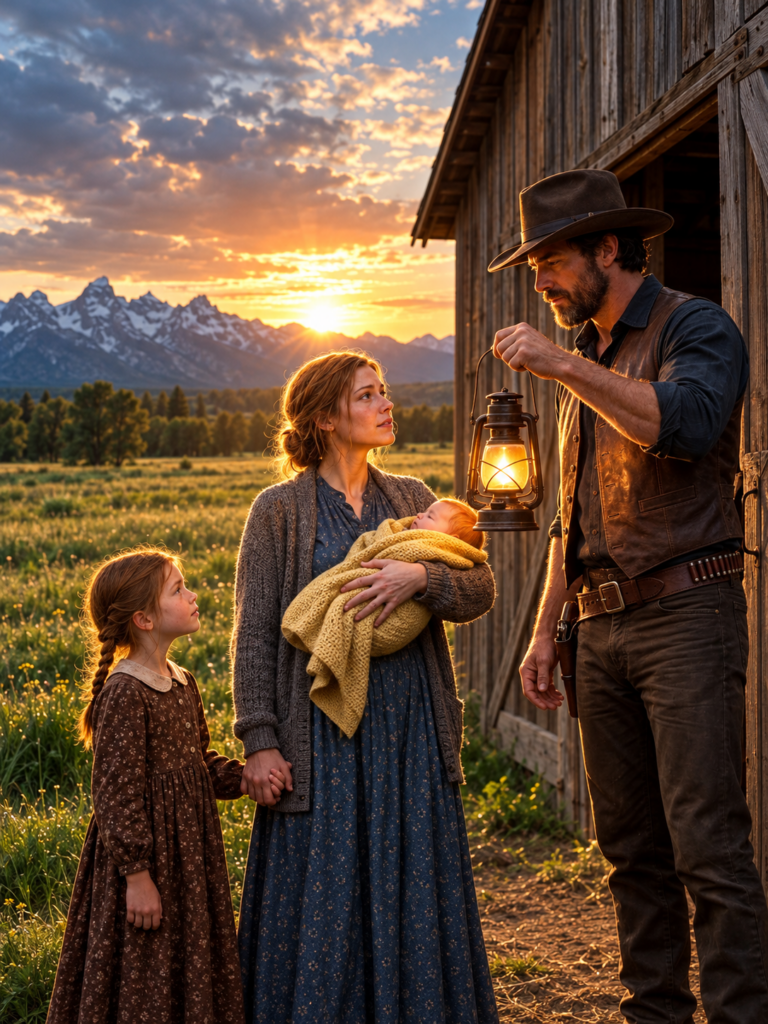
the rain-soaked widow asked only for his barn — the hard man who had buried his heart said no and gave her the house instead
Part 1
The rain had been falling since midmorning, the kind that turned the road to soup and drove the cold straight through a man’s coat. Wade Harlan stood on his porch with a lantern at his side and watched the three figures come out of the gray. A woman in a dark dress that clung to her legs, a little girl in boots two sizes too big, and a bundle in the woman’s arms that moved and made a thin, tired sound. They stopped at the gate. The woman lifted her face. Water ran off the brim of a hat that had once been decent.
“May we sleep in your barn, mister?” she called. “Just till the rain stops.”
Wade looked at the baby’s head, at the girl’s soaked stockings, at the way the woman held herself as if one more step might finish her. The barn was dry enough. The loft had hay. He had slept worse places himself, years ago.
“No, ma’am,” he said. “You’ll sleep in the house.”
The little girl peered around her mother’s skirt. “Does he bite, Mama?”
The woman’s mouth twitched, not quite a smile. “Only on Sundays.”
Wade opened the gate. The latch stuck; he had not used it for anyone but himself in a long while. They came through. Up close he saw the red in the woman’s hair where the rain had darkened it, and the set of her jaw that said she was not asking twice. The baby was asleep or too cold to fuss. Wade took the woman’s satchel without asking and carried it up the steps. She followed. The girl came last, looking at everything.
Inside, the house smelled of woodsmoke and the coffee he had made at noon and left on the stove. The clock in the hall ticked. Ellie Price—she gave him the name while she stood dripping on the boards—looked around as if she were counting exits. Wade pointed her to the stairs.
“There’s a bed upstairs. Clean sheets.”
“We’ll be gone before light, mister.”
“Harlan,” he said. “And you’ll be gone when the rain’s gone. Not before.”
She nodded once. The girl, Molly, was already halfway up the stairs, boots squelching. Ellie went after her. Wade heard the door of the spare room close. He stood in the hall a minute, listening to the rain on the roof and the small, wet breathing of the baby through the floorboards. Then he went to the kitchen and put the kettle on again. He had not done that for anyone but himself in three years.
Upstairs Ellie sat on the edge of the bed with her back to the wall and the baby in her lap. Molly had kicked off the oversized boots and was examining the quilt as if it might hide something useful. Ellie did not undress them yet. She waited until she heard the man’s boots on the porch again, the scrape of a chair, the low creak of weight settling. Then she eased Molly out of the wet stockings and into a dry shift from the satchel. The baby—Sam—stirred and made a small sound. Ellie put him to the breast under the cover of her shawl. He latched and quieted.
She had left Leadville four days earlier in the back of a freight wagon under a tarp that smelled of coal oil. Sixty-one cents, a Bible, a pocket pistol that had belonged to Henry, and two children who had not asked where they were going. The teamster had put them down at the crossroads when the road turned south. After that they walked. The rain found them on the second day and stayed. By the time the house appeared, with its lamp in the window and the gate closed, Ellie’s legs had stopped feeling like her own.
She slept sitting up, between the children and the door. Wade knew that kind of sleep. He had slept it himself once, in a country where the next knock could be the last. He sat on the porch with the lantern low and the rifle across his knees, not because he expected trouble tonight but because the habit had never quite left him. The rain ran off the eaves in steady ropes. Somewhere past midnight the baby cried once and was soothed. A board creaked. Then quiet again.
In the morning the rain had eased to a drizzle. Ellie came down with Sam on her hip and Molly behind her, hair braided with more determination than skill. Wade was already at the stove. He had fried bacon and set out bread. He did not look at her when he said there was coffee. She poured two cups without asking and set one in front of him. They ate at the table. Molly swung her feet and watched him the way children watch animals they have been told not to touch.
“Is this your house all by yourself?” she asked.
“It is now.”
Ellie cut a piece of bacon small and fed it to Sam on the tip of her finger. “We’ll be out of your way as soon as the road firms.”
“Road’s not the problem,” Wade said. “You’re soaked through. The girl’s boots are no good. Stay till you’re dry and fed. That’s all.”
She looked at him then, steady. “I don’t take charity, Mr. Harlan. I pay with what I have.”
“Then you’re a rich woman.” He stood and took his plate to the basin. “Nobody’s cooked in that kitchen in three years. If you want to earn your keep, the stove’s yours.”
She did not answer. But after he went out to the barn she washed the dishes and set a pot of beans on the back of the stove with a pinch of the salt he kept in a tin. Molly found a rag and wiped the table. When Wade came back at noon the house smelled different. Not better, exactly. Just occupied.
That afternoon Molly discovered the ladder to the loft. Wade heard her voice from the yard—“Mister! There’s a baby bed up here!”—and went inside faster than he meant to. Ellie was already at the foot of the ladder. Molly’s head appeared over the edge.
“Whose is it?”
“Leave it be, Molly,” Ellie said. “Please.”
Wade climbed the ladder. The cradle was where he had left it, covered with a feed sack. He had carved the rockers the winter before the boy was born, working by lamplight after the chores. Anna had sanded the edges so there would be no splinters. He pulled the sack off. Dust rose. The wood was still smooth.
“Her name had been Anna,” he said, not looking at either of them. “The boy was called Daniel, after my father. Fever took them both in the spring of seventy-eight. Same week.”
Molly was quiet. Ellie came up the ladder far enough to see. She put a hand on the rail. “She must have been very loved.”
“She was.”
He covered the cradle again. They went down. In the kitchen Ellie stood with her hands on the table. “You didn’t have to tell us.”
“You asked.” He poured coffee he did not want. “Anna would’ve had you dry and fed before you got through the door. I made you stand in the rain long enough to ask. That was wrong of me.”
“My husband would have liked you,” she said. “He wrote poems on the backs of assay slips. He was teaching Molly her letters. He was going to buy a little farm in the valley when the boy was old enough to ride.” She stopped. “A beam gave way. Four hundred feet down. Lucius Vance—his father—owns the mine. He owns most of what matters in Leadville.”
Wade nodded. He had heard the name. Silver men did not stay quiet.
The rain came and went for the next two days. Ellie cooked. She mended a shirt she found on the back of a chair without being asked. She wound the clock in the hall. Molly learned the name of the brown cow and how to tell a hawk from a buzzard by the set of its wings. Wade showed her. In the evenings they sat at the table with the lamp between them. Ellie read from the Bible in a low voice while Sam slept in a basket Wade had lined with a clean blanket. Molly practiced her letters on the back of an old newspaper. Wade listened and said little.
On the fourth morning he hitched the wagon. “Girl needs shoes,” he said. “Baby needs milk. We’ll go into Cedar Bluff.”
Ellie looked at the road. “They may be looking for us.”
“Then better we know it.”
She climbed up beside him. Molly sat in the back with Sam, both of them wrapped in the quilt from the spare room. The sun came out as they topped the ridge. The town lay in the valley, small and white and ordinary. Wade drove straight to the store. Inside, the clerk looked at Ellie once and then at the children and then at Wade’s face and decided not to ask questions. Ellie chose the smallest pair of boots that would fit. She counted coins onto the counter.
“I can pay half now and the rest—”
“No credit to strangers, ma’am,” the clerk said. “Cash or nothing.”
A woman in a good hat turned from the dry-goods shelf. “A widow, sleeping under a widower’s roof. In my day we had a word for women like that.”
Wade set a sack of flour on the counter. “Boots for the girl. A sack of flour. And whatever else the lady needs.” He looked at the woman in the hat. “In my day, Mrs. Whitcomb, we had a word for women who walk forty miles through a storm to keep their children. We called them mothers.”
The clerk wrapped the boots in paper. Molly carried them to the wagon as if they were made of glass. On the way home she fell asleep with the package in her arms. Ellie sat quiet for three miles. Then she said, without looking at him, “Nobody has stood up for me in a very long time, Wade.”
He drove a little slower the rest of the way. The sun went down behind the ridge. The lamp in the kitchen window was already lit when they turned into the yard; he had left it burning on purpose, the way a man does when he expects someone to find the gate.
Part 2
The days settled into a shape. Ellie rose before the light and had coffee ready when Wade came in from the barn. She learned which boards in the porch creaked and which did not. Molly took to following him on the short chores, carrying the egg basket with both hands. Sam grew louder. He laughed when the rooster crowed and kicked his feet when Ellie held him up to the window. Wade found his shirts mended and a jar of wildflowers on the table where nothing had stood since Anna died. He did not move the jar.
One evening Molly looked at him across the table and said, “How come you never smile, Mister Wade?”
“Forgot how, I guess.”
“That’s all right. I’ll show you. It’s easy.” She demonstrated, pulling her mouth wide. Wade’s face did not change, but something in his eyes did. Ellie saw it and looked down at her plate so he would not catch her watching.
He never asked why they had left Leadville in such a hurry. Some questions a man only asks when he is ready to hear the answer. Ellie did not offer it. She slept in the spare room with the children. Wade slept downstairs on the narrow bed he had moved into the room off the kitchen years ago, closer to the door. They passed each other in the hall with careful distance. Once her hand brushed his when she reached for the same cup. Neither of them spoke of it.
On the fifth day a letter arrived with the mail rider. Wade opened it at the table after supper. His face went still. He folded the paper and set it under the lamp.
“From Leadville,” he said. “They say you took the boy. Court gave him to the old man. Papers say you’re unfit.”
Ellie set her sewing down. “Lucius Vance had a doctor sign a paper that says I’m not right in the head. There’s a place in Denver for women like that. They don’t come out. Henry’s father never wanted me. He wanted a grandson he could raise the way he raised Henry—hard, and useful, and afraid of him. He doesn’t want Molly. He doesn’t want me. He wants Sam.”
“You walked.”
“Forty miles. Molly carried the bag the last ten.”
Wade looked at the children. Molly was on the floor with her new boots, polishing the toes with a rag. Sam was asleep in the basket. “You’re not walking out into the rain again.”
“They’ll burn your house down to get him.”
“Then they’ll have to come through the gate first.”
He did not tell her what he had been before he was a rancher. He did not tell her about the badge in the bottom of his trunk or the name men in Texas still said quietly. He only took the lantern from the table and walked her back to the stairs when the lamp began to gutter. At the top step she stopped.
“Wade.”
“Sleep,” he said. “I’ll be on the porch.”
Before Colorado there had been Texas. Eleven years with Company D of the Frontier Battalion, from the Rio Grande to the Staked Plains. He had ridden after cattle thieves and men who burned homesteads for sport, and he had brought most of them back. When Anna married him she asked for one thing: that he put the badge away for good. He had kept that promise for nine years. That night he opened the trunk. The badge lay on top of a folded shirt. He looked at it a long time. Then he loaded the Colt and put the badge back where it had been.
The rain came back harder the next afternoon. Black clouds rolled over the ridge from the west. With them, down the valley road, came a closed buggy and three riders in long slickers. Wade saw them from the porch. He knew the man in the black hat by reputation. In Texas they called him Deacon because he liked to quote scripture. Wade had put his younger brother in Huntsville in the summer of seventy-two. A man like Deacon Pike did not forget. Neither did Wade.
Nobody in the house slept much that night. Ellie sat by the upstairs window with Sam, watching the road. Molly slept in her new boots because she said they might need to run. Wade sat on the porch with the rifle across his knees the way he had sat outside a hundred camps, listening to the rain and waiting for morning.
They came at first light. The buggy stopped at the gate. A man in a town coat stepped down with a paper in his hand. Deacon Pike stayed on his horse. The other two riders spread out without being told.
“Thaddeus Greer,” the man in the coat said. “Attorney for Mr. Lucius Vance. I have a court order for the child.”
Wade stood. The rifle stayed low but ready. “Harlan.”
Pike’s mouth moved. “Captain Wade Harlan. Company D. Texas Rangers.”
“That was a long time ago.”
“You sent my brother to Huntsville. He died there.”
“Then you know how this ends, Deacon.”
Ellie came out onto the porch with Sam wrapped against her. Molly stood in the doorway behind her, boots on, face pale. Greer held up the paper.
“Signed April ninth. The boy is to be delivered to his grandfather.”
“Judge Kittredge was buried April second,” Wade said. “I was at the funeral.”
Pike’s horse shifted. One of the riders put a hand on his gun. Wade’s voice stayed level. “Drop it, Pike.”
Ellie stepped forward. She had a folded letter in her free hand. “Henry wrote this the night before he went down that shaft. He knew.” She opened it. The paper shook, but her voice did not. “My children are to remain with their mother. My father is not to raise them as he raised me.”
Greer’s face changed. He looked at the signature, then at Pike. Pike looked at Wade. For a moment the only sound was the rain on the roof and the baby’s small breathing. Then Pike turned his horse. The other riders followed. Greer climbed back into the buggy without another word. They rode down the valley road the way they had come.
Wade lowered the rifle. Ellie stood where she was, the letter still in her hand. Molly came out and took hold of her skirt. None of them moved until the riders were out of sight.
Inside, Ellie sat at the kitchen table and put her head on her arms. Wade set the rifle in the corner and poured coffee he did not drink. After a while he said, “They’ll try again. Different paper. Different man.”
“I know.”
“You can stay here. Or I can take you to the railhead at Pueblo. You decide.”
She lifted her head. “And if I stay?”
“Then you stay because you choose it. Not because the road is bad or the men are coming. When the rain stops for good, you can still go.”
She looked at the letter. Henry’s writing was small and careful. “He would have liked this house,” she said. “He would have liked you.”
Wade did not answer. He went out to see to the horses. When he came back the letter was on the table under the lamp and Ellie was upstairs with the children. He sat across from the empty chair until the window turned gray. For the first time in three years he did not want the night to end too fast.
Part 3
The storm blew itself out a little after midnight. By morning the road was still soft but the sky was clear. Wade walked the fence line and found no fresh tracks. When he came back Ellie was in the kitchen with her sleeves rolled and flour on her hands. Molly sat on the floor teaching Sam to clap. The house smelled of bread.
“They won’t come today,” Wade said.
“No.”
He washed at the basin. She set a plate in front of him without speaking. They ate. Afterward she wiped her hands and looked at him.
“Wade. You don’t have to keep us.”
“I know.”
“Molly asked if we could stay till the rain stops.”
“Rain’s stopped.”
“She said stay anyway.”
He was quiet a long moment. Then he said, “There’s a room upstairs that hasn’t been used. The cradle’s in the loft if you want it down. I’ll build a proper bed for the girl. You cook if you want to. You leave when you want to. That’s the bargain.”
“And you?”
“I stay where I am. Downstairs. Door between us stays open or closed as you like.”
She nodded. “All right.”
The days that followed were ordinary and not. Ellie took the cradle down herself. Wade sanded the rockers again and set it by the stove where Sam could see the fire. Molly’s bed went against the wall in the spare room; Wade built it from boards he had been saving for a new gate. In the evenings Ellie read aloud. Sometimes she sang, low, the way a woman sings when she is not sure anyone is listening. Wade listened. He began to answer when Molly asked questions. Once, when the brown cow kicked over the milk pail, he laughed—one short sound—and Molly looked so pleased that Ellie had to turn away to hide her own face.
Word traveled the way it does in small places. By Sunday half of Cedar Bluff had heard that Wade Harlan stood at his gate against three hired men. The other half had heard about the boots. Mr. Hobbs at the store sent a sack of sugar out with his compliments and did not send a bill. Mrs. Whitcomb did not come calling. No one missed her.
On a clear evening in late May, Ellie found Wade on the porch mending a bridle. She sat on the step below him. Sam was asleep upstairs. Molly was practicing her letters by the lamp.
“I’ve been thinking,” Ellie said. “About the railhead.”
“You can still go.”
“I know.” She watched the last light on the ridge. “I don’t want to. Not because of the men. Because of the bread in the morning and the way Molly talks to you and the fact that the house doesn’t feel empty when I walk into it. I want to stay because I choose it. If you’ll have us.”
Wade set the bridle down. “I’ll have you. Not as a duty. Not as a debt. As yourself.”
“That’s all I ever wanted.”
He reached down and took her hand. Her fingers were warm from the dishwater. He did not pull. She did not pull away. They sat like that until the first stars came out.
They were married in June in the little white church on Main Street. Molly wore her new boots and threw wildflowers at everyone, including the preacher. Mrs. Whitcomb was not invited. Lucius Vance’s lawyer wrote one more letter; Wade answered it with a copy of Henry’s will and the name of a Denver attorney who did not owe Vance money. The matter ended. Deacon Pike was seen once more in Cañon City, wearing stripes. No one in Cedar Bluff mentioned it aloud.
On stormy nights from then on the lamp in the Harlan window stayed lit till morning, in case anyone else came knocking. Sam Harlan—he took Wade’s name the year he turned six—grew up to wear a silver star of his own. People who knew him said he never once turned away a stranger at the door. When they asked him why, he said his father had taught him. And that his father had learned it one stormy night in the spring of 1881, from a woman, a little girl, and a baby who only asked to sleep in the barn.


