
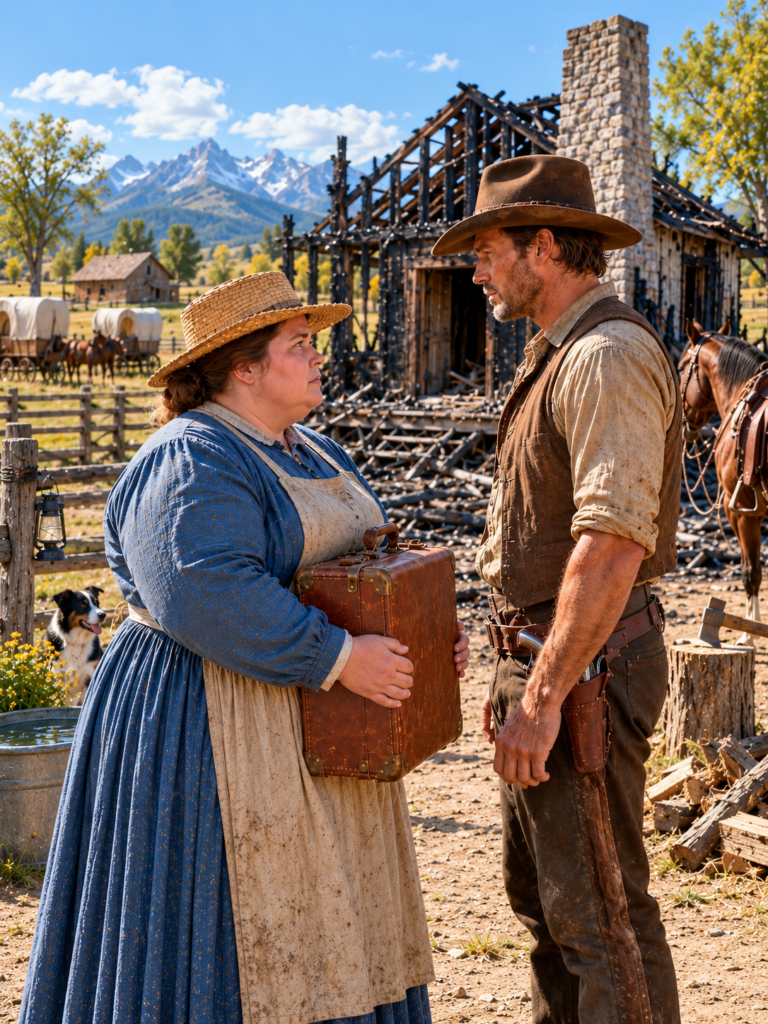
the mail-order bride arrived at his burned wyoming ranch with one suitcase — then he learned she could have bought the whole valley
Part 1
The stagecoach stopped three miles outside Dry Creek because the road ahead was still black with ash.
Evelyn Parker stepped down before the driver could offer his hand.
Wind moved across the Wyoming valley carrying the smell of burned grass and wet charcoal. Six weeks had passed since the prairie fire, but the land still looked wounded. Fence posts leaned at odd angles. Cottonwoods along the creek had been scorched on one side. In several places, the earth was so black that Evie’s boots left pale brown prints through the ash.
The driver climbed down behind her.
“Miss Parker.”
Evie turned.
He nodded toward the road.
“You sure about this?”
She looked where he was looking.
Hayes Ranch lay ahead.
Or what remained of it.
One side of the farmhouse still stood. The other had burned open to the sky. The barn was a roofless skeleton. A wagon lay on its side near the corral, its wheels charred down to iron rims.
Beside a half-filled stock trough stood a man.
Caleb Hayes.
Six months of letters had taught Evie to expect a quiet rancher who wrote slowly and carefully, as if every sentence cost money.
The man before her looked older than thirty-four.
A scar ran from the left side of his jaw down beneath his shirt collar.
His right hand was partially curled from burns.
He wore a work shirt faded almost white across the shoulders and a hat darkened by sweat.
He did not come toward her.
He simply looked at her suitcase.
Then at the stagecoach.
Then back at Evie.
“You came too late.”
The driver made a small sound behind her that meant he agreed.
Evie looked at the burned house.
“For what?”
“The life I offered you.”
Caleb’s voice was rougher than she had imagined.
Evie had read his letters in a Chicago boardinghouse beneath gaslight. In those pages he had described ninety-three acres of grassland, thirty-two cattle, a barn built by his father, and a house with a kitchen window facing east.
He had told her that Wyoming winters were difficult.
That ranch work was harder than advertisements made it appear.
That he was not handsome, sociable, wealthy, or particularly clever with women.
He had also written that he did not drink, gamble, or strike people in anger.
Evie had found that last sentence strangely reassuring.
Now the barn was gone.
The house was half gone.
And the cattle she could see were thin.
Caleb pointed toward the coach.
“Monday’s return can take you east.”
Evie looked at him.
“You want me to leave?”
“I want you to know what you’re staying for.”
“I just got here.”
“There’s not much here.”
She picked up her suitcase.
“I didn’t come for a finished life.”
Something changed in his face.
Only for a second.
Then it disappeared.
The stagecoach driver sighed.
“You folks done deciding?”
Evie nodded.
“I’m staying.”
The driver looked at Caleb as if expecting him to stop her.
Caleb did not.
The coach turned around twenty minutes later and disappeared into the gray distance.
Evie stood beside her suitcase.
Caleb stared toward the burned pasture.
Finally he said, “Bunkhouse survived.”
“Then I suppose that’s where I’ll sleep.”
“There’s a stove.”
“Good.”
“Roof leaks near the back wall.”
“Less good.”
Caleb almost smiled.
Almost.
He carried her suitcase with his left hand because his burned right hand could not close properly.
Evie noticed.
She did not offer help.
Men like Caleb sometimes treated help as an accusation.
Inside the bunkhouse, she found one narrow bed, a washstand, a stove, and two chairs.
Everything smelled faintly of smoke.
She opened her suitcase.
There were three dresses.
Two work skirts.
Undergarments.
A Bible.
A ledger.
And her mother’s old sewing box.
Evie lifted out a faded blue scarf.
It had no practical use in Wyoming.
Too thin for winter.
Too fine for work.
Her mother had worn it during the last spring of her life.
Evie tied it to a nail beside the door.
Outside, nearly everything was gray, brown, or black.
The small piece of blue moved in the wind.
Caleb watched from across the yard.
“You always decorate ruins?”
“Only when they’re depressing.”
“This whole ranch is depressing.”
“I noticed.”
That time, his mouth definitely moved.
Evie slept poorly.
Wind found every crack.
Somewhere outside, loose metal struck wood again and again.
Near midnight, she heard footsteps.
Then silence.
She looked through the small window.
Caleb was standing near the remains of the barn.
Alone.
The moon silvered the burned beams.
He stayed there almost an hour.
At breakfast the next morning, Evie asked about the fire.
Caleb stiffened.
“You don’t have to tell me.”
He stared into his coffee.
“Lightning.”
She waited.
“Dry storm came over the western ridge. One strike hit the south pasture.”
He rubbed his injured hand.
“Wind did the rest.”
“How fast?”
“Fast enough.”
His younger brother Daniel had been living on the ranch with his wife Sarah and their eight-year-old son Ben.
When the fire crossed the lower fence, Daniel ran to open the pasture gates.
Caleb went toward the house.
“Sarah was inside?”
“With Ben.”
Caleb’s jaw tightened.
“Roof had caught. I got Ben out through the side window. Went back for Sarah.”
“And Daniel?”
“He didn’t come back from the pasture.”
Evie looked toward the ruined barn.
“You went after him?”
“I tried.”
His burned hand curled tighter.
“Roof beam came down. Sarah couldn’t walk. Ben was screaming. I carried them toward the creek.”
Caleb swallowed.
“Daniel should’ve been right behind us.”
“But he wasn’t.”
“No.”
“What happened?”
“They found him the next morning near the south gate.”
Evie said nothing.
“He’d gotten most of the cattle through.”
Caleb stared at his hands.
“I should’ve gone back.”
“You would have died.”
“Maybe.”
“There were two people with you who couldn’t get out alone.”
“I know.”
“You saved them.”
“I know.”
But the words meant nothing to him.
Evie recognized that kind of guilt.
If Caleb made Daniel’s death his own fault, then the fire obeyed some terrible logic.
A choice had been wrong.
A mistake had caused the loss.
Therefore, in another version of the night, the ending could have changed.
The harder truth was worse.
Sometimes brave people made the best choice available and someone still died.
Evie did not tell him to forgive himself.
People rarely surrendered punishment simply because a stranger suggested it.
Instead she asked, “Where are Sarah and Ben?”
“In town.”
“They don’t come here?”
“Ben does sometimes.”
“And Sarah?”
“No.”
“You think she blames you?”
Caleb looked at her sharply.
“She doesn’t have to say it.”
Evie drank her coffee.
“That’s convenient.”
His eyes narrowed.
“What is?”
“Knowing what another person thinks without asking.”
He stood.
“We’ve got fence to repair.”
That was the end of breakfast.
For the first week, Evie discovered how little she knew.
She had never stretched barbed wire.
Never saddled a ranch horse by herself.
Never repaired a windmill.
Never vaccinated cattle.
Caleb showed her without mocking her.
He was patient until she pretended to understand something she did not.
Then he became merciless.
“You don’t know how to tie that.”
“I do.”
“Then why’s the knot upside down?”
“It has character.”
“It has gravity. It’ll come loose.”
On the third day, she tore both palms on wire.
The next morning, a pair of smaller leather gloves sat outside her bunkhouse.
No note.
No explanation.
Evie wore them.
Two days later, she saw the cuff of Caleb’s coat had split nearly six inches.
That evening, after he went to check cattle, she used thread from her mother’s sewing box to repair it.
She left the coat exactly where she found it.
He wore it the following morning.
Neither mentioned the matter.
Their affection began that way.
Not with declarations.
With small problems quietly disappearing.
After ten days, Evie opened the ranch books.
Caleb sat opposite her.
“You said you knew figures.”
“I said I know when numbers are lying.”
“These don’t lie.”
“They’re screaming.”
He frowned.
Evie turned the ledger.
Hay.
Feed.
Lumber.
Medical bill.
Bank note.
Outstanding supplier account.
Insurance payout from the fire: painfully small.
“How much cash?”
Caleb told her.
“How much cattle?”
“Thirty-seven survived.”
“Pasture?”
“North forty never burned.”
“Well?”
“Still good.”
“Land mortgage?”
“None.”
Evie looked up.
“You own the land outright?”
“Yes.”
“Then this ranch isn’t dead.”
Caleb laughed without humor.
“You see the barn?”
“Yes.”
“The house?”
“Yes.”
“My brother’s grave?”
She stopped.
Caleb looked away.
“You see numbers. I see what used to be here.”
That silenced her.
He was right.
Evie had spent most of her life being practical because practicality had protected her.
Her father’s freight company had taught her that every problem became easier after it was reduced to figures.
But houses were not only timber.
Barns were not only square footage.
Fields were not only acreage.
Some structures were witnesses.
Caleb’s father had driven the first fence posts.
Daniel had helped raise the barn.
Caleb’s mother had baked bread in the kitchen that burned.
Evie closed the ledger.
“We don’t have to decide today.”
Caleb looked surprised.
“You giving up?”
“No.”
“Then what?”
“I’m learning the difference between something expensive and something valuable.”
For the first time, Caleb looked at her as if the woman who had stepped from the coach might be more complicated than he expected.
That afternoon, eight-year-old Ben Hayes appeared on the road.
He walked nearly two miles from Dry Creek carrying a school satchel.
Caleb pretended to be annoyed.
“Your mother know you’re here?”
Ben kicked dust.
“Maybe.”
“That means no.”
Ben stared at the ruined barn.
Evie noticed a biscuit wrapped in cloth beside the stove.
Caleb had put it there that morning.
He gave it to the boy without comment.
Ben ate half.
Then sat on a fence rail while Caleb replaced a burned post.
“Uncle Caleb?”
“Yeah?”
“Did Dad know he wasn’t coming back?”
The hammer stopped.
Evie turned away.
Caleb stared at the nail.
“I don’t know.”
Ben nodded with the strange solemnity children used when accepting answers adults could barely survive giving.
After Ben left, Caleb worked until dark.
Evie found him that evening outside a rented house in Dry Creek.
He carried a sack.
Flour.
Coffee.
Canned peaches.
He left it beside Sarah’s door.
Then walked away before knocking.
Evie followed him.
“You always do kind things where nobody can thank you?”
He kept walking.
“Cheaper that way.”
She understood.
Gratitude created obligation.
Caleb did not believe anyone should owe him anything.
He had decided surviving Daniel required a lifetime of repayment.
Evie wondered how long a man could live that way before he no longer remembered he was alive too.
Thirty days after her arrival, she opened the ranch ledger again.
Caleb sat across from her.
“Well?”
he asked.
Evie looked at the repaired north fence.
The functioning well.
Thirty-seven cattle.
The bunkhouse.
The surviving pasture.
The half-house.
Then at him.
“The ranch is worth saving.”
Caleb’s voice was quieter.
“And you?”
Evie closed the book.
“I haven’t decided.”
But they both knew she had.
Part 2
By November, Hayes Ranch no longer looked abandoned.
It still looked poor.
That was different.
A small stable stood where the barn had burned.
The south fence had been replaced.
Caleb and Evie patched one half of the farmhouse roof before the first snow.
They did not rebuild the missing rooms.
Not yet.
Evie convinced Caleb that surviving winter mattered more than restoring a parlor nobody needed.
Dry Creek noticed.
People who had laughed at the Chicago woman stopped laughing when they saw her hauling lumber.
At first, townspeople assumed Evie would last two weeks.
Then a month.
Then somebody saw her help deliver a difficult calf during an early freeze.
Opinions changed without anyone admitting they had changed them.
One afternoon, Caleb and Evie entered Haskins Mercantile for nails.
The owner nodded toward Evie.
“Heard you’re still here.”
Evie looked around.
“Apparently.”
“Cold weather coming.”
“So people keep warning me.”
“You ever seen thirty below?”
“No.”
Haskins grinned.
“You’ll leave by February.”
Caleb put the nails on the counter.
“She’ll outlast you.”
The words surprised everyone.
Especially Evie.
Outside, she asked, “Was that confidence?”
“Observation.”
“You defended me.”
“I defended the ranch. We need cheap labor.”
She smiled.
That winter, they fell into a rhythm.
Caleb rose first.
Evie cooked breakfast.
They fed cattle together.
He repaired machinery.
She kept accounts.
At night, they sat beside the stove working separately but within reach of one another.
Caleb read agricultural bulletins.
Evie wrote correspondence.
Sometimes Ben stayed for supper.
Sarah never came.
Evie asked once whether Caleb had visited her.
“No.”
“Why?”
“She doesn’t want me.”
“She told you?”
He glared.
Evie raised both hands.
“Right. We’ve established you’re clairvoyant.”
Caleb ignored her.
The more the ranch recovered, the more another problem emerged.
Money.
Caleb had borrowed from Dry Creek Bank immediately after the fire.
The bank president, Warren Pike, had offered what he called a recovery note.
Evie read it one night.
Then read it again.
“Did a lawyer review this?”
“No.”
“Why not?”
“Because my barn was burning six days before I signed it.”
Evie’s mouth tightened.
The note gave the bank aggressive rights if Caleb missed certain payments.
Not outright ownership.
But enough leverage to force sale of cattle and equipment.
Pike had also inserted a clause tying future advances to a percentage of ranch proceeds.
“Warren Pike wrote this?”
“Yes.”
“He’s a thief.”
Caleb looked up.
“He’s the bank president.”
“Those are not mutually exclusive occupations.”
Caleb almost smiled.
Then Evie found a second problem.
Their lumber supplier had increased freight charges after the fire.
Nearly forty percent.
“Why?”
she asked.
Caleb shrugged.
“Rail transfer.”
“That doesn’t cost this much.”
“How do you know?”
Evie hesitated.
Because Parker Freight shipped similar loads across three states.
Because she had spent twelve years negotiating those contracts.
Because she knew almost every freight tariff between Chicago and Denver.
But Caleb believed she had worked as a bookkeeper for her father.
That was true.
It simply was not all the truth.
“I’ve seen freight schedules.”
“Can you fix it?”
Maybe.
She should have said she would try.
Instead, she did something that later nearly broke them.
She wrote a letter using a Parker Freight business contact.
She negotiated the supplier’s transport rate.
Then, through another contact, she reorganized part of Caleb’s bank debt into a less expensive private line.
She did not use her own money.
She told herself that mattered.
What she used was influence.
Her name.
Her company relationships.
Things Caleb did not know she possessed.
Within weeks, the lumber bill dropped.
Caleb was pleased.
“You did that?”
“I negotiated.”
“How?”
“Persistent letters.”
That was not exactly false.
Evie hated how easily partial truth could dress itself as honesty.
Meanwhile, Ben kept coming.
One snowy afternoon, he arrived shivering.
Caleb immediately wrapped him in a blanket.
“You walk here?”
Ben nodded.
“In this?”
“Ma was working.”
“You could freeze.”
“I didn’t.”
“That isn’t the same as being safe.”
Ben stared into the stove.
“Ma says we might leave Dry Creek.”
Caleb froze.
“Where?”
“Laramie maybe.”
“Why?”
“She says everything here reminds her.”
The room became quiet.
Ben looked up.
“I don’t want to go.”
Caleb’s scar pulled tight as his jaw clenched.
Evie expected him to say something reassuring.
He did not.
Later she found him in the stable.
“You could talk to Sarah.”
“She’s made her decision.”
“You don’t know that.”
“She wants to leave.”
“Ben said maybe.”
Caleb looked away.
“You’re afraid she’ll tell you she blames you.”
His face hardened.
Evie continued.
“So it’s easier to lose them without asking.”
“That’s enough.”
“No. It isn’t.”
“You don’t know anything about Daniel.”
“No.”
“You don’t know Sarah.”
“No.”
“You don’t know what happened that night.”
“I know you’ve been sentencing yourself for months without allowing anyone else to testify.”
Caleb stepped close.
For a moment Evie wondered if she had gone too far.
His voice remained controlled.
“You like fixing things.”
“Yes.”
“Not everything wants fixing.”
He walked away.
That evening, neither spoke during supper.
Evie lay awake listening to wind strike the bunkhouse walls.
She thought about the irony.
She accused Caleb of making decisions based on assumptions.
Yet she was hiding the largest truth about herself because she had already decided how he would respond.
The letter from Chicago arrived three weeks later.
Caleb handed it to her at breakfast.
The envelope carried the Parker Freight seal.
His eyes lingered on it.
“Thought your father’s company belonged to your brothers.”
Evie stopped breathing for half a second.
Her father had died eleven months earlier.
Everyone assumed her brothers, Charles and Henry, inherited Parker Freight.
They had assumed the same.
So had Evie.
Until the will was read.
She had spent her entire life working behind men who received credit for her competence.
Her father had apparently noticed.
He left the controlling interest to Evelyn.
Not a small portion.
Everything that mattered.
Warehouses.
Contracts.
Teams.
Cash reserves.
Properties.
Enough wealth that Evie could have purchased Hayes Ranch many times over.
Caleb turned the envelope.
“Why are they writing you?”
Evie reached for it.
He did not release it.
“Caleb.”
“What aren’t you telling me?”
Snow tapped the kitchen window.
Evie felt the moment she had avoided for months arrive exactly when she deserved it.
“My father changed his will.”
Caleb slowly released the envelope.
“What does that mean?”
“It means the company is mine.”
He stared at her.
“How much of it?”
“All.”
The stove popped.
Neither moved.
Caleb sat down.
“All?”
“Controlling ownership. Yes.”
“Warehouses?”
“Yes.”
“Money?”
“Yes.”
“How much?”
“Enough.”
His expression changed.
Not greed.
That would have been easier.
Hurt.
“You wrote me six months.”
“Yes.”
“You came here.”
“Yes.”
“You watched me sell cattle.”
“Yes.”
“You watched me borrow money.”
“Yes.”
“And you could’ve bought this ranch.”
“I could have.”
Caleb stood so abruptly his chair scraped across the floor.
“Did you think I’d take your money?”
“No.”
“Then why hide it?”
Evie looked at her hands.
Because she had asked herself that question every night since arriving.
Finally she answered honestly.
“I thought you might start seeing it.”
He frowned.
“What?”
“The money.”
“Instead of you?”
“Yes.”
The word came out smaller than she expected.
Evie looked toward the blue scarf near the door.
“For most of my life, men barely noticed me.”
Caleb said nothing.
“I was too tall. Too broad. Too plain. Too willing to discuss business. My brothers were invited to dinners with clients. I prepared the figures they used. Men shook their hands afterward.”
Her throat tightened.
“Then my father died.”
Caleb listened.
“Suddenly I became interesting.”
She laughed without humor.
“Men who’d overlooked me for ten years remembered I was a woman. Cousins wrote affectionate letters. Families I barely knew invited me to dinner. Suitors began finding my opinions fascinating.”
“Evie—”
“Money didn’t make me more lovable.”
She looked at him.
“It made people better at pretending.”
Caleb’s anger softened.
Then his gaze dropped to another paper beneath the envelope.
A revised lumber invoice.
He picked it up.
The Parker Freight discount was printed near the bottom.
“What is this?”
Evie closed her eyes.
There was no escaping the second truth.
“I renegotiated freight costs.”
“Using your company.”
“Yes.”
His expression hardened again.
“And the bank?”
She did not answer quickly enough.
Caleb understood.
“What did you do?”
“I moved part of the debt.”
“How?”
“Through a private credit line.”
“Whose?”
“A company associate.”
“You told me you wrote letters.”
“I did.”
“You made financial decisions about my ranch without telling me who you were.”
“I saved hundreds of dollars.”
“That isn’t the point.”
“I was helping.”
“You were deciding.”
The words hit harder than shouting.
Evie stopped.
Caleb’s voice remained quiet.
“Partnership isn’t you deciding what’s good for me because you know more.”
“I didn’t use my money.”
“You used power I didn’t know you had.”
Evie had spent years believing competence was the opposite of helplessness.
She had never considered the possibility that competence could become control.
Protection could become power without ever raising its voice.
Caleb put on his coat.
“Where are you going?”
“Town.”
“When will you be back?”
“I don’t know.”
He left.
Evie remained at the kitchen table.
For the first time since arriving, the ranch felt as empty as it had on that burned September afternoon.
Part 3
Caleb did not go to the saloon.
He rode directly to Sarah’s rented house.
Snow had begun falling harder.
By the time he tied the horse outside, white covered his shoulders.
Sarah answered after his second knock.
She looked exhausted.
Her hair was pinned badly.
Flour covered one sleeve.
“What happened?”
“Nothing.”
“Then why are you here?”
Caleb nearly said he had brought something.
That would have allowed him to leave.
Instead he forced out the question that had poisoned almost a year.
“Do you blame me?”
Sarah stared.
“For what?”
“Daniel.”
All color left her face.
Caleb continued before courage disappeared.
“For going after you instead of him.”
Sarah stepped backward.
“Come inside.”
He did.
Ben slept in the next room.
Sarah closed the door.
Then turned.
“You think I blame you?”
“Yes.”
She grabbed the dish towel from the table and slapped it down.
“I thought you blamed me.”
Caleb went still.
“For what?”
“For Daniel going back.”
“What are you talking about?”
Sarah’s eyes filled.
“That night.”
She gripped the edge of the table.
“When you were getting Ben through the window, Daniel came to the back door.”
Caleb stopped breathing.
“He was there?”
“For maybe ten seconds.”
“Why didn’t you tell me?”
“You never asked.”
The cruelty of those three words was not intentional.
That made them worse.
“What did he say?”
Sarah wiped her eyes.
“He said the south gate was open. He told me to go with you.”
Caleb’s voice broke.
“And then?”
“He turned back.”
“Why?”
“There were cattle trapped against the creek fence.”
Caleb looked away.
Sarah continued.
“I grabbed his arm.”
She was crying now.
“I told him not to go.”
Caleb closed his eyes.
“He said, ‘Tell Caleb to get Ben out.’”
That was all.
Not blame.
Not accusation.
A decision.
Daniel had chosen.
Caleb sat down.
For months, he had believed Sarah’s silence condemned him.
Sarah had believed his silence condemned her.
They had built two prisons from the same absence of words.
Caleb thought suddenly of Evie.
He had been furious because she made decisions for him without asking.
Yet he had spent nearly a year deciding what Sarah felt without asking her.
Some faults were easiest to recognize when another person carried them.
Sarah sat opposite him.
“I couldn’t come back to the ranch.”
“I know.”
“No, you don’t.”
He looked at her.
“I didn’t stay away because of you.”
“Then why?”
“Daniel is everywhere there.”
Caleb swallowed.
“I know.”
“And nowhere.”
He understood that too.
Sarah covered her face.
“I kept thinking if I walked into that yard, I’d expect him to come around the barn.”
They sat quietly.
After a while Caleb said, “The barn’s gone.”
Sarah laughed through tears.
“That doesn’t help.”
“No.”
Another silence.
Then she asked about Evie.
Caleb frowned.
“How’d you know?”
“You only come talk about feelings when something has gone terribly wrong.”
Despite himself, he laughed.
He told Sarah everything.
The inheritance.
The secret.
The debt.
Sarah listened.
When he finished, she said, “So she lied.”
“Not exactly.”
“That’s worse.”
Caleb looked at her.
Sarah shrugged.
“A clean lie is easy. Half a truth lets both people pretend.”
He rubbed his burned hand.
“She helped.”
“Yes.”
“She saved me money.”
“Yes.”
“She also made decisions for you.”
“Yes.”
Sarah leaned back.
“Sounds like both things are true.”
Caleb hated sensible answers.
“What do I do?”
“I don’t know.”
“That’s useless.”
“Welcome to family.”
Before he left, Sarah said something else.
“Ben misses the ranch.”
Caleb stopped.
“So do I.”
He turned.
Sarah looked at the table.
“Not yet.”
“All right.”
“But maybe someday.”
For the first time since the fire, someday sounded possible.
Caleb returned before sunrise.
Evie was sitting at the kitchen table.
She had not slept.
The Chicago letter lay unopened.
Beside it were the debt papers.
Caleb removed his coat.
“No more decisions like that without me.”
Evie nodded.
“Agreed.”
“Your inheritance stays yours.”
“Agreed.”
“The ranch stays mine unless we both decide otherwise.”
Her eyes flickered.
“Agreed.”
Caleb pushed the papers toward her.
“Now do it again.”
Evie frowned.
“Do what?”
“Help me.”
She looked at him.
“Just ask first.”
Something inside her loosened.
Not because he had excused her.
He had not.
Because he was giving her something she had rarely received.
Trust with boundaries.
She rewrote their arrangement.
Any major financial change concerning the ranch required two signatures.
Any use of Parker Freight influence had to be disclosed.
Any investment from Evie’s personal inheritance would require a written agreement protecting both parties.
Caleb laughed when she wrote that.
“You planning to sue me?”
“I’m planning to never need to.”
He signed.
Evie signed beneath him.
A drop of snowmelt slipped through the patched roof and landed on one corner of the paper.
Neither moved it.
Two names remained side by side as the dark spot spread.
The next problem arrived through Warren Pike.
Dry Creek Bank had not appreciated Caleb refinancing part of the post-fire debt.
Pike visited the ranch personally.
He arrived in a polished carriage and wore a black overcoat with a fur collar.
Evie disliked him immediately.
“Mrs. Parker.”
“Miss.”
“For now, I suppose.”
Caleb’s face hardened.
Pike smiled.
“I’m here on business.”
He entered the kitchen without waiting for an invitation.
He carried the original recovery note.
“Mr. Hayes, you’ve moved obligations without clearing them through us.”
“They were outside the secured portion.”
Pike glanced at Evie.
“Been receiving advice?”
“Yes.”
“Dangerous thing.”
Evie folded her arms.
“For whom?”
Pike’s smile thinned.
The bank claimed Caleb still owed fees.
Evie read the figures.
They were questionable.
Not obviously fraudulent.
Just complicated enough to frighten a rancher who lacked legal counsel.
“Why is there a livestock lien here?”
she asked.
Pike answered smoothly.
“Standard protection.”
“It isn’t referenced in the signed schedule.”
“It is incorporated.”
“Where?”
He pointed.
Evie read.
Then looked at him.
“This paragraph applies only after default.”
“Mr. Hayes was technically in default after the fire.”
“For eleven days.”
“Default is default.”
Evie studied Pike.
He had built his business model around people being too desperate to argue.
“What happens if we dispute this?”
Pike smiled.
“Court costs money.”
“So does fraud.”
Caleb looked at her.
Pike’s face changed.
Only slightly.
“Careful, Miss Parker.”
Evie leaned forward.
“I usually am.”
After he left, Caleb said, “You think he’s cheating?”
“I think he assumes hardship makes people easy to manage.”
“How do we prove it?”
“We find somebody else he managed.”
That took weeks.
Dry Creek was small.
People talked, but fear shortened conversations.
A widowed farmer named Martha Dawson had nearly lost eighty acres after her husband’s illness.
A ranching family named Cole had surrendered equipment under a recovery note.
Another man had sold land for half market value after missing two payments during a drought.
Each story sounded ordinary alone.
Together, a pattern appeared.
Pike waited until disaster.
Then offered complicated credit.
Then tightened terms.
Evie wanted to use Parker Freight lawyers immediately.
Caleb stopped her.
“Ask.”
She took a breath.
“May I have our attorneys review the documents?”
“Our?”
“My company’s.”
“What will it cost?”
“Nothing personally.”
“Will they control what happens?”
“No.”
“Then yes.”
It felt ridiculous.
It also felt important.
Two weeks later, a Chicago attorney sent a six-page letter.
Several Pike contracts appeared legally questionable.
One might constitute deliberate misrepresentation.
Caleb read the report twice.
“We could ruin him.”
Evie looked at him.
“Maybe.”
“You sound disappointed.”
“No.”
“What?”
She folded the letter.
“I’m learning not to decide what happens before everyone else gets a say.”
Caleb smiled.
“Progress.”
Meanwhile, winter loosened its grip.
One afternoon Ben appeared carrying a small bundle.
Behind him walked Sarah.
Caleb was repairing a gate.
He stopped.
Evie stood on the porch.
Sarah looked toward the new stable.
Then toward the blackened foundation of the old barn.
Her face tightened.
Caleb took one step toward her.
Then stopped.
He understood now that grief could not be dragged.
Sarah walked to one of the new beams.
Touched it.
For a long moment nobody spoke.
Then she frowned.
“Daniel would’ve complained you used pine.”
Caleb blinked.
“What?”
“He hated pine.”
“He complained about every kind of lumber.”
“Especially yours.”
“He once spent three hours explaining why my fence posts were cut wrong.”
Sarah laughed.
Caleb laughed too.
Then both of them began crying.
Evie turned toward the house.
She gave them privacy.
People imagined healing as solemn.
Apologies.
Forgiveness.
Carefully chosen speeches.
Sometimes it arrived as a joke about a dead man’s irritating habits.
Maybe grief changed when the person you lost became whole again.
Not only a body in a burned field.
A brother who complained about lumber.
A husband who snored.
A father who hid candy in his coat pocket.
Daniel was not coming back.
But for the first time, his memory did not belong entirely to the fire.
Part 4
By early spring, Hayes Ranch looked alive again.
Not restored.
Alive.
Calves stood unsteadily beside their mothers.
New grass pushed through sections of burned pasture.
The stable roof no longer leaked.
Sarah and Ben visited regularly.
Sometimes Sarah brought supper.
Sometimes she stayed.
Evie moved from the bunkhouse into the repaired portion of the main house, though she kept her own room.
Dry Creek noticed that too.
People whispered about an unmarried heiress living with a rancher.
Evie found this amusing.
Nobody had cared when they believed she was poor.
Caleb did.
“If you want a room in town—”
“I don’t.”
“People talk.”
“They talked when I arrived.”
“They’ll talk worse now.”
“Then at least we’re giving them something consistent.”
Caleb shook his head.
He loved her.
Evie knew it.
She loved him too.
Neither had said it.
Both had learned that important truths did not improve merely because they were spoken early.
Then Warren Pike made his mistake.
He sent a notice to Martha Dawson.
She had missed one installment after losing half her wheat crop.
Pike demanded immediate transfer of equipment pledged under her note.
The equipment listed included a tractor not actually covered by the agreement.
Martha came to Hayes Ranch because someone in town told her Evie understood contracts.
She apologized three times before sitting.
“I’m not asking for charity.”
Evie recognized the shame immediately.
The need to prove hardship had not made her helpless.
“I didn’t offer charity.”
Martha looked up.
Evie opened the ledger.
“Let’s see what you still have.”
Not what she had lost.
What remained.
Land.
Seed.
A second tractor.
Twenty acres unaffected by blight.
A daughter who could help keep books.
Three neighbors owed her money.
Insurance pending.
Caleb watched Evie work.
This was the woman her brothers had hidden behind office doors.
Not merely wealthy.
Capable.
By evening, Martha had options.
Evie asked permission before contacting anyone.
Each time.
Caleb noticed.
Three days later, the Parker attorneys found something significant.
Pike’s contracts with five distressed families contained differing language but identical hidden triggers.
Late fees appeared in one place.
Accelerated transfer rights in another.
Valuation clauses shifted depending on what property the borrower owned.
The pattern looked deliberate.
A state investigator agreed.
The bank examination began quietly.
Pike responded by becoming dangerous.
He spread rumors that Evie was using her wealth to seize local land.
He suggested Hayes Ranch was secretly owned by Parker Freight.
He hinted that Caleb was marrying money.
Dry Creek did what small towns always did.
It divided.
Some believed the rumors.
Others did not.
Caleb heard the worst one at Haskins Mercantile.
A rancher he barely knew laughed and said, “Guess getting burned out worked well for you. Rich wife fell right out of the stagecoach.”
Caleb hit him.
Once.
Hard enough to knock him into a flour display.
Evie learned about it before Caleb got home.
She was furious.
“You punched him?”
“Yes.”
“Why?”
“He insulted you.”
“I have survived insults without your fist for thirty-one years.”
“He insulted me too.”
“That sounds more honest.”
Caleb rubbed his knuckles.
Evie tried to remain angry.
Failed.
“Did you at least win?”
He looked offended.
“Obviously.”
She laughed.
Then became serious.
“Caleb.”
“I know.”
“No more fighting over gossip.”
“I know.”
“If Warren Pike wants us angry and stupid, don’t help him.”
Caleb nodded.
Then asked the question he had avoided.
“Do you plan to stay?”
Evie went still.
“Here?”
“Yes.”
She looked toward the eastern window.
The one they had repaired.
Outside, the new fence crossed the pasture.
Ben chased a dog near the stable.
Sarah was hanging laundry.
The blue scarf moved beside the back door.
“I don’t know what Parker Freight becomes if I stay.”
“You don’t have to give it up.”
“My brothers think I do.”
“What do you think?”
That was the question nobody had asked.
Men in Chicago assumed she would eventually surrender control.
People in Dry Creek assumed she would sell the company and become Caleb’s wife.
Both versions required Evelyn Parker to disappear inside somebody else’s idea of her future.
“I think I can do both.”
Caleb nodded.
“So do both.”
She stared at him.
“You make that sound simple.”
“A ranch has cattle and hay. Why can’t you have freight and Wyoming?”
“Because Chicago is eight hundred miles away.”
“Trains exist.”
She smiled.
“That’s an unusually progressive thought for a man who still distrusts indoor plumbing.”
“I distrust pipes in winter.”
“There’s a difference?”
“Significant.”
That evening Evie wrote to her managers.
She proposed a western freight division based in Dry Creek.
Ranchers throughout isolated territory paid inflated prices because they purchased small shipments individually.
If Parker Freight combined regional orders, farmers could buy lumber, seed, tools, and household goods at rates previously available only to larger operations.
It was practical.
Profitable.
And useful.
Her brothers opposed it immediately.
Charles wrote that Dry Creek was beneath the Parker name.
Henry wrote that Evelyn was allowing “sentiment” to distort business judgment.
Evie smiled when she read that.
For twelve years, the same men had called her cold.
Now that she had power, they accused her of emotion.
She sent one answer.
The board approved her plan.
Work began.
Then Warren Pike was arrested.
Not dramatically.
No sheriff stormed the bank.
No crowd gathered.
A state officer entered through the polished front door on an April morning.
By noon, Pike’s brass nameplate had been removed.
Investigators uncovered manipulated recovery contracts affecting five families.
Two transfers were reversed.
Several liens were invalidated.
Pike faced fraud charges.
Dry Creek buzzed for weeks.
Evie expected Caleb to celebrate.
He folded the newspaper.
Then went outside to mend fence.
“You’re not happy?”
she asked later.
“I am.”
“You don’t look it.”
Caleb tightened a wire.
“Pike getting arrested doesn’t give Martha back the nights she thought she’d lose her farm.”
Evie said nothing.
“Doesn’t give the Coles back the year they spent ashamed because everyone thought they failed.”
He looked toward the pasture.
“Justice fixes papers faster than people.”
Evie understood.
Money could repair a roof.
Not every fear created beneath it.
The same week, her brothers came to Wyoming.
They arrived wearing city coats inappropriate for ranch mud.
Charles stepped from the hired carriage and stared at the house.
“You live here?”
“Yes.”
“Voluntarily?”
“Yes.”
Henry looked at Caleb’s scar.
Then at the stable.
Then at Evie.
“You cannot seriously intend to remain.”
Evie crossed her arms.
“I seriously do.”
Charles lowered his voice.
“Father left you the company because he trusted your judgment.”
“He did.”
“This is not judgment.”
“What is it?”
“This is marrying beneath yourself.”
Caleb, standing twenty feet away, heard.
Evie saw his expression.
Before he could leave, she said, “Caleb.”
He stopped.
She looked at her brothers.
“You think money tells you which people are beneath you?”
Charles sighed.
“Don’t make this crude.”
“You made it crude.”
Henry stepped in.
“We’re trying to protect what Father built.”
Evie laughed softly.
“No. You’re trying to regain control of what Father did not leave you.”
Silence.
Charles’s face hardened.
“You belong in Chicago.”
Evie looked around Hayes Ranch.
At burned fence posts still left near the creek.
At Daniel’s rebuilt stable.
At Sarah carrying bread from the kitchen.
At Ben waving from the pasture.
At Caleb.
“No.”
she said.
“I belong wherever I choose to build.”
Her brothers left before supper.
That night Caleb sat beside her on the porch.
“You embarrassed them.”
“They’ll recover.”
“Rich men usually do.”
Evie looked at him.
“You never asked how much.”
“How much what?”
“My inheritance.”
“No.”
“Why?”
Caleb shrugged.
“Would the number change who stepped off that coach?”
Evie felt tears come unexpectedly.
She looked away.
Caleb reached for her hand.
His burned fingers did not close completely.
He placed them over hers anyway.
“For what it’s worth,” he said, “I saw the blue scarf first.”
Evie laughed through tears.
“That’s a terrible proposal.”
“I wasn’t proposing.”
“Good.”
Caleb looked offended.
She squeezed his hand.
“Try again when you mean it.”
Part 5
Caleb meant it three weeks later.
There was no grand speech.
No dinner.
No ring hidden in champagne because Dry Creek had neither champagne nor patience for such things.
He took Evie behind the rebuilt farmhouse where two cottonwoods had survived the fire.
Daniel had planted one.
Caleb had planted the other.
He carried a small wooden box.
Inside was a plain gold ring that had belonged to his mother.
“I have no idea what kind of husband I’d be.”
Evie looked at him.
“That is not an encouraging opening.”
“I’m working on it.”
“All right.”
“I know I’m stubborn.”
“Yes.”
“I assume things.”
“Yes.”
“I’m bad at talking.”
“Yes.”
Caleb frowned.
“You could let me finish before agreeing.”
“You were doing so well.”
He took a breath.
“I don’t want your money.”
“I know.”
“I don’t want your company.”
“I know.”
“I don’t want you to make yourself smaller so I don’t feel poor.”
That silenced her.
Caleb continued.
“I want you.”
Wind moved through the cottonwood leaves.
“The woman who argued with me three minutes after getting off the stagecoach. The one who can make a bank president nervous with a ledger. The one who repaired my coat and pretended she didn’t.”
Evie smiled.
“You noticed.”
“Immediately.”
“You said nothing.”
“So did you about the gloves.”
“Fair.”
Caleb held out the ring.
“I don’t know what our life looks like five years from now.”
“Neither do I.”
“But if you’re willing to build it before knowing, I am.”
Evie looked toward the ranch.
The life she had expected when answering Caleb’s mail-order advertisement no longer existed.
Perhaps it never had.
She imagined a complete farmhouse.
A strong barn.
A quiet marriage.
Something simple.
Instead she found ashes.
Debt.
A grieving man.
A child without a father.
A widow who could not return home.
A crooked banker.
Brothers who underestimated her.
And work enough for twenty years.
She held out her hand.
“Yes.”
They married beneath the cottonwoods in May.
Sarah stood beside Evie.
Ben carried the rings and almost dropped Caleb’s into the grass.
Walter Haskins supplied chairs.
Martha Dawson brought pies.
The preacher forgot part of what he planned to say because a calf escaped the corral halfway through the vows.
Nobody cared.
Evie wore a cream-colored dress she already owned.
No transformation occurred.
No one suddenly discovered she was secretly delicate.
Caleb married the same tall, broad-shouldered woman who had stepped from the stagecoach carrying one suitcase.
Afterward, they ate at long tables beside the house.
Sarah laughed.
Ben ran through the grass.
For several minutes Caleb disappeared.
Evie found him near Daniel’s grave.
She did not approach.
Some conversations did not need witnesses.
Later he returned and took her hand.
That summer Parker Freight opened a Dry Creek office.
Not charity.
Business.
Ranch families combined shipments.
Lumber prices dropped.
Seed deliveries became cheaper.
Small farms received rates previously reserved for big operations.
Evie hired a local widow to run the office.
Then two young men.
Then Sarah.
Sarah discovered she was excellent at schedules.
Caleb joked that Daniel would have found this terrifying.
“He was late to everything,” Sarah said.
“Funeral excepted.”
The joke shocked them both.
Then they laughed.
Grief had changed again.
Not vanished.
Changed.
Hayes Ranch expanded carefully.
Caleb bought twelve additional cattle.
They rebuilt the barn larger than before.
He insisted on heavier beams.
Sarah accused him of overbuilding because Daniel was no longer around to complain.
“Exactly,” Caleb said. “I have freedom.”
The half-burned farmhouse was eventually repaired.
Evie kept one blackened beam exposed near the kitchen ceiling.
Caleb objected.
“Why keep that?”
“Because we shouldn’t pretend the fire never happened.”
He studied it.
Then nodded.
Beside the back door hung her mother’s blue scarf.
Its edges frayed.
Evie refused to replace it.
One August afternoon, Warren Pike’s trial concluded.
He was convicted on several fraud charges.
Some people in town wanted celebration.
Evie did not attend.
Instead, she spent the day helping Martha Dawson review her wheat accounts.
Martha had survived.
Barely.
She still apologized whenever asking questions.
Evie understood that too.
Needing help could make proud people feel as though poverty had changed their character.
Evie turned the ledger toward her.
“You’ve got twelve acres producing better than last year.”
“Yes.”
“Two notes paid.”
“Yes.”
“Equipment?”
“Old.”
“Working?”
“Yes.”
“Then stop telling me what you lost.”
Martha looked up.
Evie softened her voice.
“Tell me what survived.”
That phrase stayed with her.
For months after the fire, everyone had measured Hayes Ranch by absence.
The barn that burned.
Daniel who died.
The money Caleb lacked.
The home Sarah could not face.
The honesty Evie withheld.
The confidence families lost to Warren Pike.
But rebuilding demanded a different inventory.
What remained?
Land.
Thirty-seven cattle.
A good well.
Caleb’s stubbornness.
Evie’s skill.
Ben’s visits.
Sarah’s love.
A blue scarf.
Two cottonwoods.
A ranch worth saving.
A relationship strong enough to survive truth.
That autumn, the new barn stood completed.
Sarah arrived early one morning carrying a wooden box.
“What’s that?”
Caleb asked.
“Daniel’s.”
Inside were tools recovered from a shed in town.
Hammer.
Plane.
Hand drill.
A folding rule with Daniel Hayes carved into the wood.
Caleb picked up the hammer.
For a moment he could not speak.
Sarah touched one of the new beams.
“He’d complain.”
“About what?”
“The joinery.”
“He was terrible at joinery.”
“He didn’t know that.”
Caleb laughed.
Ben, now nine, climbed onto a hay bale.
“Can I use Dad’s hammer?”
Caleb looked at Sarah.
She nodded.
He handed it over.
“Careful.”
Ben drove one nail crooked.
Caleb opened his mouth.
Sarah raised an eyebrow.
Caleb closed it.
Evie watched from the doorway.
There were things wealth could buy.
Lumber.
Land.
Tools.
Security.
There were things it could not.
A dead man’s hammer in his son’s hand.
Forgiveness.
Trust.
The courage to return to a place where your life had broken.
Those had to be earned differently.
Years passed.
Parker Freight’s western routes expanded.
Evie traveled to Chicago several times a year but always came home to Wyoming.
Her brothers eventually stopped trying to remove her from the company.
Not because they suddenly respected her.
Reality simply made their opinion irrelevant.
Hayes Ranch prospered modestly.
Never extravagantly.
Caleb refused to use Evie’s fortune to turn it into a gentleman’s estate.
“We’re a cattle ranch.”
“We could have indoor plumbing in the stable.”
“No cow needs hot water.”
“Some of them might appreciate it.”
“No.”
“You’re limiting their potential.”
Caleb kissed her forehead.
“Go bother the freight company.”
Ben grew.
Sarah eventually built a small house on five acres near the creek.
She never remarried.
Nobody treated that as a tragedy.
Some lives were complete without replacing what had been lost.
On the tenth anniversary of the fire, the family gathered beneath the cottonwoods.
They did not call it a memorial.
Sarah brought supper.
Ben, nearly grown, repaired a section of fence with Daniel’s old hammer nearby.
Caleb stood beside the original burned gatepost they had intentionally left standing.
Its top was black.
Its base remained strong.
Evie touched it.
“You ever wish we’d removed this?”
“No.”
“Why?”
Caleb looked across the ranch.
“Same reason you kept the beam.”
They stood quietly.
After a while he said, “You know, when you arrived, I really thought you were too late.”
“For the ranch?”
“For everything.”
Evie leaned against him.
“You were right.”
Caleb looked down.
“That supposed to make me feel better?”
“The life you offered me in those letters was already gone.”
He considered.
“Yes.”
“The barn was gone. Daniel was gone. The house was burned. You weren’t the same man.”
“No.”
“And I wasn’t the same woman you thought was coming.”
Caleb smiled.
“Definitely not.”
“So I was too late.”
Evie looked toward the finished farmhouse.
The cattle.
Sarah’s house beyond the creek.
Ben.
The freight wagon unloading supplies near the road.
“But maybe being too late for one life is how you arrive in time for another.”
Caleb took her hand.
His burned fingers still did not bend fully.
They never had.
Evie knew every scar now.
Not just the ones the fire left.
Inside the kitchen, morning light still entered from the east.
Her mother’s blue scarf hung near the door.
Faded almost gray after ten Wyoming winters.
Evie sometimes thought about replacing it.
She never did.
It reminded her of the woman who stepped from a stagecoach carrying one suitcase and hiding an inheritance large enough to buy the ranch several times over.
That woman believed safety meant never needing anyone.
Caleb believed surviving meant spending the rest of his life paying for those who had not.
Both had been wrong.
Strength had saved them once.
Evie’s independence protected her from being used.
Caleb’s guilt kept him moving after the fire.
But survival habits could outlive the danger that created them.
Eventually independence became secrecy.
Guilt became punishment.
Competence became control.
Silence became assumption.
Healing began only when they stopped treating old defenses as permanent virtues.
Evie learned to ask before helping.
Caleb learned to ask before deciding what another person felt.
Sarah learned returning did not betray Daniel.
Ben learned his father could be remembered for more than dying.
Dry Creek learned that wealthy men and bank presidents were not automatically the smartest people in the room.
And the burned ranch taught all of them the same lesson.
Disaster makes absence easy to count.
You see the roof that is gone.
The money gone.
The person gone.
The years gone.
What remains is quieter.
A foundation.
A pasture.
A skill.
A promise.
A hand willing to reach for yours.
Another morning.
Another season.
Another chance to build something that could not have existed before everything else burned.
Years after Evie first arrived, travelers sometimes asked why one blackened post still stood beside the beautiful new barn at Hayes Ranch.
Caleb usually gave the shortest answer.
“Because it survived.”
Evie always thought that answer described more than the post.
It described him.
Sarah.
Ben.
Her.
Maybe that was why she had stayed all those years ago when the driver offered to take her back east.
She had not known Caleb was worth saving.
She had not known whether the ranch would recover.
She had not known whether two strangers could build a marriage over ashes.
She only knew that when everyone else looked at Hayes Ranch, they counted what was gone.
She looked at what remained.
And sometimes that was enough to begin.


