
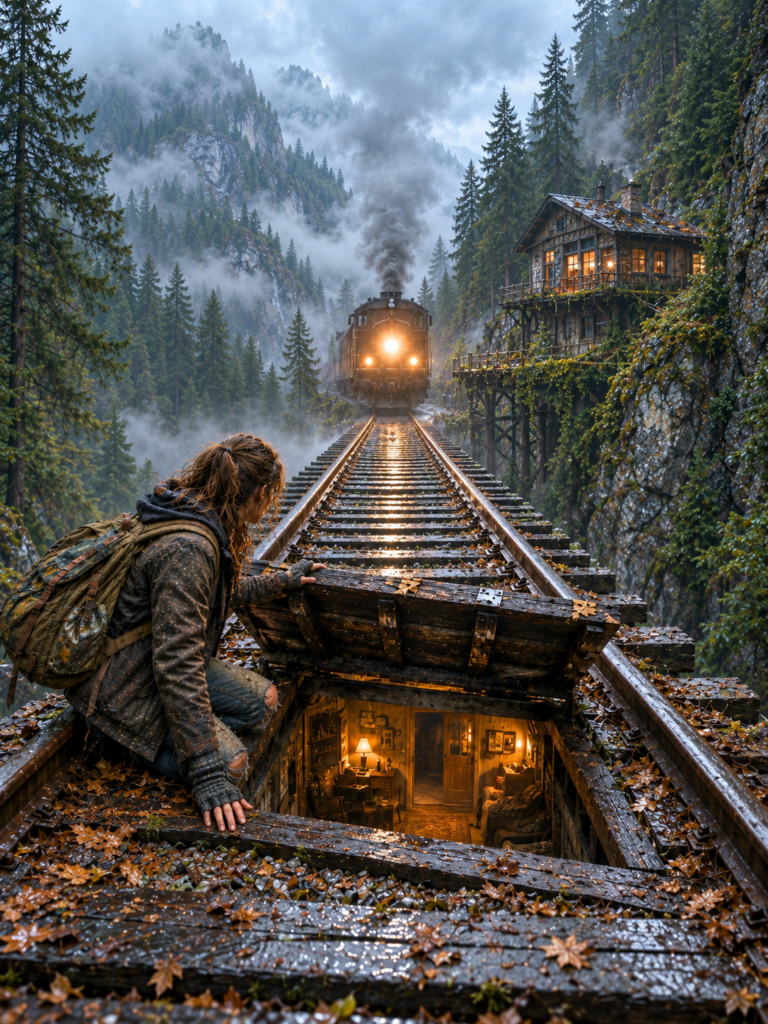
the homeless girl found a hidden room beneath abandoned train tracks—then the mountain gave her something no town ever had
Part 1
By the time Mara Ellis reached the northern edge of Bellweather, Kentucky, the rain had soaked through her coat, her socks, and the only shirt she owned that didn’t have a tear under one arm.
She was twenty-six years old, though three years of sleeping in rented rooms, borrowed trailers, motel laundries, and occasionally the back seat of a stranger’s car had taught her that age meant less than people thought.
People cared where you lived.
Who your family was.
Whether somebody respectable would answer the phone if things went wrong.
Mara had no one left who fit those categories.
Behind her was a diner where she’d worked eleven-hour shifts for three weeks before the owner told her business was slow and there wasn’t enough money for everybody.
He still owed her four hundred and eighty dollars.
When she asked for it, he told her she’d get paid “when the books straightened out.”
The room she rented by the week had been locked before the books ever straightened out.
Her landlord put her belongings in two trash bags beside the back stairs.
A sheriff’s deputy who came when she protested looked first at the landlord, then at Mara’s patched backpack, then at the county named on her old driver’s license.
“You’re not from here.”
“No.”
“Got somewhere else you can go?”
“If I did, I wouldn’t be standing here.”
He sighed as though she were the inconvenience.
That was when she knew.
Leave before somebody decided leaving for her.
She had learned that lesson early.
Her mother had died when Mara was seventeen.
Her father disappeared into alcohol long before that, then into Tennessee, then into silence.
An aunt took Mara for eight months until the aunt’s boyfriend complained that groceries were expensive.
Afterward came seasonal jobs.
Motel housekeeping.
Apple sorting.
Chicken processing.
Waitressing.
Warehouse packing.
Greenhouse work.
Any place that hired quickly and asked few questions.
She became good at reading faces.
A manager who wouldn’t meet your eyes on Friday probably wouldn’t have hours for you Monday.
A landlord who asked when you planned to leave was already thinking about another renter.
A man who offered help too eagerly usually wanted something returned.
So Mara walked.
That morning she had twelve dollars and sixty-three cents.
Inside her backpack were one change of clothes wrapped in plastic, a thin wool blanket, a jar of peanut butter, half a box of crackers, a folding knife, a road atlas printed nine years earlier, a pencil, and a little spiral notebook.
The notebook was the one thing she never considered abandoning.
Her mother had kept notebooks.
Grocery prices.
Garden dates.
Phone numbers.
Recipes.
Weather.
Things children said.
Things she feared forgetting.
After her mother died, Mara began doing the same.
Not a diary exactly.
Evidence.
Proof that days had happened.
She walked north because south led back into town.
The county road narrowed, then became gravel.
Rain drummed against the hood of her coat.
Pickup trucks passed without slowing.
After an hour, the road ended at a rusted steel gate.
Beyond it, climbing through pines, ran two abandoned railroad tracks.
At least they looked abandoned.
The rails were orange with rust.
Pine needles packed the spaces between rotten ties.
Brush grew shoulder-high along the embankment.
Mara climbed the gate.
A railroad grade was easier walking than mud.
That was reason enough.
She followed the tracks uphill.
The mountain closed around her.
Bellweather disappeared behind wet trees.
No houses.
No barking dogs.
No engines.
Only rainfall against pine needles and the sound of her boots crossing old ties.
An hour later, the tracks crossed a narrow gorge.
Mara stopped.
The trestle looked ancient.
Timbers silvered by weather supported rusty rails sixty feet above a creek swollen white from rain.
There was no railing.
No walkway.
Only ties, rails, and space.
She almost turned around.
Almost.
Then she looked back at the mountain road she’d climbed.
Her stomach was empty.
Her coat was wet.
Darkness would come in a few hours.
Going back meant Bellweather.
Going forward meant she didn’t know what.
She chose what she didn’t know.
Mara stepped onto the trestle.
One tie at a time.
Don’t look down.
She had crossed perhaps eighty feet when she noticed something near the far side.
A rectangle beneath the track.
She stopped.
Between two heavy bridge beams was a wooden hatch.
Not debris.
Not a loose plank.
A hatch.
It was framed squarely into the trestle and fitted with an iron ring.
Mara crouched.
Rain ran off her sleeves.
She pulled.
The hatch opened.
Too easily.
That frightened her more than if it had been nailed shut.
Below was a ladder.
Warm air touched her face.
Mara stared down.
A faint amber light glowed below.
Someone was there.
Or had been very recently.
Every instinct she possessed said to close the hatch.
Walk away.
Unknown shelter was sometimes more dangerous than weather.
Then the trestle vibrated.
At first Mara thought it was thunder.
No.
Metal.
A deep trembling came through the rails.
Her head snapped uphill.
Far around the curve came a low horn.
A train.
“Impossible.”
The rusty rail beneath her boot trembled harder.
The abandoned line was not abandoned.
Mara looked at the trestle.
Nowhere to stand.
No side platform.
Sixty feet of gorge beneath her.
The horn sounded again.
Closer.
She swung her legs through the hatch.
Her backpack snagged.
She yanked it free and descended.
The ladder dropped twelve feet.
Mara pulled the hatch shut over her head just as the vibration became a violent pounding.
The first locomotive crossed overhead.
The room shook.
Dust floated from beams.
The roar swallowed everything.
Mara crouched instinctively.
For twenty seconds, iron thunder passed above her.
Then another car.
Another.
Another.
She counted fourteen.
When silence returned, it felt impossible.
Mara waited.
Her breathing was loud.
The room was warm.
Not heated exactly.
Earth-warm.
Dry.
She slowly stood.
The hidden chamber measured perhaps fifteen feet by ten.
Heavy timber lined the walls.
A cot stood against one side.
An iron stove occupied one corner.
Shelves held tin canisters, crocks, books, tools, and folded blankets.
An oil lamp burned on a narrow table.
Mara stared at the flame.
Somebody had lit it.
Today.
Maybe hours ago.
She moved toward the ladder.
Then stopped.
If the person who lived here returned, they could trap her.
She listened.
Nothing.
Mara reached for the lamp.
Its chimney was warm.
She examined the wick.
Freshly trimmed.
Her heart beat harder.
“Hello?”
Nothing.
She tried again.
“I’m not stealing anything.”
The sentence sounded ridiculous.
Still no answer.
A wooden chest sat beneath the cot.
Mara did not open it.
That surprised her.
Two years earlier, hunger might have made the decision for her.
But her mother had once slapped her hand away from a neighbor’s strawberry basket and said something Mara remembered better than any sermon.
Being poor doesn’t make other people’s things yours.
Mara walked to the books instead.
Plant guides.
Engine repair.
An old paperback novel.
A weather manual.
And one dark green notebook.
She hesitated.
Reading felt like stealing too.
Then the train rumbled faintly somewhere down the mountain.
If this place held information about where she was, she needed it.
Mara opened the notebook.
On the first page:
BRIDGE 14.
ELEVATION 4,190.
ARRIVED SPRING.
The year had been erased.
She turned the page.
The handwriting was small and careful.
The structure was already here when I found it.
Older than I expected.
Whoever built this knew the mountain better than the railroad men who crossed it.
Mara sat on the cot frame.
She read.
The writer described the room.
The cold fissure at the rear wall.
A root cellar beneath the floor.
A spring higher along the ridge.
He described trains so infrequent he learned to feel them before hearing them.
He described winters alone.
Potatoes stored in sand.
Apples wrapped in paper.
Beans dried on wire screens.
Small repairs.
Snow depth.
Bear tracks.
The journal wasn’t dramatic.
That made it more intimate.
Someone had lived here because living elsewhere had become impossible.
Mara recognized that instinct.
Halfway through, she found a line underlined twice.
A hidden thing is not the same as a buried thing. Hidden things still need to breathe.
She read it again.
Then she noticed the floor.
In the southeast corner was a narrow seam.
A second hatch.
Mara set down the notebook and lifted the panel.
Cold air rose.
Below lay shelves dug into earth and rock.
Crocks.
Wooden crates.
Wire racks.
Most empty.
Some not.
One crate held glass jars.
Another contained old tools wrapped in cloth.
A shelf held sealed tins.
Mara closed the panel.
Her fear had changed.
This was no abandoned hole.
This was a system.
Somebody had planned survival here.
She returned to the journal.
The earliest entries were dated 1941.
The writer never gave his name.
He described cutting the room into the ridge over two summers.
He built it first as cold storage.
Later, he used it to overwinter grafted fruit saplings.
Then she reached the orchard entries.
Six apple trees.
Three pear.
Two plum.
Upper bench.
Protected western exposure.
Mara turned another page.
A hand-drawn map spread across the margins.
Tracks.
Bridge.
Tunnel.
Spring.
Orchard.
She knew orchards.
One autumn near Asheville she’d picked apples for eight weeks.
Eleven mature trees weren’t wealth.
But they weren’t nothing.
She kept reading.
The last complete entry stopped abruptly in 1964.
No farewell.
No explanation.
Only:
First frost early.
Spring still strong.
Baldwin apples smaller this year.
Need to shore south tunnel post before winter.
Then nothing.
Mara stared at the blank page.
Someone had built an entire life here.
Then one day the writing stopped.
She looked toward the burning lamp.
But if the writer had disappeared sixty years ago—
Who lit it?
A sound came from behind the wall.
Mara froze.
Not the railroad.
A scrape.
Then another.
She grabbed her folding knife.
A wooden panel beside the shelves moved.
A man stepped through.
Mara jumped backward.
He was old.
Very old.
White beard.
Canvas coat.
Wool cap.
One hand gripped a walking stick.
The other held a metal thermos.
They stared at each other.
The man looked at Mara’s knife.
Then at the journal.
Then at the open floor hatch.
“Well,” he said.
Mara tightened her grip.
“I’m leaving.”
“Wouldn’t advise it.”
“Why?”
“Because the storm took half the east trail.”
“I’ll use the tracks.”
“Next train comes downhill at six-ten.”
She stared.
“You know the schedule?”
“I’ve had some practice.”
“Is this yours?”
The old man glanced around.
“Depends what you mean by mine.”
“I didn’t take anything.”
“I can see that.”
“I only read the book.”
He nodded toward her knife.
“You planning to stab me with that?”
“If I have to.”
“Fair.”
He placed the thermos on the table.
“My name’s Amos Vale.”
Mara said nothing.
“You got one?”
“One what?”
“Name.”
“Mara.”
“All right, Mara. You hungry?”
“No.”
Her stomach growled loudly.
Amos looked at it.
“Your stomach appears to disagree.”
He opened the thermos.
Steam rose.
Bean soup.
Mara nearly cried from the smell.
Amos poured half into a tin cup.
He slid it across the table.
“No strings.”
She didn’t move.
“That’s usually when strings start.”
His expression changed.
Not offended.
Sad, maybe.
“Then sit near the ladder where you can leave first.”
Mara watched him.
Finally she sat.
She ate the soup.
Slowly at first.
Then too fast.
Amos pretended not to notice.
When she finished, he poured the rest.
Only after the second cup did Mara realize something.
“You knew I was here.”
“Yes.”
“How?”
“Smoke draw changed.”
“What?”
“The room vents differently with the hatch opened. Saw it from the ridge.”
“Then why didn’t you come in immediately?”
Amos removed his cap.
His hair was white and thin.
“Didn’t know whether you needed help or privacy.”
Nobody had ever described those as two different kinds of kindness to Mara before.
She didn’t know what to say.
Outside, rain began again.
And beneath a forgotten railroad bridge in the Kentucky mountains, beside a stranger old enough to be her grandfather, Mara experienced something she had almost forgotten.
A door that had not yet closed.
Part 2
Amos did not offer Mara the room.
He didn’t offer her money.
He didn’t ask for her story.
That was why she stayed the night.
“You can sleep on the cot,” he said.
“Where do you sleep?”
“Other chamber.”
“There’s another chamber?”
“Several.”
Mara looked at him.
“How many?”
“Depends how much rock has fallen since yesterday.”
He smiled faintly.
That night he showed her how the chamber worked.
The stove could be used, but carefully.
The fissure controlled airflow.
Too much fire created condensation.
Water came from the spring through an old pipe system that needed priming.
Food scraps went into a covered bucket because bears had noses better than locks.
Nothing stayed damp.
Nothing blocked the tunnel.
Nothing was taken without being recorded.
“Recorded where?”
Amos pointed toward a ledger on the shelf.
“Everything coming in. Everything going out.”
“Why?”
“Because forgetting what you have is the quickest way to discover you don’t have it.”
The rule sounded like something Mara’s mother might have said.
Before sleeping, Mara asked about the journal.
“Who wrote it?”
“My father.”
She sat up.
“Your father built this?”
“Most of it.”
“Then you’re—”
“Old.”
“I wasn’t going to say that.”
“You were thinking it.”
Amos sat near the stove.
“My father was named Eli Vale. Railroad mechanic during the Depression. Lost his job twice. Worked timber. Repaired engines. Never trusted banks after 1933.”
“He lived under a bridge?”
“Sometimes.”
“Why?”
“Because people remember history cleaner than it happened.”
Mara waited.
Amos looked into the stove.
“In the thirties, families lost farms. Men lost jobs. Some lived in camps. Some rode trains. Some did things they never expected they’d have to do. My father built this first as a place to store food where nobody would steal it.”
“Then the orchard?”
“Later.”
“Did he own the land?”
Amos gave a humorless laugh.
“That’s complicated.”
That word would matter.
But not yet.
For three days, rain trapped Mara on the ridge.
Amos never once told her she had to leave when it stopped.
He simply worked.
So she worked too.
There were always things to do.
Clear drainage.
Stack wood.
Clean lantern glass.
Check crocks.
Carry water.
Sweep.
Inspect the tunnel posts.
On the second day, Amos took her uphill.
The hidden passage ended in a small stone room beneath a crack in the ridge.
From there they climbed through brush onto a narrow bench of nearly level land.
Mara stopped.
The orchard was real.
Old apple trees twisted against the sky.
Pear trees leaned heavily downhill.
One plum tree was dead.
The other had split but still carried living branches.
The orchard had not been professionally pruned in years.
Dead limbs tangled the crowns.
Suckers crowded trunks.
Black knot scarred some branches.
Yet tiny buds covered the surviving wood.
Mara walked to the nearest apple tree.
Its trunk required both arms to circle.
“These are older than you,” she said.
Amos snorted.
“Careful.”
She smiled.
It may have been the first time in months.
On the far side stood a small cabin.
Not visible from below.
Stone chimney.
Tin roof.
Two rooms.
Amos lived there.
The underground chambers were storage and storm shelter.
“You walked down to the bridge every day?”
“Most days.”
“Why light the lamp?”
“My father always did.”
“Even when no one’s there?”
“Especially then.”
Mara looked at him.
“Why?”
Amos shrugged.
“Maybe he figured a traveler might need it.”
That sentence followed Mara through the afternoon.
A lamp kept burning for a traveler nobody knew was coming.
Ridiculous.
Wasteful.
Beautiful.
When the rain stopped on the fourth morning, Mara packed her bag.
Amos was splitting kindling.
“Road should be passable by noon,” he said.
“You want me gone?”
He set down the hatchet.
“I didn’t say that.”
“I can’t stay here forever.”
“No.”
“What am I supposed to do?”
“That’s your business.”
Mara felt anger rise.
She wasn’t sure why.
“Then I guess I’ll go.”
“All right.”
That made her angrier.
She shouldered the pack.
The left boot sole peeled halfway open.
Amos looked at it.
“Won’t make five miles.”
“I’ve got glue.”
“Glue won’t set wet.”
“I’ll manage.”
He nodded.
Mara turned toward the trail.
“Mara.”
She stopped.
“I’ve got an extra pair of boots.”
“No.”
“They belonged to my wife.”
Mara looked back.
Amos’s face had changed.
“She died eleven years ago.”
“I’m sorry.”
“They’re just boots now.”
“No.”
“Why?”
“Because they’re hers.”
“Were.”
Mara hated that word.
Amos disappeared into the cabin.
He returned with brown leather work boots.
Worn but good.
Probably her size.
Mara shook her head.
“I can’t pay.”
“Didn’t ask you.”
“I can’t owe you.”
“Didn’t ask that either.”
“Everybody asks eventually.”
Amos held out the boots.
“Then don’t owe me.”
“That’s not how it works.”
“It can.”
Mara stared at him.
“Why are you helping me?”
Amos took a long breath.
“Because forty-seven years ago, I came up this mountain with eighteen dollars and a coat somebody gave me.”
The answer took the fight out of her.
He continued.
“My father had been dead six years. I hadn’t spoken to him for twelve before that.”
“You didn’t know this place existed?”
“Not exactly.”
“How did you find it?”
“A letter.”
Amos looked toward the old orchard.
“He left instructions with an attorney. Said if I ever ran out of places to go, there was one left.”
Mara looked down at the boots.
“What happened?”
“I came.”
“And stayed?”
“Mostly.”
She sat on a stone.
“Why didn’t you speak for twelve years?”
Amos smiled bitterly.
“Young men are talented at being certain.”
He had wanted college.
Eli wanted him to learn machinery.
Amos wanted a life away from the mountain.
They fought.
Amos left.
Marriage.
Factory work.
Children.
Then divorce.
Layoff.
Drinking.
His children eventually stopped answering calls.
When he reached the ridge, he expected nothing.
Instead he found the chambers stocked.
Tools oiled.
Blankets wrapped.
His father’s journal waiting.
“He knew you might come back.”
“I don’t think he knew anything.”
“Then why leave it?”
“Hope.”
Amos looked at Mara.
“Hope and pride are strange enemies. My father was too proud to ask me home. But hopeful enough to leave the door unlocked.”
Mara stayed.
Not forever.
One week, she told herself.
Then two.
She moved into the underground chamber while Amos kept the cabin.
She repaired her old boots and stored them.
She helped prune the orchard.
Amos taught her how to cut out deadwood without stripping too much canopy in one year.
“You can’t fix ten years of neglect in one afternoon.”
Mara studied a damaged pear tree.
“Why not?”
“You’ll shock it.”
“Sometimes something needs fixing fast.”
“People say that about trees and people. Usually wreck both.”
She glanced at him.
“You giving orchard advice?”
“Only orchard advice.”
Spring warmed.
Buds opened.
The ridge turned green.
Mara walked to town once a week.
She bought flour, salt, coffee, lamp oil, and canned meat.
She found occasional work cleaning motel rooms.
But she returned to the ridge.
Every time.
For the first time since her mother died, returning somewhere felt different from merely stopping there.
Then came trouble.
One afternoon in May, Mara returned from town to find a white pickup parked beside the old railroad gate.
Two men stood near the bridge wearing reflective vests.
Amos watched from the trees.
“Railroad?”
“Surveyors.”
“What for?”
He didn’t know.
They waited until the men left.
Three days later, bright orange paint appeared on trees beside the grade.
A week after that, a registered letter arrived at the post office addressed to Amos Vale.
NOTICE OF RIGHT-OF-WAY REACTIVATION STUDY.
A timber company had leased acreage beyond the ridge.
The railroad planned to restore freight service.
Mara read the letter twice.
“What happens to the bridge?”
“Inspection.”
“And the room?”
Amos didn’t answer.
“What happens if they find it?”
“I don’t know.”
“You said your father built it.”
“He did.”
“On railroad property.”
“Probably.”
“Probably?”
Amos looked tired.
“The right-of-way boundaries haven’t been clear since 1918.”
Mara remembered the journal line.
The ridge belongs to nobody that I can find record of.
“Do you own the orchard?”
“No deed.”
“The cabin?”
“No.”
“The spring?”
“No.”
She stared at him.
“You’ve lived here forty-seven years.”
“Yes.”
“And legally none of this is yours?”
“Possession and ownership aren’t always the same.”
“That’s a beautiful way of saying we’re in trouble.”
Amos smiled faintly.
“You’re learning.”
The inspection came in June.
Engineers walked the line.
They hammered timbers.
Measured clearances.
Photographed supports.
One man spotted the hatch.
Mara watched from the slope.
He knelt.
Pulled the ring.
The hatch opened.
Her stomach dropped.
Twenty minutes later, three men stood inside the chamber.
Amos went down to meet them.
Mara followed.
The lead engineer introduced himself as Thomas Keller.
He was polite.
That frightened Mara more than hostility.
“Mr. Vale, this structure cannot remain beneath an active bridge.”
“It’s been here since before you were born.”
“That doesn’t make it safe.”
“It’s safer than half the bridge.”
Keller looked around.
“I’m not here to insult your craftsmanship.”
“Wasn’t mine.”
“Regardless, when rehabilitation begins, this area must be cleared.”
“Cleared?”
“No occupancy. No stored materials interfering with inspection access. Depending on structural requirements, portions may need removal.”
Mara stepped forward.
“Removal?”
Keller looked at her.
“Ma’am?”
“You mean destroyed.”
“I mean evaluated.”
“People say evaluated when they don’t want to say destroyed.”
Amos said quietly, “Mara.”
She stopped.
Keller wasn’t cruel.
That made it harder.
He explained liability.
Federal inspection standards.
Bridge rehabilitation.
Emergency access.
Workers couldn’t operate around an unapproved hidden structure.
Every point made sense.
Mara hated him anyway.
“When?” Amos asked.
“Preliminary work begins September.”
Three months.
After the engineers left, Mara found Amos sitting beneath the oldest apple tree.
“What are we going to do?”
He looked toward the valley.
“Don’t know.”
“That’s it?”
“What would you like me to say?”
“Fight.”
“With what?”
“Records. Lawyers. Historical status.”
Amos shook his head.
“The bridge is railroad property.”
“We don’t know that.”
“I do.”
“How?”
He hesitated.
Then Mara understood.
“You’ve researched it.”
“For years.”
“And?”
“The chamber is inside the railroad easement.”
“The orchard?”
“Mostly outside.”
“Mostly?”
“The upper bench sits on an unpatented remnant parcel between old deeds.”
“Meaning?”
“Meaning nobody has paid attention to it for nearly a century.”
Mara stood.
“So we claim it.”
Amos almost laughed.
“That’s not how property law works.”
“Then we find how it works.”
“You planning to hire an attorney with twelve dollars?”
Mara’s expression hardened.
“I’ve got thirty-seven now.”
That finally made him laugh.
But she was serious.
Because Mara Ellis had spent years leaving before doors closed.
This was the first place she wanted badly enough to stand in one.
Part 3
The county clerk’s office became Mara’s second home that summer.
The first time she entered, the clerk assumed she wanted directions to social services.
“No,” Mara said. “Property records.”
“Whose?”
“Possibly nobody’s.”
The woman stared.
“That’s not usually how property works.”
“So I’ve been told.”
Mara learned.
Deeds.
Tax maps.
Easements.
Railroad grants.
Parcel numbers.
Survey descriptions written in chains and rods.
She learned the difference between a fee-simple railroad parcel and a right-of-way easement.
She learned county records contradicted state archives.
She learned clerks knew more than computers.
And she learned that asking one good question often opened three useful doors.
The old railroad charter dated to 1909.
Bridge 14 stood within a right-of-way.
The land east of the right-of-way had once belonged to Harland Mining and Timber Company.
Harland dissolved in 1927.
Most holdings were sold for taxes.
But a narrow ridge parcel—approximately seventeen acres—appeared in one map and vanished in the next.
No transfer.
No tax sale.
No modern owner.
Mara brought copies to Amos.
He looked them over.
“My father was right.”
“About nobody owning it?”
“About nobody knowing.”
“Not the same thing.”
“No.”
Mara drew a circle around the parcel.
“The orchard is here.”
“Yes.”
“And the cabin.”
“Yes.”
“And the spring.”
“Likely.”
She looked up.
“We need help.”
“Who?”
Mara thought of Bellweather.
The town that fired her.
Locked her out.
Sent her walking.
For a moment old pride rose.
Then she remembered something Amos said.
Being angry at a whole town is like being angry at rain. Neither notices.
So Mara went back.
The library had a volunteer historian named Eleanor Price.
Seventy-six.
Retired teacher.
She listened to Mara’s story without interrupting.
Then asked, “Did you say Eli Vale?”
“You know the name?”
“No. But I’ve seen it.”
Eleanor disappeared into a back room.
She returned carrying a box labeled RAILROAD / CCC / MOUNTAIN COMMUNITIES.
Inside lay photographs.
Payroll sheets.
Newspaper clippings.
And one black-and-white picture taken in 1942.
Five men stood beside a railroad maintenance truck.
The name beneath the third man:
ELIAS VALE – MECHANIC.
Mara stared.
The man had Amos’s eyes.
Eleanor adjusted her glasses.
“If this is the same man, he worked emergency rail maintenance during the war.”
“That matters?”
“It might.”
They searched.
Hours passed.
Near closing, Eleanor found a county newspaper article from 1944.
LANDSLIDE CLOSES NORTHERN RIDGE LINE.
RAIL CREW SAVES FREIGHT ROUTE.
The story described a spring storm that undermined Bridge 14.
A mechanic named Eli Vale identified drainage failure and used an improvised retaining system to prevent further washout.
Mara read it twice.
“He saved the bridge.”
“Apparently.”
“Then why isn’t there anything else about him?”
Eleanor shrugged.
“Most useful people don’t get statues.”
The railroad still intended to clear the chamber.
But the story changed how Mara approached the fight.
She wasn’t defending an illegal shack dug by a trespasser.
She was defending a structure built by a railroad worker who had helped preserve the line during wartime.
Eleanor contacted the state historic preservation office.
Opal-like older historians, once interested, were dangerous forces.
Within weeks, people were asking questions the railroad hadn’t expected.
Was the chamber part of historic maintenance infrastructure?
Had Eli used it in connection with bridge operations?
Could portions be documented or preserved?
Railroad counsel responded carefully.
They weren’t villains.
They agreed to delay demolition pending review.
Mara celebrated.
Amos did not.
“Delay isn’t victory.”
“It’s time.”
“Time for what?”
“More questions.”
The orchard, meanwhile, came alive.
The Baldwin apples bloomed heavily.
Pears set fruit.
Mara thinned clusters.
Mulched trees.
Cleared brush from the spring.
She found three younger apple trees beyond the mapped orchard, likely seedlings.
Amos taught her grafting.
“Cut clean.”
“I am cutting clean.”
“You’re sawing.”
“I’m using a knife.”
“Emotionally sawing.”
“What does that even mean?”
“It means you’re impatient.”
She glared.
He smiled.
They became family before either admitted it.
Not father and daughter.
That would have been too simple.
Amos had children.
Mara had had a father.
Neither wanted replacements.
They were two people who understood abandonment from opposite ends.
Amos regretted leaving his children emotionally when drinking swallowed his life.
Mara regretted needing people who left physically.
Some evenings they talked.
Some evenings they did not.
Silence became comfortable.
In August, Amos collapsed.
Mara found him beside the spring.
One moment he’d been cutting brush.
The next he sat hard against the limestone shelf, face gray.
“Amos?”
“I’m fine.”
“You look dead.”
“Rude.”
Then he passed out.
Mara dragged him flat.
Her hands shook.
There was no cell signal.
No vehicle.
Three miles to the road.
She ran.
The same tracks she’d once followed because she had nowhere else to go became the road she sprinted because someone now mattered at the end of it.
She reached the county road.
A utility truck stopped.
Amos survived.
Heart rhythm problem.
Treatable.
But the doctor looked at Mara.
“He can’t live that isolated anymore.”
Amos heard.
“I’ve been isolated since before you were born.”
“Then you’ve been lucky.”
“I don’t believe in luck.”
“Your cardiogram does.”
Mara sat beside his hospital bed.
After the doctor left, Amos said, “Don’t start.”
“You’re moving closer to town.”
“No.”
“Then I’m staying.”
“No.”
“Pick one.”
“It’s not your responsibility.”
“Stop deciding what belongs to me.”
That silenced him.
Mara leaned forward.
“You let me decide whether to stay in your room. You let me decide whether to take your wife’s boots. You don’t get to decide now whether I care.”
Amos stared at the blanket.
After a long while he said, “My daughter talks like you.”
Mara froze.
“You have a daughter?”
“Yes.”
“You said your children stopped answering.”
“They did.”
“How long ago?”
“Seventeen years.”
“What happened?”
“Me.”
That night Amos told the truth.
His drinking had worsened after losing factory work.
He borrowed money.
Missed birthdays.
Made promises.
Drove drunk once with his son in the truck.
Nobody was hurt.
That didn’t make it harmless.
His daughter, Rachel, gave him one last condition.
Treatment.
He refused.
She left.
Eventually Amos sobered alone on the mountain.
But shame hardened into silence.
He never called.
“Why?”
“What would I say?”
“I’m sorry.”
“Too small.”
“It’s a start.”
“After seventeen years?”
Mara thought about all the doors she’d fled before they closed.
“Maybe you’re doing what I do.”
“What?”
“Leaving first.”
He looked at her.
“You don’t call because then you can tell yourself they rejected the old version of you. If you call now and they reject who you are today, that hurts worse.”
Amos turned toward the window.
She knew she’d struck the truth.
Two days later, he asked for the phone.
Rachel lived in Ohio.
The number in his old address book still worked.
Amos dialed.
His hand shook more than when he’d collapsed.
Mara stood to leave.
“Stay.”
The call rang.
A woman answered.
“Hello?”
Amos closed his eyes.
“Rachel.”
Silence.
Then:
“Dad?”
Mara walked quietly into the hallway.
Some moments belong to the people who earned the pain inside them.
Amos remained on the phone forty-nine minutes.
When Mara returned, he was crying.
“She didn’t forgive me.”
Mara sat beside him.
“Didn’t expect her to.”
“But?”
“She said I can call next Sunday.”
Mara smiled.
“That’s something.”
“Yes.”
Something.
Mara understood the weight of that word better than most.
After Amos came home, the ridge changed.
Not physically.
Emotionally.
Rachel called.
Then Amos’s son, David.
Letters followed.
Photographs of grandchildren Amos had never met.
Life he thought he’d lost completely had not returned.
But a narrow path had reopened.
Like an old trail through brush.
Meanwhile, Mara’s property research produced a problem.
The seventeen-acre remnant parcel did have an owner.
Or rather, an heir.
Harland Mining’s assets had passed through a bankruptcy trust.
One overlooked tract transferred eventually to a man named Franklin Harland in Indiana.
Franklin died in 1988.
His only surviving heir was a granddaughter named Claire Harland Bennett.
A real estate attorney found her.
Claire was sixty-two and had never heard of the ridge.
That could have solved everything.
Instead, it made everything worse.
Because when Claire learned a railroad company planned to reactivate the line beside seventeen acres she technically owned, she saw value.
Her attorney sent Amos a letter.
VACATE WITHIN THIRTY DAYS.
Mara read it outside the cabin.
Amos sat quietly.
“Forty-seven years,” he said.
“Don’t.”
“Forty-seven years and I never owned a board.”
“We fight.”
“Mara.”
“We fight.”
“You cannot build a life entirely out of fighting.”
“No.”
She folded the letter.
“But sometimes you have to fight long enough to be allowed to build one.”
Part 4
Claire Bennett came to the ridge in September.
Mara expected cruelty.
Instead, Claire wore clean hiking boots, carried a leather folder, and looked deeply uncomfortable.
She was not rich.
Not obviously.
She taught accounting at a community college in Indiana.
The land had surprised her as much as anyone.
“I don’t want to put an old man on the road,” Claire said.
They sat at Amos’s cabin table.
“Then don’t,” Mara answered.
Claire looked at her attorney.
He frowned.
“It’s not that simple.”
“It usually is when somebody says that.”
Amos shot Mara a warning look.
Claire continued.
“The railroad’s reactivation increases access. There’s potential timber value. Maybe recreational leasing.”
“These trees?”
Mara gestured toward the orchard.
“No. The tract includes hardwood further east.”
“So you want to log it.”
“I said potential.”
Amos remained quiet.
Claire noticed.
“Mr. Vale, why didn’t you ever file anything?”
“What would I file?”
“Adverse possession, perhaps.”
Her attorney leaned in.
“Kentucky requirements are specific. Continuous possession, hostility, notoriety—”
“I wasn’t hostile.”
Mara almost laughed.
“Legal meaning,” the attorney said.
Amos shook his head.
“I came here because my father left me a place. I never thought beyond that.”
Claire looked around.
A patched curtain.
Handmade cabinets.
Photographs.
Forty-seven years of ordinary life.
“I need time,” she said.
Her attorney clearly disliked that.
After they left, Mara said, “She doesn’t want this.”
“No.”
“Her lawyer does.”
“Lawyers like clarity.”
“People like money.”
“So do hungry drifters.”
Mara looked at him.
He smiled.
“Don’t get righteous. Makes people stupid.”
The railroad historical review arrived two weeks later.
The underground chamber itself did not qualify for standalone landmark protection.
Too altered.
Insufficient documentation connecting it directly to railroad operations.
But Eli Vale’s wartime work and the bridge’s engineering history justified documentation before rehabilitation.
The railroad agreed not to destroy the chamber unless structural work required it.
That was a partial victory.
The land fight remained.
Then winter came early.
Freezing rain coated the ridge in November.
Amos’s health worsened.
Rachel visited for Thanksgiving.
Seventeen years melted awkwardly.
Not magically.
She hugged him.
Then pulled away.
They argued about medication within an hour.
That was somehow comforting.
Real families didn’t reconcile in perfect speeches.
They reconciled in pill organizers, uncomfortable dinners, old accusations, new boundaries, and the decision to come back tomorrow anyway.
Rachel met Mara.
“So you’re the reason he called.”
“No.”
“He says you are.”
“He wanted to.”
Rachel studied her.
“How long have you lived here?”
Mara almost answered.
Then stopped.
Lived.
Nobody had used that word about her in years.
“Since spring.”
Rachel nodded.
“Dad says you saved him.”
“He saved me first.”
“Sounds like him.”
“Didn’t sound like him seventeen years ago, apparently.”
Rachel’s expression tightened.
Mara immediately regretted it.
“Sorry.”
“No. You’re right.”
Rachel looked toward Amos.
“He was awful.”
Mara waited.
Rachel continued.
“And he’s different.”
“Both can be true.”
“Yes.”
That lesson mattered.
People wanted stories clean.
Bad father becomes good father.
Homeless girl becomes rescued girl.
Landowner becomes villain.
Railroad becomes enemy.
Life resisted those shapes.
Claire Bennett called in December.
She had an offer.
She would sell the seventeen acres.
Price: ninety-two thousand dollars.
Mara almost laughed.
“We don’t have nine thousand.”
“I know,” Claire said.
“Then why call?”
“Because there’s something you haven’t considered.”
The county conservation trust.
Claire had spoken with them.
The ridge contained mature hardwood, a perennial spring, historic orchard trees, and habitat connecting two forest parcels.
If the trust bought the land, Amos could receive a lifetime residency lease.
The orchard could remain.
Public access could be limited.
Mara listened.
“Why would you agree?”
Claire was quiet.
“Because I visited.”
“That’s it?”
“No.”
Another pause.
“My grandfather grew up poor. I found letters after I got home. He wrote about Harland land in Kentucky. Said his family made money buying tax property from people who had lost farms during the Depression.”
Mara said nothing.
“I don’t know whether this tract came from that. But I don’t need ninety-two thousand dollars badly enough to pretend history doesn’t matter.”
The trust could pay only sixty-five thousand.
Claire agreed.
But there was a condition.
They needed twenty thousand in local matching funds.
Again money.
Always money.
The conservation trust launched a campaign.
Eleanor published the story in the regional paper.
A former drifter found shelter under a railroad bridge.
An aging orchard.
A forgotten railroad mechanic.
A mountain spring.
A seventy-eight-year-old man trying to stay on the land that saved him.
Donations came slowly.
Five dollars.
Twenty.
One hundred.
Mara hated fundraising.
It made need public.
She had spent years hiding need.
Eleanor noticed.
“You’re embarrassed.”
“No.”
“You are.”
“I don’t like begging.”
“You’re not begging.”
“Feels the same.”
Eleanor took Mara’s hands.
“Listen to me. Asking people whether they want to participate is not begging. You’re giving them a choice.”
Mara looked away.
“What if they say no?”
“Then you survive no.”
She had survived worse.
By February, they’d raised twelve thousand.
Still short.
Then the railroad donated five thousand.
Mara stared at Keller when he delivered the letter.
“You?”
“The company.”
“Why?”
“Community relations.”
She raised an eyebrow.
Keller smiled.
“And because the room is remarkable.”
“That sounds almost human.”
“I’ll try not to let headquarters hear.”
Three thousand remained.
Caleb-style local effort came from Bellweather High School.
Students held a winter supper.
The diner where Mara had worked donated pies.
That infuriated her.
“They still owe me money.”
Amos looked up.
“How much?”
“Four hundred eighty dollars.”
“Did you ask?”
“No.”
“Why?”
“They know.”
“That’s not what I asked.”
Mara went to the diner.
The owner, Dale, looked surprised.
Then embarrassed.
“I thought you’d left.”
“I did.”
“I tried to find you.”
“You knew I used the post office.”
He looked down.
Mara waited.
Finally Dale opened the register.
He counted four hundred eighty dollars.
Then added twenty.
“No.”
“For interest.”
“You don’t get to decide interest.”
He removed the twenty.
Mara took what she was owed.
At the door, Dale said, “I’m sorry.”
She turned.
He seemed smaller than she remembered.
Not evil.
Just cowardly.
“You should’ve paid me.”
“I know.”
Mara nodded.
That was all.
Outside, she sat on the curb and cried.
Not because of the money.
Because for once she’d returned to a place that had wronged her and didn’t run.
She donated eighty dollars to the ridge fund.
Kept four hundred.
Amos approved.
“Never donate everything.”
“Why?”
“Because generosity without arithmetic becomes another kind of foolishness.”
The final funding arrived from someone nobody expected.
Rachel.
Not personally.
She organized a family contribution.
Amos’s children and grandchildren raised the remaining amount.
When she told him, Amos sat silently.
“They don’t owe me that.”
Rachel answered, “It’s not for what you were.”
He looked at her.
“It’s for what you’re trying to leave behind.”
The trust purchased the ridge in March.
Claire sold below appraisal.
Amos signed a lifetime residency agreement.
Mara was listed as orchard caretaker for three years with a small stipend.
She read that line repeatedly.
Caretaker.
A job.
A place.
Her name on paper connected to land.
She had not realized how badly she wanted evidence.
But the railroad work still threatened the hidden chamber.
Bridge rehabilitation began in April.
Crews replaced ties.
Reinforced supports.
Cleared vegetation.
One engineer determined that two sections of Eli’s underground timber wall interfered with access to a bearing.
Part of the chamber had to come out.
Mara argued.
Amos stopped her.
“They’re right.”
“You built your life in there.”
“My father built a room.”
“Same thing.”
“No.”
He touched the wall.
“A room isn’t a life.”
They documented everything.
Photographed joints.
Numbered boards.
Removed shelves.
Saved the lamp.
Saved the cot.
Saved Eli’s ledger.
The southeast corner was dismantled.
Mara cried when the first timber came down.
Amos didn’t.
Not then.
Later she found him alone holding one of his father’s hand-cut boards.
His shoulders shook.
Mara sat beside him.
Neither spoke.
Sometimes dignity means giving people words.
Sometimes dignity means not making them use any.
The chamber became smaller.
But safer.
The railroad added a steel access door beneath the trestle.
Keller arranged an unusual compromise: the historical society could maintain the preserved section under agreement with the railroad, with no overnight occupancy.
“No sleeping?” Mara asked.
“Absolutely not.”
“Not even travelers?”
“No.”
She smiled.
“What?”
“Nothing.”
Because the mountain had another room.
And another entrance.
And a cabin.
The place adapted.
So did they.
Then in late May, Amos had another heart episode.
This one worse.
He spent nine days in the hospital.
When he returned, he could no longer climb the ridge safely.
Rachel wanted him in Ohio.
Amos refused.
Mara understood both.
Finally the conservation trust approved construction of a small accessible cottage near the lower service road, on trust land.
Close enough to the orchard.
Far enough that an ambulance could reach him.
Amos hated it.
“It’s got drywall.”
“Tragic.”
“And vinyl windows.”
“You’ll survive.”
“Debatable.”
“It has indoor plumbing.”
“So does the cabin.”
“The cabin has a pipe running into a bucket.”
“System works.”
Mara laughed.
They moved him in August.
He sat on the new porch furious at modern convenience.
Then admitted the chair was comfortable.
The orchard produced heavily that fall.
More fruit than Mara and Amos could use.
She sold apples at the Bellweather Saturday market.
The first morning, she set twelve baskets on a folding table.
A handwritten sign read:
RIDGE ORCHARD.
HEIRLOOM APPLES.
She sold out in two hours.
The next week she brought twenty baskets.
Then cider.
Then dried apples.
Then pears.
She kept careful records.
Income.
Expenses.
Fuel.
Packaging.
Pruning equipment.
Every dollar.
Everything coming in.
Everything going out.
Amos noticed.
“My father would’ve liked you.”
“You say that because I use his ledger system.”
“I say that because you’re stubborn.”
That year Mara made enough from the orchard and part-time work to buy a used pickup.
Nothing impressive.
1997 Ford.
Two colors.
One door required lifting before closing.
To Mara it looked like freedom with headlights.
She drove it up to Amos’s cottage.
He walked around it once.
“Bad transmission.”
“You haven’t driven it.”
“I can hear it sitting still.”
“You’re impossible.”
“Offer was nineteen hundred?”
“Eighteen.”
“You paid?”
“Sixteen fifty.”
Amos smiled.
“Good.”
Then winter settled over the ridge.
For the first time in nearly a decade, Mara knew where she expected to be when spring arrived.
Part 5
Three years later, the orchard had thirty-eight trees.
Not all old.
Mara learned grafting properly.
She took scion wood from Eli’s surviving apples and worked it onto young rootstock supplied by the county extension office.
That mattered because no one knew exactly what varieties grew on the ridge.
Two were identified.
One Baldwin.
One Winesap.
Another might have been an old regional variety Eleanor found mentioned in agricultural records but could not confirm.
Mara didn’t care much about the name.
She cared that it survived.
The conservation trust built a small teaching shelter near the lower trail.
School groups came twice each fall.
Children learned about railroad history, mountain orchards, food storage, grafting, and spring water.
The underground chamber reopened for limited tours.
The lamp stood behind glass now.
Mara disliked that.
But she understood.
One afternoon a ten-year-old asked why anyone would live beneath train tracks.
Mara looked toward Amos.
He sat in a folding chair nearby, cane between his knees.
“You answer,” he said.
Mara thought carefully.
“Because sometimes people build safety out of whatever the world leaves them.”
The boy frowned.
“Like a fort?”
“Kind of.”
“Was he hiding?”
“Maybe.”
“From bad people?”
“Maybe from bad years.”
The boy seemed satisfied.
Mara wasn’t.
Years could be bad.
Economies.
Families.
Weather.
Mistakes.
Sometimes no villain existed.
Only circumstances heavy enough to push a person somewhere unexpected.
Amos turned eighty-one.
Rachel visited regularly.
David came twice a year.
Three grandchildren learned to prune trees.
Reconciliation never became perfect.
Amos and David once argued so badly David drove away before supper.
He returned the next morning with coffee.
That was progress.
Mara eventually told Amos she had located her father.
He lived outside Knoxville.
Sober, according to what she could find.
Remarried.
She had not contacted him.
“You going to?” Amos asked.
“Don’t know.”
“You want advice?”
“No.”
“Good. Didn’t have any.”
She laughed.
Months passed.
Then one Sunday Mara wrote a letter.
Not forgiveness.
Not accusation.
Simply:
I’m alive.
I thought you should know.
She included a post office box.
Six weeks later, a reply came.
Mara carried it for two days unopened.
Finally she sat beneath the oldest apple tree and read.
Her father apologized.
Badly.
Too many explanations.
Too much shame.
Not enough ownership at first.
Then near the end:
I have wanted to find you for years, but I was afraid knowing me again would hurt you more than losing me did.
Mara read that sentence several times.
Then she thought about Amos.
Leaving first.
She wrote back.
One letter became three.
Then a phone call.
No miracle.
No instant reunion.
Only another narrow trail through brush.
That was enough.
The ridge became known locally as Vale Orchard Preserve.
Amos objected.
“Should be Eli’s name.”
Mara said, “Vale covers both.”
“Shouldn’t be mine.”
“You don’t control everything.”
“I used to.”
“No, you thought you did.”
He grumbled.
The name stayed.
When Amos died, it happened in winter.
Quietly.
He was eighty-three.
Rachel had visited the week before.
David planned to come in March.
Mara brought supper one evening and found Amos asleep in his porch chair under a blanket.
At first she was annoyed.
“You’re going to freeze out here.”
Then she touched his shoulder.
He was gone.
No drama.
No hospital.
No final speech.
His face looked tired and peaceful.
Mara sat beside him until the ambulance arrived.
Snow began falling.
She remembered the first bowl of bean soup.
The boots.
The lamp.
The orchard.
The phone call to Rachel.
All the small things that had become a life.
At his funeral, Rachel stood beside Mara.
“You were his family.”
Mara shook her head.
“You were.”
Rachel took her hand.
“We both were.”
Amos left almost nothing financially.
A little savings.
Tools.
Books.
The old Ford tractor.
His personal effects.
The conservation land couldn’t be inherited.
That was intentional.
But his will gave Mara one thing.
Eli’s journal.
Inside the cover Amos had written:
Mara—
My father left a lamp burning for me when he did not know whether I would return.
I tried to do the same.
Keep it lit for somebody else.
—Amos
Mara read it alone.
Then again.
She cried harder than she had at the funeral.
That spring, she moved into Amos’s accessible cottage.
The trust offered.
She almost refused because accepting felt like taking his place.
Rachel corrected her.
“You’re not replacing him.”
“What am I doing?”
“Continuing.”
Mara accepted.
Years passed.
The railroad line remained active.
Two freight trains most days.
Sometimes only one.
Children visiting the preserve learned to feel the rails hum before hearing the horn.
The hidden chamber remained locked except during tours.
Mara kept the oil lamp lit during open hours.
Not electric.
Real oil.
Keller, now retired, visited once and complained about liability.
Mara told him retirement had made him boring.
The orchard grew.
A small farm stand opened near the road.
Apples.
Pears.
Cider.
Preserves.
Dried fruit.
Local honey.
Mara hired two teenagers each autumn.
She paid them every Friday.
Always.
Even when sales were poor.
Especially then.
One year a waitress from Bellweather came looking for work.
Nineteen.
No stable home.
Mara hired her for harvest.
The girl showed up late twice.
Dropped a crate.
Broke a pruning saw.
Expected to be fired.
Mara remembered herself.
She didn’t excuse the mistakes.
She taught.
Accountability and cruelty were not the same.
The girl stayed two seasons, saved money, then left for nursing school.
Before she went, Mara gave her a pair of work boots.
“These yours?” the girl asked.
“No.”
“Whose?”
“A woman named Helen Vale.”
“Who’s that?”
“Long story.”
Mara smiled.
“Take care of them.”
Eventually Mara bought a small piece of land of her own.
Five acres adjoining the preserve.
The deed had her name.
MARA ELLIS.
She sat in her truck after closing and stared at the document for nearly an hour.
The girl who once had no fixed address now owned ground.
It was not the seventeen-acre ridge.
It was not the orchard.
It didn’t need to be.
Ownership mattered differently when you’d spent years believing permanence belonged to other people.
She built a modest house.
Two bedrooms.
Wood stove.
Porch.
Nothing fancy.
One spare room.
That was deliberate.
Years later, people who heard Mara’s story often wanted a clean lesson.
They wanted her to say homelessness made her stronger.
It didn’t.
It made her tired.
Suspicious.
Ashamed of needing help.
Quick to leave.
They wanted her to say everything happened for a reason.
She never said that.
Some suffering is simply suffering.
Losing her mother had no hidden benefit.
Being cheated of wages taught nothing worth the cost.
Sleeping cold did not make her noble.
But she did believe something else.
What happens next can give meaning to what almost destroyed you.
Not justify it.
Not erase it.
Transform what you carry forward.
Mara became good at noticing people about to disappear.
The waitress sitting alone after closing.
The old widower whose farm taxes confused him.
The teenager who kept missing school because his mother needed the car.
The woman sleeping in a minivan behind the market.
She couldn’t save everybody.
Amos had taught her not to confuse kindness with control.
Sometimes she offered work.
Sometimes food.
Sometimes a phone number.
Sometimes nothing more than information.
And occasionally, when somebody had nowhere safe to sleep, she opened the spare room.
Not forever.
Not without rules.
But long enough for morning to look different.
Every autumn, on the anniversary of the day Mara first found Bridge 14, she walked the old railroad grade.
The left rail was no longer rusty.
Freight polished it silver.
She crossed the trestle only when maintenance access allowed.
Usually she approached from the service trail.
She unlocked the steel door beneath the tracks and stepped into the preserved chamber.
The room had changed.
One wall newer.
Safety supports.
Information plaque.
Emergency light required by the railroad.
But much remained.
The cot.
Shelves.
Tin canisters.
Eli’s old stove.
Copies of his maps.
And the lamp.
Mara would trim the wick.
Fill the reservoir.
Strike a match.
The amber flame rose.
Then she’d sit quietly.
Sometimes a train approached.
First came the faint vibration.
Then trembling wood.
Then thunder overhead.
Visitors often flinched.
Mara didn’t.
She liked the sound.
It reminded her that something powerful could pass directly above you without destroying the shelter beneath.
One October afternoon, decades after the rainy day that brought her there, Mara sat inside with a young girl from a school group.
The others had gone uphill.
The girl lingered.
“Ms. Ellis?”
“Yeah?”
“Were you really homeless when you found this?”
Mara considered the word.
“Yes.”
“Weren’t you scared?”
“Constantly.”
“Of the room?”
“At first.”
“Of Amos?”
“At first.”
“Of trains?”
“Definitely.”
The girl smiled.
Then became serious.
“My mom says we’re staying with my aunt because we’re between places.”
Mara recognized the phrase.
Between places.
Adults used softer words when hard ones frightened children.
“That can be difficult.”
The girl looked at the lamp.
“Does that mean we’re homeless?”
Mara chose her answer carefully.
“It means where you’re sleeping right now might not be permanent.”
The girl’s eyes lowered.
Mara continued.
“But temporary isn’t the same as worthless.”
The child looked up.
“This room was temporary for people too.”
“Really?”
“Yes.”
“Then why did they keep it?”
“Because temporary shelter still matters when you’re in a storm.”
The girl thought about that.
Then joined her class.
Mara stayed behind.
Outside, wind moved through pine trees.
She opened Eli’s original journal.
The pages had become fragile.
She rarely handled it now.
One sentence remained her favorite.
A hidden thing is not the same as a buried thing. Hidden things can still breathe.
Mara finally understood.
For years, she had been hidden.
Moving from place to place.
Never leaving enough behind to prove she had existed.
She thought that meant her life had been buried.
Lost.
But she had been breathing the whole time.
Waiting.
Not for rescue.
She disliked that word.
Waiting for enough safety to stop running.
Amos gave her that.
Not by giving her everything.
By giving her one night without conditions.
One bowl of soup.
One pair of boots.
One room where the door did not close behind her.
Everything afterward grew from that.
An orchard does not begin with fruit.
It begins with something small placed somewhere it might survive.
A graft.
A seed.
A cutting.
A choice.
So does a life.
Mara closed the journal.
Above her, the rail began to hum.
A train was coming.
She smiled.
She no longer hurried away from that sound.
Instead she reached up and adjusted the lamp.
The flame steadied.
The first locomotive crossed Bridge 14.
The chamber shook.
Dust moved gently in the amber light.
And Mara thought about all the things the world mistakes for useless because it doesn’t know what they’re becoming.
Abandoned rail lines.
Forgotten orchards.
Old men.
Poor girls.
Hidden rooms.
Families that broke and tried again.
Land nobody bothered to claim until somebody loved it.
None of them were miracles.
They were simply unfinished.
Outside, the train continued through the mountain.
Inside, the lamp stayed lit.

