
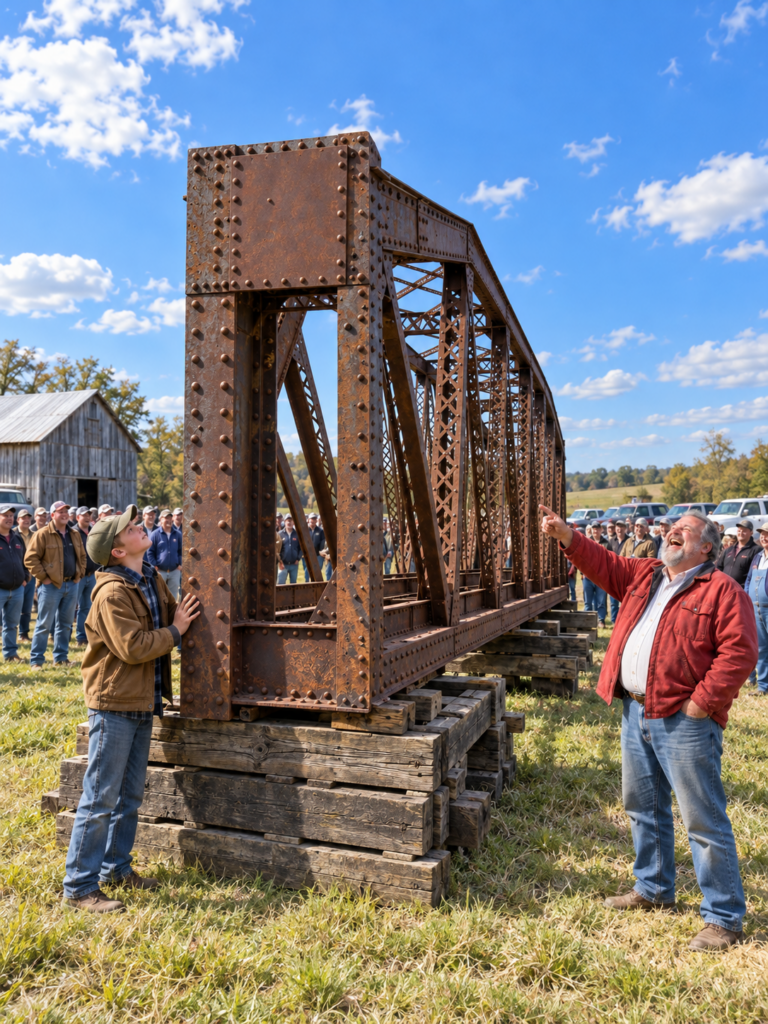
the boy who paid forty five dollars for the rusted iron bridge the whole county laughed at and would not let the scrap man cut the name his grandfather’s old friend had hidden for ninety years
Part 1
The hayfield still held the night’s damp when Dwayne Kitridge set his coffee on the hood of his truck and laughed so hard the cup rocked. Twenty-two tons of rust, and the boy had just bid forty-five dollars for it. The sound carried across the stubble, past the pie table where two women covered their mouths, past the man in the seed cap who slapped his knee. Dwayne spread his arms like a preacher handed the perfect text. “You hear that? He’s protecting it. From what, son? Termites?”
Lyall Pennock stood with both palms flat on the riveted iron, the square of plain plate warm under his hands from the morning sun. He was twelve, narrow through the shoulders, the canvas chore jacket hanging loose on him. The torch Dwayne kept talking about sat twenty steps away in the bed of the red pickup, the company name stitched across the back of the jacket in yellow thread. Lyall looked up at the portal, taller than a hay wagon, the lattice work the color of old blood, then looked back at Dwayne.
“No, sir,” he said. “Nobody’s cutting anything.”
That only made it funnier. The auctioneer, Bev Strand, a square-shouldered woman who had called sales in Tamson County for thirty years, had opened the bridge at five hundred and gotten nothing but grins. She had dropped it to two hundred, then one hundred. The terms were printed plain on the sale bill: sold as is, buyer removes it within thirty days at his own expense or it goes back to the estate. Dwayne had finally said twenty-five the way a man tosses a quarter to a street singer. Everybody knew why. He would come out with two torches and a loader, cut the thing into pieces right where it sat, and sell it by the ton.
Thirty, said a voice from the front. The crowd turned, saw the boy, and turned back to Dwayne, smiling, waiting for him to finish it. Forty, Dwayne said. Forty-five. That was when the laughing started. Dwayne did not bid again. He did not have to. He knew, and everybody in that field knew, that no twelve-year-old was moving twenty-two tons of iron off Grant Voss’s land in thirty days. When the boy failed, the bridge went back to the estate, and the estate would give it to the first man with a torch. Dwayne had just let a child pay forty-five dollars to hold his place in line.
Bev brought the gavel down and said, “Sold to the young man. Forty-five dollars.” Even she was smiling as she said it.
Lyall walked up to the clerk’s table and counted it out in fives and ones from an envelope that still had his name on it in his mother’s handwriting. Two dollars went back into his jacket pocket. That was the rest of what he owned. His grandfather, Hollis Pennock, stood a few steps behind him the whole time and did not say one word. Hollis was seventy-three, lean as a rake handle, white mustache, the gray wool flat cap he had worn through four presidents. He had driven a milk truck on the county roads for forty-one years, and people in Harlo said he had never once been in a hurry. When Dwayne looked over at him for help, expecting the old man to grab the boy by the collar and undo the whole thing, Hollis only nodded at him, pleasant as Sunday.
“Hollis,” Dwayne said, “you’re going to let him do this?”
“Already did,” said Hollis.
The crowd thinned toward the lunch stand. Dwayne did not. He walked over to the bridge with three or four of the coffee men trailing behind him and wrapped the iron with his knuckles like a man knocking on a door. “You know what this is, son? It’s a cow bridge. The county threw it away in 1931. Old August Voss gave them a dollar for it, which was a dollar too much, and he dragged it down here so his holings could get to the back forty without waiting. That’s all it ever was.”
“Yes, sir,” Lyall said.
“So what’s under the patch?”
“I don’t know yet.”
“You don’t know?” Dwayne grinned around at his audience. “He paid forty-five dollars for a patch and he doesn’t know what’s under it and he won’t let anybody look.” He leaned down until he was eye to eye with the boy. “Tell you what, my offer stands all month. You call me when you figure out you can’t move it, and I’ll cut it up for free and haul it off. I’ll even let you keep the scrap check. Can’t say fairer than that.”
Lyall took his hands off the iron and put them in his jacket pockets. “It’s not getting cut,” he said. “And the patch stays on until somebody who knows what it is takes it off.”
“Somebody who knows what it is,” Dwayne repeated. The coffee men laughed again, and this time Dwayne laughed hardest. “Well, when you find him, you bring him by the yard. I’d love to meet him.”
He walked back to his truck, still shaking his head. The bright red jacket moved through the crowd like a warning flag, and people stepped aside for it the way they always had.
On the drive home, in the cab of Hollis’s old green Ford, Lyall finally let his shoulders come down from around his ears. The heater blew dust and the smell of old vinyl. “You think I’m crazy?” he said.
“I think you’ve got twenty-nine days,” Hollis said. “Crazy is a separate question.”
The truth was simpler than anybody at the sale would have guessed. For three summers Lyall had mowed Elmer Voss’s lawn for ten dollars a week, and for three summers the old man had paid him an extra half hour of stories on the porch, whether Lyall wanted them or not. Most of the stories were about weather and cattle prices. One of them was about the bridge. Elmer had been a baby when his father brought it home. In 1931 the county put a new concrete crossing in at Puit’s Mill and sold the old iron span to August Voss for a single dollar on the condition that he take it away himself. August did. He rolled it a mile and a half upstream on greased logs with two teams of horses and a borrowed steam engine, and it took him most of a month. And the first thing my father did when he got it set, Elmer had told him, rocking slowly in the porch chair, was rivet a sheet of plain iron over the top of each end.
“Over the name?” Lyall had asked.
“What name?”
“Every iron bridge in those days had a name on it. Who built it? When? Who paid? Cast right into a plate up on the portal. Nice raised letters. And back then there were men driving the back roads at night with pry bars, pulling those plates off and selling them to collectors back east. Took the name right off the bridge and left the iron to rot. My father said a bridge without its name is just a pile of iron. So he covered it up so nobody would know there was anything worth stealing.” Elmer had pointed a crooked finger at the boy. “Don’t you ever let a man take her name off in the dark. Somebody’s going to want her back someday.”
Lyall had been nine when he heard that. He had not thought about it much until the sale bill came in the mail with the bridge listed near the bottom between a manure spreader and a lot of fence posts. Bridge iron, approximately fifty feet, buyer to remove. He had not known what he would do if anybody bid against him with real money. Nobody had. They had only laughed.
That evening his mother, Dina, came home from her shift at the county hospital lab, heard the whole story from Hollis at the kitchen table, and sat very still for a while. The fluorescent light hummed. A stack of unpaid bills sat under the salt shaker. “Forty-five dollars,” she said.
“It was all I had,” Lyall said. “Mostly.”
“I know. I’m the one who wrote your name on the envelope.” She rubbed her eyes. “Baby, where are you going to put a bridge?”
Hollis cleared his throat. “My pasture’s flat by the windbreak. Nothing grazing it but rabbits.”
“And how are you going to get it there?”
Nobody had an answer for that one. Not that night. Outside, the wind moved through the cedars and the old Ford ticked as it cooled. Lyall lay in his room with the window open and listened to the quiet of the county and tried not to think about the torch twenty steps away.
Part 2
The next morning Hollis made calls from the wall phone in the kitchen. A heavy haul outfit in the county seat wanted four thousand dollars and couldn’t come for six weeks. A crane company wanted more than that. The grain elevator’s loader could lift one end of the bridge but not carry it anywhere. By Wednesday the boy had a list of nine ways nobody could help him and twenty-six days on the clock.
Then Hollis remembered Marcus Blye. Marcus ran a two-truck towing and rigging outfit out of a pole barn south of Harlo. He was a broad quiet man in his forties with a gray beard and a permanent squint. Twenty years earlier, in a January blizzard, Hollis had pulled Marcus’s father out of a ditch with the milk truck and driven him to the hospital with a broken hip. Marcus had never forgotten it, and he had told Hollis so every Christmas since.
He drove out to the Voss place on Thursday, walked the length of the bridge twice, crouched under it, measured the cribs with a tape, and spat thoughtfully into the hay stubble. “Twenty-two tons, give or take,” he said. “Riveted lattice. It’ll hold together if we pick it up right. I can put it on my lowboy with the winch truck and a couple of jacks. It’s a half-day job.”
“What do we owe you?” Hollis asked.
Marcus looked at the boy. “Diesel,” he said. “And I want to hear what’s under that patch before Dwayne Kitridge does.”
So the job was set for the following Saturday. There was only one thing left, which in Tamson County was usually the easiest thing in the world. A load that wide and that long needed an oversized permit to travel two miles on a county road, and permits came from the county road office. Marcus filed for it Friday morning.
The permit did not come on Monday. It did not come on Wednesday either. When Marcus called, the clerk at the front desk sounded embarrassed. The application had gone up for review, she said. The road board wanted to look at it. There were three men on the road board. One of them was Dwayne Kitridge.
The days went by. Nineteen left, then fifteen, then twelve. Lyall went to school and came home and walked down to the Voss field every afternoon to look at his bridge. And every afternoon it was still there, still sealed, still waiting. The wind moved through the lattice and made a low sound like a string. One day he found a line of orange spray paint on the timber crib under the north end, a neat little mark of the kind a scrap crew makes when it is planning where to cut. He did not touch it. He took a picture of it with his mother’s old phone and showed it to his grandfather.
“Well,” said Hollis, “that’s a man counting chickens.”
At the Harlo feed and seed, where the coffee men met every morning at the long counter by the register, Dwayne had started asking about the bridge the way other men asked about the weather. “How’s the bridge builder?” he would call whenever Hollis came in for mineral blocks or fence staples. “He get it moved yet? Tell him my offer is still good. I’ll even give him back his forty-five. I’m not a monster.”
The men at the counter laughed every time. Hollis would pay for his staples, tip his flat cap, and leave without a word.
By the second week the joke had grown a price tag. Dwayne offered Hollis two hundred for the bridge, then three hundred, then five hundred cash counted out right there on the counter. The coffee men went quiet at that one. A man does not put five hundred on the table for something he is sure is worthless. Hollis counted the bills with his eyes and left them where they lay. On the walk back to the truck his boots made the only sound on the gravel. He did not tell Lyall about the five hundred until they were home, and even then he only said, “The man’s getting nervous. That’s all.”
Lyall kept walking down to the field. The orange paint stayed bright against the gray timber. On the eighteenth day, with twelve days left, he rode his bicycle into town after school and walked into the county building in his canvas chore jacket and his faded green cap and asked to see the county engineer.
Part 3
Her name was Patrice Lindgren. She was a tall, tired woman with reading glasses on a cord around her neck, and she had spent sixteen years trying to keep Tamson County’s bridges from falling into its creeks. She listened to the whole story without interrupting, then pulled up the permit application on her computer, read it twice, and frowned. “There’s nothing wrong with this,” she said. “This should have been signed two weeks ago. They told Mr. Blye the road board wanted to look at it.”
Patrice took off her glasses and let them drop on their cord. For a moment she looked very much like a woman deciding whether to say something she would regret. “Oversized permits,” she said instead, “are signed by the county engineer, not by the road board.” She signed it, stamped it, printed it, and handed it to the boy across the desk. “Go move your bridge.”
They moved it that Saturday with nine days to spare. Marcus brought the winch truck and the lowboy at first light, and two of his nephews came along to work the jacks. A few neighbors drifted over to watch with their hands in their pockets. The sky was pale and the hay stubble still held frost in the low places. Hollis stood beside Lyall at the edge of the field, and when Lyall started forward to help, Hollis put one hand on his shoulder and kept it there. “Your job is to watch,” he said. “Watching is a job.”
It took the better part of the morning. Marcus jacked one end of the span off its crib an inch at a time, slid oak blocking under it, and dragged the lowboy in underneath with the winch cable singing, then the other end. The bridge settled onto the trailer with a long iron groan that Lyall felt in his teeth, and then it simply sat there, fifty-two feet of rust-red lattice on eighteen wheels, looking bigger on a road than it had ever looked in a field.
They hauled it at walking speed down the Salo Creek Road with orange flags on every corner, and Hollis’s green Ford creeping along behind with its flashers on. Halfway there a white pickup came up fast from the other direction and slowed alongside the trailer. The window came down. Dwayne Kitridge leaned across the seat in his red jacket, took one long look at the bridge rolling down a public road with a county permit taped inside the windshield, and for once in his life he did not seem to know what to say. Then he found it. “Bridge to nowhere!” he shouted, and he laid on his horn the whole way past.
Marcus did not even turn his head. “That,” he said to the boy through the open window of the winch truck, “is the sound of a man who just lost twenty-two tons of scrap.”
By noon the bridge stood on new timber cribs in Hollis’s pasture, square to the windbreak, with a row of cedars behind it and nothing in front but open grass. It looked strange there, and somehow exactly right. The two iron patches sat over the portals at either end, still sealed, every rivet head in place, the way August Voss had left them ninety-some years before. Lyall paid Marcus his diesel money out of a coffee can that turned out to hold Hollis’s money, not his. Marcus pretended not to notice. The can had been under the sink for years, the lid rusted at the rim. Hollis said nothing when Lyall counted out the bills. He only nodded, the way he had at the auction, and walked out to the pasture to look at the bridge one more time before dark.
The next Monday Lyall went looking for the name.
Part 4
The Harlo Public Library was a brick building the size of a two-car garage, and the woman who ran it, Agnes Torvik, had been the county’s unofficial memory for longer than most of its residents had been alive. She was seventy, birdlike, with silver hair cut short and a cardigan for every month of the year. When Lyall told her what he was after, she did not laugh. She got up from her desk, took a ring of keys off a nail, and led him downstairs to a room that smelled like dust and paste. “The county commissioners kept minutes of every meeting since 1854,” she said. “Most of them are on microfilm. The old ones are still in the ledgers because nobody ever found the money to film them. You’ll want both.”
They started with 1931 because that was the easy one. On the third reel they found it in a clerk’s tidy typing. The old iron bridge at Puit’s Mill sold to August Voss for the sum of one dollar. The said Voss to remove it at his own expense within ninety days. Then they went backward. It took three afternoons. The early ledgers were heavy and brown at the edges, and the handwriting leaned like grass in a wind. Agnes read the hard words aloud, and Lyall copied them into a spiral notebook. On the third afternoon, in a volume from 1869, they found a resolution that made Agnes put her hand flat on the page. The board would contract with the Ashworth Iron Bridge Company of Elmira, New York, for one wrought iron lattice bridge of fifty-two feet to be set over Salo Creek at Puit’s Mill at a cost of four thousand one hundred dollars, payable in three parts.
“Fifty-two feet,” Lyall said.
“Four thousand in 1869,” Agnes said. “That’s a courthouse. That’s more than the county spent on its roads for a whole year.” She looked at him over her glasses. “Lyall, I have lived here my entire life, and I never knew that bridge was the first iron bridge in Tamson County. I don’t think anybody alive did.”
“Is that worth something?”
“I have no idea, but I know who would.” She went back upstairs, typed something on the library’s ancient computer, and came back down with a printed page. “There’s a professor at the state university who keeps the list of every old iron bridge in this state. Where they stand, who built them, which ones are gone. Dr. Ruth Halverson. Write to her. A real letter in your own words. People like that get a hundred emails a day and they read letters.”
So Lyall wrote one at the kitchen table, in pencil first and then in pen. He told her about the sale and the forty-five dollars and the patches over the portals. He copied out the resolution from 1869 word for word. He told her what Elmer Voss had said about men with pry bars in the night. He did not tell her about Dwayne Kitridge because his mother said a letter to a professor was no place to complain. Agnes put a stamp on it herself.
The answer came eight days later, not by mail, but by phone on a school night while Lyall was doing fractions. His mother handed him the phone with a strange look on her face. The woman on the other end had a low, careful voice, and she asked him to describe the lattice, how many diagonals crossed in each panel, whether the top cord was flat or curved, whether the rivets were round-headed or flat. Lyall took the phone out to Hollis’s pasture in the last of the light with his grandfather beside him holding a flashlight and answered every question while he looked. When he was done, Dr. Halverson was quiet for a long moment.
“Lyall,” she said, “I have a file on that bridge. It’s a thin one. It says built 1869, removed 1931, presumed scrapped. There are no Ashworth bridges left standing anywhere in the country. Not one. If you’re right about what you’ve got, the file is wrong.”
“Is that good?”
“That depends on what happens next. So I’m going to ask you to do something, and it’s going to be hard.” Her voice got firmer. “Do not take those patches off. Don’t let anyone else take them off. Not your grandfather, not the nicest man in town, nobody. If there’s a plate under there, it comes off in daylight in front of witnesses with a camera running and a conservator’s drill. Not a torch. A torch would cook cast iron that old, and it would crack. Can you keep it shut for six weeks?”
Lyall looked at the bridge standing dark against the cedars and at his grandfather’s flashlight moving slowly over the riveted patch at the top of the portal. “Yes, ma’am,” he said. “I’ve had practice.”
Six weeks is a long time in a town the size of Harlo. By the end of the first one, everybody at the feed and seed knew the boy had written to a professor, and Dwayne Kitridge had a new joke for every morning. “Heard the bridge builder hired himself a scientist,” he would say. “Going to carbon date the rust.” Lyall kept his word. He walked out to the pasture every afternoon after school, and every afternoon the two patches were still sealed, the rivet heads dull and round and whole.
Then on a gray Tuesday in the fourth week he found fresh bright scratches around two of the rivets on the south patch, the kind a cold chisel leaves when somebody swings it in a hurry and in poor light. Whoever it was had given up before the iron did. Hollis looked at the scratches for a long time. He did not say a name. That night he parked his green Ford beside the bridge with its nose to the road, and every night after that until the professor came. He sat in it until ten o’clock with a thermos and the radio on low, and nobody came back. The thermos was the same one he had carried on the milk route. The radio played the farm report and then nothing. Lyall watched the lights of the truck from his bedroom window until they went dark.
He wrote the invitations himself, eight of them on lined paper. One went to Bev Strand who had sold the bridge. One went to Grant Voss in the city who had owned it. One each to Agnes Torvik, to Marcus Blye, to Patrice Lindgren at the county building, and to Jodie Fenwick, who wrote most of the Harlo Ledger every week. The seventh went on the refrigerator for his mother and grandfather. He delivered the eighth by hand at seven in the morning at the long counter of the feed and seed.
Dwayne read it out loud for the coffee men. “Saturday, ten o’clock, Hollis Pennock’s pasture. Dr. Ruth Halverson of the state university will remove the iron patches in front of witnesses.” He looked up, grinning. “Witnesses? Like it’s a moon landing.”
“At the sale,” Lyall said, “you said you’d love to meet somebody who knows what it is. She’s coming Saturday.”
The grin slipped just slightly. Then it came back. “I’ll be there, son,” Dwayne said. “I’ll bring my torch in case your professor needs a hand.”
Part 5
Saturday came in bright and cold and cloudless, the kind of October morning where every fence wire shines. The Lutheran church lent two rows of folding chairs, and Marcus set them up on the grass in front of the bridge like a little country wedding. Bev Strand came early with a box of donuts. Grant Voss drove three hours and stood at the back, looking uneasy. Agnes Torvik sat in the front row in her October cardigan with her hands folded. Patrice Lindgren came in her county truck. Jodie Fenwick had a camera around her neck and a notebook in her coat.
Dr. Halverson arrived at a quarter to ten in a dusty state car. She was a short gray-haired woman in a canvas field coat, and she walked straight past every outstretched hand to the north end of the bridge and laid her palm against the iron like a doctor feeling for a pulse. With her came Niels Brea, a conservator from the state historical museum with a long padded case and a cordless drill, and a younger man named Calvin Oay from the state transportation department who carried a folder and said almost nothing.
Dwayne Kitridge arrived last at two minutes past ten in his red jacket with a coffee in his hand. He did not bring a torch. He took a chair at the end of the second row and crossed his legs. “Don’t let me hold things up,” he said. Somebody laughed, but not many.
Marcus set an orchard ladder against the north portal and held it while Niels climbed. Lyall stood back by the first row of chairs beside his grandfather in safety glasses Marcus had made him wear, and watched the drill bite into the first rivet head. There were fourteen. Niels took them one at a time, slowly blowing the iron dust away between each one. Jodie Fenwick’s camera clicked. Nobody spoke. When the last rivet head came off, Niels worked a flat bar gently under the edge of the patch, and Marcus reached up and took its weight, and the plain iron square that August Voss had put there in 1931 came away in his hands.
Underneath, black with old paint and clean as the day it was cast, was a plate of raised iron letters. Ashworth Iron Bridge Company. Elmira, New York. 1869.
Dr. Halverson made a small sound, almost a laugh. She climbed the ladder after Niels came down and ran her fingertips across the letters one at a time. “I’ve seen this mark in exactly two photographs,” she said without turning around, “both of bridges that were cut up for scrap before I was born.” She came down slowly. “This is the last one anywhere, and it’s the oldest iron bridge left standing in this state by twenty years.”
Lyall felt his grandfather’s hand settle on his shoulder.
“Well,” said Dwayne Kitridge a little too loudly, “do the other end too. Maybe there’s a twenty in it.”
So they did. Fourteen more rivets, two of them scarred by somebody’s chisel, and the south patch came away, and under it was a second plate, smaller, the kind a county put on a bridge to say who had paid for it. Tamson County Commissioners. Amos Uit, Henry Dah, Josiah Kitridge. 1869.
It was Bev Strand who said it very quietly into the silence. “Dwayne, that’s your people.”
Dwayne Kitridge stared at the plate. His great-great-grandfather’s name, cast in iron, had been hanging over Salo Creek for ninety years under a patch he had offered to cut off with a torch for free. He stood there holding his coffee, and for the first time anyone in that pasture could remember, he said nothing at all.
Niels Brea wrote in his notebook for a while. Then he turned to the boy because Dr. Halverson had told him whose bridge it was. “For insurance purposes,” he said, “as an intact documented 1869 wrought iron lattice truss, the only surviving work of its maker with both plates in place, I would appraise this structure at one hundred sixty-four thousand dollars, and that’s being careful.”
Calvin Oay opened his folder for the first time. “The state is building a trail along Salo Creek,” he said. “There’s a crossing at the old Puit’s Mill site, and we’ve spent two years looking for a historic span to put there. We’d assumed we’d have to settle for something from another county.” He looked at the plate, and then at Lyall. “The state would like to buy your bridge at the appraised value, restore it, and set it back over the creek where it was built, if you’ll sell it.”
The boy looked at his grandfather. Hollis only nodded. Pleasant as Sunday.
“Yes, sir,” Lyall said, “but the patches go with it, and both plates stay on.”
It went back over Salo Creek the next summer on new stone abutments at Puit’s Mill, painted the dark green the ledgers said it had first been painted, with both plates cleaned and sealed and shining. Part of the money went into an account Lyall could not touch until he was eighteen. Part of it put a new transmission in Hollis’s Ford. Marcus Blye got a check for diesel that made him laugh out loud, and the Harlo library finally got the money to put its old ledgers on film.
There was a small new plate at the north end under the old one. It said the bridge had been kept by Lyall Pennock, twelve years old, who paid forty-five dollars for it and would not let anybody open it in the dark.
Dwayne Kitridge came to the dedication. He stood at the back of the crowd in his red jacket and read his great-great-grandfather’s name for a long time, and he did not laugh once. The creek moved under the lattice the way it had in 1869. Hollis stood beside Lyall with his hands in his pockets and the flat cap tipped against the sun, and neither of them said a word. The iron held.


