
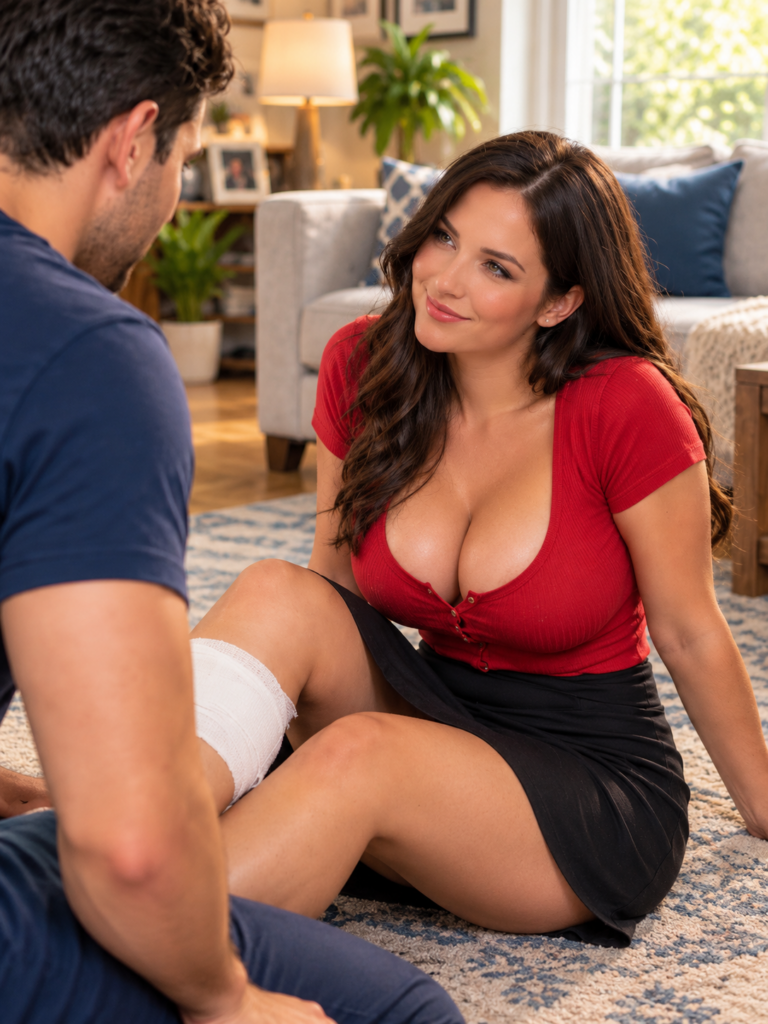
Part 1
The first thing Emma did after twisting her ankle was laugh. It came out thin and embarrassed, the kind of sound a person makes when pain arrives in front of someone they have spent years trying not to need. The second thing she did was look at me with a blush I had not seen on her face since we were twenty-four.
“Please don’t make this weird,” she whispered. Her hand was still locked around my forearm. “But can you carry me to the couch?”
The roller had already hit the drop cloth. Paint the color of weak coffee spread in a slow oval across the canvas. Outside, a March rain had started against the front windows of the house on Sycamore, and across the street Diane Pell’s porch light was on even though it was only four in the afternoon. I did not look at the light. I was looking at Emma’s right foot, turned a little inward, and at the way she was trying to smile like the whole thing was a joke we could both walk away from.
We could not walk anywhere. That was the problem.
“Couch is fifteen feet,” I said.
“I can hop.”
“You already tried standing.”
“I stepped wrong.”
“You fell.”
She narrowed her eyes. Even hurt, she had that look, the one that used to shut Ryan up at the dinner table when we were kids and he tried to tell a story that was not his. “You’re enjoying this.”
“Absolutely not.”
“Liar.”
I was not enjoying it. I was counting. Fifteen feet of unfinished oak. One bad ankle. A woman who had come back to town three months ago and had not called me, and a Saturday I had stolen from a job site because the living room still looked like the previous owner had given up in the middle of a thought. If I called one of my guys, I would have to pay them time and a half I did not have. If I let her hop, she was going to go down on the drop cloth and take the ice pack with her.
I crouched. “Toes move?”
“Yes.”
“Scale of one to ten.”
“Only when I breathe.”
“That’s not a number.”
“It’s a nine if you keep talking.”
I got the first-aid kit from under the kitchen sink, the same kit my father used to throw in the truck before he would let me on a site. Ice pack, towel, elastic wrap. Emma sat on the floor with her back against the wall and watched me wrap her ankle like she was trying to decide whether to be grateful or furious. The house hummed. Refrigerator. Rain. Somewhere in the walls, the old boiler knocked once and went quiet.
“You’re doing that thing,” she said.
“What thing?”
“Looking at me like I’m a problem on a punch list.”
“I am looking at you like a person who should not be on my ladder.”
“You handed me the roller.”
“You took it.”
She almost smiled. Then she tried to shift her weight and the smile died. I saw it happen in her mouth first, then in her eyes. She had always been bad at hiding pain and good at hiding everything else.
I should start earlier than the ladder. Not eight years earlier. Just far enough back that the afternoon makes sense.
My name is Cole Brennan. I run Brennan & Son, which is a generous name for three full-time guys, two trucks, and a stack of invoices in the passenger seat of the Ford. My father died when I was twenty-six. Heart, on a Tuesday, between a porch rebuild on Elm and a call from the lumberyard about a late delivery. I took the company because the alternative was selling the tools to a man who would have changed the name by Friday. For a while that felt like loyalty. Later it felt like a loan I had signed without reading.
The house on Sycamore was the latest version of that loan. I bought it in January from an estate. The list price had dropped twice. The inspection listed a soft spot in the bathroom floor, a panel that would not pass, and windows that leaked when the wind came from the west. I bought it anyway. Rent on my apartment had gone up, the lease was month to month, and I told myself a man who built other people’s kitchens ought to be able to sleep in a house with his name on the deed. The down payment cleaned out what I had been calling savings. The furnace repair took the rest. By March I was painting the living room myself on a Saturday because the bid I had out with the county was still sitting in somebody’s inbox, and payroll was due on Thursday.
Emma knew none of that. Or she knew the shape of it, the way she had always known when I was lying about being fine, and she had still shown up with her hair in a knot and an old Seattle sweatshirt that had a hole at the cuff.
“Most people hire professionals for this,” she had said from the second step of the ladder.
“I am a professional.”
“You’re a contractor. That’s different. You’re standing on your own ladder on your day off.”
“You’re standing on my ladder.”
“Exactly. Free labor. You should be nicer to me.”
Ryan had told me she was back. That was six weeks ago, over meatloaf at his place, like it was a weather report. Emma’s renting the little house on Maple, he said. I nearly dropped my fork. She had been in town three months. Three months of living fifteen minutes away, and the only reason I knew was because her brother mentioned it between bites. That was Emma. She could leave a room without making the door click. Apparently she could walk back into a life the same way.
I saw her at Ryan’s birthday before I saw her anywhere else. She looked the same and not the same. Same crooked smile. Same habit of pushing her hair behind her ear when she was deciding whether to tell the truth. Something quieter in the way she held her shoulders. We talked for ten minutes. Seattle. The company. Neither of us mentioned the eight years. After that it was coffee once, then a hardware-store run because she needed a showerhead and did not trust the one in the rental, then this. Painting. Nothing romantic. That was the sentence I had been using on myself in the truck.
The ladder shifted because I had set it on the edge of the drop cloth like an amateur. That part was my fault. Emma stepped down too fast. Her right foot found the hem of the canvas instead of the floor. I caught her elbow before she went all the way over, and the laugh came, and then the blush, and then the sentence I was still holding in my hands.
“Okay,” she said, when the ice had been on long enough that her mouth had gone tight. “Enough. I can get to the couch if you let me use you as a crutch.”
“No.”
“Cole.”
“You’ll plant wrong and we’ll both end up explaining this to Ryan.”
“Ryan doesn’t get a vote.”
“He gets a vote if I drop his sister.”
She looked at the couch. Then at me. The blush had not left. “Fine. But if you say anything cute, I will make you put me down in the kitchen.”
“Deal.”
I slipped one arm behind her back and the other under her knees. She was lighter than I remembered and warmer than the room. Her arm went around my neck on instinct, the way it had the summer we were twenty-four and her car died at the edge of the county fair parking lot and I carried her across the gravel because she had already walked a blister into her heel. Neither of us had called that a date. We had called it a ride. I had thought about kissing her for the entire walk and had not done it, because she was Ryan’s little sister and because I was a coward in a clean T-shirt.
Her face was close. I looked at the doorway instead.
“Couch,” I said.
“Right.”
I carried her across the unfinished floor. Her fingers tightened once on my shoulder when I turned sideways through the space where the old armchair had been. I felt it. I did not mention it. When I lowered her onto the couch, she did not let go right away. The rain picked up. Across the street, if I had looked, I would have seen Diane Pell standing at her storm door with a mug, watching a man carry a woman out of a half-painted room. I did not look. I was busy not making it weird.
Emma’s cheeks were pink. “Please don’t.”
“I wasn’t.”
“You were thinking about it.”
“I was thinking about not dropping you.”
She laughed, soft, and then she said the thing I would hear again in the truck for weeks. “Can you stay here for a while?”
“Of course.”
I sat on the floor because the couch was a two-cushion relic and I did not trust myself with the other cushion. She pulled the old quilt over her legs. For a few minutes we listened to the rain and the boiler and the tick of the ice pack warming. I had a text from Luis, my lead carpenter, about a Monday start on a deck in Grove City. I did not open it. Emma watched the window.
“Do you ever think about it?” she said.
“About what?”
“Us.”
The word sat between us like a tool left on a rung. I could have said no. I had practice. Instead I said, “I think about it.”
Her eyes came up. “Really?”
“All the time.”
She looked almost frightened, which was fair. I was frightened. “Why didn’t you ever say anything?”
“Because you were Ryan’s little sister.”
“That never stopped you from telling me other things.”
“It stopped me from telling you that.”
She was quiet long enough that I heard a car pass on Sycamore and not slow down. Then she said, “I thought you didn’t feel the same. I thought you saw me as a kid.”
“I never saw you as a kid.”
“Then why did you let me leave?”
There it was. The question I had asked the cab of the truck on every highway between here and the lumberyard. I looked at her ankle, at the paint on her wrist, at the hole in the cuff of the sweatshirt.
“I thought you wanted Seattle,” I said.
“I did.”
“And I thought you wanted a different life.”
“I did.” She pulled the quilt higher. “Then I met someone.”
My stomach went tight in the ordinary way. “Okay.”
“His name was Daniel. We dated for three years. He proposed. I said yes.” She watched my face and did not look away. “Two years ago I gave the ring back.”
The room got smaller. The rain got louder. I waited, because if I spoke I was going to ask the wrong question first.
“I was trying to build a life with someone who wasn’t the person I wanted to come home to,” she said. “I came back because of you. I know that isn’t fair. I know you can’t just—”
“Emma.”
“I’m tired of being afraid.” Her voice cracked on afraid, then steadied. “What are you afraid of? That you don’t feel it anymore?”
I looked at her injured ankle. I looked at the woman who had driven across town with a roller and a bad sweatshirt because I had mentioned, once, that the living room made the house feel like a job and not a place to sleep. “I never stopped.”
She laughed once, nervous, and her eyes filled. She did not let the tears fall. “That was the answer I was hoping for.”
I took her hand. She let me. Her fingers were cold from the ice.
“There’s more,” I said, because I could feel it sitting under the sentence.
She nodded. “Daniel called last week. He wants to try again. I told him no.”
“Then what’s the problem?”
“He asked me why I came back.” She looked at me straight. “I told him the truth. I came back because I wanted to find out if I had imagined what was between us. And now I know I didn’t.”
I should have kissed her then. I did not. The ankle was swelling under the wrap, and the part of me that had taken over my father’s company was already making a list: urgent care, insurance card, whether she could get up the step into the truck. Wanting her had waited eight years. The ankle was not going to wait until morning.
“We should get that looked at,” I said.
“I hate doctors.”
“I know.”
She stared at me. “You remembered.”
“I remember everything about you.”
Something moved in her face. She held out her arms. “Carry me. Unless you’d rather drag me.”
The second time was different. She did not look embarrassed. She rested her head against my shoulder while I got her shoes, her bag, the quilt she insisted on bringing because the waiting room would be cold. At the front door she said, quiet enough that the rain almost took it, “You know, for someone who waited eight years, you’re taking an awfully long time to kiss me.”
I stopped on the porch. “You’re injured.”
“My ankle is injured. The rest of me is fine.”
I kissed her forehead. She rolled her eyes, and I felt her smile against my collar.
“That wasn’t what I meant.”
“I know.”
I carried her down the wet steps. Across the street, Diane Pell had come out onto her porch with a recycling bin she did not need to take out until Tuesday. She watched us the way a person watches when they are trying not to be seen watching. I nodded. She nodded back. Neither of us spoke. Emma’s hair was damp by the time I got her into the truck.
I did not know Diane’s last name yet. I knew she lived in the brick house, that she drove a clean gray sedan, and that she had waved once when I was scraping the porch. I did not know she sat on the county housing board, or that she had spent the last month looking for a contractor who would not disappear in the middle of a rehab. I did not know she had already written my truck number on the back of an envelope.
I knew the ankle. I knew the blush. I knew I was about to spend money I had planned to spend on primer.
Part 2
Urgent care smelled like floor cleaner and the inside of a vending machine. Saturday afternoon meant a full waiting room: a boy with a towel around his hand, a woman in scrubs who had clearly come from a shift, an older man coughing into his elbow. I signed Emma in because the clipboard was on the far side of the desk and she could not stand long enough to reach it.
“Insurance?” the woman at the window asked.
Emma went still. “I have a card. It might not be active. I left my job in December. The marketplace plan doesn’t start until April.”
The woman nodded like she heard that sentence every hour. “We can do self-pay. Visit is one eighty-nine before imaging. If they x-ray, it’s more.”
Emma reached for her wallet. I saw the math happen in her hands. She had a debit card, a folded grocery receipt, and the look of a person who had already checked the balance that morning. I put my card on the counter before she could finish the calculation.
“Cole,” she said.
“We’ll sort it.”
“I don’t want you to sort it.”
“I know.”
The woman ran the card. For a second I thought about the furnace invoice and Thursday’s payroll and the way the Ford had started rough that morning. The charge went through. I did not let my face change. Emma looked at the floor.
They called her back twenty minutes later. I stayed in the waiting room because she asked me to, then texted me from the exam table that the doctor was late and the paper sheet was loud. I bought two bottles of water I did not want. When I sat down again, the woman from the brick house was in the chair opposite, holding a numbered slip and a paperback with the spine cracked.
“You’re the new one on Sycamore,” she said. Not a question.
“Cole Brennan.”
“Diane Pell. I saw you carry her out. Ankle?”
“Sprain, we think.”
“Mm.” She turned a page she was not reading. “My husband twisted his on a job site in ’09. Walked on it for a week because he didn’t want to miss a pour. He limped until he died. Don’t let her do that.”
“I won’t.”
She studied me over the book. “Brennan and Son. You did the Hartwell porch.”
“Last fall.”
“They said you came back when the rail pulled loose. No charge.”
“The bracket was mine. It should have held.”
“Most people would have argued whose bracket.” She closed the book. “I have a row of houses on Kendall. Workforce units. I’m tired of bids that look good on paper and fall apart in the walls. If your card isn’t declined by the time they call her name, come see me Monday.”
My card was not declined. It was close enough that I felt the difference in my pocket. “I can come see you.”
“Don’t bring a pitch deck. Bring what you actually did on Hartwell.”
They called Emma before I could answer. The doctor confirmed a bad sprain, no break, three weeks if she behaved and longer if she did not. They sent us out with a boot, a wrap, and a printout. The boot was sixty dollars at the desk. I paid that too. Emma did not speak until we were in the truck.
“You shouldn’t have,” she said.
“You were going to put it on a card you weren’t sure about.”
“That’s my problem.”
“It was our Saturday.”
She turned her face to the window. The rain had thinned to a mist. “I have four hundred and twelve dollars until the first. Rent is eight-fifty. I was going to pick up hours at the bakery on Maple. I can’t stand on a line with this.”
“Then you won’t.”
“Cole.”
“I’m not offering charity. I’m offering a couch and a ride and the boot I already bought. You can hate it from a seated position.”
She was quiet for three lights. Then she said, “Daniel would have made a speech about it.”
“I’m not Daniel.”
“No,” she said. “You’re not.”
I took her to the house on Maple because she asked. The rental was small and clean and colder than it should have been. The thermostat was set at sixty-two. She said the landlord called that efficient. I carried her up the three steps, then into the front room, then onto a couch that faced a window with a view of a fence and a recycling bin. She hated every second of being carried and held on anyway.
“Stay until the ibuprofen works,” she said. “Then go home. You have a deck to worry about.”
“Luis has the deck.”
“Luis is not the one who paid for the boot.”
I stayed until the color came back into her mouth. I made eggs because eggs were what she had. I wrote my number on the printout even though she already had it. When I left, she was asleep with the boot elevated on a pillow and the quilt from my house pulled to her chin. I drove back to Sycamore with the heater on and the radio off and tried not to do the math.
The math did itself.
Payroll for Luis, Andre, and the kid we called Miles was due Thursday. The Grove City deck deposit had covered materials and not much else. The county bid, a small accessibility ramp at the library branch, was still unanswered. The Ford needed a sensor I had been pretending was a cold-morning problem. The urgent care charge and the boot had taken the grocery money and the primer money. I could move money from the tax account and put it back after the Hartwell final payment cleared. I had done that once in February. My father used to say a man who borrows from his own taxes is a man writing a letter to his future self. I had not enjoyed being the future self.
Sunday I checked on Emma twice. Once with soup from the place on Main, once because she texted that the boot was louder than the pain. Ryan called while I was on her porch.
“She says she fell off your ladder,” he said.
“She stepped off it. I caught her.”
“And then you took her to urgent care.”
“Yes.”
A pause. Ryan and I had been friends since shop class. He installed HVAC. He was not delicate, but he was not stupid. “She’s my sister, Cole.”
“I know who she is.”
“Do you? Because she came back quiet, and I didn’t ask why, and now she’s on a couch with your quilt. If this is a weekend thing, don’t. She doesn’t have a lot of extra life left to spend on almost.”
“It isn’t a weekend thing.”
“Then say that to her. Not to me.” He hung up before I could tell him I already had.
Monday I went to Diane Pell’s office, which was not an office so much as the front room of the brick house, with a table, a laptop, and a row of labeled folders. She did not offer coffee. She offered floor plans.
“Four units on Kendall,” she said. “Kitchens, baths, two porch repairs, one foundation crack I want somebody honest to look at before I pay an engineer to tell me what I already suspect. Budget is tight. Timeline is tighter. The last crew left a bathtub in a yard for six days. I will not do that again.”
“I can look this week.”
“You’ll look tomorrow. Bring your lead. If I like what I hear, I’ll give you unit one as a trial. Not the whole row. I’m not in the business of hope.” She tapped the folder. “I was at urgent care for a blood pressure check I didn’t need a pamphlet for. I saw you put your card down. She didn’t want you to.”
“That isn’t part of the bid.”
“It’s part of whether I trust you in a house where the tenant is still living in unit three.” She looked at me the way my father used to look at a joint. “Don’t confuse that with a favor. If your numbers are wrong, I’ll hire someone else.”
I left with the plans and a headache. At the truck, Luis was already waiting, because I had texted him from the porch.
“Side job?” he asked.
“Maybe. Trial unit. We’d have to start after Grove City or overlap.”
“Overlap means nights.”
“I know.”
He squinted at the brick house. “She the one who watched you carry that girl?”
“How do you know about that?”
“Andre’s cousin lives on Sycamore. Small town, boss. You carried a woman to a truck in the rain. People have hobbies.”
Emma called while we were still in the lot. Her voice was careful. “The bakery can’t use me if I can’t stand. I told them three weeks. They said call when the boot is off.”
“All right.”
“It is not all right. I transferred you eighty dollars. It’s what I can do this week. Don’t argue in a parking lot.”
“I’m not in a parking lot.”
“Luis is with you. You’re in a parking lot.” She exhaled. “Come by after work if you want. Bring nothing. I mean it.”
I brought nothing except the leftover soup, which she called a violation and ate anyway. The house on Maple was still cold. She had a stack of bills on the table, face down, and a laptop open to a job board. I did not read the bills. I sat in the chair she pointed at and told her about Kendall Street in the flat way I would have told Ryan about a bid. She listened. She asked about the foundation crack. She asked whether Diane Pell was fair. I said I did not know yet.
“You paid for the boot,” she said, halfway through the soup. “And the visit. I keep doing the number. I hate the number.”
“Then stop doing it.”
“That’s not how being broke works.”
“I know how it works.”
She looked at me then, really looked, and some of the Seattle quiet left her face. “Your dad’s company. Is it all right?”
“It’s a company.”
“Cole.”
“Payroll is Thursday. I’ll make payroll. The truck needs a sensor. The house needs primer. None of that is your ankle.”
She set the spoon down. “When I left, I thought I was choosing a bigger life. Graduate school. A job with a title. Daniel and his apartment with the view of the water. I used to walk to the bus and practice not thinking about Ohio. It worked until it didn’t. Giving the ring back cost me the apartment. Leaving the job cost me the insurance. Coming here cost me the story I had been telling about why I went. I don’t want to cost you a payroll.”
“You aren’t a line item.”
“Everyone is a line item if the month is bad enough.”
I did not have a clean answer. I took her bowl to the sink and washed it, because washing a bowl was something I could finish. When I turned around she was watching my hands.
“Ryan called you,” she said.
“He did.”
“He thinks you’ll hurt me by accident.”
“I might. Not by accident if I can help it.”
She nodded like that was the first honest contract she had heard in years. “Daniel texted again. I didn’t answer. I want you to know that before you decide I’m a risk you can’t price.”
“I already decided.”
“Decided what?”
“That I’m not spending eight more years being careful at you.”
She smiled, small, and then winced because she had shifted the boot. I fixed the pillow. She let me. Outside, a neighbor dragged a trash can to the curb and the sound scraped the whole street.
The week got worse in the ordinary ways. The Grove City client wanted the deck rails changed after the posts were set, which meant materials I had already bought and a conversation I did not bill for because the contract was vague and I wanted the referral. The Ford’s sensor light came on and stayed on. The shop quoted four hundred and eighty dollars. I scheduled it for Friday and drove with the windows cracked so I would hear anything worse. On Kendall Street, the foundation crack was real but not catastrophic. Diane walked the unit with us, asked Luis about blocking, asked me about change orders, and did not smile when I said I would put overages in writing before I bought a screw. She said she would call.
She did not call on Wednesday. She called on Thursday, after payroll, after I had moved the tax money and felt sick about it.
“Unit one,” she said. “Trial. Start Monday. I’ll be in and out. If you vanish, I’ll replace you and I will tell people why.”
“We won’t vanish.”
“Your friend with the ankle. She walking?”
“Boot. Three weeks.”
“Hm.” A pause. “Tell her the brick house has a ramp at the side door if she ever needs a chair that isn’t her couch. I am not offering company. I am offering a door.”
I almost said thank you. She hung up before I could make it awkward.
That night Emma’s heat went out. She texted me a photo of the thermostat and the words landlord says tomorrow. I drove over with a space heater from the job trailer and a pizza I pretended was already in the truck. The heater was company property. I wrote it on the inventory sheet anyway, because my father had believed in writing things down even when no one was checking. Emma sat on the couch in two sweatshirts and looked at the heater like it was a verdict.
“I can pay you back for the pizza,” she said.
“You can eat the pizza.”
“Cole, if Diane Pell is giving you work, you need to be on Kendall, not in my cold rental.”
“I can be in both places for an hour.”
She was quiet. The heater ticked. Then she said, “When you carried me off that ladder, I thought I was going to die of embarrassment before I died of the ankle. I also thought, if he puts me down and makes a joke, I will know we are still the people who left. You didn’t make a joke. You just carried me. I have been trying to figure out what to do with that.”
“You don’t have to do anything with it tonight.”
“I want to.” She held out her hand. I took it. “Come to the house when the boot is off. Not urgent care. Not soup. Dinner. A date that we call a date so Ryan can’t say we skipped the part where we admit it.”
“All right.”
“And if your truck dies between now and then, you tell me. No quiet heroics. I didn’t come back for a man who disappears into his invoices.”
“That’s a high bar.”
“You built it.”
I stayed until the room warmed. I did not kiss her on the mouth. I kissed her hair when I left, and she caught my sleeve and said, “Foreground, Brennan,” which was a joke from a summer so old it should not have still worked. It worked.
Friday the shop kept the Ford overnight. I borrowed Luis’s car and hated the mirrors. Saturday the county sent a form letter: the library ramp bid was awarded to a larger outfit out of Columbus. I read it twice in the driveway. The letter thanked me for my interest. Interest did not make payroll. Kendall Street might. If we did not mess it up. If the trial unit did not turn into a fight about a crack in a wall.
Emma texted a photo of her ankle, less swollen, and the words I can hobble to the mailbox. Do not be proud of me. I am very brave and very slow. I looked at the letter and the photo and felt both things at once, the drop and the small stupid lift. Across the street, Diane Pell was on her porch again, sorting mail. She lifted a hand. I lifted mine. She did not come over. She did not need to. She had already seen the part I would rather not have had an audience for, and she had written it down next to the Hartwell porch.
On Sunday Ryan showed up at Sycamore with a six-pack and no announcement. He walked through the half-painted room, nodded at the ladder like it had personally offended him, and sat on the couch where Emma had sat.
“She likes you,” he said. “She liked you before Seattle. I pretended I didn’t notice because it was easier than having the conversation. If you’re in, be in. If the company eats you alive, don’t take her with you into the quiet. She just got out of a quiet thing.”
“I’m in.”
“You look broke.”
“I’m working on it.”
“Yeah.” He opened a beer and handed me the other. “She said you paid the clinic. She also said she’ll never forgive you and she already forgave you. That’s Emma. Don’t make her choose between pride and a boot.”
“I won’t.”
He looked at the paint tray. “You missed a spot.”
“It’s primer.”
“Still missed it.”
We drank the beer. The rain started again. I thought about Thursday’s payroll and Monday’s trial and the woman on Maple with her foot on a pillow. I did not know that Diane Pell had already called two of my old clients. I did not know she had driven past the Hartwell porch on her way to church. I did not know the meeting she was about to put on my calendar would feel, for the first twenty minutes, like a job I was about to lose.
Part 3
Monday on Kendall Street smelled like wet plaster and the orange cleaner the last crew had left in a bucket. Unit one was a two-bedroom with a kitchen that had given up in stages. Luis marked the cabinets. Andre checked the subfloor. Miles carried trim and tried not to look nervous in front of Diane, who arrived at seven-forty with coffee she did not share and a notebook she did share.
“Write down what you open,” she said. “If you find someone else’s mistake, I want it in ink before you become responsible for it.”
We found someone else’s mistake by nine. The dishwasher supply had been capped with a fitting that would not have passed a bored inspector. I showed her. She looked at it, looked at me, and said, “Price the repair. Don’t bury it.”
I priced it at the tailgate. She initialed the page. No speech. No thanks. She left for a board meeting and told us the tenant in unit three got home at four and did not like radios in the hallway. We kept the radio off.
Emma called at noon. “I have a phone interview at two. Sitting down. Don’t jinx it.”
“I won’t.”
“It’s a clinic front desk. Not Seattle. Benefits after ninety days. If I get it, I can stop doing arithmetic on your card.”
“Get it because you want it.”
“I want a bus pass and a dentist. Don’t romanticize my spreadsheet.”
She got the interview. She did not get the job. They called her Tuesday and said they needed someone who could be on her feet for the training week. She told me without the joke first. The joke came later, smaller. I was on a ladder in unit one, which felt like a bad joke of its own, when the text arrived. I called her on the break.
“I’m fine,” she said. “I’m angry. Those can overlap.”
“You want company?”
“I want a time machine and a closed-toe shoe that isn’t a boot. Company is allowed after six. Bring the ugly primer stories. I like your voice when you’re complaining about paint.”
I brought takeout from the Thai place and the story about the dishwasher fitting. She ate on the couch with the boot propped up and corrected my description of a supply line until I admitted she had listened better than Miles. Halfway through the noodles her phone lit up. She turned it over. Then she turned it back and showed me the screen.
Daniel: I don’t understand how Ohio is the answer. Call me.
“I’m not calling,” she said. “I want you to see that I’m not calling. He gets to be confused. He doesn’t get a committee.”
“All right.”
“Does it bother you?”
“It bothers me that he had years I didn’t. It doesn’t bother me that he lost.”
She set the phone face down on the table, next to the bills. “One of those is the electric. I can pay it. The other is the urgent care balance they mailed even after your card. Forty-two dollars. I will pay that one myself or I will lose my mind.”
“Pay that one.”
“You’re learning.”
We sat with the window open a crack because the heater had made the room too dry. She told me about the bus in Seattle, about the morning she put the ring in a box and could not find a post office that felt neutral enough. I told her about the day I signed the papers for the company, about the coffee that went cold while the lawyer explained liability. Neither of us performed. The boot creaked when she shifted. I fixed the pillow without announcing it. She let me.
Wednesday Diane asked me to meet her at the brick house at six-thirty. The text said bring the Kendall log. It did not say why. I spent the afternoon sure I had mispriced the dishwasher repair, or that the tenant had complained about footsteps, or that she had found a cheaper crew. Luis told me I was making the face I made before bank meetings. I told him to finish the blocking.
Diane’s front room was the same. Folders. Laptop. No coffee. She had a second chair pulled out, which felt worse than a closed door.
“Sit,” she said. “You look like you’re waiting for a fine.”
“Am I?”
“Not today.” She opened a folder that was not the Kendall folder. “I called Hartwell. I called the church on Grant where you rebuilt the steps and ate the cost when the concrete went short. I called a woman named Patrice who said you plowed her mother’s driveway twice last winter and sent a bill for one. She was annoyed you billed at all. I don’t need a saint. I need a man who writes things down and comes back when the rail fails.”
I did not know what to do with my hands. “The driveway was on my way.”
“Everything is on someone’s way. Most people keep driving.” She slid a paper across the table. “Unit one is fine. I’m giving you units two and four. Not three. Three has a tenant and a nephew who thinks he can hang cabinets. You’ll start two when one is closed. Payment on the first and third if your invoices match your log. If they don’t, we stop.”
The number on the paper was not a fortune. It was a season. It was the sensor, the tax account, the primer, a margin that would not humiliate me at the supply house. I read it twice.
“This is because of the ankle,” I said.
“This is because of the porch and the fitting and the fact that you didn’t invent a story at urgent care.” She capped her pen. “The ankle told me which man to check. The work told me whether to hire him. Don’t mix those up or you’ll start performing kindness for an audience. She didn’t look like she wanted an audience.”
“She didn’t.”
“Good.” Diane sat back. The house ticked the way old houses tick. “My husband ran crews for thirty years. He was decent at the work and bad at coming home. I used to think those were separate skills. They’re not. You can take the units or you can tell me you don’t have the men. Either answer is acceptable. A speech is not.”
“I’ll take them. Luis runs lead when I’m on a ladder. I’ll put the overages in writing.”
“Then we have a contract and not a mood.” She stood. At the door she added, “Tell her the side ramp is still there. And tell her I don’t gossip about what I see from my porch. I just use it.”
I sat in the truck for a full minute before I texted Emma. Not the number. Just: Can I come by. She sent back: If this is bad news, bring it anyway.
She was on the couch with a library book and the boot, hair down, the cold rental warmer than it had been. I told her about the units. I told her about the driveway bill and the church steps. I told her Diane had seen me put the card down and had not hired me for that. Emma listened without interrupting, which was new and old at the same time.
“So the woman across the street watched you carry me,” she said.
“Yes.”
“And then she checked whether you were any good.”
“Yes.”
Emma looked at her hands. “I don’t know how to feel about being a reference.”
“You weren’t. The work was. She was clear.”
“Still.” A breath. “I’m glad it’s real. I’m glad it isn’t a prize for picking me up. I would have hated that more than the bill.”
“I know.”
She nodded toward the cushion. “Sit up here. The floor is ridiculous. My ankle is the injured party, not your knees.”
I sat. The couch was too small. Our shoulders touched. She did not move away. Outside, a siren went somewhere else and faded.
“The clinic said no,” she said. “There’s a scheduling job at the community college. Part time. I applied before you got here. If I get it, benefits are far away and the pay is honest. I can live on honest if the heat stays on.”
“You’ll get something.”
“Don’t promise that. Promise you’ll tell me when the Ford is fixed so I can stop picturing you on the side of the road being noble.”
“It’s fixed. Sensor. Four eighty. I yelled at no one in the parking lot.”
“Good.” She leaned her head against my shoulder, careful of the boot. “I kept thinking about the day you carried me at the fair. I was twenty-four. My heel was bleeding into a sandal. You didn’t make it a scene. I spent the drive home wondering what would have happened if you’d kissed me in the parking lot. I also spent it knowing I had a fellowship application on my desk. Both things were true. That’s the part I couldn’t explain to Daniel. He wanted the version where I had been waiting. I hadn’t been waiting. I’d been building a life. I just never put you down while I built it.”
“I didn’t put you down either.”
“You let me get on a plane.”
“I did.”
“Don’t do that again.” She said it into my sleeve. “If you want out, say out. If you want in, stay in when the invoices are ugly. I can handle ugly. I can’t handle another eight years of almost.”
“I’m in.”
She was quiet long enough that I thought she had fallen asleep. Then she said, “My ankle hurts. That tends to happen when you twist it. You are still unsympathetic.”
“You came back to town because of me. I’m supposed to feel sorry for the ankle?”
“Yes. Both. Multitask.”
I laughed. She did too, and then she tipped her face up. The kiss was not the forehead. It was brief, careful of the boot and the lamp and the fact that we were thirty and thirty-two and had wasted a perfectly good decade being polite. She tasted like tea. Her hand stayed at my collar. When we stopped, she looked pleased and a little stunned, which felt accurate.
“There,” she said. “Eight years. You can clock out.”
“I’m not clocking out.”
“Good. Carry me to the kitchen anyway. I want water and I want the indignity. It keeps us honest.”
I carried her. She complained the entire ten feet. At the sink she drank and looked at the dark window and said, “Diane Pell can keep her porch. This part is ours.”
The next three weeks were not a movie. Unit one closed on schedule except for a back-ordered faucet, which I wrote down and did not hide. Unit two opened with a worse floor than the plans promised. I sent Diane the photos before I sent the price. She approved half and argued the rest, and we met in the middle like adults. Payroll cleared without the tax account. I put the borrowed money back and slept the kind of sleep that is mostly relief.
Emma’s bruise went from purple to yellow to nothing. The bakery held her spot and then lost it to a faster hire, and she took the part-time scheduling job at the college after a second interview she attended in one normal shoe and one boot she was not supposed to be done with. The pay was modest. The chair was real. She bought her own groceries and left the receipt on my counter once, not as a performance, just because she had used my pen. I did not mention the receipt. She paid the forty-two dollars and mailed the statement to me with a note that said you may frame this if you are unbearable.
Ryan came to Kendall on a Thursday and installed a thermostat at cost because Diane asked who I trusted with air. He stayed after the tenant left and drank a soda on the tailgate.
“She looks like herself,” he said. “Don’t mess that up.”
“Working on it.”
“You painted the living room yet?”
“Saturday.”
“Use a drop cloth, genius.”
The Saturday Emma came back to Sycamore, she was walking. Slowly, with a wrap, but walking. She brought takeout and a smaller ladder story she did not need to bring. The living room was painted. The couch was the same couch. The rain was a different rain.
“You owe me something,” she said, setting the bags on the counter.
“What?”
“A proper first date. We skipped the awkward part.”
“I don’t think we’re capable of awkward.”
She raised an eyebrow. I thought about eight years of birthday texts and the plane and the ring in a box.
“Okay,” I said. “Maybe we are.”
We ate on the porch because the porch was finally a porch and not a punch list. Nothing grand happened. Diane’s light was on across the street. She did not come out. A dog barked and got bored. Emma leaned her head on my shoulder and said she remembered the fair, and the gravel, and the way I had looked at the exit sign instead of at her mouth. I told her I had been trying not to ruin her fellowship. She said the fellowship had been fine and the silence had been the expensive part.
“We might not have been ready,” she said.
“Maybe.”
“We are now.” She threaded her fingers through mine. “If the truck dies, you call. If the units go sideways, you say so. If I get proud about a bill, you let me pay the small one and you don’t make a speech. That’s the whole contract.”
“I can build that.”
“You’d better. I’m not twisting the other ankle to get your attention.”
In the morning I would be on Kendall with Luis, writing down what we opened. Emma would be at a desk, learning a calendar system and keeping her foot elevated on a box she had labeled do not mock this. Ryan would pretend he had always known. Diane would initial a log and go to her board meeting and never mention the rain. The house on Sycamore would still need the bathroom floor. The company would still be three guys and two trucks and a name I had not changed.
I looked at Emma under the porch light and understood the simple part at last. She had not come back because she missed a street. She had come back because there was a person she had never really put down. The ankle had stopped us long enough to say so. The rest would be work, and bills, and the ordinary courage of not getting on a plane this time.
She reached for the last spring roll and missed, then looked at me.
“Don’t you dare carry me for a spring roll.”
“Wasn’t going to.”
“Liar.”
I passed her the container. Across the street, the porch light clicked off. Emma’s hand found mine again, easy, like a tool set back where it belonged. The rain started, light, on the roof we had not replaced yet. We stayed where we were.


