
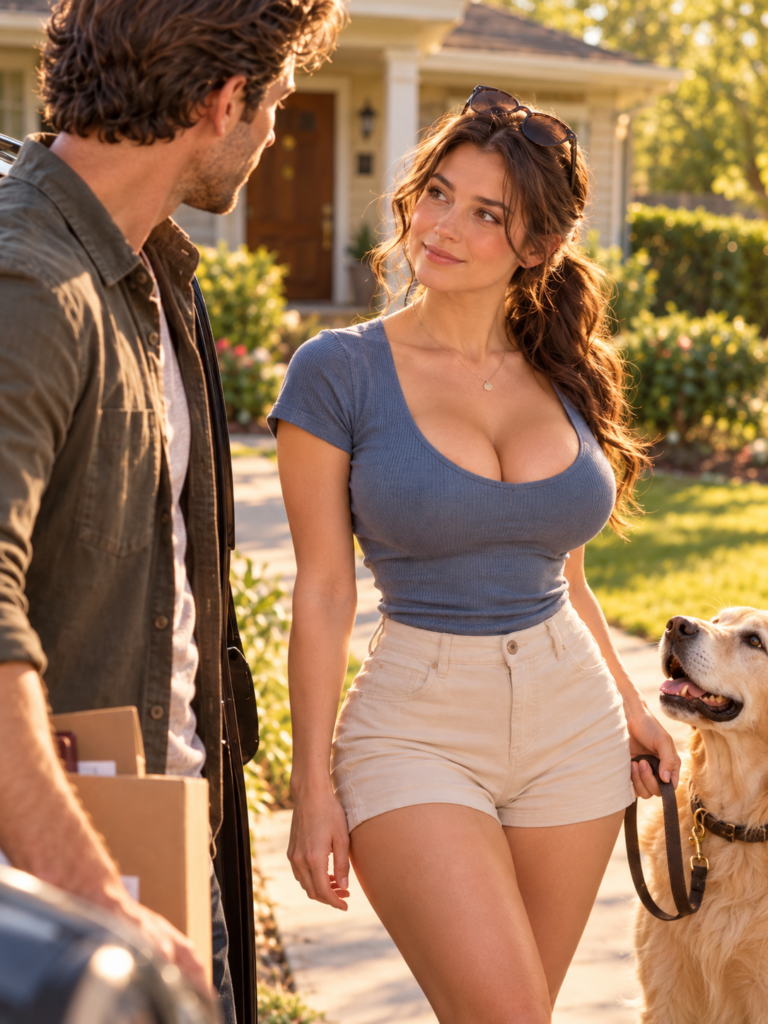
I came home to sell my father’s house after sixteen years away—but when my first love stood in the driveway holding his old dog’s leash, she smiled and said, “Long time no see…”
Part 1
Milo reached Conrad Whittaker before Conrad had fully shut the car door.
The old yellow Labrador came lumbering across the driveway with the determination of a much younger dog, his gray muzzle lifted, nails clicking against the cracked concrete. Conrad barely had time to put down the folder in his hand before Milo shoved his head against his stomach.
“Whoa. Easy, old man.”
The dog ignored him.
Conrad laughed despite himself and crouched, rubbing both hands along Milo’s neck. The familiar smell of warm fur, grass, and whatever ancient blanket the dog had slept on hit him harder than expected.
For one strange second, the sixteen years Conrad had spent building a life two hours away seemed to collapse.
He was seventeen again.
His father was inside shouting that dinner was ready.
Milo was a clumsy puppy chewing through one of Conrad’s sneakers.
And Rosalie Bennett was sitting on the hood of Conrad’s first car, laughing because the engine had died for the third time that week.
Then he heard a woman’s voice.
“You’re going to encourage him.”
Conrad froze.
He looked up.
Rosalie stood near the end of the driveway with an empty leash looped around one wrist.
She was thirty-three now.
That should not have surprised him. He was thirty-three, too.
But some foolish part of his memory had preserved Rosalie at eighteen—dark hair whipping around her face in the wind, cheap silver bracelets on both wrists, a stubborn smile that usually meant Conrad was about to lose an argument.
The woman in front of him was different.
Her dark hair was tied back loosely. Sunglasses rested on top of her head. She wore running shoes, jeans, and a faded navy T-shirt from some charity 5K.
There was no dramatic entrance.
No wounded expression.
No folded arms.
No accusation waiting behind her eyes.
She simply looked at him for a moment.
Then she smiled.
“Long time no see.”
Conrad slowly stood.
Sixteen years.
He had imagined this meeting before, though he would never have admitted it.
In some versions Rosalie hated him.
In others she had married somebody else and barely remembered him.
In several particularly stupid fantasies, he returned successful enough that she immediately understood why leaving had been necessary.
Reality was worse.
Reality was Rosalie standing six yards away looking completely comfortable.
“Hey,” he said.
Her eyebrows rose.
“That’s it?”
“What?”
“Sixteen years and I get ‘hey’?”
Conrad glanced at Milo, hoping the dog might provide an escape.
Milo sat beside him, tongue hanging out.
“He seemed happy with it.”
“Milo has lower standards.”
Conrad laughed.
It happened automatically.
Rosalie laughed too.
And suddenly neither of them did.
The silence between them shifted.
They remembered that sound.
They had once known each other well enough to hear one another laughing from across the cafeteria and immediately know what was funny.
Conrad looked toward the house.
His father’s house.
That was why he was here.
Not Rosalie.
Not memories.
Not unfinished conversations.
The folder on the driveway contained an estate inventory, a preliminary listing agreement, contractor estimates, and a checklist from the realtor.
His plan was simple.
Sort his father’s possessions.
Keep what mattered.
Donate what did not.
Make whatever minor repairs were necessary.
Sell the house.
Return to Richmond.
Two weeks.
Three at most.
Rosalie had not appeared anywhere in that plan.
She approached and reached for Milo.
Instead of taking the leash, she scratched behind the dog’s ears.
“He already had his morning walk,” she said. “His arthritis pill goes with dinner. Half a tablet. If you put it directly in his food, he’ll eat around it, so you have to hide it in something.”
Conrad frowned.
“You know his medication?”
Rosalie looked at him.
The question hung there longer than he intended.
“My dad told you?”
“Your dad’s knee got worse last winter.”
Conrad knew that.
At least, he thought he knew it.
His father had mentioned pain. Trouble sleeping. Trouble getting up from the recliner.
Conrad had offered to pay for someone to help around the house.
His father had refused.
Conrad had sent money anyway.
He had driven down twice.
February.
Then May.
Both visits had been brief because there was always a Monday waiting in Richmond.
Rosalie continued.
“He came into the clinic after his knee replacement because he wanted exercises he could do at home. I wasn’t his therapist, but I knew him, so I checked on him a couple of times.”
“You treated him?”
“No. I helped him.”
There was a difference in the way she said it.
No billing.
No appointment.
No formal obligation.
“He started having trouble walking Milo,” she added. “So I started taking Milo out in the mornings.”
Conrad looked at the dog.
“How often?”
“Most days.”
Something unpleasant settled behind his ribs.
Rosalie noticed.
“Don’t.”
“Don’t what?”
“Turn this into evidence against yourself.”
“I wasn’t.”
“You were.”
“You haven’t seen me in sixteen years. You don’t know what I was doing.”
Rosalie’s face softened.
“No. I don’t.”
That answer made him feel worse than an accusation would have.
She walked toward her car.
Conrad thought she was leaving.
Instead, she opened the passenger door and returned carrying a grocery bag.
Inside were Milo’s medication, joint supplements, a battered rubber ball, two cans of prescription dog food, and a folded sheet of paper.
Conrad opened it.
There were feeding instructions.
Medication times.
The veterinarian’s number.
Walking routes.
A warning that Milo refused the back steps after dark unless the porch light was turned on first.
Conrad stared.
“You made me instructions?”
Rosalie folded her arms.
“I made your father instructions.”
“Oh.”
“He ignored most of them.”
“That sounds right.”
“So technically you inherited them.”
Conrad laughed again.
This time Rosalie smiled without immediately looking away.
For one dangerous moment, the years between them did not feel as large.
Then Rosalie crouched beside Milo.
“I’ll let you settle in.”
“You don’t have to stop walking him.”
The words came out before Conrad had decided to say them.
Rosalie looked up.
“Milo.”
“He’s used to you.”
“He’ll get used to you.”
“I know.”
Something unspoken passed between them.
Conrad added, “You can still come tomorrow.”
Rosalie straightened.
“Seven.”
“Seven?”
“That’s when he waits by the door.”
“You trained my father’s dog better than my father trained me.”
“That wasn’t difficult.”
There it was again.
The easy rhythm.
The part Conrad had not prepared for.
Rosalie walked back to her car.
Before opening the door, she turned.
“You still drink coffee with two sugars?”
Conrad stared at her.
“What?”
She smiled.
“Just checking.”
Then she drove away.
The house became quiet.
Conrad stood in the driveway holding Milo’s leash long after her car disappeared around the corner.
“Don’t start,” he told the dog.
Milo wagged his tail.
Inside, the house smelled like furniture polish, old books, and the coffee his father had stopped making during the last months of his life.
Conrad placed his keys on the kitchen counter.
His father’s reading glasses still sat beside the newspaper basket.
A mug rested upside down on the drying rack.
Two envelopes had been tucked beneath a magnet on the refrigerator.
Every object seemed to insist that somebody would come back for it.
Nobody would.
That was why Conrad had made a schedule.
Schedules kept grief administrative.
Donation boxes in the dining room.
Important papers in the office.
Clothing by Wednesday.
Realtor photographs Thursday.
Listing by the weekend.
If grief could be reduced to tasks, Conrad understood it.
He worked until nearly six.
Then Milo appeared beside him with the damaged rubber ball.
The dog dropped it directly on Conrad’s shoe.
“No.”
Milo stared.
“I’m working.”
Milo picked up the ball, walked toward the front door, dropped it again and waited.
Conrad checked Rosalie’s sheet.
6:00 p.m. walk.
“You have got to be kidding.”
Milo’s tail moved once.
Conrad sighed.
“Fine.”
They walked around the block.
At the first intersection, Conrad tried to turn right.
Milo planted all four feet.
“Seriously?”
The dog pulled left.
Toward the park.
Conrad eventually surrendered.
The route took them past streets he had not walked in years.
The old baseball field.
The brick church where his father had once forced him to attend a Christmas concert.
A row of houses that had been repainted but somehow still looked exactly the same.
Milo moved slowly but confidently.
At certain corners, he seemed to know precisely where he was going.
When they reached the park, he stopped beside a bench.
Conrad waited.
Milo sat.
It took Conrad several seconds to understand.
Rosalie rested here with him.
That knowledge should not have mattered.
Instead it opened another question.
How many pieces of his father’s final year belonged to other people?
The pharmacist who knew which prescriptions he forgot to refill.
The neighbor who carried his trash can back from the curb.
Rosalie, who knew the old dog’s walking route.
Conrad had known the large facts.
Cancer had been ruled out.
The knee replacement had gone well.
His father had fallen twice.
His blood pressure medication had changed.
But apparently there were hundreds of smaller facts Conrad had missed.
By the time they returned, the streetlights had begun to glow.
Conrad turned on the porch light before Milo reached the back steps.
The dog climbed them without hesitation.
“Yeah,” Conrad whispered. “She knew.”
At 6:58 the following morning, Milo sat beside the front door.
Conrad was holding coffee and pretending not to notice.
At exactly seven, a car pulled into the driveway.
Rosalie climbed out.
She carried a travel mug.
Milo began whining.
Rosalie pointed at him through the screen door.
“See?”
Conrad opened it.
“You planned this.”
“He has a watch.”
“He’s a dog.”
“He’s retired. He has hobbies.”
She reached for the leash.
Conrad kept it.
Rosalie looked at his hand.
“You trust me with the medication but not the leash?”
“Show me the route.”
Her eyebrows rose.
“Come with us.”
“You always this territorial before breakfast?”
“Only about inherited Labradors.”
She took a sip of coffee.
“Still two sugars?”
Conrad narrowed his eyes.
“You need new material.”
“I’ve had sixteen years. I have plenty.”
They walked.
Rosalie let Milo set the pace.
That meant slowly.
Very slowly.
At the park, Milo stopped beside the same bench.
Rosalie sat.
Conrad remained standing.
“You can sit down,” she said.
“I’m aware.”
“You look like you’re waiting for an airport shuttle.”
He sat.
For several seconds neither spoke.
It surprised Conrad.
The Rosalie he remembered could not tolerate silence.
At seventeen she had filled every empty moment.
Jokes.
Questions.
Songs she only half knew.
Opinions about strangers.
Now she seemed comfortable simply watching Milo sniff grass.
“What do you do?” Conrad asked.
“Physical therapist.”
He nodded.
“That makes sense.”
“Why?”
“You always liked telling injured people what they were doing wrong.”
Rosalie glanced at his leg.
“You still favor your right knee when you’re tired.”
Conrad looked at her.
“That happened in high school.”
“Your knee apparently didn’t get the memo.”
“You remember that?”
She shrugged.
“I remember lots of useless things.”
Conrad looked away.
Somewhere behind them, a man was throwing a tennis ball for a black dog.
A child rode past on a bicycle.
There was nothing romantic about the morning.
That somehow made it more dangerous.
Conrad had spent years believing memory faded symmetrically.
Apparently it did not.
By the third morning, Conrad told Rosalie she did not need to come anymore.
She said, “I know.”
She came anyway.
By the fifth morning, neither of them pretended Milo was the only reason.
Conrad learned that Rosalie had bought a townhouse three years earlier.
She worked at a clinic west of downtown.
She had started kayaking because one of her patients had told her adults should occasionally do things they were terrible at.
She hated cilantro now.
“You loved cilantro,” Conrad said.
“I developed judgment.”
“That’s tragic.”
“You still hate mushrooms?”
“They taste like damp furniture.”
“That is the exact sentence you used when you were seventeen.”
“Because it remains scientifically correct.”
They ran into one another outside the pharmacy.
Then at the coffee shop.
Then outside the old movie theater.
At some point Conrad realized these meetings lasted longer than necessary.
He would tell himself he needed coffee.
Twenty minutes later he was still standing outside talking to Rosalie.
He would tell himself Milo needed a walk.
An hour later the three of them were sitting beside the creek.
Meanwhile, the house became emptier.
Conrad labeled boxes.
Found receipts his father had saved for twenty years.
Donated old coats.
Called utility companies.
Signed forms.
Every afternoon, the rooms became less personal.
Every evening, Rosalie became more so.
One night they reached the stone bridge at the far edge of the park.
Milo was tired.
Rosalie sat on the low wall while Conrad poured water into a collapsible bowl.
The evening light turned the leaves gold.
Conrad asked the question he had been avoiding.
“Why did you help him?”
Rosalie looked toward Milo.
“Your dad?”
“Yeah.”
“He needed help.”
“I know, but…”
She turned toward him.
“But what?”
Conrad hated the answer before saying it.
“I wondered whether it had anything to do with me.”
Rosalie stared at him.
Then she gave a small incredulous laugh.
“Conrad.”
“I know how that sounds.”
“Do you?”
He rubbed the back of his neck.
“Apparently not.”
Rosalie’s voice became gentler.
“I liked your father.”
Conrad said nothing.
“He was funny when he forgot he was trying to act grumpy. He brought terrible cookies to the clinic at Christmas. He once called me because he couldn’t figure out how to unsubscribe from some email newsletter and somehow blamed the entire internet.”
Conrad smiled.
“That sounds exactly like him.”
“He asked about you sometimes.”
The smile disappeared.
“What did he say?”
Rosalie shook her head.
“No.”
“What?”
“I’m not doing that.”
“Doing what?”
“Becoming a messenger between you and your dead father.”
Conrad stared at her.
Rosalie leaned forward.
“If there were things he wanted you to know, they belonged between you two. I’m not going to turn every conversation I had with him into something you have to interpret.”
Conrad swallowed.
“That’s annoyingly reasonable.”
“I’ve improved.”
He looked down at Milo.
“Was he lonely?”
Rosalie hesitated.
“Sometimes.”
The single word cut deeper than anything else she could have said.
Conrad nodded.
Rosalie continued.
“But lonely isn’t the same as abandoned.”
He looked at her.
“He talked about you with pride. Constantly. Your job. Your apartment. That ridiculous award your company gave you.”
“It wasn’t ridiculous.”
“It was a glass rectangle.”
“It had my name on it.”
“So does your driver’s license.”
Conrad laughed.
The tension loosened.
They walked back toward town.
At the intersection where Rosalie normally turned home, Milo stopped and sat.
Rosalie looked at him.
“He’s done.”
“One more block?”
“He’s eighty in dog years.”
“I’ll carry him.”
“You’ll carry him.”
“Deal.”
Rosalie smiled.
They walked another block anyway.
Their shoulders brushed once.
Neither moved away.
That night, Conrad lay awake in his childhood bedroom staring at the ceiling.
He had returned to Winchester because his father died.
That was the sentence he had been using.
It was factual.
It was also incomplete.
His father’s death brought him back.
But Rosalie was making it difficult to leave in the uncomplicated way he had planned.
The next afternoon, his realtor called.
“We can list tomorrow.”
Conrad stood in his father’s office surrounded by boxes.
“That fast?”
“The photographer finished early. Inventory is low. Honestly, Conrad, I expect strong interest.”
“That’s good.”
“It is.”
He should have been relieved.
Instead, he looked through the window at the street.
Rosalie and Milo had walked there that morning.
“How quickly could an offer come?”
“Could be the first weekend.”
The house went live Thursday.
By Friday there were three showings.
Saturday brought two more.
Conrad started stretching ordinary moments.
Longer walks.
Coffee on the porch.
Extra conversations with Rosalie.
He was not consciously trying to slow time.
At least that was what he told himself.
Saturday afternoon, they stood outside the coffee shop.
Rosalie had just finished telling him about a patient who kept pretending his exercise band had “mysteriously disappeared.”
Conrad interrupted.
“Have dinner with me.”
She stopped.
“What?”
“Dinner.”
“With Milo?”
“No.”
“That seems unfair to him.”
“With me.”
Her expression changed.
Conrad suddenly felt seventeen.
Rosalie tilted her head.
“As friends catching up?”
There it was.
The doorway.
Sixteen years earlier Conrad would have escaped through humor.
This time he forced himself to stay.
“No.”
Rosalie waited.
“Dinner with me,” Conrad said. “As a date.”
She studied his face.
“That looked physically painful.”
“It was exhausting.”
A smile tugged at her mouth.
“Seven?”
“Seven.”
“Pick somewhere we didn’t go in high school.”
“Why?”
“Because I’m not interested in spending dinner pointing at booths and saying, ‘Remember when?’”
Conrad nodded slowly.
“Good rule.”
“Also nowhere with live music.”
“You hate live music?”
“I hate trying to talk over men named Trevor playing acoustic versions of songs that were better before Trevor touched them.”
Conrad laughed.
“Seven.”
Their first date in sixteen years took place at a small Italian restaurant neither of them had visited before.
No nostalgia.
No old stories for the first twenty minutes.
That became another unspoken rule.
Conrad learned about thirty-three-year-old Rosalie.
She hated restaurant birthday songs.
She carried a toolbox in her trunk.
She had an irrational loyalty to an ugly green jacket.
She once drove four hours to adopt a cat for her sister and discovered upon arrival that her sister had changed her mind.
Rosalie learned that Conrad had moved apartments three times in Richmond.
That he hated professional networking.
That he had once spent six months designing a software feature canceled two days before launch.
“You cried,” Rosalie said.
“I did not.”
“You cried internally.”
“I complained aggressively.”
“Same thing for men with expensive laptops.”
Two hours disappeared.
When Conrad walked her home, they stopped on the steps of her townhouse.
There was a moment.
Both of them knew it.
Rosalie’s eyes dropped briefly toward his mouth.
Conrad felt his pulse jump.
He could have kissed her.
Instead, he reached for her hand.
“Good night.”
Rosalie looked down at their hands.
Then back up.
“You’re leaving?”
“I’m trying not to ruin a surprisingly successful first date.”
“Technically not our first.”
“New rules.”
She smiled.
“Good night, Conrad.”
She squeezed his fingers before letting go.
He drove back to his father’s house feeling lighter than he had in months.
The feeling lasted until Sunday morning.
His phone rang at 9:12.
The realtor.
“We have an offer.”
Conrad sat at the kitchen table.
“How much?”
“Full asking.”
He went silent.
“Conventional financing. Inspection for information only. They want to close in just under three weeks.”
That was everything he wanted.
Clean.
Fast.
Simple.
“Send it.”
The documents arrived fifteen minutes later.
Conrad read them twice.
Signed.
Returned them.
At 10:27 the realtor confirmed provisional acceptance.
Conrad stared at the message.
Three weeks.
Then back to Richmond.
His apartment.
His office.
His usual grocery store.
His usual gym.
His real life.
Milo slept beneath the table.
Conrad told himself the pressure in his chest was relief.
That afternoon Rosalie came by to retrieve a bowl she had left in Conrad’s car.
They sat on the back steps while Milo wandered around the yard.
Conrad mentioned the offer too casually.
“House sold.”
Rosalie turned.
“What?”
“Well. Basically. We accepted an offer.”
“When?”
“This morning.”
“That was fast.”
“Yeah.”
“When do you close?”
“Three weeks.”
Rosalie went very still.
Conrad saw it.
“What?”
“Nothing.”
“Rosalie.”
She looked toward the yard.
Then down at the plastic bowl in her hands.
“I like spending time with you.”
Conrad waited.
“More than I planned to,” she added.
“Same.”
“That’s the problem.”
“How is that the problem?”
Rosalie looked directly at him.
“You asked me on a date yesterday.”
“Yes.”
“And today you’re telling me you’ll disappear in three weeks like those two things are completely unrelated.”
Conrad felt himself become defensive.
“The house was always going to sell.”
“I know.”
“I live in Richmond.”
“I know.”
“I didn’t hide that.”
“I didn’t say you did.”
“Then what exactly did I do wrong?”
Rosalie stood.
The calmness in her face made him more uncomfortable than anger would have.
“I’m not accusing you of doing anything wrong.”
“Sounds like you are.”
“I’m telling you what I’m willing to do.”
Conrad stood too.
“And what’s that?”
“Not this.”
He stared.
Rosalie continued.
“I’m not interested in spending three weeks getting closer to somebody who has already decided where the story ends.”
“That’s dramatic.”
“No, Conrad. Dramatic would be asking you to cancel the sale and prove you love me after one date.”
He flinched.
“I’m not asking you to keep the house. I’m not asking you to stay. I’m not asking for a promise.”
“Then what are you asking?”
“Nothing.”
She handed him the bowl.
“That’s the point.”
“Rosalie—”
“You’re allowed to leave.”
“I know.”
“And I’m allowed not to practice missing you before you do.”
That silenced him.
Rosalie walked toward the driveway.
Conrad followed.
“So that’s it?”
She turned.
“Don’t make this bigger than it is.”
“You’re just done coming around?”
“Milo needs to get used to you handling everything.”
“This isn’t about Milo.”
“No.”
“Then say it.”
Rosalie’s expression softened.
“I like you.”
He swallowed.
“I like you too.”
“That’s why I’m stopping.”
Conrad stared at her.
She opened her car door.
“Figure out what you actually want.”
“I know what I want.”
“No.”
Rosalie shook her head.
“You know what you planned.”
Then she got into the car and drove away.
That evening Conrad walked Milo alone.
At Rosalie’s corner, the dog paused.
He looked down the street toward her townhouse.
Then he looked at Conrad.
“Don’t,” Conrad muttered.
Milo continued walking.
Conrad followed.
For the first time since coming home, three weeks did not feel like enough time.
And for the first time in years, Conrad wondered whether the problem was not that time was running out.
Maybe the problem was that he had already decided what happened when it did.
Part 2
The next morning, Rosalie did not arrive at seven.
Milo waited at the door.
At 7:03, he looked at Conrad.
At 7:08, he lay down.
At 7:15, Conrad clipped on the leash.
“Come on.”
Milo followed him without complaint.
That annoyed Conrad more than it should have.
The dog had adapted immediately.
Conrad had not.
For the next two days, he focused aggressively on practical tasks.
The inspection happened Tuesday.
The buyer requested nothing significant.
The movers were scheduled.
Donation pickup was confirmed.
Utility transfer forms were signed.
Conrad made spreadsheets.
He answered work messages.
He packed dishes.
He avoided the coffee shop Rosalie liked.
He took Milo along different streets.
None of it worked.
Rosalie remained present precisely because she was absent.
On Wednesday afternoon, Conrad found one of his father’s old jackets hanging behind the basement door.
He checked the pockets before placing it in the donation box.
Inside the left pocket was a folded receipt from a hardware store.
Nothing important.
Then he saw handwriting on the back.
CALL R.B. ABOUT DOG FOOD.
R.B.
Rosalie Bennett.
Conrad sat on the basement stairs.
His father had trusted her.
The thought came with a wave of gratitude and shame so intertwined he could not separate them.
He called his older cousin Michael that night.
Michael answered with the sound of children screaming in the background.
“You alive?”
“Barely.”
Conrad could hear someone yelling about pizza.
“You busy?”
“I have three children. I haven’t not been busy since 2014.”
Conrad almost hung up.
Instead he said, “Can I ask you something stupid?”
“Those are my specialty.”
“Did Dad ever say I should move back?”
Michael became quiet.
“No.”
“Never?”
“Not to me.”
Conrad leaned against the kitchen counter.
“He was having a harder time than I realized.”
“Yes.”
The answer hurt.
Michael added, “He also hid half of it.”
“I should’ve known.”
“How?”
“I’m his son.”
“You lived two hours away, not inside his knee.”
Conrad rubbed his forehead.
“Rosalie knew.”
“Rosalie was nearby.”
“Exactly.”
“Conrad.”
“What?”
“You sound like you’re trying to punish yourself because someone else had information you didn’t.”
“I wasn’t there.”
“No. You weren’t.”
Michael did not soften it.
“But you called him. You visited. You paid for stuff he pretended he didn’t need. You tried to get him help and he refused it because Uncle David would rather crawl across broken glass than admit he needed assistance.”
Conrad smiled despite himself.
“That sounds right.”
“You leaving after the closing?”
The question caught him off guard.
“That’s the plan.”
“Okay.”
“You don’t have an opinion?”
“About where you live?”
“Yes.”
“No.”
Conrad frowned.
Michael laughed.
“You sound disappointed.”
“I’m not.”
“You wanted me to tell you what Dad would’ve wanted.”
Conrad said nothing.
“Can’t help you.”
“Why not?”
“Because then you’d use a dead man to avoid making your own decision.”
Conrad closed his eyes.
“You and Rosalie been talking?”
“No. Why?”
“Nothing.”
Michael laughed again.
“Oh.”
“What?”
“There’s a Rosalie problem.”
“There is not a Rosalie problem.”
“There is absolutely a Rosalie problem.”
“Goodbye, Michael.”
“Tell her I said—”
Conrad hung up.
He stood alone in the kitchen.
Then he looked around.
His father’s kitchen.
For years Conrad had equated staying in Winchester with failure.
It was not something anybody explicitly taught him.
It had formed slowly.
Small town.
Limited options.
Everybody knowing everybody.
At eighteen, Richmond had represented movement.
College represented movement.
Career represented movement.
Leaving meant ambition.
Returning meant retreat.
But Rosalie had stayed.
And she did not seem trapped.
She owned a home.
She had work she valued.
Friends.
Routines.
Patients who trusted her.
A life that did not require an apology.
Conrad had built an entire hierarchy around geography when he was eighteen and never seriously reconsidered it.
He opened his laptop.
Typed:
Winchester VA furnished rentals pet friendly.
Then immediately closed the screen.
“That’s ridiculous,” he told Milo.
Milo snored.
The next morning Conrad drove to Richmond.
He told himself it was necessary.
The apartment needed attention.
Work wanted him at an in-person planning meeting.
He needed clothes.
All true.
Still, when Winchester disappeared behind him, he felt unexpectedly unsettled.
Richmond looked exactly as it always had.
Traffic.
Construction.
Coffee shop downstairs from his building.
Delivery boxes stacked near the mailroom.
His apartment smelled faintly stale after being empty.
Conrad stood in the living room and waited for relief.
He had expected the familiar furniture to reset something.
Instead, the apartment looked like a place he had been living.
Not necessarily a place he had chosen.
That distinction bothered him.
At work the next morning, his manager, Alicia, pulled him aside after the meeting.
“How’s everything?”
“Fine.”
“That sounded convincing.”
Conrad smiled.
“House is under contract.”
“Good.”
“Yeah.”
“You coming back full-time after closing?”
Conrad opened his mouth.
No answer came.
Alicia noticed.
“What?”
“How much do you actually need me here?”
She leaned against the conference table.
“You mean physically?”
“Yeah.”
“Almost never.”
Conrad blinked.
Alicia laughed.
“Conrad, half our engineering team lives in states I’ve never visited.”
“I’m product.”
“You attend meetings through the same laptop they do.”
“What about client sessions?”
“Two, maybe three days a month.”
“That’s it?”
“That’s been it for a year.”
Conrad stared.
“Why?”
He hesitated.
“Thinking about moving?”
“Maybe.”
“Where?”
“Winchester.”
Alicia considered it.
“That’s what? Two hours?”
“Roughly.”
“Then I genuinely do not care.”
Conrad almost laughed.
He had spent years assuming his job required Richmond because that had once been true.
Apparently he had never updated the assumption.
That afternoon he called his landlord.
Subletting was allowed with thirty days’ notice and approval.
Another obstacle dissolved.
Conrad did not feel relieved.
He felt exposed.
Because now leaving Winchester was not an unavoidable consequence of work.
It would be a choice.
And staying would be one too.
He returned Friday evening.
Milo nearly knocked him over.
Conrad unpacked.
Then he opened the rental listings again.
He found a furnished duplex ten minutes from downtown.
Fenced yard.
Six-month lease.
Pet friendly.
The photographs showed a beige couch, glass coffee table, fake plants, and three inexplicable framed pictures of sailboats.
Conrad scheduled a viewing.
The landlord met him Saturday morning.
“You got a dog?”
“Old Labrador.”
“Big?”
“Emotionally.”
The landlord blinked.
Conrad cleared his throat.
“About seventy pounds.”
The backyard was small but enclosed.
The office was large enough for his desk.
The lease was six months.
Not permanent.
Not romantic.
Not a declaration.
An experiment.
Conrad signed.
Only afterward did he realize his hands were shaking slightly.
He sat in his car for ten minutes.
Then he drove past Rosalie’s townhouse.
He did not stop.
He needed to understand why.
If he went to Rosalie immediately, the decision would become about her.
That was exactly what she had warned him against.
So Conrad waited.
One day.
Then another.
He packed more boxes.
Prepared for closing.
Went to dinner alone.
Walked Milo.
On Monday morning, he ran into Rosalie outside the pharmacy.
She saw him.
He saw her.
Both slowed.
“Hi,” she said.
“Hi.”
“How’s Milo?”
“Manipulative.”
“So healthy.”
“Very.”
There was an awkward pause.
Rosalie adjusted her bag.
“How’s the house?”
“Closing next Tuesday.”
“Good.”
“Yeah.”
She smiled politely.
“I should go.”
“Rosalie.”
She stopped.
Conrad nearly told her everything.
The job.
The duplex.
The six-month lease.
Instead he said, “Can I see you Friday?”
Her expression changed slightly.
“For what?”
“No Milo. No house. No excuse.”
Rosalie studied him.
Finally she nodded.
“Seven.”
“Where?”
“Library.”
Then she walked away.
Friday evening, Conrad arrived early.
Rosalie appeared at seven in jeans and the ugly green jacket he had already learned to recognize.
She looked behind him.
“No Milo?”
“He was deeply offended.”
“Good. Builds resilience.”
They started along the creek path.
For several minutes they discussed nothing important.
Weather.
Road construction.
A bakery that had closed.
Then Rosalie stopped.
“What did you figure out?”
Conrad looked toward the water.
“The house is still selling.”
“Okay.”
“I’m not backing out.”
“Okay.”
“Closing Tuesday.”
“Conrad.”
He looked at her.
“I rented a place here.”
Rosalie stared.
“What?”
“For six months.”
Her face gave him nothing.
“A duplex.”
Still nothing.
“Small backyard. Milo approved.”
“Conrad.”
“Furniture looks like a divorced dentist selected it.”
“Stop.”
He did.
Rosalie crossed her arms.
“You rented a house?”
“Duplex.”
“That distinction is not helping.”
“I know.”
“Why?”
There was the question.
Conrad had spent days preparing not an impressive answer, but a truthful one.
“Because I realized I didn’t actually know why I was leaving.”
Rosalie said nothing.
“I knew why I was selling Dad’s house. That part is simple. I don’t want it. Keeping it won’t bring him back, and I don’t want grief making real estate decisions for me.”
Rosalie’s expression softened slightly.
“But every time I thought about leaving Winchester,” Conrad continued, “I treated it like gravity. Like there wasn’t a decision involved. House sells, therefore I go back to Richmond.”
He shoved his hands into his jacket.
“So I called my manager. My job can be remote. I need to be in Richmond maybe a few days each month.”
Rosalie listened carefully.
“My apartment can be sublet. Milo can live here. There’s nothing forcing me back.”
“And me?”
Her voice was quiet.
Conrad nodded.
“You’re part of why I questioned it.”
Rosalie’s face tightened.
“But you are not why I signed the lease.”
She looked surprised.
Conrad continued.
“If you tell me tonight you don’t want to see me again, I’m still staying six months.”
“Why?”
“Because I need to know whether I actually dislike this town or whether eighteen-year-old me just decided staying meant failure.”
Rosalie looked toward the creek.
Conrad waited.
“And what happens after six months?” she asked.
“I don’t know.”
Her eyes came back to him.
“That’s not exactly reassuring.”
“I know.”
“So I date you while you conduct a six-month experiment?”
“No.”
“What do you call it?”
“Two people dating.”
Rosalie gave him a skeptical look.
Conrad stepped closer.
“I’m not asking you to wait for me to decide whether you’re worth staying for.”
“Good.”
“Because that would be unfair.”
“Yes.”
“I’m telling you I’ve chosen to be here now. Not forever. Not because of some promise I made when I was eighteen. Now.”
Rosalie looked down.
“I don’t want to pick up where we left off.”
“Neither do I.”
“I mean it.”
“So do I.”
“No nostalgic tour of places we kissed in high school.”
“Agreed.”
“No telling me I haven’t changed.”
“You’ve definitely changed.”
Her eyebrow lifted.
“For the better.”
“That was almost smooth.”
“I panicked.”
A small smile appeared.
Rosalie looked serious again.
“And I don’t want us treating first love like destiny.”
Conrad nodded.
“I don’t know you well enough to love you now.”
Rosalie stared.
He winced.
“That sounded terrible.”
“It was definitely unexpected.”
“What I mean is…”
He searched for the words.
“I loved the girl you were. I know that. But you’re not her anymore.”
Rosalie waited.
“And I don’t want to love a memory so much that I never bother learning the woman standing in front of me.”
Something changed in her expression.
Conrad exhaled.
“I want the chance to know you again.”
Rosalie looked away.
When she spoke, her voice was quieter.
“That might be the least romantic romantic thing anybody has ever said to me.”
“I’ve had a difficult week.”
She laughed.
The sound released something in Conrad’s chest.
They started walking again.
At the stone bridge, Rosalie stopped.
“Okay.”
Conrad turned.
“Okay what?”
“We date.”
He stared.
“Present tense,” she added.
“Present tense.”
“No countdown.”
“No countdown.”
“No promises about ten years from now.”
“None.”
Rosalie held out her hand.
Conrad looked at it.
“A handshake?”
“You appreciate clarity.”
He reached for her hand.
Instead of shaking, Rosalie threaded her fingers through his.
Conrad forgot what he had been about to say.
They walked back toward the library holding hands.
Nothing about it felt like recovering something lost.
That mattered.
For the first time, Conrad was not touching Rosalie because of history.
He was touching her because both of them had made a decision in the present.
Closing day came four days later.
There was no dramatic storm.
No final sign from his father.
No reason to change his mind.
Conrad walked through each room.
Checked cabinets.
Confirmed the attic was empty.
Left the garage remote on the kitchen counter.
Milo waited in the car.
After the buyer’s representative left, Conrad stood alone in the living room.
The walls looked bare.
Pale rectangles marked where photographs had hung.
His father’s chair was gone.
The floor beneath it was lighter than the surrounding wood.
Conrad rested one hand against the doorway.
“I’m selling it, Dad.”
Silence.
He smiled faintly.
“You’d probably complain about the price.”
More silence.
Then Conrad nodded.
“Okay.”
He locked the door.
Placed the keys in the lockbox.
Walked to his car.
Milo was watching from the passenger seat.
Conrad opened the door.
“Ready?”
Milo wagged his tail.
They drove ten minutes.
Not two hours.
The new duplex looked even uglier with Conrad’s boxes inside it.
Rosalie came over that evening.
She stood in the living room studying the sailboat prints.
“You were not exaggerating.”
“I told you.”
“This is aggressive.”
“They’re all different oceans.”
“We’re in Virginia.”
“I know.”
Milo lay in a patch of sunlight beside the sliding door.
Rosalie walked toward the kitchen.
Conrad followed.
She opened a cabinet.
Then another.
“What are you doing?”
“Inspecting.”
“You’re not my landlord.”
“No. A landlord would have better taste.”
Conrad laughed.
Rosalie closed the cabinet.
Their eyes met.
The house was sold.
The dog did not need walking.
His father was no longer the reason she was there.
Neither had an excuse.
Conrad stepped closer.
“How was closing?” Rosalie asked.
“Sad.”
She waited.
“But okay.”
“That’s allowed.”
“I kept expecting the house to tell me I was making a mistake.”
“And?”
“It remained structurally neutral.”
Rosalie smiled.
Conrad reached for her hand.
“I’m glad I sold it.”
“Good.”
“I’m glad I stayed.”
Her smile faded into something softer.
“Good.”
He leaned in slowly.
Slow enough that Rosalie could move away.
She did not.
Their first kiss in sixteen years was nothing like the ones Conrad remembered.
There was no teenage urgency.
No need to prove that history still mattered.
Rosalie’s hand rested lightly against his chest.
Conrad placed one hand at her waist.
When they separated, she stayed close.
“You still overthink the first move,” she whispered.
“And you still critique it afterward.”
“Occupational hazard.”
“You’re a physical therapist.”
“Exactly.”
Conrad laughed.
Milo barked once from the living room.
Rosalie looked toward him.
“He disapproves.”
“He’s jealous.”
“He introduced us.”
“We met before he was born.”
“He doesn’t know that.”
Rosalie took Conrad’s hand.
“Walk?”
“Now?”
“Now.”
“No Milo?”
She considered.
“No Milo.”
From the living room, the old Labrador lifted his head in betrayal.
Conrad pointed at him.
“You started this. Live with the consequences.”
They left together.
At the corner, Conrad automatically turned toward the old park route.
Rosalie tugged gently on his hand.
“Not that way.”
“Why?”
She pointed toward another street.
“We already know where that road goes.”
Conrad looked down the unfamiliar block.
Then at her.
“Fair enough.”
They turned together.
Part 3
The first month was harder than the romantic version of staying.
Conrad discovered quickly that choosing Winchester did not transform every ordinary day into evidence that he had made the right decision.
Some mornings he missed Richmond.
He missed the coffee shop downstairs from his apartment.
He missed being able to walk to the office.
He missed friends who did not require a two-hour drive.
On one particularly bad Tuesday, his internet failed during a client presentation.
Conrad sat in his car outside a public library using his phone hotspot while rain hammered the windshield.
Rosalie called afterward.
“How’d it go?”
“I explained a multimillion-dollar product strategy from a Honda Civic.”
“Leadership.”
“I hate this town.”
“You hate your internet provider.”
“Same thing.”
“No.”
“I’m moving back.”
“Okay.”
Conrad paused.
“That’s all?”
“If you want to move back because your Wi-Fi failed, I probably can’t stop you.”
“You’re terrible at emotional manipulation.”
“I’ve been practicing.”
Ten minutes later, Rosalie arrived with coffee.
She did not say, Stay.
She did not say, See how good life is here.
She simply climbed into the passenger seat and handed him a cup.
“Two sugars.”
Conrad looked at her.
“You remembered.”
“I remember lots of useless information.”
He smiled.
“That line sounds familiar.”
“Maybe you’re getting old.”
Life became a series of moments like that.
Small choices.
Repeated.
Conrad drove to Richmond for work twice a month.
The first time, Rosalie did not ask when he would return.
The second time, she did.
Not anxiously.
Just normally.
“When are you back?”
“Thursday night.”
“Dinner Friday?”
“Yes.”
And he came back Thursday night.
That mattered.
At the clinic, Rosalie’s coworkers eventually learned who Conrad was.
A receptionist named Tasha cornered Rosalie during lunch.
“That’s him?”
Rosalie kept eating.
“That’s who?”
“First-love guy.”
“There is no ‘first-love guy.’”
“You dated him in high school.”
“Yes.”
“He left.”
“For college.”
“And now he came back.”
“Because his father died.”
“And now he’s staying.”
“For six months.”
Tasha stared.
Rosalie sighed.
“Please stop turning my life into television.”
“You have to admit it’s decent television.”
“No.”
“He cute?”
Rosalie tried not to smile.
Tasha pointed.
“That is a yes.”
Meanwhile, Conrad’s Richmond friends were equally unhelpful.
His friend Aaron called during one commute.
“So you moved home for a woman.”
“No.”
“You rented a duplex in the same town as your high-school girlfriend.”
“She is not my high-school girlfriend.”
“You dated her in high school.”
“She’s my current girlfriend.”
“Worse.”
“How?”
“More expensive emotionally.”
Conrad laughed.
“I moved because I wanted to reconsider where I was living.”
“And she had nothing to do with it?”
“I didn’t say that.”
“That is the most software-product-manager answer possible.”
Conrad became quiet.
Aaron’s voice softened.
“You happy?”
Conrad considered it.
“Sometimes.”
“Good.”
“That’s not very romantic.”
“Romance is mostly marketing.”
Conrad smiled.
“Yes.”
“I mean, are you building something you want?”
Conrad looked through the windshield at the highway stretching ahead.
“I think so.”
“Then keep building.”
The relationship did not move in a straight line.
That was part of what made it real.
Conrad sometimes treated uncertainty like a problem to solve.
Rosalie sometimes interpreted his caution as distance.
One night in November they argued over nothing.
At least it began as nothing.
Conrad had been working late.
Rosalie brought dinner.
He barely looked up from his laptop.
“I’m almost finished.”
“You said that forty minutes ago.”
“I know.”
“Food’s cold.”
“I can microwave it.”
Rosalie went quiet.
Conrad continued typing.
Several minutes passed.
Then he realized she was putting on her jacket.
“Where are you going?”
“Home.”
“Why?”
“Because you’re working.”
“You can stay.”
She looked at him.
“For what?”
The question irritated him.
“To be here.”
“You haven’t spoken to me in an hour.”
“I have a deadline.”
“I know.”
“Then what’s the problem?”
Rosalie stared.
“You invited me over.”
“I know.”
“So I came.”
“I know.”
“And now I’m sitting on your couch listening to keyboard sounds.”
Conrad closed the laptop harder than necessary.
“Fine. I’m done.”
“That’s not better.”
“What do you want me to do?”
“I don’t know, Conrad. Maybe not act like spending time with me is another item you can drag around on a calendar.”
“That’s not what I’m doing.”
“It feels like it.”
He stood.
“I rearrange work every week to make this possible.”
The second the words left his mouth, he wanted them back.
Rosalie’s face changed.
“To make what possible?”
“This.”
“You mean us?”
“That’s not what I meant.”
“Then say what you meant.”
Conrad rubbed both hands over his face.
“I drive to Richmond. I come back. I’m balancing two places.”
Rosalie became very still.
“There it is.”
“What?”
“The six-month trial.”
“That’s not fair.”
“Isn’t it?”
“No.”
“Then why does every hard day sound like evidence in a case you’re building?”
Conrad stared.
Rosalie picked up her purse.
“I’m not asking you never to be tired. Or frustrated. Or busy.”
“I know.”
“But I cannot spend six months wondering whether every inconvenience is another reason you’ll eventually decide this was a mistake.”
“That’s not what I’m doing.”
Rosalie looked at him.
“Are you sure?”
She left before he could answer.
Conrad slept badly.
The next morning Milo refused breakfast.
Conrad crouched beside him.
“You’re not sick.”
Milo looked miserable.
“You’re emotionally manipulative.”
The dog rested his chin on the floor.
“I’m not calling her because you skipped breakfast.”
Milo closed his eyes.
Conrad lasted twelve minutes.
Rosalie answered on the third ring.
“What?”
“Milo won’t eat.”
“He’ll eat.”
“He looks sick.”
“He’s mad.”
“At me?”
“Probably.”
“How does he know?”
“Dogs know everything.”
“This is medically useless.”
“You called a physical therapist about a dog.”
Conrad sighed.
“Rosalie.”
Silence.
Then she said, “What?”
“I’m sorry.”
Another silence.
“I shouldn’t have made it sound like being here is work I’m doing for you.”
“No. You shouldn’t have.”
“I also shouldn’t pretend it’s always easy.”
“I never asked you to.”
“I know.”
Conrad looked down at Milo.
The dog opened one eye.
“I think part of me is still waiting to know for certain.”
“Know what?”
“That staying was the correct decision.”
Rosalie’s voice softened.
“Conrad, that’s impossible.”
“I know.”
“No, I don’t think you do.”
He sat on the kitchen floor.
Rosalie continued.
“There might not be one correct life. Richmond could have been fine. Winchester could be fine. Another city could be fine.”
“I hate that.”
“I know.”
“I want data.”
She laughed quietly.
“Of course you do.”
“What am I supposed to do instead?”
“Choose.”
He closed his eyes.
“That sounds irresponsible.”
“It’s adulthood.”
“Worse.”
Rosalie laughed again.
The tension broke.
Conrad asked, “Can I bring dinner tonight?”
“Are you going to answer emails?”
“No.”
“Laptop closed?”
“Yes.”
“Phone?”
“Emergency only.”
“Then okay.”
Milo stood and walked toward his food bowl.
Conrad stared.
“You manipulative bastard.”
Rosalie heard him.
“He eating?”
“Yes.”
“Told you.”
Their relationship survived.
Then Christmas came.
Winchester changed under December lights.
Storefronts hung wreaths.
The park filled with strings of white bulbs.
The clinic held a holiday drive for families who needed winter clothing.
Rosalie volunteered Conrad without asking.
“You work in software,” she told him. “You understand spreadsheets.”
“That is insulting.”
“Can you make one?”
“Yes.”
“Great.”
Conrad spent an entire Saturday organizing donation inventory.
Milo slept beneath the table wearing a red bandana Rosalie had bought him.
Conrad found himself enjoying the ridiculousness of it.
His father had loved Christmas.
Not elegantly.
Loudly.
He owned plastic reindeer.
A mechanical Santa.
A collection of ornaments that looked homemade because most of them were.
Conrad had kept one box from the house.
He had not opened it.
Rosalie found it in the spare room.
“What’s this?”
“Decorations.”
“You’re decorating.”
“No.”
“You kept them.”
“That’s different.”
“How?”
“I haven’t figured that out.”
That evening Rosalie opened the box.
Conrad protested.
Then stopped.
Inside were ornaments from his childhood.
A wooden baseball bat with his name painted badly across it.
A photograph of Conrad at seven wearing enormous glasses made from red pipe cleaners.
A ceramic dog labeled MILO’S FIRST CHRISTMAS even though Milo had not existed when it was made.
Rosalie laughed.
“Your dad recycled names.”
“He was economical.”
At the bottom was a photograph.
Conrad and Rosalie at eighteen.
They were standing beside his father’s Christmas tree.
Rosalie wore a red sweater.
Conrad had one arm around her.
Both were laughing at something outside the frame.
Rosalie’s smile faded.
Conrad picked up the photograph.
For several seconds neither spoke.
Finally Rosalie said, “We were babies.”
“I had worse hair.”
“You had significantly worse hair.”
He looked at her.
“Do you miss them?”
“Who?”
“Those people.”
Rosalie considered it.
“Sometimes.”
“Me too.”
She touched the corner of the photograph.
“But I wouldn’t go back.”
Conrad nodded.
“Neither would I.”
He placed the picture on the bookshelf.
Not hidden.
Not displayed like a shrine.
Just there.
On Christmas Eve, Michael arrived with his wife and children.
The duplex immediately became too small.
Milo loved it.
Children chased him.
Wrapping paper covered the floor.
Somebody spilled hot chocolate.
Michael looked around the room.
Then at Rosalie, who was helping his youngest daughter untangle ribbon.
He leaned toward Conrad.
“So.”
“No.”
“I didn’t say anything.”
“You were going to.”
Michael smiled.
“You look good.”
Conrad glanced across the room.
“So does she.”
“I meant you.”
Conrad looked at him.
Michael’s expression was serious now.
“You looked tired after Uncle David died.”
“I was.”
“You look less tired.”
Conrad watched Rosalie laughing with the children.
“I am.”
Michael nodded.
“Then maybe stop trying to predict the ending.”
Conrad smiled.
“Everybody gives me that advice.”
“Probably because you need it.”
After the family left, Rosalie helped Conrad clean.
Near midnight they sat on the floor beside the Christmas tree.
Milo slept between them.
Rosalie rested her head on Conrad’s shoulder.
“Your six months are almost half over.”
Conrad looked down at her.
“That sounded suspiciously like counting.”
“I’m aware.”
“Do you want to know?”
She hesitated.
“No.”
“Liar.”
“Okay. A little.”
Conrad traced his thumb across her knuckles.
“I don’t know yet.”
Rosalie nodded.
He continued before she could pull away.
“But I know something else.”
“What?”
“I stopped thinking about it every day.”
She looked up.
“At first I woke up and evaluated Winchester.”
“That sounds exhausting.”
“It was.”
“Score out of ten?”
“Sometimes.”
Rosalie laughed.
“You’re ridiculous.”
“I know.”
“What changed?”
Conrad looked around the duplex.
The terrible sailboat prints.
The Christmas lights.
His father’s old record player.
Milo snoring.
Rosalie beside him.
“I started living here instead of testing it.”
She became quiet.
Conrad kissed her forehead.
“That’s all I’ve got.”
“It’s enough.”
January arrived cold and gray.
One morning Milo struggled to stand.
Conrad noticed immediately.
The dog’s hind legs slipped on the kitchen floor.
“Milo?”
The dog tried again.
Failed.
Conrad’s stomach dropped.
He called Rosalie.
She arrived ten minutes later.
Together they got Milo into the car.
The veterinarian examined him.
Arthritis.
Inflammation.
Age.
Nothing catastrophic.
But the message was unavoidable.
Milo was old.
The vet adjusted medication and recommended shorter walks.
In the parking lot, Conrad sat behind the wheel without starting the car.
Rosalie sat beside him.
Milo lay across the back seat.
Conrad stared forward.
“He was Dad’s.”
“I know.”
“I know he’s old.”
“I know.”
“I know this happens.”
Rosalie placed her hand over his.
Conrad’s jaw tightened.
“I’m not ready.”
She did not tell him everything would be okay.
She did not promise Milo had years.
She simply stayed.
That evening, Conrad carried the dog up the two steps into the duplex.
Milo hated being carried.
He tolerated it.
Conrad lowered him onto his bed.
Rosalie crouched nearby.
Milo rested his head on her knee.
“Traitor,” Conrad whispered.
Rosalie smiled.
Over the next weeks, Milo improved.
Slowly.
Conrad added rugs to slippery floors.
Bought a ramp for the back step.
Reduced walks.
Rosalie helped without taking control.
Something about caring for the old dog clarified Conrad’s relationship with the town.
His father was gone.
The house was gone.
But care remained.
Not obligation.
Care.
The kind people choose.
By March, Conrad had been in Winchester almost six months.
His lease renewal notice arrived by email on a Monday morning.
He opened it.
Six-month extension available.
Twelve-month extension discounted.
Decision requested within ten days.
Conrad stared at the screen.
There it was.
The deadline he had once refused to think about.
He closed the email.
For the rest of the day, he worked.
That evening Rosalie came over.
Conrad did not mention it.
On Tuesday he drove to Richmond.
Alicia offered him a new role.
Senior product lead.
More responsibility.
Higher salary.
More travel.
Conrad read the proposal twice.
“How often would you need me here?”
“Maybe one day a week.”
He laughed.
Alicia frowned.
“What?”
“Nothing.”
“You don’t want it?”
“I do.”
“Then what’s funny?”
“Six months ago I was convinced this job required me to live ten minutes from the office.”
Alicia smiled.
“People confuse habit with requirement all the time.”
Conrad signed the promotion.
That evening he returned to Winchester.
Rosalie was waiting at the duplex with Milo.
“You’re late.”
“Traffic.”
“How was Richmond?”
“I got promoted.”
Rosalie’s face lit up.
“What?”
Conrad barely had time to put down his bag before she hugged him.
“That’s amazing.”
He held her.
For a few seconds, he considered saying everything.
The lease.
His decision.
The future.
Then he stopped.
He wanted to do it correctly.
Not theatrically.
The following Saturday, Conrad drove Rosalie to the park.
They followed Milo’s old route.
The dog moved slowly now.
At the familiar bench, they sat.
Rosalie looked suspicious.
“You’ve been weird all morning.”
“I’m always weird.”
“Different weird.”
Conrad handed her a coffee.
She took it.
“What?”
“My lease is ending.”
Rosalie’s expression changed.
“Oh.”
“I have to decide whether to renew.”
She nodded.
“Okay.”
“I got the email Monday.”
“And you’re telling me Saturday?”
“I wanted to decide before I told you.”
Rosalie looked away.
Conrad touched her hand.
“I’m renewing.”
Her eyes returned to him.
“One year.”
Rosalie said nothing.
Conrad continued.
“Not because I think one year proves anything. Not because I’m promising we’ll get married or buy a house or become those people who send Christmas cards with matching sweaters.”
“We are never becoming those people.”
“Agreed.”
He smiled.
“I’m renewing because I want to live here.”
Rosalie studied him carefully.
“You’re sure?”
“No.”
She blinked.
Conrad laughed softly.
“I mean I’m sure I want to renew. I’m not sure about everything that comes after.”
“That sounded dangerous for a second.”
“I’m learning to tolerate uncertainty.”
“Slowly.”
“Very.”
Rosalie looked down at their hands.
“And us?”
Conrad answered without hesitation.
“I want us.”
Her eyes lifted.
“Not because you’re my first love.”
He squeezed her fingers.
“Because I love who you are now.”
Rosalie went completely still.
Conrad realized what he had said only after it was already between them.
“I didn’t plan that.”
“I can tell.”
“That was supposed to happen later in the conversation.”
Rosalie laughed, but her eyes filled.
“Terrible timing.”
“I’m sorry.”
“Don’t apologize.”
She leaned closer.
“I love you too.”
Milo barked from beside the bench.
They both looked down.
Rosalie wiped beneath one eye.
“He hates emotional scenes.”
“He wants credit.”
“He deserves some.”
Conrad scratched the old dog behind the ears.
Milo leaned into his hand.
The three of them sat there beneath bare trees while children played near the path and traffic moved beyond the park.
Nothing about the moment was extraordinary.
That was exactly why Conrad remembered it.
One year later, he and Rosalie were still together.
Not perfectly.
There had been arguments.
Missed dinners.
A weekend when Conrad became so consumed by work that Rosalie threatened to hide his laptop charger.
A kayaking trip during which Conrad discovered Rosalie had dramatically exaggerated her ability.
“You said you kayak.”
“I do.”
“You capsized in twelve inches of water.”
“That was tactical.”
“You screamed.”
“There was a fish.”
“You’re a healthcare professional.”
“Fish are outside my scope of practice.”
They laughed about it for months.
Milo grew slower.
Rosalie still stole him for walks.
She returned him tired and satisfied.
Conrad eventually moved out of the furnished duplex.
He and Rosalie did not move in together immediately.
That surprised everyone except them.
Instead Conrad rented a small house three streets away.
It had a fenced backyard.
A decent office.
No sailboat prints.
They wanted the next step to be chosen, not assumed.
One Sunday afternoon Conrad unpacked the final box.
At the bottom was the photograph from his father’s Christmas decorations.
Eighteen-year-old Conrad.
Eighteen-year-old Rosalie.
He studied it.
Then Rosalie came through the front door carrying groceries.
“What are you looking at?”
He held up the picture.
She groaned.
“Your hair.”
“We’ve established that.”
She set the bags down and joined him.
For a moment they looked at the two teenagers.
“They thought they knew everything,” Rosalie said.
“They were idiots.”
“They were adorable idiots.”
“Speak for yourself.”
She leaned her head against his shoulder.
“Do you ever wish we’d stayed together?”
Conrad thought about it.
Really thought about it.
“No.”
Rosalie looked up.
“No?”
“If we’d stayed together because we were afraid to lose each other, we probably would’ve eventually hated each other.”
“Optimistic.”
“I’m serious.”
“So am I.”
He looked at the photograph again.
“We needed to become different people.”
Rosalie smiled.
“And then accidentally meet again because your dog attacked you in a driveway.”
“My father’s dog.”
“Our dog now.”
Conrad glanced toward Milo, sleeping beside the couch.
“Our dog.”
He placed the photograph on a shelf.
Beside it sat another one taken the previous Christmas.
Conrad.
Rosalie.
Michael’s children.
Milo wearing his ridiculous red bandana.
Nobody matching.
Nobody posing particularly well.
Everybody laughing.
Months later, on a warm evening near the beginning of summer, Conrad and Rosalie walked Milo through the park.
The old dog could no longer manage the entire route.
Conrad carried a collapsible wagon for when he became tired.
Halfway to the bridge, Milo stopped.
Rosalie crouched.
“You done, old man?”
Milo sat.
Conrad unfolded the wagon.
The Labrador accepted transportation with the solemn dignity of royalty.
Rosalie laughed.
“He trained you.”
“He trained both of us.”
They continued walking.
At the intersection near the creek, Rosalie reached for Conrad’s hand.
He took it.
No hesitation.
No memory attached.
Just habit.
The good kind.
Conrad looked toward the road leading back to his father’s old neighborhood.
The house belonged to another family now.
Sometimes he drove past it.
There were bicycles near the garage.
New curtains.
A basketball hoop.
Once he saw a child throwing a ball in the front yard.
He felt no regret.
His father was not trapped inside those walls.
Neither was Conrad.
He had come home believing the important choice was whether to sell a house.
It had not been.
Selling the house was paperwork.
The real choice was whether he would continue living according to decisions made by a younger version of himself.
At eighteen, Conrad believed leaving meant courage.
At thirty-three, he learned courage could also mean staying long enough to discover whether something mattered.
Rosalie never asked him to come back for her.
She never promised to wait.
She never demanded certainty he could not honestly give.
She simply refused to become a temporary chapter in a story whose ending Conrad had already written.
And because she refused, Conrad finally looked at the ending himself.
Then he changed it.
Not for her.
Not entirely.
For himself.
For the life he had dismissed without examining.
For the old dog sleeping peacefully in a wagon while the evening sun fell through the trees.
For the possibility that moving forward did not always require moving away.
At the bridge, Rosalie stopped.
“Where are you going?”
Conrad realized he had automatically started turning toward their usual path.
He looked down the other street.
The unfamiliar one.
The same direction she had pulled him toward after their first kiss.
He smiled.
“Somewhere we haven’t been.”
Rosalie squeezed his hand.
Milo lifted his head from the wagon.
Together, they turned.
And this time, Conrad did not need to know exactly where the road ended before he was willing to take it.


