
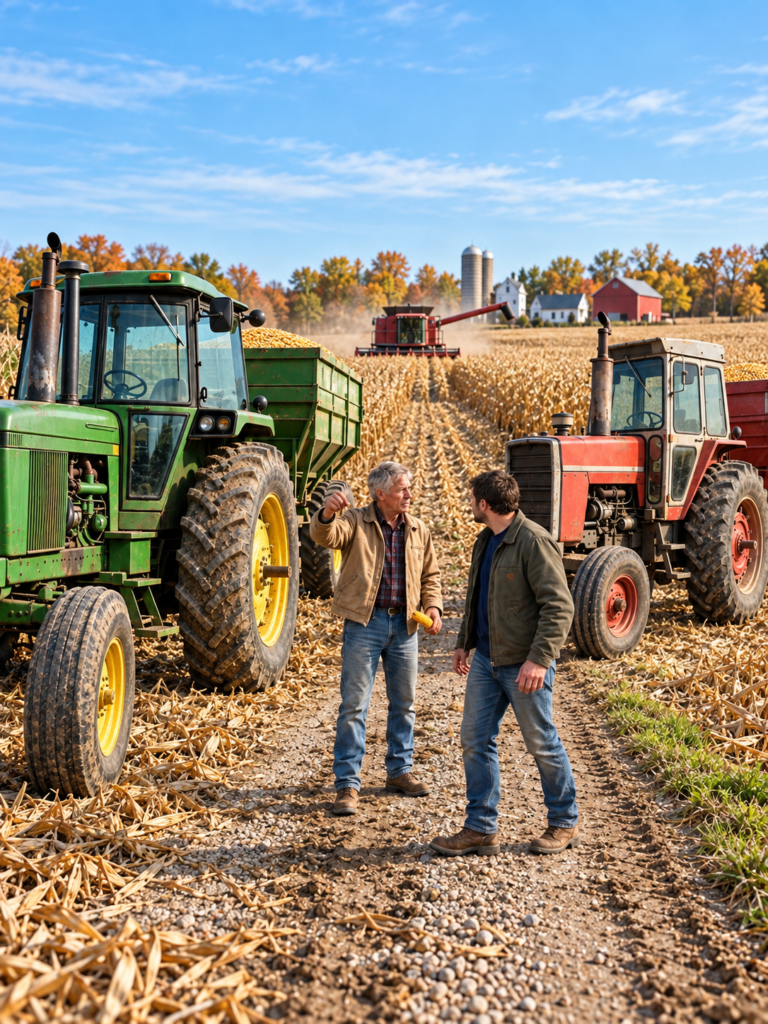
his son came home for 210 acres of corn then his father took the combine key and made him choose the old john deere
Part 1
At 6:42 on a clear October morning Ryan Cooper stood on the step of the combine with his hand still held out for the key that was no longer there. His father had climbed up carefully, both feet on each step the way a man does when his knees have started keeping their own accounts, and had taken the key from the ignition and slipped it into the pocket of his worn work jacket. The engine was cold. The header sat quiet above the first rows of the west field. Two hundred and ten acres of corn stood ready beyond the machine shed, brown leaves hanging under heavy ears, bins empty, wagons hitched behind the two old tractors. No rain was in the forecast. Nothing was broken that Ryan could see.
Howard Cooper, seventy-one, rested one hand on the rail. His knuckles were thick and the skin along one thumb was cracked from years of cold and dry. He had not looked at Ryan when he took the key.
“Don’t harvest a single row,” he said.
Ryan kept his hand where it was for a moment longer, then lowered it. Sunlight caught the faded yellow wheels of the John Deere 4440 parked beside the shed. Beyond it the Massey Ferguson 1135 stood with its wagon squared up behind it, tires checked, ready. This was no forgotten chore. Howard had walked the place already this morning. Ryan could see the fresh tracks.
“You called me down here to start harvest,” Ryan said. He had driven four hours from Kansas City after the phone call the night before. The call had come while he was packing for Friday. Can you leave tonight? Something break? No. You hurt? No. Then a pause long enough for Ryan to hear a chair scrape across the kitchen floor. I found something in the west field. That was all. Ryan had reached the farmhouse after midnight and found his old bedroom made up, a clean towel on the dresser, the light left on in the kitchen. His father had thought of everything except an explanation.
“I called you to help,” Howard said. He climbed down, bringing both feet to each step, and left Ryan alone above the silent header. A pickup passed on the county road. Somewhere east of the farm another combine was already running. Ryan followed him to the ground.
“You brought me four hours from Kansas City to stand here.”
Howard looked toward the corn. “Once we start, we’re going to have to move fast.”
“Then let’s start.”
“Not yet.”
He crossed the yard toward the shop. On the windowsill sat a folded feed sack weighted with a wrench. Howard lifted the wrench and opened the sack. Inside were three ears of corn. He set them on the bench under the shop light.
“Before you turn anything on,” he said, “look at these.”
Ryan picked up the nearest ear. Most of the kernels were firm and yellow. Near the tip a dull patch clung between them, gray-brown, the kind of damage a man might ignore on a good day. He turned the ear under the light. Howard placed the other two beside it. One had a darker streak farther down. Ryan remembered damaged ears from childhood. Every harvest had a few. He remembered them disappearing into full wagons without much comment.
“That’s what stopped you?”
“That’s what made me look again.”
Howard folded the sack around the ears. “Come with me.”
They passed the empty bins. Fresh grease marked a bearing on the loading equipment. Beside the shed Howard had stacked spare belts in a shallow wooden box. Ryan recognized the box. He had built it in high school and one corner still sat crooked. Nothing here had waited untouched for him to return. At the west field Howard stepped across the ditch slowly. Ryan offered a hand. His father took it without comment, then let go as soon as both boots were on level ground. They followed a row toward a fence post Howard had marked with orange ribbon. He pulled an ear and opened the husk. Ryan opened another. Clean kernels caught the sun.
“This one looks fine.”
Howard nodded. The next looked fine too. Dry leaves scraped against Ryan’s jacket. He wondered if his father had walked alone too long, studying ordinary damage until it became a threat. How far had he gone yesterday? Farther than he meant to. Howard pointed beyond the ribbon. Ryan crossed three rows, chose an ear from halfway up a stalk, and peeled the husk back. He stopped. A pale, dirty-looking growth spread along one side. Beneath it several kernels looked shriveled. This ear had come from well outside the little patch he thought they were checking.
Howard reached him and studied it. “You think it’s rot?”
“Could be. I want somebody who knows to look. Can you tell how bad it is not standing here?”
No lecture followed. Howard simply handed him another ear. Ryan held both against his jacket. Behind them the bins rose above the shed roofs, empty and ready. He pictured this corn entering one of them, vanishing beneath a season’s worth of grain. For the first time that morning the key in his father’s pocket seemed less like stubbornness. He still could not see why they had to wait.
“Then we test the first load,” Ryan said when they reached the yard again. He set the ears on the feed sack and brushed bits of husk from his sleeve. Howard glanced toward the wagons.
“And where do you put it while we’re waiting?”
Ryan pointed at the nearest bin. “There’s nothing in it.”
“That’s exactly where I’m not putting it.”
Ryan lowered his hand. An empty bin had seemed like an answer. Now he saw what his father was asking. Once they chose where the grain went, how easily could they undo that choice?
Howard opened a notebook on the shop bench. Yesterday’s date stood above three names and a short list of times. He had called the elevator, his crop insurance contact, and someone who could examine the ears and arrange testing. Below the last number he had written, Wait for sampling. They asked me to leave it standing until we talked through what they needed.
“Somebody’s coming this morning,” he said.
“So you’ve already done all this.”
“Yesterday afternoon.”
Ryan studied the handwriting. Howard had pressed hard enough to leave marks on the next page. While Ryan had been finishing work in Kansas City, his father had been here turning the same few ears under a shop light and making calls. The kitchen clock struck eight when they went inside. Howard poured coffee into two mugs. Ryan checked his phone. He had promised to be back in the city Monday. The visit still had an end. The harvest had not even begun.
“Two hundred and ten acres,” he said. “How long with just us depends on how many times we stop. That isn’t much of a plan.”
“It’s the part I know.”
Part 2
At a quarter past nine a dusty pickup entered the lane. The man who climbed out listened before he offered an opinion. Howard brought out the ears, his notes, and a field map. Then all three of them walked back toward the orange ribbon. Ryan expected a quick answer. Instead there were questions about where each ear had come from, more stops between the rows, and samples kept apart in labeled bags. Nobody promised that clean-looking corn proved anything. By late morning Ryan understood the delay. This was not a problem they could settle by looking at one wagon.
Back beside the combine Howard spread the map across its tire. “When we do start,” he said, “the grain can’t all go to the same place.”
Ryan looked at the two waiting tractors. He had thought they were here to make harvest faster. His father had another job in mind. By early afternoon the sampling was finished and Howard had spoken again with his insurance contact and the elevator. They could begin under the handling plan they had discussed. The samples still needed testing. Nobody had called the whole west field safe.
Howard set the key on the bench. Ryan reached for it, then waited.
“What goes where?”
His father pointed to the map. Corn from the areas they had agreed to harvest first would travel behind the John Deere. The designated suspect areas would go behind the Massey to separate holding arranged with the elevator. Those loads would stay out of the farm bins. Ryan wrote the destinations on two cards. Howard fastened each card inside its tractor cab where the driver could read it before moving. They spent another hour checking the wagon assignments and each trip. Ryan kept seeing ways to save a turn, shorten a wait, keep the combine cutting.
“We’re cutting our speed in half,” he said.
“Speed isn’t the problem.”
“Then what is?”
Howard looked from one wagon to the other. “Forgetting which one is which.”
At last the combine started. Its engine settled into a familiar rumble. Dust lifted behind the header as Howard entered the first agreed strip. Ryan followed with the Deere, leaving the Massey’s wagon empty beside the lane. The first unloading felt strangely solemn. Grain rattled into the Deere’s wagon. Ryan checked the card and their field position. His father watched from the cab until Ryan gave a clear nod. For years that nod had meant the wagon had room. Today it meant something more.
The afternoon moved in short stretches. Cut, unload, check, haul, return. Before Howard crossed into a designated suspect area they stopped. The Deere’s wagon went away. The Massey came forward. The combine was cleared as agreed before the next lot began. Ryan disliked every idle minute. Yet when he reached the separate holding point and saw his load recorded apart from the others, he felt a small relief he had not expected.
By dusk Howard’s notebook showed eighteen acres harvested. One hundred and ninety-two remained. They stood beside the tractors while the engines cooled.
“That was a long day for eighteen acres,” Ryan said.
Howard rubbed dust from the edge of the map. “It was.”
Ryan looked at the separate notebook entries, then at the wagons. They had finally begun. Now every trip required a decision. Howard closed the notebook and headed for the shop. Ryan stayed beside the John Deere, one hand on the door handle. Through the glass he could see the worn seat and the pale place on the steering wheel where his father’s palm always rested. At twelve he had ridden in that cab with his lunch balanced on his knees. Back then the tractor seemed large enough to pull the whole county home. Now the paint had faded along the hood and a narrow tear crossed the seat.
Howard returned carrying a clean rag. “Door still sticks?”
“Only when somebody slams it.”
Ryan smiled. He had heard that answer before. He opened the door gently. A folded receipt sat beside the destination card. Under it was an old photograph, its corners bent. Ryan in a baseball cap standing beside the same tractor. Howard behind him with one hand on his shoulder.
“You keep that in here?”
“Been there a while.”
Ryan looked at the boy’s broad grin. He could not remember the picture being taken. “I thought you’d have traded this by now.”
Howard wiped dust from the window. “It does the job, and it’s paid for.” He said it without pride or complaint. Ryan looked toward the Massey. Two aging tractors, two separate wagons. Yesterday he would have called them a slow way to do a simple job. Today each one carried a responsibility that could not be handed carelessly to the other.
Howard reached into the cab and straightened the destination card. His thumb passed over the photograph before he tucked it beneath the receipt again. Ryan remembered a summer when Howard had taught him to back a wagon into the shed. He had jackknifed it twice and expected an angry lesson. His father had walked beside the wheel, pointing until Ryan finally put it where it belonged. That fall Howard let him do it alone.
“Guess you had more patience then,” Ryan said.
Howard glanced at him. “You weren’t asking me to hurry every ten minutes.”
The words stung, then made Ryan laugh. They checked the wagons together before going inside. Nothing grand passed between them. Howard named tomorrow’s first strip. Ryan repeated the route and destination. At the farmhouse door Howard paused to scrape his boots. For a moment his shoulders sagged beneath his work jacket. Ryan nearly asked how many evenings had ended that way. Instead he held the door. Tomorrow, he decided, he would watch more carefully.
Part 3
By seven the next morning the combine was cutting again. Sunlight spread across the stubble, turning loose husks silver before warming them to brown. Ryan brought the Deere along the field edge and checked the card before every trip. Howard’s map divided the two hundred and ten acres between the west field and the smaller north field beside it. The first day’s eighteen acres were shaded in pencil. Most of the paper was still blank.
At ten they had reached forty-two acres altogether. One hundred and sixty-eight remained. Ryan began doing the math between wagon trips. With a full day ahead they might recover some of the hours lost yesterday. He could still keep his promise to be back in Kansas City Monday. Then the elevator called. Howard stopped the combine at the end of a row and climbed down to answer. Ryan watched his father listen, looking toward the Massey’s empty wagon. The separate intake would close at four that afternoon instead of six. The elevator could keep their designated loads apart, but it needed its crew elsewhere afterward. If they missed the window those loads would have to wait in the assigned wagon until another delivery was arranged.
Howard repeated the time and thanked the caller. “So we push harder.”
“We change the order.” His father spread the map on the pickup hood. Suspect sections went first while the separate destination was available. The sections assigned to the Deere could follow later after the combine had been cleared for that work.
“What about the tests?”
“Still waiting.”
Ryan pressed his finger against the shaded eighteen acres. “We can’t spend another morning waiting.”
“We’re harvesting,” Howard said. “We just aren’t doing everything at once.”
A breeze lifted one corner of the map. Howard pinned it with his hand. Ryan noticed the pencil marks beside each route, the delivery times, the calls squeezed into the margin. His father had carried all of that in his head before Ryan arrived. Now the headcount was two, and Ryan still kept asking him for every answer. He pulled out his phone and set an alarm for the last delivery they could reasonably make before four. Howard watched him.
“That gives us room if the line’s slow,” Ryan said.
His father nodded and folded the map. They returned to the machines. The sky was as clear as yesterday. Nothing in the weather had changed, but the day had lost two hours they had already counted on.
At half past one Ryan returned from the separate holding point with the Massey’s wagon empty. Howard was waiting beside the combine. The header stood above a strip they had designated for separate handling.
“You’ve been stopped long.”
“Twenty minutes.”
Ryan looked across the lane. The Deere and its wagon were sitting unused. He felt the old irritation rise before he could stop it. “You could have filled that one.”
Howard shook his head. “Then we’d have two wagons to sort out. The destination would still be the same today. What about tomorrow when you’re tired and that card still says something else?”
Ryan opened his mouth, then looked through the Deere’s window. The card he had written yesterday was plainly visible. One shortcut would leave another thing to remember. He climbed down from the Massey and brought his delivery slip to the pickup. Howard laid it beside the earlier slips. A field location was written on each one, but the papers had begun to curl and shift in the breeze. Ryan found an empty clipboard in the cab and fastened them in order.
“Here,” he said. “Nothing blows away.”
Howard glanced at the neat stack. “That’s better.”
It was a small approval. Ryan felt it anyway. They resumed work. Instead of urging Howard to cut faster, Ryan watched the wagon’s progress and called before leaving. Howard told him where the combine would stop. For the first time each man knew what the other would need before he asked.
By three, sixty acres had been harvested. One hundred and fifty remained. Ryan made the last planned delivery of suspect grain with time to spare. At the holding point he watched the clerk compare his slip with the assigned location before taking the load. He had spent years in logistics asking other people to match numbers and destinations. Here the numbers belonged to his father’s crop. He returned to find Howard seated on the pickup tailgate drinking water. His face was gray with dust. Ryan handed him the final receipt.
“Made it,” he said.
Howard read the time, then let his shoulders settle. They checked the combine before moving to the next designated section. The long pause no longer felt like wasted motion to Ryan. He knew what they were protecting, even if they still did not know the full size of the problem.
Howard stood and reached for the map. “We can get some more before dark.”
Ryan took the clipboard. “Tell me where. I’ll get the Deere.”
By early evening their total stood at seventy-eight acres. One hundred and thirty-two remained. The north field had opened beneath the combine in straight even rows, and the Deere’s wagon made its familiar trips toward the farm. Howard had found no obvious trouble there during his earlier walks. The samples still awaited results, but this field had seemed simpler. Ryan allowed himself to believe tomorrow might be easier.
He met Howard beside the pickup while the combine was stopped for their next route check. His father had penciled the day’s acres onto the map. The shaded ground finally looked like progress.
“Sixty today,” Ryan said.
Howard nodded. “Better than eighteen.”
“Longer day.”
Ryan smiled. His father would not let a number tell more than it should. On the pickup seat lay the clipboard, now thick with slips. Ryan straightened the papers and found one tucked beneath the seat belt. Howard had already caught it and marked its field location in the notebook.
“You always check twice?”
“Usually.”
“When do you not?”
Howard rubbed his eyes before answering. “When I think I already know.”
Ryan looked at the dust caught in the lines of his father’s face. He had come home expecting to supply another pair of hands. He was beginning to see how much work happened before those hands ever touched a machine. The corn rustled beyond them. Two tractors stood in the lowering light, each beside its own wagon. Ryan felt their system could carry them through. If most of the corn looked good but one area might threaten the value of everything mixed with it, would a man keep harvesting or stop until he knew what he had?
Ryan went ahead to check the next section while Howard finished the entries. Beyond a shallow rise he noticed several ears hanging differently from the others. He pulled one and opened it. Most of the kernels looked ordinary. The second ear had a stained patch beneath the husk. He chose a third from several rows away. That one made him turn toward the pickup.
“Dad.”
Howard looked up. Ryan held the ears where his father could see them. The next section had not yet entered the combine. Behind Ryan the remaining north field rows stretched toward the fence without a warning mark on Howard’s map. Howard crossed the stubble and examined what his son had found. For a moment neither spoke. Then Howard looked toward the waiting Deere.
“Leave that wagon where it is.”
Part 4
Howard carried the ears back to the pickup. Ryan followed, watching his father compare them with the map. “I walked this field,” Howard said.
“I know. I didn’t see that.”
Ryan heard the weight beneath the words. His father had missed something. Until this moment Ryan had not understood how much Howard depended on being the one who noticed. They stopped for the night at seventy-eight acres. One hundred and thirty-two remained. Howard called the people handling the samples and left a message about the new area. Then they checked the earlier north field deliveries against the notebook. Those loads had gone into the second bin. Howard marked it to remain untouched until they had further guidance. The records gave them somewhere to begin. They had not erased the problem, but they could still tell where that grain had come from.
Howard drew a line around the remaining north field. “That goes with the Massey now.”
“All of it?” Ryan asked.
“Until we know more.”
Ryan studied the pencil line. Trouble had appeared beyond yesterday’s markers. A field name no longer told them enough. “Let me try something.” He divided the remaining ground into smaller marked sections, then wrote a simple code beside each one. Howard frowned.
“We’re already writing everything down.”
“We’re writing field names. If another patch turns up, I want to know which loads came from the rows around it.”
Ryan matched a code to a blank delivery slip. The same code would follow that lot from the map to the wagon record and its assigned holding place. The tractors would keep their separate jobs. This would make those jobs easier to check. Howard studied the page.
“More paper, less guessing.”
His father looked across the north field. For a long moment Ryan thought he would fold the map and put it away. Instead Howard pointed at one of the new boundaries. “Move that line to the rise. You can see it from the cab.”
Ryan moved it. They worked under the pickup’s dome light. Howard supplied the landmarks. Ryan supplied the order. Before using the revised plan they would review it with the people receiving and testing the grain. At last Howard set the pencil down.
“I thought this field was the easy part.”
“So did I.”
The admission brought no relief. Tomorrow would be slower again. But when Howard handed Ryan the map he left the pencil in his son’s hand. They ate sandwiches beside the John Deere after the yard lights came on. The engines were quiet. A wrapper moved against Ryan’s boot whenever the breeze reached beneath the tractor. Howard held half a sandwich without taking another bite.
“We could quit for tonight,” Ryan said.
“We have.”
“I mean, quit looking for another way to do it faster.”
His father glanced at the map between them. Ryan checked his phone. Monday was closer than it had seemed when he left Kansas City. There were still one hundred and thirty-two acres standing, new samples to arrange, and a plan that now required more decisions on every trip. He put the phone away.
“Why’d you call me?”
“Needed help.”
“You’ve got neighbors.”
Howard looked toward the dark field. Ryan waited, then asked again. “Why me?”
His father turned the sandwich in its paper. “Because if I mix something up, you’d catch it.”
Ryan stayed still. For years he had heard a question beneath his father’s harvest calls. When are you coming back? Not for a visit. Back to the life he had left after college. He had mistaken every pause about Kansas City for disappointment. Now Howard was looking at the clipboard, not the road out.
“You figured I’d be useful at this.”
“You tell me about your work. Mostly I complain about it. I listen.”
The yard light hummed above them. Ryan could see the old photograph through the Deere’s window, partly covered by the receipt. “I thought you wanted me here because I used to drive a tractor.”
“I wanted that, too.” Howard finally took another bite. It was such an ordinary answer that Ryan nearly laughed. His father had not stopped needing hands. He had simply seen something else his son could bring.
“I should have found that patch,” Howard said.
“You found the first one.”
Howard shook his head. “I can’t keep all of it straight when I’m tired.”
Ryan looked at the notebook. He had spent two days measuring delays. Howard had spent them trying to make sure exhaustion did not turn a small mistake into a larger one. “We’ll use the new map tomorrow,” Ryan said. “After they check the plan. And your job?”
“I’ll call in the morning. Tell them I need another day.” He was not promising to move home. He was making one decision he could keep. Howard folded the wrapper around the unfinished sandwich. “All right.”
They put the papers inside, checked the morning’s call list, and went to the house. This time Ryan carried the notebook.
Part 5
The next morning began with another field visit, more samples, and calls about the newly marked lots. They reviewed the revised handling plan before starting again. Their map now held more than field names. Every load had a place to begin and a place to wait. Grain from the new suspect area would remain separate. The earlier north field grain stayed in its own bin while its condition was reviewed. They lost the morning. Then they worked.
Over the next two days their total reached one hundred and eighty-two acres. Twenty-eight remained. The numbers came slowly with stops, separate deliveries, and repeated checks. Ryan’s extra day became two. He arranged it, then returned to the yard without making his father ask. On the final morning Howard climbed into the combine while Ryan brought the Massey to the next designated lot. The tractor started reluctantly. Howard waited until its engine settled before lowering the header. The old tractors kept doing their assigned work.
By afternoon only a narrow band of corn stood along the fence. Ryan returned from a delivery and found Howard waiting. A load from the final suspect section was ready, but the loose destination note on the pickup seat had slipped beneath other papers. Howard reached toward the Deere’s keys. Ryan stopped beside him.
“That one’s the Massey.”
Howard looked at the map. They checked the lot code together. Ryan matched it to the clipboard entry and the assigned destination before either wagon moved. For a moment Howard said nothing. Then he handed Ryan the Massey’s keys. A short pause kept the load from following the wrong route.
Later, after the final suspect lot was delivered and the combine cleared for the remaining section, the Deere took its last turn. Ryan watched clean stubble appear where the standing rows had been. Howard stopped at the fence and raised the header. Two hundred and ten acres harvested. Ryan brought the last wagon home and checked its final slip. The Massey stood by the shed, its assigned work finished. Across the yard Howard shut down the combine. They checked the final entries. Some grain still needed decisions. Some would bring less than they had hoped, but the lots remained identifiable, and one uncertain area had not disappeared into everything else.
Howard looked at the first date in the notebook. “Glad we waited.”
Ryan nodded. This time he understood exactly what his father meant.
The following morning the yard was quiet enough for Ryan to hear sparrows inside the shed. Dew darkened the stubble. Both tractors stood parked, their destination cards still in the cabs. At the kitchen table Howard laid the test reports beside the delivery slips. The sound lots accepted for their intended market had remained apart from the problem grain. Some suspect loads required further testing. Others faced separate handling and lower prices. They had not saved every dollar. They had kept the farm from having to treat all its corn as one unanswered question.
Ryan checked the records with his father where a decision was still pending. They left space for it. Howard would make the next calls. Ryan would keep a copy of the lot list in Kansas City. The work no longer ended at the county road. Before loading his bag Ryan returned to the shed. He wiped dust from the Deere’s door glass and straightened the photograph beneath the receipt. The boy in the baseball cap still looked certain his father knew everything. Now Ryan understood something harder. Howard could be wrong, could get tired, and could still make a careful choice that protected what mattered.
Howard came around the tractor holding the farm map. “The west field’s done,” he said. “So is the north.”
“I know.”
He handed Ryan the paper. The completed sections were shaded. Along the margins Howard had added notes about next year’s work. Ryan looked closer. Beside several fields, in his father’s heavy handwriting, stood the same word. Ryan. He lifted his eyes.
“What’s this?”
“Next year’s field plan.”
Ryan pointed to his name. “That’s not a field plan.”
Howard reached for the paper. “Then forget you saw it.”
Ryan let him take it. His father folded it once, then hesitated before making the second fold. “Hold it a second,” Ryan said. He took out his phone and photographed the map. Howard watched. He did not turn the paper over.
A few minutes later Ryan put his bag in the car. Kansas City was still four hours away. His job was still there. Next October was still an open question. Beside the John Deere Howard unfolded the map again. Ryan looked back before getting into the car. Was his father asking for help with another harvest? The sparrows kept singing in the shed. The two old tractors stood quiet under the morning light, destination cards still in place, ready for whatever came next. Ryan started the car and sat with his hands on the wheel a moment longer than he needed to. Then he put it in gear and drove out the lane, the photograph of the map already saved on his phone, the old John Deere visible in the rearview mirror until the road took the curve and the farm dropped out of sight.


