
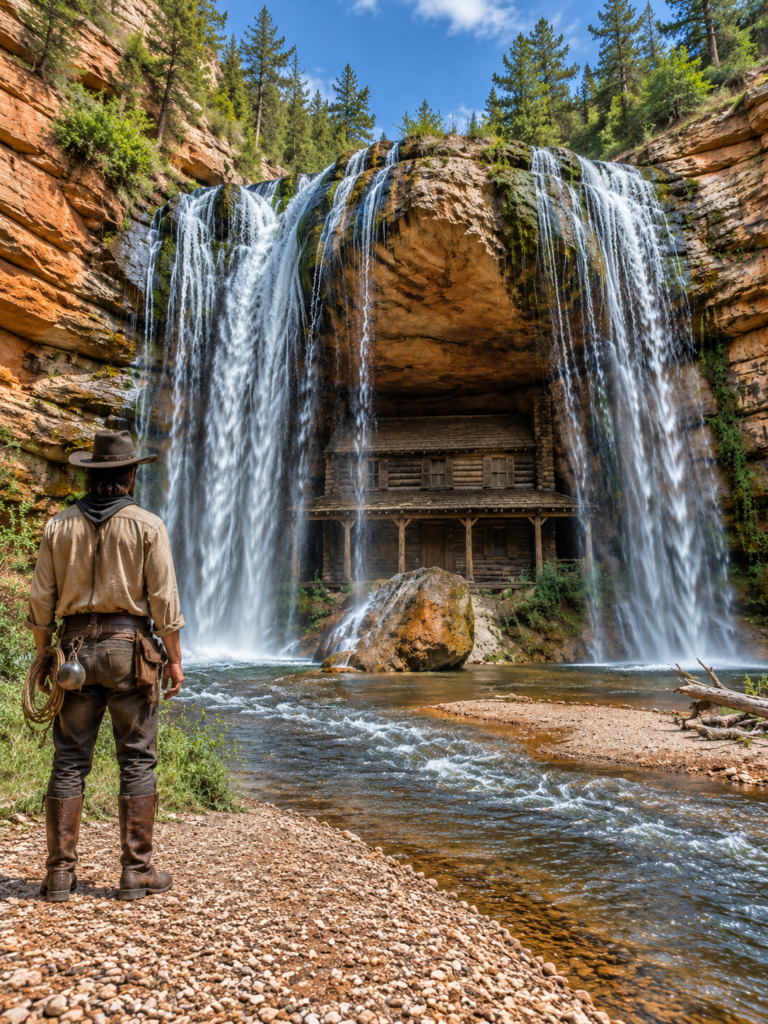
Part 1
Charles Gray was forty-one years old when his brothers took the ranch he had spent half his life keeping alive.
They gave him three days to leave.
Three days to gather his clothes, saddle his horse, and walk away from the land where he had buried his mother, worked beside his father, and spent twenty winters repairing fences while his brothers slept in warm beds.
What he received in return was a narrow strip of rocky mountain property containing a waterfall nobody wanted.
And eighteen dollars.
That was everything his father had left him.
On the morning the will was read, Charles stood inside the farmhouse kitchen wearing the same brown work coat he had worn to his father’s funeral.
The October wind rattled the loose windowpanes. A small fire burned in the iron stove, but the room seemed colder than the barn outside.
His eldest brother, Merritt, stood beside the window in a dark wool vest. At forty-nine, Merritt had the polished appearance of a man who preferred negotiating cattle prices to handling cattle.
Jack, the middle brother, sat at the table, turning his hat slowly between his hands.
Attorney Samuel Halstead unfolded the will.
“Your father, Wyatt Gray, has made the following provisions concerning his property.”
Charles lowered his eyes.
He had not come expecting a fortune. He had never wanted one.
He only wanted the place he had worked since he was a boy to remain his home.
Halstead adjusted his spectacles.
“The principal ranch property, including the dwelling, barns, grazing acreage, livestock, and associated water rights, shall pass in equal shares to Merritt Gray and Jackson Gray.”
Charles looked up.
Merritt remained still.
Jack stared at his hat.
Halstead continued.
“To my youngest son, Charles Edward Gray, I leave the parcel known as Widow Falls, situated approximately six miles north of the North Fork settlement, together with all improvements and natural resources contained within its surveyed boundaries.”
The lawyer set down the paper.
Silence filled the kitchen.
Charles waited.
Surely there was another paragraph. A mention of the horses he had broken, the tools he had purchased, or the twenty years of wages he had never collected.
But Halstead closed the folder.
“That concludes the distribution.”
Outside, a cow called from the south pasture.
Charles heard the familiar sound and felt something inside him give way.
“That’s all?” he asked.
Halstead looked uncomfortable.
“The deed to the northern parcel is properly executed, Mr. Gray.”
“I’m not asking about the deed.”
Charles turned toward Merritt.
“Pa left me the waterfall?”
Merritt finally faced him.
“That’s what the will says.”
“There’s nothing up there but rock.”
“Then you’ll have to make something of it.”
Charles looked at Jack.
“You knew?”
Jack swallowed.
“We knew Pa had been thinking about dividing things.”
“Did you know what he intended to leave me?”
Jack said nothing.
That silence answered more than words could have.
Charles remembered the previous spring, when he had spent eleven days repairing the western fence after a late snowstorm crushed nearly a quarter mile of posts.
Merritt had been in Missoula arranging cattle sales.
Jack had been laid up with a bad shoulder.
Charles had worked until the skin split across both palms.
At night, his father had stood on the porch coughing into a handkerchief.
“Don’t wear yourself out, Charlie,” Wyatt had told him.
“Somebody has to keep this place standing.”
His father had nodded.
Charles had taken that nod for gratitude.
Now he wondered whether it had meant anything at all.
Merritt cleared his throat.
“There’s something else.”
Charles turned.
“We’re bringing in two hired men for winter repairs. They’ll need the bunkhouse.”
Charles stared at him.
“The bunkhouse?”
“You understand the situation.”
“I’ve slept there twenty-two years.”
“That doesn’t make it yours.”
Jack lifted his head.
“Merritt, maybe we could give him until spring.”
“We’ve discussed this.”
Charles watched the exchange.
So they had discussed it.
They had sat somewhere, perhaps in this very room, and decided when he would be put out.
His father’s body had barely settled in the grave.
“How long?” Charles asked.
Merritt straightened his vest.
“Three days should be sufficient.”
Charles nodded once.
He had learned a long time ago that arguing with someone who had already decided your worth rarely changed the price.
He took the deed from Halstead, folded it, and slipped it into his coat.
“I’ll be gone tomorrow.”
Jack stood.
“Charlie—”
But Charles was already walking toward the door.
He stepped outside into the pale October sunlight, crossed the yard, and entered the old barn.
The familiar smells hit him immediately.
Hay. Leather. Horse sweat. Dry timber.
His sorrel gelding, Copper, raised his head over the stall door.
“Well, old boy,” Charles whispered. “Looks like we’re moving.”
The horse stretched his neck toward him.
Charles laid a hand against the animal’s warm face.
Copper was fifteen years old.
Charles had broken him when the horse was four, back when his own knees still bent without complaint and he could work from sunrise until midnight without paying for it the next morning.
The gelding had carried him through spring floods, summer droughts, cattle drives, and three winters that nearly ruined the ranch.
Unlike his brothers, Copper had never questioned where Charles belonged.
Charles rested his forehead against the horse’s neck.
For a moment, he wanted to sit down in the straw and stay there.
He was forty-one.
He had no wife, no children, no savings worth mentioning, and no land capable of feeding a single cow.
He had given his strongest years to a place that no longer wanted him.
Then his hand brushed the folding knife in his pocket.
Its bone handle was worn smooth, and one brass pin sat slightly crooked.
The knife had belonged to Emmett Poe.
Emmett was an old Texas wrangler who had come north after the war and stayed on the Gray ranch until he died.
When Charles was twelve, Emmett had begun teaching him everything his father was too busy or too tired to explain.
He had shown the boy how to shoe a horse, sharpen an ax, repair a wagon wheel, and recognize the particular smell of wet earth before a hard storm.
Emmett never raised his voice.
When Charles made mistakes, the old man simply showed him again.
Once, after Merritt had blamed Charles for losing three calves in a flood, the boy had hidden behind the barn, furious and ashamed.
Emmett found him there.
“Know the difference between a weak man and a quiet man?” the old wrangler asked.
Charles shook his head.
“A weak man needs somebody else to tell him what he’s worth.”
“And a quiet man?”
Emmett handed him a hammer.
“He gets back to work.”
Seven years later, Emmett died beside the bunkhouse stove, a cooling cup of coffee still in his hand.
His only possession of value was that folding knife.
He had left it to Charles.
Now, standing inside the barn, Charles took it from his pocket.
The blade still opened smoothly.
“Guess it’s time to get back to work,” he whispered.
That evening, Charles packed his belongings.
Two shirts. One spare pair of trousers. A wool blanket. A canvas slicker. His saddle repair tools. A tin plate and spoon.
He found his mother’s coffee pot hanging above the bunkhouse stove.
It was dented along one side and blackened by years of cooking fires.
His mother, Eleanor, had died when Charles was nine.
He remembered little about the fever that killed her.
What he remembered was her standing beside the stove on winter mornings, humming softly as coffee boiled, and the smell of biscuits warming beneath a clean cloth.
He wrapped the pot carefully in a flour sack.
It was the only thing in the room he could not bear to leave behind.
Near midnight, Jack appeared in the bunkhouse doorway.
He carried a small sack.
“Some bacon,” Jack said. “And a little cornmeal.”
Charles continued rolling his blanket.
“Thank you.”
Jack stepped inside.
“Merritt isn’t trying to be cruel.”
Charles tightened the cord around his bedding.
“Then he’s managed it without trying.”
Jack looked toward the floor.
“The ranch has debts you don’t know about.”
“I know about the bank note.”
“There’s more than that.”
Charles stopped.
“What kind of debts?”
Jack hesitated.
“Things got difficult while Pa was sick.”
“Then why didn’t you tell me?”
“Because you couldn’t have done anything about it.”
Charles turned slowly.
“I kept the cattle alive. I repaired your fences. I worked without wages so there’d be enough money to cover feed. And you think I couldn’t have helped?”
Jack said nothing.
Charles looked at his brother for a long time.
Then he returned to his packing.
“Good night, Jack.”
Jack set the food beside the door.
For several seconds, he seemed ready to say something else.
But he walked away.
At sunrise, Charles led Copper into the yard.
Merritt stood on the porch.
“You’ll need to return any ranch equipment you’ve taken.”
Charles stopped beside his horse.
“I’ve taken nothing that belongs to you.”
Merritt looked at the tools tied behind the saddle.
Charles understood.
He untied the small hammer and hoof rasp he had bought with his own money years earlier and placed them on the ground.
“Keep them.”
Merritt’s expression shifted.
“I didn’t say—”
“You won’t have to.”
Charles mounted.
Jack watched from the barn doorway, his face gray beneath his hat.
Neither brother approached.
Charles guided Copper through the gate.
At the bend in the road, he could have looked back and seen the farmhouse, the big barn, the pasture fence, and the cottonwood tree beneath which his mother was buried.
He did not look.
Instead, he reached into his father’s old coat and counted the money he had found folded inside its inner pocket.
Eighteen dollars.
He returned it to its place beside the deed.
Then he turned his horse north.
He did not know it yet, but the most important inheritance his father had left him was waiting behind sixty feet of falling water.
And someone had been there before him.
Someone who understood what it meant to lose everything.
Part 2
By noon, the last cultivated fields had disappeared behind Charles.
The wagon road narrowed into a winding track that followed the North Fork through stands of pine and yellowing aspen.
The October air smelled of wet bark and approaching snow.
Copper picked his way carefully around exposed roots.
Charles rode with his collar raised against the wind.
Every few miles, he stopped to check the gelding’s feet and examine the ground ahead.
He had never traveled this far up the North Fork.
Most ranchers avoided the country.
The slopes were steep, the soil thin, and the winters difficult enough to starve a man who arrived without provisions.
At a creek crossing, Charles dismounted and let Copper drink.
He unfolded the deed.
The description was short and discouraging.
A narrow parcel containing Widow Falls, approximately two hundred yards wide and a quarter mile long.
No buildings were listed.
No meadow.
No grazing acreage.
Nothing that explained why his father had purchased it twenty years earlier.
Charles studied the faded handwriting.
Purchased from a traveling landholder in 1863.
His father had never mentioned visiting the place.
Charles wondered whether Wyatt had forgotten he owned it until someone reminded him while preparing the will.
That thought hurt more than he wanted to admit.
He folded the paper and put it away.
“Come on, Copper.”
They traveled until the sun fell behind the western ridge.
Charles found a patch of level ground among the aspens and made camp.
He gathered dead branches, arranged a small fire beneath an overhanging rock, and boiled coffee in his mother’s old pot.
For supper, he ate cold bacon and a piece of hard bread.
Copper grazed nearby, his tether line dragging softly across the leaves.
Charles sat against a fallen log.
He had spent decades surrounded by voices.
Cattle bawling outside the barn. Men arguing over fences. His father coughing inside the farmhouse. Merritt complaining about prices.
Now there was only the creek.
And the wind.
He took out his pocketknife and opened it.
The metal reflected the fire.
“Emmett,” he murmured, “I could use some advice.”
The wind stirred the treetops.
No answer came.
Charles laughed once, without humor.
“Suppose you’d tell me to quit talking and fix something.”
He closed the knife.
The fire burned lower.
For the first time since the funeral, he allowed himself to imagine what would happen if he failed.
Eighteen dollars would not last long.
Copper was aging.
The mountain parcel might prove completely useless.
If winter closed the trail, he could become trapped without enough food or shelter.
No one would come looking.
Merritt had the ranch.
Jack had his comfortable place beside the stove.
Charles had a waterfall.
He pulled the blanket around his shoulders and stared into the coals.
A grown man shouldn’t cry over losing a house, he told himself.
But he wasn’t grieving the house.
He was grieving the years he had given to people who apparently believed those years had cost him nothing.
By morning, frost covered his blanket.
The coffee pot had frozen to the ground beside the dead fire.
Charles broke it loose carefully, warmed his hands against Copper’s neck, and resumed the climb.
The trail grew rougher.
Twice, he had to lead the horse around fallen trees.
At one narrow crossing, Copper slipped on loose stone.
Charles caught the bridle and pulled him backward before the animal could tumble into the creek.
“Easy. Easy, boy.”
His own boot skidded.
For one terrifying second, he felt the slope giving way beneath him.
Then Copper found solid footing.
Charles stood breathing hard.
He could feel his heart pounding in his throat.
“That was close,” he whispered.
The horse shook himself.
Charles rubbed his neck.
“Both of us are getting too old for this nonsense.”
Around midmorning, a steady roar began to rise above the sound of the creek.
At first, Charles mistook it for wind moving through the timber.
Then the trail curved around a ridge, and the mountains opened.
Widow Falls stood before him.
A white column of water plunged from a stone shelf nearly sixty feet high into a deep, green pool.
Mist drifted through the narrow gorge.
Dark rock walls rose on either side, streaked with rust-colored mineral deposits.
Small spruce trees clung to cracks in the stone.
Moss covered the ledges.
It was beautiful.
And almost completely worthless to a cattleman.
Charles sat motionless in the saddle.
There was no pasture beside the pool.
No place for a cabin.
No barn.
No visible wagon access.
The rock walls formed a natural prison around the water.
He looked from one side of the gorge to the other.
Then he began to laugh.
It was not a happy sound.
“Well, Pa,” he said quietly. “You certainly made your point.”
Copper turned an ear toward him.
Charles dismounted.
He walked to the pool and knelt beside it.
The water was so cold that his fingers ached almost immediately.
Across the surface, the waterfall sent small waves rolling toward the bank.
Charles stared into the dark green center.
He wondered what would happen if he simply turned south.
He could find work at another ranch.
Perhaps Hollis Renner, the blacksmith at the North Fork settlement, knew someone hiring.
He could live in another bunkhouse.
Work another man’s cattle.
Spend another twenty years building somebody else’s future.
The idea exhausted him.
He looked at the deed again.
His name was written clearly beneath the legal description.
Charles Edward Gray.
For the first time in his life, something belonged to him alone.
Even if it was only a wet patch of stone.
He folded the paper.
“All right,” he said. “We’ll stay tonight.”
Finding a campsite proved difficult.
Eventually, Charles discovered a narrow shelf above the pool, protected from most of the spray by a jutting wall.
There was enough room to unsaddle Copper and spread a bedroll.
But the horse needed feed.
Charles searched along the lower edge of the parcel.
He found scattered tufts of mountain grass growing between the rocks and a few dry stalks beneath the timber.
Not nearly enough for winter.
He returned to camp carrying an armful of dead wood.
By late afternoon, clouds had gathered above the gorge.
Cold rain began to fall.
Charles struggled to light his fire.
The first bundle of pine needles smoked but refused to catch.
The second burned briefly and died.
His hands grew stiff.
He crouched over the tinder, shielding it with his coat.
“Come on,” he muttered.
At last, a small flame took hold.
He fed it thin twigs, then thicker branches.
By dark, he had a miserable little fire burning between two stones.
His supper was a small portion of bacon and cornmeal mush.
He saved half his remaining bread.
The night was worse than the first.
The waterfall roared continuously.
Moisture soaked his blanket.
He slept in fragments, waking each time the fire collapsed or Copper shifted his footing.
Shortly before dawn, wind swept through the gorge and scattered sparks across the stone.
Charles rose too quickly.
A sharp pain caught in his lower back.
He staggered against the rock wall.
For several seconds, he could barely straighten.
He stood in the darkness, breathing through clenched teeth.
Forty-one wasn’t old.
But years of ranch work had left their marks.
His shoulders ached in cold weather.
His left knee stiffened after long rides.
And now he had no roof, no warm bed, and barely enough money to reach the settlement if he changed his mind.
He leaned against the stone and closed his eyes.
“Maybe they were right,” he whispered.
The words frightened him.
Not because he believed them.
Because he had come close.
When daylight arrived, Charles forced himself to move.
He watered Copper and inspected the horse’s hooves.
Then he began walking the property boundary.
If this place contained anything useful, he intended to find it.
He discovered a thin stand of young spruce.
A patch of level gravel below the pool.
Several dead lodgepole pines that could be cut into building timber.
None of it was much.
But it was something.
Near noon, he approached the waterfall from its eastern side.
The rock wall curved inward beneath the falling water.
From the opposite bank, the feature was almost invisible.
Charles noticed a narrow ledge disappearing behind the spray.
He stopped.
The ledge was barely three feet wide.
Water had polished the stone smooth.
Below it lay the deep pool.
One slip could kill him.
He took off his hat and watched the falling water.
There was darkness behind it.
Not the shallow shadow he expected.
A deeper space.
He picked up a small stone and tossed it toward the dark opening.
It struck somewhere beyond the curtain of water.
Charles listened.
The sound came back hollow.
He felt a strange tightening in his chest.
He walked slowly along the ledge until the spray soaked his coat.
The stone beneath his boots was dangerously slick.
His right hand pressed against the wall.
He took another step.
Then another.
The cold water struck his shoulder.
He lowered his head and continued sideways.
After several yards, the ledge widened.
The spray weakened.
Suddenly, he was standing on dry gravel.
Charles straightened.
Before him stretched a hollow space hidden entirely behind the waterfall.
The mountain wall curved backward, forming a natural chamber.
And at the far end of that chamber stood something impossible.
A small log cabin.
Charles stopped breathing.
For a long moment, he could only stare.
Someone had built a house inside the mountain.
And no one had thought to tell him.
Part 3
The cabin looked as though it had been waiting for him.
Charles stood beneath the overhanging mountain wall, studying the little building in disbelief.
It measured perhaps twelve feet by sixteen.
The walls were constructed from squared pine logs, fitted tightly together and sealed with clay and moss.
Weathered wooden shingles covered the roof.
A short black stovepipe rose through the shingles and disappeared into a natural opening in the rock above.
That explained why Charles had seen no sign of smoke from the valley.
Whoever built this place had understood the mountain.
More importantly, he had understood how to hide.
Charles approached the door carefully.
There were no fresh footprints in the gravel.
No chopped firewood scattered outside.
No smoke.
The place appeared abandoned.
Yet it was far better preserved than any neglected building had a right to be.
He raised the wooden latch.
The hinges complained softly.
The door swung inward.
Charles stepped across the threshold.
The first thing he noticed was the smell.
Dry timber.
Old iron.
Cold ashes.
The faint, familiar scent of leather and machine oil.
It reminded him of Emmett Poe’s little workshop behind the Gray barn.
The second thing he noticed was that the cabin had everything a man needed to survive a winter.
A narrow bunk stood against one wall.
A wool blanket lay folded at its foot.
Beside the opposite wall sat a cast-iron cookstove.
A small woodbox held neatly stacked pine.
There was a table beneath a single window, a chair, two enamel cups, a skillet, a lantern, and a covered crock.
Charles lifted the lid.
Inside were salt and several hardened lumps of sugar.
He almost smiled.
“Whoever you were,” he murmured, “you knew how to live.”
Then he looked toward the far wall.
Tools hung from wooden pegs.
Axes. Saws. Augers. A drawknife. A froe. A hammer. A hand adze.
There were enough tools to build a barn, repair a wagon, and clear a road through the mountains.
An old Winchester rifle hung separately on the lowest peg.
Charles lifted an ax.
Its edge was clean.
He touched the metal.
Someone had oiled it.
Recently enough that it had not rusted.
A feeling of unease replaced his excitement.
Perhaps the cabin wasn’t abandoned.
Perhaps its owner would return.
Charles set the ax down.
“Hello?” he called.
His voice sounded strange inside the little room.
“Anybody here?”
Only the waterfall answered.
He waited.
Then he examined the cabin more carefully.
Under the bunk, he discovered three wooden crates.
They had been pushed against the wall and covered with a folded piece of oilcloth.
On the oilcloth, someone had written in faded pencil:
For whoever finds this.
Charles knelt.
His hands trembled slightly as he drew the first crate into the light.
It was heavy.
The nails had darkened with age.
Using the claw of a hatchet, he carefully removed them.
The lid lifted with a dry crack.
Charles stared.
Inside lay rolls of silver dollars.
Beside them rested a small canvas bag containing gold coins.
There was also a worn leather wallet and a folded letter sealed with red wax.
He did not immediately touch the money.
After a lifetime of poverty, the sight of so much coin made him strangely cautious.
He had seen men destroy themselves over considerably less.
Instead, he picked up the letter.
The paper crackled as he broke the seal.
It was written in a steady but old-fashioned hand.
To the person who has found my home:
My name is Josiah Meek. I came to the North Fork from Missouri in the winter of 1849, looking for a place where a man might work without being chased by the mistakes of his past.
If you are reading this, I have either gone beyond these mountains or gone to the place where every tired man eventually rests.
Charles sat slowly on the floor.
He read on.
Josiah had been a prospector.
He had arrived with his young wife, Ruth, and their infant son, Thomas.
Together, they built the cabin behind Widow Falls.
They had believed the mountains would give them a fresh beginning.
But happiness had proved painfully brief.
Ruth died during a summer fever outbreak.
Their little boy survived her by less than two years.
Josiah buried them both beneath a stand of spruce farther down the creek.
Afterward, he remained.
For thirty-one years, he worked a narrow silver vein hidden in the rock above the falls.
He sold small amounts of ore when he needed supplies.
The rest he saved.
He built tools, repaired his home, and gradually accumulated enough money to live comfortably anywhere in the country.
But he never left.
Charles looked around the quiet cabin.
He understood more than he wished to.
Josiah had not stayed because the mountain was rich.
He had stayed because it was the last place where his family had been together.
The letter continued.
There is enough here to help a careful man begin again. I ask only that he earn his living honestly and remember that a home is worth more than the money required to build it.
If you are a man who has known loss, then perhaps you will understand why I kept this place.
The tools are yours to use. The money is meant to carry honest work forward.
I have no living family to claim it.
I have been happy here, even after sorrow came.
I hope you will be, too.
Charles finished the fourth page.
He read the last line again.
Then he folded the letter and sat without moving.
The waterfall thundered beyond the cabin door.
Tears blurred his vision.
All his life, Charles had believed he needed to earn a place in his father’s home.
He had worked harder, spoken less, and asked for almost nothing.
Yet an old stranger, dead and buried somewhere in the mountains, had left behind words of kindness for a man he would never meet.
Charles pressed the letter against his knee.
“Thank you, Mr. Meek,” he whispered.
That night, for the first time since his father’s funeral, Charles slept beneath a roof.
But he did not celebrate.
He had discovered shelter and money.
He had not yet discovered whether he could turn either into a life.
The following morning, he counted only enough coins to purchase provisions.
The remaining money stayed in the crates.
Before he spent it, he wanted to establish his right to the land and learn whether Josiah had left anyone who could lawfully claim the possessions.
Charles had seen what inheritance could do to families.
He had no intention of beginning his new life by stealing from another man’s memory.
He spent the next several days examining the property.
Behind the cabin, he found the narrow opening where Josiah had worked the silver vein.
It was little more than a shallow passage carved into solid rock.
Old mining tools lay beside it.
The timber supports were weathered, but the stone remained firm.
Charles did not enter.
Mining was dangerous work, and he had no knowledge of it.
Whatever the mountain still contained could remain there.
He was a cattleman.
He wanted grass and livestock, not another man’s silver.
Below the pool, he discovered something he had overlooked.
The creek bent west around a low ridge before narrowing again.
Along that bend lay a small stretch of level ground, protected from the northern wind.
It wasn’t large.
But there was grass.
Enough to hold a temporary corral.
Enough to build a shelter.
And perhaps enough to begin.
Charles stood in the weak autumn sunlight, looking across the little flat.
For the first time, he could imagine cattle there.
He could imagine a fence.
A small barn.
A horse standing beneath a roof while snow fell outside.
He took Emmett’s knife from his pocket and opened it.
“Well,” he said, “looks like we’ve found something to fix.”
He spent the rest of the week working.
First, he cleaned the cabin.
He carried the old blanket outside and beat the dust from it.
He swept the floor, inspected the chimney, repaired a loose roof shingle, and cleaned the stovepipe.
He laid a fire in the iron stove and made coffee with his mother’s battered pot.
As the smell filled the cabin, Charles suddenly remembered standing beside Eleanor in the farmhouse kitchen when he was a small boy.
She would pour the last of her coffee into a tin cup and smile at him.
“One day you’ll have a place of your own, Charlie.”
He had forgotten those words.
Now, seated beside a stranger’s stove, he remembered them so clearly that his chest hurt.
He lifted the cup.
“Guess I finally do, Ma.”
On the eighth morning, Charles saddled Copper and rode toward the North Fork settlement.
He carried two silver dollars, his father’s deed, and Josiah’s letter.
At the county courthouse, he asked the clerk to examine the recorded property history.
The clerk, a thin man named Benton, spent nearly an hour searching through dusty volumes.
“Wyatt Gray purchased the parcel in 1863,” Benton said.
Charles nodded.
“That’s what the deed says.”
“Before that, the land passed through two recorded owners. There’s no separate conveyance for a cabin. Improvements generally go with the land, but the personal property is another matter.”
Charles placed Josiah’s letter on the desk.
“I found this.”
Benton read it carefully.
“You’ll need to establish whether Mr. Meek had any surviving heirs.”
“He says he didn’t.”
“Then we’d best find out whether anybody ever filed a claim on his estate.”
Charles agreed.
He could wait.
For the first time in years, waiting did not mean losing everything.
Before leaving, he paid the recording fee and had the clerk place his deed properly in the county book.
When Benton handed him the receipt, Charles studied it for a long moment.
His name was there.
Not Merritt’s.
Not Jack’s.
His.
Outside the courthouse, Charles stood beside Copper as the afternoon wind swept dust along the street.
He had a cabin.
He had tools.
He had a little patch of ground.
And he had a chance.
But the first winter storm was already gathering beyond the northern mountains.
And Charles had no idea how much his new home was about to demand of him.
Part 4
The first snow fell before Charles finished building the corral.
He was working beside the creek when the sky darkened and small white flakes began drifting between the trees.
By sundown, the ground was covered.
Charles stood beneath the unfinished fence, staring at the mountains.
Winter had arrived early.
He had enough food for several weeks.
Copper had only the sparse grass below the waterfall and what hay Charles could bring up from the settlement.
The cabin offered shelter, but the narrow trail made hauling supplies difficult.
He needed help.
Two days later, a mule came climbing up the track.
Its rider was Hollis Renner, the North Fork blacksmith.
Hollis was fifty-eight, broad through the shoulders, with thick gray whiskers and hands scarred by decades at the forge.
He stopped near the pool.
“Are you Charles Gray?”
Charles lowered the ax.
“Depends who’s asking.”
“Hollis Renner. Heard somebody bought himself a waterfall.”
“Inherited it.”
“Even worse.”
Charles laughed.
Hollis dismounted and surveyed the unfinished corral.
“Looks like you could use another pair of hands.”
“I don’t have much to pay.”
“Didn’t ask what you had.”
Hollis pulled a sack of horseshoe nails from his saddlebag.
“I knew your father.”
Charles went quiet.
“Then you know he left me the part of the ranch nobody wanted.”
Hollis studied him.
“I know he left you a piece of land. Don’t know what either of you thought about it.”
The older man looked toward the falling water.
“Beautiful place.”
“Beauty won’t feed cattle.”
“No. But neither will standing here talking.”
He rolled up his sleeves.
For two days, they cut posts, dug holes, and assembled the first section of the corral.
Hollis showed Charles how to brace the corners against heavy snow.
In return, Charles cooked beans and bacon.
On the second evening, they sat inside the cabin while the stove glowed red.
Hollis looked around.
“I’ll be damned.”
Charles watched him carefully.
“You know this place?”
“I knew an old prospector used to come down from these mountains.”
“Josiah Meek?”
Hollis slowly nodded.
“Haven’t heard that name in years.”
Charles showed him the letter.
Hollis read the first page, then lowered it.
“I was a younger man when I knew him. Strange old fellow. Quiet. Paid his bills. Never wanted company.”
“Did he have family?”
“Not by the time I met him.”
“Do you know what became of him?”
Hollis shook his head.
“He stopped coming down. A few years later, I heard he died somewhere west of the mountains. Never knew for certain.”
Charles looked at the letter.
The mystery troubled him.
Someone had maintained the tools more recently than Josiah’s own account seemed to explain.
Hollis noticed the tools hanging above the table.
“Those were his?”
Charles nodded.
“Every one.”
The blacksmith examined the ax.
“Well cared for.”
“Someone kept them oiled.”
“Could’ve been somebody he trusted. Old miners sometimes had arrangements with trappers or woodsmen.”
Charles considered that possibility.
But he didn’t pursue it.
Josiah’s secrets were not all his to uncover.
The following morning, Hollis rode away after refusing payment.
“If you want to settle up,” he said, “bring me a load of split firewood before Christmas.”
Charles shook his hand.
“I will.”
“And Charles?”
“Yes?”
“Don’t try to do everything yourself.”
For the first time in a long while, Charles realized he had spent years confusing independence with being alone.
A week later, a young man named Ned Purdy arrived at the waterfall.
Ned was twenty-two, thin as a fence rail, with a crooked front tooth and a coat too light for the weather.
He stood beside a borrowed horse, shivering.
“Mr. Gray?”
“That’s me.”
“Hollis said you might need a hand.”
Charles studied him.
“Can you swing an ax?”
“Yes, sir.”
“Handle cattle?”
“A little.”
“Work in snow?”
Ned smiled nervously.
“Can’t say I’ve ever convinced it to stop.”
Charles almost laughed.
“Then we’re equally qualified.”
He hired Ned for a dollar a day and meals.
Together, they cleared fallen lodgepole pine from the flat, built a small plank shed, and widened the trail sufficiently for a narrow wagon.
Ned slept in the shed near the corral.
Charles continued living in the hidden cabin.
Each morning, before daylight, they drank coffee beside the stove and discussed the day’s work.
Ned talked more than Charles.
He spoke about losing his job after a ranch owner sold out, about his younger sister working in a boardinghouse, and about his fear of reaching thirty without having saved a dollar.
Charles listened.
One evening, Ned asked a question that stopped him.
“Why’d your father leave you this place?”
Charles stared into his coffee.
“I wish I knew.”
“Maybe he thought you’d like it.”
Charles gave him a tired smile.
“Most fathers leave their sons houses that aren’t hidden behind waterfalls.”
Ned grinned.
“Maybe yours had a sense of humor.”
Charles laughed for the first time in weeks.
But later, alone in the cabin, the question returned.
Why had his father left him the waterfall?
Was it punishment?
Carelessness?
Or had Wyatt known something he never explained?
Charles thought of his father’s final winter.
He remembered the old man sitting in the kitchen, too weak to work, watching Charles repair a broken harness.
“You’re a good hand,” Wyatt had said.
Charles had waited for more.
But his father had coughed and turned away.
You’re a good hand.
Not a good son.
Not a man who deserved a share.
Just a good hand.
Charles closed his eyes.
Some wounds did not need fresh words to reopen.
By December, the little operation had begun to resemble a ranch.
Charles used part of Josiah’s money to buy twelve yearling heifers and a young red bull from a cattleman leaving the valley.
He examined every animal carefully before paying.
He refused two that were coughing.
He checked their teeth, legs, and condition.
Ned watched with admiration.
“How do you know all that?”
“Thirty years of getting things wrong before learning how to get them right.”
They drove the cattle north over three difficult days.
Snow covered the upper trail.
The animals resisted the narrow crossings.
Twice, the bull turned back toward the settlement.
But Charles kept moving.
At dusk on the third day, they brought the herd into the new corral.
Charles dismounted and stood beside the fence.
Twelve heifers.
One bull.
A shed.
A road.
And a cabin hidden behind the falls.
It wasn’t much compared with the Gray ranch.
But not one board or animal depended on Merritt’s permission.
That night, Charles sat beside the stove and opened his father’s deed.
He traced his name with one finger.
Then he folded it beside Josiah’s letter.
For the first time since October, he felt something close to peace.
It lasted less than a week.
The trouble began with a broken fence.
A storm swept through the North Fork, bringing freezing rain followed by heavy snow.
One of the newly set corral posts shifted in the saturated ground.
The lower rails collapsed.
By morning, three heifers had escaped into the timber.
Charles and Ned followed their tracks uphill.
They found the first two huddled beside a fallen spruce.
The third had slipped down an icy bank.
She stood trembling in a narrow ravine, unable to climb out.
Ned dismounted.
“We’ll need a rope.”
Charles studied the slope.
“If she panics, she’ll break a leg.”
They worked for nearly three hours.
Ned carried a line around a tree.
Charles approached the heifer slowly, speaking in a low voice.
He looped the rope around her chest and guided her toward the least dangerous slope while Ned held the line steady.
Twice she fell.
The second time, Charles slipped trying to keep her from sliding backward.
His left leg twisted beneath him.
Pain shot through his knee.
He cried out and dropped to the ground.
Ned hurried toward him.
“Mr. Gray!”
“Get the animal clear!”
“Your leg—”
“She’s still sliding. Get her clear!”
Ned returned to the rope.
Together, they managed to bring the frightened heifer onto level ground.
Only then did Charles allow himself to inspect his knee.
It had begun to swell.
He could still move it, but every step hurt.
Ned helped him onto Copper.
They returned to the cabin long after dark.
For two days, Charles barely left the bunk.
Ned kept the animals fed, repaired the fence, and carried water from the pool.
Charles lay beneath the wool blanket, listening to the waterfall.
He hated being unable to work.
He hated needing help.
Most of all, he hated the thought that Merritt might somehow hear about it and say he had been right.
On the third morning, Ned entered carrying a letter.
“Came from the settlement.”
Charles sat up.
The envelope bore Halstead’s name.
He opened it.
His brothers had learned that the waterfall property was producing income.
They were now questioning whether the mineral resources belonged to Charles under the terms of their father’s estate.
Merritt claimed the old man could not have intended to transfer something of significant value without making a separate provision for it.
Halstead requested a meeting.
Charles read the letter twice.
The cabin seemed to grow smaller around him.
His brothers had taken the ranch.
They had taken the barn, the livestock, and his right to sleep beneath the roof he had repaired.
Now they wanted to know whether they could take the one piece of land he had managed to turn into a home.
Ned watched his face.
“Bad news?”
Charles handed him the letter.
The young man’s expression hardened.
“They can’t do that.”
“I don’t know what they can do.”
“Well, they shouldn’t be allowed.”
Charles stared toward the cabin door.
Outside, the falling water formed a white curtain against the gray winter daylight.
For months, it had protected him from the world.
Now it felt as though the world had found him anyway.
He looked at his swollen knee.
Then at the firewood stacked beside the stove.
Then at the tools Josiah had left hanging on the wall.
He thought of Merritt in his clean vest, Jack turning his hat in his hands, and his father’s will lying on the kitchen table.
Charles reached for Emmett’s knife.
He opened it slowly.
“No,” he said.
Ned looked up.
“No what?”
Charles closed the blade.
“No more walking away.”
Part 5
Charles Gray returned to the North Fork settlement in the middle of February.
His injured knee still ached, especially in cold weather, but he could ride again.
Ned traveled beside him.
Inside Charles’s coat were three documents: his father’s deed, Josiah Meek’s letter, and the receipt proving that Charles had recorded his ownership.
The winter sky was hard and blue.
Snow lay along the roadside.
When they reached the courthouse, Merritt’s wagon was already waiting outside.
Charles recognized the team immediately.
They were the same horses he had helped break years earlier.
Jack stood beside the courthouse steps.
He looked older than he had in October.
“Charlie,” he said.
Charles dismounted.
“Jack.”
His brother glanced at the young man accompanying him.
“Who’s this?”
“Ned Purdy. Works for me.”
Jack looked surprised.
Charles noticed.
He said nothing.
Inside, Merritt stood beside attorney Halstead.
A county clerk had already placed several property records on the table.
Merritt glanced at Charles’s coat and worn boots.
“I see you’ve been doing well.”
Charles removed his hat.
“I’ve been working.”
“So we’ve heard.”
Halstead gestured toward a chair.
“Perhaps we should begin.”
Charles remained standing.
“Tell me why I’m here.”
Merritt sighed.
“Father left you a strip of land that everyone believed was practically worthless.”
“That’s correct.”
“Now we’re hearing about silver, cattle, hired workers, and improvements.”
Charles looked steadily at him.
“And?”
Merritt’s mouth tightened.
“It raises questions about whether the estate was properly divided.”
Charles felt anger rising in his chest.
He thought of his first night beside Widow Falls, when his blanket had soaked through and his hands had become too stiff to light a fire.
He remembered searching the rocks for enough grass to feed Copper.
He remembered standing in the dark, wondering if he had made the worst mistake of his life.
“Did the division raise questions when you got the house?” he asked.
Merritt said nothing.
“When you got the barns? When you got the cattle? When you told me to leave?”
Jack looked toward the floor.
Charles continued.
“You had no questions then.”
Halstead raised a hand.
“Mr. Gray, let us examine the documents.”
The clerk opened the county record book.
He read the original conveyance, the surveyed boundaries, and the terms of Wyatt Gray’s will.
Then he examined the deed Charles had recorded.
“The parcel was conveyed without a reservation of mineral rights,” he said. “The will likewise makes no exception for minerals or improvements.”
Merritt leaned forward.
“But Father never knew there was silver.”
“That does not change the description of the property.”
Halstead nodded reluctantly.
“The land was devised in its entirety.”
Charles remained silent.
The clerk continued.
“Your brothers received the ranch property. You received Widow Falls. As far as these documents establish, that division is valid.”
Merritt’s face flushed.
“What about the money he’s spending?”
Charles took Josiah’s letter from his pocket.
“I found an old cabin. It contained personal property and a letter from a man named Josiah Meek. I reported it when I recorded the deed.”
The clerk nodded.
“We’ve made inquiries concerning Mr. Meek. No surviving relatives or outstanding estate claims have been identified in the records available to us.”
He turned toward Halstead.
“The letter appears to express his intention to leave his possessions to whoever found them. Any remaining question about that property can be handled through the appropriate estate proceedings. It does not give these gentlemen ownership of their brother’s land.”
Merritt stared at the table.
Charles understood that the matter of Josiah’s belongings still required care.
He would continue working with the clerk until everything was properly settled.
But Widow Falls was his.
His brothers could not take it simply because they now wished it had been left to them.
Halstead closed the file.
“I see no basis in these papers for reclaiming the parcel.”
Merritt’s jaw tightened.
For several seconds, no one spoke.
Then Charles reached inside his coat again.
He placed a folded document on the table.
It was a list of improvements he had made since October.
The corral. The shed. The road. The livestock purchases. The recorded deed. The wages paid to Ned.
Merritt glanced at it.
“What’s this?”
“A record of what I’ve built.”
“Why are you showing me?”
“Because you seem to think I found something valuable and sat down to enjoy it.”
Charles rested both hands on the table.
“I found a cabin. I found tools. I found money that another man spent thirty-one years putting aside. And then I spent a winter working harder than I have in a long time.”
He looked directly at his eldest brother.
“You got the ranch ready to run. I got a place where even my horse couldn’t find enough grass.”
Merritt looked away.
Charles’s voice remained calm.
“I’m not asking you to feel sorry for me. I never wanted that. But you don’t get to call what I’ve built a mistake just because it turned out better than you expected.”
Jack lifted his head.
“He’s right, Merritt.”
Merritt turned sharply.
“Stay out of this.”
“No.”
The word surprised everyone.
Jack stood beside the window, gripping his hat.
“We both knew what he gave up.”
Merritt stared at him.
Jack’s voice shook.
“We knew he worked without wages. We knew he kept the place alive while Pa was sick. And when we got the ranch, we let him leave like he was nothing.”
Merritt said nothing.
Jack turned toward Charles.
“I’m sorry.”
Charles looked at his brother.
For years, he had imagined hearing those words.
Now that they had finally come, they did not heal everything.
But they mattered.
“You should have said something that morning,” Charles replied.
Jack nodded.
“I know.”
“You should have said something before that.”
“I know.”
Charles studied his brother’s face.
He saw no clever excuse there.
Only shame.
Merritt gathered his papers.
“Well, apparently the matter is settled.”
He turned toward the door.
Charles spoke before he reached it.
“Merritt.”
His eldest brother stopped.
Charles hesitated.
There were a hundred things he could have said.
He could have reminded Merritt of every fence repaired, every winter spent hungry, every year he had worked without reward.
He could have told him what it felt like to be forty-one and unwanted in the only home he had ever known.
Instead, he said something simpler.
“I hope you take care of the ranch.”
Merritt turned.
Charles continued.
“Pa worked his whole life for it. So did I.”
Merritt’s expression changed.
For the first time, he looked uncertain rather than angry.
But he did not apologize.
He walked outside.
Charles watched him go.
Then he turned toward Jack.
“If you ever come up the North Fork, bring your own coffee.”
Jack almost smiled.
“Is that an invitation?”
“It’s a warning. Mine’s usually terrible.”
A small laugh escaped Jack.
They shook hands.
It was not the embrace Charles might once have wanted.
It was not forgiveness for everything.
But it was an honest beginning.
Outside, Ned waited beside the horses.
“How’d it go?”
Charles swung carefully into the saddle.
“The land’s mine.”
Ned grinned.
“Then we’d better get home. That bull’s been looking for an excuse to knock down the north fence.”
Charles laughed.
For the first time in his adult life, he was riding toward a home no one could order him to leave.
The remaining winter was difficult.
There were frozen water troughs, feed shortages, and long nights when wind pushed snow through the cracks in Ned’s little shed.
Once, a late storm buried the road so deeply that Charles and Ned spent three days clearing a passage with shovels.
Charles’s knee troubled him.
His hands became stiff in the mornings.
Some evenings, he fell asleep in his chair before finishing his coffee.
But each morning, he rose and worked.
The legal questions concerning Josiah’s personal estate were gradually addressed, and Charles maintained careful records of every expense made from the money.
He never returned to the silver vein.
Instead, he relied on the money already recovered and the small income he hoped the cattle would eventually provide.
He used only what the ranch required.
The rest remained safely stored.
One afternoon, Hollis Renner arrived with fresh horseshoe nails and a sack of oats.
Behind him rode Mary Ann Doggett, a forty-seven-year-old widow who operated a small dairy on the lower flats.
She brought butter, cheese, and two jars of preserved peaches.
“I’ve heard a great deal about your place,” she told Charles.
“Most of it probably isn’t true.”
She looked toward the waterfall.
“Well, the water seems real enough.”
Charles smiled.
He invited them inside.
Mary Ann stood in the cabin doorway, astonished.
“Good heavens. Someone built a house behind a waterfall.”
“Apparently.”
“And you live here?”
“When I can keep the stove burning.”
She studied the plank table, the carefully cleaned tools, and the little coffee pot hanging above the lantern.
“There’s something peaceful about it.”
Charles poured coffee into three cups.
“That’s what I’ve been trying to tell myself.”
Mary Ann laughed.
They talked until afternoon light faded.
She told him about the dairy, the difficulties of running it after her husband’s death, and the two cows she hoped to place with another farmer for the summer.
Charles mentioned the pasture lease he had been considering.
“If the county approves it,” he said, “I may have room for dairy cattle.”
Mary Ann nodded.
“Then perhaps we ought to discuss business when the grass comes in.”
After she left, Charles stood outside the cabin, watching the last sunlight catch the waterfall.
He realized something had changed.
People were coming to Widow Falls because they wanted to.
Not to demand something.
Not to question his worth.
Not to tell him he was taking up space.
They came because he had become part of the North Fork community.
By April, the snow had begun to disappear.
Water ran beneath the ice.
The valley floor turned green.
Charles secured a grazing lease on two sections of state land above the gorge, enough to support his growing herd through the summer.
The county papers recorded his new operation under his own name.
Charles Gray.
Rancher.
He studied those words longer than necessary.
One morning, Ned came running toward the waterfall.
“Mr. Gray! You’d better come!”
Charles stepped from the cabin.
“What happened?”
“One of the heifers!”
Charles grabbed his coat.
They hurried to the corral.
Near the far fence, a young cow stood over a newborn calf.
The little animal was wet, trembling, and struggling to find its feet.
Charles slowed.
The calf pushed upward.
Its front legs buckled.
It tried again.
This time, it stood.
Ned laughed.
“Look at him!”
Charles rested his arms against the fence.
The calf wobbled toward its mother.
She lowered her head and began licking its face.
Charles felt something warm rise in his chest.
He had seen hundreds of calves born.
He had pulled frightened cows through difficult deliveries and spent sleepless nights nursing weak newborns.
But this one was different.
This calf had been born on his land.
To an animal he had purchased with money he had carefully accounted for.
Behind a fence he had built with his own hands.
Beside a shed that had not existed six months earlier.
The calf took another uncertain step.
Charles smiled.
“Welcome to the North Fork, little fellow.”
Ned leaned against the fence beside him.
“Think we’ll make it?”
Charles looked toward the mountain.
The waterfall shone white beneath the morning sunlight.
He thought of the first time he had seen it.
How defeated he had felt.
How certain he had been that the land contained nothing useful.
Then he looked at the calf.
The corral.
The road.
The shed.
The broad green pasture beyond.
“I believe we already have,” he said.
That evening, Charles walked alone behind the waterfall.
He entered the cabin and lit the kerosene lantern.
The room glowed softly.
He sat at the table and took out the three possessions that had come to mean more to him than anything else.
His father’s deed.
Emmett Poe’s folding knife.
Josiah Meek’s letter.
For a long time, he studied them.
The deed reminded him of how easily a family could mistake a man’s silence for weakness.
The knife reminded him of an old wrangler who had taught a lonely boy to keep working even when no one noticed.
And the letter reminded him that kindness could travel farther than a human life.
He unfolded Josiah’s final page.
I have been happy here.
I hope you will be, too.
Charles read those words again.
He thought of the years Josiah had spent alone after burying his wife and child.
He thought of how carefully the old man had stored his tools, how he had prepared his cabin, and how he had left his savings for someone who might need a second chance.
Charles realized that Josiah had done something remarkable.
He had taken the grief that could have ruined him and turned it into a gift for someone he would never know.
Charles folded the letter.
Then he reached for a clean sheet of paper.
By lantern light, he began writing.
His handwriting was rough and slow, but each word came carefully.
To whoever comes after me:
My name is Charles Edward Gray. I came to this place at forty-one years of age with eighteen dollars, one old horse, and very little hope.
I believed my family had left me nothing worth keeping.
I was wrong.
Behind this waterfall, I found the home of a man named Josiah Meek. He left behind the means for an honest man to begin again.
I have tried to honor that gift.
If you are reading this, I hope you will do the same.
Charles stopped.
He looked through the window toward the falling water.
Then he added one final paragraph.
There may come a day when someone tells you that your best years are behind you, that you have nothing left to offer, or that the work you have done means nothing.
Do not believe them.
Sometimes the ground everyone else rejects is the very ground where a man finally finds his place.
He signed his name.
Then he folded the letter and placed it inside a small wooden box beside Josiah’s original message.
For a moment, Charles imagined another man entering the cabin years from now.
Perhaps a younger man.
Perhaps an old widower.
Perhaps someone who had been betrayed, abandoned, or simply forgotten.
He hoped that person would find the tools clean, the stove ready, and some useful reminder that life could begin again.
Charles stood.
He took Emmett’s folding knife and placed it on the table beside his mother’s coffee pot.
The two objects sat together in the lantern light.
One reminded him of the man who had taught him to work.
The other reminded him of the woman who had once promised he would have a home of his own.
He looked around the cabin.
He could almost hear his mother humming beside the stove.
Almost hear Emmett telling him to hold an ax properly.
Almost hear his father coughing on the farmhouse porch.
Charles had spent months wondering why Wyatt had left him Widow Falls.
He would never know for certain.
Perhaps his father had believed the land was worth nothing.
Perhaps he had trusted his youngest son to make something of it.
Perhaps the choice had been thoughtless and unfair.
Charles could no longer ask.
And he no longer needed an answer to go on living.
His father’s decision had brought him here.
But everything that followed had been his own choice.
He had chosen to stay.
To work.
To accept help.
To build a place where another man could earn an honest living.
And when his brothers had returned to take it, he had chosen to stand his ground without becoming cruel.
Outside, the evening wind moved through the spruce.
Charles stepped onto the dry gravel behind the waterfall.
Below him, the cattle were settling for the night.
A thin column of smoke rose from Ned’s shed.
The first stars appeared above the mountain ridge.
Charles listened to the steady thunder of the water.
At forty-one, he had believed his life was nearly finished.
Now he understood that it had only changed direction.
He had arrived with eighteen dollars and a deed nobody valued.
He had discovered a cabin, an old man’s savings, and a letter written for a stranger.
But the greatest thing he found was neither silver nor gold.
It was the knowledge that his worth had never depended on his brothers recognizing it.
It had never depended on owning the old ranch.
And it had never disappeared simply because his father had failed to speak the words Charles needed to hear.
He was Charles Gray.
A rancher.
A neighbor.
An employer.
A man who paid his debts and kept his promises.
And finally, a man with a home.
He pulled his coat around his shoulders and walked toward the narrow path leading down to the cattle.
Tomorrow there would be fences to mend, animals to feed, and a dozen ordinary problems waiting for him.
That was all right.
For the first time in his life, the work belonged to him.
And so did the future.
Behind him, Widow Falls continued pouring down the mountain, just as it had before he was born and would long after he was gone.
For years, everyone had looked at that waterfall and seen a worthless piece of land.
Charles Gray had looked behind it.
And found the beginning of his life.

