
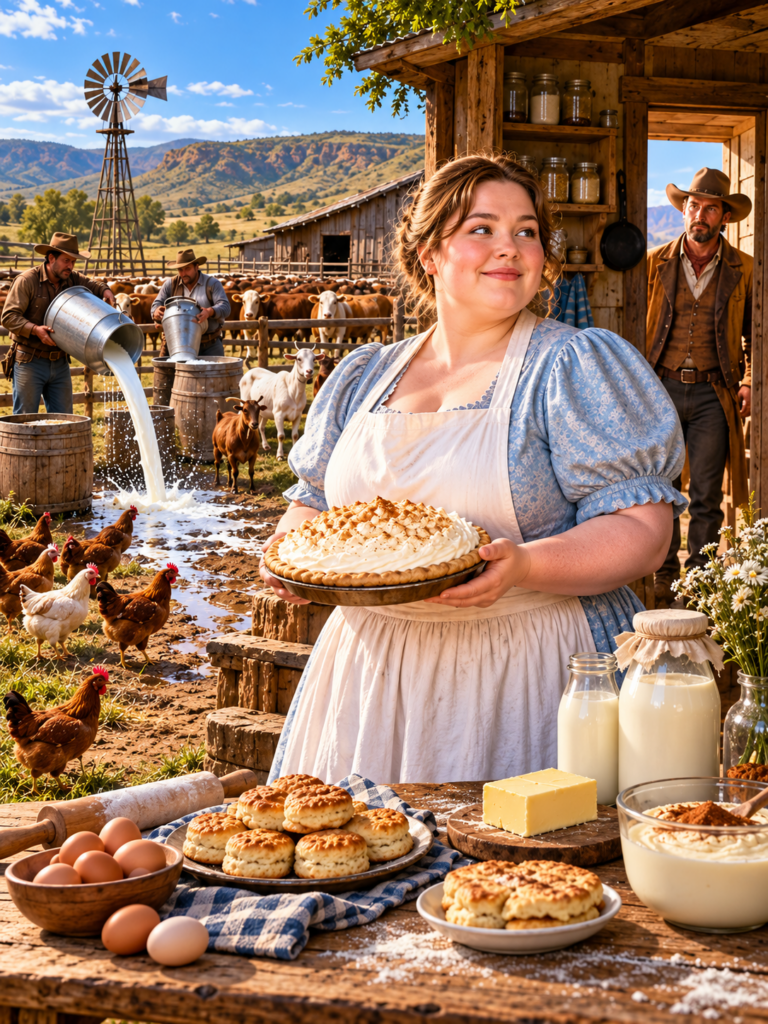
Every morning, sixty-five gallons of fresh milk were poured into the dirt at Caldwell Creek Ranch.
And every morning, nobody said a word.
Not the cowhands who worked from sunrise until dark.
Not the housekeeper who struggled to stretch the food budget.
Not even the ranch owner, who was quietly running out of money.
Then a thirty-two-year-old woman named Nora Pruitt arrived with a battered traveling bag, a flour-stained apron, and a figure that made the men underestimate her before she’d spoken a single sentence.
On her very first morning, she watched the foreman lift a wooden bucket and pour thirty gallons of milk over a fence.
She stared at the pale liquid disappearing into the dry Texas soil.
“You’re pouring money into the ground,” she said.
The foreman turned toward her.
His name was Darnell Voss, and he had spent five years convincing everyone that he knew more about running a ranch than anyone else alive.
He looked Nora up and down.
Then he laughed.
“You’re the new cook’s helper?”
“Assistant cook.”
“Then get inside and assist.”
He picked up another bucket.
And emptied it.
Nora didn’t argue.
She watched him walk away, counted the remaining buckets, and entered the kitchen.
But before that first week was over, she would uncover a problem far larger than wasted milk.
And the man laughing at her would discover that the woman he’d dismissed could read numbers more accurately than he could hide them.
It was May of 1887, deep in the Texas Hill Country, where cedar-covered ridges rose above dusty valleys and cattle trails stretched toward the horizon.
Caldwell Creek Ranch occupied nearly eight thousand acres of rolling pasture, creek bottomland, and scrub-covered hills.
At first glance, it looked prosperous.
There were sturdy barns, a sprawling farmhouse, good fencing, and herds of cattle grazing beneath the morning sun.
But the buildings needed repairs.
Several wagons stood idle.
And the ranch hands had begun whispering that wages were arriving later than usual.
Nora noticed those things almost immediately.
She had spent most of her life noticing what other people overlooked.
Her mother had operated a boardinghouse in Abilene, and Nora had learned two skills before her sixteenth birthday: cooking enough food for twenty hungry men and keeping accounts that left no room for excuses.
When her mother died, Nora inherited the boardinghouse debts but not enough money to save the business.
A dishonest grain merchant had charged them for deliveries they never received.
By the time Nora proved the discrepancies, the bank had already begun foreclosure proceedings.
She fought for nearly a year.
She lost anyway.
At thirty-two, with no husband, little money, and a lifetime of being judged for her broad hips and round cheeks, Nora boarded a stagecoach headed south.
Caldwell Creek had advertised for an assistant cook.
It wasn’t the future she’d imagined.
But it was honest work.
And she was very good at honest work.
Margaret Ellis, the ranch’s head cook, met her in the kitchen shortly before dawn.
Margaret was fifty-three, gray-haired, and built like a woman who could carry two sacks of flour without asking for help.
“You’re Nora Pruitt?”
“Yes, ma’am.”
“Can you bake biscuits?”
“I can.”
“Four dozen by six. Flour’s in the barrel. Lard’s in the crock. The right side of the oven runs hot.”
Nora set down her traveling bag.
“Understood.”
Margaret watched as she tied on an apron and began working.
Nora didn’t ask where the rolling pin was.
She found it.
She didn’t complain about the heavy mixing bowl or uneven oven.
She adjusted.
By six o’clock, forty-eight golden biscuits sat beneath clean towels.
Nora had started another batch because she’d counted fourteen plates on the shelves and suspected forty-eight wouldn’t be enough.
The men arrived smelling of leather, sweat, and early morning dust.
They ate quickly.
Most didn’t acknowledge her.
But one man stopped at the door.
He was lean, weathered, and carried himself with the quiet assurance of someone who had spent more time working than talking.
“Good biscuits,” he said.
Nora smiled.
“Thank you.”
He nodded and went outside.
Margaret looked up from the stove.
“That’s Cal Hennessy. Been here eleven years.”
“Seems polite.”
Margaret snorted.
“He hasn’t complimented breakfast since the winter of eighty-four.”
Nora laughed.
Later that morning, the ranch owner entered the kitchen.
Thomas Reed was thirty-eight, tall and broad-shouldered, with dark hair beginning to turn silver at the temples.
He poured his own coffee, took a biscuit, and paused after the first bite.
“You’re the new assistant?”
“Nora Pruitt.”
“Thomas Reed.”
“I know, sir.”
He looked at the biscuit.
“Better than yesterday’s.”
From behind the stove, Margaret made an offended noise.
Thomas almost smiled.
Then he left.
Nora waited until the kitchen was quiet before mentioning the milk.
“Margaret, why are they throwing so much away?”
Margaret continued scrubbing a pan.
“Been doing it for years.”
“How many dairy cows?”
“Forty, give or take.”
“And nobody makes butter or cheese?”
“We make enough for the house.”
“What about the rest?”
Margaret shrugged.
“Voss says there’s no market worth the trouble.”
Nora thought about the trading post she’d passed on the way in.
Rhea Station lay twelve miles east.
She’d seen the posted prices for butter, cheese, and preserved provisions.
“There’s a market,” Nora said.
Margaret looked at her.
“Perhaps. But Darnell Voss doesn’t like people interfering with his operation.”
“Does Mr. Reed know how much they’re losing?”
“He’s got enough worries.”
Nora said nothing.
But later that morning, she found a scrap of flour sack, borrowed a pencil, and began calculating.
Forty cows.
Roughly eighty gallons of milk on an ordinary spring day, depending on production.
Fifteen gallons for household and ranch use.
About sixty-five gallons left over.
Every day.
She calculated the potential yields of butter and cheese, allowing for the cream available and the limitations of their equipment.
She estimated salt, firewood, labor, packaging, and transportation costs.
She didn’t claim every gallon could be turned into profit.
She knew better.
But even conservative figures showed that the ranch was throwing away a meaningful source of income.
When Thomas appeared in the kitchen, she showed him the calculations.
He studied them carefully.
“Where’d you learn arithmetic like this?”
“My mother ran a boardinghouse. I kept the books.”
He looked at her again.
“Voss runs the dairy.”
“I understand.”
“And I can’t have every worker making decisions outside their responsibilities.”
“I’m not asking to run the dairy, Mr. Reed. I’m asking whether you’d rather sell the surplus or keep pouring it into the dirt.”
Thomas’s expression tightened.
For a moment, she thought he’d fire her.
Instead, he folded the flour sack.
“I’ll think about it.”
After he left, Margaret shook her head.
“That’s ranch-owner language for no.”
“Perhaps.”
Nora returned to her work.
“But he didn’t say the numbers were wrong.”
That evening, she asked Margaret for two gallons of cream.
Margaret hesitated.
“What for?”
“Something we can sell.”
The older woman studied her.
Then she nodded.
“Two gallons. No more.”
Nora stayed up after supper.
She cleaned the old churn, skimmed the cream, and worked the wooden handle until her arms ached.
Margaret sat nearby, mending a shirt.
Neither spoke much.
Finally, the sound inside the churn changed.
Nora stopped.
She lifted the lid.
Pale yellow butter had formed.
She washed and worked it, packed it into molds, and set it in the cool cellar.
The remaining buttermilk went into a crock for breakfast.
Margaret inspected the butter.
“Looks good.”
“Tastes better.”
Margaret took a small sample.
For several seconds, she said nothing.
Then she reached for another bite.
Nora smiled.
The following morning, she used the buttermilk to make biscuits.
Cal Hennessy ate four.
A young ranch hand named Pete Garland came back for seconds twice.
Even Boone, the quiet cattle boss, looked up.
“These are different.”
“A little.”
“Better.”
Nora thanked him.
But Darnell Voss didn’t appreciate what she’d done.
He appeared in the kitchen after breakfast.
“I hear you’ve been taking milk without permission.”
“Margaret requested cream for kitchen use.”
“That’s not how supplies work around here.”
“Then perhaps we ought to reconsider how they work.”
His face darkened.
“You’ve been here two days.”
“Yes.”
“And already you think you know better than the man who’s run this ranch for five years?”
Nora set down her knife.
“No, Mr. Voss. I think milk should be used before it spoils.”
He stepped closer.
“Stay in the kitchen.”
She met his eyes.
“I intend to.”
He turned and walked away.
But Nora had seen something in his expression that disturbed her.
He hadn’t looked merely annoyed.
For one brief moment, he had looked frightened.
Three days later, disaster struck.
A hard overnight rain left the creek bank dangerously muddy.
Three of the ranch’s best dairy cows slipped down the slope.
By sunrise, Cal and the ranch hands were struggling to pull them to higher ground.
One animal couldn’t put weight on its front leg.
Thomas stood beside the creek, shouting instructions.
Voss was furious.
“We’ll lose the morning milking!”
Nora heard the commotion from the kitchen.
She hurried to the doorway.
Cal was kneeling beside the injured cow.
“She needs to be milked as soon as we get her secure,” he said.
Thomas rubbed his forehead.
“With three cows out of position and the morning schedule gone to pieces, half the milk will spoil before we can use it.”
Nora stepped forward.
“Mr. Reed.”
He turned.
“Not now, Nora.”
“I can take the milk.”
Voss scoffed.
“You can’t process this much.”
“I can preserve what we bring in until we reach our limit. But I need clean containers, two extra hands, and permission to use the cold cellar.”
Thomas looked at her.
“How much?”
“As much as we can safely handle. I’ll tell you when we reach capacity.”
Voss shook his head.
“She’s going to make a mess.”
Nora ignored him.
“Every minute we argue, the milk gets warmer.”
Thomas stared at her.
Then he turned toward Cal.
“Send Pete and Rodriguez to the kitchen.”
Nora was already moving.
By midday, she had transformed the kitchen into a small dairy-processing operation.
Milk arrived in clean cans.
Cream was separated.
Butter was churned.
Fresh cheese was prepared.
The work was exhausting.
Nora’s sleeves were soaked.
Her shoulders burned.
Margaret worked beside her without complaint.
Pete carried water and scrubbed equipment.
Rodriguez hauled fresh milk from the barn.
By evening, they had preserved a considerable portion of what otherwise would have been lost.
They couldn’t save everything.
But they had proved something far more important.
The surplus was usable.
And the ranch already had enough people with enough skill to begin doing something about it.
The next morning, Thomas entered the kitchen carrying a notebook.
“I counted what you produced yesterday,” he said.
Nora looked up.
“And?”
“Twelve pounds of butter. Several crocks of buttermilk. Fresh cheese.”
“From an emergency operation.”
He nodded.
“I checked your calculations again.”
She waited.
“They hold up.”
Across the room, Margaret quietly turned toward the stove.
Thomas pulled out a chair.
“Suppose I gave you responsibility for processing surplus milk. What would you need?”
Nora wiped her hands.
“Another churn. Better storage. Reliable milk collection. A written agreement with Rhea Station.”
“And the workers?”
“Voss manages the cows. I manage the processing. We establish the responsibilities clearly.”
Thomas watched her.
“You’ve been thinking about this.”
“Since the first bucket hit the ground.”
For the first time, he smiled.
“Then let’s see what you can do.”
Nora felt relief spread through her.
But before she could answer, the kitchen door opened.
Voss stood in the doorway.
He had heard enough.
His face was rigid.
“Mr. Reed,” he said, “before you give her control of anything, there’s something you ought to know.”
He looked directly at Nora.
“Ask her why she really left Abilene.”
The room fell silent.
Nora’s blood went cold.
Because the answer involved a scandal she had spent two years trying to escape.
And somehow, Darnell Voss knew about it.
Part 2
Darnell Voss stood in the kitchen doorway holding a yellowed newspaper clipping between two fingers.
He looked pleased with himself.
“Before you hand this woman your dairy operation, Mr. Reed, you might want to know she was accused of stealing from a boardinghouse in Abilene.”
Margaret stopped stirring the soup.
Thomas looked from Voss to Nora.
“Is that true?”
Nora felt the old humiliation return.
She remembered the bank manager’s expression, the townspeople whispering outside her mother’s boardinghouse, and the morning someone painted the word THIEF across its front door.
“Yes,” she said.
Voss smiled.
“There you have it.”
Nora straightened.
“I was accused. I wasn’t convicted.”
“Convenient distinction.”
“It’s an important one.”
Thomas held out his hand.
“Let me see the clipping.”
Voss reluctantly passed it over.
Thomas read the article.
It reported that the Pruitt boardinghouse had failed after accusations of missing funds and irregular accounts. A local merchant named Abel Grady had claimed Nora falsified the books to conceal mounting debts.
Thomas looked up.
“Why didn’t you mention this when you applied?”
Nora swallowed.
“Because I was hired to cook, not to keep your financial records.”
“That’s not an answer.”
She met his eyes.
“Because people usually stop listening after they hear the accusation.”
Silence settled over the kitchen.
Then Nora told him what had happened.
Her mother had trusted Abel Grady for years.
He supplied grain, flour, preserved meat, and other provisions to the boardinghouse.
When her mother became ill, Nora took over the accounts.
She discovered duplicate invoices, false delivery charges, and payments recorded for goods that had never arrived.
She challenged Grady.
Two weeks later, several pages from the boardinghouse ledger disappeared.
Grady accused Nora of altering the books.
The bank demanded repayment of the outstanding loan.
Customers stopped coming.
And the boardinghouse collapsed before Nora could prove what had happened.
“I kept copies of the invoices,” she said. “But the sheriff said it was a business dispute.”
“Did you steal the money?” Thomas asked.
“No.”
He studied her face.
“Then why leave?”
“Because being innocent doesn’t put food on the table.”
Voss gave a humorless laugh.
“That’s a beautiful story.”
Nora turned toward him.
“Where did you get that clipping?”
“People talk.”
“It’s from an Abilene newspaper. You’ve never mentioned traveling there.”
He shrugged.
“Doesn’t matter.”
But Nora noticed he wouldn’t meet her eyes.
Thomas folded the clipping.
“Mr. Voss, I appreciate being told about concerns. But accusations aren’t proof.”
Voss’s jaw tightened.
“The ranch needs to be careful.”
“Agreed,” Thomas said. “Which is why we’re going to judge the dairy operation by its records and results.”
He turned to Nora.
“The trial arrangement continues. Every expense and delivery gets documented.”
“That’s exactly what I want.”
Voss stared at them.
Then he left.
Margaret waited until his footsteps faded.
“That man went hunting for something to use against you.”
Nora picked up her apron.
“Then we’d better give him nothing else.”
For the next two weeks, she worked harder than she ever had.
She rose before dawn.
She baked biscuits for fourteen men, prepared the midday meal, and spent the afternoons turning surplus milk into butter, cheese, and cultured buttermilk.
The kitchen became warmer and busier.
Pete Garland helped scrub equipment after his regular chores.
Rodriguez brought milk cans from the dairy barn.
Margaret supervised storage and adjusted menus to make use of the products.
Cal Hennessy quietly ensured the workers respected the new arrangements.
Even Thomas began helping.
One evening, he arrived carrying a heavy wooden churn he’d purchased from a supplier in San Antonio.
Nora stared at it.
“You bought it?”
“You said we needed one.”
“I said we would need one if production increased.”
Thomas looked at the crowded shelves of butter molds.
“Seems to me it already has.”
She laughed.
It was the first time she’d laughed freely in weeks.
Thomas seemed startled by the sound.
Then he smiled.
For a few minutes, they worked together assembling the equipment.
Nora showed him how the mechanism operated.
He listened without interrupting.
When the churn was ready, he looked around the kitchen.
“My father would have liked you.”
Nora glanced at him.
“Why?”
“He hated waste. Said a rancher who throws away what the land gives him doesn’t deserve the land.”
“What happened to him?”
Thomas’s smile faded.
“He died five years ago.”
“I’m sorry.”
Thomas tightened a bolt.
“Afterward, everything became my responsibility. The ranch. The workers. The debt.”
He paused.
“Some days I feel like I’ve been trying to keep his house standing with my bare hands.”
Nora understood that feeling better than he knew.
“Then perhaps it’s time to stop holding up every wall by yourself.”
Thomas looked at her.
Something quiet passed between them.
He was still studying her when Margaret entered carrying a basket of eggs.
“Well,” Margaret announced, “if you two are finished admiring the machinery, somebody needs to peel potatoes.”
Thomas immediately reached for a knife.
Margaret looked delighted.
Nora hid a smile.
A week later, Thomas returned from Rhea Station with their first regular sales agreement.
The commissary would purchase twenty pounds of butter each week at nineteen cents per pound.
It wasn’t a fortune.
But it was reliable income from something the ranch had previously discarded.
They also agreed to consider buying cheese if the quality remained consistent.
Nora read the agreement twice.
“That’s a beginning.”
Thomas nodded.
“A good one.”
Then he produced a letter.
It came from Gerald Croft, a wholesale provisions buyer in San Antonio.
Croft supplied several hotels and a hospital.
He wanted samples, production estimates, and a meeting.
Nora felt her pulse quicken.
“Thomas, this could change everything.”
“I know.”
But the next morning, the milk arrived an hour earlier than scheduled.
By the time Pete brought the first cans to the kitchen, their temperature had already begun rising.
Nora frowned.
“Why was this sitting so long?”
Pete twisted his hat.
“Mr. Voss changed the milking schedule.”
“When?”
“Yesterday.”
“Did he tell Margaret?”
“No, ma’am.”
Nora closed her eyes briefly.
Voss had found a way to interfere without openly refusing Thomas’s instructions.
He was going to make the processing operation fail.
And then blame her.
She checked the milk carefully and rejected the portion she couldn’t safely use.
Then she reorganized the morning routine.
Pete and Rodriguez agreed to help deliver milk promptly under a schedule Thomas approved.
Nora arranged earlier preparation in the kitchen.
The operation continued.
Voss changed delivery times again.
She documented them.
A milk ladle disappeared.
She found it in the barn.
Then the cold cellar door was left unsecured on a warm night.
Several crocks of butter nearly spoiled.
Nora discovered the problem just before midnight.
She checked the storage temperature, moved the products to the coolest available area, and secured the door.
Then she sat at the kitchen table and began writing.
Dates.
Times.
Missing equipment.
Late deliveries.
Changed schedules.
She didn’t accuse anyone.
Not yet.
But she was no longer willing to mistake a pattern for coincidence.
The following Monday, she knocked on Thomas’s study door before breakfast.
He opened it wearing a rolled-sleeve shirt.
“Nora? Is something wrong?”
“We need to talk.”
He stepped aside.
She placed her notes on his desk.
Thomas read them slowly.
His expression hardened.
“Why didn’t you come to me sooner?”
“Because one mistake isn’t sabotage. Neither are two. But a pattern deserves attention.”
“Do you think Voss is doing this?”
“I think someone wants the dairy operation to fail.”
Thomas looked toward the window.
“Voss has been with this ranch since my father died.”
“I know.”
“He kept the cattle alive during the drought. He negotiated feed deliveries when I couldn’t get credit.”
“Then he’s earned your loyalty.”
“Yes.”
Nora leaned forward.
“But loyalty doesn’t require blindness.”
Thomas said nothing.
She continued.
“There’s something else. I want to see the ranch’s dairy purchasing records.”
He frowned.
“Why?”
“Because Voss keeps telling everyone that processing milk costs more than it’s worth. I want to understand what his existing operation actually costs.”
Thomas hesitated.
Then he reached for a ledger on the shelf.
“These are the accounts he submitted.”
Nora opened it.
She studied the entries.
Feed purchases.
Veterinary supplies.
Equipment repairs.
Transportation.
She turned another page.
And stopped.
A supplier’s name caught her eye.
A. Grady & Company — Abilene, Texas.
For several seconds, she couldn’t breathe.
Thomas noticed.
“Nora?”
She pointed to the entry.
“Where does Voss buy the dairy feed supplements?”
“From that company, apparently.”
“How long?”
“Since before my father died.”
Nora turned the pages.
The same name appeared repeatedly.
Large purchases.
Unusual transportation charges.
Additional fees for emergency orders.
Some invoices showed charges for quantities that seemed excessive for forty dairy cows.
Her hands began trembling.
“Thomas, do you have the original invoices?”
“I believe so.”
“Please.”
He stood and unlocked a cabinet.
Inside were several bundles of old receipts tied with string.
He placed them on the desk.
Nora searched through them.
When she found the first invoice, her stomach turned.
The handwriting was familiar.
The same heavy downward strokes.
The same peculiar way of crossing the number seven.
Abel Grady.
The man who had ruined her mother’s boardinghouse.
She examined another invoice.
Then another.
Several referenced wagon deliveries from Abilene.
Yet the amounts, dates, and receiving signatures didn’t always match the ranch’s own inventory records.
Nora looked up.
“Thomas, I think someone’s been stealing from you.”
He went very still.
“Who?”
“I don’t know for certain.”
She placed the papers side by side.
“But this supplier falsified invoices at my mother’s boardinghouse. These records show discrepancies that need explaining.”
Thomas sat down heavily.
“How much?”
“I need time to calculate it.”
He looked toward the door.
“Voss signed some of these.”
“I see that.”
Thomas rubbed his face.
For several moments, he said nothing.
Then he whispered:
“If this is true, it could explain why the ranch never has enough money.”
Nora nodded.
“And why someone might not want you looking too closely at the dairy.”
They spent the next two evenings reviewing the records.
Margaret brought them coffee.
Cal helped confirm which supplies had actually arrived.
Pete recalled deliveries he’d witnessed.
Slowly, the discrepancies became impossible to ignore.
Over three years, the ranch had paid substantial sums for supplies that couldn’t be accounted for.
Some invoices duplicated earlier deliveries.
Other charges exceeded agreed prices.
And several receipts bore questionable receiving signatures.
The financial losses were large enough to explain a significant portion of Caldwell Creek’s outstanding debt.
Thomas stared at the totals.
“I trusted him.”
Nora knew he meant Voss.
“He may have explanations,” she said. “We should hear them.”
Thomas looked at her.
“After what he did to your reputation, you’re still willing to give him that chance?”
“I’m not interested in ruining a man because I dislike him.”
She pointed to the paperwork.
“I’m interested in finding the truth.”
The next morning, Thomas summoned Voss to his study.
Nora sat beside the desk.
Cal stood near the doorway.
Voss entered looking irritated.
“What’s this about?”
Thomas gestured toward the chair.
“Sit down, Darnell.”
“I’ve got cattle waiting.”
“They can wait.”
Voss sat.
Thomas pushed three invoices toward him.
“Explain these deliveries.”
Voss glanced at the papers.
“Feed.”
“According to our records, the quantities never arrived.”
“They arrived.”
“Then where are the receiving logs?”
Voss shrugged.
“Records get lost.”
Thomas placed another invoice beside the first.
“These two show the same delivery wagon, the same quantity, and the same date. Yet we paid for both.”
Voss stared at the papers.
“Clerical error.”
Nora spoke quietly.
“Then why does the second invoice have a different delivery signature?”
Voss looked at her with undisguised hatred.
“You’ve been digging through my accounts?”
“Mr. Reed asked me to review the records.”
Voss stood abruptly.
“That woman came here to destroy me!”
Thomas rose.
“Sit down.”
“No! You bring in some disgraced cook from Abilene and suddenly I’m the criminal?”
Nora remained seated.
“How do you know Abel Grady?”
Voss stopped.
The color drained from his face.
For the first time, he looked genuinely frightened.
Then he forced a laugh.
“Everyone in the livestock trade knows Grady.”
Nora shook her head.
“He’s a provisions merchant. Not a cattle dealer.”
Voss’s eyes narrowed.
“You don’t know what you’re talking about.”
“Then explain why he sent you that clipping about me.”
Silence.
Thomas looked sharply at his foreman.
“Darnell?”
Voss stepped toward the door.
Cal moved into his path.
“Mr. Reed hasn’t finished.”
Voss turned.
His face was red.
“You think you’re clever, Nora?”
“No,” she replied. “I think my mother died believing we’d lost everything because I made a mistake. I want to know whether the man who cheated us is doing the same thing here.”
For one moment, Voss looked at her with something almost like shame.
Then his expression hardened.
“You’ll regret this.”
He pushed past Cal and left the room.
Thomas followed him outside.
But Voss was already riding toward the north pasture.
By evening, he had disappeared.
So had a packet of ranch receipts and nearly four hundred dollars from the cashbox in the dairy office.
Thomas sent men to search the roads.
Cal rode toward Rhea Station.
Nora stayed in the kitchen, surrounded by invoices and account books.
She should have felt vindicated.
Instead, she felt sick.
Because Voss had fled before explaining what the missing money was being used for.
And just before midnight, a rider arrived from Rhea Station carrying an urgent letter.
It was from Abel Grady’s attorney.
The letter claimed that Caldwell Creek Ranch owed Grady & Company more than nine thousand dollars in unpaid commercial obligations.
Unless payment was arranged immediately, the company intended to pursue the property pledged as security for those debts.
Thomas read the demand aloud.
Then he looked at Nora.
“Nine thousand dollars.”
It was a devastating sum for a ranch already struggling to pay its workers.
Nora took the letter.
At the bottom was a familiar signature.
Abel Grady.
The same man who had driven her mother’s boardinghouse into ruin.
And beside the signature was a notation that made her hands turn cold.
The debt had supposedly been guaranteed by Thomas Reed’s late father.
Five years earlier.
Three weeks after his death.
Part 3
Thomas Reed stared at the date on the document.
Then he read it again.
His father had died on October 11, 1882.
The supposed guarantee was dated November 3.
Twenty-three days after the funeral.
Thomas slowly lowered the paper.
“My father couldn’t have signed this.”
Nora looked at him.
“No.”
For several seconds, the only sound in the study was the ticking of the mantel clock.
Then Thomas stood.
“Grady’s trying to take my ranch.”
Nora studied the document.
The signature was convincing at first glance.
But the date was impossible.
And beneath the main text, in smaller lettering, the guarantee referred to several feed purchases that had supposedly been made before the original loan was finalized.
Nora recognized the pattern.
It was the same one she’d seen in Abilene.
Start with genuine business transactions.
Add inflated invoices.
Create a growing debt.
Then pressure the borrower before anyone has time to challenge the records.
“They did this to my mother,” she whispered.
Thomas turned toward her.
“What?”
“The invoices. The accusations. The missing ledger pages. Everything.”
She looked down at the forged guarantee.
“Grady doesn’t need the debt to be legitimate. He only needs you frightened enough to sign something that makes it legitimate.”
Thomas sank into his chair.
“I’ve already borrowed against part of the ranch.”
“How much?”
“Enough that another lawsuit could frighten the bank into calling the loan.”
Nora understood.
Even if Grady’s claim eventually failed, the legal expenses and uncertainty could bankrupt Caldwell Creek before the dispute was resolved.
For years, she’d dreamed of confronting Abel Grady.
Now the same man was threatening the one place where she’d begun to build a new life.
Thomas looked at her.
“What do we do?”
Nora folded the letter.
“We stop treating the threat like a verdict.”
The following morning, Thomas rode to Rhea Station and sent telegrams to two attorneys.
One practiced in San Antonio.
The other had represented cattle ranchers in Austin.
Both agreed to review the documents.
Meanwhile, Nora began assembling the evidence.
She worked at the kitchen table every evening.
Margaret brought tea.
Pete copied figures onto clean paper.
Cal reviewed delivery records.
Even Boone, who rarely spoke unless cattle were involved, contributed observations about feed quantities and wagon arrivals.
They compared invoices against livestock inventories, storage records, and payments.
By the end of the week, they’d identified more than two thousand dollars in questionable charges.
Nora also found something remarkable.
One of the oldest surviving delivery books contained a notation written by Thomas’s father.
Grady account disputed. No further credit authorized.
The entry had been made shortly before his death.
Thomas held the book with trembling hands.
“He knew.”
Nora nodded.
“He suspected something.”
Thomas stared at his father’s handwriting.
For five years, he’d believed his father had left him a ranch burdened by debts he didn’t understand.
Now he was beginning to see that some of those debts might have been deliberately manufactured.
His father had tried to stop them.
And then he’d died before the matter was resolved.
Thomas closed the book.
“We need to find Voss.”
Two days later, Cal returned with news.
Voss had been seen at a boardinghouse outside Fredericksburg.
He was preparing to travel west.
Thomas wanted to confront him immediately.
But Nora stopped him.
“Don’t go alone.”
Thomas frowned.
“I’ve known the man five years.”
“Which means he knows exactly what you’ll say. And exactly how to provoke you.”
She pointed toward the folder of documents.
“Take the attorney. Take someone who can witness whatever he tells you.”
Thomas studied her.
Then nodded.
The next morning, he traveled with Cal and a local deputy.
Nora remained at the ranch.
She spent the day working through the remaining invoices.
And for the first time, she noticed a discrepancy that made her sit perfectly still.
A delivery charge from Abilene was dated the same week her mother’s boardinghouse records had disappeared.
The wagon number matched another receipt from the Pruitt business.
The same wagon had supposedly delivered flour to Abilene and dairy supplies to Caldwell Creek on the same afternoon.
A journey of more than a hundred miles.
Impossible for one team of horses.
She searched the older records.
Then she found another match.
And another.
Her heart began racing.
Grady had been billing multiple customers for the same deliveries.
The ranch fraud and the boardinghouse fraud weren’t merely similar.
They were connected.
Nora gathered the papers and hurried to Margaret.
“I need a horse.”
Margaret looked up from the bread dough.
“Where are you going?”
“Rhea Station. I need to send a telegram to Abilene.”
Margaret stared at her.
Then untied her apron.
“I’ll have Pete bring the wagon.”
Nora returned after dark.
She had sent copies of the relevant details to an Abilene attorney who’d once tried to help her mother.
She had also asked him to locate the surviving boardinghouse records.
There was no guarantee he could find them.
But for the first time in two years, she had evidence that might explain everything.
Thomas returned the following evening.
His clothes were dusty.
He looked exhausted.
Nora met him at the barn.
“Did you find Voss?”
“Yes.”
“What did he say?”
Thomas dismounted slowly.
Then he looked at her.
“He admitted Grady had been paying him.”
Nora felt the ground shift beneath her.
“For how long?”
“Almost four years.”
Thomas handed the reins to Pete.
“Grady paid him to approve inflated invoices. Voss received a portion of the money. At first, he said it was a harmless arrangement. Then Grady began threatening to expose him.”
“Did he admit forging the guarantee?”
“He says Grady prepared it. But Voss helped him obtain samples of my father’s signature.”
Nora closed her eyes.
The pieces finally fit.
Voss hadn’t opposed the dairy operation merely because he disliked taking orders from a woman.
A successful dairy business meant more careful accounting.
More deliveries.
More inventory.
More reasons for Thomas to examine records he’d previously trusted Voss to maintain.
Nora had threatened the fraud without even knowing it existed.
Thomas continued.
“Voss agreed to give a signed statement. The attorney and deputy witnessed it.”
Nora nodded slowly.
“And the four hundred dollars?”
“He admitted taking it.”
“Will he repay it?”
“He’s turned over what he still has. The rest will be addressed through the legal proceedings.”
Thomas looked toward the farmhouse.
“I spent five years trusting that man.”
Nora stood beside him.
“You trusted someone who knew how to appear useful.”
Thomas shook his head.
“He was useful. That’s what makes it difficult.”
She looked at him.
“People can do good work and still make terrible choices.”
He was quiet.
Then he said:
“I’m beginning to understand that.”
Over the following weeks, the dispute became the talk of the Hill Country.
Grady’s attorney initially insisted the debt was legitimate.
But when Thomas’s lawyers presented the impossible signature date, the original account notation, and Voss’s statement, the claim began to unravel.
Additional records from other merchants supported the existence of irregular billing practices.
The contested guarantee was challenged.
The courts did not settle every question immediately.
There were hearings, sworn statements, and months of work ahead.
But Grady could no longer demand payment without facing serious scrutiny of his own records.
A separate investigation began into the suspected fraud.
And the bank, reassured by the ranch’s documented income and legal position, agreed to work with Thomas on his existing legitimate obligations rather than force an immediate sale.
It wasn’t a miraculous rescue.
Caldwell Creek still owed money.
Fences still needed repairing.
Cattle still had to be fed.
And the ranch remained vulnerable to drought and changing market prices.
But for the first time in years, Thomas understood what he actually owed.
That knowledge gave him room to plan.
Meanwhile, the dairy operation continued growing.
Gerald Croft, the San Antonio buyer, visited Caldwell Creek in person.
He arrived wearing a brown traveling coat and carrying a notebook.
Nora met him in the kitchen.
He inspected the equipment.
He examined the storage conditions.
He tasted the butter and cheese.
Then he asked a dozen questions about quantities, consistency, and transportation.
Nora answered every one.
When he finished, he closed his notebook.
“Miss Pruitt, I believe we can do business.”
She smiled.
“I’d like that.”
He proposed a supply agreement with deliveries scaled to what the ranch could reliably produce.
The initial quantities were modest.
Nora preferred it that way.
She had learned that promising more than she could deliver was another form of waste.
Thomas arranged transportation.
Margaret helped establish production routines.
Pete and Rodriguez received additional wages for regular processing duties.
Over the next several months, the dairy products brought in steady income.
They didn’t make the ranch rich.
But they helped pay wages on time.
They funded repairs.
And they reduced the money Caldwell Creek lost every week.
The effect on the workers was immediate.
The men no longer worried whether the next payday would be delayed.
The kitchen had better supplies.
The barns received necessary maintenance.
And the milk that once disappeared into the dirt became something the entire ranch could take pride in.
One afternoon, Cal found Nora loading butter into a wagon.
He watched her tighten the last rope.
“Remember your first morning?”
She laughed.
“When Voss told me to get back in the kitchen?”
Cal nodded.
“You looked like you wanted to hit him with that bucket.”
“I was considering it.”
He smiled.
Then he handed her a folded scrap of paper.
It was the note Pete Garland had left after eating her first batch of molasses cookies.
Thank you, ma’am.
Nora stared at it.
“Where did you find this?”
“Pete said you kept it until your apron wore through. He found it among the kitchen linens.”
She unfolded the worn paper carefully.
Cal looked toward the wagon.
“You changed more than the milk.”
Nora swallowed.
“I didn’t do it alone.”
“No,” he said. “But somebody had to notice what was being thrown away.”
He walked toward the barn before she could answer.
By autumn, another piece of news arrived.
The attorney in Abilene had recovered enough of the old boardinghouse records to compare them with Grady’s invoices.
The duplicate wagon charges, inconsistent delivery records, and surviving correspondence supported Nora’s account of what had happened.
The old accusations against her were publicly challenged.
A local newspaper printed a follow-up story detailing the newly uncovered evidence.
It didn’t erase the foreclosure.
It didn’t return her mother’s boardinghouse.
And it couldn’t give Nora back the years she’d spent carrying the shame.
But it changed something important.
The story that had followed her across Texas was no longer the story everyone believed.
One evening, she sat alone at the kitchen table holding the newspaper.
Margaret entered.
“Good news?”
Nora nodded.
“I think so.”
Margaret pulled out a chair.
“Then why are you crying?”
Nora looked down at the article.
“Because my mother died thinking we’d failed.”
Margaret reached across the table and covered Nora’s hand.
“Your mother knew what kind of daughter she’d raised.”
Nora tried to answer.
But the words wouldn’t come.
Margaret squeezed her fingers.
“Sometimes the world takes longer to catch up.”
That winter, Thomas offered Nora a permanent position overseeing Caldwell Creek’s dairy-processing business.
The title was new.
So was the pay.
She would continue working closely with Margaret, but the processing operation would have its own accounts, equipment budget, and responsibilities.
Thomas explained everything in his study.
Nora listened.
Then asked:
“What about the profits?”
He blinked.
“What about them?”
“I want a percentage tied to the operation’s net earnings. A fair one. And clear records of expenses so we both know what the percentage means.”
Thomas smiled.
“I thought you might.”
He slid a second document across the desk.
She looked down.
It outlined a profit-sharing arrangement.
Reasonable wages.
Defined responsibilities.
A quarterly accounting.
And a provision for increased compensation if the business expanded.
Nora read it slowly.
Then looked up.
“You already prepared this?”
“I had a feeling you wouldn’t accept a title and a pat on the back.”
She laughed.
“No, I wouldn’t.”
Thomas leaned back.
“Good.”
She signed the agreement.
Then he extended his hand.
They shook.
His hand was warm and calloused.
For a moment, neither moved.
Then Nora released him.
“Thank you, Mr. Reed.”
“Thomas.”
She blinked.
He smiled.
“You’ve saved me enough money to call me Thomas.”
She laughed again.
“All right, Thomas.”
He watched her gather the papers.
“Nora, would you have dinner with me in Fredericksburg next Saturday?”
She stopped.
He looked almost nervous.
Not like the ranch owner who negotiated cattle purchases.
Not like the man who could make decisions in a storm without hesitation.
Just a man asking a woman he respected to spend an evening with him.
Nora studied his face.
“Is this a business meeting?”
“No.”
“Are you planning to ask about cream yields?”
“I’ll try very hard not to.”
She smiled.
“Then yes.”
Their relationship developed slowly.
There were carriage rides through the hills.
Long conversations on the farmhouse porch.
And evenings when Thomas helped Nora close the dairy accounts before they walked outside to watch the sunset.
He never made her feel that her weight diminished her beauty.
He never treated her work as an amusing hobby.
And when ranch visitors questioned why a woman had authority over an important business operation, he didn’t answer for her.
He let Nora explain.
That mattered more than flowers or compliments.
Because she’d spent so much of her life being spoken over.
Thomas gave her room to be heard.
The following spring, Caldwell Creek Ranch held a gathering to celebrate its first full year of dairy production.
The commissary agreement was still active.
The San Antonio deliveries had expanded.
The ranch had met its revised financial obligations.
And the workers’ wages were current.
Margaret prepared an enormous meal.
Pete hung lanterns across the yard.
Rodriguez and Boone moved tables beneath the old oak trees.
Cal brought out his fiddle.
By sunset, the ranch was filled with laughter.
Nora stood near the kitchen door watching everyone enjoy the evening.
She wore a simple blue dress.
Her hair was pinned back.
A few loose curls framed her round face.
Thomas approached carrying two cups of coffee.
“You’re missing your own celebration.”
“I like watching.”
He handed her a cup.
“Thinking about the first morning?”
She nodded.
“The milk.”
He smiled.
“Of course.”
Nora looked toward the dairy barn.
“Do you know what bothered me most?”
“The waste?”
“Not exactly.”
She turned toward him.
“It was that everyone had gotten used to it.”
Thomas considered that.
She continued.
“Once people decide something is normal, they stop asking whether it makes sense. They stop seeing the cost. And sometimes they stop seeing the people who could help.”
Thomas glanced at her.
“I nearly made that mistake.”
“Nearly?”
He smiled ruefully.
“All right. I made it.”
Nora laughed.
He set down his coffee.
Then he took her hand.
“I’ve been meaning to ask you something.”
She raised an eyebrow.
“Does it involve cows?”
“Not a single one.”
He reached into his coat pocket and withdrew a small velvet box.
Nora went completely still.
Thomas opened it.
Inside was a simple gold ring.
“I don’t need someone to rescue this ranch,” he said quietly. “I need someone who tells me the truth, even when I don’t want to hear it.”
Her eyes filled with tears.
“And I need someone who can build a life with me, not behind me or beneath me.”
He took a breath.
“Nora Pruitt, would you marry me?”
For a moment, she couldn’t speak.
She thought of Abilene.
Her mother’s boardinghouse.
The accusations.
The bank.
The stagecoach ride to Caldwell Creek.
The laughter she’d endured when she first arrived.
Then she looked at the man standing before her.
A man who had learned to listen.
A man who no longer confused loyalty with refusing to question old habits.
A man who had offered her not a rescue, but a partnership.
“Yes,” she whispered.
Thomas smiled.
“Yes?”
She laughed through her tears.
“Yes, Thomas.”
He slipped the ring onto her finger.
From the yard, Margaret let out a delighted shout.
“Well, it’s about time!”
Nora turned.
Everyone was watching.
Pete clapped.
Boone raised his coffee cup.
Cal began playing his fiddle.
And Thomas drew Nora gently into his arms.
One year earlier, she had arrived at Caldwell Creek Ranch with a traveling bag and almost nothing else.
She’d been dismissed because of her appearance.
Doubted because of her position.
And threatened because she recognized something other people preferred to ignore.
But she hadn’t saved Caldwell Creek by proving she was better than everyone else.
She’d saved it by refusing to accept that waste, dishonesty, and fear were simply the way things had always been.
The milk became butter.
The butter became income.
The income gave the ranch breathing room.
And that breathing room allowed the truth to surface.
Long afterward, people around Rhea Station would tell stories about the round-faced cook who turned a failing ranch into a thriving business.
Some exaggerated her accomplishments.
Others claimed she’d worked miracles.
Nora always corrected them.
“It wasn’t a miracle,” she’d say.
“It was milk, work, and arithmetic.”
Then she’d smile.
“Though a little stubbornness helped.”
And whenever a new ranch hand asked why Caldwell Creek kept such careful records of its milk, Thomas would point toward the dairy building, where Nora’s name now appeared beside the ranch brand.
Then he’d tell the young man about a morning in 1887 when a foreman laughed at a woman standing beside a fence.
A woman who saw money being poured into the ground.
A woman who refused to look away.
Because the most valuable thing at Caldwell Creek hadn’t been the milk everyone was wasting.
It was the woman nobody thought was worth listening to.

