
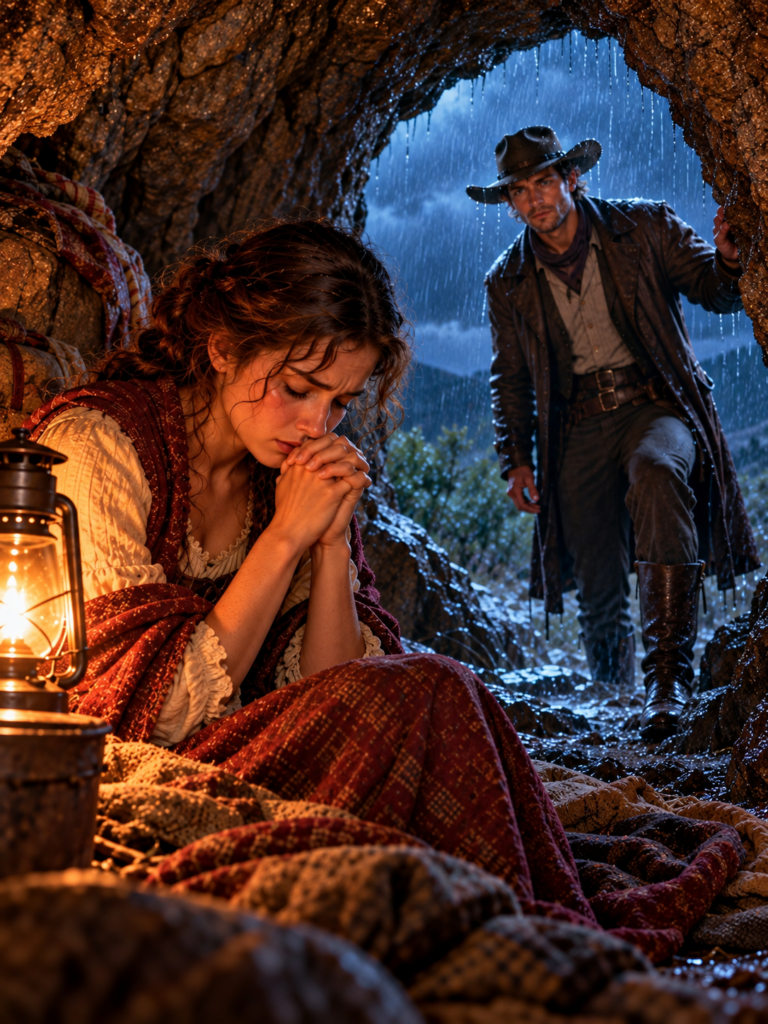
he sought only dry ground from the autumn storm — then heard a widow whisper she had nowhere else left to go
Part 1
The storm came down off the ridgeline so fast that a clear autumn afternoon turned almost black within the hour. Rain struck the rocks hard enough to bounce. Water streamed from the brim of Caleb Hendris’s hat and ran cold along his jaw. His wool coat had grown heavy enough that every step uphill felt like dragging another man behind him. The gelding, Buck, shivered and sidestepped whenever thunder broke over the canyon.
Caleb had been three days riding back from Helena after settling accounts from a difficult season. He knew better than to stay exposed on a high trail beneath a sky full of lightning. When he saw the dark mouth of the cave cut into the slope, he angled Buck toward it without thinking of anything except shelter.
Ten feet from the entrance a woman’s voice stopped him colder than the rain.
“Lord, I have nowhere else to go.”
He stood motionless, one hand on the bridle. The words were not loud. That was what held him. He had heard frightened people shout before. He had heard men curse in blizzards and pray when cattle stampeded. This sounded like a person who had already used up fear.
“Lord,” the woman whispered again from somewhere beyond the dark entrance, “I don’t know what else to do.”
Caleb stayed outside. Rain ran from his hat to his chin. He called, gentle, “Hello, the cave.”
The prayer stopped. Inside, something shifted.
“Didn’t mean to come up on you without warning,” he said. “Storm drove me here same as I expect it drove you. Name’s Caleb Hendris. I’ve got a ranch south of here. I’m alone except for my horse.”
No answer. He waited.
“I won’t step inside without your leave.”
Thunder rolled through the canyon. Then a woman answered. “Stay where you are.”
He did.
“Are you armed?”
“Yes, ma’am.”
A pause. “So am I.”
Despite the cold, a faint smile touched his mouth. “Then I expect we both understand each other.”
Another long silence. Finally she said, “There’s room. Come in before you freeze.”
Caleb led Buck beneath the rock overhang. The cave was shallow, more a deep cut in the stone than a true cavern. A small lantern burned near the back wall, its weak orange light barely reaching the entrance. That was where he saw her.
She looked younger than the weariness in her voice had suggested—twenty-eight, perhaps twenty-nine. Dark hair had come loose around her face and dried in uneven strands where the cave had protected her from the rain. A worn shawl covered her shoulders. Her skirt was muddy to the knees. She sat against the wall with both hands wrapped around the edge of the shawl. Her lips were pale from cold. There were dark hollows beneath her eyes that no single sleepless night could have made.
Caleb kept several feet between them. “Sorry I heard your prayer.”
Her eyes sharpened. “I wasn’t listening on purpose.”
“Wind carried it.”
She studied him. “Prayer is not a private thing once you say it loud enough for the mountains to hear.”
“That may be true. Name’s Abigail Sutton.”
“Caleb Hendris.” He took off his hat. “Mrs. Sutton?”
“Miss.” Something in the answer told him not to ask more.
He tied Buck where the horse could remain under shelter and opened one saddlebag. “I’ve got hardtack, dried beef, little coffee if my tin stayed dry.”
Abigail’s gaze followed the food before she caught herself. Caleb noticed. “When did you last eat?”
“Yesterday.”
“Proper?”
Her eyes lowered. “No.”
He handed her the food first. She hesitated, then accepted it. And that was when he heard the sound. A small whimper, so soft the rain nearly swallowed it. He looked toward Abigail’s side. What he had mistaken for a folded blanket moved.
Abigail reacted instantly. She pulled the bundle against her chest. Her entire body shifted between Caleb and whatever was inside.
Caleb went still. “There’s a child.”
“My daughter.” Abigail drew back one corner of the blanket. A baby slept there, cheeks flushed with warmth, one tiny fist tucked beneath her chin. “Nine months. Her name’s Hope.”
Caleb looked from the baby to Abigail. Something about the name tightened his chest. Abigail saw it.
“If you mean either of us harm, tell me now.”
His eyes lifted. She continued before he could answer. “I’ve got no husband, no family left that can take us, no place waiting at the end of this trail. So if you’re a bad man, Mr. Hendris, I’d rather know before I start believing otherwise.”
The cave seemed to grow quieter around them. Caleb lowered himself slowly onto a flat rock, leaving distance between them. “I mean you no harm. Not you, not Hope. I’ll share what food I’ve got. Keep to my side of this cave. And when the storm breaks, I’ll help you get somewhere safe if you let me.”
She said nothing. He added, “That’s all I can promise tonight.”
Abigail looked down at her daughter. “That may be more than I had an hour ago.”
The rain did not ease. By nightfall water had begun running in silver threads down the cave entrance, and the air smelled of wet stone, horse leather, smoke from the tiny fire Caleb built, and coffee boiled too long in a blackened tin cup. Hope woke hungry. Abigail turned away slightly while feeding her beneath the blanket. Caleb gave her privacy and watched the storm.
When the baby slept again, Abigail finally spoke. “Hope’s father was my husband, Edwin. He died before she was born.”
“I’m sorry.”
She nodded. “He took fever near Christmas last year. Was gone in four days.” Her fingers traced the edge of Hope’s blanket. “She came in January.”
Caleb did the arithmetic without meaning to. Nine months. It fit.
“I thought having her would keep me too busy to grieve. It did, for a while. Then spring came.” She looked toward the lantern. “A man named Wesley Rourke came to the farm with papers. Said Edwin had mortgaged the property the year before without telling me.”
“You knew nothing about it.”
“Nothing. I could read enough to know Edwin’s name was on them. Couldn’t tell if every word was honest. I fought it. Went to the courthouse, wrote letters, sold two milk cows to pay a lawyer in Bozeman to look at the claim.”
Caleb’s expression changed. “You had a lawyer.”
“For about three weeks. He said the mortgage had been properly filed.” Abigail swallowed. “I still don’t know if Edwin kept it from me because he was ashamed or because he thought he could pay it before I ever learned.”
A gust pushed rain through the cave mouth. Caleb shifted closer to the entrance so Abigail and Hope stayed dry. “When did you lose the farm?”
“Two weeks ago. The man came himself. With the sheriff and a final order. I was given until sundown.”
Caleb said nothing.
Abigail looked down at Hope. “I packed what I could carry and started toward Bozeman. For my sister. Martha was the last one. I reached Bozeman four days ago.” Something in her face warned him what came next. “She died in July. Same fever that took Edwin. I stood in front of her grave with Hope in my arms and realized I had spent two weeks fighting toward a place that no longer existed.”
The fire popped between them. “What did you do?”
“I left.”
“To where?”
Abigail gave a tired little laugh. “That’s the trouble.” She looked toward the storm. “There was nowhere.”
Caleb finally understood the prayer. Not a figure of speech, not despair exaggerated by rain. She truly had no destination.
“I took rides when people offered, walked when they didn’t. Slept in a church shed one night. A widow let us use her kitchen floor the next. Then the storm found us.”
His voice was quiet. “You’re not out of road tonight.”
“No. And tomorrow?”
Caleb did not make a grand promise. He only said, “Tomorrow we’ll find the next mile.”
For some reason, that was the sentence that made Abigail cry, not loudly. She turned her face away and wiped at her eyes. Caleb looked toward the storm and pretended not to notice.
Part 2
The rain broke after midnight. By dawn the mountains looked washed clean. Mist clung low over the trees. The rocks outside the cave shone black with water. Somewhere below, a creek that had been a quiet thread the previous afternoon now roared brown and full through the canyon.
Caleb saddled Buck. Abigail watched him. “How far is your ranch?”
“Two days if we go slow.”
“We?”
“If you’re willing.”
She tightened Hope’s blanket. “What exactly are you offering?”
“A room until you decide what comes next.”
Abigail’s expression closed. “I won’t be kept.”
“I didn’t ask to keep you.” The answer came fast enough to surprise them both. Caleb softened it. “You can leave the day you choose. I’m only saying you don’t need to choose today with a baby in your arms and wet boots on your feet.”
She looked toward the trail. “What will people say?”
“People always find work for their mouths.”
“That doesn’t answer me.”
“My housekeeper is Mrs. Pruitt. Widow. Lives in a room off the kitchen because she says riding home after dark is foolish at her age.” He smiled. “If she decides my intentions are improper, she’ll likely hit me with a spoon before you have to.”
That earned the smallest smile from Abigail. Caleb held out his hand to help her onto Buck. “You ride. I’ll walk.”
“That’s two days.”
“I have boots.”
Abigail stared at his hand, then took it.
The first day passed slowly. Caleb chose the lower trail, avoiding the exposed ridges the storm had made dangerous. Mud pulled at his boots. Pine branches dripped cold water down his collar whenever he passed beneath them. Hope slept against Abigail’s chest. By afternoon sunlight finally broke through the clouds. They stopped beside a creek where the water ran high from the storm. Abigail watched Caleb kneel near the bank.
“You drink from that?”
“Not right after a storm if I can avoid it.” He pointed upstream. “Too much mud, and you never know what got washed in.”
“So how do you know where to stop?”
“Mostly by knowing the country.”
That evening beside their small fire, Caleb explained more. Travel through Montana in those years depended on far more than any single map. Ranchers, freighters, hunters, and families passed along information about dependable springs, difficult crossings, washed-out trails, and passes that could close early with snow. Experienced travelers learned to read the country itself: a trail cut into a slope, a tree marked years earlier to help travelers stay on a route, fresh tracks near water, how fast a creek rose after a storm. What looked ordinary to a stranger often carried meaning for somebody who had worked that land for years.
Abigail listened. She had not spoken much all day. Now she asked, careful, “You lost someone.”
Caleb fed another branch into the fire. “Lost my mother when I was nine. My father didn’t take it well. Drink.” He nodded. “There was a woman two homesteads over. Dorothy Vance. She fed me more suppers than I could count. Made sure I went to school. Never asked my father for money.”
“Why?”
“I asked her once. She said a hungry child was reason enough.”
Abigail’s expression softened. “I’ve spent years wondering what makes somebody help when they don’t owe anything.”
“And did you decide?”
“No.” He looked at Hope asleep between them, wrapped in his spare coat. “But I think I understand Dorothy better than I did before yesterday.”
Abigail followed his gaze. Trust did not arrive all at once, but something settled between them beside that fire. Something quieter than gratitude.
They reached the Hendris ranch near sunset on the second day. Mrs. Pruitt came out before Caleb could dismount. She was a broad-shouldered widow in her late fifties with gray hair pulled so tightly back it seemed capable of correcting bad behavior on its own. She looked at Caleb, then Abigail, then Hope, then back at Caleb.
“Explain.”
Caleb did. Mrs. Pruitt listened. When he finished, she marched past him, took Hope gently from Abigail’s arms, and said, “There’s stew.”
Abigail blinked. Mrs. Pruitt looked over her shoulder. “You coming inside or planning to freeze politely on the porch?”
That was how Abigail entered the Hendris ranch. Not as Caleb’s dependent, not as a guest everyone whispered about. As a tired mother who needed food, sleep, and a door that locked.
The spare bedroom sat across from Mrs. Pruitt’s small room near the kitchen. The first night Abigail slept eleven hours. When she woke, Hope was playing on a quilt beside Mrs. Pruitt. Caleb was nowhere in sight.
“He’s fixing the west fence,” Mrs. Pruitt said.
Abigail sat up. “How long have you had her?”
“Two hours.”
“I’m sorry.”
Mrs. Pruitt snorted. “You think I’m suffering?” Hope slapped both hands against the quilt. Mrs. Pruitt smiled. “I haven’t had anybody this interested in my wooden spoon in twenty years.”
The first weeks passed carefully. Abigail refused to remain idle. She helped with the household books after Mrs. Pruitt discovered she could keep columns straighter than Caleb. She mended linens. She took over ordering flour and lamp oil from town. Caleb paid her. She objected. He ignored the objection.
“You work, you’re paid.”
“I’m using your room.”
“You’re also keeping me from buying lamp oil twice because I forgot I already bought it.”
“That happened once.”
“Twice,” Mrs. Pruitt called from the stove. “Three times.”
Abigail laughed. Caleb stared at her, not because she was beautiful, though she was, but because it was the first time he had heard her laugh without exhaustion sitting behind it. He wanted to hear it again. That frightened him more than he expected.
The ranch began changing in small ways. A folded baby blanket appeared over the back of a kitchen chair. A wooden spoon spent more time in Hope’s hands than in the stew pot. Caleb started coming in through the kitchen instead of the front door because there was always someone there now. Abigail noticed that he never reached for Hope without first letting the child reach toward him. She noticed that when Hope cried at night, Caleb never appeared in the hallway asking what was wrong. He never made Abigail feel watched or indebted. In the morning he simply asked whether either of them had slept.
And Caleb noticed things too. He noticed Abigail always set aside the smallest biscuit for Mrs. Pruitt because she liked the crisp edges. He noticed she still checked the lock twice before bed. He noticed that every time a strange rider approached the ranch, her shoulders tightened until she saw who it was.
Healing did not arrive as one great moment. It came as ordinary days that did not hurt quite as much as the days before them.
Then six weeks after Abigail arrived, a letter came for Mrs. Pruitt. She read it after breakfast, then read it again. Abigail noticed.
“Bad news?”
“No.” Mrs. Pruitt folded the letter. “My sister’s family in Helena needs help. Household manager. Two school-aged children. Their last woman married and moved east.” She looked at Abigail. “They pay wages. Room included.”
The kitchen became very quiet. Abigail’s hand stopped over Hope’s bowl. Caleb kept his eyes on his coffee.
Mrs. Pruitt continued, “It’s respectable work. Stable.”
Abigail swallowed. “In Helena?”
“Yes.”
“How soon?”
“They want someone before winter sets in.”
Caleb finally spoke. “You should consider it.”
Abigail looked at him. Something painful crossed her face before she hid it. “You think I should go?”
Caleb’s fingers tightened around the cup. “I think you said from the beginning you didn’t want to be kept.”
“That isn’t what I asked.”
He met her eyes. “No.”
Mrs. Pruitt rose. “I suddenly remembered something outside.”
“There’s snow coming,” Caleb said.
“I’ll remember it quickly.” She left.
Abigail looked at Caleb. “If I take that work, Hope and I would have a life that belongs to us.”
“I know.”
“A wage.”
“Yes.”
“A place nobody can take away because a man decides I owe him something.”
“Yes.” Caleb’s voice roughened. “You should have that choice.”
Abigail studied him. “And if I leave?”
The question hurt. Caleb answered anyway. “Then I’ll take you to the stage myself.”
That night Abigail cried again for a very different reason. Caleb had rescued her once. Now he was refusing to make rescue into a chain.
Part 3
The days before her decision changed the house in nothing obvious. Caleb still worked cattle. Abigail still balanced the books. Mrs. Pruitt still complained that both of them drank coffee after it turned bitter. But the future had entered every room.
Abigail began counting the money she had saved. Not much. Enough for clothes suitable for Helena. Enough for stage fare if she refused Caleb’s offer to pay it. Enough to remind herself that the woman in the cave no longer existed in quite the same way.
One morning she found Caleb repairing the hinge on her small travel case. She stopped in the doorway. “What are you doing?”
“Latch was loose.”
“You think I’m leaving?”
Caleb kept working. “I think you might. And that doesn’t make you angry.”
He looked up. “It makes me miserable.”
The honesty silenced her. He returned to the hinge. “But miserable is not the same as entitled.”
Abigail stared at him for a long moment, then walked away before he could see her eyes fill.
A few days later Hope pulled herself upright against a kitchen chair. Mrs. Pruitt clapped. Caleb knelt several feet away. “Come on, little one.”
Hope stared at him, then at Abigail. Then she let go. One step, another. Her knees wobbled. Caleb held both hands out. “Easy.”
A third step. Hope fell directly into his arms. Caleb laughed. Hope grabbed his beard. “Ow.”
Mrs. Pruitt laughed. Abigail did too. Then the laughter caught in her throat. She saw Hope safe in his arms and felt joy arrive tangled with fear. Caleb noticed immediately.
“What?”
“Nothing.”
“That wasn’t nothing.”
Abigail sat at the table. “I’ve been asking myself whether staying here means I’m afraid to leave. And whether leaving means I’m afraid to stay.”
He sat across from her. “What answer did you get?”
“None.”
Caleb nodded. “That’s an inconvenient answer.”
She smiled weakly. “Very.”
He hesitated. “Abigail, I need to say something.”
Her eyes lifted.
“I don’t want your decision tangled up in gratitude. You don’t owe me a life because I walked into a cave.”
“I know.”
“I need to know you know.”
Abigail looked toward Hope, still sitting on the floor. “I do.”
Caleb breathed out. “And I don’t want Helena to be something you refuse because you think I need you here.”
“Do you?”
He looked at her. “Yes.” The truth landed between them. Caleb continued. “But needing you isn’t the same as having a right to ask you to stay.”
Abigail’s eyes filled. “When did this happen?”
“What?”
“This.”
Caleb gave a helpless little laugh. “I don’t know. Maybe there wasn’t one moment. Somewhere between that cave and all these evenings around this kitchen table, I stopped imagining this house without you in it.”
Abigail’s breath caught. Caleb stood. “I love you.” He did not reach for her. “I love Hope too.”
Abigail covered her mouth.
“I’m not asking you because you need somewhere to go anymore.” His voice shook. “I’m asking now because you finally have somewhere else to go.”
That was what broke her. Tears came freely. Caleb waited. Abigail stood. She crossed the small space between them.
“I prayed for shelter that night.”
“I know.”
“I thought asking for anything more would be greedy.”
Caleb smiled through his own tears. “Then be greedy.”
Abigail laughed. Then she took his hand. “I don’t want Helena.”
Caleb searched her face. “Because of me?”
“Because I choose this.” She looked around the kitchen. “You. Hope. Mrs. Pruitt shouting about coffee. This table.”
Caleb laughed. Abigail squeezed his hand. “I choose this.”
“Then marry me.”
She did not hesitate. “Yes.”
They did not marry immediately. That mattered to Abigail. For the next several months she continued working and saving her own wages. Caleb never touched the money. By summer Abigail had enough set aside that if life ever turned cruel again, she and Hope would never be trapped without options. She also wrote to Helena herself. She thanked Mrs. Pruitt’s sister for the offer and explained that she had chosen another future. The reply came two weeks later: Then I hope it is a happy one, and if you ever need work, write again. Abigail folded the letter and placed it beside her savings. She did not throw either away. Choosing Caleb did not require pretending the other road had never existed.
Only then did she choose a wedding date. They married the following autumn, almost exactly one year after the storm. The sky that morning was clear, no thunder, no rain. Hope was twenty-one months old and determined to walk the entire aisle herself. Mrs. Pruitt had sewn her a small white dress. Halfway to Abigail, Hope stopped to pick up a flower somebody had dropped. Everyone laughed. Caleb waited. He had learned by then that Hope did most things on her own schedule.
Eventually she reached him. “Papa,” she said. The word had appeared weeks earlier. Caleb still looked startled every time he heard it.
Abigail saw his face, and in that moment she remembered another face: Caleb standing outside a cave, rain running from his hat, asking permission to enter. She had believed then that God might give her one dry night. Instead the answer had taken a year to reveal its full shape.
In the years that followed, the Hendris ranch grew louder. Two more children came. Hope grew up knowing Edwin’s name. That mattered to Abigail too. Caleb never tried to erase the father who had come before him. On Hope’s birthdays Abigail sometimes told her small stories about Edwin—how he sang badly, how he could never sharpen a kitchen knife properly, how he had cried the first time he felt her move before she was born. Caleb listened. Love did not require forgetting.
Abigail kept one object from the cave: a smooth gray stone she had picked up the morning they left. It sat in a small wooden box on her dresser. Years later, when Hope asked why she kept an ordinary rock, Abigail placed it in her daughter’s hand.
“Because once I thought I had reached the end of every road.”
Hope turned the stone over. Abigail smiled.
“Then someone asked permission to come inside.”


