
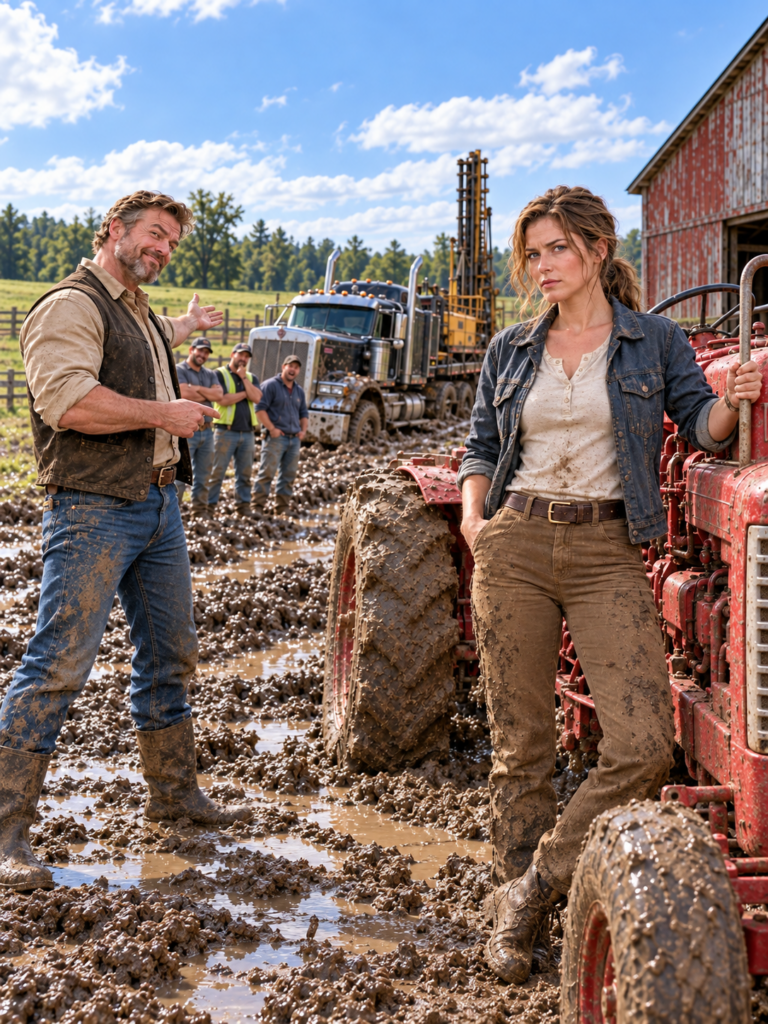
he laughed at her father’s 1975 farmall and offered fifty cows just to watch her fail—until she cleared the blocked culvert her old man had marked in pencil and proved the ground still remembered who built it
Part 1
The kitchen still smelled like Gordon’s coffee even though the pot had been cold for weeks. Brenna stood at the sink with both hands braced on the chipped porcelain, watching the first light come up over the east pasture. The cows were already moving along the fence line, fourteen head, thin but still hers. The debt notices were stacked on the table behind her, weighted down by the same salt shaker her father had used every morning. Twenty-eight thousand six hundred dollars. The number sat there the way a gate latch sits crooked after too many winters—still holding, but not for long.
She had not meant to stay. Tulsa had been simple. Warehouse maintenance coordinator. One-bedroom apartment she had painted herself. A schedule that did not depend on weather or the price of diesel. Then the phone call came on a Tuesday in October. Gordon had gone down in the feed aisle of the barn, one hand still on the grain scoop. By Thursday she was driving south with everything she owned in the bed of the truck. Eleven days later he was gone. The farm was not. One hundred thirty-seven acres in the southern part of the state, a barn that had already lost most of its arguments with ice, and the equipment he had kept running on stubbornness and careful records.
The tractor sat at the near end of the barn, red under its coat of dust and dried mud. 1975 Farmall. Gordon had bought it used and written every oil change and hydraulic leak in the same block lettering he used for the tax forms. Brenna had grown up beside it. She knew the exact choke position it liked on a cold morning and the way the clutch grabbed when the ground was soft. That knowledge was not glamorous. It was precise. The same way he had taught her to read tire impressions in soft ground and to tell the difference between soil that looked solid and soil that actually was.
Wade Kessler had been watching the place for two years. He ran Kessler Recovery out of a shop two counties over and kept a cattle operation that looked better on paper than most of the farms around it. Fifty breeding cows. He had already priced a new recovery rig and needed capital. He had come by once after the funeral and offered a number that assumed she was already packing. When she said no, he had stood in the yard with his hands in his pockets and told her sentiment did not cover operating costs. She would come around. She had not.
The trouble arrived on a Wednesday six weeks into her second full season alone. She heard the convoy before she saw it—two support trucks and a semi loaded with drilling equipment that weighed sixty-nine thousand pounds. Nolan Voss climbed out of the lead vehicle with a project map that already had approval markings on it. Redstone Pipeline Services. Right-of-way access along the eastern edge, he said. Brenna asked to see the documentation before anything left the road. Nolan looked at his watch and told her the schedule did not allow for that. He directed the semi to cut through the field and bypass a damaged section of the service road.
It had rained for four days. The field looked firm from the edge. It was not. The rear axle sank within thirty feet of the turn-in. A secondary drainage channel—one Gordon had dug by hand and maintained for more than two decades—took the full weight of the loaded trailer and collapsed. Water that had been routing safely under the field reversed course and began pooling across the east pasture where the cows were grazing.
Brenna walked the edge of the damage with her boots sinking at every step. The first recovery unit arrived, assessed the angle, and left. The second unit cited unstable ground for their outriggers and left. Redstone called Wade. He showed up with a crew, walked the perimeter once, and announced his plan inside of ten minutes. Tracked excavator. Cut an approach path through the compromised section. Pull the truck from a new angle. Direct. Fast. Billable.
The approach path went straight through the drainage infrastructure she needed to protect.
“That drainage line feeds my entire east pasture,” she said.
Wade looked at the tractor parked by the barn, then at her. “That thing? Lady, that machine is older than your mortgage. I’m bringing in an excavator. We cut through, we pull it out, everybody goes home.”
“Landowner problems,” one of his men said under his breath. Wade did not correct him.
He turned to the Redstone crew and the truck driver and spoke loud enough for all of them to hear. “Look, I feel for her. I do. But that truck isn’t moving itself.” He paused, then smiled like he had already written the ending. “Fifty cows are yours.”
The offer was not real. It was a punchline delivered to the crowd, meant to end the conversation. Brenna stood in the mud with her hands at her sides and watched the way the water was already climbing the collapsed channel. She had not planned any of this. She had only planned to keep the place long enough to sell the cows she could not feed and pay down enough of the debt that the bank would not take the rest. Now the east pasture was flooding and a man who had already tried to buy the farm was standing in her field offering her his herd as a joke.
She looked once at the Farmall. Then she looked at Wade.
Part 2
Wade Kessler had spent twenty years knowing exactly how much a situation was worth and how little anyone standing in his way mattered. When he made the offer about the cows, he expected her to flinch or argue or walk away. He did not expect her to reach into the cab of her own truck and pull out a notepad and a pen.
“Are you making an official offer,” she asked, “or performing for the audience?”
The field went quiet. Nolan shifted his weight. The truck driver, Curtis Bell, looked down at his boots. Wade’s smile thinned but held.
“Write it down if it makes you feel better,” he said.
She handed him the notepad without expression. The conditions were specific. She would organize the extraction without excavating the drainage line. The Farmall would assist. Wade would transfer fifty cows with full documentation upon successful completion. Both the Redstone site supervisor and Curtis confirmed the terms out loud. Wade signed. He was certain she would fail before dark.
Brenna walked into the barn and stood for a moment with her hand on the Farmall’s fender. The metal was cool. Gordon’s grease pencil marks were still visible on the inside of the side panel from the last time he had noted a slow leak. She did not start the engine yet. First she walked the field.
She followed the tire impressions from the road to where the semi had stopped, moving slowly, pressing her boot into the ground at regular intervals the way she had once checked warehouse floors for soft spots before a forklift found them the hard way. The principle was the same. The ground told you what it knew if you asked the right questions. Twenty feet north of where the semi had turned in, the surface changed. Not visibly—the grass looked identical—but her boot stopped sinking. Underneath that strip of field, Gordon had laid compacted stone decades ago when he used the corridor to move heavy baling equipment from one end of the property to the other. The corridor had grown over, unmarked, forgotten by everyone except the man who built it and the daughter who had read his records.
She went back to the barn, laid the old maintenance map flat on the workbench, and marked the corridor endpoints with a grease pencil. Then she built the plan in sequence. Reduce trailer weight by transferring the detachable equipment to the support vehicles. Lay road plates across the damaged section to bridge the gap. Bring the semi back along the buried corridor to firm ground. The Farmall would provide directional assistance and tension during the approach.
She presented it to Nolan in the shade of his truck. He looked at the map for a long moment. Wade crossed his arms.
“You’re adding hours to an already expensive day,” Wade said. “Unload part of the trailer, rent plates, and for what? So you can try to drag that truck out with a tractor that’s been parked since your old man died?”
Brenna kept her voice even. “Without ground preparation and load reduction, I will not attempt the pull. The conditions in the agreement are my conditions. Either we work the problem the right way or you bring in your excavator and I will be speaking with someone about the drainage line afterward.”
Nolan authorized the use of the site’s road plates and the crew’s labor. Brenna spent eleven hundred and fifty dollars of her own operational reserve to rent additional plates and bring in two workers she trusted from the next farm over. They began the ground preparation in the early afternoon. The temperature on the Farmall climbed past the normal band while she was positioning it. Not a spike. A creep. The kind of rise that meant something small was wrong but would become something large if ignored.
She shut the engine down, popped the side panel, and found a weeping joint on the coolant line. A slow leak, probably aggravated by the cold start that morning. She had the parts in the shop. The repair took ninety minutes. Wade made a remark to the Redstone crew about rescue operations requiring their own rescue. Nobody laughed very loudly. Brenna was already under the tractor with a wrench, the smell of old coolant and machine oil rising around her, her father’s voice in her head telling her not to torque the fitting until the thread caught clean.
It was during the repair that she confirmed a suspicion she had been carrying since Nolan arrived. With the Farmall cooling down, she pulled out the maintenance map again and set it beside the project documentation Nolan had provided. The entry point the semi had used sat clearly outside the access corridor marked on the Redstone survey. Not marginally outside. Twenty feet outside. On land that no pipeline easement covered.
She flagged down Curtis while the crew was repositioning equipment. He was a contract driver, not a Redstone employee. He had no particular reason to protect the company’s version of events. He told her without much hesitation that Nolan had instructed him to cut through the field to save time on the approach. The service road delay had put them behind schedule. Nolan had called it a judgment call.
Brenna photographed the entry point, the tire tracks, and the collapsed drainage channel. Then she called Audra Fenwick. Audra had handled Gordon’s property documentation for fifteen years. She was methodical and not easily surprised. Brenna gave her the short version. Entry outside the documented corridor. Collapsed drainage. A driver who would confirm the instruction. Audra said she would review the Redstone filing and call back.
The call came in forty minutes. The access paperwork Redstone held was a survey permit, expired and limited to foot and light vehicle access for route assessment. It authorized nothing that had happened that afternoon. Brenna absorbed this and made a decision. She was not going to use the truck as leverage. She was going to finish the job she had agreed to finish, protect the documentation, and let Audra handle Redstone separately. Using the stuck truck as a negotiating chip would make her look like she was manufacturing a dispute. Completing the recovery cleanly, with witnesses and a paper trail, would make her look like exactly what she was.
She went back to work.
Part 3
By late afternoon the ground preparation was not complete. The road plates were down, but the transition point where the plates met the buried corridor was still soft from the sustained water pressure. The first load test shifted the near plate two inches. Brenna called a stop before the Farmall took full tension. To proceed in current conditions risked burying the semi deeper and damaging the corridor she needed intact.
That evening Nolan set a document on the tailgate of his truck. It stated that Brenna acknowledged Redstone’s right of access across the affected portion of the field and released any future damage claims arising from the day’s operations. In exchange, Redstone would handle the extraction the following morning using their own contractor. Wade stood beside him with his hands in his pockets.
“Sign it,” he said. “The fifty-cow agreement terminates the moment another recovery unit takes over the job.”
Brenna read the document twice. The paper was warm from the sun that had already dropped behind the barn. She set it back on the tailgate and walked to her truck without signing it. Her operational reserve was nearly exhausted. Her cows were in a temporary pasture. The drainage was still compromised, and the truck was still in the ground. Tomorrow morning an excavator was scheduled to arrive.
She did not sleep well, but she did not waste the night. She sat at the kitchen table with Gordon’s maintenance binders spread across the surface, the ones he had kept in a specific order on the third shelf of the shop, updated in pencil every season. The salt shaker still held the debt notices down. She was not looking for comfort. She was looking for the reason one section of that buried corridor had held up better than the rest over forty years of freeze and thaw cycles.
She found the answer in a subfolder labeled drainage and haul routes do not discard. Gordon had noted in his careful block lettering that a section of the corridor near the east fence had been reinforced with additional base material after a wet season in the late 1980s. He had extended a culvert at the field’s low point to keep water from undercutting the stone. The note beside the culvert entry read: Check after heavy rain. Brush and debris collect at mouth, backs up fast.
Brenna looked at the note for a long moment. The kitchen clock ticked. Outside, the cows shifted in the temporary pasture, their shapes dark against the fence. She pulled on her boots and went outside with a flashlight. The culvert mouth was forty yards from where the road plates ended. She found it under six inches of standing water and a mat of dead grass and broken branches that had washed in during the four-day rain. The culvert was fully blocked. Water that should have been draining east was sitting against the base of the corridor approach, softening exactly the transition point that had failed her load test.
She called the two workers back out at nine o’clock. They cleared the culvert by hand in just under an hour, working by flashlight and the headlights of her truck, their boots and gloves soaked, the sound of water finally beginning to move again. By midnight the standing pool had dropped by more than half. By three in the morning the ground at the transition point had firmed enough that Brenna’s boot no longer left a full impression.
She also found, in the same subfolder, the complete document that Nolan had referenced when justifying Redstone’s access—all four pages of it, not the single summary sheet the company had provided. Page three contained the expiration date and the access classification. Survey only. No mechanized equipment. She photographed every page and sent the images to Audra with a single line of context.
Audra’s response came at six forty-five in the morning, twenty minutes before the excavator was scheduled to arrive. Redstone’s legal contact had been reached. The company agreed to document all existing site damage independently of the recovery operation and to withdraw the liability waiver. The excavator was held at the staging area pending the outcome of Brenna’s attempt. If she completed the recovery under the agreed terms before noon, Redstone would proceed with a separate damage assessment and no further pressure would be applied regarding the access dispute.
Brenna read the message, drank the rest of her coffee, and drove to the field. The crew arrived at seven. Curtis was already there, standing beside the cab, drinking from a thermos. The road plates had settled overnight. Brenna walked the transition point and pressed her boot down at six separate spots. Everyone held.
She briefed the crew in plain terms. The detached equipment was already on the support vehicles. The plates bridged the soft section. The buried corridor began twelve feet past the far edge of the plates. The plan was to use the Farmall to hold lateral tension on the semi’s frame while Curtis applied controlled forward drive, keeping the trailer tracking straight across the plates and onto the corridor surface. No jerking. No sudden throttle. Smooth and progressive.
Wade arrived at seven-twenty. He looked at the transition point, looked at the Farmall, and said nothing directly to Brenna. He stood at the field’s edge with his hands in his jacket pockets.
Part 4
They began at seven thirty-one. The Farmall took tension on the left side of the frame with a rigging chain Gordon had used for years. Brenna held the tractor at a low, steady throttle, not pulling the truck but guiding the angle. The engine note was familiar under her hands. Curtis felt the resistance through the steering and adjusted his line. The semi moved forward by two feet, then stopped. One of the near plates had shifted laterally under the load.
Brenna called a stop. Wade said something to the worker standing next to him. The worker did not respond. The crew repositioned the plate in four minutes. Brenna reset the rigging. They began again.
The second attempt moved the semi six feet before the rear wheels found the transition point. For three seconds nothing happened. The engine note on the Farmall changed as the load transferred. Brenna felt it through the seat and the steering wheel and the soles of her boots. Then the rear axles rolled up and over the edge of the stone corridor and the resistance dropped sharply. Curtis felt the change, held his line, and kept the throttle steady. The front axle crossed the plates. The entire trailer was on firm ground. The semi moved under its own power from that point. Curtis brought it the remaining distance to the service road in a long, careful arc. When the rear wheels crossed onto paved surface, he set the brake and climbed down from the cab.
He walked back to where Brenna was shutting down the Farmall and told her the truck was clear. She checked the time. Forty-seven minutes from first movement to road surface. The air still smelled like diesel and wet earth. The east pasture was still flooded, but the truck was no longer in it.
Wade approached before she had the tractor fully shut down. He began with the money. A flat offer, a number he had arrived at on his own, lower than the market value of fifty breeding cows with documented history. He framed it as easier. Less logistics. No transport to arrange. No vet checks to coordinate.
“You’re doing yourself a favor taking cash,” he said. “Your pasture is still compromised. You have no space to receive fifty cows in your current condition. You have no idea what feeding and caring for that many animals is going to cost you.”
Brenna reached into the cab of her truck and laid a single sheet of paper on the tailgate. It was a one-page summary. Eighteen cows she intended to keep, sorted by breeding record and age. Thirty-two cows she had already discussed with two neighboring operations, with tentative agreements in place pending health documentation. Scheduled transport dates. A vet contact who had confirmed availability for intake checks. She had prepared it the night before between the culvert clearing and the document review.
Wade read it without speaking. Curtis, who was standing nearby completing his own paperwork, did not look up. The Redstone site supervisor had been watching from the edge of the road. There was nothing left for Wade to negotiate with. The agreement he had signed in front of his own crew specified the terms. The recovery had been completed under those terms. Brenna had documentation, a witness, and a plan.
He completed the transfer. Fifty cows changed hands within two weeks, transferred with full health records and ownership documentation. Brenna kept eighteen. She sold thirty-two through the arrangements she had already made at prices that reflected the quality of the herd Wade had been planning to sell for capital anyway. The proceeds cleared the farm’s operational debt, funded the water system repair, and left a working reserve she had not had since returning to Missouri.
Redstone’s damage settlement covered pasture restoration and drainage reconstruction. Every future access request, Audra made clear, would require a new negotiation from a blank page.
Part 5
Brenna used the shop and her maintenance background to build a small equipment service operation. Nothing large. Nothing rushed. Local farmers with older iron who needed someone who understood it. The work fit the hours the farm did not fill. Three years on, the operation carried itself. Three seasonal workers. A herd she had selected carefully. A business that grew without advertising because the work was done right.
The 1975 Farmall was still in the barn. A young man she had taken on as a helper asked her once, while they were replacing a hydraulic line on a neighboring farmer’s tractor, why she kept a machine that old when she could have bought something newer with what she had made.
Brenna set down her wrench and thought about the culvert note, about the corridor her father had built by hand and documented in pencil in a binder on the third shelf, about a blocked drain that two professional recovery crews had walked right past. The kitchen table where she had sat with the binders open. The salt shaker still holding the debt notices down until the day the last one was paid. The sound of water finally moving under the field again.
“My father taught me what it could do,” she said, “and when to stop.”
She picked up the wrench and went back to work.
She did not win because she had the biggest equipment or the loudest voice. She won because she understood the ground she was standing on, literally and in every other way that mattered. She knew what she had. She knew its limits. And she prepared for every outcome before the first wheel turned. That was the part most people skipped. Not the effort. The preparation. Not the reward. The plan for what came after.
The east pasture held again. The drainage line ran the way Gordon had dug it. The Farmall started on the third try most mornings and still pulled more than it looked like it should. Brenna kept the maintenance binders on the third shelf of the shop, updated in pencil every season, the same way he had done it. Some nights she still sat at the kitchen table with a cup of coffee and the salt shaker and listened to the quiet of the place. It was not the life she had planned in Tulsa. It was the one the ground and the records and the old tractor had left her. And it held.


