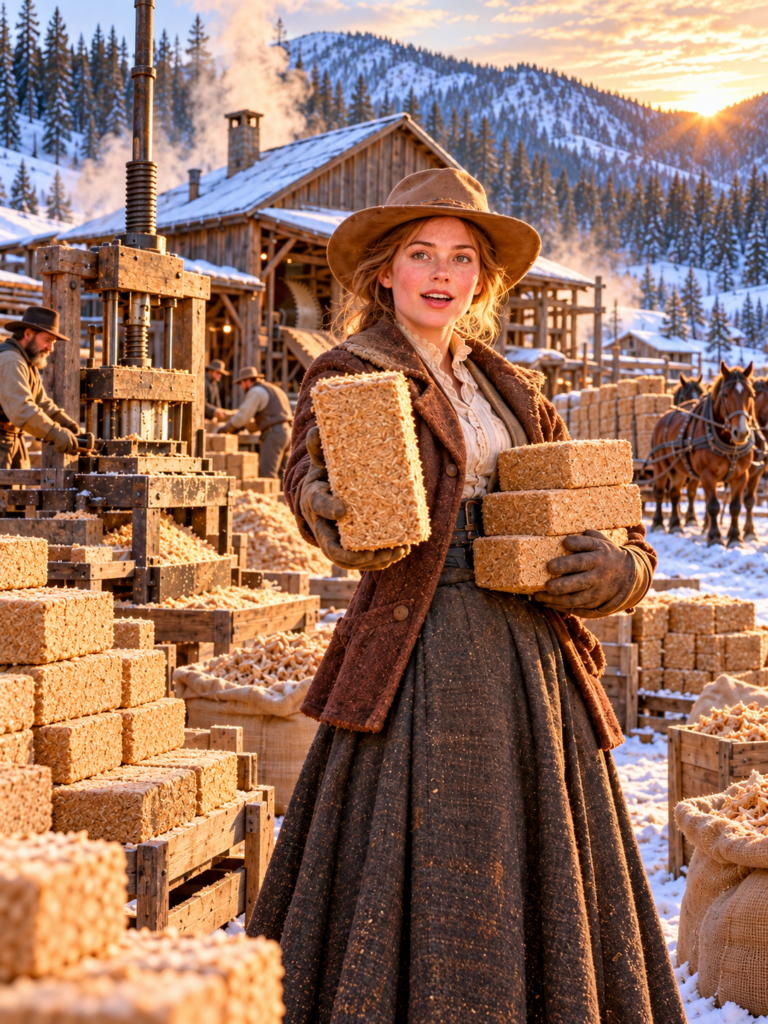
everyone called the sawdust worthless until the widow and the man they named a thief pressed it into the only fuel that kept cedar ridge from freezing solid
Part 1
The cold arrived before the light did. It settled over the ranch the way a heavy quilt settles when no one is left to lift it, and Nelly stood in the doorway of the fuel shed with a lantern raised, watching her own breath turn white and thin against the dark. October had not yet finished its work, but the temperature had dropped hard enough in the last three nights that the horses stamped in their stalls and the water in the trough skimmed with ice before dawn. She had banked the stove in the house and come out to check the drying racks one last time, the way she checked everything that could be lost if a person turned her back for an hour.
The racks held what she had made alone through the late summer and the first wet weeks of fall. Blocks the size of ordinary firewood, pressed from the sawdust the mill had been glad to let her haul away. Most of them were still soft at the corners. A few had already crumbled when she lifted them. She had mixed the dust with flour paste the way her mother had once mixed it for holding loose chinking in a cabin wall, and she had used the broken wagon jack for pressure because that was what she had. It was not enough. She knew it was not enough. Still she kept the blocks under the reinforced roof of the shed, stacked as tight as she could make them, because the woodpiles behind every house in Cedar Ridge were already turning dark with the rain that had come three days running.
She heard the sound before she saw him. Not a footstep exactly. A shift of straw and a low breath that did not belong to any of the horses. She raised the lantern higher and stepped into the barn.
He was curled on the hay at the far end, coat pulled over his face the way a man pulls a blanket when he does not expect to be found. The coat was thin. The boots were worn through at one heel. He had not taken anything. The grain barrel stood closed. The bridles hung where she had left them. He had only gone as far into the dark as the wind would let him.
Nelly lowered the lantern so the light fell between them instead of into his eyes. “You’re on my hay,” she said.
He came up fast, hands already lifted, already backing toward the door. “I’ll go. I didn’t mean— I was only getting out of the wind a spell.”
“I didn’t say get off it.” She watched him the way she watched a fence post that had begun to lean. Assessing, not afraid. “Question is whether you’re fixing to keep being on it or whether you’ve got a day’s work in you.”
He stopped. The lantern light caught the side of his face. He looked older than the letter in his pocket had any right to make him. The letter had named him a thief. He had read it so many times on the train west that the ink had smudged under his thumb. It said he had taken silver that did not belong to him from the last place he had worked. Nothing had been proven. Nothing had been returned because nothing had been taken. The letter had followed him anyway, the way a shadow follows a man when the sun is low enough.
Nelly tilted her head toward the stack of raw lumber leaning against the far wall and the pile of brown blocks drying on the shelf beside it. “I need crates to carry those. You look like you’ve held a hammer before.”
“I have.”
“Then there’s a loft up there with a blanket in it, and there’ll be supper if the crates get built. I’m not paying you to stand there.”
She turned the lantern toward the house and walked out. She did not offer her hand. She did not ask his name. The matter was settled in the only way she knew how to settle things: by the work that needed doing.
He stood a moment longer in the dark. Then the old stubborn instinct that had built barns and mended wagon tongues across three territories rose in him for the first time in weeks. He picked up the lantern she had left and crossed to the lumber.
She came back an hour later with a plate of cornbread and salt pork. The crates were not built. He had found the press instead. It stood crooked against the wall, a wooden frame lashed with rawhide, a salvaged wagon jack turning in a hole bored slightly too wide. Every third brick came out soft at the corners. He had reset the screw housing with scraps of leather so the thread would not wander. He had reinforced the corners with iron straps taken from a broken harness hook. He had squared the mold until it sat true. Four new bricks sat on the shelf beside the ones she had made. They were dense. Sharp-edged. Identical.
Nelly stood in the doorway and did not speak. She picked one of his bricks up, weighed it the way a buyer weighs a steer, and set it down again. The nod she gave was small. It recalculated something private.
“You’ll build crates tomorrow,” she said. “Tonight you’ll show me how you did that.”
He laid the mechanics out plain, the way a man discusses weather. Leverage. Compression. The give in green wood that had never been properly seasoned. She listened with the stillness of someone memorizing a thing she meant to keep. When he finished she handed him the plate.
“Eat,” she said. “The loft’s through that ladder. Don’t let the horses hear you come and go. They’ve had enough strangers for one season.”
He ate standing up. The cornbread was still warm. Outside the wind moved across the ridge and the first thin snow of the year began to fall, so light it did not yet stick. Inside the barn the new bricks sat hard and dry on the shelf, and the man who had arrived with nothing but a letter calling him a liar slept for the first time in days with a blanket over him and the smell of sweet dusty hay in his nose.
Part 2
The foreman watched him the way men watch a tool they have not yet decided is safe to use. His name was Harlan. He had worked the ranch for six years, longer than most, and he had opinions he did not keep to himself when the work was slow. The first week the stranger slept in the loft and ate at the edge of the porch, Harlan stood in the yard with his arms crossed and his hat pulled low.
“A thief playing carpenter,” he said, loud enough to carry. Nelly was mending a harness near the porch steps. She did not look up. She had learned that her silence carried more weight than her argument ever could, and that time, given enough of it, argued better than she did.
The man—he had still not given his name—kept his head down and his hands busy. He widened the sled runners with scrap iron from the mill’s discard pile so they would ride the snow instead of cutting through it. He doubled the leather on the harness traces where the stitching had worn thin. He forged iron rings at the blacksmith’s fire after the shop had closed, when no one was there to doubt him. An ordinary sled loaded heavy would have foundered in the drifts that were already forming along the lower fence line. This one held.
Harlan planted himself in front of the corral gate one afternoon in late October, when the air still held a little apology of warmth in the afternoons. The hired hands gathered the way men gather when they sense an argument is about to become a performance. They leaned on the rails and chewed on nothing and let their eyes slide sideways toward the drifter.
“Heard you left your last place on account of missing silver,” Harlan said. His voice was built for an audience. “Heard you never proved different.”
The man crouched at the broken gate hinge that had been dragging in the dirt since the spring thaw. He drew the pin, examined the worn socket, and set to repairing it with the tools already hanging from his belt. He did not look up.
“I’m asking you a question,” Harlan said.
“You asked it of the hands,” the man answered. “I expect they’ve got better things to do than wait on my answer.”
He tapped the new pin home. The gate swung without complaint for the first time in months. The hinge sang a small clean note instead of its old grinding protest. Nelly stood at the edge of the yard with a sack of flour balanced on her hip.
“That gate’s been needing doing since before you came,” she said. It was not a defense. It was a fact laid down like a plank across a gap.
Harlan spat into the dust and went back to his work. The hands drifted away. Nothing further was said that day because nothing further had needed saying. The hinge swung. The silence held. The man kept working as though his worth were a thing to be built, same as everything else.
They went to the mill together the first time in the thin light before full morning. The sawdust pile steamed faintly in the cool air. The mill owner stood with his thumbs hooked in his belt, watching Nelly with the particular patience men use when they expect to be talked past rather than talked to. She had made her case before. Clean waste for the hauling. Nothing owed either way. He had not yet given her the full yes she wanted.
The man did not speak first. He walked the lot slow, hands loose at his sides, looking at the stacked offcuts and the drifts of shavings the way a man looks at a fence line before deciding where to set a post. The mill owner’s eyes followed him without seeming to.
When the man finally spoke it was not to argue. He asked how much bark came off in a week. Whether the sanding dust was kept separate. Whether the mill minded the noise of a wagon coming twice instead of once. Small questions. Working questions. The kind a man asks when he intends to use a thing properly rather than simply carry it away.
The mill owner answered him plainly, warming by degrees the way a stove does. By the time the wagon was loaded he had offered not only the sawdust but the bark fragments too, waved off as an afterthought. He said to Nelly, almost apologetic, that he supposed he should have offered the whole lot the first time she asked, only he hadn’t seen the use in it till a man stood there looking like he meant to use it.
They rode back in silence. Nelly let it sit easy between them. The man came to understand, over the weeks that followed, that her silence was its own kind of thanks.
At dawn, before the mill woke and before the horses stirred, they took coffee standing near the stove in the shed. The tin cups warmed their palms against air that had begun to bite in earnest. They talked of wood the way other people talked of weather. Pine gave up its heat quickly. Poplar held its fire low and slow. He turned a handful of shavings in his fingers as though reading a book only he could see. She listened, then tested, filling the stove with one mixture and timing its burn against the turning of the sun through the shed door. She marked her findings in a notebook gone soft at the corners from handling.
Between them a kind of shorthand grew. He would nod toward a bin of fine sawdust and she would already be reaching for the paste pail. She would hold up two bricks of differing color and he would tell her, without being asked, which one would catch a flame fastest. Out of the unhurried collaboration came the three kinds they settled on. A light, quick brick that caught almost the instant a match touched it, meant for travelers and cold mornings when patience ran thin. A denser, long-burning block pressed hard and slow from fine sawdust, meant to last through a night without tending. A third, heavier than the rest, mixed with bark fragments and worked for hours under the screw, meant for furnaces and forges that demanded steady, punishing heat.
Each required its own ratio, its own drying time, its own place on the racks. Working it out took the better part of a season. Neither of them ever called it by its proper name. Partnership. It had become exactly that.
Part 3
The rain came first. Three days of it, steady and gray, turning the woodpiles behind every house in Cedar Ridge into something sodden and useless. Logs hissed and smoked and refused the flame no matter how a man coaxed them. Nelly stood under the lean-to roof of the drying shed while the rain drummed above, watching the bricks stacked dry and solid in their rows. She understood, before anyone else did, what that dryness was about to be worth.
The orders came in twos and threes, then in wagon loads. The little hand press groaned from sunup past dark and still could not keep pace with the knocking at the shed door. He turned the problem over the way he turned any broken thing over, looking for where the strain was and where the strength might be added. One evening he set a stick of charcoal to a board and sketched what he saw in his mind. A longer frame. A heavier screw. A lever arm that a man’s full weight could bear down upon instead of wrist and shoulder alone, so that six molds might be filled and pressed at once instead of one.
He brought the sketch to her not as a request but as an accounting. Material needed. Hours required. What it would mean if it worked. She studied the lines a long moment, then nodded once, the particular nod she gave when she had already decided to trust a thing before fully understanding it.
“Build it,” she said.
Two men from the mill who had watched him with narrow eyes all autumn, on account of the story that followed him from his last post, came to help once the mill owner vouched that the lumber and iron were being put to honest use. They worked beside him through cold mornings with their breath hanging white, wrestling timber into frame and fitting the salvage screw until it bit true. When the lever swung down for the first time and six bricks came out of the mold near identical as coins from a mint, something in the millmen’s faces changed. Some reservation quietly set down like a tool no longer needed.
Dozens a day became hundreds. The racks filled faster than the weather could slow them. Still the orders came. Still the snow had not yet shown what it truly intended for Cedar Ridge that winter.
There were evenings when the press fell silent and they sat on upturned crates, eating whatever had been fried that day, saying little. The kind of silence that did not ask to be filled. Harlan, watching from a distance, no longer troubled himself to comment. The millmen came and went with the easy manner of men who had decided their doubts weren’t worth the keeping.
But the sky that autumn had not yet shown its hand. The first hard rain, when it came, would test every brick they had made. And the snow that followed would test the man who had stepped off the train with lint in his pockets and a letter naming him a thief, and the woman who had found him on her hay and given him work instead of a shotgun.
Part 4
The snow came in the night and kept coming. It buried the wagon roads under drifts that no team could pull through. Somewhere out past the ridge there were families waking to stoves gone cold and woodpiles turned to ice. That was the shape of the urgency now. Not an idea anymore. Not an experiment with sacks of sawdust behind a barn. Hundreds of dense brown blocks stamped with a single letter W, stacked under a roof he himself had reinforced against exactly this kind of morning.
They loaded the sled in the blue dark behind the fuel shed. His hands had long since stopped feeling the edges of the bricks. Each block went into the frame the way he had learned to stack cordwood as a boy, tight and square, no wasted space, because space was the one thing the cold would not forgive. She worked beside him without speaking, her breath a pale rope unwinding into the air, counting under it. Forty. Forty-one. The number that would mean the difference between a ranch surviving the week and a ranch that did not.
“That ought to see the Hollis place through,” she said, tying the last bundle with rough twine pulled so tight her knuckles whitened.
“Ought to see them through longer than that,” he answered, “if the wind holds off the north side of the shed.”
It was the kind of exchange that had become familiar between them. Plain and unhurried. Each sentence carrying more trust than either of them would have named aloud.
The runners groaned beneath the weight of the load. An ordinary sled would have foundered an hour back in the drift that had swallowed the lower fence line whole. This one held because he had widened the runners himself, had shod them with strips of scrap iron, had spent three evenings fitting and refitting until the thing rode atop the snow rather than through it. She walked beside the lead horse’s head, breaking trail where the drift crested too high for the animal to judge safely.
They crested the ridge and the memory came the way the cold came, without warning. October then. The corral smelling of trampled hay and horse sweat. Harlan planted in front of the gate. The hands leaning on the rails. The hinge repaired while the accusation hung in the air and was answered only by the clean swing of iron that had been dragging since spring.
Now the snow came sideways, driven by a wind that had teeth in it. The whole world narrowed to the lantern light and the breath of the horses and the weight of the bricks stacked and roped behind them. He had insisted on bringing a small canvas roll of tools before they left the yard before dawn. A hammer. A chisel. Two lengths of strap iron. A coil of wire. She had thought it excessive. She did not say so now.
The crack came sudden and sharp, a sound like a rifle shot under the sled. The whole load lurched sideways into a drift. One runner split clean along an old knot in the wood. For a moment there was only the horses stamping and her own heart loud in her ears and the terrible stillness of a cargo that could not sit stranded in cold like this. Not with three ranches waiting on it and the temperature still falling.
He was already down in the snow before she had found her voice, kneeling beside the broken runner with his bare hands working fast despite the cold. He felt along the split wood the way another man might feel along a wound, judging its depth, its direction, what it would bear and what it would not.
“Hold the lantern close,” he said.
She crouched beside him with the wind cutting at her collar, watching him lay the strap iron along the crack and begin working the wire through with the chisel’s point. Twisting. Tightening. His breath coming in short pale clouds. His fingers going white and then red and then white again.
“Will it carry the load?”
“It’ll carry it to the Hollis place. After that we lighten it.”
He did not ask her opinion of the plan. He did not need to. She found herself simply nodding, handing him what he reached for before he asked, holding the sled steady while he drove the last of the wire tight and tested the runner with his full weight against it. It held.
She watched him climb back onto the seat beside her, snow in his hair, his hands raw, and she understood with a quiet unspoken certainty that she was no longer merely grateful for what he could do. She had begun, without quite deciding to, to count on it the way a person counts on weather or daylight or the particular steadiness of a hand that has proven itself more than once.
They reached the Puit place through a scrim of blowing white. First the smoke that should have been thick and wasn’t. Then the sagging line of the roof. Then a woman standing at the door with a shawl clutched to her throat. Behind the house, stacked against a lean-to that had never been built to keep weather out, sat the woodpile. Logs gone the color of a drowned thing. Bark slick and dark. Split faces swollen with moisture they would never shed before spring. Somebody had tried to burn a few anyway. The evidence sat in a blackened ring near the step, more smoke stain than fire.
“We’ve had nothing but spitting and hissing out of that pile since Tuesday,” the woman said before either of them had climbed down. “I’ve got the baby wrapped in every blanket in the house.”
Nelly lifted the oilcloth. Beneath it the hard bricks sat stacked and dry as bone, the stamped W catching what little light the sky offered. The woman’s hand went to her mouth the way a hand goes when relief arrives faster than words can.
He carried the first bundle to the door himself, twine cutting a line into his palm through the glove, and set it down just inside the threshold where the warmth hadn’t yet fled entirely. The woman knelt beside it, testing the dryness with her fingers, pressing her thumb into the dense grain as though she still half expected it to crumble into the same disappointment as the logs out back.
“These will see us through,” she said, and then looked up at him directly, the way almost no one in Cedar Ridge had troubled to look at him since he’d arrived with an empty pocket and a reputation that wasn’t his to carry. “I don’t believe I caught your name.”
It was such a small thing. A question any neighbor might ask. He felt it land somewhere under his ribs, the plain decency of being asked rather than simply tolerated. For a moment the cold seemed to step back half a pace to let him answer her.
“Caleb,” he said, plain as a nail driven straight.
She repeated it back to herself the way a woman tests a new tool before trusting it with real work. Then the sled was loaded again and the cold did not care that a name had finally passed between them, and they moved on to the next gate, the next lane buried under a white that had forgotten where the road used to be.
Weeks before that morning the railroad agent had come down from the depot with a ledger under his arm and a wagon large enough to carry half the season’s stock. The order he placed that day had made Nelly’s hands shake as she wrote the figures down. It was the kind of order that changed a thing from an experiment into a business. She had known it even as she signed her name beneath his.
The agent had not come alone. A freight inspector rode with him, down from the same line Caleb had once worked before his name had been spoken alongside the word theft. When the inspector saw him stacking bricks at the press, his face went still with recognition. He said, low enough that only she and Harlan standing nearby could hear it, that he remembered the case. Remembered the accusation. Remembered that nothing had ever been proven either way.
Harlan’s jaw tightened. The old suspicion, the one that had taken months to wear down to almost nothing, flickered up behind his eyes like a coal not quite smothered.
Nelly did not hesitate. She stepped between the inspector and the press, not dramatically, not with raised voice, but with the plain certainty of a woman stating a fact already settled in her own ledger.
“He built that machine,” she said, nodding at the great lever and screw frame turning behind them. “He’s kept this operation standing through a wet autumn and the hardest cold I’ve seen. Whatever happened at his last post is his business and the railroad’s, not mine. What I know is what I’ve seen with my own eyes every day for months.”
The inspector studied her, then him, then the stacks of bricks rising neat and uniform under the shed roof, each one stamped with its small deliberate W. Whatever he had meant to say, he did not say it. He made a note in his ledger instead, something about tonnage, about delivery schedules, and the matter passed the way a cloud passes over a field, darkening it briefly before moving on toward some other place.
Harlan let out a breath he had not known he was holding. Caleb said nothing at all, only bent back to the press, though she saw the faint unclenching of his shoulders, the way a man’s body remembers relief before his face allows it. She did not speak of it again that day, nor the next. But something in her had settled quietly and permanently, the way frost settles into the ground before winter. Not loudly. Not all at once. But deep enough to last.
Part 5
The last sled had gone out before the sun broke over the ridge, loaded with the final bundles bound for the Hollis place and the two cabins beyond it where the Pierce family had been burning green pine and praying it would catch. Caleb had walked beside the runners the whole way, steadying the ropes with hands that had learned over months exactly how tight a load could be cinched before the wood split through canvas.
When they returned the horses blew great clouds into the gray morning air. The yard was quiet in the particular way a battlefield goes quiet once the fighting has moved elsewhere. Not peaceful exactly, but emptied of urgency, scoured clean by exhaustion. Nelly had not said much on the ride back. She rarely did when there was something large enough that words seemed too small a vessel for it.
But when they came into the ranch house, stamping snow from their boots, she did not go first to the stove or the ledger as she had every night that winter. She went instead to the table and from the cupboard she took down a second plate, setting it across from her own with a plainness that made the gesture larger rather than smaller.
Caleb stood in the doorway a moment, watching her do it the way a man watches weather change slowly and then all at once.
“Sit,” she said.
When he hesitated she looked up and said it again, this time not with the word mister riding ahead of it the way it had for months, but with the name his mother had given him, spoken as though she had been carrying it in her mouth for a long while before she let it out.
“Caleb. Sit.”
He sat. Outside the snow lay unbroken and bright over the yard, save where sled runners had cut their long patient grooves toward the road, toward the ranches that would wake warm because of what had been built there. Not out of charity. Not out of rescue. Out of two sets of hands willing to press something worthless into something that could carry a town through the hardest season it had ever known.
“This was never meant to be run by one person,” she said, setting bread between them. The paste and dust smell of the shed still clung faintly to both their coats. “I built the first ones alone because there wasn’t anyone else. That isn’t the same as wanting to keep it that way.”
He did not answer right away. He looked instead through the window where the dawn light was beginning to climb over the shed roof and catch on row after row of bricks, each one stamped with its small deliberate W, stacked higher than either of them had dared imagine in that first autumn of damp sawdust and borrowed flour paste.
“No,” he agreed finally. “I don’t suppose it was.”
They ate. The coffee was strong and the bread was ordinary and the quiet between them held the particular weight of a thing that had been tested and had not broken. Harlan came in later to report that the next load was ready for the following morning. He looked at the second plate and at the man sitting across from Nelly and said nothing about thieves or silver or the letter that had once followed Caleb off a train platform in a thinner coat and a colder kind of cold. The hinge on the corral gate still swung true. The press in the shed still turned under its lever. The bricks still burned clean and long in stoves that had gone silent for three nights running.
Outside the wind moved across the ridge and the snow kept falling, fine and merciless, the way it would keep falling until the roads opened again and the woodpiles dried and the ordinary business of a ranch resumed. Inside the house two people who had found each other by accident and by necessity sat at a table that had held only one plate for longer than either of them cared to count, and the work waited, and the winter waited, and neither of them was doing it alone anymore.