Part 1
The airplane dropped so suddenly that a woman screamed three rows behind me.
A paper cup flew off a tray table. Someone shouted for the captain. The overhead compartments rattled as though the entire aircraft were being shaken by invisible hands.
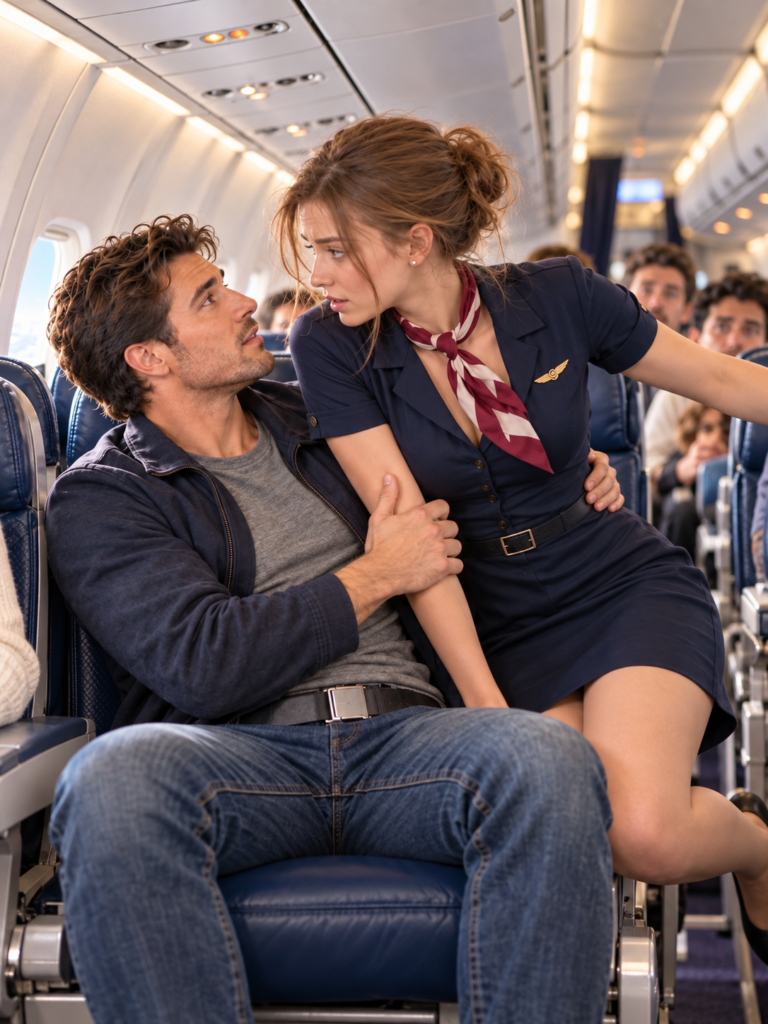
And the flight attendant standing beside my seat lost her balance.
One moment, she was smiling politely at a passenger across the aisle.
The next, her feet slipped out from under her.
She reached desperately for the nearest seatback, but her fingers caught nothing.
I saw the sharp metal edge of the armrest directly in her path.
There wasn’t time to think.
I reached out with both arms.
She fell against my chest.
The impact knocked the breath out of me, but my seat belt held. I caught her beneath her shoulders, keeping her from striking the armrest.
For one extraordinary second, we simply stared at each other.
Her hands gripped my shoulders.
Her brown eyes were wide with shock.
Then the airplane lurched again.
“Hold on,” I said, tightening my grip. “I’ve got you.”
She pressed one hand against the back of my seat, trying to steady herself.
The captain’s voice crackled over the speakers.
“Ladies and gentlemen, we’re experiencing an unexpected area of turbulence. Please remain seated with your seat belts securely fastened. Cabin crew, take your seats immediately.”
The flight attendant looked down at me.
“Oh my goodness. Are you okay?”
I nodded.
“I’m fine. What about you?”
She glanced at the armrest she’d almost struck.
“I think you just saved me from a very unpleasant injury.”
“I’m glad I was sitting here.”
She let out a breathless laugh.
“Me too.”
For the first time, I noticed her name tag.
Mara Hoffmann.
She was probably around thirty, with chestnut-brown hair pulled neatly away from her face and a small silver watch on her wrist.
There was nothing dramatic about her uniform. Dark blue jacket, white blouse, polished shoes.
But there was something about her expression.
Even after nearly falling into a stranger’s lap, her first concern had been whether I was hurt.
“Can you stand?” I asked.
She nodded.
“Yes. Thank you.”
I released her carefully.
She steadied herself against the seat, then hurried toward the crew jumpseat.
“Please keep your belt fastened,” she said over her shoulder.
“Only if you promise to stay on your feet.”
She laughed.
“I’ll do my best.”
Then she disappeared toward the front of the cabin.
I leaned back.
My heart was pounding.
I’d boarded that flight expecting an ordinary vacation.
A few quiet days in Hamburg. Some sightseeing. Photography. Good food. Maybe an afternoon wandering through a park without anyone calling to ask about construction permits or project deadlines.
Instead, I’d just caught a beautiful flight attendant in my arms.
And as the aircraft continued bouncing through the clouds, I found myself wondering whether she was all right.
Not because I’d caught her.
But because, for those few seconds, she’d looked at me with an expression I couldn’t quite forget.
My name is Jonas Berger.
I was thirty-two years old and worked as a landscape architect in Frankfurt, Germany.
Most people imagined my profession involved choosing flowers for wealthy homeowners and deciding where trees should go.
The reality was considerably less romantic.
My days were filled with planning applications, drainage calculations, construction budgets, public meetings, and arguments about whether a walking path needed to be three meters wide or three and a half.
For the past seven months, I’d been working on the biggest project of my career.
An abandoned industrial site on the outskirts of Frankfurt was being transformed into a public park.
The site covered nearly twenty acres.
For decades, it had been surrounded by fences and neglected warehouses. Families living nearby had no proper green space, and the neighborhood had spent years campaigning for somewhere children could play and older residents could walk safely.
When our firm won the contract, I’d been thrilled.
I believed in the project.
I still did.
But somewhere between the third budget revision and the nineteenth meeting about drainage systems, the work had begun consuming my life.
I arrived at the office before eight.
I left after seven.
I answered emails over dinner.
And on weekends, I found myself reviewing drawings instead of seeing friends.
My younger sister, Anna, had started calling me “the man who schedules his own breathing.”
She wasn’t entirely wrong.
Three weeks earlier, she’d invited me to dinner at her apartment.
I’d canceled an hour before arriving because of a last-minute meeting.
The following Sunday, I’d forgotten our mother’s birthday lunch.
Not the birthday itself.
I’d sent flowers.
But I’d forgotten that I was supposed to be there.
My mother had been understanding.
That somehow made me feel worse.
Then, on a rainy Tuesday afternoon, my boss, Matthias Keller, called me into his office.
He was a practical man in his late fifties who believed most problems could be solved with a spreadsheet and sufficiently strong coffee.
“Jonas,” he said, looking over his glasses, “when was your last vacation?”
I thought about it.
“Last October.”
“A proper vacation.”
“That was proper.”
“You attended two video meetings from your hotel.”
“One was important.”
“And you reviewed the drainage plans on the beach.”
I frowned.
“How do you know that?”
“Because you sent me a revised drawing at six-thirty in the morning.”
I said nothing.
He leaned back.
“Take a week off.”
“I can’t. The park project—”
“Will survive.”
“We’re behind schedule.”
“And you’ll be even further behind if you collapse at your desk.”
I laughed.
He didn’t.
“I’m serious, Jonas.”
I looked down at the drawings in my hands.
He softened his voice.
“You’re good at what you do. That’s why I need you to learn when to stop.”
Two days later, I booked a flight to Hamburg.
Nothing complicated.
A modest hotel.
Five days.
No meetings.
No work calls unless there was an actual emergency.
I made a list of twelve places I wanted to visit.
Then I made a second list organizing them by neighborhood.
And then a third list showing which attractions were easiest to reach by public transportation.
Anna saw the itinerary when I visited her.
She stared at it.
“Jonas.”
“What?”
“This is not a vacation.”
“Of course it is.”
“This is a military operation.”
“It’s efficient.”
“You’ve scheduled thirty minutes for a leisurely walk.”
“Forty-five.”
She shook her head.
“You need help.”
“Thank you for the encouragement.”
She hugged me before I left.
Then whispered, “Try doing something that isn’t on your list.”
I promised I’d consider it.
I didn’t expect that something would involve a flight attendant falling into my arms.
The turbulence lasted another twelve minutes.
Long enough for the cheerful conversation around me to fade into uneasy silence.
Long enough for an elderly man across the aisle to close his eyes and grip his wife’s hand.
Long enough for me to reconsider whether flying was really the most relaxing way to begin a vacation.
When the aircraft finally steadied, the captain explained that we’d passed through an unexpected pocket of rough air.
The cabin crew remained seated for several minutes longer.
Then the seat belt sign switched off.
I was reaching for my book when someone stopped beside my row.
“Excuse me.”
I looked up.
Mara.
Her hair was still perfectly secured, but a few loose strands framed her face.
She wore the same professional smile as before, although her eyes looked genuinely concerned.
“Are you sure you’re all right?” she asked.
“Completely.”
“No pain in your shoulder?”
I moved my arm experimentally.
“Nope. Everything seems attached.”
She laughed.
“That’s a relief.”
“What about you? Did you hurt yourself?”
“Just my pride.”
“I think your pride survived.”
“Barely.”
She glanced toward the armrest.
“Honestly, thank you. I could have been injured.”
“You’re welcome.”
She hesitated.
Then her eyes moved toward the travel guide protruding from my seat pocket.
A brightly colored photograph of Hamburg’s harbor was printed across the cover.
“Are you traveling alone?”
The question surprised me.
“Yes,” I answered. “At least, that was the original plan.”
Her eyebrows rose.
“The original plan?”
“Well, I wasn’t expecting unexpected company to fall into my arms.”
She laughed.
A real laugh this time.
Warm and completely unguarded.
“I’m sorry about that.”
“Don’t be. Though I hope it’s not part of the regular service.”
“No,” she said, smiling. “We usually serve coffee and tea, not ourselves.”
“Good to know.”
She looked at the guidebook.
“First time in Hamburg?”
“First proper visit.”
“Business or vacation?”
“Vacation.”
“Lucky you.”
“Hopefully. I thought five days without meetings would be good for my health.”
She studied me.
“You look like someone who hasn’t had a proper day off in a while.”
I blinked.
“Is it that obvious?”
“Only a little.”
“Wonderful.”
Her smile widened.
“What do you do?”
“Landscape architecture.”
“That sounds interesting.”
“It can be.”
“What kind?”
“Public parks, mostly. Urban redevelopment. Places people can actually use instead of just looking at.”
Her expression brightened.
“I like that.”
“Really?”
“Of course. Cities need places where people can breathe.”
I looked at her a moment longer than necessary.
It was a simple comment.
But after months of hearing nothing except costs, deadlines, and planning restrictions, it felt unexpectedly good to hear someone talk about the purpose behind my work.
She glanced at the folded papers on my tray table.
“Is that your itinerary?”
I hesitated.
“Maybe.”
She leaned slightly closer.
Her eyes widened.
“Jonas, is that a schedule?”
“An outline.”
“There are times written beside everything.”
“Approximate times.”
She laughed.
“Have you scheduled your coffee breaks?”
“Not all of them.”
“Oh, you’re going to love Hamburg.”
“I certainly hope so.”
“You know what you need?”
“More flexible travel planning?”
“Exactly.”
She pointed toward the guidebook.
“Visit the Speicherstadt in the late afternoon. The light on those old brick buildings is beautiful. And don’t rush through it.”
I nodded.
“That sounds wonderful.”
“And leave yourself time to get lost.”
I frowned.
“Deliberately?”
“Especially deliberately.”
I smiled.
She glanced toward the other passengers.
“I should get back to work.”
“Of course.”
“Can I get you anything before I go?”
“No, thank you.”
She nodded.
Then looked at me once more.
“And Jonas?”
“Yes?”
“Thank you again.”
I smiled.
“Watch out for the armrests.”
She laughed as she walked away.
For the rest of the flight, I tried to read my book.
I managed three pages.
Every time footsteps approached, I found myself looking up.
And every time Mara passed, she seemed to notice.
Once, she caught my eye and smiled.
I smiled back.
Then immediately wondered whether I was making an idiot of myself.
Of course she was friendly.
She was a flight attendant.
Being kind and attentive was literally part of her job.
I knew that.
I wasn’t some teenager who mistook professional courtesy for romantic interest.
Still, something about our conversation had felt different.
Not flirtatious exactly.
Just easy.
As though we’d skipped the awkward introductions and started somewhere in the middle.
Forty minutes before landing, she came down the aisle handing out water.
When she reached my row, she looked at the little map spread across my tray table.
“Still planning?”
“I’m reducing the list.”
“How many places now?”
“Ten.”
She laughed.
“A tremendous sacrifice.”
“I thought you’d appreciate it.”
“I’m deeply moved.”
She handed me a bottle of water.
Then she glanced at the map.
“You should visit the little streets around the old warehouse district. There are some wonderful cafés tucked away from the crowds.”
“You know the city well?”
“A little. My crew stays here fairly often.”
“That must be nice.”
Her smile changed.
“Sometimes.”
I tilted my head.
“Sometimes?”
She shrugged.
“Traveling for work isn’t the same as traveling for fun.”
I considered that.
“I suppose you spend a lot of time in airports and hotels.”
“Exactly. I can tell you where to find decent coffee in twelve airports, but ask me about the museums in those cities and I’m useless.”
“That sounds unfair.”
She smiled.
“It has its advantages.”
“Like what?”
“Occasionally meeting interesting passengers.”
I looked up.
Her expression was perfectly innocent.
But there was a little sparkle in her eyes.
I smiled.
“Occasionally?”
“Very occasionally.”
Before I could answer, another passenger called her.
She gave me a small nod.
“Enjoy the rest of your flight, Jonas.”
“You too.”
She laughed over her shoulder.
“I’m working.”
“Right. Sorry.”
I watched her move down the aisle.
And suddenly, for reasons I couldn’t explain, I wished the flight were longer.
We landed in Hamburg without further incident.
As the aircraft rolled toward the terminal, several passengers clapped.
A little girl in the row ahead announced loudly that she’d never fly again.
Her father assured her that airplanes were very safe.
She replied, “Then why did the nice lady fall down?”
I hid a smile.
When the seat belt sign finally switched off, people stood and began collecting their belongings.
I waited patiently.
At the front of the aircraft, Mara stood beside another crew member.
She thanked each passenger as they left.
When I reached her, she smiled.
“Have a wonderful time in Hamburg, Jonas.”
“You remembered my name.”
“Of course.”
I grinned.
“I’m impressed.”
“You did catch me before I fell on my face. That’s fairly memorable.”
“Glad I could help.”
She tilted her head.
“And remember—no rushing.”
“I’ll try.”
“No twelve-stop sightseeing marathons.”
“Ten stops.”
She sighed dramatically.
“Hopeless.”
I laughed.
“Take care, Mara.”
“You too.”
Then I stepped into the jet bridge.
I didn’t look back.
Not because I didn’t want to.
Because she was working, and I had no intention of making her uncomfortable.
As I walked toward baggage claim, I told myself that was the end of it.
A strange little encounter.
A lovely woman.
A funny story to tell Anna when I got home.
Nothing more.
Yet when I took out my phone to check the route to my hotel, I found myself smiling.
My hotel room wouldn’t be ready for another two hours.
I could have stored my suitcase and headed downtown immediately.
Instead, I stopped at a small airport café.
It was tucked near a row of wide windows overlooking the runways.
Planes rolled across the tarmac while travelers hurried past with suitcases.
I ordered an iced coffee and a sandwich, then sat near the window.
For the first time in months, I had nowhere urgent to be.
It felt strange.
Almost uncomfortable.
I opened my phone.
My work email had seventeen unread messages.
I stared at the notification.
Then turned it off.
“Vacation,” I muttered.
I opened my sightseeing list instead.
Speicherstadt.
Elbphilharmonie.
Harbor promenade.
A botanical garden.
Several parks.
A photography exhibition.
I was debating whether to visit the harbor first when a familiar voice spoke behind me.
“Please tell me you aren’t planning another emergency landing.”
I turned.
Mara stood beside my table.
She was still wearing her navy-blue uniform, but her name tag was gone and a small black bag hung over her shoulder.
Her hair had loosened slightly.
And without the formal posture she’d maintained on the plane, she looked different.
Relaxed.
Almost shy.
I smiled.
“Actually, I was hoping to avoid excitement for the rest of the day.”
“Probably wise.”
She gestured toward the empty chair.
“May I?”
I sat up.
“Of course.”
She smiled.
“I’ll just get a coffee.”
As she walked toward the counter, I stared after her.
Was this a coincidence?
Had she simply noticed me while passing?
Or had she seen me and decided to come over?
I had no idea.
What I knew was that my carefully organized vacation had just become considerably more interesting.
When Mara returned, she set her coffee down and offered her hand.
“I think we should introduce ourselves properly.”
I shook it.
“Jonas Berger. Landscape architect. Occasional emergency support for flight attendants.”
She laughed.
“Mara Hoffmann. Usually much better at remaining upright.”
“I’ll reserve judgment.”
“How generous.”
We smiled at each other.
Then she settled into the chair.
And just like that, the conversation began again.
Mara was thirty years old.
She lived in Munich and had worked as a flight attendant for nearly seven years.
She loved parts of her job.
The independence.
The people.
The unexpected conversations.
The chance to see places she’d never imagined visiting when she was younger.
But she hated the uncertainty.
Early departures.
Late arrivals.
Changing schedules.
Holidays spent away from family.
And the peculiar loneliness of being surrounded by people all day without always having someone to talk to when the work was finished.
“My mother still thinks I spend my life sightseeing,” she said.
I smiled.
“Do you?”
“Yesterday I saw the inside of an airport, a shuttle bus, and a hotel room.”
“Very glamorous.”
“Extremely.”
She took a sip of coffee.
“Last month I spent twenty-six hours in Rome.”
“That sounds wonderful.”
“I slept for fourteen of them.”
I laughed.
“Did you at least see something?”
“The airport parking lot.”
“Beautiful?”
“Spectacular.”
She smiled.
Then looked toward the windows.
“My job can be wonderful. But sometimes I get tired of feeling like I’m always passing through somewhere.”
There was something thoughtful in her voice.
I studied her.
“Do you ever think about doing something else?”
“Sometimes.”
“What would you do?”
She shrugged.
“I don’t know. That’s the problem.”
“You don’t have to know immediately.”
She looked at me.
“Spoken like someone who has his life perfectly organized.”
I laughed.
“Trust me, it isn’t.”
“Really?”
“Really.”
I told her about the park project.
About the deadlines.
About the meetings that seemed to multiply whenever I finished another task.
About my boss practically ordering me to take a vacation.
She listened with genuine interest.
Not merely smiling while waiting for her turn to speak.
She asked questions.
Why had I chosen landscape architecture?
What made a public park successful?
Did I really care whether benches faced east or west?
“Yes,” I admitted.
She stared.
“Seriously?”
“Sun exposure matters.”
“Jonas.”
“What?”
“Do you evaluate the position of every bench you sit on?”
“Only badly positioned ones.”
She laughed so hard she had to put down her coffee.
It was a wonderful sound.
I found myself wanting to make her laugh again.
Eventually, her phone lit up.
She checked the screen.
“Our crew shuttle leaves soon.”
I felt an unexpected flicker of disappointment.
“Then I shouldn’t keep you.”
She looked up.
“I still have a few minutes.”
“Of course.”
She studied me for a moment.
“Do you always worry so much about other people’s schedules?”
“Only when they’re working.”
“I’m not working anymore.”
I looked at her.
She smiled.
“My duty ended when we arrived.”
“Oh.”
“I’m just a woman having coffee.”
“With the man who caught her.”
“Exactly.”
I tried not to smile too obviously.
It didn’t work.
We talked a little longer.
About families.
About Hamburg.
About how neither of us was particularly good at taking time off.
Then Mara set down her empty cup.
“So, Jonas.”
“Yes?”
“Do you really intend to explore Hamburg alone for the entire five days?”
“That was the plan.”
“And now?”
I looked into her eyes.
“I suppose I’m open to changing it.”
She smiled.
“Good.”
My heart gave a strange little jump.
“Good?”
“I have a few hours free tonight.”
I waited.
“And I was thinking,” she continued, “if you haven’t already committed yourself to visiting all twelve attractions, perhaps we could have dinner.”
For a second, I was certain I’d misunderstood.
“Dinner?”
“Yes.”
“Together?”
She raised an eyebrow.
“That is generally how dinner invitations work.”
I laughed.
“Sorry.”
Her cheeks colored slightly.
Then she asked, more softly, “Unless you’d rather go alone?”
“No.”
The answer came out too quickly.
I cleared my throat.
“I mean, I’d love to.”
She smiled.
“Really?”
“Absolutely.”
“Then let’s meet downtown. Six-thirty?”
“Six-thirty sounds perfect.”
We exchanged phone numbers.
A moment later, my phone vibrated.
A message from Mara.
Please don’t catch any other women before our date.
I burst out laughing.
She watched me with obvious satisfaction.
“Just a precaution,” she said.
“I appreciate the concern.”
She stood.
Then offered her hand with exaggerated formality.
“It was a pleasure meeting you properly, Mr. Berger.”
I stood and shook it.
“The pleasure was mine, Ms. Hoffmann.”
“See you tonight.”
“See you tonight.”
She walked away.
Halfway toward the exit, she turned and smiled.
I smiled back.
Then she disappeared into the crowd.
I sat down slowly.
My coffee had gone cold.
My sandwich was untouched.
And I had completely forgotten about my sightseeing list.
For the first time in a very long time, I was looking forward to something I hadn’t planned.
Part 2
At six-twenty that evening, I was standing near the entrance to Hamburg’s historic warehouse district, checking my phone for the fourth time.
I’d arrived twenty minutes early.
Not because I was nervous.
At least, that’s what I told myself.
I was simply punctual.
Extremely punctual.
Perhaps aggressively punctual.
My phone vibrated.
Almost there. And please tell me you haven’t created a spreadsheet for tonight.
I smiled.
Only a small one.
Her reply appeared immediately.
I’m turning around.
I’m kidding.
You’d better be.
I laughed.
Then I looked up.
Mara was standing across the street.
For a moment, I barely recognized her.
The uniform was gone.
She wore dark jeans, a cream-colored sweater, and a light jacket.
Her brown hair hung loose around her shoulders.
She spotted me and smiled.
Then waited for the crossing signal.
When she reached me, she stopped.
“Hello again.”
“Hi.”
Her gaze moved over my face.
“What?”
“Nothing.”
“You’re looking at me strangely.”
I smiled.
“You look beautiful.”
Her cheeks turned pink.
“Oh.”
“Sorry. Was that too direct?”
“No.”
She smiled more warmly.
“Actually, it was nice.”
I felt myself relax.
“You look pretty good too,” she added.
“High praise.”
“Don’t let it go to your head.”
She stepped closer and hugged me.
Not a formal greeting.
A warm, brief embrace.
I caught the faint scent of her perfume.
Something soft and citrusy.
When she stepped back, she looked toward the narrow streets.
“So, Mr. Berger, what’s the itinerary?”
“No itinerary.”
Her eyebrows rose.
“Really?”
“Really.”
“Not even a secret one?”
“I looked at the map twice.”
She laughed.
“Progress.”
We began walking.
The afternoon light was fading over the old brick warehouses.
Canals reflected the warm glow of streetlamps.
Tourists paused for photographs while bicycles rattled across cobblestone streets.
Mara walked beside me, occasionally pointing out a detail I’d overlooked.
A little courtyard.
An old iron bridge.
A café tucked into a narrow alley.
I noticed how differently we approached the city.
I saw building materials, street layouts, and drainage systems.
She saw stories.
“That little window,” she said, pointing toward an upper floor of an old warehouse. “I wonder who worked behind it a hundred years ago.”
I looked up.
“Probably someone handling cargo records.”
She smiled.
“That’s your romantic imagination?”
“Historically plausible.”
“Hopeless.”
I laughed.
She slipped her hands into her jacket pockets.
“Do you ever wonder about places like this?”
“What do you mean?”
“The people who lived here. The conversations they had. The things they worried about.”
I looked at the old buildings.
“I suppose I usually think about how they were built.”
“Of course you do.”
“But you’re right.”
She glanced at me.
“About what?”
“Buildings are only interesting because of the people who use them.”
Mara smiled.
“That’s a lovely thing to say.”
“Don’t sound so surprised.”
“I was beginning to think you only spoke in measurements.”
I laughed.
And as we continued walking, I realized something.
She made me notice things I’d stopped looking for.
Not because I lacked imagination.
But because I’d spent so long trying to understand how everything worked that I’d forgotten to simply enjoy what was in front of me.
We found a small restaurant on a quiet side street.
Warm light spilled through its windows.
Inside, the tables were wooden, the walls were exposed brick, and soft music drifted from hidden speakers.
A waitress led us to a corner table.
Mara slipped off her jacket.
“You know,” she said, “this is already better than most of my hotel dinners.”
“That’s a low bar?”
“Very low. Yesterday I ate a sandwich standing beside a vending machine.”
“That sounds miserable.”
“It had cheese.”
“An improvement.”
“Barely.”
We ordered dinner.
Then conversation settled into something easier.
She told me about growing up outside Munich.
Her father had been a mechanic.
Her mother worked in a pharmacy.
She had a younger brother, Felix, who was twenty-five and apparently believed borrowing something meant eventually returning it when the owner had forgotten it existed.
“He once borrowed my vacuum cleaner,” she said.
“Reasonable.”
“For eight months.”
I laughed.
“Did he return it?”
“Only because I showed up at his apartment and took it.”
“Very decisive.”
“He offered to make me coffee while I was there.”
“Generous.”
“With my coffee machine.”
I laughed harder.
She smiled.
“Families.”
I told her about Anna.
About our mother.
About how I’d been the serious child while Anna climbed trees, broke rules, and somehow convinced everyone that her mistakes were charming adventures.
“She sounds wonderful,” Mara said.
“She is.”
“Close?”
“Very.”
I hesitated.
“Although I haven’t been a particularly good brother lately.”
Mara tilted her head.
“Why?”
“Work.”
I explained about the missed dinners.
The birthday lunch.
The constant cancellations.
When I finished, she was quiet.
Then she asked, “Do you like your job?”
“Very much.”
“Then maybe that’s part of the problem.”
I frowned.
“How?”
“When you love something, it’s easy to convince yourself that giving it everything is a good thing.”
I looked at her.
She continued.
“I used to take every extra flight I could get. I wanted to prove I was reliable. Flexible. Worth keeping.”
“What happened?”
“I got exhausted.”
She gave a small smile.
“And one Christmas, I realized I’d spent three consecutive holidays away from my family.”
“That sounds difficult.”
“It was.”
She looked down at her glass.
“My father had a heart scare the year before. Nothing catastrophic, thankfully. But it made me realize how many ordinary days I’d missed.”
I listened.
“He was home by Christmas,” she said. “I wasn’t. I was working a flight to Madrid.”
Her voice softened.
“He called me that evening and asked whether I’d eaten anything good. He didn’t complain. Didn’t make me feel guilty.”
She smiled sadly.
“That almost made it worse.”
I nodded.
“My mother does that.”
“Exactly.”
We were quiet for a moment.
Then I said, “Maybe we’re both terrible at remembering there’s a world outside work.”
Mara looked up.
She smiled.
“Maybe.”
The waitress arrived with our food.
The conversation shifted.
But something had changed.
It was no longer simply flirtation.
We were beginning to show each other the less polished parts of our lives.
And instead of making the evening uncomfortable, it made me want to know her better.
After dinner, we walked toward the harbor.
The sky had turned deep blue.
Lights shimmered on the water.
The evening air carried the smell of salt, food from nearby restaurants, and the faint metallic scent of the docks.
We talked about music.
Books.
Embarrassing childhood memories.
Mara confessed that she bought novels in airports and rarely finished them.
I admitted I owned three cameras but usually took photographs with my phone.
“Why?” she demanded.
“Convenience.”
“Jonas.”
“What?”
“You sound like a man who owns expensive running shoes and takes the elevator.”
“That’s painfully accurate.”
She laughed.
We passed a group of tourists clustered around a street performer.
Someone stepped backward into Mara’s path.
Without thinking, I reached for her hand.
She caught mine.
I guided her around the group.
Once we reached the open sidewalk, I loosened my grip.
But she didn’t let go.
Instead, her fingers slid between mine.
I looked down.
Then at her.
She smiled.
A small, almost shy smile.
I squeezed her hand gently.
And we kept walking.
It was such a simple thing.
But it changed the evening completely.
We weren’t just two people enjoying dinner.
We were two people choosing to be close.
At the harbor, we stopped beside a railing.
Boats moved slowly across the dark water.
Mara leaned lightly against my arm.
For several minutes, neither of us spoke.
I was aware of her hand in mine.
Of the cool air brushing my face.
Of the strange happiness spreading through my chest.
Then she said, “Can I ask you something?”
“Of course.”
“Are you always this careful?”
I smiled.
“Careful?”
“With people.”
I thought about it.
“Probably.”
“Why?”
I looked out at the harbor.
“I don’t know. I suppose I don’t like making assumptions.”
“That sounds reasonable.”
“It’s also a good way to avoid embarrassment.”
She laughed softly.
“Ah.”
I glanced at her.
“What?”
“Nothing.”
“Mara.”
She smiled.
“I think you’re afraid of making mistakes.”
I considered arguing.
Instead, I nodded.
“Maybe.”
She turned slightly toward me.
“Do you know what I thought when I saw you sitting in that airport café?”
My heart quickened.
“What?”
“That you looked lonely.”
I blinked.
“Lonely?”
“Not miserable. Just… alone.”
I looked toward the water.
“I wasn’t unhappy.”
“I know.”
“I like spending time by myself.”
“So do I.”
She squeezed my hand.
“But there’s a difference between enjoying solitude and getting so used to it that you forget someone might want to sit beside you.”
Her words settled somewhere deep inside me.
I looked at her.
“Did you deliberately come over to my table?”
She smiled.
“Would you be disappointed if I said yes?”
“Quite the opposite.”
She laughed.
“Yes, Jonas. I saw you from across the café.”
I grinned.
“And?”
“And I thought perhaps the man who caught me should at least get a proper thank-you.”
“Coffee?”
“Coffee.”
“Dinner?”
She smiled.
“That was a bonus.”
I turned toward her.
“Mara?”
“Yes?”
“I’m very glad you came over.”
Her expression softened.
“So am I.”
We stood close together.
The harbor lights reflected in her eyes.
I wanted to kiss her.
But there was something I needed to ask first.
“Can I see you again after tonight?”
She looked at me for a long moment.
Then sighed softly.
“I was wondering when we’d get to that.”
I smiled nervously.
“Is that good?”
“It could be.”
She looked away toward the boats.
“I live in Munich, Jonas. You live in Frankfurt. My schedule changes constantly. Sometimes I’m gone for days.”
“I know.”
“And you have a demanding job.”
“Yes.”
She looked back.
“I don’t want you to think this is going to be simple.”
I considered her words.
Then said, “I don’t think it has to be simple.”
Her eyebrows rose.
“No?”
“No. I just think it has to be something we both want.”
She studied me.
“And do you?”
I smiled.
“Very much.”
She let out a quiet breath.
Then laughed.
“Good.”
“Good?”
“Because I do too.”
I moved a little closer.
She looked at my lips.
Then back into my eyes.
“Jonas,” she whispered, “you can kiss me if you want to.”
I smiled.
“I’d really like that.”
I touched her waist gently.
She stepped toward me.
And beneath the harbor lights, I kissed her.
It wasn’t dramatic.
There were no fireworks.
No cheering strangers.
Just the soft sound of water, the cool evening air, and the warmth of her lips against mine.
When we pulled apart, she smiled.
“Not bad, Mr. Berger.”
I laughed.
“High praise.”
She kissed me again.
And I stopped thinking about whether the timing was good.
Whether the distance would be difficult.
Whether this was too sudden.
For once, I simply let myself enjoy the moment.
The next morning, Mara flew out of Hamburg.
I woke to a message from her.
Successfully reached the airport without falling into anyone’s arms.
I smiled.
Remarkable progress.
I also survived the escalator.
Very proud of you.
Don’t get too attached. I may still require emergency assistance.
I laughed aloud in my hotel room.
Then stared at the message for longer than necessary.
It was ridiculous.
We’d known each other barely twenty-four hours.
But I already missed her.
Over the next few days, we exchanged messages.
Photographs.
Little observations.
Jokes that probably wouldn’t have made sense to anyone else.
I sent her a picture of an absurdly crooked park bench.
Professional opinion: this is a crime against landscape architecture.
She replied ten minutes later.
Still more comfortable than an aircraft jumpseat.
I sent another photograph of a beautiful courtyard.
You were right. Getting lost has advantages.
She replied:
Please frame this message. I may never hear you admit that again.
I laughed.
But the conversations weren’t always playful.
Sometimes she told me she was tired.
Once, after a delayed flight, she messaged just before midnight.
Today was awful.
I called her.
She answered after three rings.
“Hey.”
Her voice sounded exhausted.
“Hey.”
“You okay?”
She sighed.
“Long day.”
“Want to talk about it?”
“Not really.”
“Okay.”
A pause.
“Would you mind staying on the phone for a little while?”
My chest tightened.
“Of course not.”
So I stayed.
We talked about nothing important.
The weather.
An absurd television advertisement.
A restaurant I’d visited.
The novel she was pretending to read.
After twenty minutes, her voice softened.
“Jonas?”
“Yeah?”
“Thank you.”
“For what?”
“Not trying to fix everything.”
I smiled.
“I considered offering a detailed recovery plan.”
She laughed.
“Please don’t.”
“Color-coded.”
“Good night, Jonas.”
“Good night, Mara.”
She hung up.
I lay awake afterward thinking about how strange it was that someone I’d met so recently could already feel important.
When I returned to Frankfurt, work was waiting.
Hundreds of emails.
A stack of revised drawings.
Two meetings that should have been emails.
And a problem with the park project’s drainage design.
Matthias greeted me at the office.
“You look rested.”
“I feel rested.”
“Good.”
He handed me a folder.
“Then you’ll enjoy this.”
I opened it.
The city had requested another cost review.
I sighed.
“Of course.”
He smiled sympathetically.
“Welcome back.”
For the first few days, I managed to maintain the balance I’d promised myself.
I left work on time.
I ate dinner at home.
I called Anna.
And every evening, I spoke to Mara.
But by the second week, the pressure returned.
The contractor discovered unexpected contamination in part of the soil.
The city wanted revised estimates.
Our project team was forced to reconsider several major design elements.
I stayed late.
Then later.
And then later again.
One Thursday evening, Mara called while I was still at my desk.
I answered without looking away from the screen.
“Hey.”
“Hey, stranger.”
I smiled tiredly.
“How was your day?”
“Busy. I’m in Vienna.”
“Nice.”
“Not particularly. We had a delay and a passenger who insisted the aircraft was waiting because the captain disliked him personally.”
I laughed.
“That sounds exhausting.”
“It was. How about you?”
“Busy.”
“Anything exciting?”
“Drainage calculations.”
“Ah. Romance.”
I smiled.
Then another email appeared.
Urgent.
My stomach tightened.
“Mara, can I call you back?”
A pause.
“Of course.”
“I’ve got something I need to finish.”
“No problem.”
“I’ll call in an hour.”
“Okay.”
We hung up.
I finished the calculations.
Then answered another email.
Then reviewed another drawing.
When I finally looked at the clock, it was eleven-forty.
I’d forgotten to call.
I grabbed my phone.
There was one message.
Hope you got everything finished. Good night.
I stared at it.
Then typed:
I’m sorry. Lost track of time.
Her reply came the next morning.
It’s okay. I know you’re busy.
But something in the message bothered me.
Not because she sounded angry.
Because she sounded as though she were trying very hard not to be disappointed.
Two evenings later, we had our first difficult conversation.
I’d called after work.
Mara was home in Munich, sitting on her couch with a cup of tea.
We talked for a few minutes.
Then she grew quiet.
“Jonas?”
“Yeah?”
“Can I ask you something?”
“Anything.”
“Are you actually ready for this?”
I frowned.
“For what?”
“Us.”
I sat up.
“Of course.”
“Because sometimes I feel like we’re having a wonderful conversation, and then suddenly your work interrupts and I disappear.”
I closed my eyes.
“Mara—”
“I’m not asking you to ignore your responsibilities.”
“I know.”
“And I understand that your project matters.”
“It does.”
“But I don’t want to spend months trying to fit into the spaces left over when everything else is finished.”
Her words stung.
Not because they were unfair.
Because they sounded painfully familiar.
Anna had said something similar.
My mother too.
I rubbed my forehead.
“I didn’t realize you felt that way.”
“I know.”
She sighed.
“And I’m not blameless. I have a job that takes me away constantly. I cancel plans because flights change. I fall asleep when we finally have time to talk.”
I was quiet.
“Maybe that’s why I’m asking,” she continued. “Because this isn’t going to work if we’re both only available when life is convenient.”
I looked around my apartment.
At the drawings on the table.
The unopened mail.
The dinner plate I’d forgotten to wash.
She was right.
I’d spent months telling myself I wanted a different life.
Then returned home and immediately started living the old one.
“Mara,” I said quietly, “I’m sorry.”
She waited.
“I’ve spent so long making work the most important thing in my life that I’m not very good at making room for anything else.”
She exhaled.
“I don’t want you to give up your career.”
“I know.”
“I just want to know there’s room for me.”
I stared at the wall.
Then said, “There is.”
“Jonas—”
“There is. And I need to do a better job showing you.”
She was silent.
I continued.
“I don’t want you to feel like an interruption.”
Her voice softened.
“Good.”
“Because you’re the part of my day I look forward to most.”
Another pause.
Then she whispered, “That’s a very nice thing to say.”
“I mean it.”
“I know.”
I smiled faintly.
“And for the record, you can interrupt my drainage calculations anytime.”
She laughed.
“Dangerous promise.”
“I’m feeling reckless.”
“Look at you.”
We talked for another hour.
Not because the problem was solved.
Because we were finally discussing it.
And by the time we said good night, I understood something.
A relationship wasn’t simply finding someone you liked.
It was deciding to make room for them even when life was difficult.
Especially then.
The following Wednesday, Mara called with news.
“I got my schedule.”
My heart skipped.
“And?”
“Two days off. Saturday and Sunday.”
I sat up.
“Really?”
“Really.”
I smiled.
“Are you coming to Frankfurt?”
She laughed.
“I’ve already checked the train connections.”
“You have?”
“Yes. Your terrible habit of planning everything is apparently contagious.”
I laughed.
“When will you arrive?”
“Saturday around noon, if the trains cooperate.”
“I’ll meet you at the station.”
“Jonas.”
“What?”
“You don’t need to create an itinerary.”
“I wasn’t going to.”
“You’re lying.”
“Only a little.”
She laughed.
“Fine. One condition.”
“Name it.”
“I don’t want to spend the entire weekend visiting famous attractions.”
“What would you rather do?”
“I want to see your life.”
I went quiet.
“My life?”
“Yes. Your favorite coffee shop. The park you visit after a hard day. The bookstore you like. The places that actually mean something to you.”
I smiled.
“That sounds wonderful.”
“And maybe,” she added softly, “I’d like to see what an ordinary weekend with you feels like.”
Something warm moved through my chest.
“I’d like that too.”
Saturday arrived with clear skies and cool morning air.
I reached Frankfurt Central Station fifteen minutes early.
Naturally.
I checked the arrivals board twice.
Then walked toward the platform.
When Mara’s train arrived, passengers began stepping onto the platform.
I spotted her almost immediately.
Dark red sweater.
Jeans.
White sneakers.
A small travel bag over one shoulder.
She saw me.
Her face brightened.
And then she was walking quickly toward me.
I barely had time to smile before she dropped her bag and wrapped her arms around my neck.
I held her tightly.
“Hi,” she whispered.
“Hi.”
She pulled back just enough to kiss me.
I kissed her back.
Then she smiled.
“Better than our first meeting?”
“Considerably.”
She glanced at her feet.
“And this time, I arrived without falling.”
“Impressive.”
“I’ve been practicing.”
I laughed.
Then picked up her bag.
“Ready?”
She slipped her hand into mine.
“Absolutely.”
We walked out of the station together.
And for the first time, the distance between Frankfurt and Munich didn’t seem quite so enormous.
We spent the afternoon exploring my favorite parts of the city.
Not the most famous places.
The meaningful ones.
I took her to a bookstore where the owner knew me by name.
Mara immediately disappeared between the shelves.
When I found her twenty minutes later, she was holding three books.
I raised an eyebrow.
“More unread novels?”
“These are different.”
“How?”
“They’re new.”
I laughed.
She bought two.
Then insisted the third was a necessary investment in her intellectual development.
We walked beside the Main River.
I showed her the bench where I sometimes sat after difficult meetings.
She looked at it critically.
“Comfortable?”
“Very.”
“Properly positioned?”
“Excellent sun exposure.”
She laughed.
“Of course.”
We stopped for coffee.
Then wandered through a small neighborhood park.
For once, I didn’t evaluate the paving materials or complain about maintenance.
I simply walked beside her.
At one point, she slipped her arm through mine.
“Jonas?”
“Yeah?”
“Thank you.”
“For what?”
“For showing me the places that matter to you.”
I smiled.
“Thank you for wanting to see them.”
She rested her head briefly against my shoulder.
And as we continued walking, I realized that perhaps the most meaningful part of sharing your life with someone wasn’t showing them extraordinary places.
It was inviting them into the ordinary ones.
That evening, I took Mara to my apartment.
She stepped inside and looked around.
Bookshelves.
Framed photographs.
A comfortable couch.
A dining table covered with a few documents I’d promised myself I’d put away.
She walked toward the window.
Then stopped.
“Jonas.”
I looked up.
“What?”
She pointed at a plant on the windowsill.
Its leaves were brown and drooping.
“Do you really work as a landscape architect?”
I groaned.
“Don’t start.”
She examined the plant.
“Does it know that?”
“I’m responsible for large-scale landscapes.”
“Apparently indoor plants are outside your jurisdiction.”
I laughed.
She picked up the watering can.
“When did you last water this poor thing?”
I considered.
“Recently?”
She stared.
“Jonas.”
“Define recently.”
She burst out laughing.
Then watered the plant.
I watched her.
It was such a small moment.
A woman I’d met because of unexpected turbulence standing in my apartment, laughing at my neglected houseplant.
But it felt strangely important.
As though a part of my life that had been empty was quietly beginning to fill.
Later that night, we sat together on the couch.
Mara held a cup of tea.
I had coffee.
A soft rain had begun tapping against the windows.
She leaned against my shoulder.
For a while, we watched the city lights beyond the glass.
Then she said, “Can I tell you something?”
“Of course.”
“When I asked whether you were traveling alone on the plane, I didn’t expect any of this.”
I smiled.
“Neither did I.”
She looked at me.
“I honestly thought I was just making conversation.”
“And then?”
She laughed softly.
“Then you made that ridiculous joke about serving flight attendants.”
“A very good joke.”
“Debatable.”
I grinned.
She continued.
“And when I saw you in the café, I kept telling myself not to bother you.”
“Why?”
“Because I didn’t know whether you’d want to talk to me.”
I stared.
“You were worried about that?”
“Of course.”
“Mara, I spent the entire flight hoping you’d walk past my row again.”
She laughed.
“You did?”
“Yes.”
Her smile softened.
“That’s good to know.”
I took her hand.
“And when you sat down at the café, I thought perhaps I was the luckiest man in the airport.”
She looked at me.
“Jonas.”
“What?”
“You’re becoming very good at saying romantic things.”
“Occupational development.”
She laughed.
Then kissed me gently.
When she pulled away, she rested her forehead against mine.
“I like being here,” she whispered.
I touched her cheek.
“I like having you here.”
Her expression changed.
A little uncertain.
“Even if it’s complicated?”
“Especially if it’s worth it.”
She smiled.
And for that evening, that was enough.
But neither of us knew that the next few months would test just how much we meant those words.
Part 3
By the beginning of winter, Mara and I had learned that long-distance relationships required more than affection.
They required calendars.
Patience.
Trust.
And the ability to accept that sometimes the person you missed most couldn’t be where you wanted them to be.
We managed.
Mostly.
She came to Frankfurt when her schedule allowed.
I visited Munich on weekends.
We met halfway occasionally, turning ordinary train stations into places we looked forward to seeing.
We learned each other’s routines.
I knew Mara needed quiet after a long flight.
She knew I became unusually irritable when a project was delayed.
She discovered that I made excellent coffee but terrible scrambled eggs.
I discovered that she packed more clothes for a two-day vacation than she did for a week of work.
We laughed often.
We argued occasionally.
And every time, we tried to remember the conversation we’d had about making room for each other.
Then, in November, everything became more difficult.
The park project entered a critical phase.
The city had approved the revised budget, but several unexpected construction problems remained.
If we missed the next deadline, our firm could face financial penalties.
Matthias was under pressure.
The contractors were frustrated.
And I found myself working longer hours again.
One Friday afternoon, my phone rang.
Anna.
“Hey,” I answered.
“Hi. Are you sitting down?”
I stopped walking.
“Why?”
“Mom’s in the hospital.”
My chest tightened.
“What happened?”
“She fainted at the grocery store. A woman called an ambulance.”
I gripped the phone.
“Is she okay?”
“They’re running tests. She’s awake.”
“I’m coming.”
I ended the call and went straight to Matthias.
He took one look at my face.
“What’s wrong?”
“My mother’s in the hospital.”
“Go.”
“But the site meeting—”
“Jonas.”
I stopped.
“Go.”
I grabbed my coat.
For the first time in years, I left the office without checking whether everything was finished.
My mother was sitting upright in a hospital bed when I arrived.
She looked tired but surprisingly cheerful.
“Jonas,” she said, “you didn’t have to come rushing over.”
I nearly laughed.
“Mom.”
“I’m fine.”
“You fainted in a grocery store.”
“Apparently my body disagreed with me about skipping lunch.”
Anna stood beside the bed.
She looked exhausted.
The doctor explained that my mother had been dehydrated and had experienced a temporary drop in blood pressure. Her initial tests were reassuring, but they wanted to observe her overnight and arrange follow-up care.
I sat beside her.
“Why didn’t you call me earlier?”
She patted my hand.
“Because Anna was already here, and I knew you had an important day.”
I stared at her.
“Mom.”
“What?”
“Nothing is more important than this.”
Her expression softened.
“Sweetheart.”
I squeezed her hand.
For the next several hours, I stayed.
I brought coffee for Anna.
I listened while my mother complained about the hospital food.
I spoke to the doctor.
And when my phone buzzed with work messages, I ignored them.
Late that evening, Mara called.
I stepped into the hallway.
“Hey,” I answered.
“Hi. You sound tired.”
I leaned against the wall.
“My mom’s in the hospital.”
There was silence.
Then Mara said, “What happened?”
I explained.
She listened carefully.
“Is she stable?”
“Yes. They’re keeping her overnight.”
“Are you okay?”
The question caught me off guard.
I looked through the window at my mother talking with Anna.
“I think so.”
Mara’s voice softened.
“Jonas.”
I closed my eyes.
“I’m scared.”
It was the first time I’d said it aloud.
“Of course you are.”
“I know the doctors said she’s probably fine, but seeing her there…”
My voice trailed off.
Mara didn’t rush to reassure me.
She simply stayed on the line.
After a moment, she said, “I wish I could be there.”
“I know.”
“I have a flight early tomorrow.”
“Don’t worry about it.”
“Jonas.”
“What?”
“I’m not saying that because I feel obligated. I’m saying it because I care about you.”
My throat tightened.
“I know.”
“And your mother.”
I smiled faintly.
“She’d like you.”
Mara laughed softly.
“I hope so.”
“She’d probably ask whether I’ve been eating properly.”
“Then we’d get along wonderfully.”
I laughed.
For the first time all evening, the tightness in my chest eased.
Before hanging up, Mara said, “Call me whenever you need to.”
“Even if it’s late?”
“Especially then.”
I looked toward my mother’s room.
“Thank you.”
“Always.”
My mother went home the following afternoon.
The doctors were satisfied with her recovery.
But the experience changed something in me.
I’d spent years believing that responsibility meant being available for work at all times.
Yet when my mother needed me, nobody at the office had collapsed because I left.
Matthias handled the meeting.
My colleagues covered the urgent drawings.
The world continued.
And I began wondering how many important moments I’d sacrificed because I’d convinced myself I was indispensable.
That evening, I called Anna.
“Hey,” she said.
“Hey.”
“Mom’s doing well.”
“Good.”
A pause.
Then I said, “I’m sorry.”
She sounded confused.
“For what?”
“For missing so much.”
“Jonas—”
“No. I mean it. Birthdays. Dinners. Weekends. All of it.”
Anna was quiet.
Then she sighed.
“We know you love us.”
“I know.”
“But sometimes it would be nice to see you without making an appointment six weeks in advance.”
I laughed softly.
“Fair.”
She hesitated.
“Can I tell you something?”
“Sure.”
“You seem different lately.”
I frowned.
“How?”
“Lighter.”
I smiled.
“Mara?”
“Probably.”
Anna laughed.
“Mom wants to meet her.”
My heart jumped.
“Really?”
“Obviously.”
“And you?”
“I want to meet the woman who somehow convinced my brother to take an actual vacation.”
I laughed.
“She didn’t exactly convince me.”
“No?”
I thought about the airplane.
The turbulence.
Mara falling into my arms.
“She made it more interesting.”
Three weeks later, Mara came to Frankfurt for dinner with my family.
She was nervous.
Far more nervous than she’d been during our first date.
We stood outside Anna’s apartment while she adjusted the sleeves of her sweater.
“Do I look okay?”
“Beautiful.”
“Jonas.”
“What?”
“Be serious.”
“I am.”
She took a breath.
“What if they don’t like me?”
I stared at her.
“Mara, my mother has been asking about you for months.”
“That doesn’t mean she’ll like me in person.”
“She will.”
“And your sister?”
“Anna likes anyone who makes fun of me.”
Mara smiled faintly.
“Then I’m practically family already.”
I laughed.
She squeezed my hand.
“Okay.”
I rang the bell.
Anna opened the door.
She looked from me to Mara.
Then grinned.
“So you’re the flight attendant.”
Mara blinked.
“Yes.”
Anna turned toward me.
“The one who fell into his arms?”
I closed my eyes.
“Anna.”
Mara burst out laughing.
“Unfortunately, yes.”
Anna stepped aside.
“Well, come in. We’ve been waiting to meet you.”
Dinner was wonderful.
My mother asked about Mara’s work.
Anna demanded the full story of our first meeting.
Mara described the turbulence.
The airport café.
The dinner in Hamburg.
The photographs.
The train journeys.
At one point, my mother looked at me.
“So you caught her?”
I nodded.
“Apparently.”
She smiled.
“And then she caught you.”
Everyone laughed.
I looked at Mara.
She was blushing.
But she was smiling too.
Later, while Anna prepared dessert, my mother took Mara aside.
I couldn’t hear the entire conversation.
But I saw my mother take Mara’s hand.
And I saw Mara’s expression soften.
When we left that evening, Mara was unusually quiet.
“Everything okay?” I asked.
She nodded.
“Your mother is lovely.”
“Thank you.”
“She told me something.”
I glanced at her.
“What?”
Mara smiled.
“She said you used to be a very serious little boy.”
I groaned.
“Oh no.”
“And that you always tried to fix everything yourself.”
“Unfortunately true.”
She touched my arm.
“Then she said she was happy you’d finally found someone who made you laugh.”
I stopped walking.
Mara looked at me.
My throat tightened.
“She said that?”
Mara nodded.
“Yes.”
I pulled her gently into my arms.
For a moment, we simply stood beneath the streetlights.
Then Mara whispered, “I think I love your family.”
I smiled into her hair.
“They love you too.”
The following month brought an unexpected opportunity.
Mara’s airline announced a new internal training program.
Experienced flight attendants could apply to become cabin-service trainers, helping prepare new crew members for safety procedures, passenger care, and emergency response.
The position was based near Frankfurt Airport.
It would involve a more predictable schedule than regular flying, although some travel would still be required.
Mara called me the evening she received the announcement.
“Jonas?”
“Yeah?”
“I need your opinion.”
“About what?”
She explained the program.
I listened.
“That sounds interesting.”
“It is.”
“You’d be good at it.”
She was quiet.
Then she said, “It’s in Frankfurt.”
My heart skipped.
“Oh.”
“Yeah.”
I sat down.
“Have you considered applying?”
“I have.”
“And?”
She sighed.
“I don’t know.”
“Why?”
“Because I don’t want to make a major career decision just because I’m dating someone.”
I understood immediately.
And I respected her for saying it.
“Mara, you shouldn’t.”
“Really?”
“Really.”
She was quiet.
I continued.
“If this is something you’d want even if I weren’t here, then you should consider it. But I don’t want you to feel like you have to change your life for me.”
She exhaled.
“That’s what I needed to hear.”
I smiled.
“Good.”
“But there’s something else.”
“What?”
“I’ve been thinking about leaving regular flying for a while.”
I sat up.
“Since when?”
“Before we met.”
She explained that the irregular hours had become increasingly difficult.
She loved aviation.
She loved helping passengers.
But she was tired of missing family gatherings and spending holidays away from home.
The training position appealed to her because it would let her use her experience without living out of a suitcase.
“I’d still be working for the airline,” she said. “I’d still be involved in the part of the job I love.”
“Then it sounds worth exploring.”
She hesitated.
“What if I don’t get it?”
“Then you still have your current job.”
“What if I do?”
I smiled.
“Then we’ll figure out what comes next.”
She was silent for a moment.
Then laughed softly.
“You really have changed.”
“How?”
“The old Jonas would have created a detailed comparison chart.”
“I already have.”
She burst out laughing.
“Of course you do.”
“Color-coded.”
“Jonas!”
I grinned.
“But it’s your decision, Mara.”
Her voice softened.
“I know.”
And for once, neither of us tried to plan the entire future.
Mara applied.
The selection process took six weeks.
There were interviews.
Assessments.
A training demonstration.
References.
And far more paperwork than she’d expected.
She was nervous.
I helped her rehearse questions.
She practiced explaining how she’d handle difficult passengers, support inexperienced crew members, and maintain safety standards during emergencies.
One evening, while we were preparing dinner, she stopped chopping vegetables.
“Jonas?”
“Yeah?”
“What if I’m not good enough?”
I looked at her.
“Mara.”
She stared down at the cutting board.
“I know I’m good at my job. But training other people is different.”
I moved beside her.
“Can I tell you something?”
She nodded.
“The first time I met you, you nearly fell into my lap.”
She groaned.
“Wonderful beginning.”
“But even after that, you checked whether I was hurt before worrying about yourself.”
She looked up.
“And during the rest of the flight, you were calm. Patient. Professional.”
I smiled.
“You made frightened passengers feel safe after a difficult moment.”
Her eyes softened.
“That matters.”
She swallowed.
“You noticed all that?”
“Of course.”
I touched her cheek.
“That’s why you’ll be a good trainer. Not because you know everything. Because you know how to care for people while doing a difficult job.”
She looked at me for a long moment.
Then stepped into my arms.
“Thank you.”
I kissed her forehead.
“Anytime.”
Two weeks later, she got the offer.
She called me from Munich.
I answered during my lunch break.
“Hey.”
“Jonas.”
Something in her voice made me stand up.
“What happened?”
“I got it.”
I froze.
“What?”
“The position.”
My mouth fell open.
“Mara!”
She laughed.
“I got the position!”
I was grinning so hard my face hurt.
“That’s incredible!”
“I know!”
“When do you start?”
“In March.”
I leaned against the wall.
For a moment, I couldn’t speak.
Then she said, more quietly, “Jonas?”
“Yeah?”
“I think I’m moving to Frankfurt.”
The words settled between us.
Not as a demand.
Not as a promise made too quickly.
But as a possibility that had suddenly become real.
I closed my eyes.
And smiled.
“I’d like that.”
She laughed softly.
“Me too.”
Moving wasn’t simple.
Mara had to finish her remaining flight assignments.
Find an apartment.
Arrange paperwork.
Pack up years of belongings.
And decide what to do with furniture that had followed her through three different homes.
I offered to help.
She accepted.
Sometimes.
Other times, she insisted on handling things herself.
I learned not to take that personally.
She was independent.
She’d built a life before meeting me.
And loving her didn’t mean taking control of it.
We spent two weekends looking at apartments.
The first was too expensive.
The second was too small.
The third had beautiful windows but a kitchen so narrow that Mara declared it suitable only for people who survived entirely on cereal.
Finally, we found a modest one-bedroom apartment near a tram line.
It wasn’t luxurious.
But it was bright.
Warm.
And within a reasonable commute of her new workplace.
She stood in the living room while the property manager explained the lease.
Sunlight spilled across the wooden floor.
Mara looked toward me.
I smiled.
Afterward, outside the building, she slipped her hand into mine.
“I think that’s the one.”
“You sure?”
She nodded.
“Yes.”
I squeezed her hand.
“Then let’s celebrate.”
“With dinner?”
“Obviously.”
She laughed.
“Do you have a reservation?”
I hesitated.
“Maybe.”
She stared at me.
Then shook her head.
“You’ll never change.”
I grinned.
“Probably not.”
She kissed my cheek.
“Good.”
On her final regular flight before beginning the training position, Mara sent me a photograph from the airport.
She was wearing her familiar navy-blue uniform.
Her hair was neatly tied back.
And her smile looked both happy and a little emotional.
Last one for a while.
I replied:
Proud of you.
A few minutes later, another message appeared.
Remember the first flight?
I smiled.
Hard to forget.
I still can’t believe I fell into your arms.
Excellent landing technique.
Very funny.
I looked at the photograph again.
Then typed:
For the record, catching you was the best thing I did all year.
Her reply came quickly.
For the record, asking whether you were traveling alone was the best thing I did.
I sat looking at the screen.
And felt that same strange warmth I’d experienced in the airport café months earlier.
The feeling that something ordinary had quietly become extraordinary.
Spring arrived.
Mara started her new role.
I continued working on the park project.
And for the first time, we lived in the same city.
We didn’t move in together immediately.
That had been a deliberate decision.
We wanted to know what our relationship looked like without airports, train stations, and the constant pressure of saying goodbye.
We wanted ordinary life.
So we built it.
Slowly.
She came over for dinner.
I spent weekends at her apartment.
We bought groceries together.
We walked along the river.
We occasionally disagreed about restaurants.
She insisted I needed to become more spontaneous.
I insisted spontaneity worked better when someone knew the train schedule.
She laughed.
I laughed.
And somehow, we found a balance.
One evening, I arrived at her apartment after a particularly exhausting day.
She opened the door.
I must have looked terrible.
Because she didn’t ask any questions.
She simply stepped aside.
“Come in.”
I dropped my bag.
She took my coat.
Then led me to the couch.
“Sit.”
I obeyed.
She returned with tea.
I looked at her.
“What’s this?”
“Emergency recovery procedure.”
I smiled tiredly.
“Sounds official.”
“Very.”
She sat beside me.
“Do you want to talk?”
I shook my head.
“Not yet.”
“Okay.”
She rested her hand on mine.
And for twenty minutes, we sat in comfortable silence.
Eventually, I leaned against her.
“Thank you.”
She smiled.
“For what?”
“For letting me be tired.”
She kissed my forehead.
“Anytime.”
I closed my eyes.
And realized that this was what I’d been missing for years.
Not excitement.
Not adventure.
Not someone to rescue me.
Just someone who made the ordinary weight of life easier to carry.
The park project was completed in late summer.
After nearly two years of planning, delays, revisions, and construction, the city opened the gates to the public.
The morning of the opening ceremony, I arrived early.
The paths were clean.
The grass had taken root.
Young trees stood along the walkways.
Children’s play equipment gleamed in the sunlight.
Benches faced the little pond exactly as we’d planned.
For a long time, I simply walked.
No phone.
No clipboard.
No urgent emails.
Just the sound of birds and the distant hum of traffic.
Then I heard footsteps behind me.
“Excuse me, sir.”
I turned.
Mara stood on the path holding two cups of coffee.
She wore jeans and a pale blue blouse.
Her hair moved gently in the breeze.
I smiled.
“What are you doing here?”
“Attending the opening of a very important public park.”
“You’re early.”
“So are you.”
She handed me a cup.
I looked around.
“What do you think?”
She surveyed the paths.
The trees.
The benches.
The little garden near the entrance.
Then she smiled.
“I think it’s beautiful.”
My chest tightened.
“Really?”
“Really.”
She slipped her arm through mine.
“And I think the man who designed it should be very proud.”
I looked toward the playground.
A little boy was already running toward the swings.
His grandmother followed slowly behind him.
He stopped beside a bench and waited for her.
She sat.
He ran off again.
Mara watched them.
Then said, “That’s why you do this, isn’t it?”
I nodded.
“Yeah.”
She squeezed my arm.
“Then all those meetings were worth something.”
I laughed softly.
“Most of them.”
She grinned.
“Progress.”
That autumn, almost a year after we’d met, Mara and I returned to Hamburg.
This time, we traveled by train.
No turbulence.
No emergency landings.
No unexpected encounters with armrests.
We stayed at a small hotel near the old warehouse district.
I brought a camera.
Mara brought three books she insisted she would finish.
Neither of us made a detailed itinerary.
Well.
I made a short one.
But I didn’t show her.
We spent the afternoon wandering through narrow streets.
Stopped for coffee.
Visited a photography exhibition.
And returned to the little restaurant where we’d had our first date.
The waitress didn’t recognize us.
Of course she didn’t.
To her, we were just another couple sitting at a corner table.
But to me, every detail felt familiar.
The exposed brick walls.
The warm lamps.
The quiet music.
The little vase of flowers on the table.
Mara looked around.
“Remember this place?”
I smiled.
“Of course.”
“You were so nervous.”
“I was not.”
“You nearly knocked over your water.”
“That table was uneven.”
She laughed.
“And you kept asking me whether everything was okay.”
“I was being polite.”
“You were adorable.”
I groaned.
She grinned.
After dinner, we walked toward the harbor.
The air was cool.
The lights shimmered across the water.
And when we reached the railing where we’d shared our first kiss, Mara stopped.
She looked at me.
“Jonas?”
“Yeah?”
“Do you ever think about how strange it was?”
“What?”
“That we met because I fell.”
I smiled.
“Frequently.”
She laughed softly.
“If the turbulence had happened five seconds earlier, I might have been somewhere else in the aisle.”
“True.”
“If you hadn’t been sitting there—”
“I know.”
“And if I hadn’t seen you in the café afterward…”
I took her hand.
“Mara.”
She looked up.
“Yeah?”
“I think about it too.”
She smiled faintly.
“But you know what I think matters more?”
“What?”
“That you came over.”
Her expression softened.
“You didn’t have to.”
“No.”
“You could have walked past.”
“I could have.”
“And I could have spent the rest of my vacation alone, taking photographs of buildings and arguing with myself about benches.”
She laughed.
“That would have been tragic.”
“Very.”
I touched her cheek.
“But you chose to sit down.”
She looked at me for a long moment.
Then whispered, “And you chose to make room for me.”
I smiled.
“Best decision I ever made.”
She moved closer.
I kissed her.
Slowly.
Gently.
Just as I had that first evening.
When we pulled apart, she rested her forehead against mine.
“I love you,” she whispered.
For a second, the world seemed perfectly still.
The harbor lights.
The passing boats.
The sound of footsteps behind us.
Everything faded.
I looked into her eyes.
“I love you too.”
She smiled.
And there was no fear in it.
No uncertainty.
Just happiness.
We moved in together the following spring.
Not because we needed to save money.
Not because it was convenient.
But because one Sunday evening, Mara was standing in my kitchen making coffee while I prepared breakfast, and I suddenly realized I didn’t want her to have to go home.
I looked at her.
“Mara.”
“Hmm?”
“Move in with me.”
She turned.
“What?”
I put down the frying pan.
“I mean it.”
She stared.
“Jonas.”
“I know we should discuss it properly. Your commute. The furniture. The lease. Everything.”
She smiled.
“Of course you do.”
“But I love waking up with you here.”
Her expression softened.
“And I hate saying goodbye every Sunday night.”
She stepped closer.
“Jonas.”
“Yes?”
“Are you asking me to move in because you love me?”
I nodded.
“Yes.”
“Or because you’ve calculated that we can reduce transportation expenses by fourteen percent?”
I burst out laughing.
“Both.”
She laughed too.
Then wrapped her arms around my neck.
“Okay.”
I blinked.
“Okay?”
“Okay.”
“You’ll move in?”
She kissed me.
“Yes, Jonas.”
I held her tightly.
Then she pulled back.
“But I have conditions.”
I laughed.
“Of course.”
“My books come with me.”
“Obviously.”
“And my plants.”
“Please. They might save mine.”
“And I get to choose some of the furniture.”
I hesitated.
She narrowed her eyes.
“Jonas.”
“Agreed.”
“And one more thing.”
“What?”
She smiled.
“No laminated schedules for our weekends.”
I sighed.
“That’s harsh.”
“Nonnegotiable.”
I kissed her.
“Fine.”
She smiled.
And then she whispered something that made my heart ache in the best possible way.
“You know, I used to think I was always traveling.”
I looked at her.
“And now?”
She rested her forehead against mine.
“Now I think I’ve finally found somewhere I want to stay.”
Two years after that turbulent flight, Mara and I took another vacation.
This time, we flew together.
We were going to visit the coast for a week.
Nothing extravagant.
Just a little hotel near the water, long walks, and several days without work.
We boarded the aircraft and found our seats.
Mara took the window.
I sat beside her.
She fastened her seat belt.
Then looked at me with a mischievous smile.
“Excuse me, sir.”
I raised an eyebrow.
“Yes?”
“Are you traveling alone?”
I laughed.
“Well, that was the original plan.”
She grinned.
“Really?”
“But then a beautiful flight attendant fell into my arms.”
“How inconvenient.”
“Extremely.”
“And what happened?”
I took her hand.
“She changed my life.”
Mara’s smile softened.
“Did she?”
I nodded.
“Yes.”
The aircraft began taxiing toward the runway.
She leaned against my shoulder.
I kissed her hair.
And as the plane lifted into the sky, I thought about the man I’d been on that first flight.
Exhausted.
Careful.
Organized.
Convinced that happiness was something you earned after finishing every responsibility.
I’d boarded that plane hoping to escape my ordinary life for a few days.
Instead, I’d met someone who taught me how to enjoy it.
Not because she rescued me.
Not because love magically solved every problem.
But because we kept choosing each other.
In airport cafés.
On busy workdays.
During difficult conversations.
Across long distances.
And eventually, in the quiet comfort of a shared home.
Mara looked up.
“What are you thinking about?”
I smiled.
“Us.”
She squeezed my hand.
“Good thoughts?”
“The best.”
She leaned closer.
“Jonas?”
“Yeah?”
“If we hit turbulence, you’re still going to catch me, right?”
I laughed.
“Always.”
She smiled.
“Good.”
Then she rested her head against my shoulder.
And as the clouds drifted past the window, I realized something I’d never understood before.
Sometimes the most important journey of your life begins when something goes wrong.
Sometimes you meet the right person when you’re not looking.
Sometimes the future you never planned turns out to be better than anything you could have organized.
And sometimes, all it takes is an unexpected fall, two outstretched arms, and one simple question.
Are you traveling alone?
I looked down at Mara.
Her eyes were closed.
Her fingers were intertwined with mine.
And for the first time in my life, I knew exactly how I wanted to answer.
“Not anymore,” I whispered.
She smiled without opening her eyes.
And together, we flew toward whatever came next.