
Part 1
“I didn’t need your permission.”
The words came out more quietly than I intended.
For a moment, I wondered whether the man standing in the aisle had even heard me. Then his expression changed, and I knew he had.
His name was Derek Hale. He was a broad, heavyset man in his early fifties, with sandy hair carefully combed over a thinning patch and a silver watch that looked expensive enough to buy a decent used car.
Four hours earlier, I had thought he seemed perfectly pleasant.
Now he was standing beside my new seat, blocking the aisle of a crowded airplane, glaring at me as though I had committed some terrible offense.
“You went complaining to the flight attendant while I was gone?”
His voice carried across several rows.
A woman holding a paperback lowered it into her lap. Someone behind me stopped talking. Two teenage boys across the aisle pulled their headphones away from their ears.
I could feel their attention settling on us.
That familiar heat of embarrassment crept up my neck.
“I asked whether there was another seat available,” I answered. “There was.”
Derek gave a short, humorless laugh.
“So you made me look like some kind of monster?”
“I haven’t called you anything.”
“Oh, come on. You expect me to believe you just happened to move?”
Before I could respond, a flight attendant approached from the front of the cabin.
Her name tag read IRIS.
She was probably in her forties, with dark hair pulled into a neat bun and the steady expression of someone accustomed to dealing with difficult people in confined spaces.
“Sir, I need you to return to your seat.”
Derek turned toward her.
“This woman has apparently been making complaints about me.”
“I understand you have concerns,” Iris replied, “but you cannot remain standing in the aisle arguing with another passenger.”
He pointed at me.
“She sat next to me for four hours without a problem. Then suddenly she runs off and tells somebody I did something wrong.”
I looked down at my hands.
They were folded together so tightly that my knuckles had turned pale.
The worst part was that his words contained a small piece of truth.
I had sat next to him for four hours.
And when Iris had asked whether everything was all right, I had told her it was.
That single lie now felt heavier than my suitcase.
Derek noticed my hesitation.
“See?” he said. “She knows.”
Something about that little declaration made me lift my head.
Perhaps it was the confidence in his voice.
Perhaps it was the way he assumed my silence belonged to him.
Or perhaps I was simply tired.
Tired of being uncomfortable. Tired of apologizing. Tired of missing my husband.
Whatever the reason, I looked directly at Iris.
“I did tell you I was fine earlier,” I said. “But I wasn’t.”
Derek snorted.
I continued before he could interrupt.
“I was afraid that if I complained while he was sitting beside me, things would get worse. I asked him to move his knees and feet several times. My hip has been hurting for hours.”
“That’s ridiculous,” Derek said.
Iris raised one hand.
“Sir.”
But Derek was already shaking his head.
“She’s exaggerating because I’m a big guy. What am I supposed to do? Shrink?”
From the row where I had originally been sitting, a quiet voice answered.
“You could have kept your feet out of her space.”
Everyone turned.
The speaker was a thin older gentleman with white hair, a navy cardigan, and a folded newspaper resting across his knees.
His name was Philip Calder.
He had occupied the aisle seat beside Derek and me.
Until that moment, I had barely heard him speak.
Derek stared at him.
“Excuse me?”
Philip adjusted his glasses.
“You heard me.”
The cabin seemed to become very still.
Iris stepped slightly between Derek and my row.
“Sir, return to your seat now. We can address this without disturbing the other passengers.”
Derek looked around, apparently realizing that the little audience he had attracted was not responding the way he expected.
His face darkened.
“This is unbelievable.”
He pointed at me one last time.
“You’ve made a big mistake.”
Then he turned and marched toward his seat.
I watched him go.
Only after he sat down did I realize I had been holding my breath.
Iris leaned closer.
“Are you comfortable staying here, Mrs. Mercer?”
“Yes,” I whispered. “Thank you.”
“Would you like me to document what happened?”
I looked toward the front of the cabin.
Derek had put his headphones back on.
He seemed perfectly comfortable now.
All that space beside him.
All that room I had been begging for.
I should have answered Iris immediately.
Instead, I stared at the empty seat next to mine and remembered how the morning had begun.
My name is Ruth Mercer.
I had turned sixty-four the previous spring, and for thirty-eight years I had been married to a man named Alan.
We lived in a modest two-story house in northern New Jersey, the kind with squeaky stairs, too many photographs, and a kitchen drawer that refused to close unless you lifted it slightly.
Alan had been a carpenter.
Not the kind who appeared on television renovating mansions.
He fixed porch steps, built kitchen cabinets, repaired storm damage, and occasionally made beautiful pieces of furniture for people who could not afford beautiful furniture.
He had large hands, a patient voice, and an irritating habit of leaving pencils behind his ears.
He was also the only person I had ever known who could tell from the sound of my footsteps whether I was upset.
Unfortunately, Alan had died eleven months earlier.
A heart condition that had seemed manageable for years had suddenly become something the doctors could no longer control.
One October morning, I had been arguing with him about whether we needed another bag of birdseed.
By the following evening, I was standing in a hospital room holding a folded sweater that still smelled like his aftershave.
Nothing prepares you for how ordinary grief can be.
It is not always crying at funerals or staring dramatically through windows.
Sometimes it is reaching for two coffee cups.
Sometimes it is finding a grocery list written in familiar handwriting.
Sometimes it is waking up because the house is too quiet and realizing there is no one left to complain about the furnace making strange noises.
For months, I had barely gone anywhere.
My daughter, Sophie, worried about me.
She had moved to Portland, Oregon, six years earlier after marrying a gentle, good-natured man named Daniel.
They had spent a long time hoping for a child.
There had been appointments, disappointments, and several tearful telephone conversations.
Then, four months after Alan’s funeral, Sophie called me one Sunday afternoon.
“Mom,” she said, already crying, “I think I have some good news.”
I sat down before she could finish.
And seven months later, my granddaughter Hazel arrived.
Sophie sent me a photograph less than an hour after the birth.
Hazel had a round pink face, dark little eyebrows, and one hand pressed against her cheek as though she had already grown tired of everyone making a fuss over her.
I stared at that photograph until my eyes blurred.
Alan should have seen her.
He had talked about grandchildren for years.
He had even built a little wooden rocking horse before Sophie was pregnant, then stored it beneath a sheet in his workshop.
“Getting ahead of yourself,” I had teased him.
“Planning ahead,” he corrected.
After Hazel was born, Sophie called almost every evening.
At first, I had promised to visit as soon as possible.
Then I kept finding excuses.
The weather.
My blood pressure.
The difficulty of traveling alone.
The unfinished paperwork concerning Alan’s estate.
Eventually, Sophie said something that stayed with me.
“Mom, I know Dad isn’t there to travel with you. But we still need you here.”
I cried after that conversation.
Then I booked the flight.
The morning I left, I stood in our kitchen at five-thirty, staring at the second coffee mug hanging beneath the cabinet.
Alan’s mug.
Blue ceramic, chipped near the handle.
For one foolish second, I nearly took it down.
Instead, I touched the handle and whispered, “Well, here goes nothing.”
I had no idea that by lunchtime I would be wishing desperately for his presence.
The trouble began before our plane had even reached cruising altitude.
Derek had the middle seat.
I had the window.
Philip Calder occupied the aisle.
At boarding, Derek had smiled and stepped aside to let me pass.
“Take your time,” he said. “We’re all going to the same place.”
I thanked him.
He helped me lift my small bag into the overhead compartment without being asked.
I remember thinking how nice it was that people still helped strangers.
Philip introduced himself as a retired city bus supervisor traveling to visit his younger sister.
He had a gentle manner and a slightly crooked smile.
When he learned I was meeting my first grandchild, he congratulated me.
Derek asked whether it was a boy or a girl.
“A girl,” I told him. “Hazel.”
“Nice name.”
We chatted briefly.
Everything seemed ordinary.
Then the seat-belt sign went off.
Derek stretched.
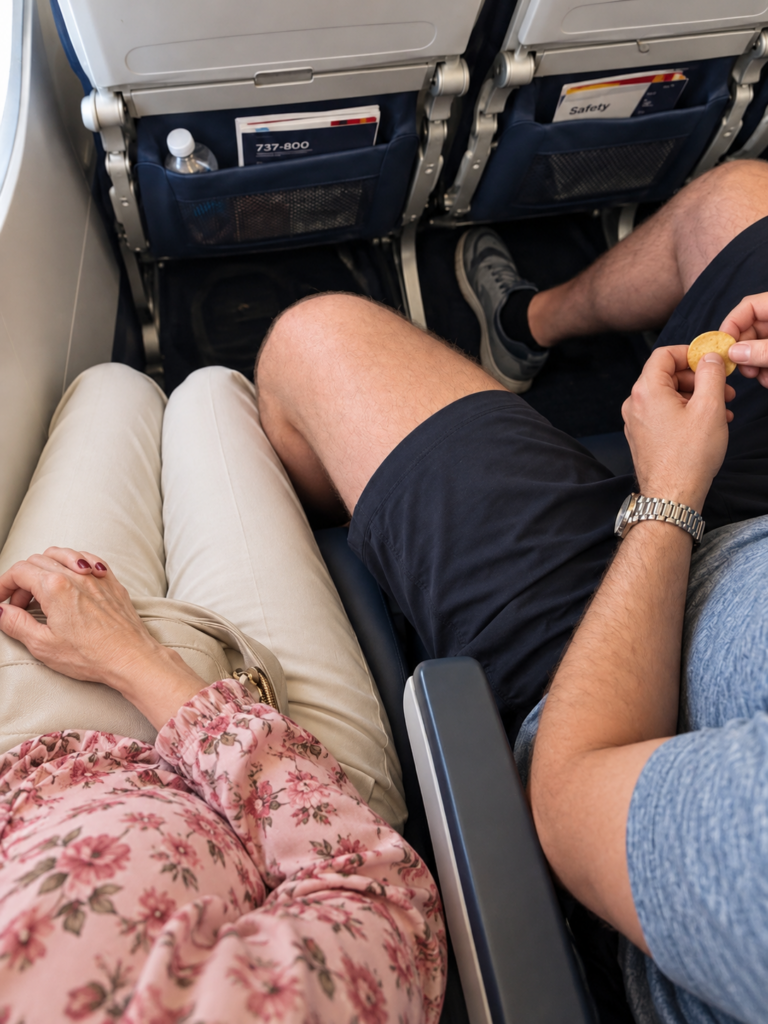
His right knee pushed against my left leg.
I moved closer to the window.
A few minutes later, his knee followed.
I told myself he probably didn’t realize what he was doing.
He was a large man, after all.
I understood that airplane seats were uncomfortable.
But when I politely asked whether he could move his leg, he looked at me as though I had requested something unreasonable.
“There’s not much room here, sweetheart.”
I disliked being called sweetheart by strange men.
Still, I smiled.
“I understand. But your knee is pressing against mine.”
He looked down, moved slightly, and returned to his magazine.
Within minutes, his leg had crept back.
Then his elbow claimed the armrest.
Then his jacket covered the divider between our seats.
By the time the beverage cart arrived, I was pressed so tightly against the window that my left shoulder had begun to ache.
I asked Derek to move his elbow so I could lower my tray table.
He sighed.
“Good grief. You need a lot of attention, don’t you?”
I felt my face grow warm.
The flight attendant waiting with my tea pretended not to hear.
I apologized automatically.
That was the first moment I truly became angry with myself.
I had apologized.
For wanting to use my own tray table.
But I did not know how to stop doing it.
For most of my life, I had been the woman who smoothed things over.
I had worked for twenty-seven years at the circulation desk of a public library.
I had dealt with angry patrons, lost books, misplaced library cards, children crying during story hour, and adults who behaved worse than children.
I knew how to lower my voice when someone else raised theirs.
I knew how to make a difficult person feel heard.
What I had never learned was how to recognize the moment when patience stopped being kindness and became surrender.
Derek apparently recognized that weakness immediately.
Every time I asked him to shift, he gave me just enough room to end the conversation.
Then he took it back.
At one point, I caught myself holding my breath whenever he moved.
That frightened me more than I wanted to admit.
I was a grown woman, a mother, a grandmother, and a widow who had survived the worst year of her life.
Yet I was sitting beside a stranger afraid to ask him to move his foot.
Philip noticed.
I could tell from the way he sometimes looked up from his newspaper.
But he said nothing.
Neither did I.
When Iris came through collecting cups, she paused beside our row.
“Everything all right here?”
Derek turned his head toward me.
His expression was neutral, but there was something challenging in his eyes.
I imagined explaining everything while he sat six inches away.
I imagined the argument.
The other passengers staring.
The possibility that he would become angrier and make the remaining hours worse.
So I smiled at Iris.
“Everything’s fine, thank you.”
She moved on.
Derek leaned back.
He gave me a small, satisfied glance.
And then he stretched his legs farther into my space.
I had never felt so foolish.
It was around the fourth hour when Derek announced that he was going to the restroom.
He nudged Philip.
“Need to get out.”
Philip stood.
Derek stepped into the aisle, adjusted his sweater, and walked toward the back of the plane.
The moment he disappeared, I straightened my left leg.
Pain shot through my hip.
I winced.
Philip noticed.
“Are you all right?”
“Just stiff.”
He folded his newspaper.
“You’ve been sitting crooked since we took off.”
I tried to laugh.
“I suppose I have.”
He studied me for a moment.
Then he said something that surprised me.
“You don’t have to pretend on my account.”
I looked away.
I was afraid I might cry.
Not because my hip hurt that badly.
But because those were the first genuinely kind words anyone had spoken to me since the trouble began.
Iris was passing with a bag of collected trash.
Before I could lose my nerve, I raised my hand.
“Could I possibly speak with you?”
She bent closer.
I explained the situation.
Not dramatically.
Not angrily.
Just the facts.
Her expression changed as she listened.
Then she glanced toward the rear of the cabin.
“There is an unoccupied aisle seat a few rows back,” she said. “Would that help?”
I could hardly believe it.
“Yes. Very much.”
She asked me to gather my things.
Philip stood to let me out.
As I lifted my handbag, he touched my sleeve.
“For what it’s worth,” he said, “I heard you ask him to move.”
I thanked him.
And three rows later, I lowered myself into a seat that felt almost luxurious.
My hip was sore.
My pride was bruised.
But I could finally sit upright.
That was where Derek found me.
And that was where the confrontation began.
Now, sitting in that same aisle seat with Iris waiting for my answer, I realized I had reached another familiar crossroads.
I could smile.
Tell her I was fine.
Let the matter disappear.
Or I could do something that felt terribly unfamiliar.
I could tell the truth without first making sure everyone else was comfortable hearing it.
I looked up at her.
“Yes,” I said. “Please document it.”
Iris nodded.
“I’ll make a note of what happened and speak with the lead flight attendant.”
She started to move away.
“Excuse me,” I said.
She turned back.
“Could you also write down that I waited too long to tell you?”
Her expression softened.
“Mrs. Mercer, you don’t need to take responsibility for his behavior.”
“I know. But I want the report to be accurate.”
For the first time that day, I heard how different those two things were.
Taking responsibility for my own decisions was one thing.
Taking responsibility for Derek’s conduct was another.
I was beginning to understand the distinction.
As Iris walked away, I took a deep breath and reached for my book.
Then I noticed Derek watching me from his original row.
His headphones were off.
His jaw was tight.
And the look he gave me suggested that the argument was nowhere near over.
Part 2
I managed to read seven pages before Derek returned.
I know because I counted them afterward.
It was a silly little detail to remember, but when a frightening experience is happening, the mind sometimes clings to ordinary things.
Seven pages.
One cup of water.
Two rows of passengers pretending not to listen.
Then his shadow fell across my book.
“Ruth.”
I looked up.
He was standing in the aisle again, one hand tucked into the pocket of his expensive trousers.
His expression had changed.
He was smiling.
Not warmly.
Not naturally.
It was the kind of smile people put on when they know they have an audience.
“Can we talk for a second?”
I glanced toward the front of the cabin.
Iris was speaking with another attendant.
“What about?”
Derek shifted his weight.
“Look, I don’t want any hard feelings.”
I waited.
He sighed.
“Maybe I got a little spread out back there. But I’m a big guy. These seats aren’t designed for people like me.”
I closed my book.
“You were uncomfortable,” I said. “I understand that.”
“Exactly.”
“But you made me uncomfortable too.”
His smile flickered.
“Right. Which is why I’m saying maybe we can just forget the whole thing.”
I considered him.
There was something almost fascinating about the way he approached the conversation.
He wasn’t asking how I felt.
He wasn’t wondering whether my hip still hurt.
He was trying to negotiate an ending that would cost him nothing.
“I’m glad I moved,” I said.
He glanced toward the galley.
“Did you tell the flight attendant to write something up?”
I said nothing.
His expression tightened.
“Because that can become a real headache. I fly for business constantly. My company pays for everything through a travel account.”
“I see.”
“A formal complaint can cause problems.”
“Then perhaps you should be more careful with other passengers.”
He stared at me.
For several seconds, the performance of friendliness disappeared entirely.
“You know what your problem is?”
I felt my stomach tighten.
“No.”
“You’ve turned a crowded flight into some kind of personal crusade.”
I heard the anger in his voice.
For the first time, I didn’t rush to calm him.
I simply waited.
He leaned closer.
“I’m offering to let this go.”
I held his gaze.
“I haven’t asked you to offer me anything.”
His face changed.
“You’re really going to be difficult?”
Before I could reply, another passenger spoke.
“Sir, you’re blocking the aisle.”
A young woman seated across from me was watching him.
She had curly brown hair and a little boy sleeping against her shoulder.
Derek turned.
“Mind your own business.”
She didn’t flinch.
“I would, but you’re standing right in front of us.”
A few people nearby smiled.
Derek looked back at me.
“Fine,” he muttered. “Do whatever you want.”
Then he walked away.
The young woman waited until he was gone.
“You okay?”
I nodded.
“Thank you.”
She smiled.
“My son has been asleep for twenty minutes. I wasn’t going to let that man wake him up just because he wanted an argument.”
I found myself smiling too.
She introduced herself as Natalie Brooks.
She was taking her four-year-old son, Owen, to visit his grandparents.
We spoke quietly for a few minutes.
She asked about my trip.
When I told her I was meeting my granddaughter for the first time, her face brightened.
“Oh, you’re going to love it. Grandparents get all the good parts.”
I laughed.
“That’s what I’ve been told.”
Then she looked at me more seriously.
“For what it’s worth, I saw how he was acting before you moved. He was halfway into your seat when I walked past the restroom.”
I stared at her.
“You noticed?”
“Of course.”
I looked down at my hands.
For four hours, I had felt invisible.
Now I was learning that people had seen more than I realized.
It made me grateful.
But it also made me sad.
I wondered how many people around us were enduring small cruelties while everyone else hoped somebody would speak first.
I took out my phone and opened a message from Sophie.
How’s the flight, Mom? Hazel has been practicing her serious face for you.
Below the words was a photograph.
My granddaughter lay in a little yellow outfit decorated with white daisies.
Her dark eyes were wide open.
Her tiny mouth had formed a perfect circle.
I pressed my finger gently against the screen.
For weeks, I had imagined the moment I would hold her.
I had pictured walking through the airport, seeing Sophie, and feeling Hazel’s warm little body settle against my chest.
I had imagined telling her stories about Alan.
How he whistled while working.
How he bought tulip bulbs every autumn even though he complained about digging.
How he once spent three whole evenings building a birdhouse because he couldn’t stand the thought of throwing away a perfectly good piece of cedar.
I had not imagined spending half the flight trying to stop a stranger from sitting on me.
I typed:
Had a little trouble with a passenger, but I’m fine now. Changed seats. Can’t wait to see you.
Sophie’s reply came almost immediately.
What kind of trouble?
I hesitated.
Then another message appeared.
Mom, please don’t tell me everything is fine if it isn’t.
I stared at those words.
My daughter knew me.
Of course she did.
She had spent thirty-five years watching me say things were fine when they weren’t.
I called her using the airplane’s available messaging service instead of voice, and we exchanged several messages.
I told her what had happened.
Her reaction was immediate.
He did WHAT?
I almost laughed.
Then she wrote:
Did you report him?
The flight attendant is making a note.
Good.
A moment later:
I wish Dad were there.
My eyes filled.
So did I.
But when I read Sophie’s next message, I felt something shift inside me.
Actually, Mom, I wish you’d remember you can handle people like this yourself.
I leaned back.
For years, Alan had been the person who spoke up when someone was rude to me.
He never enjoyed arguments.
He wasn’t especially loud.
But he had a way of meeting unpleasantness without backing down.
Once, a contractor doing work on our roof had tried to charge us for materials he had never delivered.
I had suggested paying the bill to avoid a fight.
Alan had calmly spread the receipts across our kitchen table.
“Ruth,” he said, “being fair to people doesn’t mean letting them be unfair to you.”
At the time, I had brushed off the comment.
Now I could hear his voice as clearly as if he were sitting beside me.
I typed back to Sophie.
I’m trying.
Her answer came quickly.
I know. I’m proud of you.
Those five words made me cry harder than Derek’s behavior had.
I turned toward the window across the aisle so Natalie wouldn’t see.
For a moment, I let myself miss my husband.
Not just the big things.
Not just his presence at Christmas or his arm around me at night.
I missed knowing that someone understood my smallest fears without needing an explanation.
I missed having a witness to my life.
And perhaps that was why Derek’s behavior had hurt so much.
It had happened during the first journey I had attempted without Alan.
I was already frightened.
Already grieving.
Already trying to convince myself that I could manage the world alone.
Then a stranger had made me feel powerless over something as simple as my own seat.
I wiped my eyes with a tissue.
There were still almost two hours left in the flight.
I decided I was not going to give Derek another minute of my attention if I could help it.
Unfortunately, he had other plans.
About twenty minutes later, Iris returned.
She had a small notepad in her hand.
“Mrs. Mercer, I’d like to clarify a couple of things, if that’s all right.”
“Of course.”
She asked when Derek had begun pushing into my space.
I gave her my best estimate.
She asked whether I had requested that he move.
“Yes. Several times.”
“Did he make physical contact beyond pressing against you while seated?”
I thought carefully.
“His knee and thigh kept pressing against mine, and his foot was under the space in front of my seat. I don’t believe he deliberately struck me.”
She nodded and wrote something down.
I appreciated the question.
I appreciated that she didn’t try to supply the answers for me.
When she finished, I said, “I should have told you earlier.”
Iris closed her notepad.
“You said you were fine because you were worried about his reaction?”
“Yes.”
“That’s helpful context.”
She paused.
“Some passengers become quite intimidating without ever raising their voices. Please don’t feel you have to handle that by yourself.”
I swallowed.
“Thank you.”
She glanced back toward my original row.
“I’ve also spoken with Mr. Calder.”
“Philip?”
She smiled.
“Yes. He corroborated that you repeatedly requested more space.”
Relief washed through me.
Then she added, “There is one more thing I wanted to ask.”
My stomach tightened.
“What’s that?”
“Mr. Hale has claimed that you became aggressive toward him.”
For a second, I thought I had misunderstood.
“Aggressive?”
“He said you deliberately elbowed him during the flight.”
I stared at her.
“I never did that.”
“I understand. I’m simply recording the differing accounts.”
The warmth drained from my face.
I remembered several moments when I had shifted my arm because his elbow was pressing into me.
Could he call that aggression?
Could he make an accusation just because I had finally refused to tolerate him?
Iris saw my distress.
“We are not making any conclusion based on his statement alone.”
“But I didn’t do anything to him.”
“Then that’s what we’ll document.”
After she left, I sat motionless for a long time.
I had been prepared for Derek to be angry.
I had expected him to deny taking up my space.
But accusing me of deliberately hurting him was something else entirely.
It meant he was willing to make me look like the problem to protect himself.
And suddenly, I understood why he had been so concerned about a complaint.
He didn’t merely want the matter forgotten.
He wanted his version to become the accepted one.
My heart began beating faster.
I considered calling Iris back and telling her not to bother.
What difference would it make?
I had moved seats.
My hip was beginning to feel better.
In a couple of hours, I would be holding Hazel.
Why risk becoming tangled in a stranger’s lies?
I imagined the complaint process.
Questions.
Statements.
People comparing stories.
Perhaps some manager would decide I was an oversensitive older woman.
Perhaps Derek would convince them I had been unreasonable.
I could almost hear the comforting explanation I would have offered myself a year earlier.
It’s not worth it, Ruth. Just let it go.
I closed my eyes.
Then I remembered an afternoon from the previous summer.
Alan had been sitting at our kitchen table, sorting through old photographs.
His health had already begun to decline.
He tired easily.
Some days, walking from the living room to the garden left him breathless.
That afternoon, he found a picture of me taken shortly after our wedding.
I was standing beside an old Chevrolet, laughing at something outside the frame.
“You used to be fearless,” he said.
I looked up from the dishes.
“I was never fearless.”
“You argued with a mechanic who tried to charge us for a repair he hadn’t done.”
“That was forty years ago.”
“You were right, too.”
I smiled at the memory.
The mechanic had spoken to me as though I knew nothing about cars.
But my father had taught me enough to recognize a dishonest estimate.
I had refused to pay.
Alan had stood beside me, grinning.
“What happened to that girl?” he asked that summer afternoon.
I shrugged.
“Life, I suppose.”
He studied the photograph.
“Maybe she got tired of fighting.”
I remember drying my hands and sitting beside him.
“I just don’t see the point in arguing about everything.”
“Neither do I,” he said. “But some things aren’t arguments. They’re boundaries.”
I had kissed his forehead and changed the subject.
Now I wished I had listened more carefully.
Because he had been telling me something important.
He had not wanted me to become combative.
He had wanted me to remain myself even when somebody else disapproved.
I opened my eyes.
Then I reached for the call button.
Iris returned several minutes later.
“I’d like my statement included,” I told her.
“It will be.”
“And I’d like to make it clear that I didn’t deliberately elbow him.”
She nodded.
“Absolutely.”
I hesitated.
“Can I add something else?”
“Of course.”
“I don’t want him punished because he’s tall. I understand people have different physical needs. But he had no right to decide that my space was available simply because I was smaller.”
Iris wrote that down.
Then she looked at me.
“That’s a very clear way of explaining it.”
I felt strangely proud.
I hadn’t raised my voice.
I hadn’t insulted Derek.
I had simply stated what happened.
It should not have felt revolutionary.
But to me, it did.
The plane began descending into Portland shortly afterward.
Outside the window, the clouds parted to reveal dark green land and winding roads.
I thought about Sophie waiting for me.
About Hazel.
About the wooden rocking horse Alan had made.
I had arranged for Daniel to have it shipped west a few weeks earlier.
Sophie had promised to keep it in the nursery until Hazel was old enough to use it.
I pictured my granddaughter one day sitting on that little horse, gripping its polished handles.
The thought made me smile.
Then Derek stood again.
The seat-belt sign was on.
Iris immediately asked him to sit down.
He ignored her for a moment and looked back at me.
“This isn’t over,” he said.
His voice was low enough that most passengers couldn’t hear.
But Natalie did.
She turned sharply.
“She’s done talking to you.”
Derek glared at her.
Then Iris repeated her instruction.
He finally sat.
I stared straight ahead.
I knew now that I was frightened of him.
Not because I believed he would physically attack me.
But because he seemed determined to make me doubt my own experience.
He could be charming one minute and threatening the next.
He could insist nothing had happened while demanding that I protect him from the consequences.
And he seemed genuinely offended that I was no longer willing to cooperate.
I wondered how often he behaved this way.
How many smaller, quieter people had moved aside for him.
How many had decided it was easier to endure a little discomfort than challenge someone who made every disagreement exhausting.
I had no way of knowing.
But I did know that I was finished being one of them.
When the plane landed, I waited until most of the passengers had gathered their belongings.
My hip had stiffened again, and I wanted to avoid being jostled in the aisle.
Natalie wished me a wonderful visit with my granddaughter.
Little Owen, now awake, gave me a sleepy wave.
Philip Calder stopped beside my row.
“Mrs. Mercer?”
I looked up.
He was holding a small folded piece of paper.
“I wrote down my contact information,” he said. “In case the airline needs somebody to confirm what happened.”
I accepted it.
“Oh, Philip. That’s very kind of you.”
He looked uncomfortable.
“I wish I’d said something sooner.”
“You did speak up.”
“Eventually.”
He glanced toward the front of the plane.
“I spent thirty years supervising bus drivers. When somebody was being bullied on one of my buses, I expected my drivers to handle it immediately.”
He gave a small shake of his head.
“Funny how much easier it is to know what ought to be done when you’re not the person who has to do it.”
I understood that better than he knew.
I thanked him again.
Then he added something curious.
“And Mrs. Mercer, there’s a detail about the seating arrangement I think the airline should know.”
“What detail?”
He started to answer.
But passengers behind him were trying to leave.
He stepped aside.
“I’ll tell you downstairs. I’m collecting a checked bag.”
I nodded.
Then I stood carefully, collected my handbag, and stepped into the aisle.
As I moved toward the aircraft door, Derek was standing near the front.
He was speaking to the lead flight attendant.
I heard only part of the conversation.
“…completely unreasonable,” he was saying. “I was just trying to sit comfortably.”
The attendant replied quietly.
Derek shook his head.
“She’s making accusations about me, and I want that on record.”
Then he noticed me.
His expression hardened.
For one second, I thought he might confront me again.
Instead, he turned back toward the attendant.
“That’s her,” he said loudly. “That’s the woman who caused all the trouble.”
Several passengers looked at me.
I felt that old, sickening desire to disappear.
But I kept walking.
I didn’t answer.
I didn’t apologize.
At the aircraft door, Iris caught my eye.
She gave me a small, reassuring nod.
I returned it.
Then I stepped into the jet bridge.
The flight was over.
I thought the worst of the afternoon had ended.
I was wrong.
At the airline customer-service counter beyond the arrival gates, I stopped to make sure my account could be submitted as a formal complaint.
Iris had explained that the cabin report would be reviewed internally, but that I could also submit my own written statement.
The employee behind the counter was a middle-aged woman named Denise.
She listened patiently as I explained the situation.
Then she asked for my flight number.
I gave it to her.
She entered something into her computer.
After a moment, her expression grew serious.
“Mrs. Mercer, I see that another passenger has already submitted an account of this incident.”
I knew before she said his name.
“Mr. Hale?”
“Yes.”
Denise hesitated.
“I can’t disclose the details of another customer’s complaint, but I can certainly help you submit your own account.”
I looked at her.
“Does his complaint say I was the one behaving badly?”
She maintained a careful professional expression.
“I can’t characterize it for you, ma’am.”
I felt my chest tighten.
Derek had wasted no time.
He had reached the counter first.
He had begun constructing his story before I even collected my suitcase.
For a moment, I imagined a report somewhere in the airline’s system describing me as troublesome or aggressive.
A widow on her first flight alone.
A woman who had spent hours trying not to inconvenience anybody.
Now officially accused of causing trouble.
I felt the tears coming.
And I nearly walked away.
Part 3
“Mrs. Mercer?”
Denise’s voice was gentle.
“Would you like to sit down?”
I nodded.
She guided me to a chair beside the counter.
I placed my handbag on my lap and stared at the carpet.
It was a dull gray pattern, covered with little blue lines that seemed to twist in every direction.
I remember thinking that somebody had probably chosen it because stains wouldn’t show.
It was such a ridiculous thought.
But I was exhausted.
My hip hurt.
My daughter was waiting somewhere downstairs with a baby I hadn’t held yet.
And I had suddenly become involved in a dispute with a man who seemed determined to win an argument I had never wanted to start.
Denise brought me a cup of water.
“Take your time.”
I thanked her.
Then I said something I hadn’t planned to say.
“My husband died last year.”
She sat quietly.
“This is the first time I’ve traveled without him. I was nervous before I even got on the airplane.”
My voice trembled.
“I didn’t expect anything special. I just wanted to get here.”
Denise didn’t interrupt.
“I know this must sound like such a small thing. Somebody taking up too much space on a plane.”
She shook her head slightly.
“You don’t have to minimize it.”
I stared at her.
Those words felt unfamiliar.
You don’t have to minimize it.
For decades, I had done exactly that.
I had minimized my disappointment when relatives forgot birthdays.
I had minimized my exhaustion when people volunteered me for tasks without asking.
I had minimized my own needs because it seemed easier than explaining them.
And today, I had nearly allowed a stranger to turn my discomfort into something I was ashamed to admit.
I looked at Denise.
“I want to finish my report.”
She nodded.
“Then we’ll finish it.”
I took my phone from my handbag and opened the notes application.
Instead of trying to write an emotional account, I began listing events in order.
The time we boarded.
The first request I made for Derek to move his leg.
The trouble with the armrest and tray table.
The repeated pressure against my hip.
The conversation with Iris.
The moment I moved.
Derek’s reaction.
His later attempt to persuade me not to report him.
I wrote carefully.
Whenever I felt myself reaching for words like perhaps or maybe I misunderstood, I stopped and considered whether the uncertainty was genuine.
If I could not remember something clearly, I said so.
If I knew exactly what had happened, I wrote it plainly.
I did not call Derek cruel or dishonest in the statement.
I described what he had done.
That seemed important.
When I finished, I read the account twice.
Then I remembered Philip’s paper.
I unfolded it.
His telephone number was written in large, careful handwriting.
Underneath, he had added:
Seat 19D. Will confirm repeated requests and the exchange after the seat change.
I showed Denise.
“A passenger sitting beside us gave me this.”
She looked at the note.
“Would he be willing to provide a witness statement?”
“He said he would.”
“That’s helpful.”
I was about to put the paper away when I heard someone behind me.
“I certainly would.”
I turned.
Philip Calder stood a few feet away, holding the handle of a small rolling suitcase.
I nearly burst into tears.
“Philip!”
He smiled.
“I thought you might still be here.”
Denise invited him to the counter.
He explained that he had been sitting in the aisle seat and had witnessed several exchanges.
He remembered Derek’s repeated comments about my size.
He remembered the way I kept shifting toward the window.
He remembered Iris checking on us.
And he remembered me asking Derek to stop pressing against my leg.
Then he mentioned the detail he had wanted to tell me.
“There’s something else,” he said.
Denise looked up.
Philip rested both hands on his suitcase handle.
“Before the plane took off, that gentleman was offered a different seat.”
I blinked.
“What?”
Philip nodded.
“While Mrs. Mercer was getting settled, one of the attendants mentioned that there was an empty aisle seat a few rows back. Mr. Hale had complained about being cramped in the middle.”
I stared at him.
“I didn’t hear that.”
“You were putting your bag away. He said he didn’t want to sit farther back because he preferred being closer to the front.”
Denise glanced at her computer.
Philip continued.
“I remember because I thought he was making a strange choice. If he needed more room for his legs, an aisle seat seemed like a better option.”
I felt something cold settle in my stomach.
Derek had been offered another seat.
He had refused.
Then he had spent four hours acting as though his only option was to occupy mine.
I thought back to his complaints.
How he had insisted he couldn’t help being tall.
How he had made my discomfort sound like a failure to understand his needs.
How he had suggested that I wasn’t using the space anyway.
And all that time, there had been another option.
He simply hadn’t wanted it.
I looked at Philip.
“Are you certain?”
“Quite certain.”
He smiled faintly.
“After thirty years working with buses, I tend to remember conversations about seating.”
Denise made another note.
She remained careful not to promise any particular outcome.
But I could see that Philip’s account mattered.
Then someone else approached.
It was Iris.
She had finished her post-flight duties and was passing through the terminal.
She recognized us immediately.
“Mrs. Mercer. Mr. Calder.”
Denise explained that we were submitting a formal statement.
Iris confirmed that she had already recorded the cabin incident, including the request for a seat change and Derek’s behavior after discovering I had moved.
When Philip mentioned the earlier offer of an aisle seat, Iris paused.
“That was my colleague,” she said. “I remember her mentioning that we had an available seat if Mr. Hale preferred to relocate after boarding.”
She looked toward Denise.
“The passenger declined.”
I sat very still.
There it was.
The detail that changed everything.
Derek’s discomfort had been real enough.
He was a large man in a narrow airline seat.
But he had been offered a reasonable solution before the flight began.
He chose not to take it.
Instead, he expected me to absorb the consequences of his decision.
That wasn’t a misunderstanding.
It was entitlement.
And for the first time, I stopped wondering whether I had made too much of the situation.
Denise helped me attach my statement to the case.
Philip provided his contact details and agreed to be contacted.
Iris explained that the airline would review the crew’s internal documentation alongside the passenger submissions.
Nobody promised that Derek would be banned from flying.
Nobody announced a punishment.
There was no dramatic public confrontation or humiliating speech.
And I was glad.
I didn’t want a spectacle.
I wanted an accurate account.
I wanted someone to recognize that a smaller, quieter person still had the same right to the space she had paid for.
When Denise gave me the complaint reference number, I wrote it in the little notebook I carried in my handbag.
Then I thanked her.
“I’m glad you came back to finish,” she said.
“So am I.”
Philip offered to walk with me toward baggage claim.
We moved slowly through the terminal.
My hip was still sore, and I appreciated not having to hurry.
At the escalator, I stopped.
“Philip, can I ask you something?”
“Of course.”
“Why did you decide to help me?”
He looked surprised.
“Because I saw what happened.”
“I know. But you didn’t have to get involved.”
He considered that for a moment.
Then he said, “My wife passed away three years ago.”
I looked at him.
“I’m sorry.”
“Thank you. She was a very gentle woman. Terrible at asking for things she needed.”
I smiled sadly.
“Sounds familiar.”
He nodded.
“I used to tell her that speaking up wasn’t the same as being difficult.”
He looked away for a moment.
“After she died, I thought a lot about the times I should have noticed that she needed help before she had to ask.”
Neither of us spoke.
Then he gave me a small smile.
“I suppose today I got another chance to notice.”
I reached for his hand.
“Thank you.”
He squeezed my fingers.
And we continued downstairs.
Derek was standing beside the baggage carousel when we arrived.
I saw him before he saw me.
He was talking on his phone, pacing beside a row of empty luggage carts.
His expression was irritated.
“No, I already reported it,” he said.
He listened for a moment.
Then he lowered his voice.
“Some woman decided to make a scene. That’s all.”
I stopped walking.
Philip followed my gaze.
Derek noticed us.
His expression changed immediately.
He ended the call and shoved the phone into his pocket.
For a moment, I thought he would turn away.
Instead, he approached.
“Well,” he said. “Looks like you’re still making trouble.”
Philip moved slightly closer to me.
I held up one hand.
Not to stop Derek.
To reassure Philip.
I could answer for myself.
“I’m collecting my luggage,” I said.
Derek looked toward the customer-service area.
“Did you file another complaint?”
“I submitted an account of what happened.”
He laughed.
“Of course you did.”
I didn’t respond.
His eyes moved to Philip.
“And you helped her, I suppose?”
Philip regarded him calmly.
“I told the truth about what I saw.”
Derek’s jaw tightened.
“Everybody’s making a federal case out of a cramped airline seat.”
I studied him.
He looked genuinely offended.
Not embarrassed.
Not remorseful.
Offended that the people around him weren’t accepting his explanation.
And suddenly I understood something that had been confusing me all afternoon.
Derek believed that because he hadn’t intended to hurt me, my discomfort shouldn’t matter.
He saw his own intentions as more important than my experience.
As far as he was concerned, being uncomfortable was my problem to solve.
But the moment I solved it without asking him, he became furious.
It hadn’t been about legroom alone.
It had been about the assumption that he should be able to decide how much inconvenience I was expected to tolerate.
“Mr. Hale,” I said, “I don’t want to argue with you.”
“Then why’d you file a complaint?”
“Because what happened was worth documenting.”
He shook his head.
“You people are unbelievable.”
A year earlier, that remark would have sent me into a spiral of self-doubt.
I would have wondered whether I was overreacting.
I would have offered an explanation.
Perhaps even an apology.
Instead, I said, “I’m sorry you feel that way.”
Then I turned toward the carousel.
Derek stood there for another moment.
He seemed to be waiting for me to turn back.
I didn’t.
Eventually, he walked away.
I watched his reflection disappear in the polished metal surrounding the luggage belt.
Philip smiled.
“You handled that rather well.”
I laughed softly.
“I was terrified.”
“That doesn’t mean you didn’t handle it well.”
I looked at him.
Then I laughed again.
This time, it felt wonderful.
My suitcase arrived twelve minutes later.
I know because Sophie had been sending increasingly frantic messages.
Mom, are you downstairs yet?
Hazel is awake.
Daniel thinks we’re at the wrong carousel.
Please tell me you’re okay.
I finally called her.
“I’m coming out now, sweetheart.”
“Mom! We were getting worried.”
“I know. I’m sorry.”
Then I stopped myself.
I was about to apologize for being delayed by something that hadn’t been my fault.
I smiled.
“I had something to take care of.”
Sophie paused.
“Are you all right?”
“I am now.”
“Good. Because somebody here is getting very impatient to meet her grandmother.”
I laughed.
“Tell her I’m on my way.”
I said goodbye to Philip near the exit.
He promised to respond if the airline contacted him.
I thanked him one last time.
Then I pushed my suitcase through the automatic doors.
And there they were.
Sophie stood near a row of benches, waving both arms.
She looked exactly the way I remembered her, though perhaps a little more tired.
Her hair was tied in a messy knot.
She wore jeans and a soft green sweater.
Beside her stood Daniel, holding a diaper bag and smiling broadly.
And in Sophie’s arms, wrapped in a white blanket, was Hazel.
My granddaughter.
For a moment, I forgot how to move.
Then Sophie hurried toward me.
“Mom!”
She wrapped one arm around my shoulders, careful of the baby between us.
I hugged her.
I could feel her warmth.
Her familiar perfume.
The solid, living presence of my child.
I had not realized how badly I needed that embrace.
When she stepped back, her eyes were wet.
“You made it.”
“I did.”
She looked at my face.
“Oh, Mom. You look exhausted.”
I smiled.
“It’s been an eventful day.”
Her eyes narrowed.
“Tell me that man didn’t bother you again.”
“He tried.”
“What happened?”
“I’ll tell you later.”
“Did you report him?”
“Yes.”
She looked relieved.
“Good.”
Then she shifted Hazel carefully in her arms.
“But first, there’s somebody I want you to meet.”
She placed the baby against my chest.
I looked down.
Hazel was smaller than I had imagined.
Her cheeks were soft and round, her eyelashes impossibly fine.
One tiny hand rested against the edge of her blanket.
Her eyes opened.
And she looked straight at me.
I felt my throat tighten.
“Hello, sweetheart,” I whispered.
She blinked.
I laughed through my tears.
“I’m your grandma.”
Sophie put an arm around me.
“She likes your voice.”
“Does she?”
“She was fussing a minute ago. Look at her now.”
Hazel made a tiny sound.
Not quite a cry.
Not quite a sigh.
I touched her cheek with one finger.
It was the softest thing I had ever felt.
Then the grief came.
Not sharply.
Not like the terrible first days after Alan’s death.
It came as a quiet ache beneath the happiness.
He should have been standing beside me.
He should have been making some ridiculous joke.
He should have been telling Sophie that Hazel had his chin, even though she was far too young for anyone to know whose chin she had.
My eyes filled again.
Sophie understood without my saying a word.
“I miss him too, Mom.”
I nodded.
“Your father would have loved her.”
Daniel stepped closer.
“He would have spoiled her rotten.”
I laughed.
“He already started.”
Sophie smiled.
“The rocking horse.”
“Yes.”
She kissed Hazel’s forehead.
“We put it in the nursery. It’s beautiful.”
I imagined Alan in his workshop, smoothing the curved wooden runners with sandpaper.
He had made that little horse before Hazel existed.
Before we knew her name.
Before he knew he wouldn’t be here to meet her.
Somehow, a small part of his love had arrived ahead of her.
And now she was in my arms.
We sat together on a bench near the arrivals area.
Daniel went to bring the car around.
Sophie stayed beside me.
Hazel had fallen asleep against my chest.
For a few minutes, neither of us spoke.
Then Sophie asked, “Mom, what really happened on that plane?”
I told her.
Not every detail.
Not yet.
But enough.
I explained how Derek had repeatedly pushed into my space.
How I had tried to manage it quietly.
How I finally asked to move.
How he became angry and then accused me of behaving aggressively.
Sophie’s expression shifted from disbelief to anger.
“He claimed you elbowed him?”
“Yes.”
“Mom, that’s awful.”
“I know.”
“Did anybody believe him?”
“I don’t know what the airline will decide. But another passenger gave a statement, and the flight attendant documented what happened.”
Sophie looked at me for a long moment.
Then she smiled.
“Dad would be proud of you.”
I looked down at Hazel.
“I hope so.”
“Mom.”
I looked at her.
“He wouldn’t be proud because you filed a complaint. He’d be proud because you stopped letting somebody convince you that your needs didn’t matter.”
I pressed my lips together.
She reached for my free hand.
“I worry about you sometimes.”
“I know.”
“Not because I think you’re helpless.”
I gave her a small smile.
“That’s good.”
She squeezed my hand.
“I worry because you’ve spent so much of your life taking care of everyone else. I don’t always know whether you’re taking care of yourself.”
For a moment, I didn’t answer.
Then I said, “I’m learning.”
She smiled.
“Good.”
We sat quietly again.
Hazel stirred in my arms.
I rocked her gently.
And I realized that the day had given me something I hadn’t expected.
I had boarded the airplane afraid of traveling without Alan.
I had believed that being alone meant having no one to protect me.
But I had discovered that I could speak for myself.
Other people could help.
I could accept their kindness.
I could ask for assistance.
And none of that meant I was weak.
Perhaps being independent did not mean handling everything alone.
Perhaps it meant knowing that I was entitled to ask for what I needed.
The airline acknowledged my complaint several days later.
A customer-relations representative thanked me for providing a detailed account and confirmed that the crew report and witness information had been reviewed.
The airline apologized for the discomfort and disruption.
They offered a travel credit as a goodwill gesture.
They did not tell me whether Derek had received any consequences, and I did not ask them to disclose information they weren’t able to share.
I didn’t need to know.
I kept a copy of my complaint.
Not because I wanted to remember Derek.
Because I wanted to remember myself.
I wanted to remember the woman who had walked onto an airplane trembling at the thought of traveling alone and had managed to stand up for herself when it mattered.
My visit with Sophie lasted three wonderful weeks.
I helped with late-night feedings.
I folded baby clothes.
I made soup while Daniel worked.
I took Hazel on slow afternoon walks through the neighborhood.
And one Sunday, Sophie found me sitting in the nursery beside Alan’s wooden rocking horse.
I had Hazel in my lap.
She was watching me with the solemn concentration only babies seem capable of.
Sophie leaned against the doorway.
“What are you telling her?”
I smiled.
“Just a few things about her grandfather.”
“Good things, I hope.”
“Mostly.”
She laughed.
Then she left us alone.
I looked down at Hazel.
“Your grandpa was a very good man,” I whispered.
Her fingers opened and closed against my sweater.
“He always knew when somebody needed a little extra kindness.”
I paused.
“And he knew something I’m only just starting to learn.”
Hazel looked up at me.
I smiled.
“You can be kind without letting people walk all over you.”
She made a small, delighted sound.
I kissed the top of her head.
Outside the nursery window, the afternoon sun moved across the garden.
A breeze stirred the leaves.
The house was full of ordinary noises.
Sophie talking to Daniel downstairs.
The dishwasher running.
A dog barking somewhere beyond the fence.
And there I sat, holding my granddaughter in a chair placed beside the little wooden horse my husband had made.
For the first time since Alan died, the future no longer felt like a place I was being forced to enter alone.
It felt like somewhere I might belong.
I adjusted Hazel gently against my chest.
She settled comfortably, her little hand resting over mine.
There was plenty of room for both of us.
And I intended to keep it that way.

