
Part 1
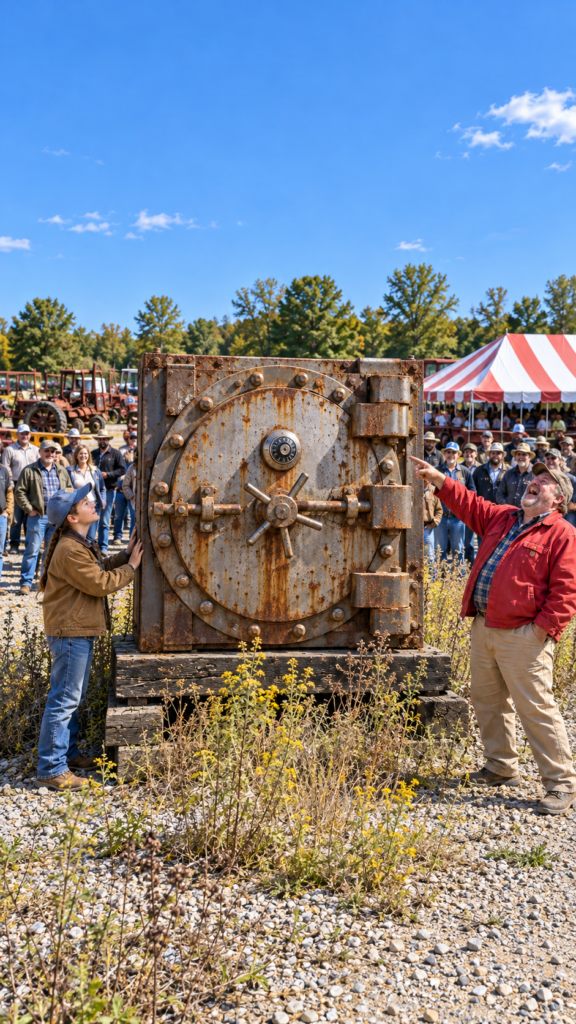
The auctioneer’s gavel came down at sixty-five dollars, and Royce Tolliver laughed so hard that a flock of pigeons scattered from the sale barn roof.
Thirty farmers, equipment dealers, and scrap buyers joined him. Some bent forward with their hands on their knees. Others slapped their neighbors on the back. One man actually removed his hat to wipe his eyes.
Standing in the middle of all that laughter was a twelve-year-old boy named Ezra Kettleman.
He wore a brown canvas chore jacket over a faded plaid shirt, an old blue ball cap pushed back on his head, and work boots that had been bought a little too large so he could grow into them.
Ezra had just spent every dollar he owned on a six-ton bank vault door that nobody in Tullick County, Indiana, had managed to open in nearly seven decades.
And he wasn’t smiling.
He stood beside the enormous circle of rusted steel, resting both palms against its rough surface, looking at the tarnished combination dial as though it were something he recognized.
“Somebody go find his mama!” Royce shouted.
More laughter.
“Tell her the boy just bought the heaviest paperweight in Indiana!”
Ezra heard every word.
He also remembered something his grandfather had told him before he died.
If that door ever comes up for sale, don’t let them cut it.
That was why Ezra had raised his hand. That was why he had offered sixty-five dollars when the bidding was only at ten. And that was why, standing among men who were certain he’d made the stupidest purchase of his life, he couldn’t bring himself to regret it.
He just had no idea how he was going to get six tons of steel home.
The door had been listed as Lot 94 at the Vorhies estate sale, held on the southern edge of Tullick.
For thirty-eight years, it had stood beyond the fence of the old demolition yard, its square steel collar resting on timbers that were slowly disappearing beneath weeds and damp soil.
It measured a little more than seven feet across. Its five-spoke handle was fixed in the center, and its circular face was marked by long orange streaks of rust.
Ironweed had grown through the wooden supports beneath it. During summer, grasshoppers gathered in the shade of its frame. During winter, snow collected around the base.
To most people, it was simply another piece of heavy industrial junk left behind by a man who had never gotten around to disposing of it.
Dale Vorhies, the yard’s former owner, had spent years insisting that somebody would eventually find a way to cut the thing open.
Several men had tried.
None had succeeded.
Now the estate was being cleared, and the property was going to be sold.
Gus Barlow, the auctioneer, had started the bidding at a dollar.
No takers.
He tried again, explaining that the buyer would be responsible for moving the entire structure.
That made the crowd even less interested. Scrap steel was one thing. Steel that required expensive equipment merely to get onto a truck was another.
Then a small voice from the back said, “Five.”
Gus looked up.
“Five dollars from the young gentleman.”
Royce Tolliver, who owned Tolliver Salvage and Iron out on the state road, lifted a hand.
“Ten.”
He was grinning before Gus even acknowledged the bid.
Then Ezra said, “Sixty-five.”
It came out so quickly that Gus stopped speaking.
“Sixty-five?”
“Yes, sir.”
Royce looked at the boy, then at the door, then toward the crowd.
He raised both hands in exaggerated surrender.
“Well, I sure can’t compete with that kind of financial genius.”
The gavel fell.
And the laughter began.
Ezra’s mother, Lena, arrived a moment later.
She had come to the sale hoping to purchase several folding tables for the school cafeteria where she worked. She had left her son near the equipment lots while she looked over a stack of furniture.
For perhaps five minutes, she’d taken her attention off him.
Now she found him standing beside a bank vault door large enough to fill one side of their pole barn.
“Ezra?”
Her voice was quiet, but he heard the alarm beneath it.
He turned.
“Hi, Mom.”
She looked at the door.
Then at the crowd.
Then back at her son.
“Honey, what did you do?”
“I bought it.”
“With what?”
“My mowing money.”
“How much?”
“Sixty-five dollars.”
Lena closed her eyes for a moment.
“All of it?”
“Yes, ma’am.”
He looked back at the metal.
“I had to.”
Lena was about to ask why when he added, “You know I had to.”
Something in those words stopped her.
Because she did know.
She remembered the conversation in her father’s kitchen, the last time Ezra had seen him alive. She remembered his hand resting on the boy’s shoulder and the seriousness in his voice when he’d spoken about the old vault door.
But remembering was one thing.
Moving six tons of steel was another.
Before she could answer, Royce Tolliver approached with several men trailing behind him.
Royce was a broad, heavy man in his fifties, with a red canvas work jacket he wore regardless of the season.
He had spent most of his adult life buying machinery cheap, stripping what could be sold, and disposing of what could not.
He knew what tractors were worth. He knew the salvage value of old engines and farm equipment. He could look at a piece of metal lying in weeds and estimate its weight before most men could locate a scale.
People in Tullick trusted his judgment about such things.
And Royce enjoyed being trusted.
“Well, Ezra,” he said, examining the steel circle. “Congratulations. You own a door.”
He waited for the crowd to quiet.
“Now, where’s the house?”
The men laughed.
Ezra stared at the toes of his boots.
“I’m serious,” Royce continued. “I’d like to hear your plan. You going to open it?”
Ezra said nothing.
“Because I can tell you something about that door. Dale Vorhies paid me to try cutting it years ago. Four different attempts. Four torches. Never got anywhere worth talking about.”
He pointed at the combination dial.
“So what have you got, son? A hairpin? Some secret trick you learned watching television?”
Ezra raised his eyes.
“I’m not going to open it.”
Royce blinked.
“You’re not?”
“Not here.”
Royce turned to his audience.
“Did everybody hear that? He spent sixty-five dollars on a locked door, and he doesn’t even want to open it!”
Another burst of laughter rolled across the gravel.
Then Royce leaned closer.
“I’ll save you the trouble, kid. There’s nothing in there. That bank closed broke back in 1959. Anything worth keeping was carried out long before somebody locked it for good.”
Ezra’s expression changed slightly.
Royce didn’t notice.
“Just old air inside. That’s all you bought.”
Gus Barlow approached with his clipboard tucked under one arm.
Unlike Royce, he didn’t appear amused.
“Ezra,” he said, “you understand the sale terms, don’t you? Buyer removes the property. You’ve got until next Saturday.”
Ezra nodded.
“If it’s still here after that, it stays with the yard.”
“And I’m buying that yard,” Royce added cheerfully. “Which means I’ll end up with your door anyway.”
He looked at Lena.
“Tell you what. Give me a hundred and twenty dollars, and I’ll take the thing off your hands and cut it up. You’ll only be out a hundred and eighty-five in the end.”
Someone behind him called, “Take the deal, kid!”
Royce chuckled.
“Cheap lesson, if you ask me.”
Ezra looked him directly in the face.
“No, thank you, Mr. Tolliver.”
The answer was so polite that Royce seemed almost offended.
“Suit yourself.”
He counted on his fingers.
“Six tons. No truck. No crane. Six days.”
He turned toward the equipment lots.
“I’ll see you Saturday.”
When the men finally drifted away, Lena placed a hand on her son’s shoulder.
For a while, neither spoke.
Then she asked the question Ezra had been avoiding.
“How on earth are we going to move it?”
Ezra swallowed.
“I don’t know yet.”
Lena let out a long breath.
He looked up at her.
“But Grandpa said not to let anybody cut it. Remember?”
She remembered.
Walter Kettleman had spent fifty-one years working as a safe and vault mechanic throughout Tullick County and the surrounding area.
There were people who had trusted him with combinations to business safes, bank vaults, church strongboxes, and private lockboxes. Others had called him when they lost those combinations.
He had opened safes for farmers who kept emergency money behind steel doors. He had rescued papers from old cabinets after their locks seized. He had worked on bank mechanisms too complicated for most local mechanics even to identify.
He was patient, exacting, and almost impossibly careful.
He had a habit of laying out each screw in the order he removed it. When he finished a repair, he cleaned his tools before putting them away.
And he believed that a good lock deserved to be understood before anyone tried to defeat it.
Ezra had spent the last six summers beside him.
At first, he’d been allowed only to watch.
His grandfather would place him on a tall stool beside the workbench, fasten an oversized pair of safety glasses over his face, and explain what each part did.
Later, Ezra was allowed to handle the old practice locks and test dials.
He learned how the wheels inside a combination mechanism engaged one another, why careless movement could spoil a setting, and why patience often accomplished what force could not.
Sometimes they worked for hours without much conversation.
Ezra liked those afternoons best.
His grandfather never treated him as though being twelve meant his questions were foolish.
He only expected him to listen to the answers.
There was one subject Walter returned to more often than any other.
The round vault door at the Vorhies yard.
He called it the Brandt door.
Five times, he had tried to buy it from Dale Vorhies.
Five times, Dale had refused.
“Finest door I ever laid a hand on,” Walter would say.
Ezra had seen it only from the road until the estate sale, but he knew what it looked like from his grandfather’s descriptions.
One afternoon, several months before Walter died, Ezra had asked why he cared so much about a piece of steel that nobody could open.
His grandfather had gone unusually quiet.
Then he’d said, “Because I shut that door myself.”
“When?”
“Summer of 1959.”
“What was inside?”
Walter had smiled faintly.
“That’s not the important question.”
“Then what is?”
“Whether somebody still remembers how to open it properly.”
He’d turned the little practice dial on his workbench and let Ezra hear the mechanism settle.
“Don’t you ever let anybody put a torch to that door, son. You don’t cut a door you can open honest.”
Ezra had asked what he meant.
But Walter had only returned to his work.
The last time Ezra saw him, he’d repeated the warning.
And that was the memory that had sent Ezra to the back of the auction crowd with sixty-five dollars in his pocket.
Walter Kettleman had died in February, sitting in his kitchen chair beside a cup of cooling coffee.
On the table was a partially disassembled lock mechanism resting on a dish towel.
It had been the kind of ordinary morning on which no one expects a life to end.
Lena had handled the arrangements. Ezra had worn his only good shirt to the funeral and stood beside his mother while neighbors talked about the things Walter had repaired for them.
Afterward, Ezra sometimes found himself walking toward his grandfather’s workshop before remembering that no one would be there.
The door had been a connection to the old man.
It was also a promise.
And now the entire county was laughing at him for keeping it.
A truck engine sounded behind them.
Lena turned.
An old Ford flatbed pulled onto the gravel, its small boom folded along the bed and a winch mounted behind the cab.
The truck was older than Lena.
The driver climbed down slowly.
He was a lean, white-bearded man wearing green coveralls and a canvas hat weathered by years of sun and rain.
“Amos?”
Lena sounded surprised.
Amos Reddick had earned his living moving houses back when that kind of work was still common in the area.
He and Walter had been friends for more than fifty years.
Amos approached the door without speaking.
He examined the collar, the base, and the heavy hinges. Then he looked at Ezra.
“Heard a Kettleman bought the Brandt door.”
“That’s what Grandpa called it,” Ezra said.
“I know.”
Amos rested a hand against the steel.
“Your granddad talked about this thing for years.”
Lena stepped closer.
“Amos, there is no way we can afford to move it.”
“Didn’t say you had to.”
He walked around the structure, studying where the weight rested.
“My little boom won’t pick up six tons,” he said. “But a winch can pull a thing that a boom can’t lift, if you support it right.”
He considered the ground.
“I can borrow a lowboy trailer. Get some proper cribbing under it. Jack her up a little at a time.”
Ezra watched him.
“Can you really get it to our place?”
“Should be able to have her in your pole barn by Wednesday night.”
Ezra’s excitement lasted only a moment.
“Mr. Reddick, I can’t pay you. I spent all my money.”
Amos looked at him for a long time.
Then he asked, “Did your granddad ever tell you about my grandmother’s safe?”
Ezra shook his head.
“Back in 1971, we thought her burial money was gone for good. Lock had failed. Nobody could get inside.”
Amos’s eyes moved toward the door.
“Walt opened it.”
He rubbed one weathered hand across his beard.
“Never charged our family a nickel.”
“That was a long time ago,” Lena said gently.
“Not to me.”
Amos looked back at Ezra.
“You don’t owe me anything, son.”
For the first time since the auction began, Ezra felt the tightness in his chest ease.
“Thank you,” he said.
Amos nodded.
“Thank your grandfather.”
The work began Tuesday morning.
Amos returned with the borrowed lowboy trailer, several stacks of oak cribbing, heavy jacks, chains, and his two nephews.
He inspected the ground again before anybody touched the steel.
The load had to be raised carefully and supported evenly. The collar was tall, and its weight was unforgiving. If it tipped or shifted unexpectedly, a man could be crushed before he had time to move.
Amos explained the danger in plain language.
Then he sent Ezra and Lena well away from the cable.
“Your job,” he told Ezra, handing him a pair of work gloves, “is to watch those supports. If anything moves that shouldn’t, you holler. You understand?”
“Yes, sir.”
“I mean holler loud.”
“I will.”
Ezra took his assignment seriously.
He stood beside his mother and watched Amos and the nephews work the jacks, inching the massive steel collar upward.
Each time the load rose, the men slid another thickness of oak beneath it.
The timbers groaned under the weight.
Every adjustment was checked before the next one began.
By noon, word had spread.
Pickup trucks lined the county road. Men stood with sandwiches beside their tailgates. Women leaned against truck doors and watched the old mover work.
Some had come out of curiosity.
Others were hoping for a failure dramatic enough to talk about over supper.
Royce Tolliver appeared with a thermos of coffee and settled onto the hood of his pickup.
He kept up a running commentary.
“Well, there she goes. Tullick County’s first bank with no money and no customers.”
When the door finally reached the trailer, he called, “Ezra, you need a teller? I’ll work cheap!”
The men nearest him laughed.
Ezra didn’t answer.
He watched the cribbing.
At one point, one of Amos’s nephews stopped working and signaled for the winch to be eased.
Ezra held his breath until the men checked the supports and resumed.
For those few moments, he understood the full weight of what he’d bought.
Not the steel itself.
The responsibility.
He had asked other people to risk their time, their equipment, and their safety for something almost nobody believed was worth saving.
He hoped his grandfather had been right.
By Wednesday afternoon, the door was secured to the trailer with heavy chains.
Amos eased the Ford onto the county road, flashers blinking, the enormous steel structure riding behind him.
He kept the truck moving at roughly eight miles an hour.
There was no practical route to the Kettleman property that bypassed Main Street.
So the procession passed directly through Tullick.
People stepped outside the hardware store to watch.
Customers came to the diner’s windows.
At the gas station, somebody honked and shouted, “Hey, safecracker!”
The name caught on almost immediately.
Ezra heard it several times before they reached home.
He couldn’t decide whether it was meant to be funny or cruel.
Perhaps it was both.
They got the door into the pole barn shortly before dark.
Amos and his nephews eased it off the trailer, positioned it upright on a crib of railroad ties, and checked the supports again.
Under the barn’s work lights, it looked even larger than it had in the field.
The steel circle dominated the concrete floor.
Rust streaks ran down its face. The five-spoke handle cast a broad shadow beneath the dial. The square collar stood like the frame of an entrance that no longer led anywhere.
Amos wiped his hands on a rag.
“Well, Ezra. There she is.”
He looked at the boy.
“What now?”
Ezra stood in front of the door.
He could almost hear Royce Tolliver laughing.
Almost hear Gus Barlow calling the final bid.
And beneath those memories, he heard his grandfather.
You don’t cut a door you can open honest.
Ezra looked at Amos.
“Now nothing.”
Amos raised his eyebrows.
“Nothing?”
Ezra shook his head.
“I’m leaving it shut.”
And that was exactly what he did.
He didn’t turn the dial.
He didn’t pull the handle.
He didn’t even try to guess the combination.
For the moment, he had saved the door.
But saving it was not the same thing as understanding why his grandfather had wanted it saved.
And somewhere, Ezra believed, Walter Kettleman had left the answer.
Part 2
By Thursday morning, everybody at Ezra’s school seemed to know about the bank vault door.
Someone had drawn a cartoon of a skinny boy trying to open an enormous safe with a spoon. The drawing was taped to Ezra’s locker when he arrived.
A few students gathered nearby, waiting to see his reaction.
Ezra pulled the paper down, folded it, and slipped it into his pocket.
He didn’t say anything.
That only seemed to disappoint them.
At lunch, two boys sitting farther down the table pretended to turn invisible combination dials. Each time they finished, they made clicking noises with their tongues.
“Got it open yet, safecracker?”
Ezra kept eating.
He’d expected some teasing. He hadn’t expected it to reach every corner of his day.
On the walk home, he passed a pickup truck whose driver called the nickname through an open window.
By the time he reached the house, Ezra wanted nothing more than to be left alone.
But he went into the pole barn anyway.
The door stood exactly where Amos had left it.
There were bits of sawdust around the railroad ties. A few faint oil marks stained the concrete where the equipment had been used. The air smelled of old machinery and damp wood.
Ezra pulled a folding chair near the steel collar and sat down.
He stared at the dial.
There were things he understood about locks now that he hadn’t understood six years earlier.
He knew how a combination wheel could pick up the next wheel in a pack. He knew why a person unfamiliar with the mechanism might turn the dial correctly once and incorrectly the next time. He knew how easily a hurried hand could miss the tiny changes a practiced hand could feel.
But knowledge of how a lock worked was not the same as knowing its combination.
And the door was not going to tell him its numbers merely because he wanted to hear them.
He remembered his grandfather’s hands: broad across the knuckles, marked by old cuts, but surprisingly delicate when handling the small parts of a lock.
Walter had always told him that impatience was expensive.
Sometimes it broke things.
Other times it made a person believe something was impossible simply because the answer hadn’t come quickly.
Ezra stood and walked toward the door.
He reached for the dial, then stopped.
He could have spent the evening turning it at random.
He could have convinced himself he was making progress.
Instead, he lowered his hand.
His grandfather had closed the door deliberately. Whatever his reasons, they deserved more than guessing.
The jokes in town grew louder.
At the diner, Royce Tolliver became the center of a small daily audience.
One morning, he claimed Ezra had bought the world’s heaviest piggy bank, except that nobody had remembered to put a penny inside.
Another morning, he announced that the boy could charge people a nickel apiece to look at it.
“At that rate,” Royce said, “he might earn his sixty-five dollars back before his grandchildren retire.”
People laughed because Royce said things confidently, and because laughing with him was easier than disagreeing.
Then he made a joke about Walter Kettleman.
“Here’s what gets me,” Royce said across the diner. “Walt was the finest lock man this county ever had. And now his grandson can’t open one lousy door.”
Lena heard about it before noon.
By the time she finished cleaning up after lunch service at the school, three different people had repeated Royce’s words to her.
She was angry in a way that surprised even her.
Her father had repaired locks for some of those same men. He had driven out in winter storms to help people recover things they’d shut away. He had worked late when a family needed papers from a safe and couldn’t wait until morning.
Now he wasn’t alive to answer for himself.
And his grandson was being treated as a fool for taking an old man’s request seriously.
That evening, Lena watched Ezra eat supper in silence.
He didn’t complain about school.
He didn’t mention Royce.
She knew her son well enough to understand what that meant.
The offers began arriving Friday.
A man from Bryce County telephoned to say he owned a plasma cutter and could open the door for forty dollars cash.
Ezra listened until the man finished explaining the service.
“No, thank you,” he said.
The man sounded confused.
“You don’t even want to know what’s inside?”
“Not that way.”
Later that day, Royce himself called.
His voice was almost friendly.
“Ezra, I’ve been thinking. I’ll give you a hundred and fifty dollars for the door just as it sits.”
Ezra gripped the telephone receiver.
“That’s eighty-five dollars profit,” Royce continued. “You didn’t have to do anything except buy it and let Amos haul it home.”
Ezra looked toward the window facing the pole barn.
“That’s a pretty good deal for a kid your age,” Royce added.
“No, thank you, Mr. Tolliver.”
“Son, don’t be stubborn just because people made a few jokes.”
Ezra hesitated.
Then he said, “Goodbye, sir,” and hung up.
Lena had heard enough from the kitchen to understand the conversation.
That night, after the dishes were washed, she sat across from him at the table.
A glass of milk rested between Ezra’s hands.
He kept turning it slowly against the wood.
“Ezra,” she began, “I’m not angry about the money.”
He nodded without looking up.
“And I’m not going to make you sell the door.”
That got his attention.
“But I need to understand something.”
Lena folded her hands.
“Your grandfather is gone. I know how much you miss him. I miss him too.”
Ezra’s fingers tightened around the glass.
“You’ve got people at school teasing you, grown men laughing in town, and a six-ton door sitting in our barn. You’ve turned down good money because you won’t let anyone cut it.”
She waited.
“What are we waiting for, honey?”
Ezra looked toward the dark window.
“Grandpa said he shut it himself.”
“I remember.”
“He said there was an honest way to open it.”
Lena nodded slowly.
“He never used those words unless he meant them,” Ezra continued. “If he locked it, he knew the combination. Maybe he wrote it down somewhere.”
“Maybe.”
“And if he didn’t, maybe there’s something else in his workshop. Something that’ll help.”
Lena considered that.
No one had gone through her father’s work records since his death.
She’d kept the workshop locked, partly because there had been so much else to manage and partly because she hadn’t been ready to see the empty stool by the bench.
“Why haven’t you tried opening it already?” she asked.
“Because I want to do it right.”
“Even if you find the combination?”
Ezra stared into his milk for a moment.
Then he said, “I still don’t want to open it alone.”
“Why not?”
He finally looked up.
“Because everybody laughed.”
Lena could hear the hurt in those three words.
“I want them to see it,” he said. “Whatever’s there. I want the ones who laughed to be there when it opens.”
“Ezra, there might not be anything valuable behind that door.”
“I know.”
“Royce might even be right about that.”
Ezra nodded.
“But Grandpa wasn’t wrong about the door.”
Lena studied him.
For a twelve-year-old, he had spent a remarkable amount of time in his grandfather’s company. And some part of Walter’s stubborn patience had taken root in him.
“All right,” she said.
Ezra straightened.
“We’ll go through Grandpa’s records tomorrow.”
The next morning, Lena took the workshop key from the hook beside Walter’s back door on Poplar Street.
The old summer kitchen had been converted into a workshop long before Ezra was born.
When Lena opened it, the familiar smell came out to meet her: pipe tobacco, gun oil, cold iron, and the dry scent of old paper.
For a moment, she stood in the doorway.
Her father’s coat still hung from a peg.
A small lock sat disassembled on the workbench. His magnifying lamp stood above it. A cloth had been spread beneath the pieces to keep them from rolling.
Everything looked almost ready for him to return.
Ezra entered quietly.
He knew the room well enough to move around the tools without touching them.
Above the long workbench was a shelf lined with green cloth-bound ledgers.
The books were arranged by year.
Walter had kept records of his jobs for decades: dates, locations, descriptions of mechanisms, repairs performed, and technical notes written in his careful hand.
Ezra had asked to read them before.
His grandfather had always refused.
“Those books are other people’s business,” he’d explain. “If a man trusts me with the combination to his safe, that trust doesn’t disappear just because his grandson is curious.”
Now Ezra stood looking at the row of volumes.
“Do you think he’d mind?”
Lena followed his gaze.
She thought of the warnings about the Brandt door, repeated so deliberately during Walter’s final months.
“No,” she said quietly. “I think he’d want you to find this one.”
They started with the books covering the late 1950s.
Ezra carried them to the workbench one at a time, laying each down gently.
His mother stood beside him while he turned the pages under the lamp.
There were entries for a church safe in Marlow, a drugstore in Tipton, and an old business strongbox whose owner had forgotten the combination after a long illness.
Some pages held drawings of internal mechanisms.
Others contained only a few lines.
Then, a little before noon, Ezra stopped turning pages.
There, dated June 1959, was an entry surrounded by a red pencil border.
At the top, in Walter’s unmistakable handwriting, were the words:
Tullick Farmers Savings Bank.
Ezra leaned closer.
The entry identified a Borchardt round exhibition door, number two of three.
It described final service performed at the request of the bank’s cashier, Elias Brandt.
Lena began reading aloud.
“The bank is closing. Every depositor paid out in full.”
She stopped for a moment before continuing.
“Door swung shut and bolts thrown in the presence of Mr. Brandt.”
Ezra followed the next line with his finger.
“Time lock run down to open stop. New combination set and recorded below.”
His heart began beating harder.
There was another sentence.
By his wish, this door is not to be drilled and not to be cut.
Ezra read those words three times.
It was exactly what his grandfather had told him.
Not a guess.
Not a sentimental attachment to old machinery.
Walter had written the same instruction in 1959.
And beneath it were four numbers, written out carefully in words.
The combination.
Lena put one hand over her mouth.
“Ezra.”
He didn’t answer.
She leaned down beside him.
“Those are the numbers.”
He nodded.
“You could go straight home and try them.”
“I know.”
For a moment, neither moved.
Then Ezra closed the ledger, slowly enough that the pages made almost no sound.
He held it against his chest.
“I’m not opening it yet.”
Lena understood.
She wanted to protect him from further disappointment, but she could see that something had changed.
He was no longer protecting a door solely because his grandfather had asked him to.
He had evidence.
The lock had been set to a known combination, and Walter had recorded it.
There was an honest way in.
They were preparing to put the ledger back when Ezra noticed something tucked inside the rear cover.
An envelope.
Its paper had yellowed, and one corner was bent.
A museum’s name was printed at the top.
Lena unfolded the letter inside.
It was dated in the spring of 1998.
The writer was a curator at the Ohio Valley Museum of Industry in Cincinnati.
The museum, the letter explained, held surviving factory records from the Borchardt Safe and Lock Works.
According to those records, three exhibition vault doors had been built in 1915.
Two had been destroyed for scrap during the wartime drives of 1942.
The third, identified as number two, had been sold to a small Indiana bank.
Its later whereabouts were unknown.
The curator wanted to know whether Walter Kettleman had ever encountered the surviving door.
At the bottom of the letter, in pencil, Walter had written:
Know where it is. Dale won’t sell.
Ezra sat down on the stool.
His grandfather had known.
For years, he’d known that the old rusted door standing behind the demolition yard might be the last surviving example of something a museum had been trying to locate.
And Dale Vorhies had refused to part with it.
Lena reread the letter.
Then she looked at her son.
“Ezra, I think we need to call these people.”
The museum offices were closed for the weekend.
Ezra wanted to telephone anyway.
Lena persuaded him to wait until Monday.
That evening, he took his grandfather’s ledger home and set it carefully on the kitchen table.
He copied the combination onto a piece of paper, checking every number against the original before putting the ledger away.
Then he went to Walter’s old practice dial and began working through the sequence.
He turned the dial slowly.
Stopped.
Cleared it.
Started again.
Over and over.
Not because the practice lock was the same as the enormous bank door, but because Walter had always insisted that a careful hand mattered.
By Sunday night, the numbers had become familiar.
He could repeat them without looking at the paper.
But every time Lena asked whether he wanted to try the real door, he said the same thing.
“Not yet.”
Monday morning, Lena called the Ohio Valley Museum of Industry from the cafeteria office.
The curator who had written the 1998 letter had retired many years earlier.
But the woman who answered in the industrial collections department listened while Lena explained the auction, the vault door, her father’s records, and the factory identification.
Her name was Dr. Miriam Castellanos.
When Lena finished, the other end of the line remained quiet for several seconds.
Then Dr. Castellanos asked, “Mrs. Kettleman, has anyone opened this door?”
“No, ma’am.”
“Has anyone drilled it?”
“Not since we’ve owned it.”
“And your father left written service records?”
“Yes.”
“With the original identification?”
“Yes, ma’am.”
There was another pause.
Then Dr. Castellanos said, “Please tell your son not to do anything to it yet.”
Lena glanced toward the office door.
“He won’t. In fact, that’s been our biggest problem. He won’t let anybody near the mechanism.”
The curator’s voice warmed.
“Then he may have done something very important.”
She asked a few more questions.
When Lena described the door’s round shape, exposed frame, five-spoke handle, and old combination dial, the woman grew even more attentive.
Finally, she said, “I can come Saturday evening.”
Lena sat straighter.
“From Cincinnati?”
“Yes.”
Dr. Castellanos hesitated.
“Mrs. Kettleman, ask your son whom he would like to have present when we inspect it.”
Ezra already knew.
He went into Walter’s workshop that afternoon and found a stack of plain index cards.
Using his best school printing, he wrote invitations for Saturday evening at seven o’clock in the Kettleman pole barn.
He was inviting people to witness the opening of the Brandt door.
A museum curator would be present.
He gave the first invitation to Gus Barlow.
The old auctioneer read it twice.
Then he took off his straw hat.
“Your grandfather’s old door, huh?”
“Yes, sir.”
Gus examined the card again.
“Well, I’ll be there.”
Ezra invited Amos Reddick and his two nephews.
Amos grinned beneath his white beard.
“Wouldn’t miss it.”
Pastor Hale received the next card.
When Ezra explained that they expected several guests, the pastor offered the folding chairs from the church basement.
“Borrow as many as you need,” he said. “Just bring them back when you’re through.”
Ezra thanked him.
Then he visited Ruth Brandt.
She was eighty-three and lived in the brick house behind the town library.
Her father had been Elias Brandt, the cashier who had closed Tullick Farmers Savings Bank in 1959.
Ruth had been sixteen that summer.
When Ezra handed her the invitation, she read the words slowly.
“The Brandt door.”
“Yes, ma’am.”
She stood very still.
“My father used to call it that.”
Ezra nodded.
“My grandfather did too.”
Ruth held the card in both hands.
For a moment, her gaze seemed to settle on something far beyond the boy standing on her porch.
Then she looked back at him.
“I’ll be there, young man.”
She gave a small smile.
“And I’ll bring a pie.”
Ezra saved Royce Tolliver’s invitation for last.
On Wednesday afternoon, he rode his bicycle four miles out along the state road.
Tolliver Salvage and Iron spread across a broad lot crowded with crushed cars, old engine blocks, and machinery waiting to be stripped.
Ezra found Royce in the office with two other men drinking coffee.
He placed the index card on the desk.
Royce picked it up.
He read the invitation aloud, emphasizing the words museum curator.
Then he laughed.
“A museum curator?”
The two men smiled.
Royce leaned back in his chair.
“Son, did you make this up?”
“No, sir.”
Royce looked at him a moment longer.
“Well, I’ll be there.”
He lifted his coffee cup.
“I’ll even bring my torch. That way, when your museum lady finds nothing but a dead mouse, we can get the steel loaded before Ruth’s pie gets cold.”
Ezra didn’t argue.
“Bring whatever you want, Mr. Tolliver.”
Royce grinned.
“That’s mighty generous of you.”
Ezra picked up his cap.
“But nobody’s cutting it.”
Then he left.
Saturday arrived clear and cool.
Amos’s nephews swept the pole barn floor and hung extra work lights from the rafters.
Three rows of borrowed folding chairs were arranged in a half circle around the vault door.
Lena placed coffee, cups, and plates on one of the cafeteria tables she’d borrowed for the evening.
Ruth arrived with her pie, accompanied by her grandson.
The old woman asked for a seat near the front.
When she settled into it, she looked at the enormous steel circle for a long time.
Her lips moved once, as though she were speaking to someone who wasn’t there.
Ezra wondered whether she remembered the day her father closed the bank.
Other guests arrived.
Gus Barlow wore a clean shirt.
Pastor Hale greeted Lena and helped arrange the chairs.
Two teachers from Ezra’s middle school came together.
Amos stood near the side wall, talking quietly with his nephews.
Royce came last.
He was wearing his familiar red jacket and had brought two men from the salvage yard.
He didn’t sit down.
Instead, he leaned against the rear wall, folding his arms across his chest.
“Evening, safecracker.”
Ezra turned.
“Evening, Mr. Tolliver.”
Royce looked around.
“Well, this is quite a production.”
He surveyed the coffee table and the borrowed chairs.
“Where’s your museum lady? Stuck in traffic back in 1890?”
A couple of people chuckled.
Most remained quiet.
Ezra looked toward the barn entrance.
He had been watching the road for nearly an hour.
At quarter to seven, headlights swept across the yard.
A white van pulled in.
A woman stepped out wearing a charcoal wool blazer, with reading glasses hanging from a cord around her neck.
Her short hair was gray, and she carried a leather case.
Lena went to meet her.
“Dr. Castellanos?”
“Mrs. Kettleman.”
They shook hands.
Then the curator turned to Ezra.
“And you must be the young man who found our missing door.”
Ezra felt his face grow warm.
“I bought it, ma’am.”
“Then I’m very glad you did.”
She entered the barn.
Halfway across the concrete floor, she stopped.
The door stood beneath the work lights, its corroded exterior looking almost ugly in the brightness.
Dr. Castellanos set down her case.
She approached the steel without speaking.
First she studied the dial.
Then the hinge.
Then the edge of the collar.
She put on her glasses and leaned close to the narrow seam where the round door met its frame.
Her movements were careful and deliberate.
Ezra recognized something in them.
She examined the mechanism much the way his grandfather would have.
After several minutes, she straightened.
“Never drilled,” she said quietly.
She traced another section of the seam with one finger.
“Never forced.”
Ezra stood beside her.
“My grandfather shut it in 1959.”
Dr. Castellanos looked at him.
“I read the details your mother gave me. And I’d very much like to see his ledger.”
Lena brought it from the table.
The curator studied the entry and the identification recorded in Walter’s small, precise handwriting.
She examined the factory description.
Then she looked again at the door.
There was an unmistakable change in her expression.
Not excitement exactly.
Something more serious.
The expression of a person who had been looking for something for a very long time and now suspected it might be standing directly in front of her.
Finally, she closed the ledger.
“Ezra,” she said, “your grandfather seems to have left you what you need.”
He nodded.
“Do you have the combination?”
“Yes, ma’am.”
“Have you practiced?”
“Every night.”
She smiled.
“Good.”
Then she stepped aside.
“I think you should be the one to open it.”
Ezra looked at the handle.
The room seemed much larger suddenly.
He hadn’t expected to feel afraid.
He had imagined this moment so often that he’d almost convinced himself it would be easy.
Now he was standing beneath the work lights, with his mother watching, his grandfather’s friends nearby, Ruth Brandt in the front row, and Royce Tolliver waiting to be proved right.
If the door opened, everyone would see.
If it didn’t, everyone would see that too.
Ezra took a step forward.
He set one hand on the dial.
It felt cold beneath his fingers.
He began turning it.
Four turns to the left.
Stop.
Three to the right.
Stop.
Two to the left.
Then the final number, approached from the right.
He moved slowly, concentrating on each turn.
When he reached the last setting, he took hold of the five-spoke handle.
He pulled.
Nothing happened.
He tried gently again.
The handle didn’t move.
Behind him, somebody made a small sound of disappointment.
Then Royce Tolliver’s voice carried across the barn.
“Well, folks. That’s the show.”
Ezra kept his hands on the handle.
Royce laughed.
“Anybody want pie?”
A few people joined him.
The laughter was weaker than it had been at the auction, but to Ezra it sounded just as loud.
His face burned.
He had found the ledger.
He had practiced every night.
He had invited everyone himself.
And the door was still locked.
Lena half rose from her chair.
Dr. Castellanos remained beside him.
“Ezra,” she said quietly.
He turned toward her.
“Take your time.”
She glanced at the old mechanism.
“It’s been shut for sixty-seven years. The wheels may be stiff.”
Ezra looked back at the dial.
“Clear it and try again.”
Her voice was calm.
“Only slower.”
Part 3
Ezra let go of the handle.
He wiped his palms on his jeans, then looked at the dial again.
There was no sound from the back of the barn now.
Even Royce Tolliver had stopped talking.
Ezra could feel everyone watching, but he tried to forget them.
He thought of the old workshop on Poplar Street. The green ledgers. The wooden stool beside his grandfather’s bench.
He remembered being six years old, reaching for a practice dial with hands too small to manage it properly.
Walter had put his own hand over Ezra’s and guided the movement.
“Don’t fight it,” he’d said. “A good lock doesn’t need you to fight it.”
Ezra drew a slow breath.
Then he cleared the dial, turning it four complete times.
He started the sequence again.
Four turns left.
Three right.
Two left.
His fingers moved more carefully now.
He wasn’t thinking about Royce.
He wasn’t thinking about the teachers from his school or the people who had gathered at the estate sale.
He was thinking about the small mechanical wheels behind the steel face, and how each turn brought them closer to alignment.
Then came the final number.
Ezra moved the dial so slowly that the movement was almost invisible.
And there it was.
A tiny change beneath his fingertips.
Not a click.
Not a loud mechanical release.
Just the faintest give, as though something deep inside the door had finally settled into its proper place.
Ezra stopped.
He knew that feeling.
His grandfather had taught him to recognize it.
He reached for the five-spoke handle.
This time, he didn’t pull against it.
He turned it.
The handle moved.
A deep metallic sound rolled through the steel.
Then another.
And another.
Behind the door, heavy bolts began withdrawing from their sockets.
They moved one after another around the circumference, each movement carrying a dull mechanical weight that seemed to vibrate through the barn floor.
Ezra held the handle with both hands.
His heart was pounding.
But he kept turning until the mechanism reached its stop.
Then he stepped back.
The great round door was unlocked.
Ruth Brandt pressed one hand against her chest.
Amos Reddick rose from his chair without taking his eyes off the steel.
Ezra turned toward him.
“Mr. Reddick?”
Amos approached.
“Yes, son?”
“Would you help me?”
The old mover stepped beside him.
Together, they took hold of the door.
Amos braced himself while Ezra pulled.
For a moment, nothing seemed to happen.
Then the enormous weight shifted on its hinge.
The door began to swing outward.
Slowly.
Smoothly.
Without scraping or resisting.
Six tons of steel moved with the precise balance its makers had intended more than a century earlier.
And for the first time since the summer of 1959, the interior face of the Brandt door came into the light.
What Ezra saw made him forget everyone standing behind him.
The outside had looked like junk.
The inside looked almost new.
There wasn’t a streak of rust across the polished mechanism.
Behind a broad panel of beveled plate glass lay the door’s intricate bolt work.
Twenty-four round steel bolts connected to heavy driving bars, their surfaces plated in nickel and polished until they reflected the work lights overhead.
Every arm, joint, and linkage was visible.
At the center sat a magnificent time lock.
Four separate clock movements rested side by side inside an engraved brass case.
Above them, set directly into the steel, was a gold medal nearly the size of a saucer.
Its surface caught the light with a warm yellow gleam.
Ezra stared at the mechanism.
He had seen drawings of similar systems in his grandfather’s books.
He had never seen anything so beautifully made.
Amos moved closer.
“Would you look at that,” he murmured.
Dr. Castellanos stepped forward.
She studied the glass, the bolt work, and the four clock movements with an expression Ezra couldn’t quite read.
Then she noticed something else.
Inside the shallow vestibule of the steel collar, leaning against the back wall, was a folded brass day gate wrapped in oilcloth.
Where the cloth had slipped, delicate scrollwork shone beneath it.
And on the inside surface of the glass, secured carefully in place, was a yellowed envelope.
Only one word was written across it.
Ruth.
Ezra looked toward the front row.
Ruth Brandt was standing now.
Her grandson held her arm.
She stared at the envelope, one hand resting against her throat.
Dr. Castellanos examined the door once more.
Then she turned toward the gathered witnesses.
“Ladies and gentlemen,” she began.
Her voice was not quite steady.
“This is Borchardt exhibition door number two.”
She paused, letting the words settle.
“It was built in Cincinnati in 1915 for the Panama-Pacific Exposition in San Francisco.”
She gestured toward the medal.
“The door won the gold medal for mechanical arts. And that is the original medal.”
Several people leaned forward.
Dr. Castellanos continued.
“The glass-backed mechanism was designed so visitors at the exposition could watch the bolt work operate. It was both a functioning security door and an exhibition of American mechanical craftsmanship.”
She pointed toward the time lock.
“That four-movement mechanism is the only surviving example of its kind known to us.”
Ezra looked again at the polished brass.
The curator’s attention moved across the interior.
“Three of these exhibition doors were built. Two were destroyed in the scrap drives of 1942. This is the remaining one.”
She looked toward Lena.
“Our museum has been searching for it for decades.”
Lena slowly lowered herself into her chair.
Dr. Castellanos turned back to Ezra.
“Your grandfather understood what he had here.”
She touched the uncorroded edge of the mechanism lightly.
“And by keeping it closed, he preserved it.”
Ezra felt a tightness in his throat.
He remembered standing in the weeds at the auction, listening to Royce describe the thing as worthless.
He remembered his grandfather’s warning.
Don’t ever let anybody put a torch to it.
Now he understood.
A torch might have destroyed the delicate mechanism behind the glass. It might have damaged something irreplaceable simply to prove that steel could be cut.
But Walter had known how to open the door without destroying it.
And he had left that knowledge where his grandson could find it.
Dr. Castellanos looked around the barn.
“I have examined many historic vault doors,” she said. “This is the finest American example I have ever seen.”
Then she added something that made Amos look up sharply.
“And because it was sealed so carefully, the original mechanism appears to need no restoration at all.”
Nobody laughed.
Nobody made a joke about the heaviest paperweight in Indiana.
At the back of the barn, Royce Tolliver stood with his arms hanging at his sides.
For once, he seemed unable to find anything to say.
Ezra looked at the yellowed envelope.
“May I take it down?” he asked.
Dr. Castellanos nodded.
He carefully removed it from the glass.
Then he walked across the concrete floor and placed it in Ruth Brandt’s hands.
She looked at her name.
For a few moments, she simply held it.
Then she opened the envelope.
Inside was a single sheet of old bank stationery.
Ruth unfolded the paper with trembling fingers.
Her eyes moved down the page.
She read it silently first.
When she reached the bottom, she closed her eyes.
Her grandson leaned closer.
“Grandma?”
She touched his hand.
“I’m all right.”
Then she looked at Ezra.
“Would everyone mind if I read this?”
“No, ma’am,” he whispered.
Ruth straightened the letter.
Her voice was thin with age, but it did not break.
“Ruthie, this door kept Tullick savings safe for forty-three years.”
She stopped briefly.
Then continued.
“When this bank closed, every depositor was paid in full, down to the last penny.”
Her fingers tightened against the stationery.
“Tell whoever opens it that we closed honest.”
She looked at the signature.
“Your loving father, Elias Brandt.”
Ruth lowered the letter.
For a long time, she said nothing.
Then she pressed it against her chest.
“People said things about Daddy when the bank closed,” she said softly.
She looked toward the door.
“They said the bank had gone broke. That something must have been wrong. That he didn’t want anybody asking questions.”
Several older people shifted in their chairs.
“He never argued with them.”
Ruth smiled through tears.
“He just said the door would answer for him.”
Ezra remembered Royce’s words at the auction.
That bank closed broke.
But Walter’s ledger had recorded the opposite.
Every depositor paid in full.
And Elias Brandt had left the same truth inside the door for his daughter.
For sixty-seven years, an accusation had followed a man who was no longer there to defend himself.
Now Ruth had his answer in her hands.
Ezra hadn’t known anything about Elias Brandt when he’d raised his hand at the auction.
He had wanted to honor his grandfather.
He hadn’t known he would also be helping a daughter recover something her father had left behind.
The money her father had safeguarded was long gone from the bank.
But his good name still mattered to her.
Dr. Castellanos allowed Ruth a few moments.
Then she opened her leather case and removed a document.
“There is something else I need to do this evening,” she said.
She looked toward Lena and Ezra.
“Given the rarity and condition of this door, it shouldn’t remain in an uninsured barn any longer than necessary.”
She held up the document.
“I’m going to make a formal appraisal for insurance purposes.”
Gus Barlow leaned forward.
Dr. Castellanos identified the components included in the assessment: the complete round door and steel collar, the twenty-four-bolt mechanism, the four-movement time lock, the exhibition medal, the brass day gate, and the surviving documentation linking it to the original manufacturer and the bank.
Then she gave the figure.
“Two hundred and seventy-two thousand dollars.”
Gus Barlow stared at her.
“Lord have mercy.”
Amos began laughing.
It was a deep, astonished laugh that came from his whole chest.
Lena covered her face with both hands.
Ezra stood very still.
Two hundred and seventy-two thousand dollars.
His entire savings had been sixty-five.
Even now, he had difficulty understanding what the number meant.
He knew only that the door hadn’t been worthless.
It had never been worthless.
Dr. Castellanos turned toward him.
“The Ohio Valley Museum of Industry would also like to make an offer to acquire the door.”
Ezra looked at his mother.
Lena was crying.
But she was smiling too.
At the back wall, Royce Tolliver had turned pale.
Four torches.
Four attempts to cut through the door for its scrap value.
He had stood in the auction yard telling people that there was nothing worth keeping.
He had offered to take Ezra’s money to destroy it.
Now he was looking at a quarter-million-dollar museum piece he had once tried to cut apart.
He said nothing.
Ezra glanced at him.
For a moment, the boy remembered every laugh and insult.
He could have said something.
He could have reminded Royce about the hundred-and-twenty-dollar hauling charge.
He could have asked whether the man still wanted to bring his torch.
But standing beside the open door, Ezra found that he didn’t need to.
Everyone had heard the appraisal.
Everyone had seen the mechanism.
And Royce had heard every word.
A week later, Ezra agreed to sell the door to the museum.
He had three conditions.
First, Amos Reddick was to be paid the full commercial rate for hauling the door from the auction yard to the Kettleman barn, whether Amos wanted the money or not.
Second, the museum’s display plaque would carry two names: Elias Brandt, the cashier who had closed his bank honestly, and Walter Kettleman, the vault mechanic who had preserved the door.
Third, the letter would stay with Ruth Brandt.
Dr. Castellanos agreed.
When Amos learned about the payment, he objected.
“I told you that haul was free, son.”
Ezra stood in the old mover’s driveway.
“I know.”
“Then why’d you go and make them pay me?”
Ezra looked at the flatbed Ford.
“Because you did the work.”
Amos shook his head.
“Your granddad would have told you the same thing I did. You don’t charge a friend for keeping a promise.”
Ezra considered that.
Then he said, “Grandpa also taught me to pay a man fairly when he does a job.”
Amos looked at him.
For a moment, the old man’s eyes grew suspiciously bright.
Then he laughed.
“Well, I suppose he did.”
Most of the money from the museum sale went into an account for Ezra’s college education.
Lena handled the arrangements with the care of someone who understood how quickly unexpected money could disappear.
Ezra didn’t ask for a new truck or expensive toys.
He bought Amos a fresh set of tires for the old Ford.
And he did one other thing.
He took sixty-five dollars from the proceeds and returned to his grandfather’s workshop.
There, beside the green cloth-bound ledgers, sat an old coffee can.
Ezra put the money inside.
His mowing money.
The same amount he had carried to the auction.
The same amount everybody had laughed at him for spending.
He left the can beside the workbench.
Then he sat on the tall stool for a little while, remembering the old man who had taught him to listen to a lock.
Royce Tolliver bought the Vorhies yard, just as he’d said he would.
But something about him had changed.
Two weeks after the opening, Gus Barlow was conducting another farm sale outside Marlow.
Among the lots was a crated church organ that nobody present knew how to play.
An elderly widow offered twenty dollars.
Royce opened his mouth, ready with a joke.
Before he could speak, Gus looked directly at him from the back of the pickup truck.
“Careful, Royce.”
The crowd laughed.
This time, they weren’t laughing at the widow.
Royce closed his mouth.
He didn’t offer another comment for the rest of the sale.
The museum’s flatbed arrived on the first cold morning of November.
Half of Tullick seemed to have gathered along the road to watch the Brandt door leave.
Amos was there, along with his nephews.
Gus Barlow stood near the fence.
Ruth Brandt watched from beside her grandson, the letter from her father safely in her possession.
Lena stood close to Ezra.
The enormous steel door had been prepared for transport.
Its mechanisms were protected, and the crew had positioned lifting equipment around the frame.
Before the crane took the weight, Ezra walked toward it.
He laid both palms flat against the rust-streaked steel.
Just as he had at the auction.
He could remember the ironweed brushing his boots.
He could remember Royce’s laughter and the sound of the gavel.
He could remember how impossible everything had seemed when he’d stood there with no money left and no way to move what he’d bought.
Now he looked at the old dial one last time.
He thought about his grandfather.
Not the way he’d looked at the funeral.
Not the empty chair in the kitchen.
But Walter in his workshop, leaning close to a lock with his glasses low on his nose, reminding a little boy that careful hands and patience could accomplish things brute force never would.
Ezra stepped back.
He gave the crew a small nod.
The crane lifted.
The Brandt door rose from its cribbing and settled onto the museum truck.
No one laughed.
The people who had watched it arrive in town as an embarrassing piece of junk now watched it leave as something worth preserving.
At the Ohio Valley Museum of Industry in Cincinnati, the Borchardt exhibition door was installed in a room of its own.
It stood open so visitors could examine the beautiful mechanism behind the glass and watch the bolts move.
Beside it, the display acknowledged Elias Brandt and Walter Kettleman.
The first had guarded the savings of his community and left proof of his honesty.
The second had understood the value of the door and had kept its mechanism intact.
And between them stood the story of a twelve-year-old boy who had trusted his grandfather enough to spend every dollar he owned.
Ezra sometimes thought about that first day at the auction.
He remembered how Royce had called the door a paperweight, how the men had laughed, and how frightening it had been to refuse them.
He had been a boy with sixty-five dollars and a promise he didn’t know how to keep.
But he had kept it anyway.
And in doing so, he had saved a rare piece of American craftsmanship, restored a father’s reputation in his daughter’s eyes, and made certain his grandfather’s name would be remembered.
The people of Tullick had once been sure there was nothing worthwhile behind that rusted door.
They had been wrong.
And although thousands of visitors could now see the polished bolts and the gold medal in Cincinnati, one small detail remained unchanged.
The museum displayed the door open.
The combination Walter Kettleman had written down in 1959 had done its work.
And the only person in Tullick who still knew it by heart was the twelve-year-old boy everyone had called a fool for buying the door.

