
Part 1
The auctioneer’s gavel struck the wooden podium with a sharp crack.
“Lot forty-seven. Three acres on Mill Creek Road, including one Quonset hut. Property condition listed as salvage. Opening bid, five hundred dollars.”
A few people in the crowded auction room laughed.
Matthew Marsh sat in the third row with his hands resting on his knees. Inside his coat pocket were nine hundred dollars, almost everything he and his wife had left in the world.
Beside him, Olivia kept one hand against her chest, breathing carefully through lungs damaged by years of work in a textile mill. Their old dog, Duke, lay across her feet, his amber eyes moving from one unfamiliar face to another.
Matthew had spent sixty years working the soil around Cedar Falls, Iowa. He had owned two hundred acres, raised three children, and believed that the farm his father had helped build would remain in the family long after he was gone.
Now strangers owned that land.
His eldest son, Robert, had persuaded him to trust a series of financial arrangements that were supposed to protect their retirement. By the time Matthew understood what had happened, the investments had failed, the farm was gone, and the security he had spent a lifetime building had disappeared.
Patricia, their daughter, had offered little beyond cold explanations about her own responsibilities. Michael, their youngest, had remained on the sidelines, too frightened of confrontation to challenge his brother.
Robert had even suggested a nursing home, as though removing his parents from sight would solve the trouble he had helped create.
For three months, Matthew and Olivia had depended on the kindness of their church. They had slept in a borrowed RV and a church parking lot, watching the ordinary world continue around them.
Matthew had known poverty when he was young. He had never imagined growing old inside it.
“Four hundred,” the auctioneer called.
Nobody moved.
“Three hundred. Surely somebody wants three acres.”
Matthew lifted his hand.
“Three hundred.”
Several heads turned.
Someone behind him whispered that old Matthew Marsh had finally lost his senses.
At the back of the room, Jerry Whitmore, who owned the salvage yard on Route 20, raised his hand.
“Three fifty.”
“Four hundred,” Matthew answered.
Jerry studied him.
“Four fifty.”
Olivia touched her husband’s sleeve.
They had agreed that eight hundred dollars was their absolute limit. Every dollar they spent on the property was a dollar they could not spend on food, fuel, or medicine.
Matthew glanced at her. She looked frightened, but she did not tell him to stop.
“Five hundred.”
Jerry leaned back and shook his head.
“Too rich for my blood. You want that rust heap, Marsh, you can have it.”
The auctioneer waited, called for another bid, and brought down the gavel.
“Sold. Five hundred dollars.”
Matthew signed the papers less than twenty minutes later. In exchange for half of their remaining money, he received a battered key and the right to call three overgrown acres his own.
Outside, the March sunlight looked thin and cold.
Carl Hendris, a farmer who had once owned property near the Marsh place, called after him.
“Matthew! What in God’s name are you planning to do with that worthless land?”
Matthew kept walking toward the borrowed church van.
“Live on it.”
Laughter followed him across the parking lot.
He heard every word.
He had once been a man people stopped on Main Street to ask for advice. Now they looked at him with a mixture of curiosity and pity, as though his misfortune had made him a stranger.
Olivia waited until they were driving before speaking.
“That hurt you.”
“What?”
“What those men said.”
Matthew kept his eyes on the road.
“They can say what they like.”
“That doesn’t mean it doesn’t hurt.”
He reached across the seat and took her hand.
“I’m going to build us something, Evie.”
She looked at him.
“I don’t know exactly how yet. But I’m going to give us a place that’s ours. Nobody gets to take it away this time.”
Olivia glanced at the envelope containing what little cash remained.
“We have a little over four hundred dollars and a rusted shed.”
“And three acres.”
“And three acres.”
“And Duke.”
From the backseat came a heavy thump as Duke wagged his tail against the upholstery.
Olivia smiled despite herself.
“Well, that’s certainly something.”
The property sat beyond town, where Mill Creek Road wound past neglected fences and fields preparing for spring.
Matthew had visited two weeks earlier, but seeing the place as its owner was different.
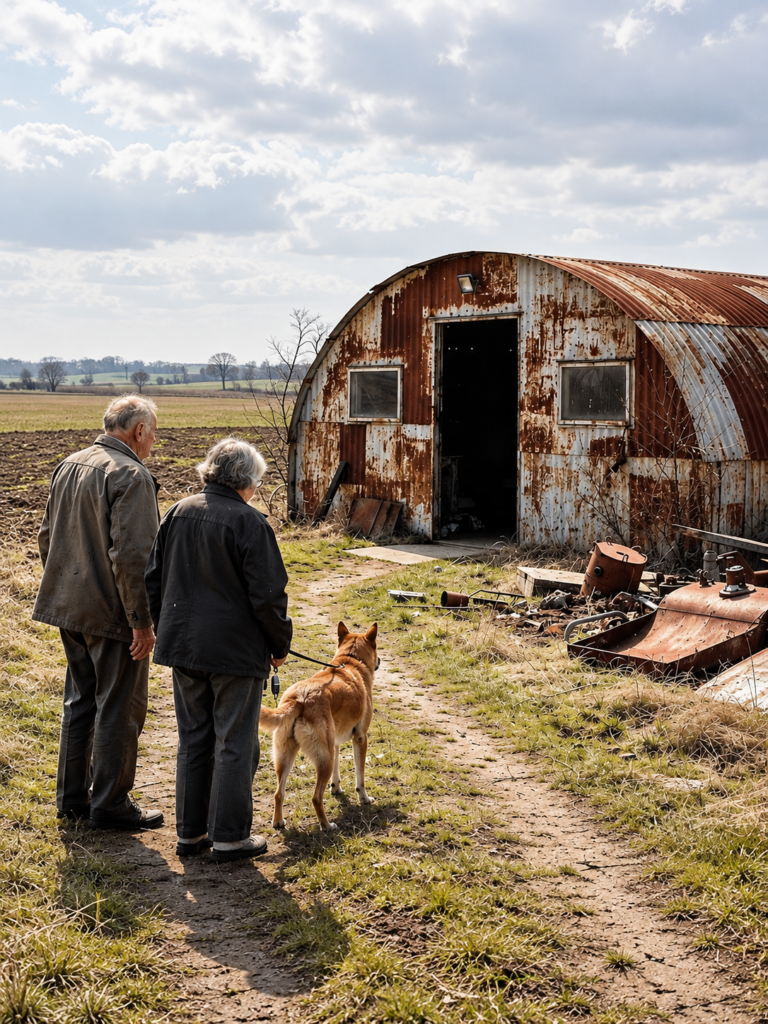
The Quonset rose from the weeds like the curved back of some enormous abandoned animal. Its corrugated steel roof was mottled with rust. Wild grass grew through cracks in the concrete foundation, and the sliding door hung slightly open on its old metal track.
There were no windows worth mentioning, no running water, and no visible electricity.
Olivia stepped carefully from the van.
“It’s bigger than I remembered.”
Matthew nodded. He had estimated the building at forty feet long, but standing in front of it now, he thought it might be closer to fifty.
Duke leaped down and immediately began circling the structure, sniffing along the foundation.
Matthew put both hands against the heavy door.
It resisted for a moment. Then, with a low metallic groan, it slid backward.
Afternoon sunlight entered the building.
Matthew stood still.
The Quonset wasn’t empty.
Beneath gray canvas covers stood the unmistakable outlines of agricultural equipment. There were implements, storage racks, wooden crates, and what looked like a tractor at the far end.
Someone had stored an entire working lifetime inside this forgotten building.
“Matthew?” Olivia called from behind him.
“There’s equipment in here.”
“Does it look usable?”
“I don’t know.”
He stepped inside.
The concrete floor was dusty, but much of the machinery appeared protected from the weather. Whoever had arranged it had done so carefully, leaving narrow paths between the larger pieces.
Then Duke barked.
The dog was standing beside an industrial shelving unit against the far wall. He sat down and looked directly at Matthew.
Matthew knew that expression.
Duke had used it when he found a broken fence, when a calf wandered away from its mother, and whenever he discovered something that demanded human attention.
“What’ve you got, boy?”
On the bottom shelf sat a small army-green metal box. A rusted padlock hung from its handle.
Matthew pulled it into the light.
Across the front, barely visible beneath seventy years of dust, were three stenciled letters.
E. T. M.
His fingers stopped moving.
Edgar Thomas Marsh.
His father’s name.
For a moment, Matthew could only stare.
Edgar had returned from World War II and spent the rest of his life farming in Cedar Falls. He was disciplined, private, and almost painfully practical. He had died in 1978 without ever mentioning this property.
Yet here was his name on a box inside a building his son had just purchased at auction.
“Matthew?” Olivia whispered.
“This belonged to Dad.”
They carried the box outside and placed it on the van’s tailgate.
The padlock had corroded badly enough that Matthew could work it loose. Inside were a leather journal, old photographs, a stopped pocket watch, several official-looking folders, and a folded hand-drawn map.
He opened the journal.
The first entry was dated August 1946.
His father wrote that he had found three acres on Mill Creek Road where he could begin preparing for the future. He intended to use the Quonset for storage and keep the property separate from the main farm.
Then came a sentence that made Matthew read the passage again.
Nobody knows about the money yet, and I aim to keep it that way until I’m sure who I can trust.
“Money?” Olivia asked.
Matthew nodded slowly.
“I don’t understand.”
They read together as the light faded.
Edgar had purchased the property, stored equipment, and apparently maintained financial arrangements that his son had never known existed.
One entry from March 1948 mentioned a banker in Des Moines, certificates that had matured, and the Mill Creek deed being added to a safe-deposit box.
Edgar wrote that someday the assets should belong to whoever needed them most.
Matthew closed the journal.
For several seconds neither spoke.
Then Olivia said, “Robert never knew about this place.”
“No.”
“He knew about the farm. He knew about the accounts. But not this?”
“Not that I ever heard.”
Her hand settled on his arm.
“Then whatever your father left in Des Moines, Robert couldn’t have included it in those financial arrangements.”
Matthew looked toward the dark doorway of the Quonset.
He wanted to believe her.
But his father had been dead for decades. Banks merged. Investments failed. Records vanished. A line in an old journal was not proof that money still existed.
Still, the three acres beneath his boots were real. The machinery was real. And the name on the green metal box was unmistakable.
“Dad owned this place,” he murmured.
“And somehow it came back to you,” Olivia replied.
They returned inside before darkness completely swallowed the building.
Duke had already moved to the covered tractor.
He scratched at the canvas until Matthew pulled it away.
Underneath stood a 1947 Farmall Model M.
Its red paint had faded and its tires were flat, but Matthew recognized the machine immediately. He walked around it slowly, examining the engine, the frame, the familiar lines of a tractor from his childhood.
Then he noticed a piece of yellowed paper tied to the steering wheel.
He carefully loosened the twine.
The handwriting was his father’s.
For my son when he finds his way here. The land provides for those who don’t give up on it.
Dad.
Matthew read the message once.
Then again.
His father’s voice seemed to fill the silent building.
Edgar had rarely told his son he loved him. Praise had always been scarce, expectations high. A good harvest was simply what was expected. A repaired fence meant another job finished. The old man had taught responsibility with tools and labor, not conversation.
Now Matthew stood beside a tractor that had been waiting most of his life, holding words intended specifically for him.
“He left this for me,” he said.
Olivia moved closer.
“He did.”
Matthew swallowed.
“I spent all these years thinking I knew him.”
Duke pressed his head against Matthew’s leg.
Outside, the last sunlight caught the rusty curve of the roof.
For the first time since the farm was taken, Matthew allowed himself to imagine tomorrow without immediately fearing it.
That night they slept in the church van.
Olivia lay across the passenger seats beneath a blanket, while Duke squeezed between them. Matthew listened to her breathing and watched the dark shape of the Quonset through the windshield.
He had bought the property because it was the only shelter he could afford.
But his father had once stood on this same ground and quietly prepared for a future nobody else could see.
The thought kept Matthew awake until morning.
At dawn he walked the boundaries.
The creek ran along the eastern edge. The land sloped gently toward it, with rich dark soil beneath the dead winter vegetation. Mature oaks stood near the northwest corner, offering shelter from the wind. The Quonset occupied the highest ground.
Edgar had chosen the location with a farmer’s eye.
It wasn’t just a hiding place.
It was good land.
When Matthew returned to the van, Olivia had heated weak coffee on their camp stove.
“What’s the plan?” she asked.
“First we make the building livable. Then we find out what’s waiting in Des Moines.”
“That’s a long drive.”
“I know.”
“And gasoline costs money.”
“I know that too.”
He accepted the coffee.
“Maybe there’s something inside we can sell.”
They spent the morning examining Edgar’s stored belongings.
There was a John Deere hay baler from the early 1950s, a disc harrow, hand tools hung in careful outlines on pegboard, rolls of copper wire, boxes of fasteners, old lanterns, and blankets still folded in their original wrapping.
Matthew could almost picture his father standing there, labeling a crate or hanging a wrench in its proper place.
Then Duke began barking again.
He stood near the rear wall beside several wooden crates.
Matthew shifted the crates one by one until he exposed a small steel door welded into the Quonset wall.
A rusted padlock secured it.
With bolt cutters from Edgar’s tool collection, Matthew opened the lock.
Behind the door, concrete steps led downward into darkness.
“There’s a cellar,” he told Olivia.
The air rising from below smelled of earth, old paper, and machine oil.
Matthew lit one of the kerosene lanterns and descended with Duke following close behind.
The underground room was roughly thirty feet square. Concrete walls supported shelves crowded with boxes labeled photographs, letters, and army records. Edgar’s military trunk stood against one wall.
In the middle of the room was a table.
And on the table stood another metal box.
This one was newer, its lock still intact.
Matthew opened it and found an envelope addressed in his father’s hand.
Matthew.
He unfolded the letter.
Edgar wrote that if his son had found his way to Mill Creek Road, life must have gone badly enough for him to need what had been stored there.
The letter apologized for keeping the secret.
It described certificates in safe-deposit box 443 at First Federal Bank of Des Moines. A key was taped to the underside of the metal box. The bank rental had been arranged through 2020, and Edgar had included another letter intended for the institution’s management.
Then the words became more personal.
Edgar admitted that he had feared inheritance could turn families against one another. He had wanted Matthew to build his own life, without dependence on wealth he had not earned.
He also admitted that perhaps he had been wrong to keep everything hidden.
Near the end, the old man had written:
Whatever happened to bring you here, don’t let it break you. You come from people who survived worse.
And then:
I love you, son. I should have said it more when I had the chance.
Matthew sat down on the edge of a wooden crate.
The lantern shook slightly in his hand.
His father had been gone for so many years that Matthew could barely remember the exact sound of his voice. Yet there was something painfully familiar in the letter: the awkward affection, the practical instructions mixed with feelings Edgar could never bring himself to say aloud.
Olivia came down the stairs and found him crying.
She didn’t ask what was wrong.
She simply placed a hand on his shoulder and waited until he was ready to speak.
“He loved me,” Matthew said.
“Of course he did.”
“I never knew how much.”
Olivia crouched beside him.
“He didn’t know what would happen to us, Matthew. But he knew that life could take everything without warning. So he prepared.”
Matthew looked around the cellar.
The stored food. The tools. The carefully preserved documents.
His father had spent decades creating a refuge that he hoped his son would never need.
Matthew searched beneath the metal box.
The brass key was there.
Small, bright, and unmistakably real.
For the next week, Matthew worked from sunrise until his aging body forced him to stop.
They needed money for the journey to Des Moines, and the contents of the Quonset offered possibilities, though none were simple.
The Farmall might interest collectors, but finding a buyer would take time. Most of the equipment was too old to attract much immediate interest.
Then Matthew discovered three sealed fifty-gallon drums of diesel fuel.
The fuel appeared to have been stabilized, and a small test indicated it could still run an engine.
He thought of Oliver Jensen.
Oliver owned the feed store in Cedar Falls. Once, he and Matthew had been friends. Since the eviction, however, Oliver had kept his distance, like so many others in town.
Matthew drove to the store anyway.
Conversation faded as he entered.
Oliver looked up from the counter.
“Matthew.”
“Oliver.”
“What can I do for you?”
“I’ve got diesel to sell. Three fifty-gallon drums. I’ll take three-fifty a gallon.”
Oliver looked interested despite himself.
“That’s below market.”
“I know.”
“Where’d you get it?”
“From my property on Mill Creek Road.”
Oliver studied him.
“That old Quonset?”
“That’s the one.”
For a long moment neither spoke.
Then Oliver came around the counter.
“Matthew, I owe you an apology.”
Matthew said nothing.
“I should’ve come by after what happened. Should’ve asked whether you and Olivia needed anything.”
“You weren’t the only one.”
“That doesn’t make it right.”
Oliver extended his hand.
Matthew shook it.
“I’ll buy the diesel,” Oliver said. “Cash. I’ll bring my truck tomorrow.”
The agreement was worth five hundred twenty-five dollars.
It was enough to give Matthew and Olivia breathing room.
The next day Oliver arrived with the money, but he also brought a propane heater and two full tanks.
“My wife was cleaning out the garage,” he explained. “Figured you could use these.”
Matthew tried to refuse.
Oliver waved him off.
“Call it a loan you don’t need to pay back.”
That evening the Marshes slept inside the Quonset for the first time.
Matthew had cleared a corner and arranged pallets beneath layers of preserved blankets. The heater warmed the immediate space, and Duke curled at their feet as though they were in a proper bedroom.
It wasn’t comfortable by ordinary standards.
But it was a roof.
It was theirs.
And no one had asked them to leave.
Before sleeping, Olivia spoke from beneath the blankets.
“Matthew?”
“Yes?”
“I think I can breathe a little easier.”
He turned toward her.
Since moving to Mill Creek Road, she had noticed a change. The fresh air seemed to help, and she believed the spring water from the creek was doing her good.
Matthew had noticed it too, though he couldn’t know what was responsible.
“Maybe this place agrees with you,” he said.
“Maybe it agrees with both of us.”
He took her hand.
In the darkness, Duke gave a sleepy grunt.
The next morning, they set out for Des Moines.
Matthew had called the bank in advance. First Federal no longer existed under that name. After several mergers, it had become part of Prairie Trust Financial.
A manager named Susan Chen had confirmed that box 443 was still in the bank’s records.
The rental payments had stopped after 2020, but the box remained intact.
There was a question of ownership and overdue fees, and Matthew would need to provide documents proving his connection to Edgar Marsh.
He carried his father’s letter, the key, identification, and a copy of Edgar’s death certificate.
Three hours later, Matthew helped Olivia out of the van outside the bank.
Duke stepped down beside her.
Susan Chen greeted them in the lobby.
When she noticed the dog, she smiled.
“Is he a service animal?”
“He’s a farm dog,” Matthew replied. “And the best friend I’ve ever had.”
Susan considered Duke’s calm posture.
“As long as he’s well behaved, I think we can make room for a best friend.”
The vault lay downstairs.
Rows of metal doors lined the walls, each with its own number and lock.
Susan examined Matthew’s documents. She explained that approximately two hundred forty dollars in back rent had accumulated, then arranged to waive the charge as a courtesy.
Matthew thanked her more sincerely than she could have known.
She inserted her master key alongside his father’s old brass key.
The lock turned.
The metal box slid free.
After placing it on a viewing table, Susan left them alone.
Matthew stood over the box.
For months, his life had been measured in necessities: enough fuel to keep warm, enough food for another day, enough strength to help Olivia through the night.
He had been afraid to hope for anything beyond survival.
Now his hands rested on something his parents had protected across decades.
“Open it,” Olivia whispered.
Matthew lifted the lid.
Inside were bundles of old stock certificates, bearer bonds, and a savings passbook showing forty-seven thousand dollars in 1985, with a note about conversion to a certificate of deposit and annual renewals.
Beneath them lay a final envelope.
The handwriting wasn’t Edgar’s.
Matthew knew it immediately.
It belonged to his mother.
Ruth Marsh had died in 1992, and he had not seen her handwriting in years.
He opened the envelope.
The letter began with three words.
My darling Matthew.
And as he read, he discovered that the greatest secret of his father’s life had never belonged to his father alone.
Part 2
Ruth’s letter was written in the careful, elegant handwriting Matthew remembered from birthday cards, grocery lists, and notes tucked into his school lunches.
For a moment, seeing those familiar letters hurt more than anything he had endured since losing the farm.
He could almost see her at the kitchen table, holding a fountain pen while sunlight fell across her hands.
He began reading.
His mother explained that the hidden investments had been her idea as much as Edgar’s. They had both understood the danger of allowing money to become an expectation rather than a responsibility.
Edgar had invested patiently over thirty years, buying certificates and bonds while gradually building a financial reserve separate from the farm.
They hoped Matthew would never need it.
But if he did, they wanted him to use it well.
Ruth wrote that wealth wasn’t measured only by what a person possessed, but by what that person chose to do with it.
She asked him to build something good and help people who needed help.
Then, near the bottom of the page, came the words that brought tears to his eyes.
I loved you from the moment you were born, and I will love you until the stars go dark.
Matthew lowered the letter.
His mother had known.
She had known about the Quonset, the underground cellar, the financial accounts, and everything Edgar had quietly prepared.
For years, Matthew had believed his parents’ marriage was built almost entirely on duty. His father handled the farm. His mother kept the household together. They worked, saved, and rarely discussed their feelings.
Now he understood that they had shared a private dream.
They had built an invisible shelter around their only son, hoping it would stand long after they were gone.
“Matthew,” Olivia said gently, “how much is there?”
He looked at the certificates.
Some carried the names of companies he recognized. Others belonged to businesses he had never heard of, or corporations that no longer existed.
The bonds were old, but their printed denominations were substantial.
“I don’t know.”
He examined the passbook again.
“But if these are still worth anything, there could be hundreds of thousands here.”
Olivia sat down beside him.
For several moments, neither moved.
Duke rested his head against Matthew’s knee.
Finally Matthew whispered, “We might not be poor anymore.”
Olivia looked at the letters, then at her husband.
“Your parents gave us another chance.”
Matthew folded his mother’s letter with extraordinary care.
It would have been easy to feel triumphant.
Instead, what he felt most strongly was grief.
He would have given a great deal to sit across the table from Edgar and Ruth for one more hour. Not to ask about the money, but to tell them that he finally understood.
On the drive back to Mill Creek Road, Olivia suggested they speak with Tom Redhawk, an attorney who had handled business matters for the farm years earlier.
Tom had been one of the few people who sent them a sympathetic message after the eviction.
Matthew remembered the card. No excuses, no elaborate promises. Just a simple acknowledgment that what had happened was wrong.
“I think he’ll see us,” Matthew said.
The following day they climbed the stairs to Tom’s office above a bakery on Main Street.
Tom, a compact man in his sixties with silver-streaked dark hair, greeted them warmly.
When Matthew placed the documents on his desk, the attorney’s expression changed.
“Where did these come from?”
“My father,” Matthew answered. “He left them in a bank box in Des Moines.”
Tom put on his reading glasses.
For nearly an hour, he examined stock certificates, recorded company names, studied the bonds, and made notes from the savings documents.
At last, he leaned back.
“Matthew, I’ll need to verify everything. Some of these companies were acquired years ago. Their shares may have been converted into holdings in larger corporations.”
“Does that mean they’re worthless?”
“Quite the opposite, potentially.”
Tom tapped one certificate.
“Your father bought some of these investments when the companies were very young. Stock splits, reinvested dividends, and decades of growth could make them considerably more valuable now.”
He estimated that the stocks alone might represent three to four hundred thousand dollars. The bonds, assuming they remained valid, could add another fifty to seventy-five thousand. The savings account might hold still more after years of accumulated interest.
Matthew stared at him.
“You’re telling me my father left half a million dollars?”
“I’m telling you it may be more than that. But don’t spend a penny based on an estimate.”
Matthew almost laughed.
For weeks he had worried about the price of gasoline.
Now he was being cautioned not to spend money he couldn’t yet comprehend.
Tom asked for several days to verify the assets and advised the couple to keep their discovery private.
Matthew understood why.
He had already seen what money could do to his family.
While Tom made calls, Matthew returned to work.
He repaired the Quonset’s sliding door with hardware found among Edgar’s supplies. He patched openings in the metal walls, cleared an area for a proper living space, and built a simple bed frame from salvaged lumber.
Olivia organized a kitchen corner and began sorting the cellar.
Duke moved between them, occasionally investigating a crate or presenting himself for a scratch behind the ears.
Oliver Jensen stopped by with metal sheeting and other supplies.
When Matthew offered to pay, Oliver shook his head.
“You can settle up when you’re back on your feet.”
Matthew looked toward the Quonset.
He was already standing straighter than he had in months.
Eight days after their meeting, Tom called.
“Matthew, I’ve verified the assets.”
Matthew lowered himself onto an overturned bucket.
“And?”
“The investments are real. The bonds are valid. The savings account survived the bank mergers.”
He heard paper moving at the other end of the line.
“You’re looking at approximately six hundred twenty thousand dollars in assets that can be converted to cash.”
Matthew stopped breathing for a moment.
“Six hundred twenty thousand?”
“Approximately. Taxes and other costs will reduce the final amount. You could still come away with something around five hundred thousand dollars once the necessary transactions are completed.”
Five hundred thousand dollars.
More than enough to repair the Quonset.
Enough to make sure Olivia had a warm home, proper medical care, and food on the table.
Enough to live the rest of their days without fear of another eviction.
Matthew looked across the clearing at his wife.
She was kneeling beside a small patch of newly turned garden soil, Duke standing nearby as though supervising.
He had to grip the edge of the bucket.
But Tom wasn’t finished.
“There’s something else. Robert has been making inquiries.”
The warmth inside Matthew disappeared.
“What kind of inquiries?”
“About inheritance. About property discovered after a previous owner died. About whether grandchildren can claim assets from a grandparent’s estate.”
Matthew closed his eyes.
“He’s found out.”
“Apparently.”
“Can he take it?”
“From the records I’ve reviewed, Edgar’s assets were his own, and you’re his surviving child and lawful heir. Robert doesn’t appear to have a valid claim. But that doesn’t mean he won’t try.”
Matthew looked at the Quonset again.
The building his father had prepared.
The ground beneath it.
The home he and Olivia were struggling to create.
“Then let him try.”
By the third week of April, spring had arrived in earnest.
The Quonset was weather-tight. Matthew had divided it into living quarters, a kitchen area, and a workshop where the old Farmall waited for restoration.
Outside, the land was gradually emerging from its wilderness of weeds and brush.
The work exhausted him, but it also restored something inside him that no financial inheritance could have purchased.
Every repaired panel, planted row, and fence post reminded Matthew that he was still capable of useful work.
One afternoon he was examining the tractor’s fuel system when Duke rose suddenly.
The dog stared down the driveway.
A dark sedan was approaching.
Matthew straightened.
Robert stepped out wearing an expensive suit and polished shoes that immediately collected dust from the gravel.
“Dad.”
Matthew did not approach him.
“Robert.”
His eldest son glanced around the property.
“You’ve been busy.”
“Yes.”
“I heard you’ve made some discoveries.”
Matthew waited.
Robert pushed his hands into his pockets.
“We need to talk about Grandpa’s investments.”
Duke began a low growl.
Matthew rested one hand on the dog’s back.
“What about them?”
Robert’s expression shifted.
“They belong to the family.”
“They belonged to my father. He left them to me.”
“Patricia and Michael are grandchildren too. We have rights.”
Matthew studied his son.
He remembered Robert as a boy chasing chickens around the farmyard. He remembered teaching him to drive a tractor, paying his college expenses, and believing that one day Robert would protect the family just as generations before him had done.
Now his son stood on the land Edgar had hidden, demanding a share of money he had not known existed.
“Tell me something,” Matthew said. “When your mother and I were sleeping in that church parking lot, did you wonder whether we had enough to eat?”
Robert frowned.
“Dad, I was trying to help you.”
“Did you?”
“The investments went badly. That happens. The risks were disclosed.”
Matthew shook his head.
“You lost our farm. You left us without a home. Then you offered us a nursing home brochure as though you’d done us a favor.”
“That’s unfair.”
“Was it unfair when your mother had to sleep in a van because she couldn’t catch her breath in the cold?”
Robert looked away.
“That was never what I intended.”
“But it’s what happened.”
Robert took a step closer.
“The law doesn’t work on hurt feelings. If Grandpa created a family arrangement, his descendants could have an interest.”
“The law is something I’ve discussed with my lawyer.”
Robert’s jaw tightened.
“I don’t believe you’d cut your own children out of an inheritance.”
Matthew met his eyes.
“I didn’t take anything from you, Robert. And I won’t let you take anything else from us.”
For the first time, Robert’s practiced confidence seemed to fail.
Matthew pointed toward the Quonset.
“Your grandfather prepared this place because he understood that people sometimes lose everything. I doubt he ever imagined the danger would come from inside his own family.”
Robert glanced toward the building.
“You really intend to live in that barn?”
“I intend to live somewhere nobody can tell me I no longer belong.”
Robert’s face hardened.
“We’ll see.”
He returned to his sedan and drove away.
Matthew watched the dust settle along the access road.
Only when the car disappeared did he sit down on the front step.
Duke climbed awkwardly into his lap, all seventy pounds of him, and pressed his face against Matthew’s chest.
“You’re getting too big for that, old boy,” Matthew whispered.
But he wrapped his arms around the dog and held him.
Olivia found them twenty minutes later.
“Robert came?”
Matthew nodded.
“He wants the money.”
“Of course he does.”
“He says it’s family property.”
Olivia sat beside him.
“And what did you say?”
“That he’s already taken enough.”
She looked toward the driveway.
For years, they had made excuses for their children.
Robert was ambitious. Patricia was busy. Michael was sensitive. They had protected each of them from consequences, imagining that generosity would teach generosity in return.
Instead, something had gone wrong.
“We taught them that we would always give,” Olivia said quietly. “Maybe we never taught them that giving ought to go both ways.”
Matthew considered her words.
It was an uncomfortable truth, but one he could not entirely dismiss.
They had raised their children with love.
Somewhere along the way, their sacrifices had become expectations.
“We can’t go back and raise them again,” Matthew said.
“No.”
“But we can decide how we live from here.”
Olivia took his hand.
“Then let’s make this a good life.”
Robert filed a legal claim alleging that Edgar Marsh’s assets belonged to a family trust and should be divided among his descendants.
Patricia joined him.
Michael, true to his lifelong habit of avoiding conflict, declined to take either side.
Tom Redhawk handled the defense.
Edgar’s records established that the investments had belonged to him personally. The property had been acquired decades before his grandchildren were born. His will and the surrounding documents supported Matthew’s claim.
Robert had hoped his father would pay simply to make the legal trouble disappear.
Matthew refused.
For six weeks, letters from attorneys arrived, deadlines came and went, and Matthew found himself once again dreading the ringing telephone.
Olivia watched the strain wear on him.
Duke rarely left his side. When Matthew grew too restless to sit, the dog appeared with a tennis ball or rested his broad head against his knee.
Finally, the court dismissed the claim.
Robert and Patricia gained nothing.
Matthew stood in Tom’s office after receiving the news.
“That’s it?” he asked.
“That’s it,” Tom answered. “The claim is dismissed.”
Matthew looked at the documents on the desk.
There was no sudden burst of joy.
He felt relief, certainly, but beneath it lay the sadness of knowing his children had chosen to fight him again rather than acknowledge what they had done.
Tom seemed to understand.
“You’ve protected what your father left you.”
Matthew nodded.
“And what happens now?”
“Now,” Tom said, “you get to decide what kind of life you want.”
By midsummer, the answer was taking shape.
Solar panels had been installed on the Quonset’s curved roof. A small addition contained a proper bathroom, and water from a newly discovered well supplied the household. A functional kitchen replaced their camp stove.
The roof had been repaired and painted. The sliding door opened smoothly. A chimney carried smoke from a wood stove that would keep the building warm through winter.
Matthew cleared the creek banks and prepared garden beds.
Olivia planted vegetables, herbs, and flowers. Small fruit trees took root where thorny brush had once grown.
The place was still unmistakably a Quonset hut, but it was no longer a wreck.
It was a home shaped by two people who had been told they were finished.
Visitors began to notice.
Oliver came regularly, sometimes bringing supplies and leaving with vegetables from Olivia’s garden.
Pastor Williams from the Methodist church visited and stood quietly looking around the property.
Neighbors who had ignored the Marshes during their worst months began stopping by again.
Some offered help.
Some asked questions about the garden.
Others simply wanted to see what the old couple had accomplished.
One evening, Matthew and Olivia sat together on the porch he had built.
Duke chased fireflies through the fading light.
“Funny, isn’t it?” Olivia said.
“What?”
“When we had nothing, most people couldn’t bear to look at us. Now everybody wants to visit.”
Matthew gazed across the land.
“Doesn’t that make you angry?”
“It did.”
“And now?”
She considered the question.
“I think some people were afraid of our trouble. They didn’t know how to help, so they stayed away. That doesn’t make it right, but I don’t want to spend our remaining years keeping track of everyone who disappointed us.”
“That’s a long list.”
She laughed softly.
“Then we’d better find something better to do.”
Matthew turned toward her.
“What would that be?”
“Build. Grow things. Help somebody when we can. Be the people we wanted our children to become.”
Duke returned to the porch and collapsed at their feet, exhausted and pleased with himself.
Matthew rested his hand on the dog’s warm back.
For the first time in longer than he could remember, the future did not feel like something approaching to punish him.
It was something he could still shape.
And the place his father had hidden was becoming far more valuable than the money it had led him to discover.
Part 3
Autumn arrived on Mill Creek Road in shades of copper, gold, and deep red.
The oak trees along the western boundary shed their leaves across the newly cleared ground. The garden produced more vegetables than Matthew and Olivia could eat fresh, and jars of preserved food began filling the shelves in Edgar’s old cellar.
The Quonset smelled of wood smoke, bread, and the herbs Olivia had hung to dry.
Matthew had never expected to feel contentment again.
He had imagined old age would mean sitting on the porch of his family farmhouse, watching grandchildren play where he had once played, knowing the land would remain in the family.
That future was gone.
But another had taken its place.
One September morning, after months of repairing the 1947 Farmall, Matthew finally turned the ignition and heard its engine cough into life.
At first it sputtered unevenly.
He adjusted the controls.
The engine settled into a steady rhythm.
Matthew sat motionless behind the steering wheel.
He remembered standing beside his father as a boy, watching Edgar diagnose machinery by sound alone. Edgar had always insisted that a man should understand his tools well enough to recognize trouble before it became disaster.
Now the tractor was running again.
Matthew let it idle while Duke sat beside the front wheel, his tail sweeping lazily through the dust.
He wished his father could see it.
Instead of driving anywhere, Matthew remained in the seat, listening.
The tractor had waited nearly seventy years for someone to bring it back to life.
In a strange way, so had the hopes Edgar had stored inside that building.
By October, the restoration was complete.
The Farmall stood outside the workshop with its red paint renewed and its engine ready for work.
Olivia came out to admire it.
“Your father would be proud.”
“He’d find something wrong with it.”
“Of course he would.”
They both laughed.
Edgar had been a demanding man, and even now Matthew could imagine him pointing out a crooked bolt or a slightly uneven coat of paint.
Then Olivia became serious.
“There’s something I want to show you.”
She led him into the cellar.
Duke trotted down the stairs ahead of them.
Behind several rows of Mason jars, Olivia had discovered a small cedar box. Duke had been pawing insistently at the spot until she moved the jars aside.
“I thought he was hunting a mouse,” she explained. “But he wouldn’t leave it alone.”
Matthew carried the box upstairs, where the afternoon light fell across their kitchen table.
Inside, resting in faded velvet, was a delicate diamond ring.
Beside it lay another note.
Matthew recognized the ring from an old family photograph.
It had belonged to his grandmother, Edgar’s mother, who had died before Matthew was born.
He unfolded the note.
Edgar explained that his mother had worn the ring throughout her marriage and wanted it passed to someone who understood that marriage meant more than a ceremony.
It meant choosing to remain when remaining was difficult.
Edgar had kept the ring because he believed it should wait for the right moment.
Then came the instruction.
Give this ring to Libby. She’s earned it. So have you.
Matthew looked at Olivia.
Her eyes were shining.
“Your father saved that all these years?”
“For you.”
He stood and took her left hand.
Her original wedding band was thin from decades of wear. They had married young, and the years since had brought good harvests, lean seasons, frightened nights, small joys, and sorrows neither could have imagined on their wedding day.
For sixty-two years they had continued choosing one another.
“May I?” Matthew asked.
Olivia nodded.
He slipped his grandmother’s ring beside her wedding band.
The little diamond caught the light.
Matthew held her hand in both of his.
“If I had to do it all over again,” he said, “every struggle, every year, every hard day, I’d still choose you.”
Olivia laughed through her tears.
“We’re already married, you old fool.”
“I know.”
“Then what are you doing?”
“Reminding you.”
He kissed her forehead.
Duke squeezed between their legs, demanding to be included.
They stood together in the kitchen of a building everyone had once dismissed as scrap metal, looking at a ring that had waited generations to find its way home.
Later that month, a letter arrived.
Matthew recognized the handwriting before opening it.
Michael.
His youngest son had sent a small check and an inadequate card after the eviction, but he had never done anything meaningful to stop Robert.
He had also stayed out of the inheritance lawsuit.
Matthew stood at the kitchen counter holding the envelope.
For a moment, he considered throwing it away.
Then he opened it.
Michael began by apologizing.
He did not ask for money or forgiveness. He acknowledged that he had known something was wrong when Robert began arranging the investments, but had remained silent because confronting his brother frightened him.
He admitted that he had spent his life avoiding difficult decisions.
He knew that silence had helped cause his parents’ suffering.
Michael had heard about the Quonset through Oliver Jensen’s daughter, who worked with his wife. He knew that the old property had been transformed and that people around Cedar Falls were beginning to call it the Marsh place.
He wrote that he was proud of his father.
And he understood that pride did not give him any right to return as though nothing had happened.
At the end, Michael wrote that he loved both his parents and always had, even when he was too weak to demonstrate it.
Matthew read the letter three times.
Then he placed it on the table.
Duke lifted his head from a patch of sunlight.
“What do you think, boy?”
The dog approached, sniffed the paper, and gave one slow wag of his tail.
Matthew almost smiled.
“That’s not much of an answer.”
He didn’t write back.
Not immediately.
The letter troubled him because it asked for nothing, and that made it harder to dismiss.
Robert had come demanding property. Patricia had joined a lawsuit. Michael, for once, seemed to understand that he was owed nothing.
One evening beside the wood stove, Matthew showed Olivia the letter.
She read it carefully.
“He’s telling the truth, I think.”
“How can you know?”
“I can’t. But he’s not asking you to do anything for him.”
“That doesn’t undo what happened.”
“No.”
“He could’ve stopped Robert.”
“Maybe. Or at least tried.”
Matthew rubbed his hands together.
“He was always afraid of his own shadow.”
Olivia looked into the fire.
“And every time he got frightened, we stepped in and protected him.”
Matthew said nothing.
They remembered Michael as a worried little boy, always hanging back during family gatherings. They had sheltered him from conflict and smoothed away every difficulty they could.
Perhaps they had protected him so thoroughly that he had never learned how to stand up for anyone else.
That understanding did not excuse what he had done.
But it complicated Matthew’s anger.
“I don’t know how to forgive him,” he admitted.
Olivia placed a hand over his.
“Then don’t promise what you can’t give. You can love him without pretending you trust him.”
The first snow arrived in November.
One morning Duke led Matthew into the workshop and began pawing at a wooden box near the workbench.
By now, Matthew no longer questioned the dog’s strange ability to discover things that had escaped human eyes.
He opened the box.
Inside were dozens of letters, tied in old bundles.
Correspondence between Edgar and Ruth.
Some dated from before their marriage. Others came from the years when Matthew was a boy. The collection continued through much of their lives together.
Matthew sat on a stool and began reading.
In one letter from 1955, Ruth described eight-year-old Matthew asking why his father worked so hard.
She had told him Edgar was building more than a farm.
He was building a future.
Another letter revealed how deeply the war had changed Edgar. Ruth understood that her husband saw dangers others ignored and prepared for disasters he could not name.
She trusted him even when she didn’t understand every precaution he took.
Edgar’s replies were equally revealing.
He worried about economic downturns, illness, and the possibility that his family might one day be left helpless.
In a letter from 1962, he explained that he was not preparing because he expected disaster.
He was preparing because he could not bear the thought of Ruth or Matthew suffering without protection.
Matthew sat alone in the workshop as snow collected outside.
All his life, he had remembered his father as a man who worked too much, spoke too little, and rarely expressed affection.
Now the letters showed him someone different.
Edgar had been afraid.
Afraid of losing the people he loved. Afraid that the world might destroy what he had built. Afraid that his son might one day stand alone without anyone to help him.
And because Edgar did not know how to express those fears openly, he had turned them into savings, equipment, property, and carefully locked boxes.
Matthew wiped his eyes.
“He loved us, Duke.”
The dog rested his head on Matthew’s knee.
“He just didn’t know how to say it.”
That evening, Matthew brought the letters into the living room.
Olivia read several aloud.
They sat together beside the stove, surrounded by the ordinary comforts they had built: a proper table, photographs, rugs, shelves of books, and a kitchen that smelled of supper.
At last Olivia set the papers down.
“Matthew, I think you should write to Michael.”
He looked at her.
“Why?”
“Because you’ve spent your life wishing your father had told you what he felt. Now you know he loved you, but it took all these years and all these letters for you to understand.”
“Michael knows I love him.”
“Does he know what you’re feeling now?”
Matthew looked at the fire.
He had spent months telling himself that his children no longer deserved his attention.
Perhaps Robert and Patricia had made choices he could not forgive. But Michael had admitted his failure without demanding anything in return.
Matthew thought about all the things he had never asked Edgar while his father was alive.
He did not want to create another lifetime of unanswered questions.
“I’ll write,” he said.
The next day he sat at the kitchen table with a pen and several sheets of paper.
He tried a dozen beginnings.
Some sounded too angry. Others sounded as though everything had been forgiven.
Neither was true.
Finally, he stopped trying to write the perfect letter.
He wrote what he actually felt.
He told Michael that he had received the apology.
He explained that what Robert had done, what Patricia had supported, and what Michael had failed to prevent had caused real suffering.
He and Olivia had lost their home during the coldest part of the year. They had been left with little money, uncertain shelter, and serious worries about Olivia’s health.
Matthew refused to minimize that harm.
But he also acknowledged that he and Olivia had made mistakes as parents.
They had sacrificed so much for their children that perhaps they had never taught them to recognize sacrifice as something that deserved gratitude and responsibility in return.
He wrote about discovering Edgar’s letters and realizing how much love could remain hidden beneath a lifetime of silence.
He didn’t want Michael to spend the rest of his life wondering whether his father still loved him.
Then Matthew wrote the hardest words.
I love you because you’re my son, and that won’t change. But I don’t trust you.
He explained that trust could only return through action, slowly and without expectation.
He was not offering money, a place to live, or instant reconciliation.
He was offering the possibility that a damaged relationship might one day be repaired.
Matthew signed the letter and mailed it before he could change his mind.
Winter settled over Mill Creek Road.
Snow gathered against the trees and lay thick across the garden beds, but the Quonset remained warm.
The wood stove burned steadily. Olivia baked bread, knitted blankets, and prepared soups from the vegetables she had preserved in autumn.
Matthew built a chicken coop from salvaged lumber and acquired six hens from Oliver Jensen. He expanded the cellar storage and organized Edgar’s old tools until every wrench and saw had its proper place.
Duke, now eleven years old, spent long afternoons sleeping beside the stove. His muzzle had turned gray, and his hips sometimes stiffened in the cold.
But every morning he still made his rounds as if the security of the entire property depended upon him.
Matthew and Olivia talked often about their children.
Those conversations were not easy.
They discussed what had happened, the choices they regretted, and the things they might have done differently.
Neither excused Robert’s actions or Patricia’s coldness.
But slowly, the need to rehearse the betrayal every day began to fade.
In February, Michael wrote again.
The letter was brief.
He had begun volunteering at a food bank in his city.
He was learning how to help people without expecting anything in return, and he wanted his father to know.
He did not ask for a visit.
He did not ask for forgiveness.
Matthew read the letter and put it carefully beside the others.
Then he wrote back, acknowledging what Michael had done and encouraging him to continue.
It was not reconciliation.
Not yet.
But it was a beginning.
Spring returned to Mill Creek Road almost exactly a year after the auction.
The land that had once been choked with weeds now held orderly garden beds, fruit trees covered in blossoms, and a well-kept yard surrounding the Quonset.
The building itself gleamed in the morning light.
Its roof was sound, its walls repaired, its windows clean. Smoke rose gently from the chimney, and the front porch offered a place to sit and watch the creek.
Matthew stood near the edge of the property with Duke beside him.
The dog was slower now, but his eyes remained bright.
“We did it, boy,” Matthew whispered.
Duke gave a gentle sweep of his tail.
From the porch, Olivia called to him.
“Oliver’s coming up the drive!”
The feed store owner arrived with seed potatoes and jars of homemade jam from his wife.
Matthew helped him unload the truck.
As they worked, Oliver looked across the gardens and toward the restored Quonset.
“You’ve built something good here.”
“We had help.”
“You had a foundation,” Oliver replied. “Your father left you more than equipment and money. He left you a reason to believe you could begin again.”
Matthew looked toward the house.
He knew Oliver was right.
The inheritance had given them financial security, but money alone hadn’t repaired the roof, planted the gardens, restored the tractor, or made Olivia laugh again.
Those things had required work, patience, and the willingness to begin each morning.
They had required the loyalty of an old dog, the kindness of a friend, and a love that had survived more than sixty years.
After Oliver left, Matthew went inside.
At the kitchen table, he took out a fresh sheet of paper.
He had been thinking about his father, about the hidden letters and the secret refuge on Mill Creek Road.
He had also been thinking about his own children.
He could not control how they remembered him.
But perhaps he could leave something that explained what he had learned.
He began writing.
He wrote that starting over was possible at any age, though it often required surrendering the future one had once imagined.
He wrote that love did not always arrive in words, and that some people expressed it through work, worry, and the things they quietly prepared.
He wrote that forgiveness did not mean pretending no harm had occurred.
It meant choosing not to let that harm become the only remaining definition of a relationship.
He wrote about Duke, who had shown him what steadfast loyalty looked like.
And about Olivia, whose presence had made even their hardest days bearable.
Finally, he wrote the words his father had left tied to a tractor steering wheel.
The land provides for those who don’t give up on it.
Matthew folded the paper and placed it inside the wooden box containing his parents’ correspondence.
Perhaps someone would discover it years from now.
Perhaps they would understand what this place had meant.
Or perhaps the letters would remain hidden, just as Edgar’s had remained hidden for so long.
Matthew found that he no longer cared which happened.
The value of the life they had built did not depend on anyone else discovering it.
He looked around the Quonset.
There were photographs of their family, the restored furniture Olivia had chosen, shelves crowded with preserves, and the steady warmth of the stove.
Olivia sat near the window reading, her grandmother’s ring beside her old wedding band.
Duke was asleep at her feet.
Matthew crossed the room and kissed the top of his wife’s head.
She looked up.
“What was that for?”
“For staying.”
Olivia smiled.
“Where else would I go?”
“For believing we could build something when everyone else thought we couldn’t.”
She closed her book and took his hand.
“We did build something, Matthew.”
He looked at her.
“A home.”
“A life,” she corrected gently. “We built a life worth living.”
Outside, the afternoon sunlight turned the Quonset’s curved roof to gold.
The three acres nobody had wanted were green and growing. The Farmall stood ready in the workshop. The creek continued its quiet journey along the eastern boundary.
A year earlier, Matthew and Olivia Marsh had arrived with almost nothing, carrying the humiliation of betrayal and the fear that their best days were behind them.
Now they had a place that was theirs.
Robert and Patricia had not made amends. Michael’s future place in their lives remained uncertain. Those wounds had not vanished simply because the bank account was full or the house was warm.
But Matthew no longer measured his entire life by what his children had taken.
His father had left him an inheritance, yes.
More importantly, Edgar had left proof that love could outlast silence, that preparation could outlast death, and that even a forgotten piece of land could become a refuge when the world offered nowhere else to turn.
Duke woke from his nap and padded over to the couple.
He pressed his graying head against their legs, making certain neither had forgotten him.
Matthew bent to scratch behind his ears.
Olivia laughed.
For a long moment, the three of them stood together in the home that once had been a rusted, abandoned Quonset.
They were not there because they had no other choice.
They were there because they had chosen it.
They had chosen the land, the work, the small daily joys, and one another.
And for Matthew Marsh, who had once believed his entire life had been taken from him, that was the greatest inheritance of all.


