
Part 1
“Nine hundred euros for the old cow.”
The auctioneer’s voice rang through the livestock hall, sharp and practiced, bouncing off concrete walls damp with the morning cold.
“Nine hundred. Anybody going higher?”
Nobody moved.
A few men exchanged glances. Someone near the back gave a quiet laugh. The auctioneer tapped his wooden hammer against the edge of the podium, waiting for a bid he clearly didn’t expect to receive.
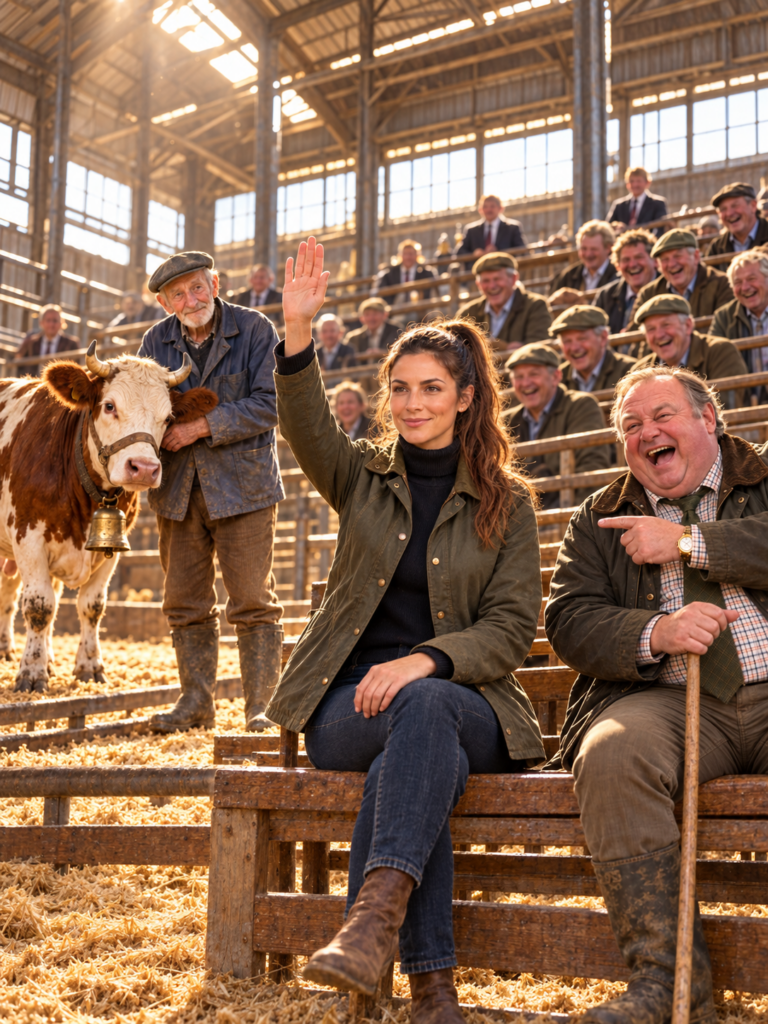
In the ring stood an aging brown-and-white cow with short, curved horns and a leather halter worn soft by years of use. A large brass bell hung beneath her neck. Its surface was dented and darkened, and the strap holding it had been repaired more than once.
The animal wasn’t especially impressive. She was eleven years old, her best milk-producing years behind her, and she stood so calmly amid the noise that she almost seemed unaware she was being sold.
Beside her stood Martin Keller.
He was an old man in a faded blue work jacket and a wool cap pulled low over his ears. His shoulders had the permanent stoop of someone who had spent a lifetime lifting things heavier than he should have. One hand held the lead rope. The other rested against the cow’s neck, just beneath the bell.
He wasn’t looking at the buyers.
He was looking at Estela.
For eleven years, she had known the same barn, the same feeding routine, and the same man’s hands. Now she stood beneath the auction lights while strangers decided how much of her life was left to sell.
“Nine hundred euros,” the auctioneer repeated. “Going once.”
At the front of the hall, Bruno Roth lowered his bidding stick.
His offer stood uncontested.
Nine hundred euros was less than a slaughterhouse would ordinarily pay for an animal that size. The farmers sitting on the wooden benches knew it. The auctioneer knew it. Martin Keller certainly knew it.
Yet nobody challenged Roth.
They had reasons.
What none of them knew was that Martin had been carrying a letter from a notary in his jacket pocket for three days. He had not opened it. If Estela left that morning in a livestock dealer’s trailer, there was a good chance he would sign away something else before winter was over.
Something much larger than a cow.
Near the back of the auction hall, a woman in a green work jacket raised her head.
Elena Berg hadn’t come to buy an old cow.
She had driven in that morning intending to look at young heifers, perhaps four or five, for a small farm she had purchased near the edge of the forest. She wore rubber boots, faded jeans with an oil stain across one knee, and a jacket that looked as if it had already survived several hard winters.
Nothing about her appearance suggested money.
That suited her.
Elena had spent much of the morning watching the auction without bidding. She preferred understanding how a place worked before trying to do business in it. The habit had served her well in the machinery industry, where the person talking the loudest often knew considerably less than the person willing to listen.
And after twenty minutes, she had learned something important.
Bruno Roth controlled the room.
He was a broad, heavy man with a red face and thinning hair combed carefully across his scalp. His expensive waxed field jacket strained around his stomach. Most of the time, he barely bothered to lift his bidding stick. When he did, competing hands tended to disappear.
Elena had noticed it happen twice already.
Finally, she leaned toward the farmer sitting beside her.
“Who’s the man in front?”
The farmer followed her gaze and lowered his voice.
“Bruno Roth.”
“Should I know him?”
“You will if you stay around here.”
The man shifted uneasily on the wooden bench.
“He buys about half the livestock that goes through this place. And if you bid against him, don’t expect him to buy anything from you next year.”
Elena looked back toward the ring.
“So everyone lets him set the price?”
The farmer shrugged.
“Everyone has to make a living.”
There was no anger in his voice. Just the weary acceptance of someone who had learned which battles cost too much to fight.
Below them, Martin’s fingers tightened around Estela’s leather strap.
The auctioneer lifted his hammer.
“Nine hundred, going twice—”
Elena raised her hand.
The auctioneer stopped.
Heads turned across the hall.
A few farmers leaned forward, thinking they must have misunderstood. Roth twisted in his seat and studied the woman at the back. His gaze traveled from her muddy boots to the old jacket and the oil-stained jeans.
Then he smiled.
“The lady in rubber boots wants to bid,” he announced.
Scattered laughter rolled through the benches.
Roth turned farther around.
“With what money?”
The laughter grew louder.
It wasn’t especially cruel. Some of the men even looked relieved. For once, someone other than themselves had attracted Roth’s attention.
Elena remained seated.
She had negotiated machinery contracts worth far more than anything in that hall. She knew how men like Roth used embarrassment as a weapon. A small offer would simply invite him to raise the price a little at a time, forcing her to keep responding while he enjoyed the performance.
She also knew something else.
A livestock dealer looking for cheap slaughter cattle didn’t usually make a speech about it.
Roth wanted the room to see who owned the bid.
Elena met his eyes.
“My money.”
Then she raised her hand again.
“Three thousand euros.”
The laughter stopped.
For a moment, the only sound in the building came from a restless calf calling somewhere behind the holding pens.
The auctioneer stared at Elena.
“Three thousand?”
“Yes.”
Roth’s smile disappeared.
Three thousand euros for an eleven-year-old cow that barely produced milk made no financial sense. Elena understood that perfectly. But the price of the animal wasn’t the only thing being decided in that ring.
Roth turned fully toward her.
“What in the world do you want with a cow that doesn’t give milk?”
Elena looked down at Estela.
The old animal stood beside Martin, patient and trusting, while the man’s hand remained pressed against her neck.
Then Elena looked back at Roth.
“Who said I wanted milk?”
A murmur passed through the crowd.
Roth studied her for another moment. His expression changed into something more thoughtful and considerably less friendly.
He didn’t raise his bidding stick.
Instead, he leaned back and spoke quietly enough that only those nearest him heard.
“You have no idea what you’re getting yourself into.”
The auctioneer lifted his hammer before the conversation could go any further.
“Three thousand euros. Going once. Going twice.”
The hammer fell.
“Sold.”
Roth stood immediately. His chair scraped against the floor, and he walked out without looking back.
Elena sat still for several seconds, surprised by the force of her own heartbeat.
She had come looking for young cattle.
Instead, she had just spent three thousand euros on an old cow and made an enemy of the most powerful livestock buyer in the valley.
Outside, the morning air smelled of wet earth, diesel exhaust, and animals.
Martin Keller led Estela toward Elena’s trailer without saying much. He tied the rope to a steel ring, checked the knot, then tied it again as though he didn’t trust his own hands.
Elena opened her mouth to speak, but Martin reached beneath the cow’s neck.
He unfastened the old brass bell.
The leather strap came free with a faint creak.
For a moment, he held the bell in both hands. His thumb moved across a dent in its side, then he placed it carefully into Elena’s palms.
“She won’t need this where she’s going,” he said.
His voice was steady, but he avoided her eyes.
“Mr. Keller—”
“Take care of her.”
He turned and walked toward an old car parked beyond the trailers.
Elena watched him climb behind the steering wheel. He closed the door and sat there without starting the engine.
Minutes passed.
Other vehicles came and went.
Still he sat.
Finally, Elena put the bell on the passenger seat of her truck and drove away with Estela in the trailer behind her.
She didn’t know that the bell carried names Martin’s family had preserved for generations.
She didn’t know that Bruno Roth had wanted Estela removed from the Keller farm for reasons having nothing to do with meat or milk.
And she certainly didn’t know that she would soon find herself fighting to save land she had never intended to own.
All she knew was that the old man sitting alone in his car had looked as though something inside him had gone quiet.
And the feeling stayed with her all the way home.
Elena’s farm occupied six hectares at the edge of a forest.
The house was old and cold. The barn roof leaked during heavy rain. One gate dragged against the ground, and the water trough had needed a thorough scrubbing before it could be used.
To most people, the property would have looked like another expensive problem.
To Elena, it had looked like a place where broken things might still be worth fixing.
She had spent twelve years building a company around that principle.
Her business had specialized in bringing aging agricultural machinery back to useful life. She designed modern control systems that could be fitted to older equipment, allowing farmers to keep working with machines they already owned rather than take on crushing debt to purchase new ones.
At first, Elena worked alone in a small workshop.
She welded brackets, rewired control panels, answered customer calls, and spent long evenings studying stubborn technical problems after everyone else had gone home.
Eventually, the workshop grew into a company employing forty people.
There were larger orders, bigger facilities, and customers who believed in what she was building.
Then a major agricultural equipment manufacturer offered to buy the business.
The offer was more money than Elena had ever imagined possessing.
She signed the papers.
Three weeks later, an email arrived announcing that the manufacturer would discontinue production of the retrofit systems.
The profit margins were too small, the message explained. It would be better for customers to replace their old machinery with newer equipment.
Twelve years of work, reduced to a decision made by people who had never stood in a muddy field beside a farmer trying to make one more season out of a reliable tractor.
Elena had become wealthy.
But she had also discovered that wealth could feel very much like having the ground removed from beneath your feet.
By spring, she was sleeping badly.
By summer, she had purchased the little farm near the forest.
She told herself she needed physical work, something honest and measurable. A roof either leaked or it didn’t. A gate either closed or it didn’t. Animals needed feeding regardless of how much money their owner had in the bank.
Those were problems she could understand.
At least, that was what she believed until Estela arrived.
The old cow wouldn’t eat.
Elena had spread fresh straw through a clean stall, filled the manger with good hay, and made sure the water was fresh.
Estela ignored it all.
She stood facing the barn door.
By midnight, she began calling.
The sound was long, low, and aching, unlike the impatient noises Elena had heard other cattle make at feeding time.
It continued for hours.
Elena pulled a bale of straw near the stall and sat down.
The brass bell lay beside her.
Every so often, Estela turned her head toward the door as if expecting someone familiar to appear.
“It’s all right,” Elena said softly.
The cow called again.
Elena looked around the neat stall she had prepared.
She had bought the best bedding she could find. She had cleaned the trough until its surface shone. She had even checked that the doors closed properly to keep out the cold.
None of it mattered.
She remembered the old man sitting motionless in his car.
Then she understood something she should have considered before placing her bid.
She had purchased an animal whose entire life was built around a home.
And she had taken that home away.
By dawn, Elena had reached a decision.
At nine the next morning, a veterinarian named Nina arrived.
She listened to Estela’s heart, checked her abdomen, examined her legs, and took her temperature. Elena stood nearby, watching every movement.
“Well?” she asked.
Nina packed away her instruments.
“There’s nothing seriously wrong with her.”
“Then why won’t she eat?”
“How long was she at the Keller place?”
“Eleven years.”
Nina nodded.
“Same barn? Same man feeding her?”
“As far as I know.”
“Then that’s probably your answer. She misses home.”
Elena looked at Estela standing beside the door.
“Can a cow really miss a place that much?”
“Animals know routines. They know voices. They know where they belong.”
Nina picked up her bag.
“You can give her time. She might settle down.”
But after the veterinarian left, Elena stood outside the barn for a long time, considering those words.
Where they belong.
By afternoon, she was driving back toward Martin Keller’s farm.
The Keller property sat at the end of a narrow country lane.
An old farmhouse stood beside a stone barn. A wooden balcony ran along part of the house, and a pear tree grew in the yard. Behind the buildings, pastures stretched toward the forest.
It was the kind of farm that had developed slowly over generations, each building repaired and adapted as needs changed.
But the land surrounding it told a different story.
On both sides of the Keller property lay large, freshly plowed fields. New boundary markers stood near the edges, neat and conspicuous against the soil.
Elena noticed them as she turned into the farmyard.
Martin was inside the empty barn.
He was sweeping.
The floor was already clean, but he kept pushing the broom across the same patch of stone, gathering almost nothing.
He didn’t notice Elena until her trailer door opened.
Estela lifted her head.
She sniffed the air.
Then she stepped down the ramp and walked straight toward the barn.
Elena barely had time to move aside.
The cow entered without a lead rope, passed Martin, and turned into her familiar stall.
Within seconds, she was eating.
Martin lowered the broom.
He stared at the cow.
Then at Elena.
“What is this?”
Elena approached slowly.
“She wouldn’t eat at my place.”
His gaze returned to Estela.
“She belongs here,” Elena said.
Martin’s jaw tightened.
“I sold her.”
“I know.”
“You paid for her.”
“Yes.”
“Then why have you brought her back?”
Elena hesitated.
“Because she belongs with you. You can have her.”
The change in his face was immediate.
The softness disappeared.
His shoulders straightened, and for the first time Elena saw the pride beneath his tired appearance.
“I don’t take charity.”
“Mr. Keller, that’s not what I meant.”
“I’m not some poor old man you get to rescue.”
“I didn’t say you were.”
“I sold the cow. You bought her. That was the agreement.”
His voice wasn’t loud, but every word had a hard edge.
Elena glanced toward Estela, who was eating as if nothing unusual had happened.
She had spent years solving problems by replacing faulty parts, correcting systems, or paying for equipment.
She had never found those methods particularly complicated.
Now, standing in front of Martin Keller, she realized she had approached an old man’s dignity as though it were another thing she could repair with money.
She looked around the barn.
The stone walls were old, but the interior was sound. The roof was dry. The stalls were maintained with care.
Her own barn leaked whenever rain blew in from the west.
An idea occurred to her.
“Then don’t take her.”
Martin frowned.
“What?”
“Don’t take her as a gift. Keep her as a boarder.”
He said nothing.
Elena continued.
“My barn isn’t ready for livestock, not properly. Yours is. I’ll pay for her feed, clean her stall, and take care of everything myself. You’ll just be renting me the space.”
Martin looked from her boots to the cow.
“You know how to keep cattle?”
“Not as well as you.”
“That much is obvious.”
“I can learn.”
He rubbed the back of his neck.
For a long while, he said nothing.
Finally, he held out his hand.
“The bell.”
Elena retrieved it from her truck.
Martin took it without examining it and walked toward the doorway.
A rusty iron hook protruded from one of the timbers.
He hung the bell there.
It made a faint metallic sound as it settled.
Then he turned toward Elena.
“Seven o’clock.”
She blinked.
“In the morning?”
“When did you think cows ate?”
“Eight would be more reasonable.”
“Seven.”
They studied each other.
Elena sighed.
“Fine. Seven.”
Martin picked up his broom.
“And bring proper gloves.”
The next morning, Elena arrived before seven.
She continued arriving at that hour every day.
Martin rarely complimented her work.
He corrected it.
Too much straw in the stall.
Not enough fresh bedding near the wall.
The fork held at the wrong angle.
The gate not latched firmly enough.
“If you keep lifting like that,” he told her one morning, “your back will give out before the week does.”
Elena adjusted her grip.
“Like this?”
“Better.”
“That sounded almost encouraging.”
“Don’t get used to it.”
She smiled despite herself.
Over the following days, their routine developed around the quiet rhythms of the barn.
Elena mucked out the stalls and carried feed. Martin checked the animals, watched her work, and occasionally showed her how something ought to be done.
Sometimes they spoke very little.
But every morning, as Martin passed the barn door, he reached toward the old brass bell.
He would brush it with two fingers, so lightly that it barely moved.
Elena noticed.
She never asked why.
During the second week, a woman named Irene came walking down the lane carrying a mug of coffee.
She was in her seventies, lived nearby, and seemed to know the history of every farm, family, and argument in the valley.
She stopped beside the fence while Elena was carrying a forkful of straw.
“So you’re the woman who bought Martin’s cow.”
Elena set down the fork.
“That’s me.”
Irene studied her with open curiosity.
“Then you’ve made quite an impression.”
“Is that good?”
“Depends who you ask.”
She took a sip of coffee.
“Bruno Roth isn’t pleased.”
“I noticed.”
“He’s not a man who enjoys being told no.”
Elena looked toward the barn.
“Why did he want an old cow so badly?”
Irene didn’t answer immediately.
Instead, she gestured toward the fields on either side of the property.
“See those?”
Elena nodded.
“Roth bought both last year. Not for himself exactly. For an investment company from the city.”
“What kind of investment?”
“Farmland. They buy it, combine it, and make money from it.”
Elena studied the landscape again.
The two large fields were separated by the narrow Keller property.
“They want the land in between,” she said.
“They do.”
Irene rested her elbows on the fence.
“Martin gave this farm to his son fifteen years ago. Thomas became the legal owner, but Martin kept the right to live in the house for the rest of his life. It’s recorded in the land register.”
“And now?”
“Thomas is in trouble. His business in the city failed. There are debts, and the bank is getting impatient. He wants to sell.”
Elena glanced at the farmhouse.
“Can he?”
“Not easily. Nobody wants to pay full price for a farm with a man legally entitled to live there until he dies. Martin would have to give up that right.”
“And he refuses?”
Irene nodded.
“For months he’s been saying he won’t sign anything while Estela is still in her barn. He even said it in front of everyone at the village celebration.”
Elena felt the pieces begin to settle into place.
“Then why did he sell her?”
“Thomas told him the bank might take everything if he didn’t cooperate. Even the house.”
Irene looked toward the barn.
“Martin’s not a cruel man. Neither is Thomas, whatever people say. But fear makes people do strange things.”
Elena turned back toward the fields.
The investment company owned the land to the left.
It owned the land to the right.
The Keller farm stood between them, containing the access they needed to join the fields for large machinery.
And in that little stone barn lived an old cow that gave Martin Keller one more reason to remain.
Suddenly, Bruno Roth’s nine-hundred-euro bid seemed very different.
He hadn’t simply wanted a cheap animal.
He had wanted Estela gone.
And if Martin lost the last thing tying him to the farm, perhaps giving up the rest would become easier.
Elena looked toward the open barn door.
Inside, Martin was talking quietly to Estela while he straightened the hay in her manger.
For the first time, Elena understood that returning the cow had done more than comfort an old man.
Without meaning to, she had interfered with a land deal worth hundreds of thousands of euros.
And Bruno Roth was not likely to forget it.
Part 2
Thomas Keller arrived two weeks later.
Elena saw his car turn into the yard shortly after the morning work was finished.
The driver was a man in his early fifties, wearing a gray jacket and polished city shoes that collected mud almost immediately. His face had the pinched, exhausted look of someone who hadn’t slept properly in months.
He stood beside the car for a moment, surveying the house and barn.
Then he noticed Elena.
“You’re the woman who bought the cow.”
“Elena Berg.”
“Thomas Keller.”
He offered his hand.
His grip was firm but distracted.
Elena had expected a different sort of man. After hearing Irene describe the pressure Martin was under, she had imagined someone cold and impatient, perhaps even greedy.
Thomas simply looked tired.
He glanced toward the barn, where his father was working.
“The company is offering six hundred and ninety thousand euros,” he said without preamble.
Elena waited.
“For the farm and nine hectares. But my father has to surrender his right to live here.”
“And if he doesn’t?”
Thomas looked down at his muddy shoes.
“Maybe they’ll offer half that. Maybe less. Then the bank takes whatever it can.”
A metallic clang sounded inside the barn.
Martin had dropped his fork against the stone floor.
Neither Thomas nor Elena needed to ask whether he had heard them.
Thomas walked toward the doorway, then stopped.
The brass bell hung from its old hook.
He stared at it.
“Still there.”
Martin continued gathering straw.
“Where else would it be?”
Thomas gave a tired half-smile.
“When I was little, I wanted to carve my name on that bell. You never let me.”
Martin didn’t turn.
“You didn’t earn it.”
Thomas looked toward Elena.
“In our family, whoever helped deliver a calf got to put the name on the bell. My grandfather did it. Then my father. My mother too.”
He returned his gaze to Martin.
“I was never awake early enough.”
Something passed across Martin’s face, too quickly for Elena to understand.
Thomas stood there another moment.
Then he returned to his car.
He left without discussing the offer with his father.
Martin worked until the light faded that evening.
Elena didn’t ask him about Thomas.
She could see the answer in the way he moved through the barn, handling each familiar tool as though keeping his hands occupied were the only thing preventing him from thinking.
But the conversation stayed with her.
Six hundred and ninety thousand euros.
Nine hectares.
A right of residence.
Two fields on either side of a narrow property that someone badly wanted to acquire.
The problem wasn’t simply money.
And that realization gave Elena an idea.
That evening, she sat at the kitchen table in her own cold farmhouse and opened her laptop.
When she had purchased her six hectares, the notary had explained something about German agricultural property law that Elena had barely considered at the time.
The sale of agricultural land required official approval.
She remembered signing forms and waiting several weeks for permission.
Now she began reading the rules more carefully.
The law wasn’t designed solely to make property transactions inconvenient. Among other things, it sought to prevent agricultural land from being diverted into the hands of buyers whose interests had little to do with farming.
Under certain circumstances, a sale could be refused when an investor wanted land that a working farmer needed and was willing to purchase on equivalent terms.
There was also a mechanism involving a nonprofit rural land organization that could exercise a statutory right of first refusal, step into the buyer’s position, and transfer the land to an eligible agricultural operator.
Elena read the explanation once.
Then again.
The investment company had no apparent intention of farming the Keller property itself. Its interest lay in combining the surrounding fields into a larger holding.
But a genuine farmer who needed the land might be treated differently.
The problem was obvious.
Elena owned a farm.
That didn’t necessarily make her a farmer.
She closed the laptop and stared through the dark kitchen window.
She had money.
She had six hectares.
She had one aging cow boarded in someone else’s barn.
What she didn’t have was the knowledge or practical experience to operate a serious livestock business.
The next morning, she drove to the district agricultural office.
A woman named Mrs. Weber received her.
She had a calm, exact manner and listened to Elena’s explanation without interrupting.
When Elena finished, Mrs. Weber folded her hands on the desk.
“Yes. Such a procedure is possible.”
Elena leaned forward.
“Then I could buy the Keller land?”
“You could try. But you would need to establish that you’re operating a genuine agricultural business, not merely buying property.”
“I own a farm.”
“Ownership is not the same as qualification.”
“I understand.”
“Do you?”
The question wasn’t insulting. Mrs. Weber asked it as though she genuinely wanted to know.
Elena hesitated.
“I’m beginning to.”
“You would need a viable business plan. Livestock, pasture capacity, revenue, costs, a realistic operating model. You would also need to demonstrate that the farm can be properly managed by someone with the necessary experience.”
“And how much time do I have?”
Mrs. Weber opened a folder.
“That depends on when the sale is formally concluded. Once the purchase contract is submitted, the normal review period is one month. If the preemption procedure is examined, it can extend to three.”
“So I can’t act until Thomas signs?”
“You can prepare. That’s what I would advise.”
Elena thanked her and left.
She sat in her truck outside the building, looking at the notes she had written.
For years, she had approached complicated problems by identifying the system, studying its weaknesses, and designing something that worked within its limits.
This was different.
It involved an old man who didn’t want charity, a son drowning in debt, an investment company with substantial resources, and land that had been farmed long before Elena was born.
But it was still a problem that required careful work.
And for the first time in months, Elena felt the unmistakable urge to begin.
By November, her kitchen table was buried beneath maps, notebooks, cost estimates, and livestock calculations.
Her first proposal looked impressive.
Thirty cattle on the combined fifteen hectares: Martin’s nine and her six.
Rotational grazing.
A small farm shop.
Direct sales of locally raised beef.
The projected figures were encouraging.
Elena checked them repeatedly, adjusted the feed assumptions, and printed the plan.
She brought it to Martin after the morning chores.
He sat at the kitchen table and read every line.
He didn’t skim.
He placed a thick finger beneath each sentence and moved slowly down the page.
Finally, he put the plan aside.
“Thirty?”
“That’s the proposed herd size.”
“On fifteen hectares?”
“With managed grazing and supplemental feeding.”
Martin stood without replying.
He opened a drawer and removed a battered notebook.
Its cover had softened with age. The corners were bent, and the pages had the uneven look of something handled every season for decades.
He placed it beside Elena’s neatly printed calculations.
“These are the fields.”
Elena leaned forward.
Martin opened to a page filled with handwritten figures.
“Yields. Every year since nineteen seventy-eight.”
He turned another page.
“The lower meadow stays wet through May. Some years longer. You put animals there before June, and you’ll ruin it.”
He tapped another entry.
“The pasture by the forest gives one proper cutting. One.”
Elena listened.
Martin continued.
“Thirty cattle would eat this place down to bare ground.”
“The projections account for purchased feed.”
“Then you’re buying feed to support cattle that the land can’t support. You’re making yourself busy spending money.”
Elena felt heat rise in her face.
“How many would you keep?”
“Fourteen. At most.”
“Fourteen won’t produce enough revenue.”
“Then change the way you’re calculating.”
She studied him.
“How?”
“Use a hardy breed that can live on grass. Not animals that need half their feed delivered on a truck.”
He pushed the notebook toward her.
“Good land tells you what it’ll carry. You don’t tell the land.”
Elena looked at the columns of handwritten numbers.
Her spreadsheet held assumptions.
Martin’s notebook held nearly half a century of observation.
She took the pages home.
That night, she rebuilt the entire plan.
Fourteen animals of an older, resilient breed.
Lower production.
Less purchased feed.
Reduced operating costs.
More attention to the actual grazing capacity of each field.
She worked until the windows began turning gray with morning light.
When the last calculations settled into place, the business still showed a modest profit.
Not a fortune.
Not the sort of return an investment company would boast about.
But enough to keep the operation going.
She carried the revised plan to Martin.
He read it carefully.
This time, he nodded.
“That might work.”
Coming from him, it felt more valuable than any compliment she had received in a corporate boardroom.
In December, Elena purchased four young heifers from a breeder in a neighboring valley.
Martin accompanied her.
He didn’t spend much time listening to the breeder’s sales pitch.
Instead, he examined the animals.
He felt along their backs, checked their mouths, and watched how they stood and moved.
Eventually, he pointed toward the smallest heifer.
“That one.”
Elena frowned.
“The others are bigger.”
“Too fat.”
“The breeder says she’s the least impressive.”
“Then he doesn’t know what he’s looking at.”
Martin watched the little animal turn.
“She’ll be your best cow.”
On the drive home, the two of them traveled for several miles without speaking.
Then Martin asked a question Elena hadn’t expected.
“Why are you doing all this?”
She kept her eyes on the road.
“Building a farm?”
“Not just that. The Keller land. The cows. All this work when you could be somewhere warm doing something easier.”
Elena’s hands tightened slightly on the steering wheel.
She could have given him several practical answers.
She could have discussed agricultural preservation, local food, or the importance of keeping small farms alive.
But Martin was looking at her, waiting.
So she told him about the workshop.
About the old agricultural machines people had brought her because they couldn’t afford to replace them.
About the control systems she developed, first alone and then with forty employees helping her.
About the sale.
And about the email that arrived three weeks afterward.
When she finished, the road had become narrow and dark between the fields.
“I sold something I shouldn’t have sold,” Elena said.
Martin remained quiet.
“For twelve years, I knew exactly why I got up every morning. After the sale, I didn’t.”
He looked ahead through the windshield.
After a long while, he nodded.
“And this plan of yours,” he said, “it’ll cost money.”
“Yes.”
“More than you can make from fourteen cattle for quite some time.”
“I know.”
“How do you intend to pay for it?”
“I’ll manage.”
Martin studied her profile.
He didn’t ask anything else.
Bruno Roth waited until the week before Christmas.
His next move wasn’t another livestock bid.
It was a piece of paper.
On Monday morning, someone left a printed business article on the counter of the village shop.
It was a photograph of Elena Berg, taken the previous year.
She wore a tailored suit and stood in front of her factory, smiling beside industrial machinery.
Beneath the photograph was an account of the company’s sale, including a figure large enough to make almost anyone in the valley stop and look twice.
No one admitted to leaving the article there.
But people drew their own conclusions.
By Tuesday, the news had reached nearly every household along the lane.
The woman in rubber boots wasn’t a struggling beginner.
She was a millionaire.
When Elena entered the shop, conversations stopped.
A man standing beside the shelves glanced at her jacket and looked away.
As she passed, she heard someone mutter, “The millionaire’s playing farmer.”
Another voice replied, “Must be nice to have enough money to pretend.”
Elena paid for her supplies and left without confronting anyone.
She had expected people to learn about her past eventually.
What she hadn’t expected was how quickly the discovery would change their interpretation of everything she did.
The boots that had made her appear ordinary now looked like a costume.
The hard work she had done at Martin’s barn became a performance.
The money she had spent saving Estela from Roth became evidence of arrogance.
By Wednesday, the attack had reached Martin.
A letter arrived from Thomas, written through an attorney.
Elena read it twice.
The barn belonged to Thomas.
Martin’s registered right of residence allowed him to live in the farmhouse, but it did not automatically authorize him to keep livestock belonging to another person in his son’s barn.
Estela was legally Elena’s cow.
No written stable rental agreement existed.
The letter demanded that the animal be removed within fourteen days.
Elena lowered the page.
She saw the logic immediately.
Martin’s arrangement with her had been informal.
Without Estela, the daily routine that kept him anchored to the farm would disappear.
And without a functioning livestock arrangement at the Keller property, her proposed farming operation would be more difficult to demonstrate.
Whoever had shaped the pressure understood exactly where to push.
But knowing that didn’t make the letter any easier to answer.
On Thursday morning, Elena arrived at seven as usual.
Martin was waiting at the barn door.
He stood with his hands at his sides.
He didn’t move when she approached.
“Good morning,” Elena said.
“You’d better go.”
She stopped.
“What?”
“You heard me.”
His voice was low and controlled.
Elena looked past him.
Estela was in her stall, chewing slowly. The old bell hung beside the doorway.
“Martin, we need to talk about the letter.”
“I’ve read it.”
“Then you know we need to work something out.”
He shook his head.
“You said you could manage.”
Elena opened her mouth.
Then she remembered their conversation in the truck.
“I didn’t lie to you.”
“You didn’t tell me the truth, either.”
“I told you what happened to my company.”
“You didn’t tell me what they paid you.”
His face tightened.
“You let me stand here correcting how you hold a pitchfork. You let me think you needed help. And all the while, you had enough money to buy this whole place without blinking.”
“That isn’t why I came here.”
“People are saying you bought yourself an old farmer to go with the cow.”
Elena felt those words strike harder than she expected.
“That isn’t true.”
Martin looked away.
“Doesn’t matter. It’s what they’re saying.”
“Martin—”
“I don’t want to be bought.”
“You aren’t.”
“Then leave me be.”
He pulled the barn door closed.
The latch settled into place between them.
Elena stood in the snow.
Inside, she could hear Estela chewing and shifting her weight.
For weeks, Elena had thought she was building something solid with Martin: a routine, a working relationship, perhaps even a friendship.
Now she understood how easily money could poison people’s judgment, including the judgment of the person trying to help.
She walked back to her truck.
She didn’t return the next morning.
Nor the morning after that.
Two nights later, shortly after two in the morning, Elena’s phone rang.
She woke immediately.
Martin’s name appeared on the screen.
“Hello?”
For a moment, there was only breathing.
Then his voice came through.
“It’s Estela.”
Elena sat upright.
“What happened?”
“She won’t get up.”
The words were almost a whisper.
“I’m coming.”
She dressed and drove through the snow.
From the truck, she called Nina, the veterinarian.
By the time Elena reached the Keller farm, the barn lights were on.
Estela lay on her side in the straw.
Her breathing was labored.
Martin knelt beside her without his wool cap. His thinning hair was disordered, and his face looked older than Elena had ever seen it.
He held the brass bell in both hands.
He must have taken it down from the hook, but now he seemed uncertain what to do with it.
Elena knelt beside the cow.
“Hey, girl.”
Estela moved an ear.
Martin said nothing.
Twenty minutes later, Nina arrived.
She checked the cow’s temperature and examined her legs.
“Fever,” she said.
Then she found the problem.
One hoof was badly inflamed.
Nina worked carefully, trimming the affected hoof and treating the injury. She administered medication, applied a bandage, and examined Estela again.
Then she paused.
Her hand rested against the cow’s abdomen.
She looked at Martin.
“Did you know she’s pregnant?”
The barn seemed to become completely still.
Elena turned.
Martin stared at the straw.
Finally, he nodded.
“July.”
Nina waited.
“The insemination technician came in July,” Martin continued.
His voice had grown rough.
“I wanted one more calf.”
He looked toward Estela.
“Then Thomas came with the news about the bank.”
Elena felt a sudden ache in her chest.
The old man hadn’t simply been holding onto a familiar animal.
He had been waiting for another birth.
Another calf.
Another name that might one day be added to the bell.
Nina finished treating Estela and explained what they should watch for during the night.
After she left, Elena remained.
She and Martin sat on overturned buckets beside the stall.
Outside, snow fell steadily against the dark windows.
The barn smelled of straw, warm animals, and the sharp medicinal scent of iodine.
Neither spoke for a long time.
At last, Martin broke the silence.
“Why didn’t you tell me?”
Elena knew what he meant.
“About the money?”
He nodded.
She considered giving him a careful answer.
Then she decided he deserved the truth.
“Because you wouldn’t have let me clean the barn.”
Martin turned toward her.
For several seconds, he looked genuinely surprised.
Then he gave a short, rough laugh.
It was the first time Elena had heard him laugh since they met.
“No,” he admitted. “I probably wouldn’t.”
The silence returned, but it felt different now.
A little before five, Estela began struggling to rise.
Martin was on his feet immediately.
“Easy, girl.”
Elena moved to the other side.
The cow pushed with her hind legs, shifted her weight, and finally brought her front legs beneath her.
For a breathless moment, she swayed.
Then she stood.
Martin closed his eyes.
He reached out and rested his palm against her shoulder.
After a while, he took the bell from the bucket beside him and hung it back on the hook.
Then he walked into the farmhouse.
When he returned, he carried an old folder.
“The transfer agreement,” he said.
Elena watched as he opened it.
“From when I gave the farm to Thomas.”
The pages were yellowing, but the text remained legible.
Martin turned through the document until he reached a paragraph near the middle.
He pressed his thumb beside it.
“Clause Four.”
Elena leaned closer.
Martin read slowly.
The transferor retained the right to keep up to two head of cattle in the farm’s barn.
He looked at her.
“My wife insisted on that.”
Elena read the paragraph again.
The clause had been included fifteen years earlier.
The notary had considered it old-fashioned, Martin explained, but his wife had refused to let it be removed.
Now that seemingly insignificant provision mattered more than anything else in the agreement.
Elena looked up.
“But Estela belongs to me.”
Martin nodded.
“Then I’ll buy her back.”
He reached into the pocket of his work jacket and removed an envelope.
Inside were nine hundred euros.
He placed it on the feed table.
“That’s what Roth was willing to pay.”
Elena looked at the envelope.
She had paid three thousand euros at the auction.
Martin had offered nine hundred.
There was no negotiation.
She took the envelope without counting the money.
Then she looked at him.
“Sold is sold.”
Martin’s mouth twitched.
He understood.
That same day, they arranged for Estela’s ownership to be officially transferred back into his name.
She was once again Martin Keller’s cow.
Living in Martin Keller’s barn.
Under the explicit right Martin’s wife had insisted on preserving fifteen years earlier.
The lawyer’s argument about an outsider’s animal no longer applied.
And for the first time since the trouble began, Elena allowed herself to believe that Bruno Roth might not have every advantage.
Just before New Year’s Day, Thomas signed the sale agreement before a notary.
The investment company had decided to proceed, even with Martin’s lifetime right of residence attached to the property.
The purchase price was reduced to six hundred thousand euros.
According to what Thomas told Elena, Roth had dismissed the problem over the telephone.
“An old man won’t live forever.”
The company wanted the land in the middle badly enough to wait.
On January second, the purchase contract reached the agricultural office.
The official review period began.
Elena submitted her business plan, financial projections, and information about the livestock operation.
She had done everything she knew how to do.
Then she waited.
Three weeks later, Mrs. Weber called.
“The rural land organization is prepared to consider exercising the right of first refusal,” she explained.
Elena closed her eyes with relief.
But Mrs. Weber continued.
“However, the purchaser’s attorney has submitted objections.”
“What kind of objections?”
“They say you’re not a farmer. They describe you as an investor pursuing a hobby.”
Elena stared at the wall.
“They’re saying you have no agricultural training and lack the experience necessary to operate the property.”
“I’m working with Mr. Keller.”
“Yes. But there’s another statement.”
Mrs. Weber paused.
“The attorney claims Mr. Keller intends to move into a nursing home anyway.”
Elena sat forward.
“What?”
“That is the representation we’ve received.”
“It’s false.”
“Then you’ll need evidence.”
Elena gripped the telephone.
“What evidence?”
Mrs. Weber’s voice remained calm.
“The organization wants three things. First, proof that the farm can be managed with appropriate professional competence. Second, a clear declaration identifying who will care for the animals while you’re still gaining that experience.”
“And the third?”
“A binding commitment that you will personally farm the land for at least twelve years.”
Elena said nothing.
“If you fail to honor that commitment,” Mrs. Weber continued, “you may be required to give up the land.”
“Twelve years?”
“Yes, Mrs. Berg.”
The official paused.
“That is the point of these protections. Agricultural land should go to people who intend to remain and work it.”
Elena thanked her and ended the call.
For a long time, she sat at her kitchen table.
Twelve years.
Exactly as long as she had spent building the machinery business.
For most of her adult life, Elena had valued the ability to leave whenever she wanted. She could change direction, sell an asset, move somewhere else, or begin again.
That freedom had once seemed like the greatest benefit of success.
Yet when she had finally exercised it, selling the company she built, she had lost the work that gave her life meaning.
Now someone was asking her to make a promise she couldn’t simply buy her way out of.
Twelve years of actual farming.
Twelve years of weather and animals, pasture management, early mornings, mistakes, and responsibilities that couldn’t be handed off whenever she grew tired.
She looked at the revised business plan on the table.
Beside it lay a copy of Martin’s old field records.
She thought of Estela standing in her familiar stall.
Of the little heifer Martin had chosen.
Of the old man touching the brass bell every morning as he entered the barn.
Then Elena reached for her coat.
She knew where she needed to go.
Part 3
At six the next morning, Elena drove to the Keller farm.
The sky was still dark when she entered the barn.
Martin was already working.
He stood near Estela’s stall, distributing hay with the same deliberate movements Elena had watched for months.
When he saw her, he glanced toward the clock.
“Early.”
“I need your pen.”
He looked at her.
“What for?”
Elena placed the twelve-year commitment on the feed table.
Martin put down his fork and read the document.
When he reached the last paragraph, he looked up.
“You understand what you’re signing?”
“Yes.”
“Twelve years is a long time.”
“I know.”
“You won’t always enjoy it.”
“I know that too.”
He studied her face.
“Cattle don’t care how rich you are.”
Elena smiled faintly.
“You’ve mentioned that.”
“And they’ll still need feeding when you’re sick, tired, or having a bad day.”
“I’ve noticed.”
Martin reached into his jacket and handed her his pen.
Elena signed the commitment on the wooden feed table.
The pen scratched across the paper.
There was no ceremony. No dramatic declaration. Just a signature made in a quiet barn while an old cow chewed hay a few feet away.
But Elena knew what it meant.
For the first time since selling her company, she was committing herself to something she couldn’t simply abandon when circumstances changed.
That same morning, she enrolled in a two-year agricultural training program.
Classes would be held on Tuesday and Thursday evenings.
She would study livestock management, pasture systems, animal health, and the practical and financial responsibilities of running a farm.
It wouldn’t transform her into an experienced farmer overnight.
But it was a beginning.
The next requirement was more difficult.
Someone had to take responsibility for managing the livestock while Elena completed her education.
And the investment company’s attorney had challenged the one person she trusted to do it.
That evening, Elena brought Martin a copy of the attorney’s statement.
He read it in silence.
Then he stopped at the sentence claiming he intended to move into a nursing home.
“Who said this?”
“The purchaser’s lawyer.”
“Who told him?”
“Elena suspected Roth, but she couldn’t prove where the claim had started.”
Martin read the sentence again.
Then he reached for a clean sheet of paper.
“Give me that pen back.”
His handwriting was slow and uneven.
He wrote that he was a qualified master farmer, having earned his diploma in 1966.
He stated that he had no intention of moving into a nursing home.
He confirmed that he would continue caring for the livestock on the Keller property and would instruct Elena Berg in the practical management of the farm for as long as he was able.
When he finished, he signed his name.
Then he stood and disappeared into the house.
He returned carrying his old yield notebook and a yellowing diploma protected inside a plastic sleeve.
He placed them beside the statement.
“There.”
Elena studied the documents.
Martin Keller wasn’t simply an elderly man refusing to leave a deteriorating property.
He was a trained farmer with decades of practical records, who had continued tending his land long after transferring ownership to his son.
His knowledge wasn’t an inconvenience.
It was exactly what Elena’s new operation needed.
“This should help,” she said.
“It had better.”
Martin took back the sheet of paper.
At the bottom, beneath the formal statement, he wrote one more sentence.
Then he covered it with his hand.
Elena leaned forward.
“What’s that?”
“Not for the agricultural office.”
“Then who’s it for?”
“You.”
“Can I read it?”
“Later.”
He folded the document so the final sentence remained hidden.
Elena looked at him suspiciously.
Martin’s expression didn’t change.
“Go on,” he said. “You’ve got paperwork to deliver.”
The decision arrived at the end of February.
Elena opened the envelope at her kitchen table.
She read the first paragraph.
Then the second.
Her hands became very still.
The agricultural authority had refused permission for the proposed sale to the investment company.
The nonprofit rural land organization had exercised its statutory right of first refusal under the terms of the submitted contract.
The property would be transferred to Elena Berg, subject to Martin’s existing rights and Elena’s binding agricultural obligations.
She read the decision again.
Then she stood and walked to the window.
Beyond the yard, her six hectares stretched toward the trees.
The old barn still needed repairs.
The farmhouse was still cold.
There were still fences to maintain, classes to attend, and years of work ahead.
But the Keller farm would not be absorbed into the investment company’s holdings.
Martin would retain his home.
And the land would continue to be farmed.
The investment company could have challenged the decision in court.
Its lawyers examined that possibility.
But litigation could take years, and even a successful challenge would leave them dealing with an elderly farmer whose lifetime residence rights remained in force.
The man also held a recognized agricultural qualification, had produced detailed records of the land’s productivity, and had committed to supervising a new operator who was formally studying agriculture.
The legal and financial advantages of continuing the fight were no longer as attractive as Roth had expected.
The company chose not to sue.
Thomas received the six hundred thousand euros specified in the final contract.
He didn’t receive less because Elena became the buyer.
The debt problems that had driven him toward the sale could now be addressed without requiring his father to surrender his home.
Roth, meanwhile, lost the commission he had expected to earn.
The investment company’s plan to consolidate the fields had failed.
For Elena, the victory didn’t arrive with shouting or public celebration.
It arrived in an official envelope.
She drove to the Keller farm and found Martin repairing something near the stable door.
She held out the papers.
He put on his glasses and read.
His face remained almost expressionless until he reached the final page.
Then he folded the documents.
“Well,” he said.
Elena waited.
Martin looked around the farmyard.
At the stone barn.
The old house.
The pear tree.
The pastures beyond.
Finally, he looked at Estela standing just inside the barn.
“We’d better keep this place in shape, then.”
Elena laughed.
It was exactly the answer she should have expected.
In March, Thomas returned.
He arrived on a Saturday wearing a pair of rubber boots that were clearly new.
Elena noticed him standing in the yard, looking toward the barn.
He remained there for a long time before going inside.
Martin was working beside Estela.
Thomas stopped at the doorway.
“Dad.”
Martin glanced up.
Thomas swallowed.
“I didn’t know what else to do.”
There were months of fear behind those words.
A failed business.
Debts he couldn’t pay.
Pressure from the bank.
And a father he had almost forced out of the only home he had ever known.
Martin looked at his son for a moment.
Then he picked up another fork and held it out.
“I know.”
Thomas stared at it.
Martin nodded toward the stall.
“Estela isn’t going to wait for us.”
Thomas took the fork.
He removed his new jacket and began working.
For the rest of the morning, father and son cleaned the barn together.
There was no long discussion.
No speech about forgiveness.
But Thomas stayed.
And when Martin told him that he was holding the fork incorrectly, Thomas adjusted his grip without arguing.
Elena watched them from the doorway.
Sometimes, she thought, the first step toward repairing a family wasn’t finding the perfect words.
It was accepting the work that needed doing.
On the night of March twentieth, Estela began to give birth.
At first, Martin thought everything would proceed normally.
He prepared the stall, checked the cow, and waited.
Elena remained nearby.
She had attended classes about calving, and Martin had explained the stages more than once, but watching an animal struggle in front of her was very different from studying diagrams.
An hour passed.
The calf wasn’t coming.
Martin knelt behind Estela to examine her.
After a moment, his expression hardened.
“One leg’s wrong.”
Elena moved closer.
“What does that mean?”
“The calf isn’t positioned properly. We have to push it back and turn the leg.”
Martin tried to adjust his hands.
His fingers wouldn’t do what he needed.
Years of physical labor had left them stiff and unreliable.
He looked at Elena.
“My hands can’t manage this anymore.”
She stared at him.
“Martin, I’ve never done it.”
“You’ve studied it.”
“That isn’t the same thing.”
“No,” he agreed. “It isn’t.”
Estela strained again.
Martin watched the cow, then turned back toward Elena.
“I’ll tell you what to do. You do it.”
Elena swallowed.
She was frightened.
Not of the blood or the mess, but of making the wrong movement and harming the animal she had brought back to this barn.
Martin seemed to understand.
He placed one hand on her shoulder.
“Listen to me. Don’t rush.”
Elena washed her arms thoroughly up to the shoulders and knelt in the straw.
Martin positioned himself where he could see and direct her.
“Wait for the contraction to pass,” he said.
She waited.
“Now, gently. Push the calf back a little.”
Elena followed his instruction.
“Good. Find the leg.”
She concentrated on his voice.
“Cup the hoof in your hand. Don’t let it scrape.”
Her shoulders ached.
Estela shifted.
Elena stopped immediately.
“Keep calm,” Martin said. “Give her a moment.”
The barn seemed to contract around them.
There was only the sound of Estela breathing, the rustle of straw, and Martin’s steady instructions.
“Now turn it.”
Elena worked carefully.
“That’s it. A little more.”
Minutes passed.
Her arms began trembling with effort.
She wanted to pull back, to tell Martin she couldn’t do it.
But he kept talking.
“Slowly. You’re almost there.”
At last, the leg was properly positioned.
Martin checked again.
Then he nodded.
“Now pull with the contraction. Never against it.”
Elena obeyed.
Twenty minutes after they began, the calf slid into the straw.
For one terrible instant, it lay motionless.
Then it coughed.
Its small body moved.
And it began to breathe.
Elena sat back on her heels.
Her arms were aching and wet.
Beside Estela lay a tiny brown-and-white heifer calf.
Alive.
Martin released a long breath.
Thomas had been standing in the doorway throughout the delivery.
Now he lowered himself onto an overturned bucket.
He didn’t speak.
Martin gathered a handful of hay and gently rubbed the calf dry.
The little animal stretched one leg, then tucked it beneath her.
Estela turned to examine her daughter.
Elena watched, unable to look away.
For years, she had worked on machinery, building systems that could make old equipment useful again.
She understood wires, control panels, and components that could be removed and replaced.
This was different.
There had been no replacement part.
No computer readout telling her precisely what to do.
Only an animal in trouble, an old farmer who knew the answer but could no longer perform the work himself, and a younger woman learning to trust his guidance.
Martin slowly rose.
He walked to the barn door and reached up toward the hook.
The brass bell came down into his hands.
He carried it beneath the overhead lamp.
Then he turned it upside down.
“Come here,” he told Elena.
She moved beside him.
Martin angled the bell toward the light.
Inside the darkened brass, small names had been scratched into the metal.
One beneath another.
Some were faint with age.
Others were still clear.
Bella — 1952.
Beneath it:
Rossy.
Lisel.
Fanny.
And more names.
Elena counted fourteen in all.
At the bottom was the most recent entry.
Estela — 2014.
Beside the name was a tiny letter H.
Martin traced the engraving with his thumb.
“The person who brings the calf into the world gets to put its name here,” he said.
Elena remembered Thomas standing beside the bell months earlier, talking about the names he had never been allowed to carve.
She understood now.
This wasn’t simply a bell that had belonged to several cows.
It was a family record.
Generations of animals born in the care of generations of Kellers.
A history written in small, imperfect letters on the inside of a piece of brass that would never have meant anything to a livestock dealer.
Martin reached into a nearby box and took out an old nail.
He offered it to Elena.
She stared.
“What?”
“You brought her into the world.”
He placed the nail in her hand.
“You get to engrave her name.”
Elena looked toward the newborn calf.
The little heifer was making an uncertain effort to rise.
Her legs trembled.
She fell once, gathered herself, and tried again.
Martin watched her.
“What are we calling her?” Elena asked.
He thought for a moment.
“Elía.”
“Elía?”
He nodded.
“Close enough to the old name.”
Elena smiled.
Then she took the bell beneath the light.
Her hands were still damp from the birth.
Carefully, she set the point of the nail beneath Estela’s name.
She began scratching the letters into the brass.
Slowly.
One at a time.
Elía.
She added the year.
And beside it, a small E.
Martin watched without correcting her.
When she finished, he took the bell and examined the new inscription.
For a moment, his thumb rested beside the tiny letter.
Then he handed it back to her.
“Good.”
Elena looked at the old man.
She had spent months learning that Martin Keller rarely wasted words.
And this time, she understood exactly how much that single word meant.
By summer, the valley had begun to change again.
Without the Keller property joining them, the two large neighboring fields were no longer as valuable to the investment company as a single consolidated holding.
Eventually, the company sold them to working farmers from the valley.
The Keller land remained intact.
Elena continued attending agricultural classes twice a week and working on the farm the rest of the time.
Fourteen animals remained the planned limit for the combined pastures.
Martin insisted on it.
He also insisted that Elena stop trusting calculations that hadn’t been checked against the actual condition of the ground.
When the lower meadow was too wet, they waited.
When the forest pasture offered only one cutting, they planned accordingly.
And when something needed repairing, Elena often found herself using skills she had thought she left behind with her old company.
There were days when she was exhausted.
Days when she made mistakes.
Days when Martin’s corrections irritated her so badly that she had to walk outside before answering.
But she stayed.
At the next livestock auction, Bruno Roth saw her across the hall.
He gave her a short, stiff nod.
Elena returned it.
Neither said a word.
There was nothing left for them to negotiate.
The bell remained at the Keller barn, hanging beside the doorway where Martin had placed it.
Sometimes, when Elena entered early in the morning, she still saw him reach toward it with two fingers.
Only now she understood what he was touching.
Not just an old piece of brass.
The memory of animals born and raised on the farm.
The work of people who had lived there before him.
And the promise that the next generation might still have something worth preserving.
One evening, Elena remembered the sentence Martin had written beneath his formal statement to the agricultural authority.
Mrs. Weber had filed the official documents in January.
But Martin had told Elena to read the final sentence privately.
She had done so that night, sitting alone in her truck outside the farm.
His handwriting had been large and uneven, shaped by fingers no longer comfortable holding a pen.
The words were simple.
“She gave me my cow back. I’ll teach her the rest.”
Elena had read them several times.
Now, months later, she thought of them again as she stood beside the stall watching Elía press close to her mother.
Martin was outside talking with Thomas.
The evening light fell across the worn stone floor.
The hay smelled sweet and dry.
Somewhere beyond the barn, a bird called from the pear tree.
Elena looked at the old brass bell, then at the newest name scratched inside it.
She had arrived in the valley with enough money to buy almost anything she wanted and no clear idea of what she wanted to do with her life.
She had gone to an auction looking for young cattle.
She had come home with an aging cow that refused to eat.
And because of that cow, she had found a farm that needed saving, a family that needed time, and a man whose knowledge was worth far more than the land others were trying to take from him.
Martin had lost nearly everything he thought made him useful.
Elena had lost the work that once gave her a reason to get up in the morning.
Neither had known how much the other had to offer.
But in a quiet barn at the end of a narrow country lane, they had discovered it together.
Elena reached toward the brass bell.
Her fingertips brushed its worn rim.
Then she picked up her fork and went back to work.


