
Part 1
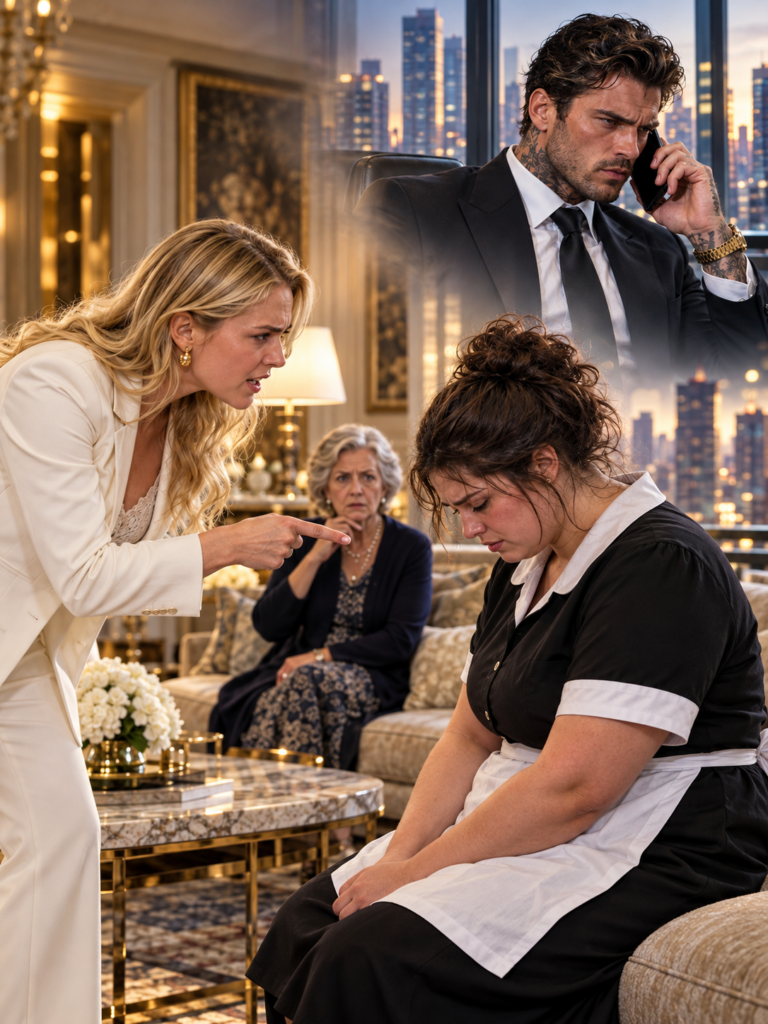
The first time I heard Bianca Rosetti threaten to make my eight-year-old son disappear, I was standing beside a woman who couldn’t scream for help.
The second time, the most feared mafia boss in the city was listening.
Bianca didn’t know that.
She stood in Donna Elena Bellini’s bedroom, surrounded by expensive furniture and fresh roses, with a diamond engagement ring glittering on her finger. She believed she had complete control over the two women in front of her.
One was a caretaker who desperately needed her job.
The other was an elderly mother who could neither hear nor speak.
Bianca thought neither of us had the power to stop her.
What she didn’t realize was that the phone resting beside those roses was still connected to her fiancé.
Nico Bellini had heard her threaten my child.
He had heard her demand that I falsify his mother’s blessing.
And by the following evening, every powerful family gathered inside the Bellini mansion would discover exactly what kind of woman he had almost married.
But before that happened, I had to survive the longest twenty-four hours of my life.
My name is Sophia.
I was thirty-two years old when I entered the Bellini household, and nothing about my previous life had prepared me to stand between a dangerous woman and the mother of a mafia boss.
I grew up in a modest apartment above a bakery, where the smell of fresh bread drifted through the floorboards every morning. My father drove a taxi at night. My mother cleaned hotel rooms until years of kneeling and lifting left her joints permanently aching.
We didn’t have expensive things, but we had each other.
My parents taught me that a person could survive without wealth. What mattered was having enough self-respect to look in the mirror without shame.
I held on to that lesson through years when survival became much harder.
Once, I had almost been married.
His name was Marco. He was gentle, hardworking, and for a while I believed we wanted the same ordinary future. We’d planned a small wedding, found an affordable apartment, and talked about raising children when our finances improved.
Then my younger sister and her husband were killed in a road accident.
Their newborn son, Luca, was left behind.
I still remember arriving at the hospital and seeing him sleeping beneath a pale blanket, completely unaware that the two people who had brought him into the world would never hold him again.
Relatives offered advice. Some suggested distant family members could raise him. Others reminded me that I was young and shouldn’t sacrifice my marriage.
Marco tried to support my decision to take Luca home.
His family did not.
His mother made it clear that she didn’t want her son spending his future raising another man’s child. His brothers agreed. Eventually, Marco began speaking about our wedding as though Luca were an obstacle we needed to solve.
One evening, I finally understood that the man I loved was waiting for me to choose.
Him or the baby.
I chose Luca.
The engagement ended, and I never regretted that decision.
There were nights when I wished I’d had someone beside me, especially when Luca was sick or the rent was due. But whenever I looked at the little boy who reached for me in his sleep, I knew I had made the only choice I could live with.
He called me Mama.
And in every way that mattered, I was.
By the time he turned eight, Luca had dark, unruly curls, a blue school backpack, and an endless collection of questions about things adults preferred not to explain.
He also had asthma.
His medicine, school expenses, and our ordinary living costs consumed nearly everything I earned.
That was why I couldn’t afford to lose my position at the Bellini mansion.
I’d trained as a caretaker at a small residential care home near the old church district. Many residents had communication disabilities caused by strokes, injuries, or illnesses. Some were deaf. Others understood everything around them but couldn’t form words.
A retired teacher who had been deaf since childhood taught me basic sign language.
The residents taught me the rest.
I learned to use alphabet boards, picture cards, blinking patterns, finger taps, and simple written messages. I learned that a person’s expression could carry meaning even when their hands couldn’t cooperate.
Most importantly, I learned not to assume silence meant agreement.
That lesson became the foundation of my relationship with Donna Elena Bellini.
The Bellini mansion stood on a hill overlooking the city, surrounded by iron gates and security cameras. Black vehicles passed through the entrance at all hours. Armed guards checked visitors while household staff moved through the marble corridors with practiced discretion.
Everything was magnificent.
Nothing felt comfortable.
Even the quiet seemed controlled.
Three caretakers had already resigned from the position I was interviewing for.
The housekeeper, a stern woman who rarely wasted words, placed a wooden communication board in front of me.
“Can you understand someone using this?”
“I can try,” I answered. “But I’d need to learn how she uses it. Every person develops her own system.”
The housekeeper studied me more carefully.
Then she showed me to the east wing.
Donna Elena sat beside a tall window overlooking the gardens. She wore a pale-blue robe, and her silver hair rested neatly against one shoulder.
At first glance, she looked fragile.
But the moment she turned toward me, I saw a sharp intelligence in her eyes.
This was not a woman who had surrendered to her condition.
She was a woman who had spent years being overlooked.
I approached slowly, making sure she could see me, and introduced myself through simple signs.
Her attention shifted toward my hands.
I placed the writing board within her reach.
She tapped it twice.
The housekeeper told me that meant thank you.
I returned the two taps, and something in Donna Elena’s expression changed.
It wasn’t quite a smile.
It was recognition.
During the following weeks, we developed an understanding that went far beyond ordinary caregiving.
Two deliberate taps meant yes.
One meant no.
When she pressed a finger against the silver cross hanging from her neck, she was warning me that someone was lying.
A tightly closed fist meant pain.
When she glanced toward the door, she wanted privacy. A flat palm against her blanket told me she needed rest.
Sometimes, when she looked far away and closed her eyes for several seconds, I knew she’d fallen into an unhappy memory.
I never pretended to understand more than I did.
If I wasn’t certain, I asked her again.
She appreciated that.
Others in the house treated her communication as an inconvenience, an assortment of gestures that someone else was supposed to interpret.
To me, those gestures were her words.
And her words deserved respect.
Her son understood that more than anyone, although he didn’t always understand the gestures themselves.
Nico Bellini visited his mother nearly every morning.
Before I met him, I’d heard enough whispered stories to be afraid of the man. He controlled a powerful criminal empire, and his name carried weight in rooms where ordinary people were careful even about asking questions.
He had wealth, influence, and men willing to enforce his decisions.
But none of those things changed the way he approached his mother’s bedroom.
He knocked.
He waited until she looked at him.
Then he came inside, bent to kiss her forehead, and asked about her day.
He never brought his guards into those visits.
One morning, Donna Elena became visibly irritated while he spoke about an upcoming business trip.
He turned to me.
“What is she trying to tell me?”
I hesitated.
“She’s upset that you missed your visit yesterday.”
He studied his mother.
Donna Elena tapped twice.
Nico lowered his gaze.
“You’re right, Mama. I should have come.”
There was no anger in his voice, no wounded pride at being corrected in front of an employee.
For a brief moment, he looked less like a feared mafia boss and more like a tired son who knew he had disappointed someone he loved.
I began to understand why Donna Elena was so important to him.
Years earlier, she had survived a violent attack that destroyed her hearing and took away her ability to speak.
Nico had been absent when it happened.
He had never forgiven himself.
He surrounded her with specialists, security, expensive comforts, and every medical resource available. Yet he could not restore what she’d lost.
So he made one promise that everyone in the family knew.
He would never marry a woman without his mother’s blessing.
At first, I thought it was a beautiful gesture.
Eventually, I understood how easily it could become a source of danger.
Because Nico was engaged to Bianca Rosetti.
And Donna Elena despised her.
Bianca was the sort of woman who attracted attention without appearing to demand it.
Her clothes were impeccably tailored. Her jewelry was understated only by the standards of the very wealthy. She knew how to lower her voice, how to touch someone’s arm, and how to make flattery sound sincere.
The first time I watched her enter Donna Elena’s room with Nico, she carried flowers and greeted the older woman with exaggerated warmth.
“Look at you, Mama Elena. You’re beautiful today.”
She kissed Donna Elena’s cheek.
Nico appeared pleased.
He wanted these two women to love each other.
But Donna Elena’s fingers gripped the arms of her chair.
Bianca noticed.
So did I.
After Nico left, Bianca’s manner changed.
Her smile became thin, and the softness vanished from her eyes.
She began moving Donna Elena’s communication board away from her chair whenever she wanted to control a conversation.
Sometimes she stood in front of the older woman and spoke with cruel satisfaction, knowing Donna Elena couldn’t hear her.
She wasn’t trying to communicate.
She was enjoying the power of saying things that couldn’t be answered.
On one occasion, I found her admiring herself in the mirror while Donna Elena struggled to reach the board.
“Stare at me all you want,” Bianca said. “I’m going to marry your son.”
I stepped forward and returned the board to its proper place.
Bianca looked at me through the mirror.
“She’s tired, Sophia.”
“She was asking for her board.”
“Was she?”
“Yes.”
For several seconds, Bianca said nothing.
Then she smiled.
It was the first time I felt certain that I had made an enemy.
As the engagement dinner approached, her visits became more frequent.
The ceremony of family approval was scheduled for Friday, October 18, when both families and their closest associates would gather inside the mansion.
Nico would formally ask for his mother’s blessing.
Without it, the marriage would not proceed.
Bianca knew that.
She also knew that Donna Elena’s answer would be no.
She tried gifts first.
Expensive scarves. Imported sweets. Elegant pearl combs that Donna Elena had never requested.
When those efforts failed, she started questioning me.
“How clearly does she understand what’s happening around her?”
“Very clearly.”
“Could she confuse one gesture with another?”
“Not usually.”
“And Nico? Can he understand her without you?”
“He understands some things.”
Bianca watched my face.
“Then you’re quite important, aren’t you?”
I didn’t answer.
A few days later, while Donna Elena slept, Bianca found me putting clothes away.
“You must earn a good salary here,” she said casually.
“It’s enough.”
“Enough for Luca’s schooling? His medication?”
My hands stopped moving.
I had never spoken to her about my son.
Bianca tilted her head.
“Eight years old. Curly hair. That bright-blue backpack.”
The air seemed to disappear from the room.
“Please don’t involve my child in anything happening here.”
“Then make sure I don’t need to.”
She walked away before I could reply.
The following morning, I noticed a black car parked across from Luca’s school.
A man sat behind the wheel.
He didn’t pretend to be doing anything else when he realized I was watching him.
I hurried Luca toward the entrance.
“Mama, you’re hurting my hand.”
I immediately loosened my grip.
“Sorry, sweetheart.”
He glanced behind us.
“Who’s that man?”
“I don’t know.”
That was the only truthful answer I could give him.
For three days, the car kept appearing.
My route to work became a series of anxious checks over my shoulder. I worried when Luca took too long to answer a question. I called his school more often than usual and tried to make my concern sound ordinary.
At night, I listened to his breathing while he slept and imagined everything Bianca could do with the resources available to her.
I thought about telling Nico.
But Bianca was his fiancée.
I was an employee.
And I had no proof that would guarantee Luca’s safety before Bianca could retaliate.
Donna Elena noticed my distress.
One afternoon, she caught my trembling hand as I poured tea.
She tapped once.
No.
Then she touched the silver cross.
I looked away.
“Please, Donna Elena.”
She reached for the board.
It took her several attempts to write four letters.
Luca.
I stared at her.
Somehow, without hearing a single conversation, she understood that my son was in danger.
Tears gathered in my eyes.
“I don’t know what to do.”
She reached toward me.
Her hand was unsteady, but she kept it extended until I held it.
That was how she comforted me.
Not with promises she couldn’t make.
With the simple assurance that she knew.
By Wednesday, the mansion was preparing for the engagement dinner.
Florists arrived with enormous arrangements. Staff polished silver, pressed table linens, and rearranged furniture while Bianca supervised everything as though she had already become mistress of the household.
She even attempted to choose Donna Elena’s dress.
“This black one is much too gloomy,” she announced. “She should wear something more flattering.”
Donna Elena tapped once.
I looked at the blue dress hanging nearby.
“She prefers that one.”
Bianca turned.
“Did she tell you?”
“Yes.”
Bianca stepped close enough to speak without anyone else hearing.
“Don’t confuse being useful with belonging to this family.”
I lowered my eyes, not because I agreed, but because I could picture that black car outside Luca’s school.
The next day, Thursday, October 17, Nico came to visit his mother before leaving for a meeting near the docks.
Bianca stood beside him.
He knelt in front of Donna Elena.
“Mama, tomorrow matters to me. You know I won’t go ahead without your blessing.”
Donna Elena looked directly at Bianca.
Then she turned away.
Nico frowned slightly and glanced at me.
“Sophia?”
My stomach tightened.
Donna Elena’s refusal was unmistakable.
But so was the warning in Bianca’s expression.
I thought of Luca standing by the school gate, waiting for me with his backpack over one shoulder.
“She’s tired,” I managed.
Donna Elena looked at me.
The disappointment in her eyes was almost unbearable.
Nico accepted my answer, kissed his mother’s forehead, and left.
After he was gone, I knelt beside her chair.
“I’m sorry.”
She didn’t respond immediately.
Then she reached for the pen.
Her writing was shaky, but I could read it.
Boy safe.
I shook my head.
“I don’t know.”
She closed her eyes.
A tear traveled down her cheek.
I had come to this house believing I was supposed to protect her.
Now she was worrying about my child while facing danger herself.
Later that afternoon, Bianca returned to the bedroom carrying her phone.
Nico had called to ask about his mother.
I was folding linen near the wardrobe when I heard his voice faintly through the speaker.
Bianca’s expression transformed.
“She’s resting, darling. Sophia is here. Everything is perfectly fine.”
She listened.
Then she gave a little laugh.
“Of course tomorrow will go well. Your mother will give us her blessing.”
Another pause.
“I love you, too.”
She touched the screen, lowered the phone, and left it beside a vase of roses.
Then she turned toward me.
Her pleasant expression vanished.
“Close the door, Sophia.”
Something in her voice made my skin go cold.
I obeyed, remaining close to Donna Elena’s chair.
Bianca approached the older woman first.
“You’ve caused me enough trouble.”
Donna Elena met her stare.
Bianca straightened.
“Tomorrow evening, when Nico asks whether his mother accepts our marriage, you’re going to tell him yes.”
“I can’t do that.”
“You interpret for her. Nico believes you.”
“But she’ll refuse.”
“Then you’ll give him a different answer.”
I stared at her.
She wasn’t simply asking me to lie.
She wanted me to steal another woman’s voice and use it against her.
“No,” I said.
Bianca moved toward me.
For the first time, she didn’t bother disguising her hatred.
“Then your little boy may not make it home from school.”
Behind her, the roses stood perfectly still.
The clock continued ticking.
And somewhere on the small table, a phone call that Bianca believed she had ended remained connected.
Nico Bellini was listening.
Part 2
For a moment, I couldn’t make sense of what Bianca had said.
The threat was too enormous to fit inside such an ordinary afternoon.
Outside the bedroom window, sunlight covered the garden paths. Somewhere downstairs, servants were arranging flowers for a celebration.
And Bianca Rosetti was calmly discussing the disappearance of my son.
She mistook my silence for hesitation.
“His school lets out in the afternoon, doesn’t it?” she continued. “He usually stands near the left gate. And there’s a dog across the street that he likes to watch.”
My stomach turned.
She knew details I had never shared with anyone inside the mansion.
This wasn’t a careless attempt to frighten me.
Someone had been watching Luca.
“Leave him alone,” I whispered.
“That depends on you.”
Donna Elena reached toward her board.
Bianca glanced at her, irritated.
“Don’t bother. Sophia and I are having a private conversation.”
She took another step toward me.
“You will tell Nico that his mother approves. You’ll make it believable. And if she refuses to cooperate, you’ll help her hand make the proper gesture.”
“She won’t allow that.”
Bianca gave a short, humorless laugh.
“She’s an old woman who can’t speak. Who’s going to contradict you?”
I looked past her at Donna Elena.
Her hands were trembling with fury.
“Everyone has a right to decide what happens to her own life,” I said.
Bianca’s expression hardened.
“You’re forgetting how little your rights will matter if something happens to Luca.”
I felt tears forming and hated that she could see them.
She continued, almost conversationally.
“And should you decide to tell Nico some ridiculous story about me, I’ll explain that you’ve been manipulating his mother. I’ll tell him you’re jealous, that you’ve turned her against me because you’re afraid of losing your influence.”
“He knows me.”
“He knows the employee his mother likes. He intends to marry me.”
She let that difference settle between us.
Then she turned toward Donna Elena and snatched the writing board from her reach.
The older woman tried to follow it with her hand.
Bianca held it against her chest.
“No more messages. No more little warnings.”
“Give it back,” I demanded.
She carried the board to a high shelf and placed it where Donna Elena could see it but couldn’t reach it.
The cruelty of that small action affected me almost as deeply as the threat.
Bianca didn’t merely want to prevent Donna Elena from communicating.
She wanted her to watch the means of communication being taken away.
“Tomorrow, you have one decision to make,” Bianca told me. “You can protect your son, or you can protect this woman’s pride.”
I looked at Donna Elena.
Her eyes were fixed on the board.
“She isn’t the one who should be ashamed,” I answered.
Bianca took a step toward me, ready to reply.
Then the phone on the table caught her attention.
The display was illuminated.
She picked it up.
And every trace of color vanished from her face.
“Nico?”
There was no audible answer.
She stared at the screen.
The connection was still open.
Her thumb moved frantically, ending the call at last.
For a few seconds, she stood completely motionless.
Then she looked at me.
I understood what had happened before either of us spoke.
Nico had been listening.
How much had he heard?
Enough to understand the threat?
Enough to know about his mother?
Bianca recovered more quickly than I did.
“If he asks,” she said, “you’ll tell him I was upset. That we argued. That you misunderstood what I said.”
I didn’t answer.
She moved closer.
“Remember who takes your son to school every morning.”
Then she left.
The bedroom door closed behind her.
I stood there shaking until Donna Elena began tapping repeatedly against her chair.
I hurried to retrieve her writing board.
Her first attempt at writing was illegible. I steadied the board while she tried again.
Nico heard?
“I think so.”
She watched my face.
“I don’t know what happens now.”
For a moment, hope and terror seemed to exist in her eyes at the same time.
We waited.
No one came upstairs.
Nico didn’t call.
Bianca didn’t return.
The house remained unnervingly ordinary.
By six o’clock, my fear had become almost unbearable.
Then my phone rang.
Luca’s school.
I answered immediately.
The school secretary explained that a driver had arrived to collect my son on behalf of the Bellini family.
“A man named Carlo,” she said.
My heart began pounding.
“Please don’t let Luca leave with anyone.”
“Miss Sophia, Mr. Bellini is here himself. He’s speaking with the principal.”
I pressed my free hand against the wall.
“Nico Bellini?”
“Yes. Would you like to speak to your son?”
“Please.”
There was a rustling sound.
Then Luca came on the line.
“Mama?”
I closed my eyes.
“Are you all right, sweetheart?”
“Yes. A tall man bought me a sandwich. He says you know him.”
“Are you still with your principal?”
“Yes.”
“Stay there until I tell you otherwise.”
He sounded puzzled.
“Are you crying?”
I swallowed.
“No, darling. I just needed to hear you.”
Donna Elena was watching me when I ended the call.
“Nico is at Luca’s school,” I told her.
She pressed her hand against her chest.
For the first time that afternoon, I allowed myself to believe my son might be safe.
Nico returned to the mansion after dark.
By then, Luca had been taken to a guarded Bellini apartment, where Rosa, a woman who had previously helped care for Donna Elena, was looking after him.
Nico had moved before Bianca could act.
At nine o’clock, a guard came to tell me that Don Bellini wanted to see me in the library.
I had never entered that room without feeling unwelcome.
Dark shelves covered the walls. Leather chairs stood around a heavy desk. The air smelled faintly of cigars and polished wood.
Nico was beside the window.
He had removed his jacket and rolled up his sleeves.
On the desk lay a phone, a small recording device, and a photograph of Luca outside his school.
I stopped.
“My son—”
“He’s safe,” Nico said.
His voice was quiet.
I looked at the photograph.
“Where did you get that?”
“From the people who were watching him.”
He turned the picture facedown.
“The car outside his school belongs to a man connected to Bianca’s cousin. My people found him.”
“Is he still watching Luca?”
“No.”
Nico’s expression made it clear he wouldn’t tolerate any argument about that answer.
I gripped the back of a chair.
“Did you hear what Bianca said?”
He glanced toward the recording device.
“The security system records calls made through the family’s office lines.”
He paused.
“I heard her.”
The relief was so sudden that my knees weakened.
I hadn’t expected that hearing the truth acknowledged aloud would affect me so deeply.
“I should have come to you sooner,” I said.
“Yes.”
The single word hurt.
But he didn’t allow me to carry the entire blame.
“She used your child against you. I understand why you were frightened.”
He looked toward the window.
“What I don’t understand is how my mother could suffer in my own home while I knew nothing about it.”
I didn’t try to comfort him with an answer that wasn’t true.
He had missed the signs.
All of them.
“How long?” he asked.
“Since Bianca first began visiting.”
He closed his eyes briefly.
Then he pulled out a chair.
“Tell me everything.”
So I did.
I told him about the communication board, the insults, Bianca’s questions, and Donna Elena’s growing distress.
I explained how carefully his mother had tried to warn him and how often Bianca interfered.
I told him about the car outside Luca’s school.
When I admitted that I had concealed Donna Elena’s refusal that morning, shame tightened my throat.
“I was afraid she’d hurt him.”
Nico didn’t excuse the lie.
But neither did he punish me for it.
He listened until I had nothing left to say.
Then he asked, “Was anyone helping Bianca keep my mother from communicating?”
“The housekeeper interrupted her sometimes. Bianca’s assistants were often nearby.”
Nico nodded.
“Some people have already been identified.”
I looked toward the recording.
“What happens now?”
“Tomorrow’s dinner will go ahead.”
I stared at him.
“You’re still holding it?”
“Yes.”
“Why?”
“Because the people she intended to deceive should hear what she planned.”
I thought of Bianca’s family arriving in their expensive clothes, certain they were about to gain a place beside the Bellini empire.
Then I thought of Donna Elena.
“Does your mother know?”
“She’ll decide whether she wants to be there.”
He looked directly at me.
“And if she does, I want her to communicate in whatever way she chooses. No one will decide her answer for her again.”
For the first time, I understood the difference between his protection and Bianca’s control.
She had wanted obedience.
He was trying to restore a choice.
Nico stood.
“Bianca believes you are still frightened enough to obey her. Let her believe it.”
“My son—”
“Will remain protected.”
He paused.
“Your loyalty kept my mother from being completely isolated. I should have protected both of you long before this.”
I didn’t know what to say.
He wasn’t offering charity.
He was acknowledging a responsibility he’d failed to meet.
That night, I slept on a narrow sofa in Donna Elena’s bedroom.
Twice, she woke and reached for her board.
The first time, she asked about Luca.
The second time, she wrote that Nico was angry.
“He is,” I told her. “But not with you.”
Her fingers rested against the silver cross.
Then she wrote two words.
I warned.
I knew she meant more than the past few weeks.
Her history carried older wounds.
Before the attack that left her unable to communicate easily, she had warned others about a woman whose affection concealed dangerous intentions.
No one had listened.
Now she had watched another woman enter her son’s life with a beautiful smile and hidden cruelty.
And once again, her warnings had been dismissed.
I covered her hand with mine.
“Tomorrow, we’ll make certain he listens.”
Friday, October 18, began before sunrise.
The mansion filled with florists, caterers, security personnel, and guests’ arriving arrangements.
Every silver tray gleamed.
Every table setting was perfect.
Bianca appeared in the morning wearing pale cream, her hair arranged with meticulous care.
She entered Donna Elena’s room while I was brushing the older woman’s hair.
“How’s your son, Sophia?”
I met her eyes through the mirror.
“Safe.”
Her expression flickered.
“For the moment, perhaps.”
“He’s safe,” I repeated.
I didn’t raise my voice.
I didn’t need to.
Bianca studied me, trying to determine whether something had changed.
But her arrogance won.
She still believed I would surrender when the time came.
At noon, Nico visited his mother without Bianca.
He knelt beside her chair and held her hand.
For several seconds, he couldn’t seem to speak.
Then he lowered his forehead against her fingers.
“Mama, I’m sorry.”
Donna Elena watched him.
“I should have understood. I should have made sure you could tell me everything you needed to say.”
His voice was rough.
“Tonight, you decide what happens. I’ll listen, however long it takes.”
He handed her the board.
Donna Elena wrote slowly.
Sophia not fault.
Nico looked at me.
“I know.”
She wrote again.
Luca safe?
“Yes, Mama. He’s safe.”
She closed her eyes.
When she opened them, she wrote Bianca’s name.
Nico nodded.
“Tonight.”
Donna Elena tapped twice.
That was all the agreement he needed.
By evening, the dining hall had become a spectacle of luxury.
Crystal chandeliers glittered above white linens and gold-edged dishes. Candles burned along the tables. Security men stood discreetly near the walls while Bellini relatives, business associates, and members of Bianca’s family mingled beneath enormous portraits.
Donna Elena entered wearing the blue dress she’d chosen.
Her silver cross rested against the fabric.
I walked beside her chair, carrying nothing more powerful than her communication board.
Nico arrived in a black suit.
Bianca approached him and rested one hand on his sleeve.
“Everything looks wonderful.”
He glanced at her.
“We’ll see.”
She laughed softly, apparently mistaking his seriousness for nerves.
Dinner proceeded.
Guests exchanged compliments.
Bianca played the affectionate future daughter-in-law.
Whenever she could, she looked at me with the same warning she’d given me the previous afternoon.
I ignored it.
Near the end of the meal, Nico rose.
He reminded the assembled families of the promise he’d made years earlier.
His mother’s approval was essential.
Without it, there would be no marriage.
Then he approached Donna Elena.
“Mama, do you bless my marriage to Bianca?”
Every face turned toward the elderly woman.
I placed her board within reach and offered the pen.
Her hand shook as she tried to write.
Bianca immediately intervened.
“She’s exhausted, Nico. Perhaps Sophia should explain what she means.”
I could feel Bianca watching me.
She still expected the answer she’d demanded.
I looked at Donna Elena.
Then I looked at Nico.
He didn’t instruct me.
He waited.
“Donna Elena can answer for herself,” I said.
Bianca’s smile disappeared.
“Don’t be absurd. Look how difficult writing is for her.”
“Then we’ll give her time,” Nico replied.
The waiting was agonizing.
Donna Elena pressed the pen against the board.
One letter appeared.
Then another.
Finally, the first word was complete.
No.
A ripple of surprise moved through the guests.
But she wasn’t finished.
Her hand continued moving.
No blessing.
Bianca hurt me.
Sophia protected me.
The first gasp came from somewhere behind me.
Then voices rose around the table.
Bianca leaned forward.
“That’s ridiculous. Sophia has been turning her against me!”
Donna Elena kept her hand firmly on the board.
Bianca looked toward Nico, her eyes filling with tears almost immediately.
“Darling, your mother is confused. Sophia doesn’t want us married because she’ll lose her influence here.”
Nico studied her.
“Is that what you believe?”
“It’s what happened!”
“Then everyone deserves to hear the evidence.”
He lifted one hand.
A guard brought a small speaker to the table.
Bianca went completely still.
Nico connected the recording device.
Her voice emerged from the speaker.
It was unmistakable.
The guests heard Bianca demand that Sophia falsely announce Donna Elena’s blessing.
They heard her insist that the elderly woman’s inability to speak would make the deception easy.
Then came the threat against Luca.
The blue backpack.
The school gate.
The warning that he might never return home.
I stood beside Donna Elena and heard my own frightened voice answering her.
For a moment, I was back in that bedroom, unable to imagine how I could save my child.
But now every person in the hall was listening.
Bianca’s father lowered his gaze.
One of her brothers rose abruptly before a Bellini guard stepped into his path.
A woman near the end of the table covered her mouth.
The recording ended with Bianca declaring that she was Nico’s fiancée and I was nothing more than an employee whose word could be dismissed.
Nico switched off the device.
No one defended her.
Bianca’s tears had become desperate.
“I was upset,” she said. “I didn’t mean any of it.”
“You threatened an eight-year-old boy,” Nico replied.
“I was frightened of losing you!”
“You abused my mother.”
“I only wanted her to accept me.”
Donna Elena tapped once.
No.
The sound was small, but everyone near her heard it.
Nico looked at his mother before turning back to Bianca.
“She recognized your dishonesty long before I did.”
Bianca reached for his hand.
“Nico, please. I love you.”
He withdrew.
“You loved what marrying me would give you.”
He took her engagement ring from her finger.
The gesture was controlled and final.
Then he instructed his guards to escort her out.
Bianca began shouting.
Her relatives protested as security men moved between the families.
She pointed directly at me.
“You’ve destroyed everything!”
My knees were shaking.
But I held my place beside Donna Elena.
“No,” I answered. “You made these choices yourself.”
The guards led her away.
Voices continued echoing through the hall, but Nico no longer seemed interested in the arguments.
He turned to his mother.
In front of everyone, he knelt and took her hands.
“Forgive me, Mama.”
Donna Elena looked at him for a long time.
Then she raised one trembling hand and touched his cheek.
Twice.
Yes.
Nico bowed his head.
And I looked away, allowing mother and son a moment that belonged only to them.
Part 3
By the time the last guests departed, the mansion had grown quiet again.
The candles had been extinguished. Servants moved through the dining hall collecting untouched desserts and glasses abandoned during the confrontation.
I found Nico outside his mother’s bedroom.
He stood alone with his jacket removed and his tie loosened, studying the closed door.
“She’s sleeping,” I told him.
He nodded.
“Rosa says Luca has eaten more cake than she’s ever seen one child consume.”
Despite my exhaustion, I smiled.
“He does that when he’s nervous.”
“Apparently, he also asked whether every mafia family has better food than ordinary people.”
I laughed softly.
For a moment, Nico’s expression warmed.
Then he grew serious.
“I owe him an apology.”
“He doesn’t understand everything that happened.”
“Children understand when adults frighten their mothers.”
I had no answer.
Nico studied me.
“You were courageous tonight.”
“I was terrified.”
“That doesn’t make what you did less courageous.”
I looked toward Donna Elena’s door.
“It’s easier for powerful men to praise courage after someone without their protection has taken the risk.”
He accepted the criticism without defending himself.
“You’re right.”
That surprised me.
I’d spent years working for people who expected gratitude for every kindness and silence for every mistake.
Nico had enough power to dismiss my words.
Instead, he listened.
“What happens to Bianca?” I asked.
“She’ll be gone from the city before morning.”
“And the man watching Luca?”
“He won’t approach your son again.”
There was something deliberately restrained about his response.
I didn’t ask him to explain his methods.
I had no desire to become comfortable with the violence associated with his world.
I wanted Luca safe.
More than that, I wanted him to grow up believing safety didn’t have to come from fear.
The following morning, I found him in a guest room larger than our entire apartment.
He sat against embroidered pillows, eating toast from a silver tray.
“Mama!”
He held up a small bowl of butter.
“Are we rich now?”
I sat beside him.
“No, sweetheart.”
“Then why do they put butter in its own little dish?”
“Maybe rich people don’t trust ordinary plates.”
He giggled.
Then his expression grew thoughtful.
“Did the bad lady leave?”
“Yes.”
“Because of Don Nico?”
I brushed his curls away from his forehead.
“Because people finally found out what she was doing.”
He considered that.
“So the truth made her go away?”
“The truth helped. But people had to be brave enough to tell it.”
He leaned against me.
“Were you brave?”
I remembered standing before Bianca, imagining the worst thing a mother could imagine.
“I tried.”
He wrapped both arms around my waist.
“I think you were.”
That was the only praise I needed.
The Bellini mansion changed after Bianca’s departure.
Not immediately, and not in ways visitors would necessarily notice.
The guards were still at the gates. The expensive vehicles still came and went. Nico’s business remained the same complicated, dangerous world it had always been.
But inside his mother’s rooms, the rules changed.
Her communication board was never again placed beyond her reach.
Additional boards appeared in every room she frequently used.
Nico hired a specialist to teach household staff basic sign language and communication methods, ensuring Donna Elena wouldn’t have to depend entirely on me to make herself understood.
The housekeeper who had interfered with her messages was dismissed.
Two guards were replaced.
Bianca’s floral arrangements disappeared, followed by her engagement portrait and the photographs celebrating her future marriage.
Most importantly, Nico began paying attention differently.
He spent longer with his mother.
He stopped asking questions that required someone else to supply an easy answer.
Sometimes, he sat beside her for several minutes while she decided how to express herself.
He learned the difference between a single tap and two.
He learned that her gaze toward the door meant she wanted privacy.
And one afternoon, when she touched the cross at her neck during a conversation, he understood the warning without looking toward me for help.
Donna Elena smiled.
Nico stared at her, almost startled by the expression.
I watched them from the doorway and realized how much their relationship had changed.
He had always loved her.
Now he was learning how to hear her.
Yet despite those improvements, I began considering leaving.
The mansion was safer than it had been, but its iron gates still reminded me of the danger Luca had faced.
I had entered that house because I needed money.
I had almost lost the one person who mattered more than anything money could buy.
I wanted an ordinary life for my son.
A neighborhood where a parked black car didn’t make my blood run cold.
A school where he could walk through the gates without someone watching from a distance.
A home without armed security or powerful enemies.
I told Donna Elena first.
She listened while I explained my fears.
“Luca needs peace,” I said. “And I think I do, too.”
She reached for her board.
Leaving because afraid?
I nodded.
“Yes.”
She wrote again.
Good mothers afraid.
I smiled sadly.
“Then you understand.”
She continued writing.
Don’t let fear decide whole life.
I looked at her for a long moment.
She wasn’t asking me to sacrifice Luca for her comfort.
She understood exactly why I wanted to leave.
But she also knew that I had spent years making decisions based on what I was afraid of losing.
That afternoon, Nico asked to speak with me in the garden.
He waited near the fountain, dressed in black, with the mansion rising behind him.
“My mother says you’re thinking of resigning.”
“Your mother notices everything.”
“She does.”
He studied my face.
“I won’t stop you.”
I hadn’t expected that answer.
“This place isn’t right for Luca,” I said.
“It could be.”
“Because you promise?”
He considered the question.
“Because I understand what I failed to do before. But you don’t have to trust that answer.”
I folded my arms.
“I’m not staying out of gratitude.”
“I wouldn’t ask you to.”
“Or because you feel guilty.”
He nodded.
“Good.”
I looked at him, confused by his lack of resistance.
“If you leave,” he continued, “I’ll help you find a suitable position elsewhere. Somewhere secure. Your salary will continue until you’re settled. If you need protection from anything connected to Bianca, you’ll have it.”
“Why would you do all that?”
“Because you protected my mother when I didn’t understand she needed protecting.”
“She was always stronger than people believed.”
“I know that now.”
His voice softened.
“And I’ll regret how long it took me to see it.”
We stood quietly beside the fountain.
“And if I stay?” I asked.
“Then I want you to have a different position.”
He explained that I would become Donna Elena’s personal advocate, with clear authority to protect her communication rights and preferences.
No one would enter her room without her permission.
No one would remove her communication tools.
No one would speak for her without her consent.
I would answer to Donna Elena first, then Nico.
“And Luca?” I asked.
“A driver can take him to school. Someone can provide security from a distance without making him feel followed. His asthma treatment and medicine will be covered.”
I watched him carefully.
“I won’t raise my son to believe he’s entitled to special treatment because of your name.”
A faint smile touched Nico’s mouth.
“That may be the most sensible rule anyone has proposed in this family.”
I looked away before he could see me smiling.
“I need to think.”
“Take whatever time you need.”
There was no command.
No attempt to purchase my agreement.
He left the decision where it belonged.
With me.
That evening, I returned to Donna Elena’s room.
She held out her hand.
When I took it, she tapped twice against my palm.
I looked toward the writing board.
Stay?
I thought about Luca.
About the new protections Nico had arranged.
About the work that mattered to me.
And about this stubborn woman who had insisted on being heard even when everyone around her found it easier not to listen.
“Yes,” I said.
“I’ll stay.”
Donna Elena tapped twice again.
Over the following months, the relationship between Nico and me changed in ways neither of us announced.
It didn’t begin with dramatic declarations or expensive gifts.
It began with conversations.
Sometimes we spoke in the hallway after Donna Elena had gone to sleep.
Sometimes he asked my opinion about changes to her care, and I found myself surprised by how seriously he considered the answers.
He began questioning assumptions that he’d accepted for years.
I began seeing the man beneath the authority.
He was not innocent.
His power came from a world that frightened me, and nothing about growing closer to him erased that fact.
But he was capable of admitting his failures.
He was capable of restraint.
And when I disagreed with him, he didn’t make me regret speaking.
I came to value that more than I wanted to admit.
Luca noticed our growing friendship long before I acknowledged it.
Some mornings, Nico accompanied him to the car under the pretense of having business near the gates.
Luca, who had no fear of asking embarrassing questions, used those opportunities enthusiastically.
“Do mafia bosses eat cereal?”
“Occasionally.”
“Why do you always wear black?”
“It saves time choosing clothes.”
“Are you scared of Mama?”
Nico considered his answer.
“A little.”
Luca found that so funny he repeated it over dinner.
I tried to remain serious.
I failed.
When I laughed, Nico looked at me with an expression I couldn’t immediately identify.
It was gentle.
And that gentleness unsettled me more than his reputation ever had.
I’d known men who offered affection as long as I remained convenient.
I wasn’t sure how to respond to someone who seemed content simply to spend time with me.
Winter arrived.
The garden paths grew cold and the windows misted in the mornings.
Donna Elena began spending more time in the sitting room, where Luca often completed his homework at a small table near her chair.
She corrected his spelling with stern looks and deliberate taps.
He adored her.
He began calling her Nona Elena, and she seemed to take particular pleasure in making him behave with nothing more than a raised eyebrow.
Nico started coming home earlier.
At first, I assumed it was because he wanted to spend time with his mother.
Then one evening, I found him standing in the doorway, watching Luca proudly explain a school drawing to Donna Elena.
Nico’s gaze shifted toward me.
He smiled.
Not the polite expression he used with visitors.
Not the cold, controlled smile that made his associates nervous.
Something quieter.
Something honest.
I looked away.
I had spent years teaching myself not to want anything I couldn’t safely keep.
And I was beginning to want him.
Near the end of winter, Donna Elena announced that she wanted dinner in the same hall where Bianca had been exposed.
Nico objected.
I objected.
Donna Elena refused to reconsider.
She wanted a small family dinner.
No business associates.
No distant relatives hoping to improve their position.
No engagement spectacle.
Only people she trusted.
So on a Friday evening, the dining hall was prepared once more.
Rosa attended, along with the cook who had become Luca’s favorite accomplice, two elderly Bellini relatives who genuinely cared about Donna Elena, Nico, Luca, and me.
Candles burned on the tables.
The chandeliers shone overhead.
But the atmosphere was completely different.
There was no one watching for the slightest mistake.
No beautiful stranger plotting to take control.
No child waiting in danger outside a school gate.
Donna Elena wore blue again.
When I finished fastening the silver cross around her neck, she looked at me through the mirror and tapped twice.
Then she pointed toward me.
I smiled.
“You’re the beautiful one tonight.”
She tapped once.
No.
Her gaze remained on me.
I felt my cheeks warm.
I’d become comfortable being useful.
Being appreciated for something beyond what I could do for others still felt unfamiliar.
At dinner, Luca entertained everyone.
He complained that the cook had used too much butter in the potatoes, then requested another serving.
He informed Nico that his teacher believed his handwriting was improving.
Donna Elena tapped twice in approval.
“And no long speeches tonight,” Luca added.
Donna Elena looked directly at him.
One tap.
No.
“Nona Elena!”
She raised an eyebrow.
Luca immediately sat straighter.
Everyone laughed.
For a little while, I forgot that I was sitting inside a house people across the city feared.
It felt like a family home.
Near the end of dinner, Donna Elena placed her palm flat against the table.
We all recognized the gesture.
She wanted our attention.
Nico leaned toward her.
“What is it, Mama?”
She pointed at her board.
I moved it closer, but she pushed the pen toward her son.
Then she gestured toward the empty chair beside him.
And toward me.
A strange nervousness settled over me.
“Donna Elena?”
She ignored my question.
Her hand closed around the pen.
She began writing slowly.
No one interrupted.
At last, she turned the board around.
I read the message.
Then I read it again.
She wanted Nico to marry me—if I freely chose him.
My face grew hot.
Across the table, Luca opened his mouth in astonishment.
Nico stared at the words.
“Mama…”
Donna Elena was already writing again.
Not servant. Not debt. Family.
My throat tightened.
It was the very distinction I’d struggled to explain when Nico offered me a new position.
I didn’t want to belong to anyone because I was useful.
I didn’t want gratitude mistaken for affection.
Donna Elena knew that.
She looked at her son, then at me, and added another message.
Nico needed someone willing to tell him the truth.
I deserved someone who would never make me choose between love and Luca.
I pressed my fingers against my mouth.
Luca leaned toward me.
“Mama?”
“Yes, sweetheart?”
“Does Nona Elena want Don Nico to be my dad?”
The question struck me harder than anything written on the board.
Nico looked at Luca.
And for the first time since I’d known him, I saw genuine nervousness on his face.
“Only if your mother wanted that,” he answered carefully. “And only if you wanted it, too.”
Luca studied him with great seriousness.
“Would I have to wear black clothes every day?”
“No.”
“Could Mama still tell you when you’re wrong?”
Nico glanced toward me.
“She already does.”
Rosa laughed into her napkin.
“Would Nona Elena still live with us?”
Donna Elena tapped twice so enthusiastically that her board shifted.
Luca nodded, apparently satisfied.
“Then maybe that would be okay.”
Everyone laughed.
Except me.
I was trying very hard not to cry.
I turned toward Donna Elena.
“You’re putting us all in a difficult position.”
She tapped once.
No.
Then she wrote again.
Blessing given.
Your choice.
Always.
I looked at those words until they blurred.
Nico stood and came around the table.
He stopped a few steps away.
“Sophia.”
I raised my eyes.
“My mother can be remarkably bold.”
A small laugh escaped me.
“Your mother is terrifying.”
Donna Elena tapped twice.
Yes.
Even Nico smiled.
Then his expression grew serious.
“I need you to understand something.”
I waited.
“I’m not going to claim that my mother’s blessing gives me some right to your future. And I won’t pretend my life is simple.”
He glanced toward Luca, then back at me.
“There are things about my world that may always worry you. I have enemies. I’ve made decisions I regret. My name carries consequences that neither of us can ignore.”
I appreciated that he wasn’t offering a fairy tale.
He continued.
“But I’ve learned something from you. I spent years believing that because I could protect my family financially and physically, I was giving them everything they needed.”
His gaze moved briefly toward Donna Elena.
“I wasn’t listening.”
Donna Elena held his eyes.
“You were the one who treated my mother like a person with choices when everyone else treated her like someone who needed decisions made for her.”
He paused.
“And you never tried to impress me by pretending I was always right.”
I gave a shaky laugh.
“That would have been difficult.”
A smile flickered across his face.
Then he looked at me with an openness that made my chest ache.
“I care about you, Sophia. Not because you work here. Not because I owe you. Not because my mother wants this.”
His voice lowered.
“I care about the way you think, the way you love your son, the way you keep your promises even when they cost you something.”
I could barely breathe.
“If you ever decide that you want a future with me, I’ll spend that future making sure you and Luca know you’re loved. Not owned. Not indebted.”
The room was very quiet.
Nico didn’t move closer.
He left me room to refuse.
That mattered.
I had once lost a man because I wouldn’t abandon a child.
Now a man whose name frightened the city was standing before me, asking to become part of our lives without demanding that I surrender anything essential to who I was.
“I spent years turning away from love,” I said, “because every time I believed in someone, I was eventually asked to give something up.”
Nico waited.
“Luca is my son. Nothing changes that.”
“Nothing should.”
“And I won’t become a decoration in this house. I need my work, my decisions, and my own place in the family.”
“You’ll have them.”
I looked toward Donna Elena.
Her eyes were shining.
Then I looked at Luca, who had slipped his hand into mine.
Finally, I turned back to Nico.
“If I say yes, it won’t be because you’re powerful. Or because you protected Luca. Or even because your mother wants us together.”
He nodded.
“Then say it only because it’s what you want.”
My hands trembled.
I could have asked for another week.
Another month.
A year.
He would have given me the time.
But something inside me had already decided.
“Then yes,” I whispered.
Nico stared at me.
I smiled through my tears.
“Not someday. Now. But slowly. Honestly. With Luca, with your mother, and with both of us free to speak our minds.”
For a moment, he looked almost unable to believe what he’d heard.
Then he approached.
Slowly enough to give me every opportunity to change my mind.
I didn’t move away.
He took my hand and kissed my fingers.
It was such a simple gesture.
And yet, after years of protecting my heart, I felt something finally open.
Donna Elena began tapping her approval.
Luca groaned.
“Do I have to watch all this?”
Rosa burst out laughing.
Donna Elena pointed toward his dessert.
He understood immediately and returned to his cake.
Nico lifted his eyes to mine.
This time, I didn’t look away.
Months later, we were married in the garden behind the Bellini mansion.
There were no crowds of ambitious strangers.
No families competing for influence.
No elaborate performance designed to impress people who didn’t truly care about us.
Only sunlight, roses, and a small gathering of those who had become part of our lives.
Donna Elena sat in the front row wearing blue.
Luca sat beside her, holding her communication board with enormous pride.
Rosa was nearby.
Nico waited for me with an expression I had come to recognize as his most honest one.
He looked happy.
And just a little afraid.
I loved him for that.
When I reached him, Luca whispered far too loudly from his seat.
“Mama, please don’t cry. Your face is going to look funny in the pictures.”
Everyone laughed.
I cried anyway.
Nico brushed a tear from my cheek.
Donna Elena tapped twice.
During the ceremony, when the priest asked for blessings, she lifted her board.
Her hand moved slowly, but there was no uncertainty in the words she wrote.
Family means protecting someone’s voice when others refuse to listen.
Nico bowed his head.
I reached for Luca’s hand.
Donna Elena tapped twice.
Yes.
In that moment, I thought about the woman I’d been when I first entered the mansion.
A struggling caretaker trying to provide for her son.
A mother who believed love always came with demands she couldn’t accept.
A woman who had learned how to interpret silence but still struggled to speak about her own fears.
I thought about Bianca and the terrible afternoon when she’d forgotten to end a phone call.
People would always say that single mistake destroyed her future.
But I knew the truth was more complicated.
Bianca had believed that power belonged to whoever could frighten others into obedience.
She believed wealth made her superior to a servant.
She believed a vulnerable mother could be manipulated because she couldn’t speak.
And she believed an eight-year-old boy could be used to force his mother into betrayal.
She was wrong.
Donna Elena had refused to surrender her choices.
Nico had learned that protecting someone required listening to them.
And I had discovered that fear didn’t have to decide every part of my future.
My son had gained a family without losing the mother who loved him.
I had gained a husband without abandoning the person I’d worked so hard to become.
And Donna Elena, whose voice had been stolen from her years before, had brought us together by insisting that her words deserved to be heard.
My name is Sophia Bellini now.
I still remember the sound of Donna Elena’s pen moving slowly across her writing board.
I still remember Nico kneeling before his mother, asking forgiveness.
And I will never forget the moment he stood in front of me, not as a man demanding what he wanted, but as someone willing to accept my answer.
I entered the Bellini mansion to help a woman communicate with the world around her.
I never imagined that, in protecting her voice, I would find the courage to use my own.
Or that the family I found there would become the greatest love of my life.


