
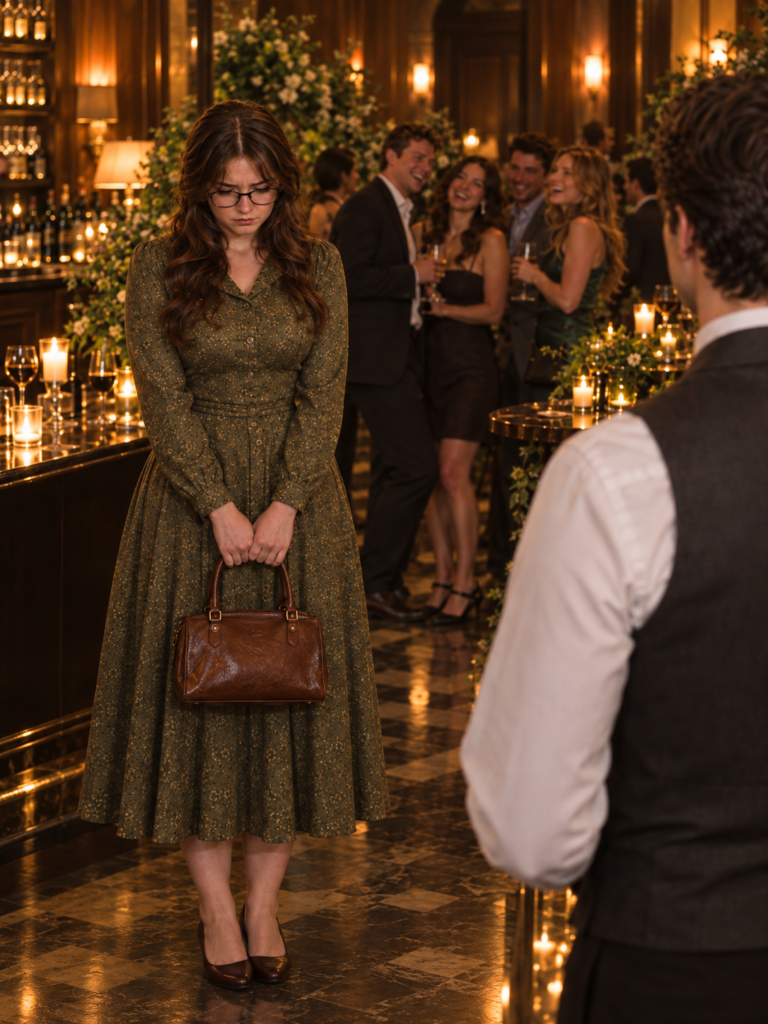
Part 1
The first sign that Grant had lied to me was written in curly white chalk.
SINGLE SUPPER NIGHT
COME HUNGRY, LEAVE WITH SOMEONE
I stood under the awning of The Copper Fig with rain darkening the shoulders of my canvas jacket and read the sign three times.
Then I looked through the glass.
Grant was at a long table in the back, waving both arms over his head like he was guiding in an aircraft.
He looked delighted.
He also looked guilty.
I should have turned around.
My truck was parked three blocks away. My apartment was quiet. There was leftover chili in the refrigerator and a book facedown on my couch exactly where I’d left it that morning.
All of those things suddenly sounded better than dinner.
Dating had become a group concern sometime after I turned thirty-two.
My sister, Nenah, sent profiles.
My coworkers offered advice.
Men I barely knew would lean against the break-room counter and tell me I needed to “put myself back out there” with the solemn authority of people assigning community service.
I wasn’t heartbroken.
Not anymore.
My last relationship had ended two years earlier without cheating or shouting or smashed dishes. We’d simply reached the part where affection wasn’t enough to disguise that we wanted different kinds of lives.
She wanted motion.
I liked steadiness.
Eventually, my quiet Sundays and grocery lists stopped feeling dependable to her and started feeling like a warning.
We admitted it on her couch one night.
Then we said we were fine.
Neither of us was, but at least we’d been honest.
After that, I stopped dating.
Not forever, I told people.
Just until being alone stopped sounding like something I needed to apologize for.
Apparently, Grant had decided that deadline had passed.
He’d called the night before.
“Group dinner,” he’d said.
“Is this a setup?”
“What? No.”
He’d answered too fast.
“Grant.”
“It’s dinner. Holly booked a table. Her friends, some of mine, my cousin Kyle’s in town. Ten people. Casual.”
“You’re saying casual too much.”
“Come eat food, Julian.”
I’d agreed because Grant had helped me move twice and once driven two hours through snow with jumper cables after my truck died.
That sort of friendship earns a man one bad dinner.
Through the window, he waved again.
I pointed at the chalkboard.
His shoulders rose toward his ears.
Caught.
I went inside anyway.
The host checked my name and led me past candles stuck into old wine bottles. The restaurant smelled like rosemary, warm bread, and something buttery that made me almost forgive Grant before we’d spoken.
Almost.
The long table sat beneath an enormous hanging lamp shaped like a pear.
Kyle was at the head.
I’d never met him, but there was no question who he was.
Tight blue shirt. Expensive watch. One arm stretched across the back of his chair as though he’d bought the building fifteen minutes earlier.
He rose when I approached.
“The famous Julian.”
“That’s unfortunate.”
He laughed too hard.
That was the first small alarm.
People laugh like that when the real joke isn’t the one you’ve just made.
Holly smiled at me with the bright, strained expression of somebody trying to convince herself everything was already going well.
Grant wouldn’t quite meet my eyes.
I counted chairs.
Two were empty.
One beside Grant.
The other at the far end of the table.
Beside that second chair sat a woman alone.
Gray cardigan. Sleeves pushed halfway to her elbows. Dark hair gathered into a loose braid. One hand curved around a water glass.
She wasn’t looking at her phone.
She wasn’t pretending to study the menu.
She was simply looking down at the tablecloth as conversations moved around her.
Then I noticed the glances.
Kyle looked at her.
Then at me.
Jenna, the woman beside him, followed his gaze and covered a smile with her wineglass.
Another couple exchanged looks.
Holly leaned toward Kyle and murmured something.
His grin widened.
There are moments when you don’t yet know the rules of a room but understand you’ve walked into something mean.
This was one.
I still had one hand on the back of the chair beside Grant when Kyle leaned toward Jenna.
He cupped a hand beside his mouth.
Not quite quietly enough.
“Okay. Send the ugly one over. He’ll reject her, and we get the show.”
My hand stopped.
Jenna made a strangled little sound and pressed her fingers to her lips.
Someone farther down the table laughed into his drink.
I looked at the woman again.
She had heard.
You could tell by the way she became completely still.
Not startled.
Not confused.
Still.
There is a particular kind of stillness people learn when humiliation isn’t new to them. It’s economical. Don’t react and you don’t give anyone more material.
Holly called toward her.
“Tessa? Go say hi. He’s new.”
So.
Tessa.
She set down her glass.
For a second, she didn’t move.
Then she stood.
Kyle lowered his phone toward his chest.
The camera was pointed in our direction.
That was when I understood the whole thing.
They hadn’t arranged an awkward introduction.
They’d arranged a performance.
Tessa walked toward me slowly, and with every step I disliked the people at that table more.
She stopped an arm’s length away.
“Hi.”
“Hi.”
“I’m Tessa. Tessa Whitlock.”
“Julian Brooks.”
“I know. They told me.”
Her eyes flicked once toward Kyle.
Then she lowered her voice.
“You don’t have to be nice about it.”
I frowned.
She continued before I could answer.
“Just get it over with. It’ll be easier.”
The words were practiced.
That bothered me more than Kyle’s whisper.
I looked past her at the empty chair.
“Is that seat beside yours taken?”
She blinked.
“What?”
“At the end.”
“No.”
“I think I’d rather sit there.”
Her face changed by a fraction.
Behind her, nobody spoke.
I pulled my hand off Grant’s chair.
“Grant has told me his fishing story eleven times. I’m pretty sure I’ve collected the complete set.”
A corner of her mouth moved.
Barely.
“I don’t think anyone’s sitting there,” she said.
“Perfect.”
She led the way.
I followed her down the table, passing Holly’s frozen smile and Grant’s sudden fascination with his bread plate.
Kyle’s phone disappeared into his lap.
I sat beside Tessa.
“For the record,” she said quietly, “I was told this was a normal dinner.”
“Good.”
She looked over.
“Good?”
“We were both lied to. That’s something in common already.”
A laugh escaped her before she could stop it.
Short.
Surprised.
Kyle heard it.
His expression shifted.
Only for a second.
But I saw the disappointment.
The show had gone off script.
The first course arrived.
Six carrots balanced on a yellow smear.
Tessa stared at them.
I picked up the menu card.
“‘Heritage carrots, lovingly raised, roasted at dusk.'”
She looked at me with complete seriousness.
“I’d like to meet the dusk.”
I nearly inhaled a carrot.
That was how I first learned she was funny.
Not funny in the way people become when they want a room to like them. Tessa’s humor seemed mostly designed to entertain herself. You could miss it if you weren’t listening.
So I listened.
She worked at Maple Street Library in the children’s section.
She loved paper trail maps, especially old ones with faded contour lines and strangely named ridges.
She liked secondhand bookstores where the owner looked mildly inconvenienced by customers.
She despised cilantro with a level of commitment that suggested a personal history.
“I can taste one leaf in an entire bowl,” she said.
“That’s impossible.”
“You people always say that.”
“What people?”
“Cilantro apologists.”
I laughed.
She glanced toward me as if checking whether I meant it.
That small look told me more than I wanted it to.
A waiter came around with water.
Young guy. Name tag said OMAR.
“Thanks, Omar,” I said. “Sorry about the disaster zone.”
He smiled.
“You’re not even my worst table tonight.”
“That’s comforting.”
After he left, Tessa said, “That’s the first test.”
“What is?”
“How someone talks to the server.”
“I’m being evaluated?”
“Obviously.”
“And?”
“I’m still gathering data.”
The table kept watching us.
It wasn’t subtle anymore.
Every time Tessa laughed, somebody looked.
Whenever she leaned toward me to hear something, Kyle checked his phone.
Finally, while moving another heritage carrot around her plate, she said, “This has happened before.”
I waited.
“Last spring. Work party.”
Her voice had changed.
Not dramatically.
Just enough.
“A guy’s friends dared him to ask me to dance.”
My fork stopped.
“He was polite about it,” she continued. “Which somehow made it worse.”
“What did you do?”
“Danced.”
“Why?”
She shrugged.
“I didn’t want him to feel bad.”
The answer sat between us.
“So you protected him.”
“I suppose.”
“Did anyone protect you?”
Her fork stopped moving.
For the first time since I’d sat down, she didn’t have a quick answer.
“No.”
Then Kyle hit his glass with a fork.
The clear ring cut through the conversations.
“Okay, Julian.”
People turned.
Kyle sat forward, smiling.
“We all want to know.”
Tessa’s fingers tightened around her napkin.
I saw it happen.
Kyle gestured toward us.
“Be honest. Is she your usual type?”
Nobody laughed.
Not yet.
They were waiting for me to give them permission.
Tessa stared at the table.
The pose was familiar now.
Braced.
Ready.
And unexpectedly, I thought of Nenah.
She’d been thirteen. I’d been twelve.
A kid on the school bus had made fun of her glasses.
Everyone in the back laughed.
I stared through the window and pretended I hadn’t heard.
For weeks afterward, Nenah kept her glasses in her backpack until she reached school.
I’d known why.
I’d never said anything.
Some failures stay small enough that nobody else remembers them.
That doesn’t mean they leave.
I set down my glass.
“No.”
Jenna inhaled sharply.
Kyle leaned back with a satisfied grin.
Tessa closed her eyes.
Just once.
I saw the instant she accepted what she thought was coming.
“No,” I repeated. “Wait.”
Kyle’s smile faltered.
“That’s not what I mean.”
I turned toward Tessa.
I didn’t want to address the table while looking at them.
If I said anything, I wanted her to know I meant it.
“She’s smarter than most people I’ve talked to this year. She’s definitely funnier.”
Tessa looked up.
“And she’s nicer to the waiter than anyone else sitting here, including me.”
Nobody moved.
“So if you’re asking whether I usually get lucky enough to spend dinner beside someone this interesting—no. She’s not my usual type.”
Kyle’s smile disappeared slowly.
I looked at him.
“If you were asking something else, don’t.”
His hands lifted.
“Jesus. It was a joke.”
“Then I missed the funny part.”
“Nobody meant anything.”
Holly said it this time.
Her voice sounded thin.
I looked toward her.
“Then nobody should mind that I meant what I said.”
That ended it.
Not with drama.
There was no applause.
No speech.
Just silence, followed by the sound of a fork dropping onto the floor.
Omar arrived with the main courses.
He took one look at the table and seemed to realize he’d walked into the aftermath of something.
To his credit, he simply set down the plates.
Tessa touched my sleeve.
Two fingers.
Lightly.
I turned.
She was smiling.
Not the small defensive smile from earlier.
This one looked unplanned.
“Well,” she said. “That was unexpected.”
“Good unexpected?”
She considered.
“Ask me after dessert.”
Something warm settled low in my chest.
I smiled.
“Fair.”
Part 2
The main course came with more carrots.
Tessa stared at my plate.
“They’re committed.”
“I respect consistency.”
“You’re rewarding them.”
“Somebody has to.”
At the other end of the table, conversation restarted badly.
Jenna began discussing Portugal at a volume that suggested she hoped geography could erase the previous ten minutes.
Another couple developed a passionate interest in bread.
Kyle turned his salt shaker around in his hands.
Grant looked at me twice and looked away both times.
I was angry with him.
I would remain angry with him.
But anger could wait.
Tessa couldn’t.
She’d spent forty minutes alone at the end of a table while people prepared to use her embarrassment as entertainment. And now, even after everything had changed, I could see her glancing at me once in a while as though checking whether I was still there for the same reason.
So I stayed present.
“What do you do?” she asked, “when you’re not ruining social experiments?”
“I run operations for a hiking gear chain.”
Her expression brightened instantly.
“Seriously?”
“Seriously.”
“Real boots?”
“Real boots.”
“Tents?”
“So many tents.”
She turned more fully toward me.
“What kind?”
I told her about inventory systems, distribution, seasonal orders, stores running short on rain shells three days before storms.
I expected her interest to fade.
It didn’t.
She asked which pieces of gear customers returned most often.
“Cheap trekking poles,” I said.
“Why?”
“People think they’re indestructible.”
“They’re sticks.”
“They are technologically ambitious sticks.”
That made her laugh.
Then she asked about trail maps.
That led to an argument about printed maps versus phone apps, which wasn’t really an argument because we agreed within thirty seconds.
“Phones die,” she said.
“Maps get wet.”
“You put them in a plastic sleeve.”
“Phones go in waterproof cases.”
“Maps don’t send notifications.”
That won.
I held up both hands.
“All right.”
She looked pleased with herself.
The strange thing was how quickly the table faded.
Not completely.
Kyle was still there.
Grant was still there.
I could feel the occasional glance.
But Tessa had a way of asking questions that forced you out of whatever answer you’d prepared.
She didn’t ask where I saw myself in five years.
She asked which famous book I secretly believed people only pretended to finish.
“The whale one.”
Her mouth dropped open.
“Moby-Dick?”
“I’ve never met anyone who finished it.”
“I finished it.”
“You’re lying.”
She laughed so hard she covered her mouth.
When she caught her breath, she told me about the children at the library.
A boy who’d checked out volcano books for almost a year.
A girl who whispered her favorite stories to the plants near the windows because plants, she’d explained, needed good news.
“Do they answer?”
“Not to me.”
“Maybe they don’t trust you.”
“Excuse me, I water them.”
“That’s transactional.”
She pointed her fork at me.
“See? This is why librarians don’t trust retail people.”
“They’re jealous of our warehouse space.”
“Our shelves are alphabetical.”
“Our boxes have barcodes.”
She shook her head.
“Soulless.”
There was something easy about talking to her that made me suspicious of how difficult the evening had begun.
Not because I thought difficult things couldn’t lead somewhere good.
Because I didn’t want to confuse relief with connection.
Neither, apparently, did she.
When Grant leaned down the table later and said, “Wow, you two are really hitting it off,” Tessa went quiet.
So did I.
Grant’s grin held for three seconds.
Then he dropped his eyes.
Tessa watched the exchange.
She noticed everything.
Dessert arrived.
Lemon tart.
Two forks.
I looked at her.
“Confident.”
“You defended my honor.”
“I moved a chair.”
“You also insulted Kyle.”
“I told him his joke wasn’t funny.”
“Shared dessert privileges have been granted for less.”
We finished most of the tart.
Mostly Tessa.
When the check came, I left cash and a larger tip than usual.
On the receipt I wrote, Thanks for the carrots.
Then crossed out carrots.
Everything.
Tessa saw.
She didn’t comment.
But she smiled.
Outside, rain had strengthened into a steady curtain.
Tessa stood beneath the awning with her arms folded and watched headlights smear across the wet pavement.
I waited a couple of minutes before following.
She heard the door but didn’t turn.
“You okay?”
“Popular question tonight.”
“Still not an answer.”
“No.”
That made me smile.
She exhaled.
“I’m okay.”
Then, after a pause:
“I’m also tired of being okay in rooms where people expect me not to be.”
I leaned against the brick wall beside her.
There wasn’t a useful response to that.
So I didn’t invent one.
Rain drummed against the awning.
“You handled Kyle well,” she said.
“He made it easy.”
“No.”
Her eyes remained on the street.
“He made it familiar.”
I waited.
“I’ve met a hundred Kyles. They walk into a room, figure out who has the least social power, and make that person into a game.”
She rubbed one thumb across the cuff of her cardigan.
“I knew something was wrong about five minutes after I sat down. Holly was acting strange. Kyle kept looking at his phone.”
“Why stay?”
She finally looked at me.
“I almost didn’t.”
“What changed your mind?”
“I thought if the man they invited looked disappointed, I’d leave quietly.”
That hurt more than it should have, considering we’d known each other two hours.
“And if he didn’t?”
Her expression softened.
“I thought the dinner might get interesting.”
“Did it?”
A pause.
Then:
“It got interesting.”
The restaurant door opened.
Grant came outside.
Hands buried in his jacket pockets.
He looked at me, then Tessa.
“Can I talk to you?”
Tessa shifted.
“I can—”
“Stay,” I said.
Grant winced.
“Great.”
“You should have a witness.”
“Also great.”
He looked down the sidewalk.
“I didn’t know Kyle was going to push it that far.”
Tessa gave a quiet laugh without humor.
Grant rubbed the back of his neck.
“He had a bet with a couple guys. Twenty bucks that he could get someone to reject a woman in front of everybody.”
I stared at him.
“He’s done it before,” Grant continued. “At some wedding.”
“And you invited me.”
“I didn’t think—”
“Correct.”
“Julian.”
“What about the video?”
Grant swallowed.
“He deleted it.”
“You’re sure?”
“I made him show me. Then empty the trash.”
Some of the pressure in my chest eased.
Not much.
“You invited me as a friend,” I said. “Then you sat there waiting to see whether I’d humiliate someone.”
Grant looked at his shoes.
“Kyle was out of line.”
“Yes.”
“And?”
He didn’t answer.
Tessa did.
“I don’t need anyone punished.”
Grant looked up.
Her voice remained even.
“I just need fewer people confusing cruelty with honesty.”
His face reddened.
“I’m sorry, Tessa.”
She nodded.
She didn’t tell him it was okay.
I liked that.
Grant went back inside.
For a while, the rain handled the conversation for us.
Then Tessa said, “You ruined my speech.”
“What speech?”
“I had one prepared.”
“For Kyle?”
“For all of them.”
“Was it good?”
“It was devastating.”
“How long?”
She sighed.
“Possibly seven minutes.”
I laughed.
“I’d been sitting alone for forty minutes. I had time.”
“I’m not sorry.”
“I can tell.”
She edged farther under the awning as the wind shifted.
A few drops caught in the loose strands around her face.
Then she looked at me.
“You asked whether tonight was good unexpected.”
“I remember.”
“Good unexpected.”
Something inside me lifted.
She tucked her hands into the pockets of her cardigan.
“And I was sort of hoping you’d ask me out again. Without an audience.”
I took a second.
Not because I didn’t want to.
Because after the night she’d had, I wanted the question to belong only to us.
“Tessa Whitlock.”
Her smile appeared slowly.
“Yes?”
“Would you go out with me on purpose?”
“On purpose?”
“Important distinction.”
“I like that.”
“So?”
She glanced through the restaurant window.
The long table was still visible.
Grant and Holly were talking.
Kyle was staring at his phone.
Then she looked back at me.
“Yes.”
My smile came before I could stop it.
“But not tonight.”
That caught me.
She saw it immediately.
“Tonight’s contaminated.”
I nodded.
“I don’t want our first real date to be the night I got turned into entertainment and you happened to behave like a human being.”
“That’s fair.”
“I want to know what this is like when nobody is watching.”
That mattered.
More than the yes, maybe.
“Saturday?”
“Bookshop first.”
“Coffee?”
“After.”
“You’re already managing the itinerary.”
“I have standards.”
She handed me her phone.
I entered my number.
A second later, mine buzzed.
One owl emoji.
“Why an owl?”
“I’m a librarian.”
“That seems aggressively predictable.”
“You’ll survive.”
Her ride arrived.
Before she got into the car, she turned back.
“Julian?”
“Yeah?”
“Thank you for what you said.”
“You don’t have to thank someone for not being cruel.”
“No.”
She gave me a long look.
“But I can thank you for being precise.”
Then she left.
Friday moved slowly.
Grant texted.
I really didn’t mean it like that.
Then:
Kyle’s a jerk. I know.
Then:
You’re mad, aren’t you?
I typed one word.
Disappointed.
He didn’t answer.
Saturday morning, I reached Dunore Used Books ten minutes early.
Tessa arrived carrying two paper cups.
Green sweater. Jeans. Canvas jacket with a worn elbow patch.
No gray cardigan.
No long table.
No audience.
“Peace offering.”
She handed me a cup.
Hot cocoa.
I took one sip.
“Annoyingly good.”
“You’re welcome.”
Inside, the shop smelled like old paper and cedar.
A fat orange cat slept across the poetry section.
An elderly man snored behind the counter.
Tessa whispered, “Perfect.”
“He’s asleep.”
“Exactly.”
We spent two hours pulling books from shelves.
She invented a game called Covers Lie.
I lost consistently.
A cheerful sailboat concealed a bleak story about a lighthouse keeper.
A black cover with a dead tree hid a comedy involving a stolen sheep.
At one point she shoved a slim poetry collection into my hands.
“You need this.”
“I absolutely don’t.”
“You sell tents.”
“I don’t personally sell them.”
“You need emotional range.”
“That’s insulting.”
“Read the river poem.”
I made her buy a used trail guide in retaliation.
By the time we left, she had the guide tucked under one arm and I had the poetry book.
Neither of us mentioned what that might mean.
Around the corner, we found a café with mismatched chairs.
At the window, Tessa stirred her drink longer than necessary.
“Can I ask you something awkward?”
“Given how we met, I think normal questions would be disappointing.”
She didn’t smile.
“Did you feel like you had to defend me?”
I considered the answer.
“No.”
Her eyes stayed on mine.
“I thought Kyle made you the punchline of a joke I hadn’t agreed to participate in.”
She turned the cup slowly.
“I’m used to people making up their minds before I speak.”
I said nothing.
“Men especially.”
Still nothing.
“And then there’s pity.”
She looked toward the street.
“That’s almost worse.”
“I didn’t pity you.”
“I know.”
She said it quietly.
“That’s what mattered.”
We walked afterward.
No destination.
Just streets.
She told me which buildings she liked and which ones she thought looked unfriendly.
I learned she hated decorative shutters that couldn’t actually close.
She learned I had strong opinions about bad hiking boots.
By late afternoon, we reached her apartment building.
Brick.
Green shutters.
Real ones, she assured me.
My truck was twelve blocks away.
Neither of us mentioned it.
Then her phone buzzed.
She read the message.
The warmth left her face.
“Holly.”
She turned the screen toward me.
Grant said you and Julian are seeing each other. That’s so cute. Guess the setup worked after all.
Tessa stared at the words.
“I really don’t want them getting credit.”
“They don’t.”
She looked at me.
“They built a bad room.”
“And you made it worth staying in.”
For a second, she said nothing.
Then she put away the phone.
“Come up for tea.”
I looked at the building.
Then at her.
“I’m not ready for today to end,” she said.
So I went up.
Her apartment made sense.
Trail maps on the walls.
Picture books stacked beside the couch.
Plants on every windowsill in varying states of confidence.
A bowl of wrapped mints by the door.
She kicked off her shoes.
“My tea shelf makes me look calmer than I am.”
“I won’t be fooled.”
She made chamomile for herself and ginger tea for me.
We sat on the couch.
For a while, nothing about the dinner came up.
Then Tessa looked into her mug.
“The funny thing about being made into a joke is people expect you to feel grateful when someone stops it.”
“You shouldn’t have to be grateful for basic decency.”
Her gaze lifted.
That sentence landed differently than I’d expected.
“I liked what you did,” she said.
“But?”
“But I think I liked what happened afterward more.”
“What happened afterward?”
“You didn’t treat me like I’d break.”
I waited.
“Julian.”
“Yeah?”
“I don’t want a speech.”
“Good. I’m bad at them.”
“I want the truth.”
She set down her mug.
“Did that night change how you see me?”
“Yes.”
Her face shifted.
I continued before she could misread it.
“It made me see you better.”
She stayed very still.
“The way you didn’t let them make you cruel back. The way you accepted Grant’s apology without pretending it erased what happened. The way you notice everybody.”
I searched for the right sentence.
“I want to know you properly.”
Her eyes shone.
A small smile appeared.
“That’s dangerously precise.”
“I was told precision matters.”
“It does.”
Then she kissed me.
No audience.
No Kyle.
No joke waiting underneath it.
She chose it.
That was what I remembered afterward.
Not the exact angle of her head or where my hands were or whether the tea went cold.
The choice.
When she pulled away, she rested her forehead against mine.
Then laughed.
“What?”
“I was going to wait until the second date.”
“How’s that plan going?”
“Terribly.”
“I’m honored.”
“You should be.”
Part 3
The second date happened three days later.
Tuesday.
A small Italian restaurant where the waiter kept bringing bread as though he feared we’d starve between sentences.
Tessa drew an owl on her napkin while telling me about a boy from the library who’d finally read an entire chapter aloud in class.
She was prouder of him than some people were of their own accomplishments.
After dinner, we walked for nearly an hour.
At one crosswalk, she took my hand.
She did it without looking at me.
Just slipped her fingers into mine and kept talking.
I liked that more than I knew how to explain.
Nothing dramatic had forced it.
Nobody was watching.
She simply wanted to.
The distinction mattered to both of us.
Grant came to my office the following week.
He stood in the doorway with the posture of a teenager reporting to a principal.
“I think this is funny,” I said.
“It isn’t.”
“A little.”
“I’m sorry.”
“You told Tessa.”
“I know.”
He stepped inside.
“I’m telling you.”
I let the silence work.
He deserved a little discomfort.
Eventually, I said, “Okay.”
Not we’re good.
Not forget it.
Just okay.
He nodded as though he understood the difference.
Later, I learned he’d gone to Maple Street Library on his own to apologize to Tessa again.
Holly had sent a card with him.
Tessa put it in a drawer.
“Are you going to read it?” I asked once.
“When I feel like it.”
She never told me whether she did.
I didn’t ask again.
Jenna surprised both of us.
She showed up at the library one afternoon.
No group.
No Holly.
No Kyle.
Just Jenna.
“I’m ashamed I laughed,” she told Tessa. “I wanted you to know.”
When Tessa told me, she sat cross-legged on her couch, turning a mint wrapper between her fingers.
“That one mattered.”
“Why?”
“She didn’t get anything from saying it.”
I understood.
Over the next several weeks, I watched Tessa change.
Or maybe I watched her stop making herself smaller.
The distinction mattered.
She bought a bright yellow scarf.
She argued at a staff meeting for new shelves in the children’s room.
When the first proposal was rejected, she returned with circulation numbers and a floor plan.
They approved it.
“You bullied them with statistics,” I said.
“I informed them aggressively.”
“Terrifying.”
“You love it.”
I did.
By then, attraction had become the simplest thing between us.
The harder part was how quickly ordinary habits started to matter.
Wednesday phone calls.
Saturday mornings.
The way she left books in my truck.
The way I started keeping the cocoa she liked in my kitchen.
She learned the names of people at my stores.
I learned which library patrons required advance warning before story hour.
She began sending me photographs of absurd children’s book covers.
I sent her pictures of badly packed pallets.
Neither category made sense to anyone else.
That was the point.
We didn’t talk about the restaurant often.
But it remained there.
Not as the foundation.
More like a scar in the floorboards of the place we’d built afterward.
Proof of where we’d started.
Sometimes, when a room grew loud or someone’s joke sharpened at another person’s expense, I saw Tessa become watchful.
She always recovered faster now.
But I saw it.
She saw things in me, too.
My tendency to disappear into work when something bothered me.
The way I answered “fine” when I didn’t want to explain myself.
She never dragged words out of me.
She’d hand me coffee.
Sit nearby.
Wait.
It turned out being known was less frightening when the other person didn’t treat knowledge as leverage.
In mid-November, rain came down on a Saturday morning.
We went hiking anyway.
Lost Boot Ridge.
Tessa had loved the trail on paper for years.
At the trailhead she unfolded the map even though I had the route on my phone.
“Backup,” she said.
“Your distrust of technology is becoming ideological.”
“Your battery is at sixty-eight percent.”
“How do you know?”
“I checked.”
“Disturbing.”
We climbed under dark clouds.
The trail grew slick.
Halfway up, my boot hit a loose rock.
My ankle rolled.
There was a sharp pop.
I went down.
Tessa was beside me immediately.
“Don’t move.”
“I’m okay.”
“You’re a terrible liar.”
“I manage logistics for a living.”
“Congratulations.”
She knelt in the mud.
My ankle had already begun to swell.
She removed her yellow scarf.
“The scarf?”
“Hold still.”
“I liked that scarf.”
“So did your ankle.”
She wrapped it firmly, then opened the paper map.
Not her phone.
The map.
Of course.
She traced a route with one finger.
“There’s a shorter way down through these pines.”
I looked at the contour lines.
“That’s not technically the main trail.”
“No.”
“Tessa.”
She folded the map.
“You carry the gear.”
Then she offered me her shoulder.
“I carry the plan.”
I leaned on her for two miles.
She didn’t complain.
Didn’t hurry me.
Didn’t turn caring for me into a performance.
At the road, she flagged down a ranger truck with the confidence of someone who’d been waiting years to prove paper maps had moral superiority.
In urgent care, while a doctor told me it was a bad sprain rather than a break, Tessa sat beside the bed reading the trail guide she’d bought on our first date.
“You planned this,” I said.
“Obviously.”
“Long con.”
“Extremely.”
I watched her turn a page.
A thought came to me then, quiet enough that I didn’t say it aloud.
I trusted her.
Not in the romantic way people say it after two impressive dates.
I trusted her when things went wrong.
That felt different.
That felt larger.
A year after we met, we moved in together.
There was no grand decision.
No emergency.
Sunday mornings had simply begun to feel wrong when they happened in separate apartments.
Tessa brought too many blankets.
I brought too many books.
She stood in the living room on moving day surrounded by boxes and said, “We have a storage problem.”
“We have a shelf problem.”
“Same thing.”
“No.”
Two days later, we bought more shelves and pretended we’d solved it.
Living together gave us all the information dates politely hide.
Tessa sang one line of a song repeatedly when she cooked because she never remembered the rest.
I left cabinet doors open.
She hated that.
She squeezed toothpaste from the middle of the tube.
I hated that.
She required tea before serious conversations.
I required breakfast before almost everything.
None of it made love smaller.
It made love less theoretical.
There were bills.
Laundry.
Wet towels.
Library events.
Inventory problems.
A faucet that developed a strange whistle at two in the morning.
Some Sundays were slow enough that nothing happened beyond groceries and coffee and Tessa reading on the couch with her feet across my lap.
Those became my favorite Sundays.
Once, late in our second year together, she caught me watching her.
“What?”
“Nothing.”
“That’s suspicious.”
I shook my head.
She returned to her book.
The truth was I had remembered my ex.
Steady had bored her.
For years I’d quietly wondered whether that meant there was something limited about the life I wanted.
Tessa never treated ordinary things as consolation prizes.
She understood that a routine could be a choice you made repeatedly.
Maybe because she’d spent so much of her life being chosen last, she paid attention to the ways people chose each other when no one else noticed.
A mug placed beside the right chair.
A ride home.
A hand offered on uneven ground.
A person staying.
Nearly two years after the night at The Copper Fig, I took Tessa back to Lost Boot Ridge.
Sunrise.
No rain this time.
The sky was clear but bitterly cold.
She carried a thermos of cocoa and complained for the first mile.
“You said sunrise.”
“It is sunrise.”
“You failed to mention sunrise occurs at an offensive temperature.”
“That’s widely known.”
“Not among librarians.”
“Maybe check a book.”
She stared at me.
“Careful.”
We reached the overlook.
Mist covered the valley below us.
The horizon had begun turning gold and pink.
Tessa poured cocoa into the thermos cup.
I put my hand in my jacket pocket.
The small box was still there.
I’d checked six times.
My fingers shook.
Tessa noticed.
Naturally.
“Are you cold?”
“No.”
She narrowed her eyes.
“You look cold.”
“I’m not.”
“Julian.”
“Tessa.”
Then I knelt.
Her expression changed so quickly I almost laughed.
The thermos cup stopped halfway to her mouth.
“Oh.”
“Yeah.”
I took out the box.
For weeks, I’d tried to decide what to say.
Everything sounded rehearsed.
Or too perfect.
Or like something written for a person who wasn’t Tessa.
So I gave up on perfect.
“I don’t want to be the man who stood up for you one night.”
Her eyes filled immediately.
I continued.
“I don’t want that to be the important thing I did.”
The wind moved the loose ends of her scarf.
The yellow one.
She had repaired the stretched fabric after wrapping my ankle and still wore it.
“I want to be the man who picks you every ordinary day after.”
One tear escaped.
Then another.
“Tessa Whitlock, will you marry me?”
She covered her mouth.
For a moment she couldn’t speak.
Then she laughed through the tears.
“Yes.”
I exhaled.
“Yes?”
“Yes.”
I stood and she threw both arms around me hard enough to make me take a step backward.
“Careful,” I said. “Last time we were here—”
“Don’t ruin it.”
“Sorry.”
She kissed me.
Then pulled away and looked over my shoulder at the valley.
Her eyes narrowed.
“You cheated.”
“What?”
“With the scenery.”
“I don’t know what you’re talking about.”
“Julian.”
“I had no control over the mist.”
“You checked the weather.”
“I work in outdoor retail. That’s normal.”
“You planned sunrise.”
“Coincidence.”
She laughed and kissed me again.
Years later, whenever somebody asks how we met, Tessa never softens it.
“A table full of people tried to humiliate me for fun,” she says.
People usually look horrified.
Then I add, “They underestimated both of us.”
Because that’s the part I remember now.
Not Kyle’s phone.
Not Holly’s strained smile.
Not even the terrible question that made Tessa’s fingers tighten around her napkin.
I remember the chair.
There had been an empty one beside her.
That was all.
One empty chair.
One small decision.
Sit here instead of there.
Listen instead of perform.
Stay instead of joining the joke.
At the time, I thought I was only refusing to participate in something cruel.
I didn’t know the woman beside me would become the person whose books covered our coffee table, whose trail maps hung slightly crooked on our walls, whose yellow scarf I could pick out across any crowded room.
I didn’t know she’d teach me that steadiness wasn’t the absence of passion.
Sometimes it was passion with somewhere to live.
I didn’t rescue Tessa that night.
She has never described it that way, and neither have I.
She didn’t need rescuing.
She needed the room to stop deciding who she was before she got a chance to speak.
Once it did, I had the good sense to listen.
And when I did, I found somebody funny, observant, stubborn, compassionate, occasionally terrifying with statistics, and completely incapable of forgiving decorative shutters.
I found someone who didn’t need me to be louder than I was.
Someone who knew that a quiet life wasn’t an empty one.
Someone who carried the plan when I couldn’t walk.
Someone who wanted to know what we were like when nobody was watching.
That answer took longer than one dinner.
Longer than one date.
Longer than a kiss.
It took shelves and rainy trails and ginger tea and arguments about cilantro.
It took apologies we accepted without pretending they erased anything.
It took ordinary days.
That was the part nobody at The Copper Fig could have understood while they waited for their joke.
They thought choosing someone happened in one dramatic second.
Sometimes it does.
But the choice that matters is the one you keep making afterward.
And I kept choosing Tessa.
She kept choosing me.
On purpose.

