
Part 1
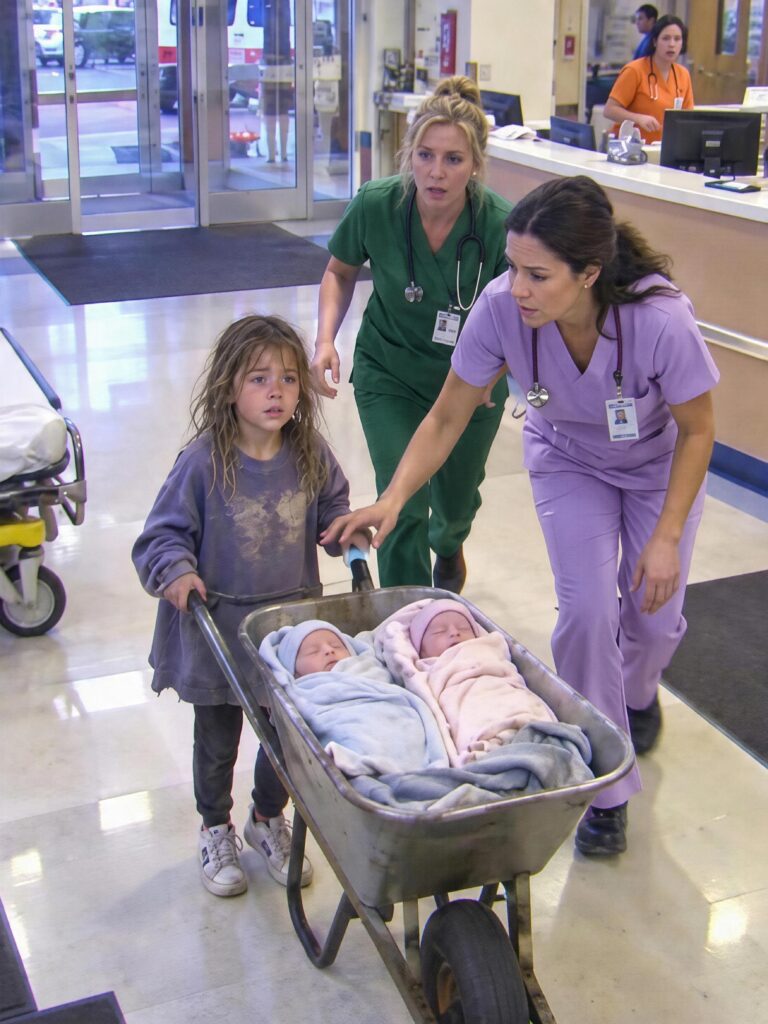
The wheelbarrow struck the edge of the emergency department sidewalk with a metallic bang.
Lucy almost fell forward.
She had been pushing it for so long that her fingers had forgotten how to open. Even when a security guard rushed toward her, she kept both hands locked around the handles.
“Sweetheart, where are your parents?”
Lucy looked past him toward the sliding glass doors.
“The babies need a doctor.”
The guard, whose name was Raymond Ellis, had worked at St. Catherine’s Medical Center for eleven years. He had seen people arrive bleeding, crying, confused, and terrified. He had watched families stumble through those doors carrying news that would divide their lives into before and after.
But he had never seen a little girl standing behind a wheelbarrow full of newborn babies.
“Are those your brothers?”
Lucy nodded.
“This one is Noah. That one is Eli.”
She pointed toward the baby on the left.
“Noah cries all the time. He didn’t cry this morning.”
Raymond stopped asking questions.
He pressed the emergency button beside the entrance.
Within seconds, two nurses hurried outside. One lifted the first baby, while the other reached carefully beneath the blankets for his brother.
Both babies were alive.
But one was alarmingly cold, and the other seemed too weak to protest being moved.
“Get neonatal support down here,” the older nurse called.
Lucy stepped forward.
“Don’t take them different places.”
“We have to examine them, honey.”
“But they’re brothers.”
The nurse looked at Lucy’s face, then at her scraped hands.
“We know. We’re going to take care of both of them.”
Lucy stood still while the nurses disappeared inside.
Only then did Raymond notice that her knees were shaking.
“Come on, sweetheart. Let’s get you somewhere to sit.”
“I can’t.”
“Why not?”
“I have to go get Mommy.”
Raymond crouched until his eyes were level with hers.
“Where is your mommy?”
“At home.”
“Is she hurt?”
Lucy hesitated.
She didn’t know how to answer.
Her mother wasn’t bleeding. She hadn’t fallen down the stairs. She wasn’t crying or saying that something hurt.
She was simply lying beside the bed, where Lucy had last seen her three mornings earlier.
“She won’t wake up.”
Raymond’s expression changed.
“Did you try talking to her?”
“Yes.”
“Did you shake her?”
Lucy nodded again.
“I put water by her mouth. But it spilled.”
He reached for the radio on his shoulder.
Lucy caught his sleeve.
“Am I going to get in trouble?”
“For what?”
“Leaving the house.”
Raymond looked at the wheelbarrow, at the two little handprints beginning to dry on its rusty handles.
“No, sweetheart.”
“But Mommy said never to go walking alone.”
He swallowed.
“Sometimes you have to get help when somebody is sick.”
Lucy stared at him.
“Even when it’s against the rules?”
“Especially then.”
Those words would stay with Raymond long after his shift ended.
Inside the emergency department, Lucy was guided into a small consultation room. A nurse named Denise Parker cleaned the dirt from her face and gave her a bottle of water.
Lucy took two careful sips.
Then she set it down.
“Can you call Mommy?”
“We’re going to send people to help her.”
“Are they going to be mad that the house is messy?”
Denise paused.
“No, honey.”
“There’s cereal on the floor.”
“That’s okay.”
“And one of the bottles fell behind the couch.”
“That’s okay too.”
Lucy looked relieved, but only for a moment.
“Mommy was trying to clean before she went to sleep.”
Denise turned away just long enough to steady her expression.
Lucy Bennett lived in a small blue house at the edge of Mill Creek, a working-class town in southern Ohio. Her mother, Rachel, was thirty-two years old and had given birth to twins only eleven days earlier.
The house was an old two-bedroom rental with peeling porch paint, a narrow kitchen, and a backyard just large enough for a vegetable patch.
Before the twins arrived, Rachel worked the morning shift at a grocery store bakery. She decorated birthday cakes, packaged bread, and occasionally brought home pastries that hadn’t sold.
Lucy loved the days when her mother came home with a pink-frosted cupcake.
She loved other things too.
The way Rachel warmed her hands around a coffee mug on cold mornings.
The funny voices she used when reading library books.
The little song she sang while brushing Lucy’s hair.
And the promise she made every night.
“No matter how tired I am, there’s always enough love for you.”
Lucy believed that promise completely.
She had never doubted her mother’s love.
What she didn’t understand was that love couldn’t keep a person’s body from failing.
Rachel had spent the last months of her pregnancy struggling with swelling, headaches, dizziness, and exhaustion.
Her doctor had repeatedly warned her to rest.
But rest was something Rachel could rarely afford.
The father of her children, Daniel Bennett, had left the marriage eight months earlier.
He hadn’t vanished completely. He sometimes called, occasionally sent money, and liked to tell relatives that he was still doing his part.
But he lived forty minutes away with his girlfriend, and his promises arrived more reliably than his help.
When Rachel told him she was expecting twins, he had gone quiet.
Then he asked whether she was certain both babies were his.
Rachel remembered sitting at the kitchen table with that question hanging between them.
They had been married for seven years.
There had been no affairs.
No separation until Daniel moved out.
Just a husband who had grown tired of being responsible for a family.
“Don’t do that,” she had said.
“Do what?”
“Make me defend something you already know.”
Daniel eventually apologized.
But he never took back the wound.
During the pregnancy, Rachel’s older sister, Monica, helped when she could. She lived in Columbus with two teenagers and a husband recovering from a back injury.
Their mother, Linda, lived closer, but the relationship between her and Rachel had always been complicated.
Linda believed in discipline, self-reliance, and keeping family problems inside the family.
Rachel had spent much of her childhood hearing some version of the same sentence.
“You made your choices. Now live with them.”
When Daniel left, Linda said it again.
When Rachel announced the twins, she said it more gently, but the meaning didn’t change.
“You’re going to have to learn to manage.”
Rachel tried.
She prepared freezer meals, washed tiny clothes, and arranged the bedroom so both cribs fit alongside her own bed.
She bought a secondhand double stroller, but one wheel came loose before she could use it.
Daniel promised to repair it.
He never did.
The old wheelbarrow in the backyard belonged to the previous tenant. Rachel used it for hauling bags of soil and fallen branches.
Lucy liked putting her dolls in it and pushing them across the grass.
Sometimes Rachel walked beside her, pretending the dolls were important passengers on a grand adventure.
“Careful with your travelers,” she would say.
Lucy would lift her chin.
“I’m a very good driver.”
Rachel always laughed.
Eleven days after the twins were born, that old wheelbarrow would carry the two most precious people in Lucy’s little world.
But on the evening everything began, nobody knew anything terrible was coming.
Rachel had returned home from the hospital with instructions to monitor her symptoms and attend a follow-up appointment.
The delivery had been difficult.
Her blood pressure had remained concerning, and she had struggled with dizziness after giving birth.
She was supposed to have an adult helping her at home.
Monica had planned to stay for several days but was called back when her husband needed medical attention.
Linda visited briefly, brought a casserole, and reminded Rachel to sleep whenever the babies slept.
Daniel came once.
He held Eli for less than ten minutes, took several photographs, and complained that the house smelled like dirty diapers.
Rachel handed him Noah.
“Could you at least take the trash out before you leave?”
Daniel glanced toward the kitchen.
“I’ve got to get back. I told Vanessa I’d be home by six.”
Rachel stared at him.
“You’ve been here twenty minutes.”
“I can’t do everything, Rachel.”
She wanted to remind him that she wasn’t asking him to do everything.
She was asking him to take out one bag of trash.
Instead, she turned toward the sink.
Daniel left shortly afterward.
Lucy watched his car disappear from the front window.
“Is Daddy coming back tomorrow?”
Rachel was folding a blanket.
“I don’t know, sweetheart.”
“He said he’d fix the stroller.”
“I know.”
“He forgot.”
Rachel pressed the folded blanket against her chest.
“Yes,” she said quietly. “He did.”
Two days later, Rachel began feeling worse.
Her headaches became sharper.
She saw spots whenever she stood too quickly.
Her hands trembled while preparing bottles.
She called the clinic, but after waiting on hold, one of the twins began crying. She hung up to tend to him.
That afternoon, Linda phoned.
“How are you managing?”
Rachel sat on the edge of her bed, trying to keep her voice steady.
“Not great.”
“Every new mother is tired.”
“I’ve been dizzy.”
“Are you eating properly?”
“When I can.”
“Rachel, you can’t let yourself fall apart. Those children need you.”
Rachel closed her eyes.
“I know they do.”
“Then you need to pull yourself together.”
Rachel ended the call without telling her mother that she had nearly fainted in the kitchen.
She didn’t want another lecture.
She didn’t want another reminder of how badly she was managing.
And, most of all, she didn’t want anyone looking at her children and deciding she wasn’t capable of caring for them.
That evening she sat at the kitchen table with a pen and a piece of paper.
She wrote down the twins’ full names and birth dates.
She explained where their medical papers were kept.
She wrote that the spare house key hung on a string by the front door because Lucy sometimes liked pretending it was a necklace.
Then she stopped.
Her vision blurred.
She pressed the heel of her hand against her forehead.
After a moment, she wrote another line.
I’ve been blacking out again.
She stared at the words.
She knew they were serious.
She knew she should call someone immediately.
But the babies were crying, Lucy was asking for dinner, and the phone was charging in the kitchen.
Rachel folded the paper and tucked it into the diaper bag.
Her final words were hurried and uneven.
If I can’t wake up, please help the babies first. Please keep my children together.
She intended to make another call after settling the twins.
She never made it.
Sometime during the night, Rachel rose from bed to check on Noah.
A terrible headache flashed through her skull.
She reached for the bedside table.
Her fingers missed.
Then the floor seemed to tilt beneath her.
She collapsed beside the bed.
When Lucy woke the following morning, her mother was still lying there.
“Mommy?”
No answer.
Lucy knelt beside her.
“Mommy, Eli’s crying.”
She touched Rachel’s shoulder.
Her mother was breathing.
Lucy could see her chest move.
So she thought Rachel must be sleeping.
And because her mother had been so tired lately, Lucy decided not to bother her.
At first, she tried to be helpful.
She brought Rachel a blanket.
She put her favorite stuffed rabbit beside her.
She found cereal in the pantry and poured it into a bowl for breakfast.
When Noah cried, Lucy went to the bassinet.
She had watched her mother feed the twins dozens of times.
She knew where the bottles were kept.
She knew the formula container had a blue lid.
But she did not understand how carefully newborns needed to be fed, or how quickly they could become dangerously ill without proper care.
She tried to imitate the routines she had seen.
Sometimes the babies drank a little.
Sometimes they cried until she began crying too.
By afternoon, Lucy had checked her mother six times.
“Mommy, please wake up.”
She pushed a strand of hair away from Rachel’s forehead.
“I’m being good.”
Nothing.
That night, Lucy dragged a pillow onto the floor beside her mother.
She slept there between trips to the bassinets.
The next day was worse.
Her cereal bowl remained on the table.
The sink filled with bottles she didn’t know how to clean properly.
Noah’s crying became weak.
Eli slept longer than Lucy remembered him sleeping before.
She tried calling her grandmother from Rachel’s phone, but the battery was dead and Lucy couldn’t find the charging cord.
She knew there was a neighbor named Mrs. Harper who sometimes waved from across the street.
But Mrs. Harper’s car wasn’t in the driveway.
Lucy stood at the front door and looked outside.
Her mother had told her never to leave the house without an adult.
She closed the door again.
By the third morning, the smell of spoiled milk lingered in the kitchen.
Lucy was hungry, frightened, and desperately tired.
When she checked Noah, he barely moved.
She touched his tiny fingers.
They felt cold.
“Wake up,” she whispered.
He made a faint sound.
Then nothing.
Lucy looked toward the bedroom.
“Mommy!”
Her voice cracked.
“Mommy, please!”
She ran to Rachel and shook her shoulder.
“Something’s wrong with Noah!”
Her mother did not move.
Lucy stood there for a long moment.
Then she remembered the hospital.
She remembered the big building with the red emergency sign.
She remembered riding past it with Rachel on their way to the grocery store.
She couldn’t remember every street.
But she remembered the bridge, the gas station, and the road with the painted yellow lines.
She went to the front door.
The key was hanging on its string.
She slipped it around her neck.
Then she went outside.
The wheelbarrow stood beside the shed.
Lucy had never lifted her brothers into it before.
She found a folded quilt and several towels.
She lined the bottom as carefully as she could, then carried each baby outside.
Noah was first.
Eli came next.
Lucy arranged the blankets around them, trying to copy how Rachel tucked them in.
She leaned close.
“I’m taking you to the doctors.”
Then she gripped the handles.
The wheelbarrow was heavy.
She could barely lift it.
But she tried again.
And again.
Finally, the single front wheel rolled forward.
At the end of the driveway, Lucy looked back at the house.
Her mother was still inside.
Leaving felt like breaking the biggest rule she had ever been given.
Lucy began crying.
“I’m sorry, Mommy.”
Then she turned toward the road.
She pushed through the neighborhood, past parked cars and closed garages.
The wheelbarrow rattled with every crack in the sidewalk.
Whenever the road became uneven, Lucy stopped to check the twins.
She didn’t know how far four miles was.
She only knew the hospital came after the bridge.
A delivery driver slowed beside her.
“Hey, little lady, where are you going?”
“The hospital.”
He glanced into the wheelbarrow.
By the time he realized what he was seeing, Lucy had already turned down the next street.
He pulled over and called 911.
Several minutes later, another driver saw the little girl pushing the wheelbarrow along the shoulder of the road.
That driver also called for help.
But Lucy kept moving.
She passed the gas station.
She crossed the bridge.
Her palms grew raw.
The sun climbed higher.
When the hospital finally appeared, she was so tired that she could hardly see through her tears.
But she could see the red emergency sign.
She kept pushing.
And now, sitting inside that same hospital, Lucy watched Denise speak urgently into a telephone.
The nurse asked for her address.
Lucy knew the house number because Rachel had made her practice it.
“Fourteen twenty-six Willow Lane.”
“Very good, sweetheart. Is there a key to get inside?”
Lucy touched the string around her neck.
“Yes.”
“Can the ambulance crew borrow it?”
Lucy hesitated.
“Mommy says we have to lock the door.”
Denise knelt beside her.
“The people going there need to open it so they can help her.”
Lucy carefully lifted the string over her head.
She placed the key in Denise’s palm.
“Tell them not to scare her.”
“I will.”
“And tell Mommy I didn’t mean to leave her.”
Denise could not speak for a moment.
Then she closed her hand around the key.
“I’ll tell her exactly why you left.”
Twenty minutes later, an ambulance reached the little blue house.
The paramedic unlocked the front door.
Inside, the rooms were quiet.
Too quiet for a home with newborn twins.
He moved toward the bedroom.
And when he saw Rachel Bennett lying on the floor, he immediately called for additional medical support.
Beside her was an empty glass.
Near the bed lay a folded baby blanket.
And inside the diaper bag, his partner discovered the note Rachel had written before collapsing.
The first line made both rescuers look at each other.
I’ve been blacking out again.
The last line made the senior paramedic lower his eyes.
Please keep my children together.
He radioed the hospital.
“Adult female located. Alive, unresponsive. Severe medical emergency. We also found a handwritten note. You’ll need to hear this.”
At St. Catherine’s, Denise listened to the message.
Then she glanced through the window at Lucy, who was sitting with her injured hands folded in her lap.
The little girl looked up.
“Did they find Mommy?”
Denise opened the door.
“Yes, sweetheart.”
“Did the key work?”
“It worked.”
Lucy exhaled.
For the first time since arriving, she leaned back against her chair.
But before Denise could explain anything else, another nurse entered the room.
Her expression was grave.
“Denise, we have a problem.”
She lowered her voice.
“The twins’ father has been contacted.”
“And?”
“He says their mother is irresponsible. He’s asking whether she abandoned them.”
Denise stared at her.
Then both women looked toward the six-year-old girl sitting alone behind the glass.
A child who had just pushed two newborn babies four miles to save their lives.
And somewhere forty minutes away, the man who had left those children behind was already preparing to blame their mother.
Part 2
Daniel Bennett arrived at the hospital shortly after two that afternoon.
He came through the emergency entrance wearing a clean navy polo shirt and carrying a set of car keys.
Vanessa, his girlfriend, walked beside him.
He asked for the twins before he asked about Rachel.
A receptionist directed him toward the family consultation area, where Denise met him.
“Mr. Bennett?”
“Yes. Where are my sons?”
“They’re receiving treatment.”
“What’s wrong with them?”
“They were brought in seriously dehydrated and in need of immediate care. The medical team is monitoring them closely.”
Daniel frowned.
“Why weren’t they fed?”
Denise held his gaze.
“Their mother suffered a medical emergency at home.”
“So she left the kids alone?”
“She was found unconscious.”
Daniel shook his head.
“Rachel’s always been dramatic about being overwhelmed.”
Denise’s expression remained professional.
“Mr. Bennett, your daughter is also here.”
“Lucy?”
“Yes.”
“How did she get here?”
Denise was silent for a moment.
“Your daughter brought the babies.”
Daniel gave a short, confused laugh.
“What do you mean, brought them?”
“She pushed them here in a wheelbarrow.”
His smile disappeared.
Vanessa put a hand over her mouth.
Daniel looked from one nurse to another.
“That’s impossible.”
“It’s what happened.”
“She’s six.”
“Yes,” Denise answered. “She is.”
In the small waiting room, Lucy had finally accepted half a sandwich.
She was taking tiny bites when Daniel entered.
“Daddy!”
She jumped from the chair.
For a moment, she looked like any child relieved to see a familiar face.
Daniel bent and hugged her.
“Lucy, what were you thinking?”
She pulled back.
“I brought Noah and Eli.”
“I heard.”
“Mommy wouldn’t wake up.”
“You should’ve called somebody.”
Lucy blinked.
“I tried.”
“You know you don’t leave the house alone.”
Her shoulders dropped.
Denise stepped forward.
“Mr. Bennett.”
Daniel waved one hand without looking at her.
“You could’ve gotten hurt, Lucy. Something terrible could’ve happened.”
Lucy’s eyes filled.
“I didn’t know what else to do.”
Vanessa touched Daniel’s arm.
“Daniel, stop.”
He looked annoyed.
“I’m just saying she should have known better.”
Denise moved between him and the little girl.
“Your daughter recognized an emergency and brought two infants to medical care. Right now, she needs reassurance, not criticism.”
Daniel stared at her.
For a moment, he looked as if he might argue.
Then he saw Lucy wiping her eyes with the back of her sleeve.
“Okay,” he muttered. “Okay, honey. I’m sorry.”
But the damage had already been done.
Lucy returned to her chair and stopped eating.
Within the hour, Linda arrived.
She had heard from Monica, who had received a call from the hospital.
Linda’s face was pale, but her voice was sharp.
“How could this happen?”
Denise explained that Rachel had been found unconscious and was receiving intensive treatment.
Linda listened, pressing her purse against her chest.
Then she asked the question that would echo through the family for days.
“Why didn’t she tell somebody she was that sick?”
Monica arrived behind her.
“Mom, maybe because every time she said she needed help, somebody told her to manage.”
Linda turned.
“This is not the time.”
“No,” Monica replied. “Apparently the time was last week.”
The sisters’ relationship had always been strained by the family habit of making Rachel responsible for everything that went wrong.
Monica had spent years watching her younger sister apologize for needing help.
Rachel apologized when she borrowed money.
She apologized when she asked someone to watch Lucy.
She even apologized for taking up space at holiday dinners when Daniel stopped attending.
Monica knew Rachel could be stubborn.
She knew her sister sometimes made things harder by refusing assistance.
But she also knew why Rachel had learned to refuse it.
In their family, needing help often came with a price.
The price was being reminded how much trouble you had caused.
“I’m going to see Lucy,” Monica said.
Linda reached for her arm.
“Don’t start an argument in front of that child.”
“Then don’t blame her mother in front of her.”
Monica walked away.
When she entered Lucy’s room, the child was sitting with a paper cup of juice.
“Aunt Monica?”
Monica opened her arms.
Lucy crossed the room and pressed herself against her.
For nearly a minute, neither spoke.
Then Lucy whispered, “I couldn’t carry Mommy.”
Monica’s chest tightened.
“What, sweetheart?”
“I wanted to bring her too. But she’s too big.”
Monica closed her eyes.
“You weren’t supposed to carry Mommy.”
“But I left her.”
“You went for help.”
Lucy began trembling.
“I thought Noah was dying.”
Monica held her closer.
“I know.”
“He wasn’t making noise.”
“I know, baby.”
“I didn’t want him to die.”
Monica’s voice broke.
“You helped him.”
Lucy pulled back.
“Daddy said I should have called.”
“Did you try?”
“Yes.”
“Then you did everything you knew how to do.”
Lucy studied her aunt’s face.
“Is Mommy going to die?”
Monica wanted to promise no.
She wanted to say Rachel would walk through the door at any moment, smiling and carrying both babies.
But she had already spoken with a doctor.
Rachel was in critical condition.
The medical team suspected a serious postpartum blood-pressure complication, made worse by dehydration and the time she had spent unconscious.
There were concerns about her kidneys and possible neurological effects.
The doctors were treating her aggressively, but the next twenty-four hours mattered.
Monica brushed Lucy’s hair behind her ear.
“The doctors are working very hard to help her.”
“Will they wake her up?”
“They’re trying, sweetheart.”
Lucy leaned against her again.
“Mommy always wakes up when I cry.”
Monica looked toward the window.
Outside, the parking lot was full of ordinary cars carrying people with ordinary worries.
She had never hated ordinary life more.
That evening, a hospital social worker named Karen Whitmore met with the family.
Karen was a woman in her fifties with short gray hair and the calm manner of someone accustomed to frightened people.
She explained that the hospital needed a safe temporary arrangement for Lucy while Rachel remained hospitalized.
The twins would continue receiving medical care.
The family also needed to understand what had happened at home.
Daniel crossed his arms.
“I’m their father. They can stay with me when they’re discharged.”
Karen nodded.
“That will be considered. We’ll need to discuss your living arrangements and who can provide their care.”
“They’re my children.”
“Of course.”
“Then I don’t see the problem.”
Monica looked at him.
“The problem is that you haven’t been around.”
Daniel turned toward her.
“That’s between me and Rachel.”
“No. The babies were found in a wheelbarrow because Rachel was sick and nobody knew.”
“I didn’t know she was sick.”
“She told you she was struggling.”
Daniel’s jaw tightened.
“Being tired after giving birth isn’t the same as being unconscious.”
“No,” Monica said. “But checking on your children is a pretty reasonable way to find out whether something is wrong.”
Linda intervened.
“Enough. Fighting doesn’t help the children.”
Karen raised one hand.
“Everyone here is upset. Right now, we need facts and a stable plan.”
She turned toward Daniel.
“When was the last time you saw the babies?”
He shifted in his chair.
“Last week.”
“Which day?”
“Tuesday. I think.”
“And when did you last speak with Rachel?”
“Couple of days ago.”
“By phone?”
“Text.”
Karen wrote something down.
“What was the conversation about?”
Daniel hesitated.
“She asked if I could come over.”
“Did you?”
“No.”
“Why not?”
“I had work.”
Monica knew Daniel was scheduled off that day.
But she said nothing.
Not yet.
Karen continued gathering information.
She wasn’t interested in turning a family argument into a public trial.
She wanted to know whether there were adults the children could safely depend on.
By the end of the meeting, Monica offered to care for Lucy with support from her husband and teenagers.
Karen arranged to review that plan.
Daniel agreed reluctantly.
“I’ll be involved,” he said.
Monica didn’t argue.
She simply looked at Lucy through the window.
Her niece had fallen asleep with both hands curled against her chest, even though the palms were bandaged.
She looked as if she were still holding the wheelbarrow handles.
The next morning, Rachel opened her eyes.
At first, the world appeared in fragments.
A pale ceiling.
A soft mechanical beeping.
Someone saying her name.
She tried to speak.
Her mouth was dry.
A nurse leaned closer.
“Rachel? You’re at St. Catherine’s Hospital. You’ve been very sick.”
Rachel frowned.
Her last clear memory was standing beside her bed.
Then she remembered Noah crying.
She tried to sit up.
“My babies.”
The nurse gently stopped her.
“They’re here. They’re being cared for.”
Rachel searched the room.
“Lucy?”
“She’s safe.”
Rachel shook her head.
“No, she’s home.”
The nurse paused.
“Rachel, you’ve been unconscious for several days.”
Rachel stared at her.
Several days.
The words didn’t make sense.
She had just fed Eli.
She had been about to make another bottle.
Lucy had been wearing her yellow pajamas.
“How many days?”
“About three.”
Rachel began breathing faster.
“The babies were home.”
“They’re receiving treatment now.”
“Who brought them?”
The nurse glanced toward the doorway, where a doctor had just appeared.
He approached the bed.
“Rachel, your daughter got help.”
Rachel’s face changed.
“Lucy?”
“Yes.”
“She’s six.”
“I know.”
The doctor explained gently, leaving out unnecessary details until Rachel was more stable.
But even the simplest version was almost impossible to absorb.
Lucy had placed the babies in a wheelbarrow.
She had pushed them to the hospital.
She had given rescuers the house key.
And because of her, all three had received medical attention before the situation became even worse.
Rachel covered her mouth.
Her eyes filled.
“Was she alone?”
“Yes.”
“All that way?”
The doctor nodded.
Rachel turned toward the wall.
She began to cry.
Not loudly.
There was no dramatic outburst.
Just a terrible, quiet sound from a mother trying to imagine her little girl walking along a road with two newborn brothers.
“I should’ve called,” she whispered.
The doctor sat beside her.
“You were seriously ill, Rachel. Right now, your job is to recover.”
“I knew something was wrong.”
“You wrote a note.”
She turned back.
“What note?”
“The paramedics found it in the diaper bag.”
Rachel remembered the pen.
The table.
The difficulty focusing her eyes.
She remembered writing the children’s names.
Then nothing.
“I thought I had more time,” she whispered.
The doctor didn’t answer immediately.
Sometimes there were no comforting words that could improve the truth.
By afternoon, Rachel was stable enough for a short visit.
Monica brought Lucy into the room.
The girl stopped at the doorway.
Rachel was lying beneath white blankets, with monitors beside the bed and an IV attached to her arm.
Lucy stared.
“Mommy?”
Rachel lifted her hand.
“Hi, baby.”
Lucy didn’t run at first.
She looked at the equipment.
Then at the nurse.
“Can I hug her?”
“Gently,” the nurse said.
Lucy crossed the room.
Rachel reached for her.
The moment Lucy felt her mother’s hand against her back, she began sobbing.
“I tried to wake you up.”
Rachel held her as carefully as she could.
“I know.”
“I brought water.”
“I know, sweetheart.”
“It spilled.”
“That’s okay.”
“And Noah wasn’t crying.”
Rachel closed her eyes.
“I know.”
Lucy pulled back.
“Are you mad?”
Rachel looked startled.
“Mad?”
“I left the house.”
Rachel’s face crumpled.
“Oh, Lucy.”
“You told me not to.”
Rachel caught her daughter’s little hands.
She noticed the bandages.
She noticed the red marks extending beyond them.
“What happened to your hands?”
“The wheelbarrow was heavy.”
Rachel pressed her lips together.
Lucy waited anxiously.
Then Rachel said, “You did something very brave.”
“I broke the rule.”
“You got help when we needed it.”
“But I left you.”
Rachel shook her head.
“You came back for me in the only way you could.”
Lucy looked confused.
Rachel touched the key hanging around her neck.
“You gave them the key.”
“They gave it back.”
“And that helped them find me.”
Lucy stared at her mother.
“So I didn’t leave you?”
“No, sweetheart. You saved us.”
Lucy leaned forward again.
Rachel kissed the top of her head.
Then she whispered something she would repeat many times in the coming weeks.
“But you should never have had to do it.”
The reunion should have been the beginning of peace.
Instead, another conflict was already taking shape outside the room.
Daniel had spoken to his mother, Patricia, about the situation.
Patricia had never liked Rachel.
She believed Rachel had trapped Daniel into marriage when they were young, then expected him to sacrifice his freedom.
She considered Rachel’s pregnancy with twins proof that her daughter-in-law made poor decisions.
When Daniel told her what happened, Patricia reacted with anger.
“Three days? She left those babies without proper care for three days?”
“She was unconscious, Mom.”
“Was she unconscious before she neglected her health?”
Daniel said nothing.
Patricia lowered her voice.
“You need to think about custody.”
He hadn’t considered it seriously until then.
But the idea stirred something uncomfortable inside him.
If the children stayed with him, he could prove he wasn’t the irresponsible parent everyone was accusing him of being.
He could show his family that he was stepping up.
And perhaps, more importantly, he could avoid examining where he had failed.
Patricia continued.
“People are going to hear about this. You don’t want them thinking you abandoned your children.”
Daniel rubbed his forehead.
“What do you expect me to do?”
“Get ahead of it.”
That evening, Daniel sent Rachel a message.
We need to talk about where the kids are going to live after this.
Rachel read it from her hospital bed.
Then another message arrived.
Mom thinks it’s safer if I take primary responsibility until you get yourself together.
Rachel stared at the screen.
For several seconds, she couldn’t move.
She had barely regained consciousness.
Her babies were still in neonatal care.
Her daughter was recovering from an experience no child should endure.
And Daniel was already discussing who would control the family.
She typed slowly.
I am their mother. I had a medical emergency.
His reply came almost immediately.
And look what happened because of it.
Rachel set the phone down.
She had spent months trying not to hate him.
She had told herself that Daniel was immature rather than cruel.
That maybe he would grow into fatherhood.
That maybe, when the twins arrived, something would change.
But looking at those words, she felt something settle painfully into place.
He was more concerned about appearing responsible than admitting she had needed him.
Monica arrived half an hour later and found Rachel staring out the window.
“What happened?”
Rachel handed her the phone.
Monica read the messages.
Her mouth tightened.
“Absolutely not.”
Rachel shook her head.
“I’m scared.”
Monica sat beside her.
“I know.”
“What if they think I neglected the babies?”
“You were unconscious.”
“But I knew I was sick.”
“You were trying to do everything alone.”
Rachel wiped her eyes.
“That doesn’t make me a good mother.”
Monica leaned forward.
“Rachel, listen to me. A medical emergency does not prove you don’t love your children.”
Rachel began crying harder.
“I keep seeing Lucy on that road.”
Monica took her hand.
“So do I.”
“I can picture her trying to lift that wheelbarrow.”
“I know.”
“She probably cried.”
Monica swallowed.
“Yes. She probably did.”
Rachel turned toward her sister.
“I don’t know how to forgive myself for that.”
Monica held her gaze.
“Then don’t start with forgiveness. Start with getting better. And when you come home, we’re going to make sure you never have to do this alone again.”
Over the following days, the twins began improving.
Noah, who had arrived weaker, responded to treatment.
Eli became more alert.
The hospital continued monitoring their feeding, hydration, and overall condition.
Lucy was allowed supervised visits when staff considered it appropriate.
During one visit, she stood between the bassinets and watched a nurse feed Noah.
“Is he hungry?”
“He is.”
“He wasn’t yesterday.”
“He’s getting stronger.”
Lucy looked toward Eli.
“Are you feeding him too?”
“Of course.”
“Both?”
The nurse smiled.
“Both.”
Lucy watched another minute.
Then she reached toward a bottle.
“Can I help?”
The nurse gently guided her hand away.
“You can sit beside me and talk to him.”
Lucy frowned.
“But I know how.”
“I believe you.”
The nurse pulled up a chair.
“Now you get to be his big sister. We get to do the grown-up work.”
Lucy seemed uncertain.
Being responsible had become such a large part of her last three days that she didn’t know how to stop.
That afternoon, a child-life specialist brought crayons and coloring books.
Lucy drew a blue house.
Three small stick figures stood outside.
Two tiny shapes sat inside a wheelbarrow.
A large figure lay in a window.
The specialist asked who the people were.
“Me and the babies.”
“And who’s in the house?”
“Mommy.”
“What are you doing?”
Lucy considered the question.
“Going to find somebody who knows what to do.”
The specialist didn’t try to turn the drawing into a lesson.
She simply sat beside Lucy.
After a while, Lucy drew a red ambulance next to the house.
Then she added a stick figure standing beside her mother.
“That’s the doctor,” she explained.
“Is your mommy okay in the picture?”
Lucy nodded.
“Somebody came.”
Meanwhile, the family conflict grew sharper.
Daniel consulted an attorney.
He told the lawyer that Rachel had been unable to care for the children and that he wanted an emergency parenting arrangement.
The attorney asked whether there was evidence of abuse or deliberate neglect.
Daniel described the incident.
Then he mentioned the medical emergency.
The attorney asked for medical records and advised him not to assume Rachel’s hospitalization automatically justified a change in custody.
That wasn’t the answer Daniel wanted.
Patricia urged him to continue.
Linda, meanwhile, began wondering whether she had failed Rachel.
She remembered the phone call.
Rachel’s quiet voice.
The words I’ve been dizzy.
Linda remembered answering with a lecture.
She had meant to encourage her daughter to be strong.
But strength had become the only thing she knew how to demand.
One evening, she approached Rachel’s hospital room carrying a container of homemade soup.
Rachel was awake, looking at photographs of the twins on her phone.
Linda stopped in the doorway.
“Can I come in?”
Rachel nodded.
Her mother set the soup beside the bed.
“I made chicken and rice.”
“Thank you.”
Linda pulled up a chair.
For a while, neither spoke.
Then Linda said, “You should’ve told me how bad things were.”
Rachel kept looking at the phone.
“I did tell you.”
Linda stiffened.
“You said you were tired.”
“I said I was dizzy.”
“You didn’t say you were fainting.”
Rachel turned toward her.
“Would it have made a difference?”
The question landed harder than an accusation.
Linda opened her mouth.
Then closed it.
Rachel’s voice remained quiet.
“Every time I told you I was struggling, you told me to manage.”
“I was trying to help you.”
“I know.”
“Your father and I didn’t have people running over every time things got difficult.”
Rachel looked down.
“I wasn’t asking you to run over every time. I wanted you to believe me when I said something was wrong.”
Linda’s eyes filled.
She studied her daughter’s face.
For the first time, she seemed to notice how thin and exhausted Rachel looked.
Not weak.
Not careless.
Sick.
“I didn’t understand,” Linda whispered.
Rachel’s answer was barely audible.
“I needed you to.”
Linda covered her mouth.
She had no defense that wouldn’t make things worse.
So she stayed quiet.
It was the first useful thing she had done in the conversation.
Two days later, a family meeting was arranged to discuss Rachel’s discharge plan and the children’s care.
Karen, the social worker, met with Rachel, Monica, Linda, and Daniel.
Rachel’s doctors had outlined the support she would require while recovering.
Monica offered to stay at the blue house temporarily.
Linda offered to provide meals and transportation.
Daniel said he wanted the twins to live with him.
Rachel looked at him.
“Where?”
“At my place.”
“With Vanessa?”
“Yes.”
“Do you have two cribs?”
“I can get them.”
“Do you know their feeding schedule?”
“I can learn.”
Rachel nodded slowly.
“That’s what I’ve been asking you to do since before they were born.”
Daniel flushed.
“I’m trying to help now.”
“Then help.”
“I am.”
“No,” Rachel replied. “You’re trying to take over.”
Karen intervened before the conversation escalated.
The discussion continued for nearly an hour.
They reviewed medical needs, practical support, transportation, child care, and the importance of keeping the children in a familiar and stable environment.
Then Karen brought up the note found in the diaper bag.
Rachel looked confused.
“Why?”
Karen took a copy from her folder.
“Because it helps us understand what you were trying to do before you lost consciousness.”
Daniel leaned forward.
“What note?”
Karen explained.
Rachel had documented the children’s information.
She had identified where their papers and key could be found.
And she had written that she was experiencing blackouts.
Daniel looked at Rachel.
“You knew you were blacking out?”
Rachel’s eyes filled.
“Yes.”
“And you didn’t go to the hospital?”
“I was trying to arrange help.”
“By writing a note?”
Monica turned sharply.
“Daniel.”
But he continued.
“You could’ve called me.”
Rachel stared at him.
“I did.”
He shook his head.
“No, you didn’t.”
Rachel reached for her phone.
Her hands trembled slightly as she opened the message thread.
She scrolled back to the day before she collapsed.
Then she handed the phone to Karen.
The message was still there.
Daniel, I’m scared. I’ve nearly passed out twice. I really need you to come over or take Lucy for a few hours so I can get checked. Please.
Below it was his response.
I can’t keep dropping everything because you’re overwhelmed. Call your mom.
The room became silent.
Daniel’s face drained.
Rachel looked at him.
“You told me I was overwhelmed.”
“I didn’t know it was that serious.”
“I told you I was scared.”
He looked down.
Patricia wasn’t there to answer for him.
Neither was Vanessa.
There was only the message, and the painful fact that Rachel had asked for help before everything fell apart.
Karen placed the phone carefully on the table.
The message didn’t erase Rachel’s medical risks or resolve every question about future care.
But it changed the conversation.
Rachel had not simply refused help.
She had asked for it.
And one of the people most responsible for supporting the children had dismissed her.
Daniel sat back.
For once, he had nothing to say.
Then Rachel spoke again.
Her voice was trembling, but clear.
“I don’t want to spend the rest of my life proving I deserved help.”
She looked at Karen.
“I want to talk about what my children need. And I want the people who promise to help them to actually show up.”
It was the first time Monica had heard her sister speak without apologizing for taking up space.
But the greatest test was still ahead.
Because Rachel could confront Daniel, arrange support, and make plans for the future.
What she could not do was erase the memory of the little girl who had believed she might have killed her brothers by waiting too long.
And that fear had begun following Lucy into her sleep.
Part 3
The nightmare came three nights before Rachel was scheduled to leave the hospital.
Lucy had been staying with Monica.
At 2:17 in the morning, Monica woke to a scream from the guest room.
She hurried down the hallway.
Lucy was sitting upright in bed, crying so hard she could barely speak.
“Noah!”
Monica switched on the lamp.
“Sweetheart, you’re okay.”
“He stopped crying!”
Monica sat beside her.
“Lucy, the babies are at the hospital.”
“I have to get them.”
She began climbing out of bed.
Monica caught her gently.
“Lucy, look at me.”
But Lucy was staring toward the door.
“I have to find the wheelbarrow.”
Those words frightened Monica more than the scream.
She drew her niece into her arms.
“The doctors have your brothers. They are safe.”
Lucy’s breath came in short gasps.
“But what if they stop making noise?”
“Then the nurses will help them.”
“What if the nurses go to sleep?”
Monica swallowed.
“They work in shifts, honey. Someone is always there.”
Lucy looked uncertain.
“Always?”
“Always.”
For a long time, Monica held her while the little girl cried.
When Lucy finally calmed, she asked for a glass of water.
Monica returned with it and found her sitting at the edge of the bed.
“Can I ask you something?”
“Of course.”
Lucy looked at the floor.
“If I hadn’t gone, would they have died?”
Monica felt the question settle deep in her chest.
She wanted to say no.
She wanted to promise the outcome would have been the same.
But she knew the truth mattered.
“The babies were very sick,” she said carefully. “Getting help was important.”
Lucy nodded.
“Mommy too?”
“Yes.”
“Then why didn’t anybody come before?”
Monica had no easy answer.
She sat beside Lucy.
“We didn’t understand how much help your mommy needed.”
Lucy frowned.
“But she told people.”
Monica stared at her.
Lucy continued.
“I heard her on the phone. She said she was scared.”
Monica took a slow breath.
“Yes, she did.”
“Why didn’t they believe her?”
There it was.
The question no adult in the family could comfortably answer.
Monica stroked Lucy’s hair.
“Sometimes grown-ups make mistakes because they don’t listen carefully enough.”
Lucy thought about that.
“Really big mistakes?”
“Yes.”
“Bigger than breaking the rule?”
Monica felt tears rising.
“Sometimes much bigger.”
The following morning, Monica told Rachel about the nightmare.
Rachel listened without interrupting.
When Monica finished, Rachel stared at the blanket over her knees.
“She’s afraid it’ll happen again.”
“Yes.”
“I don’t know how to fix that.”
“You don’t have to fix it in one day.”
Rachel shook her head.
“She used to sleep through thunderstorms. Now she’s afraid when somebody doesn’t answer her right away.”
Monica sat beside her.
“A child therapist can help. Karen’s already arranging a referral.”
Rachel nodded.
But she continued staring at the blanket.
“I keep thinking about what I said to her.”
“What?”
“Before I got sick, I told her she was my big helper.”
Monica waited.
“I told her I didn’t know what I’d do without her.”
Rachel’s voice cracked.
“She probably thought keeping everybody alive was her job.”
Monica took her hand.
“Then you can tell her it’s not.”
Rachel looked up.
“Will she believe me?”
“Not right away, maybe. But you’ll keep showing her.”
That became Rachel’s first promise to herself.
She would never again make Lucy feel responsible for holding the family together.
Not even accidentally.
Not even with loving words.
A six-year-old could help set the table.
She could put toys away.
She could fetch a diaper when an adult asked.
But she should never feel that the survival of her mother and brothers depended on whether she was strong enough.
Two days later, Rachel met with Karen to finalize her home-care plan.
The doctors were encouraged by her recovery, although she would need close follow-up and help caring for the newborns.
Monica had arranged time away from work.
Linda had organized a schedule of meals, pharmacy trips, and transportation to appointments.
A neighbor, Mrs. Harper, had volunteered to help with groceries.
A visiting nurse would provide support where available through Rachel’s care plan.
Emergency numbers were written in large letters and placed on the refrigerator.
The practical details weren’t dramatic.
There were no grand speeches.
No sudden miracle.
Just adults making clear commitments and then arranging their lives to keep them.
For Rachel, it meant more than anyone knew.
She had spent so long treating help as something she needed to earn that accepting it felt almost unnatural.
When Linda offered to stay overnight so Rachel could sleep, she nearly refused.
Then she remembered Lucy’s bandaged palms.
“Yes,” she said.
Linda looked surprised.
Rachel repeated herself.
“Yes, Mom. I would appreciate that.”
Linda nodded.
“I’ll be there.”
This time, she was.
Daniel’s role took longer to settle.
After the meeting, he stopped pushing for an immediate change in where the children would live.
His attorney had explained that the family’s situation required careful assessment, not assumptions based on a frightening medical incident.
The professionals involved wanted stable care arrangements and reliable adult support.
Daniel remained the children’s father, and his responsibilities had not disappeared.
Nor had Rachel’s right to participate in decisions about her children simply because she had become ill.
A few days later, he came to the hospital alone.
Rachel was sitting beside the window, working through discharge instructions.
“Can we talk?”
She looked up.
“About what?”
He closed the door.
“I owe you an apology.”
Rachel set the papers down.
Daniel sat.
For a while, he stared at his hands.
“I saw the messages again.”
Rachel said nothing.
“I keep remembering how you asked me to come over.”
He swallowed.
“I thought you were exaggerating.”
“You always thought I was exaggerating.”
He nodded.
“I know.”
Rachel looked toward the window.
“I didn’t need you to solve everything.”
“I know.”
“I needed you to believe me.”
Daniel rubbed his face.
“I failed you.”
She looked back at him.
“You failed the children too.”
He lowered his eyes.
“Yes.”
The admission hung between them.
Rachel had once dreamed of hearing Daniel admit he was wrong.
She had imagined it would make her feel vindicated.
Instead, she felt tired.
Not because the apology meant nothing.
But because it had arrived after too much damage.
Daniel continued.
“Mom was the one pushing me to ask for custody.”
Rachel held up a hand.
“Daniel, your mother didn’t type those messages.”
He stopped.
“She didn’t leave when I asked you to take out the trash. She didn’t promise Lucy you’d fix the stroller. She didn’t make you question whether the twins were yours.”
His eyes filled.
Rachel’s voice remained steady.
“I know you want someone else to carry some of the blame. I’ve done that myself. But you made your choices.”
Daniel nodded slowly.
“I did.”
She took a breath.
“If you want to be their father, then be their father.”
“I do.”
“Not when there’s an audience. Not when your mother wants to defend your reputation. Not because you’re afraid people will think badly of you.”
He looked at her.
“What do you want me to do?”
Rachel pushed a sheet of paper across the table.
It contained upcoming appointments, supply needs, and specific times when help was needed.
“Start here.”
Daniel looked at the list.
It was ordinary.
Diapers.
Formula.
Transportation.
A pediatric appointment.
An hour of supervised time with the twins while Rachel rested, when appropriate.
There was no room for grand gestures.
Only work.
He looked up.
“I can do that.”
Rachel held his gaze.
“Then do it.”
She would judge him by what followed.
Not by what he promised.
The twins were discharged shortly before Rachel.
Noah had gained strength, and Eli was feeding better.
Both would require follow-up care, but their medical team was satisfied that they could leave with an appropriate plan.
Lucy was allowed to help choose their going-home blankets.
She picked blue for Noah and green for Eli.
“Because Noah likes blue,” she explained.
A nurse smiled.
“How do you know?”
Lucy shrugged.
“He just does.”
Nobody corrected her.
Some of being a big sister was getting to invent small, harmless things about her brothers.
On the day Rachel finally returned home, the blue house looked different.
Not because anyone had renovated it.
The porch paint was still peeling.
The screen door still squeaked.
The kitchen floor still had an old scratch near the refrigerator.
But the house was clean.
Fresh sheets covered the bed.
The cribs were ready.
A basket of groceries sat on the counter.
And someone had placed a vase of daisies beside the sink.
Monica carried one of the babies inside.
Linda carried the other.
Rachel walked slowly up the porch steps, one hand resting on the railing.
Lucy waited beside the door.
“Mommy?”
“Yes, baby?”
“Do you want me to help?”
Rachel smiled gently.
“You can open the door.”
Lucy brightened.
Then Rachel added, “And after that, you can go play.”
Lucy looked confused.
“Who’s going to watch the babies?”
“Aunt Monica and Grandma are here.”
“And you?”
“And me, when I’m well enough. We have lots of grown-ups helping now.”
Lucy glanced toward the cribs.
“Both babies?”
“Both.”
She considered that.
Then she opened the door.
The house smelled of lemon cleaner and chicken soup.
Rachel stepped into the kitchen.
For a moment, she couldn’t move.
She remembered lying on the bedroom floor.
She remembered the blurred edges of the room before everything went dark.
She remembered being certain she could stand up after resting for just another minute.
Her eyes filled.
Monica noticed.
“You okay?”
Rachel nodded.
“I just didn’t know if I’d see this place again.”
Monica set Noah into his crib.
“Well, you’re here.”
Rachel looked around.
For the first time, she didn’t interpret the sight of other people doing household chores as proof that she had failed.
She interpreted it as proof that she wasn’t alone.
That evening, Lucy came into her mother’s bedroom carrying a stuffed rabbit.
Rachel was resting against several pillows.
“Can I sleep here?”
Rachel moved the blanket.
“For a little while.”
Lucy climbed onto the bed.
She curled beside her mother, careful not to touch the place where Rachel’s IV had been.
For several minutes, they listened to the quiet sounds of the house.
Water running in the kitchen.
Monica speaking softly to Linda.
A baby making a sleepy little noise.
Then Lucy asked, “Are you going to sleep again?”
Rachel turned toward her.
“Yes, sweetheart. Everybody sleeps.”
Lucy stiffened.
“But are you going to wake up?”
Rachel felt her heart ache.
She didn’t make a promise she couldn’t guarantee.
Instead, she took Lucy’s hand.
“I’m getting better. I’m seeing my doctors, and the grown-ups are watching out for me.”
Lucy looked at the door.
“What if you’re sick again?”
“Then we call for help right away. That’s a grown-up job.”
“But I know where the hospital is.”
Rachel held her gently.
“I know you do.”
“I can push the wheelbarrow.”
“No, baby.”
Lucy looked startled.
Rachel softened her voice.
“You did something very brave because you had no other choice. But now we have a plan, and you don’t have to do that again.”
Lucy stared at her.
“Even if the babies cry?”
“Even if the babies cry.”
“Even if you get tired?”
“Even then.”
Lucy thought about that for a long time.
Then she whispered, “Can I just be little?”
Rachel pulled her closer.
“Oh, sweetheart. Yes.”
Lucy buried her face in her mother’s shoulder.
And for the first time since the emergency, she cried without trying to be quiet so she wouldn’t wake the babies.
Rachel held her until the tears stopped.
There was no need to tell her to be strong.
No need to call her a hero.
No need to say she had saved everyone.
At that moment, Lucy needed something much simpler.
She needed permission to be six years old.
The weeks that followed were uneven.
Rachel’s recovery wasn’t a straight line.
Some mornings she felt well enough to make breakfast.
Other mornings she needed help walking from the bedroom to the kitchen.
There were appointments, medications, blood-pressure checks, and difficult conversations about how close the family had come to disaster.
Lucy also needed time.
She sometimes checked her mother’s breathing at night.
She became upset when Noah slept too quietly.
She cried once when Monica left for the grocery store without telling her exactly when she’d return.
The therapist explained that Lucy’s fear would not vanish just because the emergency was over.
Her family would have to rebuild her sense of safety through patience, predictability, and repeated reassurance.
So they did.
They kept schedules visible.
They told Lucy which adult was responsible for the babies.
They answered her questions honestly.
And whenever she tried to take on too much, someone gently reminded her that she was allowed to play.
Linda changed too.
It began with small things.
She stopped responding to every problem with advice.
Sometimes she simply listened.
When Rachel said she was exhausted, Linda no longer told her that motherhood was supposed to be difficult.
She asked whether Rachel wanted to lie down while she handled the next feeding.
One afternoon, while washing bottles at the sink, Linda began crying.
Rachel noticed.
“Mom?”
Linda shook her head.
“I’m all right.”
Rachel waited.
Linda dried her hands.
“I keep thinking about that phone call.”
Rachel leaned against the counter.
“I know.”
“I heard you tell me you were dizzy, and all I could think about was how hard my own life had been.”
Rachel didn’t speak.
“I thought if I pushed you to be strong enough, you’d never need anybody.”
Linda wiped her cheeks.
“But everybody needs somebody.”
Rachel’s eyes filled.
“Yes.”
Linda moved closer.
“I should have come over.”
Rachel nodded.
“Yes, Mom. You should have.”
There was no easy forgiveness that afternoon.
But Linda didn’t ask to be forgiven.
She put her arms around Rachel, and Rachel let her.
Sometimes reconciliation began with somebody finally accepting the truth without arguing against it.
Daniel’s progress was slower and less certain.
He began attending the twins’ appointments when his schedule allowed.
He brought supplies.
He learned how to feed them properly and how to recognize warning signs that required medical attention.
Once, he arrived late without calling.
Rachel didn’t shout.
She simply told him that unreliable help wasn’t help she could plan around.
He apologized and began confirming visits in advance.
Whether he would become a consistently dependable father remained an open question.
Rachel no longer built her life around the hope that he would suddenly change.
She welcomed real effort.
She insisted on boundaries.
And she stopped mistaking promises for support.
As autumn settled over Mill Creek, the babies grew.
Noah developed a loud, indignant cry that made everyone smile because it meant he had the strength to complain.
Eli became fascinated with the ceiling fan.
Lucy liked showing them picture books.
Sometimes she sat on the floor between their blankets and told them stories about princesses, dragons, and talking animals.
She never mentioned the wheelbarrow unless someone else brought it up.
The wheelbarrow itself had been returned by Raymond Ellis, the hospital security guard.
He had arranged for it to be brought back after the emergency department no longer needed it.
When Raymond arrived at the house, Rachel met him on the porch.
He was carrying the little brass key.
Lucy had returned it to the hospital on a follow-up visit because she thought it might belong to the paramedic who had borrowed it.
Raymond explained that the paramedic had given it to the hospital staff for safekeeping.
Rachel held it in her palm.
Such a small object.
Such an enormous consequence.
“Thank you,” she said.
Raymond shook his head.
“Your daughter did the hard part.”
Rachel looked toward the backyard, where Lucy was playing with Monica’s children.
“She shouldn’t have had to.”
“No,” Raymond agreed.
They stood silently for a moment.
Then he said, “I’ve been thinking about her ever since that day.”
Rachel looked up.
“She told me she was worried about getting in trouble.”
Rachel’s eyes filled.
Raymond continued.
“I told her she wasn’t.”
“She believes that now,” Rachel said softly. “Most days.”
He nodded.
“Good.”
Rachel looked at the wheelbarrow sitting beside the porch.
“Sometimes I wish I could make her forget it.”
Raymond considered that.
“Maybe she doesn’t have to forget. Maybe she just needs enough good days afterward that it stops being the thing she thinks about first.”
Rachel held the key more tightly.
She hoped he was right.
The wheelbarrow stayed beside the shed through the rest of autumn.
Nobody used it.
Rachel occasionally saw it from the kitchen window and felt a sudden tightness in her chest.
She would picture the wheel turning over uneven pavement.
Lucy struggling to hold the handles.
The twins lying beneath their blankets.
Sometimes she had to turn away.
But she didn’t throw it out.
The wheelbarrow wasn’t what had hurt her family.
It was the thing Lucy had found when every easier option failed.
By the following spring, the house had begun to feel ordinary again.
The twins were round-cheeked babies who laughed when Lucy made funny faces.
Rachel had returned to part-time work after receiving medical clearance.
Monica visited often.
Linda spent Thursday afternoons with the children and had learned to ask Rachel what kind of help she wanted before assuming she knew.
Daniel maintained regular contact, though Rachel continued to keep clear expectations about his responsibilities.
The family wasn’t perfect.
Some relationships remained strained.
There were still awkward holidays, old resentments, and moments when Rachel wondered whether she would ever stop being frightened by an unanswered phone call.
But there was laughter again.
There were bedtime stories.
There were meals eaten together without anyone apologizing for needing another serving.
And Lucy had started kindergarten.
Her teacher described her as thoughtful, curious, and unusually observant.
She liked drawing flowers.
She liked playing house with her friends.
And when the teacher asked what she wanted to be when she grew up, Lucy said she wanted to own a bakery with her mother.
Rachel cried when she heard that.
Not because it was a remarkable dream.
Because it was an ordinary one.
An ordinary dream meant Lucy was beginning to imagine a future that wasn’t shaped around keeping everyone alive.
One warm Saturday afternoon, Rachel stood at the kitchen sink washing strawberries.
The window was open.
Outside, birds moved through the branches of the maple tree.
Noah and Eli were sleeping in their cribs.
Linda was reading on the porch.
The house was peaceful.
Then Rachel heard it.
A familiar metallic squeak.
Her hands froze beneath the running water.
The sound came again.
A wheel turning.
Metal rattling.
For a split second, she was back in that hospital bed, hearing that her little girl had pushed two babies miles down a road.
She turned off the faucet.
“Lucy?”
No answer.
Rachel hurried toward the back door.
She stepped onto the porch.
And there was the wheelbarrow.
Lucy stood behind it, both hands on the handles.
Rachel’s stomach tightened.
Then she looked inside.
There were no blankets.
No newborn babies.
Only a bag of potting soil, a plastic watering can, and a pair of small yellow gardening gloves.
Lucy looked up.
“Mommy, can I use this?”
Rachel leaned against the doorframe.
“For what, sweetheart?”
“I want to move the dirt to Grandma’s flower bed.”
Rachel looked at the wheelbarrow.
Then at her daughter.
Lucy was taller now.
Her hands had healed completely.
There were no bandages, no blisters, no frightened eyes searching for someone to help.
Just a little girl who wanted to plant flowers.
Rachel walked down the porch steps.
She placed one hand on the wheelbarrow handle.
The metal felt warm from the sun.
For a moment, she could barely speak.
Lucy watched her.
“Is it okay?”
Rachel nodded.
“Yes, honey.”
“It’s easier than carrying the bag.”
“I bet it is.”
Lucy smiled.
Then she began pushing.
The wheel squeaked across the grass.
Rachel flinched.
Lucy stopped.
“Mommy?”
Rachel steadied herself.
“I’m okay.”
“Do you want me to stop?”
Rachel looked at the flower bed a few yards away.
Then at the bag of soil.
Then at her daughter.
“No,” she said gently. “Go ahead.”
Lucy pushed the wheelbarrow toward the garden.
This time, the load was light.
This time, the journey was short.
And this time, her mother was standing nearby, watching over her.
Linda stepped off the porch with a small gardening shovel.
“Need a hand, Lucy?”
“Yes, Grandma!”
Rachel watched them kneel beside the flower bed.
Lucy pulled on her yellow gloves.
She dug a shallow hole.
Linda handed her a small marigold.
Together they lowered it into the earth.
Lucy pressed soil around the roots and reached for the watering can.
“Mommy, look!”
Rachel walked closer.
The bright orange flower stood slightly crooked in the freshly turned dirt.
“It’s beautiful.”
Lucy smiled proudly.
“It’s for the babies.”
Rachel crouched beside her.
“They’ll love it.”
Lucy looked toward the house.
“Can we plant one for you too?”
Rachel smiled.
“Of course.”
“And one for me?”
“Absolutely.”
Lucy thought for a moment.
“Then everybody gets a flower.”
Rachel looked at her daughter.
“Yes,” she whispered. “Everybody gets a flower.”
That evening, after the children were asleep, Rachel stood beside the front door.
The little brass key hung on a hook at adult height.
It no longer rested around Lucy’s neck.
The emergency numbers were still on the refrigerator.
The family’s calendar was full of appointments, school activities, and ordinary errands.
From the bedroom came the gentle sound of the twins breathing.
Down the hallway, Lucy slept beneath a blanket covered in yellow stars.
Rachel walked into her daughter’s room.
She stood beside the bed and watched the child’s chest rise and fall.
For months, Lucy had been the one checking to see whether everyone else was breathing.
Now Rachel was awake.
Now the adults were watching.
Now Lucy could sleep.
Rachel reached down and pulled the blanket over her daughter’s shoulder.
Lucy stirred.
“Mommy?”
“I’m here, sweetheart.”
“Are the babies okay?”
“They’re fine.”
“Is Grandma here?”
“She is.”
Lucy smiled sleepily.
“Good.”
Then her eyes closed again.
Rachel stayed a little longer.
She thought about the day a six-year-old had carried an impossible responsibility down a long road.
She thought about the people who had failed to listen.
The fear that had nearly swallowed their family.
The strangers who had opened the emergency room doors.
And the small, stubborn child who had refused to stop pushing when the wheelbarrow grew too heavy.
People would probably tell that story for years.
They would call Lucy courageous.
They would speak about the miles she walked and the babies she saved.
Rachel would never deny her daughter’s bravery.
But she hoped that, someday, when Lucy remembered that wheelbarrow, the first thing she pictured would not be the hospital or the frightening road.
She hoped Lucy would remember a sunny afternoon, a bag of soil, yellow gloves, and orange marigolds growing beside the porch.
Because the greatest gift Rachel could give her daughter now was not another reminder that she had been brave.
It was a childhood in which she no longer needed to be.
And outside, beside a little flower bed where four marigolds had begun to bloom, the old wheelbarrow stood quietly in the grass—finally carrying nothing at all.


