
Part 1
For nearly a minute after the call ended, I sat staring at my phone.
The screen had gone dark, but I could still see my mother’s name reflected in it.
Patricia Ellis.
The woman who had taught me to tie my shoes, who had cried when I graduated from college, who used to leave a porch light burning whenever I came home late.
I had always believed that if something truly terrible happened, she would be the person I could call.
Now I knew there were conditions attached to her love.
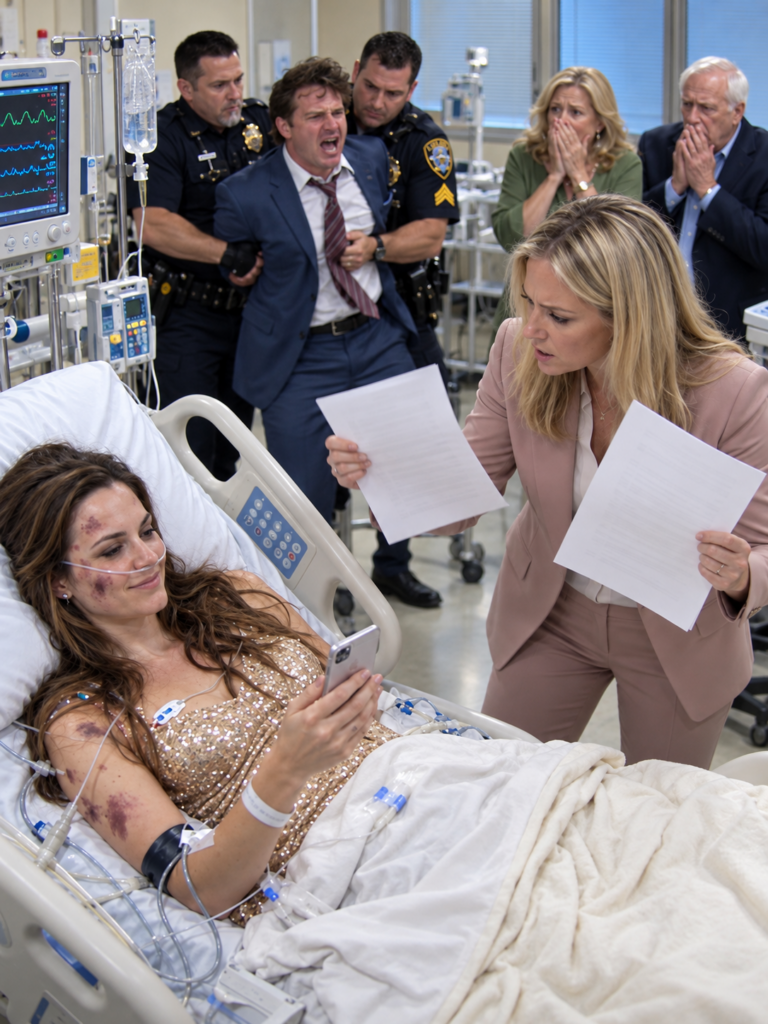
A machine beeped steadily beside my bed. Beyond the glass doors, nurses moved through the intensive care unit in soft shoes, speaking in voices that seemed impossibly calm.
I had three fractured ribs, a partially collapsed lung, and bruising around my shoulders and throat. A drainage tube ran from my chest to a container beside the bed.
My husband, Wesley Calder, had told the emergency responders that I slipped.
He had even cried.
One of the paramedics had apparently described him as a devoted husband.
I wondered whether she would have thought the same thing if she had seen him an hour earlier, standing in our kitchen with my bank statement in his hand.
A nurse with silver-framed glasses approached my bed.
“I’m Joan,” she said. “You asked for help making a call?”
“I need to contact an attorney.”
“Of course.”
“Not my husband’s attorney. Mine.”
She paused, perhaps recognizing something in the way I said it.
“Do you have someone in mind?”
I nodded.
“Leah Price. She used to work with me.”
Joan brought my belongings from a locked drawer. My phone charger was tangled around the strap of my purse. Inside the purse were my reading glasses, a lipstick I hadn’t used in months, and a folded grocery receipt.
Ordinary objects from a life that had stopped being ordinary.
I found Leah’s number and sent her a message.
I’m in intensive care. Wes hurt me. I need you to contact the lender handling my parents’ house purchase and withdraw my personal guarantee before closing. I also need help protecting my accounts. Please call me.
I read it twice before pressing send.
For seven years, I had corrected every sentence that made Wesley sound dangerous.
He was stressed.
He didn’t mean it.
We both lost our tempers.
This time I wrote four words without changing them.
Wes hurt me.
Leah responded eleven minutes later.
Are you somewhere safe?
I looked through the glass at Joan talking to another nurse.
Yes.
I’ll handle the lender first. Do not sign anything else. I’m coming in the morning.
I placed the phone on the blanket.
Then I cried.
Not loudly. I couldn’t have managed that with my ribs.
I cried because I had finally told the truth to someone who might believe me.
Wesley and I had been married seven years.
When we met, I was thirty-one, working in contract compliance for a commercial real estate firm outside Baltimore.
He was handsome in an understated way, with dark hair that always looked freshly cut and a patient smile that made people feel as though they had his entire attention.
He owned a growing property development company, Calder Residential.
He remembered birthdays. He helped elderly neighbors carry groceries. He gave generous donations at charity dinners and personally thanked every waiter who brought food to our table.
My parents adored him.
My father, Frank Ellis, called him the son he’d always wanted, despite already having a son.
My younger brother, Ethan, joked that Wes had somehow become everyone’s favorite family member.
Even my grandmother, Margaret Whitcomb, had been polite.
But she never quite liked him.
On the afternoon before our wedding, she took my hands and asked whether I understood the difference between someone who loved me and someone who loved being needed by me.
I laughed.
“Grandma, that’s a strange wedding present.”
She didn’t smile.
“Just remember you are allowed to keep things that belong only to you.”
I thought she meant my career.
I understood now that she had been talking about something much larger.
During the first year of our marriage, Wes encouraged me to leave my employer and join Calder Residential.
We would be a team, he said.
For a while, it felt that way.
I reviewed contracts, negotiated vendor agreements, and helped build compliance procedures that made the company attractive to lenders.
Then Wes began changing those procedures.
He wanted fewer approvals.
He wanted executives to have shared access to important files.
He hated being questioned about money.
When I objected, he said I had brought the wrong attitude into a family business.
“I’m your husband, Nora. You shouldn’t treat me like a stranger trying to steal from you.”
It was a clever thing to say.
After that, every time I requested documentation, I felt like an untrusting wife instead of a responsible employee.
Slowly, I stopped asking.
Then came the little rules.
He preferred that I didn’t meet former coworkers alone.
He thought my college friends encouraged negative thinking.
He wanted us to share passwords.
If I bought something without mentioning it, he asked why I was keeping secrets.
If he bought something expensive, he explained that important business decisions were beyond my understanding.
The first time he frightened me physically, he blocked the doorway during an argument and wouldn’t let me leave until I apologized.
He brought flowers the next day.
The second time, he grabbed my arm hard enough to leave marks.
I wore long sleeves to Sunday dinner.
By the time I understood how much of my life I had surrendered, leaving seemed more complicated than staying.
Our house belonged to a trust connected to his company.
My salary went into a joint account.
My professional reputation was tied to Calder Residential.
And whenever I looked uncertain, Wes reminded me that my parents depended on him.
I didn’t understand how literally he meant that.
Not yet.
The argument that sent me to intensive care began over eighty thousand dollars.
I had been preparing financial documents for my parents’ mortgage application when I noticed a transfer from our joint account to an unfamiliar consulting company.
Northline Advisory.
The transfer was marked as an executive authorization.
Mine.
I knew I hadn’t approved it.
When Wes came home, I placed the statement on the kitchen island.
“What is Northline Advisory?”
He glanced at the paper.
“A vendor.”
“What do they do?”
“Consulting.”
“Eighty thousand dollars’ worth?”
He took off his coat and laid it over a chair.
“Nora, I’ve had a long day.”
“So have I.”
“Then don’t start an argument.”
I should have stopped.
That was the thought I had afterward, lying on the kitchen floor.
I should have waited until morning. I should have called Leah before confronting him. I should have been more careful.
But I was tired of organizing my life around the possibility of his anger.
“My name is on the approval,” I said. “I didn’t sign it.”
Wes became very still.
For a moment, there was no anger in his face.
Only calculation.
“Are you accusing me of something?”
“I’m asking who authorized the transfer.”
“Maybe you’ve forgotten.”
“I haven’t.”
He walked around the island.
I took one step backward.
“Nora,” he said quietly, “you need to think very carefully about what you’re suggesting.”
Then he reached for the statement.
I held on to it.
What happened next lasted only seconds, but I remembered pieces with terrible clarity.
The scraping sound of a chair.
My shoulder striking the counter.
The sharp, startling pain in my side.
My phone sliding across the tile beyond my reach.
I remembered Wes standing over me and telling me to get up.
When I couldn’t, his expression changed.
Not to remorse.
To fear.
He was frightened of what would happen to him.
Our neighbor, Mrs. Haskell, heard me crying through the open kitchen window and called emergency services.
Wes told the paramedics I had fallen.
By the time the ambulance arrived, he had already begun explaining why I had been confused lately.
At 6:40 the following morning, Leah Price appeared in my doorway carrying a canvas bag and looking as though she hadn’t slept.
She stopped when she saw me.
“Oh, Nora.”
I tried to smile.
“It’s worse than it looks.”
“No,” she said gently. “I don’t think it is.”
She pulled a chair beside my bed.
Leah and I had worked together for five years before my marriage. She was precise, stubborn, and unusually difficult to intimidate.
I had stopped returning her calls after Wes complained that she disliked him.
Now she reached for my hand as though no time had passed.
“The lender confirmed they received the withdrawal notice,” she said.
“Can they still use my guarantee?”
“They’ve suspended the closing. Your guarantee hadn’t become binding under the pending loan arrangement, and they’re reviewing the application without it.”
My throat tightened.
“So my parents can’t buy the house?”
“Not on the same terms. The lender will make that determination.”
I pictured the lake house.
It was a large property in Briar Cove, with pale stone steps, a dock, and windows overlooking the water.
My parents had been talking about it for six months.
My father said they deserved something beautiful after a lifetime of hard work.
My mother had already chosen furniture for the upstairs guest rooms.
Neither had mentioned that their dream depended on me guaranteeing a mortgage far beyond what their income could support.
“They’ll be furious,” I whispered.
Leah looked at the bruises on my arm.
“Are you more worried about their reaction than about what happened to you?”
I stared at the blanket.
“Yes.”
She didn’t tell me I was foolish.
Instead, she opened her bag.
“Then we have more work to do.”
She took out a thin folder.
“Do you remember the trust your grandmother established?”
“Of course.”
Margaret Whitcomb had been the most financially independent woman I knew.
She owned a modest house, a small commercial property, and investments she’d built over decades.
She never bought things to impress people.
After she died two years earlier, I received a letter explaining that she had established a separate trust for me.
I believed it held a small inheritance.
Wes had told me the paperwork was routine and offered to help organize it.
“What about it?” I asked.
Leah opened the folder.
“At thirty-five, you became entitled to control the assets. The trust originally held approximately eight hundred and thirty thousand dollars.”
I stared at her.
“That can’t be right.”
“I’m afraid it is.”
“I never had that much money.”
“You should have.”
She showed me a statement.
Eighteen months earlier, the trust had transferred six hundred and ten thousand dollars to Redbrook Property Group.
I recognized the name vaguely.
One of Calder Residential’s subsidiaries.
“What did Redbrook buy?”
Leah studied me.
“Your parents’ current house.”
For several seconds, I didn’t understand.
“My parents own their house.”
“According to the county records, Redbrook owns it. The company purchased the property after a foreclosure threat six years ago.”
“But my father said his business restructuring paid off the mortgage.”
Leah turned another page.
“Your father has been making monthly occupancy payments to Redbrook ever since.”
I looked at the transfer authorization.
At the bottom was my signature.
Or something that resembled it.
The final letter of my last name had a long downward stroke.
I never wrote it that way.
Wes did.
He had copied my signature for years.
At first, it had been convenient little things.
Greeting cards. Delivery confirmations. Documents he said were too unimportant to bother me with.
I used to complain.
He used to laugh.
Leah watched my face.
“Do you recognize the signature?”
“I recognize who made it.”
My parents arrived shortly after nine.
I had not invited them.
A hospital security officer accompanied them to my room, where Joan was checking my medication.
My mother entered first.
She wore a blue cardigan and carried her expensive leather handbag.
My father followed, his jaw rigid.
“Thank goodness you’re awake,” my mother said.
For one ridiculous second, I thought she might embrace me.
Instead, she took out her phone.
“The bank says your guarantee has been withdrawn.”
I looked at her.
“Good morning, Mom.”
She flushed.
“Nora, please. We’re under tremendous pressure.”
My father approached the bed.
“Wes says your judgment may be affected by the medication.”
“Wes hurt me.”
“He says you had an argument and fell.”
“I didn’t fall.”
My father glanced toward the security officer.
“This isn’t something we should discuss in front of strangers.”
Joan finished adjusting my medication.
She didn’t leave.
For that, I would always be grateful.
I reached for the folder Leah had left beside my bed.
“Dad, who owns your house?”
He froze.
My mother frowned.
“What kind of question is that?”
“Who owns the house you’ve been living in for the last eleven years?”
My father gave a small, humorless laugh.
“You know perfectly well.”
“Then tell me.”
He looked at the folder.
Something changed in his expression.
“Where did you get those documents?”
My stomach sank.
He knew.
I had come prepared to hear him deny everything.
Instead, he asked where I had found the evidence.
“Redbrook Property Group,” I said.
My mother’s face went blank.
“What is Redbrook?”
My father stepped closer.
“Lower your voice.”
I looked down at the hospital bracelet around my wrist.
Even now, he could make me feel twelve years old.
But he couldn’t make me unknow what I’d seen.
“Redbrook owns your house. Six hundred and ten thousand dollars from Grandma Margaret’s trust went into that company.”
My mother turned toward him.
“Frank?”
He didn’t answer.
“Frank,” she repeated, louder this time, “what is she talking about?”
He rubbed his forehead.
“My business had debts.”
“We knew that,” she said.
“No. You didn’t know how bad it was.”
He looked at me.
“Wes offered a way to keep the house. He took care of the creditors and arranged the purchase through one of his companies. It was supposed to be temporary.”
“With my money?”
“I didn’t know where every dollar came from.”
“Did you ask?”
Silence.
It hurt more than an admission.
My father had always been proud of teaching me responsibility.
When I was sixteen, he made me return twenty dollars a cashier had accidentally given me in change.
He told me character was what a person did when nobody was looking.
Now he stood beside my hospital bed and couldn’t look at me.
My mother sank into the visitor’s chair.
“The lake house,” she said faintly. “What happens to the lake house?”
I stared at her.
I had just discovered that my husband had apparently stolen most of my inheritance to keep my parents financially dependent on him.
And she was still thinking about her new kitchen.
“You won’t be buying it with my signature,” I said.
Her eyes filled with tears.
“Nora, you’re punishing us.”
“No. I’m refusing to risk the rest of my life for you.”
My father straightened.
“You need to understand something. Wes has helped this family when nobody else would. You cannot make accusations that destroy his livelihood and expect us to stand by you.”
“He put me in this bed.”
“That’s what you say.”
The room went silent.
Until that moment, some childish part of me had believed my father would choose me if he saw the injuries.
I realized he already had.
He had seen everything.
He was choosing Wes anyway.
I turned toward Joan.
“I’d like them to leave.”
My mother looked shocked.
“Nora!”
“Please.”
The security officer opened the door.
My father moved first.
Before leaving, he turned back.
“Think about what you’re doing to this family.”
I watched him disappear into the hallway.
Then I looked at the documents in my lap.
For years, I had believed I was the person keeping my family together.
I was beginning to understand that I might simply have been the person paying to keep their secrets hidden.
That afternoon, Detective Renee Alvarez came to take another statement.
She listened without interrupting while I described the argument, the financial documents, and Wes’s habit of using my signature.
Then she told me something that made the room feel colder.
Mrs. Haskell’s security camera faced part of our driveway.
After the ambulance left, it recorded Wes returning to the house.
He stayed inside for fourteen minutes.
When he emerged, he was carrying a document box and my old laptop bag.
“He told the officers he was following the ambulance,” Detective Alvarez said.
“He wasn’t?”
“No.”
I remembered the papers he’d been staring at before the argument.
The files he’d been keeping in his locked study.
The nights he spent working after he thought I was asleep.
“What did he take?”
“We’re trying to determine that.”
Then she showed me an electronic authorization record.
It belonged to the eighty-thousand-dollar transfer.
The system listed my username, my approval credentials, and my electronic signature.
But the time stamp was from the morning after I entered the hospital.
While I was unconscious under sedation, someone had used my account again.
The detective placed the page on the table.
“Mrs. Calder, who else knew your password?”
I could think of three people.
My husband.
His chief financial officer.
And my younger brother, Ethan.
I looked at the signature on the page.
For seven years, I had been terrified of what would happen if I stopped protecting Wes.
Now, for the first time, I wondered how many people had been helping him protect himself from me.
Part 2
The hospital arranged for a social worker to visit me the following morning.
Her name was Melissa Grant. She had kind eyes and a plain gray notebook that she kept closed until I was ready to talk.
She asked where I planned to live after leaving the hospital.
I opened my mouth.
Nothing came out.
For seven years, I’d lived in the house Wes considered his.
Before that, I’d lived in an apartment I could no longer afford on my reduced salary.
My parents’ guest bedroom had always been available when things were good.
Now I doubted they would let me through the front door.
Melissa waited.
Finally, I said, “I don’t have anywhere.”
She wrote something down.
“Then we’ll work on that.”
She explained the hospital’s domestic violence resources, temporary housing programs, and the steps involved in requesting a protective order.
I had spent years believing that leaving Wes required one enormous act of courage.
It was beginning to look more like a hundred ordinary decisions.
A new phone number.
A secure email account.
Different bank passwords.
Someone to collect my clothes.
A place to sleep.
The practical details frightened me almost as much as the memories.
When Melissa left, I studied the hospital ceiling.
I was thirty-eight years old.
I had helped oversee multimillion-dollar contracts.
I knew how to question an indemnity clause and identify weaknesses in a commercial lease.
But I didn’t know how to arrange my own life without asking my husband for permission.
Ethan called at eleven.
He was thirty-two, six years younger than me, with the same brown eyes and crooked smile he’d had as a boy.
At least, I had always thought we had the same eyes.
His voice sounded strained.
“Nora, I need to talk to you.”
“Did Dad send you?”
“No.”
“Wes?”
“Absolutely not.”
I said nothing.
He cleared his throat.
“I’m sorry I didn’t call sooner. I didn’t know how bad things were.”
“Do you know now?”
“Yes.”
He sounded as though he might cry.
I wanted to comfort him.
It was a habit I had carried since childhood.
Instead, I asked the question that mattered.
“Have you used my work credentials?”
A long silence followed.
“Once,” he said.
My heart sank.
“When?”
“Last spring. Wes said you had approved a group of vendor payments but hadn’t completed the final step. He asked me to use your workstation because I knew the system.”
“Why didn’t he ask me?”
“He said you were traveling.”
“I wasn’t traveling last spring.”
“I know that now.”
“Ethan, what did you approve?”
“I thought it was a routine package. It wasn’t.”
He explained that a subcontractor had contacted him two weeks earlier about an overdue payment. Wes blamed an accounting delay.
But when Ethan checked the payment history, he discovered that money had been redirected to Northline Advisory.
He found twenty-three other suspicious transfers.
Most carried my digital authorization.
“How much?” I asked.
“About three million dollars over two years.”
I felt the room grow smaller.
“From Calder Residential?”
“And its subsidiaries.”
“Where did the money go?”
“I don’t know all of it. Some went to Northline. Some to property holding companies.”
“Why are you telling me?”
“Because I found the access logs.”
I gripped the phone.
Ethan spoke quickly now.
“Someone has been signing into your account remotely. There’s a laptop registered to Wes that appears repeatedly in the connection history. It doesn’t prove every transaction came from him, but he told me you were approving things yourself.”
“Can you preserve the records?”
“I already did. I gave copies to a lawyer this morning.”
“Which lawyer?”
“Leah Price.”
For the first time during the conversation, I felt something other than fear.
“You went to Leah?”
“Yes.”
“Good.”
“Nora, there’s something else.”
I closed my eyes.
Of course there was.
“Wes has been keeping recordings of you.”
“What kind of recordings?”
“Conversations in his office. Meetings. Arguments.”
I remembered him leaving his phone on the kitchen counter during disagreements, always screen-down.
“He’s been editing them,” Ethan said. “He made a recording where it sounds like you agreed to the Northline payments.”
I swallowed.
“Why?”
Ethan answered quietly.
“I think he planned to make you responsible if the money was ever investigated.”
I stared through the window.
I had spent years trying to prove to Wes that I was trustworthy.
All that time, he had apparently been preparing evidence that I wasn’t.
“Ethan, I need you to tell Detective Alvarez everything.”
“I will.”
“And don’t go back to the office alone.”
He hesitated.
“Dad says you’re trying to ruin us.”
I almost laughed.
“Is that what you believe?”
“No.”
His answer was immediate.
Then he added, “But I believed him for longer than I should have.”
That afternoon, my mother began calling again.
I ignored the first three calls.
After the fourth, she sent a message.
People at church are asking questions. Please stop telling everyone your private business.
I read it twice.
I hadn’t told anyone at church.
A few minutes later, my cousin Rebecca called.
She asked whether I was receiving treatment for a nervous breakdown.
Apparently Wes had told relatives that my medication was causing paranoia.
My father had repeated the story.
My mother had asked everyone to pray for the family and avoid spreading rumors.
There had been no mention of the bruises.
No mention of the missing money.
No mention of the fact that Wes had not been permitted to visit me.
By dinner, I had received messages from six relatives.
Three urged me to forgive my husband.
Two begged me not to embarrass my parents.
One asked whether I could still co-sign the mortgage once I was feeling better.
I turned off the phone.
Joan found me sitting upright, crying silently.
“Bad news?” she asked.
“Just family.”
She adjusted a pillow behind my back.
“Sometimes that means the same thing.”
I looked at her.
“Does it get easier?”
“What?”
“Accepting that people aren’t who you thought they were.”
She considered the question.
“I don’t know if easier is the right word. But eventually you stop spending so much energy explaining away what they’ve done.”
She handed me a cup of water.
“You’re allowed to believe your own experience, Nora.”
It was a small sentence.
I held on to it for the rest of the evening.
Two days later, Ethan arrived with Leah.
The protective order had been issued, and security checked their identification before allowing them onto the floor.
Ethan looked terrible.
He stood at the foot of my bed, holding a small cardboard box.
“I found this in the company archive,” he said.
There was an old inventory label across the lid.
M. Whitcomb — personal estate papers.
My grandmother’s name.
“Why were her things at Calder Residential?”
Ethan looked at Leah.
She answered.
“Your father had Wes help organize the estate paperwork after Margaret died. Apparently several boxes were stored at the company’s office.”
I remembered being grateful when Wes offered to handle the administrative details.
I’d been overwhelmed by grief.
He told me there was no reason to burden myself with dusty papers and old receipts.
Ethan placed the box on the table.
“I was searching for documents connected to Redbrook. This was in a cabinet marked for disposal.”
Inside were old bank statements, photographs, and a small blue envelope.
I knew the envelope.
I had seen one just like it on the afternoon before my wedding.
Grandma Margaret had tried to give it to me privately.
Wes had found it in my purse that evening.
He told me it contained nothing important.
I never asked to see it again.
Leah carefully lifted the envelope.
On the front, in my grandmother’s handwriting, were the words:
For Nora, when she is ready to hear the truth.
My hands began trembling.
Inside was a photograph.
It showed my grandmother standing outside her old house beside two young women.
One was my mother.
The other was a slender woman with auburn hair, holding a baby wrapped in a yellow blanket.
I turned the photograph over.
There was a date.
June 1988.
Underneath, my grandmother had written:
Patricia, Lydia, and baby Nora.
I stared at the picture.
“Who is Lydia?”
Ethan didn’t answer.
Leah was studying the documents.
I turned to my brother.
“Ethan?”
“I don’t know,” he said. “I’ve never seen her.”
I looked at the young woman holding the baby.
She was smiling down at me.
My mother stood beside her, one hand resting on her shoulder.
Something about the photograph felt wrong.
Not the setting.
Not the clothes.
The way the woman held me.
She wasn’t posing like an aunt admiring a new baby.
She held me with the unconscious confidence of someone who had spent hundreds of hours carrying me.
I opened the next envelope.
It contained a photocopy of a birth certificate.
My name appeared near the top.
Nora Whitcomb.
The mother’s name was Lydia Anne Whitcomb.
I stopped breathing.
“No.”
Leah looked up.
“Nora—”
“No. My mother is Patricia Ellis.”
Ethan stepped closer.
“Nora, sit back.”
I was already sitting.
I couldn’t feel my hands.
I turned the page.
There was another document.
A petition for adoption, filed when I was two years old.
The petition named Patricia and Frank Ellis as my prospective adoptive parents.
I read the words three times before they meant anything.
Patricia was not my biological mother.
She was my aunt.
And Frank, the man I called Dad, had adopted me.
I looked at Ethan.
“Did you know?”
He shook his head.
“Nora, I swear I didn’t.”
He was crying now.
Somehow that made everything worse.
All the ordinary memories of my childhood began rearranging themselves.
Why my baby photographs started later than Ethan’s.
Why my mother always became uncomfortable when I asked about her pregnancy with me.
Why she said she’d lost my original birth certificate during a move.
Why my grandmother had once told me that families could be built in more than one way.
I had never understood what she meant.
I looked at the woman in the photograph.
“Where is Lydia?”
Leah turned another page.
There was a police report dated November 1990.
Lydia Anne Whitcomb had been reported missing by her brother-in-law, Frank Ellis.
According to the report, she had disappeared after a period of emotional instability.
I read the phrase twice.
Emotionally unstable.
The same description Wes was now using against me.
At the bottom of the box was a sealed packet tied with faded blue ribbon.
Leah untied it.
Inside was a document titled Last Will and Testament of Margaret Louise Whitcomb, dated six months after the will my father had presented for probate.
It named an independent executor instead of my father.
It also referred to a separate written statement concerning my identity and the circumstances of my adoption.
My grandmother had made a second will.
And someone had hidden it.
That evening, Leah returned alone.
She had spent hours speaking with a retired attorney who had once represented my grandmother.
He remembered the second will.
More importantly, he remembered why Margaret had changed it.
“She was concerned that your father might interfere with certain records,” Leah explained.
“What records?”
“Letters. Adoption documents. Financial correspondence involving your biological mother.”
I looked down at the photograph in my hands.
“Did Grandma know where Lydia was?”
“Yes.”
The answer shocked me.
“She knew?”
“Apparently they exchanged letters for years.”
“Then why didn’t she tell me?”
Leah sighed.
“I don’t know. But she left you an explanation.”
She opened her laptop.
Ethan had found a small memory card taped beneath the lining of the box.
On it was a video recorded in my grandmother’s kitchen three years earlier.
I recognized the yellow curtains.
The chipped ceramic teapot.
The wooden chair where she used to sit and mend clothes.
Then my grandmother appeared on the screen.
She looked thinner than I remembered.
Her hands shook slightly as she adjusted the camera.
“Nora, sweetheart,” she began.
I covered my mouth.
Her voice.
I hadn’t heard her voice since the last time we spoke on the telephone.
“I’m making this because I’ve waited too long to tell you something important. And because I’ve discovered that someone has been looking through the financial records I intended to leave you.”
She glanced down at a piece of paper.
“Your husband has been asking questions about the trust. Your father has been giving him information he has no right to have.”
I gripped the edge of the blanket.
“I told Patricia she needed to tell you the truth about Lydia. She begged me to leave it alone. She said it would destroy the family.”
My grandmother paused.
“But a family built on silence can destroy the person it claims to protect.”
Tears rolled down my cheeks.
“Lydia is my youngest daughter. She is also your birth mother.”
I closed my eyes.
For thirty-eight years, I had carried a story about myself that wasn’t true.
My grandmother continued.
“Lydia was very young when she had you. She was frightened and had no money. Patricia and Frank offered to care for you while she found work and a stable place to live.”
She lowered her gaze.
“That arrangement became something else.”
My pulse quickened.
“When Lydia returned, Frank told her the adoption was already settled. He said she would only hurt you by fighting it.”
My grandmother’s voice cracked.
“I was ashamed of the choices our family made. I told myself you were loved, and that was enough. But it was not enough.”
She wiped her eyes.
“Lydia tried to reach you after you became an adult. Frank told her you wanted no contact. Patricia told you nothing.”
I stared at the screen.
“I should have told you myself, Nora. I cannot make that right by leaving you money. But I can make sure the truth belongs to you.”
She reached toward the camera.
Then the recording ended.
For a long time, I couldn’t speak.
Finally, I asked Leah, “Is she alive?”
“Yes.”
“Lydia?”
“Yes.”
“Where?”
“North Carolina, according to the most recent records.”
I looked at the photograph again.
The young woman with auburn hair.
The baby in the yellow blanket.
My mother.
The real one.
The woman I had been told was missing.
And somewhere in the room, beneath the shock and confusion, a terrible question was beginning to form.
If my parents could hide something this important from me for thirty-eight years, what else had they been willing to do?
My mother came the next morning.
I hadn’t asked her to visit.
But when Joan told me she was downstairs, I agreed to see her.
I needed to hear the truth from her mouth.
She entered wearing the same blue cardigan she’d worn during her previous visit.
This time she wasn’t carrying her handbag.
She looked smaller.
I placed the photograph on the bedside table.
“Who is she?”
My mother stopped walking.
For several seconds, she said nothing.
Then she lowered herself into the chair.
“Where did you get that?”
“Tell me her name.”
She closed her eyes.
“Lydia.”
“Who is she?”
My mother began crying.
I didn’t move.
“Nora, I wanted to tell you.”
“When?”
She covered her mouth.
I waited.
“Before you got married,” she whispered.
“Then why didn’t you?”
She looked toward the door.
“Wes found out.”
I felt a cold pressure settle behind my ribs.
“How?”
“He was helping your father with the estate paperwork. He discovered the old documents.”
“And?”
“He told us it would devastate you if the truth came out.”
I stared at her.
“You believed him?”
“He said you were happy. That your marriage was just beginning. He said there was no reason to reopen painful things.”
“And you let him decide?”
Her tears fell harder.
“He knew about the adoption. About the irregularities in the old court records. He said if we turned against him, people might start asking questions about what your father had done.”
I thought of the missing-person report.
The adoption petition.
The signatures.
“Dad lied to the court?”
My mother looked down.
“The circumstances were complicated.”
“Did he lie?”
She nodded.
I felt sick.
“Did Lydia consent to the adoption?”
My mother hesitated for too long.
“She signed temporary guardianship papers. Frank handled the rest. He told me the adoption was properly arranged, and I believed him.”
“Did she ever ask to see me?”
“Yes.”
“How many times?”
My mother’s shoulders shook.
“Several.”
“And you told her I didn’t want her?”
“I was afraid.”
“Of what?”
“Losing you.”
The answer was so simple that it hurt more than a complicated lie.
I had spent years believing my mother was afraid of Wes.
Now I understood that she had been afraid of losing her place in my life long before Wes appeared.
She looked at me desperately.
“I loved you, Nora. I raised you. I was there for everything.”
“I know.”
“Doesn’t that count for something?”
“Of course it does.”
Relief flickered across her face.
Then I continued.
“But it doesn’t give you the right to decide which parts of my life I’m allowed to know.”
She looked away.
I picked up the photograph.
“Wes used this secret to control you.”
My mother nodded.
“And you let him use me to protect it.”
She didn’t answer.
I thought of my wedding.
My grandmother trying to hand me the envelope.
My mother pulling Wes aside that evening.
The way my father had insisted that Wes manage the estate papers after Margaret died.
The memory made my stomach turn.
Then I asked the question I’d been avoiding.
“When I called you from the hospital, did you believe Wes had hurt me?”
My mother stared at her hands.
“Mom.”
Her lips trembled.
“Yes.”
The word was barely audible.
I felt something inside me give way.
She had believed me.
She had known I was injured.
And she had still asked about the house.
“Then why didn’t you help me?”
She began sobbing.
“I thought if Wes lost the financing, he’d take our house. Your father said he could expose everything. I panicked.”
I looked at her for a long time.
There were so many things I could have said.
Instead, I asked quietly, “Do you remember when I was little and I was afraid of thunderstorms?”
She nodded.
“You used to sit beside my bed until the thunder stopped. You told me you would never let anything happen to me.”
“I meant it.”
“I believe you did.”
She reached for my hand.
I pulled it away.
“But when something did happen, you decided your house mattered more.”
My mother’s face crumpled.
I pressed the call button.
When Joan appeared, I asked her to escort my mother out.
Patricia stood slowly.
At the doorway, she looked back.
“Nora, I’m still your mother.”
I looked at the photograph in my lap.
“I don’t know what that word means right now.”
She left without another word.
That night, Leah called with news from the investigation.
Ethan’s records showed that several disputed approvals had originated from Wes’s laptop.
The transfer initiated while I was unconscious had been made through the same remote access connection.
Forensic specialists were examining the devices and original files.
The corporate records also suggested that Northline Advisory had received substantial payments for consulting work nobody could document.
Leah had petitioned for emergency financial protections while the authorities investigated.
But there was another problem.
Wes had hired an attorney.
He was claiming I had become unstable after discovering accounting mistakes I had personally made.
He had also obtained a signed statement from my father saying I’d been under unusual emotional pressure for months.
I stared at the wall.
My father had chosen Wes again.
Then Leah’s voice changed.
“There’s one more thing, Nora.”
“What?”
“The original adoption documents include a signature attributed to Lydia. We’ve compared it with letters she wrote later. There are significant differences.”
“Another forgery?”
“Possibly. We need an expert examination.”
I closed my eyes.
The pattern had started before my marriage.
Someone in my family had learned that a signature could be more useful than the person whose name was written above it.
My husband’s greatest trick had not been inventing a new kind of betrayal.
It had been recognizing an old one.
And using it against me.
Part 3
I called Lydia six days after leaving the hospital.
I had been discharged to a small furnished apartment arranged through a local recovery program. It had beige walls, mismatched dishes, and a narrow balcony overlooking a parking lot.
There was no marble kitchen.
No landscaped garden.
No walk-in closet filled with clothes Wes preferred.
But the lock on the front door belonged to me.
That first night, I slept with the bedroom light on.
The second night, I slept for six uninterrupted hours.
By the sixth morning, I had enough courage to call the woman in the photograph.
Leah had contacted her first, explaining that I had discovered the truth and wanted to speak with her.
Lydia had given permission to share her number.
When she answered, her voice was low and uncertain.
“Hello?”
I swallowed.
“Lydia?”
“Yes.”
“It’s Nora.”
There was silence.
Then I heard her draw a shaky breath.
“Oh, sweetheart.”
Two words.
I had spent thirty-eight years without them in her voice.
“I don’t know what to say,” I admitted.
“Neither do I.”
That helped more than anything rehearsed could have.
We stayed on the telephone for nearly two hours.
She told me she lived in a small North Carolina town, where she managed a garden center and taught weekend classes on growing vegetables.
She had married once.
The marriage ended quietly, without children.
She had spent much of her life trying to make peace with things she could not change.
“When I had you,” she said, “I was nineteen. I worked at a grocery store, and I had no savings. Your father wasn’t going to be involved. Patricia offered to help while I found steadier work.”
She paused.
“I trusted her.”
I looked down at the photograph in my hand.
“What happened when you came back?”
“Frank told me you had adjusted to living with them. He said removing you would hurt you.”
“Did you believe him?”
“At first.”
Her voice tightened.
“Then I learned they’d filed for adoption.”
She told me she’d signed a temporary guardianship agreement, not a permanent surrender of her rights.
When she objected, Frank insisted everything had been handled legally.
She couldn’t afford the attorney she needed.
My grandmother urged her to avoid a family fight.
Eventually, exhausted and ashamed, Lydia left Maryland.
“I was young,” she said. “I didn’t understand how to fight people who had money, lawyers, and everyone in the family on their side.”
“Why didn’t you contact me later?”
“I tried.”
I closed my eyes.
“I wrote when you turned eighteen. Again when you graduated from college. I sent another letter before your wedding.”
My heart tightened.
“Before my wedding?”
“Yes.”
“What happened?”
“Patricia said you knew everything and didn’t want a relationship. She asked me to respect your decision.”
I put my hand over my mouth.
Lydia continued.
“I thought maybe you were happy. I told myself that loving you meant leaving you alone.”
For a long time, neither of us spoke.
Finally, I asked, “Do you still have the letters?”
“Every copy.”
“Could you send them to me?”
“Of course.”
“And Lydia?”
“Yes?”
“I’d like to meet you.”
She started crying.
So did I.
The investigation into Wes continued while I recovered.
Detective Alvarez interviewed former employees, examined the corporate access records, and obtained financial documents from banks that had handled the disputed transactions.
Two former accounting employees eventually admitted they had questioned Northline’s invoices.
One had been transferred to another department.
The other had resigned after Wes threatened legal action over supposedly confidential company information.
Both agreed to cooperate.
The digital records were particularly damaging.
Some approvals carrying my credentials had been transmitted from Wes’s laptop while I was attending events elsewhere.
Others were made after the company’s internal system recorded my account as inactive.
One transfer had been initiated while I was in intensive care.
There were also emails.
In one, Wes instructed his chief financial officer to route several payments through my approval account because it would provide what he called a cleaner compliance history.
In another, he discussed how to make the transactions appear consistent with routine company expenses.
The records did not make the whole case overnight.
Investigators still had to establish who had done what and where the money had gone.
But they provided something I hadn’t possessed during seven years of marriage.
Independent evidence.
Facts that did not depend on whether people thought I was emotional, medicated, bitter, or unstable.
My name had been used.
The records were beginning to show that I had not been the one using it.
Two months after I left the hospital, my father asked to meet me.
I refused at first.
Then Leah called.
“He says he’s willing to give a formal statement.”
“About Wes?”
“And about the adoption.”
We met in a conference room at Leah’s office.
Detective Alvarez attended part of the meeting, and my father had his own attorney.
Frank Ellis looked older than I remembered.
His expensive watch was gone.
His hair had turned almost completely gray.
He sat across from me, staring at his hands.
“I owe you an apology,” he said.
I waited.
“I’ve made decisions I can’t defend.”
“That isn’t an apology, Dad.”
He lifted his eyes.
“I’m sorry.”
I thought I would feel something when I heard those words.
Relief.
Satisfaction.
Maybe forgiveness.
Instead, I felt tired.
“Why did you give Wes a statement saying I was unstable?”
My father’s face tightened.
“Because I thought he’d destroy us if I didn’t.”
“By exposing the adoption?”
“Partly.”
He looked toward his attorney.
“Wes knew the paperwork wasn’t handled properly. He knew I had made false claims about Lydia’s circumstances.”
“And he threatened to reveal that?”
“Yes.”
“What else?”
My father swallowed.
“He knew about the old business debts. Some of the transactions were improper. He said he’d report everything and let the authorities sort it out.”
“So you let him steal from me.”
My father looked down.
“At first, I didn’t know the money belonged to you.”
“But later?”
He said nothing.
“Dad.”
“Yes.”
The word was quiet.
“When did you know?”
“About a year ago.”
A year.
For twelve months, he had known money was being taken from the trust my grandmother established for me.
He had continued accepting Wes’s help.
Continued inviting him to family dinners.
Continued praising him in public.
And when I ended up in intensive care, my father had defended him.
“Why?” I asked.
Frank rubbed his eyes.
“I thought I could fix it. I thought the business would recover and we could repay the money before you found out.”
I stared at him.
“You thought the problem was that I might find out?”
He began crying.
I’d seen my father cry only once before, at my grandmother’s funeral.
This time I didn’t reach across the table.
He reached into his coat and produced a folded document.
It was a written account of the business arrangement with Wes, including dates, payments, and meetings.
His attorney confirmed that he intended to provide it to investigators.
“I should have done this months ago,” Frank said.
“Yes,” I answered.
He looked at me hopefully.
“Does it help?”
I glanced at the document.
“It may help the investigation.”
“That’s not what I meant.”
“I know.”
I stood.
My father reached for my hand.
I stepped away.
“I spent my whole life trying to be the daughter you could be proud of,” I said. “I wish you had spent even one night trying to be the father I needed.”
He lowered his head.
I left before he could ask me to forgive him.
I met Lydia in October.
She traveled to Maryland rather than asking me to come to North Carolina.
We agreed to meet in a quiet restaurant near the waterfront.
I arrived twenty minutes early.
I had imagined this moment dozens of times.
Would I recognize her?
Would she hug me?
Would we sit in uncomfortable silence, staring at two versions of the same face?
When she entered, I knew immediately.
She was shorter than I expected.
Her auburn hair had faded to soft gray, and she wore a green raincoat over a simple navy dress.
She held a small paper bag.
For a moment, we stood looking at each other.
Then she smiled.
It was the same smile I’d seen in the photograph.
“Nora?”
I nodded.
She approached slowly.
“May I hug you?”
I had not expected her to ask permission.
That nearly broke me.
“Yes.”
Her embrace was gentle.
She smelled faintly of lavender soap.
There was no magical rush of recognition.
No sudden feeling that every missing piece of my life had fallen into place.
She was a stranger.
But she was a stranger who had been waiting a very long time to meet me.
We ordered coffee.
She gave me the paper bag.
Inside was a small wooden picture frame.
It held another photograph of us.
I was a baby sitting on a blanket beneath a tree. Lydia sat beside me, laughing.
“I thought you might like something from the time before everything became complicated,” she said.
I studied the photograph.
“You look happy.”
“I was.”
Her eyes filled.
“I was frightened, too. But I loved being your mother.”
I reached across the table.
This time, I took her hand.
We talked about ordinary things afterward.
Her garden center.
My favorite books.
Whether I liked the ocean.
She told me I had hated mashed carrots as a baby.
I told her I still did.
We laughed.
It felt strange and wonderful to laugh about something so small.
Before we left, she asked whether I wanted to see her again.
“Yes,” I said. “But slowly.”
She nodded.
“Slowly is fine.”
For once, nobody demanded that I make a relationship happen on someone else’s schedule.
The legal consequences arrived over the following year.
Wes was charged in connection with the assault and the financial transactions.
As investigators traced the payments, they uncovered more evidence of falsified authorizations and transactions involving companies that performed little or no legitimate work.
Several employees became cooperating witnesses.
Ethan gave a detailed statement about his role in accessing my account.
He acknowledged his mistake, even though he knew doing so could damage his career.
For the first time since we were children, I saw him take responsibility without asking me to protect him from the consequences.
Our relationship did not return to what it had been.
But he called.
He showed up when he said he would.
And he stopped making excuses for people who had hurt me.
Eventually, Wes agreed to plead guilty to criminal charges arising from the assault and financial fraud.
I attended the sentencing hearing.
He wore a dark suit.
His hair was carefully combed.
He looked like the same polished businessman I’d married.
For a moment, seeing him sitting beside his attorney brought back the old reflex to straighten my clothes and check whether he was displeased.
Then I remembered where I was.
He no longer decided what happened to me.
When the court permitted me to speak, I stood and read from a statement I’d written the night before.
I described the years of financial monitoring.
The isolation.
The bruises I’d hidden.
The way Wes had used my professional credentials to make fraudulent transactions appear legitimate.
I explained what it meant to discover that the people who should have protected me had chosen to preserve their own comfort.
Then I looked toward Wes.
“You used to tell me that without you, I would have nothing,” I said. “You controlled the accounts, the house, my schedule, and even the way I explained my injuries.”
He stared straight ahead.
“For a long time, I believed you.”
I took a breath.
“But you were wrong.”
I placed the statement on the lectern.
“I still have my judgment. I still have my voice. And I know what happened to me.”
There was no applause.
No dramatic confession.
The judge continued with the hearing.
The court imposed a prison sentence and financial penalties based on the offenses to which Wes had pleaded guilty.
The civil and financial cases continued separately.
That was how justice worked in the end.
Not as one extraordinary moment when every wrong was instantly repaired.
But as a series of decisions, records, witnesses, and consequences that could no longer be explained away.
Recovering the missing money was harder.
Some of the funds had passed through multiple companies.
Other amounts had been spent or used to service business debts.
Leah worked with forensic accountants and the court-appointed professionals overseeing Calder Residential’s financial affairs.
Redbrook Property Group’s ownership of my parents’ house became part of the broader dispute.
Eventually, the property was sold under a supervised settlement.
My parents moved into a modest rented townhouse.
The dream house in Briar Cove had been sold to another buyer months earlier.
They lost part of their deposit.
My mother stopped attending the social gatherings she’d once organized so proudly.
My father faced separate legal scrutiny over the old financial and adoption records.
The second will prompted renewed examination of my grandmother’s estate, while the trust transactions became the subject of restitution claims.
I recovered a substantial portion of the diverted trust assets through settlements and asset recovery, though not all of it.
Leah cautioned me that some losses might never be repaid.
For once, I could hear bad financial news without feeling that my life was ending.
Money mattered.
Security mattered.
But I was no longer willing to trade my safety for either one.
My mother wrote me a letter the following spring.
Six pages.
I recognized her careful handwriting the moment I opened it.
She didn’t ask me to restore her old life.
She didn’t mention the lake house.
For the first time, she acknowledged what she had done without making Wes or my father entirely responsible.
She admitted that she had chosen to hide Lydia because she feared losing me.
She admitted that she had stayed silent when Wes began using our family secrets as leverage.
And she wrote about the night I called from the hospital.
I knew you needed me. I understood that you were frightened and hurt. I told myself your father needed my support more urgently, but the truth is that I chose the situation I was most afraid of losing.
I read that paragraph several times.
Near the end, she wrote:
I don’t expect you to forgive me. I only want you to know that I finally understand why you may never trust me again.
I folded the letter.
For several days, it remained on my kitchen table.
Then I put it in a drawer.
I wasn’t ready to answer.
I might never be ready.
But for the first time, my mother had given me something without demanding an immediate response.
It was not enough to repair what had happened.
It was a beginning of accountability.
I could acknowledge that without promising her reconciliation.
Fourteen months after the night I entered intensive care, my divorce was final.
I had moved into a small white house with a narrow front porch.
It wasn’t luxurious.
The kitchen cabinets needed repainting.
The back door stuck when the weather was damp.
There was a large oak tree in the yard and a patch of sunlight beside the fence where I planned to grow roses.
I bought the house with money I could account for.
My name was on the deed.
Only mine.
Leah came over the weekend I moved in and brought a bottle of sparkling cider.
Ethan helped carry boxes.
Lydia arrived from North Carolina with three rosebushes and a handwritten list of planting instructions.
She and Ethan met for the first time on the porch.
He looked at her nervously.
“I’m Ethan,” he said.
“I know,” Lydia replied.
Then she smiled.
“I’ve heard you can fix almost anything.”
He looked at me.
I shrugged.
“He’s good with cabinet doors.”
Ethan laughed.
It was the first time in a long while that being together felt easy.
After everyone left, I stood alone in the living room.
Evening light came through the windows.
There were cardboard boxes stacked near the wall.
One contained my grandmother’s notebooks.
Another held the photographs Lydia had given me.
On the kitchen counter sat the original photograph of the two sisters and the baby in the yellow blanket.
I studied it for a long time.
For years, I’d thought learning the truth would give me a simple answer about who belonged in my life.
Instead, it had taught me something more difficult.
People could love you and still fail you.
They could raise you, feed you, celebrate your birthdays, and make choices that wounded you for decades.
They could offer help while quietly demanding ownership of the person they helped.
And sometimes the people you barely knew could treat you with more care than the ones who had known you forever.
I thought of Joan bringing me water.
Leah answering my frightened message.
Ethan choosing to testify.
Lydia asking permission before hugging me.
None of them had fixed my life for me.
They had simply made room for me to decide what it would become.
I carried the photograph to the little table beside the window.
Then I took out my grandmother’s last letter.
Near the bottom, beneath an apology I had read many times, she’d written:
Nora, I hope one day you understand that belonging to a family does not mean surrendering yourself to it. You deserve a life in which love is given freely, not used as a debt that must always be repaid.
I placed the letter beside the photograph.
Outside, the evening air smelled of rain.
I stepped onto the porch and switched on the light.
As a little girl, I had believed that a porch light meant someone was waiting to protect me.
For years, I kept searching for that feeling in other people’s houses.
My parents’ house.
My husband’s house.
The homes I’d helped pay for without ever truly belonging in them.
Now I stood in my own doorway, holding a ring of keys.
Inside was a quiet house.
A kitchen where nobody would frighten me.
A bedroom where I could sleep without listening for footsteps.
A table with room for the people who had earned a place there.
I locked the door, tested it once, and smiled.
For the first time in my life, I wasn’t waiting for someone else to leave the light on.
I had finally found my way home.

