
Part 1
For several seconds, I honestly believed the pain medication was making me misunderstand what I was seeing.
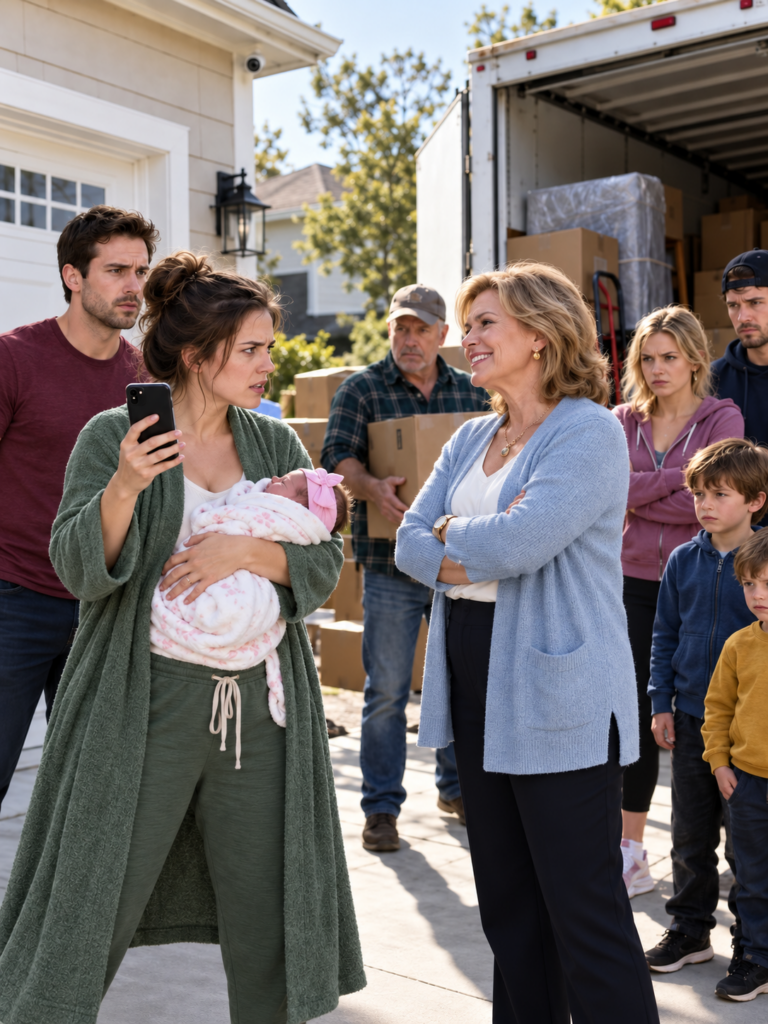
The moving van stretched across half the driveway of our house in Cedar Grove, Ohio, its rear door rolled open. Mattresses stood strapped against one wall. Plastic storage tubs were stacked three high. A faded brown recliner I recognized from my mother’s apartment sat near the ramp.
And scattered across our lawn were people who had absolutely no reason to be there.
My mother, Diane.
Her husband, Ron.
My younger brother, Scott.
Scott’s girlfriend, Kayla.
And Kayla’s eight-year-old daughter, Madison, who was sitting on one of my porch chairs eating crackers from a plastic bag.
My husband, Daniel, came around the passenger side of our SUV with our three-day-old son tucked carefully against his chest.
Noah was asleep beneath a blue knit cap the maternity nurse had given us.
Daniel looked from the truck to my mother.
Then he looked at me.
“Sara?”
I held the car door because my knees felt unstable.
Three days earlier, doctors had rushed me into surgery after Noah’s heart rate suddenly dropped. Everything afterward had become a blur of fluorescent lights, nurses checking my incision, sleepless nights, blood-pressure cuffs, feeding schedules, and Daniel sleeping upright in an uncomfortable hospital chair.
All I had wanted was my own bed.
My own shower.
My own quiet house.
Instead, my mother smiled as though she had organized a surprise party.
“There she is.”
She hurried toward us.
I stepped back automatically.
“Mom, what is this?”
She stopped.
For half a second, annoyance crossed her face.
Then the smile returned.
“The solution.”
“To what?”
“To everything.”
She gestured toward the moving van.
“Ron and I gave notice on the apartment. Scott’s landlord finally got ridiculous about the back rent, and Kayla’s place is too small for everybody. You’ve got all this space sitting empty.”
I stared at her.
Our home had four bedrooms.
One was ours.
One was Noah’s nursery.
One was Daniel’s office, which he needed because he worked remotely three days a week.
The fourth was a small guest room.
There was no mysterious unused wing.
No vacant apartment.
No collection of empty bedrooms waiting for relatives.
“Mom,” I said quietly, “you are not moving into my house.”
Kayla, who had been unloading a plastic tote, stopped walking.
Scott gave an irritated laugh.
Ron looked away.
My mother’s expression hardened.
“Don’t start.”
“I’m not starting anything.”
“You just came home from the hospital. You’re exhausted. That’s why you’re reacting this way.”
Daniel shifted Noah slightly higher against his chest.
“Diane, Sara isn’t confused.”
My mother’s eyes snapped toward him.
“This is family business.”
Daniel’s jaw tightened.
“Sara is my wife. Noah is my son. This is my house too. That makes it my business.”
Mom sighed dramatically.
“Daniel, please. Nobody is trying to hurt anybody.”
Then she turned back to me.
“You need help.”
“I need rest.”
“Exactly. Which is why this is perfect. Kayla can help with the baby. I can cook. Ron can take care of the yard.”
She pointed toward the second floor.
“Scott and Kayla can use the back two bedrooms, and Ron and I will take the room beside yours.”
I stared at her.
“The room beside ours is Noah’s nursery.”
Her expression barely changed.
“Well, the baby doesn’t actually need his own room yet.”
Something inside me became very calm.
Maybe it was exhaustion.
Maybe it was the pain.
Or maybe there are moments when your mind finally becomes too tired to keep making excuses for someone.
For thirty-four years, my mother had treated boundaries as negotiations.
When I was sixteen, she borrowed the money I had saved from my grocery-store job because the electric bill was overdue.
She never repaid it.
When I was nineteen, she put her phone plan in my name because her credit was poor.
When I was twenty-three, she cried until I cosigned a lease for Scott because nobody else would.
When he stopped paying rent, I covered three months because I was terrified an eviction would destroy my credit.
And every time I objected, my mother used the same sentence.
Family doesn’t keep score.
But somehow I was always the one paying.
Three months before Noah was born, that pattern had finally crossed a line I could not ignore.
A collection notice arrived at my office for a store credit card I had never opened.
The balance was $8,640.
The account had been created using my maiden name, my birth date, and the address of the house where my mother had lived before marrying Ron.
She swore she knew nothing about it.
Scott swore he knew nothing about it.
Everyone acted offended that I had even asked.
Daniel did not.
He sat beside me at our kitchen table that night and said, “Sara, somebody used your information.”
“I know.”
“And whoever did it knew enough about you to answer security questions.”
I knew that too.
For years, I had confused keeping peace with being kind.
That evening, I stopped.
I contacted the card issuer.
I froze my credit.
I hired an attorney named Leah Morgan.
And after Leah asked whether my mother had ever possessed old financial paperwork, identification documents, or account information, I installed security cameras around our home.
I changed the locks.
Then I sent my mother a written message.
No borrowing money.
No using my information.
No receiving mail at our address.
And absolutely nobody would be staying in our house after Noah was born.
Her answer had been two words.
So dramatic.
Now she stood in my driveway with half her apartment packed into a truck.
Scott opened the back door of the van.
“Can we argue inside? We’ve got another load coming.”
“No.”
He looked at me.
“What?”
“You’re not coming inside.”
He laughed.
I didn’t.
Mom folded her arms.
“Sara, stop embarrassing yourself.”
“I’m not embarrassed.”
“You’ve been home thirty seconds.”
“And I already said no.”
“You agreed to this.”
Daniel and I looked at each other.
“No,” I said. “I didn’t.”
Mom’s eyes sharpened.
“Yes, you did.”
“When?”
“Months ago.”
“No.”
She glanced toward Ron.
It was subtle.
But I saw it.
And suddenly I knew there was more.
“What did you do?”
Mom exhaled loudly.
“Oh, for heaven’s sake.”
“What did you do?”
Scott stepped between us.
“Can everyone calm down?”
I looked at him.
“Why does she think I agreed?”
He shoved his hands into his sweatshirt pockets.
“I don’t know.”
It was a lie.
Scott had always been terrible at lying.
His neck turned red.
My mother stepped toward the moving truck.
“Ron, start carrying things upstairs. She’ll settle down once she gets inside.”
Ron hesitated.
“Diane…”
“Just do it.”
He reached for a box.
Daniel moved toward the porch.
“No one is entering the house.”
Ron stopped.
My mother stared at my husband.
Then she actually smiled.
Not warmly.
Confidently.
“You can’t keep us out.”
That sentence changed everything.
I pulled my phone from my purse.
Mom laughed.
“What are you doing?”
“Calling the police.”
Kayla’s mouth fell open.
Scott said, “Are you insane?”
My mother’s smile remained for another second.
Then disappeared.
“You would call police on your own mother?”
“I’m calling because people I told not to enter my home are attempting to move into it.”
“You invited us.”
“No.”
“Yes, you did.”
“Then prove it.”
That was when Kayla spoke.
Her voice came from behind me.
“Diane has the paperwork.”
Every face turned toward her.
My mother went completely still.
“What paperwork?” I asked.
Kayla blinked.
Apparently she hadn’t realized she was revealing anything unusual.
“The residency paperwork.”
My incision seemed to ache harder.
“What residency paperwork?”
“Kayla,” my mother snapped.
But Kayla continued.
“The stuff for Madison’s school.”
I looked at Scott.
His face had gone pale.
“What did you use my address for?”
Nobody answered.
Daniel handed me the diaper bag and shifted Noah into one arm.
“Sara.”
I knew that tone.
Stay calm.
Think.
Mom stepped closer.
“This is being blown completely out of proportion.”
“Show me the paperwork.”
“No.”
“Then nobody moves anything.”
She lowered her voice.
“We did what we needed to do.”
Those words frightened me more than yelling would have.
“What did you need to do?”
“Scott’s place wasn’t safe.”
Scott looked offended.
“Mom.”
“You had mold. The landlord wouldn’t fix it. Madison needed to stay in her school district. Ron’s lease was ending. We had to make arrangements.”
“With my address?”
“You weren’t using it.”
For a moment I genuinely couldn’t understand the sentence.
“I live here.”
“I mean for school purposes.”
“And what else?”
Silence.
My mother reached into her handbag.
Then stopped.
She seemed to reconsider.
I held up my phone.
“The dispatcher is waiting.”
I had already dialed.
That finally ended the argument.
Mom pulled out a blue folder.
She opened it and removed several papers.
“I was going to explain everything after you got settled.”
I took one photograph.
Then another.
Electric bill.
Insurance correspondence.
A change-of-address confirmation.
School registration documents.
And beneath them, something titled TEMPORARY FAMILY OCCUPANCY AGREEMENT.
The property address was mine.
The listed occupants were Diane Mercer, Ronald Mercer, Scott Palmer, Kayla Jennings, and Madison Jennings.
The agreement claimed they had permission to reside in my home beginning September 15.
Two weeks earlier.
At the bottom was my typed name.
Sara Palmer Whitaker.
And beside it was a signature.
It looked almost like mine.
Almost.
A cold feeling spread through my chest.
Daniel leaned closer.
“You didn’t sign that.”
“No.”
Mom tapped the page.
“We discussed it.”
“No, we didn’t.”
“You forget conversations all the time lately.”
I stared at her.
She was going to use my pregnancy against me.
Not just emotionally.
Legally.
“You forged my name.”
“I did not.”
“That isn’t my signature.”
“You approved it.”
“No.”
“You told me we would figure something out.”
“That isn’t permission to manufacture a housing agreement.”
Her voice rose.
“Don’t use lawyer language with me.”
“I am a lawyer.”
That was another thing my mother disliked whenever it became inconvenient.
I worked in compliance for a midsized insurance company. I wasn’t a criminal attorney or property specialist, but I understood documentation.
I understood patterns.
And I understood why she had created papers before arriving.
She wanted evidence that they already lived there.
Mail.
Utility connections.
School records.
A signed occupancy agreement.
This wasn’t desperation that had started that afternoon.
It was preparation.
I photographed every page visible inside the folder.
Then I stepped away and spoke to the dispatcher.
“My family is attempting to enter my residence without permission. They have documents bearing what appears to be a forged version of my signature, and they are claiming residency.”
My mother’s face changed.
For the first time, she understood that I wasn’t bluffing.
The police arrived eleven minutes later.
During those eleven minutes, nobody touched another box.
Noah woke and began making the small, wounded sounds he made before crying.
I wanted desperately to take him inside.
Instead, I stood in my driveway while Daniel rocked him carefully.
Mom tried three times to talk to me.
I ignored her.
When the patrol car pulled up, she immediately changed personalities.
Her shoulders slumped.
Her voice softened.
She looked like a worried mother.
“Officer, this is all a terrible misunderstanding. My daughter has just come home after a very traumatic delivery.”
I almost admired the speed of it.
The officer looked at me.
“Are you the homeowner?”
“My husband and I are.”
“And these people are family?”
“Yes.”
“Were they invited to live here?”
“No.”
Mom held up the paper.
“She gave us permission months ago.”
The officer examined it.
“Ma’am?”
I looked directly at him.
“That is not my signature.”
Mom made a hurt sound.
The officer glanced between us.
“Do you have any messages concerning this?”
“Yes.”
I opened my phone.
Two weeks earlier, my mother had written:
We’re going to need someplace temporary once Ron’s lease ends.
I had responded:
You cannot move into our house.
She wrote:
Stop being selfish. You have room.
I answered:
I am putting this in writing so there is no confusion. Nobody has permission to move into our home, use our address, receive mail here, copy our keys, store property here, or represent themselves as residents.
The officer read the exchange.
Then he looked at my mother.
“Do you have keys to this property?”
Nobody answered.
The second officer, a woman, looked toward Scott.
“Sir?”
Scott looked at Mom.
That was enough.
“Do you have keys?”
He slowly pulled a brass key from his wallet.
Ron produced another.
My stomach turned.
They were copies of our previous house key.
Before we changed the locks.
Mom had possessed an emergency copy years earlier.
Apparently she’d duplicated it.
The first officer tested the key.
It didn’t work.
For the first time that night, my mother seemed surprised.
I said nothing.
The officer handed the key back.
“Did the homeowners give you permission to copy this?”
Ron immediately said, “Diane told me they had.”
Mom turned on him.
“Ron.”
“What? You did.”
Her face reddened.
The female officer looked at me.
“Do you want these individuals formally trespassed from the property?”
I could hear Noah crying behind me.
I thought about what my mother expected.
She expected hesitation.
Guilt.
A plea for compromise.
Anything she could use as an opening.
“Yes,” I said.
The word came easier than I expected.
“I do.”
The officers instructed everyone to leave.
My mother stood at the edge of the driveway while Scott and Ron closed the moving van.
Her face was rigid.
“You’re making a mistake.”
I didn’t answer.
She moved closer.
The female officer immediately stepped between us.
Mom ignored her.
“You have no idea what you’re doing to this family.”
I looked at the truck.
At the copied keys.
At the forged agreement.
Then at my mother.
“No,” I said. “I finally do.”
Part 2
I didn’t sleep that night.
Not because of the baby.
Noah slept in two-hour stretches, which felt almost generous after the hospital.
I couldn’t sleep because every small noise convinced me somebody was testing a door.
Daniel checked the locks twice.
At three in the morning, I asked him to check them again.
He didn’t tell me I was being irrational.
He simply got up.
After he returned, he sat beside me on the bed.
“Everything’s locked.”
I nodded.
Noah was asleep in his bassinet.
Moonlight fell through the curtains across his blanket.
Daniel touched my hand.
“You okay?”
“No.”
It was the first time all day I had admitted it.
My eyes filled.
“I wanted tonight to be different.”
He waited.
“I wanted to bring him home and put him in the nursery. I wanted pictures. I wanted us to order something terrible for dinner because neither of us wanted to cook. I wanted to sit on the couch and be scared about normal new-parent things.”
Instead, my first memory of carrying our child home would always include police lights reflecting off the siding.
Daniel leaned closer.
“You protected him.”
“I called the police on my mother.”
“Both things can be true.”
I started crying.
Quietly at first.
Then harder.
Not because I regretted calling.
Because some childish part of me had apparently remained convinced that if I behaved well enough, helped enough, forgave enough, my mother would eventually become the person I needed her to be.
She had arrived at my house on the most vulnerable day of my adult life with a moving truck and forged paperwork.
There was nothing left to misunderstand.
At seven the next morning, my phone started buzzing.
Aunt Lorraine.
Then Cousin Deb.
Then an old family friend.
Then Scott.
Then two numbers I didn’t recognize.
I turned it facedown.
At 8:32, Daniel showed me why.
My mother had posted on Facebook.
She had written that her daughter, “fresh from becoming a mother herself,” had thrown six relatives onto the street because Daniel had poisoned me against my family.
She didn’t mention the moving truck.
Or the forged agreement.
Or the copied keys.
Or the months of written refusals.
Her post included a picture of Madison sitting beside several suitcases.
That image did the work my mother wanted it to do.
Within an hour, there were more than eighty comments.
Some defended me because they knew enough not to trust the story.
Others did not.
How can someone do this to their own mother?
Poor little girl.
Having a big house changes people.
She’ll regret this when Diane is gone.
I read too many.
Then I made myself stop.
At nine, Leah Morgan called.
I’d sent her photographs the night before.
“Don’t respond publicly,” she said.
“I wasn’t planning to.”
“Good. And don’t answer your mother unless I tell you to.”
“What about the document?”
A pause.
“That’s why I’m calling.”
Something in her voice made me sit straighter.
“It isn’t just an occupancy agreement.”
“What do you mean?”
“The wording is copied from a standard month-to-month rental form. They altered the title and removed the rent section.”
My chest tightened.
“Why?”
“Because a document showing permission to occupy a property can complicate removal if somebody gets inside and establishes residency.”
“Are you saying she was trying to become my tenant?”
“I’m saying somebody wanted paperwork that could be used to argue lawful occupancy.”
I looked toward the living room, where Daniel was changing Noah.
“She planned this.”
“Yes.”
Leah continued.
“We should also determine whether any utility accounts were actually transferred.”
I remembered the electric bill in the folder.
“I saw something from the power company.”
“I’ll contact them with you.”
That call opened another door.
Our electricity remained in Daniel’s name.
But four weeks earlier, somebody had attempted to add Diane as an authorized occupant.
The request had been denied because the account holder hadn’t verified it.
The gas company had received a similar request.
So had our homeowners insurer.
Each attempt included an email address I did not recognize.
Leah asked the companies to preserve the application records.
Then she contacted the investigator handling the fraudulent credit card.
His name was Marcus Bell.
He called that afternoon.
“Mrs. Whitaker, I need to ask you something.”
“Okay.”
“Do you know the email address dmercer1965 at Outlook?”
I closed my eyes.
“Yes.”
“Whose is it?”
“My mother’s.”
There was silence on the line.
“The disputed store card was opened using that email.”
For months, my mother had insisted she knew nothing.
I felt almost nothing when Marcus told me.
That frightened me.
“Can you prove it was her?”
“We can prove the email was used. We’re requesting additional records now.”
“Do that.”
He hesitated.
“There’s something else.”
Of course there was.
“There was a second application we hadn’t previously linked to you because your Social Security number was entered incorrectly by one digit.”
“What application?”
“An auto loan.”
I stood.
“For whose car?”
“I can’t disclose the account holder until we confirm the identity issue.”
But I already knew.
Ron had purchased a used Ford F-150 the previous spring.
My mother posted pictures of it for weeks.
Finally moving up in the world, she had written.
That evening, I told Daniel.
He put down the dish he was drying.
“You think she used your information to get Ron’s truck?”
“I don’t know.”
“Yes, you do.”
I looked at him.
He wasn’t accusing me.
He was reminding me that denial was a habit I had learned at home.
Three days passed.
My mother did not contact me directly.
Other people did it for her.
Aunt Lorraine left a voicemail.
“Sara, honey, I’m sure your mom went about things the wrong way, but she was desperate. You know how hard life has been for Scott.”
I deleted it.
Scott sent:
Hope you’re happy. Madison had to miss school because of you.
I typed six different answers.
I sent none.
Then Kayla contacted me.
Not by text.
She called from an unfamiliar number.
I nearly ignored it.
“Hello?”
“Sara?”
Her voice was low.
“It’s Kayla.”
“What do you want?”
“I need to tell you something.”
I waited.
“I didn’t know the paper was fake.”
I almost laughed.
“You watched my mother tell the police I signed it.”
“She told us you did.”
“And you believed her?”
“Yes.”
The answer was immediate enough that I paused.
Kayla started crying.
Not dramatically.
Quietly.
“She told Scott you’d offered the house months ago. She said you wanted family around after the baby came. She told me Madison could register in your district because we were all moving there.”
“Kayla, I repeatedly told Mom no.”
“I know that now.”
Something shifted.
“What happened?”
“I found messages.”
“Between who?”
“Your mom and Scott.”
I sat down.
“What do they say?”
“She told him not to ask you anything because you’d get nervous and Daniel would interfere.”
My fingers tightened around the phone.
“What else?”
“She said once our stuff was inside, you wouldn’t make everybody leave.”
That sounded exactly like my mother.
Then Kayla said something that didn’t.
“She also told him you wouldn’t risk having police come because of your job.”
I stopped breathing for a second.
“What?”
“She said lawyers hate public scenes. She said you’d complain, but you’d let us stay because you’d be afraid it would look bad.”
So even my career had been incorporated into the plan.
My mother had mistaken restraint for fear.
Again.
“Can you send me those messages?”
“I took pictures.”
“Send everything.”
Ten minutes later, twenty-seven screenshots arrived.
Most were ugly but unsurprising.
Then I reached one from six weeks earlier.
SCOTT: What if Sara says no again?
MOM: She always says no first.
SCOTT: Daniel won’t go for it.
MOM: Daniel doesn’t own everything. Sara’s name is on the house too.
SCOTT: Still risky.
MOM: Once mail is coming there and Madison is registered, nobody is putting a child on the street. Sara cares too much about what people think.
I read that sentence three times.
Then another.
SCOTT: What if she calls somebody?
MOM: She won’t.
SCOTT: How do you know?
MOM: Because I raised her.
For some reason, that one hurt worst.
Not because she hated me.
Because she believed she understood exactly how to control me.
I forwarded everything to Leah.
Then Kayla called again.
“There’s something else.”
“What?”
“Scott said your mom could get money after we moved in.”
“What money?”
“He didn’t explain.”
“Ask him.”
“He won’t talk to me now.”
“Why?”
“Because I told him I’m taking Madison to my sister’s.”
That surprised me.
“You’re leaving?”
“I didn’t sign up for whatever this is.”
For the first time, I wondered whether Kayla had been less involved than I assumed.
Before we hung up, she said, “I’m sorry about your first night home.”
I didn’t forgive her.
But I believed she meant it.
Two days later, Leah found the money.
The house had belonged to my grandmother before she died.
What almost nobody knew was that she hadn’t left it directly to me.
She left it in a family property trust.
I was the primary beneficiary and had exclusive occupancy rights. When Daniel and I renovated, we paid the mortgage-related obligations and expenses, but legal title remained in the trust.
My mother knew about the trust.
Or thought she did.
What she apparently did not understand was that it contained a clause concerning dependent family housing.
Years earlier, when my grandmother was alive, the trust had permitted short-term financial assistance for relatives living in property owned by the trust—provided the trustee approved the arrangement.
My mother had found an old copy.
She believed that if she established herself and Scott’s family as occupants, they could demand trust assistance for maintenance and household costs.
It would not have worked.
The clause had expired when my grandmother died.
But my mother didn’t know that.
She had planned to force herself into my house and then try to make the trust help finance her stay.
I felt sick.
Daniel read the paperwork at our kitchen table.
“So this wasn’t just about needing somewhere to live.”
“No.”
“She thought she could get paid?”
“Possibly.”
He leaned back.
“And if you complained?”
“She’d tell everyone I was throwing Madison onto the street.”
He was quiet.
Then he said, “That’s why she needed the kid registered at our address.”
Exactly.
Madison wasn’t merely a child caught in the situation.
My mother had turned her into leverage.
That realization made something in me snap.
Not violently.
Cleanly.
I had spent my life believing my mother behaved recklessly because she was emotional.
Now I understood how much planning existed beneath the chaos.
She knew which person to guilt.
Which relative to call.
Which child to display.
Which story to tell.
Chaos was not always the absence of strategy.
Sometimes it was the strategy.
The following Monday, Leah sent formal notices to every adult involved.
Cease using our address.
Cease representing themselves as residents.
Cease attempting to establish utility, school, insurance, or financial records connected to the property.
Preserve all communications regarding the forged occupancy document.
My mother called thirty-one minutes after receiving it.
I didn’t answer.
Then she called from Ron’s phone.
Then Scott’s.
Then an unknown number.
Finally she left a voicemail.
“You have gone too far. Call me before this becomes something you can’t undo.”
I saved it.
That evening, somebody drove slowly past our house three times.
The security camera captured the license plate.
It belonged to Ron.
Daniel wanted to call police immediately.
I told him to wait unless the truck returned.
At 11:17 p.m., it did.
Ron parked across the street.
My mother got out.
She walked toward our front door carrying a grocery bag.
I watched from the upstairs camera feed while Daniel called police.
She didn’t knock.
Instead, she moved toward the side gate.
The camera recorded everything.
When the porch light switched on automatically, she froze.
Then she looked directly at the camera.
For a long moment, neither of us moved.
Even through the screen, I could see her expression.
Not guilt.
Anger.
She reached into the grocery bag.
And pulled out an envelope.
She walked back to the front porch and shoved it beneath the doormat.
Then she returned to Ron’s truck and left.
The police arrived four minutes later.
The envelope contained a letter.
Handwritten.
Sara,
If you continue this, you will hurt people who have done nothing to you.
Scott could lose everything.
Ron could lose his truck.
I could lose my marriage.
You have always been the successful one. You have a husband, a career, a beautiful home, and now a baby. Nobody is trying to steal from you. We are asking you to share some of what life has given you.
I hope becoming a mother teaches you compassion.
Mom
I read the last sentence twice.
Then I laughed.
Not because anything was funny.
Because finally I understood.
My mother believed my life had been given to me.
Not built.
Not earned.
Not protected.
Given.
And because she believed that, anything I had was something she could redistribute.
Three days later, Marcus called.
They had confirmed the auto loan.
My identifying information had been included as a secondary guarantor.
The electronic application originated from my mother’s home internet connection.
The phone number used for verification belonged to her.
The truck was Ron’s.
There was also a personal loan.
Twelve thousand dollars.
Paid into an account jointly controlled by my mother and Scott.
“What was it used for?” I asked.
“Mostly rent payments and cash withdrawals.”
My throat tightened.
Scott’s rent.
The apartment my mother said he was about to lose because nobody helped him.
I stared out my kitchen window.
For years, she had told me Scott couldn’t survive without family because he was unlucky.
Maybe he had simply never been required to survive on his own.
Marcus continued.
“We’ll need a formal statement.”
“You’ll have one.”
That night, my mother finally reached me.
She used Aunt Lorraine’s phone.
I answered because I thought my aunt was calling.
Instead I heard, “Sara.”
I nearly disconnected.
“Don’t hang up.”
“What do you want?”
“Tell the investigator you made a mistake.”
“No.”
“It is one sentence.”
“No.”
Her voice became sharper.
“Ron didn’t know your name was on the loan.”
“That doesn’t make fraud disappear.”
“Nothing happened to you.”
I looked around our living room.
At the new deadbolt.
The security monitor.
The folder of legal correspondence.
The baby monitor beside me.
“You showed up at my house with forged papers three days after I had surgery.”
“That has nothing to do with the loan.”
“It has everything to do with it.”
“You always have to be right.”
I closed my eyes.
“No, Mom. I spent years pretending you were right because it was easier.”
She went silent.
Then her voice changed.
Small.
“You’re going to send your own mother to jail?”
I had imagined that question since the investigation began.
When she finally asked it, I knew the answer.
“I don’t decide that.”
“You’re cooperating.”
“Yes.”
“Same thing.”
“No. The same thing would be me opening accounts in your name and then blaming you for reporting them.”
“You don’t understand what pressure I was under.”
“What pressure made you forge my signature on my house?”
Another silence.
Then she said, “Scott was going to lose Madison.”
“What?”
“He and Kayla were fighting. She was threatening to leave. I was trying to stabilize things.”
My mind raced.
Kayla was not Madison’s mother biologically? Wait—no. She was. Scott wasn’t.
Scott had been dating Kayla for four years.
He had no legal custody rights to Madison.
My mother had been using the child to frame the crisis as though Scott was protecting his own daughter.
“You told me Madison needed my house.”
“She needed stability.”
“She needed adults who weren’t using her as paperwork.”
My mother began crying.
Real crying this time.
“I was trying to hold everyone together.”
There it was.
The story she always told herself.
She wasn’t stealing.
She was rescuing.
She wasn’t controlling.
She was holding everyone together.
She wasn’t lying.
She was protecting people from inconvenient truths.
And anyone who refused to participate was cruel.
I heard movement beside me.
Daniel had entered the room.
He didn’t speak.
He simply sat down.
My mother whispered, “After everything I’ve done for you.”
For most of my life, that sentence could turn me into a child.
I would remember school lunches.
Birthday cakes.
Her sitting beside me when I had pneumonia at nine.
The used Honda she helped me buy at nineteen.
The nights she worked double shifts when Scott and I were little.
She had done things for me.
Real things.
Loving things.
That was what had made all of this so difficult.
People wanted villains to be evil every day.
My mother wasn’t.
She was funny.
She remembered birthdays.
She made excellent chicken soup.
She could sit beside someone in a hospital for twelve hours without complaining.
She had loved me.
And she had also stolen my identity.
Copied my keys.
Forged my signature.
Used my address.
And tried to manipulate me into surrendering my home.
Both versions were true.
I finally understood that accepting the first did not require tolerating the second.
“I know what you’ve done for me,” I said.
Her breathing slowed.
For one second, I could almost feel her hope.
Then I continued.
“And none of it bought the right to do this.”
She stopped crying.
“Sara—”
“Don’t contact me again except through Leah.”
“You can’t mean that.”
“I do.”
“You’ll regret this.”
I looked at Noah sleeping in Daniel’s arms.
Maybe someday I would regret certain things.
But not this.
“No,” I said.
“I think I’m finally going to stop regretting all the times I didn’t say it sooner.”
Then I hung up.
Part 3
The criminal case took five months.
Real life was less dramatic than television.
There was no surprise courtroom confession.
No judge slamming a gavel while relatives gasped.
Mostly there were phone calls.
Emails.
Documents.
Interviews.
Certified letters.
Weeks when nothing seemed to happen.
Then suddenly three things would happen in one afternoon.
The forged occupancy agreement became important because investigators discovered where it came from.
Scott had downloaded the original rental template.
My mother modified it.
She created the signature herself by tracing my name from an old Christmas card she had scanned years earlier.
They knew because the electronic document had been saved in her cloud storage.
That detail destroyed her claim that the signature was a misunderstanding.
The financial investigation found more.
The store card.
The personal loan.
Ron’s truck financing.
And one attempted home-improvement account that had been rejected before approval.
The total exposure exceeded thirty thousand dollars.
Some of the money had indeed gone toward Scott’s rent.
Some had paid household bills.
Some had covered the down payment on Ron’s truck.
And several cash withdrawals could not be explained.
Scott avoided charges related to the credit applications because investigators could not prove he knew my information had been used.
But his messages about the house were another matter.
He had known they didn’t have permission.
Kayla’s screenshots made that clear.
My mother eventually accepted a negotiated plea rather than risk trial.
There would be restitution.
Probation.
Mandatory financial-crimes counseling.
Restrictions concerning contact with me.
And conditions preventing her from using my address or approaching the property.
Ron surrendered the truck after the financing company challenged the loan.
His anger ended their marriage before the criminal case was finished.
My mother blamed me.
For that too.
Scott and Kayla broke up.
Kayla moved with Madison to her sister’s home outside Columbus and, to my surprise, sent me a Christmas card months later.
She wrote only:
Thank you for forcing all of us to see what was happening.
I kept the card.
I didn’t know whether we would ever be friends.
We had never really been friends before.
But I appreciated that she didn’t ask for forgiveness.
She simply acknowledged the truth.
Scott had a harder time.
Without my mother quietly covering rent, utilities, groceries, and emergencies with money she didn’t actually possess, he finally had to confront his finances.
He moved into a smaller apartment.
Sold his expensive gaming equipment.
Took overtime shifts at the warehouse where he’d worked for five years.
For the first time I could remember, he lived entirely on his own income.
Three months after Mom’s plea, he called me.
I almost didn’t answer.
But I did.
“Hey.”
His voice sounded different.
Tired.
“Hi.”
“I won’t keep you.”
“Okay.”
A long silence followed.
Then he said, “I knew you said no.”
I looked toward the backyard, where Daniel was pushing Noah in a stroller along the patio.
“I know.”
“I kept telling myself Mom would fix it.”
“She usually did.”
“Yeah.”
Another silence.
“I think that’s the problem.”
I didn’t rescue him from the uncomfortable moment.
Finally he said, “I’m sorry.”
“For what part?”
It wasn’t meant cruelly.
I genuinely wanted to know.
“All of it.”
“That isn’t specific.”
He exhaled.
“For letting her turn you into the bad guy because it made my life easier.”
That landed differently.
I sat down.
Scott continued.
“You were always the one who could handle things. So whenever something went wrong, Mom would say you could help. And when you didn’t want to, we’d act like you were selfish.”
He gave a short, bitter laugh.
“I never noticed how convenient that was for me.”
I didn’t speak.
“I knew we weren’t invited,” he said. “I didn’t know she forged the paper. But I knew you had told her no. I came anyway.”
“Why?”
“Because I thought once we were there, you’d let us stay.”
Exactly what Mom had believed.
“I’m sorry.”
I looked at Noah.
He had recently discovered his own feet and spent most of every day trying to grab them.
His entire understanding of family was still being formed.
“Scott, I’m not ready to have a relationship with you.”
“I know.”
“But I appreciate you saying it.”
“That’s more than I expected.”
Before hanging up, he said, “For what it’s worth, I think Mom really believed she was helping everybody.”
“I know.”
That was the saddest part.
By spring, my credit had been repaired.
The fraudulent accounts were removed from my reports.
The trust attorney updated every document connected to the house and tightened protections around the property.
We changed the locks again even though it wasn’t necessary.
Daniel said he wanted me to watch the locksmith throw the old cylinders into his toolbox.
I did.
It felt ridiculous.
It also felt wonderful.
The family reaction changed slowly.
At first, many relatives remained loyal to my mother.
Then the evidence became impossible to dismiss.
Leah prepared a short factual letter that I could share if necessary.
No emotional accusations.
No insults.
Just dates.
Documents.
Police report number.
Fraud claims.
The forged occupancy agreement.
My written refusal from before the attempted move.
I sent it to Aunt Lorraine after she called me cruel for the third time.
She never apologized.
But she stopped calling.
Cousin Deb did apologize.
“I thought Diane was exaggerating,” she said.
“She was.”
“I mean, I thought she was exaggerating about you.”
I laughed despite myself.
“That too.”
By April, nobody was debating whether I had overreacted.
They were debating how long my mother had been doing similar things.
Stories surfaced.
An aunt remembered lending her four thousand dollars that was never returned.
A cousin discovered an old phone account opened under his name.
My grandmother’s former neighbor remembered Mom asking to use her address for a loan years earlier.
None of those incidents became my responsibility.
That might have been the greatest change.
Old Sara would have created a spreadsheet.
Called everyone.
Organized repayment plans.
Made appointments.
Found attorneys.
Tried to repair a family structure built around everyone leaning on the same person.
I didn’t.
I had a baby.
A husband.
A home.
A life.
For once, I stayed inside it.
When Noah was seven months old, we finally finished the nursery.
The night of the attempted move, my mother had planned to put Scott and Kayla there.
For months afterward, I couldn’t enter the room without remembering Ron carrying that box toward the porch.
Daniel suggested repainting.
The walls had been soft gray.
We chose a warm blue instead.
He built white shelves beneath the window.
I framed a picture from the morning after Noah was born.
Not the driveway.
Not the police.
The hospital.
In it, Daniel was asleep in the chair with his head tilted sideways, and Noah was curled against my chest beneath the blanket.
I looked exhausted.
Pale.
Hair everywhere.
I loved the picture.
It showed what mattered before anybody tried to ruin it.
One Saturday afternoon, as we arranged books on the shelves, Daniel held up an old stuffed bear.
“This yours?”
I smiled.
“My grandmother gave me that.”
The bear’s fur was worn almost flat.
One eye was scratched.
Daniel set it beside Noah’s books.
“Then he gets it.”
I watched him for a moment.
“You know what I keep thinking about?”
“What?”
“The police officer asking whether I wanted them trespassed.”
Daniel waited.
“I almost said no.”
“I know.”
I looked at him.
“You knew?”
“You paused.”
“Maybe two seconds.”
“Long two seconds.”
I sat on the floor beside the crib.
“I was scared everybody would think I was terrible.”
“And now?”
“Some of them still do.”
He smiled.
“That wasn’t my question.”
I looked around the room.
The blue walls.
The books.
The stuffed bear.
The baby monitor.
The window looking down toward the driveway where the moving van had been.
“No,” I said. “I’m not scared of that anymore.”
My mother’s no-contact restriction lasted through the probationary period.
She tested it indirectly.
Birthday cards sent through Lorraine.
Messages passed through cousins.
A Christmas package with no return address.
I sent everything back unopened when possible.
Then, nearly a year after Noah was born, I received a letter from her attorney.
My mother wanted permission to send one written apology.
Leah asked what I wanted.
I surprised myself.
“Let her.”
The letter arrived a week later.
I waited three days before opening it.
It was six pages long.
The first page sounded familiar.
She explained the pressure she had been under.
Scott’s housing situation.
Ron’s lease.
Money.
Fear.
Embarrassment.
By page two, I nearly stopped reading.
Then the tone changed.
She wrote about counseling.
About how often she had used emergency as an excuse for dishonesty.
About how helping Scott had become a way of preventing him from ever having to face consequences.
About how she had mistaken my competence for obligation.
One sentence made me stop.
I kept calling you selfish whenever you stopped sacrificing because I needed you to believe sacrifice was your job.
I read that line several times.
It was the closest she had ever come to naming what had happened between us.
Near the end, she wrote:
I am not asking you to let me into your home. I understand now that an apology does not create access.
I cried when I read that.
Not because everything was repaired.
It wasn’t.
Not because I suddenly trusted her.
I didn’t.
I cried because for the first time, she had acknowledged the difference between love and entitlement.
I folded the letter.
Put it back in the envelope.
And stored it in a drawer.
I did not answer immediately.
Months passed.
Then one afternoon, after Noah’s first birthday, I mailed a short note.
Mom,
I received your letter.
I believe you are beginning to understand why I made the choices I did.
I hope you continue counseling and build a life that doesn’t depend on controlling or rescuing other people.
I am not ready for contact.
If that changes, I will be the person who reaches out.
Sara
It was not forgiveness.
It wasn’t punishment either.
It was simply a boundary without anger wrapped around it.
That felt new.
The following September, almost exactly one year after the moving truck appeared, Daniel and I sat on our front porch after dinner.
Noah toddled unsteadily between us, laughing every time he reached one parent without falling.
The lavender along the walkway had grown thicker than I expected.
Daniel had planted it because the nursery book we’d read said the scent could be calming.
He claimed it was for Noah.
I suspected it was for me.
Across the street, the Hendersons were washing their car.
Someone farther down the block was grilling.
A lawn mower buzzed in the distance.
Ordinary sounds.
Beautifully ordinary.
My phone vibrated on the porch table.
A message from Cousin Deb.
Your mom asked me whether I’ve heard from you. I told her she needs to respect what you said. She didn’t ask me to pass anything along. Thought you’d want to know.
I read it once.
Then locked the screen.
Daniel looked over.
“Everything okay?”
“Yes.”
And it was.
Not perfect.
Not repaired.
Not the version of family I spent decades trying to create.
But safe.
Noah lost his balance and landed on his diaper.
His face scrunched with surprise.
Then he laughed.
I scooped him up and kissed his warm cheek.
Behind us, the front door stood open to the screen, and beyond it was our living room, scattered with toys and board books and the ordinary clutter of people who actually belonged there.
For most of my life, I thought a home stayed peaceful because one person kept letting everyone else in.
I know better now.
Sometimes peace comes from deciding who gets a key.
And sometimes love begins with finally being willing to close the door.

