
Part 1
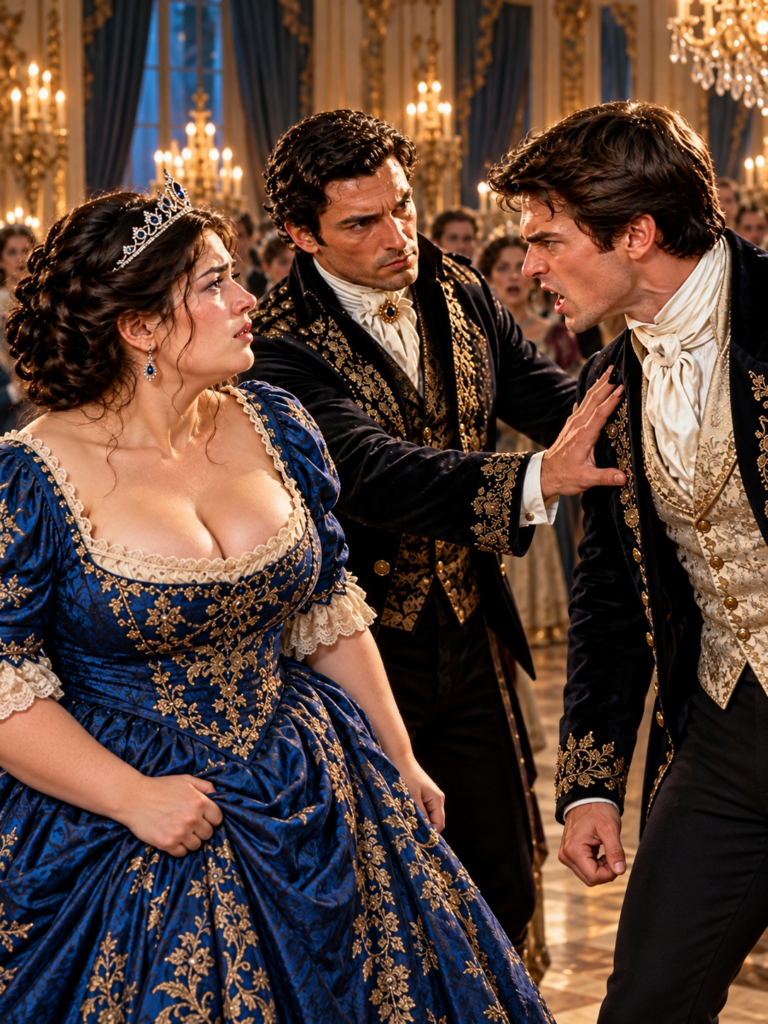
The first thing Lady Eleanor Ashcombe heard was the sound of her measuring tape striking the marble floor.
The second was laughter.
It came from somewhere behind the young gentleman standing before her, a discreet, unpleasant sound that seemed to spread through the drawing room as quickly as a stain across white silk.
Lord Sebastian Harcourt stood beside the long dressing mirror at Blackthorn House, his embroidered waistcoat hanging unfinished from his shoulders. Twenty-nine years old, handsome by the forgiving standards of London society, and heir presumptive to one of England’s most substantial dukedoms, he possessed the peculiar confidence of a man who had never been required to earn anything he considered valuable.
He looked at the yellow measuring tape near his polished boot.
Then he looked at Eleanor.
“Pick it up.”
The room grew quiet.
Eleanor did not move.
Thirty guests had assembled for what Lady Beatrice Harcourt had described as an informal afternoon reception. In truth, the gathering had been arranged to display Sebastian’s new wardrobe before the winter season, and Eleanor had been summoned to make the final alterations.
She wore a plain charcoal dress with narrow cuffs, her dark hair secured beneath a modest bonnet. A work apron covered her waist, and a small velvet pincushion hung from her wrist.
Nothing about her appearance suggested that she had once attended balls in rooms more magnificent than this one.
Nothing except the way she stood.
“Did you not hear me?” Sebastian asked.
“I heard you perfectly, my lord.”
“Then obey.”
Eleanor lowered her eyes briefly to the tape.
“It will be easier to finish the waistcoat if you allow me to take the remaining measurements.”
Sebastian’s face hardened.
Behind him, Lady Beatrice lifted a lace handkerchief toward her mouth.
“Good heavens,” she murmured. “She speaks as though she were still one of us.”
Several ladies exchanged glances.
Eleanor recognized the voice immediately.
Lady Beatrice had been among the first to abandon her family after the collapse of Ashcombe Hall. She had also been among the last to accept invitations to its dinners while Eleanor’s father remained wealthy.
Sebastian turned toward his companions.
“You see? This is precisely what comes of allowing impoverished gentlewomen to become tradespeople. They forget the difference between employment and equality.”
A young baronet laughed.
Eleanor felt the familiar heat of humiliation rise beneath her collar.
She had endured difficult customers, unpaid bills, sleepless nights, and the cold indifference of people who had once called her friend.
But there was something singularly cruel about being insulted before a room filled with people who remembered her father.
“I have never confused the two, Lord Sebastian,” she replied. “You employed me to make a waistcoat. You did not purchase my silence.”
The laughter stopped.
Sebastian stared at her.
“What did you say?”
“The truth, my lord.”
He stepped closer.
“Your father died bankrupt. His creditors stripped your house bare. You live above a shop and sew garments for money. Yet you stand beneath this roof and address me as though your family had suffered some great injustice.”
“My father was an honorable man.”
“Your father was a fool.”
Eleanor’s fingers tightened around the silver scissors resting against her apron.
For one terrible instant, the drawing room seemed to disappear.
She saw instead the library at Ashcombe Hall, empty shelves standing against pale wallpaper, rain falling beyond the windows, her father seated at a desk covered with demands for payment.
She remembered the trembling of his hands.
And the letter he had burned the night before his death.
She had never known what it contained.
“My father’s misfortunes,” she said carefully, “do not give you permission to insult his memory.”
Sebastian smiled.
“Permission? You speak of permission?”
He raised his voice.
“Perhaps you ought to be reminded of your position. I would sooner marry a chambermaid than allow a seamstress to imagine herself suitable company for my family.”
A few gentlemen laughed again.
Eleanor remained perfectly still.
“I have not requested your hand, Lord Sebastian.”
Someone coughed to conceal a smile.
Sebastian’s cheeks reddened.
“No gentleman of consequence would ever offer it.”
“Then we are fortunate to agree on something.”
The silence that followed was absolute.
Sebastian snatched the unfinished waistcoat from his shoulders and threw it onto a nearby chair.
“Get out.”
Eleanor gathered her scissors.
“I shall send an invoice for the work already completed.”
“You shall receive nothing.”
“The house steward signed a contract.”
“I am the future master of this house.”
“Not yet.”
The voice came from the open doorway.
It was deep, quiet, and entirely without haste.
Every face turned.
A tall gentleman stood beneath the carved oak arch, wearing a dark traveling coat and carrying an ebony walking stick with a silver falcon for its handle.
His hair, black and touched with gray at the temples, was brushed neatly away from a stern face. He looked to be in his early forties. A faint scar crossed one eyebrow, lending severity to eyes already inclined toward it.
Alexander Harcourt, Duke of Blackthorn, had returned from Yorkshire three days earlier than expected.
Sebastian went pale.
“Uncle.”
The duke did not answer.
He looked around the room.
His gaze passed over the scattered guests, the abandoned waistcoat, Eleanor’s workbox, and finally the yellow measuring tape lying near Sebastian’s boot.
“Who threw that?”
Nobody spoke.
Alexander waited.
Sebastian cleared his throat.
“There has been a misunderstanding.”
“That was not my question.”
Sebastian shifted his weight.
“The woman was insolent.”
Alexander looked at Eleanor.
“Was she?”
Eleanor met his eyes.
“I reminded Lord Sebastian that an agreement signed on behalf of your household remains an agreement, Your Grace.”
“And what caused him to require such a reminder?”
Before she could answer, Sebastian interrupted.
“She presumes upon her former rank. I will not tolerate a tradeswoman behaving as though she were our equal.”
Alexander studied his nephew for several seconds.
Then he walked across the room.
His cane sounded against the marble.
He stopped beside the measuring tape, bent with visible stiffness in his left leg, and picked it up.
There was a small intake of breath among the guests.
Alexander brushed the dust from the linen.
Then he approached Eleanor.
“Lady Eleanor.”
He held out the tape.
She hesitated.
He had addressed her by a title that almost nobody had used since her father’s death.
“Your Grace.”
He placed the tape in her hand.
“I apologize for the treatment you have received beneath my roof.”
Eleanor looked at him in surprise.
“It was not Your Grace who offered the insult.”
“No,” Alexander answered. “But a house is judged by what its master permits.”
He turned toward Sebastian.
“You will apologize.”
Sebastian stared.
“Surely you cannot expect—”
“Now.”
A dreadful stillness settled over the room.
Sebastian’s lips moved before any sound emerged.
“I regret any offense, Lady Eleanor.”
Alexander’s expression did not soften.
“That is not an apology for what you did.”
Sebastian swallowed.
“I apologize for insulting you and your father.”
Eleanor inclined her head.
“I accept your apology, my lord.”
The words were courteous.
Her expression was not forgiving.
Alexander turned to the steward standing near the doorway.
“Mr. Bell, Lady Eleanor’s account is to be settled in full. Add compensation for today’s inconvenience.”
“Certainly, Your Grace.”
“And remove Lord Sebastian’s name from the list of persons authorized to commission work on behalf of this household.”
Sebastian looked up sharply.
“Uncle, you cannot mean—”
“I mean precisely what I have said.”
Alexander’s gaze moved across the company.
“Any person who finds honest work beneath their dignity is welcome to leave my house without assistance from those whose labor they despise.”
There was no shouting.
There was no further argument.
Within minutes, the drawing room began to empty.
Eleanor was closing her workbox when the duke spoke again.
“Lady Eleanor, would you permit me a word before you depart?”
She paused.
“Of course, Your Grace.”
He waited until the others had gone.
Then he gestured toward a chair.
“You are the daughter of Edmund Ashcombe?”
Her heart gave an unexpected thud.
“Yes.”
“Of Ashcombe Hall in Hertfordshire?”
“Formerly.”
Alexander’s expression changed.
Not dramatically.
But something behind his eyes became suddenly alert.
“I knew your father.”
Eleanor said nothing.
“He was a man of exceptional honesty.”
“Few people say so now.”
“Few people have cause to know the truth.”
She looked at him.
“What truth?”
Alexander remained silent long enough for her to become uneasy.
Then he asked, “Did your father ever mention a merchant named Nathaniel Voss?”
The name seemed to strike a hidden chord in Eleanor’s memory.
She had heard it before.
Not in conversation.
Not in any of the ordinary recollections of childhood.
But spoken through the closed door of her father’s study, on a night when he had believed the entire household asleep.
“He did,” she answered.
Alexander’s hand tightened slightly upon the silver handle of his cane.
“Under what circumstances?”
Eleanor took a breath.
“I heard him quarrelling with someone about a railway investment. Mr. Voss’s name was mentioned. So was a document my father believed had been altered.”
“Do you remember anything else?”
“Only that my father said he would never sign away what belonged to another man.”
Alexander looked toward the window.
Outside, November rain drifted across the garden.
At last he said, “I would like to commission your services.”
She blinked.
“For clothing?”
“Not merely clothing.”
He turned back to her.
“Blackthorn Abbey contains a collection of ceremonial garments, wall hangings, and family textiles dating back more than two centuries. Several require expert restoration.”
“There are established conservators in London.”
“I have seen examples of your work.”
“You have?”
“My housekeeper recommended your atelier months ago. I requested samples without revealing my name.”
For the first time that afternoon, Eleanor was genuinely surprised.
Alexander continued.
“I require someone capable of understanding both the construction and the history of old fabrics. Someone who works carefully.”
He paused.
“And someone who knows the value of records.”
Eleanor regarded him with growing suspicion.
“Your Grace, is this an offer of employment or a request for information about my father?”
“Both, perhaps.”
At least he had not lied.
She respected him more for that.
“What would the commission involve?”
“Three months in Yorkshire. A private workroom. Proper accommodation. Your assistant may accompany you. You will retain full ownership of your designs, and your fee will be guaranteed regardless of the result.”
“And the other matter?”
Alexander lowered his voice.
“There are accounts connected to your father’s final investment that have troubled me for some time.”
Eleanor felt the room grow colder.
“What accounts?”
“I cannot yet say.”
“Cannot, or will not?”
His eyes returned to hers.
“Cannot, because I have suspicions rather than proof.”
Eleanor considered him.
She had learned that powerful men often disguised their wishes as generosity.
Yet the duke had offered her something far rarer than charity.
He had offered her work.
And perhaps an opportunity to understand the last months of her father’s life.
“I shall require a written agreement,” she said.
Alexander’s mouth moved almost imperceptibly.
“Naturally.”
“My assistant, Miss Martha Finch, must receive separate wages.”
“Agreed.”
“And no one in your household shall interfere with my work.”
“Within reason.”
“That is too uncertain a qualification.”
Alexander studied her.
Then, to her astonishment, he smiled.
“Very well. No one shall interfere without a demonstrable necessity.”
Eleanor considered the concession.
“That will suffice.”
As she prepared to leave, Alexander spoke once more.
“Lady Eleanor.”
She turned.
“Your father once told me that cloth and character have something in common.”
She waited.
“He said neither can be judged properly until it has been placed under strain.”
Eleanor’s throat tightened.
It was exactly the sort of thing her father would have said.
Alexander continued.
“I think he would have been proud of you today.”
For the first time since Sebastian had thrown her measuring tape across the floor, Eleanor nearly lost her composure.
She lowered her head.
“Thank you, Your Grace.”
Three weeks later, she arrived at Blackthorn Abbey.
The estate rose above the Yorkshire moors like an ancient fortress, its weather-darkened towers surrounded by bare trees and fields divided by miles of stone walls.
The house was immense, yet strangely quiet.
Mrs. Whitmore, the housekeeper, welcomed Eleanor and Martha with respectful efficiency.
Their workroom overlooked the eastern gardens.
Long tables had been arranged beneath tall windows. There were lamps, cabinets for thread, protective coverings for old fabrics, and a coal stove that kept the room pleasantly warm.
Eleanor examined everything.
Then she began to work.
For the first fortnight, Blackthorn Abbey offered her precisely what she had been promised.
Silence.
Order.
A task worthy of her skill.
The ceremonial textiles were remarkable. Crimson velvet banners embroidered with the Blackthorn crest had survived civil unrest, changing fashions, and generations of indifferent storage.
Eleanor spent hours separating damaged threads, studying old stitching methods, and recording every alteration in a carefully maintained ledger.
Martha worked beside her.
One afternoon, while repairing the lining of an embroidered hunting mantle, Martha discovered a narrow strip of parchment folded into the seam.
“Miss Eleanor?”
Eleanor looked up.
“What is it?”
Martha held out the scrap.
“It was sewn beneath the collar.”
The parchment was yellowed and brittle.
Across it ran a short series of figures, followed by a name.
Eleanor read it once.
Then again.
Her fingers became cold.
The name was Edmund Ashcombe.
Beneath it appeared a date from the final year of her father’s life.
And below that, written in a hurried hand, were six words.
The duplicate was never sent north.
Eleanor stared at the parchment.
For nearly two years she had believed her father’s ruin was the consequence of misplaced trust.
Now, hidden inside a garment that belonged to the Duke of Blackthorn, she held the first suggestion that someone had deliberately concealed the truth.
Before she could speak, the door opened.
Alexander stood on the threshold.
His gaze fell to the parchment in her hand.
The color drained from his face.
“Where did you find that?”
Eleanor rose.
“In the lining of your family’s mantle.”
Alexander stepped closer.
He read the words.
Then he whispered something she had not expected to hear from a man of his composure.
“God forgive me.”
Eleanor looked directly into his eyes.
“What have you done, Your Grace?”
And for the first time since she had met him, the duke had no immediate answer.
Part 2
Alexander did not ask for the parchment.
That was the first thing Eleanor noticed.
He stood beside the worktable, looking at the brittle fragment as though it were a message carried back from a grave.
Martha glanced anxiously between them.
At last the duke said, “Miss Finch, would you be good enough to ask Mrs. Whitmore for the household inventory of the old hunting collection?”
Martha looked toward Eleanor.
Eleanor nodded.
When the door closed, Alexander drew a chair toward the table.
“May I sit?”
It was an odd question from the master of the house.
“Of course.”
He lowered himself carefully, placing his cane beside his knee.
Eleanor waited.
“My father,” Alexander began, “had considerable dealings with Edmund Ashcombe. They shared an interest in agricultural improvements and the early railway ventures connecting northern manufacturers with the southern markets.”
“I know.”
“Three years ago, my estate entered an agreement with several investors. One of them was Nathaniel Voss.”
Eleanor felt the familiar chill.
Alexander continued.
“The arrangement was supposed to provide transport for wool and grain. My father had approved it before his death, but the final documents were presented to me after I inherited the dukedom.”
“And you signed them?”
“Some of them.”
“Without reading them?”
His gaze sharpened.
“No.”
The answer was firm enough to sting.
Eleanor lowered her eyes.
“My apologies.”
“Do not apologize. It is a fair question.”
He leaned forward.
“The documents I approved were limited. They authorized investment from the estate’s available revenues, not borrowing against settled lands. Six months later, I learned that additional obligations had been issued in my name.”
“Forged?”
“I believed so.”
“Yet you did nothing?”
Alexander’s jaw tightened.
“I confronted the man I thought responsible.”
“Who?”
“My estate secretary, Mr. Pritchard.”
Eleanor knew the name.
Pritchard had died the previous winter.
“He denied everything,” Alexander said. “I dismissed him, then discovered that several of the records had disappeared.”
“And my father?”
“Your father approached me shortly afterward. He said the creditors were using documents that differed from the agreements he had signed.”
Eleanor could hear her own heartbeat.
“What did you tell him?”
Alexander did not look away.
“I told him I would investigate.”
“Did you?”
“Yes.”
“Then why was he ruined?”
The question emerged more sharply than she intended.
Alexander endured it.
“Because I accepted evidence that he had knowingly guaranteed the debts. I believed the documents.”
Eleanor stared at him.
“My father would never have done that.”
“I know that now.”
“You knew him.”
“Yes.”
“And still you believed strangers over him?”
Alexander looked down at his hands.
It was the first time she had seen him resemble an ordinary man rather than an institution.
“I was angry,” he admitted. “The estate had suffered losses. My father’s death had left me responsible for obligations I did not fully understand. I allowed myself to believe the simplest explanation.”
Eleanor turned toward the window.
Beyond the glass, winter sunlight fell across the bare branches of the garden.
For months after her father’s death, she had wondered how so many people who knew his character could have abandoned him.
Now one of them sat before her.
A man who had picked up her measuring tape.
Who had defended her.
Who had offered her employment.
And who had failed her father when it mattered.
“I should have listened to him,” Alexander said.
Eleanor closed her eyes.
“Yes. You should have.”
He did not protest.
The silence stretched.
Finally he said, “I cannot undo that failure. But I can help uncover what happened.”
She turned.
“Why was this parchment hidden in a mantle?”
“I do not know.”
“Who had access to it?”
“Household servants, visiting tailors, and members of my family.”
“Sebastian?”
Alexander hesitated.
“Yes.”
Eleanor understood that hesitation.
A duke might condemn a nephew for discourtesy without difficulty.
Accusing him of fraud was another matter.
“Your Grace,” she said, “if I remain here, I will follow these records wherever they lead.”
“That is what I want.”
“Even if they lead to someone you love?”
Alexander looked at her for a long moment.
“Especially then.”
The investigation began quietly.
Eleanor continued her restoration work while examining records in the evenings. Alexander granted her access to old household inventories and merchants’ correspondence, while the estate’s elderly steward, Mr. Fenwick, assisted with accounts.
The fragment from the mantle contained a date corresponding to a shipment of ceremonial cloth purchased from a London merchant.
But no such cloth had arrived.
Instead, a payment of nearly eight hundred pounds had been entered under an obscure heading concerning repairs to the estate chapel.
The handwriting belonged to Pritchard.
The authorization bore Alexander’s name.
Eleanor laid the document beneath a lamp.
“Your signature is very regular.”
Alexander glanced at it.
“I was taught that a gentleman’s signature ought to be legible.”
“This one is too regular.”
He frowned.
“Explain.”
She placed two examples side by side.
“In your authentic correspondence, the final stroke of your surname rises slightly. Here it descends.”
“A difference of handwriting proves little.”
“Alone, yes.”
She produced a third document.
“And here the error is repeated exactly. Even the spacing between the letters is identical.”
Alexander bent closer.
Eleanor continued.
“A man writing his own name varies the movement. Someone copying it may reproduce the same mistake.”
The duke looked at the papers.
“Then someone practiced my signature.”
“More than practiced.”
She drew out the narrow parchment.
“The figures here correspond to a payment that was entered twice, once under furnishings and once under transport.”
“Why hide the note in a garment?”
“Perhaps someone wanted it preserved without being found.”
“Who?”
Eleanor studied the list of household staff employed during the relevant year.
One name caught her attention.
Mrs. Agnes Bellamy.
A needlewoman.
Dismissed shortly after the fraudulent accounts began.
The explanation given was ill health.
Eleanor tapped the entry.
“I should like to speak with this woman.”
Alexander looked doubtful.
“She left the county.”
“Then we shall discover where she went.”
That evening, he found Eleanor in the eastern gallery standing before a portrait of his mother.
The duchess in the painting wore a dark green gown, a pearl necklace, and an expression of gentle intelligence.
Eleanor was studying the unusual construction of the sleeves.
“My mother preferred simple clothing,” Alexander said.
Eleanor turned.
“I can see that.”
“She disliked the elaborate fashions of court.”
“Then she possessed very good judgment.”
He came to stand beside her.
For a while neither spoke.
At length Alexander said, “She died when I was twenty-three.”
“I am sorry.”
“She was the only person in this house who could persuade my father to admit he was wrong.”
Eleanor glanced at him.
“And did she ever persuade you?”
“Frequently.”
A faint smile touched her lips.
Alexander noticed.
It was the first time he had seen her smile without restraint.
He remembered that expression long afterward.
They walked through the gallery.
He told her of his mother’s efforts to establish a school for tenants’ daughters. Eleanor described teaching Martha bookkeeping because the young woman had been cheated by an earlier employer.
Their conversation moved naturally from practical matters to childhood memories, from literature to the responsibilities of landowners.
For the first time in many years, Alexander found himself speaking without weighing every sentence.
And Eleanor discovered that beneath his formidable reserve lived a man who had spent much of his life mistaking duty for solitude.
But the growing understanding between them did not erase the past.
Several evenings later, while discussing her father, Eleanor asked a question he could not answer.
“If you had believed him, would you have saved our home?”
Alexander considered it.
“Perhaps.”
“Then perhaps he would still be alive.”
He lowered his head.
The words hung between them.
Eleanor regretted their cruelty almost at once.
But she did not take them back.
Alexander made no attempt to excuse himself.
Instead, he said, “That possibility has occurred to me every day since you arrived.”
She looked at him.
His face was pale.
For one moment she understood that his silence was not indifference.
It was remorse.
And remorse, she realized, could be its own kind of prison.
Two days later, Martha returned from the village with troubling news.
Someone had been asking questions about Eleanor.
A gentleman in a dark traveling coat had visited the post office and attempted to discover whether letters were being sent to London.
He had also offered money to one of the stable boys in exchange for access to the east gallery.
Alexander ordered the servants to report any unfamiliar visitors.
Eleanor was furious.
“If your nephew is responsible, he will only grow more dangerous when he learns we are afraid.”
Alexander stood near the fireplace.
“I do not intend to let him frighten you.”
“I do not require protection from unpleasant words.”
“This may go beyond words.”
“Then help me find the proof.”
Her insistence stirred something in him.
He had spent years issuing commands to people who seldom questioned him.
Eleanor demanded reasons.
She did not treat his wealth as wisdom.
And when he was wrong, she told him so.
It was inconvenient.
It was also the most refreshing experience of his adult life.
They found Mrs. Bellamy in a small market town near Durham.
She was a widow of sixty with bent shoulders and clever eyes, earning a modest living repairing garments for local families.
At first she refused to speak.
Then Eleanor placed the parchment on the table.
Mrs. Bellamy began to cry.
“I never thought anyone would find it.”
“You hid it?” Eleanor asked.
The old woman nodded.
“I was ordered to alter the duke’s hunting mantle. Mr. Pritchard came to the sewing room one night carrying papers. He was frightened. He asked whether I could conceal something where no one would discover it.”
“Why?”
“He said he had done a terrible thing.”
Alexander leaned forward.
“What thing?”
Mrs. Bellamy wrung her hands.
“He had copied signatures and changed the sums in the accounts. But he said the orders came from a gentleman of the family.”
“Which gentleman?”
She looked at Alexander.
“I never saw his face.”
“Did Pritchard name him?”
“No. Only that the gentleman had promised to pay his son’s medical bills.”
Eleanor felt a sharp pang.
Pritchard’s son had died of fever that same year.
“The poor man,” she whispered.
Mrs. Bellamy shook her head.
“Mr. Pritchard knew he had been used. He wanted to confess, but he believed the gentleman would ruin his family.”
“What happened to the original papers?” Alexander asked.
“Most were taken away. But Pritchard kept a list of the false payments. He told me the full duplicate was hidden in London.”
“Where?”
“He never said.”
Eleanor unfolded the parchment.
“The duplicate was never sent north.”
Mrs. Bellamy nodded.
“Those were his words.”
As they prepared to leave, the old woman caught Eleanor’s sleeve.
“There was one thing more.”
Eleanor waited.
“Mr. Pritchard said the gentleman wore a ring with a red stone. He used to turn it around his finger whenever he was angry.”
Alexander went completely still.
Eleanor noticed.
“Your Grace?”
He did not answer immediately.
Then he said quietly, “Sebastian has worn such a ring since his twenty-first birthday.”
The journey back to Blackthorn Abbey passed in strained silence.
Eleanor understood what the revelation meant.
But she also understood that a ring was not proof.
Alexander was a magistrate and a peer of the realm.
His word carried enormous influence.
Yet even he could not condemn his nephew merely because a frightened servant recalled a piece of jewelry.
More evidence was necessary.
That evidence arrived in an unexpected fashion.
One cold morning, Martha discovered that Eleanor’s workroom had been entered during the night.
A cabinet had been forced.
Several correspondence files were missing.
The old mantle had been slashed from collar to hem.
Eleanor stood among the scattered papers, scarcely able to speak.
Months of patient work lay ruined at her feet.
Alexander arrived shortly afterward.
When he saw the destruction, fury transformed his expression.
“Who was responsible for guarding this gallery?”
Mrs. Whitmore answered nervously.
“Two servants, Your Grace. Neither heard anything.”
Alexander turned toward the door.
“Summon the constable.”
“No,” Eleanor said.
He stopped.
“No?”
“Not until we examine what remains.”
“Eleanor, someone has deliberately destroyed your work.”
“Then let us make certain they have not destroyed the reason.”
She knelt beside the mantle.
The lining had been ripped open.
But something about the damaged collar caught her eye.
The thief had cut through the central seam.
He had not touched the narrow reinforcement beneath it.
Eleanor examined the stitching.
It was unusually dense.
She slipped a small blade beneath the thread.
A thin packet emerged.
Inside were three folded sheets of paper.
The first contained a list of payments.
The second named Nathaniel Voss.
The third bore a series of initials.
S. H.
Eleanor looked up.
Alexander’s expression hardened.
But the final entry troubled him more than anything else.
A payment of four thousand pounds had been made to a creditor on the exact date Edmund Ashcombe was forced to surrender his property.
Beside the payment appeared a brief notation.
Ashcombe foreclosure completed. Remaining securities to be transferred upon succession.
Alexander read the sentence twice.
Then he sank slowly into a chair.
Eleanor watched him.
“Your Grace?”
His voice was almost inaudible.
“He expected to inherit.”
“Sebastian?”
Alexander nodded.
“My nephew knew that the obligations would become almost impossible to challenge once he controlled the estate’s private records.”
Eleanor felt anger rise inside her.
“He ruined my father to conceal his theft?”
“Perhaps.”
“No. We must know.”
Alexander looked at her.
She stood before him holding the papers, her face pale but determined.
He saw the daughter of the man he had failed.
He also saw the woman who had taught herself a trade rather than beg for assistance.
And he understood, with uncomfortable clarity, that he had begun to love her.
Not because she required saving.
But because she did not.
“We shall know,” he promised.
Their next discovery came from London.
Alexander engaged a solicitor, Mr. Thomas Wren, to examine the financial records without alerting the principal creditors.
Wren located a former clerk employed by Nathaniel Voss.
The man agreed to speak in exchange for protection from prosecution concerning his lesser involvement.
His testimony revealed the central fraud.
Sebastian had borrowed heavily to finance gambling and speculative investments.
Unable to satisfy his creditors, he had arranged fraudulent transactions against the Blackthorn estate.
Edmund Ashcombe had unwittingly invested in a related company, believing it backed by legitimate estate revenues.
When Ashcombe became suspicious, Sebastian and Voss altered several guarantees to make him personally liable for obligations that properly belonged elsewhere.
The foreclosure had not been an unfortunate accident.
It had been engineered.
And the proceeds from Ashcombe Hall had been used to satisfy Sebastian’s private debts.
The clerk produced a letter.
It was signed by Sebastian.
In it, the young nobleman instructed Voss to ensure that Edmund Ashcombe received no further opportunity to inspect the original contracts.
The final sentence read:
His ruin must appear to arise from his own incompetence.
Eleanor sat very still when she read it.
She thought of her father’s last months.
His shame.
His exhaustion.
The bitter silence of former friends.
And the way he had continued insisting, even as illness consumed him, that he had signed no such guarantee.
He had been telling the truth.
All along.
For a moment Eleanor could not breathe.
Alexander reached across the table.
He stopped before touching her hand.
She noticed the hesitation.
Then she placed her fingers over his.
Neither spoke.
Outside, winter rain began to fall.
Several days later, Sebastian arrived at Blackthorn Abbey without invitation.
He entered the library wearing a new coat, his red-stoned ring flashing in the firelight.
Alexander was standing behind his desk.
Eleanor sat beside the window, reviewing the documents.
Sebastian looked at her with undisguised hatred.
“So the seamstress has become my uncle’s adviser.”
Alexander said nothing.
Sebastian turned toward him.
“I understand extraordinary accusations are being made against me.”
“Then you understand correctly.”
“Based upon the inventions of a disgraced tradeswoman?”
Eleanor rose.
“Based upon records bearing your signature.”
Sebastian laughed.
“Anyone may imitate a signature.”
“That is precisely what you arranged.”
His smile faltered.
Alexander stepped forward.
“You will remain here until Mr. Wren arrives.”
Sebastian’s face changed.
“You cannot detain me.”
“I have not detained you. I have asked you to remain.”
“And if I refuse?”
Alexander looked at him.
“Then your departure will be recorded alongside the evidence already delivered to the magistrates.”
Sebastian’s gaze darted toward Eleanor.
“You have destroyed this family.”
“No,” Alexander said. “I fear you have done that yourself.”
Something dangerous moved behind Sebastian’s eyes.
He approached Eleanor.
“You think this man cares for you? You think he will marry a woman who has spent two years sewing for shopkeepers?”
Alexander’s voice became cold.
“Step away from her.”
Sebastian ignored him.
“My uncle may indulge his conscience by treating you kindly, but a duchess must be born to her place.”
Eleanor met his gaze.
“Then you ought to be grateful I have no wish to obtain it by your methods.”
Sebastian’s hand closed around her wrist.
It happened so quickly that neither man expected it.
“Listen to me, you insolent—”
Eleanor twisted free.
“Do not touch me.”
Alexander seized Sebastian by the shoulder and pulled him backward.
The young man stumbled against a chair.
For an instant the two men faced each other.
Then Sebastian laughed.
It was a bitter, desperate sound.
“You still have no idea, do you?”
Alexander narrowed his eyes.
“What are you talking about?”
Sebastian straightened his coat.
“Ask your precious seamstress what she knows about the first Blackthorn agreement.”
Eleanor frowned.
“What agreement?”
Sebastian smiled again.
“The one your father signed before you were born, Uncle.”
Alexander went pale.
Sebastian continued.
“Your father began this business. Mine merely learned from him.”
Then he turned and walked out.
Alexander did not follow.
Eleanor watched him.
For the first time, she saw something beyond anger in his expression.
Fear.
Not fear of Sebastian.
Fear that the crimes they had uncovered might reach backward into the history of the family itself.
And that the truth might demand more from him than the punishment of a corrupt nephew.
Part 3
The original Blackthorn agreement was found in a locked iron cabinet beneath the estate library.
Alexander had never opened it.
The cabinet belonged to his father, the eighth Duke of Blackthorn, and its contents had passed into his possession after the old duke’s death without a complete examination.
The key had been kept in a small box of personal effects.
When Alexander finally opened the cabinet, he found correspondence, property maps, investment certificates, and several volumes of estate memoranda.
Eleanor stood beside him.
Neither spoke as he searched the papers.
At last he withdrew a narrow leather folder.
Across the cover, in faded ink, were written the words:
Ashcombe — Private Arrangement.
Alexander opened it.
The first document was dated more than thirty years earlier.
It concerned a proposed railway development between Yorkshire and the Midlands.
The agreement established that Edmund Ashcombe’s father and the eighth Duke had jointly financed the original purchase of several parcels of land.
The Ashcombe family had supplied much of the initial capital.
The Blackthorn estate had provided the legal connections necessary to secure parliamentary approval for the venture.
But the arrangement contained a private clause.
If future profits exceeded a specified amount, the Ashcombe family would retain a permanent share of the resulting revenues.
The clause had never been registered in the public accounts.
Eleanor read it slowly.
“My grandfather owned part of the investment.”
Alexander nodded.
“And his interest passed to your father.”
“Why was it concealed?”
Alexander examined a letter enclosed with the agreement.
It had been written by his father.
The old duke explained that he wished to protect the Ashcombe family’s interest until the railway became profitable.
He had instructed his secretary to keep the records separate from the ordinary estate ledgers.
But later correspondence showed that Nathaniel Voss had gained access to the arrangement.
He discovered that the unregistered profits could be manipulated without attracting immediate scrutiny.
And Sebastian, years afterward, had exploited the confusion between the private agreement and the public accounts.
Eleanor looked at Alexander.
“Your father did not begin the fraud.”
“No.”
“He created a situation in which it could be concealed.”
Alexander read the final letter.
His expression became grim.
“He knew the arrangement should have been disclosed. He delayed because he feared a dispute with the other investors.”
Eleanor closed the folder.
“So a secret intended to protect my family helped destroy it.”
Alexander looked at her.
“Yes.”
She stood silently for a long time.
Then she asked, “What will you do?”
He knew the answer.
He had known it from the moment the folder was opened.
But saying it aloud still required an effort.
“I will submit everything.”
“Even the documents that reveal your father’s negligence?”
“All of them.”
“The estate may suffer.”
“Yes.”
“Your family’s reputation?”
“Very likely.”
Eleanor studied him.
“And your position?”
Alexander met her eyes.
“My position is worth very little if maintaining it requires me to conceal the truth.”
It was not a grand declaration.
He spoke quietly, as though stating an unpleasant duty that had finally become unavoidable.
Eleanor felt something within her shift.
For months, she had admired his intelligence and integrity.
But this decision revealed the measure of both.
Alexander was choosing to expose the failings of his own family rather than preserve its appearance of perfection.
He did not know whether society would forgive him.
He could not promise that his estate would emerge untouched.
Yet he had decided.
And in that decision Eleanor recognized the quality she had loved most in her father.
Courage without spectacle.
The legal proceedings began in London in January.
Mr. Wren placed the recovered documents before the appropriate authorities, and the financial papers were examined by independent accountants.
The investigation uncovered more than twenty fraudulent instruments connected to Sebastian’s gambling debts.
Nathaniel Voss, faced with substantial evidence and testimony from his former clerk, attempted to negotiate leniency.
His statements confirmed Sebastian’s involvement in the forged securities and the manipulation of Edmund Ashcombe’s liabilities.
The Blackthorn accounts revealed that funds had been diverted over several years.
The Ashcombe foreclosure was among the transactions used to disguise those withdrawals.
Sebastian denied everything.
He insisted that Voss had acted independently.
He accused the former clerk of dishonesty.
He described Eleanor as a resentful woman seeking revenge against a family more powerful than her own.
But each accusation brought renewed attention to documents that he could not explain.
The scandal reached London society before the inquiry concluded.
The newspapers did not agree on its meaning.
Some presented Sebastian as a reckless young aristocrat corrupted by gambling.
Others questioned how the financial affairs of a great estate could have remained so vulnerable to manipulation.
A few attempted to make Eleanor herself the subject of ridicule.
A seamstress accusing a nobleman.
An impoverished lady interfering in family affairs.
An ambitious woman hoping to marry a duke.
Eleanor read these accounts without comment.
Martha, however, was furious.
“They have no right to write such things.”
Eleanor folded the newspaper.
“They have every freedom to print foolishness, Martha. It does not oblige us to believe it.”
“But it hurts you.”
Eleanor looked at her assistant.
“Less than it once would have.”
Martha sat beside her.
“I remember when we first opened the atelier. You counted every penny twice because you were frightened we could not afford coal.”
“I remember.”
“And now these people pretend you have been scheming all this time to become a duchess.”
Eleanor smiled faintly.
“London society has a talent for misunderstanding work it has never performed.”
Yet beneath her composure lay a more private anxiety.
Alexander had become the center of the scandal.
His willingness to expose the old duke’s negligence had angered several distant relatives.
They warned that he risked damaging the family’s standing.
They urged him to settle quietly.
One elderly cousin went so far as to suggest that Edmund Ashcombe’s reputation was hardly worth the embarrassment of a dukedom.
Alexander dismissed him from Blackthorn House.
But Eleanor saw the toll the affair was taking.
The duke slept little.
His old leg injury worsened in the cold.
He spent long hours conferring with solicitors and reviewing accounts.
And though he remained courteous and attentive toward her, he seemed increasingly reluctant to speak of anything beyond the investigation.
One evening, Eleanor found him in the library.
Snow pressed against the dark windows.
A lamp burned beside his desk.
He was examining a draft of the estate’s formal statement.
“Your Grace.”
He looked up.
“Eleanor.”
“You have missed dinner.”
“So I am informed.”
“Mrs. Whitmore is considering sending a deputation.”
“Then I shall surrender before she reaches the library.”
Eleanor smiled.
Alexander set aside the document.
She approached the desk.
“Will the inquiry soon be complete?”
“The financial findings have been submitted. The remaining proceedings may take longer.”
“And Ashcombe Hall?”
“The court must determine the validity of the original foreclosure. But the evidence is strong, and the creditors have been notified that their claim is disputed.”
Eleanor nodded.
She was careful not to mistake possibility for certainty.
Too much of her life had been damaged by promises that proved easier to make than fulfill.
Alexander watched her.
“I wish I could give you a better answer.”
“You have given me the truth. That is more valuable.”
He stood.
There was something he had meant to say for weeks.
But the words remained difficult.
“Eleanor, when this matter is settled, you will no longer require employment here.”
She looked at him.
“Perhaps not.”
“You will have your property restored, if the judgment is favorable. You may choose where to live.”
“Naturally.”
“You will be free of obligations to this household.”
Eleanor felt a faint ache.
“Am I presently under some obligation?”
“No. That is not what I meant.”
“Then what did you mean?”
Alexander looked toward the fire.
“I would not have you remain because you believe you owe me gratitude.”
She studied him.
“And would you have me leave because you believe you owe me an apology?”
His silence answered her.
Eleanor crossed the room.
“Alexander.”
It was the first time she had spoken his name without his title.
He looked at her.
She took a breath.
“I know that you failed my father.”
His face tightened.
“I know that your silence helped others believe the worst of him. I know there may always be some part of me that grieves what might have happened differently.”
Alexander lowered his eyes.
“But I also know what you have done since.”
She moved closer.
“You have placed truth above your family’s comfort. You have risked disgrace when concealment would have been easier. And you have never once asked me to be grateful for what justice required you to do.”
He remained motionless.
“Do you think I cannot see the difference between the man who made that mistake and the man standing before me?”
Alexander’s voice was rough.
“I do not deserve your forgiveness.”
“Perhaps forgiveness is not a reward for deserving.”
He looked at her.
For a moment all the careful restraint between them seemed to fall away.
“I have loved you,” he said, “since before I had any right to speak of it.”
Eleanor’s heart beat painfully.
He continued.
“Not from pity. Never that. I loved you when you challenged me in my own drawing room. I loved you when you refused to accept my explanations. And I have loved you every day that you worked beneath this roof.”
Eleanor reached for his hand.
He held hers as though it were something fragile and immeasurably valuable.
“I have loved you too,” she whispered.
Alexander closed his eyes.
Then, very gently, he kissed her hand.
It was not a promise of marriage.
Not yet.
There were matters that belonged first to law, to conscience, and to the memory of a dead man.
But it was a promise that neither of them would hide behind silence again.
By early spring, the legal position had changed decisively.
The investigation established that Edmund Ashcombe had been held liable under documents materially altered without his knowledge.
The foreclosure was set aside following the court’s review, and arrangements were made to return Ashcombe Hall and the remaining recoverable estate revenues to Eleanor.
The recovery was not perfect.
Some possessions had disappeared.
Several valuable books had been sold into private collections.
Money lost through the fraud could not all be immediately recovered.
But the house would be hers again.
And her father’s name was formally cleared of the accusations that had followed him to his grave.
Sebastian faced criminal proceedings connected to the forged instruments.
Alexander withdrew all private financial support from him and took legal steps to prevent him from exercising any authority over the Blackthorn estate.
He did not attempt to pronounce a sentence himself.
Nor did he claim the power to alter hereditary law by personal decree.
He allowed the courts and the lawful instruments governing the family property to determine the consequences.
For Alexander, this restraint was not weakness.
It was the distinction between justice and revenge.
The evening after the judgment concerning Ashcombe Hall, a reception was held at Blackthorn House.
It had originally been intended as a gathering of family and political acquaintances.
By then, the scandal had transformed it into something else.
London society came expecting to discover whether the Duke of Blackthorn had survived the disgrace of his nephew.
They found him standing beside Lady Eleanor Ashcombe.
She wore a gown of deep blue silk.
There were no extravagant jewels, no elaborate decorations, and no attempt to imitate the fashions of the most celebrated Parisian dressmakers.
The gown was her own work.
Its beauty lay in the precision of its construction and the effortless dignity with which she wore it.
Martha had spent three evenings helping with the final stitching.
“I believe it is the finest thing we have ever made,” she had said.
Eleanor had smiled.
“Then we shall have to make something finer next year.”
Now, beneath the chandeliers of Blackthorn House, the same people who had once pitied or mocked her watched her enter on the duke’s arm.
Lady Beatrice stood near the fireplace.
Her face changed when she saw Eleanor.
“Lady Eleanor,” she said with an uncertain smile. “How wonderful to see you restored to your proper circumstances.”
Eleanor inclined her head.
“Thank you, Lady Beatrice.”
“I always believed your father’s affairs would be resolved.”
Eleanor regarded her calmly.
“How fortunate that the records have survived. Memory is sometimes less reliable.”
Lady Beatrice’s smile weakened.
Alexander turned away to conceal his amusement.
Across the room, an elderly countess approached.
“I understand you intend to reopen Ashcombe Hall.”
“Yes.”
“And perhaps give up your little sewing enterprise?”
Eleanor looked at her.
“No, my lady.”
The countess blinked.
“Surely you have no need to continue such work.”
“Need is not the only reason to make something useful.”
“But your position—”
“My position has changed. My principles have not.”
Alexander watched her with unmistakable pride.
Before the evening ended, he asked the musicians to pause.
The room gradually fell silent.
He stood beside Eleanor beneath a large portrait of his father.
For a moment he looked at the painted face.
Then he addressed the company.
“Many of you are aware of the difficulties that have recently affected my family.”
The guests exchanged cautious glances.
“I shall not insult your intelligence by describing them as mere misunderstandings. Serious wrongs were committed. Those wrongs injured innocent people, damaged a family’s good name, and revealed failures of judgment within my own household.”
His voice remained steady.
“Among those injured was the late Edmund Ashcombe, a gentleman whose integrity should never have been questioned.”
Eleanor lowered her eyes.
Alexander continued.
“His daughter has pursued the truth with a courage that I cannot sufficiently praise. She did not seek protection from inquiry. She welcomed it. She did not ask for favor. She insisted upon evidence.”
The room was perfectly quiet.
“Much has been said about Lady Eleanor’s decision to support herself through her profession. Some have treated it as a degradation.”
He paused.
“I consider it among the strongest proofs of her character.”
A murmur moved through the assembly.
Alexander turned toward her.
“Lady Eleanor, when you came into this house, you were received with discourtesy by a member of my family. I have regretted that day ever since.”
Eleanor looked at him.
“I do not regret it,” he added quietly.
Surprise passed across her face.
“Because it was the day I learned how much strength a human being may possess without wealth, rank, or protection.”
He took her hand.
“I have no right to ask you to surrender the independence you have worked so hard to secure.”
His voice deepened.
“But I would consider it the greatest privilege of my life if you would share that independence with me.”
The countess near the fireplace drew a sharp breath.
Alexander continued.
“Will you marry me?”
Eleanor had imagined many possible endings to the long road that began with her father’s ruin.
She had imagined poverty.
Work.
Loneliness.
Perhaps, if providence were kind, the restoration of her home.
But she had never imagined standing beneath the chandeliers of Blackthorn House, looking into the eyes of a man who valued the very qualities society had once despised in her.
She smiled.
“Yes, Alexander.”
The duke’s face changed.
The severe reserve that had guarded him for so many years gave way to a happiness so clear that several guests stared in astonishment.
He raised her hand to his lips.
And when the applause began, Eleanor scarcely heard it.
She was thinking of her father.
Of the empty library.
Of the needle-pricked fingers that had supported her through winter.
And of the strange journey that had carried her from a small workshop to this moment.
Yet she knew something important.
Her happiness did not begin with the duke’s proposal.
It had begun long before, on the day she decided that losing a fortune did not require her to surrender her dignity.
Their wedding took place in early summer.
It was held in the chapel at Blackthorn Abbey, before a modest gathering of family, trusted friends, and members of the household.
Martha stood beside Eleanor.
Mrs. Whitmore wept into a handkerchief.
The old steward smiled so broadly that his usually solemn expression became almost unrecognizable.
Eleanor wore a gown of ivory silk that she had designed herself.
She had worked on it in secret, though Alexander had guessed what she was making after finding white thread caught on the sleeve of his coat.
When she entered the chapel, he turned.
And for a moment the man who had spoken confidently before magistrates, parliamentarians, and an entire assembly of the aristocracy found himself unable to say anything at all.
They exchanged their vows beneath the old stone arches.
No one spoke of wealth.
No one spoke of advantage.
The promises were simple.
Faithfulness.
Respect.
A shared life.
After the ceremony, Eleanor and Alexander walked through the gardens while the guests gathered for the wedding breakfast.
The air smelled of roses and freshly cut grass.
Beyond the estate walls, the Yorkshire moors stretched into the distance beneath a pale blue sky.
Alexander took Eleanor’s hand.
“Do you regret anything?”
She considered the question.
“I regret that my father did not live to see this.”
“So do I.”
“And I regret the years wasted by people who believed pride was more valuable than kindness.”
Alexander nodded.
“But I do not regret my work.”
“Nor should you.”
Eleanor smiled.
“I intend to continue it.”
“I should be disappointed if you did not.”
“The atelier in London will remain open. Martha will manage it, with a partnership interest of her own.”
“An excellent arrangement.”
“And I should like to establish a workshop here, where young women may learn tailoring, accounts, and the management of a business.”
Alexander looked at her.
“Then we shall find you a suitable building.”
“We?”
“If you permit me to assist.”
She pretended to consider it.
“I suppose I may allow you a small part.”
He laughed.
It was an unfamiliar sound, rich and unguarded, and she loved him more for it.
In the years that followed, the workshop at Blackthorn prospered.
Young women from the surrounding villages came to learn a profession that could support them without dependence upon uncertain charity.
Some became dressmakers.
Others established businesses in nearby towns.
Several remained to teach those who followed.
Eleanor insisted that every apprentice learn to keep accurate accounts.
“Skill without knowledge of its value,” she often told them, “leaves a worker at the mercy of whoever holds the purse.”
Ashcombe Hall was restored gradually.
Not as a monument to vanished grandeur, but as a living home.
Eleanor recovered several of her father’s books and returned them to the library shelves.
In his study she placed a portrait of him, painted during the happiest years of his life.
Beneath it stood a small mahogany table.
On the table rested the first pair of scissors she had purchased after leaving the estate.
One autumn afternoon, many years later, Alexander found her there.
She was examining a length of blue silk, sunlight falling across her hair.
He stood in the doorway for a moment.
Then he asked, “What are you making?”
“A wedding gown.”
“For whom?”
“The daughter of one of our first apprentices.”
Alexander smiled.
“Still working, after all these years?”
Eleanor looked up.
“Would you have me do otherwise?”
“Never.”
He approached and kissed her forehead.
On the table beside her lay an old yellow measuring tape.
Its brass ends had been polished smooth from years of use.
Alexander picked it up.
He examined the worn linen.
Then he placed it carefully beside her scissors.
Eleanor watched him.
“Do you remember the first time you touched that?”
“Very clearly.”
“You astonished half of London.”
“Only half?”
She laughed.
Alexander took her hand.
“I have often wondered what would have happened had I arrived five minutes later.”
Eleanor considered the question.
Then she smiled.
“I should have gathered my workbox and gone home.”
“And I might never have known you.”
“Perhaps.”
He looked at the measuring tape.
“And I would have remained a very foolish man.”
“You were not entirely foolish.”
“That is generous.”
“Merely accurate.”
They stood together in the fading afternoon light.
Beyond the windows, the fields of Ashcombe Hall shone gold beneath the autumn sun.
The house had been recovered.
A father’s honor had been restored.
An old family wrong had been brought into the open.
And a proud duke had learned that the worth of a human being could not be measured by property, ancestry, or the approval of society.
But Eleanor’s greatest victory was something quieter.
She had never needed a title to become worthy of respect.
She had been worthy when she stood alone in a room filled with laughter.
She had been worthy when her hands were rough from work and her pockets nearly empty.
She had been worthy when the world turned its back upon her.
And she remained worthy now, standing beside the man she loved, with a needle in her hand and a future she had helped build.
For the first time in many generations, the house of Blackthorn understood a truth that no heraldic crest could express.
Nobility was not the privilege of being born above others. It was the courage to stand beside them with honor.


