
Part 1
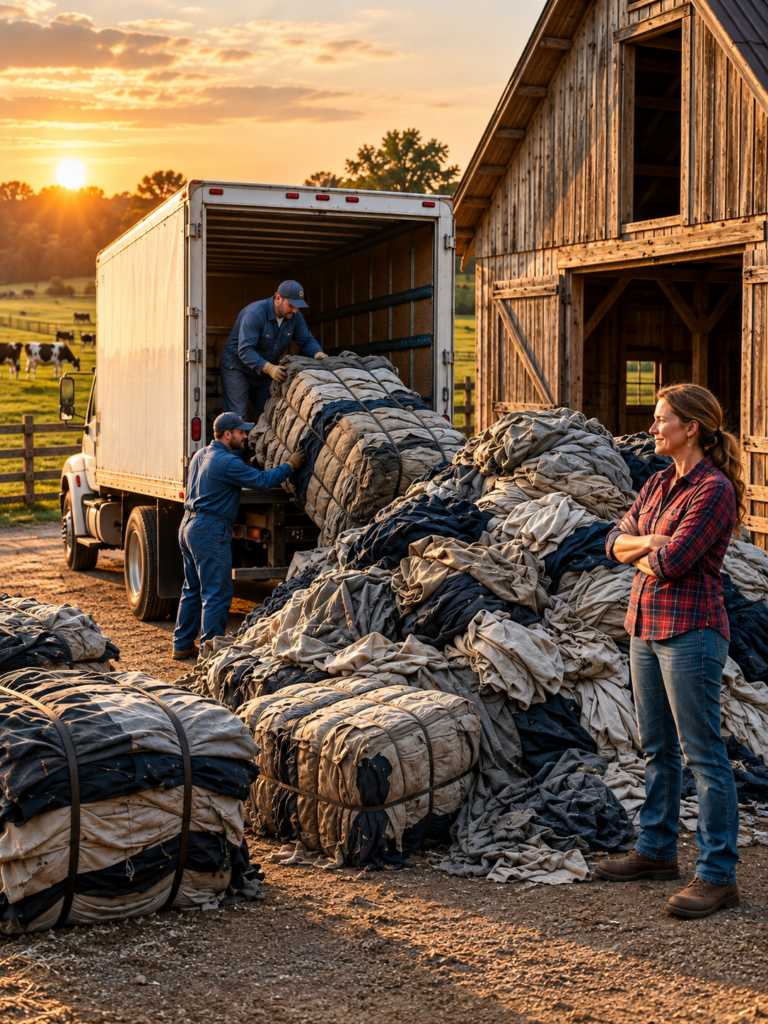
The trucks had been coming to her barn for eleven years.
They never brought anything a person would have mistaken for a valuable delivery. There were no carefully wrapped goods, no polished equipment, no expensive materials accompanied by invoices and guarantees. What arrived from the nearby cotton mill was what remained after everything considered useful had already been taken.
Fabric scraps.
Some were broad enough to cover a tabletop. Others were no wider than a person’s hand. There were crooked sections cut from the edges of larger pieces, narrow strips that twisted when lifted, faded lengths of cotton, and pieces with flaws that made them unsuitable for the mill’s regular orders.
The mill had no particular reason to keep them. Storing irregular fabric required space. Sorting it required labor. Finding a profitable use for every leftover piece would have consumed time that could be spent producing materials customers were already willing to buy.
The woman who lived beside the old barn saw the situation differently.
She had little money to spare, and she understood the value of anything that might save her from having to purchase something new. A length of cotton might not look like much, but it could still mend a torn household item, provide padding where something had worn thin, or become part of a simple project.
She had learned to be careful with what she owned. Replacing things was not always an option. Sometimes a repair was the only sensible answer.
And so she accepted the scraps.
At first, there was nothing remarkable about that decision.
She was not starting a company. She had no business name, no customers, and no plan to manufacture anything for sale. There was simply an old building behind her home with enough room to store material that might be useful someday.
The barn itself had seen better years.
Its wooden walls were weathered, their surfaces roughened by age. Light entered through thin spaces between the boards, falling in uneven bands across the interior. Near the entrance, the ground had been worn hard by years of footsteps and the occasional delivery truck.
Inside were the ordinary signs of a building that had served more than one purpose. Tools rested where they had last been needed. Boxes occupied corners. A work surface stood among the things she had saved.
And increasingly, there was cotton.
When the first bundles arrived, she had no trouble finding room.
She could set them aside, return to her usual work, and forget about them until a repair required fabric. If a particular piece was strong enough to patch something, she used it. If another seemed too thin for practical work, she might fold it away until she thought of a better purpose.
Some scraps were used quickly.
Others remained untouched.
Then another delivery came.
And another.
Over time, the bundles became stacks, and the stacks began to claim more of the barn.
It happened gradually enough that she could adjust to each small change. A box moved closer to the wall. A collection of fabric shifted from one surface to another. A pile that had once fit neatly in a corner spread farther across the floor.
There was no single morning when the barn suddenly became crowded.
It happened through accumulation.
One year passed, then several more.
The mill continued producing cotton fabric, and the leftovers continued arriving.
By the time eleven years had gone by, the interior of the barn looked very different from the place where she had first stored a few unwanted pieces.
There were sections of cotton folded over themselves, bundles of irregular shapes, and strips too narrow to stack properly. Colors appeared between old tools and storage boxes. The pieces varied in texture and thickness, from soft, loosely woven material to firm cotton that resisted being folded.
Walking across the floor often meant finding a path around the fabric.
Visitors looking through the doorway could see little reason for keeping so much of it.
Her neighbors noticed the growing collection.
From their perspective, it was easy to understand what was happening. The nearby mill had a disposal problem, and the woman with the old barn was accepting the material it no longer wanted.
There were only so many household repairs a person could make.
Only so much padding she might need.
Only so many small projects that could reasonably justify an entire building crowded with leftover cloth.
To someone passing by, the fabric looked like clutter.
She could understand why.
There were times when she stood inside the barn and saw the disorder herself. Pieces had become mixed together. A useful length of heavy cotton might be buried beneath lighter material. Finding a particular color or texture could require moving several bundles.
Yet even when the barn seemed crowded beyond good sense, she hesitated to throw the fabric away.
The material had already been made.
Somebody had grown the cotton, somebody had processed it, and machinery at the mill had turned it into cloth. Work and resources had gone into every piece before it had become a leftover.
She could not look at something still usable and regard it as worthless merely because it no longer suited the purpose for which it had been produced.
That was not a philosophy she had carefully developed.
It was simply how she lived.
When an item broke, she tried to repair it. When something remained from a project, she saved it if it might be useful again. When money was limited, she learned to see possibilities in things other people overlooked.
The habit shaped her days so quietly that she hardly recognized it as a skill.
But the barn was teaching her something.
Every time she handled a bundle, she became a little more familiar with the cotton.
At first, she had thought mostly about size.
Was a piece large enough to cover a worn area? Could she cut a usable patch from it? Would the shape be suitable for whatever small job she had in mind?
Gradually, she began noticing other differences.
Two pieces that looked nearly identical could behave differently in her hands. One might stretch slightly when pulled, while another barely moved. A soft piece could drape easily over an object, while a heavier one retained its shape.
Some cotton folded neatly.
Other pieces formed thick, awkward edges.
A tightly woven section could withstand more handling than another of similar thickness. A fabric that appeared attractive might turn out to be too weak for a repair expected to endure repeated use.
She began recognizing these characteristics by touch.
She could run a piece between her fingers and form a reasonable idea of what it might be good for. She could see that a long narrow strip might have uses that a broad square did not. She could separate a softer remnant from a sturdier one without needing to know where either had originally been cut.
None of this seemed particularly important at the time.
She was not studying textile manufacturing in a classroom. There was no instructor, no examination, and no certificate waiting at the end of her work.
She was simply becoming familiar with a material she encountered almost every day.
That familiarity would eventually become one of the most valuable things she owned.
But for years, she had no idea what it was preparing her to do.
The change began with a simple observation.
A useful object did not always need to be made from one large, perfect piece of fabric.
Sometimes several smaller pieces could serve the same purpose if they were joined correctly.
It was an idea that could easily have been overlooked.
She had spent years seeing the cotton as material for repairs, padding, and small household projects. Each piece had been useful according to what it could accomplish on its own.
Now she began considering what the pieces might accomplish together.
A bag came to mind.
It was an ordinary object, the sort of thing people used without giving much thought to its construction. A bag needed a body, something strong enough to support its contents, and handles that would remain secure when lifted.
It did not necessarily need perfectly matching fabric.
It did not need to be cut from a single uninterrupted length of cotton.
If smaller pieces could be arranged and joined properly, perhaps the material that had filled her barn for eleven years could become something people would actually carry.
The possibility interested her.
But it also exposed how much she still had to learn.
Knowing that a particular piece of cotton was strong was not the same as knowing how to turn it into a durable product.
A bag was only useful if it survived being used.
It had to endure the weight of whatever someone placed inside it. Its seams could not open when the material was pulled. Its handles had to bear repeated strain. Its shape had to remain practical, even when the finished object was no longer resting neatly on a table.
She would have to learn to sew with a level of care and consistency she had never needed before.
And that meant she would have to accept making mistakes.
She cleared a section of the old worktable.
For years, she had been accustomed to searching for whatever piece suited an immediate need. Now she began selecting fabric with a specific object in mind.
She laid out several pieces of cotton.
The first problem was obvious.
They did not match.
One was heavier than the others. Another was softer and more flexible. A third had a tighter weave but an inconvenient shape.
She turned the pieces, placed one beside another, and tried to imagine how they might fit together.
The barn was still crowded, and her equipment was modest. She had no industrial cutting surface, no production machinery capable of making identical pieces by the hundreds, and no experienced team to guide her.
There was the table.
There were the scissors.
There was the sewing machine.
And there was the cotton.
She began with simple shapes.
The first cuts demanded more attention than she had expected. A small mistake could leave an edge too short or a piece unsuitable for its intended position. Material that seemed large enough before cutting could suddenly become awkward when she tried to join it to another section.
She adjusted the pieces and tried again.
At the sewing machine, a different set of problems appeared.
The stitching had to hold fabrics of different thicknesses together. The edges had to meet properly. Seams that seemed straight while laid flat could become distorted when the material was lifted.
She worked carefully, often stopping to examine what she had made.
Eventually, she had something that resembled a bag.
It was a modest accomplishment, but it gave her reason to continue.
Then she tested it.
A seam that had seemed secure began to separate when the bag carried weight.
She examined the failed section.
The thread had held in one place and pulled loose in another. The fabric near the stitching had shifted in a way she had not anticipated.
The bag looked better on the table than it performed in her hands.
She could have set it aside and considered the experiment unsuccessful.
Instead, she began taking it apart.
That choice became central to everything that followed.
She learned more by examining a failed bag than she would have learned by looking at a successful one and assuming it would always remain strong.
The torn seam showed her where the construction needed reinforcement. The distorted shape showed her how two fabrics behaved when joined under strain. A handle that loosened revealed a weakness she could correct in the next attempt.
Failure gave her something specific to study.
So she studied it.
Another bag took shape.
This time she paid closer attention to the connection between the handles and the main body. She added material where she expected the greatest stress.
The bag held together better.
But another weakness became apparent.
She returned to the table, examined the construction, and changed it again.
Some attempts failed quickly.
Others survived the first test but developed problems after being used.
She learned that simply adding more fabric did not always make a handle stronger. The arrangement of the material mattered. Several carefully positioned layers could provide better reinforcement than one thick section assembled without thought.
She discovered that soft cotton could work well inside a bag but might not provide sufficient structure for its exterior. Heavier pieces could keep the body from collapsing, while thinner fabric could serve as lining.
Long strips could become useful components rather than inconvenient leftovers.
Even the smallest pieces deserved closer examination.
A narrow remnant that had seemed nearly worthless might provide exactly the reinforcement needed at a vulnerable point.
The more she learned, the less she viewed the fabric as a collection of interchangeable scraps.
Every piece had characteristics.
Every characteristic suggested a purpose.
The work was slow.
There were hours when little seemed to improve. She might finish an entire bag only to discover that its handles were uncomfortable, its sides were uneven, or its seams would not tolerate the weight they needed to carry.
Sometimes she had to undo work that had taken much of the day.
The sewing machine would fall silent while she turned a failed piece in her hands, looking for the reason it had disappointed her.
Then she would begin again.
Outside, the barn remained the same unremarkable building it had always been.
The weathered boards did not announce that anything important was happening inside. A passerby would have seen the familiar structure and the same woman working among the accumulated fabric.
But within those walls, the purpose of the cotton was changing.
It was no longer enough for a piece to be potentially useful.
She wanted to make something finished.
Something that would withstand ordinary wear.
Something another person could depend on.
Gradually, the failures became less frequent.
The stitching improved. The handles became stronger. She began anticipating problems before they appeared, recognizing when two fabrics were unlikely to work together or when a particular section needed another layer of support.
She could look at a design and understand more clearly where the strain would fall.
She could also recognize when a piece of cotton should not be used.
That judgment mattered as much as learning what to keep.
The woman who had once saved nearly everything was discovering that making a dependable product sometimes required rejecting material that did not meet her standards.
Her goal was no longer merely to prevent fabric from being discarded.
Her goal was to make something good.
Eventually, she finished a bag she felt comfortable using herself.
She carried it.
She put it through the ordinary demands that had exposed weaknesses in the earlier versions.
The handles remained attached.
The seams held.
The shape was practical.
For the first time, the cotton from the mill had become more than a repair material or a household convenience.
It had become a finished object with a purpose of its own.
She studied the bag with the knowledge of someone who understood how much imperfect work had preceded it.
There were still things she could improve.
There would always be things she could improve.
But this one worked.
And that was enough to introduce a question she had not yet answered.
She knew she could make a bag from the scraps.
She knew she could make it strong enough to use.
What she did not know was whether anyone else would consider it worth buying.
For eleven years, she had accepted material because another business did not want it.
Now she faced the possibility that someone might want what she had made.
And the difference between those two things would determine whether the old barn remained a place for storing leftovers—or became the beginning of something much larger.
Part 2
The first bags did not sell themselves.
She had spent so long thinking about their construction that it was easy to forget how they might appear to someone who had never seen the barn, the piles of cotton, or the mistakes that had come before.
To her, every finished bag represented a series of decisions.
She remembered which pieces had been difficult to cut, which seams needed extra attention, and how much work had gone into making the handles secure.
A customer would see none of that.
Someone encountering one of the bags for the first time would see only an unfamiliar handmade product, its exterior assembled from pieces of fabric that had never been intended to match.
There was no established brand to inspire confidence.
There was no expensive display or advertising campaign to explain why the bag deserved attention.
She had a few finished examples, a small amount of experience, and the hope that their usefulness would be apparent to someone besides herself.
At first, interest was limited.
The bags were different from the neatly manufactured items people were accustomed to seeing. One might contain sections of cotton with slightly different textures. Another might combine colors that had originally belonged to entirely separate production runs.
Their unusual appearance was part of their identity, but she could not be certain that anyone would regard it as an advantage.
She continued working.
After spending so much time learning how to sew the bags, stopping merely because there were no immediate buyers would have seemed premature.
She had already overcome problems that once looked discouraging. She had learned to correct weak seams and reshape handles that failed. She understood more about choosing the right fabric than she had when the first pieces arrived at her barn.
Finding someone willing to buy the result was another difficulty to work through.
Then, finally, someone wanted one.
The customer had no reason to know the history of the cotton.
They did not know that the mill had once considered the material an inconvenience. They did not know how many years the scraps had remained in the barn, or how many unsuccessful attempts had taught the woman which pieces could withstand repeated use.
They simply saw a bag they liked.
And they were willing to pay for it.
For a woman who had been surrounded by unwanted material for eleven years, the moment carried a weight far beyond the price of a single handmade item.
Until then, she had been the person assigning value to the scraps.
She believed they were useful. She believed there was a reason to save them. She had spent her own time proving they could become something functional.
Now another person had reached the same conclusion without sharing her history or her reasons.
A stranger to the work had looked at the finished product and judged it worth money.
The sale was small.
It did not transform her financial circumstances. It did not empty the barn or provide the resources needed to build a large operation.
She still had piles of irregular cotton, modest equipment, and more work than she could accomplish easily.
But the first sale established something important.
The value she saw in the material was no longer hers alone.
There was a market for what she could make.
Whether that market would grow was uncertain.
One customer could have been an exception. One sale did not prove that other people would appreciate the bags or that the labor required to produce them would ever be worthwhile.
She understood that she had a long way to go.
Still, the next time she sat at the sewing machine, the work felt different.
She was no longer simply trying to make an object that could survive being used.
She was making something another person might choose to own.
The distinction influenced her attention to detail.
A bag for herself could have an imperfect edge if it remained useful. She knew how it had been assembled and could repair it if necessary.
A bag sold to another person carried a different responsibility.
The buyer had trusted her work.
She wanted that trust to be justified.
So she continued checking the stitching, examining the joins between different materials, and reinforcing the sections she knew were most likely to experience strain.
More people began noticing the bags.
The interest did not arrive as a sudden flood of customers. It developed through individual encounters with the finished products.
Some people were attracted by the colors.
Others noticed the unusual combinations of fabric.
Because the cotton came from irregular mill leftovers, she could not manufacture the bags as identical copies. Even when she used the same general design, the available scraps made each finished piece different.
A section of patterned fabric might be large enough for one bag but too small for another.
A particular shade could disappear from her available materials for a time.
Two bags assembled according to the same basic construction might have noticeably different appearances.
At first, this variability had seemed like another obstacle.
Large manufacturers could purchase consistent fabric, cut repeated shapes, and produce goods that looked nearly identical.
She could not expect that level of visual uniformity from discarded scraps.
But customers did not necessarily consider the difference a defect.
Some liked having a bag that did not look exactly like every other bag they saw.
Others appreciated that the cotton had been saved from disposal.
And some were concerned less with the story or appearance than with whether the bag could carry their belongings without coming apart.
That final consideration was especially important to her.
A bag might attract attention because of its unusual fabric, but its usefulness determined whether the customer had made a good purchase.
She had spent too many hours examining torn seams to treat durability as a secondary matter.
The bags had to work.
As sales continued, she began learning from a new source.
For years, almost everything she understood had come from working directly with cotton.
She had learned what material could endure by pulling, folding, cutting, stitching, and testing it.
Now she needed to learn what buyers valued.
It was not enough to know how to make something.
She had to understand why people wanted it.
She noticed which designs drew attention and which remained overlooked. She paid attention to the difference between a bag that someone admired and one they actually purchased.
Those were not always the same thing.
A striking combination of fabric could encourage someone to look more closely without persuading them to buy.
A simpler bag might prove more desirable because its shape was practical and its construction dependable.
The responses were useful, but they were not always easy to interpret.
Every customer had different preferences.
She could not redesign her work to satisfy every opinion.
Instead, she began looking for patterns.
Which bags sold?
Which constructions worked best?
Which materials caused fewer difficulties?
How long did she spend making each design?
Which finished products seemed to justify the effort?
She started keeping simple records.
There was nothing elaborate about the process. She was not running a corporate accounting department, and she did not need a complicated system to understand what was happening inside her barn.
She needed reliable observations.
A design that repeatedly caused trouble deserved attention. A method that saved time without weakening the finished product was worth remembering.
If a particular fabric combination proved difficult to stitch, that knowledge could help her avoid the same problem later.
She began measuring her work in a way she had not done when she was making bags only for herself.
The change revealed an uncomfortable truth.
The cotton might cost her almost nothing, but the finished bags were not inexpensive to produce simply because the raw material had been discarded.
A piece of free fabric still had to be examined.
It had to be sorted, measured, cut, fitted, and sewn.
Thread had a cost.
Hardware had a cost.
Electricity, packaging, and the gradual wear of her tools all added to the expense.
Every mistake consumed material and time.
And above everything else was the labor.
Her labor.
She had been willing to spend hours repairing an imperfect bag while learning the craft. During those early experiments, the value came partly from understanding what had gone wrong.
But a business could not survive indefinitely if every product required more labor than its selling price could reasonably support.
That realization changed how she approached the worktable.
For the first time, she was forced to consider whether some of the bags she enjoyed making were sensible products to sell.
There were designs that attracted interest but required extensive preparation. Certain pieces of fabric looked appealing together yet demanded careful adjustment before they could be joined.
A complicated bag might require repeated changes in positioning, cutting, and assembly.
The finished result could be beautiful and useful.
But if producing it consumed too much time, selling more of that design might create more pressure without providing enough money to justify the work.
Other bags were easier to make.
Their shapes were more straightforward. Their fabric requirements were less demanding. The seams were easier to reinforce consistently.
Yet not every simple design attracted the same enthusiasm from customers.
She had to find a balance between what people wanted and what she could produce responsibly.
This was different from the challenge of learning to sew.
A weak handle could be repaired.
A poorly positioned seam could be unpicked and stitched again.
A design that was too costly to produce required a broader decision.
She might need to simplify the construction, change the arrangement of materials, or stop making a particular variation as frequently.
The goal was not to remove the individuality from the bags.
That individuality was one reason people noticed them.
The goal was to preserve what mattered while eliminating work that added expense without improving the finished product.
She made adjustments.
Some were small enough that a customer would never notice.
A more practical order of cutting reduced unnecessary handling. A simpler arrangement of pieces saved time at the sewing machine. Using a familiar construction made it easier to predict where reinforcement would be required.
Each improvement seemed modest.
Taken together, they began changing the pace of production.
The woman who had once spent long periods wondering whether two scraps could become a usable bag was now learning to recognize a suitable combination much more quickly.
She was becoming efficient without abandoning the careful work that had made the bags dependable.
But efficiency introduced another difficulty.
More people wanted what she made.
As demand increased, the limits of her small operation became harder to ignore.
She could sort only so much cotton in a day.
She could cut only so many pieces.
She could sew only as quickly as her equipment, energy, and standards allowed.
Every bag required several stages of work, and nearly all of those stages depended on her.
If she spent time sorting a difficult pile of scraps, that was time she could not spend sewing.
If a machine required attention, production slowed.
If a bag failed inspection and needed to be repaired, the next unfinished piece remained on the table.
Customers might see an attractive handmade item.
She saw the work required to make another one.
And another.
And another.
As the requests accumulated, she began to recognize that success could create its own problems.
It had once been difficult to imagine anyone wanting one of her bags.
Now she had to consider what would happen if she could not make enough of them.
The barn had never been designed for production on that scale.
For years, she had used it primarily as storage. The layout had grown around the arrival of more fabric rather than around the efficient manufacture of finished goods.
Cotton lay wherever she had found room.
The sewing machine occupied its place among the accumulated supplies.
Tools and materials were available, but finding and preparing them could interrupt the work repeatedly.
That inconvenience had been tolerable when she was making an occasional bag.
It became increasingly frustrating when more orders depended on her ability to finish products consistently.
She might know that she needed a heavier piece of cotton for the outside of a bag, yet still have to search through several stacks to find suitable material.
Then she needed something softer for the lining.
Then narrow strips for reinforcement.
The supplies were there, but they were not organized according to the work she was trying to accomplish.
As demand grew, the cost of that disorder became more apparent.
She could spend a considerable amount of time searching for fabric before making a single stitch.
The same barn that had helped her save money by storing free material was now beginning to consume valuable working time.
She understood that simply working harder would not solve the problem.
There were limits to how many hours one person could spend at a sewing machine. Rushing through construction might increase the number of bags completed in the short term, but it could also reintroduce the failures she had worked so hard to eliminate.
A weak seam would not become acceptable merely because a customer was waiting.
Neither would a poorly attached handle.
She had built the early reputation of her bags on their usefulness.
Sacrificing that reliability to meet demand would undermine the reason people wanted them in the first place.
So she began looking closely at the barn itself.
Not at the building’s walls or age, but at the way work happened inside it.
She started noticing how often she crossed the same area to retrieve different materials. How frequently she interrupted one task to begin another. How much of her time went into moving scraps rather than transforming them.
She realized that her working habits had developed in the same accidental way as the original piles of cotton.
One decision had followed another.
A tool had been placed where it was convenient at the time. A bundle had been stored where there was space. Finished bags had been set aside wherever they would remain out of the way.
Those habits had been reasonable when the barn was primarily a storage building.
They were no longer serving her well.
For years, she had learned to see the hidden usefulness of individual pieces of fabric.
Now she had to apply that same attention to the space around her.
She began by separating the cotton according to how it could be used.
The stronger pieces went together.
Softer material suitable for lining was placed in another area.
Long narrow scraps were saved where she could find them when preparing handles or reinforcing seams.
Pieces that could not meet her standards were no longer allowed to interfere with the search for usable material.
The change was not glamorous.
There was no dramatic announcement or impressive new machinery.
She was simply organizing what she already had.
Yet the effect was immediate in the ordinary rhythm of her work.
When she needed material for the main body of a bag, she knew where to begin looking.
When a design required lining, she could reach the appropriate group of fabric without searching the entire barn.
The cotton that had once formed a confusing collection of leftovers was becoming an inventory.
She could see how much usable material she had and which types were becoming scarce.
She could prepare the next stage of work without constantly retracing her steps.
And as the piles became more orderly, she began to understand something that had escaped her during the early years.
The value of the cotton was not created by saving it alone.
Saving it had given her the opportunity.
Learning to sew had allowed her to turn it into a product.
But making a dependable business from those products required another skill entirely.
She had to learn how to manage the work.
She stood in a building filled with evidence of eleven years of patience, years of experiments, and the first signs of growing demand.
The old barn had helped her get this far.
Now, if the business was going to continue growing, she would have to change the way she used it.
She had learned to transform scraps into bags.
The next challenge was transforming the making of those bags into a process she could sustain.
Part 3
The first real change inside the barn was not the arrival of new equipment.
It was the order in which she began doing things.
For years, she had approached each bag almost as a separate experiment. She would find suitable fabric, cut what she needed, stitch the pieces together, make adjustments, and finish the product before beginning the next one.
That method had worked when there were few customers and she was still developing her skills.
But repeated orders required more than individual craftsmanship.
They required consistency.
She began thinking about the entire journey of a piece of cotton, from the moment she selected it to the moment a finished bag was ready for a customer.
Instead of treating every task as something to handle whenever it became necessary, she organized the work into stages.
First came sorting.
Then cutting.
Then assembling the pieces into their intended shapes.
Next came sewing and reinforcing the construction.
Afterward, she examined the finished work, corrected anything that needed attention, and prepared the bags for sale.
The sequence was simple.
Its importance became apparent only when she began following it consistently.
She no longer had to interrupt sewing repeatedly to search for the right material. Fabric could be selected and prepared before she began assembling a bag.
She no longer needed to move unfinished products from one available surface to another without a clear purpose.
Each stage had a place.
The barn itself began to reflect the new way she thought about her work.
Where uneven piles of cotton had once occupied the floor, organized stacks became easier to manage. Tools were positioned according to their purpose. Materials awaiting preparation were kept separate from pieces already cut.
Finished bags had designated areas.
Thread, hardware, and packaging no longer competed for space among unidentified bundles of fabric.
A visitor looking inside might not have recognized how significant the changes were.
The building remained old.
Its boards were still weathered. Light still entered through the narrow openings in the walls. The work surfaces were practical rather than impressive.
There was nothing about the place that suggested a fashionable manufacturing facility.
But to the woman who had spent years working there, it had become an entirely different environment.
She could move from one task to the next with fewer interruptions.
She could recognize which materials were ready to use.
She could estimate more accurately how much work remained before a bag was finished.
The improvement did not eliminate the physical demands of production. She still had to handle the fabric, guide it through the machine, inspect the seams, and make sure each product met her standards.
But her time was being spent more effectively.
She had discovered that increasing production did not always require moving faster.
Sometimes it required eliminating the reasons work had been slow.
As the process became more dependable, she continued refining the bags themselves.
The lessons from her earliest failures remained important.
She had not forgotten the handles that tore loose when weight was added. She remembered how promising seams had opened and how certain fabric combinations had failed despite looking suitable on the table.
Those experiences had changed how she judged a finished product.
She no longer trusted appearance alone.
A beautiful section of cotton could not compensate for a weak construction.
A carefully arranged pattern meant little if the bag could not withstand ordinary use.
She inspected the vulnerable points with the attention of someone who knew exactly what could go wrong.
The handles needed secure connections.
The seams needed strength.
The edges needed proper finishing.
The chosen fabrics had to work together as part of the same object.
Every finished bag could look different, but every finished bag needed to meet the same basic expectations.
That principle helped her manage one of the most difficult features of the business.
Her raw materials were inconsistent.
Unlike a manufacturer purchasing large quantities of identical fabric, she worked with the leftovers available from the mill.
The size, texture, thickness, and color of those pieces varied.
She could not force them to become uniform.
Instead, she learned to build a consistent process around their differences.
She could choose a sturdy piece for the body without requiring every bag to have the same color.
She could select softer cotton for a lining without needing to use an identical pattern each time.
She could reinforce a handle according to the strength of the material rather than assuming that every strip behaved alike.
The design could accommodate variation.
The construction could remain dependable.
That distinction became one of the foundations of her work.
And it made possible something that had once seemed far beyond her circumstances.
She could produce bags repeatedly without having to solve every problem from the beginning.
The fabric still demanded judgment, but the process no longer depended entirely on improvisation.
She had accumulated enough experience to recognize difficulties before they became expensive failures.
A piece that would have taken her considerable time to evaluate years earlier could now be assessed almost immediately.
She could feel its weight.
Notice the weave.
Consider the strain it might tolerate.
Decide whether it belonged on the outside of a bag, inside it, or in a supporting section.
Those decisions had become familiar because she had made them so many times.
The eleven years of collecting cotton, followed by all the unsuccessful attempts at sewing, had provided an education no expensive piece of equipment could have replaced.
She knew her material.
And that knowledge helped the business continue growing.
Orders became more regular.
The growing demand confirmed that the first sale had not been an isolated event. More people were finding reasons to choose the bags, and more finished products were leaving the barn.
The name attached to her work began reaching people beyond those who knew the building where the bags were made.
For years, the cotton had arrived at the barn because it was unwanted.
Now the finished bags were drawing interest because people wanted to own them.
There was a certain quiet irony in that reversal.
The mill had considered the scraps too inconvenient to retain.
She had turned that inconvenience into the source of the bags’ individual character.
The irregular colors and patterns had once been a problem to manage. Now they helped distinguish one finished product from another.
A customer might choose a bag because of a particular combination of fabric that would never appear in exactly the same arrangement again.
Another might appreciate the idea that usable cotton had been given a second purpose instead of being thrown away.
Still another might care only that the bag was practical, strong, and worth the price.
She did not need every customer to be drawn by the same reason.
She needed the bags to fulfill the expectations they created.
And that continued to require discipline.
As demand increased, the number of orders sometimes exceeded what she could comfortably fulfill alone.
There was satisfaction in realizing that more people wanted her products than she had once imagined possible.
There was pressure in understanding that each order represented work still waiting to be completed.
She could not simply multiply her available hours.
The limitations of one person and one modest workshop remained real.
But she had already learned an important lesson from her earliest attempts.
Trying to conceal a weakness did not remove it.
When a seam failed, she examined it.
When a design consumed too much time, she reconsidered it.
When the barn became difficult to work in, she reorganized the space.
Growth had to be approached with that same practicality.
She continued looking for ways to make the process more efficient without compromising the finished product.
Sometimes the improvement came from preparing materials more carefully.
Sometimes it came from choosing a simpler design.
Sometimes it came from avoiding a fabric combination she knew would require more effort than the result justified.
There was no single dramatic breakthrough that solved every difficulty.
Instead, the business improved through countless small corrections.
One step became easier.
Another became more reliable.
A recurring mistake disappeared.
A useful method became part of the regular routine.
In the beginning, she had measured progress by whether a bag survived being lifted.
Later, she measured it by whether someone was willing to buy one.
Now she had to consider whether she could continue producing bags, satisfy customers, control costs, and preserve the quality that had made the business possible.
Those were different problems.
They required different kinds of thinking.
But each one grew naturally from the problem that came before it.
The barn was no longer simply the place where she kept material other people discarded.
It had become a working business.
A modest manufacturing operation built around resources that had once appeared to possess almost no commercial value.
The transformation had taken years, and most of the changes were too gradual to notice as they occurred.
A more dependable stitch did not look like the foundation of a company.
Neither did a better handle.
A shelf of sorted fabric hardly seemed important enough to remember.
Yet each improvement made the next one possible.
Over time, the effect became substantial enough to measure in money.
The business ultimately reached the $650,000 milestone.
It was a remarkable achievement for an operation that had begun with discarded cotton in an old barn.
And it was the kind of number people could understand immediately.
Six hundred and fifty thousand dollars.
A figure large enough to make the original piles of scraps seem almost unbelievable.
But money told only part of the story.
The number did not explain the years when she had no customers.
It did not describe the failed bags she had taken apart or the hours spent trying to understand why a handle would not remain secure.
It did not capture the frustration of finding a beautiful piece of cotton that was too weak for the purpose she had imagined.
Nor did it reveal how many times she had chosen to improve an ordinary detail rather than accept work she knew could be better.
Those were the things that had made the milestone possible.
Standing inside the organized barn, she could see evidence of how far the work had come.
The cotton was still there, but it no longer occupied the space in uncontrolled piles.
It had been sorted according to its usefulness.
Work surfaces served clear purposes.
Finished bags waited apart from the material that had not yet been prepared.
Tools and supplies were arranged around a process she understood.
The old building had not become valuable because its walls were new or its equipment extravagant.
It had become valuable because of what happened inside it.
She had transformed a habit into a skill.
A skill into a product.
A product into a business.
And the business had grown because she continued learning long after she had proved that the original idea could work.
There was no need to pretend the road had been effortless.
She knew too much about the work for that.
The cotton had required sorting even when it cost almost nothing. The bags had required time even when their materials were inexpensive. Every increase in demand had created pressure to produce more, and every attempt to improve efficiency had required judgment.
She had never discovered a way to make the work disappear.
What she had discovered was how to make the work worthwhile.
That achievement was quieter than the financial milestone, but perhaps more enduring.
She had become capable of looking at irregular pieces of cotton and understanding possibilities that most people would never notice.
Not because she possessed some extraordinary secret.
Not because she had been given an advantage unavailable to everyone else.
But because she had spent years paying attention.
She knew how cloth behaved under strain.
She knew which seams needed reinforcement.
She knew what customers expected from a useful bag.
She knew that inexpensive materials did not guarantee a profitable product.
And she knew that a workshop could produce more reliable results when the work inside it followed a thoughtful sequence.
None of that knowledge had arrived all at once.
It had been earned through repetition.
Through mistakes.
Through the discipline of examining what went wrong rather than hiding it or walking away.
In the beginning, the cotton mill had seen a disposal problem.
It had to remove material that no longer fit its regular production needs. The scraps occupied space, demanded handling, and offered too little apparent return to justify keeping them.
From the mill’s perspective, sending the material away was practical.
The woman had not proved the mill wrong about its own business.
She had simply found a different use for what its business could not conveniently retain.
That was the essential difference.
The same material could have little value in one operation and considerable value in another.
What mattered was not merely what the cotton was.
It was what someone knew how to do with it.
For eleven years, she had been gathering fabric without fully understanding where that habit might lead.
The years had appeared ordinary while she lived through them.
Another bundle delivered.
Another piece folded away.
Another repair completed.
Another small observation about the difference between one kind of cotton and another.
There had been no sign that these scattered moments were building toward a recognizable achievement.
Only later could she see how closely they were connected.
The early repairs had taught her to handle fabric carefully.
The accumulated scraps had given her material with which to experiment.
The first failed bags had taught her the importance of construction.
The first customer had shown her that someone else could recognize value in the finished work.
The growing number of orders had forced her to understand costs, production, and organization.
Every stage had prepared her for the next.
And every stage depended on what had come before.
Without the years of saving cotton, she might never have developed the same familiarity with the material.
Without the willingness to take apart a failed bag, she might never have learned to make a dependable one.
Without paying attention to her customers, she might have continued producing designs that satisfied her own preferences but did not support a sustainable business.
Without changing how the barn operated, increasing demand might have overwhelmed her ability to keep up.
The $650,000 milestone had many beginnings.
Most of them looked too ordinary to be remembered.
Years later, the old tools remained.
So did the cotton, the thread, and the familiar work of making bags.
The barn still carried traces of its earlier life. Its rough boards and modest surroundings had not lost their character merely because something valuable was being produced within them.
But the building no longer felt like a place where unwanted things accumulated.
It had become evidence of what sustained attention could accomplish.
The woman who once moved aside bundles of fabric to find room for another delivery could now look around a workshop organized for purposeful work.
She had learned not merely to preserve material but to understand it.
Not merely to create something once, but to create it again with reliable quality.
Not merely to sell a handmade object, but to consider the costs and responsibilities that made continued production possible.
There had been no moment when the scraps suddenly changed into valuable goods by themselves.
Their transformation required her hands, her judgment, and the experience that had accumulated through years of use.
She had supplied what the scraps lacked.
Purpose.
Skill.
A process.
And the determination to keep improving it.
The story might sound extraordinary to someone hearing only its beginning and end.
An old barn filled with discarded cotton.
A handmade bag business that eventually reached $650,000.
Between those two facts, however, lay years of unremarkable work.
Fabric being unfolded.
Scissors moving through cotton.
A sewing machine running across a seam.
A finished bag being turned over and inspected.
A mistake noticed.
A weakness corrected.
A customer listened to.
Another bag made better than the one before it.
That was where the real transformation occurred.
Not in a sudden discovery that the cotton had secretly been worth a fortune.
It had not.
The material was still irregular, imperfect, and inconvenient for the purpose the mill had originally intended.
Its value came from what she learned to make with it.
And perhaps that was why the old barn mattered so much.
It had given her room to keep things other people had finished with.
Then it had given her room to make mistakes.
Eventually, it gave her the space to turn those mistakes into experience and that experience into a business.
The same cotton that had once been regarded as an unwanted leftover became part of something customers deliberately chose.
The same woman who had begun by trying to save money on household repairs became someone capable of producing goods other people trusted.
And the same building that had spent years filling with scraps became a place where those scraps could leave as finished products.
The trucks had brought her material the mill no longer needed.
They had never delivered success.
That was something she had to build herself.
One piece of cotton at a time.
One stronger seam.
One better handle.
One finished bag.
Until the barn that had once held almost nothing of commercial value stood at the center of a business worth remembering.
And after all those years, the most important discovery was not that discarded cotton could become expensive.
It was that something other people had stopped seeing as useful could still become valuable in the hands of someone willing to learn what it could do.
The scraps had never been the end of the story.
They were only the beginning.

