
Part 1
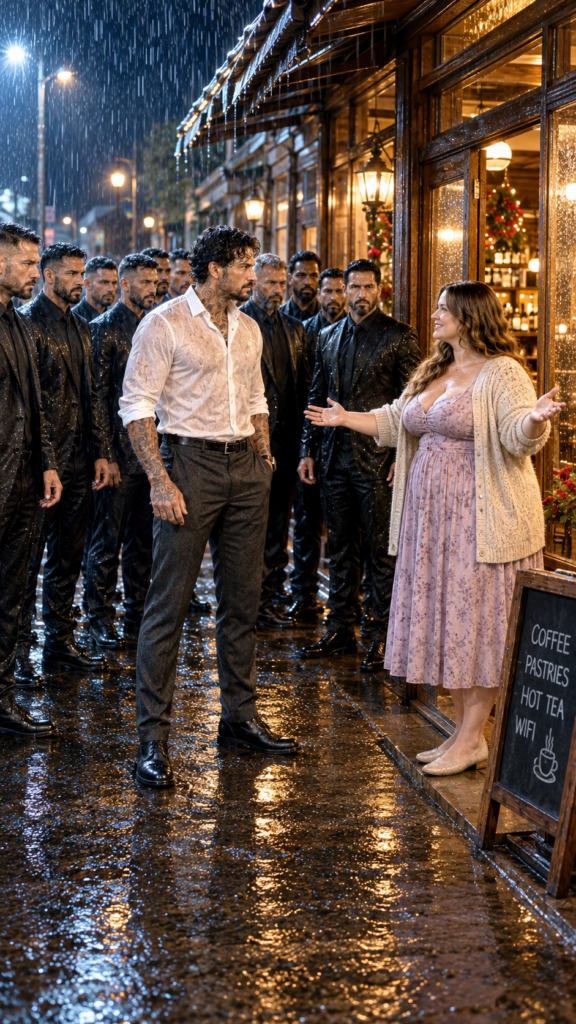
The first thing Oilia Whitaker noticed was that none of the strangers had come inside carrying an umbrella.
Sixteen figures stood beneath the merciless Chicago rain, their expensive dark clothing soaked through, water streaming from their hair and dripping onto the pavement outside her little café.
Behind them, three black SUVs sat uselessly in the flooded street.
At the center of the group stood a man who looked as if he had never needed to ask permission for anything in his life.
Dorian Ferrante was thirty-six years old, enormously wealthy, and powerful enough to make seasoned businessmen reconsider their words before speaking. Across Chicago, his surname carried the particular weight of a warning.
Two gas stations had already refused his convoy shelter. A diner had lowered its shutters when his men approached. Every illuminated storefront on the street had suddenly found a reason to close.
Now he was standing outside Pearl’s Corner, a struggling neighborhood café in Bridgeport, waiting for the woman behind its glass door to make the same decision.
Oilia had every reason to lock it.
Her seven-year-old daughter was asleep in the back room. There were forty-three dollars in the register, unpaid bills behind the counter, and a property developer threatening to take away the only business her grandmother had left her.
Instead, she opened the door wider.
“You’re freezing. All of you, come inside.”
Dorian studied her for a moment.
Then, with a slight movement of his head, he allowed his people to enter.
Oilia couldn’t have known that the man crossing her threshold had inherited an empire built on fear.
She certainly didn’t know that his family owed a debt to that very doorway—a debt almost fifty years old.
And she could never have imagined how much suffering, courage, and love it would take before that debt was finally repaid.
Only twenty minutes earlier, Oilia had been counting the day’s earnings for the second time.
Forty-three dollars.
She stared at the bills spread across the counter, hoping she had overlooked something. Perhaps two twenties had stuck together. Perhaps a deposit hadn’t been recorded.
But there was nothing more.
After opening before dawn and working until nine that evening, forty-three dollars was all that remained in the drawer.
The shop’s expenses hadn’t become smaller simply because business was slow.
The roof leaked. One heater had stopped working. A cracked front window was held together with clear tape.
And beneath the register sat a letter from Price Realty, notifying her that she had thirty days to accept an offer involving the building or face further proceedings.
The letter was accompanied by another demand from a debt collector.
Both were reminders of Wade Cutler.
Her former husband had left three years earlier, taking their savings and disappearing west with his truck. The debts he left behind had outlasted their marriage.
Oilia folded the bills into a worn cloth pouch.
Then she looked toward the back room.
Maisie lay curled on the old sofa, a mathematics workbook resting across her knees. Her pencil had slipped from her fingers halfway through an addition problem.
Oilia removed the book and pulled her coat over the child’s shoulders.
“Just a few more minutes, sweetheart,” she whispered.
Maisie didn’t stir.
She had grown up among the smells of roasted beans, warm bread, and dishwashing soap. The café was almost as familiar to her as their apartment four blocks away.
Before returning to the front, Oilia paused beneath a faded photograph of Grandma Pearl.
Her grandmother stood behind the original counter, smiling beside a magnificent brass coffee machine with curved pipes and a small eagle perched on top.
Below the photograph hung a blackboard.
In careful white lettering, it carried Pearl’s favorite words:
The measure of a person’s heart is how they treat someone who can never repay them.
Oilia traced a faint letter with her fingertip.
She had been nine when her mother died, and Grandma Pearl had taken her in. Everything Oilia knew about work, hospitality, and surviving an impossible day had been learned in that little café.
Now, with her hand reaching for the light switch, she heard engines approaching through the storm.
That was how the strangers came.
And that was how everything began.
Once inside, the visitors moved with an orderliness that made Oilia uneasy.
They didn’t rush toward the heater or seize the available chairs. Instead, they quietly distributed themselves through the room.
Several remained close to the windows.
One examined the rear entrance.
A huge, broad-shouldered man with a shaved head checked the locks and the basement door before taking a position near the front.
Their leader chose the corner table where he could see both exits.
Oilia had dealt with difficult customers, exhausted night-shift workers, and strangers who made her uncomfortable.
She had never served a group that behaved like this.
She overheard enough to understand their predicament.
Floodwater had disabled two SUVs. The remaining vehicle had suffered tire damage. Roads were blocked, and the southbound bridge was closed.
Hotels were apparently not an option.
She didn’t ask why.
Instead, she switched the coffee machine back on and retrieved a pot of chicken soup from the refrigerator.
“There isn’t much left,” she told them, “but I can warm it up. The coffee will be ready shortly.”
For a moment, nobody answered.
Then the man in the corner nodded.
Only afterward did the others begin thanking her.
A woman with neatly tied hair approached the kitchen.
“May I help?”
Her name was Petra, and she moved with the efficient confidence of someone accustomed to taking care of people under difficult circumstances.
Before Oilia could object, Petra was distributing bowls, examining a man’s injured hand, and ordering another to remove his wet coat.
The most chilled visitors ate first.
The strongest waited.
The youngest man, Toby, announced that the chicken soup was so good he might cry.
He was twenty-three, talkative, and apparently incapable of remaining dignified for longer than a minute. On his way to fetch bread, he struck his knee against a table, apologized to the furniture, then dropped his spoon.
His efforts to catch it made the others laugh.
The enormous man by the entrance offered no comment.
But when Oilia began collecting dirty dishes, he silently relieved her of the stack and carried everything to the sink.
He washed the plates, wiped the tables, and returned each sugar jar to its original position.
Toby stared.
“Since when does Bull clean tables?”
Without looking up, the giant replied, “My mother ran a diner for thirty years. When you finished eating, you cleaned.”
Toby immediately went to help.
Slowly, the strange gathering began to resemble something less frightening.
Not quite an ordinary group of travelers.
But human beings who were cold, hungry, tired, and relieved to have found somewhere warm.
Only Dorian remained apart.
He sat with an untouched cup of coffee, watching.
His attention moved over the café’s damaged window, the broken heater, the water stain spreading across the ceiling.
Then it settled on the Price Realty notice.
Oilia knew he had read it.
She could tell by the slight change in his expression.
Near midnight, she approached to refill his cup.
“Why did you let us in?” he asked.
She stopped.
His voice was quiet, controlled, and remarkably clear beneath the conversations around them.
“Other places turned us away,” he continued. “You saw that.”
“Yes.”
“Then why open your door?”
Oilia considered the question.
Not because the answer was difficult, but because she was surprised anyone needed to ask it.
“You were standing out in that weather,” she replied. “I couldn’t leave you there.”
Dorian waited.
He seemed to expect another sentence. A request, perhaps. A condition. Something that would turn her generosity into a transaction.
But Oilia merely refilled his coffee and returned to work.
For the first time that night, Dorian Ferrante looked genuinely uncertain of what to make of someone.
At eleven fifteen, the back-room door opened.
Maisie appeared wearing mismatched socks, her mother’s coat hanging crookedly from her shoulders.
Conversation died away as she examined the unfamiliar people filling her café.
“Mommy,” she asked, “did their cars break?”
Oilia hurried toward her.
“Yes, honey. They’re waiting for the roads to clear.”
Maisie accepted the explanation.
Then she noticed the empty dessert plates.
“Did you give them cookies?”
Before her mother could answer, she disappeared and returned carrying a metal tin of oatmeal cookies they had baked together.
She went around the room offering one to every guest.
Toby accepted his with the solemnity of a knight receiving an honor.
When she learned his full name was Tobias, Maisie declared that Tobias sounded like a wizard, while Toby sounded like a friendly dog.
Even Bull laughed.
Then she reached the corner table.
Dorian looked down at her.
Maisie held out the tin.
“There’s a big one and a small one. You can have the big one.”
He chose the smaller cookie.
She seemed pleased.
“What’s your name?”
“Dorian.”
“That’s a storybook name.”
He didn’t know how to respond.
She placed the remaining cookie beside his cup.
“Save that one for someone who didn’t get any.”
Then she returned to her mother, satisfied that everyone had been properly fed.
Dorian looked at the cookie for a long time.
Eventually he ate his own, wrapped the extra one carefully in a paper napkin, and placed it inside his jacket.
Across the room, Bull exchanged a glance with an elderly silver-haired man everyone respectfully called Mr. Aldo.
Neither spoke.
But both had witnessed something they were unlikely to forget.
Later, when Maisie fell asleep again beside the heater, one of the visitors quietly covered her with a dry coat.
And Dorian, who had spent his life surrounded by people anxious to please him, found himself thinking about a little girl who had given him the smaller share of something without expecting anything back.
At two in the morning, Mr. Aldo stood examining Grandma Pearl’s photograph.
He was sixty-eight, thin, silver-haired, and still carried himself with an unmistakable dignity.
“Who is she?” he asked as Oilia approached.
“My grandmother. Pearl Whitaker.”
His eyes remained fixed on the picture.
“And that machine?”
Oilia followed his gaze.
“The Victoria.”
She smiled faintly.
“Grandma had it shipped over from Italy. She said there was nothing else like it in Chicago when it arrived.”
“Where is it now?”
Oilia’s smile disappeared.
“I sold it.”
The older man turned toward her.
She had avoided telling that story for years. Yet something about the stillness of the café and the man’s patient attention made the truth easier to speak.
“Three years ago, Maisie needed emergency surgery. We had no insurance. My husband had left and taken everything we saved.”
She glanced toward the child sleeping beneath the borrowed coat.
“The hospital needed payment. The Victoria was the only thing I owned that could cover it.”
An antique collector named Harold Bishop had arrived with a white truck and men to carry the machine away.
Oilia remembered signing the papers while the men wrapped the brass pipes in gray blankets.
She remembered watching the truck disappear.
And she remembered returning to Maisie’s hospital room, terrified but grateful that her daughter was alive.
“Do you regret selling it?” Aldo asked.
“No.”
Her answer came immediately.
“If the same thing happened tomorrow, I’d sell it again.”
She looked toward the photograph.
“But my grandmother taught me to make coffee on that machine. Sometimes I think I can still hear it running.”
Her voice softened.
“I can know I made the right decision and still miss what it cost me.”
Aldo said nothing for several seconds.
He studied Pearl’s face once more.
His fingers curled briefly against his palm.
“Pearl,” he murmured.
The name seemed to carry a private memory.
Then he wished Oilia good night and returned to his chair.
Dorian had listened from the corner.
He noticed the old man’s reaction.
And he filed it away.
By morning, the storm had ended.
Tow trucks arrived, followed by replacement SUVs. Phones began ringing, and the visitors gathered their belongings.
Oilia boiled the remaining eggs and insisted that everyone take breakfast.
Nobody argued.
Petra squeezed her hand in gratitude. Toby promised Maisie he would be her first customer if she ever opened a cookie shop.
Bull folded the cleaning cloth and left it neatly beside the sink.
Finally, Dorian approached the counter.
He placed a thick bundle of cash in front of Oilia.
“For the food, the shelter, and everything you’ve done.”
She stared.
There was enough money to solve problems that had kept her awake for months.
She could repair the roof. Pay creditors. Perhaps even negotiate with the people threatening her building.
Her fingertips touched the bundle.
Then she pushed it back.
“I didn’t invite you inside because you could afford to pay.”
Dorian looked at the money.
“Your business needs repairs.”
“Then I’ll find a way to repair it.”
His expression remained unreadable.
She added, more gently, “You needed somewhere safe. I had somewhere safe. That’s all.”
Slowly, Dorian returned the cash to his jacket.
“Thank you.”
Two ordinary words, spoken with an unfamiliar gravity.
As the others left, Mr. Aldo stopped beneath Grandma Pearl’s photograph.
He read the blackboard.
Then he approached Dorian and whispered something Oilia couldn’t hear.
Dorian’s shoulders became still.
He glanced at the photograph, then toward the shop.
Finally, he gave Bull a small, deliberate nod.
Nobody explained what it meant.
The convoy departed.
Oilia watched the vehicles vanish around the corner and believed she had reached the end of the strangest night of her life.
She was wrong.
The following morning, three white trucks stood outside Pearl’s Corner.
Workers unloaded replacement windows, heating equipment, and building materials.
An older contractor approached with a clipboard.
“We’re here to replace the roof, repair the windows, install the heating, and repaint your sign.”
“There must be a mistake.”
He showed her the work order.
Her address. Her shop’s name.
Paid in full.
The instructions required the sign to be restored using Grandma Pearl’s original lettering.
Before Oilia could discover who had ordered the work, another delivery arrived.
Premium coffee beans.
Flour, milk, sugar, and other supplies.
The driver explained that six months of deliveries had already been prepaid.
Oilia examined the invoice.
The buyer’s name was absent.
But a message appeared at the bottom:
Payment for one bowl of soup.
She stood beside the delivery truck, holding the paper against her chest.
For the first time in months, she had to turn away because she couldn’t trust herself not to cry.
That afternoon, the building looked almost new.
The roof no longer leaked. Warm air flowed through the café. Sunlight reached the counter through flawless windows.
And when Oilia contacted Price Realty, she learned that the proceedings against her property had unexpectedly been suspended.
There was no new deadline.
No explanation.
Only a temporary hold.
She should have felt completely relieved.
Instead, she remembered the man whose money she had refused.
What frightened her wasn’t merely the size of his generosity.
It was the realization that someone could reach into her life and rearrange it without ever asking permission.
One week later, Dorian returned.
Alone, apart from a discreet driver waiting outside.
He ordered an espresso, paid in cash, and sat at the same corner table.
He read a newspaper for forty minutes.
Then he left.
Three days later, he came back.
After that, his visits became regular.
He never mentioned the repairs.
Oilia never thanked him directly.
They continued with the careful politeness of two people aware that a much larger conversation remained unfinished.
Gradually, she discovered who he was.
A local news report showed him attending a hearing concerning contracts at Chicago’s ports.
The name Ferrante appeared beneath his face.
Neighbors began watching the black sedan. Men who had once intimidated local shopkeepers disappeared from the street.
Oilia understood enough to become frightened.
She thought about asking Dorian to stop coming.
But he never behaved threateningly inside her café.
He ordered coffee, read his newspaper, and left without requesting anything.
Then Maisie took matters into her own hands.
One afternoon, frustrated by a division problem, she marched to the corner table with her workbook.
“Do you know how to divide numbers?”
Dorian lowered his newspaper.
“Usually.”
“Can you help me? Mommy’s busy.”
He pulled out a chair.
For the next twenty minutes, the man whose decisions affected an entire criminal empire sat arranging sugar cubes into small piles.
He didn’t give Maisie the answer.
He let her work it out.
When she finally understood, she raised both arms triumphantly.
Dorian responded with a solemn nod, as if she had successfully negotiated an important contract.
From that day forward, she called him Uncle Dorian.
And Oilia began watching him differently.
Not without fear.
But with a growing awareness that the man he became inside her café was not entirely the man the rest of Chicago knew.
Weeks later, Maisie presented him with a drawing.
It showed sixteen smiling figures beneath blue streaks of rain, gathered outside Pearl’s Corner.
Dorian identified himself among them.
Then he folded the drawing carefully and placed it in the same inner pocket where he had kept her cookie.
Oilia watched from behind the counter.
Something in her chest moved, quietly and dangerously.
The conversation they had avoided finally came on a Friday evening when Maisie was staying with a school friend.
After closing, Oilia sat opposite Dorian.
“What kind of man are you when you leave this place?”
He folded his newspaper.
For once, he didn’t attempt to hide behind silence.
“The kind people in this city are afraid of.”
“Are the stories true?”
“Some.”
“And the rest?”
“Depends on who’s telling them.”
She studied him.
“Was the money used to repair my shop clean?”
“The contractor was legitimate. He pays his taxes.”
“That’s not what I asked.”
“I know.”
His answer was quiet.
He wasn’t offering innocence.
And she wasn’t willing to mistake expensive repairs for moral goodness.
At last, she placed her palms flat against the table.
“Then we need an agreement.”
He waited.
“My daughter trusts you. So do I, more than I expected to. But whatever happens in your world cannot happen here.”
She gestured toward the windows, the photographs, the narrow room her grandmother had built around ordinary acts of kindness.
“No business from your world. No threats. No problems brought to my door. When you’re here, you’re the man who helps Maisie with her homework.”
She held his gaze.
“If you can’t keep that promise, you can’t come back.”
Dorian studied her for a long time.
For a man with so much power, agreeing to someone else’s rules did not come naturally.
But eventually, he nodded.
“Agreed.”
When he left that evening, Oilia remained seated beneath the photograph.
She knew that the man beyond the doorway was dangerous.
What she didn’t know was that somewhere else in Chicago, another dangerous man had already begun asking why Dorian Ferrante cared so much about a tiny café in Bridgeport.
And the answer would soon put everything Oilia loved in danger.
Part 2
For several weeks, Dorian honored his promise.
Inside Pearl’s Corner, he remained a quiet customer.
Outside it, his men continued handling the responsibilities of the Ferrante empire: port disputes, financial reports, territorial disagreements, and the endless calculations required to keep a powerful family powerful.
But something had changed.
For the first time, Dorian found himself arranging his afternoons around a place that couldn’t possibly increase his wealth or influence.
He had inherited office towers, valuable properties, fleets of vehicles, and businesses across the city.
Yet none of them offered what he found in that small room.
At Pearl’s Corner, nobody needed him to command anything.
Maisie expected help with mathematics.
Oilia expected him to respect her rules.
And sometimes, simply sitting beside a window with an espresso felt more valuable than owning the entire building.
Then, one evening, Mr. Aldo accompanied him to the café.
The old man had barely spoken to Oilia since the storm.
Now he requested tea and asked her to sit with them beneath Grandma Pearl’s photograph.
“I have something to tell you,” he began.
His expression was unusually grave.
“That night when I asked about your grandmother, I already knew who she was.”
Oilia looked toward Dorian.
He offered no explanation.
Aldo folded his hands.
“Fifty years ago, I was eighteen. Dorian’s father was twenty.”
He described a winter night in Bridgeport, bitter enough to turn the streets into sheets of ice.
Two young men had been running for their lives.
They owed money to people who had no intention of negotiating. One had been struck across the forehead with an iron club, and the other was half-carrying him through the streets.
Every door they approached remained shut.
Except one.
A young woman opened a small coffee shop and dragged them inside.
She locked the door, turned off the front lights, and hid them while their pursuers ran past.
Then she cleaned their wounds, bandaged the bleeding young man’s forehead, and heated two bowls of soup.
She never asked their names.
At daybreak, she gave each a loaf of bread.
And before sending them out through the back entrance, she told them to live decent lives.
Aldo looked at Oilia.
“I was the injured one. The man carrying me was Dorian’s father.”
Oilia couldn’t speak.
Her gaze moved toward the photograph.
Grandma Pearl had never told her that story.
Dorian leaned forward.
“My father told me about that woman once, when I was ten. He made me promise that if I ever found the place, I’d remember what she did.”
He glanced at Aldo.
“The morning we left, he recognized her photograph.”
Oilia remembered the old man whispering to Dorian before the convoy departed.
Now she understood.
Aldo spoke gently.
“Your grandmother saved us fifty years ago. You gave us shelter during the storm. The same family opened the same door, without asking who we were or what we could offer.”
Oilia stood and approached the photograph.
For years she had thought her grandmother’s lessons survived only in the work she did every day.
Now she understood that an ordinary decision made long before she was born had traveled through another family’s history.
And returned.
But the revelation also unsettled her.
Dorian’s generosity had been tied to a debt she hadn’t known existed.
She turned toward him.
“Is that why you keep coming here?”
He considered his answer carefully.
“It’s why I understood what this place meant to my father.”
“And now?”
His eyes met hers.
“Now I come because I want to.”
She looked away before he could see how much those words affected her.
Seven and a half miles away, Gordon Price sat in an expensive office overlooking the Chicago River.
He had spent nine months trying to acquire properties along Oilia’s block.
The public explanation was redevelopment.
The real purpose was something far uglier.
Price was purchasing buildings for Vadim Orlov, a forty-eight-year-old criminal financier who had built a lucrative operation around Chicago’s ports.
Orlov wanted aging shops, laundromats, restaurants, and other small businesses that handled regular streams of cash.
With enough properties, and enough companies placed between himself and the transactions, he could disguise illicit port revenue as legitimate income.
Pearl’s Corner was the last missing property in the row.
The owner had refused every offer.
Then the Ferrante name appeared.
Price reported that proceedings against the café had been suspended because nobody wanted to risk Dorian Ferrante’s displeasure.
Orlov listened without interruption.
For years, he had searched for a weakness in Dorian’s defenses.
The man rarely indulged himself, avoided obvious personal scandals, and kept his emotions carefully hidden.
Yet now, according to Price, he was protecting a tiny coffee shop with extraordinary determination.
Orlov smiled.
The building itself no longer interested him as much as it had.
What interested him was the woman inside it.
If Dorian cared about her, she could become something far more valuable than another property.
A way to hurt him.
A way to make him hesitate.
Orlov decided to send a message.
At 3:17 on a Tuesday morning, a fire alarm began screaming in the building beside Pearl’s Corner.
By the time firefighters arrived, flames had already spread through the café’s rear kitchen.
At 4:10, Oilia’s telephone rang.
She barely understood the laundromat owner’s frantic words.
Fire.
Your shop.
Come quickly.
She left Maisie with a trusted downstairs neighbor, telling her daughter only that something needed her attention at work.
Then she drove through the nearly empty streets.
The firefighters had contained the blaze.
The front room survived.
But the kitchen—the place where Pearl had once fed people who couldn’t afford their next meal—was blackened and half-destroyed.
A fire commander explained that investigators had found indications of an accelerant.
Oilia understood the implication.
Someone had done this deliberately.
After the emergency crews left, she entered the damaged café.
The new windows were intact.
The recently repaired roof remained overhead.
But the rear shelves had twisted in the heat, the stove was ruined, and dirty water covered the floor.
She stopped beneath her grandmother’s photograph.
The glass was coated in soot.
With the sleeve of her coat, she began cleaning it.
Slowly, she uncovered Pearl’s face.
Then the brass machine in the photograph.
And finally, the familiar smile.
She continued wiping long after the glass was clean.
Her knees gave way.
For years she had held herself together through abandonment, debt, illness, and uncertainty.
Now, alone on the wet floor, she wept.
Not only for the shop.
For the exhaustion of having to save it over and over.
At seven, Dorian arrived.
He entered quietly, his gaze traveling over the damage.
Oilia rose from the floor and faced him.
“This wasn’t an accident.”
“No.”
“Then somebody did it on purpose.”
Dorian looked toward the burned kitchen.
“Because of me.”
She waited.
“They didn’t attack this place because of anything you’ve done,” he said. “They attacked it because I care about it.”
His words came slowly.
“I promised your world wouldn’t have to pay for mine. I broke that promise.”
“You didn’t set the fire.”
“But I gave them a reason to choose this building.”
She could see that his decision had already been made.
“I can’t keep coming here, Oilia. Not while my presence puts you and Maisie at risk.”
She stepped forward.
“You don’t get to make every decision for us.”
His expression shifted.
But he didn’t move closer.
“I won’t come back.”
“Dorian—”
“I’m sorry.”
He turned and left before she could say anything else.
Oilia stood among the wreckage, furious with him for leaving and even more furious with herself for wanting him to stay.
For a long time she had feared becoming dependent on a powerful man.
Now she understood that losing his company hurt in a way his money never could have repaired.
Pearl’s Corner closed.
Oilia found work at a bakery six blocks from her apartment.
Every evening, after collecting Maisie from school, she completed insurance forms, compared building estimates, and applied for loans.
The insurance settlement was delayed by the unresolved investigation.
She told Maisie that the kitchen had been damaged and needed repairs.
Her daughter accepted the explanation.
But one evening, while eating dinner, Maisie asked, “When is Uncle Dorian coming back?”
Oilia stared at her plate.
“I don’t know, sweetheart.”
“Is he mad at us?”
“No.”
“Then why doesn’t he visit?”
Oilia couldn’t find a truthful answer that wouldn’t burden her daughter with things no child should have to understand.
“He has some important things to take care of.”
Maisie nodded and returned to her meal.
She didn’t ask again.
That silence hurt more than the question.
Unknown to them, Dorian sometimes parked his black sedan across from the dark café late at night.
He never got out.
He sat looking at the closed door while the drawing Maisie had given him remained folded inside his jacket.
He had decided that removing himself from their lives was the safest choice.
But he had not decided to abandon them to the man who had ordered the fire.
In the world beyond Bridgeport, he began gathering evidence against Orlov.
And he chose to fight this battle with documents and witnesses rather than violence.
Near the end of the month, Oilia made her own decision.
She sold her car.
It was the last valuable possession she could spare, and watching a stranger drive away in it felt like giving up another piece of stability.
But she took the money and her handwritten business plan to a community bank on Thirty-Fifth Street.
She brought years of sales records, expense figures, and proof that the café had been serving Bridgeport for decades.
After a long meeting, the bank approved a small loan.
Nothing extraordinary.
Nothing that would make the papers.
Just a fair loan carrying her own name and a repayment schedule she believed she could meet.
The money would cover basic kitchen equipment and materials.
Not labor.
She decided to do whatever repairs she could manage herself.
On the first Saturday, she arrived carrying paint buckets and a secondhand wall scraper.
An elderly electrician was already waiting by the entrance.
He held up his toolbox.
“I heard your kitchen needs wiring.”
“I can’t afford—”
“Good thing I’m not charging.”
By midday, the couple who owned the nearby auto repair shop had arrived with a floor sander.
A college student brought three friends to paint.
The laundromat owner appeared carrying a huge pot of stew and announced that nobody was working without lunch.
For two weeks, the neighborhood rebuilt Pearl’s Corner.
People who had borrowed money from Oilia, received free coffee during hard times, or simply found somewhere warm when they needed it came forward.
The electrician told her that Grandma Pearl had fed him on credit during a winter when he was unemployed.
He considered the repairs an overdue payment.
Oilia began to understand something that no bank statement had ever shown her.
Her grandmother had left her more than a building.
She had left her a place in the lives of people who remembered what kindness felt like when they had needed it most.
When Pearl’s Corner reopened, Maisie wrote WE’RE BACK in colored chalk on the board outside.
The kitchen was smaller.
The equipment was modest.
A faint dark patch remained visible beneath the paint in one corner.
But the café belonged to Oilia.
Its repairs had been funded with a legitimate loan, the sale of her car, her own labor, and the generosity of neighbors who wanted nothing in return.
For the first time in years, she looked around her shop without feeling that a powerful stranger owned some invisible part of it.
The work was hers.
The choices were hers.
And the door was still open.
Then Gordon Price appeared across the street.
Oilia recognized him immediately from the property correspondence.
He stood on the opposite sidewalk in an expensive wool coat, examining the shop’s new sign and crowded windows.
He didn’t approach.
He merely checked his watch and walked away.
Three days later, on a quiet Tuesday afternoon, three unfamiliar men entered Pearl’s Corner.
Two remained near the front entrance.
One flipped the sign to CLOSED.
The third approached Oilia.
He wore a tailored coat and expensive leather gloves.
His pale eyes moved around the room with the detached assessment of someone deciding how much a property was worth.
Oilia knew who he was before he spoke.
Vadim Orlov.
He placed a blue-covered agreement on the counter.
Beside it, he set a black fountain pen.
“One and a half times market value,” he said. “You sign today. The money is transferred today.”
Oilia didn’t touch the documents.
“The café isn’t for sale.”
Orlov regarded her with faint amusement.
“Everything has a price.”
“Not this.”
His eyes moved toward the rear of the café.
“The last fire damaged only the kitchen.”
Cold fear moved through her.
He leaned closer.
“Next time, perhaps it will be the whole building.”
Oilia thought of Maisie.
Of the neighbors who had spent two weeks helping her rebuild.
Of every morning her grandmother had stood behind that counter before her.
Her hands trembled beneath the counter where Orlov couldn’t see them.
But she lifted her chin.
“My grandmother once hid people here when they were being hunted.”
Orlov’s expression hardened.
“That is not my concern.”
“Then you don’t understand this place.”
She pushed the agreement away.
“I won’t surrender it to the man doing the hunting.”
For the first time, he stopped smiling.
And at that exact moment, the rear door opened.
Part 3
Dorian Ferrante entered through the rear doorway.
Bull followed two steps behind him.
The two men stationed near the entrance stiffened. One moved his hand toward his coat, then stopped when Bull looked in his direction.
Dorian’s attention remained on Orlov.
He approached the counter with the measured calm Oilia remembered from the stormy night.
In his hand was a thick gray file.
He placed it beside the blue property agreement.
“Open it, Vadim.”
Orlov didn’t move immediately.
Then he lifted the cover.
He read the first page.
Then the second.
His expression changed.
Dorian watched him without satisfaction.
“Nine months of purchases through Gordon Price. Three layers of shell companies. Port revenue disguised as income from neighborhood businesses.”
He tapped the file.
“Every relevant signature is documented.”
Orlov looked up.
“Where did you get this?”
“The originals are secured. Copies reached the FBI’s Chicago office at six this morning.”
Dorian paused.
“And Price is cooperating.”
For the first time, Orlov seemed to have difficulty finding words.
The threat he had brought into the café was now facing something he couldn’t intimidate into silence.
Evidence.
Witnesses.
Federal investigators.
Dorian leaned slightly closer.
“You could have kept this between us. Instead, you burned a woman’s business and threatened to do it again.”
Orlov’s eyes flickered toward Oilia.
Dorian’s voice became quieter.
“If you touch this shop again, the evidence waiting for the prosecutors will be the least of your problems. You’ll spend the next twenty years wondering which decision put you in prison.”
Orlov closed the file.
He stood still for several seconds.
Then he gathered his agreement and fountain pen.
Without another word to Oilia, he turned toward the front entrance.
His men followed.
The bell rang as the door shut behind them.
Oilia watched their car disappear.
Only then did she realize that her legs were trembling.
She steadied herself against the counter.
Dorian remained where he was.
He didn’t embrace her.
Didn’t claim credit for saving the café.
Didn’t step any closer than she had invited him to.
“Are you all right?” he asked.
Oilia looked at him.
“You never really went away, did you?”
He gave the smallest nod.
There were a hundred things she wanted to ask.
How long had he known about Orlov? How had he persuaded Price to cooperate? Why had he decided to fight someone like that without resorting to the violence his reputation suggested?
But she also saw that he had not come back seeking forgiveness.
He had come because a dangerous man was threatening her.
And he had done what was necessary to stop him.
Dorian turned toward the rear door.
Bull followed.
Then both were gone.
Two weeks later, the nine o’clock news carried footage of federal vehicles surrounding an office near the Chicago River and warehouses close to the port.
Gordon Price, fifty-five, and Vadim Orlov, forty-eight, were among those accused in a major money-laundering investigation.
The report described shell companies, falsified business transactions, and financial records collected over several months.
Additional arrests were expected.
Oilia sat motionless in front of the television.
In the next room, Maisie was reading a comic book.
For the first time since the fire, Oilia felt something release inside her chest.
The men who had threatened her café were facing consequences that couldn’t be settled with intimidation or a larger payment.
And not a single gunshot had been fired inside Pearl’s Corner.
Around Bridgeport, people talked about the investigation for weeks.
But the café continued operating.
Customers returned.
Maisie added the word FOREVER beneath her earlier chalkboard announcement.
And the corner table remained empty.
Dorian didn’t come back.
Not because he had stopped caring.
Because he believed he had not yet earned the right to return.
Across the city, he was doing something his father’s oldest associates had never expected.
He was changing the Ferrante empire.
He sold businesses whose income could never be separated from criminal activity.
He restructured others into legitimate companies, with recorded transactions, accountants, and taxes paid openly.
The decisions cost him money, influence, and relationships with men who had served his father for decades.
Some advisers protested.
Others warned that abandoning old arrangements would make the family vulnerable.
Dorian listened.
Then he signed the necessary documents anyway.
When Bull asked whether he was certain, Dorian gave him an answer that settled the discussion.
“I won’t bring that life into her shop again.”
He understood now that protecting someone wasn’t the same as placing them under his control.
Oilia had rebuilt her café without asking him for a rescue.
He wanted to become a man who could walk through her door without bringing another disaster behind him.
But before that could happen, there was one final task he had begun months earlier.
One that even Oilia knew nothing about.
The morning after the storm, when Mr. Aldo had whispered the truth about Grandma Pearl into Dorian’s ear, Dorian had given Bull a quiet order.
Find the Victoria.
The antique brass coffee machine Oilia had sold to pay for Maisie’s surgery.
Bull began with Harold Bishop, the collector who had purchased it three years before.
Bishop lived in a mansion north of Chicago.
Unfortunately, he no longer owned the machine.
It had been included in an auction lot sent to Milwaukee eighteen months earlier.
The investigation became unexpectedly complicated.
There were handwritten invoices that could barely be read, missing sales records, and dealers who couldn’t remember where an item had gone.
The trail crossed three states and broke into nine dead ends.
Bull kept looking.
Eventually Toby joined the search.
On a rainy day months later, the young man drove six hours to a closed auction house outside Milwaukee.
He persuaded an elderly manager to let him inspect the basement archive.
For two days, he sorted through boxes of old receipts.
At last, he found a record describing an Italian brass coffee machine, heavily damaged, sold to a private restoration workshop.
The address was in Seattle.
The workshop belonged to Gus Barlo.
When Toby telephoned, the old restorer listened to the description.
Curved brass pipes.
A small eagle at the top.
An unusual old machine named Victoria.
There was a long silence.
Then the man asked him to hold the line.
A storage door opened somewhere in the background.
When Barlo returned, his voice had changed.
“I believe I’ve got your machine.”
On a busy Saturday morning, a faded blue truck stopped outside Pearl’s Corner.
Oilia was cleaning the counter when she noticed Toby climbing out of the passenger seat.
He waved enthusiastically.
Beside him, an elderly man in a plaid shirt stepped down from the driver’s seat.
Oilia hurried outside.
“Toby?”
“Hello, Mrs. Whitaker!”
“What are you doing here?”
The old man extended his hand.
“Gus Barlo. I’m a restorer from Seattle.”
He glanced toward the back of the truck.
“I’ve brought something I think belongs here.”
Toby opened the rear doors.
Inside stood a tall object secured with straps and covered in gray blankets.
Together, they carefully lowered it onto the sidewalk.
Oilia watched without understanding.
Then Gus removed the final blanket.
And her world seemed to stop.
The Victoria stood before her.
Its polished brass shone beneath the Chicago sunlight.
The curved pipes were exactly as she remembered them.
The little eagle still spread its wings at the top.
For three years, she had carried the memory of the machine being driven away because there had been no other way to save her daughter.
Now it had returned.
Oilia reached toward it.
Her fingers stopped just before touching the metal.
Gus pointed toward a long, faint scratch near the handle.
“I repaired everything necessary to make her work again,” he explained. “But I left that mark. She’s old enough to deserve her own history.”
He had purchased the damaged machine in Milwaukee and spent months restoring it.
The work had been completed long before Toby found him.
Yet Gus had never brought himself to sell it.
He handed Oilia an envelope.
Inside was a handwritten letter explaining the long search.
It described the collector, the auction, the missing paperwork, the journey across three states, and the young man who had spent two days searching through dusty receipts.
It explained how the effort had begun with a single quiet instruction given on a rainy morning in Chicago.
No names appeared.
Oilia didn’t need them.
She lowered the letter.
Her eyes filled with tears.
Around her, customers had gathered on the sidewalk.
Maisie stood beside the Victoria, staring at the beautiful machine she had known only from the photograph.
Then the little girl looked across the street.
“Uncle Dorian!”
Oilia turned.
Dorian stood outside, beside the place where his sedan had been parked.
He wore a charcoal-gray suit.
He had crossed the street but stopped just short of the café entrance.
For a man who had once commanded doors to open everywhere he went, he looked strangely uncertain.
Maisie ran toward him.
She seized his hand with both of hers.
“Why are you standing out here? Come inside! Mommy’s going to make coffee with Great-Grandma Pearl’s machine!”
Dorian looked toward Oilia.
She stood beside the Victoria, holding Gus’s letter.
For several seconds neither moved.
Then she stepped aside from the doorway.
And Dorian followed Maisie inside.
The restored Victoria was placed beneath Grandma Pearl’s photograph.
Oilia approached it slowly.
She knew exactly what to do.
Her grandmother had taught her each movement when she was still a child.
She measured the freshly ground coffee, pressed it into the portafilter, secured it, and adjusted the controls.
Steam escaped through the curved brass pipes.
The familiar sound filled the café.
Oilia closed her eyes briefly.
She could almost hear her grandmother giving instructions over her shoulder.
Then the first espresso in three years flowed from the Victoria into a white cup.
Oilia carried it to Dorian.
He stared at the cup before looking up at her.
“I didn’t bring it back because I wanted anything from you,” he said.
“I know.”
“I wanted it to be where it belongs.”
She set the cup down.
“Dorian, I never expected you to be perfect.”
His eyes remained on hers.
“But I needed to know whether you could leave behind the things that made me afraid for Maisie.”
He told her about the businesses he had sold, the companies he was restructuring, and the changes he intended to continue making.
He didn’t pretend every decision was easy.
He didn’t claim his past had been erased.
He simply explained what he was doing to build a different future.
“My father owed this shop his life,” he said. “I want to honor that debt by living mine differently.”
Oilia studied him.
She had known powerful men who believed kindness gave them ownership over other people.
Dorian had begun that way too, trying to solve her problems with money and invisible protection.
But when she had demanded boundaries, he had respected them.
When violence threatened her, he had found a legal way to stop it.
And when she rebuilt her own café, he had allowed the achievement to belong to her.
Now he stood before her without demanding a reward.
Oilia moved the espresso cup closer to him.
“You’d better drink that before it gets cold.”
Dorian smiled.
It was small, almost unfamiliar on his face.
He lifted the cup.
And when he tasted the coffee, he closed his eyes for a moment.
For the first time in years, Dorian Ferrante had somewhere he wanted to remain when there was no work left to do.
One year later, on a Saturday afternoon in early autumn, Pearl’s Corner was filled with customers.
The Victoria stood proudly beneath Grandma Pearl’s newly framed photograph.
Its brass surface gleamed, and steam rose around the little eagle as Oilia worked.
The blackboard still displayed Pearl’s favorite words.
Maisie, now eight, had begun helping her mother retrace the chalk lettering whenever it faded.
The café was thriving.
The street outside had changed too.
The man in the charcoal-gray suit had become such a familiar presence that the neighborhood no longer spoke his surname with apprehension.
He was simply Dorian.
The man who drank espresso at the corner table.
The man who helped a little girl with her mathematics.
The man who was clearly in love with the woman behind the counter.
People had begun calling him Oilia’s future husband.
Though no one had actually seen him propose.
Not yet.
Near closing time that Saturday, the last customers departed.
Only three people remained.
Oilia was polishing the Victoria with a soft cloth.
Maisie sat on a stool completing her homework.
Dorian rose from his corner table.
He walked toward the counter and placed a small open box on the wood.
Inside was a ring.
It was beautiful, but far simpler than anything people might have expected from someone bearing the Ferrante name.
Oilia stared at it.
Dorian didn’t immediately turn toward her.
Instead, he faced Maisie.
The little girl looked up from her workbook.
“Maisie,” he said seriously, “may I have your permission to stay on the inside of this door forever?”
Maisie considered the question.
She looked at the ring.
Then at her mother.
Finally, she nodded with the gravity of someone approving an important contract.
“Yes. But you still have to teach me math.”
Dorian’s expression softened.
“I promise.”
Then he turned toward Oilia.
He didn’t need to say anything more.
She had already set down the polishing cloth.
Already stepped around the counter.
And as she wrapped her arms around him, she gave him her answer.
“Yes.”
Dorian held her close.
For a man who had spent much of his life believing love could be earned by providing safety, wealth, or power, the simplicity of that moment meant more than any fortune.
Oilia hadn’t chosen him because he was powerful.
She had chosen the man who had learned to respect a door that wasn’t his to command.
And Dorian hadn’t fallen in love with her because she needed saving.
He loved the woman who had opened that door when everybody else closed theirs, then proved she had the courage to keep it open on her own terms.
That evening, the three of them closed Pearl’s Corner together.
They cleaned the tables, checked the kitchen, wiped the counters, and switched off the lights in the order Grandma Pearl had established decades earlier.
Maisie insisted on helping.
Dorian checked the back door.
Oilia switched off the coffee machine.
Finally, they stood beneath the photograph of the woman who had started everything.
Beside it, the brass Victoria reflected the final warm light.
And below, the blackboard carried the same words it always had:
The measure of a person’s heart is how they treat someone who can never repay them.
Fifty years earlier, Pearl had opened her door to two frightened young men.
One grew up to become Dorian’s father.
And many years later, on a stormy Chicago night, Pearl’s granddaughter opened that same door to a stranded convoy.
Neither woman had known whom she was helping.
Neither had asked what she might receive in return.
Yet the kindness of one generation had reached into another, surviving loss, violence, and time.
Now Oilia turned the final light off.
Dorian took her hand.
Maisie slipped between them.
And together, they stepped onto the sidewalk.
Behind them, the sign above Pearl’s Corner glowed softly beneath the streetlights.
Tomorrow, the café would open again.
There would be coffee to prepare, customers to greet, homework to finish, and ordinary problems waiting to be solved.
But tonight, the woman who had once counted forty-three dollars after sixteen hours of work walked home beside the man who had finally learned that the greatest thing his power could give him was the freedom to leave that power outside.
And between them walked a little girl who knew something far simpler.
Her mother was happy.
Uncle Dorian was staying.
And the door to Pearl’s Corner would always open again in the morning.


