Part 1
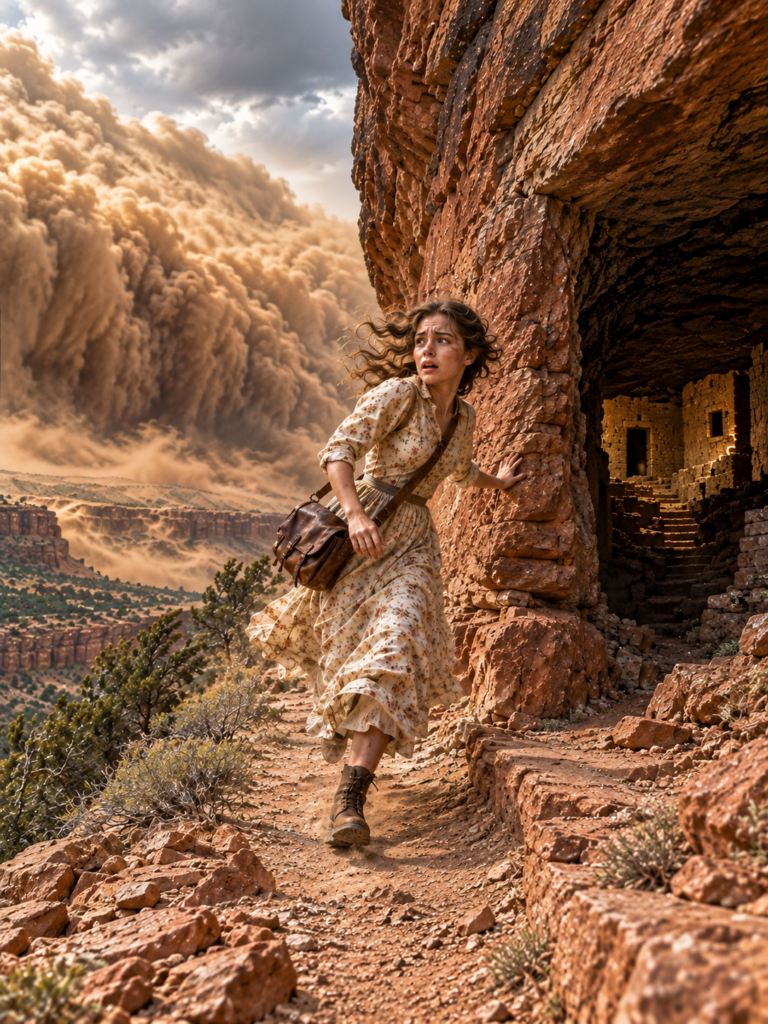
The dust storm came across the valley like a wall of earth, and eighteen-year-old Mary Gray knew she could never outrun it all the way home.
She was standing beside the spring with two empty buckets when she first saw the brown darkness rising over the northern ridge. Within moments, the familiar hills disappeared behind it. The grass bent flat. A bitter wind struck her face, carrying enough grit to sting her eyes.
Her family’s cabin stood nearly a mile down the draw.
The nearest shelter was a narrow black opening in the rocky hillside above the spring.
Mary dropped her buckets and ran toward it.
She had seen that opening before. Years earlier, a frightened deer had vanished into it, and Mary had assumed it was nothing more than a shallow cave. She had never bothered to follow the animal.
Now she scrambled up the slope, fell to her knees, and crawled into the darkness just as the storm swallowed the hillside behind her.
What she found inside would eventually save the very land she was about to lose.
But that night, with dust pouring through the entrance and the wind roaring outside, all Mary wanted was to survive.
She crawled until her hands touched something unexpected.
A wall.
Not rough rock shaped by nature, but flat stones fitted together in careful courses.
She reached farther. The floor beneath her was level. Beyond it, the passage widened enough for her to sit upright.
Someone had built this place.
Mary pressed her back against the cold wall and held her canvas satchel against her chest.
Inside were eleven dollars in folded paper money, a small tin holding another dollar and forty cents, and a yellow bone comb that had belonged to her mother.
Those were the possessions she could not bear to lose.
Everything else in her life already seemed to be slipping away.
The trouble had started long before the storm.
The Gray family had settled near Dry Creek when Mary’s grandmother, Ivy, was still a girl. Her grandfather, Thomas Gray, had helped turn a wagon stopping place into a ranch.
Thomas built a log cabin, dug a root cellar into the slope behind it, and spent four winters hauling flat creek stones to construct a chimney that would draw properly in any weather.
Mary had never known him. He died of fever in a year when eleven people were lost in a county of only four hundred.
But she had grown up beside his chimney.
She knew which stones were smooth, where the mortar had darkened, and how the warmth remained in the rock long after the stove went cold.
Her mother, Adeline Gray, called Addie, had been born in that same cabin.
Addie could mend a fence, pull a calf, stretch a sack of flour through a difficult spring, and make almost anything last longer than it ought to.
She taught Mary that keeping a home was less about having enough than knowing precisely what to do with what remained.
Mary’s father, Russell Gray, was different.
He had arrived with an easy smile, a fine coat, and promises about cattle he intended to bring west.
The cattle never came.
When the dry years began, Russell announced that he was going east to find work. He wrote three letters. Each was shorter than the one before.
Then there were no more letters.
Mary was eleven when she stopped asking when he would return.
Addie stayed.
She worked the ranch through drought and sickness, and for a while it survived because the Gray land possessed one extraordinary advantage.
High among the folds of the hills, a spring flowed from iron-stained rock.
The creek below might shrink into dirty puddles. Other families might pack their wagons and leave. But the spring never failed.
It filled a bucket in the time it took Mary to count slowly to forty.
She knew every step of the path leading there: the leaning fence post, the wild plum, the rattlesnake shelf, and the little pocket of green where cold water emerged from stone.
That water kept the family’s cattle alive.
It also attracted the attention of a neighboring rancher named Ruf Bell.
Bell owned cattle on the southern benches. For eleven years, he had wanted the Gray property, not because of its sagging cabin or its tired fields, but because of the spring.
Whenever he met Mary, he would suggest that a young woman ought to live somewhere more suitable.
He always smiled.
Mary learned to answer him with the same quiet words.
“No, thank you.”
Three years before the dust storm, Addie fell ill.
The sickness began as a cough during winter. By summer, she had grown so thin that her dresses hung from her shoulders.
Mary was fifteen and already doing nearly all the ranch work.
One Tuesday afternoon in October, Addie called her close.
Mary expected a farewell.
Instead, her mother told her not to let the fire go out beneath the beans. They were the last of the good ones.
Then she died.
Mary kept the fire burning.
For the next three years, she kept the ranch operating too.
She milked Peg, the family’s aging Shorthorn cow, raised hay, patched fences, and counted expenses on scraps of paper.
She had learned useful skills from another person as well.
Hyram Deakons lived alone in a dugout up the North Fork. He had lost a hand in the gears of a fanning mill and earned his living digging wells.
He had known Mary’s grandfather and helped him haul chimney stones.
When Mary was young, she followed Hyram because he never seemed to mind having her around.
He taught her to read the ground for water, set fence posts in stone, sharpen tools properly, and judge hay by smell.
He also had a habit of standing north of the Gray cabin and staring toward the hill above the spring.
“That hill holds water like a jug,” he would say.
Mary always assumed he meant the spring.
When Hyram died, he left her his tools: a crosscut saw, an auger with three bits, chisels, a drawknife, a hand axe, a jar of iron nails, and a spirit level in a wooden case.
They became some of the most valuable things she owned.
But knowledge and good tools could not stop a debt from growing.
The dry years kept coming.
The herd grew smaller. The hay crop diminished. Almost every dollar from the sale of three steers went toward taxes and necessities purchased from Hobart Mallister’s store.
Mallister maintained a black ledger containing the debts of nearly everyone in Dry Creek.
He was meticulous, not especially unkind, and unwilling to mistake sympathy for payment.
Eventually a county notice arrived.
The assessment on the Gray property had not been paid in full. A lien had been filed, and unless Mary settled two hundred and forty dollars within sixty days, the property could be sold to satisfy the debt.
She counted her savings twice.
Twelve dollars and forty cents.
She had Peg, four steers, a damaged wagon, and the tools Hyram had left her.
She did not have two hundred and forty dollars.
In desperation, she wrote to her aunt Prudence in Ashland.
Prudence was married to a druggist and lived in a house with a piano and proper carpets. Mary asked for a loan, offering interest and security against the ranch.
Ten days later, a brief letter arrived.
Her aunt had no money available for that purpose.
She also suggested that a young woman living alone on a remote ranch should reconsider her circumstances.
Mary read the letter, folded it, and returned to her chores.
Then came the dust storm.
Now, sitting in the strange stone passage, Mary could hear its force scraping against the hillside.
She touched the squared wall again.
Whoever had built it knew stonework. The corners were fitted tightly, and the passage seemed to bend farther into the hill.
She considered exploring, but the darkness was complete.
She had no lantern.
Instead, she waited, thinking of her mother, the old chimney, and Hyram’s patient instructions.
By the small hours, the roaring wind diminished.
Mary listened until the last grains of dust stopped falling.
Even then, she waited longer.
Hyram had always told her that wind could lie down and rise again.
At daylight, she crawled outside.
The valley looked as though someone had covered it with flour.
One bucket lay overturned. She found the other partly buried, its handle bent.
The grasses were nearly hidden. No birds called.
Mary recovered what she could and hurried home.
Peg and the four steers were standing together in the low ground, dusty but alive.
The cabin still stood.
Then Mary noticed two papers.
One had been wedged above the door latch.
The other lay inside an envelope pushed beneath the door.
She opened the official notice first.
The lien on the Gray property had been assigned to Ruf Bell. He had filed his intention to foreclose, and the paperwork directed Mary to remove herself, her belongings, and her livestock by the first day of November.
The notice bore Sheriff Warren Ty’s signature.
Mary read the document once.
Then she read it again.
At the bottom was the property description.
One hundred and fifty-six acres, more or less.
She stared at the number.
The Gray ranch had always been called one hundred and sixty acres.
Her mother had said it. Her grandfather’s neighbors had said it. Every discussion Mary remembered had treated the parcel as one hundred and sixty acres.
Yet the official document described only one hundred and fifty-six.
Four acres were missing.
Mary had no survey map and no money to hire someone to investigate.
Still, the difference troubled her.
She folded the notice and placed it beneath the flour tin on the kitchen table.
Then she opened the second envelope.
It was from Prudence.
Her aunt had heard that the property was being lost. There was no room for Mary in Ashland, and she was not to arrive without writing first.
Prudence enclosed the address of a family seeking a domestic worker.
The position paid twelve dollars a month, with board.
Mary sat on the step for several minutes.
The place where she had been born was about to belong to someone else. Her father was gone. Her mother was buried. Her aunt had offered her employment in another person’s home instead of shelter in her own.
Finally, Peg called from the yard.
Mary stood up and milked her.
The sound of milk striking the bucket steadied her more than any words could have.
Two days later, Mary drove into Dry Creek and asked Mallister about the foreclosure.
He brought out his ledger and showed her the entries.
There was Russell Gray’s old debt, its assignment, and Ruf Bell’s name.
Mallister confirmed that the arrangement was legal.
Mary asked about the missing four acres.
He could offer no answer that would settle the matter.
Outside, Neta Puit, a washerwoman who knew Mary from childhood, placed a loaf of yesterday’s bread into the wagon without ceremony.
Later that day, Ruf Bell approached her.
He offered to purchase her livestock.
Then he suggested something he considered generous.
Mary could remain in the cabin through winter, cooking, cleaning, hauling water, and tending the animals. He would pay five dollars a month and provide her keep.
She looked at the man’s hands resting on her wagon.
The house her grandfather had built would be his.
She would become a servant inside it.
“No, thank you,” she said.
Bell urged her to consider it.
“No, thank you,” Mary repeated.
He tipped his hat and went away.
During the following week, she packed the things she could rightfully take.
Hyram’s tools went into the wagon, wrapped in straw.
She added her blankets, flour, coffee, salt, coal oil, buckets, seed potatoes, harness, and canvas satchel.
She repaired the cracked wagon reach with wet rawhide, binding it tightly so it would shrink around the wood as it dried.
On her final evening, she built a fire in the cabin stove and sat outside until darkness came.
The chimney stones still held the day’s warmth.
Mary placed her palm against them, thinking of Thomas Gray spending four winters bringing those stones home.
Before sunrise, she loaded the wagon, hitched the team, and gathered the cattle.
Neta Puit appeared beside the road and left a jar of preserves in the wagon.
Sheriff Warren Ty passed on horseback and lifted two fingers in greeting.
Neither spoke.
At the rise above the valley, Mary stopped.
The road east led toward Ashland, her aunt’s house, and the position as a servant.
The road down the valley led toward people who knew she had lost everything.
Mary looked northwest.
She remembered Hyram standing beneath the hill.
That hill holds water like a jug.
She turned the horses off the road.
She was not going to Ashland.
She was going back to the spring.
And this time, she intended to discover what lay inside the stone passage.
Part 2
Getting the wagon across the low ground took nearly an entire day.
The storm had filled the shallow depressions with soft dust, hiding the harder earth beneath.
Twice the wheels sank badly enough that Mary had to climb down and help the horses pull.
At one crossing, the wagon settled almost to its hubs.
Mary placed her shoulder against the box, called gently to the team, and felt the repaired reach strain beneath her.
The rawhide held.
By afternoon, her throat was dry and the cattle were moving slowly.
She could hear nothing but hooves, wagon wheels, and the occasional low complaint from Peg.
Then the land began to rise.
Mary recognized the wild plum, the rattlesnake shelf, and the narrow path she had traveled with water buckets since childhood.
At last she heard the spring.
She knelt beside the iron-stained rock and drank.
The water was as cold as ever.
She counted while one bucket filled.
Forty.
Nothing about the spring had changed.
She watered the animals, made camp beside the warm rock shelf, and slept beneath her blankets.
The next morning, she studied the hillside properly.
Forty feet above the spring, beneath a broken ledge of gray stone, was the cave entrance.
This time she had a lantern.
She filled it carefully, trimmed the wick, took Hyram’s hand axe, and climbed.
The opening forced her onto her knees.
Inside, the floor rose slightly, allowing water to drain away from the rooms rather than gather in them.
Farther in, the ceiling lifted.
The passage turned left, then right.
Those bends stopped wind from driving directly inside.
Mary understood the arrangement immediately.
Someone had built this shelter for more than a single night.
At the second turn, she found the remains of a wooden doorframe, its hinges still attached. The missing door had once swung inward across a threshold worn smooth by years of use.
Beyond it stood a room approximately fourteen feet long and eleven feet wide.
Three bunks lined the right wall.
One retained a canvas mattress stuffed with old straw.
Wooden pegs were fixed above each bed, though nothing hung from them.
At the far wall, another opening led into a larger room.
Mary lifted the lantern.
A cast-iron box stove stood on a slate hearth.
Its front leg had been repaired with a metal splint and rivets. A stovepipe ran into a carefully cut stone flue.
Beside it stood a pine table, two benches, tin plates and cups, a coffee pot, a bone-handled knife, and several horn spoons.
Above the table were shelves holding jars and two lanterns, one tin and one brass.
Behind the room was a smaller chamber with a dirt floor sunk below the stone.
It was noticeably colder.
There were crocks, an old barrel, and remnants of spoiled meal.
A storage room, Mary realized.
The entire place had been arranged like a home.
She found a ventilation shaft cut into the ceiling and watched the lantern flame lean gently beneath it.
Then she noticed something else.
The stonework had grown neater deeper inside the hill.
The earlier courses were rougher. The later ones fitted more precisely.
Someone had worked here long enough to improve at the task.
On the left side of the first room, a few fallen stones exposed a smaller passage. It had collapsed about ten feet in.
Mary examined the old rubble but did not enter.
She had been taught not to trust unsupported stone.
Above the bunks, nearly hidden in shadow, a short wooden shelf held four objects.
A hinged tin box.
A small wooden box with a sliding lid.
A folded gray blanket.
And a book without a cover.
Mary stood beneath them for a long time.
Whoever had lived here had left ordinary possessions behind.
She did not know whether the person had died or departed, and she was reluctant to disturb the shelf before understanding more.
Instead, she returned outside and carried in her belongings.
She stacked Hyram’s tools against the wall, put her food in the cool storage room, and gathered pinewood fallen during the storm.
Then she lit the stove.
The fire caught.
Smoke traveled cleanly up the flue.
Warmth began spreading through the larger room.
Mary sat before the iron stove and watched the flames through the opened door.
The person who had built this place had solved problems she understood: damp, smoke, wind, food storage, cold weather.
She felt something she had not felt in the cabin for months.
A possibility.
That evening, after tending Peg and the steers, she cooked a small meal and slept in the lower bunk.
The mattress was old, but it supported her weight.
The stone rooms were quiet.
No wind rattled the walls. No loose shingle scraped against a roof.
When she woke before dawn, she heard Peg calling faintly from below.
She milked the cow, watered the animals, and returned to the room with the shelf.
She wanted to know whose house she was occupying.
Mary took down the tin box first.
Its hinge resisted, then opened with a faint scrape.
Inside were packets of folded paper, carefully tied together.
She loosened the uppermost string.
Money.
Old banknotes, some printed with unfamiliar names and buildings.
She carried them to the table and began counting.
There were twenty-dollar notes, tens, fives, and many ones.
The total in paper money was one hundred and twenty-eight dollars.
A smaller packet contained silver coins and two gold pieces.
Those added forty-one dollars and sixty cents.
Mary counted everything again.
One hundred and sixty-nine dollars and sixty cents.
She placed both palms flat on the table.
The sum was too important to trust to a single count.
The county wanted two hundred and forty dollars.
She had arrived with twelve dollars and forty cents.
Now she possessed one hundred and eighty-two dollars.
She was still short, but no longer helpless.
For several minutes, Mary sat without touching the money.
She was thinking less about what she might purchase than about how much work those notes represented.
Whoever had saved them had gone without something, year after year.
She folded the packets again.
The smaller wooden box came next.
It contained a brass key, three fishhooks, a small whetstone, a carpenter’s pencil worn nearly to its end, and a thimble made of horn.
At the bottom was a folded slip of brown paper.
A name was written on it.
Emmett Row.
Beneath the name was a date from the year Mary was born.
She unfolded the gray blanket.
It had been patched with careful stitches and folded around something firm, though Mary did not examine the hidden paper yet.
Finally, she lifted the book.
Its first pages were missing, but the rest contained ruled entries written in a small, square hand.
It was a journal kept like a workingman’s ledger.
Most entries concerned practical matters.
Stone hauled.
Posts set.
Rain.
The stove repaired.
A table sanded.
There were observations about the spring, too.
Mary read slowly, turning the fragile pages with one finger.
Then she reached an entry that made her stop.
The writer had seen a girl at the spring.
Another entry mentioned that she counted to forty.
Mary looked toward the doorway.
She had spent her childhood carrying buckets beneath this hill.
Someone had watched her.
Not once, but often enough to recognize her habit.
She resumed reading.
The later entries were longer and less steady.
Emmett described having lost a hand and learning to accomplish tasks differently.
He mentioned a well at the Deakons place going dry.
He wrote about stonework, years of labor, and the possibility that a man might lose possession of land while still needing to protect what was inside it.
Then Mary found the passage explaining his life.
Emmett Row had traveled west with the same wagon company that brought the first Gray family into the valley.
He had helped with their early building work.
Later, he had traveled east during a year of terrible sickness.
His wife and son died.
He returned alone.
The spring reminded him of the water his wife and child had loved.
So he began building into the hill.
The rooms were not intended merely to hide him.
He wanted to make a place where someone might find shelter, warmth, and safety long after he was gone.
Mary turned another page.
Emmett wrote that he had visited the county seat twelve years earlier to inspect the original survey records.
There was a discrepancy between the line drawn on the county plat and the line marked by the surveyor’s stone.
Four acres lay between them.
Four acres containing the spring.
The very difference Mary had noticed on the sheriff’s notice.
She read the passage again.
Emmett had witnessed the relevant survey record.
He had known that the spring did not belong to the ranch parcel described by the county.
Mary’s hands grew unsteady.
At the end of the journal was a final message.
Emmett wrote that he had not built the rooms for himself alone, but for whoever the wind brought inside.
There was money in the tin box.
And beneath the blanket was a deed to the water, recorded in trust for the child of Adeline Gray.
If the person reading his words was that child, the place was waiting for her.
Mary lowered the book.
For a long time, she listened to the fire settling inside the stove.
She had never met Emmett Row.
She had not known his name until that morning.
Yet he knew her mother’s name.
He had watched Mary carry water as a little girl.
And somewhere inside this stone house, he had placed a document meant for her.
Mary took the blanket down and unwrapped the paper beneath it.
Three sheets.
Two were written in Emmett’s familiar hand. The third carried a county recorder’s certification.
She read carefully.
Emmett Row had held title to the four acres containing the spring under a federal land patent.
He had conveyed that parcel to himself as trustee for the child of Adeline Gray, with ownership to pass to that child upon his death.
The land description identified the disputed strip between the original survey line and the marked boundary.
The spring lay within it.
The document carried the county recording reference.
Book D of Deeds.
Page 212.
Mary traced the figures with her finger.
The sheriff’s notice covered the Gray ranch as described in the foreclosure papers.
It did not describe Emmett’s four acres.
Ruf Bell’s assignment therefore could not, by itself, give him title to the spring parcel.
But Mary understood that possessing this paper was not the same as establishing the claim in county records.
There would have to be filings, proof of Emmett’s death, proof of her identity, and an accounting of the original ranch debt.
She carefully rolled the deed again.
That afternoon she started repairing the missing door.
Four boards removed from the wagon box were enough to make a serviceable replacement.
With Hyram’s auger and chisels, she prepared the hinges and fitted the wood.
The first time she swung the door inward, it stopped short of the frame.
She trimmed the edge and tried again.
This time it closed neatly.
Mary stepped back and examined it.
She had entered the hill as someone seeking shelter.
Now she was repairing it as someone who intended to stay.
Over the next days, she reset loose stones, cleaned the stove and flue, replaced rotten mattress straw, and built a corral below the shelf.
She cut pine posts from storm-fallen timber and started a modest shed to shelter the animals.
The collapsed side passage remained untouched.
There was no reason to risk a cave-in.
On the fourth day, Mary carried milk into Dry Creek.
The deed was tucked safely beneath her clothing.
She placed it on Mallister’s counter.
He examined it twice.
Then he brought out an old plat book and opened it beside the paper.
His finger followed the section line.
The difference was plain enough to trouble even him.
“The county assessed what the Gray patent covered,” he said. “This is another parcel.”
Mary waited while he examined the recording reference.
“The trust will need to be documented. And Emmett Row’s death.”
“He died two years ago.”
“Someone will have to swear to it. And to who you are.”
Mary nodded.
Mallister sharpened his pencil with his pocketknife and wrote a note beside her name in his black ledger.
Claim of water shown. Deed recorded.
He made no promises about money.
But he told her what she needed to do next.
Ora Kerwin, the schoolmistress, happened to be in the store.
She had taught in Dry Creek for nineteen years and maintained a register containing generations of children’s names.
She remembered Adeline Gray.
She remembered Mary.
Her register could help establish their relationship.
Eight days later, Ora came to the hill carrying the old school records wrapped in oilcloth.
She looked at the stone rooms with astonishment before spreading the register across Emmett’s table.
Together they examined the entries.
Mary felt that each written name was another stone set firmly beneath her feet.
Other people began helping in their own ways.
Merl Estep, the blacksmith, reinforced the cracked wagon reach with iron straps and repaired the stove leg.
Wy Doss hauled lime and transported supplies.
Neta Puit brought yeast, eggs, a hat, and eventually a hen. She also washed and mended Emmett’s old gray blanket.
Mary paid for what she could.
Some people accepted milk or work instead of money.
Nobody made a ceremony of it.
Then Ruf Bell appeared.
He stood below the shelf, looking at the corral, the smoke drifting from the hill, and Mary working beside the wagon.
He offered to buy two of her four steers.
Mary needed the money, so she accepted thirty-one dollars apiece.
Sixty-two dollars.
Bell counted out the notes and went away believing she still had too little money to save the ranch.
He knew nothing about Emmett’s tin box.
Mary let him believe what he wished.
On October twenty-ninth, Hobart Mallister drove her to the county seat in his store wagon.
Mary carried two hundred and forty dollars sewn into her dress and secured in her satchel.
At the treasurer’s office, she paid the outstanding assessment, interest, and costs required to redeem the ranch.
The clerk made the entry and handed her a certificate of redemption.
At the recorder’s office, she presented the trust deed and completed the necessary sworn statement regarding Emmett Row’s death and her identity as Adeline Gray’s child.
The recording fee was one dollar.
She received her copy with the county stamp upon it.
The entire business took less than two hours.
Outside, Mallister stood beside her on the courthouse steps.
He said he had kept Mary’s name in his ledger for years, always with an amount owing beside it.
“Now,” he told her, “I can write clear.”
Mary looked down at the certificate.
She had been prepared to leave the county with twelve dollars and forty cents and a wagon of possessions.
Instead, she was returning with the ranch redeemed and a documented claim to the spring.
After the payments, she had three dollars left.
The money had almost vanished.
But the land had not.
She rode home beside Mallister while the late autumn cold moved across the fields.
Above the spring, the hill waited.
There was a new door inside it.
A stove that drew cleanly.
A bed, a table, and a brass lantern.
Mary had recovered the property her family had nearly lost.
What she had not yet understood was that the hill would give her something more important than legal ownership.
Part 3
The first snow arrived four days after the redemption.
It fell quietly through the night, covering the valley with a brightness that seemed almost unnatural after months of dust.
Mary woke in the stone rooms beneath the hill.
The stove was still warm.
She dressed, lit the smaller lantern, and followed the familiar bends toward the entrance.
Outside, Peg was waiting to be milked.
Mary pressed her forehead against the cow’s warm side and worked until the bucket was full.
Steam rose from the milk into the cold morning.
Then she carried it inside, fed the stove, and set water on to heat.
The rooms were becoming a home through repetition.
She learned how much firewood the stove required during a hard freeze, how long the stone walls retained warmth, and how to keep the storage room cool enough for potatoes without letting them freeze.
She stacked pine in the shed, repaired the corral, and cleared safe walking paths between the shelter and the spring.
Every task reminded her of Emmett.
The careful slope of the entrance kept water outside.
The ventilation shaft carried stale air away.
The cool room preserved food.
The hearthstone supported the stove without cracking.
He had thought about the needs of an ordinary life and built answers into the hillside.
Mary began setting two plates on the table every morning.
She ate from one and cleaned both.
Nobody asked her why.
If someone had, she might have struggled to explain.
She had never eaten with Emmett Row, yet his work sheltered her every night. Keeping his place at the table seemed the least she could do.
In January, after several weeks of gray weather, Mary decided to whitewash the main room.
The lime Wy Doss had delivered was waiting beneath the shelf.
She mixed it with spring water and applied it carefully across the stone.
By evening, the room looked entirely different.
The pale walls reflected the lantern light.
The stove seemed warmer.
Even the old pine table appeared brighter.
Mary sat down after finishing and looked around.
She was no longer simply occupying the rooms as Emmett had left them.
She was making changes that suited her own life.
Gradually, people in Dry Creek learned the full story.
Mallister explained the recorded trust.
Ora Kerwin talked about the family connection.
Neighbors who had once regarded the hill as ordinary pasture began wondering how an entire stone dwelling could have existed there without anyone noticing.
Some came out of curiosity.
Mary showed them the bunks, the repaired stove, the table, and the carefully fitted walls.
They always asked who had built it.
“Emmett Row,” she answered.
Most did not recognize the name.
A few dimly remembered a quiet, one-handed man who had lived somewhere beyond the north draw.
Mary found their uncertainty difficult to understand.
A man could spend decades building something of such skill and leave barely a memory of his face.
Yet the rooms remained.
Emmett’s name grew better known after Mary began explaining his work to visitors.
By late winter, people started coming for another reason.
Their wells were running low.
The Gray spring still flowed.
Delbert Seismore, a sawyer with a pit saw, arrived hauling two barrels.
He offered to pay.
Mary refused the money.
“Water’s not something I intend to sell,” she told him.
Delbert looked toward the spring and then at the rooms above it.
“A person can’t keep hauling it for nothing.”
“I’m not hauling yours,” Mary replied. “And the man who left it to me never charged me.”
Delbert considered that.
Then he offered boards instead.
Mary accepted.
He returned with his equipment, cut straight pine planks, and showed her how to snap a chalk line before sawing.
She used the boards to make shutters, shelves, and a better lid for the woodbox.
Soon other neighbors followed.
They brought buckets, barrels, and empty containers tied to wagon beds.
Mary established a simple practice.
One person filled a bucket, then stepped aside for the next.
Nobody claimed an advantage because of wealth, land, or the number of cattle they owned.
The spring belonged to Mary, but its water was available to the valley.
She hung a tin drinking cup near the wild plum for anyone arriving thirsty.
It disappeared twice.
Both times it found its way back.
Before long, people began talking while they waited their turn.
They discussed calves, weather, broken wheels, and the price of flour.
Mary sometimes listened from the shelf above.
She had spent years believing that survival required doing everything alone.
Now she watched neighbors arrive with empty buckets and leave having helped one another load a wagon or repair a strap.
The spring was becoming more than a water source.
It was becoming a place where people met.
Minnie Hoke, a widow who kept hens, arrived one winter day with two birds and a sack of fleece.
She wanted somewhere warm to spin.
Mary had never learned the craft.
Minnie stayed four days, carding wool, demonstrating how to join the fibers, and teaching Mary to work the spinning wheel.
Mary proved patient but clumsy.
Her first yarn was thick in one place and nearly transparent in another.
Minnie examined it and pronounced it better than nothing, though not much better.
Mary laughed.
It surprised her how unfamiliar the sound felt inside the stone room.
Soon there was a hen beneath the bench and another arrangement involving eggs and Neta Puit.
The place that had once smelled only of stone and old smoke now carried the scents of coffee, fresh wool, warm iron, and animals.
In spring, Hester Bun arrived to inspect the land above the water.
She kept bees and recognized that the protected rock shelf and constant spring made a good location for hives.
She placed two on flat stones where they would receive morning sun.
Her only conditions were that nobody disturb the hives in anger and that the vegetation near the spring be protected.
Mary agreed.
Those rules became part of the way the Gray spring was managed.
The gathering place continued growing.
Wy Doss arrived with barrels.
Families from the lower ford came with buckets balanced on carrying poles.
Children learned to wait their turns.
Ora Kerwin eventually brought twenty-three pupils from the schoolhouse.
They stood in a line beside the spring while she explained what had happened to the land.
She told them about the original survey, the trust deed, and how the spring had belonged to a different parcel than the ranch described in the foreclosure papers.
Then she asked them to count slowly while Mary filled a bucket.
The children began together.
When they reached thirty-four, the water touched the rim.
Several laughed.
Mary remembered her mother teaching her to count to forty on the same path.
Now children who had never known Addie were learning it too.
Mary stood nearby holding the brass lantern.
She had not expected to become the person who guarded the valley’s most dependable water.
But she could see what the responsibility meant.
A spring could support a herd.
It could also support a community.
That May, the county surveyor, Hollis May, came to examine the disputed boundary.
He brought his measuring chain, survey instrument, and records.
Starting from the section corner, he ran the line across the ground.
Then he measured it again from the opposite direction.
When he finished, he discovered that the marked survey stone lay one hundred and forty-seven feet north of where the county plat indicated.
The discrepancy explained the missing four acres.
The land Emmett had secured included the spring, exactly as the deed described.
Hollis recommended correcting the records.
In June, the county board approved an amended plat.
The documents now properly distinguished the spring’s four-acre parcel from the adjoining ranch, whose corrected area was shown as one hundred and fifty-two acres.
The long-standing mapping error was finally visible in the county’s own books.
Mary thought of the afternoon she had sat on the cabin step reading a foreclosure notice.
Four acres.
She had been unable to stop thinking about the difference.
Now a surveyor had measured it, a board had recognized it, and the county had corrected its records.
The truth had not changed.
Only the official understanding of it had.
Ruf Bell eventually came to the spring.
Mary saw his horse approaching from the southern benches and watched him dismount below the shelf.
He looked at the hives, the corral, and the steady stream of water.
Then he asked whether she intended to sell the water or allow others to use it.
“People can take what they need,” Mary said.
Bell glanced toward the spring.
“And cattle?”
“They can be watered. But they don’t stand in it. And nobody drives a wagon across the green edge.”
He considered those conditions.
“Fair enough.”
He filled his canteens and went away.
Mary did not demand an apology.
Bell had wanted the spring for years. He had used the means available to him in trying to acquire the ranch.
His actions had nearly cost her everything, but she understood that the spring’s value had driven him.
Later, they traded cattle and hay at ordinary prices.
He paid in cash.
They spoke civilly whenever they met on the road.
Neither brought up the offer he had made when she was losing her home.
Mary had no desire to build the rest of her life around that old humiliation.
There was too much work worth doing.
By summer, the place had taken on a rhythm of its own.
Hester’s bees moved among the plants above the spring.
Hens scratched near the shed.
Mary planted potatoes, beans, and turnips in a small patch of cultivated ground.
Peg had another calf.
Mary continued managing the ranch as well, using the restored property for grazing and crops while keeping the stone rooms as her principal home.
The old cabin still stood.
She visited it regularly, swept the floor, tended the stove against damp, and kept the root cellar useful.
She never considered tearing down the chimney.
Thomas Gray had spent four winters building it.
Mary intended to leave it standing.
Neta Puit began washing clothes at a designated place along the spring’s overflow.
Together, she and Mary selected ground where the washing would not muddy the source.
They arranged stones around a fire pit and established a place for the copper kettle.
On Mondays, Neta worked there with her washboards.
Sheets, dresses, and shirts from households all over the valley hung between the pines.
The clothes moved in the breeze like pale sails.
Mary would sometimes carry hot coffee down to her.
Neta repaid the favor with bread.
One afternoon, someone asked where the washing was done.
“At the Gray spring,” Neta answered.
The name remained.
Mary liked the sound of it, although she did not say so.
For years, people had called the place the Gray ranch, usually when discussing its debts.
Now they spoke of the Gray spring when discussing clean water, fresh laundry, or a place to meet neighbors.
One name had become associated with something that belonged to the past.
The other suggested a future.
By her second year in the hill, Mary had become a capable keeper of both.
She managed the animals, maintained the stonework, repaired tools, planted crops, and made decisions about the water with the same careful attention her mother had once given the ranch.
Her possessions remained modest.
The walls were stone. Her furniture was plain pine. Her clothes needed mending as often as anyone else’s.
But she had warmth, reliable water, useful work, and people who came to her door without expecting her to surrender anything.
On a rainy Sunday evening that autumn, Mary sat alone at Emmett’s table.
The stove drew softly.
The brass lantern burned low on the shelf.
Outside, rain moved across the hillside, feeding the ground above the spring.
Mary had opened both boxes.
The tin box was empty of money now, except for the papers she kept there.
The small wooden box held Emmett’s little belongings.
She laid two objects on the table.
Her mother’s yellow bone comb.
Emmett Row’s horn thimble.
The comb had been carved by Thomas Gray for Ivy and passed through the women of the family until it reached Mary.
One tooth had always been broken.
She remembered her mother’s thumb running across that place whenever she put up her hair.
The thimble had belonged to a stranger who lost a hand and learned to sew with the one that remained.
Its crown was nearly transparent from use.
Mary had worn it herself while repairing blankets and stitching the mattress cover.
She looked from one object to the other.
Two men she had never met had made things that still served her.
Thomas had built a cabin and carved a comb.
Emmett had built a shelter and saved money he might never spend.
Hyram had taught her how to use tools and had left his own tools in her care.
Addie had shown her how to stay alive when conditions became difficult.
Even the neighbors who had appeared during her hardest months had contributed something.
Neta’s bread.
Ora’s register.
Mallister’s careful accounting.
Merl’s ironwork.
Wy’s freight wagon.
Delbert’s boards.
Minnie’s spinning lessons.
Hester’s bees.
Mary considered how differently her life might have unfolded had any one of those people chosen not to help.
For years she had believed she was completely alone.
At eighteen, she had possessed little money, a troubled name, and a debt she could not settle.
Yet unseen preparations had already been made for her.
Emmett’s deed had been recorded long before she understood the need for it.
The money had been waiting in a tin box.
The rooms had existed above the path she walked every day.
She had never looked up.
Mary opened Emmett’s journal.
His entries filled page after page with weather, repairs, and the small details of daily life.
The later pages were still blank.
She had begun using them herself during her first summer in the rooms, recording the work she completed in the same straightforward manner.
Now she turned to the current week’s entries.
She sharpened the carpenter’s pencil with her knife.
She wrote about the posts she had set, the stove she had cleaned, and the work done along the north line.
Then she stopped.
She remembered the storm.
The brown wall swallowing the valley.
The narrow opening into which she had crawled.
Her fear when she discovered that someone had squared the stones.
The sheriff’s notice.
Prudence’s letter.
Ruf Bell’s offer.
The day she turned her wagon away from the road to Ashland.
She thought of Emmett watching a small girl fill her buckets while he stood unseen in the doorway.
She would never know exactly what had led him to place the spring in trust for Addie’s child.
Perhaps he remembered the kindness of the Gray family.
Perhaps he had watched Mary grow up and recognized how hard she worked.
Perhaps losing his wife and son had left him determined to protect another person’s future.
His journal did not explain everything.
Mary found she no longer needed it to.
She had the deed, the rooms, and the evidence of a lifetime’s patient labor.
Those things spoke clearly enough.
She wrapped the comb and thimble together in Emmett’s repaired gray blanket and placed them on the upper shelf beside the journal.
Then she returned to the table and wrote one final line beneath the week’s work.
The hill holds.
She looked at the words for a moment.
Hyram had always said the hill held water like a jug.
He had been right.
But it held more than water.
It held the labor of a man who had built a refuge after losing his family.
It held savings intended for someone he might never meet.
It held a deed that protected a child’s future.
And now it held the life Mary had made for herself.
Outside, the rain continued.
Mary banked the stove, lowered the lantern flame, and listened to water moving through the earth.
She could still picture the younger girl who had sat on the cabin step with a sheriff’s notice in her hands, wondering how she could possibly begin again.
That girl had believed losing the ranch meant losing every place she belonged.
She had been wrong.
The storm had forced her into a doorway she had passed all her life without understanding.
Behind it were rooms built by a man almost forgotten by the valley.
His money helped her redeem the ranch.
His deed established her claim to the spring.
His shelter became her home.
And what began as one frightened girl’s search for safety became a place where the entire valley could find water and welcome.
Mary Gray never became wealthy in the way people in Ashland might have measured wealth.
She did not acquire a grand house or a parlor with a piano.
She had something more suited to the life she wanted.
Her work mattered.
Her name was written beside the word clear in Mallister’s ledger.
And whenever someone came up the path carrying an empty bucket, the spring was there for them.
A woman who had once been told there was no room for her had made a room for others.
High inside the hill, the stove continued drawing, the lantern burned steadily, and Emmett Row’s careful stonework stood firm against the weather.
The wind could rise.
The dry years could return.
But the water still flowed.
And the hill held.