
Part 1
The last sound Judith Renick heard before leaving her mill was a wooden shutter striking the wall.
It had been swinging loose for three weeks. She had meant to repair it, just as she had meant to mend the loading dock, replace the torn bolting cloth, and settle the account that had kept her awake nearly every night since June.
But repairs required money, and money required a working mill.
The waterwheel behind her father’s stone building had not moved in sixty-three days.
On the morning of August 12, 1886, the creek beneath it held nothing but hot stones, dead minnows, and a scattering of shallow puddles green with insects.
Judith stood at the office desk, turning a page in the account book.
Ezra Colton — $86.40.
She touched the entry with her forefinger.
It was the largest unpaid account she could reasonably expect to collect before autumn.
There were other names, certainly. Thirty-one of them, written in her own neat hand. But a farmer with burned corn could not pay merely because she asked. Nor could a widow whose hens had stopped laying, or a laborer whose wages had vanished when the railroad construction moved west.
Ezra Colton was different.
He owned cattle. He owned land. And, according to the men who talked outside the general store, he possessed two of the finest draft horses in the county.
A man with such things ought to be able to pay eighty-six dollars.
At least, Judith intended to tell him so.
She closed the ledger, fastened the brass clasp, and looked toward the doorway.
A boy of twelve stood there with a broom twice his height.
“You’re going after Colton,” he announced.
“That is where the road leads.”
“Mr. Peabody says he doesn’t pay anybody until the cattle go north.”
“Mr. Peabody talks more than he knows.”
“Sometimes he knows things.”
“Usually by accident.”
The boy grinned.
Davey Brannan had been living at the mill since a fever buried his mother four summers earlier. Nobody had officially given Judith custody of him. Nobody had come looking for him, either.
He had simply appeared one morning carrying a torn blanket and asking whether the mill needed sweeping.
Judith had told herself he would remain until another arrangement could be made.
Four years later, he still swept badly, ate enormously, and asked questions that exhausted her patience.
“Will he pay?” Davey asked.
“He will tell me why he hasn’t.”
“What if he gets angry?”
“Then he may do so after he settles his bill.”
Davey considered that.
“You’re not frightened of him?”
Judith lifted her chin.
“I have managed a mill through flood, fever, and a broken mainshaft. I hardly think a cattleman will be the end of me.”
But as she rode away, she found herself rehearsing the words she would use.
The account had been outstanding since March.
She needed payment, not promises.
Her father’s loan at the Toiver Crossing Bank amounted to three hundred and forty dollars, and the final payment was due in September.
If the mill could not meet it, the bank would take the property.
The building, the machinery, the little house beside the creek, even the patch of ground where her father lay buried beneath a cedar.
Everything.
She had already lost her father.
She would not lose the rest of him.
By the time she reached the Colton ranch, the afternoon sun had turned the hills the color of old copper.
The house stood beneath a line of live oaks, built of pale limestone with a broad porch and a chimney that leaned slightly toward the east. A barn occupied the higher ground, its roof patched with mismatched shingles.
Nothing about the place suggested great wealth.
But something beside the house arrested her attention.
Water.
A narrow wooden pipe emptied into a stone watering trough. The basin was full, and the excess spilled steadily over the rim, darkening the dust below.
Judith stared.
For nine miles she had ridden past dry creek beds, empty stock tanks, and fields where the corn had withered before producing a single ear.
Yet here, beneath the cruel August sun, clean water was flowing freely onto the earth.
She dismounted and dipped two fingers beneath the stream.
Cold.
Not water that had been sitting in a tank, but water freshly drawn from somewhere underground.
She looked toward the limestone ridge behind the house.
A spring, perhaps.
She filed the thought away.
First the money.
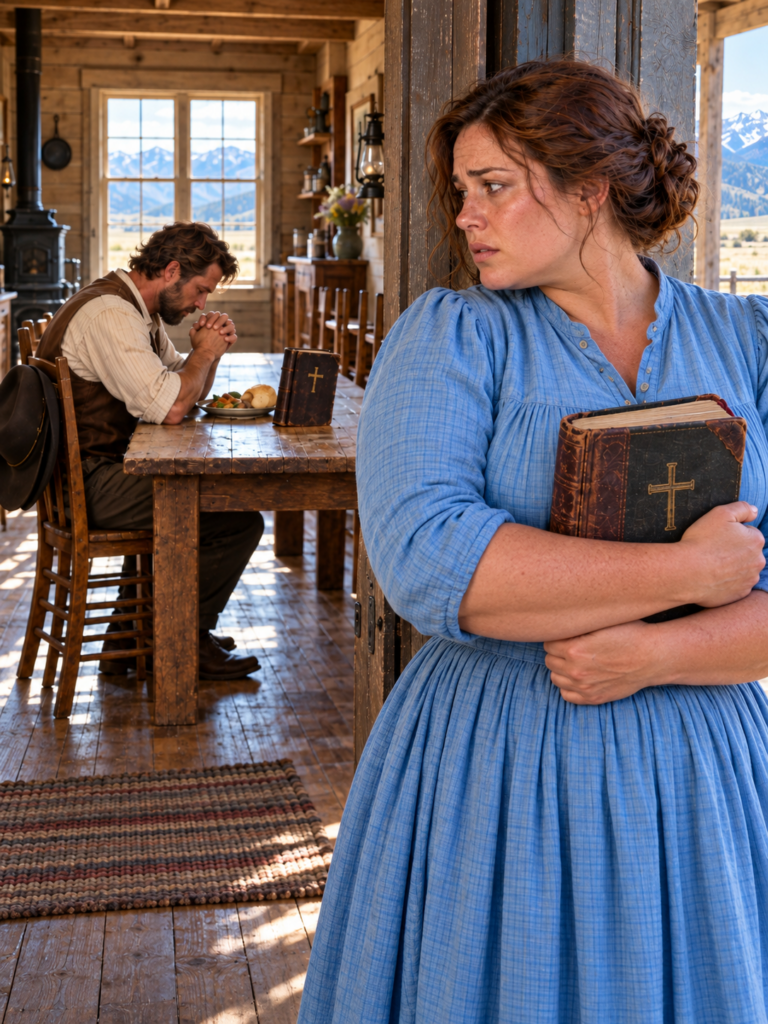
Judith crossed the porch, raised her hand to knock, and heard a man’s voice through the open doorway.
He was praying.
She almost withdrew immediately.
Instead, she stood motionless when she heard what he said.
“Father, I’ve had my bread today, and that’s more than some have had. Keep a watch over the people who haven’t enough, and forgive me for the things I ought to have done better.”
A pause followed.
Then the voice grew softer.
“And if You have any kindness left for this house, send somebody who might care to stay awhile. I’m weary of sitting down alone.”
Judith’s raised hand slowly fell.
Through the hallway she could see part of the kitchen.
A heavy dining table stood near the window. Several chairs had been placed against the far wall, covered with folded grain sacks to keep off the dust.
Only one chair remained at the table.
Only one plate had been laid.
A broad-shouldered man sat before it, head bent, his dark hair brushed back from a weathered face. A narrow scar interrupted his left eyebrow.
For a moment, Judith felt something she had not come prepared to feel.
Recognition.
Every evening she ate her own supper beside the account books because sitting at her father’s table required looking at the empty chair across from her.
She had called it efficiency.
The stranger’s prayer made that explanation seem suddenly foolish.
Judith stepped backward.
The porch board beneath her boot complained loudly.
The man lifted his head.
“Who’s there?”
There was no sensible escape.
Judith straightened her shoulders and knocked.
Footsteps sounded inside.
A moment later Ezra Colton appeared in the doorway.
He was taller than she had expected, with a short beard and hands marked by rope burns and hard labor.
“Miss Renick.”
“Mr. Colton.”
His eyes moved to the ledger beneath her arm.
“I expect this isn’t a social visit.”
“No.”
“Then you’d better come inside. The sun’s too mean for business on the porch.”
“I can say what I need to say here.”
“You can. But I’ve got coffee, and I don’t see any reason for us both to suffer.”
She nearly refused.
Then she stepped through the doorway.
Ezra brought another chair from the wall and wiped its seat with a clean cloth.
Judith wished he had not.
It made the room feel like somewhere she had been invited rather than somewhere she had come to demand money.
She opened her ledger.
“Eighty-six dollars and forty cents. Feed, meal, and oats supplied since March. The terms were thirty days.”
“I know.”
“You received my notice?”
“I did.”
“Then perhaps you’ll explain why the account remains unpaid.”
Ezra studied the coffee in his cup.
“I’ve got forty-three head worth taking to market. Until the fall drive, I’ve got no buyer prepared to give me a fair price. I can sell cattle now and lose half what they’re worth, or wait and pay you properly.”
“Your convenience is not my concern.”
“No, ma’am.”
His agreement irritated her more than an argument would have.
“My bank doesn’t intend to wait for your cattle.”
He looked up.
“How bad?”
Judith hated the question.
She hated even more that there was no mockery in it.
“The mill’s been idle since early June. My note comes due next month. What I have saved will not cover it.”
Ezra remained quiet.
Outside, a bird called from the trees.
At last he said, “Would you consider payment in work?”
“I cannot pay a bank with fence posts.”
“I wasn’t thinking of fence posts.”
He stood and went to a cabinet near the kitchen door. From it he retrieved a wooden gear tooth, worn smooth along one edge.
“My father helped rebuild a cotton gin some years back. I’ve got iron and seasoned oak left from the work. I’ve also got Duke and Sally in the barn.”
“Your horses?”
“They pull well. Better than they eat, most days.”
He set the gear tooth on the table.
“Your waterwheel isn’t the only way to turn a pair of millstones.”
Judith looked at him.
She knew about animal-powered mills, though her father had dismissed them as slow and troublesome.
“A horse sweep,” she said.
Ezra nodded.
“Run a beam around a central post. Carry the motion through gearing to the mill shaft. It won’t give you everything the creek once did, but it’ll give you meal to sell.”
“You’re offering to build one?”
“I’m offering the wood, the horses, and my own hands. You pay the foundry for what iron we can’t make. Allow me a dollar a day against what I owe.”
Judith calculated rapidly.
The expense of castings would hurt.
The machinery might fail.
And a horse mill would never match the old waterwheel.
But it would be something.
A mill that could grind a little corn was still a mill.
“You’re certain you can build it?”
“No.”
She frowned.
He continued, “I’m certain I can build most of it. The rest we’ll have to learn.”
For the first time that afternoon, her mouth almost curved into a smile.
“Monday,” she said. “If you arrive after sunrise, you’ve lost the day.”
“I’ll be there.”
“And dinner is included in the arrangement. A man cannot work a horse sweep on an empty stomach.”
He looked at her for an instant longer than politeness required.
“That’s generous.”
“It’s the ordinary practice of employing labor.”
“Then I’ll take ordinary practice, Miss Renick.”
When she left, he walked with her to the horse.
As she put her foot into the stirrup, her eyes returned to the water spilling from the trough.
“Where does that come from?”
Ezra glanced toward the ridge.
“A spring above the house.”
“Has it never failed?”
“Not in my lifetime.”
“Even this year?”
“Even this year.”
Judith studied the water another moment.
Then she mounted and rode away.
She had come for eighty-six dollars.
Instead, she had acquired a workman, an uncertain piece of machinery, and the uncomfortable knowledge that a stranger had spoken aloud the loneliness she had spent fourteen months refusing to name.
On Monday morning, Ezra Colton arrived with a wagon full of timber.
Duke and Sally drew it between the mill buildings like two solemn brown giants.
Davey emerged from the grain storehouse and stopped dead.
“Lord above,” he whispered. “Those horses could pull the courthouse down.”
Ezra climbed off the wagon.
“They might, if the courthouse had oats inside.”
Davey laughed.
Judith did not.
She had spent eleven dollars at the foundry, and the loss of those coins lay against her heart like a stone.
“Where do we begin?” she asked.
Ezra surveyed the ground, the mill wall, and the silent waterwheel.
“With a hole.”
“A hole?”
“A deep one. Something has to hold the center post, or the horses will turn the whole contraption into a traveling circus.”
By noon, they had dug the posthole.
By Tuesday evening, a long timber balanced on its iron pivot while Davey carried tools from one end of the yard to the other.
Ezra worked without complaint.
He listened when Judith explained the existing gearing. He asked questions when he did not understand. More surprisingly, he accepted her answers without trying to prove that a woman must know less about machinery than a man.
On Wednesday, Judith climbed to the grinding floor to sharpen the furrows in the millstones.
She had learned that work from her father when she was fourteen.
The hammer and mill bill demanded patience, a steady wrist, and a precise understanding of how the grooves would carry ground meal outward.
After four hours, dust coated her hair and clothing.
When she descended, Ezra was waiting with a dipper of cool water.
“You’ve been up there most of the day.”
“The stones won’t dress themselves.”
“No. I suppose they won’t.”
She drank.
He glanced toward the staircase.
“Wouldn’t hurt to let me know before you attempt something that heavy.”
“Wouldn’t help, either.”
“Maybe not.”
He took back the dipper.
“But somebody ought to know where to find you if you fall.”
Judith looked at him.
For one sharp moment she remembered the morning her father had been found on that same grinding floor, one hand pressed against his chest and the other still holding a wrench.
No one had known anything was wrong until Davey went searching.
She turned away before Ezra could read her face.
“I don’t fall, Mr. Colton.”
“No, ma’am.”
His answer was gentle enough to make her angry.
That evening, after he left, Judith found a repaired hinge on the loose shutter.
He had fixed it without asking.
She stood beside the window longer than necessary, testing the latch twice.
The horses moved the millstones on Thursday.
At first the mechanism protested so violently that Judith thought the main gear would split.
Then Duke leaned into his collar, Sally followed, and the great shaft began to turn.
Judith pressed her fingertips to the wooden housing, feeling every shudder travel through the old machinery.
“Ease them back!” she shouted.
Ezra shortened the reins.
The horses slowed.
The shaking diminished.
Above them, the grinding stones settled into a low, familiar rumble.
Davey ran up the stairs.
“Is it working?”
Judith opened the feed gate.
A handful of corn slipped into the eye of the stones.
For several seconds, nothing emerged.
Then pale meal fell through the spout.
Judith caught it in her hand.
Warm.
Coarse, but properly ground.
She rubbed it between her fingers and found herself thinking of her father, standing in this very place, teaching her how good meal ought to feel.
She had not cried at his funeral.
She had not cried when the creek stopped running.
Now her eyes filled without warning.
Davey threw his cap into the air.
Ezra stood below with his hands on the reins, looking toward the mill window.
Judith raised her palm so he could see the meal.
He smiled.
It changed his entire face.
By afternoon, several farmers had brought grain, and the loading dock was no longer empty.
The mill had made money for the first time in weeks.
Not much.
But enough to place actual coins beside the ledger.
At dinner, Davey set three plates on the kitchen table.
Judith noticed immediately.
“Mine belongs in the office.”
“No, ma’am,” Davey said.
She stared at him.
The boy swallowed.
“Well, it could. But there’s room here.”
Ezra stood near the door, hat in hand.
“I can take my dinner outside if you’d rather.”
His words were entirely free of accusation.
Somehow that made them harder to resist.
Judith looked at the table.
Three plates.
Three chairs.
She could eat beside the ledgers for another fourteen months, and nobody would stop her.
Or she could sit down.
“Mr. Colton,” she said quietly, “would you care to give thanks?”
Ezra placed his hat aside.
They bowed their heads.
He offered a simple prayer for the food, the horses, and the day’s labor.
He did not mention being alone.
Judith found that she was grateful he did not.
Afterward, Davey talked so much that the beans grew cold, and Ezra told a story about Duke escaping a pasture only to return through the same gate when supper arrived.
Judith laughed.
It surprised her.
Later, after the dishes had been washed, she discovered that someone had moved her father’s old chair from the storeroom into the kitchen.
It stood near the window.
She suspected Davey.
She said nothing.
But that evening she sat in it long enough to finish her coffee.
When the boy had gone to bed, Judith carried the latest feed tickets into the office.
She intended to match them against Ezra’s outstanding account.
Most were perfectly ordinary.
One hundred pounds of feed.
Another hundred.
Four sacks of oats.
But as she sorted the receipts, something began to trouble her.
The quantities were far too regular.
Every week, almost without exception, Ezra had collected the same amount at nearly the same hour.
Always before daylight.
And on four of the oldest tickets, beside the weights, someone had written initials in a hand she did not recognize.
T.P.
H.D.
A.L.
M.S.
Judith examined the letters under the lamp.
They weren’t abbreviations for feed or grain.
They looked like people’s names.
Outside, the new horse sweep stood silent beneath the moon.
She thought of Ezra’s prayer, the overflowing water trough, and the way he had accepted a dollar a day without asking how long it would take to repay the account.
For the first time, Judith wondered whether the eighty-six dollars in her ledger represented something other than a rancher’s failure to pay.
And when she went to bed, she left the receipts on the desk.
She intended to discover whose names those letters stood for.
Part 2
On Friday morning, Judith rode east with eleven overdue accounts folded inside her coat.
She told herself that the initials on Ezra Colton’s receipts were none of her concern.
A man’s purchases were his own business, provided he paid for them.
Unfortunately, he had not.
The first farm stood beyond a low ridge where the grass had turned brittle and gray. Its fences leaned badly, and the small vegetable garden beside the house contained nothing living except a stubborn row of onions.
Tilda Pettybone met Judith at the gate.
She was a broad woman with strong hands, an untidy apron, and a manner suggesting that she had already decided how the conversation would end.
“If you’ve come about the three dollars and fifty cents,” she said, “I haven’t got it.”
“I haven’t yet asked.”
“You don’t have to. That’s the trouble with owing money. Everybody knows what a visitor wants.”
Judith dismounted.
“I’ve come to see what arrangement might be made.”
Tilda gave a humorless laugh.
“Take the chickens if you like. They don’t lay much, but they complain less than Amos.”
From the barn came a weak, familiar lowing.
Judith turned.
Two milk cows stood in the shade, their ribs visible beneath their hides.
There was a feed sack beside the manger.
She recognized the mill’s blue stitching immediately.
“Where did you purchase that feed?”
Tilda’s face changed.
“I didn’t.”
“Who supplied it?”
The older woman looked toward the road.
Then her expression hardened.
“Ezra Colton told us not to speak of it.”
Judith felt a cold weight settle in her stomach.
“Mr. Colton?”
“Since March. Every week, regular as Sunday.”
Tilda went into the barn and returned carrying an empty sack.
“He leaves it before daylight. Amos wanted to send it back at first. Said a grown man shouldn’t take charity from another man.”
“And what changed his mind?”
Tilda looked at the cows.
“Our youngest daughter married last spring. She’s expecting a child before Christmas. Those cows are her winter milk if we can keep them alive.”
The words quieted Judith.
Tilda continued, “Ezra said he had more hay and feed than his cattle could use. Claimed it would spoil if he kept it.”
Judith knew perfectly well that he had purchased that feed on credit.
“He never asked you for payment?”
“He said if Amos wanted to settle the matter, he could help him mend fence come winter.”
“And has your husband done so?”
“Not yet. Ezra keeps finding reasons the fence can wait.”
Judith lowered her eyes.
Four sets of initials.
Four households.
She finished her round before sunset.
At Hester Dunlap’s place, she discovered that Ezra had been feeding the widow’s mule since April. Without the animal, Hester could not haul firewood or carry vegetables to market.
At old Albert Larkin’s cabin, she found a blind man whose grandson had been collecting sacks left beside the gate.
And at the Svenson holding, a Swedish family with three young children told her how a wagon had appeared before sunrise each Tuesday, always without a driver willing to stay for thanks.
The feed tickets suddenly made sense.
So did the unpaid account.
Ezra had borrowed against his expected cattle money to keep four other households from losing the animals they depended upon.
He had allowed Judith to believe he was careless rather than tell her that those neighbors were unable to feed their stock.
By evening, she had collected fourteen dollars and thirty-five cents.
She should have been pleased.
Instead, she rode home thinking about a man sitting alone in a house large enough for a family.
A man who had been putting food into other people’s barns while his own dinner table remained empty.
Ezra was cleaning the horse collars when she returned.
Duke stood patiently beside him, one enormous hoof resting on its toe.
Judith stopped at the edge of the yard.
“Mr. Colton.”
He looked up.
“Miss Renick.”
“I visited Mrs. Pettybone today.”
His hands went still.
For a few seconds, neither spoke.
Then he put down the brush.
“I see.”
“She told me about the feed.”
He nodded once.
“All of it?”
“Enough.”
Ezra looked past her toward the mill.
Judith had expected some explanation, perhaps even an apology.
Instead, he said, “Her cows would have died without it.”
“And you thought that entitled you to eighty-six dollars of someone else’s credit?”
The words came out more sharply than she intended.
His gaze returned to hers.
“No.”
The answer was immediate.
“I thought I could pay in November. I still do. But you have every right to be angry.”
Judith gripped her riding gloves.
“Do you understand what that money means to me?”
“I believe I do now.”
“If my bank takes this mill, Davey loses his home. So do I. Those people you helped won’t have anywhere to grind their grain when the rain finally comes.”
Ezra’s face tightened.
“I hadn’t reckoned on the creek staying dry so long.”
“Neither had I.”
The silence between them grew uncomfortable.
He turned the brush in his hands.
“I could have bought fewer sacks.”
“Yes.”
“I could have let the Svensons find another way to feed their stock.”
Judith closed her eyes briefly.
“That’s not what I’m saying.”
“Then tell me what you are saying.”
She looked toward the mill, where Davey’s voice carried from an upper window.
“I am saying that you don’t get to carry every burden in this valley while leaving the rest of us ignorant of what it costs.”
Ezra stared at her.
The remark seemed to reach somewhere deeper than the unpaid account.
At last, he said, “I’ve been doing it that way a long time.”
“Perhaps too long.”
He looked down.
“Perhaps.”
Judith turned toward the kitchen.
“There’s stew on the stove. Wash your hands before it burns.”
She walked away before he could answer.
That evening, he joined her and Davey at the table.
Nobody mentioned the feed.
But when Ezra finished his meal, he did something that surprised Judith.
He asked whether he might wash the dishes.
She nearly told him that was unnecessary.
Then she passed him the towel.
The following Monday, the bank changed everything.
Ellis Garrity had managed the Toiver Crossing Bank for thirty years. He wore gray suits even in summer and kept the counters so polished that customers could see their reflections beneath the inkstands.
Judith had known him since childhood.
He had lent money to her father when the mill needed new stones.
He had attended Walter Renick’s funeral.
And when Judith entered his office on August 23, he could hardly bring himself to meet her eyes.
“Sit down, Judith.”
“I’d rather hear the matter standing.”
He removed his spectacles.
“My lender in San Antonio has called the bank’s outstanding paper. I’ve been instructed to reduce every commercial obligation I can.”
“My note isn’t due until September thirtieth.”
“I know.”
“Then there can be no difficulty.”
Ellis opened a thin folder.
“Your father signed a provision permitting an earlier call under certain circumstances.”
Judith felt the room tilt slightly.
“Are you telling me the bank wants its money now?”
“By September first.”
“That’s nine days.”
“Yes.”
“And you expect three hundred and forty dollars?”
Ellis folded his hands.
“I expect what the agreement permits me to demand.”
For several moments, Judith could hear nothing except the clock ticking behind him.
Then she drew a breath.
“How much would you need to keep the note open?”
Ellis looked at her sharply.
“Judith—”
“You have known my family for twenty years. You know the mill isn’t worthless. The creek is dry, but the stones are sound. We have a horse-powered mechanism working now.”
“I’ve heard.”
“Then name the sum.”
The banker sighed.
“Sixty percent by September first. And proof that the mill can continue operating. I can personally guarantee the remainder until October thirty-first.”
Judith calculated.
Two hundred and four dollars.
She had one hundred and thirty-three dollars and thirty-five cents available.
She needed another seventy dollars and sixty-five cents merely to meet his condition.
“Nine days,” she said.
Ellis nodded.
“I wish I could offer more.”
She rose.
“So do I.”
Outside, the street was bright with sunlight.
A wagon passed carrying empty barrels.
Judith watched the driver for several seconds without seeing him.
Seventy dollars.
The horse sweep could grind enough for a handful of customers each day, but it couldn’t earn that sum in time. Worse, the labor account would continue to consume part of its proceeds.
She could sell the furniture.
She could sell her mare.
She could sell the little silver watch her father had given her.
None of it would be enough.
By the time she reached the mill, she had begun to imagine something she had refused to consider since June.
Closing the doors.
Ezra found her beside the idle waterwheel at dusk.
She had been standing there so long that mosquitoes gathered around her ankles.
“Davey says you went to the bank.”
Judith did not turn.
“Davey talks.”
“He’s worried.”
“He needn’t be. Worry won’t settle a note.”
Ezra came to stand beside her.
The great wooden wheel hung above the dry channel like an abandoned machine in a forgotten mine.
“How much?” he asked.
She told him.
He listened without interruption.
When she finished, he studied the slope of the creek bed.
“Your father ever try another water source?”
Judith looked at him.
“What other water source?”
“The spring on my property.”
She remembered the trough.
“That’s nine miles from here by road.”
“Not by the lay of the land.”
“What are you suggesting?”
Ezra crouched and drew two lines in the dust with a stick.
“My father once surveyed a channel from our spring basin down through the lower pasture and toward this creek. The natural fall runs southeast. He figured the water might be carried to the old millrace.”
Judith stared at the lines.
“How long a channel?”
“A mile and a half, give or take.”
“That’s impossible to dig in a week.”
“To dig new, maybe.”
He lifted his head.
“But most of it was already dug.”
Her heart began to beat faster.
“What happened to it?”
“Silt. Brush. Twenty years of neglect.”
“Then the channel still exists?”
“Parts of it.”
“Have you seen it?”
“Last winter. I was looking for a stray heifer and found an old bank cut beside the limestone flats.”
Judith seized his arm.
“Why didn’t you tell me?”
The question startled them both.
She released him.
Ezra remained still.
“Because I didn’t think your waterwheel could use it.”
“Did your father measure the flow?”
“He did. With yours.”
Judith stopped breathing.
“My father?”
Ezra nodded.
“I’ve got their survey somewhere in the barn.”
She was already moving.
They searched among broken harnesses, weathered tools, and stacks of old timber until daylight disappeared from the open barn doors.
Davey arrived carrying a lantern and immediately asked whether they were looking for buried money.
“No,” Judith answered.
“Then it’s taking an awful long time.”
Ezra found the document inside a battered wooden box beneath a pile of worn tack.
It had been folded into quarters and wrapped in faded cloth.
He carried it to the workbench.
When the paper opened, Judith saw a carefully drawn line winding across the limestone hills.
There were measurements, changes in elevation, and marks showing places where the proposed channel would have crossed old pasture boundaries.
Near the upper corner stood a date.
October 1871.
Below it were two signatures.
Thomas Colton.
Walter Renick.
Judith touched her father’s name.
It was unmistakably his handwriting, angular and slightly inclined to the right.
Beneath the survey, he had written a note.
Steady spring. Sufficient fall for the lower race. Less power than the main creek, but useful during a dry season. Requires a timber crossing at the southern gully.
Judith read the final sentence twice.
“Why didn’t he build it?”
Ezra opened another folded sheet.
“My father wrote something about that.”
The letter was unfinished.
Thomas Colton had apparently intended to offer the spring water to Walter Renick for a small annual payment, but the two men had never settled the terms.
Judith remembered that year.
She had been nineteen.
Her father and Thomas Colton had argued about something at the county fair, and neither man had spoken to the other afterward.
At the time, she had paid little attention.
Now she looked at the old survey and felt a bitter sadness.
Two proud men had possessed the means to keep the mill working through a drought.
Neither had been willing to yield enough to put the plan into practice.
Twenty years later, their children stood beside the same unfinished work.
“Your father wanted to charge mine for the water,” Judith said.
“Looks that way.”
“And mine refused.”
“Looks that way, too.”
She examined the survey again.
“What would you charge?”
Ezra folded his arms.
“Nothing.”
“That’s not a business arrangement.”
“Then write one.”
She looked at him.
He added, “Write down that you may use the spring to operate the mill for as long as there’s water to spare for my stock. Make it an agreement in both our names. I don’t intend to let our fathers’ quarrel finish your mill.”
For a moment, Judith couldn’t speak.
Then she picked up the document.
“We’ll need men.”
Ezra nodded.
“More than we have.”
“And tools.”
“Every mattock and shovel between here and Toiver Crossing.”
She turned toward him.
“Who will you ask?”
His expression changed.
It was a small thing, but Judith saw it clearly.
Fear.
Not fear of violence or hard labor.
Fear of standing before another person and admitting that he could not manage by himself.
“I don’t know,” he said.
She understood then why he had fed four households without telling anyone.
Giving help had allowed him to remain strong.
Asking for help would require him to be seen.
“Start with Amos Pettybone,” she suggested.
Ezra gave a tired smile.
“Amos doesn’t like owing a man.”
“Neither do you.”
He studied her face.
Then, slowly, he nodded.
Amos was mending a gate when Ezra arrived the following morning.
Judith remained by the wagon, pretending to straighten a loose strap.
She watched Ezra remove his hat.
The two men spoke too quietly for her to hear.
Amos stared at him.
Then he looked toward Judith.
At last, he walked into the barn.
He returned carrying a mattock.
“Where do you want me?” he called.
By afternoon, seven people had agreed to work.
By the next morning, there were eleven.
Tilda Pettybone brought biscuits and salt pork.
Hester Dunlap arrived with her late husband’s digging shovel and a pair of work gloves far too large for her hands.
Old Albert Larkin, unable to see well enough to dig, sat beside the survey and helped the younger men remember where water had once run after spring storms.
Pastor Orin Wills left his church office and came carrying a spade.
“I can prepare Sunday’s sermon after dark,” he announced.
Davey joined the work with a borrowed shovel.
Judith made him keep his hat on and drink water every hour.
They began at the spring basin on Wednesday.
The work was brutal.
The old channel had filled with hardened silt, roots, and loose stone. In some places, they could follow the original banks easily. In others, the trench had vanished beneath decades of grass.
Judith moved among the workers with the survey in one hand and a measuring line in the other.
She was not merely supervising.
She dug alongside them until her palms blistered.
Ezra tried twice to send her home.
The second time, she looked up from the trench.
“Mr. Colton, if you intend to argue about my ability to use a shovel, you had better choose a day when we’re not in a hurry.”
He laughed.
Amos laughed harder.
And something changed after that.
People began talking while they worked.
They told stories, complained about the heat, argued over the best way to shift heavy stones, and passed water without needing to be asked.
Ezra, who had spent so many years working in silence, began to answer them.
At noon, they sat beneath a cottonwood and ate together.
He found himself between Amos and Pastor Wills, with Davey stretched on the grass nearby.
Judith watched him from the opposite side of the group.
The man who had prayed for company at his supper table had somehow become part of a company that scarcely allowed him a quiet moment.
She wondered whether he recognized the change.
Sometimes, when their eyes met, she thought he did.
On Friday evening, after the others had gone, Judith found Ezra sitting beside the spring.
He had taken off his boots and was soaking his aching feet in a shallow pool.
The sight was so unlike his usual dignity that she smiled.
“Your men seem to have exhausted you.”
“Our men,” he corrected.
She sat on a flat rock nearby.
For a while, they listened to the sound of flowing water.
Then Judith asked a question she had been keeping to herself.
“Why do you live alone?”
Ezra rubbed his hands together.
“My mother died five years ago. My father before that.”
“You never married?”
“I meant to.”
The answer surprised her.
He continued, “There was a young woman in Fredericksburg once. We were fond of each other. I kept telling her that when I had the ranch in better order, when the fences were sound and the debts settled, I’d come asking properly.”
“What happened?”
“She married a storekeeper.”
Judith looked down.
“I’m sorry.”
“Don’t be. She wanted a home and children. I offered her another promise to wait.”
He picked up a pebble and turned it between his fingers.
“After that, there was always another reason. Another bad season. Another piece of work. By the time I could afford a family, I had made a habit of living without one.”
Judith watched the spring pour over the stones.
“I understand habits.”
“I’ve noticed.”
She gave him a sharp glance.
He smiled faintly.
“Your father taught you to run the mill?”
“Everything I know.”
“He must have been proud.”
“He was.”
She paused.
“Though he was also stubborn enough to argue with a fence post.”
Ezra chuckled.
“Sounds familiar.”
Judith’s smile faded.
“When he died, I thought the surest way to honor him was to do everything exactly as he had. I kept his desk where it stood. His tools where he left them. Even his coffee cup.”
She swallowed.
“Sometimes I was so busy keeping things unchanged that I forgot why he had built any of them.”
Ezra said nothing.
So she continued.
“He built a mill to feed people. Not so I could sit alone beside a ledger and defend every board until the bank took it.”
A breeze moved through the grass.
At length, Ezra said, “Perhaps both our fathers left us more work than instructions.”
Judith looked at him.
The quiet understanding between them felt more intimate than anything either had said.
Then a voice called from the ridge.
“Mr. Colton! Miss Renick!”
Davey appeared against the evening sky, waving both arms.
“You need to come!”
They rose immediately.
The boy ran toward them.
“It’s the south gully,” he gasped. “The old crossing. There’s nothing there.”
They followed him along the channel.
At the southern edge of the pasture, the trench ended abruptly above a steep, broken ravine.
The timber crossing marked on the survey had collapsed years earlier.
Its remains lay scattered among rocks fifteen feet below.
A gap nearly twenty feet wide separated the upper channel from the lower one.
Beyond it, the remaining ditch continued toward the mill.
Judith stared into the darkness gathering beneath the ravine.
The old survey had warned them of a timber crossing.
She had been so determined to believe in the channel that she had not measured the danger properly.
“We can’t carry water across that,” Amos said.
“Not without a flume,” Ezra answered.
“And where are we supposed to find enough sound timber for one?”
Nobody replied.
The sun had already disappeared behind the ridge.
It was Saturday evening.
The bank deadline was Tuesday.
Judith looked at the dry channel behind them.
Four days of labor.
Eleven exhausted neighbors.
A spring full of water that still could not reach the mill.
Then Ezra spoke.
“I’ve got timber.”
Amos turned.
“Where?”
“The north side of my barn.”
Judith understood before anyone else.
The heavy oak supports along that side had been installed to carry an enclosed winter shelter for the cattle.
Removing them would leave the structure badly weakened.
With November approaching, Ezra would need that shelter.
“Absolutely not,” she said.
He faced her.
“Miss Renick—”
“You’ve already spent your money feeding half the valley. I won’t have you tearing apart your ranch for my mill.”
He looked at her steadily.
“That barn can be repaired.”
“With what money?”
“Money I haven’t got yet.”
“That’s precisely the problem!”
Their voices carried across the ravine.
The others fell silent.
Judith felt every eye upon her.
Then she saw the expression on Ezra’s face.
It wasn’t anger.
It was the same tired determination she had seen when he offered to build the horse sweep.
He would give away what he needed rather than admit there might be another way.
She drew a slow breath.
“No,” she said more quietly. “Not like this.”
Ezra frowned.
“Then what do you propose?”
Judith looked toward the neighbors.
She remembered Tilda’s cows, Hester’s mule, Albert’s grandson, and the Svenson children.
Then she looked back at Ezra.
“You’ve spent years making certain nobody has to ask anything of you.”
She paused.
“Perhaps now it’s time to let them answer.”
Amos Pettybone cleared his throat.
“I’ve got two long beams behind my hay shed.”
Pastor Wills nodded.
“The church has oak planks from the old porch.”
Hester crossed her arms.
“My husband left half a wagonload of cedar boards. Been sitting under a tarp since he died.”
Another man spoke.
Then another.
Within minutes, the impossible flume had become a collection of timbers scattered across six farms.
Judith looked at Ezra.
He had gone very still.
“You see?” she said softly.
He looked around at the faces of the people he had helped without ever asking for anything in return.
For the first time since she had known him, Ezra Colton seemed unable to find words.
But there was still one terrible fact neither of them could escape.
They had less than three days to bring the water through.
And the bank would not postpone its deadline for good intentions.
Part 3
On Sunday morning, the church bell rang over Toiver Crossing as it had every week since the town was founded.
But something unusual happened when Pastor Wills finished his sermon.
Instead of closing his Bible immediately, he looked across the congregation.
“I’ve been speaking this morning about the trouble men have accepting what they cannot earn.”
A few people shifted in their pews.
The pastor continued.
“We teach our sons that a good man stands on his own feet. There is wisdom in it, up to a point. But a man can become so determined never to lean on anybody that he mistakes loneliness for strength.”
Judith sat near the middle aisle.
Ezra occupied the pew beside her.
She felt him become motionless.
Pastor Wills glanced toward the dusty, blistered hands of the men and women who had been digging all week.
“Yesterday I saw eleven people trying to make a dry creek run again. Not one of them could have finished the work alone.”
He smiled.
“I expect the Lord has known for some time what we have only just discovered. He made us neighbors for a reason.”
When the service ended, nobody hurried home.
Wagons were already gathering outside.
Timbers had been tied across their beds.
Ropes, hammers, iron straps, and barrels of nails were stacked beside the church steps.
Tilda Pettybone handed Judith a basket.
“Biscuits for the workers. Don’t let Davey eat every one before noon.”
Judith looked at the growing procession.
“You’ve all done so much already.”
Tilda snorted.
“Don’t start sounding like Ezra.”
Across the yard, Amos was arguing cheerfully with Ezra about the best way to brace a wooden trough.
Hester Dunlap climbed onto a wagon and announced that she intended to prove a widow could drive a team without a husband explaining which end of the reins to hold.
The churchyard rang with laughter.
Judith stood beside her mare with the basket in her hands.
For the first time in months, she allowed herself to believe that they might succeed.
The flume took shape beneath the hot sun.
They laid two heavy beams between the stone banks and braced them with posts driven into the ravine floor. Across the frame they fastened planks, then lined the joints with canvas, packed fibers, and tar.
It was rough work.
No engineer in San Antonio would have mistaken it for a permanent structure.
But it had to carry water only far enough to join the lower ditch.
Ezra worked on the frame while Amos directed the ropes from above.
Judith watched the alignment.
She knew the fall required to turn her father’s wheel. Too steep, and the current would damage the wooden joints. Too shallow, and the spring would spread uselessly over the stones.
By late afternoon, the crossing stood complete.
Davey climbed onto the far bank.
“Looks like a bridge for a very skinny wagon!”
“It’s not a bridge,” Judith called.
“Then I won’t drive on it!”
“That would be wise.”
Ezra climbed down from the frame.
His shirt was soaked through. There was a fresh cut along one knuckle and a streak of tar across his cheek.
He looked toward Judith.
“What do you think?”
She walked the length of the crossing, measuring the angle with her eye.
At the far end, she knelt beside the joint where the wooden trough met the earthen bank.
The timber was imperfectly fitted.
She took a handful of clay and pressed it into the seam.
Then she stood.
“I think we ought to find out whether our fathers knew what they were talking about.”
Ezra smiled.
For one dangerous instant, she wanted to reach up and wipe the tar from his face.
Instead, she handed him the survey.
“Open the spring gate.”
The first water entered the old channel shortly before dusk.
At the head of the spring, Ezra lifted the wooden gate and secured it with an iron pin.
The water gathered, hesitated against the dry earth, and began moving downhill.
Judith and Davey followed it.
The others waited along the route, watching for leaks.
At first, the current crept through the trench in a narrow stream.
Then the dry soil drank so much of it that the flow dwindled.
Davey looked stricken.
“Where’s it going?”
“Into the ground,” Judith said.
“Will it all disappear?”
“Not forever.”
She hoped.
The spring had run for years without failing. The earth could swallow only so much before its thirst was satisfied.
Gradually, the water advanced.
It filled low places, darkened the channel walls, and began to gather speed.
Shouts traveled down the valley as one group signaled the next.
Judith walked beside it with her skirts pinned above her boots.
When the leading edge reached the timber flume, everyone held their breath.
The water entered the wooden trough.
For a few moments, it traveled cleanly.
Then a bright spray burst from one of the joints.
“Leak!” Amos shouted.
Ezra climbed down immediately.
He pressed an old strip of canvas into the opening while Judith packed clay around it from above.
Water splashed over his shoulders.
He laughed.
“Well, we’re getting plenty of it!”
“That’s not the purpose!”
“I thought you’d be pleased to see water!”
“Inside the trough, Mr. Colton!”
They worked until the spray weakened to a trickle.
The flume held.
One by one, the volunteers climbed onto the upper bank.
Beyond the ravine, the water entered the final stretch of the old channel.
The mill lay somewhere below the darkening hills.
Judith began walking faster.
Then she ran.
It was after ten o’clock when the water reached Branic Mill.
Davey had gone ahead with a lantern, and his shout carried from the loading dock.
“Miss Judith! It’s coming!”
She stumbled over the stones beside the millrace.
Ezra caught her elbow before she fell.
Together, they reached the wheel pit.
At first there was only the sound of water moving over gravel.
Then a shallow current appeared around the bend.
It shone beneath the lantern light and slid into the race as though it had remembered the way home.
Judith gripped the wooden railing.
Her father had designed that channel.
He had shaped its banks, set its gates, and taught her how to control the wheel without wasting water.
She had walked beside it a thousand times.
But she had never expected the sight of water returning to hurt so much.
The current gathered against the first wooden bucket.
The wheel gave a faint creak.
Nothing more.
Davey leaned forward.
“Come on,” he whispered.
A second bucket filled.
Then a third.
The great wheel trembled.
Slowly, reluctantly, it began to move.
Wood groaned against iron.
Water spilled from one bucket into the channel below.
The main shaft turned.
Judith heard the sound travel upward through the old building.
It was not the heavy roar the spring floods had once produced.
It was quieter, steadier.
But the wheel was moving.
Her father’s mill was alive.
She covered her mouth with one hand.
Ezra stood beside her, his hat hanging forgotten at his side.
“You did it,” he said.
Judith shook her head.
“No.”
She looked toward the dark hills, where eleven exhausted neighbors had spent the better part of a week dragging a forgotten watercourse back into use.
“We did.”
For a moment, neither spoke.
Then Judith turned toward him.
“There’s something I need to tell you.”
Ezra waited.
“The day I first came to your house, your front door was open.”
His expression became thoughtful.
“I remember.”
“You were saying grace.”
He looked down.
Judith forced herself to continue.
“I heard what you said after you finished thanking God for the food.”
The waterwheel turned behind them.
Ezra’s fingers tightened around his hat.
“About being alone?”
She nodded.
“I’m sorry. I should have told you. I didn’t mean to listen.”
He was silent for a long time.
Then he said, “I thought I heard somebody on the porch before you knocked.”
Judith looked at him.
“You knew?”
“Not for certain.”
“Why didn’t you say anything?”
He studied the water flowing beneath the wheel.
“I was embarrassed enough to have said it where the Lord could hear.”
A small, unexpected laugh escaped her.
Ezra looked at her, and the corner of his mouth lifted.
Then his expression softened.
“Wasn’t much of a secret, I suppose. Anybody who walked into that kitchen could see how I lived.”
Judith swallowed.
“I don’t think being lonely is something to be ashamed of.”
“No?”
“No.”
She looked toward the mill office.
“I’ve eaten almost every supper standing beside my father’s desk since the day we buried him. I told myself I couldn’t spare the time to sit down.”
“And could you?”
“Of course.”
She folded her hands.
“I just couldn’t bear looking across the table and finding him gone.”
Ezra’s face grew still.
The understanding in his eyes was almost more than she could endure.
“I think,” she said carefully, “that I understood your prayer better than you might imagine.”
He did not move closer.
He did not reach for her or speak of feelings neither of them had yet learned how to name.
He simply stood beside her while the waterwheel turned.
At last, he rested his hand on the railing near hers.
After a moment, Judith moved her fingers.
They touched his.
She left them there.
Neither of them mentioned it.
There would be time later for words.
For now, the mill was running.
Before dawn on Tuesday, August 31, the wagons began arriving.
Judith heard them while she was still fastening her apron.
At first there were three.
Then five.
By sunrise, a line of farm wagons stretched from the loading dock to the county road.
Corn, wheat, and oats lay beneath canvas covers.
Some had been waiting nine weeks to be ground.
Old Mr. Zeller was first, having brought two bushels of corn and a tin cup of coffee he insisted Judith needed more than he did.
Behind him stood the Pettybones, the Svensons, Hester Dunlap’s boys, and farmers from farther down the valley.
News of the working waterwheel had traveled overnight.
Judith opened the mill doors.
“One wagon at a time,” she called. “And nobody brings wet grain past my scale.”
A cheer went up.
Ezra moved the first sacks onto the platform.
Davey sat beside the scale with a piece of slate, determined to record every bushel.
The wheel turned steadily beneath the mill.
Upstairs, Judith adjusted the stones.
The spring water did not provide the full power of Branic Creek in flood season, but the old mechanism responded beautifully once the speed settled.
Meal poured from the spout.
The customers carried away flour and ground corn that had become almost impossible to obtain locally.
Money changed hands.
Coins struck the counter.
Judith barely had time to place them in the strongbox.
By noon, the mill kitchen was crowded.
Tilda had brought enough food for the workers, and Hester had supplied coffee.
Davey ate standing between two sacks until Judith ordered him to sit down.
Ezra remained at the loading dock.
Every time Judith looked out, he was helping another customer unload grain or explaining how the water had reached the wheel.
He made a point of naming the neighbors who had worked on the ditch.
He did not claim the accomplishment for himself.
At three o’clock, the bolting cloth tore.
Fine flour blew across the upper room.
Judith stopped the machinery and hurried upstairs.
The damaged fabric had caught against a wooden edge.
She examined it, heart sinking.
A replacement would have to come from San Antonio.
They couldn’t afford the delay.
Davey appeared carrying a needle and waxed thread.
“Can you mend it?”
Judith looked at him.
He lifted his chin.
“You taught me to repair grain sacks.”
“This isn’t a grain sack.”
“No. But it’s got a hole.”
Despite everything, she laughed.
Together, they worked the torn edges back into place and reinforced the seam.
Half an hour later, the machinery began running again.
The customers cheered from below.
At sunset, the last sacks were delivered.
Judith locked the mill office and counted the day’s receipts.
She counted them twice.
Then a third time.
Seventy-eight dollars and sixty-five cents.
She added the amount to the cash already in the strongbox.
The total was exactly two hundred and twelve dollars.
Davey stood beside her, watching the figures.
“Is it enough?”
Judith checked her arithmetic.
“Yes.”
“More than the bank wanted?”
“Eight dollars more.”
Davey let out a shout that brought Ezra running from the yard.
“What happened?”
The boy seized his arm.
“We’ve got it!”
Ezra looked at Judith.
She could barely speak.
“The banker wanted sixty percent.”
“And?”
“We’ve got more.”
Ezra lowered himself into the chair opposite her desk.
For several seconds, he simply stared at the money.
Then he bent his head.
Judith heard him whisper something.
She couldn’t catch the words.
She didn’t need to.
Ellis Garrity counted the money the next morning.
He arranged the coins and banknotes carefully, making neat stacks across the polished desk.
When he finished, he checked the total and looked up.
“Two hundred and twelve dollars.”
Judith nodded.
“That’s sixty-two percent of the note, and a little more.”
“I can see that.”
“The mill is working.”
“So I’ve heard.”
He took off his spectacles.
“I heard it yesterday morning, actually. From the street.”
Judith waited.
Ellis opened the loan folder.
“You’ve met the condition I set.”
He signed the extension papers.
“The remaining balance of one hundred and twenty-eight dollars will be carried until October thirty-first.”
Judith did not move.
She had imagined that moment so many times that she had almost forgotten how to recognize it.
“Thank you, Mr. Garrity.”
The banker looked at her over the desk.
“Your father would have been pleased.”
Her throat tightened.
“Yes,” she said. “I believe he would.”
Ellis handed her the signed papers.
Then he hesitated.
“Judith, I knew Walter Renick for a long time. He was a capable man. But he didn’t always know when to accept help.”
She gave a faint smile.
“No. He didn’t.”
“You’re very like him.”
“I know.”
Ellis folded the folder shut.
“Perhaps that isn’t always a blessing.”
Judith thought of Ezra, standing in the churchyard surrounded by neighbors who had finally been given a chance to return his kindness.
“Perhaps not,” she said.
When she stepped outside, Ezra was waiting beside the wagon.
Duke and Sally stood in the shade, flicking their tails at flies.
He rose when he saw her.
Judith held up the papers.
“It’s settled.”
He released a long breath.
“Until October.”
“Until October.”
She approached the wagon.
“We still have one hundred and twenty-eight dollars to earn.”
“We’ve got a working mill.”
“And several customers who haven’t brought their grain yet.”
“And two good horses if the spring runs low.”
Judith smiled.
“Then I suppose we had better get back to work.”
Ezra offered his hand to help her climb aboard.
This time, she took it without pretending she did not need it.
The following Sunday, Judith found an invitation tucked beneath the mill office door.
It was written in Ezra’s careful, uneven handwriting.
Miss Renick,
If you and Davey have no other engagement, I would be pleased to have you for Sunday dinner.
I believe the table is large enough.
Ezra Colton.
Judith read the note twice.
Then she turned it over and smiled at the blank reverse.
There was no mention of wages, debts, horses, or the mill.
For once, somebody had invited her somewhere simply because he wanted her company.
She placed the note beside her father’s ledger.
On Sunday morning, she dressed in her best dark-blue gown.
Davey watched her from the doorway.
“Are we going courting?”
“David Brannan!”
“Well, you put on the blue dress.”
“It’s Sunday.”
“You haven’t worn that dress on a Sunday since Easter.”
“Go harness the mare.”
Davey grinned all the way to the stable.
The ride to the Colton ranch took them through hills that remained dry and brown beneath the late-summer sky.
But the fields no longer seemed quite so lifeless.
They passed wagons carrying sacks of meal from Branic Mill.
They passed the old ditch, newly cleared, with clear spring water running through the channel.
And when they came over the ridge, Judith saw Ezra’s house standing in the sunlight.
Water still spilled from the stone trough.
But now the excess was being carried away toward the mill, where it could serve far more than one household.
Ezra stood on the porch.
He had shaved, polished his boots, and put on a clean white shirt.
The scar through his eyebrow seemed less severe when he smiled.
“Miss Renick.”
“Mr. Colton.”
“Davey.”
“Sir.”
Judith looked toward the open doorway.
“Are we early?”
Ezra shook his head.
“Not at all. Everybody else is here.”
She frowned.
“Everybody?”
From inside came the sound of conversation.
Then laughter.
Davey rushed past them before she could stop him.
Judith followed more slowly.
When she entered the kitchen, she stopped.
The long dining table stood beneath the open windows.
Every chair had been brought out from the wall.
Tilda Pettybone was arranging biscuits on a platter.
Amos sat beside old Mr. Zeller, arguing about whether autumn would bring enough rain to fill the stock tanks.
Hester Dunlap was serving coffee.
Pastor Wills stood beside the stove, attempting to keep a pie away from Davey’s curious fingers.
The Svenson children occupied a bench near the window.
It was a room filled with voices.
Filled with life.
Filled with the warm, ordinary confusion of people who expected to eat together.
Judith turned toward Ezra.
“You invited everyone?”
He shrugged.
“Seems a shame to have all these chairs standing empty.”
She looked at the table again.
The sacks that had covered the extra chairs were gone.
The plates had been set.
The room smelled of roast beef, cornbread, and fresh coffee.
And for the first time since she had met him, Ezra’s kitchen did not feel like a place waiting for something that would never arrive.
It felt like a home.
Tilda waved Judith toward the table.
“Come along, dear. You’ll be sitting beside Ezra.”
Judith felt heat rise into her face.
Ezra did not appear embarrassed.
He simply pulled out the chair at his right.
“There’s room,” he said.
She sat down.
Davey climbed onto the bench and began counting the people around the table.
Ezra took his place at the head.
For a moment, he surveyed them all.
The neighbors whose stock he had helped preserve.
The men and women who had returned that help with their labor.
The boy who asked too many questions.
And the woman who had appeared at his door carrying a ledger, convinced that money was the only thing she had come to collect.
Pastor Wills bowed his head.
“Ezra, would you say grace?”
Ezra looked down at his hands.
Judith recognized the gesture.
She had seen it through the open doorway on the afternoon when she first arrived.
But now there were people on both sides of him.
He began quietly.
“Lord, we thank You for this food, and for the work that brought it to our table. We thank You for the water beneath the hills, for the hands that opened its way, and for the kindness that comes back to a man when he’s learned to receive it.”
His voice hesitated.
Judith looked at him.
He drew a breath.
“And thank You, Father, for filling this house with good people. I asked You once for somebody to share my supper.”
He glanced toward Judith.
A small smile touched his face.
“I reckon You gave me more than I knew how to ask for.”
“Amen,” said Pastor Wills.
“Amen,” the others answered.
For several seconds, nobody moved.
Then Davey reached for the biscuits.
The whole table broke into laughter.
Dinner lasted nearly two hours.
They talked about the weather, the coming harvest, and the work that still needed doing before winter.
Amos promised Ezra enough timber to replace the damaged supports in the barn.
Tilda announced that she would bring cheese to the mill every Thursday.
Hester said the boys could help reinforce the flume before the autumn rains.
Nothing was settled forever.
The drought had not ended.
The remaining bank payment still had to be earned.
Ezra’s cattle would still need feeding through winter, and Judith’s mill would require repairs before another spring.
But for the first time, the weight of those troubles seemed small enough to be carried.
Not because they had disappeared.
Because nobody would have to carry them alone.
When the guests finally began leaving, Judith stayed to help clear the table.
Davey had fallen asleep on the bench, one arm dangling toward the floor.
Ezra collected the coffee cups while Judith stacked the plates.
They worked comfortably together.
At length, he looked toward the empty chairs.
“Funny thing,” he said.
“What is?”
“I used to think the house was too big.”
Judith wiped her hands on a towel.
“And now?”
“Now I’m wondering whether I’ve got enough chairs.”
She smiled.
“That is a problem easily remedied.”
He looked at her for a moment.
“Would you come again next Sunday?”
The question was plain.
There was no speech about marriage, no promise beyond what the next week might bring.
Only an invitation.
Judith considered pretending to check her schedule.
Then she thought better of it.
“Yes,” she said. “I would like that.”
Ezra’s smile came slowly.
“Good.”
She turned toward the table.
A single cup remained near the head, beside the chair he had occupied on the day she first visited.
She picked it up, then changed her mind.
Instead, she set it beside the other clean cups in the cupboard.
There was no reason to leave it alone.
Outside, the evening sun settled behind the limestone hills.
Far below, water from the Colton spring continued its patient journey toward Branic Mill.
It crossed the ravine on a timber flume built by neighbors.
It followed a channel surveyed by two men whose pride had once kept them from finishing it.
And it turned a wheel that had stood motionless through the hottest summer anybody could remember.
In the kitchen, Ezra began stacking the chairs against the wall.
Judith stopped him.
“Leave them.”
He turned.
“All of them?”
“Yes.”
“Why?”
She looked around the room.
At the long table.
At the empty plates waiting to be washed.
At Davey asleep on the bench, safe and well-fed.
Then she looked at Ezra.
“Because people will be coming back.”
He considered that for a moment.
Then he set the chair down.
And for the first time in many years, neither of them felt the need to prepare the house for being alone.

