
Part 1
At 6:46 on Christmas Eve, the lobby tree inside the old Tolbert candy warehouse was still glowing for people who had already gone home.
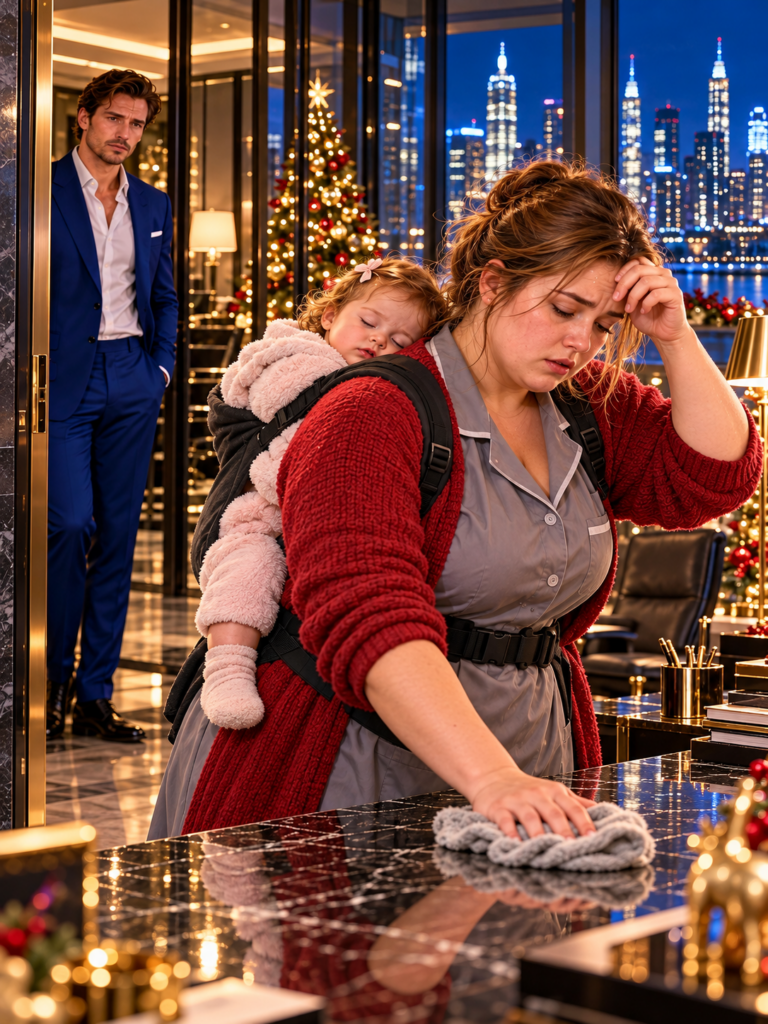
Hadley Rowan hurried past it with one hand on a cleaning cart and the other pushing a secondhand stroller whose left wheel squeaked every few feet.
Under a fleece blanket printed with little moons, ten-month-old Mae was wide awake.
And delighted.
That was the problem with babies, Hadley sometimes thought. They could find wonder in places where adults saw invoices.
Mae stared at the lights as if Christmas had been arranged specifically for her.
Hadley didn’t slow down.
At three that afternoon, Mrs. Penland, the woman who watched Mae during Hadley’s evening shifts, had called from urgent care. She had slipped on her back steps and fractured her wrist.
Hadley had tried everyone.
The upstairs neighbor.
The woman across the street.
A backup daycare on Broadway whose answering machine had cheerfully wished her a Merry Christmas before informing her that the facility was closed.
Missing the shift would cost Hadley her holiday bonus.
Worse, it would earn her another attendance point.
Three points meant termination.
So Mae had come to work.
Beside the elevators, Hadley stopped in front of a vending machine.
A bottle of water cost two dollars and twenty-five cents.
She stared through the glass, calculated automatically, and moved on.
Darla Haskins was waiting beside the supply closet.
Darla had supervised the night crew for eleven years. She was the kind of woman who noticed a missed baseboard from thirty feet away and who could tell from the sound of a mop bucket whether somebody had overfilled it.
She looked at the stroller.
The color drained from her face.
“I didn’t see anything,” Darla said quietly.
Hadley swallowed.
“Darla—”
“Keep her away from the cameras.”
That was all.
Darla took floors one through three.
Hadley took the fourth.
The fourth floor always smelled faintly of peppermint. Ninety years of candy manufacturing had soaked sweetness into the brick, and no amount of disinfectant had managed to scrub it out.
Hadley rolled her cart toward the corner office.
A brass plate beside the door read:
JUDE TOLBERT.
She parked Mae’s stroller where she could see it from inside.
Then she worked.
Wipe the desk.
Look up.
Empty the wastebasket.
Look up.
Clean the windowsill.
Look up.
Warm Mae’s bottle in the break room, hurry back, look up.
“You still there?” Hadley whispered.
Mae kicked beneath her blanket.
“Good girl.”
Hadley smiled.
She didn’t know somebody else was watching.
Across the hall, beyond the glass walls of a dark conference room, Jude Tolbert sat alone beside the windows.
He had been there since 4:52.
His mother was expecting him for Christmas Eve dinner in Sequoyah Hills.
She had expected him the year before too.
And the year before that.
Four Christmases.
Every December, Jude promised Glenda Tolbert that he would try.
Every December, he eventually found himself here instead, sitting in the dark above Knoxville while lights moved across the city below as though life were something happening to other people.
He heard the baby before he saw her.
A laugh rang through the quiet floor, bright and sudden.
Jude straightened.
Through the conference-room glass he saw the stroller.
Then the cleaning cart.
Then the young woman in a gray uniform.
His hand moved toward his phone.
There were rules governing contractors inside the building. Safety rules. Insurance rules. Building access rules.
Security was one call away.
Then Hadley started singing.
Not well.
Not even close.
She murmured half-remembered lines from “Rudolph the Red-Nosed Reindeer” while wiping his desk in long, methodical strokes. Every few seconds she turned toward the doorway.
Every few seconds she smiled at the stroller.
Jude placed his phone facedown.
This was none of his business, he told himself.
Yet he kept watching.
Inside his office, Mae had worked one arm free of her blanket.
Then another.
By the time Hadley looked down again, the baby was no longer in the stroller.
“Mae?”
A tiny hand appeared beside a low cabinet.
Hadley’s heart lurched.
Mae had crawled across the carpet and pulled herself upright against the shelving.
Behind a stack of old annual reports sat a small walnut box.
“Mae, don’t—”
Too late.
The box struck the carpeted floor.
Its lid sprang open.
A delicate melody began.
“Silent Night.”
Mae gasped with pleasure.
Hadley dropped to her knees.
Then, halfway through a note, the music stopped.
The brass hinge had snapped.
Hadley stared at the box.
“No. No, no, no.”
She tried pressing the hinge into place.
It wouldn’t hold.
Her fingers began trembling.
The box had been hidden behind dusty reports. She could return it there. Turn the broken side toward the wall.
Days might pass.
Weeks, perhaps.
Nobody might connect it to her.
She looked at Mae.
Mae stared back, solemn now, watching her mother.
Hadley exhaled.
“Yeah. I know.”
She pulled a work sheet from her folder and wrote in large, careful letters.
I broke this. My daughter knocked it down. I am very sorry. I will pay for it or repair it, whichever you prefer.
Hadley Rowan, night cleaning crew.
She added her telephone number.
Then she placed the box back on the shelf and propped the note against it where nobody could miss it.
Across the hall, Jude stopped breathing for a moment.
She thought she was alone.
That was what struck him.
There had been no audience for the decision.
No manager.
No camera facing inside his office.
No reward for admitting what had happened.
Hadley simply told the truth.
Then Mae coughed.
Hadley turned.
The second cough sounded different.
Hollow.
Sharp.
A bark.
Mae inhaled.
A high whistle followed the breath.
Hadley’s face changed instantly.
She lifted Mae and felt the baby’s ribs pull inward.
“Okay. Okay, sweetheart. Mama’s here.”
Another breath.
Another frightening whistle.
Hadley searched for her phone, but her hands no longer seemed to belong to her.
Behind her, the conference-room door opened.
She spun so quickly she nearly lost her balance.
A man stood in the darkened doorway.
Tall. Mid-thirties. Dark coat.
She knew his face.
His framed photograph hung downstairs.
Jude Tolbert.
Her first words were not a request for help.
“I’m sorry.”
Jude stared at her.
Hadley backed toward her cleaning cart, clutching Mae.
“I’m so sorry. I’ll finish the floor. I swear. I just—”
“Which hospital?”
She blinked.
Mae struggled for another breath.
“What?”
“Which hospital?”
Hadley looked down at her daughter.
“Children’s. East Tennessee Children’s Hospital.”
“My car is downstairs.”
She hesitated.
Only a second.
He noticed anyway.
She had come by bus. A Christmas Eve rideshare would cost money she didn’t have. And the man offering to drive her owned the building in which she had just violated nearly every contractor rule imaginable.
Mae coughed again.
Hadley grabbed the diaper bag.
In the elevator, she called the nurse line printed on the back of Mae’s insurance card.
The nurse listened to the cough through the phone.
“That sounds like croup. Bring her in. Cold air may help on the way.”
In the parking garage, Jude opened the back door of a dark gray sedan.
There was no child seat.
Hadley knew what the law required.
She also knew how Mae’s chest looked each time she inhaled.
Waiting felt more dangerous.
Jude started the engine.
Then he lowered every window.
Thirty-degree air rushed through the car.
Hadley wrapped Mae inside her coat and held the baby’s cheek against her throat.
“Breathe, birdie. Come on. Breathe.”
Jude drove.
Not recklessly.
Not slowly either.
Steady.
Controlled.
No one spoke.
On the Henley Street Bridge, above the dark Tennessee River, the sound coming from Mae’s throat changed.
The whistle softened.
Then softened again.
Hadley closed her eyes.
In front, Jude’s hands tightened around the steering wheel.
He was listening too.
Two strangers in a freezing car on Christmas Eve, both holding their breath so a little girl could get hers back.
At the emergency entrance, a nurse took one look at Mae and waved Hadley inside.
Jude stopped at the doors.
“I’ll wait.”
Hadley glanced back.
He didn’t follow.
The diagnosis was croup.
A doctor wearing reindeer socks listened to Mae’s lungs, administered a steroid, and told Hadley they would observe her for three hours.
“She’s going to be all right.”
Hadley nodded.
“You did the right thing bringing her in quickly.”
That almost broke her.
At registration, a nurse glanced toward the waiting room.
“And the gentleman outside?”
“He only drove us.”
The nurse wrote something down.
Accompanying adult.
Hadley was too exhausted to correct it.
For three hours, Jude Tolbert sat in a molded plastic chair beneath a television playing A Christmas Story with the sound muted.
He watched the doors.
At twelve forty-five, Mae was sleeping normally, cheeks pink again.
A nurse found them a temporary car seat.
Jude spent four minutes installing it incorrectly.
Hadley silently moved one strap, adjusted the angle, tightened the base, and tested it.
Jude watched.
“Better?”
She pushed the seat once.
“Now it is.”
They drove back toward Fountain City.
Mae slept.
At a red light on Broadway, Hadley finally asked the question she had been carrying all night.
“Are you going to report me?”
The light remained red.
Jude looked straight ahead.
“I don’t know yet.”
Hadley’s stomach dropped.
It wasn’t the answer she wanted.
But it was honest.
Somehow that frightened her more than a comforting lie.
Her duplex was dark when they arrived.
Plastic covered one of the front windows, taped carefully around the edges to keep the winter air out.
Jude saw it in the headlights.
He said nothing.
At the door, Hadley shifted Mae against her shoulder.
“Thank you. For tonight.”
He nodded once.
Then drove away.
At three in the morning, Jude returned to his office.
The walnut music box was exactly where Hadley had left it.
So was the note.
He read it twice.
My daughter knocked it down.
I will pay for it or repair it.
He folded the paper carefully.
Not like trash.
Like something he intended to keep.
Then he placed it inside the music box and lowered the damaged lid.
He remained in the office until the sky above the old city turned gray.
At 7:12 Christmas morning, Hadley’s phone vibrated beside her bed.
The message came from Gil Warner, owner of Warner Building Services.
YOU ARE REMOVED FROM THE TOLBERT ACCOUNT EFFECTIVE IMMEDIATELY. BUILDING SECURITY SENT ME VIDEO. CALL ME.
Hadley sat upright.
Beside her, Mae slept peacefully.
Jude’s answer returned to her.
I don’t know yet.
Apparently, she thought, by morning he had decided.
Christmas at the Rowan duplex didn’t look much like a greeting card.
Mae sat in her high chair wearing footed pajamas, slightly hoarse but cheerful.
Hadley stood at the stove making pancakes that were supposed to resemble snowmen.
They looked more like potatoes.
“Merry Christmas, birdie.”
Mae slapped both hands on the tray.
“Mama is an artist.”
Under the tabletop tree was one present: a board book about farm animals Hadley had found for a dollar at a thrift store.
She had wrapped it in Sunday comics.
Mae ate one corner of the wrapping paper and seemed delighted with the morning.
Hadley kept the baby monitor beside her anyway.
She listened to every breath.
And when Mae finally slept, the memory Hadley had spent twenty years outrunning found her again.
She was seven.
Her mother worked nights at a hosiery factory in Maryville.
One evening, there had been nobody to stay with her.
Her mother tucked her into bed, kissed her forehead, and locked the door.
Hadley woke near dawn to a stranger standing in the kitchen.
A woman.
Brown coat.
Folder held against her chest.
A neighbor had noticed a light on and no car outside.
Hadley spent the next four months living in somebody else’s house under somebody else’s rules.
When she finally went home, her mother hugged her too hard.
Neither of them was ever quite the same afterward.
At seven years old, Hadley had made herself a promise.
My child will never wake up alone.
That promise was why Mae had been at work.
Now somebody had seen her.
Two days after Christmas, Jude’s assistant, Lorna Teague, called him.
“Security logged your badge at three a.m. Christmas morning.”
“I forgot something.”
“That triggered an automatic holiday review.”
Jude closed his eyes.
Lorna continued.
“They pulled corridor footage. There’s an infant in it, Jude. The clip went to the cleaning contractor automatically. Procedure.”
He had reported no one.
He had only returned for the music box.
But the system had done the rest.
That evening, Jude unfolded Hadley’s note and called the number at the bottom.
She answered on the fourth ring.
“Hello?”
“This is Jude Tolbert.”
Silence.
“I didn’t report you. My badge triggered a security review. The footage went to your company automatically. I didn’t know until this morning.”
More silence.
Somewhere behind Hadley, Mae babbled.
“Okay,” Hadley finally said.
He knew immediately that she didn’t believe him.
“How is she?”
“Better. Loud.”
“Good.”
Another silence.
“The music box is still here,” Jude said.
“I said I’d pay for it or fix it.”
“I’d rather you fix it.”
Her voice steadied.
“My grandfather repaired watches. He taught me how springs worked before I learned how to ride a bicycle.”
“You don’t have to.”
“I wrote that I would.”
Jude looked at the folded note.
“Then I suppose you do.”
On Friday morning, Hadley left Mae with the upstairs neighbor for one hour and took a bus to Warner Building Services.
Gil Warner ran the company from a converted garage behind a brick ranch house off Clinton Highway.
He had started the business with one mop and a borrowed truck.
At fifty-four, he looked as though he had been carrying both ever since.
He didn’t yell.
That was worse.
“I watched the video three times,” he said. “Forty-seven minutes. Baby in a stroller. Chemical cart beside her.”
“I was eight feet away the entire time.”
“The camera doesn’t show that.”
“I was inside the office.”
Gil leaned back.
“Security also mentioned Mr. Tolbert was in the building.”
Hadley’s stomach tightened.
“That’s my problem,” Gil continued. “Tolbert renews at the end of the month. They’re forty percent of my business. If they fire us over this, eleven people lose jobs.”
Darla was one of those eleven.
Gil opened a drawer.
He slid a printed statement across the desk.
Hadley read the first sentence.
I, Hadley Rowan, confirm that Mr. Jude Tolbert granted me permission—
She stopped.
“Sign it,” Gil said. “You’ll have your shifts back Monday.”
Hadley looked at him.
“Did Mr. Tolbert tell you he gave permission?”
Gil didn’t answer.
“Did he?”
“If the client authorized the child—”
“He didn’t.”
Gil’s expression hardened.
“Hadley.”
“He didn’t even know I was there.”
She folded the statement once.
Placed it back on his desk.
Then stood.
“I was eight feet from my daughter. Jude Tolbert never gave me permission for anything.”
By Monday, every shift had disappeared from her scheduling app.
And Hadley understood exactly what telling the truth was going to cost.
Part 2
Hadley applied at a hotel laundry on Cumberland Avenue.
Then at Food City.
Then everywhere else she could reasonably reach by bus.
She wrote carefully in every blank on every application and smiled at every manager as though rent were not approaching and daycare didn’t require payment whether she had work or not.
On Tuesday, Jude called.
“I heard about your shifts.”
Hadley closed her eyes.
“There is an employee assistance fund attached to the company. It can replace lost wages until—”
“No.”
“Hadley—”
“Gil wanted me to sign something saying you gave me permission to bring Mae into the building.”
Jude went still.
“I didn’t sign it.”
“You should have told me.”
“Why?”
“Because he asked you to lie using my name.”
“And?”
“And I can deal with him.”
“That’s exactly why I didn’t tell you.”
Jude had no answer.
Hadley’s voice remained calm.
“I won’t take money from you either.”
“It’s not personal money.”
“It’s money I would only be receiving because you own the building.”
“You’re out of work because of something that happened in my building.”
“I’m out of work because Gil wanted me to lie and I wouldn’t.”
“That doesn’t make accepting help wrong.”
“No. But I don’t want it.”
A pause.
Then she said, “I’m not for sale, Mr. Tolbert. Neither is the truth.”
The line stayed quiet long enough that she wondered whether he had hung up.
Finally he said, “The music box?”
“Bring it Saturday. Ten.”
He arrived at exactly ten.
Hadley let him into the kitchen.
Only the kitchen.
Not the living room.
Not the hallway.
Her table had one unstable leg and a lemon-print vinyl cloth.
Jude seemed to understand the boundary without being told.
Mae was sleeping.
Hadley opened a worn leather case.
Inside were tiny screwdrivers, brass tweezers, picks, a loupe on a cord, and tools polished smooth by decades of use.
“My grandfather’s,” she said. “Odell Rowan. He repaired watches at a pawnshop in Maryville for thirty years.”
She fitted the loupe over one eye.
Then opened the walnut box.
Jude sat opposite her.
He watched her hands.
Small.
Chapped from cleaning chemicals.
Perfectly steady.
She knew he was watching.
This time, unlike Christmas Eve, she knew.
She worked anyway.
After several minutes, she said, “There’s a broken spring.”
“Can you replace it?”
“Maybe.”
She removed the damaged piece and set it carefully on white paper.
The following Monday, Hadley carried it in an envelope to Brickbill Jewelers on Kingston Pike.
The shop was narrow and crowded with clocks that ticked at different speeds.
Arlo Brickbill was seventy-eight and wore half-moon glasses.
He studied the spring.
Then opened one drawer.
Another.
A third.
Eventually he found a match.
Instead of handing it over immediately, he watched Hadley test it with tweezers.
“Who taught you to hold a tool that way?”
“My grandfather.”
Arlo nodded slowly.
Apparently that answered something.
The next Saturday, Jude arrived with a paper bag of peppermint sticks.
Hadley examined the red-and-white Tolbert label.
“Those are for you,” he said.
She looked at him.
“I bought them at Weigel’s on Broadway.”
“Full retail?”
“Full retail.”
She almost smiled.
Almost.
Halfway through the morning, Mae woke early from her nap.
She crawled into the kitchen wearing socks and made directly for Jude’s chair.
Before anyone could stop her, she seized a fistful of his trouser leg and pulled herself upright.
Jude froze.
Mae stared at him.
He stared back.
He did not pick her up.
He didn’t reach for her.
He simply kept both hands flat on the table and let her decide how long to hold on.
Hadley noticed.
The third Saturday, Hadley was the one who placed Mae in his arms.
Jude held the baby as though somebody had entrusted him with blown glass.
Mae patted his chin.
Then laughed.
“She likes you,” Hadley said.
“She has questionable judgment.”
His voice wasn’t quite steady.
By noon, Hadley had installed the replacement spring.
She turned the music box over to secure the final screw in the base.
That was when she saw the inscription.
Small letters.
Worn at the edges from someone’s thumb passing over them again and again.
For Avery Jane.
Hadley’s hand stopped.
She did not look up.
She did not ask.
She tightened the final screw and turned the box upright.
Across the table, Jude had gone completely still.
He knew she had seen it.
She knew he knew.
Mae babbled in his lap.
Neither adult said a word.
But after he left, Hadley stood at the window longer than she intended.
Avery Jane.
A daughter?
A wife?
Someone dead?
Someone who had left?
She disliked how badly she wanted to know.
Two days later, at nine Monday morning, somebody knocked on her door.
Hadley opened it with Mae balanced against her hip.
A woman stood on the porch.
Brown coat.
Folder against her chest.
State identification clipped near the pocket.
For one terrifying instant, Hadley was seven years old again.
“Ms. Rowan? I’m Shay Lowry. Tennessee Department of Children’s Services.”
Hadley couldn’t feel her hands.
Shay sat at the same kitchen table where Jude had sat two days before.
She was somewhere in her forties, reading glasses pushed into graying hair.
Not warm.
Not cold.
Careful.
The way people became careful when their job punished assumptions.
“I want to make something clear,” Shay said. “A report is not a finding. My job is to determine what happened.”
Hadley nodded.
Mae sat on the floor chewing a plastic spoon.
“The report was submitted by your employer.”
“Gil Warner.”
“Yes.”
Of course.
“He states that on Christmas Eve, your daughter was left unattended in a stroller beside cleaning chemicals for forty-seven minutes and required emergency medical care later that night.”
Shay turned a tablet around.
The corridor outside Jude’s office appeared on-screen.
Gray security footage.
Poor angle.
The stroller stood alone in the doorway.
The cleaning cart beside it.
The timestamp advanced.
Minute after minute.
No adult crossed the image.
Forty-seven minutes.
Hadley stared.
From the camera’s perspective, Gil’s statement looked exactly right.
“I was there.”
Shay watched her.
“Where?”
“Inside the office. Eight feet away.”
“The camera doesn’t show that.”
“It can’t see behind the doorframe. I looked at Mae constantly. Every time I raised my head.”
“Can anyone verify that?”
Hadley stood.
She opened the drawer near the sink and returned with a folder of her own.
Mae’s hospital discharge papers.
Vaccination records.
Every appointment documented.
Daycare schedule.
The holiday closures circled.
Mrs. Penland’s Christmas Eve message timestamped 3:04 p.m.
Fell. Broken wrist. I’m so sorry, honey.
Shay read everything.
Then she put down her pen.
“Was anyone else on that floor?”
Hadley said nothing.
Her entire life had been built around not needing another person to explain her.
Especially not a wealthy man who owned the building.
But truth wasn’t independence.
Truth was truth.
“There was one person,” she finally said. “I didn’t know he was there at the time.”
Hadley stepped onto the back porch and called Jude.
“Child Services is here. Gil filed a report.”
She heard him stand.
Before he could answer, she said, “If you come, tell her what you saw.”
“I will.”
“Only what you saw.”
A pause.
“Hadley—”
“Don’t defend me. Don’t tell her I’m a good mother. Don’t tell her what kind of person you think I am. That’s mine to prove.”
Jude was silent.
“Do you understand?”
“Yes.”
“And don’t make this about who you are.”
Another pause.
“Twenty minutes.”
He arrived in eighteen.
Jude sat opposite Shay.
“I entered the building at 4:52 that afternoon. You can verify the access log.”
Shay wrote.
“I sat in the conference room across the corridor. The lights were off. The walls are glass and the room faces my office.”
“Why were the lights off?”
“Personal reasons. I didn’t want anyone to know I was there.”
Shay wrote that too.
“The child was not alone,” Jude continued. “Ms. Rowan worked inside my office. Every time she looked up, she checked the stroller.”
“Every time?”
“Every time.”
“How can you be certain?”
“Because I was waiting for her to stop.”
Hadley looked at him.
Jude reached inside his coat and removed a folded piece of paper.
“The child knocked an object from a shelf. It broke. Ms. Rowan could have put it back. Nobody would have known for some time.”
He placed the note on the table.
“She wrote this instead.”
Shay unfolded it.
Her gaze moved slowly across Hadley’s handwriting.
Then Shay reached into her own file.
She removed another page.
“Hospital intake record.”
Halfway down the form were two hurried words.
Accompanying adult.
“Mr. Tolbert,” Shay said, “Mr. Warner included another statement.”
She read it.
“It appears the chief executive and cleaning employee have a personal relationship.”
The kitchen seemed to contract around Hadley.
“I drove her to the hospital,” Jude said.
“That’s all?”
“Yes.”
“You understand my problem.”
Jude said nothing.
“My only independent witness is the same person the reporting party alleges has a personal involvement with the mother.”
Hadley’s stomach turned.
The one man who had seen the truth had become the one witness someone could argue was biased.
At the door, Shay paused.
“The investigation may remain open for up to forty-five days. I’ll need to speak to your employer and your daughter’s daycare.”
Then she left.
Jude’s phone vibrated on the table.
Lorna.
He read the message.
His expression changed.
“What?”
“Gil Warner called my office. He wants to resolve things before his contract renewal.”
The next morning, Jude met Gil at a Waffle House off Clinton Highway.
At seven, the restaurant was half full of truck drivers and nurses ending night shifts.
Gil was already in a corner booth.
“I’ll make this quick,” he said. “The report’s been filed. Can’t change that.”
Jude said nothing.
“But reports can be clarified. Employers reconsider details all the time.”
“What details?”
“Timing. Distance. Perspective.”
“What would cause you to reconsider?”
Gil stirred his coffee.
“Your contract ends this month.”
Jude studied him.
Until that moment, he had believed Gil Warner was frightened.
A small-business owner facing a mistake that could cost eleven employees their jobs.
Then Jude understood.
Gil had known exactly what he was doing.
And now he was bargaining with a child’s welfare investigation.
That evening Jude stood in Hadley’s kitchen wearing the coat he had not yet removed.
“I can end this.”
Hadley looked up from the table.
“I’ll cancel his contract tomorrow. I’ll send the matter to counsel. He filed false information and now he’s effectively admitted he wants commercial consideration in exchange for changing it.”
“No.”
“Hadley.”
“No.”
“He used your daughter.”
“I know what he did.”
“Then let me—”
“If you cancel that contract, eleven people lose work in January.”
“I can find them other positions.”
“And then what?”
Jude stopped.
“What does Child Services see? A CEO using attorneys and jobs to protect a cleaning woman?”
She pressed both palms against the table.
“It will look exactly like what Gil wrote.”
“That doesn’t make it true.”
“It doesn’t have to be true to complicate an investigation.”
“I’m trying to keep you from being hurt because you told the truth.”
Hadley looked exhausted suddenly.
Not angry.
Worn through.
“Protecting me isn’t the same as deciding for me.”
The sentence stopped him.
She sank into a chair.
Nearly three weeks without shifts.
Rent due on the first.
Daycare due on the first.
Enough money for one.
Not both.
When she spoke again, her voice was smaller.
“I don’t even know you.”
Jude stared at her.
“You sit at this table every Saturday. You know my daughter. You know what groceries I buy because they’re sitting behind you. You know my grandfather’s name.”
She raised her eyes.
“I don’t know one real thing about you.”
Jude knew what was coming before she said it.
“Who is Avery Jane?”
He went completely still.
Hadley watched him try to answer.
His mouth opened.
Nothing came.
Then he picked up his keys.
Walked toward the door.
So that was the boundary, Hadley thought.
He could enter her life.
See her poverty.
See her fear.
See her child.
But whatever lived inside that walnut box belonged behind locked glass.
“Every time you get close to me,” she said to his back, “somebody is watching us.”
His hand stopped on the doorknob.
“Please don’t come back.”
He left.
The next morning, Lorna brought Jude Warner Building Services’ renewal file.
“I assume you’re canceling?”
“Extend it sixty days.”
Lorna stared.
“After what he did?”
“Eleven people work for him.”
“Jude—”
“They didn’t do anything.”
He signed.
He did not call Hadley.
He did not drive past her duplex.
He did not ask Lorna for updates.
Respecting the boundary she had set was one of the hardest things he had done in four years.
Thursday, Mae’s daycare director asked Hadley to step into the office.
“The state called.”
Hadley’s fingers went cold.
“Routine questions,” the woman added quickly. “I’m sure it’s nothing.”
Hadley smiled.
“Thank you for telling me.”
She made it as far as the bus shelter before she had to sit down.
Friday, Hadley returned to Brickbill Jewelers to bring back a pair of tweezers Arlo had lent her.
The old jeweler looked over his glasses.
“I need somebody in this shop.”
Hadley stopped.
“Somebody with hands like yours.”
For one reckless second, hope opened inside her.
Arlo continued.
“One question I ask everybody. Any open issues with law enforcement or a state agency?”
Hadley could have lied.
He would never have known.
“Yes, sir.”
His expression fell.
“Child Services. The allegation isn’t true, but the investigation is open.”
Arlo removed his glasses.
“Then I can’t hire you yet, sweetheart.”
Hadley nodded.
“I understand.”
“I am sorry.”
“I know.”
Understanding was somehow the worst part.
That night she sat on the kitchen floor with her back against the cabinets.
Two envelopes waited on the table.
Rent.
Daycare.
She could pay one.
At 11:58, headlights moved across the plastic covering the front window.
A car door shut.
Footsteps crossed the porch.
Hadley picked up her phone and approached without turning on a light.
Through the glass she saw a heavy coat.
Gray braid.
A face she knew.
Darla Haskins.
Behind her, inside an old Buick, a little boy slept against the rear window.
Hadley opened the door.
Darla’s eyes were red.
“Gil didn’t identify you from that video,” she said.
Hadley frowned.
“I’m the reason he knew it was you.”
Darla sat at the lemon-covered kitchen table and told Hadley everything.
For two years, she had sometimes brought her grandson Tucker to work.
His mother worked nights at a nursing home in Halls.
When there was nobody else, Darla hid Tucker in a second-floor supply closet with a sleeping bag.
“Christmas Eve, Gil watched the video and called me.”
Darla’s hands twisted around her purse strap.
“He asked whose baby it was.”
Hadley already understood.
“I knew if he started looking, he’d find Tucker.”
“So you told him.”
Darla’s eyes filled.
“I gave him your name.”
Hadley looked toward the Buick outside.
“I told him you were inside the office,” Darla rushed on. “I told him you were checking Mae constantly. He knew she wasn’t abandoned.”
She pulled out her phone.
Her hands shook as she opened an old message.
KEEP QUIET ABOUT YOUR GRANDSON AND YOU KEEP YOUR JOB.
Hadley read it twice.
Darla wiped at her face.
“I stayed quiet.”
Hadley placed a hand over hers.
“I don’t know why.”
“You were scared.”
“That doesn’t make it right.”
“No.”
Darla looked at her.
Hadley squeezed her hand once.
“Then tomorrow we stop being scared alone.”
Part 3
The next morning, Hadley and Darla sat side by side in Shay Lowry’s office at the Department of Children’s Services.
Darla told her everything.
The hidden sleeping bag.
Tucker’s nights inside the building.
Gil’s Christmas Eve call.
Hadley’s location eight feet from Mae.
The threat.
The text message.
Even the parts that could cost Darla her own job.
Shay photographed the message.
When she finished, she looked at Darla.
“That took courage.”
Darla rubbed her eyes.
“It took two years too long.”
That evening, Hadley and Darla drove to the converted garage off Clinton Highway.
Jude had offered to come.
Hadley had refused.
This part belonged to them.
Gil sat behind his desk.
When he saw both women enter together, something in his face collapsed.
“You lied about my daughter,” Hadley said.
She didn’t raise her voice.
“You said she was alone when you knew I was inside that office.”
Gil pushed back from his desk.
“Hadley—”
“You knew exactly where I was. You threatened Darla so she’d stay quiet.”
“I didn’t threaten anybody.”
Darla raised her phone.
Gil stopped.
Behind them, a side door creaked.
A woman wearing a cardigan stood there holding a stack of invoices.
Bonnie Warner.
Gil’s wife.
She had kept the company’s books for twenty-six years.
“Gil,” she said quietly. “What did you do?”
He covered his face with both hands.
“This company started with a mop,” he said. “I was going to lose everything over a baby in a hallway.”
Bonnie crossed the room.
She placed a yellow legal pad on the desk.
Then a pen.
“Write it down.”
Gil looked at her.
“Bonnie—”
“All of it.”
Nobody spoke.
“The distance,” Bonnie said. “The timing. What you knew. What you wrote anyway.”
Gil picked up the pen.
It took him twenty minutes.
The following week, Bonnie took over Warner Building Services.
Gil stopped coming to the garage.
The Tolbert contract remained in place.
Darla kept working.
And Hadley waited.
January passed slowly.
So did the first half of February.
Then a letter arrived from the State of Tennessee.
Hadley opened it on the front step.
Mae sat bundled in her lap.
Hadley read one phrase.
Then read it again.
Unsubstantiated.
She lowered the letter.
For the first time since Christmas Eve, Hadley cried.
Not quietly.
Not neatly.
Weeks of fear came out at once.
Mae watched her, confused.
Then patted Hadley’s cheek with one mittened hand.
That evening, Darla let Hadley into the Tolbert building.
“He’s up there most nights,” she said. “Lights off.”
The fourth floor still smelled of peppermint.
The conference room was dark.
Jude sat in the same chair beside the window where he had watched her on Christmas Eve.
City lights glowed below him.
Hadley entered.
He turned.
She carried the walnut music box.
Jude rose slowly.
Hadley placed it on the table.
The brass hinge was repaired.
The walnut had been cleaned and polished.
“It works,” she said.
He stared at it.
Then at her.
“Your case?”
“Closed.”
His shoulders shifted with a breath.
“Good.”
Hadley waited.
Jude ran one finger along the lid.
Then he said, “She was my daughter.”
Hadley sat down.
Jude did not.
“Four years ago. Early December. Kendall was thirty-four weeks pregnant.”
His voice had changed.
The CEO was gone from it.
So was the man who had once calmly offered a hospital ride while a baby struggled to breathe.
“There was no heartbeat.”
Hadley remained still.
“They told us on Thursday.”
Jude swallowed.
“Avery was born Friday.”
The room seemed to shrink around his words.
“And Monday,” he continued, “I came to work.”
Hadley looked at him.
“I walked into this building and acted like nothing had happened. Kendall stayed home and fell apart. I negotiated a distribution agreement.”
He gave a quiet, humorless breath.
“A year later she left.”
“Your wife?”
He nodded.
“Kendall.”
Hadley looked toward the box.
“Did you ever talk about Avery?”
“Kendall did.”
“You didn’t?”
“No.”
“Not even her name?”
Jude’s expression answered before he did.
“She told me that once. Near the end. That I had never said our daughter’s name after the hospital.”
His hand rested on the walnut lid.
“She was right.”
Hadley understood the box now.
“Was this for the nursery?”
“Yes.”
“It plays ‘Silent Night.'”
“Yes.”
“And you kept it behind old reports.”
Jude’s fingers curled slightly.
“I could wind it. I could open it. But every time it played, I stopped it before the song finished.”
“For four years?”
“Yes.”
He looked toward the conference-room glass.
“Christmas Eve, I heard Mae laughing. Then I watched you singing to her in my office.”
Hadley said nothing.
“I saw you checking that stroller every few seconds. I saw her knock the box down. I saw you write the note when you thought nobody was watching.”
His voice became rougher.
“And I couldn’t move.”
“Until Mae couldn’t breathe.”
“Until Mae couldn’t breathe.”
For a while, neither spoke.
Jude looked down.
“I think some part of me believed that if I never talked about Avery, I could keep what happened contained. I could make one sealed room in my life where nothing moved.”
He touched the repaired hinge.
“Then your daughter dropped it on the floor.”
A tiny smile almost appeared on Hadley’s face.
“Mae has never respected sealed rooms.”
“No.”
Jude’s smile vanished again.
“I don’t know how to do this.”
Hadley picked up the music box.
She placed it in his hands.
“Say it.”
He stared at her.
“Her name.”
Jude’s breathing changed.
“She should hear you say it.”
Hadley stood.
Then she walked out of the conference room and gently closed the glass door.
She did not disappear entirely.
She waited in the dark corridor.
Jude sat alone.
He turned the small key.
The mechanism tightened.
The lid rose.
A melody began.
“Silent Night.”
The same melody Mae had interrupted on Christmas Eve.
The same song Jude had refused to allow past a certain point for four years.
His shoulders trembled.
“Avery Jane.”
The cylinder turned.
“Avery Jane,” he said again.
The song reached the note where it had stopped after Mae dropped the box.
Then continued.
One note.
Another.
Another.
Jude bowed his head over the music box.
Hadley stood beyond the glass with one hand pressed against it.
This time she was the one watching.
And when the song reached its final note, Jude did not stop it.
One year later, every clock inside Brickbill Jewelers announced noon at slightly different times.
Hadley Rowan barely noticed anymore.
She sat at the repair bench wearing a canvas apron, a loupe fixed over one eye, carefully resetting the balance wheel in a 1952 Hamilton watch whose owner wanted it working before Christmas.
She now worked mornings.
Eight until four-thirty.
Her health-insurance card had her own name printed across the front.
Mae went to daycare and returned home with glitter in her hair often enough that Hadley had stopped asking where it came from.
Arlo hired Hadley the week after the Tennessee letter arrived.
When she reminded him about the investigation, he waved one hand.
“You answered me truthfully when lying would have been easy.”
He pointed toward the repair bench.
“That’s the whole business, sweetheart.”
Now he told customers that when he retired, Hadley would inherit the bench.
Her life had improved.
Not magically.
She still checked grocery prices.
Still put things back on shelves.
Still calculated bills before buying anything unnecessary.
In June, she bought an eleven-year-old Toyota Corolla.
Everything she owned, she had earned.
Nothing had come from Jude.
That mattered to Hadley.
And Jude understood why it had to matter.
Darla now ran the Warner night crew under Bonnie’s management.
One new rule appeared inside every supply closet.
Bonnie had typed it herself.
NO ONE GETS FIRED BECAUSE THEIR CHILD IS SICK.
Jude changed too.
Not dramatically enough for magazines.
In April, he called Kendall for the first time in three years.
They spoke for nearly an hour.
At the end, Kendall cried.
“Thank you,” she told him.
“For what?”
“For saying her name.”
In May, a wooden bench appeared beside a trail at Ijams Nature Center, overlooking quarry water.
Its small brass plaque read:
AVERY JANE.
Most evenings, Jude began going home before seven.
Hadley and Jude did not rush toward romance simply because grief had been confessed or because danger had passed.
There were Saturday coffees at a little place on Broadway.
There was a bookshelf for Mae that Jude assembled without reading the instructions, discovered was backward, and assembled again.
There were arguments about schedules.
There were long conversations in which neither person tried to win.
There were evenings when both were too exhausted to be romantic and ate cereal on Hadley’s couch instead.
Jude never offered to fix her window.
Hadley eventually replaced it herself.
He didn’t offer to buy her a car.
When she bought the Corolla, he asked whether she wanted him to look at it.
“No.”
“Good.”
“You didn’t even hesitate.”
“I’m learning.”
She laughed.
It was slow.
Ordinary.
That was what made it real.
On Christmas Eve, one year after Hadley had pushed a squeaking stroller through the Tolbert lobby, Jude drove Hadley and Mae to his mother’s house in Sequoyah Hills.
He had not sat at that Christmas table in five years.
Glenda Tolbert opened the door wearing a red sweater.
She stopped.
Her eyes moved from her son to Hadley.
Then to Mae.
Mae was almost two now and wore shoes that flashed pink every time she stomped on the welcome mat.
Glenda looked back at Jude.
Her son was smiling.
Not politely.
Not for a photograph.
Actually smiling.
Glenda did not say a word.
She turned, walked to the dining-room cabinet, and quietly added two more plates to the table.
After dinner, Jude and Hadley stood on the back porch.
The air was cold and clean.
Below the hill, the river reflected the city lights.
Inside, Mae was attempting to convince Glenda that Christmas cookies were an acceptable substitute for vegetables.
Jude rested both hands on the porch rail.
“I used to think loving someone meant watching them.”
Hadley looked at him.
“Watching?”
“Close enough that nothing bad could happen.”
He looked toward the dark river.
“Then Avery died anyway. And I couldn’t protect Kendall from what happened after. So I stopped watching anyone at all.”
Hadley pulled her coat tighter.
“I used to think being watched meant being judged.”
Jude glanced at her.
She smiled faintly.
“I had reasons.”
“So did I.”
Neither pretended those reasons had disappeared.
Jude turned toward her.
“I can’t promise you a fairy tale.”
“Good.”
“I won’t fix your life.”
“It doesn’t need fixing.”
“I know.”
He took a breath.
“I want to walk beside you. Not ahead of you.”
Hadley said nothing.
“And I don’t ever want to make your decisions for you.”
Through the glass door, Mae appeared.
She pressed her nose against the window and pointed urgently toward the Christmas lights outside.
Hadley looked at her daughter.
Then at Jude.
A small pink coat was draped over a porch chair.
Hadley picked it up.
“She wants to see the lights.”
Jude waited.
Hadley held the coat toward him.
“Can you help her put this on?”
For a moment, Jude only looked at it.
Then he understood what she was offering.
Not surrender.
Not rescue.
Trust.
A place beside her.
He took the coat.
Mae fought him through the entire process, refusing to put her second arm into the sleeve with the stubborn commitment of a person defending a constitutional right.
Jude eventually got the zipper closed.
Mae immediately ran to Hadley.
Then ran back to Jude.
Later, the walnut music box rested beneath Glenda’s Christmas tree.
The hinge was whole.
The wood gleamed.
Mae knelt in front of it and seized the winding key with both hands.
She twisted.
Nothing happened.
She frowned.
Tried harder.
Jude crouched beside her.
Instinctively, he reached out.
Then stopped.
He looked across the room at Hadley.
Hadley saw the question.
She nodded.
Jude placed his hand around Mae’s little hand.
Together they turned the key.
The lid opened.
“Silent Night” filled the room.
Glenda pressed a hand to her heart.
Someone in the kitchen stopped washing dishes.
Mae swayed in her flashing shoes, humming something that bore very little resemblance to the melody.
Jude sat on the floor beside her.
He listened as the song moved through every note.
All the way to the end.
Then he looked at Hadley.
Once, he had watched her through a wall of dark glass while she believed herself alone.
This time, she knew he was watching.
And she let him.

