
Part 1
“Twenty-five dollars!”
Royce Amler said it loud enough for nearly sixty people inside Ness Feed and Implement to hear.
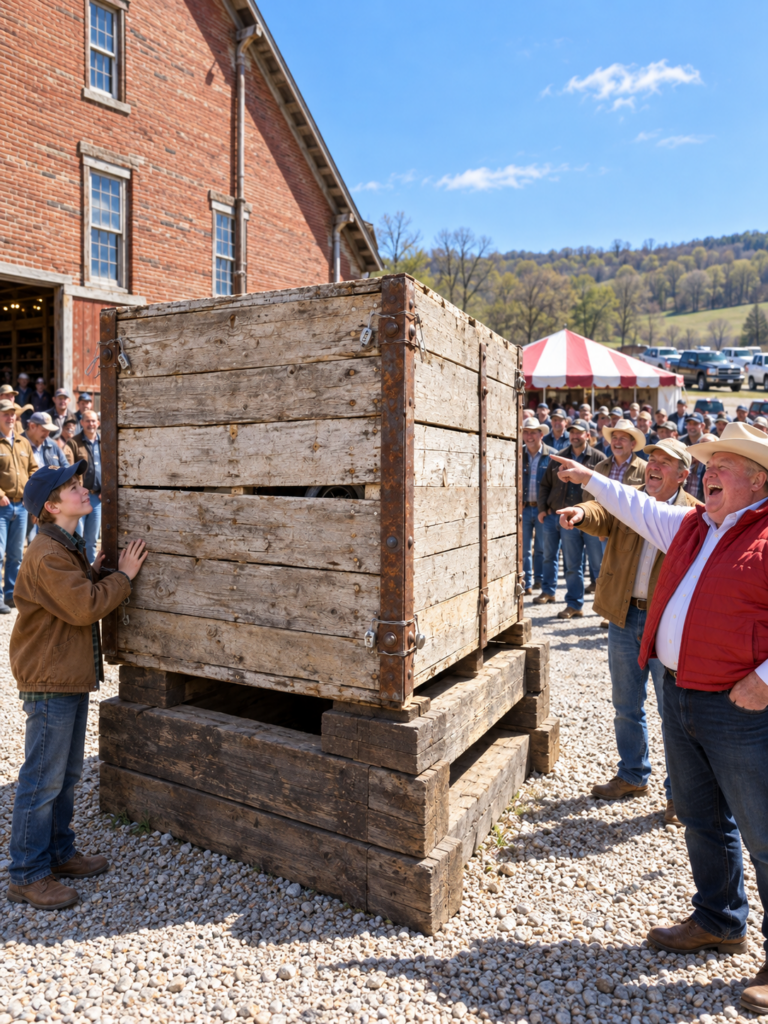
He stood near the auctioneer’s platform in his familiar red quilted vest, grinning as he pointed toward the enormous wooden crate at the back of the feed barn.
“Folks, the Pelfrey boy just paid twenty-five dollars for a box of rotten barn boards.”
Laughter rolled across the concrete floor.
Some men shook their heads. Others turned to get a better look at the skinny twelve-year-old standing beside the auction clerk, carefully counting quarters into his hand.
Royce wasn’t finished.
He stepped closer, bent slightly at the waist, and lowered his voice just enough to make the insult feel personal while keeping it loud enough for everyone nearby to hear.
“Better hang on to whatever change you’ve got left, son. Your mother’s gonna need it for the moving truck.”
That brought another round of laughter.
Owen Pelfrey didn’t answer.
He stood in his worn brown canvas jacket with his eyes lowered toward the money in his hand.
The crate behind him was nearly seven and a half feet tall, twelve feet long, and six feet wide. Its whitewashed boards were streaked with age. Rusted iron straps held it together, and years of dust had settled into every crack.
Nobody in the building knew what was inside.
Nobody had bothered to find out.
And now a twelve-year-old boy who didn’t have enough money for a decent bicycle had spent almost everything he owned on it.
But Royce’s remark about the moving truck was more than ordinary teasing.
Royce owned the farmhouse where Owen lived with his parents.
In five weeks, that house and the forty acres surrounding it would be sold at auction.
Unless something extraordinary happened, the Pelfrey family would have to leave.
And Royce knew it.
He knew it so well that he was willing to make a joke of it in front of half the town.
Owen finished counting his money.
One twenty-dollar bill. Four singles. And four quarters.
Twenty-five dollars exactly.
The money had taken him an entire summer to save, mowing the grass outside the Methodist church every Thursday.
He pushed the last quarter across the clerk’s table.
Marv Tuttle, the auctioneer, watched the transaction with a puzzled smile.
“Well, son,” Marv said, “lot number two-oh-six belongs to you.”
He glanced toward the massive crate.
“Only one condition. You bought it, you move it. Saturday at noon is your deadline.”
Someone near the loading door whistled.
Another man called, “Better get yourself a bigger bicycle, Owen!”
Royce’s brother, Dwight, laughed and said he’d seen smaller corn cribs.
Owen folded his empty wallet and put it back in his pocket.
Then he looked once at the crate.
“I’ll get it moved,” he said.
He wasn’t loud.
He wasn’t trying to impress anybody.
But there was something about the certainty in his voice that made Marv stop smiling for a moment.
Ness Feed and Implement had stood at the edge of Ashby Mill for 112 years.
The original brick building had survived blizzards, droughts, floods, the Depression, and enough changes in farming to make most of its earliest equipment look like museum pieces.
Generations of farmers had bought seed, tools, feed, and machinery there.
Now the business was closing for good.
Everything that could be sold had been placed on the auction list.
Old scales. Grain cleaners. Hand tools. A rolltop desk. Shelving. Wagons. Forgotten equipment.
The enormous crate had been saved for last because Marv had no idea what to call it.
It had been sitting in the same rear corner for longer than anyone could remember, hidden behind pallets of feed sacks.
Its oak boards had been painted white so many times that most of the original lettering had disappeared.
Nine iron straps circled the box, each secured with a small gray wire seal.
Not one seal had been broken.
Marv had started the bidding at one hundred dollars.
Nobody raised a hand.
He dropped to fifty.
Still nothing.
When he reached twenty-five, someone suggested buying it for firewood.
That was when Owen raised his hand.
He had been watching that crate since the preview day.
And unlike everyone laughing around him, he had a reason.
As Owen turned to leave the barn, a thin hand caught his sleeve.
“Boy.”
Owen looked down.
Walt Ness sat in a folding chair beside the old office door, his wooden cane resting across his knees.
At ninety-one, Walt had watched nearly the entire history of the business unfold. His grandfather had owned it first, then his father, and finally Walt himself.
The closing auction had taken away more than a building from him.
It had ended something his family had spent generations keeping alive.
Walt glanced past Owen toward the crate.
“That box was sitting there before I was born,” he said quietly.
Owen waited.
“My father never let anybody touch it. Wouldn’t even let the hired hands move it.”
“Did he tell you why?”
Walt’s eyes remained on the faded wood.
“No. Just said it belonged where it was.”
He tightened his fingers around Owen’s sleeve.
“Whatever you do, don’t let anybody rush you into opening it.”
Owen felt a strange warmth move through his chest.
All afternoon, people had treated his purchase like a joke.
Walt Ness was the first person who seemed to think the crate might actually matter.
“I won’t,” Owen promised.
Saturday morning arrived cold and bright.
By nine o’clock, a small crowd had gathered behind the old feed barn.
Word had traveled quickly through Ashby Mill. People wanted to see how a twelve-year-old planned to move a crate that looked heavier than a small building.
Lonnie Vic arrived in his battered flatbed truck.
Lonnie was seventy-four, a retired machinist with a white mustache, broad hands, and a patient manner that made him seem impossible to hurry.
For years, he had been Owen’s neighbor, teacher, and unofficial grandfather.
When Owen wanted to understand how an engine worked, Lonnie explained it.
When something broke, Lonnie showed him how to repair it rather than doing the work for him.
And when Owen came to him asking for help moving a mysterious wooden crate, Lonnie had agreed before asking what was inside.
Now he walked slowly around it, examining the boards, the straps, and the heavy oak skids underneath.
He knelt and pressed his palm against one of the timbers.
“That’s good oak,” he murmured.
He stood and studied the dimensions again.
“Wouldn’t surprise me if this thing weighs close to three tons.”
Rhonda Pelfrey looked at her son.
“Three tons?”
Owen swallowed.
Lonnie nodded.
“Whoever built this box expected it to travel a long way. Those skids aren’t decoration.”
Rhonda folded her arms against the cold.
She worked as a rural mail carrier, driving ninety-four miles of gravel road every day in an aging station wagon. Her route required her to steer and operate the car from the passenger side so she could reach the mailboxes.
She had taken the morning off without pay to help her son.
That wasn’t a small sacrifice.
In the Pelfrey household, every missed hour mattered.
Before leaving home, she had asked Owen one question.
“Are you sure about this?”
He had looked at her and said yes.
She didn’t understand what he had bought.
But she understood that her son wasn’t the kind of boy who spent his savings carelessly.
So she had come.
Lonnie positioned his truck, fed the winch cable into the barn, and attached it to a heavy chain wrapped around the crate’s skids.
He checked the connection twice.
Then he ordered Owen and Rhonda to stand behind the fence.
When the cable tightened, the old crate groaned.
Dust poured from its top in a long gray cloud.
For one awful moment, nothing moved.
Then the massive box shifted.
An inch.
Another inch.
The oak skids scraped across the concrete.
Slowly, steadily, it emerged from the corner where it had stood for more than a century.
Nobody laughed while the winch was pulling.
There was too much weight in motion, too much old wood creaking beneath the strain.
But when the crate finally reached the flatbed, Royce Amler found his voice again.
He was leaning against his pickup, watching with Dwight beside him.
“Where you planning to put that thing, son?”
“In the machine shed,” Owen answered.
Royce lifted his eyebrows.
“That’s my shed you’re talking about. Don’t go breaking the floor.”
“I won’t.”
“And remember, it’s all getting sold next month.”
Owen looked directly at him.
“It’ll be gone before the sale.”
Royce grinned.
“Sure it will. Might take you all winter to burn that much wood, though.”
Several men laughed.
Owen climbed into Lonnie’s truck without replying.
They drove the crate home at fifteen miles an hour, taking the county road with the caution of men moving something that couldn’t be replaced.
The Pelfreys lived on the old Amler home place along Plum Creek.
The white farmhouse sat among forty acres of pasture and creek bottom, with a red machine shed that Royce’s grandfather had built decades earlier.
It wasn’t a grand house.
The porch steps creaked. The kitchen windows rattled during hard winds. Rainwater sometimes collected along the back foundation.
But Owen had lived there since he was six.
He knew which floorboard outside his bedroom squeaked, where the spring mud stayed longest, and how the creek sounded when it rose after three days of rain.
His mother had planted flowers beside the porch.
His father had repaired the fence whenever he was home.
And the shed was where Owen spent his happiest hours, taking apart old machinery and trying to understand how to put it back together.
Lonnie backed the truck toward the wide shed doors and carefully winched the crate down onto a prepared bed of railroad ties.
The enormous box nearly filled the building.
When the truck finally pulled away, Owen stood looking at it.
For the first time, he had the strange realization that whatever was inside now belonged to him.
That evening, Rhonda found him in the shed.
He was sitting on an overturned bucket, staring at the crate.
“All right,” she said.
Owen looked up.
“Now tell me what you bought.”
He hesitated.
“I’m not completely sure.”
Rhonda studied him.
“Then why did you spend your money on it?”
“Because I think it’s something different.”
“Different how?”
“I think it’s machinery. Really old machinery.”
She turned toward the box.
“Then shouldn’t we open it?”
“No.”
The answer came so quickly that she looked back at him.
“Not yet,” Owen added. “Maybe not at all. At least, not me.”
Rhonda stepped closer.
“Would you mind explaining that?”
Owen stood and walked toward the back corner of the crate.
A week before the auction, during preview day, he had been studying the equipment at Ness Feed and Implement while the adults inspected the more obvious bargains.
Everybody had walked past the old crate.
Everybody except Owen.
He noticed that one board near the bottom had shrunk slightly away from the next, leaving a narrow opening.
He carried a small flashlight because he often used it to check the well pump.
He pressed the flashlight against the gap and looked inside.
There wasn’t much room to see.
But the beam struck something black.
Curved iron.
He adjusted the angle and saw square metal cleats fastened along the curve.
Then, farther inside, a cast-iron hub.
He knew that shape.
It looked like the rear wheel of a tractor from the earliest days of mechanized farming, before rubber tires became common.
There was something else.
A smell.
Old grease.
Not dirty, burned grease from an engine that had worked through years of dust and mud.
Clean, preserved grease.
The kind that belonged to machinery that had been protected from the world.
For four summers, Lonnie had taken Owen to the annual Thresher Reunion at the county fairgrounds.
Owen loved those three days more than any holiday.
He could spend hours looking at steam engines, old tractors, belt-driven threshing machines, and mechanical designs that most people no longer recognized.
He had read every tractor book in the Ashby Mill Public Library, some more than once.
And one afternoon, when they were examining a rusted machine salvaged from a creek bed, Lonnie had told him something that had never left his mind.
“Used iron is everywhere, Owen. You can always find more of that. But iron that was never used? That’s a different matter.”
At the time, Owen had only partly understood.
Now, standing in his shed, he could almost hear Lonnie’s voice again.
A sealed crate might hold a machine that hadn’t run a single day.
And if someone opened that crate carelessly, destroyed the original packaging, or threw away the seals, something important could be lost forever.
Rhonda listened as her son explained what he had seen.
Then she rested one hand against the cold oak.
“So you don’t know what kind of machine it is.”
“No, ma’am.”
“But you think it might be valuable.”
“I think it might be important.”
She was quiet for a moment.
Outside, wind moved through the bare trees along Plum Creek.
Finally, she looked at him.
“Those aren’t always the same thing, honey.”
Owen nodded.
He knew.
And there was a reason he desperately wanted the two things to be the same.
In August, a letter had arrived at the farmhouse.
It was printed on the local co-op’s letterhead and signed by Royce Amler.
The property would be sold at public auction on the last Saturday of October.
The tenants would have thirty days after closing to vacate.
That was all.
Six years of paid rent, repairs, and making a life inside those walls had been reduced to a few cold paragraphs.
Owen’s father, Curtis Pelfrey, worked as a long-haul truck driver.
He was home only two weekends most months.
Rhonda delivered the mail through heat, snow, and endless miles of gravel.
Between the two incomes, they kept the bills paid.
But they had never saved enough to purchase the property.
And everybody in Ashby Mill knew what would probably happen at the auction.
Brasque Aggregate had spent two years testing the gravel beneath Plum Creek.
Its representatives had surveyed the land, examined the creek bottom, and calculated what a commercial gravel operation might produce.
The forty acres were worth more to a gravel company than to a family trying to live on them.
A gravel pit didn’t need a white farmhouse.
It didn’t need flower beds.
It didn’t care that a little boy had learned to ride his bicycle along the driveway.
One night, after the letter arrived, Owen had awakened and heard his mother crying in the kitchen.
She thought everyone was asleep.
He had stopped in the hallway, listening to the muffled sound of her trying to keep quiet.
It frightened him more than the eviction notice.
His mother could carry mail through a blizzard, fix a flat tire, manage an overdue bill, and still find a way to smile at supper.
Owen had almost never heard her cry.
He hadn’t gone into the kitchen.
He hadn’t known what to say.
Instead, he returned to bed and lay awake thinking about the house.
He wasn’t certain that memory had made him buy the crate.
But he knew it had made him raise his hand when the auctioneer called twenty-five dollars.
Now the crate stood inside the shed, enormous and mysterious, while the days before the land auction continued slipping away.
By Monday, the whole town knew what Owen had bought.
Royce repeated the story at the co-op coffee counter.
“He won’t even open it,” Royce told anyone who stopped to listen. “Kid’s probably afraid it’s empty.”
At school, the boys began calling Owen names involving the word crate.
One asked whether he was moving into the wooden box after his family lost the farmhouse.
Owen kept his head down and went to class.
He couldn’t explain what he was doing without telling people something he still couldn’t prove.
That made the jokes harder to endure.
On her mail route, Rhonda heard about it too.
A man on Kettle Ridge Road leaned out beside his mailbox and asked if her son had started a firewood business.
She managed a smile.
Two miles later, she pulled beside a culvert and sat with both hands on the steering wheel.
She could survive people talking about her finances.
But hearing them laugh at her son was another matter.
Still, Owen refused to open the crate.
Instead, he began documenting everything.
He measured the box carefully.
Twelve feet long. Six feet wide. Seven feet, four inches tall.
He wrote the measurements in a spiral notebook and photographed every side using his mother’s old phone.
He recorded the placement of each iron strap, each bolt, and every remaining patch of faded lettering.
One evening, Lonnie sat on an overturned bucket while Owen shone his flashlight sideways across the crate’s weathered surface.
“Keep the beam low,” Lonnie advised. “Same way you read a worn date on an old coin.”
At first, Owen saw only whitewash and scratches.
Then faint shadows appeared beneath the paint.
Letters.
The beginning of a word.
A large K.
Farther along, a second word that appeared to end in QUE.
Owen leaned closer, holding his breath as he changed the angle of the light.
Another marking appeared near the end.
Ness.
And beneath it:
Ashby Mill.
He stepped back.
“Lonnie, that’s the store’s name.”
Lonnie rose slowly.
“Looks that way.”
They examined the seals next.
There were nine of them.
Each was a twisted wire passed through a small stamped metal tag.
All nine carried the same three letters.
KMP.
Lonnie held one of the tags between two fingers, careful not to bend it.
For a long time, he didn’t speak.
Then he looked at Owen.
“These aren’t something a farmer put on a box after bringing it home.”
“What are they?”
“Factory seals.”
Owen stared at him.
Lonnie pointed toward the iron straps.
“This crate was sealed wherever that machine was manufactured. The tags prove the straps haven’t been opened.”
“Since when?”
“Since it left the factory, far as I can tell.”
Owen turned back toward the enormous wooden box.
He looked at the dusty boards, the heavy iron, and the tiny wires that had somehow survived more than a hundred years.
“Then whatever’s inside is still new.”
Lonnie didn’t answer immediately.
He walked around the crate once more.
Then he stopped beside Owen and laid a hand on his shoulder.
“Don’t let anybody near this thing with a pry bar.”
That Thursday evening, Curtis called from a truck stop outside Rawlins, Wyoming.
Owen could hear the wind buffeting the cab through the phone.
“Your mother says the whole county’s talking about your box,” Curtis said.
Owen stared toward the shed through the kitchen window.
“Yes, sir.”
“Is it worth anything?”
“I don’t know yet.”
“Then how come you won’t open it?”
“Because that’s part of what might make it valuable.”
Curtis was quiet.
Then he gave a small laugh.
Not the kind of laugh Royce Amler made.
The kind that meant he recognized something stubborn and familiar in his son.
“Well,” Curtis said, “I guess you’ve got yourself a mystery.”
“Yes, sir.”
“Then figure it out, buddy.”
Those words stayed with Owen the next morning when he carried his notebook into the Ashby Mill Public Library.
The library occupied a single room above the old bank.
Dolores Van had managed it for thirty-one years.
She was a small woman with short white hair, a lavender cardigan, and the firm belief that almost any question could be answered if someone was willing to look through enough paper.
Owen laid his notebook on her desk.
He showed her the photographs, the measurements, and the letters from the crate.
Mrs. Van studied the markings.
“K,” she murmured. “And something ending in Q-U-E.”
She examined the photograph again.
“Dubuque.”
Owen blinked.
“What?”
“Dubuque, Iowa. It’s a manufacturing town. That would make sense.”
She looked at the marking bearing the Ness name.
“If Albert Ness ordered a machine that large, he probably advertised it. Albert advertised nearly everything that came into that store.”
She walked toward a gray steel cabinet and returned with a box of microfilm.
“The Ashby Mill Ledger,” she announced. “We’ve got every issue back to 1892.”
They searched after school.
Then again the next afternoon.
And once more the following evening.
Owen learned how slowly history could reveal itself when it was printed in tiny columns on old newspaper pages.
They found advertisements for equipment manufacturers that had disappeared decades earlier.
They found notices about county fairs, seed shipments, railroad delays, and auctions held by farmers whose descendants Owen knew.
Then, during their third evening of searching, Mrs. Van stopped turning the microfilm reel.
“Wait.”
She leaned toward the screen.
“Owen, come look at this.”
It was a quarter-page advertisement from the second week of March 1919.
At its center was a drawing of a squat little tractor standing on large steel wheels fitted with cleats.
Above the drawing were the words:
THE KESLER MOTORPLOW
Below it:
Manufactured in Dubuque, Iowa. Arriving This Spring. See It First at Ness Feed and Implement.
Owen could barely speak.
“KMP,” he whispered.
Mrs. Van nodded.
“Kesler Motorplow.”
The letters on the seals suddenly made sense.
So did the K on the crate.
And the word ending in QUE.
Owen felt as if an enormous locked door had opened just a crack.
But Mrs. Van kept turning the film.
Five weeks after the advertisement, they found another mention of Kesler.
This one was much smaller.
A short paragraph on page six.
The Kesler Motorplow Company had closed.
Its creditors had taken control of the factory.
Dealers who had placed orders were warned that no replacement parts or service would be available.
Owen read the paragraph three times.
Then he sat back.
“That’s why nobody bought it.”
Mrs. Van looked at him.
“What do you mean?”
“The motorplow. If the company closed before it even got sold, nobody would want it. You couldn’t get parts if it broke.”
He looked at the old newspaper.
“So Albert Ness kept it in the box.”
“Perhaps he meant to sell it later,” Mrs. Van said. “Or return it. Or settle things with the company.”
“But the company was gone.”
“Yes.”
“And the box stayed there.”
Mrs. Van slowly nodded.
For more than a hundred years, an unopened machine might have remained in that feed barn simply because the man who ordered it never knew what to do with it.
They searched the later newspapers.
There were no more Kesler advertisements.
No more mentions of the motorplow.
It had disappeared from Ashby Mill’s written history.
But something about that disappearance bothered Owen.
A factory closing did not automatically make every machine it had produced valuable.
For all he knew, there might be dozens of Kesler motorplows sitting in barns across the country.
So he returned to the library shelves.
Near closing time, he found the thick blue encyclopedia of American farm tractors he had read so many times before.
He flipped through the alphabet until he reached Kesler.
There was only a brief entry.
Kesler Motorplow Company. Dubuque, Iowa. 1917–1919. Production: Small. No known survivors.
Owen’s fingers tightened against the page.
No known survivors.
He read those three words again.
They didn’t prove what was inside his crate.
They didn’t prove the machine was complete.
And they certainly didn’t prove anyone would pay enough for it to save the farmhouse.
But they told Owen that if his guess was correct, he might be looking at something far more unusual than a forgotten piece of farm equipment.
That night, he sat at the kitchen table after supper.
His spiral notebook lay open beside the photographs.
The 1919 advertisement was spread carefully across the table.
With a pencil and three sheets of lined paper, Owen began writing a letter to the State Museum of Agriculture.
He described the crate.
He gave its dimensions.
He explained the factory seals, the surviving stencil markings, the newspaper advertisement, and the tiny gap through which he had seen the old iron wheel.
He told them he believed the crate contained an unused Kesler motorplow.
And he explained that he had deliberately left every board and seal untouched.
He didn’t mention that he was twelve.
He didn’t mention Royce Amler.
He didn’t mention that his family’s home was about to be sold.
He wanted the museum to judge the evidence, not feel sorry for the boy who had found it.
The following morning, Mrs. Van typed the letter and sent it by email with the photographs.
At the bottom, she added one sentence of her own.
I have known this young man since he was four years old. He does not exaggerate.
Then the waiting began.
Every afternoon, Owen checked whether a reply had arrived.
Every evening, he went to the machine shed and examined the crate without touching its seals.
And every morning, the October auction drew closer.
For the first time since the letter from Royce Amler had arrived, Owen could imagine a future in which his family didn’t have to leave Plum Creek.
But imagining it wasn’t the same as making it happen.
Somewhere beneath those old wooden boards was the answer.
And until someone qualified could identify what was inside, Owen had only a sealed crate, a few fading letters, and a hope he was almost afraid to say aloud.
Part 2
The Sunday after Owen sent his letter to the museum, Royce Amler came to the farmhouse.
He arrived shortly after lunch in his pickup, with Dwight sitting beside him.
Owen heard the engine outside the machine shed, followed by the slam of two truck doors.
He was sitting on a stool, copying notes into his spiral notebook.
Royce walked in without knocking.
“Well, would you look at that,” he said, staring at the enormous crate. “Still haven’t found the nerve to open it?”
Owen closed his notebook.
“No, sir.”
Royce made a slow circle around the box.
He rapped his knuckles against one of the boards.
The hollow sound echoed beneath the metal roof.
“Seems a shame to waste all this good space on something nobody wants.”
Dwight chuckled from the doorway.
Royce looked at Owen with an expression that was almost friendly.
“Tell you what. I’ll do you a favor.”
Owen said nothing.
“I’ll give you fifty dollars for it. Cash. That’s twice what you paid.”
He reached into his pocket as though the deal were already settled.
“Then I’ll haul it off, burn the wood, and you can tell those kids at school you made yourself a profit.”
Dwight laughed again.
For a moment, Owen thought about how much fifty dollars would have meant to him only a few weeks earlier.
He could have replaced the cracked screen on his mother’s old phone.
He could have bought tools.
He could have helped with groceries.
But he remembered the advertisement from 1919.
He remembered the words no known survivors.
And he remembered Lonnie warning him not to break the seals.
“No, thank you, sir.”
Royce stopped reaching into his pocket.
“What?”
“It’s not for sale.”
The smile remained on Royce’s face, but his eyes changed.
“Son, I don’t think you understand who’s being generous here.”
Owen swallowed.
“I appreciate the offer. But I’m keeping it.”
Royce looked toward Dwight.
Then back at the crate.
“Suit yourself.”
He started toward the door, then stopped.
“But you’ve got a bigger problem coming, boy.”
Owen knew what he was going to say before he said it.
“October twenty-sixth. That’s when this property sells. Anything you leave in this shed is going with it, as far as I’m concerned.”
Owen’s fingers curled around the edge of his notebook.
“I’ll get it moved before then.”
Royce gave a dry laugh.
“You’d better. Because those gravel people aren’t going to want a three-ton box of junk sitting in the middle of their property.”
Outside, down near the creek, a man in a Brasque Aggregate windbreaker was walking the fence line.
He carried a bundle of survey stakes beneath one arm.
Every hundred feet or so, he stopped and drove another stake into the ground.
Royce watched him through the shed doorway.
There was genuine satisfaction on his face.
Then he turned back to Owen.
“Better start packing.”
He left without waiting for a reply.
Dwight followed.
A minute later, their pickup rolled out of the driveway.
Owen remained on his stool.
For the first time since buying the crate, he felt how precarious his situation really was.
Even if the machine inside was rare, that didn’t mean the museum would want it.
Even if the museum wanted it, that didn’t mean anyone would pay enough to make a difference.
And even if all of those things happened, there was still the matter of time.
The land auction wouldn’t wait for him.
That evening, Owen stood in the kitchen while his mother sorted mail she had brought home to check.
“Royce came by,” he told her.
Rhonda stopped working.
“What did he want?”
“He offered fifty dollars for the crate.”
She looked at him carefully.
“What did you tell him?”
“No.”
A faint smile appeared on her face.
“Good.”
Owen hesitated.
“He said we have to move it before the sale.”
Rhonda’s smile disappeared.
“Well,” she said, setting down the papers, “we’ll figure that part out.”
Owen looked at the old kitchen table.
“Mom?”
“Yes?”
“What if I’m wrong about it?”
She pulled out a chair and sat.
“Then you’ll have spent twenty-five dollars trying to find out something the rest of this town never bothered to ask.”
“But everybody’s laughing.”
“I know.”
“And you took time off work. Lonnie spent a whole morning moving it. Mrs. Van’s been helping me for days.”
Rhonda reached across the table.
“Owen, none of us did those things because you promised us money.”
He looked at her.
“We did them because you asked us to help you do something you believed was worth doing.”
She squeezed his hand.
“There’s a difference.”
Two evenings later, the telephone rang during supper.
Rhonda answered it.
Owen was reaching for another piece of bread when he noticed his mother’s expression change.
She listened for several seconds.
Then she slowly looked toward him.
“Yes,” she said into the receiver. “He’s right here.”
She held out the telephone.
“Owen. It’s for you.”
“Who is it?”
“A woman from the State Museum of Agriculture.”
Owen nearly knocked over his glass.
He took the phone with both hands.
“Hello?”
“Is this Owen Pelfrey?”
“Yes, ma’am.”
“My name is Margaret Lindfist. I’m the senior curator at the State Museum of Agriculture.”
Her voice was calm and precise.
“I’ve read your letter four times.”
Owen glanced at his mother.
He didn’t know whether that was good or bad.
Margaret continued.
“I want to ask you a few questions about the crate.”
“Yes, ma’am.”
“The original metal seals you photographed. Are all nine still intact?”
“Yes.”
“And the boards?”
“Still nailed shut.”
“No one has removed a panel?”
“No, ma’am.”
He heard a breath on the other end of the line.
“Good.”
There was a pause.
“Owen, I’ve been looking for a Kesler motorplow for twenty-two years.”
Owen gripped the receiver more tightly.
“I have one factory photograph from 1918,” Margaret said. “Just one. And I’ve kept space on our museum floor because I’ve always hoped we’d find an example.”
She paused again.
“If your crate contains what you believe it contains, this could be extraordinarily important.”
Owen felt his heart beating in his throat.
“Do you think it really is one?”
“I think you’ve assembled enough evidence that I need to come and look for myself.”
She explained that she wanted to bring Harlon Weeks, an appraiser from a Kansas City auction house specializing in antique engines and tractors.
Harlon had spent decades examining old agricultural machinery.
He knew the difference between a valuable restoration and an original survivor.
And he understood why an untouched factory crate might be significant.
“I’d like to arrange a visit as soon as possible,” Margaret said.
“Yes, ma’am.”
“One more thing. Whatever you do, please don’t open it before we arrive.”
“I won’t.”
“Excellent.”
Owen hesitated.
Then he asked the question he’d been carrying around since that afternoon at Ness Feed and Implement.
“Ma’am?”
“Yes, Owen?”
“When it does get opened, could we do it where people can see?”
Margaret didn’t answer immediately.
Owen stared at the wall.
“I don’t mean everybody in the whole county,” he added. “Just the people who were there when I bought it. And the people who helped me figure it out.”
“Why?”
He thought of Royce standing over him in the feed barn.
He thought of his mother sitting beside a culvert, trying not to let the neighbors see her cry.
He thought of the kids at school.
“Because they all think I bought a box of junk,” he said. “And if I was right, I want them to know.”
Another pause.
Then Margaret spoke more gently.
“I think we can arrange that.”
After they hung up, Owen stood motionless with the telephone in his hand.
His mother waited.
“Well?”
He turned toward her.
“They’re coming.”
“Who?”
“The museum. And an appraiser from Kansas City.”
Rhonda sat down slowly.
For a moment, neither spoke.
Then she covered her mouth and laughed.
It was a small, astonished laugh.
The first hopeful sound Owen had heard from her since the eviction notice.
Within days, arrangements were made to move the crate to the county fairgrounds.
Lonnie knew the manager of the exhibit hall, the long steel building where the Thresher Reunion was held each August.
It had wide doors, a concrete floor, and enough space for the machine to be examined safely.
More importantly, it was a place where people could gather without crowding around an enormous, heavy object being dismantled.
On Friday, Lonnie brought his flatbed back to the Pelfrey farm.
He loaded the crate again, with Owen watching every chain and cable.
This time, the small crowd that followed the truck was much quieter.
People had begun hearing that someone from a museum wanted to inspect the box.
Not many were willing to say Owen had been right.
But they were no longer quite as confident he’d been wrong.
By late afternoon, the crate stood in the center of the exhibit hall.
The Methodist church loaned forty folding chairs.
Owen and his mother carried them inside, setting them in three rows facing the crate.
Then Owen sat at the kitchen table and began writing invitations.
He invited Walt Ness, whose grandfather had ordered whatever lay inside.
He invited Marv Tuttle, who had sold him the crate.
He invited Mrs. Van, who had spent three evenings helping identify its markings.
He invited Paul Sabbo, the young editor of the Ashby Mill Ledger.
Lonnie would be there, of course.
So would Rhonda.
And Owen hoped his father could make it home.
The last invitation was addressed to Royce Amler.
Rhonda looked over Owen’s shoulder as he wrote the name.
She was quiet for a moment.
“Are you sure you want him there?”
Owen nodded.
“He was the one who made fun of me in front of everybody.”
His pencil stopped.
“If I was wrong, he’s going to tell everybody anyway.”
He looked up at her.
“But if I was right, I want him to see it for himself.”
Rhonda studied her son.
Then she picked up the finished envelopes and set them in a neat stack.
“All right,” she said.
Royce accepted his invitation at the co-op counter.
He opened it, read it, and began laughing.
“A public opening?”
He turned toward the men gathered around the coffee pot.
“Would you believe this? The kid’s having a ceremony for his firewood.”
Someone chuckled.
Royce wiped his eyes.
“Wouldn’t miss it for anything. I’ll bring the marshmallows.”
But beneath the laughter, curiosity had begun spreading through Ashby Mill.
Why would a senior curator travel to inspect an old wooden crate?
Why would an appraiser come all the way from Kansas City?
And why did a twelve-year-old boy insist that the thing remain sealed until experts arrived?
Saturday morning, Curtis Pelfrey came through the farmhouse door at six o’clock.
He had handed his load to another driver in Omaha and driven through the night to get home.
His gray work jacket smelled of diesel fuel and roadside coffee.
Owen was already awake.
Curtis set down his bag, walked across the kitchen, and put one hand on the back of his son’s neck.
“Morning, buddy.”
“Dad.”
Curtis looked at him for a long moment.
“Big day.”
Owen nodded.
“You think you’ve got something?”
“I think so.”
Curtis squeezed his shoulder.
“Then let’s go find out.”
They arrived at the fairgrounds shortly after nine.
Royce’s pickup was already parked near the entrance.
He stood beside the tailgate in his red vest with Dwight nearby.
A bag of marshmallows rested on the hood of the truck.
When Owen stepped out of the car, Royce straightened.
“Well, here he is.”
He approached with one hand extended.
“Last chance, son.”
Owen stopped.
“Five hundred dollars. Cash. Right now.”
Royce held out his hand as if expecting Owen to shake it.
“You can save yourself a whole lot of embarrassment.”
Owen looked at the hand.
Five hundred dollars.
Twenty times what he’d paid.
More money than he’d ever held at one time.
But he thought of the letter from Margaret.
He thought of the nine factory seals.
And he thought of the way Royce had laughed when his mother needed a moving truck.
“Everybody already knows about the crate,” Owen said.
Royce frowned.
“What?”
“You told them.”
Owen walked past him into the exhibit hall.
By ten o’clock, more than forty people had gathered.
The folding chairs filled quickly, leaving others standing along the walls.
Walt Ness sat in the front row, his cane between his knees.
Beside him sat Mrs. Van, holding a small folder containing copies of the old newspaper advertisements.
Paul Sabbo stood near the aisle with his camera.
Rhonda and Curtis sat together, leaving a place for Owen.
Lonnie waited beside the crate, ready to help with the heavy work.
Royce chose a seat at the end of the second row.
The bag of marshmallows sat in his lap.
At ten minutes past ten, Margaret Lindfist entered the building with Harlon Weeks.
Margaret was in her fifties, with a silver-gray bob, wire-rimmed glasses, and a navy blazer.
Harlon was taller, soft-spoken, and dressed in a tweed jacket with a bow tie.
He carried an old canvas tool bag.
Neither one looked particularly impressed when they first approached the crate.
They looked careful.
And for Owen, that was much more reassuring.
Margaret examined the markings while Harlon studied the iron straps.
They photographed the crate from every side.
They compared its dimensions with Owen’s measurements.
Harlon knelt beside the lowest seal and turned its small metal tag between his fingers.
He looked at Margaret.
Then at Owen.
“Kesler Motorplow Company.”
He said the words quietly.
“Factory seal. Wired at the plant.”
He examined the next one.
Then another.
Margaret took photographs while he worked.
Finally, Harlon stood.
“All nine are intact.”
He surveyed the enormous crate.
“Based on what I’m seeing, this box hasn’t been opened since it left Dubuque.”
A murmur moved through the chairs.
Owen felt his father’s hand settle against his shoulder.
Harlon looked directly at him.
“Young man, would you like me to open it now?”
Owen stood.
Every face in the building turned toward him.
“Yes, sir.”
Harlon opened his canvas tool bag and removed a pair of side cutters.
He crouched beside the first seal.
Margaret raised her camera.
The cutters closed.
Snip.
The tiny sound seemed surprisingly sharp in the enormous hall.
Harlon lifted the severed wire carefully.
Margaret photographed the tag before placing it aside for preservation.
They repeated the process with the remaining eight seals.
Nine little pieces of metal and wire.
Nine witnesses to a century of waiting.
Then Lonnie joined Harlon beside the iron straps.
With penetrating oil, wrenches, and slow, deliberate pressure, they loosened the old nuts.
One by one, the straps came down.
The iron clanged against the concrete floor.
No one made a joke.
Even Royce sat forward in his chair.
Harlon moved to the top edge of the long side and began removing the nails.
He worked slowly so the oak wouldn’t split.
Lonnie supported the boards as they came loose.
Margaret asked them to keep each plank in order.
Lonnie took a piece of chalk and marked the boards before stacking them on the floor.
Owen watched Harlon ease the first long plank away.
For a moment, the opening revealed only darkness.
Then sunlight from the high windows struck something inside.
Green.
Not dull, weathered green.
Not the faded green of a machine left in a field.
This was a deep, glossy color, almost as rich as fresh grass after rain.
Owen leaned forward.
Harlon removed the second plank.
A massive steel wheel appeared.
Its spokes were painted bright red.
Square iron cleats marched along the rim, exactly like the ones Owen had glimpsed through the narrow gap weeks earlier.
He recognized the shape instantly.
The wheel from his flashlight beam.
The evidence that had brought him here.
Only now, instead of seeing a few inches of black iron through a crack, he was watching an entire machine emerge from a hundred years of darkness.
The third board came down.
Then the fourth.
More green metal appeared.
The radiator.
A brass plate across its top.
A section of the engine.
The curved hood.
Each exposed piece looked remarkably clean.
The paint still held its original shine.
The hardware hadn’t been worn smooth by years of work.
There were no patches of field dirt trapped beneath the frame.
Someone behind Owen whispered, “My goodness.”
Nobody answered.
Harlon continued working.
As the side of the crate opened, the machine revealed itself piece by piece.
A pressed-steel seat remained wrapped in factory paper tied with string.
The grease cups still held their protective lubricant.
The smaller front wheels rested on the oak skids without the wear of ordinary use.
The machine was compact and sturdy, built for a farmer who wanted mechanical power without owning one of the enormous tractors already appearing on America’s larger farms.
By the time the last plank was lowered to the floor, the Kesler motorplow stood alone.
Green.
Red-wheeled.
Complete.
As though workers in a factory in 1919 had finished building it yesterday, packed it for shipment, and left it waiting to be delivered.
Owen couldn’t move.
He had imagined this moment so many times that the actual sight felt almost impossible to take in.
He had been right about the wheel.
Right about the grease.
Right about the factory seals.
Right about the crate.
But even his imagination had not prepared him for the beauty of the machine standing before him.
A faint sound came from the front row.
Walt Ness had risen from his chair.
He leaned heavily on his cane.
Tears were running down his face.
“My grandfather ordered that,” he said.
His voice trembled.
“My dad used to say Grandpa bought something once that broke his heart.”
Walt shook his head slowly.
“I never knew what it was.”
He stared at the Kesler.
“All those years. It was sitting right there behind the feed sacks.”
Margaret came to stand beside him.
Walt reached toward the machine, then stopped himself.
“My father wouldn’t let anybody open it,” he whispered.
He looked at Owen.
“And you finally did.”
Harlon was still examining the machine.
He opened a wooden toolbox bolted to the frame.
Inside was a canvas roll containing the original wrenches, each coated with protective oil.
There was also an instruction manual wrapped in waxed paper.
He lifted it gently.
Margaret leaned closer.
“That’s the factory manual.”
Harlon nodded.
“Never even been used.”
Then he found a small shipping tag attached beside the seat.
The paper was brittle and dark brown, but the lettering remained legible.
Margaret read it aloud.
“Albert Ness. Ness Feed and Implement. Ashby Mill.”
She paused.
“Shipped March eighteenth, 1919.”
Walt closed his eyes.
For him, the machine was no longer simply old equipment.
It was a message from his grandfather, preserved by accident and stubbornness across three generations.
Margaret asked everyone to remain seated for a few minutes.
She wanted to examine the serial plate and confirm the identifying marks.
Harlon crouched beside the engine.
He cleaned a small patch of metal with a soft cloth.
Then he called Margaret over.
Together, they read the number.
Thirty-one.
Margaret stood for a moment with her fingers resting against the green hood.
Then she turned to face the audience.
“I’d like to explain what you’ve just seen.”
Owen sat slowly beside his parents.
Margaret adjusted her glasses.
“The Kesler Motorplow Company operated in Dubuque, Iowa, from 1917 to 1919.”
She gestured toward the machine.
“They built thirty-eight of these in two years.”
Several people shifted in their seats.
“The machines were designed for smaller family farms. They were practical, relatively simple, and intended for people who couldn’t afford the biggest equipment on the market.”
She paused.
“But the company had borrowed more money than it could sustain. In the spring of 1919, its bank called the loan.”
She turned toward the brass plate.
“Kesler closed three weeks after this motorplow was shipped.”
Owen remembered the newspaper clipping in Mrs. Van’s folder.
The notice about the company closing.
The warning that no parts would be available.
Now he understood what had happened to the other machines.
Margaret continued.
“The other Keslers were sold, worked, repaired, worn out, and eventually scrapped.”
She looked around the room.
“For decades, historians and collectors have searched for a surviving example.”
Her hand settled on the hood again.
“The records said none were known to exist.”
She looked toward Owen.
“But we know differently now.”
A silence spread through the building.
“This is serial number thirty-one. It has never been fueled. It has never been run.”
Margaret’s voice grew softer.
“To the best of our knowledge, it is the only surviving Kesler motorplow in the world.”
Owen felt his mother grip his hand.
He stared at the machine.
The only one.
There wasn’t another in an Iowa museum.
There wasn’t another in a collector’s barn.
There wasn’t another waiting beneath a tarp somewhere in Kansas.
At least, none anyone had found.
The enormous wooden crate that everyone had laughed at had protected the last known example of an entire manufacturer’s work.
Margaret turned toward Harlon.
He removed his glasses and folded them carefully into his pocket.
“I’ve been appraising old farm machinery for thirty-four years,” he said.
He looked toward the motorplow.
“I can count on one hand the number of times a machine has made me want to sit down.”
A few people gave nervous smiles.
“This is one of those times.”
He walked slowly around the Kesler.
“It’s not just the rarity. It’s the condition. It’s the complete factory equipment, the manual, the original shipping tag, and the documented chain of custody.”
He pointed toward the stacked planks.
“And that crate matters, too. Those unbroken seals tell us this machine stayed packed exactly as it left the factory.”
Harlon stopped beside Owen.
“The history is unusually complete. That’s what makes this discovery so important.”
Owen looked up.
Then Harlon said the words nobody in the building was expecting.
“For insurance purposes, I wouldn’t let this machine leave this building for less than three hundred and ten thousand dollars.”
Rhonda’s grip tightened so suddenly that Owen almost winced.
For several seconds, he couldn’t understand what he’d heard.
Three hundred and ten thousand dollars.
His father leaned forward.
“Did he say three hundred and ten thousand?”
Rhonda nodded without speaking.
Lonnie stared down at the concrete, smiling into his white mustache.
Mrs. Van pressed the folder of old newspaper clippings against her chest.
Paul Sabbo stood motionless with his camera.
Then he raised it and began taking photographs.
One after another.
Walt Ness wiped his face with a handkerchief.
And Royce Amler sat at the end of the second row with a bag of marshmallows resting in his lap.
His mouth was slightly open.
He looked from the machine to Harlon.
Then toward the twelve-year-old boy he’d humiliated at the auction.
For once, Royce had nothing to say.
There was no joke about firewood.
No clever remark about a moving truck.
No offer to double the boy’s money.
The crate he had called worthless had held a machine valued at more than the forty-acre property he planned to sell.
Royce slowly stood.
He tucked the marshmallows beneath his arm.
Dwight looked down at his boots.
Then Royce walked toward the side door.
He opened it and stepped outside.
Nobody called after him.
Nobody laughed.
Owen barely noticed him leave.
He was still trying to understand what three hundred and ten thousand dollars meant.
His mother was crying now.
But these tears were different from the ones Owen had heard in the kitchen after the eviction notice arrived.
Curtis had one arm wrapped around her shoulders.
He was smiling, though his eyes looked wet too.
Owen looked at the two of them.
For weeks, he had imagined finding something valuable inside the crate.
Now he was sitting a few feet away from something experts believed was worth enough money to buy the home his family was about to lose.
Yet there was still one enormous difference between an appraisal and money in the bank.
The Kesler had been valued at three hundred and ten thousand dollars.
Nobody had bought it.
And the auction for the farmhouse was only days away.
Part 3
Margaret Lindfist made her offer that same afternoon.
By then, most of the crowd had left the exhibit hall.
The Kesler motorplow remained in the center of the floor, surrounded by the carefully numbered oak planks that had protected it for more than a century.
Owen sat between his parents on folding chairs.
Across from them sat Margaret and Harlon Weeks.
Lonnie remained nearby, quietly examining the old machine.
Margaret folded her hands.
“Owen, our museum has been hoping to acquire a Kesler for a very long time.”
Owen nodded.
She glanced at his parents.
“We’ve contacted a donor who is willing to help us make a substantial acquisition.”
Rhonda leaned forward.
“What does that mean?”
“It means the museum and its donor can meet the appraisal.”
Curtis stared at her.
“All of it?”
Margaret nodded.
“Three hundred and ten thousand dollars.”
Owen looked toward the motorplow.
The green paint gleamed beneath the overhead lights.
He thought of the day he had first seen the narrow gap between the crate’s boards.
He had expected old iron.
He had hoped for something special.
But he had never imagined sitting in front of a museum curator who wanted to pay three hundred and ten thousand dollars for something he owned.
Margaret continued.
“We would purchase the machine for permanent preservation and public exhibition. Its history would be documented, and visitors would be able to learn why it matters.”
She looked directly at Owen.
“Of course, it belongs to you. You don’t have to decide without talking it over with your parents.”
Owen glanced at Rhonda.
Then Curtis.
He already knew what he wanted to do.
But he also knew the machine had become something bigger than his original hope of making money.
It was the last known Kesler.
A small piece of American farming history that had somehow survived because nobody had ever opened its box.
“Can I ask for two things?” he said.
Margaret smiled.
“Certainly.”
“First, the crate has to go with it.”
She glanced at the numbered boards.
“All of it?”
“Yes, ma’am. Every board, every iron strap, and all nine seals.”
He pointed toward the old wood.
“That’s how it survived. If you show the tractor without the crate, people won’t understand.”
Margaret considered his words.
Then she nodded.
“I agree.”
“And I want Albert Ness’s name with it. On the museum sign. He’s the one who ordered it.”
Walt Ness was sitting farther down the row.
At those words, he lowered his face and pressed a handkerchief against his eyes.
Margaret nodded again.
“We can do that.”
Owen drew a breath.
“Second, whenever you put fuel in it for the first time, I want to be there.”
Harlon smiled.
“You want to hear it run?”
Owen looked at the green machine.
“Yes, sir.”
Margaret extended her hand.
“Then we have an agreement.”
Owen shook it.
His hand looked very small inside hers.
The adults still had paperwork and arrangements to complete, but the decision was made.
For a hundred years, the Kesler had waited in a forgotten corner of Ness Feed and Implement.
Now it would belong somewhere people could finally appreciate it.
And the money it brought might let the Pelfreys remain in their home.
That evening, they returned to the farmhouse on Plum Creek.
The house looked exactly as it had that morning.
The old porch.
The peeling paint beside the kitchen window.
The gravel driveway where Curtis parked his truck when he came home.
The same familiar rooms that, only a few hours earlier, had seemed almost certain to become memories.
Rhonda set her purse on the kitchen table.
Curtis took off his jacket and hung it beside the door.
Owen stood near the window, looking toward the creek.
Nobody spoke for a while.
Then his father came to stand beside him.
“Did you know?” Curtis asked.
Owen looked up.
“Know what?”
“That it was worth that much.”
Owen shook his head.
“No, sir.”
Curtis smiled faintly.
“Then what made you keep going?”
Owen thought about the auction.
The laughter.
Walt Ness catching his sleeve.
Lonnie examining the skids.
Mrs. Van searching old newspapers.
His mother’s expression when the museum called.
“I wanted to find out what everybody else walked past.”
Curtis looked toward the darkened machine shed.
“That’s a pretty good reason.”
The money came through on October twenty-fourth.
Two days before the property auction.
Rhonda checked the bank confirmation more than once.
Curtis sat at the kitchen table studying the paperwork, his reading glasses low on his nose.
Owen stood beside them, hardly breathing.
The number was real.
Three hundred and ten thousand dollars.
It wasn’t merely an appraiser’s opinion anymore.
The museum had completed the purchase.
The money was there.
And the farmhouse auction was still scheduled for October twenty-sixth.
For the first time, the family could attend that sale as serious buyers.
Owen looked out at the pasture.
Down near the creek, the survey stakes left by Brasque Aggregate stood in uneven rows.
They marked a possible future in which the farmhouse might be demolished and the land dug for gravel.
But now there was another possibility.
One that had seemed impossible when Royce Amler laughed at him in the feed barn.
The morning of the auction was bright and cold.
Marv Tuttle had set up a hay wagon in the front yard of the farmhouse.
The auctioneer stood on it with his microphone, looking down over the gathering crowd.
Royce Amler stood nearby in his red quilted vest.
He kept his hands in his pockets and avoided looking toward the Pelfreys.
Near the front of the crowd waited the representative from Brasque Aggregate.
He wore a company jacket and carried a bidder’s card.
A folder containing plans for the proposed gravel operation was tucked beneath his arm.
He looked like a man attending an ordinary business transaction.
For him, perhaps that’s exactly what it was.
Forty acres of land.
A gravel deposit.
A commercial opportunity.
For Owen, the same forty acres held nearly every memory he could remember.
He knew where his mother had planted flowers.
He knew where Lonnie had taught him to handle tools.
He knew where he had stood beside his father repairing the fence.
And he knew the machine shed where a giant crate had spent several weeks changing his family’s future.
Rhonda stood on one side of him.
Curtis stood on the other.
Owen held bidder number forty-three.
Marv adjusted the microphone.
“Ladies and gentlemen, we’re offering the Amler home place. Forty acres, improvements, farmhouse, and outbuildings.”
He gave the crowd a moment to study the property.
Then he began.
“Who’ll give me one hundred fifty thousand dollars?”
The representative from Brasque Aggregate raised his card.
Owen lifted number forty-three.
Marv’s voice quickened.
The bidding climbed.
Five thousand dollars at a time.
Then smaller increments.
Owen heard the numbers and felt them pass through him like blows.
One hundred seventy thousand.
One hundred eighty-five thousand.
Two hundred thousand.
He looked briefly toward his mother.
She nodded.
Curtis stood steady beside them.
They had talked about how far they could go.
They knew what the museum had paid.
They knew they couldn’t let the excitement of the auction erase the need to make a sensible decision.
But they also knew why they were standing there.
The bidding continued.
At the front of the crowd, the Brasque representative raised his card again.
Owen answered.
Marv called another figure.
The representative bid.
Owen raised number forty-three.
People began turning their heads between the man from the gravel company and the twelve-year-old boy.
A few had attended the crate auction five weeks earlier.
Some had been in the fairgrounds exhibit hall when the Kesler was opened.
They recognized the boy.
They recognized the man who had mocked him.
And slowly, the extraordinary reversal became clear.
The same child Royce had told to start packing was now bidding to buy the property Royce wanted him to leave.
The price reached two hundred thirty thousand dollars.
Brasque raised its card.
Owen answered.
Marv called out the next bid.
“Two hundred thirty-six thousand!”
The representative from Brasque lowered his card and opened his folder.
He looked at the figures inside.
For several seconds, the auction seemed to suspend itself.
Marv waited.
The man reviewed his calculations.
Then he shook his head.
No more.
Marv looked across the crowd.
“Any advance?”
Nobody moved.
He lifted his gavel.
“Sold!”
The sound carried across the farmhouse yard.
“Two hundred thirty-six thousand dollars! To bidder number forty-three!”
For a moment, Owen remained frozen.
Then his mother bent toward him and wrapped both arms around his shoulders.
Curtis put an arm around them both.
The Pelfreys had bought the farmhouse.
Not the gravel company.
Not a stranger who would tear down the buildings.
The Pelfreys.
Marv looked at Owen with an expression very different from the one he’d worn while selling lot number 206.
Five weeks earlier, he had watched a boy count quarters onto the clerk’s table.
Now that same boy held the winning bidder’s card for a two-hundred-thirty-six-thousand-dollar property.
The purchase was paid in full that afternoon with a certified check from the town bank.
Royce Amler signed the papers on the hood of his own pickup.
His hand wasn’t quite steady.
He looked at the documents, then at the Pelfrey family.
Owen stood a few feet away.
He could have reminded Royce of the laughter.
He could have mentioned the moving truck.
He could have asked whether Royce still thought the crate was only good for firewood.
But he didn’t.
There was no need.
Royce signed the final page and handed the pen back to Marv.
Then he climbed into his pickup and drove away.
Nobody tried to stop him.
Owen watched the truck disappear down the driveway.
For six years, Royce had owned the house where Owen slept.
He had controlled whether the family could stay.
He had known exactly how frightened they were of losing it.
Now the farmhouse belonged to the Pelfreys.
And for the first time, that uncertainty was gone.
The evening after the sale, Owen walked outside by himself.
The late-October air had turned cold enough that he could see his breath.
He crossed the yard toward the red machine shed.
Inside, the railroad ties still lay where Lonnie had positioned them beneath the crate.
The crate itself was gone.
The huge rectangle of space it had occupied seemed strangely empty.
Owen stood in the doorway for a long time.
He remembered staring at the sealed boards and wondering whether he’d made the biggest mistake of his life.
He remembered the laughter at school.
He remembered Royce offering him fifty dollars to burn it.
And he remembered the first long plank coming away in the exhibit hall, exposing that extraordinary green paint.
The crate had spent more than a century hiding a machine nobody knew was there.
Then, for a few weeks, it had stood inside this shed while a boy tried to understand what it contained.
Now the machine was headed for a museum.
And the family had a home they could keep.
Owen heard footsteps behind him.
His mother came to the doorway.
“Wondered where you’d gotten to,” she said.
He turned.
“Just looking.”
She glanced around the empty shed.
“Feels different without it.”
“Yes, ma’am.”
Rhonda stepped beside him.
They stood together, looking at the place where the crate had rested.
Then she put her arm around his shoulders.
“You know,” she said quietly, “when you first told me you weren’t going to open that box, I thought you might’ve lost your mind.”
Owen laughed.
“A little?”
“Maybe more than a little.”
They smiled.
Then her expression softened.
“But you knew something the rest of us didn’t.”
Owen shook his head.
“Not exactly. I just knew there was something worth finding out.”
Rhonda pulled him closer.
“That was enough.”
Winter came to Plum Creek.
The family stayed in the farmhouse.
Curtis continued driving his long-haul routes, and Rhonda continued delivering the mail along the same ninety-four miles of gravel roads.
Their work didn’t disappear because of the Kesler.
The ordinary demands of life went on.
There were chores, cold mornings, repairs, and school assignments.
But there was no moving truck coming.
No eviction deadline.
No uncertainty about whether someone else would buy the ground beneath their home.
Meanwhile, the Kesler was being prepared for permanent exhibition at the State Museum of Agriculture.
Lonnie spent much of the winter working with the museum’s mechanic, carefully going through the engine before anyone attempted to run it.
The work required patience.
The machine was mechanically complete, but it had been standing untouched since 1919.
Its first operation deserved the same care that had gone into opening the crate.
Margaret kept her promise about the display.
The original oak boards were preserved.
The nine cut seals were saved.
The iron straps remained with the crate.
Albert Ness’s name was included in the machine’s history.
And arrangements were made for Owen to attend the first start.
The following May, on a warm spring morning, the Pelfrey family entered the museum.
The Kesler stood beneath the high windows, its green hood polished and its red wheels shining.
Beside it, the original crate had been laid out plank by numbered plank.
Visitors could see how the entire machine had remained protected inside its wooden enclosure.
Walt Ness had come in a wheelchair.
Mrs. Van stood nearby.
Lonnie was beside the engine, looking more nervous than Owen had ever seen him.
Margaret greeted them warmly.
“Ready?” she asked.
Owen nodded.
His mother gave him a look.
“And you’re not the one turning that crank.”
He grinned.
“I know, Mom.”
She had already made that rule clear.
Starting an old engine by hand wasn’t a job she intended to give a twelve-year-old, regardless of how much he knew about tractors.
Lonnie took his place beside the Kesler.
The museum mechanic made the final preparations.
The fuel had been added.
Everything had been checked.
For the first time since the machine left the factory in March 1919, it was ready to run.
Lonnie gripped the crank.
He pulled it through once.
Nothing.
He reset his hands.
Turned it a second time.
Still nothing.
Owen watched every movement.
Lonnie adjusted his grip.
Then he turned the crank a third time.
The engine coughed.
A rough mechanical sound broke through the museum hall.
Then another.
And suddenly, the Kesler caught.
The engine began running with a steady, rhythmic beat.
Blue smoke drifted upward toward the high windows.
The machine that had waited more than a hundred years finally came to life.
People began clapping.
Walt Ness smiled from his wheelchair, tears shining in his eyes.
Mrs. Van applauded beside him.
Margaret watched with the expression of someone seeing a twenty-two-year dream fulfilled.
Lonnie stood back from the engine, his white mustache lifting into a broad smile.
Curtis put his arm around Rhonda.
They looked toward their son.
Owen wasn’t clapping.
He stood with both hands buried in the pockets of his brown canvas chore jacket.
He was grinning.
Listening.
Learning the sound of an engine that no living person had ever heard run before.
He thought of the narrow gap between two oak boards.
The faint smell of clean grease.
The nine wire seals.
The little K beneath a century of whitewash.
All those details had been there for anyone willing to look.
For a hundred years, people had walked past the crate without asking what it held.
Then a twelve-year-old boy had spent twenty-five dollars because he couldn’t stop wondering.
That curiosity had saved a rare piece of history.
It had preserved a forgotten manufacturer’s work.
It had given Albert Ness’s family an answer to a mystery that had survived three generations.
And it had saved the Pelfreys’ home.
Owen looked toward his parents.
His mother smiled at him.
His father nodded.
Beyond the museum windows, sunlight spilled across the spring grass.
Back in Ashby Mill, the white farmhouse still stood beside Plum Creek.
The red machine shed was still there.
And forty acres of land that might have become a gravel pit now belonged to the family who had lived there for six years without daring to believe they could ever own it.
The Kesler’s engine kept running.
Its steady rhythm filled the hall.
Owen closed his eyes for a moment and listened.
He didn’t need the applause.
He didn’t need Royce Amler to apologize.
And he didn’t need anyone to tell him that he’d been right.
The proof was running right in front of him.
And the home waiting for him at the end of the day was finally his family’s own.

