
Part 1
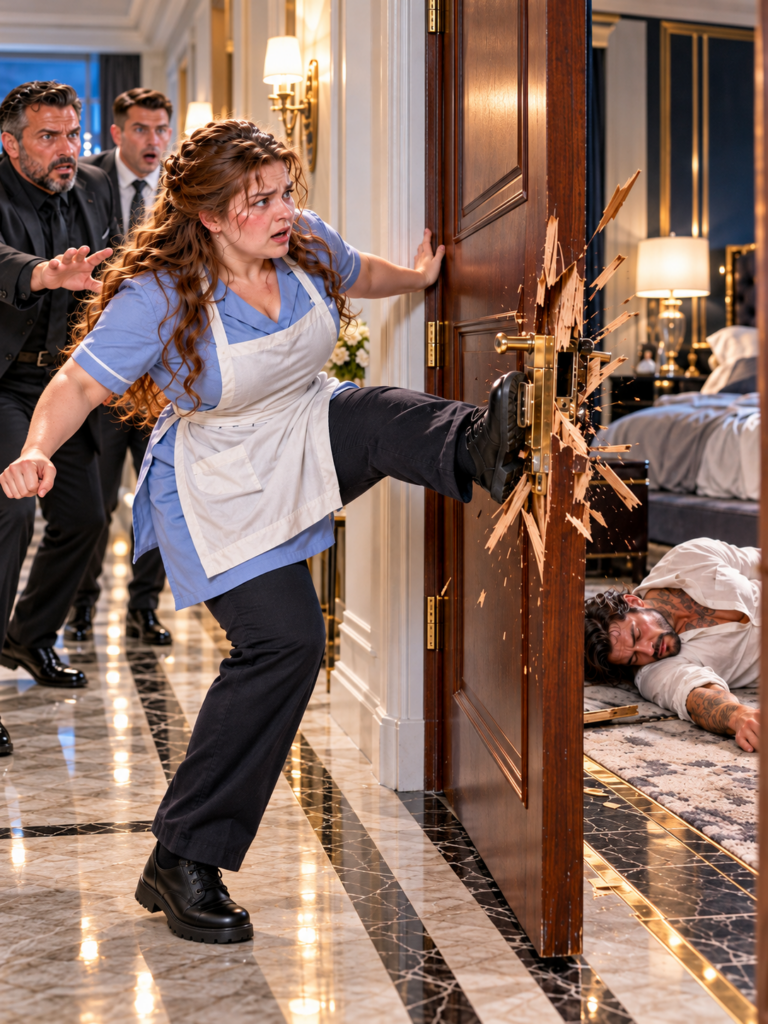
At 2:04 in the morning, Winnie Doyle heard a man’s body strike the floor behind the locked bedroom door of the most feared Mafia boss in the city.
The sound was unmistakable.
Heavy. Sudden. Wrong.
Two armed guards stood outside the door. Both men turned toward it. Neither moved to open it.
Then came another impact, followed by a dragging noise that made Winnie’s stomach contract.
The younger guard took one step backward. His pistol knocked against his belt buckle.
Winnie stared at him.
“Are you going to check on him?”
The older guard’s expression hardened.
“Keep moving, Doyle.”
Something hit the floor again.
Winnie pushed her mop into the younger man’s hands.
“Hold that.”
She started toward the bedroom.
The older guard caught her sleeve so firmly that the fabric pulled against her shoulder.
“Do you understand whose door that is?”
“Yes.”
“Then you understand what happens if you open it.”
Winnie looked past him at the brass handle.
She understood perfectly.
Three weeks ago, another maid had knocked on that same door. By sunrise, she was gone. Her locker had been emptied, her name removed from the payroll, and nobody in the household would discuss what had happened to her.
Winnie had rent due. She had a sister struggling to keep a family diner alive. She had almost nothing in savings and absolutely no powerful friends.
She needed this job.
But beyond the door, a man was making sounds she recognized from the worst nights of her life.
The older guard stepped directly into her path.
“Last warning.”
Winnie planted her palm against his chest.
“Then fire me.”
She drove her heel into the door beside the lock.
Wood split with a sharp crack.
And for the first time in six years, someone broke the one rule Rhett Marquetti had made absolutely untouchable.
Four hours earlier, Winnie had entered the Marquetti estate through the servants’ kitchen with damp socks and a sandwich wrapped in a reused bread bag.
She was thirty-three years old, with a full figure, rounded hips, and the practical habit of making herself smaller whenever wealthy people needed space.
It wasn’t embarrassment. It was experience.
People who carried cleaning buckets learned quickly that furniture mattered more than their comfort, carpets mattered more than their shoes, and silence was usually safer than conversation.
At the kitchen entrance, a security guard searched her supplies.
He examined the detergent bottle, lifted the cleaning cloths, and checked beneath the spare trash bags.
Another guard stood beside the cook, watching as the kitchen knives were locked away for the night.
Winnie waited with her hands folded loosely in front of her.
She had stopped finding the procedure unusual.
The Marquetti estate was less a home than a beautiful fortress. Its polished corridors, expensive paintings, and carefully arranged furniture concealed an organization held together by money, fear, and rules nobody dared question.
The housekeeper, a severe woman who measured punctuality as carefully as she measured bleach, handed Winnie the upstairs keys.
“East wing again.”
Winnie nodded.
“The usual instructions?”
Winnie repeated them. “No entering the boss’s bedroom after midnight. No opening the door. No knocking unless I’m specifically ordered to.”
“And if you break the rule?”
“I’m gone by morning.”
The housekeeper studied her face.
“Make sure you remember that.”
Winnie took the keys.
She remembered the missing maid.
She remembered asking whether someone should return the woman’s shoes. The housekeeper had shut the storage cupboard with such force that the cups inside rattled.
Winnie hadn’t asked again.
The extra money for cleaning the east wing was generous enough to cover her rent. That was why she agreed to work alone when other cleaners refused.
She knew generosity rarely came without a reason.
By eleven that evening, she was kneeling beside a tall floor lamp in the upstairs corridor.
The lamp’s electrical cord had worn thin where it rubbed against a decorative brass foot. Winnie had unplugged it and covered the damaged section with insulating tape as a temporary precaution, intending to report that the cord needed proper repair.
She was smoothing down the last edge when the corridor changed around her.
Conversation stopped.
Footsteps slowed.
Winnie glanced up.
Rhett Marquetti stood several feet away.
At forty-one, the Mafia boss possessed the kind of authority that made older, wealthier men wait patiently for his permission. His tailored black trousers were immaculate. His dark shirt was open at the throat, and his expression gave away almost nothing.
He didn’t need to threaten people.
The men behind him already behaved as though he had.
His gaze dropped to the tape in Winnie’s hand.
“What are you doing?”
“Keeping someone from getting electrocuted.”
A guard behind him shifted.
Rhett looked at the lamp.
“Did someone tell you to repair it?”
“No.”
“Then why are you touching it?”
Winnie sat back on her heels.
“Because it’s dangerous.”
For a moment, the only sound came from the ventilation system.
Rhett examined the frayed section of cord, then looked at her again.
“You work nights?”
“Yes, sir.”
“How long?”
“Three weeks.”
He seemed to consider that.
Then he walked past.
Only when he reached the end of the corridor did the guards begin moving again.
Winnie returned the tape to her pocket.
She hadn’t been trying to impress him. A damaged electrical cord needed attention whether it belonged to a billionaire, a janitor, or a man with enough armed employees to occupy every staircase.
Across the corridor, beside the servants’ elevator, another man watched her.
Garrick Hail.
Rhett’s underboss.
He had pale eyes, a carefully practiced smile, and a manner so pleasantly restrained that Winnie distrusted him immediately.
Unlike the guards, Garrick did not stare at her hands.
He looked at her employee badge.
Then he smiled.
Winnie lowered her eyes to the floor and went back to cleaning.
At midnight, the older bedroom guard checked his watch.
“Clear the doorway.”
Winnie moved her trolley farther down the hall.
The guard tested Rhett’s bedroom handle. The loose brass plate rattled against the wood.
Winnie had reported the damaged frame earlier that week. Maintenance had sent a carpenter, but security had refused to let him work on it.
The guard pulled the door shut.
From inside came the scrape of a bolt sliding into place.
That sound stayed with her.
She polished the landing. Removed muddy footprints near the stairs. Wiped fingerprints from a glass cabinet that probably cost more than her annual salary.
The guards changed positions in pairs.
Nobody left a post unattended.
Downstairs, the cook departed under escort. Somewhere in the east wing, a clock quietly marked the passing quarter hours.
Winnie’s sandwich remained untouched.
Every time she reached for it, someone appeared with another instruction.
Near two, she heard a peculiar scraping sound approaching the corridor.
Three soft knocks.
A pause.
Then three more.
It made her turn sharply because she had heard something like it earlier that week.
A nurse appeared, pushing a medical trolley with a damaged wheel that repeatedly caught against the floor.
Behind her came a doctor carrying his coat and bag.
An armed guard accompanied them.
The nurse’s identification badge had been removed.
She looked close to tears.
The doctor stopped when he saw Garrick waiting near the elevator.
“This isn’t advisable,” the physician said quietly.
Garrick placed a hand against the man’s chest.
“Your services are no longer required.”
The doctor seemed prepared to argue.
Then he glanced at the armed escort and thought better of it.
The elevator swallowed both medical workers.
Winnie stood beside her trolley, watching the doors close.
A doctor dismissed in the middle of the night.
A frightened nurse.
A boss whose bedroom nobody could enter.
Something about it made her uneasy.
But she had no authority in that house, and asking the wrong question could cost her everything.
She returned to work.
Then, at 2:04, came the crash.
And now she was standing in the broken doorway, breathing hard, with two terrified guards behind her.
Rhett Marquetti lay between his bed and the wall.
His body was convulsing so violently that his shoulder struck the bedside table.
Blood marked his lower lip.
Winnie recognized what was happening instantly.
She dropped to her knees.
“Call an ambulance!” she shouted.
Neither guard moved.
She looked over her shoulder.
“Now!”
The younger man fumbled for his radio.
Winnie pushed the bedside table away, clearing the space around Rhett. She moved carefully, protecting his head without holding his limbs down.
His body jerked again.
She eased him onto his side, keeping his face turned so his airway remained clear.
There was no pillow within reach.
She pulled the fabric of her skirt beneath his head and settled his temple against her lap, cushioning him from the hard floor.
His breathing came in harsh, uneven bursts.
His belt had tightened against his abdomen as he twisted.
She loosened the buckle without forcing him flat.
“You’re all right,” she whispered, although she knew he couldn’t hear her properly. “I’ve got you. Just breathe.”
Behind her, the older guard remained frozen.
Winnie began counting.
Not because counting could stop a seizure.
Because she needed to know how long it lasted.
Because she had learned years ago that panic stole seconds and seconds mattered.
“Forty-one. Forty-two. Forty-three.”
Rhett’s hand opened beside her knee.
Then it closed so tightly that his knuckles whitened.
She kept her hands away from his mouth. Kept the space around him clear. Watched the movement of his chest.
“Forty-four. Forty-five.”
A smaller convulsion passed through him.
“Forty-six.”
His shoulders trembled.
“Forty-seven.”
Then his body began to relax.
“Forty-eight.”
Winnie stopped counting but continued watching him.
The silence afterward frightened her almost as much as the seizure.
She leaned closer.
His chest rose.
A thin, difficult breath escaped his lips.
Then another.
“Good,” she whispered. “That’s good.”
Across the broken threshold, the older guard reached for the badge hanging from her cleaning trolley.
He unclipped it.
Winnie watched him close his fist around the plastic.
There went her wages.
Her rent.
Her next grocery trip.
Everything she had been trying to hold together.
She looked back at Rhett.
His eyelids moved.
Slowly, he opened his eyes.
For several seconds, he appeared unable to understand where he was.
Then his gaze found Winnie.
He was lying with his head in a cleaner’s lap, his expensive shirt disordered, two armed guards watching from a ruined doorway.
Rhett stared at her.
Winnie swallowed.
“You had a seizure,” she told him. “You need a doctor.”
His eyes moved to the broken door.
Then to the men standing beyond it.
His expression became unreadable.
With obvious effort, he pushed himself into a sitting position.
Winnie kept one hand nearby in case he lost his balance.
Rhett looked at the guards.
“Out.”
His voice was rough but unmistakably commanding.
Both men obeyed.
Winnie gently pulled her skirt free.
“I should go too.”
He said nothing.
She stood, retrieved her cleaning bucket, and walked out of the room.
She spent the remaining hours in the laundry room.
The machines had stopped running. The fluorescent lights hummed overhead. A forgotten towel lay folded beside a stack of clean sheets.
Winnie sat on a narrow bench and waited for her dismissal.
She tried to eat her sandwich.
It tasted like paper.
At seven, someone came looking for her.
“The boss wants everyone downstairs.”
Winnie followed the housekeeper into the main hall.
Every employee had been assembled.
Cooks. Gardeners. Drivers. Gate guards. Cleaners.
The two bedroom guards stood near the staircase, their faces drawn.
Winnie positioned herself toward the back.
She expected someone to read out her name.
Instead, Rhett appeared at the top of the stairs.
He was dressed in a dark suit, his hair neatly arranged, his expression giving no indication that hours earlier he had been helpless on his bedroom floor.
He descended three steps and stopped.
“The rules for the east wing have changed.”
Nobody moved.
“My bedroom will no longer be secured against entry.”
A few heads turned.
“There will be one designated keyholder.”
His gaze found Winnie.
“Miss Doyle.”
Her heart lurched.
She looked behind her, briefly hoping another Doyle worked in the building.
“Come here.”
She stepped forward.
Rhett held up a key.
It looked ordinary.
That was what made the moment so extraordinary.
For six years, men with guns had protected his bedroom door. Staff had lost their jobs for approaching it. Even senior members of his organization treated the threshold like sacred ground.
Now he was placing access to that room in the hands of a cleaner who had worked for him for three weeks.
“This key belongs to you,” he said.
Winnie accepted it.
“Your wages are increased tenfold. Effective today.”
Someone behind her drew a sharp breath.
Winnie could barely comprehend the number.
“Mr. Marquetti—”
He continued before she could finish.
“She may enter my room whenever she considers it necessary. Day or night. Anyone who interferes answers directly to me.”
His eyes shifted toward the two guards.
Neither looked up.
“Is that understood?”
A scattered chorus of agreement moved through the hall.
Rhett returned his attention to Winnie.
For a moment, his expression softened almost imperceptibly.
Then he walked away.
The staff began dispersing in stunned silence.
Winnie remained standing with the key in her palm.
She should have felt triumphant.
Instead, she felt the strange weight of being noticed by a man whose attention could change someone’s life—or destroy it.
Across the hall, Garrick Hail watched her.
This time, he wasn’t smiling.
Two days later, he found her in the pantry corridor, where the security cameras did not reach.
Winnie was stacking canned goods when he approached.
“Miss Doyle.”
She straightened.
“Mr. Hail.”
He leaned against the shelving as though they were old acquaintances.
“I hear you’ve become quite important.”
“I still clean floors.”
“Of course.”
He took an envelope from inside his coat and placed it beside the cans.
It was thick enough to stand upright.
Winnie looked at it.
“What’s that?”
“An opportunity.”
“I don’t need one.”
Garrick gave a gentle laugh.
“Everyone needs an opportunity. Particularly people with families.”
Winnie’s fingers stopped moving.
He noticed.
“I understand your sister runs a diner.”
“Yes.”
“Twenty-two years in business. Your mother’s recipes still on the wall. That’s admirable.”
Winnie felt cold.
“Why are you asking about my sister?”
“I’m not asking about her. I’m asking about what happened the other night.”
He nudged the envelope closer.
“Tell me what you saw in Rhett’s bedroom. Nothing invented. Nothing exaggerated. One conversation, and your family won’t have to worry about rent again.”
Winnie looked from the money to his pleasant face.
She understood what he wanted.
Not the truth for its own sake.
He wanted a weakness he could carry into a room full of powerful men.
Something that would make Rhett Marquetti look incapable of commanding them.
She reached for another can.
“I saw a man sleeping.”
Garrick blinked.
“Sleeping?”
“Not prettily. But that’s hardly a crime.”
His smile remained in place.
Only his eyes changed.
“I’d reconsider.”
“No, thank you.”
“You might regret that.”
Winnie finished arranging the cans.
“I regret plenty of things. I don’t think this will be one of them.”
Garrick picked up the envelope.
He left without another word.
Twelve hours later, Winnie’s sister called her in tears.
The diner had been shut down.
A surprise inspection had supposedly uncovered violations serious enough to close the business immediately.
No one would provide clear photographic proof of what had been found.
Twenty-two years of work had ended overnight.
Winnie stood in the servants’ stairwell, listening to her sister cry.
She pressed her free hand against the cold wall.
“I’ll figure something out,” she said.
But she didn’t know how.
After the call ended, Winnie remained on the stairs for a long time.
She could take the story straight to Rhett.
Tell him what Garrick had offered.
Tell him what had happened to the diner.
Yet she could already imagine Garrick’s defense.
A cleaner making accusations.
A boss protecting the woman who knew his secret.
An underboss presenting himself as the reasonable man caught between them.
That was the trap.
Garrick wanted her to run for protection.
He wanted Rhett’s concern for her to become another piece of evidence against him.
Winnie pushed herself upright.
She tucked the phone into her pocket, collected her cleaning supplies, and returned to the east wing.
She cleaned the mansion as though nothing had happened.
But now she understood something important.
The key Rhett had given her didn’t merely open his bedroom.
It had placed her directly in the path of a man who intended to take everything Rhett possessed.
And Garrick Hail had already shown that he was willing to destroy innocent lives to get there.
Part 2
The first sign that Garrick had underestimated Winnie arrived on Tuesday morning.
A gardener working near the lower terrace noticed a stranger standing among the trees with a camera.
The man wasn’t photographing the gardens.
His lens was trained on the east wing.
More specifically, the repaired doorway leading to Rhett’s bedroom.
By the time the stranger lowered his camera, two gate guards were already approaching him.
They brought him inside with his arms held behind his back.
Winnie saw the commotion from an upstairs window.
She watched Rhett’s security chief speak briefly with the stranger, then escort him toward the main building.
Within an hour, the household knew the man was a licensed private investigator.
Within another hour, someone had discovered who was paying him.
A small downtown law office.
The same firm that quietly handled Garrick Hail’s real estate interests.
Winnie expected Rhett to erupt.
He didn’t.
He ordered coffee brought to his study.
Then he spent forty minutes alone with the investigator.
When the man finally left, he carried his camera and a sealed folder.
He also carried a completely different story from the one he’d been hired to uncover.
Rhett Marquetti, he would report, had suffered a shoulder injury during the old dock wars.
The injury had required discreet medical treatment.
It was now fully healed.
Nothing more.
The investigator’s fee had been doubled.
And the man who had paid for information about Rhett’s health would receive a carefully prepared lie.
Winnie learned only fragments of this from the household whispers.
She didn’t ask questions.
She understood the significance well enough.
Rhett knew someone was investigating him.
He knew where the investigation originated.
Yet he had chosen not to confront Garrick publicly.
That disturbed Winnie more than anger would have.
Men like Rhett Marquetti rarely hesitated because they were afraid of another man’s gun.
They hesitated when a larger consequence stood behind the trigger.
At the end of the week, Winnie was restocking the private bathroom attached to Rhett’s bedroom.
She arranged the towels, replaced toiletries, and checked the medicine cabinet.
Several prescription bottles stood on the shelf.
She had learned to keep them in their original positions, labels facing forward.
The new refill had arrived Thursday.
At first, she saw nothing unusual.
Same bottle.
Same printed label.
Same prescribed medication.
Then she opened it.
Winnie stared at the tablets in her palm.
Something was wrong.
She had seen the previous supply often enough to recognize the tiny letters pressed into each pill.
These markings were different.
The color was almost identical. So was the size.
But the imprint did not match.
She stood motionless, listening to the faint sound of footsteps beyond the bathroom door.
Anyone else might have dismissed the discrepancy.
Winnie couldn’t.
For eight years, medication had been a central part of her life. She understood how small differences could carry terrible consequences, even though she was no pharmacist.
And she understood that medicine in the hands of a man surrounded by enemies deserved more than casual trust.
She returned the tablets to the bottle.
All except one.
That one she wrapped carefully in a square of clean tissue and concealed in her apron pocket.
Then she replaced the bottle exactly where she had found it.
No accusation.
No confrontation.
Not yet.
She needed something stronger than suspicion.
Her first question was simple.
Who had delivered the refill?
In the kitchen, she found the cook preparing vegetables.
“Was the pharmacy delivery late yesterday?”
The cook shook his head.
“New courier brought it. Polite young fellow. Started this month.”
“New?”
“That’s what I heard.”
“Did he bring anything else?”
“Not that I saw.”
Winnie nodded and pretended to lose interest.
That evening, she went to the gatehouse.
The guard on duty was smoking beside an open window.
Winnie borrowed a cigarette, although she didn’t smoke.
She held it between her fingers while chatting about the day’s deliveries.
The guard eventually turned back to his paperwork.
Winnie let her gaze wander over the ledger.
The pharmacy courier’s name was recorded in blue ink.
Beside it was a copy of his delivery route.
One stop.
The Marquetti estate.
She stared at the page.
A pharmacy courier with a route of one house was unusual enough to demand an explanation.
She copied the name onto the inside of her wrist, using the pen she kept in her apron.
Then she returned the cigarette untouched.
“Changed my mind,” she told the guard.
He laughed and accepted it.
Winnie walked back into the mansion with one counterfeit-looking tablet in her pocket and a courier’s name written against her skin.
For the first time, she had something Garrick might not know she possessed.
The following Friday, Rhett ordered several members of the household staff to tour a new cold-storage warehouse that the estate would be supplying.
Winnie was among them.
The building smelled of metal, cardboard, and refrigerated air.
Forklifts moved between tall storage racks.
Armed guards stood near the entrances while a driver waited outside with the engine running.
Rhett walked through the warehouse with the controlled attention of a man accustomed to evaluating risks before anyone else noticed them.
Winnie followed several steps behind.
They had just entered an aisle stacked with canned goods when she heard metal scrape against metal.
A forklift was raising a loaded pallet.
Something above her shifted.
Then came a sharp snapping sound.
The pallet tilted.
Half a ton of canned goods began sliding from the forks, suspended for one terrible instant by a failing strap.
Winnie looked up.
She understood what was happening.
Her body simply didn’t move quickly enough.
A hand caught the back of her collar.
Rhett.
He pulled her backward with such force that her shoes lifted from the concrete.
She stumbled into him.
His body moved into the space she had occupied.
The load crashed down barely a yard away.
Cans exploded from their cartons.
Metal struck concrete.
Dust rose through the cold air.
For a moment, Winnie couldn’t hear anything except a high ringing in her ears.
Rhett steadied her.
He took her face lightly between his hands, checking her eyes, then released her.
“Are you hurt?”
She shook her head.
His gaze moved across her shoulders, her arms, her legs.
“Winnie.”
It was the first time she’d heard him say her first name without the distance of an employer addressing his staff.
“I’m okay,” she managed.
Rhett looked at the fallen pallet.
Then at the forklift operator.
He crossed the warehouse.
One short punch broke the man’s nose.
No shouting.
No theatrical warning.
Just a brutal, controlled movement that left the operator staggering backward.
“Find out what happened,” Rhett told his men.
Later, someone discovered that the lifting strap had been cut almost all the way through.
It had not simply worn out.
Winnie sat in the back of the waiting car, her hands clasped tightly in her lap.
Rhett had saved her life.
But he had also shown her how naturally violence fitted into his world.
She was grateful.
She was frightened.
And for the first time, she understood how easily those two feelings could exist together.
Three nights later, at three in the morning, Winnie was mopping the upstairs gallery when she noticed Rhett sitting halfway down the staircase.
Alone.
One lamp burned beside him.
An untouched cigarette rested between his fingers, a long cylinder of ash collecting at its tip.
He looked different without his guards.
Not weaker.
Simply tired.
Winnie slowed.
“Should I come back later?”
“No.”
She continued mopping.
After several minutes, Rhett spoke.
“You haven’t been sleeping much.”
“Neither have you.”
He gave a faint, humorless smile.
“Occupational hazard.”
Winnie wrung out her mop.
“The worst part isn’t falling,” she said quietly.
Rhett looked at her.
She kept her eyes on the floor.
“It’s waking up afterward. Seeing people looking at you. Everyone suddenly careful with their faces, trying not to show how frightened they are.”
The cigarette stopped moving between his fingers.
Winnie pushed the mop forward.
“That part can make you feel more helpless than the fall.”
He didn’t answer.
But she could sense that he was listening.
After a while, he placed the cigarette in an ashtray without ever taking a drag.
“You recognized what was happening that night.”
“Yes.”
“You knew what to do.”
“Enough to keep you safer until help could come.”
“You counted.”
Winnie stopped.
Rhett studied her.
“People don’t learn to stay that calm by accident.”
For several seconds, she considered giving him a harmless explanation.
A first-aid course.
A relative with occasional medical trouble.
Something simple.
Instead, she leaned the mop against the wall.
“My brother,” she said.
Rhett waited.
“Charlie.”
His name seemed to change the temperature of the staircase.
Winnie sat on the bottom step, leaving a respectful distance between them.
“My mother left when I was fourteen. Charlie was six. After that, there wasn’t anybody who could look after him properly except me.”
She rubbed her palms together.
“His seizures started young. He’d be laughing one minute, and the next I’d hear him fall.”
Rhett’s attention never shifted.
“I learned what to move away from him. How to protect his head. What not to put near his mouth. How to count the seconds when I was so scared I could barely think.”
She swallowed.
“Eight years of waking up in the middle of the night. Eight years of listening for a sound I hoped I’d never hear again.”
Rhett lowered his gaze.
“What happened to him?”
Winnie looked toward the darkened gallery.
“He was nineteen.”
The words were almost inaudible.
“He had a seizure in a stairwell. The landlord had locked the stairwell door.”
Rhett remained completely still.
“I was on the other side. I heard him fall. I could hear him, Rhett.”
Her voice strained.
“I was thirty seconds away from him, and I couldn’t get through.”
She pressed her fingers against her eyes.
“I kept pounding. Calling his name. I thought if I made enough noise, someone would come with a key.”
Nobody had come in time.
Charlie died behind that door.
Winnie lowered her hands.
“So when your guards told me I couldn’t enter your room, I wasn’t thinking about your rules. I wasn’t thinking about my job.”
She looked directly at Rhett.
“I was thinking about my brother. I wasn’t going to stand outside another locked door listening to someone die.”
The house seemed painfully quiet.
Rhett rested his forearms on his knees.
For the first time since Winnie had met him, he looked like a man unable to command the thing he most wanted to change.
“I’m sorry about Charlie,” he said.
There was no practiced reassurance in his voice.
Winnie believed him.
A long silence passed before Rhett spoke again.
“The scar beneath my hair isn’t from a fight.”
Winnie watched him.
“When I was fifteen, my father was shot eleven times getting into a car. There was an explosion. Shrapnel threw me against a wall.”
He touched the side of his head.
“Two years later, the seizures started.”
Winnie felt something inside her settle into place.
The late-night doctors.
The locked bedroom.
The fear surrounding his condition.
Rhett continued.
“The commission decides whether a boss is fit to remain in charge. If they decide he isn’t, he doesn’t collect a retirement package and move somewhere quiet.”
His expression hardened.
“He disappears.”
Winnie understood.
Not just the threat of losing his position.
The threat of losing his life.
“You’ve been hiding this for years.”
“Six years since I made the door rule. Longer than that since the first seizure.”
“Does Garrick know?”
Rhett looked at the lamp.
“He knows enough to be dangerous.”
Winnie thought of the frightened nurse, the dismissed physician, and the new prescription tablets in her apron.
She thought of her sister’s diner.
Then she made a decision.
“There’s something else you need to see.”
She reached into her pocket and unfolded the tissue.
A single tablet lay inside.
Rhett looked at it.
“Where did you get that?”
“Your bathroom. Thursday’s refill.”
She showed him the writing on her wrist.
“And this is the courier who brought it. I checked his route sheet. Your house was the only stop.”
Rhett sat upright.
“Are you certain?”
“About what I saw, yes. About what the pill contains, no. That’s why I kept it.”
He held out his hand.
Winnie placed the tissue in his palm.
“Don’t take anything from that bottle until someone qualified checks it.”
His eyes remained on the tablet.
“What made you notice?”
“The imprint didn’t match the old medication.”
Rhett closed the tissue carefully.
For several seconds, he said nothing.
Then he stood.
“I need to make a call.”
By noon, his chemist had an answer.
The tablets were counterfeit.
They were not the anticonvulsant medication prescribed to Rhett.
They contained no effective dose of the drug he needed.
Worse, the chemist found traces of a stimulant that could dramatically increase his risk of another violent seizure.
The substitution was not an accident.
Someone wanted Rhett Marquetti to collapse.
And this time, they wanted witnesses.
The investigation moved quickly.
The courier was detained and questioned.
The pharmacy’s ownership records led through two shell companies.
Those companies led to the same downtown law office that had hired the private investigator.
The firm connected to Garrick Hail.
Rhett ordered the genuine medication restored, secured the chemist’s findings, and locked down the evidence.
But he did not order Garrick killed.
Winnie found him standing near his study window that afternoon.
“You know who did it,” she said.
“I know who the evidence points toward.”
“Isn’t that enough?”
“Not in my world.”
She waited.
Rhett turned toward her.
“If I kill my underboss because of a pill and a delivery sheet, Garrick gets exactly what he wants.”
“How?”
“His people tell the commission I’m unstable. That my medical condition has destroyed my judgment. That I’m executing my own officers because I imagine plots around every corner.”
Winnie looked down at her hands.
“And they’ll believe him.”
“Some of them want to.”
Rhett approached his desk.
“I don’t need Garrick dead. I need him to expose himself in front of the men he’s been lying to.”
Winnie understood the difference.
A private accusation would become Rhett’s word against Garrick’s.
A betrayal witnessed by the commission could end Garrick’s power without handing him the story he wanted.
But Garrick was moving faster than they expected.
A friendly capo brought the news from a meeting in a parking garage.
Garrick had formally requested a commission hearing to evaluate Rhett’s fitness as boss.
And he had found someone to blame for the worsening condition.
Winnie Doyle.
The cleaner who possessed the only authorized key to Rhett’s bedroom.
The woman who had entered his private room during the night.
The woman whose struggling family business had suddenly been closed.
Garrick had photographs.
One showed a thick envelope between him and Winnie in the pantry corridor.
The image had been cropped to make it appear she was accepting money.
Other evidence suggested she had the motive and opportunity to interfere with Rhett’s medication.
Two household guards had been summoned to testify.
Both would have to admit that Winnie alone had entered the bedroom that night.
The story was carefully constructed.
A desperate woman had been bought.
A compromised boss had rewarded her.
His health had deteriorated under her influence.
Garrick would present himself as the reluctant man trying to save the organization.
Winnie listened as Rhett’s security chief outlined the accusations.
“They’re going to say I poisoned you?”
“Yes,” Rhett said.
“And they’ll use my sister’s diner as the reason?”
“Yes.”
She stared at him.
The room suddenly felt too small.
Everything she had done to save his life was being turned into evidence that she had tried to destroy it.
Rhett walked toward her.
“Winnie, listen carefully. I won’t let him take you.”
She stepped back.
“Don’t promise what you can’t control.”
He stopped.
She saw the effect of her words.
Not anger.
Recognition.
“You told me yourself what happens when the commission decides someone is inconvenient,” she continued. “You have rules you can’t break. What protection would I have?”
Rhett looked at her for a long moment.
“Less than you deserve.”
She appreciated the answer more than a false promise.
The hearing was scheduled for midnight.
At the estate.
Garrick’s choice.
He intended to put Rhett on trial in his own home.
Rhett prepared the house meticulously.
The chemist would wait in the kitchen with his analysis.
The private investigator, now cooperating with Rhett, would remain in the gatehouse with the retainers, corporate records, and evidence tracing the shell companies back to Garrick’s law office.
The commission’s physician would receive the genuine medication and the counterfeit tablet for direct comparison.
Armed guards were assigned to every corridor.
Drivers were ordered to keep the cars ready.
Nothing was left to chance.
Or almost nothing.
That evening, Winnie stood across Rhett’s desk and told him what she intended to do.
“I’ll stand beside you.”
Rhett shook his head.
“No.”
“The evidence started with me.”
“The evidence will be presented.”
“I found the tablet.”
“The chemist can explain it.”
“I know what Garrick offered me.”
“The photographs and investigator will show the rest.”
Winnie braced her hands against the desk.
“Then let me tell them myself.”
Rhett’s face became grave.
“You don’t understand the protocol.”
“Then explain it.”
He looked away.
“In a fitness hearing, the accused boss isn’t permitted to defend himself through personal testimony. The commission considers the evidence and votes. His voice carries no authority in his own defense.”
Winnie felt dread beginning to gather.
“Fine. I’ll speak.”
“Household staff are forbidden from entering the chamber.”
“Then change the rule.”
“I can’t.”
“You changed the rule about your bedroom.”
“That was my house. This is the commission.”
His voice remained controlled, but frustration showed through it.
“If I break their procedure during a hearing about my judgment, they can declare me unfit for breaking it. Garrick knows that.”
Winnie straightened.
“So the one person who knows exactly what happened is supposed to wait outside?”
“The evidence will be there.”
“But I won’t.”
Rhett said nothing.
She looked at him.
He was surrounded by armed men, wealth, property, and power.
Yet a rule made by eleven older men could force him to stand helpless while another man dismantled his life.
For the first time, Winnie saw how closely their situations resembled each other.
She had once been powerless because she was a cleaner.
Rhett was now powerless because he was a boss.
Both were expected to accept that certain doors must remain closed.
At midnight, five black cars rolled through the estate gates.
Eleven members of the commission entered the great room.
Garrick arrived last, carrying a thin folder and wearing the solemn expression of a man attending the funeral of someone he had personally arranged to bury.
Winnie watched from the corridor.
The commissioners filed past her without acknowledgment.
The great room’s double doors were heavy oak, nearly four inches thick.
A sergeant-at-arms took his position.
The doors closed.
The latch dropped.
The sound traveled straight through Winnie.
She had heard a lock like that before.
She had spent eight years wishing she could go back to a stairwell and break one.
Now another man was on the wrong side of another door.
And the people who could save him had ordered her to stay outside.
Part 3
Winnie stood outside the commission chamber with a counterfeit tablet wrapped in tissue inside her fist.
Through the heavy doors, the voices were little more than a low murmur.
She could distinguish Rhett’s voice occasionally.
Calm.
Measured.
Then another voice rose above the others.
Garrick.
“My loyalty to Rhett has never been in question, gentlemen.”
Winnie moved closer.
“I have served him like a brother. That’s what makes this so difficult.”
She closed her eyes.
Even through four inches of oak, she could hear the performance in his voice.
“Our boss is ill. His condition has compromised his judgment, and the woman he has placed closest to him has made it worse.”
Winnie looked at the tablet.
She had spent days protecting it.
The evidence was inside the room, but she knew how Garrick worked.
He didn’t need to disprove every document.
He only needed to convince enough men that those documents were a desperate boss’s attempt to escape accountability.
“And so,” Garrick continued, “I respectfully move that we proceed to a vote.”
Chairs scraped across the floor.
Winnie’s heart began hammering.
The vote.
Already.
She moved toward the chamber.
Two men emerged from the shadows near the opposite wall.
Garrick’s men.
One smiled.
“Kitchen’s downstairs, sweetheart.”
Winnie didn’t stop.
“I need to get inside.”
“Nobody goes inside.”
“There’s evidence they haven’t heard.”
“Not your problem.”
He reached for her arm.
Winnie pulled away.
Behind the men stood the two bedroom guards from the night of Rhett’s seizure.
The older man.
The younger one.
She recognized their faces immediately.
They had watched her risk her job to save the man they were paid to protect.
They had seen her kneel beside him while they stood frightened in the doorway.
And they had watched the older guard remove her employee badge.
Winnie looked directly at them.
“You remember what happened that night.”
Neither answered.
“You know he wasn’t attacking anyone. You know I wasn’t hurting him.”
The younger guard swallowed.
Garrick’s man stepped closer.
“That’s enough.”
Winnie ignored him.
“That medication was changed. Someone wanted another seizure to happen. Someone wanted your boss helpless in front of the commission.”
The older guard’s gaze shifted toward the door.
Winnie took another step.
“You’re going to stand here again?”
His face changed.
Just slightly.
“You heard him hit the floor,” she continued. “You knew he needed help. You let a locked door decide what you were willing to do.”
The younger guard looked down.
Winnie’s voice lowered.
“I’m not asking either of you to break that door. I’m asking you not to stop me.”
Garrick’s man reached for her wrist.
Before he could close his fingers around it, the older bedroom guard caught his arm.
The movement was slow.
Deliberate.
“Let her go.”
The other man frowned.
“That’s a direct violation of protocol.”
The older guard looked at the chamber door.
“Protocol says she can’t enter.”
He released the man’s wrist.
Then he stepped aside.
“It doesn’t say I’m required to protect the lock.”
Winnie understood.
She took three quick steps backward.
The sergeant-at-arms opened his mouth.
“Miss, you cannot—”
She ran forward.
Her heel struck the door beside the latch.
A crack split through the frame.
She kicked again.
The latch tore from its mounting.
The enormous oak door lurched inward.
And Winnie Doyle entered a room that women in her position were never supposed to enter.
Eleven commissioners turned toward the noise.
Hands moved beneath expensive coats.
Chairs scraped backward.
At the head of the table, Rhett Marquetti sat perfectly still.
Garrick stood beside his chair, his thin folder open.
For an instant, the entire chamber seemed unable to process what had happened.
A thirty-three-year-old cleaner in a work apron had just broken through the commission’s guarded door.
Winnie felt the eyes on her.
She also heard the sergeant-at-arms behind her.
“Unauthorized entry. She forfeits protection.”
The words struck hard.
She knew what they meant.
By entering without permission, she had placed herself outside the safeguards of the hearing.
If the commission chose to punish her, Rhett’s authority might not be enough to save her.
Her legs wanted to retreat.
She thought of Charlie.
Of the locked stairwell.
Of the sound of his body falling where she couldn’t reach him.
Then she thought of Rhett, surrounded by powerful men who had already decided what kind of man he was allowed to be.
She moved forward.
“Before you vote,” she said, “you need to know what you’re voting on.”
Garrick’s expression sharpened.
“This is outrageous.”
Winnie walked past him.
Her hands trembled, but her voice held.
“You’ve heard that Mr. Marquetti is sick. That’s true.”
Several commissioners exchanged glances.
“You’ve heard that I entered his bedroom at night. That’s also true.”
Garrick spread his hands.
“Thank you, Miss Doyle. I believe that confirms—”
“But you haven’t heard why.”
Winnie approached the table.
“The night I opened his door, he was having a seizure. Two armed guards heard him fall and wouldn’t enter. I went inside because he needed help.”
One commissioner leaned forward.
“Are you admitting you treated him without authorization?”
“I’m telling you I kept him safe until the seizure stopped.”
Garrick gave a weary shake of his head.
“A moving story. But it doesn’t address the medication.”
Winnie looked at him.
“Actually, it does.”
She unfolded the tissue.
Inside lay the counterfeit tablet.
She placed it on the polished table beside the evidence the commission’s physician had already received.
“Thursday’s pharmacy delivery,” she said. “One pill from the bottle in his bathroom.”
The doctor bent forward.
Winnie pointed to the tablet.
“Look at the imprint.”
He examined it.
Then he retrieved the genuine medication.
Same general appearance.
Different marking.
His expression changed.
“These are not identical.”
“No,” Winnie said. “They aren’t.”
The doctor studied the chemist’s report beside him.
One commissioner spoke.
“Explain.”
The physician lifted the counterfeit tablet.
“The chemical analysis indicates this is not the prescribed anticonvulsant. It contains no effective quantity of the intended medication.”
He turned a page.
“There is also evidence of a stimulant compound that could provoke neurological complications, including seizures.”
A commissioner frowned.
“You’re saying the medication was deliberately falsified?”
“That is consistent with the laboratory findings.”
Winnie looked around the table.
“He didn’t stop taking his medication. Someone replaced it.”
Garrick moved forward.
“An accusation from a woman with unrestricted access to his bedroom.”
Winnie turned toward him.
“The delivery came from a new courier. His route sheet showed one stop. This estate.”
She placed the copied information beside the tablet.
“The pharmacy that supplied those pills is connected through two shell companies to the law office that manages your real estate.”
Garrick’s smile vanished.
“That’s absurd.”
Winnie looked toward the damaged doorway.
“Then you’ll have no trouble explaining the documents.”
As though responding to a rehearsed cue, another door opened.
The private investigator entered from the adjoining room.
He carried a thick folder.
The same man who had once aimed his camera toward Rhett’s bedroom now laid contracts, retainer records, ownership documents, and dates across the commission’s table.
The oldest commissioner adjusted his glasses.
He began reading.
The investigator spoke without dramatics.
He identified the law office that had retained him.
Explained the payments.
Outlined the connections among the shell companies and the pharmacy.
The documents did not depend on Winnie’s word.
They connected Garrick’s private financial arrangements to the counterfeit medication.
For several minutes, the only sounds were turning pages and quiet questions.
Winnie remained beside the table.
She could feel Rhett watching her.
But she didn’t look at him.
Not yet.
Garrick tried to laugh.
“This is theater. The entire performance has been arranged by a man desperate to conceal his declining health.”
No one answered.
He pointed at Winnie.
“Look at her. A cleaner who suddenly receives ten times her wages and the only key to his bedroom. A woman whose family’s business is failing. You expect me to believe she’s here out of loyalty?”
Winnie met his gaze.
“You offered me money to tell you what happened in that room.”
“Careful.”
“When I refused, my sister’s diner was shut down.”
Garrick’s face darkened.
“Those are serious allegations.”
“Yes,” Winnie replied. “They are.”
She gestured toward the investigator’s folder.
“That’s why we’re using evidence instead of your photographs.”
The oldest commissioner closed one of the documents.
“Mr. Hail, who authorized the pharmacy transactions?”
Garrick did not answer immediately.
For the first time, he appeared to be searching for a version of the truth that could still save him.
Then his hand moved.
Inside his coat.
Winnie saw it.
So did Rhett.
So did the eleven commissioners.
“Don’t,” Rhett said.
His voice was quiet.
Garrick froze.
Rhett remained seated.
“Take your hand out.”
Garrick’s eyes shifted toward the doorway.
Four Marquetti soldiers stood there.
Beyond them, Garrick’s men had already been disarmed and forced against the corridor wall.
The underboss looked back toward the table.
Rhett folded his hands.
“Eleven members of the commission just watched you reach for a weapon during a hearing about my fitness to lead.”
Nobody moved.
“Take it out carefully,” Rhett continued. “Place it on the table.”
Garrick hesitated.
Rhett’s voice remained steady.
“Or the gentlemen here can watch exactly how efficiently I still command my people.”
Slowly, Garrick withdrew his pistol.
He placed it on the polished oak.
The sound was small.
Yet it seemed to end everything.
The commissioners looked from the gun to the documents.
From the documents to the man who had carried them into the room.
The hearing was no longer about whether Rhett could control his organization.
It was about whether Garrick had attempted to destroy his boss to seize it.
Winnie finally turned toward Rhett.
He stood.
Not quickly.
Not triumphantly.
He rose with the controlled patience of a man who had spent years surviving by refusing to show weakness.
He crossed the chamber toward the broken door.
An iron ring of keys hung from a hook beside the frame.
Rhett removed it.
Then he returned to Winnie.
She looked down as he placed the keys in her hand.
His fingers closed gently around hers.
For a moment, neither spoke.
Then Rhett addressed the commission.
“I want the record to reflect what Miss Doyle did tonight.”
One commissioner cleared his throat.
“She violated the chamber.”
“Yes.”
“That offense carries consequences.”
Rhett looked directly at him.
“Then record the reason.”
The commissioner said nothing.
“She entered because the evidence against a traitor was being ignored. She risked her life because the people responsible for protecting this room were protecting procedure instead.”
Rhett glanced at the broken doorway.
“The same thing happened in my bedroom. My guards obeyed a rule while I lay on the floor.”
He turned back to Winnie.
“She didn’t.”
Her throat tightened.
Rhett faced the commission again.
“From this night forward, Winnie Doyle has the authority to open any door in my house. At any hour. Without asking anyone’s permission.”
He paused.
“Anyone who tries to stop her answers to me.”
No one challenged him.
Not because the room had suddenly become gentle.
Because every man at that table understood what had just happened.
A cleaner had exposed an underboss’s betrayal.
A powerful man had survived because she refused to obey a deadly rule.
And the woman Garrick intended to destroy had become the reason his entire plan collapsed.
Before sunrise, the commission voted to strip Garrick Hail of his position and authority.
Rhett did not order his execution.
He did not need to.
His lawyer had maintained a quiet channel to a federal prosecutor for years.
The counterfeit tablets, the courier’s records, the pharmaceutical ownership documents, and the financial trail were assembled into one complete evidence package.
By dawn, Garrick was being led down the estate’s front steps in handcuffs.
Camera flashes illuminated his face.
He was still trying to explain himself when the car door closed.
The pharmacist involved in producing the counterfeit tablets was arrested that morning.
By Friday, the supposed violations against Winnie’s sister’s diner had disappeared.
On Saturday, the diner reopened.
Customers lined up outside the building.
Inside, the old recipes still hung on the walls.
Nothing could return the days of business that had been lost.
Nothing could erase the fear Winnie’s sister had endured.
But the doors were open.
And for the first time in weeks, her sister’s voice sounded like her own when she called.
That evening, Winnie found Rhett waiting in the estate kitchen.
Two cups of coffee stood on the table.
Beside them lay a thick envelope.
Rhett gestured toward the chair opposite him.
“Sit down.”
Winnie hesitated.
“Am I in trouble?”
Something almost like amusement crossed his face.
“No.”
She sat.
Rhett pushed the envelope toward her.
“Severance.”
Winnie stared at it.
“I haven’t resigned.”
“I know.”
She looked up.
“Then why are you paying me to leave?”
“I’m giving you the choice.”
His expression was serious.
“There’s enough money there to live comfortably. More than your sister’s diner will earn in ten years.”
Winnie didn’t touch the envelope.
Rhett continued.
“You can leave tonight. No one will stop you. No one will follow you. You won’t owe me anything.”
She watched his face.
He had never looked more composed.
Or more vulnerable.
“You’ve seen what being close to me costs,” he said. “I won’t pretend the danger is gone.”
Winnie lowered her gaze.
The envelope represented something she’d wanted her entire adult life.
Security.
Freedom from overdue bills.
The ability to help her sister without calculating the price of groceries.
She could walk out of the mansion and never clean another marble floor.
No more armed guards.
No more midnight threats.
No more listening for danger behind closed doors.
Rhett waited.
He didn’t reach for her.
Didn’t tell her what he hoped she would choose.
For a man accustomed to controlling everything around him, it might have been the most difficult restraint he had ever practiced.
Winnie pushed back her chair.
Rhett’s shoulders went still.
She picked up her coat.
Then she walked past the envelope.
Past the kitchen doorway.
Down the corridor toward the east wing.
Rhett followed a few steps behind, saying nothing.
When Winnie reached his bedroom, she opened the door.
Inside, the room looked different.
Not because the furniture had changed.
Because the door was no longer a warning.
She hung her coat on a hook inside.
Then she turned toward him.
“I spent eight years on the wrong side of locked doors,” she said.
Rhett stood in the doorway.
Winnie looked into his eyes.
“I’m staying on this side of yours.”
He studied her for a long moment.
“Not because you owe me?”
“No.”
“Not because you’re afraid to leave?”
She shook her head.
“Because I want to stay.”
Something in his face eased.
He stepped into the room.
There was no dramatic declaration.
No promise that his world would suddenly become safe.
Only the understanding that, for the first time in years, both of them were choosing something beyond fear.
Several nights later, Rhett found Winnie in the upstairs gallery.
He held out a small object.
She opened her palm.
A key rested against a steel chain.
She recognized its shape immediately.
The master key.
But it had been recast.
No longer the ordinary brass carried by household staff.
It was made from the same kind of steel Rhett used for his own keys.
The metal was still warm from his hand.
Winnie looked up.
“What’s this?”
“Yours.”
“I already have the key.”
“That one was issued to an employee.”
She glanced at the chain.
“And this one?”
Rhett closed her fingers gently around it.
“This one isn’t.”
Winnie felt tears rising unexpectedly.
She lowered her head, letting the steel rest against her palm.
“Charlie would have liked you,” she whispered.
Rhett said nothing.
But he remained beside her.
And that was enough.
Later that night, with his bedroom door left open its customary inch, Rhett Marquetti finally fell asleep while another person remained nearby.
Winnie sat quietly, listening to his breathing.
She knew the sound of a seizure.
She knew the frightening silence that sometimes followed.
But tonight, his breaths came evenly.
Unhurried.
Peaceful.
For the first time in six years, the most feared man in the city slept without sealing himself behind a locked door.
And Winnie discovered that watching over someone did not always have to end in loss.
For a little while, the mansion almost felt like a home.
But peace in Rhett Marquetti’s world was never guaranteed.
Three nights later, a gray sedan appeared across the street from the estate.
Its headlights were off.
Its engine remained running.
By the time the gate guards approached, it had disappeared.
The following night, it returned.
Then again.
Always in the same place.
Always leaving before anyone could reach it.
Rhett’s security team increased surveillance.
Winnie tried not to think about it.
She reminded herself that Garrick had been arrested.
That the counterfeit medication was gone.
That the commission had accepted the evidence.
The danger, she told herself, had passed.
Then, one morning, an envelope arrived.
No return address.
No letter.
No demand for money.
Only a photograph.
Winnie opened it in the upstairs corridor.
Her blood turned cold.
The picture showed a broken door lock.
Splintered wood.
A damaged brass plate.
The door she had kicked open at 2:04 in the morning.
But the photograph had not been taken from the hallway.
It had been taken from inside Rhett’s bedroom.
Someone had stood beyond the threshold.
Close enough to touch the broken frame.
Close enough to see the room where the Mafia boss had lain helpless on the floor.
Winnie stared at the image.
The steel key rested against her chest, suddenly cold.
Beyond the gallery windows, morning sunlight spread across the immaculate lawns.
The estate was quiet.
Too quiet.
She turned the photograph over.
Nothing.
No handwriting.
No explanation.
Only the unmistakable proof that someone had been much closer to Rhett than any of them had realized.
Winnie slowly raised her eyes toward the bedroom.
The door stood open an inch.
Just as it always did now.
For eight years, she had feared being trapped outside a locked door.
Now, for the first time, she feared who might already be on the other side.
She closed her fingers around the photograph.
Somewhere beyond the estate gates, a gray sedan was waiting.
And whoever had taken that picture had not finished watching them.

