Part 1
The first note was still stuck to the freezer door when I walked into my kitchen at 6:14 on a Thursday morning.
BUY THE GOOD COFFEE. HE HATES THE CHEAP STUFF.
I read it four times.
Not because the sentence was complicated. Because my brain, after a red-eye flight, a bus ride, and a long walk home with a duffel bag digging a trench into my shoulder, had expected a dark house and eight months of dust.
Instead, someone knew I hated cheap coffee.
I let the duffel slide to the floor.
The house smelled faintly of detergent, coffee grounds, and something green growing near the window.
Growing.
That was my second clue.
When I left, there had been one plant on the kitchen sill. A stubborn little thing my sister Nora had bought me because she said a thirty-one-year-old man should be responsible for one living object that wasn’t himself.
I had nearly killed it twice before deployment.
Now there were three plants.
All alive.
Not barely alive, either. Healthy. Glossy leaves. Turned toward the light. One had been rotated recently enough that a damp ring still showed on the sill.
I looked toward the living room.
A blanket was folded over the arm of my couch.
Not tossed.
Folded.
Deliberately.
Someone hadn’t simply checked on this place.
Someone had lived here.
My hand was still wrapped around my keys.
I stood there listening.
The refrigerator hummed. Pipes ticked softly inside the wall. Somewhere outside, a truck changed gears.
Nothing else.
Then I noticed the next note.
It was stuck beside the back door.
TRASH GOES OUT TUESDAY NIGHT OR IT DOESN’T GO OUT AT ALL.
Another on the stair rail.
THE THIRD STAIR CREAKS. STEP ON THE LEFT SIDE. YOU’RE WELCOME.
One above the hall closet.
IF THE WATER HEATER MAKES THE SOUND, HIT IT ONCE. NOT HARD. IT’S SHY.
I laughed before I meant to.
Just one tired breath through my nose, but the sound felt enormous in the quiet house.
I knew who had written them.
Of course I did.
There was only one woman in my life who would assign emotional sensitivity to a water heater.
Emma Reyes.
My sister’s best friend.
My house sitter.
The person I had spent the better part of twelve years being extremely careful not to want.
Emma had entered our family when she and Nora were fourteen.
Quiet girl. Dark hair. Sketchbook always tucked under one arm. She noticed things nobody else noticed.
Which teacher was about to lose patience.
Which relative needed a glass of water before asking.
When Mom got sick, Emma learned how to make the soup she liked because Nora couldn’t stand at the stove without crying, and I had the culinary skill of a man who considered eggs successful if they stopped moving.
Emma had been at our kitchen table through four years of homework.
She’d been in the backseat on road trips.
She had keys to Nora’s apartment, knew where Mom kept the good towels, and had once threatened to break my fingers when I teased Nora too hard after her first breakup.
Practically family.
That was the problem.
You’re not supposed to notice family.
You’re especially not supposed to notice your little sister’s best friend at a Fourth of July barbecue when you’re twenty-three and she’s twenty.
But I had.
I remembered the exact moment.
Someone had made a bad joke. Probably me.
Emma laughed.
Not her polite laugh.
The real one.
The one that folded her face and made her shoulders curl forward like the laugh had physically surprised her.
Something in my chest moved.
I immediately decided it was heartburn.
Then I spent eight years pretending heartburn had dark eyes, a sketchbook, and a habit of putting pencils behind one ear.
I got good at pretending.
Then I joined the army.
That decision had not been entirely about Emma.
But years later, standing in the kitchen at 6:14 in the morning surrounded by her handwriting, I was finally willing to admit she’d been somewhere inside it.
Distance had always made sense to me.
Distance was clean.
Deployment had rules. Orders. Dates. Objectives.
Feelings didn’t.
Eight months earlier, I had been preparing to leave when I mentioned to Nora on a video call that I needed somebody to watch the house.
“I can pay a service,” I’d said.
Nora had gone strangely still.
“Emma’s lease is up.”
I’d looked at the screen.
“So?”
“So she’s between places.”
“Nora.”
“She’d take better care of your house than a stranger.”
That had been true.
I said yes.
Too quickly, probably.
But it was practical.
Emma needed somewhere to stay. I needed someone to stop pipes from freezing, pick up mail, and keep the property from looking abandoned.
Practical.
Responsible.
Entirely harmless.
I had left a key under the mat and a note on the counter.
MAKE YOURSELF AT HOME. DON’T JUDGE THE WALLPAPER. IT CAME WITH THE PLACE.
Then I’d left the country without once letting myself think too hard about Emma Reyes sleeping under my roof.
Cooking in my kitchen.
Learning which stair creaked.
Eight months later, every room carried evidence of her.
A mug drying beside the sink.
A cardigan over the back of a chair.
Three books stacked beside the couch, one open facedown in a way I would have complained about if the book were mine.
And notes.
Everywhere.
Some were instructions.
Some were jokes.
One inside the pantry said:
THE PASTA ON THE TOP SHELF EXPIRES IN THREE YEARS. I DON’T KNOW WHAT YOU BOUGHT, BUT I DON’T TRUST IT.
Another on the thermostat:
DO NOT TOUCH THIS. YOU HAVE TERRIBLE INSTINCTS.
That one made me smile.
Then I saw the folded note on the coffee maker.
It wasn’t taped down.
It stood upright like a small paper tent.
My name was written across the front.
Caleb.
No joke.
No instructions.
Just my name.
The handwriting looked slower there.
More careful.
Like she’d taken a breath before writing it.
I reached for it.
Stopped.
I’ve dealt with explosive charges, unstable structures, roads where you learn to read disturbed dirt differently from everyone else.
Danger isn’t always loud.
Sometimes it’s simply the knowledge that the ground beneath you may not be what you thought it was.
I stood with my thumb against the fold for several seconds.
Then I put the note back.
I made coffee.
The good coffee.
Naturally, a note inside the cabinet told me exactly where she’d put it.
I was halfway through the first cup when the third stair creaked.
The right side.
Whoever was coming down either didn’t remember the rule or was too asleep to care.
I turned.
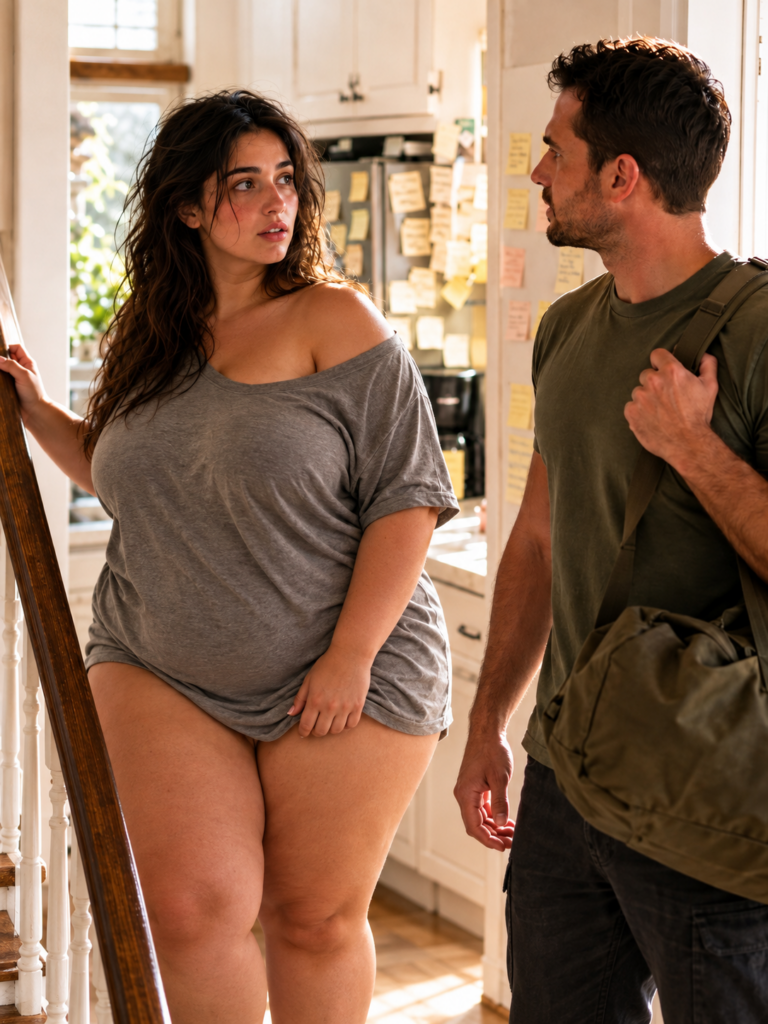
Emma came around the corner wearing an oversized gray T-shirt and rubbing one eye.
My T-shirt, I realized.
Almost certainly mine.
She stopped.
So did I.
For one second we simply stared at each other.
She was twenty-eight now.
There were subtle differences from the girl at the barbecue.
A little more tiredness around the eyes.
More certainty in the way she held herself.
The same dark hair, sleep-tangled down her shoulders.
The same face that always seemed to be noticing more than it said.
Her gaze traveled from me to the duffel bag near the door.
Then to the coffee in my hand.
Then back to me.
“You’re not supposed to be here.”
“I live here.”
Her eyes narrowed.
“You know what I mean.”
“Flight got moved up.”
“You’re eleven days early.”
“I counted too.”
She stared another second.
I lifted my mug.
“I made coffee.”
Her gaze dropped to it.
Then slowly moved toward the coffee maker.
Toward the folded note.
The change in her expression was immediate.
“Oh, no.”
She crossed the kitchen too fast and slammed one hip into the counter.
She didn’t even react.
She grabbed the note and pressed it against her chest.
“That is nothing.”
I took another sip.
“It has my name on it.”
“It’s a housekeeping note.”
“A formal one?”
“Very formal.”
“Emma.”
Her grip tightened around the paper.
For all her embarrassment, there was something else there.
Something that didn’t look like simple panic.
Grief, maybe.
The grief of someone watching an exit disappear.
“I was going to be gone,” she said.
I lowered the mug.
“What?”
“My new lease starts in twelve days. You were coming back in eleven.”
She gave a helpless little gesture toward the door.
“I did the math. I was going to hand you the keys, give you the plant instructions, tell you not to murder anything, and leave.”
“Before I got home?”
“Yes.”
“Why?”
Her mouth parted.
Closed.
“Before you ever—”
She stopped.
I waited.
“Before I ever what?”
She looked away.
The morning light had begun spreading across the floor between us.
For twelve years, Emma and I had been good at this.
The unfinished sentence.
The joke instead of the truth.
The careful distance nobody had officially asked us to keep.
I had once convinced myself that joining the army was simply a career decision.
Emma had arranged a lease so she would move out one day before I came home.
Different methods.
Same instinct.
Leave before the hard part.
I leaned against the counter.
“You remember the morning I left?”
Her eyebrows pulled together.
“What about it?”
“I burned the toast.”
“You always burn toast.”
“Eight months ago.”
Recognition changed her face.
I continued.
“You were here. I had a bag by the door. Nora had been crying on the phone. I burned breakfast.”
Emma’s eyes softened.
“And you took the pan away from me.”
“You were going to deploy on an empty stomach.”
“You told me, ‘An employed idiot still needs to eat.’”
A tiny smile touched her mouth.
“I remember.”
“You remember that?”
The smile disappeared.
“I remember all of it.”
The words settled between us.
Emma heard them too.
I could tell by the way she immediately looked down.
The coffee maker clicked.
Three houses away, a garbage truck groaned to a stop.
I looked around at the notes.
“Can I ask you something?”
She nodded cautiously.
“Why these?”
She glanced at the freezer.
“They’re practical.”
“I don’t mean the trash schedule.”
“The trash schedule is important.”
“Forty notes, Emma.”
Her head came up.
“You counted?”
“I’ve been home twenty minutes. Give me time.”
That almost got a smile.
I didn’t let it change the question.
“You wrote down the coffee I like. The stair. How much water the plants need. You gave my water heater a personality.”
“It started it.”
“You’ve been talking to me for eight months.”
Her eyes met mine.
“To an empty house,” I added.
She went still.
“Why?”
The answer took long enough that I almost told her she didn’t have to give one.
Then she said quietly, “Because saying things to a house was easier than saying them to a person.”
I didn’t move.
She gave a small laugh with no humor in it.
“That sounds ridiculous.”
“No.”
“It does.”
“It sounds specific.”
She stared at the note held against her chest.
I’d spent enough years around men who answered I’m fine when they weren’t to know that sentences usually had another sentence underneath.
Emma had just shown me the edge of hers.
My gaze dropped to the paper.
“What’s in the note?”
Her thumb rubbed the folded edge.
“The one with my name.”
“I know which one.”
“What does it say?”
She looked at me.
“If I tell you, everything changes.”
I heard myself answer before I could retreat behind something safer.
“Some things are supposed to.”
Emma inhaled.
Her breath left unsteadily.
Then she crossed to the table, set the note down, and flattened it with two fingers.
“Not yet.”
I waited.
“If I’m doing this, I’m doing it in order.”
She pulled out a chair.
“With coffee.”
I sat.
“And you are not allowed to make jokes until I’m finished.”
“I make no promises.”
“Caleb.”
“One joke.”
“No.”
“I’ll ration it.”
The corner of her mouth moved.
Not quite a smile.
But enough that something inside me loosened.
Emma poured herself coffee, sat across from me, and wrapped both hands around the mug.
This was the same woman who had done homework at our old kitchen table when she was fourteen.
The same woman I’d left behind eight months ago.
The same woman who had spent those eight months apparently writing conversations onto my walls.
And for the first time in twelve years, neither of us had anywhere immediate to go.
She began.
“I moved in the day after you left.”
I said nothing.
“I cried in the driveway.”
That surprised me.
Emma pointed at me.
“You swore no jokes.”
“I haven’t said anything.”
“Your face did.”
“My face is innocent.”
“Your face has never been innocent.”
“That’s a joke from you.”
She gave me a look.
Then her expression changed again.
“The house was too quiet,” she said.
I waited.
“I thought I would like that. My old place had three roommates. Somebody was always playing music or leaving dishes everywhere. I wanted silence.”
Her fingers shifted around the mug.
“But your house didn’t feel empty in a normal way.”
“What does that mean?”
“It felt like it was waiting for you.”
Something tightened behind my ribs.
She looked toward the freezer.
“The first note was the coffee one.”
“Why?”
“I found the terrible coffee you left.”
“It was adequate.”
“It was a human rights violation.”
“That seems dramatic.”
“Accurate.”
I almost smiled.
She did too.
Then she continued.
“I went out and bought the kind you actually like. When I came back, I stood there holding the bag and felt stupid.”
“For buying coffee?”
“For buying your coffee.”
Her gaze dropped.
“You were seven thousand miles away. You weren’t going to drink it. I didn’t know why it mattered to me that your kitchen had the right coffee in it.”
She traced a finger around the rim of her mug.
“So I wrote the note.”
BUY THE GOOD COFFEE. HE HATES THE CHEAP STUFF.
“Present tense,” she said.
“Like you were just at work.”
That sentence did something I couldn’t name.
“The house felt less empty after that.”
“So you kept doing it.”
She nodded.
“The stair after I almost fell down it.”
“The water heater?”
“Two in the morning. It made that sound.”
“What sound?”
“The haunted submarine sound.”
“I know the sound.”
“I hit it.”
“You assaulted my water heater.”
“It recovered.”
“Strong character.”
“That’s your one joke.”
“I didn’t agree to the accounting system.”
She smiled.
This time it lasted.
Then the smile faded as she looked past me toward the living room.
“After a while the notes changed.”
“How?”
Emma’s fingers tightened on the mug.
“At first, they were for you.”
“For when I came home?”
“Instructions. Things you needed to know.”
She swallowed.
“Then around month three, they stopped being for future you.”
I waited.
“They became a place to put things.”
“What things?”
Her eyes lifted.
“The things I couldn’t say to you.”
My hand stopped around my cup.
“There are notes behind your books.”
I stared at her.
“You hid notes behind my books?”
“You own too many books for someone who claims not to enjoy reading.”
“I read.”
“You complain every time you do it.”
“I read slowly and with resentment.”
“That’s not better.”
“What do the notes say?”
Emma looked down.
“They’re mostly after the video calls.”
I knew exactly which calls she meant.
I called Nora whenever I could.
Sometimes Emma was at Nora’s place.
Sometimes Nora visited Emma here.
Emma would be somewhere in the background, usually pretending to sketch or read.
I’d hear her laugh occasionally.
She rarely said more than a handful of words directly to me.
For months I’d told myself that had meant nothing.
“You’d call Nora,” Emma said, “and she’d put you on speaker. You’d talk for an hour.”
She paused.
“I’d say maybe six words.”
“I noticed.”
Her gaze snapped up.
“You did?”
“I noticed when you weren’t there too.”
Emma looked at me for a long second.
Then continued more carefully.
“When the call ended, I’d come back here.”
“To my house.”
“To a house full of you.”
She gave a small, helpless shrug.
“Your boots. Your books. Your stupid coffee machine. That dent in the wall where you clearly tried to move furniture by yourself.”
“It almost fit.”
“It did not.”
“Continue.”
Her eyes stayed on mine.
“I’d write down whatever I’d wanted to say on the call.”
“Why not just say it?”
“Because Nora was there.”
“So?”
“Because you were deployed.”
“So?”
Her voice grew quieter.
“Because the last thing a man in a war zone needs is his sister’s best friend developing a complication.”
There it was.
A word small enough to hold twelve years.
“A complication,” I repeated.
Emma looked miserable now.
“A large, inconvenient, twelve-year complication that I have handled with enormous dignity.”
“Have you?”
“I was doing well until you came home eleven days early and destroyed my exit strategy.”
Something inside me almost laughed.
Not because it was funny.
Because I knew that strategy.
I had lived by it.
Emma had planned her lease around avoiding me.
I had built half my adult life around keeping distance from her.
Different map.
Same route.
Part 2
“I have a confession too,” I said.
Emma immediately shook her head.
“You don’t have to.”
“Yes, I do.”
“Caleb.”
“The Fourth of July.”
She froze.
“Old house. Years ago.”
Her fingers went motionless around the mug.
“You laughed at something.”
Emma’s face changed in tiny degrees.
“The real laugh,” I said.
She knew.
I could see it.
“I remember looking at you and feeling something happen in my chest.”
Her lips parted.
“For the next eight years, I decided it was heartburn.”
Emma stared.
I looked at my coffee.
Then back at her.
“It wasn’t heartburn.”
“Caleb.”
“It was you.”
She didn’t move.
The hardest truths, I had discovered, usually arrived without ceremony.
No music.
No grand setting.
Just a kitchen, cooling coffee, and a woman wearing your shirt.
“I joined the army partly to get away from a girl at a barbecue.”
Her eyes filled so quickly I nearly stopped.
But stopping was what we’d always done.
So I kept going.
“I’ve never told anyone that.”
“You left because of me?”
“No.”
Her face fell anyway.
I leaned forward.
“I left because I was afraid of you.”
She blinked.
“Those aren’t the same thing.”
“I don’t understand.”
“One makes you responsible. The other makes me a coward.”
Her mouth trembled.
“I want to be accurate.”
A startled laugh escaped her.
Wet around the edges.
“You want to be accurate.”
“It matters.”
I held her gaze.
“You’ve spent years thinking you were a complication I had to manage.”
Her smile vanished.
“I need you to understand something.”
I searched for the words.
Then found the closest thing to truth I had.
“You were never a burden I carried.”
Emma’s breath caught.
“You were a door I locked because I didn’t trust myself to walk through it.”
Her hand went over her mouth.
“That’s on me.”
She looked down.
“Not you.”
When she lowered her hand, her eyes were shining.
“That might be the kindest thing anyone has ever said to me.”
I frowned.
She added, “And you delivered it like a structural engineering report.”
“I contain multitudes.”
“You contain a spreadsheet.”
“That was a joke.”
“You already used yours.”
“That wasn’t the agreement.”
Emma laughed.
The real laugh.
The one from the barbecue.
It folded her face exactly the same way.
And for one ridiculous second I was twenty-three again, standing under cheap yard lights with a paper plate in my hand, realizing too late that the safest person in my sister’s life had somehow become dangerous to mine.
Except this time I didn’t leave.
I stayed at the table.
So did she.
The laughter faded.
Reality didn’t.
There was still an entire person we hadn’t discussed.
“Nora,” I said.
Emma closed her eyes.
“Nora.”
The name settled between us.
Loving your sister’s best friend sounds uncomplicated only if you don’t care what happens afterward.
Emma wasn’t simply someone Nora knew.
She was twelve years of history.
The person who knew which anniversaries made Nora quiet.
The person who made Mom’s soup.
The person who had survived adolescence beside my sister and stayed.
If Emma and I tried this—whatever this was—and ruined it, the damage wouldn’t stop with us.
Nora could lose something too.
I knew Emma understood that better than I did.
“If this goes wrong,” she said, “I don’t just lose you.”
“I know.”
“She’d say it wouldn’t affect us.”
“But it might.”
Emma nodded.
“I can’t pretend that doesn’t scare me.”
“It should.”
She gave me a look.
“You’re bad at reassurance.”
“I’m trying not to lie.”
“I know.”
That mattered.
The fact that she knew.
Then another thought occurred to me.
“She set this up.”
Emma frowned.
“What?”
“The house sitting.”
“No.”
“She did.”
“Caleb.”
“She told me your lease was up.”
“Because it was.”
“She told me you’d take better care of the house than a stranger.”
“I did.”
“She said it in the voice.”
Emma’s eyes narrowed.
“What voice?”
I stared at her.
“You know the voice.”
A beat.
“The scheming voice?”
“The scheming voice.”
Emma sat back.
“Oh my God.”
“What?”
“She used the voice on me too.”
I pointed across the table.
“See?”
“She told me you’d need somebody reliable.”
“Which sounds normal.”
“And that it would be good for both of us to have less on our plates.”
We stared at each other.
“What does that even mean?” Emma asked.
“I don’t know.”
“I have wondered about that sentence for eight months.”
“We’ve been played.”
Emma’s mouth twitched.
“By Nora.”
“By a woman who once cried too hard to make soup.”
That did it.
Emma folded forward, laughing.
I followed.
For a few minutes we were useless.
Twelve years of restraint collapsed into the absurdity of realizing Nora might have seen through both of us before either of us had admitted anything to ourselves.
Then Emma’s laughter thinned.
She lowered her head onto her folded arms on the table.
When she looked up again, tears still brightened her eyes.
“I still don’t know if this is a good idea.”
“It’s probably terrible.”
“Thank you.”
“We’re both cowards.”
“Caleb.”
“We are.”
I counted on my fingers.
“We leave. We hide. We spent twelve years not saying anything useful. Your best friend’s my sister, which means if this fails spectacularly, we could blow a hole through the middle of a family.”
“You are doing an incredible job selling this.”
“I’m being accurate.”
“Stop being accurate.”
“No.”
Emma gave a weary laugh.
I sobered.
“I want you to know exactly what you’d be choosing.”
Her gaze settled on me.
“Because I’m done with the considerate thing.”
“What considerate thing?”
“The part where I decide what you’re capable of carrying without asking you.”
She went very still.
“You’re an adult,” I said. “You get all the information.”
I drew a breath.
“So here it is.”
Emma waited.
“I’m not smooth.”
“No argument.”
“I disappear when I’m scared.”
Her amusement vanished.
“I’ve done it my whole adult life.”
“Caleb—”
“I literally deployed rather than deal with what I felt.”
“You didn’t deploy because of me.”
“Not entirely. But you were part of why leaving was easy.”
I rested my arms on the table.
“I will probably have the instinct to do that again. Not deploy. Leave.”
Her eyes didn’t leave mine.
“Shut down. Decide silence is safer. Convince myself I’m protecting somebody.”
I swallowed.
“If we ever try this, I need you to tell me when I’m doing it.”
Emma’s expression softened.
“Because sometimes I won’t see it.”
“Okay,” she said.
“And there is a real chance Nora gets hurt or angry or weird about it.”
“Definitely weird.”
“Definitely.”
I continued.
“But I won’t build something with you that has to be hidden like we’re ashamed of it.”
Emma’s throat moved.
“I’m not ashamed.”
“Neither am I.”
The words came easier now.
“This is the least shameful thing I’ve ever wanted.”
For several seconds she simply stared.
Then she reached across the table.
Slowly.
Giving me time to refuse.
Her hand settled over mine.
Warm from the coffee.
I looked down at our hands.
Mine were steady.
That surprised me.
“I have one term,” she said.
“Name it.”
“We tell Nora together.”
I nodded.
“Before anything else.”
I looked up.
“I mean it,” Emma said. “I’m not sneaking around behind my best friend’s back in the house she apparently manipulated me into occupying.”
“Fair.”
“If we do anything about this, we do it in the light.”
The phrase caught.
“In the light.”
“And Nora gets to react however she reacts.”
“Angry.”
“Yes.”
“Smug.”
“Unfortunately.”
“Weird.”
“Certainly.”
“No hiding.”
Emma’s fingers tightened around mine.
“No shadows.”
I held her gaze.
“No shadows.”
For a while, neither of us spoke.
Our hands stayed together on the table.
The folded note remained on the counter.
Every few seconds my eyes drifted toward it.
Emma noticed.
“You still haven’t read it.”
“You said not yet.”
“I did.”
Her thumb moved slowly over my knuckles.
Then stopped.
“Okay.”
I waited.
“Now.”
I looked at her.
“You can read it now.”
I stood.
Emma did not.
“But before you do,” she said, “I need you to know when I wrote it.”
My hand paused over the note.
“Month six.”
Her voice had changed.
“Two in the morning.”
I turned back toward her.
“After one of the calls with Nora.”
I remembered month six.
Not the specific date.
Just the stretch.
A kid in my unit had lost someone back home. Bad phone call. Worse night.
I had mentioned it to Nora because she could hear something in my voice and wouldn’t let it go.
“You sounded exhausted,” Emma said.
I didn’t answer.
“And I was sitting on Nora’s couch.”
She folded her hands together in her lap.
“I wanted to say something. Anything.”
Her mouth tightened.
“But I was just her friend sitting beside her.”
“Emma.”
“I know.”
She shook her head.
“I know how that sounds now. But that’s how I thought about it.”
She gestured toward the note.
“I wrote that after I came home.”
Her eyes met mine.
“I never planned for you to see it.”
“Then why leave it out?”
“I was supposed to be gone.”
A humorless smile.
“I think part of me wanted you to find it when I wasn’t around to be embarrassed.”
I picked up the note.
“Whatever is in there,” she said, “it doesn’t have any dignity.”
“I don’t think dignity is helping us.”
“That is easy for a man who just confessed to fake heartburn to say.”
I unfolded the page.
Her handwriting filled most of it.
Caleb,
I keep writing you notes about coffee and stairs because those are the things I’m allowed to know about you.
But here’s the one I’m not allowed to say.
I hope you come home.
Not the house.
I hope you come home.
All of you.
The whole difficult, accurate, stubborn man.
And I hope when you do, you find these and understand that someone was thinking about you every single day you were gone.
Not because I had to.
Because I wanted to.
Because somewhere in the last twelve years you stopped being Nora’s brother and started being the person I check the door for.
I’ll be gone before you read this, but the coffee will be good and the plants will be alive and the house will have been loved the whole time you were away.
Come home.
E.
I read it twice.
The first time, I understood the words.
The second time, I understood what they had cost her.
My hands lowered slowly.
Emma sat exactly where I’d left her.
Her fingers were twisted together.
Her chin was raised in that stubborn way people use when they’re waiting for impact.
“You check the door for me?”
Her expression broke.
“Every time a car slowed down.”
“For eight months?”
She nodded.
“Which is stupid because I knew you weren’t coming.”
“Emma.”
“I knew.”
Her eyes shone.
“And I still looked.”
I set the letter down carefully.
Then walked around the table.
I crouched in front of her chair.
Not because I had planned anything.
Because I didn’t want her looking up at me while I said this.
I wanted us level.
Nothing between us but a foot and a half of kitchen air.
“I’m home.”
Emma drew a shaky breath.
“All of me.”
Her mouth trembled.
“The whole difficult, accurate, stubborn man.”
A laugh escaped her.
“Eleven days early.”
“Terrible timing.”
“The worst.”
“And ready to have the most uncomfortable conversation either of us has ever had with my sister.”
She laughed again, quieter.
I looked at her.
“But I want to be the door you check.”
Her eyes closed for one second.
When they opened, I continued.
“I want to be the person who’s actually standing behind it.”
Emma made a small sound.
Then she lifted her hand.
It stopped halfway between us.
“Can I?”
“Yes.”
She blinked.
“You don’t even know what I was going to ask.”
“Whatever it is.”
Her hand touched my jaw.
Gentle.
Her thumb moved once against the roughness there.
I had imagined kissing Emma before.
More than once.
I had spent years refusing to admit I’d imagined it.
What I had never imagined was how careful she would be.
She leaned down.
I moved up.
We met somewhere in the middle.
The kiss was soft.
Almost tentative.
A question before an answer.
She tasted faintly of coffee.
The good kind.
My hand rose to the back of her neck.
Emma exhaled against my mouth.
Twelve years of caution didn’t disappear.
It loosened.
Like a house sealed through winter when someone finally opens every window.
When we separated, her forehead settled against mine.
For a moment I kept my eyes closed.
So did she.
“I thought I’d feel like I was stealing something,” Emma whispered.
I opened my eyes.
“From Nora?”
“From her. From the friendship. From the version of us that’s always existed.”
“Do you?”
She stayed quiet long enough that I didn’t rush her.
Then slowly shook her head.
“No.”
Her nose brushed mine.
“I feel like I finally stopped hiding a note behind the books.”
I laughed.
She smiled.
And because neither of us trusted happiness without terms and conditions, we did exactly what we’d promised.
We called Nora.
Part 3
We sat side by side on the couch.
The blanket Emma had folded remained over the arm.
Her hand stayed in mine.
The phone rang once.
Twice.
Then Nora appeared on screen mid-complaint.
“—and then this guy doesn’t even signal, which should be a criminal offense, and Caleb, why are you—”
She stopped.
Her eyes widened.
“You’re home?”
“Yes.”
“You’re not supposed to be home.”
“I’ve heard.”
“You’re eleven days early.”
“Also heard.”
“Is that my—”
Nora leaned closer to the camera.
“Is that Emma?”
Emma lifted one hand.
“Hi.”
“What are you doing there?”
Her gaze traveled.
Our shoulders.
Our faces.
Then our hands.
We had deliberately left them visible.
No shadows.
Nora’s eyes narrowed.
“Oh my God.”
Emma inhaled.
“Nora—”
“Oh my God.”
“Before you say anything,” Emma began, “I need you to know that this is real and I’m taking it seriously. You are the most important person in my life, and I would never risk—”
“You check the door for him, don’t you?”
Emma stopped.
I turned toward her.
She turned toward me.
Then both of us looked at Nora.
Nora’s expression had become something I knew well.
The scheming voice, somehow visible.
“You knew,” I said.
Nora gave us the calm dignity of a person about to confess to a felony she believed was morally justified.
“I have known for years.”
Emma stared.
“No.”
“Yes.”
“Years?”
“Fourth of July.”
My stomach dropped.
Nora pointed at me through the screen.
“You got heartburn for no reason.”
Emma made a strangled sound.
I closed my eyes.
“I hate both of you.”
“And you,” Nora continued, pointing at Emma, “started saying six words every time he called and then going completely silent.”
Emma opened her mouth.
Closed it.
Nora looked pleased.
“I had a brother who kept leaving whenever feelings were within fifty feet of him and a best friend who could schedule her entire life around avoiding one conversation.”
“You set up the house sitting,” I said.
“Obviously.”
Emma leaned toward the phone.
“Nora.”
“What?”
“You told me it would take things off our plates.”
“It did.”
“What did that sentence mean?”
“Nothing.”
“You are a terrible person.”
“I am an excellent person.”
Nora smiled.
“I couldn’t get you two in the same country. So I arranged for you to eventually occupy the same house.”
“You cried too hard to make Mom’s soup,” I said, “but you can run a twelve-year psychological operation on your brother?”
“Those are unrelated skills.”
Emma laughed.
Nora did too.
Then abruptly my sister’s face changed.
Her eyes filled.
Emma’s laughter vanished.
“Nora?”
“Are you really doing this?”
Her voice broke.
Emma tightened her hand around mine.
“Yes.”
Nora wiped at her cheek.
“Like really?”
I looked at Emma.
She looked back.
That mattered.
Even now, neither of us answered alone.
“We’re really trying,” Emma said.
Nora started crying harder.
Then laughing through it.
“I am going to be unbearable.”
“I assumed.”
“No. You need to understand the scale of this.”
She pointed at both of us.
“I have waited years.”
“You’ve earned it,” I admitted.
“I have.”
Her gaze shifted to Emma.
Then narrowed.
“Are you wearing his shirt?”
Emma looked down at herself.
“It is a formal shirt.”
I covered my face.
Nora laughed so hard she had to put the phone down.
We didn’t decide the rest of our lives that day.
That turned out to be important.
After twelve years of running before anything difficult could happen, the easy mistake would have been to sprint in the opposite direction.
Emma had a lease starting in twelve days.
She kept it.
“I am not going from temporary house sitter to live-in girlfriend because you walked through the door jet-lagged and emotionally compromised,” she told me.
“I am not emotionally compromised.”
“You cried reading my note.”
“I had dust in my eye.”
“You were indoors.”
“Old house.”
“Coward.”
“Accurate.”
She moved into the apartment.
I helped.
Three boxes of books.
Two boxes of kitchen things.
One enormous portfolio case.
More plants than I believed any individual woman needed.
“You multiplied them,” I said.
“They were lonely.”
“Plants don’t get lonely.”
“You’re emotionally unequipped to know that.”
I carried another box upstairs.
At her new place, I checked the door every time I arrived.
Knock.
Wait.
Emma would open it and say, “You know you don’t need to perform the metaphor.”
I always answered, “What metaphor?”
Then she’d let me in smiling.
Our first real date happened the following week.
We picked a diner outside town.
No candles.
No expensive reservation.
Neither of us could handle the idea of pretending we’d just met.
The vinyl booths were cracked.
The coffee was mediocre.
Emma ordered pancakes at seven in the evening.
“Pancakes aren’t dinner.”
She looked offended.
“Pancakes are timeless.”
“That isn’t a food category.”
“Then you lack imagination.”
“I’ve seen a lot of things called dinner.”
“And yet you remain wrong.”
I stole half her bacon.
She stole my fries.
We talked about things we’d somehow avoided discussing for twelve years.
Not the dramatic things.
Not at first.
Music she liked.
How she chose what to draw.
Why she’d taken three different jobs before settling into freelance design work.
Why I hated silence at night but still needed it.
Which movies Nora had made us both pretend to enjoy.
How Emma had known for years that I rotated the coffee mug in my hand three times before I drank whenever I was thinking.
“You notice too much,” I told her.
She looked over the rim of her glass.
“You noticed me laughing once and changed the direction of your life.”
“That’s an unfair interpretation.”
“Is it inaccurate?”
I considered.
“No.”
We went slow after that.
Not because we doubted the feelings.
Because feelings weren’t the problem anymore.
Habits were.
I had spent years making distance feel like responsibility.
Emma had spent years making silence feel like kindness.
Neither habit disappeared because we’d kissed once in a kitchen.
There were nights I went quiet.
Nights she saw it happening before I did.
Once, after a bad day, I stopped answering messages for almost six hours.
Not intentionally.
At least that’s what I told myself.
I was sitting in my truck outside my house when Emma knocked on the passenger window.
I unlocked the door.
She climbed in.
Didn’t ask what happened.
Didn’t demand I talk.
She sat beside me.
After several minutes she said, “Are you leaving?”
I looked at her.
“What?”
“Not physically.”
That landed harder.
I stared through the windshield.
“I don’t know.”
“Okay.”
“Okay?”
“You said to tell you when I saw it.”
I closed my eyes.
She continued.
“You’re deciding what I can carry again.”
I let out a breath.
“I had a bad day.”
“I assumed.”
“I don’t want to give it to you.”
“You don’t get to decide that part.”
I looked at her.
Emma’s expression was steady.
“You can tell me you don’t want to talk.”
She rested her hands loosely in her lap.
“You can ask for space.”
“But don’t disappear and call it protection.”
The sentence hurt because it was true.
I nodded.
“Okay.”
“Okay.”
I sat with that.
Then I told her about the day.
Not all of it.
Enough.
She listened.
Nothing exploded.
The world kept turning.
That was how trust grew between us.
Not through grand declarations.
Through surviving ordinary honesty.
Through discovering that a difficult conversation did not automatically become a goodbye.
Eventually, I started finding the notes behind the books.
Emma refused to show me where.
“If you want them, you have to read.”
“This is extortion.”
“This is literacy.”
“You hid emotionally significant material in books I don’t even like.”
“You own them.”
“That doesn’t mean I like them.”
“Read faster.”
The first note fell from a paperback three weeks after she moved out.
It was dated from month four.
TOLD A BAD JOKE ON THE CALL TONIGHT. HE LAUGHED. REAL ONE. WROTE IT DOWN SO IT COUNTS.
I sat on the floor for a while after reading it.
Another appeared inside a history book.
THE PLANTS ARE GETTING BIG. SO IS THE THING I’M NOT SUPPOSED TO FEEL.
Then month five.
I’M RUNNING OUT OF WAYS TO SAY I MISS YOU TO A HOUSE.
That one stayed in my pocket all day.
I found more over the following weeks.
Some were funny.
Some practical.
Some only one sentence.
He sounded better tonight.
Nora made him laugh.
He looked tired.
Wanted to tell him to sleep. Didn’t.
Bought the coffee again even though I’m the only one drinking it.
A whole relationship existed in those notes.
Not between Emma and me exactly.
Between Emma and the absence I’d left behind.
I put every note in a box.
No lock.
No hiding place.
Just a plain box on the shelf tied with a piece of string.
When Emma saw it, she stared.
“String?”
“I didn’t have ribbon.”
“You could buy ribbon.”
“I am not a ribbon man.”
“You’ve tied love notes into a bundle.”
“With string.”
“Which is apparently very masculine.”
“Correct.”
She laughed.
The real laugh.
I never got tired of earning it.
Some nights were harder than others.
Sleep didn’t always come easily after deployment.
On the worst ones I’d wake up before dawn, confused for a second by the silence.
Sometimes Emma was there.
Sometimes I was at her apartment.
One night she found me sitting at the kitchen table.
She didn’t ask what was wrong.
She took the box from the shelf.
“Pick one.”
“No.”
“Pick one.”
I pointed.
Emma unfolded a note.
It was one of the stupid ones.
A grocery reminder turned confession.
BUY MILK.
ALSO, THIS HOUSE HAS TOO MANY ROOMS FOR ONE PERSON TO MISS ANOTHER PERSON IN.
She read it aloud.
I laughed.
Quietly.
Then she put the note on the table and took a blank piece of paper.
“What are you doing?”
“Your turn.”
“For what?”
“You’ve been benefiting from my emotional labor for months.”
“I thought this was a support situation.”
“It is.”
She pushed the paper toward me.
“Write.”
I looked at the page.
Then at her.
“This is ridiculous.”
“It works.”
So I wrote.
COULDN’T SLEEP.
SHE SAT WITH ME WITHOUT ASKING ME TO PRETEND I COULD.
I slid the note across the table.
Emma read it.
She didn’t say anything.
Just folded it carefully and put it in the box with hers.
After that, notes appeared again.
Mine this time too.
On the refrigerator:
WE NEED EGGS.
ALSO, YOU WERE RIGHT ABOUT PANCAKES BEING DINNER. THIS ADMISSION SELF-DESTRUCTS AT MIDNIGHT.
On her bathroom mirror:
YOU HAVE A MEETING AT NINE. STOP READING THIS AND FIND YOUR KEYS.
On my third stair, beside her old note:
STEP ON THE LEFT SIDE. YOU’RE WELCOME.
I never fixed the stair.
I probably could have.
Didn’t.
Some things deserve to keep making their little sound.
A year after I came home early, Nora visited.
She walked into the kitchen carrying two grocery bags and immediately looked between Emma and me.
We were standing shoulder to shoulder at the counter.
Nothing dramatic.
Emma slicing vegetables.
Me ruining something in a pan.
Nora put both bags down.
“I did this.”
I looked at her.
“What?”
“This.”
She waved at us.
“This is my work.”
Emma didn’t look up from the cutting board.
“You suggested house sitting.”
“A decisive intervention.”
“You manipulated two emotionally avoidant adults.”
“Exactly.”
“I want credit,” Nora said.
“You’ve had credit for a year.”
“I want it on the record.”
“It’s on the record,” I said.
Nora nodded with satisfaction.
“You’re welcome.”
Emma pointed toward the stairs.
“Wrong note.”
Nora frowned.
“What?”
I looked at Emma.
She looked at me.
Then we both started laughing.
Nora demanded an explanation.
We refused.
That made it worse.
She complained until she laughed too.
And standing there in my kitchen, watching my sister and Emma argue about a joke written on a staircase, I understood something I hadn’t known how to name when I first came home.
I used to think home was a location.
Four walls.
Keys.
A refrigerator.
The address you returned to after being gone.
But for eight months, Emma had loved this house because she couldn’t love me out loud.
She had watered the plants.
Bought good coffee.
Learned the sound of the pipes.
Stepped around the creaking stair.
Filled empty rooms with things she couldn’t say to the man who owned them.
And when I returned, I thought I’d discovered evidence that someone had lived in my absence.
What I’d actually found was proof that I hadn’t been absent to her at all.
She had carried me through ordinary things.
Coffee.
Trash day.
Books.
Plants.
A water heater that needed one firm hit.
Small facts.
Safe facts.
Until the small facts weren’t enough.
The first morning, Emma told me she’d planned to be gone before I arrived.
That had been her careful plan.
Leave before the hard part.
I understood because I had spent years doing the same thing.
Now, sometimes, a car slows outside and Emma still glances toward the door.
She doesn’t always realize she’s doing it.
I do.
Once I asked whether she thought she’d ever stop.
She considered.
“No.”
“Does it bother you?”
She looked at me.
“No.”
Then she smiled.
“Because now you’re usually the one coming through it.”
I still write notes.
So does she.
Some are important.
Most aren’t.
BUY COFFEE.
CALL NORA.
PLANT NEEDS WATER.
DON’T FORGET DINNER.
The ordinary things became sacred somehow.
Not because they’re romantic.
Because they’re evidence.
Evidence that we’re still here.
Still speaking.
Still choosing not to disappear.
I used to believe consideration meant keeping my weight away from people I loved.
Not asking too much.
Not complicating their lives.
Leaving before my fear could become their problem.
Emma taught me the difference.
Consideration asks someone what they can carry.
Fear decides for them.
Fear is quiet.
It leaves early.
It writes the letter but makes sure the room is empty before anyone can answer.
For twelve years, I had confused fear with restraint.
So had she.
Then she wrote forty notes.
One about coffee.
One about a stair.
Several behind books.
One with my name.
Tiny acts of courage from someone who still wasn’t ready to say the larger thing.
Until one morning, I walked into the kitchen eleven days early and wrecked both our exit strategies.
Emma was supposed to be gone before I read that note.
That was the plan.
Clean.
Careful.
Considerate.
Instead, I came home while she was still upstairs.
I made coffee.
She came down wearing my shirt.
And when the hard part arrived, neither of us left.
Best thing I ever did.