
Part 1
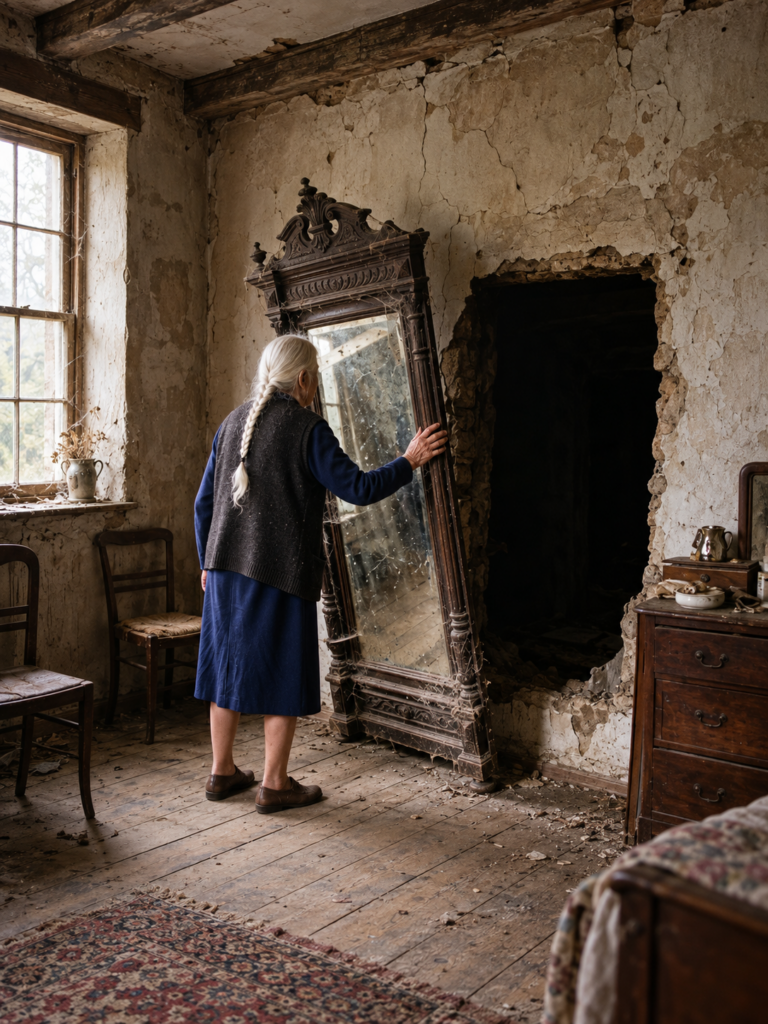
I promised my grandmother I would never move the mirror.
For forty years, I kept that promise.
Not approximately forty years. Not most of forty years. Forty complete years.
Every two weeks I cleaned the glass with newspaper and vinegar. I dusted the dark wooden frame, taking care not to push it even an inch. I painted the living room twice and painted around the mirror both times, leaving a rectangle untouched behind it like the space around a religious image no one dared disturb.
Earthquakes came.
Rain leaked through the old roof.
My husband, Aurelio, once suggested that a bookshelf would fit better on that wall. My younger daughter wanted the mirror in her bedroom because she liked what remained of the gold leaf around the frame.
I refused them all.
When Aurelio died nineteen years ago, we moved nearly every piece of furniture in the living room so there would be space for his coffin and the people who came to sit with us through the night.
We did not move the mirror.
It hung above us while we prayed.
My name is Benita Solís. I turned seventy-one in March, and I have lived almost my entire life in the same old house in Morelia, Michoacán.
I am a bookbinder.
I began learning the trade when I was fifteen under a man named Don Nicolás Cendejas, in a narrow workshop not far from the arcades. I learned to fold signatures, pierce holes with an awl, sew with waxed thread, pare leather, make paste, repair worm-eaten pages with thin Japanese paper, and wait.
Waiting is more important in bookbinding than people think.
A book spends half its life in a press.
Rush it, and you ruin it.
Don Nicolás used to say that we repaired what time had undone. When I was young, I thought that sounded grand. Now I know better. We don’t defeat time. We only persuade things to hold together a little longer.
Perhaps that is why what happened behind that mirror affected me the way it did.
My grandmother was called Pura.
Everyone in the neighborhood knew her as Doña Pura, the woman by the green gate. She raised me after my mother, Rosaura, died of a fever when I was five. I remember almost nothing about my father. He went north, sent money twice, and then disappeared from our lives.
So there was my grandmother and there was me.
She taught me to sweep, pray, sew, work, and keep quiet.
Of those five skills, silence was the one she knew best.
She was a small woman with long hands, fine bones, very dark hair that turned white surprisingly early, and a tight bun I never once saw undone. She was obsessively clean. She scrubbed floors that were already clean and picked crumbs from the floor almost before they landed.
She never beat me.
In those days that made her unusual.
Her punishment was worse.
When I disappointed her, she stopped speaking to me.
She still cooked. Still washed my clothes. Still placed my breakfast on the table. But she might go three days without saying my name.
Once, she went five.
For most of my life I thought that was simply her temperament.
Now I understand that silence was the only weapon she had practiced long enough to master.
She could also be tender, although never in the obvious way.
I don’t remember hearing her tell me she loved me.
Instead, she gave me the best piece of meat. She mended my socks after I went to bed. When I had my appendix removed, she slept three nights sitting upright beside my hospital bed.
Whenever I woke, she would tell me, “Go back to sleep, little girl.”
Little girl.
The phrase always sounded strange coming from her. People around us used other expressions. But that was hers, and because it was hers, I never questioned it.
There were many things about my grandmother I never questioned.
Families are good at that.
Give an odd habit enough years and it stops looking odd.
We knew she sometimes used words no one else around us used.
Once, while peeling potatoes, she called them patatas. She froze with her back to me, then corrected herself.
Another time she called a sweater a jersey.
When she was sick with a high fever, I heard her muttering in her bedroom. She used vosotros. She called for “Mother” in a way I had never heard from her before.
The next morning I asked who she had been talking to.
“Sick people talk nonsense,” she said.
Then she added, “Don’t remember it.”
I obeyed.
She hated the sea.
That was another thing.
She claimed she had never seen it, yet when my husband once suggested taking the family to Manzanillo, the color drained from her face.
“I am not going back to the sea.”
Back.
None of us noticed the word.
Aurelio laughed. I laughed with him. We assumed she was an old woman frightened by travel.
Years earlier, when I was a child, I had pasted a picture of an ocean liner onto a school project about transportation.
My grandmother tore the ship off the cardboard with her fingernail, crushed it, and threw it into the stove.
She never explained why.
She never spoke about her childhood either.
When I asked about her mother, she gave vague answers.
Her brothers or sisters?
She didn’t remember.
Where had she grown up?
“A ranch over that way.”
Which ranch?
It no longer existed.
Nobody remained there.
A perfect place, I later realized, because no one could visit it and nobody from it could ever appear at the front door.
Then there was June seventh.
Every June seventh my grandmother woke before dawn, dressed in dark clothes, skipped breakfast, and worked until there was almost nothing left in the house to clean.
By afternoon she would sit on the patio step with her hands folded and stare toward the lemon tree.
The next morning she was herself again.
We called it Grandma’s Day.
We joked about it.
Perhaps an old sweetheart had died on June seventh, someone said.
Perhaps it was her wedding anniversary.
Perhaps it was the day her mother died.
We laughed about Grandma’s Day for years.
There was also the biscuit tin.
A blue English tin decorated with flowers and a castle sat on top of her wardrobe beneath a folded cloth. When I was seven, I climbed onto a chair and opened it.
Buttons.
That was all.
My grandmother caught me.
She replaced the tin and then refused to speak to me for five days.
From then on, everyone knew: never touch Doña Pura’s tin.
When she died, several of us gathered around while my aunt finally opened it.
Buttons. Two holy cards. A thimble.
Nothing more.
We laughed then too.
The old woman’s great secret was a box of buttons.
Or so we believed.
The mirror was something else.
I was thirty-one when my grandmother made me swear.
She was dying by then. She had been ill for some time, and twelve days after my birthday, she was gone.
During one of her final lucid moments, I sat beside her bed holding her hand.
Her eyes opened.
She searched for me although I was only inches away, then suddenly closed her fingers around my wrist with such force that the marks remained the next morning.
“Benita,” she said. “Swear something to me.”
“Anything.”
“The mirror in the living room.”
I waited.
“Never move it. Not you. Not anyone. As long as this house is standing, that mirror does not come down.”
I thought she was delirious.
“Yes, Grandma.”
Her grip tightened.
“Don’t say yes as though I’m crazy. Swear.”
That frightened me.
So I swore.
I swore on my mother’s life.
Only then did she release me.
“Why?” I asked. “What’s behind that mirror?”
She closed her eyes.
Three days later, she died.
For forty years, I did exactly as she asked.
Eventually the promise stopped feeling like a promise.
It became part of the architecture.
The washbasin.
The lemon tree.
The mirror that never moved.
Then the rains came.
Our house is old, with adobe and stone walls, and water is not kind to either one. A damp stain appeared low on the living-room wall and began climbing.
Paint peeled.
White saltpeter pushed through the plaster.
Then a piece of wall fell away.
My daughter Rosario brought a mason named Don Chuy.
He poked at the damaged area and said the entire section needed to be stripped, dried, replastered, and painted.
Then he pointed at the mirror.
“That has to come down.”
“No.”
He thought I was joking.
I wasn’t.
The worst damage, he explained, was directly behind it.
Rosario and I argued late into the night.
She told me I was seventy-one years old, living alone in a house too large for me. She reminded me that I had fallen in the patio months earlier and lain there until a neighbor came.
Then she asked the question I had spent forty years avoiding.
“What if Great-Grandma was simply a stubborn old woman?”
I became furious.
Not because Rosario deserved it.
Because part of me had begun asking the same question.
After she left, I poured myself a tequila even though I rarely drink and sat facing the mirror.
The lamp cast yellow light across the damaged glass. Age had eaten the silver backing into black clouds and gray flecks.
I walked closer.
Half my forehead disappeared behind one of those dark spots, exactly as it had when I was nine years old.
Then I saw my grandmother.
Not a ghost.
My own face.
People had always told me I looked like her. The same narrow mouth. Same nose. Same deep-set eyes.
And for the first time in seventy-one years, a terrible thought came to me.
I knew my mother’s name.
I knew my grandmother’s name.
Beyond that, there was nothing.
No town.
No grave.
No great-grandmother’s surname.
No family photograph.
No childhood story.
No people.
I didn’t know where my own face came from.
Standing in front of that mirror, I became angry in a way I had never allowed myself to be angry.
Whatever my grandmother had hidden, she had hidden part of me too.
The next morning I called Rosario.
“Come Saturday,” I said. “Bring Octavio.”
“For what?”
“We’re taking down the mirror.”
My grandson Octavio is tall enough that he barely needed the ladder. Rosario came with gloves and plastic sheets.
Before they touched the frame, I cleaned the glass one final time.
Then we counted.
“One.”
“Two.”
“Three.”
They lifted it free.
For the first time in forty years, I saw the wall behind it.
There was a perfect rectangle of old pale-green paint, protected from sunlight and every later coat I had applied.
And in the center of that green rectangle was a patch.
About a foot wide.
Different plaster.
Crude plaster.
I touched it.
Hollow.
Rosario reached for the hammer.
“No,” I said.
I went to my workshop and returned with the bone folder I had used since I was seventeen.
If something had survived decades inside a wall, I wasn’t going to destroy it in thirty seconds.
I knelt and began lifting the plaster carefully.
It turned to powder.
Behind it was cloth.
I worked until I could reach inside.
For one foolish moment, I thought of money.
Coins.
Jewelry.
Perhaps documents.
Instead my fingers touched canvas.
I pulled out a small bundle tied with a cord so old it nearly disintegrated.
It weighed almost nothing.
We sat on the plastic-covered floor.
I opened it the way I would open a fragile book.
Inside were five things.
A photograph.
A narrow cloth label.
A single fabric-covered button.
A folded piece of paper.
And eight letters.
The photograph showed a young couple and two girls.
One girl was perhaps seven.
The other was a toddler on her father’s lap.
I stared at the older girl’s mouth.
I knew that mouth.
Rosario saw it too.
“That’s Great-Grandma.”
The photographer’s card beneath the portrait named a city.
It wasn’t in Mexico.
The cloth label had once been sewn into clothing. A word and several numbers were barely visible.
The button belonged to a heavy coat.
The folded paper contained a woman’s full name.
It was not Pura.
Beneath it was the name of a place.
Also not Mexican.
Rosario searched it on her phone.
Spain.
Then I picked up the letters.
Six had been opened.
Two had not.
The opened letters came from overseas and were addressed to a location in Morelia—not our house.
The unopened letters had traveled in the opposite direction.
From Mexico to Spain.
Both had been returned.
On one was a word that could still be read.
Unknown.
I opened the first of the six letters my grandmother had read.
A mother asked her daughter whether she had enough to eat.
Whether she was warm.
Whether she had shoes.
She mentioned the younger sister.
She sent kisses.
Near the bottom was a sentence written harder than the rest, the pencil pressed deeply enough to leave a groove.
Do not stop writing, even if we do not answer soon.
Signed simply:
Your mother.
I was seventy-one years old when I first saw my great-grandmother’s handwriting.
And sitting there on the floor, I finally understood one thing.
My grandmother had never come from a ranch “over that way.”
She had come from across the sea.
Part 2
Rosario stayed with me that night.
Neither of us slept.
At three in the morning I found her in the kitchen, and we both pretended we had only just gotten up for water.
I spread the six opened letters across the dining table and examined them under a magnifying glass.
I had expected secrets.
There were none.
That was what hurt.
There was no dramatic confession. No explanation of a crime. No fortune. No family scandal.
There was only an ordinary mother writing to a child.
Eat well.
Stay warm.
Your little sister is walking.
Your father is thin from working.
Don’t cry.
We will come for you as soon as we can.
That promise appeared again and again.
As soon as we can.
In the final surviving letter, the handwriting became hurried.
The mother said she had not received her daughter’s recent letters. She had written several times. She had asked someone else to help locate her.
Then:
Write at least two lines, daughter, even if it’s only to tell me you’re there.
The year had disappeared beneath water damage.
I held the paper to the morning light anyway, as though wanting something badly enough could restore missing ink.
It could not.
A good restorer learns that lesson early.
Some things are gone.
The two letters my grandmother herself had written remained sealed.
I did not open them.
Not then.
Instead, the following Monday, I placed everything inside a cardboard folder I made by hand and walked to the public library.
I had repaired books there for decades. A young employee knew me and looked at the Morelia address on the envelopes.
“Doña Benita,” he said, “don’t you know what used to be there?”
I didn’t.
He sent me to an elderly retired teacher named Aurelio Lemus.
Don Aurelio was eighty-nine and lived with his daughter near Santa María. His eyesight was poor, but his mind was sharp.
I laid the five objects on his table.
The photograph.
The label.
The button.
The scrap of paper.
The letters.
He picked up the cloth label carefully.
“Where did you get this?”
“Inside a wall.”
“Whose?”
“My grandmother’s.”
“Her name?”
“Pura Solís.”
I told him she had always claimed to come from a ranch.
Then I showed him the address on the envelopes.
He leaned back.
“That was the Spain-Mexico School.”
I had never heard the name.
He explained.
In 1937, Spain was at war.
Families desperate to protect their children agreed to send some of them away, believing the separation would be temporary.
A few months.
Perhaps a year.
Then they would return home.
Hundreds of Spanish boys and girls crossed the Atlantic to Mexico.
Don Aurelio gave me the number: 456.
He said they had left Europe aboard a French steamer called the MIC and arrived in Mexico on June 7, 1937.
June seventh.
After hearing those words, I barely heard anything else for several minutes.
June seventh.
My grandmother rising before dawn.
June seventh.
Dark clothes.
June seventh.
Scrubbing an already clean floor on her knees.
Grandma’s Day.
The joke.
Forty years of jokes.
Don Aurelio continued.
The children had been brought to Morelia during the administration of President Lázaro Cárdenas. They were housed and educated there and eventually became known as the Children of Morelia.
The war did not end quickly.
For many of them, going home became impossible.
Some built good lives in Mexico.
Some struggled.
Many never saw their parents again.
I looked at the faded cloth label.
“Were names and numbers sewn into their clothes?”
“When hundreds of children travel together,” Don Aurelio said, “someone has to know which child is which.”
I touched the label.
Suddenly it was not a scrap of cloth.
It was something adults had sewn onto a seven-year-old girl’s clothing so she wouldn’t disappear among hundreds of frightened children.
Then I thought about the button.
Heavy wool.
A winter coat.
No child in Morelia needed a coat like that in June.
It had come from Europe.
Perhaps my great-grandmother’s fingers had buttoned it before she sent her daughter away.
Perhaps it was the last thing from home my grandmother could touch.
I walked home instead of taking the bus.
As I crossed the old stone streets, I imagined a seven-year-old girl walking there for the first time.
She would have understood the language and yet heard everything spoken differently.
She might have been hot in her coat.
She might have expected her mother to come for her before Christmas.
That night I began rereading my grandmother’s entire life.
June seventh was only the beginning.
I remembered songs she hummed while washing, strange songs I had never heard on the radio. One was sad, and whenever she sang it, she stopped before the end.
For decades I had never noticed that she never finished it.
Had she forgotten the rest?
Or could she not bear to sing it?
I remembered Christmas Eve.
After dinner, when everyone else talked inside, my grandmother stood alone near the washbasin in the cold patio.
My aunt joked that she secretly smoked.
She never smoked.
I remembered how frightened she became whenever official documents appeared.
Her voter identification.
Property papers.
The census.
We had called it the suspicion of an old woman.
But an old woman who has spent fifty years living under a name that is not hers has reason to fear forms.
Then I remembered another sentence from my childhood.
Whenever I cried because someone had been cruel to me, my grandmother said, “Don’t cry. People who show weakness get eaten alive.”
I used to think it was a proverb.
It wasn’t.
It was survival advice.
And then there were the words.
Patatas.
Jersey.
Vosotros.
The slips she immediately corrected.
I finally understood why she had corrected my speech so relentlessly when I was little.
She wasn’t only teaching me.
She was practicing on me.
Every time she made me use the Mexican word, she was reminding herself which word she was supposed to use.
For fifty years, she had edited her own voice.
She had made herself Morelian one syllable at a time.
The oath took on a different meaning too.
She had not forced me to guard treasure.
She had forced me to guard the entrance to her former self.
The blue biscuit tin had been a curtain. Something forbidden placed in plain sight so curious children would focus their attention there.
Buttons on the wardrobe.
A life inside the wall.
Rosario helped me find a history student named Fátima.
I paid her to help search old records.
Nothing happened quickly.
There was no magical file.
There were lists—bad lists.
Typed lists.
Handwritten lists.
Copies of copies.
Names spelled two or three ways. Ages that changed from one document to another. A boy listed as a girl. Brothers whose surnames didn’t match because some exhausted clerk had written what he thought he heard.
“If we find her,” Fátima told me, “her name may be wrong. That doesn’t mean it isn’t her.”
We searched for four months.
I stopped taking new work.
Three books remained inside my press longer than I intended. When I eventually removed them, they were perfectly flat.
Books benefit from patience.
People do not always have the same luxury.
We narrowed the records to three girls.
One was eliminated quickly.
The second consumed six weeks before we proved she was someone else.
The third matched.
Not perfectly.
But enough.
The first name matched the one written on the scrap from the wall. The surname appeared with different spellings. The town was misspelled by one letter. The age fit.
Then we found a handwritten note.
The girl had a younger sister who remained in Spain.
The baby in the photograph.
From there we went to the civil registry.
That was where I found the document that hurt more than the letters.
My grandmother’s marriage certificate.
She had married young.
On that paper she gave the name I knew.
She claimed Morelia as her birthplace.
She listed her parents as deceased.
She presented no supporting documents.
Instead, two witnesses vouched for her identity, a legal practice at the time.
At the bottom was her signature.
I knew that handwriting.
She had signed my school report cards with it.
That was the day Pura became Pura on paper.
A young woman entered an office with one identity and walked out with another.
Her real town disappeared.
Her parents disappeared.
Her childhood disappeared.
She had not merely hidden where she came from.
She had legally buried the girl who arrived on the ship.
After that, the paper trail belonged to the woman I knew: wife, mother, grandmother, seamstress, guardian of a house in Morelia.
But I still wanted something no archive could give me.
A human voice.
Through Fátima, I met Doña Elvira Cuevas, an eighty-six-year-old woman whose father had also been one of those children.
She lived near the aqueduct and served me spiced coffee and bread.
When she saw the photograph, she became serious.
“Another one,” she said.
“Another what?”
“Another family that found out late.”
Her father had spoken of the journey, though never fully.
He remembered the ship.
The food.
Other children.
He once said that at the port there had been mothers everywhere, down below, while the children climbed aboard.
Some of the children believed they were going on a vacation.
Some carried food for the journey.
Some had their names sewn into their clothing.
Letters came at first.
Then fewer.
Then none.
Each child eventually realized, without anyone having to say it aloud, that no one was coming to take them home.
I asked why my grandmother would hide it.
Why change her name?
Why deny an entire country?
Doña Elvira stirred her coffee.
She told me that some of the Spanish children grew up speaking proudly about their origins.
Others did not.
Some were mocked.
Some were pitied.
And pity, she said, can become another kind of cage.
“Some people get tired of being from somewhere else.”
That sentence stayed with me.
“You get tired of answering questions,” she continued. “You get tired of being the person with the sad story. Eventually some decide they belong here. Completely here.”
I left her apartment after dark and sat beneath the illuminated arches of the aqueduct.
For the first time, I wondered whether my grandmother had lied to me only after lying to herself for so long that the lie became her home.
At seven, adults had decided where she would live.
Adults had put her on a ship.
Adults had numbered her.
Adults had told her the separation was temporary.
As a young woman, perhaps the first decision that truly belonged to her was choosing who she would be next.
She chose Pura.
She chose Morelia.
She chose silence.
I still couldn’t decide whether that was defeat or victory.
Then I wrote a letter to Spain.
A real letter on paper.
I sent it to the town named on the scrap from the wall and explained who I was.
Two months later, a reply came.
The family surname still existed there.
And there was a woman who might speak to me.
Her name was Pilar.
She was fifty-eight, a primary-school teacher.
And she was the granddaughter of the little baby in the photograph.
The sister who had stayed behind.
At seventy-one years old, I discovered I had relatives.
Part 3
I spoke to Pilar on a Sunday morning.
It was late afternoon in Spain.
I dressed for the call.
Rosario laughed when she saw me put on earrings, but I didn’t care.
For seventy-one years I had believed the part of my family before Pura was an empty space.
If I was going to speak across that emptiness for the first time, I wanted to look respectable.
Octavio helped with the phone.
I had written questions on a sheet of paper.
I asked none of them.
The first thing I said was something ridiculous about the weather.
Then Pilar spoke.
Her accent stopped me.
I had heard Spanish accents in films and on television all my life.
But never from someone whose blood was also mine.
There was something in the rhythm—not my grandmother’s words, because Pura had spent a lifetime eliminating those—but something underneath.
A melody.
I told Pilar about the mirror.
The oath.
The damaged wall.
The canvas bundle.
Then I described the photograph.
The father seated in his suit.
The mother with one hand on his shoulder.
The older girl.
The little girl sitting on her father’s lap.
Pilar interrupted me.
“I have that photograph.”
She put down the phone.
I heard footsteps inside a house thousands of miles away. A drawer opened. Something moved.
Then she returned.
It was the same portrait.
Same studio.
Same family.
Two copies had been printed.
One remained in Spain.
The other crossed the ocean with a seven-year-old girl and eventually spent forty years sealed behind an adobe wall in Michoacán.
For the first time, the story became more than probability.
It had another side.
Pilar carefully separated what her family knew from what they only believed.
The father in the photograph had died during the war.
There was no known grave.
The mother lived into the early 1950s and died after an illness. Different relatives remembered the illness differently.
She had struggled.
She worked where she could.
And she raised the younger daughter alone.
But there was something else.
The family in Spain had always remembered the girl sent to Mexico.
Always.
Consuelo—the baby in the photograph—grew up knowing she had an older sister somewhere across the sea.
Their mother kept writing.
First to the school.
Then to other addresses.
Eventually letters began returning.
She asked authorities and other people for help.
She said she would go get her daughter.
She never did.
Not because she stopped caring.
Because she did not have the means.
A widowed woman raising another child in those years could not simply cross an ocean.
“Did Consuelo ever learn what happened to her sister?” I asked.
“No,” Pilar said.
Consuelo died in the 1990s.
Until near the end of her life, she still sometimes said perhaps there would be a knock at the door one day.
No one ever knocked.
Pilar and I were silent.
Outside my house, a gas truck drove past with its loudspeaker blaring.
She asked what the noise was.
I explained.
We both laughed, because sometimes laughter is the only way two strangers related by blood can avoid crying into a telephone.
Then I said my grandmother’s real name.
I had never spoken it before.
Pilar answered immediately.
“Yes.”
That was the name.
I will not repeat it here.
My grandmother surrendered it deliberately, and I don’t believe discovering a secret gives me the right to publish every part of it.
My daughters will know.
That is enough.
There are things I still cannot answer.
I don’t know what my grandmother believed happened to her family.
She received at least six letters from her mother. She read them and preserved them.
But two letters she sent back were returned unopened.
Unknown.
Maybe she concluded that the people she loved had vanished.
Maybe she believed they had moved.
Maybe she thought they had forgotten her.
Maybe she never learned that her mother kept searching.
Maybe she did know and could not bear to answer.
I don’t know.
The temptation, when you discover a secret, is to make the dead explain themselves.
They cannot.
We put motives in their mouths because uncertainty irritates us.
I spent months resisting that.
I do not know whether my grandmother regretted becoming Pura.
I do not know whether she ever whispered her original name when no one could hear.
I don’t know if she came close to telling me.
I don’t know what she thought during those June sevenths when she sat staring at the lemon tree.
And I don’t know why, on her deathbed, she made me promise the mirror would never move.
Perhaps she was still protecting herself.
Perhaps she thought she was protecting me.
Perhaps she simply could not bear the thought of her two lives touching after she was gone.
There is one thing I chose to believe.
Her family loved her.
I cannot prove that with a perfect document.
But I have the letters.
I have a mother repeatedly promising to come.
I have a sister who spent decades imagining a knock on the door.
And I have two copies of the same photograph—one kept in Spain, the other given to a seven-year-old child crossing the Atlantic.
For me, that is enough.
I had another decision to make.
The two returned letters remained sealed.
They were my grandmother’s own words.
For weeks I carried them from one room to another.
Opening fragile paper is my profession.
I knew exactly how to do it without causing damage.
But skill does not create permission.
My grandmother had those letters for decades.
She could have opened them.
She chose not to.
So I did not open them either.
I placed them inside an archival envelope and wrote an explanation for my daughters.
When I die, Rosario and Lucía may decide differently.
That will be their decision.
Not mine.
Don Chuy eventually repaired the wall.
It took months.
The damaged plaster had to be removed, the adobe allowed to dry, the salts treated, the surface repaired.
During the work I stayed with Rosario.
I had spent years insisting I would never survive in her suburban neighborhood.
I survived perfectly well.
I ate more than usual and gained weight.
When I returned home, the living room smelled of fresh paint.
Rosario had chosen an off-white color.
I don’t like it.
I will never tell her.
Then came the mirror.
After everything that had happened, people assumed I would throw it away.
I didn’t.
Octavio helped me hang it in exactly the same place.
He measured the distance from the ceiling and both corners until it sat almost exactly where it had been for all those decades.
The wall behind it was repaired.
The hidden opening disappeared.
The old pale-green rectangle disappeared.
But the mirror remained damaged.
I could have had the glass restored.
I could have replaced the silver backing and removed the black clouds that ate pieces of my reflection.
I decided not to.
That was the mirror my grandmother had looked into.
That was the mirror I had used as a child.
Its damage belonged to it.
I changed only one thing.
I took the faded photograph from the bundle.
The young father.
The mother with her hand on his shoulder.
The seven-year-old girl.
The baby.
I tucked the photograph into the bottom corner of the mirror’s wooden frame, between the frame and the glass, the way people sometimes display a prayer card.
For forty years, that family had been hidden behind the mirror.
Now they were in front.
Some mornings I pass through the living room carrying coffee.
I stop.
The photograph is there.
Four people from a village in Spain who, for most of my life, did not exist to me.
Beside them, reflected in the damaged glass, is an old woman in a robe.
Me.
The mirror still covers part of my forehead with a dark spot.
My mouth is still my grandmother’s mouth.
My nose still comes from people whose names I learned too late.
And for a moment, if I stand at the right angle, all five of us appear together.
It is the closest thing I will ever have to a complete family portrait.
I made it at seventy-one years old with a damaged mirror and a faded piece of cardboard.
For forty years, I believed I was protecting something behind that wall.
I imagined money sometimes.
Documents.
Perhaps a shameful secret.
There was no gold.
No deed.
No treasure in the usual sense.
There was a country.
A town.
A mother.
A sister.
A coat button.
A numbered label sewn to a child’s clothing.
There were letters crossing an ocean and letters that never reached the other side.
There was a seven-year-old girl who came to Morelia believing she might be going home soon.
There was a young woman who eventually decided that, if she could not return to the life she had lost, she would build another one so completely that nobody would ever ask where the first one had gone.
She changed her name.
She changed her words.
She changed the story of where she had been born.
She avoided photographs.
She feared official papers.
She refused to see the sea.
Once a year, on the anniversary of her arrival, the old wound opened and she cleaned the house until her hands had no time to remember.
And we laughed.
That is the part I still struggle to forgive in myself.
But I was a child.
Then I was busy becoming a wife.
A mother.
A widow.
A craftswoman.
We think there will always be another afternoon to ask old people why they do strange things.
Then one morning there is no one left to answer.
My grandmother spent decades repairing fabric, paper, clothing, whatever people placed before her.
I spent my life repairing books.
Perhaps both of us understood the same thing.
Damage cannot always be made invisible.
Sometimes the most honest repair is the one that shows.
You place thin paper over the hole.
You reinforce the weak place.
You make it strong enough to be handled again.
But you do not pretend the page was never torn.
I no longer want my grandmother’s history made invisible.
I also don’t want to judge the frightened girl she once was by the standards of the old woman I became.
At seven, adults sent her away.
In her twenties, she chose another identity.
For the rest of her life, she carried the cost of both decisions even though only one of them had been hers.
She paid for belonging by erasing herself.
And I inherited the final payment.
The silence.
Now I know what was behind the mirror.
I also know something more difficult.
Sometimes family secrets are not created because people want to deceive us.
Sometimes people hide the place where they were hurt because they cannot survive living there every day.
That does not make the silence harmless.
It does not give them the right to erase our history.
But it makes the silence human.
The mirror is still on my wall.
This time it hangs there because I chose it.
That difference matters.
I am no longer keeping the oath my grandmother demanded.
I am keeping the mirror because it belongs to both versions of her—the woman who raised me and the child whose name she buried.
And in the corner, where anyone who enters my house can see it, is the family photograph.
Not behind the wall.
Not inside a tin.
Not under cloth.
In the open.
Where it should have been all along.

