
Part 1
The first drop struck the supper table just as Willa Prior was counting her money.
She looked up from the six silver dollars and three copper pennies arranged beside her father’s old account book.
Another drop fell.
Then another.
The water came through a dark seam in the ceiling, struck the table, and spread across the page where she had written the cost of roofing nails.
Willa shut the book before the ink could run.
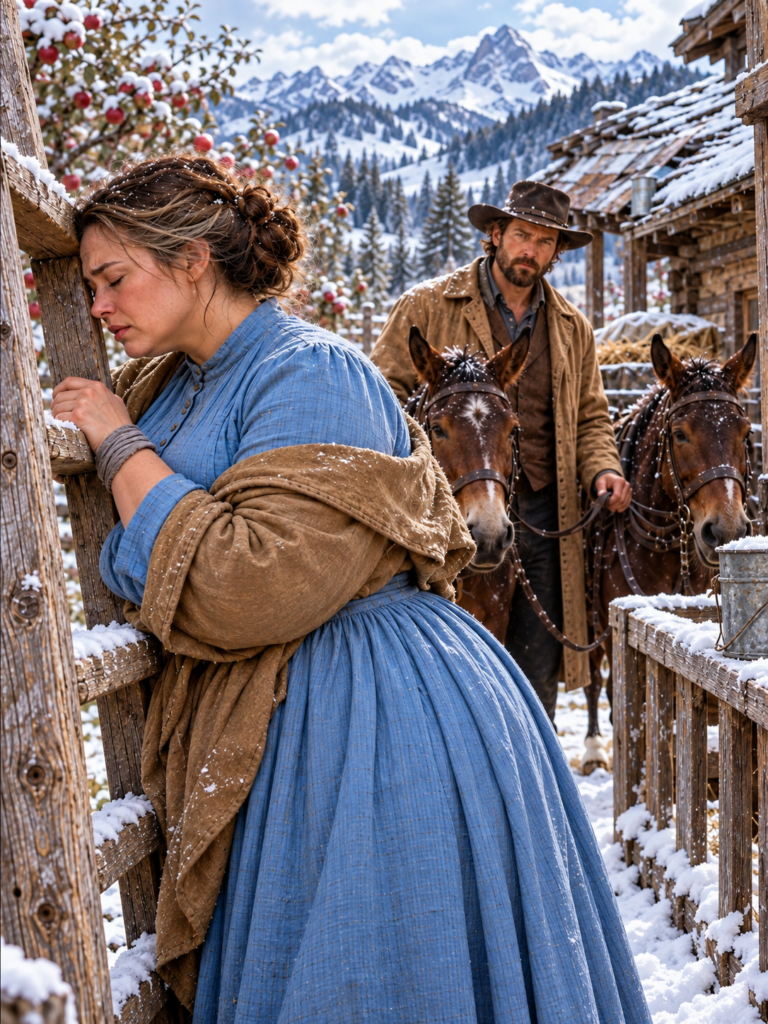
Outside, October rain swept across the Colorado foothills with a coldness that belonged to November. Wind rattled the loose shutters. The apple trees beyond the cabin bent under their burden of unpicked fruit, and somewhere above her head, a piece of old roofing lifted and slapped against the rafters.
She moved the account book to the mantel, fetched a milk pan from beneath the stove, and placed it under the leak.
For several moments, she stood listening.
Plink.
Plink.
Plink.
There were already four pans and two buckets scattered through the little house. One beneath the bedroom window, another beside the kitchen cupboard, and three more in the sitting room where her father had once kept his books.
The last bucket was beside his empty chair.
Willa had not moved that chair since June.
She picked up her lantern, carried it onto the porch, and stared at the north side of the roof.
Even through the rain, she could see the trouble.
The patched shingles had begun curling away from the boards underneath. Near the middle of the slope, a dark hollow had formed where the roof should have been straight. Her father had repaired that spot every autumn for three years, always promising that next summer he would replace the whole thing.
Next summer had come.
Her father had not lived to see it.
Willa set the lantern down and dragged the ladder away from the porch wall.
Her right wrist throbbed as she lifted it.
She had injured it in September, slipping from the third rung while attempting to nail another sheet of tin over the worst of the damaged boards. The swelling had gone down, but she could no longer grip a hammer without feeling pain shoot toward her elbow.
She told herself the injury would mend.
She had been telling herself many things since June.
The ladder scraped against the cabin.
She raised it carefully, planted its feet in the mud, and climbed four rungs before the wind pushed against her skirts.
At the fifth rung, she stopped.
The wet wood creaked beneath her boots.
For a moment, the yard disappeared.
She saw another afternoon, bright and warm, and heard the sudden wooden clatter of a ladder striking the ground.
She heard her father call her name.
Then she heard nothing.
Willa shut her eyes.
“No,” she whispered. “Not tonight.”
She descended slowly, one rung at a time.
When her boots touched the mud, she leaned both hands against the rails and lowered her head.
She had not intended to pray.
For months, prayer had seemed another kind of labor, one at which she was no better than she was at repairing roofs.
But the words came anyway.
“Lord, I don’t need a miracle. I just need somebody who knows what he’s doing. Somebody who can mend this roof before the snow comes.”
She swallowed.
“And please don’t send someone who’ll make me pay for kindness I can’t afford.”
The wind moved through the orchard.
Behind her, a mule snorted.
Willa turned sharply.
A stranger stood beside the open gate, holding the reins of two exhausted animals.
He was tall, broad through the shoulders, and dressed in a weather-darkened coat. His hat brim dripped steadily. Behind him stood a freight wagon stacked with hay beneath a sagging canvas cover.
He had been there long enough to hear her.
How long, she could not tell.
The man removed his hat.
“Evening, ma’am.”
Willa straightened.
“This isn’t the public road.”
“No, ma’am. I know that.”
“Then you’ve taken a wrong turning.”
“Could be.” He looked toward the muddy road behind him. “Though I’d be grateful if it turned out to be the right one.”
She gave him no encouragement.
“My name’s Ezra Colton. I’m bound for Loveland with a load of hay. Road washed out along the creek crossing, and my team hasn’t had a proper rest since yesterday.”
One of the mules lowered its head until its muzzle nearly touched the mud.
Ezra stroked the animal’s neck.
“I was hoping to put them under cover for the night. I’d pay for the space.”
Willa studied him.
He was perhaps forty, with a weathered face, gray beginning at his temples, and hands marked by old scars. His boots were worn but carefully repaired. His wagon harness had been mended in several places, each stitch neat and strong.
He looked like a working man.
That did not make him trustworthy.
“There’s a boardinghouse at Pine Fork.”
“Four miles behind me.”
“They keep a stable.”
“So I hear.”
“Then why aren’t you there?”
Ezra glanced at the smaller mule.
“Because this one’s been limping the last two miles, and another four might finish him.”
Willa’s expression changed despite herself.
She understood injured creatures.
The mule raised one muddy foreleg, favoring it.
She looked toward the barn.
Its roof was sound. Her father had built it when she was twelve, using timber from the eastern slope and enough nails, he used to say, to satisfy a railroad superintendent.
The barn had room for twice as many animals as she owned.
“Ten cents,” she said.
Ezra blinked.
“For the night?”
“For both mules. Hay not included. You’ll sleep with your wagon, and you won’t enter my house.”
“Fair terms.”
“And you won’t leave your animals loose in the orchard.”
“Wouldn’t think of it.”
She stepped aside.
“Barn’s yours until morning, Mr. Colton.”
He touched his hat.
“Much obliged, Miss—”
“Prior. Willa Prior.”
He repeated her name quietly.
Then he led his animals across the yard.
Only when his back was turned did Willa notice how carefully he avoided looking at the ladder.
That troubled her more than if he had stared.
Because it suggested he had heard more than he intended to admit.
Ezra Colton had encountered lonely houses before.
He had spent fourteen years hauling freight between Wyoming, Colorado, and the smaller settlements scattered along the eastern mountains. He knew what poverty looked like when it came creeping into a family that had once been comfortable.
It rarely announced itself with an empty cupboard.
More often, it appeared in a patched coat, a repaired window, or a good piece of farm machinery kept working beyond its proper years.
The Prior place bore all those signs.
But it bore others, too.
The orchard was carefully planted. The fences were straight wherever the posts had not rotted. The barn floor had been swept, and the harness hanging inside was oiled and protected from damp.
Someone had loved the place.
Someone still did.
After settling his mules, Ezra walked toward the back wall of the barn in search of a dry space for his bedding.
He found a long pile of pine bolts beneath a canvas sheet.
Beside them stood a shaving horse, a splitting block, and a rack of tools.
Ezra lifted the canvas.
The wood had been cut to even lengths and stacked with narrow gaps between the pieces. Much of it was seasoned, dry enough to split into roofing shakes.
He picked up a bolt, examined its grain, and returned it carefully.
There was enough wood here to cover most of a house.
Perhaps all of one, if a man knew how to use it.
He looked through the open barn door toward Willa’s cabin.
Light shone behind the curtains.
A shadow crossed the room carrying a bucket.
A moment later, Willa appeared at the back door and emptied the water into the grass.
She did it again ten minutes later.
Then again.
Ezra sat on the wagon tongue beneath the barn overhang and ate cold cornbread from his supper sack.
He had come to this farm because his mules needed shelter.
That was a plain fact.
Another plain fact was that he had heard a woman ask God for somebody to mend her roof.
He wished he had arrived a minute later.
There were some things a decent man was not meant to overhear.
Especially a prayer spoken by someone who believed herself alone.
Yet the words would not leave him.
Please don’t send someone who’ll make me pay for kindness I can’t afford.
Ezra had heard versions of that fear in many places.
He had learned its meaning years earlier, when his wife, Clara, lay ill through an entire winter in a rented room outside Cheyenne.
People had offered remedies, advice, and promises.
Some had offered money.
A few had made certain he remembered the debt afterward.
Clara died in March, and Ezra spent the next two years paying obligations that had done her no good.
He knew how an offered hand could become a chain.
He had never wanted to make another person feel such a thing.
By midnight, the rain had stopped.
The cabin remained lit long afterward.
Ezra lay beneath his blanket, listening to the faint irregular sound of water striking metal.
Before sleep claimed him, he made a decision.
He would say nothing about the prayer.
Not unless silence itself became a kind of dishonesty.
In the morning, Willa found a dime balanced on the barn’s gate latch.
Beside it lay a short strip of cloth Ezra had used to bind his mule’s sore hoof.
The animal stood more comfortably now, though Ezra was checking it when she approached with a coffeepot.
“Looks improved,” she said.
“Some.”
“You could stay another night if it needs rest.”
He raised his eyes.
“At ten cents?”
“Naturally.”
A small movement touched his mouth.
“I wouldn’t expect otherwise.”
She poured coffee into a tin cup and handed it to him.
As he drank, his gaze moved toward the house.
“Your roof’s carrying quite a load of trouble.”
Willa stiffened.
“It’ll be managed.”
“I expect so.”
He said nothing else.
That made her suspicious.
Most men who saw a woman struggling with a difficult job seemed compelled to explain what she ought to do.
Ezra merely finished his coffee and handed back the cup.
But his eyes had already moved toward the barn.
“Those pine bolts stacked against your west wall,” he said. “Were they cut for shingles?”
“Shakes.”
“Good ones, if the grain’s as straight inside as it looks outside.”
“My father cut them.”
“Well, he knew his timber.”
Willa glanced toward the barn.
The stack had stood there since May.
Her father had selected every tree himself, split the logs into bolts, and stored them where summer air could dry the wood.
He had meant to begin the new roof in July.
She could still remember his satisfaction as he set the last bolt beneath the canvas.
“That’ll outlast the two of us,” he’d said.
He had been wrong about one of them.
“Can you split shakes?” she asked.
Ezra nodded.
“Used to do roofing work with my uncle before I took to freight hauling.”
“Have you laid them?”
“Plenty.”
Willa looked up at him.
“You’d charge more than I can pay.”
“I haven’t named a price.”
“That’s usually when the trouble starts.”
He regarded her without offense.
Then he said, “What becomes of all those apples?”
She followed his gaze.
Beyond the cabin, nearly two hundred trees stood in the sloping orchard. Their branches were so heavy with fruit that wooden props had been placed beneath some of the larger limbs.
Bright red and yellow apples lay scattered through the grass.
“Most go to cider,” she said. “Some to dried fruit. Some to the cellar.”
“And the rest?”
“Rot, if I don’t find time to pick them.”
Ezra considered this.
“Is there a press?”
“In the shed beyond the kitchen garden.”
“Working?”
“Of course it’s working.”
“Then perhaps we ought to talk about your apples instead of your roof.”
Willa narrowed her eyes.
“What do you mean?”
“I need to be at Loveland by the twelfth. That’s nine days from now. If the creek crossing remains high, I’ll have trouble getting there before tomorrow evening anyhow.”
“And?”
“And I’m a man who knows his way around a roof, while you’re a woman with fruit that’s about to freeze on the trees.”
She studied him for a long moment.
“You want to buy my apples?”
“No. I want to work for them.”
That surprised her.
She waited.
Ezra explained without haste.
He would stay and repair the worst of the roof, using her father’s prepared wood. In return, she would give him a share of the cider pressed during his stay.
He could take the barrels to Loveland with his hay, where cider sold well at the boardinghouses and provision stores.
Willa considered the proposition.
Then she shook her head.
“Half,” she said.
Ezra frowned.
“Half what?”
“Half the cider. Not a quarter. Not whatever you think is fair afterward. Half of whatever we press before you leave.”
“That’s a sizeable share.”
“So is a roof.”
He glanced up at the damaged north slope.
“Fair enough.”
“And we put it in writing.”
“I was hoping you might say that.”
Something in his answer made her look twice at him.
He did not appear amused by her caution.
If anything, he seemed relieved.
They sat at the workbench in the barn while Willa wrote their agreement on the back of a seed invoice.
Ezra would remove the damaged roofing, replace unsound boards where necessary, and lay new shakes across the north slope. He would also make secure any adjoining edges exposed by the work.
Willa would provide materials, meals, and use of the barn.
They would pick and press apples together when weather allowed.
Ezra would receive one-half of the finished cider.
Neither party would owe the other additional payment.
Willa read the words aloud.
Then she signed.
Ezra took the pencil and wrote his name below hers.
Their signatures looked oddly different.
Hers was small, square, and precise.
His stretched across the page with the slant of someone more accustomed to signing freight receipts than formal agreements.
“There,” Willa said.
She folded the paper and put it in her apron pocket.
“Now neither of us needs to pretend we’re doing the other a favor.”
Ezra nodded.
“Wouldn’t dream of it.”
They began that afternoon.
Ezra set up the splitting block beneath the barn overhang and started working through the pine bolts.
Willa brought him the froe and wooden mallet.
He drove the steel blade into the end grain, twisted the handle, and opened a long, clean split.
The first shake peeled away from the bolt.
Then a second.
Then a third.
Soon the air smelled of fresh pine.
Willa watched longer than she intended.
Her father had worked with the same deliberate rhythm, pausing only to turn a bolt when the grain ran crooked.
The resemblance disturbed her.
Not because Ezra looked like her father.
He did not.
But because the familiar sound of wood splitting filled a silence she had spent four months trying not to hear.
Ezra noticed her face.
“Something wrong?”
“No.”
He lowered the mallet.
“I can move the work outside if the noise bothers you.”
Willa’s expression tightened.
“Why would it bother me?”
“I don’t know. That’s why I asked.”
She lifted her chin.
“The sound is perfectly ordinary.”
“Then I’ll keep at it.”
He did.
By sunset, a respectable pile of new shakes stood beneath the barn roof.
Willa carried supper to the porch.
Two plates, two cups, a loaf of bread, and fried potatoes with onions.
Ezra took the chair farthest from the door.
For a while they ate without speaking.
Then he asked, “How long have you kept the orchard yourself?”
“My father planted the first trees thirty-one years ago. I’ve worked here all my life.”
“Your mother?”
“Dead these seven years.”
He nodded.
“And your father?”
Willa’s fork stopped.
Ezra saw his mistake at once.
But before he could speak, she answered.
“June.”
One word.
Nothing more.
Ezra lowered his eyes.
“I’m sorry.”
“Thank you.”
She began eating again.
After a moment, she said, “He was sixty-one.”
Ezra waited.
“He’d been stronger than most men ten years younger. Never took a day’s rest unless he was ill. Never left work unfinished if he could help it.”
Her voice grew quieter.
“He was always telling me that patience was more useful than strength.”
Ezra glanced toward the barn.
“Sounds like a man who knew a thing or two.”
“He did.”
Willa looked at the cabin roof.
Then she stood.
“There’s more rain coming,” she said. “We’d better cover the new shakes.”
She gathered the dishes before he could offer to help.
Ezra remained at the table.
Above the doorway, he noticed the words carved into the pine lintel.
EXCEPT THE LORD BUILD THE HOUSE.
He recognized them from the Psalms.
The letters were worn by years of wind, but someone had cut them deeply enough to last another lifetime.
He wondered whether Willa had ever found comfort beneath them.
Judging by the way she had looked at the roof, he suspected she had not.
That night, the wind returned.
Shortly after midnight, a violent gust tore loose a strip of old tin.
Ezra heard it strike the yard.
He was out of the barn before the second gust came.
The cabin door opened.
Willa stood in her nightdress beneath a heavy coat, holding a lantern.
Water streamed from the roof.
Then something inside gave a dull, splitting crack.
Both of them looked up.
The sagging portion of the north slope dropped several inches.
Willa made a sound Ezra would remember long afterward.
Not a scream.
A small, strangled breath, as though someone had struck her unexpectedly.
Ezra crossed the yard.
“Get away from that wall.”
“My father’s books—”
“Miss Prior, move.”
She hesitated.
Another crack sounded overhead.
This time she obeyed.
They retreated beneath the porch overhang just as a section of rotten sheathing broke free and dropped into the yard.
Rain poured through the opening.
Willa stared at the damage.
The roof was no longer merely leaking.
It was failing.
Ezra studied the dark shape of the exposed timbers.
“That middle rafter’s compromised,” he said. “Might be more than one.”
“Can you mend it?”
“I need daylight to see.”
“Can you?”
He looked at her.
Water ran from the brim of her coat onto the porch boards.
Her face had gone pale, but she stood perfectly straight.
“I believe I can,” he said. “But it won’t be a matter of laying shakes over the trouble. We’ll have to take it back to sound timber.”
“How long?”
“I can’t promise until I see what’s underneath.”
Willa turned toward the cabin.
Inside, water was falling onto the floor where her father’s chair stood.
For the first time since June, she seemed unable to move.
Ezra reached for the lantern.
“I’ll get some canvas over the opening before anything else gives way.”
She caught his sleeve.
“Mr. Colton.”
He stopped.
“If the whole thing comes down—”
“It hasn’t.”
“But if it does?”
He looked up at the ruined roof.
“Then we build what’s needed to keep it standing.”
She released his arm.
He turned toward the barn.
Behind him, Willa said something so softly that he almost missed it.
“My father said that once.”
Ezra paused.
“He said it the day we finished the barn.”
Neither spoke for several seconds.
Then Ezra went for the canvas, and Willa followed him into the rain.
By morning, both knew the bargain had become something more serious than either had intended.
For Ezra, it meant risking the delivery that supplied his winter income.
For Willa, it meant trusting a stranger with the house her father had died trying to save.
And as the gray light revealed the broken timbers, she understood one more terrible thing.
If they could not repair the roof before the first heavy snow, she might lose the home itself.
Part 2
The damage was worse than Ezra had hoped.
In the morning, he climbed onto a temporary platform built beside the porch and pulled away the loose boards around the collapsed section.
Beneath the old tin patches, the wood was black and spongy.
One rafter had split near its center.
Another had rotted where it met the outer wall.
Ezra tested both with the point of his knife, then climbed down and spread a rough drawing on the barn workbench.
Willa stood across from him.
“Tell me what you need.”
“Three lengths of good timber, for a start. Boards for the sheathing. And more nails than I first reckoned.”
“I have nails.”
“Enough?”
“My father bought two kegs in May.”
“Good. What about timber?”
She thought for a moment.
“There’s a pile in the old cart shed. He kept it for replacing the apple racks.”
They walked there together.
Inside, beneath layers of old canvas, they found seasoned pine planks and several heavier lengths of lumber.
Ezra inspected them.
“These will do.”
Willa felt something loosen inside her chest.
Then he added, “Provided the wall beneath the damaged rafter is sound.”
“And if it isn’t?”
“We’ll find that out before we put weight on it.”
She folded her arms.
“You don’t give a person much comfort, Mr. Colton.”
“Better a little truth now than a great deal of trouble later.”
That silenced her.
Her father had said much the same thing about the first fence he’d built along the creek.
She began to suspect Ezra Colton had been raised by a man very much like Abel Prior.
They worked through the next two days.
Ezra removed the worst sections of roofing, cut away rotten wood, and installed temporary bracing beneath the damaged rafters. He measured every replacement twice and refused to hurry even when Willa reminded him that colder weather was approaching.
She handled the jobs she could manage without climbing.
She sorted the new shakes, sharpened tools, carried water, gathered sound lumber, and kept the work area clear.
When Ezra needed a length of timber raised against the wall, she operated the rope from below.
When he needed a board cut, she marked it to his measurements.
They discovered that they disagreed about nearly everything except the work itself.
Willa believed a task worth doing should be started before breakfast.
Ezra believed breakfast was a useful preparation for work.
Willa saved bent nails.
Ezra straightened them only when he was certain they would hold.
She thought his habit of sharpening tools at the end of every day unnecessary.
He thought her habit of working until her wrist shook was foolish.
Neither admitted the other might have a point.
Yet something changed between them.
They began anticipating each other’s movements.
By the third morning, Willa could tell when Ezra needed another board simply by the way he glanced toward the lumber pile.
He learned that she preferred the ladder moved before she asked, because she disliked standing beside it.
Once, as he worked high above the porch, he called down for a particular length of wood.
She handed up exactly the piece he needed.
Ezra looked at it.
“How’d you know?”
“You’ve been staring at it since breakfast.”
“Have I?”
“Like a schoolboy waiting for a girl to notice him.”
He laughed.
The sound startled both of them.
Willa looked away quickly.
It had been a long time since laughter had sounded beneath the Prior roof.
On Friday, the fourth day after Ezra’s arrival, they stopped early enough to begin pressing apples.
The cider shed stood behind the cabin, a low building with wide doors and a heavy oak press.
Abel Prior had constructed the machine twenty years earlier.
Its great wooden screw had been polished by countless harvests. The iron fittings were dark with oil, and the stone collection trough had been scrubbed until no trace of last year’s pulp remained.
Willa moved through the shed with the confidence of someone who understood every inch of the machinery.
She showed Ezra how to sort the fruit, rejecting badly bruised apples and those touched by rot.
She worked the grinder with her left hand until he took over the crank.
“Don’t turn so quickly,” she told him.
“Why not?”
“Because you’ll choke the hopper.”
He slowed.
“Like this?”
“Better.”
After half an hour, she told him he was turning too slowly.
Ezra gave her a long look.
“Miss Prior, is there a speed at which this contraption pleases you?”
“There is.”
“Will you be telling me when I find it?”
“Certainly.”
He shook his head and returned to the crank.
The sweet smell of crushed apples filled the shed.
Willa folded the pulp into clean cloths and arranged them beneath the press. Ezra lowered the heavy screw until dark golden cider trickled into the trough.
Soon it became a steady stream.
They worked until the light faded from the orchard.
At last, Willa dipped a small cup into the fresh cider and handed it to him.
He tasted it.
The sweetness came first, followed by a sharpness that made him draw another breath.
“That’s better than any cider I’ve bought in town.”
Willa studied his expression.
“You’re not merely saying that?”
“No.”
She took the cup from him and tasted it herself.
For a moment, she closed her eyes.
“My father always had the first drink,” she said.
Ezra stopped turning the crank.
“Then perhaps I shouldn’t have—”
“No.”
She looked down at the cup.
“He said the first taste belonged to whoever had earned it.”
She handed it back to him.
“You’ve earned it.”
Ezra accepted without another word.
That evening, they filled their first barrel.
Willa marked its head with a piece of chalk and wrote the date beside it.
For the first time that autumn, she looked at her harvest without seeing only the fruit she would lose.
She began calculating what might still be saved.
After supper, Ezra found her standing beneath the orchard’s oldest tree.
Its trunk had grown thick and twisted, with branches extending over the path toward the cabin.
A wooden support held one heavy limb upright.
The evening was cold enough that their breath showed.
“Your father’s first tree?” Ezra asked.
Willa nodded.
“He brought it here in a wagon from Fort Collins. It was hardly taller than I was.”
“Seems to have taken kindly to the place.”
“He used to say everything needed three things to grow properly. Good ground, enough water, and someone willing to remain when the weather turned.”
Ezra looked at the tree.
“Sounds like more than advice about apples.”
“It usually was.”
She bent and picked up a fallen fruit, examining the skin before placing it in her basket.
“Do you have family, Mr. Colton?”
“Not much now.”
“That wasn’t what I asked.”
“No.”
He rested one hand on the tree’s wooden support.
“I had a wife.”
Willa waited.
“Clara. We were married nine years. She died two springs ago.”
“I’m sorry.”
“Thank you.”
He spoke without looking at her.
“We had a small house outside Cheyenne. She wanted a garden. Kept saying we’d plant roses once I stopped traveling so much.”
“Did you?”
“Plant them?”
“Yes.”
Ezra shook his head.
“Never got round to it.”
Willa felt the weight of the answer.
For a long moment, only the leaves moved above them.
Then Ezra said, “I was always certain there’d be another spring.”
Willa looked toward her father’s house.
“That’s a dangerous certainty.”
“It is.”
He turned toward her.
“After she died, I sold the place and went back to hauling. Roads don’t ask a man why he keeps moving.”
Willa picked another apple.
“Perhaps that’s why my father never liked leaving home.”
Ezra smiled faintly.
“Perhaps.”
They walked back together as the western sky darkened.
At the porch steps, Ezra reached for her basket.
She hesitated before letting him take it.
The weight was nothing to him.
The surrender of it was not nothing to her.
The following morning brought a hard frost.
White crystals covered the orchard grass. The fallen apples had stiffened, and a narrow rim of ice formed along the trough beside the pump.
Willa knew the signs.
There would be more frost.
Then snow.
She had spent thirty-six autumns watching the mountains, and the mountains had never cared what the almanac predicted.
She hurried to the barn, where Ezra was sorting roofing nails.
“We need to finish by Tuesday.”
He looked up.
“Why Tuesday?”
“That wind last night came out of the northwest. There’s snow behind it.”
“How soon?”
“Three days. Maybe four.”
Ezra glanced at the unfinished pile of shakes.
“We’ll need to work carefully.”
“We’ll need to work quickly.”
“Both, then.”
She turned to fetch the ladder.
Ezra followed.
“Miss Prior, your wrist’s no better.”
“I didn’t ask for your opinion.”
“No.”
He paused.
“You asked for help.”
Willa stopped so abruptly that he nearly walked into her.
She turned.
“What did you say?”
Ezra stood still.
He realized too late what he had done.
“I said—”
“I heard you.”
Her eyes narrowed.
“Why did you say I asked for help?”
“Because—”
“I never asked you for anything except to shelter your mules. Not until we made our agreement.”
Ezra remained silent.
She watched his face.
Then something changed in her expression.
A terrible understanding seemed to form behind her eyes.
“You were at the gate that night,” she whispered.
He did not answer.
“You were standing there before I saw you.”
“Yes.”
“How long?”
“Not very.”
“Long enough to hear me?”
Ezra took off his hat.
“Yes.”
Willa stepped backward.
The morning air seemed suddenly colder.
“What did you hear?”
He could have lied.
He could have claimed he had heard only the wind, or a few indistinct words, or nothing worth remembering.
But there was no kindness in another deception.
“You asked the Lord to send someone to repair the roof before the snow,” he said quietly.
Willa’s face drained of color.
“And?”
Ezra looked at her.
She shook her head.
“Tell me.”
He swallowed.
“You asked that whoever came wouldn’t make you pay for kindness you couldn’t afford.”
The silence that followed was so complete that he could hear a loose board knocking against the barn wall.
Willa pressed her injured hand against her coat.
“You heard that.”
“Yes, ma’am.”
“And you said nothing.”
“I thought it wasn’t mine to speak of.”
She gave a short, bitter laugh.
“Wasn’t yours to speak of?”
Ezra held his hat in both hands.
“Miss Prior—”
“All these days, you’ve been watching me work and struggle. You’ve eaten at my table. You’ve slept under my barn roof. And all the while, you knew.”
“I knew you needed help. That much was plain without hearing a word.”
“But the bargain.”
“The bargain is real.”
“Was it?”
“Yes.”
She looked toward the cider shed.
“Did you ever intend to take the barrels?”
“Of course.”
“Or did you invent the entire arrangement because you felt sorry for me?”
Ezra’s expression tightened.
“No.”
“Because I prayed?”
“No, Miss Prior. Because there was a roof to mend and apples to press, and we both had work the other could use.”
She turned away.
He continued, more quietly.
“I should have told you I’d heard. I was wrong about that.”
Willa folded her arms tightly.
“Do you know what it feels like to have someone hear you beg when you’ve spent your whole life trying never to do it?”
Ezra said nothing.
“Do you know what it feels like to discover a stranger has seen the one thing you never meant another living soul to see?”
“I can imagine.”
“No. You can’t.”
He accepted the rebuke.
Her eyes filled, but her voice remained controlled.
“That prayer wasn’t meant for you.”
“I know.”
“It wasn’t an invitation.”
“I know that too.”
She looked at him for a long time.
Then she said, “I think you’d better leave.”
Ezra’s shoulders settled.
He did not protest.
“All right.”
“Today.”
“Yes, ma’am.”
She stared at him, almost as though she had expected an argument.
When none came, she turned toward the house.
Ezra watched her go.
Then he returned to the barn and began gathering his belongings.
By noon, his wagon was packed.
The mules were harnessed, their hoof bindings removed, and their harness buckles checked.
Ezra had left the unfinished roofing covered beneath canvas.
He had also stacked the split shakes where the weather could not reach them and placed his working tools on the barn bench.
There was nothing more he could do without Willa’s permission.
He led the animals toward the gate.
The road beyond the orchard was still muddy but passable.
A man could make Loveland by evening if he started now.
Ezra stopped beside the gatepost.
He looked back toward the cabin.
The new bracing held firm, but much of the north roof remained unfinished.
From where he stood, he could see Willa moving through the orchard with a basket.
She was picking apples.
Even now.
He climbed onto the wagon seat.
The smaller mule shook its head.
Ezra gathered the reins.
Then he noticed Willa had stopped working.
She stood beneath a tree with the basket hanging from her good arm.
Slowly, she set it down.
Ezra waited.
After several minutes, she crossed the orchard toward him.
Her face was pale from the cold.
“You’re leaving,” she said.
“You asked me to.”
“Yes.”
He said nothing.
Her eyes went to the loaded wagon.
“Have you taken your cider?”
“Only one barrel’s ready. It belongs to the bargain. I won’t claim payment for work unfinished.”
“You’ve done more than one barrel’s worth.”
“We can settle that later.”
Willa looked toward the damaged roof.
“Will you reach Loveland by supper?”
“Should do.”
She nodded.
Then she rubbed her thumb against the seam of her coat.
Ezra recognized the movement.
It was the same thing she did whenever she was trying to force words through a mouth that had learned to keep them locked away.
“Mr. Colton.”
“Yes?”
She raised her eyes.
“Is it possible to be ashamed of needing something and still know you need it?”
Ezra looked at her carefully.
“I expect so.”
“I don’t know how to ask people to stay.”
He waited.
“My father always stayed,” she continued. “Even when I was difficult. Even when I was wrong. And after June, I thought if I could manage everything myself, then perhaps I wouldn’t have to learn how to ask.”
Her voice shook.
“I can’t mend that roof alone.”
“I know.”
“I can’t get the apples pressed alone either.”
“I know that too.”
She drew a breath.
“But I don’t want you here because you heard me praying.”
Ezra climbed down from the wagon.
“Then don’t ask me for that reason.”
She looked at him.
“Ask me because we’ve got an agreement to finish. Ask me because you need a man who knows roofing, and I need a decent load of cider to take to market.”
She blinked.
He continued.
“Or don’t ask me at all. It’s your land and your home, Miss Prior. You decide who comes through that gate.”
For a long time, Willa stood motionless.
Then she said, very quietly, “Would you stay, Mr. Colton, and help me finish what we started?”
Ezra nodded.
“I would.”
She pressed her lips together.
“Under the original terms.”
“Under the original terms.”
“And you mustn’t tell me I’ve been foolish.”
“Wouldn’t occur to me.”
She gave him a doubtful look.
Then, unexpectedly, the smallest smile appeared.
It was gone almost at once.
But Ezra had seen it.
He led the mules back toward the barn.
As he passed her, Willa said, “Mr. Colton?”
He stopped.
“Thank you for letting me ask.”
Ezra looked at her.
“You’re welcome, Miss Prior.”
For the first time since he arrived, her gratitude did not seem to frighten her.
On Sunday, Ezra discovered the hammer.
He had spent the morning replacing the damaged sheathing, working from the sound timbers outward.
Willa stood below, feeding him boards by rope.
Near the lower edge of the roof, where the gutter met the old eaves, his pry bar struck something solid beneath a thick layer of decayed leaves.
At first, he thought it was a piece of iron flashing.
He reached into the debris.
His fingers closed around a wooden handle.
He pulled it free.
A claw hammer.
Ordinary enough at first glance.
But the hickory handle had been carefully shaped, and three small notches had been cut near its end to give a better grip.
Burned into the wood were the letters:
A. PRIOR.
Ezra turned the hammer over in his hands.
Rust covered the head.
There was no blood, no dramatic mark of violence.
Only a tool, forgotten in a place where a working man might easily have lost it.
Yet Ezra knew something about the date Willa’s father had died.
And he knew she had been afraid of the ladder from the moment he arrived.
He climbed down.
Willa stood beside the porch, holding a stack of new shakes.
“What’s that?” she asked.
Ezra offered the hammer handle first.
“I found it caught in the gutter.”
She looked at the tool.
The shakes slipped from her arms.
They struck the ground in a scattering clatter.
For a moment, Willa did not seem to breathe.
Then she reached out.
Her fingers touched the carved notches.
“Where?”
“Near the bottom of the north slope.”
She took the hammer.
Her right wrist trembled beneath its weight.
“I looked everywhere,” she whispered.
Ezra said nothing.
“I thought it had fallen into the grass. I thought perhaps someone had taken it.”
She closed her eyes.
“That’s why I couldn’t find it.”
She sank onto the lowest porch step.
Ezra remained standing until she motioned toward the other end.
Then he sat.
Willa held the hammer across her lap.
“My father climbed that roof on the ninth of June.”
Her voice was so quiet he had to lean slightly forward to hear.
“The morning was warm. We’d had rain the night before, but by noon the sun was out. He said he wanted to replace another patch before the summer storms.”
She ran her thumb over the handle.
“I told him to wait until the boards dried.”
Ezra watched her face.
“He laughed. Said the sun had done its work, and he wasn’t getting any younger.”
Willa swallowed.
“I was picking apples that hadn’t set properly. Thinning the fruit. He called to me from the ladder and asked whether I’d brought the basket inside.”
She looked toward the orchard.
“I said I hadn’t.”
Her hands tightened.
“Then I heard the ladder fall.”
The wind moved through the branches.
Willa continued.
“When I reached him, he was on the ground beside the porch. The ladder had slipped away from the wall. He was alive, but he couldn’t get up.”
Ezra lowered his eyes.
“He asked me whether the ladder had broken.”
She gave a small, broken laugh.
“Imagine that. He was lying there, and all he wanted to know was whether the ladder was sound.”
“What did you tell him?”
“That it was.”
Her voice cracked.
“I told him it was fine. I thought he’d be angry if the ladder was ruined.”
She looked at Ezra.
“He died before the doctor reached us.”
Ezra sat without moving.
Willa lowered her eyes to the hammer.
“I’ve been going up there ever since. Every time water came through, I climbed with another piece of tin and another handful of nails.”
She flexed her injured hand.
“In September, I slipped. Only three rungs up. I landed badly, but it wasn’t a serious fall.”
She drew a slow breath.
“I lay in the yard for nearly an hour.”
Ezra turned toward her.
“Why?”
“Because for a moment, I couldn’t remember whether I was the one who’d fallen or whether it was still June and I was running toward him.”
Tears slid down her face.
She made no attempt to hide them.
“That’s why I can’t climb that ladder, Mr. Colton. Not because I’m weak. Because every time I put my foot on a rung, I hear it hitting the ground.”
Ezra sat beside her.
He had known sorrow.
He had carried the weight of Clara’s final winter, the regrets of roads taken and journeys that could have waited.
But he understood that another person’s grief could not be repaired by explaining it away.
So he said only, “Your father left good wood behind.”
Willa looked at him.
“And a good house,” Ezra continued. “It’s suffered some neglect, but there’s plenty worth saving.”
She wiped her cheek with her sleeve.
“He intended to finish it.”
“I can see that.”
“He was always planning things.”
“Then perhaps it’s right that you finish what he began.”
Willa stared at the hammer.
Her expression slowly changed.
“That’s what I want.”
Ezra waited.
“When we get to the top,” she said, “when the last shakes are ready to be nailed along the ridge, I want to do that part.”
Ezra looked toward the roof.
Then back at her injured wrist.
“Miss Prior—”
“I know.”
“It’s dangerous work.”
“I know that too.”
“You won’t be able to grip properly with that hand.”
“Then I’ll use the other.”
He frowned.
Willa looked at him with sudden determination.
“I’ve spent four months patching a roof because I couldn’t bear to see another person finish my father’s work. But I couldn’t finish it myself either.”
She held the hammer upright.
“I don’t want to spend another winter being frightened of a ladder.”
Ezra studied her.
Finally, he said, “We’ll make it as safe as a man can make it. Secure the footing, lash the rails, set a proper platform. And if the weather turns dangerous, we stop. Even if it means waiting for spring.”
Willa considered his words.
Then nodded.
“Agreed.”
She placed the hammer beside her on the porch.
For several minutes, neither spoke.
At last, Willa said, “He would have liked you.”
Ezra looked at the old tool.
“I’d have liked to meet him.”
By Monday evening, they had finished repairing the damaged rafters.
The new timbers were sound.
The first courses of shakes lay straight and tight along the eaves.
But the work remaining was considerable.
Ezra had been unable to obtain the pace he wanted. Each rotten board removed had exposed another place requiring attention. Every careful repair had cost daylight.
Meanwhile, the weather worsened.
The apple trees had begun losing their leaves in great yellow sheets.
The creek ran black and cold.
And at sunset, Willa noticed something she had not seen since the previous winter.
Clouds had settled against the western mountain peaks without lifting.
She stood at the orchard fence.
Ezra joined her.
“Storm?” he asked.
“Yes.”
“Rain?”
Willa shook her head.
“Snow.”
“Tomorrow?”
“Before tomorrow’s finished.”
Ezra examined the roof.
The north slope remained uncovered across its upper third.
He had enough split shakes for most of the remaining work, but the ridge needed careful fitting, and Willa’s final course was still untouched.
They would have to work with the storm approaching.
Willa looked at him.
“Can we finish?”
Ezra considered the dark mountains.
“I don’t know.”
She nodded slowly.
“That’s a fair answer.”
They went back to the barn and sorted nails by lantern light.
Willa sharpened her father’s hammer claws against an oilstone and rubbed the handle with a dry cloth.
Ezra prepared additional rope and reinforced the platform supports.
Neither spoke much.
Around midnight, a hard wind struck the barn.
It shook the doors and extinguished one of the lanterns.
Willa looked up.
For a moment, she was back in June.
Then Ezra relit the lantern.
The flame steadied.
“We’ve done all we can tonight,” he said.
Willa placed the hammer on the workbench.
“Then tomorrow we finish.”
Outside, the first tiny flakes began drifting through the dark.
Neither of them saw them.
Part 3
Tuesday dawned beneath a sky the color of iron.
Snow had fallen lightly during the night, leaving a thin white covering across the orchard grass. The ground was firm beneath their boots, but the wind had grown stronger.
Ezra stepped outside before sunrise.
He examined the ladder, tested the lashings securing it to the roof, and checked the timber braces beneath the work platform.
Then he climbed up to inspect the exposed boards.
They were cold but mostly dry beneath the canvas.
That was something.
By the time Willa emerged from the cabin, he had already laid out the first bundle of shakes.
She carried coffee and a plate of warm bread.
“You’re starting without me,” she said.
“Only checking the work.”
“Is everything sound?”
“So far.”
She looked toward the western mountains.
“Snow will come hard by afternoon.”
Ezra nodded.
“Then we’d better make good use of the morning.”
She placed the breakfast on the porch table.
“Eat first.”
He looked at her in surprise.
Willa raised an eyebrow.
“Didn’t you tell me breakfast was a useful preparation for work?”
“I believe I did.”
“Then I suggest you follow your own advice.”
He smiled.
They ate standing in the cold, watching the first sunlight touch the orchard.
Neither knew whether the roof would be finished by nightfall.
But for once, Willa did not feel that uncertainty belonged to her alone.
By eight o’clock, they were working steadily.
Ezra climbed to the secured platform and began laying the remaining shakes across the upper portion of the north slope.
Each piece overlapped the course beneath it.
He measured, aligned, and nailed with practiced movements, stopping whenever the wind rose too strongly.
Below, Willa prepared bundles and sent them up on a rope.
The work demanded patience.
A poorly laid shake could allow water beneath the next course. A nail driven carelessly might split the wood. One mistake hidden beneath the roofing could become a leak the following spring.
Ezra refused to rush those details.
Willa, who understood the price of bad repairs better than anyone, did not argue.
By ten, they had covered half the remaining space.
At noon, the wind dropped.
For twenty minutes, the whole orchard seemed to hold its breath.
Willa looked up.
“That quiet won’t last.”
“I know.”
She handed him another bundle.
“Then keep going.”
At one, snow began to fall again.
Small white flakes drifted over the barn and disappeared against the new roofing.
By two, the flakes had grown thicker.
Ezra worked toward the ridge.
The final shakes waited in a covered stack beside Willa.
She had kept them separate since Sunday.
Her father’s hammer lay nearby, wrapped in a clean cloth.
At half past three, Ezra finished the last full course.
He climbed down, his arms aching and his coat stiff with cold.
Willa stood waiting.
“How much remains?”
“The ridge cap. A few shakes along the top.”
“Then we’re nearly finished.”
“Nearly.”
She looked up at the roof.
The upper edge remained exposed.
Beyond it, snow gathered against the mountains like smoke rolling down a hillside.
Willa lifted the hammer.
Ezra saw the expression on her face.
“Miss Prior.”
She turned.
“We need to talk about how you’ll get up there.”
“I know how to climb a ladder.”
“Knowing how and being ready are different matters.”
Her jaw tightened.
For a moment, he feared he had offended her again.
But she did not turn away.
Instead, she looked directly at the ladder.
“Tell me what you’ve done to secure it.”
Ezra nodded.
He showed her the feet set deep into firm earth and blocked against the foundation stones. He demonstrated the rope securing the ladder to a sound rafter and the additional supports beneath the platform.
He explained where she could place her feet, where the handholds were strongest, and how they would carry the nails and hammer separately so she would have both hands free while climbing.
Then he looked toward the snow.
“We have one more decision to make.”
“What decision?”
“If the wind strengthens or the platform begins icing over, you come down. We cover the ridge and wait for better conditions. No argument.”
Willa stared at him.
“You think I’d leave it unfinished?”
“I think your father would rather see you alive in a leaking house than buried beside a finished one.”
She flinched.
Ezra immediately regretted the bluntness.
But Willa did not become angry.
She looked at the hammer.
For a long moment, she considered his words.
Then she said, “You’re right.”
He waited.
“I’ve spent four months thinking courage meant doing something even when it terrified me. But perhaps it also means knowing when the risk is too great.”
Ezra nodded.
“Sometimes.”
She examined the platform.
“The wood isn’t icy yet.”
“No.”
“And the wind’s still light.”
“For now.”
“Then I want to try.”
He looked into her eyes.
“All right.”
Willa stood at the bottom of the ladder.
The first rung was scarcely a foot above the ground.
It might as well have been a mountain.
She placed her good hand on the rail.
Immediately, she heard the sound again.
Wood crashing against earth.
Her father’s sharp cry.
The terrible silence afterward.
Her breath caught.
Ezra stood beside her.
He did not touch her.
He did not tell her to be brave.
At last, Willa whispered, “I keep expecting it to happen again.”
“I know.”
“I’ve dreamed about that ladder every night since June.”
Ezra waited.
She placed one boot on the first rung.
Then withdrew it.
Her face twisted with frustration.
“I thought I could do this.”
“You can decide not to.”
She looked at him.
He continued.
“Nothing you’ve done here becomes less because you don’t climb. Not the orchard, not the work, not your father’s memory.”
Tears gathered in her eyes.
“Then why do I feel that if I don’t finish it, I’ll never be free of that day?”
Ezra thought carefully.
“Maybe because you’ve been trying to change what happened.”
Willa stared at him.
He looked toward the place where Abel Prior had fallen.
“There’s no fixing June, Miss Prior. But today is still yours.”
Something in her expression softened.
She looked down at her hands.
Then at the ladder.
Slowly, she placed her boot on the first rung again.
This time, she lifted herself.
One rung.
Then another.
Ezra braced the ladder from below.
At the fourth rung, Willa stopped.
Her hands shook.
“Mr. Colton.”
“I’m here.”
“Is it steady?”
Ezra tested the rails with his full weight.
“Yes.”
“You’re certain?”
“The footing is firm. The upper end is secured. I’m holding it, and I won’t leave.”
Willa closed her eyes.
The words did not erase her fear.
But they gave her something real to place beside it.
She climbed another rung.
Then another.
At the top, Ezra guided her onto the platform, where the timber supports held steady beneath her weight.
She moved cautiously, testing every foothold before shifting.
When she reached the ridge, she looked out over the orchard.
From here, she could see the entire Prior property.
The apple trees stretched down the slope in orderly rows. The barn stood beneath its sound roof. The creek wound through the valley, and beyond the pasture, the road disappeared among the hills.
She had lived here all her life.
Yet she had never seen it quite this way.
For months, the house had seemed only a collection of things threatening to fail.
A leaking ceiling.
An unpaid account.
A broken ladder.
An empty chair.
Now she could see what remained.
Her father’s trees.
Her mother’s garden wall.
The barn they had built together.
Land that had endured droughts, hailstorms, and winters more severe than this one promised to be.
It was still home.
Below, Ezra called, “Ready?”
Willa turned toward the work.
“Send up the hammer.”
He tied the hammer and nails into a small canvas bag and raised it carefully on the rope.
She received it, set the bag beside her, and positioned the first shake.
Her right wrist was too weak for hammering, so she worked with her left.
The first nail bent.
She pulled it free.
The second went in crooked.
She steadied the shake and tried again.
This time, the nail held.
Willa continued.
Snow gathered lightly on her shoulders.
Her fingers grew stiff.
She worked slowly, not attempting to match her father’s speed or Ezra’s skill.
One nail.
Then another.
Piece by piece, she closed the final gap.
When the last shake lay in place, she reached for the narrow ridge cap Ezra had prepared.
She set it across the peak where the two slopes met.
The wood fitted exactly.
For a moment, she could not bring herself to strike the nail.
She looked down at the hammer in her hand.
She remembered her father standing in the barn, showing her how to hold a nail between two fingers.
Never be angry with the wood, Willa. It doesn’t know you’re in a hurry.
She gave a small, unexpected laugh.
Then she raised the hammer.
The first blow rang across the orchard.
The second drove the nail nearly home.
The third seated it firmly.
She shifted her weight, reached for the final nail, and struck again.
The sound carried over the snowy yard.
Then the hammer fell silent.
Willa stared at the completed ridge.
“It’s finished,” she whispered.
She touched the new wood.
“Papa, it’s finished.”
For a moment, she bowed her head.
Then she began crying.
Not violently.
Not with the desperate grief that had kept her awake through summer nights.
These tears came quietly, while snow settled on the roof her father had wanted to build.
Below, Ezra waited.
He did not call to her.
He understood that some moments belonged entirely to the person living them.
At last, Willa wiped her face.
“Mr. Colton?”
“Yes, ma’am?”
“I’m coming down.”
“I’ve got the ladder.”
She returned carefully to the platform and lowered herself onto the first rung.
Her hands were numb.
Halfway down, her right boot slipped against the wet wood.
Her body lurched.
For one terrible instant, she felt herself falling.
Ezra tightened his grip and leaned his weight against the ladder.
The lashings held.
The rails did not shift.
Willa caught herself with her good hand.
She remained frozen, breathing hard.
“Don’t hurry,” Ezra said.
She looked down.
He was still there.
Exactly where he had promised to be.
Slowly, she lowered one foot.
Then the other.
When she reached the ground, her knees nearly failed.
Ezra stepped forward but stopped before touching her.
Willa looked up at the ladder.
Then she began to laugh.
It was a strange sound, half laughter and half sobbing.
“It stayed,” she said.
Ezra nodded.
“It did.”
“The ladder stayed.”
“Yes, ma’am.”
She pressed a hand over her mouth.
“My father would’ve been pleased.”
Ezra looked toward the new roof.
“I believe he would.”
Willa wiped her eyes.
Then she surprised him.
She stepped forward and embraced him.
Only for a moment.
Her arms closed around his coat, and she rested her forehead against his shoulder.
Ezra stood motionless before gently placing one hand against her back.
“Thank you,” she whispered.
He said nothing.
After a moment, she stepped away.
Her cheeks colored.
“That wasn’t in the agreement.”
Ezra looked at her.
“No, ma’am.”
She glanced toward the barn.
“You’d better come inside before your hands freeze.”
He smiled.
“Wouldn’t want that.”
The snow fell heavily that night.
By darkness, it covered the orchard paths and gathered against the porch steps.
Wind swept over the north slope, rattling the shutters.
Inside the cabin, seven empty buckets stood against the kitchen wall.
Willa had not put them away.
She kept waiting to hear the familiar dripping.
But the house remained quiet.
After supper, she checked the bedroom ceiling.
Dry.
She inspected the sitting room.
Dry.
She went to the kitchen and stood beneath the place where the first drops had struck her account book.
Nothing.
At nine o’clock, she extinguished the lamp.
She climbed into bed and pulled the blankets around her shoulders.
For the first time since her father’s death, she did not lie awake listening for trouble.
She slept until morning.
Ezra knew something had changed when Willa opened the cabin door at seven.
She wore a clean apron.
Her hair was pinned neatly behind her head.
And although her face still carried the marks of a difficult autumn, her eyes were no longer shadowed by exhaustion.
“Good morning, Mr. Colton.”
“Morning, Miss Prior.”
She looked at the snow on his hat.
“Breakfast is ready.”
He glanced toward the porch table, buried beneath white drifts.
“Looks like our usual dining room’s unavailable.”
Willa followed his gaze.
“Apparently.”
He smiled.
She stepped aside.
“Come in.”
Ezra hesitated.
“The agreement says—”
“I know what the agreement says.”
“Then perhaps—”
“Mr. Colton, are you going to stand in the snow discussing paperwork, or are you going to come inside and eat?”
He removed his hat.
“Inside sounds sensible.”
“Then wipe your boots.”
He did.
The cabin was warm.
A small fire crackled in the stove, and the smell of fried apples filled the kitchen.
Ezra looked around.
The room was simple but carefully kept.
Seven buckets stood in a neat row against the wall.
Every one was empty.
Willa followed his gaze.
“I suppose I ought to put those away.”
“Suppose so.”
“Later.”
He nodded.
“Later’s fine.”
They sat at the kitchen table.
For a moment, Willa looked toward her father’s chair.
Then she bowed her head.
Ezra followed her example.
“Lord,” she began, “I asked you to send someone before winter.”
Her voice trembled.
“I don’t pretend to understand why some prayers are answered and others aren’t. I don’t understand why Papa died when he did. And I don’t know whether this man was sent here or whether he simply needed a place for his mules.”
Ezra kept his eyes lowered.
“But I know we had work to do, and we found a way to do it together.”
She took a breath.
“Thank you for the roof. Thank you for the harvest we saved. And thank you for letting me stand on my own feet while someone held the ladder.”
A tear slipped down her cheek.
“Amen.”
“Amen,” Ezra said.
They began breakfast.
After a while, Willa asked, “How much cider do we have?”
“Six barrels ready and sealed.”
“Then three are yours.”
“That’s the agreement.”
“And the rest will bring enough to buy the provisions I need before winter.”
Ezra nodded.
“More, if the market’s as good as I expect.”
She looked at him across the table.
“Then I believe we’ve made a successful trade.”
“I believe we have.”
They spent Wednesday finishing the cider packing and securing the remaining apples against the cold.
Ezra loaded three barrels into his wagon and tightened the ropes over the hay.
Willa checked every knot.
Twice.
He pretended not to notice.
By Thursday morning, the road had cleared enough for travel.
Ezra needed to reach Loveland by the following day, and he could delay no longer without risking his freight payment.
Willa stood beside the wagon while he harnessed the mules.
“Do you think the roof will last?”
“It should.”
“Through the winter?”
“If the other slope remains sound.”
“And spring?”
“That’s when you’ll know how well the new work settles.”
She considered that.
“Would it need checking?”
“Wouldn’t hurt.”
Ezra tightened the last buckle.
“I usually come through this valley after the thaw.”
Willa looked at him.
“Do you?”
“Most years.”
She folded her hands.
“Then perhaps you might stop and see whether the work has held.”
Ezra met her eyes.
“I’d like that.”
She nodded.
“Good.”
There was no promise beyond those words.
No dramatic declaration.
No attempt to turn gratitude into something either of them was unprepared to give.
But the silence between them had changed.
It no longer seemed empty.
Ezra climbed onto the wagon seat.
Willa stood beside the gate.
As he gathered the reins, she called, “Mr. Colton.”
He turned.
“If you come through in spring, you needn’t pay for the mules.”
He smiled.
“That so?”
“The barn will be available.”
“Very generous terms.”
She lifted her chin.
“Don’t become accustomed to them.”
He laughed.
Then he touched his hat and guided the wagon onto the road.
Willa watched until it disappeared beyond the orchard trees.
Only then did she return toward the house.
At the porch, she stopped.
Snow still rested along the edges of the new roof.
The north slope was straight.
The gutters were clear.
The shingles her father had prepared lay in even rows from the eaves to the ridge.
She reached into her coat pocket and took out the folded agreement.
The paper had become worn from being opened and read so often.
Two names stood at its bottom.
Willa Prior.
Ezra Colton.
Two people who had needed something the other could provide.
She smiled and folded it again.
Inside, she placed the agreement between the pages of her father’s account book.
Then she picked up the empty buckets.
One by one, she carried them to the pantry.
When the last was put away, she returned to the doorway and looked up at the words her father had carved into the lintel all those years before.
EXCEPT THE LORD BUILD THE HOUSE.
For months, she had looked at that verse as though it were a promise God had failed to keep.
Now she thought of her father’s hands cutting the letters.
Of his patience with crooked boards.
Of the wood he had left stacked in the barn.
Of a stranger arriving in the rain with two tired mules.
Of six barrels of cider, a signed agreement, and a ladder that had stayed firm beneath her feet.
Perhaps a house was not saved by one person being strong enough to carry every burden.
Perhaps it endured because one generation prepared something the next could finish, and because there were times when another pair of hands arrived just when they were needed.
Willa did not know whether that was faith.
But she knew the roof was sound.
And for the first time since June, she was willing to believe that tomorrow might hold something besides loss.
She went inside and shut the door against the winter wind.
Above her, the new roof stood firm beneath the snow.
And in the quiet house her father had built, not a single drop of water fell.

