Part 1
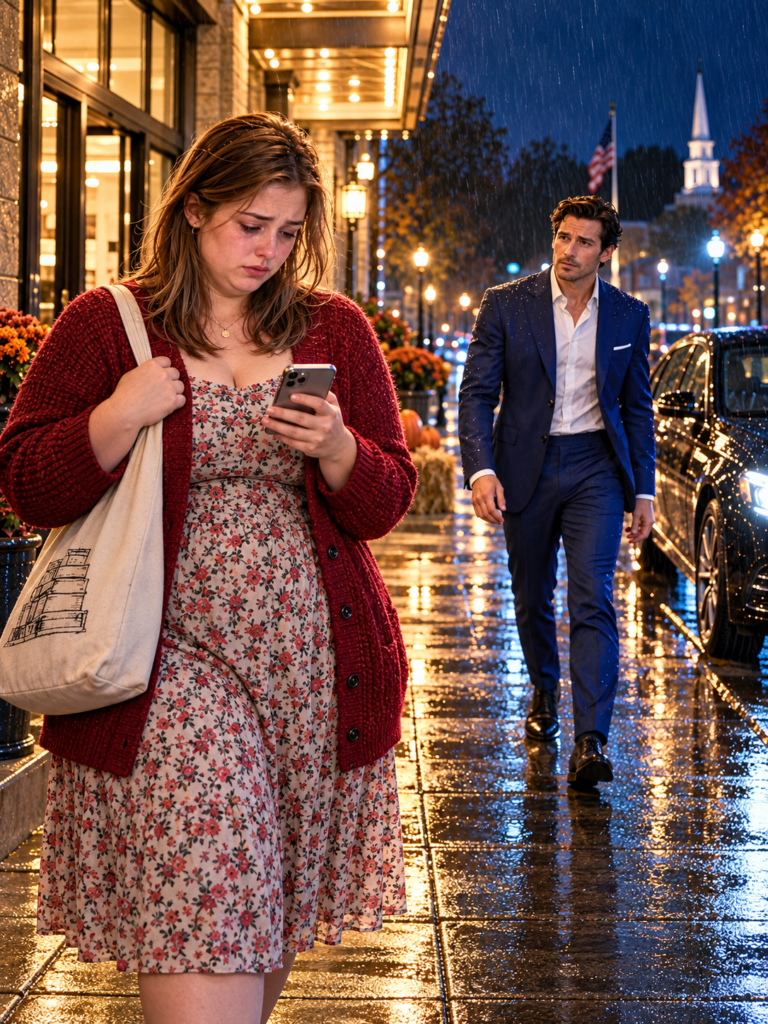
At 8:47 on a cold October night, Hailey Prescott stood outside the Morrow Falls Community Center with a cardboard box of donated children’s books balanced against her hip and a message on her phone that made her stomach sink.
Your driver has canceled your ride.
Six minutes before the scheduled pickup.
She tapped the screen again, watching the little circle spin while rain drummed against the concrete steps.
No drivers available.
For several seconds, Hailey simply stared.
Her aging Honda Civic was sitting in a repair garage, waiting for brake work she couldn’t afford until Friday. Her neighbor Winnie, who was keeping her daughter overnight, didn’t drive after dark. And every friend Hailey trusted was either working or already home with their family.
She looked down the deserted street.
Nearly two miles separated her from home. Two miles past the closed pharmacy, across the town square, and alongside the old brick shoe factory, where the sidewalk disappeared into darkness whenever the streetlights failed.
Tonight, all three lights were out.
Hailey tightened the strap of her canvas bag and adjusted her coat.
“It’s okay,” she whispered. “I’ll walk home.”
She had barely stepped away from the building when a man’s voice came from behind her.
“That’s a long walk in weather like this.”
Hailey turned.
A tall man stood on the upper step, wearing a beautifully tailored charcoal overcoat. His dark hair was damp, and raindrops glistened on the shoulders of his jacket. Everything about him suggested money and careful habits, from his polished leather shoes to the expensive watch partly concealed beneath his cuff.
She recognized him from the literacy fundraiser.
He was the quiet donor who hadn’t delivered a speech or demanded attention. Instead, he’d spent most of the evening listening, occasionally asking questions that were more thoughtful than anyone else’s.
One question had stayed with her.
How many of these books will actually reach children who can’t get to a library?
Now he descended a step.
“I’m Sam,” he said. “My driver can take you wherever you’re going.”
He nodded toward a black sedan waiting beside the curb.
Hailey followed his gesture, then shook her head.
“That’s very kind, but no, thank you.”
She knew what sometimes followed a refusal.
The insistence. The offended expression. The suggestion that she was being unreasonable for declining something generous.
She had learned to recognize those reactions during nine years of marriage.
But Sam did none of those things.
He glanced toward the rain, then down at his immaculate shoes.
After a moment, he looked back at her.
“Then would you mind if I walked with you?”
Hailey blinked.
“Walked?”
“You shouldn’t have to make that trip alone tonight.”
For the first time, she examined him closely.
He hadn’t challenged her decision. He hadn’t tried to convince her that his judgment was better than hers.
He had simply offered a different way to help.
“Only as far as Main Street,” she said.
“Main Street it is.”
He leaned toward the waiting sedan, said something to his driver, and watched the vehicle pull away.
Then he stepped into the rain beside her.
He didn’t reach for her bag without asking. He didn’t attempt to steer her by the elbow or choose which direction they should go.
He simply matched her pace.
Within a block, water had begun seeping through the seams of his expensive shoes.
Hailey noticed him glancing down.
“Having second thoughts?”
“About the walk? No.”
“About the shoes?”
He considered them with visible regret.
“These were designed for conference rooms.”
“And the coat?”
“Apparently designed to absorb an unreasonable amount of water.”
“Very practical.”
“It’s Italian.”
“That explains everything.”
He laughed, and the sound was so unexpectedly ordinary that Hailey found herself laughing too.
It had been a long time since she had laughed with a man without immediately wondering what he expected in return.
They crossed the square beneath maple trees dripping autumn rain.
Sam asked about the fundraiser.
Hailey told him what the organizers had accomplished, how many books had been donated, and how many families might benefit.
Then she told him what bothered her.
“We keep celebrating how many books we collect,” she said. “But collecting books isn’t the same thing as putting them into people’s hands.”
“What do you mean?”
“Half the families I know don’t have reliable transportation. Some don’t have any transportation at all. And the older people over at Mill Pond can’t manage the library stairs.”
Sam listened.
“So what would you do differently?”
The question surprised her.
Most people responded to her complaints by explaining why the situation was difficult. Very few asked what she would actually change.
“A van,” she said.
“A van?”
“Not an ordinary one. Something with shelving inside. A little library that can travel around town and out to the county roads.”
She grew animated despite herself.
“It could stop outside apartment buildings, senior residences, even rural schools. People wouldn’t have to come looking for books. The books would come to them.”
Sam glanced at her.
“You’ve thought about this.”
“For years.”
“What’s stopping you?”
She gave a small, embarrassed smile.
“The same thing that stops most good ideas. Money.”
“How much?”
“More than I’ve saved.”
“Have you looked into financing?”
“Of course.”
“And?”
“I’ll figure it out.”
She spoke the last sentence with quiet certainty.
Sam didn’t tell her the idea was wonderful. He didn’t dismiss it as impractical.
He simply kept asking questions, listening as though the details mattered.
For Hailey, that was almost more unsettling than a compliment.
They reached the long brick wall of the Thayer shoe factory.
Three streetlamps stood along its perimeter.
Not one was working.
Hailey stepped carefully around a puddle.
“They’ve got people working the second shift until one in the morning,” she said. “And apparently nobody can manage to illuminate one sidewalk.”
Sam looked up at the dark fixtures.
His expression changed, although he didn’t comment.
Instead, he moved to the side nearest the road.
High above them, on the loading dock, a man stood smoking beneath a protective metal light.
He watched them pass.
Sam noticed him.
Hailey didn’t.
Her attention remained on the wet pavement and the conversation they had been having.
At Main Street, she stopped beneath a functioning streetlight.
“This is me.”
Sam looked toward the modest houses beyond the intersection.
“Then I suppose this is where I say good night.”
“Thank you for walking with me.”
“Thank you for letting me.”
The light caught the faded green lettering on her canvas bag.
MILL STREET BOOKS.
Below it hung a volunteer identification badge.
Hailey Prescott.
For a brief instant, Sam’s face became unreadable.
Then he offered her a small smile.
“Good night, Hailey.”
“Good night, Sam.”
She watched him turn back toward the square, his ruined Italian shoes making faint, wet sounds against the pavement.
She didn’t know his last name.
She didn’t know that he owned the factory they had just passed.
And she certainly didn’t know that the man watching from the loading dock was about to become the reason their lives would collide.
The following morning, Sam Thayer sat behind the desk in his office overlooking the factory floor.
His leather shoes, still damp from the previous night, stood beside a cabinet.
An employee transfer request waited among the morning paperwork.
He had already reviewed several before reaching this one.
Kevin Prescott. Shipping Department. Second Shift.
Request: Transfer to First Shift.
Reason: Childcare responsibilities.
A photograph was attached to the employee record.
Sam stopped moving.
He recognized the face immediately.
The man on the loading dock.
The one who had watched Hailey Prescott walk through the rain.
Sam looked from the photograph to the surname.
Prescott.
He read the transfer request again.
It had already been denied under the company’s seniority rules.
For a long moment, he sat perfectly still.
Then he placed the file back on the desk.
He had no reason to involve himself in this man’s private affairs.
Not yet.
Across town, Hailey was beginning another morning before sunrise.
By 6:40, she had packed two lunches, retrieved a missing library book from beneath the sofa, and delivered her daughter Olive to Winnie’s kitchen.
Olive was eating toast while explaining why Winnie’s cat had ruined her unfinished volcano project.
“He thinks it’s his house,” Olive declared.
“Maybe he’s studying geology,” Winnie suggested.
“He’s not. He’s just rude.”
Hailey kissed her daughter’s hair.
Olive was nine, opinionated, intelligent, and increasingly capable of detecting when her mother was worried.
Hailey tried not to give her too many reasons.
Friday was payday and bank day.
Before opening Mill Street Books, she stopped at the Morrow Falls Cooperative Bank and slid a small blue savings passbook beneath the teller’s window.
Forty dollars.
That was what she could spare.
The teller stamped the new balance.
$9,140.
Hailey held the passbook for a moment before closing it.
Four years of saving.
Four years of skipped lunches, repaired clothing, and purchases postponed until they were no longer necessary.
She had started putting money aside before the divorce, when the mobile library was still an idea Kevin laughed at over the dinner table.
That’s not a business, Hal.
That’s an expensive hobby.
She could still hear the dismissive certainty in his voice.
At Mill Street Books, familiar smells greeted her: old paper, fresh coffee, and the dusty warmth of the heating system.
The wooden floors sloped near the register. Every shelf had a handwritten label. A large cushion occupied the back corner, where children were allowed to sit and read without buying anything.
Doris Fitch had maintained the little store that way for nearly thirty years.
She looked up as Hailey arrived.
“You look exhausted.”
“I walked home last night.”
“In that rain? Alone?”
Hailey hesitated.
“Not exactly.”
Doris lifted an eyebrow.
Hailey busied herself with a stack of books.
Unfortunately, Doris didn’t need words to make her curiosity unbearable.
By noon, the mail arrived.
Among the envelopes was one addressed in Kevin’s familiar handwriting.
Hailey opened it behind the register.
He was concerned, the letter said, that her van project would interfere with her time with Olive.
Perhaps they needed to discuss whether Hailey could manage both motherhood and a business.
She read the letter twice.
Then she made a photocopy.
At home, she kept a folder marked with Kevin’s name. Every troubling message went into it.
Nine years of marriage had taught her the importance of written records.
If something hadn’t been written down, Kevin had a remarkable talent for convincing her it had never happened.
At four o’clock, his pickup truck stopped outside the bookstore.
He didn’t come in.
Hailey stepped onto the sidewalk.
“I can’t take Olive this Saturday,” he announced through the driver’s window. “Picked up another shift.”
“You were supposed to have her.”
“Something came up.”
“Kevin—”
“Tell her I’ll see her next time.”
He started raising the window, then paused.
“Oh, and Hailey?”
She waited.
“I saw you Thursday night.”
A faint smile crossed his face.
“Your new friends have expensive coats.”
Then he drove away.
Hailey remained on the sidewalk long after the truck disappeared.
He had seen them.
And he wanted her to know.
At ten on Saturday morning, the bell over the bookstore door rang.
Sam walked in.
His coat was dry, and his shoes had apparently survived their encounter with the weather.
Hailey stared at him.
“You’re a long way from a community center.”
“I need a birthday gift for my niece. She’s turning nine.”
“And you decided to come here?”
“Of all the bookstores in Massachusetts, this is the only one I know by name.”
She tried not to smile.
He was hopeless in the children’s section.
For someone who seemed so assured of himself, he approached the shelves as if they contained complicated legal documents.
He picked up one mystery novel, then another, then a third.
At eleven, Olive arrived from art class with paint on her sleeves.
She looked at the book in Sam’s hand.
“Not that one.”
Sam turned.
“Why not?”
“The ending cheats.”
“How?”
“The dog did it.”
“The dog?”
“The whole time.”
“Was there a clue?”
“No. That’s why it’s cheating.”
Sam studied the cover.
“That does seem unfair.”
Olive took his hand without hesitation and led him toward another shelf.
“This is better.”
He listened to her recommendation with the seriousness of a man receiving professional advice.
Then he bought exactly what she selected.
Doris emerged from the back room just as he approached the register.
“Well, Mr. Thayer. We don’t usually see you shopping downtown.”
Hailey froze.
“Thayer?”
Sam looked at her.
“As charged.”
“As in Thayer Shoes?”
“Unfortunately, yes.”
She looked down at his polished footwear.
Then she started laughing.
“You own a shoe company, and you wore those shoes in the rain?”
“I sell shoes,” he said gravely. “Apparently I don’t know how to wear them.”
For a moment, she laughed harder.
Then the implications settled over her.
“Does Kevin work for you?”
Sam’s amusement faded.
“Kevin Prescott?”
“My ex-husband. Shipping department.”
“Yes.”
She held his gaze.
“Don’t do anything about him.”
Sam said nothing.
“Not for me. Not against him. Whatever happens between Kevin and me is our responsibility, not yours.”
He seemed to consider the weight of her request.
“All right.”
“I mean it.”
“I understand.”
“Promise?”
“I promise.”
She wanted to believe him.
At the door, Sam paused.
“About your mobile library. I know someone at a financing firm in Worcester. He could probably arrange something within a month.”
Hailey shook her head.
“No, thank you.”
“It could save you years.”
“Maybe. But it would cost me something else.”
“What?”
She took a breath.
“I need to understand every dollar. I need to know it’s mine.”
Sam looked as though he wanted to challenge the distinction.
But he didn’t.
“Fair enough.”
He left with Olive’s recommended book beneath his arm.
That evening, after Olive went to bed, Hailey’s phone rang.
She had written her number on the back of Sam’s receipt in case his niece already owned the book.
He had another reason for calling.
“I started the novel you recommended,” he said. “The Lighthouse Keeper.”
“And?”
“I need to know whether the narrator is lying.”
Hailey leaned against her kitchen counter.
“It’s been a long day. I may not be very entertaining.”
“Good. Then you can settle an argument between me and a fictional character.”
He didn’t ask why she was tired.
He didn’t demand an explanation about Kevin or the bookkeeping or the mountain of laundry waiting beside the kitchen door.
They talked about the novel.
By the end of the call, Hailey noticed that the tightness between her shoulders had eased.
Later, she opened her laptop and searched the listings again.
There it was.
A retired public-library van.
Shelves already installed. A wheelchair lift. Roadworthy, according to the description.
Seller: Lenny Abbott.
Gardner, Massachusetts.
Price: $24,000.
Hailey looked at the blue savings passbook on the counter.
She knew the balance without opening it.
For once, she didn’t feel frightened.
She felt the sharp, exhausting disappointment of being close enough to see her dream clearly and still being unable to reach it.
On Wednesday, Sam returned to Mill Street Books carrying a flat gray folder.
He set it on the counter.
“Before you say anything, don’t be angry.”
Hailey looked at the folder.
“That is a terrible way to begin.”
He opened it.
Inside were three professionally designed concepts for the mobile library.
Deep-green paint.
Gold lettering.
A small open book with wings shaped like wheels.
Across the upper section, in an elegant serif font, were the words:
THE TRAVELING PAGE.
For several seconds, Hailey couldn’t speak.
It was beautiful.
Her idea, which had existed for years as calculations and sketches and private hopes, suddenly looked like something that could drive down a real street.
Sam watched her reaction.
“A designer I work with had some time.”
Then she noticed the attached cover note.
Sam, first drafts as discussed. Happy to make revisions for the Thayer Community Initiative if this is the direction we’re taking.
Her eyes returned to the beginning.
Thayer Community Initiative.
She slowly closed the folder.
“What’s this?”
Sam followed her gaze.
“Just a way of structuring things.”
“Structuring what?”
“The project. Thayer could cover the startup costs. We’d put our name on the van, but you would run it.”
Hailey looked at him.
“I would run it.”
“Exactly.”
“On a vehicle owned by your company.”
“That’s not what I meant.”
“Under your company’s name.”
“You’d have complete operational control.”
“And what happens when someone at your company disagrees with how I operate?”
Sam hesitated.
“It wouldn’t work like that.”
“How do you know?”
“Because I wouldn’t allow it.”
The words hung between them.
He seemed to realize their meaning almost immediately.
Hailey pushed the folder back across the counter.
“It has to be mine, Sam. Including the mistakes.”
“I was only trying to help.”
“I know.”
Her voice was quiet.
“That’s what makes this difficult.”
Sam looked at the designs.
After a moment, he closed the folder.
“I’m sorry. I should have asked.”
She believed the apology.
She also knew he still didn’t understand.
To Sam, she had just refused an extraordinary gift.
To Hailey, she had protected the only dream she had never surrendered to another person’s decisions.
Behind the register, a photograph of the white van was pinned to a corkboard.
Someone had circled its price in red.
Beneath it, in Hailey’s handwriting, were two words.
Someday.
Sam saw it on his way out.
He didn’t mention it.
That evening, he had dinner with his sister Ingrid at her house in Princeton.
She listened while he explained what had happened.
When he finished, she set down the plate she’d been holding.
“You did what?”
“I offered to fund her project.”
“You offered to take over her project.”
“That’s not fair.”
“Sam, you were going to put the company name on her van.”
“She would still be running it.”
“Until someone decided otherwise.”
He looked away.
Ingrid studied him.
“You’re doing it again.”
He knew what she meant.
Five years earlier, on his wedding anniversary, he had paid off every remaining dollar of his then-wife Natalie’s student loans.
He’d presented the payment confirmation over dinner, proud of having lifted a burden from her shoulders.
Natalie had cried.
He had mistaken those tears for gratitude.
Two years later, she had packed her belongings into her car.
At the door, she had said something he still remembered.
You never once asked me what I wanted to carry myself.
Sam had never fully understood why paying someone’s debt could feel like a betrayal.
Now Ingrid gave him the same answer.
“You thought it was a gift,” she said. “But it was a decision you made for her.”
Across town, Hailey sat on Winnie’s back porch with two cups of cooling tea.
“I like him,” she admitted.
Winnie didn’t appear surprised.
“More than I meant to.”
“That much I gathered.”
“It’s not the money.”
“What is it, then?”
Hailey watched the darkness beyond the porch.
“How easy it would be to let him handle everything. And then someday wake up and realize I don’t know which parts of my life I actually chose.”
Winnie considered that.
“Letting someone walk beside you doesn’t mean handing him the map.”
Hailey looked down at her tea.
“But refusing every helping hand isn’t always freedom either, sweetheart. Sometimes it’s just a lonelier kind of fear.”
The words stayed with Hailey.
The following morning, she brought her mobile-library budget to Doris.
“Tell me what’s wrong with it.”
Doris put on her glasses.
She found three problems.
Hailey had underestimated the insurance, underestimated fuel costs, and completely forgotten to include a salary for herself.
“You’re budgeting for everyone except the woman who’s supposed to run the business.”
Hailey corrected every figure.
The numbers became less encouraging.
But they became honest.
On Friday afternoon, Sam drove past Mill Street Books.
Through the window, he watched Hailey remove the photograph of the van from the corkboard.
She studied it for a moment.
Then she folded it carefully and placed it inside a drawer.
She didn’t look devastated.
She looked like someone accepting a sensible decision.
For reasons Sam didn’t want to examine, that hurt worse.
He remained at the traffic light long after it changed to green.
That night, he called Cory Walsh.
“There’s a van for sale in Gardner,” Sam said. “A man named Lenny Abbott owns it. He’s asking twenty-four thousand.”
Cory listened.
“I want you to pay him fourteen thousand five hundred dollars from my personal account. Not the company account.”
A pause.
“And then?”
“He lowers the asking price to ninety-five hundred.”
“For whom?”
“Whoever contacts him next.”
Cory said nothing.
“She’ll be the one to call,” Sam added.
“What is Abbott supposed to tell her?”
“That he’s retiring. That he wants the van to go to someone who’ll actually use it.”
“And the paperwork?”
“Her name goes on the title. She pays him directly. My arrangement with Abbott stays separate.”
Cory took a slow breath.
“Sam, what happens if she finds out?”
Sam looked down at his polished shoes.
He didn’t answer.
He told himself he was protecting Hailey’s dignity.
He told himself she would own the van.
He told himself that keeping his name out of the transaction wasn’t the same as lying.
But underneath those comforting explanations was a truth he refused to confront.
Hailey had told him exactly what she wanted.
And once again, Sam Thayer had decided that he knew better.
Part 2
The call came on Tuesday.
Hailey was making dinner when her phone rang with an unfamiliar Massachusetts number.
“Mrs. Prescott? This is Lenny Abbott. You wrote to me about the library van.”
She put down the kitchen towel.
“Yes. I remember.”
“Well, I’ve been thinking. I’m retiring, and I’d rather see the vehicle put to good use than sit in my garage.”
Hailey gripped the edge of the counter.
“Are you lowering the price?”
“Nine thousand five hundred dollars. That’s as low as I’ll go.”
For a moment, the kitchen seemed to tilt.
“Nine thousand five hundred?”
“That’s right.”
She sat down on the floor.
Her savings account held $9,140.
The remaining $360 was in a coffee tin above the sink, money she had been saving for winter boots.
She could wear last year’s boots another season.
“I’ll take it,” she whispered.
Two days later, Hailey drove her newly repaired Civic to Gardner with a bank envelope on the passenger seat.
Lenny Abbott met her at his workshop.
The van was exactly as advertised.
Its interior had been fitted with sturdy shelving. The wheelchair lift was mounted at the rear. The engine started without hesitation.
Hailey walked through it twice, brushing her fingers against the shelves.
She could almost see the children choosing books.
She could imagine the elderly residents stepping inside for the first time.
At the workbench, she counted out the money.
Lenny avoided her eyes while she signed the title.
She thought he was simply uncomfortable with emotional strangers.
When everything was finished, he handed her the keys.
Hailey climbed into the driver’s seat.
The wheel was larger than the one in her Civic. The cabin smelled faintly of dust, engine oil, and old paper.
She placed both hands on the steering wheel.
Then she cried.
Not because someone had rescued her.
Not because a wealthy man had bought her a future.
But because she believed she had finally purchased something important with money she had earned herself.
Every dollar accounted for.
Every sacrifice hers.
For the first time, the mobile library wasn’t someday.
It was sitting beneath her hands.
The following Saturday, Mill Street Books hosted the family reading night that the local elementary school had nearly canceled after losing its sponsor.
Doris asked Hailey to organize it.
Hailey agreed before Doris finished speaking.
She convinced a bakery to donate day-old cinnamon rolls, borrowed bilingual picture books from the library, and arranged large-print novels for grandparents.
She organized folding chairs, tables, volunteer schedules, and reading activities.
When Sam offered to write a check, she shook her head.
“We don’t need money.”
“What do you need?”
“Hands.”
So he came.
Without a suit jacket, without an entourage, and without announcing that the owner of Thayer Shoes was volunteering at a neighborhood bookstore.
He carried boxes and arranged chairs. He helped a little boy locate the third book on a reading list.
Then Olive handed him a roll of tape.
“The castle’s falling down.”
Sam examined the cardboard structure in front of her.
One tower leaned at a dangerous angle.
“I think I can manage.”
Five minutes later, the tower leaned even farther.
Olive studied his work with solemn disappointment.
“You have to start with the corners.”
“I do?”
“Like an X.”
Sam removed the tape and followed her instructions.
The tower stood upright.
He looked at the girl.
“Thank you, boss.”
Hailey had been watching from the register.
Kevin would have reacted badly to being corrected by a child.
Sam had simply listened.
She felt something inside her soften.
By seven, the store was crowded.
Children sat on the reading cushion, volunteers moved between tables, and grandparents browsed shelves they rarely had time to visit.
An elderly woman wearing her church coat stopped at the counter with two grandchildren.
“This is the only place downtown I can bring them without spending money I don’t have,” she told Hailey.
Hailey remembered those words.
She began keeping notes.
How many people attended. Their neighborhoods. The books they borrowed or purchased. Their transportation difficulties.
By the end of the evening, she realized she had gathered something far more useful than compliments.
Evidence.
Evidence that the community wanted what she hoped to build.
The following week, she met Sam at a downtown diner.
He ordered grilled cheese and tomato soup.
She brought her notebook.
After looking through her figures, he put down his spoon.
“Can I say something about your profit margins? Or would you rather I didn’t?”
Hailey looked at him.
He had asked permission.
Such a small thing.
Such an enormous difference.
“Go ahead.”
They argued for almost an hour.
He believed the margins on used books were too narrow.
She believed inexpensive used books were essential to the entire mission.
He questioned the fuel projections.
She challenged his assumption that revenue mattered more than accessibility.
Neither yielded simply to please the other.
By the end of lunch, Hailey was smiling.
She couldn’t remember the last time she had enjoyed disagreeing with someone.
Sam walked her home afterward.
On the porch, beneath the soft yellow light, she turned toward him.
He stopped a comfortable distance away.
For a moment, she studied his face.
Then she stepped closer and kissed him.
It was a gentle kiss, uncertain at first, filled with the possibility of something neither had planned.
When she drew back, Sam waited.
“Slowly,” she whispered. “Can we do this slowly?”
“As slowly as you want.”
She went inside smiling.
Sam remained on the porch.
He wanted to feel entirely happy.
But there was something standing between him and that happiness.
A man in Gardner.
A payment of $14,500.
And the secret Hailey didn’t know.
On Monday afternoon, Cory Walsh made a careless remark in the factory break room.
“The boss bought some woman downtown a used van,” he said.
Someone asked what he meant.
“Paid most of the price himself. Don’t ask me why.”
Near the vending machine, Kevin Prescott stopped moving.
He thought about the rainy night.
Sam Thayer walking beside his ex-wife.
Hailey’s impossible dream.
A van she shouldn’t have been able to afford.
By five o’clock, Kevin was standing inside Sam’s office without an appointment.
“I want first shift,” he announced.
Sam looked up.
“Transfer requests go through personnel.”
“Mine was denied.”
“Then there was a reason.”
Kevin leaned over the desk.
“I want that day shift starting Monday.”
Sam set down his pen.
“And if you don’t get it?”
Kevin smiled.
“Maybe Hailey would like to know what her new boyfriend really paid for that van.”
Sam said nothing.
“She thinks she bought it herself, doesn’t she?”
The question struck precisely where Kevin intended.
Sam thought of Hailey crying behind the wheel of the van, convinced that her years of sacrifice had finally been enough.
He thought of how she would look at him if she knew.
He reached for the transfer paperwork.
There was already someone entitled to the day shift.
Joan Kerr.
She had worked in shipping for twenty-six years. Under the company’s seniority rules, the opening belonged to her.
Joan wanted that schedule so she could meet her grandson Danny at the school doors every afternoon at 3:15.
Sam knew those facts.
He knew the decision was wrong.
And still, he signed.
Kevin got the shift.
Joan lost the opportunity she had earned.
Sam bought a little more silence.
On Friday, Kevin arrived to pick up Olive for the weekend.
Hailey’s van sat in the driveway, partly painted dark green, with primer still visible along one side.
Kevin took his time looking at it.
“Nice van.”
Hailey said nothing.
“Ask your boyfriend what it really cost.”
She felt her throat tighten.
Kevin opened the passenger door for Olive and fastened her seat belt.
Then he looked back.
“And while you’re at it, ask him what I cost.”
He drove away before she could respond.
That evening, Hailey called Lenny Abbott.
“Mr. Abbott, I need to ask you something. And I need you to tell me the truth.”
The old man hesitated.
“Did someone pay you to lower the price of that van?”
There was a long silence.
“Ma’am,” Lenny finally said, “I’m sorry.”
Hailey closed her eyes.
“A man from Thayer Shoes brought me fourteen thousand five hundred dollars in cash. Said you were never supposed to know.”
She pressed a hand against the table.
“He told you that?”
“Yes.”
Lenny’s voice weakened.
“You looked so happy when you signed the papers. I couldn’t bring myself to tell you.”
Hailey thanked him.
She meant it.
Then she hung up.
The title document lay in front of her, bearing her signature.
She had believed every dollar was hers.
Every decision.
Every consequence.
Now she realized that someone had arranged the entire opportunity behind her back.
A man who had promised to respect her choices.
And then there was Kevin.
What had Sam given him to keep the secret?
Hailey sat at the kitchen table until midnight.
By morning, she knew what she had to do.
She sent Sam a text.
Community center. Ten o’clock.
He was already waiting when she arrived.
The same building where they had first met.
The same steps where he’d offered her a ride.
She sat across from him at a table beside the window.
“Did you pay Lenny Abbott to sell me that van?”
Sam didn’t look away.
“Yes.”
“How much?”
“Fourteen thousand five hundred.”
She absorbed the answer without moving.
“And Kevin?”
Sam took a breath.
“He found out.”
“What did he want?”
“The day shift.”
“Did you give it to him?”
“Yes.”
Hailey nodded slowly.
The calmness in her own voice frightened her.
“Kevin spent nine years making me doubt what was real,” she said. “You managed it in three weeks.”
Sam looked stricken.
“Hailey—”
“And you did it kindly.”
He opened his mouth.
“That’s what scares me,” she continued. “You weren’t trying to hurt me. You were trying to help.”
“I never intended—”
“I know you didn’t.”
Her eyes filled.
“That’s the problem, Sam. You don’t intend anything. You just decide.”
He leaned forward.
“Keep the van. Please. It’s already done. I’ll never mention the money again.”
And there it was.
Even now, he was trying to solve the problem by removing its price.
Hailey reached into her coat pocket.
She placed the keys on the table.
The small metallic sound seemed louder than it should have.
“I don’t drive gifts I didn’t choose.”
“Hailey, please.”
“Refund what I paid. I’ll transfer the title to you on Monday. Until then, it stays in my driveway.”
He looked at the keys.
“Can we talk about this?”
“We just did.”
She stood.
“I think we need to end whatever was starting between us.”
His face changed.
“If there’s anything else,” she said, “put it in writing.”
Then she left.
Outside, the rain had started again.
Sam eventually stepped into it.
His driver pulled alongside him, but he waved the car away.
He walked through the puddles, ruining his shoes for a second time.
This time, he understood that discomfort was not an act of heroism.
It was simply discomfort.
The person who had truly been hurt was already gone.
On Monday, Hailey met Sam’s attorney at a small downtown office.
She signed the transfer documents and surrendered the keys.
The attorney confirmed that her $9,500 would be returned through the bank.
Hailey thanked him and left.
She didn’t ask where the van would go.
She had spent the weekend forcing herself not to look at it through the kitchen window.
When she returned home, a letter waited among the morning mail.
The return address read:
Quabin Literacy Partners.
She opened it while standing in the hallway.
It was a service contract.
Paid visits to Mill Pond Apartments and two additional senior residences.
Actual revenue.
Actual scheduled stops.
The kind of work she had been building toward for four years.
Then she reached the condition printed in bold.
The contractor had to own, insure, and maintain an inspected vehicle.
Hailey sat down on the stairs.
She had just given hers back.
For a long time, she stared at the letter.
Then she stood, found a clean sheet of paper, and began writing.
She would buy the van from Sam at its independently appraised market value.
She would obtain her own loan.
Her name alone would appear on the title.
No discounts.
No favors.
No friends at the bank.
If Sam refused, he could sell the vehicle to someone else.
She signed the letter.
Hailey Prescott.
The following morning, she dropped it into the mailbox at Thayer Shoes.
For the first time since meeting Sam, she wasn’t waiting to hear what he was willing to give her.
She was establishing the terms herself.
His reply arrived beneath her door on Saturday evening.
Two words, written in his neat handwriting.
Agreed.
Sam.
On Sunday night, an email from Quabin changed everything again.
Mill Pond had moved up the start date.
The first visit had to take place on December 15.
Hailey checked the calendar.
Twelve days.
Twelve days to arrange a valuation, financing, insurance, inspection, and ownership transfer.
Twelve days to reclaim the van without owing Sam another favor.
At seven that evening, Kevin brought Olive home.
The little girl entered the kitchen unusually quietly.
She hung up her coat and stood near the doorway.
“Mom?”
“Yes, sweetheart?”
Olive looked down.
“Dad says you’re too busy for me now.”
Hailey felt a sharp ache beneath her ribs.
“Did he?”
“Are you?”
She knelt and took Olive’s cold hands.
“I’ll never be too busy to love you. But I will be busy working, and sometimes I might make mistakes.”
Olive watched her.
“That’s different from being too busy for you,” Hailey said. “And if it ever feels the same, I want you to tell me.”
Olive nodded.
But she didn’t look convinced.
Hailey knew words alone wouldn’t be enough.
On Monday morning, an independent appraiser examined the van.
He walked around it twice, checked the condition of the equipment, and reviewed the market.
His valuation was $21,800.
Hailey intended to pay every cent.
The refunded $9,500 arrived in her account that evening.
She would use it as her down payment and borrow the remaining $12,300.
The sale would pass through the bank. No private financial arrangements with Sam.
She knew he would recover less than the amount he had originally paid.
But that loss belonged to him.
She wasn’t responsible for protecting him from the consequences of his own decision.
At Morrow Falls Cooperative Bank, the loan officer reviewed her proposal.
Her projected income was credible.
The service contract was real.
Her budget demonstrated that she understood the operating costs.
Unfortunately, her credit history was less convincing.
An old joint credit card from her marriage to Kevin still damaged her report.
The loan officer looked apologetic.
“We’ll need a co-signer.”
Hailey drove home and sat in the Civic for ten minutes.
She thought about calling Sam.
Then she thought about everything she had just fought to establish.
Instead, she walked to Winnie’s house.
Winnie listened as Hailey explained the loan, the repayment schedule, and the risk.
When Hailey finished, Winnie reached for a pen.
“Write down the terms, sweetheart. I’ll sign them, and so will you.”
Hailey hesitated.
“You’re sure?”
“I’m sure.”
They wrote everything out at Winnie’s kitchen table.
When they were done, Winnie capped the pen.
“Took you long enough to ask me.”
Hailey felt her eyes sting.
This help was different.
Not because it carried no risk, but because Winnie had been told the truth and allowed to choose that risk for herself.
Two days later, the bank approved the loan.
The sale was completed.
Hailey paid the full appraised price and walked out carrying title documents in her own name.
For a moment, she sat behind the wheel without starting the engine.
There were no hidden payments.
No secret agreements.
Just a loan she had agreed to repay, an obligation she understood, and a business she had chosen to build.
Then she turned the key.
The following days blurred into figures, insurance quotes, fuel estimates, inventory lists, and route calculations.
Doris stayed late with her, eating crackers over spreadsheets.
One Thursday evening, the insurance quote came in much higher than Hailey had budgeted.
Far higher.
Exhausted, she began typing a smaller number into the forecast.
Doris placed a hand over the keyboard.
“No.”
Hailey looked up.
“If we start changing numbers to make ourselves feel better,” Doris said, “we’re no different from the men who lied to you.”
Hailey stared at the screen.
Then she erased the false figure and entered the real one.
The plan looked harder.
It also looked honest.
Across town, Sam drove to a small house on Elm Street.
Joan Kerr opened the door wearing a sewing apron.
A nine-year-old boy peered around her.
“Mrs. Kerr,” Sam began, “the day shift was rightfully yours. I gave it to someone else for the wrong reason.”
Joan’s expression became guarded.
“I’m restoring it. Starting Monday. And I’m sorry.”
She studied him for a long moment.
Then she turned slightly toward the boy.
“Danny, did you hear that?”
He nodded.
“Grandma’s going to be there to pick you up.”
Later, at the three o’clock shift change, Sam entered the factory break room.
Forty employees looked up from their coffee.
“Some of you have heard about a shift transfer,” he said. “Here’s what happened.”
He told them the truth.
He had given away a shift to purchase someone’s silence.
The employee who received it had no right to it.
Sam himself had no right to award it.
A few employees stared at the floor.
Two men near the door stood and left before he finished.
Sam let them go.
He didn’t try to make himself appear noble.
He didn’t offer money to make anyone forget.
For once, he allowed his mistake to exist where other people could see it.
That evening, Kevin confronted him in the parking lot.
“You think I won’t tell her now?”
Sam unlocked his car.
“Tell her anything you want.”
Kevin’s smile disappeared.
“She already knows,” Sam said.
Then he got into his car.
He didn’t call Hailey afterward.
He didn’t send flowers.
He didn’t try to explain how hard it had been to tell his employees the truth.
When Hailey emailed him a question about the transfer paperwork, he replied in a single line.
I don’t know. Ask the appraiser, not me.
Hailey read it twice.
It was a small thing.
For perhaps the first time, Sam was admitting that he wasn’t the person who got to decide.
She noticed.
But she refused to make it mean more than it did.
Kevin, meanwhile, had not finished trying to control her life.
Now back on second shift, he called on Sunday night.
“You’re so wrapped up in that little van of yours that you can’t even raise our daughter.”
Hailey closed her eyes.
“Kevin, don’t.”
“I’m meeting a lawyer Monday. Primary custody.”
Her hand tightened around the phone.
“You’re threatening to take Olive because I’m starting a business?”
“I’m protecting my child.”
Hailey ended the call.
Then she took out her notebook and wrote down every word.
On Tuesday, her insurance agent arrived forty minutes late.
By the time she finished the appointment and hurried to the school gymnasium, it was 6:25.
Olive’s class presentation about the solar system had ended at 6:15.
Her daughter was waiting beside the door, holding a folded program.
“It’s okay, Mom.”
Hailey wanted to explain.
The insurance paperwork. The deadline. The financial pressure.
But Olive hadn’t asked for an explanation.
At home that night, Hailey found the program inside her daughter’s bag.
In the upper corner, written carefully in pencil, was a single word.
Mom.
Olive had saved it for her.
Hailey sat on the edge of her daughter’s bed, looking at the sleeping child.
She had fought so fiercely to remain independent that she had begun treating every obligation as something she alone had to carry.
But independence was becoming another excuse for absence.
The next morning, she handed the inventory list to Doris and the volunteer schedule to Winnie.
Then she sat down with Olive.
“Thursday nights are ours from now on.”
“Every Thursday?”
“Every Thursday. No work appointments. No van emergencies unless somebody’s actually in danger.”
“Not even for the library?”
“Not even for the library.”
Olive considered the offer.
Then she smiled.
Hailey drew her close.
The business mattered.
But it was supposed to help her build a life with her daughter, not take that life away.
And two nights before the first scheduled route, something happened that threatened to destroy everything she had worked for.
Just after midnight, Hailey looked through the kitchen window.
The van’s rear door stood open in the darkness.
She was certain she had locked it.
A familiar fear moved through her.
Kevin.
She hurried outside with a flashlight, her heart hammering.
The shelves were intact.
Nothing appeared to be missing.
But the door hadn’t simply stayed where she left it.
Something was wrong.
The following morning, the inspector tested the wheelchair lift.
It shuddered.
A harsh mechanical squeal came from beneath the platform.
Then the lift stopped halfway.
The inspector shook his head.
“This vehicle can’t pass like this.”
Hailey felt the blood drain from her face.
The local repair shop needed nine days.
She had two.
She called every qualified technician she could find in central Massachusetts.
Only one man within sixty miles held a current certification for that particular lift.
Stan Szabo.
Head of maintenance at Thayer Shoes.
Hailey stood beside the silent equipment, staring at the name on her phone.
The one person who could save her opening day worked for the man she had sworn she would never need again.
Part 3
That evening, Olive sat at the kitchen table painting a sign for the van.
Across the paper, in uneven blue watercolor letters, she had written:
THE TRAVELING PAGE.
No pictures of people.
No complicated design.
Just the words, arranged the way she wanted them.
Hailey stood at the sink, drying dishes.
Without looking up, Olive asked, “Is Sam still allowed to walk with us?”
Hailey stopped.
“What do you mean?”
“Or is that over too?”
The word too stayed with her.
Olive had grown accustomed to things ending.
Visits. Promises. People who seemed important one month and disappeared the next.
Hailey remembered another kitchen, years earlier.
Kevin standing across the table, explaining in his calm, reasonable voice why the family functioned better when she didn’t question him.
When you’re reasonable, Hal. When you’re grateful. When you stop making everything difficult.
For years, she had tried.
She had stopped arguing.
Stopped asking.
Stopped trusting her own judgment.
After the divorce, she’d made herself a promise.
Never need anyone so badly that they could take part of her life away.
But standing in the kitchen that night, Hailey finally understood something uncomfortable.
She and Sam had been making opposite versions of the same mistake.
She had confused accepting help with surrendering control.
He had confused providing help with earning trust.
Neither of them had learned how to simply ask.
She put down the dish towel.
Then she picked up her phone.
Sam answered almost immediately.
“Hailey?”
“I need Stan Szabo for four hours tomorrow morning.”
A pause.
“I’ll pay his regular rate,” she continued. “That’s all I’m asking. Nothing else.”
Sam didn’t question her.
He didn’t offer to send an entire maintenance team.
He didn’t volunteer to come supervise the repairs.
“All right,” he said.
“Just Stan.”
“Just Stan.”
“Thank you.”
“You’re welcome.”
The call ended.
Hailey stood holding the phone, surprised by how ordinary the exchange had been.
No negotiation over her independence.
No invisible debt.
A clear request.
A clear answer.
And a boundary that remained intact.
At seven the following morning, Stan Szabo arrived alone in a Thayer Shoes maintenance vehicle.
He was a practical man who seemed more interested in machinery than conversation.
He slid a piece of cardboard beneath the wheelchair lift and disappeared under the platform.
For twenty minutes, Hailey heard nothing but the occasional scrape of a tool.
Then Stan emerged holding a small black rubber ring.
“Hydraulic seal,” he said. “Completely worn out.”
He showed her the cracks running across its surface.
“And your rear-door latch is worn smooth. A strong wind could open that door without anyone touching it.”
Hailey looked toward the driveway.
“So someone didn’t—”
“No.”
Stan turned the damaged seal in his hand.
“See these cracks? Years of wear. No fresh cuts. No sign of tampering.”
He wiped his hands.
“Nobody did this to you, ma’am. It’s just old.”
Hailey stood quietly.
She had been so certain Kevin was responsible.
So certain the open door meant someone had come to destroy her work.
But not every bad thing had a villain behind it.
Sometimes equipment failed.
Sometimes people grew tired.
Sometimes the world was simply difficult without anyone making it that way.
By noon, the lift was functioning properly.
The van passed inspection.
Hailey wrote Stan a check for the full amount.
He folded it into his shirt pocket.
“Boss told me not to argue with you about payment.”
Despite herself, Hailey smiled.
“Good advice.”
December 15 arrived with snow.
At 3:30 in the afternoon, The Traveling Page pulled up outside Mill Pond Apartments.
Dark-green paint gleamed beneath the falling flakes.
Gold lettering curved along its side.
Inside the rear door, Olive’s watercolor sign was carefully displayed.
Residents began emerging from the building, bundled in coats and scarves.
Folding chairs had been arranged beneath the awning.
Children gathered near the wheelchair lift.
An elderly woman asked whether the large-print books could be borrowed.
Hailey showed her the shelf.
A little boy in a red hat became the first child to climb aboard.
Danny Kerr.
His grandmother Joan had picked him up from school at 3:15, then brought him along while visiting her mother.
Hailey watched Danny examine the books.
There was something almost overwhelming about seeing a child step into a place that, for years, had existed only in her imagination.
The van was real.
The contract was real.
The people were here.
And the work had begun.
Then a car door slammed.
Hailey turned.
Kevin was crossing the parking lot, wearing his work jacket and carrying an appointment card from a lawyer.
“Is this what you call parenting?” he demanded.
Several people looked around.
“You drag our daughter out here in a snowstorm so you can play bookstore?”
Hailey felt Olive move closer to the van.
“Kevin, this is a scheduled community event.”
“I know exactly what it is. And I know exactly what I’m going to tell my attorney.”
He held up the card.
Before Hailey could answer, Joan Kerr stepped forward.
Snow had gathered on her shoulders.
“Kevin.”
He stopped.
Joan spoke loudly enough for the people nearby to hear.
“I got my shift back because that man went into the break room and told the truth, even when it cost him.”
Kevin’s expression hardened.
“You don’t know anything about—”
“I know you took something that wasn’t yours.”
She didn’t move aside.
“Now it’s your turn to decide what kind of man you’re going to be.”
The parking lot became quiet.
Kevin looked at the appointment card.
Then toward the van.
Olive stood on the lift platform holding a mystery novel against her chest.
For several seconds, father and daughter looked at each other.
Kevin finally lowered his hand.
“Do you like it?” he asked her.
Olive nodded cautiously.
“I helped paint the sign.”
He glanced at the crooked blue lettering displayed inside the door.
His expression didn’t soften into a smile.
But when he answered, his voice was quieter.
“Looks like you worked hard on it.”
Olive looked toward Hailey, visibly surprised.
Kevin folded the lawyer’s card and placed it in his pocket.
He stepped aside, allowing another family to enter the van.
Then he left.
He hadn’t apologized.
He hadn’t taken back his threats.
Hailey knew better than to believe one decent moment meant he had fundamentally changed.
But she also knew Olive had heard her father acknowledge something she had done well.
For now, that mattered.
That evening, Hailey tucked Olive into bed.
“Sam made a very big mistake,” she said gently.
Olive looked up.
“With the van?”
“Yes. And with some other people too.”
“Is he still bad?”
Hailey considered the question.
“I think he’s trying to make things right. Not just by saying sorry, but by changing what he does.”
“Are you going to forgive him?”
“I’m still figuring that out.”
Olive seemed satisfied.
Hailey smoothed the blanket.
“You don’t have to figure it out for me.”
Later, at the kitchen table, she wrote a letter addressed to Thayer Shoes.
She requested repairs to the three broken streetlights beside the factory on Mill Road.
People walked there at night.
They deserved a safe sidewalk.
She signed it as a resident of Morrow Falls.
It was the first favor she had ever formally requested from Sam’s company.
Then she sent Sam a separate email.
We’re preparing the shelves for our spring route on Saturday at the bookstore. Volunteers are welcome.
Sam came.
He sorted books, lifted cartons, and helped organize supplies.
When he finished, he returned Doris’s toolbox and thanked her.
Then he put on his coat and left.
He didn’t ask Hailey for coffee.
He didn’t ask whether she’d forgiven him.
He didn’t ask for a few minutes alone.
From the window, she watched him disappear into the gray afternoon.
For the first time, she understood how much restraint could cost someone who was accustomed to obtaining whatever he wanted.
He was respecting her boundaries even when doing so might mean losing her.
The van belonged to Hailey now.
Every dollar, every shelf, every payment due.
But there was still one question that no bank statement or title document could answer.
Could she choose to love someone again without losing the woman she had fought so hard to become?
Eight months after the rainy night outside the community center, Morrow Falls held its summer book fair in the town square.
By seven in the morning, almost nothing was going according to plan.
Hailey’s coffee had gone cold on the dashboard.
The price stickers were still on her kitchen table.
And one of the folding display shelves had jammed halfway open.
Olive sat on the curb, carefully organizing bookmarks by color.
Hailey wrestled with the shelf for another moment.
Then she started laughing.
Six months on the road.
Every loan payment made on time.
A second service contract secured the previous afternoon, bringing The Traveling Page to two rural elementary schools beginning in September.
She wasn’t wealthy.
The business wasn’t guaranteed to survive every difficult season.
But it was working.
And it was hers.
Olive’s blue watercolor sign still hung inside the rear door.
At 7:30, Sam’s car pulled up.
He climbed out carrying two folding tables borrowed from the community center.
“Where do you want these?”
Hailey pointed toward a shaded area.
“Over there, please.”
He carried them exactly where she indicated.
Their relationship hadn’t healed all at once.
After the December launch, there had been coffee.
Just coffee, in public places where either of them could leave.
Then a few dinners.
Then long, difficult conversations about what Sam had hidden, why he’d hidden it, and what it had cost other people.
Neither pretended that an apology could erase the past.
Hailey learned to say what she needed.
I need some space tonight.
Or, just as importantly:
I could use your help with this.
Sam learned to ask before acting.
The harder lesson was learning to sit beside a problem he couldn’t solve and remain present without taking control.
By ten, the square was crowded.
Grandparents browsed large-print books beneath the maple trees.
Children sat cross-legged on picnic blankets while Winnie read aloud in the practiced voice of a former librarian.
Doris approached Hailey beside the van.
“Three new regular customers at the shop this month,” she said. “All of them found us through your routes.”
Hailey smiled.
“Maybe we could add a third route in the fall.”
“Maybe,” Doris replied. “After we look at the summer numbers.”
“Carefully?”
“Very carefully.”
They laughed.
Near noon, Kevin arrived to take Olive to lunch.
He was on time.
For the fourth consecutive month, he’d kept his pickup arrangements.
Child-support payments had been arriving regularly since January.
He was still difficult.
Still capable of making Hailey feel tense with a single sentence.
But he was becoming consistent, and she hoped that consistency would mean something for their daughter.
Sam stayed out of the interaction.
Once, Olive had asked him why he never said much when Kevin came to pick her up.
Sam had shrugged.
“He’s your father. I’m just the guy who argues with you about mystery endings.”
Olive had seemed to appreciate that answer.
In the afternoon, a retired bus driver stopped at the van with his grandson.
“You came to our building last week,” he told Hailey.
She remembered them.
The grandfather nodded toward the boy.
“He hasn’t stopped reading since.”
Hailey watched the child holding his book with both hands, already impatient to open it again.
For years, she’d dreamed of bringing books to families who couldn’t easily reach a library.
Now those families had a library that came to them.
That was the whole dream.
Not a building with her name on it.
Not a wealthy sponsor announcing what he’d made possible.
Just children and older people finding stories they might otherwise never have discovered.
Sam watched from a nearby bench while Hailey managed volunteers, customers, and a card reader that repeatedly lost its connection.
He didn’t move.
Only when she looked toward him and called, “Little help?” did he approach.
He reset the device.
It started working.
She thanked him.
He returned to the bench.
Things had changed at Thayer Shoes too.
Sam now walked the factory floor every week.
Shift transfers followed written seniority rules, with no executive quietly overriding the process.
Joan Kerr had the day schedule she deserved.
At 3:15 every school afternoon, she waited at the doors for Danny.
Sam had discovered that leading a company responsibly wasn’t only about making large decisions.
Sometimes it was about making sure the smallest promises were kept.
By evening, the book fair began winding down.
Olive left with Winnie for a movie and sleepover.
Hailey packed the remaining books, checked the shelves, and locked the van.
Sam returned after taking the borrowed tables back to the community center.
He stopped beside her.
“You look tired.”
“I am.”
“Can I give you a ride home?”
He paused.
Then smiled faintly.
“Actually, let me try that again. May I walk you home?”
Hailey looked toward the town square, peaceful beneath the warm June light.
She remembered another evening.
Cold rain.
A canceled ride.
A stranger in beautiful, completely impractical shoes.
A man who had asked to accompany her without insisting on being needed.
She smiled.
Then she placed her hand in his.
“I’d like that.”
They crossed the square together.
Past the old pharmacy.
Past the familiar shops.
Toward the long brick wall of the shoe factory.
When they reached it, Hailey looked up.
All three streetlights were shining.
She turned toward Sam.
He kept his eyes ahead.
“Someone wrote a very firm letter,” he said.
Hailey laughed.
They continued walking.
They talked about Sunday breakfast with Olive, the farmers’ market, and whether Sam could be trusted to choose ripe peaches.
Hailey wasn’t convinced.
Then she looked down at his feet.
“What happened to the Italian shoes?”
Sam glanced at the well-worn pair of Thayer walking shoes he was wearing.
The leather showed months of use.
“I finally learned something about footwear.”
“Oh?”
“Some shoes are meant to look impressive.”
“And these?”
“These are meant to take you somewhere.”
Hailey squeezed his hand.
They walked the rest of the way without hurrying.
At her house, the kitchen light was already glowing through the window.
Sam stopped at the bottom of the porch steps.
He didn’t assume he would be invited inside.
He didn’t reach for the door.
He simply waited while Hailey unlocked it.
She stepped into the doorway.
Then turned back.
“Would you like to stay for a cup of tea?”
Sam looked at her.
“I’d love to.”
Hailey opened the door wider.
Behind her was the home she’d built for herself and her daughter.
The life she’d fought to protect.
Nothing about it had become less hers because she was inviting someone else to share an evening.
Sam climbed the steps.
And Hailey, without pressure, obligation, or fear of owing him something, chose to welcome him inside.
On their first night together, she’d let him walk beside her because the road was dark.
This time, she chose him because the road belonged to her.
And she wanted him on it.