
Part 1
Three weeks after Margaret Whittaker died, her husband found a brass key in a wooden box she had kept at the back of their bedroom closet.
Walter Whittaker was seventy-six years old, a retired carpenter with stiff knees, scarred hands, and the lifelong habit of repairing things other people had already given up on. He had fixed porch steps in sleet, rebuilt kitchen cabinets after midnight, patched roofs with storms gathering over the hills, and once kept an ancient furnace alive through a Kentucky winter with little more than stubbornness and a toolbox.
But for three weeks, Walter had been unable to fix anything that mattered.
The farmhouse felt wrong without Maggie in it.
Her reading glasses still rested beside the couch. A blue sweater hung from the hook behind the bedroom door. The coffee canister sat where she had always kept it, three inches left of the sugar bowl because Maggie insisted that was where it belonged.
Some mornings Walter woke before sunrise and reached toward her side of the bed.
Then his hand touched cold sheets.
Rusty, their aging dog, seemed to understand the absence in his own way. He spent afternoons beside Maggie’s chair, his gray muzzle resting on his paws, waiting for the woman who used to scratch behind his ears and tell him he was handsome even when he tracked mud across her clean kitchen floor.
Walter had not moved her chair.
He had not packed her clothes.
He had not even finished the coffee she had bought the week before she died.
People kept telling him there was no hurry.
Daniel, their oldest son, called nearly every day.
“Dad, you don’t have to deal with any of this yet.”
Walter knew Daniel meant well.
At least he had believed he did.
On the twenty-first morning after Maggie’s funeral, Walter finally opened the wooden box containing their insurance papers, birth certificates, tax receipts, and photographs Maggie considered too important for albums.
Beneath a faded picture of Daniel in a Little League uniform lay a small envelope.
Walter’s name was written on it.
Not “Walt.”
Not “Walter Whittaker.”
Just Walter.
Maggie’s handwriting.
He sat at the kitchen table for nearly a minute before opening it.
Inside was a brass key and a narrow slip of paper.
Four words.
Walter, go to the barn.
He read the sentence again.
Then he looked through the kitchen window.
Across the pasture, beyond a line of bare maple trees, stood the old barn that had belonged to Maggie’s family for generations.
No one had used it in twenty-seven years.
At least, that was what Walter had believed.
The barn was one of the few things Maggie had never allowed him to touch.
Every few years Walter suggested repairing it.
Maggie refused.
Then he suggested tearing it down before weather did the job for him.
She refused that too.
“That thing’s one hard winter away from falling down,” Walter would say.
“Then let it make its own decisions,” Maggie would answer.
He had always assumed she was sentimental about the place.
Her father had worked there. Her grandfather had stacked hay there. She had grown up on the property.
People became attached to useless things.
Walter understood that better now than he ever had.
Rusty stood suddenly beside the table.
The dog looked toward the window.
Toward the barn.
Walter closed his hand around the key.
For the first time in three weeks, grief was not the only feeling inside him.
There was curiosity.
And beneath it, something he did not want to name.
Fear.
He waited until the next morning.
He told himself daylight would be better.
The truth was that he was afraid of discovering there had been a part of his wife he had never known.
At a little after eight, Walter put on his canvas work jacket and crossed the pasture with Rusty trailing him.
Frost silvered the grass. Cold air slipped beneath Walter’s collar. By the time they reached the barn, his knees were complaining.
Up close, the building looked worse than he remembered.
Boards had warped away from the frame. One window was broken. Vines crawled along the north wall. The roof sagged near the middle like the back of a tired animal.
Walter stood before the double doors.
He could almost hear Maggie.
One hard winter.
He pulled the key from his pocket.
The padlock looked ancient, but beneath the surface rust its keyhole was surprisingly clean.
Walter noticed that immediately.
A carpenter noticed wear.
A husband noticed contradictions.
He pushed in the key.
It turned without resistance.
The doors groaned open.
Cold, stale air rolled out.
Dust drifted through the morning light.
Rusty entered first.
Walter followed.
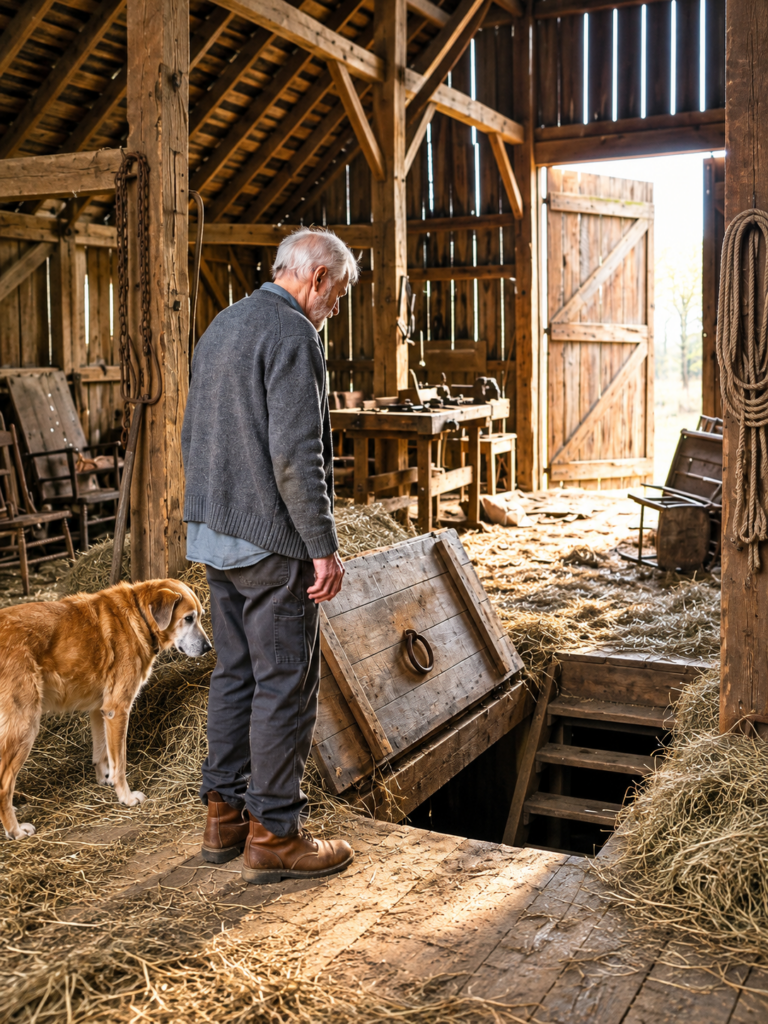
Inside stood a leaning workbench, rusted tools, cracked feed buckets, broken chairs and heaps of old hay gone pale with age.
Nothing looked valuable.
Nothing looked dangerous.
Walter almost laughed.
“Maggie,” he whispered, “you brought me out here for this?”
Rusty ignored him.
Walter worked for nearly an hour.
He carried rotten boards outside. He dragged out feed sacks eaten through by mice. A wooden crate collapsed when he picked it up, leaving splinters and dust across his boots.
The work felt good.
For three weeks, Walter had awakened without purpose.
Now a hinge needed oil.
A floor needed sweeping.
Something broken needed attention.
That was a language he still understood.
Then he noticed the rocking chair.
It stood near the rear wall beneath a coat of dust.
Walter stopped.
He knew every curve in that chair because he had shaped them himself.
He had built it for Maggie on their twenty-fifth wedding anniversary.
Years later it disappeared from the farmhouse.
Maggie said she had donated it.
Walter ran his fingertips across one arm.
The wood was worn smooth in the place where her hand would have rested.
Beside it stood a small table.
And on that table was a blue coffee mug.
Walter picked it up.
There was a tiny chip near the handle.
His chest tightened.
It had come from their kitchen.
He remembered dropping a spoon against it years ago and Maggie refusing to throw it away.
“If it still holds coffee, it still has a job,” she had said.
Walter stared around the barn.
Maggie claimed she had not been inside this place in twenty-seven years.
Yet her chair was here.
Her mug was here.
And the lock had opened as though someone had maintained it.
Rusty barked.
Walter turned.
The dog stood in the far corner, staring at a mound of hay.
“Rusty.”
The dog barked again.
Then he started digging.
Hay flew behind him.
“Hey. Leave it.”
Walter pulled him back.
Rusty whined and strained against his grip.
Walter looked down.
The hay near the floor was darker than the rest.
Compressed.
Packed.
He crouched.
He pulled away one handful, then another.
Rusty joined him.
Walter’s fingers struck metal.
He stopped.
Carefully he removed more hay.
An iron ring appeared between the floorboards.
Walter sat back on his heels.
Maggie’s message returned to him.
Go to the barn.
Not clean the barn.
Not repair it.
Go to it.
Walter took the ring in both hands and pulled.
At first nothing happened.
He planted his boots and tried again.
A square section of floor lifted with a groan.
Cold air breathed up from below.
There was a staircase beneath the barn.
Rusty moved toward it.
“Stay here.”
The dog ignored him.
Walter pulled a flashlight from his work belt.
Its beam flickered, steadied.
He started down.
The stairs went farther than he expected.
At the bottom was an underground room.
Shelves lined the walls.
Boxes were stacked carefully beneath them.
Photographs filled one shelf. Bundles of letters tied with string filled another. Maps, notebooks and old documents lay beneath a layer of dust.
Across from the staircase sat a wooden trunk.
Walter approached it.
On top was a photograph.
Maggie was in it.
Young Maggie.
Twenty, perhaps.
She stood beside a young man Walter had never seen.
Maggie was smiling the way she had smiled before age softened the corners of her face.
Walter turned the photograph over.
June 1971.
The promises we couldn’t keep.
Walter read the words twice.
He had met Maggie the following year.
His light moved across the trunk.
A name had been carved into its lid.
Arthur Hayes.
Walter had been married to Maggie for fifty-one years.
He had never heard that name.
Rusty growled.
Walter turned.
A floorboard creaked above them.
Then another.
Someone was walking inside the barn.
Walter switched off the flashlight.
Darkness swallowed the underground room.
Rusty’s growl deepened.
Walter put a hand on the dog’s back.
“Easy.”
The steps moved closer.
They stopped above the hidden staircase.
Walter held his breath.
A scraping sound came from the barn floor.
Then a crash.
Rusty exploded into barking.
Walter turned on the flashlight and climbed.
“Who’s there?”
No answer.
He reached the barn.
The side door swung in the wind.
A rusted shovel lay on the floor.
Walter stared at it.
“Good Lord.”
Maybe the wind had done it.
Maybe.
Rusty walked to the open doorway and sniffed.
Then he stared toward the tree line.
Walter followed his gaze.
Nothing.
“There’s nobody there.”
He closed the door.
As he turned back, something near the entrance caught his eye.
Mud.
A partial boot print.
Fresh.
Walter crouched.
It had rained the previous afternoon.
This print had not been there when he entered.
He looked again toward the trees.
Then he locked the side door from inside.
Back underground, Walter sat on the bottom step with Maggie’s photograph in his hands.
Fifty-one years.
They had survived bad harvests, hospital bills, Walter’s heart surgery, Maggie’s mother’s dementia, Daniel’s teenage years, a furnace failure two days before Christmas and every ordinary disappointment that accumulated inside a marriage.
Walter had believed there were no locked rooms left between them.
Now he was sitting inside one.
He opened the wooden trunk.
There was no money.
No jewelry.
No treasure.
There was something worse.
A life he had never known about.
Photographs.
Newspaper clippings.
Property maps.
Letters.
Notebooks filled with Maggie’s handwriting.
He opened the oldest journal.
At first the entries were ordinary.
Weather.
Chores.
Arguments with her father.
Then a name began appearing.
Arthur.
Arthur came by again tonight.
Later:
Dad says Arthur needs to leave this alone before somebody gets hurt.
Then:
Arthur says the records prove everything.
Walter frowned.
“What records?”
He turned another page.
One sentence stopped him.
Arthur didn’t run away. They made everyone believe he did.
Walter looked at the photograph.
“What happened to you?”
He searched deeper in the trunk.
Several numbered envelopes lay near the bottom.
One.
Two.
Three.
Four.
Five.
Seven.
Walter checked them again.
There was no six.
Rusty began sniffing beside a small desk.
Walter opened the drawer.
Inside was a cassette recorder wrapped in a dish towel.
Beside it lay one tape.
For Walter.
He carried the machine to a shelf, inserted the tape and pressed play.
Static crackled.
Then Maggie spoke.
Walter stopped breathing.
Her voice was older.
Tired.
But unmistakable.
“Walter, if you’re listening to this, then I guess I finally ran out of time.”
Walter covered his mouth.
For three weeks he had wanted one impossible thing.
To hear Maggie again.
Now she was speaking to him from a room he had never known existed.
“I need you to understand something before you open the rest of those boxes. I never lied about loving you.”
His eyes burned.
“But there was something I couldn’t tell you. Not because I didn’t trust you.”
A pause.
“Because I knew you, Walter.”
Despite himself, Walter almost smiled.
“You would’ve tried to fix it. You would’ve stood between me and whatever was coming. That’s who you’ve always been.”
Walter wiped his face with the heel of his palm.
Then Maggie’s voice changed.
“And I couldn’t let what happened to Arthur happen to you.”
Walter looked at the photograph.
“If envelope number six is still there, don’t open it in the barn. It’s the only thing they were ever truly afraid of.”
Walter’s eyes moved to the gap between envelopes five and seven.
Then Maggie said, “And Walter… if number six is gone…”
Silence.
“Someone got here before you.”
The tape clicked off.
Walter remained still.
Rusty barked sharply.
Not toward the stairs.
Toward the wall.
Beneath the lowest shelf, a white corner protruded from behind a loose board.
Walter pulled it free.
A photograph.
Maggie stood outside the barn.
Older.
Perhaps seventy.
Someone stood beside her.
Walter recognized him immediately.
His son.
Daniel.
Walter turned the photograph over.
Maggie’s handwriting filled one line.
If anything happens to me, don’t trust him.
Part 2
Walter stared at Daniel’s face until the photograph blurred.
Daniel Whittaker was forty-eight.
His oldest child.
The boy Walter had taught to ride a bicycle.
The teenager he had once waited up for until two in the morning.
The man who had driven Walter home after Maggie’s funeral and sat across from him at the kitchen table the next day.
Dad, this place is too much for you.
Sell the farm.
Move closer to town.
Maybe somewhere they handle the yard and meals.
Walter had heard concern.
Now he heard something else.
He looked again at Maggie’s warning.
If anything happens to me, don’t trust him.
Anger rose so quickly Walter had to stand.
Not at Daniel.
At Maggie.
“You should’ve told me.”
His voice sounded strange in the underground room.
“You should’ve trusted me enough to tell me.”
There was no answer.
Only shelves.
Letters.
A dead woman’s secrets.
Then Walter looked toward the cassette recorder.
Because I knew you.
You would’ve tried to fix it.
Walter sat again.
Maggie had known exactly what he would have done.
If she had told him someone threatened her, Walter would have gone toward the danger.
That was what he had always done.
He opened envelope seven.
A letter began:
My Walter.
His throat tightened.
Nobody else had called him that.
If you’ve reached this letter, then you’ve probably learned enough to be angry with me. You have every right to be.
Walter continued.
But before you decide our marriage was built around a secret, understand this: You were never the secret. You were the safest thing that ever happened to me.
Walter lowered the page.
For several seconds he could not continue.
Rusty pressed against his leg.
Walter rested a hand on the dog’s head and read on.
Arthur Hayes had not been Maggie’s lover.
He had been her closest friend when they were young.
His family had farmed outside town for generations. In the early 1970s, Arthur became suspicious about a series of disputed property transfers involving local families.
Deeds had been altered.
Tax claims appeared where families insisted none should exist.
Land changed hands under circumstances that did not make sense.
Some owners lacked the money to fight.
Others lacked influence.
Arthur believed someone was stealing property through manipulated records and intimidation.
Maggie’s father had access to older property documents.
Maggie helped Arthur copy them.
Then Arthur disappeared.
The town said he ran away.
Maggie never believed it.
Walter opened another envelope.
Inside were copies of deeds.
Statements.
Property maps.
Names Walter recognized from families who had lived in the county for decades.
Arthur had not been chasing treasure.
He and Maggie had been collecting evidence.
Walter returned to her letter.
For years, Maggie wrote, she believed the danger had passed.
Then Daniel found one of her old files.
Walter stopped.
The memory of Daniel’s behavior during Maggie’s final months shifted inside him.
Questions about the barn.
Questions about the property line.
Repeated suggestions that the old building should be demolished.
A contractor Daniel claimed could take it down cheaply.
Then after Maggie died, Daniel pushed Walter to sell.
Walter continued reading.
Please don’t hate our son. I don’t know how far he’s gone, and I don’t know who has been talking to him.
Fear can make decent people do terrible things.
So can money.
Walter could hear Maggie saying it.
Even frightened, she left room for mercy.
The final paragraph made him close his eyes.
Please don’t spend whatever years you have left being angry that I kept this from you.
I wasn’t protecting a secret from my husband.
I was protecting my husband from the secret.
Walter pressed the letter against his chest.
Then he cried.
Quietly.
Rusty stayed beside him.
When the grief finally loosened enough for Walter to breathe normally again, he whispered, “You stubborn woman.”
For the first time in weeks, he smiled.
Then he looked at the missing envelope.
The smile disappeared.
Maggie had spent fifty years carrying the danger.
Now she was gone.
Whatever she had feared was not.
Walter gathered the photographs, Maggie’s letter and the cassette into an old canvas tool bag.
He left the original deeds behind.
Before climbing the stairs, he photographed the shelves with his phone.
“Always make a copy of what matters,” Maggie used to say.
Walter had thought she meant photographs of the grandchildren.
Now he wondered how many ordinary sentences had carried another meaning.
His phone vibrated.
Daniel.
Walter answered.
“Hello?”
“Dad, where are you?”
Walter looked around the room.
“Why?”
A pause.
Then Daniel asked, “You’re not in Mom’s barn, are you?”
Walter’s grip tightened.
He had never been a convincing liar.
Maggie used to tell him his face confessed before his mouth.
“I’m cleaning around the property.”
Silence.
Then Daniel said, “Dad, listen to me. Don’t mess with anything in that barn.”
“Why?”
“The place isn’t safe.”
Walter waited.
“You’ve been inside,” he said.
Another pause.
That was answer enough.
“Dad—”
Walter ended the call.
His hands trembled.
Not from fear.
From disappointment.
Few things hurt a father more than learning his child has been keeping something from him.
Except perhaps learning that his dead wife knew first.
Walter climbed out of the hidden room and crossed the pasture.
He did not return to the farmhouse.
He put Rusty in the pickup and drove twenty-three miles into town.
The county historical society occupied an old brick library between a pharmacy and a hardware store.
Walter had passed it hundreds of times.
He had never entered.
A silver-haired woman named Clara Bennett sat behind the front desk.
Walter told her he had found some old family papers.
He did not mention Daniel.
He did not mention the warning.
He did not mention the missing envelope.
“What kind of papers?” Clara asked.
“Property records. Letters. Photographs.”
“How old?”
“Late sixties. Early seventies.”
Clara gave him the polite expression people used when they expected a box of old receipts.
Then Walter placed a photocopied deed on the table.
Her expression changed.
“Where did you get this?”
“My wife’s barn.”
Clara looked at him more carefully.
“Your wife was Margaret Whittaker?”
A chill moved across Walter’s back.
“You knew Maggie?”
“Not personally.”
Clara hesitated.
“But I’ve heard her name.”
She disappeared into a back room.
When she returned, she carried a thick archival folder.
Inside was a newspaper clipping from August 1971.
Walter recognized Arthur immediately.
LOCAL FARMHAND MISSING.
FAMILY FEARS HE LEFT COUNTY.
“He didn’t leave,” Walter said.
Clara looked up.
“How do you know?”
“My wife didn’t believe he did.”
Clara leaned back.
For a moment neither spoke.
Then she said, “Mr. Whittaker, people have been looking for records like the ones you’re describing for decades.”
Walter’s fingers tightened around the clipping.
Clara explained that several families had challenged land transfers during the 1970s.
Most cases went nowhere.
Original documents disappeared.
Witnesses died.
People moved away.
Eventually the story became something people whispered about but could not prove.
“If your papers are authentic,” Clara said, “they may fill in things nobody has been able to establish.”
“Can you prove they’re real?”
“Not by myself.”
She slid the deed carefully back toward him.
“But I know people who can help.”
Walter sat quietly.
For years he had teased Maggie because she saved everything.
Birthday cards.
Church programs.
Vacation receipts.
Old photographs.
He had believed she was sentimental.
Maybe Maggie had not simply been saving memories.
Maybe she had been preserving evidence.
“No originals leave your possession,” Clara said. “And don’t tell anyone what you have until we understand it.”
Walter almost smiled.
“You sound like my wife.”
Clara smiled back.
“Then your wife was smart.”
“The smartest.”
Walter’s voice cracked.
On the drive home, Rusty rested his head against Walter’s arm.
Walter scratched behind his ears.
“Looks like your mama left us a job, old boy.”
For the first time since Maggie died, Walter did not feel as though he were driving toward an empty house.
He was driving toward something unfinished.
Then the farmhouse appeared.
A black pickup was parked beside the barn.
The barn doors were open.
Daniel stood outside.
And he was not alone.
A man Walter did not recognize stood beside him.
The stranger held a crowbar.
Walter stopped his truck fifty feet away.
Rusty growled.
Then Walter noticed the stranger’s boots.
Reddish mud covered the soles.
The same color as the footprint inside the barn.
Walter felt something settle inside him.
The footsteps he had heard above the underground room had not been the wind.
Someone had been there.
Now that someone had returned.
Walter got out of the truck.
Rusty jumped down.
Daniel saw him.
“Dad.”
The stranger lowered the crowbar.
Walter approached slowly.
“Who is he?”
Daniel glanced at the man.
“This is Mark. He’s a contractor.”
“Contractor for what?”
“I told you. That barn isn’t safe.”
Walter looked at the crowbar.
“He inspect all his buildings with one of those?”
Mark shifted.
Daniel stepped closer.
“Dad, can we talk inside?”
“No.”
Daniel blinked.
Walter almost never spoke to him that way.
“We’ll talk here.”
Rusty remained beside Walter’s leg.
Daniel lowered his voice.
“You don’t understand what’s going on.”
“Then help me understand.”
Daniel rubbed both hands over his face.
“I found some of Mom’s papers months ago.”
Walter said nothing.
“She got upset when I asked. Told me they were private. I thought maybe she was confused.”
“Maggie wasn’t confused.”
“I know that now.”
“Do you?”
Daniel looked toward the barn.
“I started asking questions.”
“What questions?”
“About the old property records.”
Walter waited.
“Somebody heard me asking.”
“Who?”
Daniel hesitated.
“People connected to those old deals.”
Walter felt cold.
“So instead of telling me, you tried to get me to sell.”
“I was trying to get you away from here.”
“By lying?”
“I was trying to protect you.”
Walter nearly laughed.
Maggie had said the same thing in another form.
But there was a difference.
Maggie had carried the danger herself.
Daniel had tried to decide Walter’s life for him.
“You don’t protect a man by taking away his choices.”
Daniel looked down.
Walter softened his voice.
“I’m old, son. I’m not dead.”
Daniel looked at him.
“I can still decide where I live. I can still decide what I’m willing to lose.”
“Daniel,” Mark said suddenly, “we should go.”
Walter turned toward him.
“Why?”
Mark did not answer.
Rusty growled.
Then Walter saw something protruding from Mark’s jacket pocket.
Brown paper.
A torn envelope.
A black number was visible.
Six.
Walter’s heart slammed against his ribs.
“What is that?”
Mark stepped backward.
Daniel turned.
“Mark?”
The man ran.
Rusty barked.
Mark made three steps before catching his boot on a broken fence rail.
He fell hard.
The envelope slipped from his jacket.
Daniel reached him before he could stand.
“What did you take?”
Mark shoved Daniel away.
Walter picked up the envelope.
Inside were photocopies of deeds.
A list of names.
A small brass key.
No fortune.
No treasure.
Just documents.
Evidence somebody had been frightened enough to steal.
Mark looked at Walter.
“You don’t know what you’re messing with.”
“Maybe not.”
Walter held the envelope to his chest.
“But my wife did.”
Something changed in Mark’s expression.
Recognition.
Fear.
Walter needed no confession.
Mark backed toward his truck.
“You bring all that into the open, you’re going to drag families through things that happened fifty years ago. Property claims. Lawsuits. People could lose everything.”
Walter looked at the farmhouse.
At the barn.
At the place where Maggie had raised their children.
Then he looked at Mark.
“Those fifty years happened whether we talk about them or not.”
Mark got into the pickup and drove away.
Dust hung over the lane.
Daniel stood motionless.
Finally he said, “Dad, I’m sorry.”
Walter looked at his son.
For the first time in years, Daniel did not look like a confident forty-eight-year-old arranging everybody else’s problems.
He looked like the little boy who used to stand beside Walter’s workbench after breaking something, waiting to see whether his father could fix it.
“You knew about number six?”
Daniel shook his head.
“I knew Mom had something hidden. Mark told me if those records came out, families could lose property. Lawsuits. Everything.”
“And you believed him?”
“I was scared.”
Walter nodded.
He understood fear.
Understanding was not the same as excusing.
“You should’ve come to me.”
“I thought after Mom died…” Daniel swallowed. “I thought you couldn’t handle one more thing.”
Walter looked toward the kitchen window.
“Neither did I.”
Daniel frowned.
Walter gave a tired smile.
“Apparently your mother disagreed.”
Part 3
Walter called Clara that evening.
By the end of the week, an archivist and a retired property attorney had examined portions of Maggie’s collection.
They were careful with their conclusions.
Some records would need independent verification.
Some might have historical value rather than legal force.
Possessing copies of old deeds did not automatically prove who owned what.
Walter appreciated the caution.
Maggie had spent half a century protecting evidence.
He had no intention of turning it into another rumor.
But one conclusion came quickly.
The collection appeared authentic.
And it mattered.
Walter spent the following days repairing the barn.
Daniel came too.
At first they worked mostly in silence.
Walter replaced rotten boards near the east wall. Daniel reinforced the hidden staircase. They installed better locks. They sealed the broken window and removed hay that had turned black with damp.
There was no dramatic reconciliation.
Walter did not pretend Daniel had done nothing wrong.
Daniel did not ask him to.
They simply worked.
One afternoon Walter handed his son a warped piece of oak.
“Don’t force the plane.”
Daniel looked at him.
“You used to say that when I was twelve.”
“And you didn’t listen then either.”
Daniel laughed quietly.
For a few minutes, they were father and son rather than two men standing inside a secret.
Later, Daniel looked around the building.
“Mom knew you’d save this place.”
Walter continued sanding.
“No.”
Daniel waited.
Walter glanced at Maggie’s rocking chair.
“Your mother knew this place would save me.”
After Maggie died, everyone had treated Walter’s life as though it were becoming smaller.
Don’t drive so far.
Sell the farm.
Move somewhere easier.
Take it easy.
People said those things kindly.
That almost made them worse.
Walter understood what seventy-six meant.
His hands were weaker.
His knees hurt.
He tired faster.
But old did not mean finished.
Every repaired board proved that to him.
Daniel saw it too.
A week after finding envelope six, Clara drove to the farm carrying a thick folder.
Walter and Daniel were working at the barn.
Rusty slept near the doorway.
Clara got out of her car and walked quickly toward them.
Even from a distance Walter could tell something had happened.
“Walter.”
He put down his hammer.
“What?”
Clara held the folder to her chest.
“We found Arthur Hayes.”
Walter froze.
Before he could speak, Clara shook her head.
“Not alive.”
Walter exhaled.
“But we found out what happened to him.”
She handed him the folder.
Walter looked at the first page.
Arthur Hayes.
Below the name was a date.
June 1971.
Walter carried the folder inside and sat in Maggie’s rocking chair.
Daniel remained near the workbench.
Rusty settled beside Walter’s boots.
He opened the file.
Arthur had never run away.
Using Maggie’s records and documents located in another county, Clara and the archivist had traced his movements after his disappearance.
In June 1971, Arthur had attempted to deliver copies of disputed property records to an attorney.
He had been attacked.
Badly injured and frightened that Maggie might become a target, Arthur left Kentucky.
He used another name.
He never returned.
Walter lowered the page.
“So she was right.”
Clara nodded.
“She was.”
Arthur had died twelve years earlier in Missouri.
But his daughter still had a box of belongings.
Inside were letters Arthur had written but never mailed.
Several were addressed to Margaret.
Clara handed Walter a copy of the last.
Arthur had written it late in life.
Maggie, if you kept those records, then you were braver than I ever was.
I hope someday somebody finishes what we couldn’t.
Walter closed his eyes.
For fifty-one years, Maggie had carried a promise that began before she met him.
Not a romance.
Not a second life.
A promise.
Two young people had seen something wrong.
They had gathered proof.
Then fear had separated them.
Arthur ran.
Maggie stayed.
And quietly, year after year, she preserved what they had found.
Walter looked around the barn.
“I thought I knew everything about her.”
Clara smiled gently.
“Maybe nobody knows everything about another person.”
Walter studied Maggie’s photograph.
“No.”
His voice softened.
“But I knew the important parts.”
Over the following months, the records were professionally copied and preserved.
Historians worked through them carefully.
Families whose names appeared in the files were contacted privately.
Some old questions were answered.
Others could not be.
Walter learned not to demand perfect endings.
Truth, he discovered, did not always arrive as a courtroom victory or a confession.
Sometimes it arrived as enough light to see what had been hidden.
Daniel stayed.
He stopped talking about selling the farm.
Every Saturday morning his truck appeared in Walter’s driveway.
Together, they repaired the barn.
Walter insisted they keep original beams whenever possible.
One morning Daniel asked why he was spending so much time preserving old wood when new lumber would be stronger.
Walter tapped one weathered beam.
“New wood can make it stronger.”
He ran his hand along its surface.
“But that doesn’t mean you throw away everything that survived.”
Daniel looked at him.
Walter knew his son understood.
By spring, the barn no longer looked abandoned.
The underground room was secured.
Copies of Maggie and Arthur’s records were displayed upstairs beside photographs and short histories of the families connected to them.
Walter refused to charge admission.
“If Maggie kept it safe fifty years,” he said, “I’m not charging people to learn what she protected.”
More than a hundred people came on opening day.
Walter wore the blue shirt Maggie always said made him look handsome.
Rusty wore a new red collar.
People shook Walter’s hand.
Some cried.
Others told stories about grandparents, lost farms, old rumors and names they remembered hearing when they were children.
Walter listened.
But throughout the day, his eyes kept drifting toward one chair beside the workbench.
Maggie’s rocking chair.
Near evening, after most visitors had gone, Clara approached him.
She held a cassette tape.
Walter’s smile vanished.
“Where did that come from?”
“The lining of envelope six.”
She handed it to him.
Maggie’s handwriting was on the label.
For Walter.
Last one.
Walter waited until the barn was empty.
Daniel remained.
So did Rusty.
Walter sat in Maggie’s chair.
He placed the tape in the recorder.
Pressed play.
Static.
Then Maggie’s voice.
“My Walter.”
His eyes filled before she said another word.
“If you’re hearing this, then you found the truth.”
A tiny laugh came through the speaker.
“But knowing you, you probably fixed half the barn along the way.”
Walter laughed through his tears.
Daniel lowered his head, smiling.
Maggie continued.
“I know what you’re going to think after I’m gone. You’re going to think your best years died with me.”
Walter’s hand covered his mouth.
“You’ll wake up and see my empty chair. You’ll reach across that bed. And you’re going to wonder what an old carpenter is supposed to do with all those mornings left.”
Walter bowed his head.
She knew.
Of course she knew.
Then Maggie said, “You spent fifty-one years believing you were the one protecting me.”
Her voice trembled.
“But Walter, you gave me fifty-one years in which I finally felt safe.”
A tear fell onto Walter’s hand.
“You were my home.”
Daniel turned away and wiped his face.
“And if I’ve left you anything worth keeping, I hope it isn’t fear. I hope it isn’t anger.”
Maggie paused.
“I hope it’s a reason to keep opening the door every morning.”
Walter looked toward the barn entrance.
“So open it, Walter. Let people in.”
Another pause.
“And when you’re ready… keep living.”
The tape clicked off.
No one moved.
Walter rested one hand on Rusty’s head.
Sunlight streamed through the barn doors.
For three weeks after Maggie died, Walter had believed she left him with nothing but absence.
An empty chair.
An empty bed.
A quiet kitchen.
Now he finally understood what she had done.
Maggie had not left him a place to mourn her.
She had left him a place from which to begin again.
A month later, Walter carved a sign by hand.
He spent two evenings choosing the wood and another day shaping the letters.
Daniel helped hang it above the entrance.
MARGARET WHITTAKER MEMORY BARN.
Below that, in smaller letters, Walter carved:
NOTHING WORTH REMEMBERING SHOULD STAY BURIED.
That evening, after the last visitors had gone, Walter stood outside with Rusty.
The Kentucky hills glowed gold beneath the setting sun.
Through the open door, he could see Maggie’s chair.
“I miss you, Maggie.”
His voice broke.
“I suppose I always will.”
Rusty leaned against his leg.
Walter smiled through his tears.
“But I’m still here.”
He reached inside and switched off the barn light.
Then he started toward the farmhouse.
Halfway across the yard, Walter stopped.
He turned.
The barn stood dark against the evening sky.
Walter looked at it for several seconds.
Then he walked back.
He opened the door.
And switched the light on again.
A warm glow appeared over the entrance.
Walter smiled.
Maggie had spent half a century protecting a light she feared somebody might put out.
Walter decided it would not go dark again.
From then on, a small light remained burning over the barn door each night.
Not for the dead.
For anyone still trying to find their way home.
Walter never stopped missing Maggie.
He still woke some mornings and looked toward her side of the bed.
He still occasionally reached for a second coffee cup before remembering.
Grief did not disappear because he found a purpose.
But grief changed.
It became something he could carry.
People continued visiting the barn.
Some came because their family names appeared in the records.
Others came because they had heard the story of Margaret Whittaker, the young woman who preserved documents for half a century because she had once promised a frightened friend that the truth would not disappear.
Walter told visitors about Arthur too.
He refused to make the story simpler than it was.
Arthur had been afraid.
Maggie had been afraid.
Daniel had been afraid.
Fear had shaped all of them differently.
Arthur fled to survive.
Maggie stayed and hid the evidence.
Daniel tried to bury a danger he did not understand.
Walter, at seventy-six, finally learned that courage did not mean running toward every threat.
Sometimes courage meant trusting other people with the burden.
Sometimes it meant preserving the truth instead of possessing it.
Sometimes it meant forgiving without pretending the hurt had never happened.
And sometimes courage was much smaller.
Getting out of bed.
Making coffee.
Opening a door.
Letting another morning begin.
Daniel kept coming on Saturdays.
Father and son still argued occasionally.
Mostly about repairs.
Daniel wanted modern lighting.
Walter said the old fixtures worked fine.
Daniel wanted a security system connected to his phone.
Walter complained until Daniel installed it anyway.
Rusty continued sleeping near Maggie’s chair.
Whenever visitors bent to pet him, Walter told them the dog deserved most of the credit.
“He found the door,” Walter would say.
People often laughed.
Walter did too.
But he meant it.
If Rusty had not started digging beneath the hay, perhaps Walter would have swept the barn, carried out the rubbish, gone home and wondered for the rest of his life why Maggie had sent him there.
Instead, an old dog had uncovered an iron ring.
An iron ring had opened a staircase.
A staircase had led to a room.
A room had revealed a promise.
And the promise had led Walter back toward life.
Late one evening, nearly a year after Maggie died, Walter sat alone in the barn.
A soft rain tapped against the restored roof.
Rusty slept beside him.
Walter held the old photograph of Maggie and Arthur.
For a long time, the image had hurt him.
Not because Maggie had loved Arthur romantically.
She had not.
It hurt because the young woman in the photograph belonged to years Walter could never enter.
There had been a Maggie before Walter.
A frightened girl with a secret.
A girl who helped copy records at night.
A girl who lost a friend and spent decades waiting for danger to return.
Walter once thought marriage meant knowing everything.
Now he understood differently.
Love was not ownership of another person’s entire past.
It was knowing enough of their heart to recognize them even when a hidden room finally opened.
Walter touched Maggie’s smiling face.
“I knew the important parts,” he said.
Rusty’s ear twitched.
Walter smiled.
Outside, the rain continued.
Above the entrance, the small light burned.
Walter thought about the first morning he had walked into the barn believing he was there to clean out old belongings.
He had been wrong about almost everything.
There had been no treasure beneath the hay.
No gold.
No fortune.
No inheritance that would make him rich.
What Maggie left him was harder to measure.
She left him the truth about Arthur.
She left him unfinished work.
She left him a chance to repair his relationship with Daniel.
She left him proof that the woman he had spent fifty-one years protecting had spent those same years protecting him in ways he never understood.
And most of all, she left him a reason to wake up.
Walter had once believed purpose was something a person lost with age.
Strength weakened.
Work ended.
Children grew.
People died.
Doors closed.
But standing in the restored barn, he realized purpose did not always disappear.
Sometimes it changed shape.
Sometimes it waited beneath old hay in a building everyone else had abandoned.
Sometimes the person you loved left behind one final task because they knew you better than you knew yourself.
Walter rose from Maggie’s chair.
His knees hurt.
His back hurt too.
He switched off the interior lights.
The small lamp above the entrance remained on.
Walter stepped outside with Rusty.
Across the pasture, the farmhouse windows glowed warmly.
For decades Walter had walked from that barn toward a house where Maggie waited.
Now the house was empty of her.
It would always be empty of her.
But Walter no longer confused empty with meaningless.
He looked back once.
The light above the door shone through the rain.
Then Walter headed home.
Slowly.
Rusty beside him.
Another morning would come.
And Walter intended to be there for it.

