
Part 1
The first thing Ren noticed was that her father wouldn’t look at her.
He kept both hands on the steering wheel, staring through the windshield as their car crawled up a narrow logging road. Snow pressed against the trees on either side, and the afternoon sky was already turning the color of dirty wool.
Ren was nineteen years old. She had spent enough of those years watching her father’s face to recognize when he was avoiding something.
Whatever it was, he had been avoiding it since they left home.
Her stepmother, Sandra, sat in the passenger seat with the heater blowing directly against her legs. She held a stainless-steel travel mug between her hands and had been explaining for nearly two hours why this trip was such a wonderful opportunity.
“Think about it, sweetheart. Your own place. No rent. No one telling you what to do. Most girls your age would be thrilled.”
Ren shifted in the back seat, where a cardboard box containing her mother’s belongings rested against her knees.
“Whose place was it before?”
Sandra took another sip of coffee.
“Family property.”
“On whose side?”
“It came through your father’s family.”
Ren glanced at the rearview mirror.
Her father kept watching the road.
“Has anyone lived there recently?”
“It’s been empty,” Sandra replied. “But that’s not important. What’s important is that you’re finally going to have something of your own.”
Ren looked away.
She had learned that Sandra’s patience usually ended at the exact moment a question became inconvenient.
Outside, the last houses had disappeared. The county road had narrowed into two frozen tire tracks climbing between tall black pines.
Eleven miles separated the cabin from the nearest town.
Ren knew because she had noticed the distance on a roadside marker before her phone lost service.
She also knew that the car she used to drive to her shifts at the diner wasn’t really hers. Her father had bought it in his name, and Sandra controlled the insurance.
Still, she had believed them when they said the cabin would be a fresh start.
She wanted to believe that her father, after eight years of barely looking at her, had finally decided to do something kind.
The clearing appeared shortly before sunset.
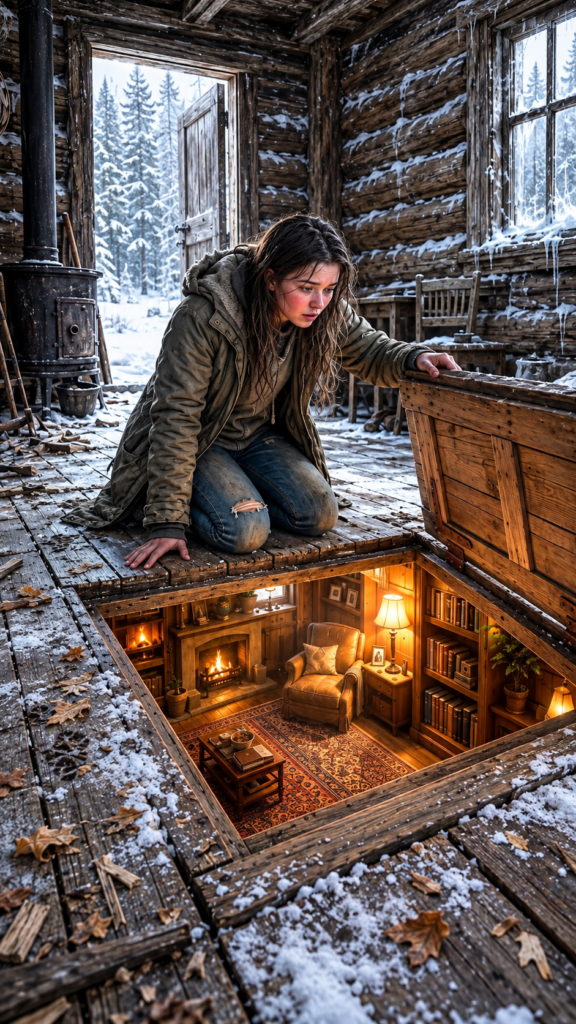
The cabin stood alone beneath a steep tin roof, its squared logs dark with age and its corners silvered by weather. A stone chimney rose above one wall. Beside the building, a woodshed leaned slightly under the weight of accumulated snow.
There was no smoke.
No light.
Not a single fresh footprint.
Her father stopped the car.
“Well,” Sandra said brightly. “Here we are.”
Inside, the cabin smelled of cedar, cold ashes, and furniture left untouched for years.
A cast-iron stove stood against the chimney. There was a table, two chairs, a narrow bed frame, a cupboard, and a braided rug spread across the center of the plank floor.
Dust covered everything.
Ren set her bag down.
“Is there electricity?”
Sandra glanced around.
“Apparently not.”
“Running water?”
“There’s a barrel.”
Ren walked toward the stove and touched its iron door.
It was as cold as the air surrounding it.
“How am I supposed to stay warm?”
Her father finally spoke.
“There’s firewood in the shed.”
She turned toward him.
“Dad, it’s supposed to get colder tonight.”
“You’ll be all right.”
He said it softly, almost as though he were trying to convince himself.
Sandra moved toward the door.
“Before we go, let me have your phone.”
Ren frowned.
“What?”
“Your phone, honey. There’s no reception up here anyway. We’ll keep it safe until you’re settled.”
“No. That’s mine.”
Sandra extended her hand.
“We’ve already discussed this.”
They hadn’t.
Ren looked toward her father, waiting for him to say something.
He studied the floor.
Sandra took the phone.
Then came the car keys, which her father removed from Ren’s jacket pocket. Then the envelope containing nearly two years of tips from the diner, money Ren had saved a few dollars at a time, refusing invitations and buying the cheapest meals she could manage.
Sandra slipped the envelope into her purse.
“We’re holding on to this until you learn to manage things properly.”
Ren stared at her.
“I earned that money.”
“And you’ll get it back when you’re ready.”
Ren opened her mouth, but her attention shifted when her father picked up the cardboard box.
It contained everything she had managed to preserve from her mother.
A few photographs. Some cassette tapes. A little glass bird, blue and gold, that her mother used to keep on the kitchen windowsill.
“Dad?”
He carried the box outside.
“Dad, where are you taking that?”
“Back to the car.”
“Why?”
Sandra answered from behind her.
“Those things could get damaged up here. We’re keeping them someplace safe.”
Ren followed her father onto the porch.
“Please. That’s all I have left of Mom.”
He opened the trunk.
He put the box inside.
Then he closed it.
For one brief moment he looked at her, and she saw something in his expression that made her feel eleven years old again.
That was how old she had been when her mother, Sylvie, died.
In the years afterward, Garrett Sailor had become a man who could sit across a dinner table from his daughter without meeting her eyes. He still carried Sylvie’s photograph in his wallet, but he could barely bring himself to look at the living girl who resembled her.
“Dad,” Ren said again.
He turned away.
Sandra climbed into the passenger seat.
“Get yourself organized. We’ll check on you.”
The engine started.
Ren stood on the porch in her thin jacket, watching her father reverse the car.
The headlights moved across the snow.
The tires found the frozen tracks.
And then her parents drove away.
Neither one looked back.
Ren remained outside until the engine noise disappeared among the trees.
Only then did she understand what they had done.
They had left her alone on a mountain in the middle of winter, with no transportation, no phone, no money, and barely enough supplies to survive.
She didn’t know why.
But she knew it hadn’t been a gift.
The first night became a series of small, necessary decisions.
Ren refused to think beyond them.
She found half a cord of split wood in the shed, reasonably dry beneath the roof. There was a hatchet buried in a chopping block and a coffee can containing kitchen matches.
Her fingers were shaking badly enough that she broke the first match.
The second flame died before the kindling caught.
On the third attempt, a thin orange tongue climbed between two pieces of bark.
Ren leaned closer, shielding it with her hands.
“Come on.”
The flame caught another twig.
Then another.
Eventually the wood began burning.
She sat on the floor beside the stove until its iron sides grew warm enough to touch.
A kerosene lamp stood on a shelf beside a half-full container of oil. She lit it and searched the cupboards.
There was a sack of flour crawling with weevils, a little coffee, several dusty jars, and enough forgotten odds and ends to suggest someone had once lived here carefully.
She found two granola bars in her bag.
That became dinner.
The water barrel had frozen across the top. She broke the ice with the handle of the hatchet, filled the kettle, and set it on the stove.
Every practical task gave her something to concentrate on besides the memory of the car pulling away.
When the stove was burning steadily, she dragged both blankets onto the bare bed frame.
She slept in her clothes.
For most of the night, she lay awake, listening to the timber creak and wondering how long Sandra intended to leave her here.
Morning arrived dazzlingly clear.
A fresh foot of snow covered the clearing. The trees carried thick white branches beneath a blue sky, and the distant ridges stretched away in layers.
Ren stood on the porch holding a cup of bitter black coffee.
It was beautiful.
That almost made her angry.
A person could admire a mountain and still starve on it.
She was considering how much wood she would need when she heard something move behind the woodshed.
A faint whine.
Then a scraping sound.
Ren put down her cup and took the hatchet.
Around the back, where the stacked logs sheltered a narrow space beside the wall, she found a dog.
He was a large black-and-tan shepherd, old enough to have gray spreading around his muzzle. His ribs were visible beneath a coat tangled with burrs and ice. One hind leg seemed stiff, and his paws were cracked.
He lifted his head.
Ren stopped several feet away.
“Hey, boy.”
His dark eyes followed her.
He didn’t growl.
When she crouched, he moved his tail once against the snow.
Ren went back to the cabin and returned with the heel of a sandwich and part of her remaining food.
She placed it between them.
The dog struggled up, limped forward, and ate.
Then he leaned his bony body against her knee.
Ren rested a hand on his neck.
For a long time neither of them moved.
“Looks like somebody forgot about you too,” she murmured.
She brought him inside.
He settled in front of the stove with the uncomplicated gratitude of an animal too tired to question good fortune.
Ren found dried beans, onions, and a jar of tomatoes. She made a thin soup and shared it with him.
By afternoon she had named him Dutch.
The name came from an old photograph she remembered seeing, and somehow it suited his square, stubborn face.
Dutch answered to it almost immediately.
That evening, Ren found herself telling him about the diner.
About the money she had saved.
About wanting to take art classes and how Sandra had dismissed drawing as something people with money did when they had nothing useful to occupy their time.
She talked about her mother, too.
“I used to remember her voice perfectly,” she said.
Dutch rested his chin on his paws.
“Now sometimes I have to think really hard.”
He watched her.
She smiled a little.
“You’re a good listener.”
It was the longest she’d spoken without being interrupted in months.
On the second night, the temperature dropped sharply.
Ren kept the stove fed, but cold slipped through the window frames and beneath the door. She moved the bed nearer the chimney, wrapped herself in both blankets, and let Dutch lie against her back.
Still, her feet wouldn’t warm.
At first she blamed the gaps between the floorboards.
Then she noticed something unusual.
The cold seemed to be moving.
A steady draft crossed the floor from the center of the room, stronger than the air creeping around the windows.
Near midnight, Dutch lifted his head.
His ears stood upright.
Ren pushed off the blankets.
“What is it?”
The dog stood beside the braided rug, staring down.
Ren knelt and held her hand near its edge.
Cold air passed over her fingers.
She caught one corner of the rug and pulled it backward.
Underneath, the floor looked ordinary for a moment.
Then the lamplight revealed a square outline.
Four carefully fitted cuts separated several planks from the surrounding floor. Dirt had been packed into the seams to conceal them.
Along one edge, sunk into a shallow notch, lay a black iron ring.
Ren stared.
Someone had built a trapdoor into the cabin floor.
Someone else, perhaps the same person, had gone to considerable trouble to hide it.
She hooked her fingers through the ring and pulled.
Nothing moved.
She braced her boots and tried again.
The dirt cracked.
Wood groaned against wood.
Then the hatch lifted.
A dark opening appeared beneath it.
Ren raised the lamp.
Four feet below was a stone-lined chamber. The wavering light touched a row of shelves, glass jars, and something metallic tucked against the far wall.
There were bundles of paper, too.
For several seconds she simply listened.
Nothing moved beneath the cabin.
Dutch sniffed the opening but showed no fear.
Ren lowered the lamp, climbed carefully through the hatch, and dropped onto packed earth.
The chamber was a root cellar.
Its stone walls were fitted tightly enough to keep the space remarkably dry. Low shelves extended along two sides, stocked with glass jars, sacks of grain, candles, lamp oil, blankets, rope, a hand ax, a whetstone, and a first-aid kit.
Someone had prepared this place for a long winter.
Not casually.
Not as an afterthought.
The supplies had been arranged by someone who understood how quickly an isolated person could get into trouble.
Ren examined the jars.
Several were labeled in careful pencil.
She remembered seeing preserves in her mother’s kitchen when she was small.
Then one label caught her attention.
Plum.
Beneath it was a childish signature.
Sylvie.
The date belonged to a summer decades earlier.
Ren touched the glass.
Her mother had written that name.
Not the woman Ren remembered from the kitchen, but a little girl who must have stood in this very cellar, proudly labeling a jar of jam.
Ren looked around again.
Whatever Sandra had told her, this had been part of her mother’s childhood.
At the far end stood two metal containers.
One was a small gray-green box secured with a simple latch.
The other was a heavy iron strongbox with a padlock.
Ren tried the lock.
It didn’t move.
She took the smaller box and a bundle of letters tied with twine, handed them up through the opening, and climbed back into the cabin.
The stove had burned low.
She added two pieces of wood, pulled the table closer, and opened the gray-green box.
Inside lay photographs, a small brass key, and a folded sheet of paper.
On the paper, written in a forceful, slanting hand, were two words.
For Ren.
She unfolded it.
The letter began:
If you’re reading this, they’ve finally brought you here. I’m sorry it took so long.
Ren stopped breathing for a moment.
She read the next line.
My name is Emmett Voss. I’m your mother’s father, which makes me your grandfather.
Her grandfather.
The man Sandra had described as cruel, bitter, and unwilling to have anything to do with her.
The man Ren had been taught to believe had rejected her before she was old enough to understand what rejection meant.
She kept reading.
Emmett explained that he had built the cabin himself when Sylvie was four years old. He had cut the logs, raised the walls, dug the cellar, and made much of the furniture with his own hands.
He described the mountain as the place where he had worked and grown old.
Then he wrote something Ren had to read twice.
I’m leaving it to you because you’ve got the same hands, even if nobody ever bothered to tell you so.
She looked down at her palms.
They were rough from work at the diner, and new blisters had formed since she arrived.
The letter continued.
The property, Emmett wrote, belonged to her. Proper papers had been signed and filed, and a lawyer in town had everything necessary to prove it.
Her father and stepmother might call the cabin worthless.
They might describe it as a burden.
But there were reasons for that, and the answers were waiting inside the locked strongbox.
Then came the words that struck her harder than any mention of land or money.
You were wanted.
You have always been wanted by me, and by your mother.
Ren put the letter down.
For eight years, she had believed her mother’s death had left her with nobody who truly wanted her.
Now she was sitting inside a house built by a man who had known her name.
A man who had left her instructions on how to survive.
A man who, according to the letter, had wanted her here all along.
There was another slip of paper tucked into the lid.
This one contained practical advice.
The stove damper stuck and needed to be tapped twice on the left. A spring behind the woodshed provided drinking water. Blue paint on the trees marked the route.
The beans in blue-lidded jars were safe, but the green-lidded ones had spoiled.
Standing deadwood burned best.
Ren stared at the instructions until the words blurred.
He hadn’t simply left her property.
He had tried to make certain she would survive long enough to claim it.
Dutch rested his head against her leg.
Ren put one hand into his fur and continued looking at the letter.
The grandfather she had spent her childhood believing didn’t love her had prepared a place for her to come home.
And the two people who had abandoned her there had never imagined she would discover it.
Part 2
Ren slept very little.
She spread the photographs from Emmett’s box across the table, examining them one by one beneath the yellow lamplight.
There was Sylvie as a little girl sitting on the running board of an old truck, her front teeth missing and her hair untidy.
There was Sylvie as a young woman wearing a yellow dress, laughing toward someone outside the frame.
And there was a photograph of a broad-shouldered man with weathered hands holding a newborn baby against his flannel shirt.
He looked terrified of dropping her.
Ren turned the picture over.
Written on the back were the words:
Emmett and Ren. Three weeks.
She sat back.
He had held her.
The grandfather she believed had never wanted to meet her had held her when she was three weeks old.
Someone had taken that memory away before she was old enough to keep it herself.
She placed the photograph beside the letter.
At the bottom of the box was a little brass key.
It didn’t fit the strongbox downstairs. She had already seen enough of the padlock to recognize that its keyhole required a longer, flatter key.
She set the brass key on the windowsill and left the question unanswered.
There were too many other questions.
The next morning, after breakfasting on beans from the cellar and feeding Dutch, she began examining the cabin properly.
A burlap curtain covered one section of the back wall.
Behind it was a narrow door.
Ren pushed it open and discovered the workshop.
The room occupied a lean-to running nearly the entire length of the cabin. Small windows admitted a thin gray light. Beneath the smell of dust lingered something familiar and comforting: dry wood, sawdust, and linseed oil.
A heavy workbench extended along one wall.
Hand tools hung from a pegboard, each outlined so its proper place would be obvious. A vise was bolted to the bench. A leather apron hung nearby, stiff with age.
And in the center stood an unfinished rocking chair.
Ren approached it slowly.
The pale wood had been fitted with remarkable precision. The curved back slats rose gracefully from the seat, and the rockers were shaped with the confidence of someone who had made furniture for decades.
Only the arms remained unfinished.
A small paper tag hung from the frame.
For Ren, for when she comes.
Underneath was one final instruction.
Finish the arms.
She read it again.
Her grandfather had been making her a rocking chair.
Not because he knew she would come.
Because he had hoped she would.
Ren ran her fingers along the unfinished wood.
She had never learned to build furniture, but she had always liked making things. Sketching was the only activity she had been able to lose herself in after her mother’s death.
Sandra called it useless.
Here, surrounded by tools, Ren wondered how many things she might have learned if anyone had encouraged her.
She picked up a chisel from the pegboard.
Its wooden handle had darkened from years of use.
Under the bench, among old shavings, she found a small three-legged stool.
Someone had burned her mother’s name into the underside in crooked childhood letters.
Ren smiled despite herself.
Sylvie had worked here too.
Emmett had taught his daughter how to shape wood, and long afterward he had left an unfinished chair waiting for his granddaughter.
There was an entire family history in this room that Ren had never been permitted to know.
Back at the table, Ren finally untied the bundle of letters from the cellar.
There were dozens.
They were addressed to Miss Ren Sailor at the house where she had grown up.
The earliest dated back to her childhood. Others had been written in the years since.
Most had been mailed around her birthday in early April.
Every envelope had been returned.
Some carried red postal markings.
Return to sender.
No longer at this address.
Ren frowned at the second phrase.
She had never moved.
Then she noticed the handwriting on several newer envelopes.
The lettering was rounded and unusually neat, with tight, closed loops.
She recognized it immediately.
Sandra.
On one envelope, her stepmother had written:
We do not want these.
Ren held it very carefully.
She remembered being thirteen and asking why she had no grandparents like the other children at school.
Sandra had told her that Sylvie’s father was unkind.
That he had rejected his daughter after her marriage.
That when Sylvie died, he wanted nothing to do with the family.
Ren remembered asking whether he had ever tried to see her.
Sandra had answered no.
Her father had been sitting across the table.
He hadn’t corrected a word.
Now Ren began opening the envelopes.
She read one from when she was five.
Emmett hoped she was getting good books and wished he could read one to her.
In another, he described the first snowfall on the mountain and included a little drawing of a bird.
One envelope contained a two-dollar bill folded around a pressed flower. He had suggested she buy herself something foolish for her birthday.
A later letter contained a photograph of the unfinished rocking chair.
Coming along, he’d written. Slow work. Good work.
The letters grew longer as the years passed.
Sometimes he told stories about Sylvie as a little girl. Sometimes he described the weather, the trees, or something he had made in the workshop.
The most painful part was what he didn’t write.
He never accused Ren of ignoring him.
Never demanded an explanation.
Never wrote anything cruel.
He kept reaching toward a child who had no idea he existed.
And each time a letter came back, he saved it.
Ren imagined him opening his mailbox, recognizing the envelope he had sent, and carrying it back inside.
Then, months later, writing another.
It was almost unbearable.
A whole childhood of love had been returned to the sender.
Ren had spent years believing she was unwanted, while a man eleven miles away had been waiting for her to answer.
She looked around the cabin.
She couldn’t bear another night of not knowing.
In the morning, she would go to town.
The road had disappeared beneath the snow.
Ren packed water, a little food, Emmett’s letter, and two photographs. She banked the stove and stepped outside with Dutch following behind.
“Stay here,” she told him.
He continued walking.
His injured leg made the deep snow difficult, but every time Ren stopped, he stopped beside her.
So they went together.
The first hour was hard.
The second was worse.
Snow reached her knees in places, and she had to search between the trees for the buried tire tracks.
Her boots grew damp. Cold settled into her toes, and the wind exposed every gap in her clothes.
She knew walking the entire eleven miles might be dangerous, but staying on the mountain without answers had begun to feel impossible.
When she heard an engine behind her, she turned.
An orange plow truck was climbing the road.
The driver slowed beside her and cranked down the window.
He was an older man with gray stubble and a wool cap pulled low over his forehead.
“You’d be the girl they left up at Emmett’s place.”
Ren stared.
“How do you know that?”
“Small valley.”
He looked at her boots.
“Get in before you lose a toe.”
Inside the cab, the heater blasted warm air across her frozen fingers.
The man introduced himself as Wendell.
Then he noticed Dutch.
“Well, I’ll be.”
Ren looked down.
“What?”
“That’s Emmett’s dog.”
She studied the shepherd.
“You’re sure?”
“Known him for years. Been trying to keep that fool animal fed since Emmett passed last winter.”
Wendell reached down to scratch Dutch behind the ears.
“He keeps running away from my place. Every time he gets warm and puts some weight back on, he disappears up that mountain again.”
Ren swallowed.
“Why?”
Wendell gave her a long look.
“Guess he was waiting for somebody.”
Ren stared out the window.
Emmett had died more than a year earlier.
Dutch had kept returning to the empty cabin.
Waiting beside the home of a man who would never come back.
Wendell continued driving.
“Your granddad built the cradle my granddaughter sleeps in. Wouldn’t take a cent for it. I plowed his road for twenty winters, and he said that made us even.”
He shook his head.
“Never knew how to accept what people owed him.”
They rode quietly for a while.
Then Wendell said, “You look like your mother.”
Ren turned.
“You knew her?”
“Used to ride down this road beside her dad when she was little. Sat right there where you’re sitting.”
Ren looked at the dashboard.
“There’s a rocking chair in his shop. He never finished it.”
Wendell nodded.
“He talked about that chair for years. Said he was making it for his granddaughter.”
Ren pressed her lips together.
Nobody had told her the man existed as anything other than a bitter old stranger.
Yet people down here remembered him as someone who built things for others.
Someone who kept promises.
Someone who had been waiting for her.
Wendell dropped Ren at the small grocery and feed store in town.
The woman behind the counter was in her sixties, with silver hair and reading glasses pushed onto her head.
When Ren entered with Dutch beside her, the woman stared.
Then her expression changed.
“Oh, honey.”
She came around the counter.
“You’re Sylvie’s girl.”
Ren nodded.
“I’m Ren.”
“I know who you are.”
The woman’s name was Fay.
She took Ren’s cold hands between hers.
“Your grandfather came in here the day you were born. Bought a cigar for my husband and cried right there beside the canned goods.”
Ren could hardly speak.
Fay guided her toward the stove, brought her chili, cornbread, and coffee, and found food for Dutch.
Only after Ren began warming up did she start asking questions.
Fay told her about Emmett’s monthly trips into town.
About the coffee and lamp oil he bought.
About the stamps he always kept buying.
“He’d ask whether anything had come for him. Any word from you. I don’t think there was a day he stopped hoping.”
Ren told her about the returned letters.
Fay closed her eyes.
“I always wondered.”
Then Ren asked the question she had carried for years.
“Why did my mother leave him?”
Fay took her time answering.
“Your mama was seventeen. She fell in love with Garrett, and her daddy didn’t approve. They had a terrible argument. Emmett was proud, and he said things he shouldn’t have.”
“Did he throw her out?”
“Your mother left with your father. Emmett was too stubborn to follow her right away. By the time he tried to repair things, the distance between them had grown.”
Fay looked at Ren.
“He regretted it for the rest of his life.”
She explained that Emmett had tried reaching out, but his letters never produced a reconciliation.
Then Sylvie died.
And Ren became the last connection to the daughter he had lost.
“He grieved your mama twice,” Fay said. “Once when she left, and once when she died.”
Ren stared into her coffee.
“And Sandra kept us apart.”
Fay didn’t try to soften it.
“Yes, honey. Looks like she did.”
The lawyer’s office occupied a small room above the hardware store.
Finn, the attorney who had handled Emmett’s estate, was a thin, tired-looking man with a space heater beneath his desk.
When Ren introduced herself, he looked at her for a long moment.
Then he reached into a drawer.
“I’ve been waiting for you.”
He brought out a folder bearing her full name.
Ren Sailor.
Inside was Emmett’s will.
The language was simple.
He had left the cabin, the 160 acres surrounding it, and everything on or beneath the property to Ren alone.
There was a recorded deed.
The property taxes were current, covered by money Emmett had set aside.
There were no hidden tax debts or complicated liens requiring Ren to surrender ownership.
Finn showed her the documents one at a time.
“Your grandfather was very particular,” he explained. “He wanted there to be no confusion about who inherited this land.”
Ren studied her name.
Then Finn revealed something else.
Her father and stepmother had visited him the previous March.
They had believed, or claimed to believe, that Garrett was entitled to the property through his deceased wife.
Finn had told them the will was explicit.
The land belonged to Ren.
He opened another document.
A timber company had wanted the old-growth trees on the north slope for years.
Emmett had always refused to sell.
The company still had a standing offer for the property.
When Ren saw the amount, she stared at it for a long time.
She had never imagined possessing that much money.
Then she remembered her father’s failing trucking business.
The repossessed vehicles.
Sandra’s sudden obsession with saving money.
The way she had begun selling household belongings.
Ren looked up.
“They knew.”
Finn waited.
“They knew the land was mine. They knew what it was worth.”
She thought about the phone in Sandra’s pocket, the keys, the stolen tips, and the cabin with its cold stove.
“They wanted me desperate.”
The words came slowly as the pieces settled into place.
“They were going to leave me up there until I couldn’t stand it anymore. Then they’d come back and offer to take me home.”
Finn’s expression tightened.
“And they would ask you to sign something?”
Ren nodded.
“Something that gave them the land.”
Finn turned the deed toward her.
“You are under no obligation to transfer this property to anyone.”
He told her that Emmett had specifically instructed him to remind her of one thing if anyone pressured her to sell.
The old man had refused the timber company for twenty years.
The trees were still standing.
Ren was entitled to keep them standing, too.
She folded her hands in her lap.
For the first time, she understood that the choice was hers.
Wendell drove her back to the cabin that evening.
He made her take a sack of groceries and promise to keep the stove burning properly.
When his truck disappeared down the road, Ren carried the food inside and set Emmett’s letter beside the lamp.
Then she went into the workshop.
The unfinished rocking chair was still waiting.
She picked up the small brass key she had found.
For several minutes she examined the drawers beneath the workbench, until she discovered a shallow one with a matching lock.
The key turned.
Inside were pencil stubs, sandpaper, and a long, flat steel key.
Ren carried it downstairs into the cellar.
It fit the iron strongbox.
She opened the lid.
And what she found inside explained why her grandfather had wanted her to know the truth before anyone else reached it.
There was some cash, old bills gathered into bundles.
But most of the contents were savings bonds.
Dozens of them.
Every one bore the same name.
Ren Sailor.
The first had been purchased the year she was born.
Another followed the next year.
And the next.
There was one for every birthday, bought little by little by a carpenter who had lived modestly and saved what he could for the granddaughter he wasn’t allowed to see.
Ren spread several across the table.
She remembered being nine, crying after a school play because nobody’s grandparents had come to watch her.
There was a bond from that year.
She remembered the birthday when Sandra had told her she was too old to expect a party.
There was a bond from that year, too.
Emmett had remembered every one.
He had been giving her a future in the only way he could.
Ren was still staring at her name when Dutch lifted his head.
His ears turned toward the door.
A low growl formed in his chest.
Outside, headlights moved between the trees.
An engine climbed the last stretch of road.
Ren recognized the sound immediately.
Her father’s car.
She gathered the papers and returned them to the strongbox.
Then she closed the lid.
The vehicle stopped outside.
Two doors opened.
Ren stood beside the stove, with Dutch at her feet, as footsteps crossed the snowy clearing.
Her parents had come back.
And this time, Ren knew exactly what they wanted.
Part 3
Sandra reached the porch first.
She was wearing boots better suited to a shopping center than a mountain road, and she picked her way through the snow with an irritated expression.
The moment she saw Ren standing in the doorway, her face softened.
“Oh, sweetheart. Look at you.”
She hurried up the steps.
“We’ve been worried sick. Your father and I have been talking, and we decided this simply isn’t safe.”
Ren said nothing.
Sandra glanced into the cabin.
“No electricity, hardly any heat. I don’t know what we were thinking.”
“You said it was my home.”
Sandra gave a small, uncomfortable laugh.
“Well, we didn’t realize how bad things were. Get your belongings together. We’re taking you back.”
Dutch stood beside Ren.
His growl was quiet but steady.
Sandra noticed him.
“Where did that animal come from?”
“He lives here.”
Ren rested a hand on his head.
“Same as me.”
Garrett stood several feet behind his wife.
His eyes moved over the cabin, lingering on the chimney, the table, and the heavy log walls.
He seemed older than he had when he left her.
“Can we come in?” Sandra asked.
Ren stepped aside.
She wanted them inside.
She wanted them surrounded by the evidence of everything they had tried to take from her.
Sandra entered rubbing her hands.
She looked at the warm stove, the stocked shelves, the clean dishes, and the food Wendell had brought.
Something flickered across her face.
The girl she had expected to find cold, hungry, and frightened was standing in a warm cabin beside a healthy fire.
But Sandra recovered quickly.
“All right,” she began. “Let’s discuss how we’re going to fix this.”
She opened her handbag and removed a manila folder.
Ren watched her place it on the table.
“There’s a problem with the property,” Sandra continued. “A rather complicated estate situation. Taxes, legal documents, old liens. We’ve been working with people to straighten it out.”
Garrett remained near the door.
Sandra took out a pen.
“The easiest thing is for you to sign everything over to your father. Then we can deal with it under one name, and you won’t have to worry about any of it.”
She turned the folder toward Ren.
“Sign here and here, and we’ll get you back into your own bed tonight.”
Ren looked down.
A quitclaim deed.
Exactly what she had expected.
“Which lawyer?”
Sandra blinked.
“What?”
“You said a lawyer suggested this. Which lawyer?”
“Our lawyer, sweetheart.”
“What’s his name?”
Sandra’s expression tightened.
“Ren, don’t be difficult.”
“I met Finn today.”
The pen stopped moving.
“He handled Grandpa Emmett’s estate. His office is above the hardware store.”
Garrett closed his eyes.
Ren continued.
“He showed me the will. The deed. The tax records. He told me you both came to see him in March.”
Sandra said nothing.
“He told you the land belonged to me. All 160 acres.”
“There’s more to it than that,” Sandra began.
“No, there isn’t.”
Ren’s voice was calm.
“You’re trying to make me sign away property that’s already mine.”
Sandra shifted in her chair.
“You’re nineteen years old. You don’t understand what owning land like this involves.”
“I understand that it isn’t yours.”
“Someone has to be practical.”
“Then let’s be practical.”
Ren pulled out the chair opposite her.
“Dad’s business is failing. The trucks were getting repossessed. You’ve been selling things from the house.”
Garrett looked down.
Ren turned back to Sandra.
“Then you learned about Grandpa’s land and the timber company’s offer. Except the property wasn’t left to Dad. It was left to me.”
Sandra’s lips parted.
“You brought me up here,” Ren continued. “You took my phone, my money, and the car keys. You left me in a freezing cabin without transportation.”
“We were trying to teach you independence.”
“No.”
Ren rested both hands on the table.
“You were trying to make me desperate enough to sign anything that would get me home.”
Sandra’s expression hardened.
“That’s a disgusting accusation to make against people who raised you.”
“Then tell me I’m wrong.”
For several seconds, Sandra said nothing.
Ren waited.
The stove burned steadily behind her.
Finally, Garrett spoke.
“Sandra, stop.”
His voice was hoarse.
His wife turned.
“Garrett—”
“Stop.”
He moved toward the table and sat heavily in the remaining chair.
He looked at his daughter.
For once, he didn’t turn away.
“I knew,” he said.
Ren felt the words settle somewhere deep inside her.
“You knew about the will?”
He nodded.
“Since March?”
“Yes.”
“And you let her bring me here?”
Garrett covered his face with his hands.
When he lowered them, his eyes were wet.
“I let her make the decisions.”
Ren waited.
He looked toward the stove.
“After your mother died, I couldn’t stand being in that house. Every room reminded me of her. Every time I looked at you, I saw Sylvie.”
His voice shook.
“You were eleven years old. You needed your father, and I couldn’t even manage to look you in the eye.”
Ren felt her throat tighten.
She had wondered about that for eight years.
She had blamed herself for his silence, his distance, his inability to speak to her without sounding exhausted.
Garrett rubbed his hands together.
“When Sandra came into our lives, she started making decisions. Small things at first. Then bigger ones. I let her because it was easier than thinking.”
He looked at Ren.
“I knew your grandfather was writing.”
Ren stared.
“You knew?”
“Yes.”
“All those years?”
Garrett nodded.
“She sent the letters back. And I let her.”
Ren felt something inside her give way.
She had expected greed.
She had expected lies.
But hearing her father admit that he had stood by while someone deliberately kept her from being loved was worse than she had imagined.
“He wrote to me every birthday,” she said quietly.
“I know.”
“You watched her send them back?”
“Yes.”
Ren looked away.
Garrett’s voice broke.
“There’s no way to explain what I did that makes it any better. I was a coward, Ren. I know that.”
She stood.
Then she walked to the corner of the room, lifted the hatch, and climbed into the cellar.
When she returned, she carried the iron strongbox.
It landed on the table with a heavy sound.
Sandra watched as Ren opened it.
Inside were the savings bonds.
Ren took several out and laid them across the table.
“My grandfather bought these for me.”
She pointed to the dates.
“Every birthday. Every year.”
Garrett leaned forward.
There was a bond from the year Ren was born.
Another from when she turned five.
Another from when she turned nine.
The years continued until Emmett’s death.
Ren looked at her father.
“You told me he didn’t want me.”
Garrett pressed a hand against his mouth.
“He was saving for me,” she said. “For college. For a life. He was doing that while you were telling me I didn’t matter to him.”
She touched the edge of one of the documents.
“He saved every letter you returned, too.”
Garrett began crying.
Ren watched him without moving closer.
She loved her father.
Some part of her probably always would.
But loving him didn’t mean she had to make his guilt easier to bear.
Sandra stared at the papers.
For the first time that evening, she looked tired rather than angry.
“You think I don’t know what I’ve done?” she asked.
Ren said nothing.
“I grew up with nothing. The lights getting shut off. The car being taken. My mother sitting at the kitchen table with bills she couldn’t pay.”
Sandra looked toward the fire.
“I promised myself I would never live like that again.”
Her hands were trembling.
“Then I married your father, and his company started going under. Everything I worked for felt like it was disappearing.”
She looked at the bonds.
“And there was all this money sitting up here.”
Ren waited for her to continue.
“I told myself you wouldn’t miss something you didn’t know you had.”
The sentence was so simple, so ugly, that Ren almost wished Sandra had shouted instead.
“You thought that made it all right?”
“No.”
“Then why did you do it?”
Sandra stared down at her hands.
“Because I was afraid.”
Ren considered that.
For the first time, she could see Sandra as someone shaped by things that had happened long before she joined their family.
It explained something.
It excused nothing.
Sandra looked up.
“We could still work something out. Together. With lawyers. A fair division.”
Ren shook her head.
“You still don’t understand.”
“Ren—”
“You look at this box and see money.”
She touched one of the bonds.
“I look at it and see someone who remembered my birthday.”
Sandra fell quiet.
Ren closed the strongbox.
“I’m not signing anything.”
Garrett stood.
For a moment, Ren thought he was walking out again.
But he went through the door and crossed the clearing toward the car.
She heard the trunk open.
Then he returned carrying a cardboard box.
Ren recognized it before he reached the table.
Her mother’s box.
Garrett set it down carefully.
“I couldn’t throw it away,” he said.
Ren touched the worn cardboard.
“Throw it away?”
He nodded.
“After the funeral, Sandra thought keeping your mother’s things wasn’t healthy. I told her I’d taken them to the dump.”
Sandra looked away.
“But I hid them under the house. In the crawl space.”
He swallowed.
“Sometimes I’d go down there and sit with them.”
Ren opened the lid.
Inside were the photographs.
The cassette tapes.
And the little blue-and-gold glass bird.
She lifted the bird into the lamplight.
It caught the firelight along one wing.
For eight years, she had been afraid of forgetting her mother’s voice.
Now the tape that preserved it was back in her hands.
Garrett stood beside the table.
“I should have brought these to you years ago.”
“Yes,” Ren said.
He nodded.
She put the glass bird gently back into the box.
“Take Sandra and go home.”
Garrett’s face changed.
“Ren, I—”
“Not tonight.”
He stopped.
“What do you want me to do about the land?”
“I don’t know yet.”
She looked directly at him.
“But I’m going to decide. Not you. Not Sandra. Me.”
Garrett stood very still.
Then he nodded.
“All right.”
Sandra collected the unsigned papers.
Neither of them spoke as Ren walked them to the door.
Outside, snow was falling again.
Garrett paused at the top of the steps.
He looked at Dutch.
“He’s yours now?”
Ren rested a hand on the shepherd’s neck.
“He always belonged to somebody,” she said. “He just had to wait for the right person to come back.”
Her father understood that she was talking about more than the dog.
He lowered his eyes.
“I’m sorry.”
Ren heard him.
She didn’t say she forgave him.
Not yet.
Garrett followed Sandra down the steps.
Their car started, turned around, and began descending the mountain.
Ren watched the taillights disappear between the pines.
Then she closed the door.
The cabin was quiet.
Dutch settled in front of the stove.
Ren placed the glass bird on the windowsill.
For the first time since her mother died, she was alone without feeling abandoned.
Winter held the mountain for another six weeks.
Ren stayed.
Not because she was trapped.
Because she chose to.
Wendell helped her repair what needed repairing, and Fay made sure she had food and supplies whenever someone could travel the road.
Ren learned to manage the stove properly, carry water from the spring, split wood, and recognize which chores couldn’t wait until morning.
Some days were difficult.
Some mornings she woke feeling frightened by how completely her life had changed.
But then Dutch would stand beside the door, ready to go outside, and there would be wood to bring in or a meal to prepare.
The work steadied her.
She began spending time in the workshop.
At first she simply cleaned and organized her grandfather’s tools.
Then she started practicing.
She studied the unfinished rocking chair, trying to understand how Emmett had shaped the wood.
She ruined two pieces of cherry before getting the curve right.
By the end of February, the arms were finished.
She sanded the chair until the surfaces were smooth and rubbed the wood with linseed oil.
When she finally brought it inside, the pale wood glowed warmly beside the stove.
Ren sat down.
The chair fit her.
For a long time, she remained still.
Then she leaned back.
It rocked.
A small movement.
Back and forth.
She smiled.
Her grandfather had never gotten to teach her how to make a chair.
But somehow he had left her enough to finish the one he intended for her.
That night, sitting in it, she opened the last of his letters.
His handwriting was shakier than before.
He had written about repairs needed on the workshop roof, where to find good cedar, and how Dutch was an excellent judge of people but a terrible judge of porcupines.
Near the end, he had written:
A cold house can still be a home. You just have to be the one who decides to light the stove.
Then he apologized for never getting to teach her that in person.
Ren read the letter twice.
She looked around the room.
The windows were clean.
The stove burned steadily.
Dutch slept at her feet.
Her mother’s little glass bird stood on the windowsill.
She folded the letter carefully and placed it back in its envelope.
Her grandfather had been right.
When spring came, the snow retreated from the south wall and water began running down the old logging road.
Ren used one of the savings bonds to repair the workshop roof, buy cedar, and put a little money aside.
She left the remaining bonds alone.
The timber company was still interested in the property.
Finn contacted her about its offer.
Ren thought about the old-growth trees on the north slope.
Emmett had refused to sell them for twenty years.
She decided she would refuse too.
Fay smiled when Ren told her.
“He’d have liked that.”
Ren smiled back.
“I think so.”
In March, she and Wendell got Emmett’s old green flatbed truck running again.
It had been sitting beneath a tarp behind the workshop.
They replaced the battery and a fuel line, and Wendell spent an afternoon showing Ren what went where beneath the hood.
When the engine finally started, Ren sat behind the steering wheel, listening to it idle.
She could leave the mountain now whenever she wanted.
That knowledge made staying feel entirely different.
She began driving into town once a week.
At Fay’s store, she learned things about her mother that had never appeared in the stories told at home.
Sylvie had wanted to be a schoolteacher.
She had a fierce temper, an enormous laugh, and a habit of humming while she worked.
Fay told Ren about the initials Sylvie carved into the workshop doorframe when she was twelve.
Ren returned home and found them.
Two old letters cut into the wood.
She ran her thumb along the grooves.
Then she took her own knife and carved her initials beside them.
A daughter leaving her mark next to her mother’s.
She left both sets untouched.
That spring, Wendell came to the workshop and found a small three-legged stool Ren had made after studying the childhood stool Sylvie had left behind.
He turned it over in his hands.
“Make me six.”
Ren laughed.
“Six?”
“For my daughter’s kitchen. And I’m paying you.”
She tried to argue.
He wouldn’t allow it.
“Your grandfather did more for this valley than most people ever knew. You don’t owe me anything.”
He looked at the tools, the finished chair, and the clean workshop.
Then he said something Ren remembered long afterward.
“A man’s measured by what he leaves standing.”
Ren looked around.
Her grandfather had left a cabin.
A workshop.
A stretch of forest.
And a granddaughter he had never stopped believing in.
She made Wendell the six stools.
He paid her in cash.
Ren put the money into a coffee can on the shelf.
It was the first money she had earned by making something with her own hands.
She liked the feeling.
One evening, Ren found an old cassette player in the back of the workshop.
It still worked.
She carried it to the table, inserted one of her mother’s tapes, and pressed Play.
For several seconds there was only static.
Then came music from a radio station that had gone off the air years earlier.
And Sylvie began singing.
Off-key.
Happily.
Unconcerned with anyone listening.
Ren sank onto the floor.
The voice was exactly as she remembered it.
She had been afraid it would sound like a stranger’s.
Instead, for three and a half minutes, the woman she had lost when she was eleven filled the room again.
When the tape clicked off, Ren rewound it.
She played it once more.
Dutch lifted his head, listened, and went back to sleep.
Ren stayed on the floor until the second recording ended.
In May, a letter arrived from Garrett.
Fay handed it to Ren at the store.
The handwriting on the envelope was unmistakably her father’s.
For a long moment, Ren simply held it.
Now he was the one writing to someone who might not want to hear from him.
The choice of whether to return the letter belonged to her.
She took it home.
For three days it sat on the windowsill beside the glass bird.
On the third evening, she opened it.
Garrett didn’t make excuses.
He wrote that his trucking business was finished. He and Sandra were selling the house and moving somewhere smaller.
He wasn’t telling Ren because he wanted money or sympathy.
He had begun seeing a counselor, and Sandra had agreed to seek help as well.
He didn’t ask Ren to forgive him.
Instead, he wrote that if she ever wanted him to visit the cabin, simply to see what her grandfather had built, he would come.
He would come alone.
He would bring no documents.
And if she never wanted to see him again, he would respect that.
He ended by saying he intended to write once a month.
She could open the letters, burn them, or return them.
He would write anyway.
Ren sat with the letter for a long time.
She didn’t answer.
But she didn’t destroy it.
That evening, she lifted the hatch and climbed into the cellar.
Beside Emmett’s bundle of returned letters, she placed the one from her father.
A new bundle, perhaps.
She didn’t know what would become of it.
For now, she was willing to leave the possibility open.
In June, Fay called on the telephone line Ren had finally had installed.
There was a seventeen-year-old girl in town who needed somewhere to go.
Her mother’s new husband had thrown her out.
She had a garbage bag of clothes and forty dollars.
Fay wondered whether Ren might have work for someone willing to sand, sweep, and learn.
Ren listened.
Then she told Fay to send the girl up.
When the teenager arrived, Ren met her at the porch steps.
She wore a cheap jacket and held a black garbage bag against her side.
Her face was carefully blank.
Ren knew that expression.
It was the look of someone trying to hide how badly they needed help.
“There’s a room behind the workshop,” Ren said. “It’s warm. There’s a stove.”
The girl nodded cautiously.
“You’ll have to work,” Ren continued. “And you’ll need to be careful with the tools.”
“Okay.”
Ren reached for the garbage bag.
The girl hesitated.
“You eaten?”
She shook her head.
“Come on, then.”
Ren carried the bag inside.
The girl slept fourteen hours that first night.
The next morning, she appeared in the workshop with her sleeves rolled up.
“What should I do?”
Ren set a block of cedar on the bench.
She handed the girl a piece of sandpaper.
“Start here.”
By July, the girl could cut a clean tenon.
Some afternoons, Ren stood beside her and helped guide her hands around the tools.
She would think of Emmett teaching Sylvie on that same bench.
Then she would think of her mother, who had dreamed of becoming a teacher.
Perhaps not every dream disappeared when the person who dreamed it was gone.
Perhaps some waited until someone else was ready to carry them.
The girl grew comfortable in the workshop.
She learned which tools belonged where, how to work patiently, and why good wood shouldn’t be wasted.
Dutch usually slept between them.
The room filled with the sounds of sanding, sawing, and occasional laughter.
Ren hadn’t planned to become responsible for anyone.
But she remembered what it meant to be nineteen and left with nowhere to go.
She knew what a warm room could mean.
By the end of summer, the root cellar was fully stocked again.
Ren replaced the supplies she had used.
She stored jars, blankets, candles, oil, and tools on the stone shelves, just as Emmett had done.
She left a spare key with Fay.
“If somebody gets stranded up here,” Ren told her, “send them to the cabin.”
Fay studied her.
“You sure?”
Ren nodded.
“There’s food. There’s a stove. Nobody should have to sit out there freezing.”
She moved the braided rug closer to the front door, where muddy boots could be wiped clean.
The hatch no longer needed hiding.
It could be opened when she wanted it open and closed when she wanted it closed.
That was the difference.
When she first arrived, the cabin had felt like a prison.
Now every door belonged to her.
She decided when to open them.
One warm evening near the end of summer, Ren finished sweeping the workshop.
The younger girl had already gone to bed.
Dutch lay stretched across the threshold, his coat thick again and his ribs no longer visible.
Ren made herself a cup of coffee and carried it onto the porch.
The sun was dropping behind the distant ridges.
The same mountains she had stared at through frozen tears months earlier were turning soft blue in the fading light.
She sat on the top step.
The cabin stood warm behind her.
Inside was her grandfather’s rocking chair, finished with her own hands.
Her mother’s glass bird caught the evening light.
The cellar held the letters of a man who had loved her from a distance and the first letter of another man trying, far too late, to learn how.
The workshop held the tools of three generations.
And down the hall, a girl who had once been unwanted was sleeping safely beneath a roof.
Ren thought about the day her father drove away.
She had stood on these same steps with no phone, no money, no car, and no idea how she would survive.
She had believed the cabin was proof that her family wanted to be rid of her.
But beneath her feet had been food, letters, photographs, a legal inheritance, and a lifetime of love.
Her grandfather hadn’t been able to come and get her.
He hadn’t been able to stop the lies or return the years they had stolen.
So he had done the one thing he could.
He built something strong enough to remain after he was gone.
He filled it with everything she might need.
And he left it waiting.
Ren reached down and scratched Dutch behind the ears.
The old shepherd lifted his head, satisfied himself that everything was in order, and settled back to sleep.
From somewhere behind the cabin came the faint sound of wind moving through the old-growth pines.
Those trees were still standing.
So was the house.
So was she.
Ren raised her cup and watched the last light settle over the valley.
For the first time in her life, she wasn’t waiting for someone to choose her.
She already had a home.
And now she knew how to make one for somebody else.

