
Part 1
The last signature took less than three seconds.
Ara Vance watched the ink settle into the paper, then placed the expensive silver pen beside the divorce agreement.
It was 11:17 on an October morning.
Fourteen years of marriage had ended in a conference room that smelled of coffee, polished furniture, and the faint chemical sweetness of printer toner.
Across the table, Derek Sutton straightened his jacket.
He looked relieved.
That was what she noticed most. Not sadness. Not regret. Relief, as though their marriage had been a complicated business transaction he was finally pleased to close.
His attorney gathered the documents into a neat stack.
“That should take care of everything.”
Ara looked at the papers.
The house. The investment accounts. The newer car. The furniture they had chosen together. Nearly everything they had accumulated during fourteen years of marriage now belonged to Derek under the settlement she had agreed to.
She had spent months fighting over numbers, valuations, and property lists. Eventually, the cost of continuing had begun to feel greater than anything she might recover.
There had been arguments about things she remembered buying herself. There had been carefully worded explanations of why her contributions were difficult to quantify.
Derek had always been good at making the things she did seem smaller than they were.
He had even argued over her father’s old pickup truck.
A 1998 Ford F-150, faded green, with a cracked dashboard and more miles than either lawyer considered reasonable.
Derek’s attorney had dismissed it as practically worthless.
Ara had insisted on keeping it anyway.
She had surrendered almost everything else without another argument, but not the truck.
Now she stood, picked up her cardboard box, and walked out.
The box contained two photograph albums, a small clay pot her mother had made, a battered paperback novel, and a silver-framed photograph of her father standing outside his garage.
In the photograph, David Vance held a wrench in one hand and squinted suspiciously at the camera.
Someone had caught him smiling just before the picture was taken.
Ara had always loved that photograph.
Her father had died six years earlier, at fifty-nine, and sometimes she still caught herself reaching for her phone when something broke, forgetting that she could no longer call him.
Outside the attorney’s office, the October air stung her face.
She walked to the truck and placed the box on the passenger seat.
For several minutes, she simply sat behind the steering wheel.
She had expected to feel free when the divorce became final.
Instead, she felt hollow.
The little apartment she had rented was waiting, but she could not bring herself to drive there yet.
She returned to the house one last time.
Derek had already removed the furniture.
The living room echoed when she entered.
Warm ivory walls surrounded an empty hardwood floor. She had chosen the paint herself. She had refinished those floors on three exhausting weekends with a rented sander, while Derek stood in the doorway offering advice she hadn’t requested.
Now there was nothing left to show anyone who had done the work.
She stood beside the window, looking at the enormous oak in the backyard.
The leaves were turning orange.
She wondered whether a person could spend fourteen years making a home and somehow never truly possess any part of it.
Her phone rang.
She expected her younger sister.
Instead, the screen showed a name she had not seen in years.
Arthur Hayes — Attorney at Law.
Ara frowned.
Arthur had handled her father’s estate after the accident.
She remembered him as an older, careful man who spoke softly and never used ten words when five would do.
She answered.
“Mr. Hayes?”
“Ara. I’m glad I reached you.”
His voice was unchanged.
“Is something wrong?”
“Not exactly. I understand your divorce was finalized this morning.”
She closed her eyes.
“Yes.”
“I’m sorry about the circumstances. But your father left instructions that require me to contact you today.”
Her eyes opened.
“My father?”
“There’s a trust, Ara.”
She leaned against the windowsill.
“What trust?”
“Your father established it when you were born. He arranged for it to become available when you turned forty, or sooner if you experienced a qualifying legal hardship.”
Ara said nothing.
“The finalization of your divorce satisfies the second condition.”
She lowered herself to the floor.
There were no chairs left.
“Mr. Hayes, my father was a mechanic.”
“Yes, he was.”
“He left me a small life insurance policy and his truck. We went through all of this when he died.”
“We went through his probate estate,” Arthur corrected gently. “This property was arranged separately, long before your marriage.”
“What property?”
“Five acres in Stafford County.”
She stared at the pale rectangle on the wall where their television had once hung.
“And an old barn,” Arthur added.
For several seconds, she thought she had misunderstood.
“A barn?”
“An old tool barn, to be precise.”
“Why would my father own a barn?”
“I believe he intended for you to find that out yourself.”
Ara pressed her free hand against her forehead.
“Does Derek know about it?”
“No. The property has been held for your benefit under arrangements your father made before you were old enough to walk. It was not marital property under the settlement as I understand it.”
The first feeling that reached her was not excitement.
It was disbelief.
Her father had never been wealthy. He bought his work boots on sale. He repaired appliances instead of replacing them. He kept the same coffee mug for twenty years despite a chip along the rim.
And somehow he had purchased five acres of land and kept them secret?
“Is there anything valuable there?”
Arthur paused.
“There are things inside the barn, Ara.”
“What kind of things?”
“I think your father would prefer that you see them.”
She looked around the empty room.
She had nothing to do here anymore.
“Can I come to your office?”
“Of course.”
“I’ll be there in forty minutes.”
She made it in thirty-five.
Arthur Hayes occupied the second floor of an old brick building downtown. His office still had the same dark wooden furniture, the same paper-filled shelves, and the same faint smell of tea she remembered from her father’s estate proceedings.
Arthur stood when she entered.
His hair had turned completely white.
He shook her hand, invited her to sit, and placed a manila folder in front of her.
“Your father came to see me in the spring of 1987,” he began. “You had just been born.”
Ara opened the folder.
Inside were decades-old documents, a property description, and a survey showing five acres beyond the old Stafford quarry.
“He told me he wanted you to have something that no one could take away simply because your circumstances changed.”
Ara studied the survey.
“Why didn’t he tell me?”
“He believed you would be better served not knowing until you needed it.”
“He kept this secret for thirty-eight years?”
“Yes.”
Arthur opened his desk drawer.
He removed an old iron key.
It was dark, heavy, and unusually long, with a worn circular bow.
He placed it in her palm.
“The property and everything lawfully belonging to it are yours.”
Ara turned the key over.
There was something else Arthur needed to give her.
From beside his desk, he lifted a cardboard box, much older than the one Ara had carried out of her divorce attorney’s office.
Her name was written across the top.
She knew the handwriting immediately.
David Vance had printed in block letters, carefully and slightly unevenly. It was the same handwriting that had appeared on grocery lists, birthday cards, and the note he had tucked into her college bag years earlier.
She touched the letters.
“When did he leave this?”
“Before he died. He asked that it be delivered when the trust became available to you.”
“Did you ever open it?”
“No.”
She looked up.
“Do you know what’s in the barn?”
“I know your father spent time there. I know he was particular about the property. And I know it mattered to him.”
Arthur folded his hands.
“But I suspect you’ll discover more than I ever knew.”
Outside, Ara put the old box on the passenger seat beside her divorce belongings.
Two cardboard boxes.
One containing the remains of fourteen years of marriage.
The other containing something her father had protected for nearly four decades.
She started the truck.
The engine turned over reluctantly before settling into its familiar rough idle.
“All right, Dad,” she whispered.
“Show me.”
The drive to Stafford County took a little over an hour.
Richmond’s commercial streets gradually gave way to quieter neighborhoods, then to small towns, scattered farms, and winding roads lined with trees.
Ara knew her father had traveled through this country often.
He had told her he went fishing.
That memory suddenly seemed strange.
He had never been particularly good at fishing.
He would leave early on Saturday mornings, take a thermos and a sandwich, and return near dark. Sometimes his boots were muddy, and sometimes his clothes smelled faintly of sawdust.
She had never questioned it.
Her father was entitled to his hobbies, especially after her mother died.
Ara had been barely two when the illness took her mother.
David had raised her alone.
He had worked long days repairing engines, packed school lunches, sat through elementary-school plays, and learned how to braid hair from a library book.
He was not a man who talked much about himself.
Whenever she asked about his younger years, he usually said some version of the same thing.
“Nothing worth making a fuss about.”
She had believed him.
Now she wondered how much she had never thought to ask.
The directions led her onto a narrow dirt road past the old quarry.
Grass grew between the tire ruts.
Tree branches scraped along the truck’s sides as she moved slowly through the woods.
Then the trees opened into a clearing.
The barn stood at the far end.
Ara stopped the truck.
It was larger than she had imagined.
The once-red siding had faded almost entirely to gray. One corner of the roof sagged. Weeds climbed past the bottom windows, and thistles filled the ground around the foundation.
A moss-covered stone wall marked part of the northern boundary.
The place looked abandoned.
Not recently abandoned.
Forgotten.
She took the key and the box and approached the building.
Large double doors were secured with a heavy chain and padlock.
Beside them stood a smaller door with an old iron lock.
Ara inserted the key.
It would not turn.
She tried harder.
Nothing.
A familiar frustration rose inside her.
Even this, she thought, wasn’t going to be easy.
Then she remembered something her father used to say whenever she struggled with a stubborn bolt or a bicycle chain.
Don’t push. Listen.
She pulled the key out, cleared dirt from the opening with a twig, and tried again.
This time she turned it slowly.
The mechanism caught.
Then released.
The door swung inward with a long wooden creak.
Cool air touched her face.
Ara stepped inside.
And stopped.
The interior did not look abandoned.
It looked preserved.
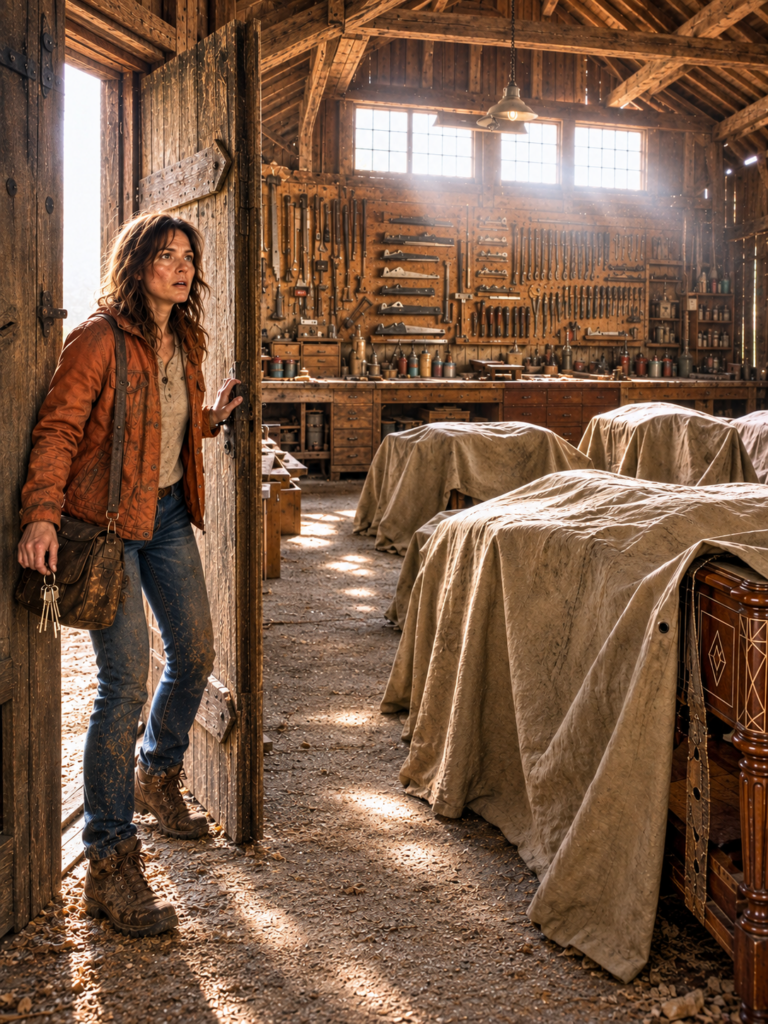
A huge workbench stretched along the back wall beneath rows of carefully arranged tools.
Hand planes. Chisels. Saws. Carving knives. Wooden mallets. Measuring gauges.
Every tool hung in its own place, with a pencil outline on the pegboard marking exactly where it belonged.
Glass jars contained screws sorted by size.
Shelves held finishing oils, wax, clamps, and neatly bundled lengths of cord.
Along one wall, stacks of carefully dried lumber rested on wooden supports.
And in the center of the barn stood six large objects hidden beneath heavy canvas covers.
Ara walked toward the nearest one.
She lifted the edge.
Underneath stood a writing desk made of dark walnut.
It was unfinished, but even she could recognize the craftsmanship.
The legs curved with quiet elegance. Thin strips of lighter wood formed a geometric inlay around the surface. Every joint fitted so precisely that the separate pieces seemed to flow into one another.
She moved her fingers over the smooth wood.
Then she uncovered another piece.
A chair, beautifully proportioned.
Another covering revealed part of an elaborate cabinet.
She looked around the barn again.
This was not an amateur’s collection of weekend projects.
Whoever had worked here possessed extraordinary skill.
But her father had fixed engines.
He had never mentioned making furniture.
Not once.
Ara carried the cardboard box to the workbench and opened it.
Inside, wrapped in yellowing tissue paper, was a small locked metal box and a thick envelope.
Her name was written on the envelope.
She sat on a wooden stool, carefully broke the seal, and unfolded several pages.
The letter began:
My dear Ara,
If you are reading this, something has happened that I hoped I could protect you from.
Maybe you have turned forty and have simply reached the day I chose for you. Or maybe life has hurt you badly enough that you need somewhere to land.
Either way, the barn is yours.
And I owe you the truth.
Ara swallowed.
Her father’s next words explained that before he had become a mechanic, he had been a furniture maker.
Not a hobbyist.
A professional craftsman.
He had designed and built expensive custom furniture for wealthy clients throughout Virginia.
He had owned a workshop and later entered a partnership with a man named Garrison Croft.
Croft came from money and knew people David could never have approached on his own.
David made the furniture.
Croft sold it.
For a time, their partnership had been extraordinarily successful.
Then Ara’s mother became seriously ill.
David had begun examining the business accounts, searching for money to help pay for treatment.
What he discovered was devastating.
Croft had been diverting payments, inventing commissions, and using accounts David knew nothing about.
The theft had continued for years.
Millions of dollars generated by David’s work had gone elsewhere.
When David confronted his partner, Croft dismissed him.
He claimed that he controlled the contracts, the clients, and the business. He insisted David was merely hired labor.
Then he threatened to ruin him if he sought legal help.
David had a sick wife, a young daughter, and no financial protection.
He walked away.
Ara lowered the letter.
Outside, the wind moved through the grass.
She looked toward the walnut desk.
Her father had built furniture worth fortunes.
And then he had spent the rest of his working life repairing other people’s cars.
She forced herself to continue reading.
I didn’t stop making things, sweetheart.
I couldn’t.
I bought this land when you were born. I built here in whatever hours I could find. Weekends. Evenings. Sometimes after a particularly hard day when working with wood was the only thing that made sense.
The pieces you see around you are mine. The tools are mine. The records are mine.
Now they belong to you.
You were never meant to carry the consequences of what happened to me. I wanted you to know me first as your father. The man who fixed your bicycle, made your breakfast, and came to your school plays.
That was the most important part of me.
But this is another part, and it deserves to be known.
There is more evidence here than you can see today. Take your time. Learn what you need to learn.
And remember something, Ara.
You have my hands. You always have.
I love you.
Dad.
Ara read the final paragraph twice.
Her hands trembled slightly when she folded the pages.
She remembered his hands.
The rough palms. The thick calluses at the base of his fingers. The permanent dark stains near his fingernails that soap never fully removed.
She had always assumed those marks came from engines.
Some of them must have come from wood.
She rose and uncovered the elaborate cabinet.
It was nearly finished.
Dark walnut panels enclosed a graceful frame. The doors were decorated with tiny carved leaves, each one so carefully shaped that it looked almost alive.
On the inside of the left door, small letters had been carved into the wood.
Ara.
Beneath her name was another inscription.
So she always has a place to keep what matters.
Her vision blurred.
For thirty-eight years, her father had been quietly preparing something for her.
Not because he expected to become rich again.
Not because he wanted revenge.
Because he wanted his daughter to have somewhere she could stand when the life around her collapsed.
He had built her a refuge without telling her.
And somehow, after all those years, she had arrived on the exact day she needed it.
That evening, Ara remained in the barn until the October light disappeared.
She examined the workbench, the tools, and the canvas-covered pieces.
She found drawers full of drawings, measurements, and old photographs, though she did not yet understand how they fitted together.
The small metal box remained locked.
She could find no key.
Eventually, rain began striking the roof.
The apartment in the city was waiting for her, but she had no desire to return.
Instead, she retrieved an old sleeping bag from the truck, reclined the driver’s seat as far as the damaged mechanism allowed, and spent the night outside the barn.
She lay awake listening to the rain.
For the first time, she pictured her father driving that same truck down the same dirt road.
She imagined him opening the workshop, switching on a lamp, and picking up his tools.
Here, nobody called him a mechanic.
Nobody reminded him of what he had lost.
Here, he was simply David Vance, making the beautiful things he had always been meant to make.
Ara cried quietly.
Not only for the father she had lost.
For the man she had never fully known.
In the morning, she woke with a stiff neck and found a deer standing in front of the truck.
It stared at her through the windshield.
“Good morning to you, too,” she muttered.
The deer turned and disappeared into the trees.
Ara climbed out, stretched her aching back, and looked toward the barn.
In daylight, the practical problems seemed enormous.
The southwest roof needed repair.
Two windows were cracked.
The small door did not seal properly.
The old building might be hiding structural damage she was not qualified to recognize.
And she had very little money left.
She could not afford to let the place deteriorate.
Not now.
So she locked the door and drove into Stafford.
A faded sign above a small storefront read:
Kowalski’s Stafford Hardware — Est. 1979
Inside, narrow aisles held lumber, tools, nails, paint, and supplies stacked in a way that seemed chaotic until she realized everything had a specific place.
Behind the counter stood a broad-shouldered man in his late sixties.
His white hair was slightly too long, and his expression suggested he had spent a lifetime listening to people describe problems they had caused themselves.
He looked up from a paper ledger.
“Help you?”
“I’ve got an old barn on Quarry Road,” Ara said. “Part of the roof is sagging, and I need to replace a couple of windows.”
The man studied her face.
Then he said something that nearly made her drop her car keys.
“David’s girl.”
Ara stared at him.
“I’m sorry?”
“You’re David Vance’s daughter.”
She nodded slowly.
“How did you know?”
“The eyes.”
He came around the counter.
“Stan Kowalski. I knew your father.”
Something tightened in her throat.
“You knew him?”
“For a long time.”
Stan glanced toward the supplies she was carrying.
“So you’re finally fixing up that barn.”
The word finally caught her attention.
“You knew about it?”
“I knew he bought lumber for it. Cherry, walnut, white oak. Expensive stuff. He’d call ahead, and I’d have his order waiting.”
“Did you know what he was building?”
“No. He never invited me inside.”
Stan paused.
“But I knew it wasn’t ordinary furniture.”
For the next half hour, he walked her through the store, showing her the supplies she would need and explaining how to assess the roof before attempting repairs.
He did not speak down to her.
He answered each question carefully, as though there were no shame in knowing nothing when you were willing to learn.
At the counter, while adding up her purchases, he suddenly stopped.
“Almost forgot.”
He reached beneath the counter and brought out a small padded envelope.
Her name was written across the front.
Ara recognized the handwriting.
Her father’s.
“He gave me this about seven years ago,” Stan said. “Told me to keep it safe until you came looking for the barn.”
She touched the envelope.
“He knew I’d come here?”
“He hoped you would.”
Inside was a small black USB drive and a folded note.
For when you’re ready to see the rest of it.
Ara looked at Stan.
“What is this?”
“Couldn’t tell you. Never opened it.”
She thanked him, loaded the supplies into the truck, and returned to the barn.
This time, she brought her old laptop.
She placed it on the workbench, connected the USB drive, and opened the only folder.
Hundreds of video files appeared.
They were organized by date.
The first was from 2009.
The last was from October 2018, less than a year before her father’s death.
She opened the earliest recording.
After a brief flicker, her father’s face filled the screen.
He was sitting on the same stool she occupied.
Behind him hung the same tools.
He wore the green flannel shirt she remembered from her childhood.
David looked into the camera with an expression of mild embarrassment.
Then he spoke.
“I don’t know if you’ll ever need these, Ara.”
He glanced toward the workbench.
“But I thought maybe one day you’d want to know how I did things.”
He stood, picked up a hand plane, and began working.
Ara watched.
For two hours, she barely moved.
Her father explained his choices as he worked, demonstrating how to select wood, read its grain, cut joints, and understand the behavior of different tools.
He was patient.
Precise.
Completely at ease.
In this little barn, he possessed a confidence she had rarely seen elsewhere.
Eventually, Ara opened the final video.
October 2018.
David appeared thinner.
His movements were slower.
But his voice was steady.
“Ara,” he began, looking directly at the camera.
“There’s something else I need to tell you.”
He paused.
“The Langford Museum in Richmond has six pieces of furniture in its permanent collection.”
Ara leaned closer.
“They’re listed under Garrison Croft’s name.”
Her father looked down at his hands.
Then back into the lens.
“I designed every one of those pieces. I built them myself.”
Ara stopped breathing for a moment.
“The original plans are here. The records are here. And there’s a sworn statement from the man who handled our books.”
David’s expression grew solemn.
“I decided not to fight Croft. That was my choice.”
He paused.
“But you don’t have to make the same choice.”
He looked directly into the camera.
“The world should know who made those things.”
The recording ended.
Ara sat motionless.
She looked toward the locked metal box on the workbench.
Then at the furniture hidden under the canvas sheets.
Her father had not merely left her a workshop.
He had left her the evidence of a theft that had remained hidden for more than thirty years.
And somewhere in Richmond, six pieces of his work stood in a museum under another man’s name.
Part 2
Ara watched the final recording three times.
Each time, she noticed something different.
The first time, she heard the accusation.
The second, she heard the exhaustion beneath her father’s carefully chosen words.
The third, she noticed how little anger he showed.
He did not curse Garrison Croft. He did not threaten him or demand revenge.
He simply explained what had happened, what he could prove, and why he had decided to leave the evidence behind.
Then, as if discussing a problem with an engine, he had returned to his work.
Ara closed the laptop.
For most of her life, she had believed her father was an ordinary man who had endured an extraordinary loss when her mother died.
Now she understood he had endured two.
He had lost his wife.
And before that, he had lost a business, a reputation, and an artistic future that should have belonged to him.
He had never told her because he wanted her childhood to be something other than a story about what had been stolen.
She understood that choice.
But she was no longer a child.
She found the sealed envelope beneath the packing material in the cardboard box Arthur had given her.
It contained an eight-page notarized affidavit dated 2003.
The signature at the bottom belonged to Thomas Aldridge, former bookkeeper for Vance and Croft Fine Furniture.
Ara read it slowly.
The document described years of fraudulent transactions.
Customer payments had been redirected.
Invoices had been altered.
Commissions supposedly owed to intermediaries had disappeared into accounts controlled by Croft.
Aldridge admitted that he had helped conceal some of those transactions.
Then came the section concerning the Langford Museum.
Six pieces.
Each listed with a detailed description, original sale information, and supporting invoices.
On copies of the original records, David Vance’s name had been crossed out as designer and maker.
Garrison Croft’s name had been written above it.
Ara pressed her thumb against the edge of the page.
She remembered Derek’s attorney referring to her father’s pickup as an asset of negligible value.
She remembered how confidently Derek had discussed the house as though she had never contributed anything to it.
And now she was staring at records showing that her father had experienced something far worse.
Another man had taken not only the money his work earned, but the credit for having made it.
At the bottom of the affidavit’s final page, David had written a short note.
He came to find me. I told him to keep living well. That’s the only revenge worth having.
Ara placed the paper on the workbench.
She was still looking at it when her phone rang.
The number was unfamiliar.
She answered.
“Miss Vance? My name is Reginald Foster. I represent the estate of Garrison Croft.”
Ara straightened.
Foster explained that Croft had died six weeks earlier.
While reviewing his business affairs, the estate’s representatives had discovered records concerning a former partnership with David Vance.
They wished to discuss a possible resolution.
“A resolution of what?” Ara asked.
“A historical business arrangement. There may be an opportunity for a modest acknowledgment of your father’s contributions.”
“An acknowledgment?”
“A gesture of goodwill. Something that might resolve outstanding concerns without formal proceedings.”
Ara looked at the affidavit.
At the crossed-out name.
At the six pieces her father had spent countless hours making.
“Thank you for contacting me,” she said. “My attorney will be in touch.”
She ended the call.
For several moments, she listened to the wind rattling the loose siding.
The Croft estate knew.
Perhaps not everything.
But enough to approach her before she had approached them.
She called Arthur Hayes.
He listened without interruption.
When she finished, he asked, “What documentation do you have?”
“More than I knew existed yesterday.”
“Then bring it to me.”
“Do you think we have a case?”
“I think we should examine the evidence before answering that.”
A pause.
“But their decision to contact you is certainly interesting.”
Ara looked at the desk beneath the work lamp.
“Mr. Hayes, I don’t want to fight for millions of dollars.”
“What do you want?”
She thought about her father standing at that workbench.
“I want people to know who made those things.”
Arthur answered quietly.
“Then that’s where we’ll begin.”
The next two weeks taught Ara that inheriting a workshop and keeping it standing were entirely different challenges.
The roof came first.
Stan visited and helped her examine the damaged section before they arranged the work needed to stop water from entering.
He showed her how moisture traveled along old timber and where to look for weakened wood.
He insisted that she understand the work rather than merely stand nearby watching someone else perform it.
When she approached a task too quickly, he would stop her.
“Look at what you’re doing.”
“I am looking.”
“Then look at why you’re doing it.”
She discovered that being willing to learn was not the same thing as being good at something.
Her hands blistered.
Her shoulders ached.
One afternoon, she spent nearly an hour fitting a replacement window component and had to start over because she had measured the opening incorrectly.
She sat on an overturned bucket afterward, staring at the useless piece of wood.
Stan examined it.
“Well, now you know that measurement matters.”
“I knew measurement mattered before.”
“Then you’ve learned it twice.”
She gave him an irritated look.
He almost smiled.
Little by little, the roof became secure.
The windows were repaired.
The door sealed properly.
She cleaned away weeds around the building and began organizing the supplies she would need through winter.
At night, she watched her father’s recordings.
Sometimes she took notes.
Sometimes she replayed the same section ten times, trying to understand the difference between a clean cut and a forced one.
She bought a cot, a folding table, and a small camp stove.
The apartment in the city remained hers, but she spent more and more nights at the barn.
It was inconvenient.
It was cold.
She had to plan every meal and watch every dollar.
Yet, for the first time in years, she could look around a space and know that her decisions mattered there.
Nobody corrected the way she arranged her tools.
Nobody complained about the smell of paint or varnish.
Nobody asked why she was spending so much time on something that would never impress anyone else.
The work belonged to her.
One evening, Stan arrived carrying sandwiches and a thermos of coffee.
Ara was examining the walnut desk when he entered.
He stopped several feet away.
For a long moment, he studied the piece without speaking.
Then he approached it, bent slightly, and examined the joinery.
“Your father made this?”
“Yes.”
Stan ran a hand across the smooth surface.
“Well, I’ll be.”
It was the strongest reaction Ara had ever heard from him.
They ate beside the workbench.
She told him about the partnership, the stolen money, and the museum pieces.
He listened carefully.
When she finished, he looked toward the tools.
“Your father was carrying something,” he said. “I always knew that.”
“Why didn’t you ask him?”
“He would have told me if he wanted me to know.”
Ara wrapped both hands around the warm coffee cup.
“He spent years hiding the best thing he could do.”
Stan considered that.
“Maybe he wanted you to know him as your dad first.”
She looked up.
Stan continued.
“The man who made your lunches. Fixed your bike. Showed up when you needed him. Maybe he figured that mattered more than anybody knowing he could build a fancy cabinet.”
Ara thought about it.
“He said almost exactly that in his letter.”
“Sounds like David.”
For a while, neither spoke.
Then she said, “I want to learn.”
Stan looked at her.
“Woodworking?”
“All of it. I want to understand what he did here.”
“I’m not half the craftsman your father was.”
“You’re better than I am.”
“That’s a low bar.”
She laughed unexpectedly.
It surprised them both.
Stan took another drink of coffee.
“All right,” he said. “We’ll start with the basics.”
Several days later, Ara found the key to the metal lockbox.
It was attached to the old ring of spare keys her father had kept in the truck.
She had tried the keys one by one, resisting the urge to force anything.
The fifth key fitted.
Inside were four leather-bound ledgers.
They were unlike any business records she had ever seen.
Each piece of furniture had its own entry.
Wood selection.
Design sketches.
Measurements.
Technical challenges.
Finishing methods.
Photographs.
Some pieces had names.
The Eleanor Desk, named for her mother.
The Stargazer’s Chair, built when Ara was twelve and obsessed with astronomy.
The Stafford Cabinet.
And the six works acquired by the Langford Museum.
Her father’s notes documented each piece from its original design to completion.
The records did not merely assert that he had made the furniture.
They showed how he had made it.
Every step.
Every measurement.
Every deliberate decision.
Beside the six museum entries, David had recorded that the pieces were sold by Croft without his authorization in November 1993.
Ara carefully photographed the pages.
She copied the video files to her computer and organized the material for Arthur.
Then she searched for Thomas Aldridge.
The former bookkeeper lived in Harrisonburg.
When she called, he answered cautiously.
She introduced herself.
The other end of the line became quiet.
“I know who you are,” he finally said.
She explained that she had found his affidavit.
“I wondered when someone would,” Aldridge replied.
“Are you willing to confirm what you wrote?”
Another long silence.
Then he asked, “What are you planning to do?”
“I want the museum to correct the attribution. I want my father’s name on the work he made.”
Aldridge exhaled.
“Your father forgave me.”
“I know.”
“I went to see him in 2003. Told him everything. I thought he’d throw me out.”
“What did he do?”
“He listened. Then he told me to keep living well.”
His voice grew rough.
“I’ve spent a long time wondering whether I deserved that.”
Ara looked toward her father’s workbench.
“I don’t think he said it because you deserved it. I think he said it because he meant it.”
Aldridge remained silent.
Then he said, “I’ll help you.”
She drove to Harrisonburg that Saturday.
His house was modest and carefully maintained, with a garden beside the front walk.
He made coffee, brought out the copies of records he still possessed, and answered every question.
He spoke about invoices he had altered and conversations he had overheard.
He described David’s work with the certainty of someone who had watched it firsthand.
With his permission, Ara recorded the conversation.
Before she left, Aldridge stood beside her truck.
“Your father was the best furniture maker I ever saw,” he said.
He looked down.
“And I helped another man pretend the work was his.”
Ara did not tell him it was all right.
It wasn’t.
Instead, she said, “You can help make the record correct now.”
He nodded.
“I intend to.”
Back in Stafford, Ara returned to her father’s tools.
She had begun practicing on an old Windsor chair Stan had brought her.
One spindle was cracked.
It seemed like a simple repair until she attempted it.
The first joint was poor.
The second was worse.
By the fifth attempt, she wanted to throw the wood across the barn.
But she remembered her father’s voice.
Don’t push. Listen.
She stopped trying to force the tool.
She watched the grain.
She adjusted the angle.
The next attempt was better.
Not perfect.
Better.
It was enough to make her try again.
On Thursday, she met Arthur Hayes with the evidence.
She carried the ledgers in a canvas bag and placed them on his desk beside the affidavit, photographs, drawings, and organized copies of the video recordings.
Arthur spent a long time reading.
His expression grew more serious with every document.
Finally, he took off his glasses.
“The evidence of authorship is substantial.”
Ara watched him closely.
“But?”
“But some financial claims may face serious legal obstacles because of the time that has passed. The estate will certainly raise them.”
“What about the museum?”
“That’s a different question. We can seek correction of the attribution records, and the estate’s acknowledgment would strengthen that effort considerably.”
She leaned forward.
“All six.”
Arthur looked at her.
“All six pieces?”
“Every one.”
“That will be a significant demand.”
“He made every one.”
“Yes.”
“Then his name belongs on every one.”
Arthur held her gaze.
“And what if they offer money instead?”
Ara looked at the photographs.
“I don’t want his work bought from me a second time.”
For the first time that afternoon, Arthur smiled.
It was small, but genuine.
“Then we’ll make sure they understand the distinction.”
Over the following weeks, they prepared the case.
Arthur handled the correspondence and negotiations.
Ara organized the records, identified matching details in the videos and drawings, and assembled the photographs in chronological order.
Aldridge agreed to confirm his statements.
The Croft estate retained its own lawyers.
Eventually, a meeting was arranged in Richmond.
Ara continued working at the barn while the legal process moved forward.
She helped repair shelving, practiced with the hand planes, and began studying the construction of the unfinished cabinet bearing her name.
She learned that the best joints were often the ones nobody could see.
The interior of a beautiful piece mattered as much as its polished exterior.
That reminded her of her father.
He had always cared about things other people never noticed.
On the morning of the meeting, Ara loaded the ledgers into the truck.
Her father’s reading glasses still lay folded in the center console.
She touched them before turning the key.
“Wish you were here, Dad,” she whispered.
Then she drove to Richmond.
The estate’s attorneys had reserved a conference room on the fourteenth floor of an office building.
Arthur sat beside her.
Across the table sat three attorneys representing Croft’s estate.
Their lead counsel, a silver-haired man named Whitmore, greeted her politely.
He spoke about respecting David Vance’s contribution to the history of American craft furniture.
He spoke about the complexities of historical records and the importance of finding common ground.
Ara listened.
Then she said, “All six pieces.”
Whitmore paused.
“Our proposal acknowledges Mr. Vance’s contributions to three of the six works. We would arrange for an archival notation and a financial settlement.”
Ara shook her head.
“No.”
Whitmore glanced at Arthur.
Ara continued.
“My father designed and built all six. I have the plans, the photographs, the videos, the original records, and a witness who was there.”
“We recognize the strength of certain aspects of your documentation,” Whitmore replied.
“Then you can recognize all of it.”
He folded his hands.
“Miss Vance, museum attribution is not always as straightforward as you might imagine.”
Ara looked toward the canvas bag resting beside her chair.
She had carried those ledgers through weeks of dust, rain, exhaustion, and uncertainty.
She knew what they contained.
And she knew what she wanted.
“My father didn’t spend years making those pieces so someone could bury his name in an archive,” she said.
“I want it on the labels where visitors can see it.”
Whitmore began to answer.
But Ara had not finished.
“All six pieces. Full public credit. And a written acknowledgment from the estate that David Vance was their designer and maker.”
She paused.
“You can keep the settlement money.”
That stopped him.
For the first time, the estate’s attorneys appeared uncertain how to respond.
They had prepared to negotiate a financial claim.
But Ara wasn’t asking them to pay for her father’s silence.
She was asking them to tell the truth.
Part 3
Whitmore looked at Ara for a long moment.
“No financial payment?” he asked.
“No payment.”
“You’re declining the estate’s proposed compensation?”
“I’m telling you what I came here for.”
Ara rested her hands on the table.
“My father spent thirty years living with the consequences of what Garrison Croft did. He worked as a mechanic. He raised me. He kept making furniture in a barn nobody knew about.”
Her voice remained steady.
“He died without ever seeing his name on the work he created. I can’t change that. But I can change what people see when they walk into that museum.”
Whitmore’s expression tightened.
“The Croft Collection represents considerable value to the estate.”
“I understand.”
“Changing its attribution could affect that value.”
Ara nodded.
“Then it should have had the correct name from the beginning.”
Whitmore looked toward his associates.
A brief, silent exchange passed between them.
Then he closed his folder.
“We’ll need a recess.”
Ara and Arthur stepped into the hallway.
At the far end was a window overlooking Richmond.
She stood in front of it, staring at the streets below.
Her hands had begun shaking.
She tucked them into her coat pockets.
Arthur joined her.
“You handled that well.”
“I’m terrified.”
“I know.”
“What if they refuse?”
“Then we consider the next step.”
She turned toward him.
“Did I make a mistake taking the money off the table?”
Arthur considered the question.
“No. I think you made it clear that they can’t resolve this by writing a check.”
Ara looked down at the city.
Somewhere below, behind museum walls, stood six pieces of furniture her father had made with his own hands.
She imagined him measuring and cutting each board.
She imagined the hours spent fitting joints so precisely they could last for generations.
Then she imagined Garrison Croft signing his own name to the paperwork.
Her father had spent the rest of his life refusing to let that man determine who he became.
Now she understood why David had kept building.
He had never allowed Croft to take his ability to make beautiful things.
That had remained his.
Twenty-three minutes later, Whitmore invited them back inside.
“The estate is prepared to consider full attribution on all six works,” he said.
Ara waited.
“Subject to agreement on the precise language.”
Arthur opened his folder.
They had already prepared for that.
The next two hours were spent examining individual words.
The estate wanted to recognize David’s contribution.
Ara insisted on sole authorship.
The estate suggested placing the correction in supplementary museum documentation.
Ara insisted on the primary display labels.
Whitmore proposed language identifying the works as products of the Croft and Vance partnership.
Ara looked at the original designs and invoices.
“No,” she said. “The business was a partnership. The designs and craftsmanship were my father’s.”
Arthur supported the distinction with the documentation.
The negotiations continued.
By late afternoon, they had reached an agreement in principle.
The estate would formally acknowledge David Vance as the sole designer and maker of all six Langford Museum pieces.
The museum’s primary attribution records and public labels would be corrected through the agreed process.
The acknowledgment would be preserved in the estate’s permanent legal documentation.
Ara would not receive a settlement payment.
When Whitmore finally accepted the terms, she did not smile.
She simply nodded.
“Thank you.”
Afterward, she and Arthur rode down in the elevator.
For several floors, neither spoke.
Then Arthur said, “Your father prepared those records carefully.”
“He prepared everything carefully.”
“He gave you a very strong foundation.”
Ara looked at the canvas bag beside her feet.
“Yes,” she said. “He did.”
She drove back to Stafford as the sun was going down.
The barn appeared through the trees, its gray siding briefly turned golden by the last light.
She parked and sat for a moment with the engine off.
Then she carried the ledgers inside.
The workshop smelled of wood, oil, and the familiar faint dampness of an old building in autumn.
She placed the bag on the workbench.
The tools hung in their rows.
The furniture stood beneath its canvas covers.
The cabinet bearing her name waited in the center of the barn.
Everything looked exactly as it had that morning.
But something had changed.
Ara sat on her father’s stool.
And cried.
She cried for the man who had spent thirty years making beautiful things in secret.
For the mother she remembered only in photographs.
For the fourteen years she had devoted to a marriage that had slowly taught her to doubt her own worth.
For the frightened woman who had walked into this barn with a rusty key and believed she had almost nothing left.
She remained there until the tears stopped.
Then she washed her face, switched on the work lamp, and returned to the Windsor chair she had been repairing.
There was still work to do.
The agreement took six weeks to finalize.
Arthur reviewed the language, the estate approved the necessary documents, and the museum began preparing its records for correction.
On a Wednesday in late November, Ara signed the final papers.
The entire process took eleven minutes.
She almost laughed at the strange symmetry.
Her divorce had taken eleven minutes to finalize.
So had this.
One set of signatures had ended the life she thought she wanted.
The other had restored a piece of her father’s.
That afternoon, she returned to Stafford.
The barn was cold.
She switched on the heater, rubbed her hands together, and stood beside the unfinished cabinet.
She had been learning its construction for weeks.
David had completed almost everything except one side panel, the upper cornice fitting, and the final finishing work.
The remaining panel required cuts more precise than she could reliably make.
She knew that now.
A month earlier, she might have attempted it anyway, desperate to prove she was capable.
Instead, she asked Stan to help.
“I don’t want you to do the whole thing,” she explained. “I want to understand how to do it.”
Stan arrived Saturday morning carrying his wooden toolbox.
He spent nearly twenty minutes inspecting the cabinet.
He examined the frame, the hand-cut joints, and the small angled shoulders David had shaped to accommodate the way wood expands and contracts.
“Look here,” Stan said, pointing to the upper corner.
Ara leaned closer.
“See that angle?”
She nodded.
“Most people wouldn’t bother with that. Your father understood what would happen to this joint twenty years after he made it.”
He stepped back.
“That’s the difference between putting something together and building something to last.”
They worked through the morning.
Stan handled the most delicate cuts.
Ara prepared the pieces, tested the fit, helped seat the joints, and applied the glue.
Whenever she could perform a step herself, Stan moved aside.
Whenever she needed help, he showed her.
By noon, the panel was fitted and clamped.
They ate sandwiches beside the workbench.
For a while, they simply looked at the cabinet.
“Two more sessions,” Stan said.
“Maybe three?”
“Maybe.”
“And I can do the finish?”
“You can do the finish.”
Ara smiled.
She had already studied the instructions in her father’s ledger.
Danish oil.
Amber.
Thin coats applied carefully.
She wanted to finish it exactly as he had intended.
Later that evening, her phone rang.
Derek.
She stared at his name.
She had not spoken to him since the divorce.
For a moment, she considered ignoring the call.
Then she answered.
“Hello?”
“Ara.”
His voice sounded strange in the barn.
Familiar, but belonging to another life.
“I saw the news,” he said. “About the museum. Your father.”
She waited.
“I didn’t know about any of that.”
“Neither did I.”
Another pause.
“I wanted to say I’m sorry.”
Ara looked at the cabinet.
“For what?”
Derek exhaled.
“The truck. The things I said about your father. About what mattered to you.”
He hesitated.
“About a lot of things.”
She had imagined this conversation during the divorce.
Sometimes she had wanted him to apologize.
Sometimes she had wanted him to understand exactly how badly he had hurt her.
Now that the apology had arrived, she discovered she did not need to argue about it.
“Thank you for saying that,” she replied.
“You sound different.”
Ara looked at her workbench.
At the tools she could now identify.
At the faint calluses beginning to form beneath her fingers.
“I am different.”
Derek seemed to be waiting for more.
But she had nothing else to give him.
“Take care, Derek.”
She ended the call.
Then she returned to the cabinet.
There was a small section of walnut she needed to sand before dinner.
And for the first time in fourteen years, another person’s opinion of how she spent her evening did not matter.
In December, a woman named Carol Weston arrived from the Langford Museum.
Carol was a curator specializing in American craft and decorative arts.
She had reviewed the settlement documents, photographs, and ledgers.
But she had never seen David’s workshop.
When Ara opened the barn door, Carol stepped inside and stopped.
For several moments, she said nothing.
Then she began walking slowly around the room.
She examined the covered furniture, the workbench, and the drawings.
With Ara’s permission, she uncovered the pieces one by one.
She studied the desk.
The chair.
The cabinet.
The extraordinary attention David had devoted to details most owners would never see.
Finally, Carol turned toward Ara.
“Your father was an exceptional craftsman.”
Ara nodded.
“I know.”
“We had independent specialists examine the museum pieces after the estate documentation arrived,” Carol continued. “They compared construction methods, joinery, tool marks, and finishes with the records from this workshop.”
“And?”
“The findings support his authorship.”
Carol looked toward the furniture.
“We should have questioned the original attribution more carefully.”
“You didn’t have this evidence.”
“No,” Carol admitted. “But we should have asked better questions.”
She paused.
“The six labels are being updated. David Vance will receive primary attribution as the maker.”
Ara looked down at her hands.
She had spent weeks thinking about this moment.
Imagining what she would feel when someone finally said those words.
Instead of triumph, she felt an unexpected peace.
“Thank you,” she said.
Carol approached the cabinet.
“There’s something else I’d like to discuss.”
Ara waited.
“These pieces deserve to be seen. Not merely as evidence of the attribution dispute, but as art.”
She gestured toward the room.
“I’d like to explore an exhibition of your father’s work. His designs, his methods, his story. Everything.”
Ara looked around the barn.
An exhibition.
Her father’s furniture displayed in a museum.
His name beside the objects.
The whole story told openly.
“I’ll think about it,” she said.
Carol smiled.
“Of course.”
But Ara already knew the answer.
She simply needed time to sit with what it meant.
Over the next weeks, she and Carol began discussing the possibility seriously.
The exhibition would not hide the partnership or the fraud.
It would explain how a gifted craftsman had created extraordinary work, watched another man receive the credit, and continued making beautiful things anyway.
Carol wanted visitors to think about how often skilled people remained invisible behind the names of those who sold or promoted their work.
Ara agreed.
Her father’s story was not only about injustice.
It was also about what a person could preserve when so much else had been taken away.
On December 19, Ara completed the cabinet.
She had spent days preparing the surface.
Now she applied the final thin coat of amber Danish oil.
The walnut deepened from a muted brown to a rich color that seemed almost copper in the morning light.
She worked carefully over the doors, panels, carved leaves, and interior shelves.
She followed her father’s notes.
She used the techniques demonstrated in his recordings.
When the last coat was finished, she set down the cloth and stepped back.
The cabinet stood complete.
It was exactly as David had designed it.
Except that his daughter had finished it.
Ara opened the left door.
Her name was still there.
Small.
Careful.
Permanent.
She touched the carved letters.
“I did it, Dad,” she whispered.
Then she closed the door.
There was no audience.
No applause.
No expensive client waiting to admire the work.
Just a woman standing in an old barn, looking at something beautiful that had been completed through the hands of two generations.
And that was enough.
Three days later, Stan arrived.
He stopped when he saw the cabinet.
Set down his toolbox.
Walked closer.
He opened the doors, examined the finish, and ran his fingertips across the walnut.
After a long moment, he nodded.
“That’s a piece.”
Ara smiled.
From Stan, it was an extraordinary compliment.
“You did all three coats?”
“Every one.”
He studied the surface again.
“Your father would be pleased.”
She looked away quickly.
“Thank you.”
Then she led him toward the workbench.
“I want to show you something else.”
Standing on the bench was a small maple side table.
Simple, straight-legged, with a single drawer.
It was the first piece Ara had designed and built herself.
Not a repair.
Not a reproduction.
Something entirely her own.
She had chosen maple because she liked its lighter color.
She had drawn the design herself.
And she had spent an absurd number of hours attempting one hand-cut dovetail joint.
Stan pulled open the drawer.
Examined the corner.
Then looked at her.
“That’s a good joint.”
“Eleventh try,” Ara said.
“What?”
“The dovetail. It took me eleven attempts.”
Stan looked at the drawer again.
Then smiled faintly.
“You know what your father would have said?”
Ara shook her head.
“He’d say the first ten were the lesson.”
She laughed.
Stan rested his hand on the little table.
“He used to tell me you don’t count the times you get something wrong. You keep going until the wrong ones teach you what right feels like.”
Ara looked at the dovetail.
For the first time, she understood exactly what he meant.
The first ten attempts had not been wasted.
They had taught her how to make the eleventh.
Before Stan arrived, she had written something on the underside of the tabletop.
Ara Vance — December 2025.
And below it:
For my father, who knew I had his hands before I did.
She did not show Stan the inscription.
Some things were meant to remain private.
In the first week of January, a local woodworker named Peter Greer finished a sign Ara had commissioned.
She had selected a plank of white oak herself.
The design was simple.
No elaborate decoration.
Just deeply routed letters:
VANCE WOODWORKS
Established by David Vance
Continued by his daughter
Peter had added a tiny carved leaf in each corner.
Ara stared at the detail when she first saw it.
The little leaves reminded her of the carvings on her father’s cabinet.
She had never mentioned those carvings to Peter.
He shrugged when she asked why he had added them.
“Seemed like the right thing for a woodworker’s sign.”
Ara smiled.
“Yes,” she said. “It does.”
Stan helped her mount the sign above the barn door.
They checked the level twice.
Then stepped back into the cold January morning.
The weathered building looked almost the same as it had on the day she arrived.
The siding was still old.
The road was still rough.
The woods still surrounded the clearing.
But the roof no longer leaked.
The windows were secure.
Light glowed from inside.
And above the door stood her father’s name.
Not hidden in a ledger.
Not crossed out on an invoice.
Not buried in a museum archive.
Visible.
Exactly where it belonged.
Stan looked at the sign.
“Good work.”
Ara glanced toward him.
“Good teacher.”
He grunted.
But she saw him smile.
Later, alone in the workshop, she carried her little maple table to a place just inside the door.
Morning sunlight fell across that corner through the east window.
She set the table down.
It looked modest beside her father’s magnificent furniture.
She knew it was not nearly as sophisticated.
But it was hers.
Every cut.
Every mistake.
Every lesson.
She found a small index card and slipped it into a clear protective sleeve.
Then she placed it beneath the table.
Like a museum label.
It read:
THE SECOND CHANCE
Maple
Ara Vance, 2025
First completed piece
She stood back.
For a long time, she simply looked at it.
A year earlier, she would never have imagined owning a workshop.
She would not have imagined learning to cut dovetails, reading woodworking ledgers, negotiating with attorneys, or helping restore her father’s name to a museum collection.
She would not have imagined sleeping in an old pickup outside a leaking barn because that was the only place she wanted to be.
And she certainly would not have imagined that the hands Derek liked carefully manicured would eventually be covered in calluses.
But here she was.
She examined her palms.
The skin beneath her fingers had grown tougher.
A callus had formed near her right thumb where the hand plane rested.
There was a small scar on her left index finger from a chisel that had slipped during her first month of practice.
Her father had been right.
She had his hands.
Not because she had inherited some miraculous ability.
But because he had given her the chance to discover what patience, repetition, and honest work could make of them.
That afternoon, Ara tidied the workshop.
She returned each tool to its outlined place on the pegboard.
She covered the finished furniture.
She checked the heater and locked the storage cabinets.
Then she stood beside the workbench and read one of her father’s notes again.
Don’t push. Listen.
She understood those words differently now.
They applied to wood and tools.
But they also applied to the choices people made.
Her father had not spent his life trying to force the world to give back everything Croft had taken.
He had built something else.
He had raised his daughter.
He had made beautiful furniture.
He had preserved the proof of his work.
And when he could no longer protect her himself, he had left her a place to begin again.
Ara switched off the work lamp.
For a moment, she stood in the soft winter light coming through the windows.
The cabinet gleamed against the far wall.
Her little maple table stood beside the door.
The tools were ready for tomorrow.
She put on her coat and stepped outside.
The January air was cold and bright.
Above her, the sky stretched blue over the bare trees.
She locked the barn and walked to the old green Ford.
The engine started on the second turn.
Inside, the familiar smell of motor oil and the faded cedar air freshener greeted her.
Her father’s reading glasses still rested in the center console.
Ara picked them up.
She held them carefully, remembering the way he used to slide them down his nose while examining a repair manual.
Then she folded them and placed them back.
She looked toward the barn.
For fourteen years, she had believed a home was something she had to earn by keeping someone else satisfied.
She had worked, compromised, apologized, and slowly surrendered pieces of herself until she barely recognized the person she had become.
Then the marriage ended.
Derek kept the house.
He kept the accounts.
He kept the furniture.
And she walked away with a cardboard box.
At the time, she thought he had taken everything.
But he had never known about the five acres in Stafford County.
He had never known about the barn.
And he had certainly never understood what her father had hidden inside it.
There had been no gold buried beneath the floor.
No fortune stacked in secret compartments.
No miraculous check large enough to erase fourteen years of pain.
What David Vance had left was something that money could not purchase.
He had left the work of his hands.
The truth of his life.
The proof of his name.
And a place where his daughter could discover a future that belonged entirely to her.
Ara backed the truck slowly toward the dirt road.
In the rearview mirror, she could see the barn and the new oak sign above its doors.
Vance Woodworks.
Her father’s name.
Her future.
She smiled.
There was more to learn.
More furniture to make.
A museum exhibition to prepare.
And a lifetime of mistakes she had not yet made.
For the first time, none of that frightened her.
She turned onto the road and drove toward town.
Tomorrow, she would come back to the workshop.
Tomorrow, she would pick up her tools.
And she would keep building.

