
Part 1
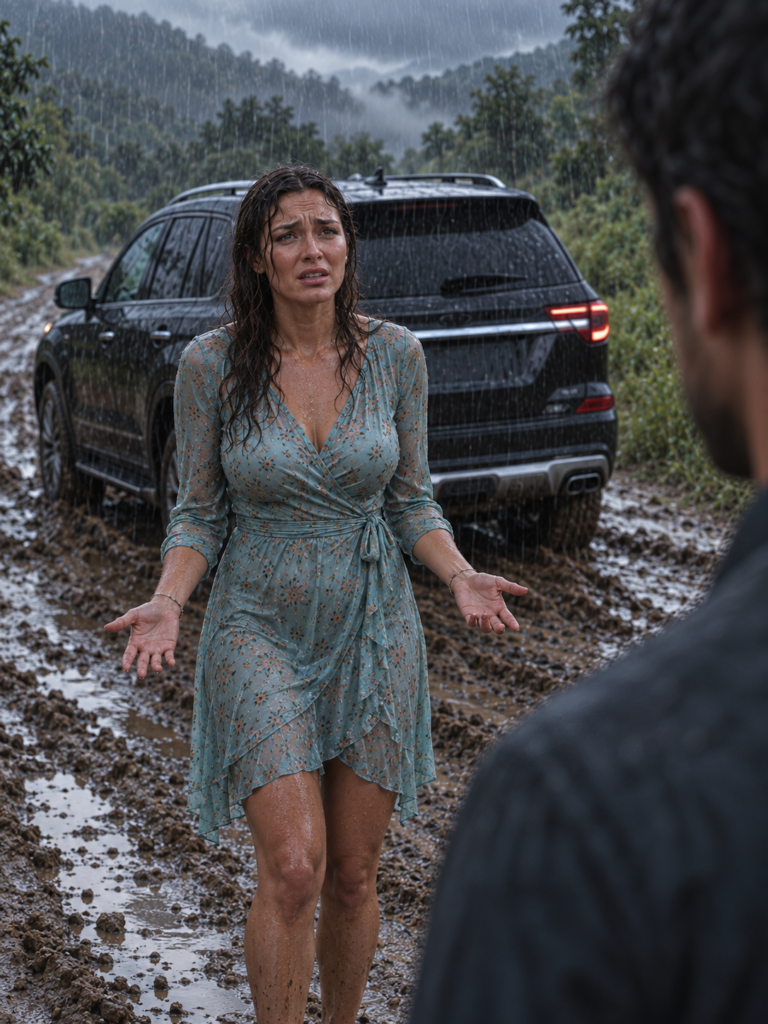
I was halfway back to my farm when I saw the SUV in the ditch.
August rain came down hard enough to flatten the weeds along the road and turn northern Georgia clay into something halfway between mud and glue. The SUV was expensive—too expensive for that road—and sitting at an angle that suggested whoever had been driving it had trusted a navigation app more than common sense.
I slowed.
Feed was getting wet under the tarp in my truck bed. I had two gates that needed attention before dark. The sensible thing was to keep driving.
Then the woman beside the SUV turned toward my headlights.
Even through the rain, I could see the fear on her face.
Not screaming fear. Worse. The controlled kind. The kind where a person is trying so hard to stay reasonable that you know panic is waiting one inch underneath.
I pulled over.
She held her phone above her head as I approached.
“Do you have service?”
“Depends,” I said. “You trying to reach a cell tower or divine intervention?”
She stared at me for half a second.
“At this point, whichever answers first.”
That earned her my attention.
She was probably in her early thirties. Good clothes, ruined shoes, rain-dark hair, and the posture of somebody accustomed to walking into rooms expecting to be taken seriously.
The rain had stripped away most of the polish.
“You hurt?”
“No. Just stranded, humiliated, and slowly becoming part of Georgia.”
“That last one takes a while.”
A shaky laugh escaped her.
“I’m Victoria.”
“Caleb.”
“Caleb, please tell me you know how to get a vehicle out of mud.”
“I’ve pulled tractors out of worse.”
“This isn’t a tractor.”
“No. A tractor would’ve known better.”
That laugh was steadier.
I walked around the SUV, checked the tires and the slope, then headed back toward my truck for the tow strap.
“The navigation said this was a shortcut,” she called.
“It lied.”
“I’ve figured that out.”
“How long you been here?”
“Almost an hour.”
“And nobody came by?”
She looked at me.
“Somebody did.”
Something about the way she said it made me uncomfortable in a way mud and rain didn’t.
For two years, I had worked hard to make my life simple.
Farm. Bills. Cattle. Repairs.
No complicated relationships. No promises that could be withdrawn later. No women who looked at my life long enough to decide it wasn’t big enough.
My ex-wife had cured me of that.
So I hooked the tow strap to Victoria’s SUV and concentrated on machinery.
“Get inside,” I told her. “Put it in neutral when I signal.”
“And if the SUV rolls?”
“It won’t.”
“You sound very confident.”
“I’m lying a little so you don’t panic.”
She narrowed her eyes.
“Oddly, that helps.”
I climbed into my pickup and eased forward.
The strap tightened.
My back tires spun once before catching. Red mud flew. The SUV resisted, then moved an inch. Another inch. Finally the front tires climbed free.
Victoria hit the brake harder than necessary.
When I climbed out, she was already opening her door.
“You did it.”
“Physics helped.”
“I’m serious. I had no idea what I was going to do.”
“Probably threaten your phone until it apologized.”
She laughed—and then hugged me.
A real hug.
Not the quick social kind people gave each other because manners required it. Both arms around me, rain soaking through my shirt, relief loosening something in her all at once.
It lasted only a few seconds.
Still long enough for me to notice.
She stepped back quickly.
“I’m sorry.”
“You are very wet.”
“That too.”
“I’ve survived worse thank-yous.”
She studied my face, then reached toward her purse.
“Let me pay you.”
“No.”
“Caleb.”
“Victoria.”
“I’m serious.”
“So am I. You were stuck. I had a truck.”
“That’s it?”
“That’s it.”
Her expression changed.
I couldn’t name it then.
Later, I understood.
She was surprised.
Not that I had helped her.
That I didn’t want anything afterward.
She thanked me again and climbed into the SUV. Before leaving, she rolled down the window.
“You live around here?”
“Farm up the road.”
She nodded as if this confirmed something.
“Of course.”
“What’s that supposed to mean?”
“You look like a man who owns fence posts.”
I stared at her.
“That might be the strangest insult I’ve heard this month.”
“It wasn’t an insult.”
“Then I’ll treasure it.”
She drove away carefully.
I stood in the rain watching her taillights longer than I had any reason to.
That evening, after feeding the animals and changing clothes, I kept thinking about the hug.
Not because I thought it meant something romantic.
It didn’t.
But I couldn’t remember the last time somebody had touched me with nothing complicated behind it.
My ex-wife had once been affectionate. Toward the end, I realized most of that affection only happened when other people were around.
Victoria’s hug had been messy and impulsive and real.
I didn’t know her last name.
I didn’t have her number.
That should have been the end of the story.
The next evening, I was fixing a gate latch when tires crunched over gravel.
I looked up.
The same SUV pulled into my yard.
Clean this time.
Victoria climbed out carrying grocery bags and wearing boots that looked as if they had been purchased that morning.
I leaned against the fence.
“Tell me you didn’t get stuck in my driveway.”
“I came prepared.”
She lifted the bags.
“For mud?”
“For dinner.”
I straightened.
“I’m sorry?”
“I’m cooking for you.”
“That is an unusually confident sentence to say to a man standing on his own property.”
“You wouldn’t take money.”
“That doesn’t mean I accept payment in casseroles.”
“It isn’t a casserole.”
“You sure?”
She glanced into the bag.
“Mostly.”
I laughed despite myself.
She explained that she wanted to thank me properly. Then, after a hesitation, she admitted she also wanted to see the farm.
“Why?”
Her gaze traveled over the barn, the pasture, the weathered house.
“Yesterday I spent nearly an hour feeling completely useless. Then you showed up, solved the problem, refused money, and acted like none of it mattered.”
“It didn’t.”
“To you.”
The bags were pulling at her fingers, so I took one.
“I have another half hour of work.”
“Fine. I’ll cook.”
“You know where my kitchen is?”
“I understand the basic concept of a house.”
“Mine was designed by somebody who distrusted hallways.”
She followed me inside.
I showed her around, then watched her open three wrong cabinets before locating a pan.
“Need help?”
“No.”
“You sure?”
She considered it.
“No.”
“That sounds more accurate.”
She pointed toward the door.
“Go fix your gate.”
“Yes, ma’am.”
“And don’t come back every five minutes to check on me.”
“I wasn’t planning to.”
“You absolutely were.”
Outside, I discovered I was working slower.
I liked hearing her move around inside.
Cabinet doors. Running water. Something dropped once, followed by silence.
Then the back door opened.
“Caleb?”
“Yeah?”
“Where’s the salt?”
“Cabinet beside the stove.”
“There are three cabinets beside the stove.”
“The one containing salt.”
“That answer was technically correct and completely useless.”
The door shut.
I smiled all the way through tightening the gate hinge.
When I came inside, dinner looked suspiciously impressive.
Chicken. Vegetables. Bread. A sauce I couldn’t identify but was certain had never before existed within ten miles of my stove.
Victoria stood beside the table, watching me carefully.
“You made this?”
“I did.”
Her chin rose just a fraction too quickly.
I noticed.
But I sat down.
“If I die, tell the sheriff I accepted the risk knowingly.”
“Eat.”
“Yes, ma’am.”
The food was excellent.
She watched my first bite with the concentration of someone waiting for a quarterly report.
“Well?”
“It’s good.”
“Good?”
“Very good.”
“You hesitated.”
“I was chewing.”
“You were deciding how nice to be.”
“I’m a farmer. Nobody trained me in advanced politeness.”
After that, she relaxed.
She asked about the farm, and I told her the truth: cattle, hay prices, equipment that broke immediately after warranties expired, and weather that seemed personally offended by financial planning.
She listened.
Not politely.
Actually listened.
Eventually I asked what she did.
Her fork stopped.
“I run a company.”
“That sounds intentionally vague.”
“It’s large.”
“How large?”
“Large enough that people behave differently after they hear the name.”
“Do I need to start behaving differently?”
“No.”
She said it so quickly I looked at her.
“Please don’t.”
So she told me.
Her family controlled a regional business empire—agricultural processing, shipping, property, investments. Her father had built most of it. Victoria had become CEO at thirty.
People praised her publicly and questioned her privately.
Men twice her age called her brilliant while waiting for her to fail.
I leaned back.
“So yesterday I made fun of a CEO for losing an argument with a dirt road.”
“Yes.”
“And today I left that CEO alone in my kitchen.”
“You survived both decisions.”
“So far.”
A small smile appeared.
“Most people calculate when they find out.”
“Calculate what?”
“What I can do for them. Who I know. Which room I can get them into.”
“That sounds exhausting.”
“It is.”
“I don’t need you opening doors for me. Mine sticks, but I can fix it.”
She looked at me.
Long enough that I almost reached for a joke.
Then she said quietly, “That’s why I came back.”
For once, I didn’t joke.
When she left, she paused beside her SUV.
“I had a good time.”
“Me too.”
“Would it be strange if I came back?”
“Yes.”
Her face changed.
I waited half a second.
“Not bad strange.”
The smile returned slowly.
“Good night, Caleb.”
“Good night, Victoria.”
After she drove away, I cleaned the kitchen.
The trash was full. I carried the bag outside, opened the bin—
and found three restaurant containers hidden underneath paper towels.
I stared.
Then I laughed.
Victoria hadn’t cooked.
She had bought dinner somewhere expensive, transferred it to my plates, scattered groceries around the kitchen as evidence, and prayed I wouldn’t notice.
I should have been irritated.
Instead, something about it got to me.
A woman who commanded a corporation had been nervous enough about impressing me to fake a home-cooked meal.
I knew what it felt like to think what you naturally offered wasn’t enough.
Apparently money didn’t cure that fear.
The next day, I didn’t mention the containers when she came back.
Instead, I handed her an old pair of work gloves.
“You wanted to see farm life.”
She studied them.
“What am I doing?”
“Moving feed.”
“I can do that.”
“Ever been near a cow intentionally?”
“I’ve attended executive meetings.”
“That wasn’t my question.”
“It should count.”
It didn’t.
She spilled feed, nearly lost a bucket, apologized to a chicken, then accused me of failing to disclose that chickens were judgmental.
“That hen dislikes everyone.”
“She lives in a shed.”
“She owns it emotionally.”
Victoria laughed.
And before I knew enough to stop it, I began looking forward to that sound.
Part 2
Her visits became routine before either of us called them that.
Some evenings she arrived directly from work, still dressed for a boardroom except for the boots waiting in the back of her SUV.
She learned how to move around cattle without getting shoved, how to close a gate behind herself automatically, and how to carry feed without wearing it.
Milking a cow nearly broke her.
She sat beside me with the concentration of somebody defusing explosives.
“This is more stressful than presenting to shareholders.”
“The cow cares about cold hands.”
Victoria looked solemnly at the animal.
“I apologize for anything I’m about to do wrong.”
I laughed.
“You’re laughing.”
“No.”
“I can hear you trying not to.”
“You’re negotiating with livestock.”
“I respect stakeholders.”
“She has no stake.”
“She has hay. Close enough.”
I reached over to adjust her grip.
Her shoulder brushed mine.
We both stopped.
Not dramatically.
Just enough.
She turned her head, and suddenly her face was much closer than I expected.
Her humor disappeared first.
Mine followed.
For several seconds, neither of us moved.
Then Victoria looked back at the cow.
“I should probably concentrate.”
“Probably.”
I moved away.
Not because I didn’t want to stay.
Because I did.
That was the problem.
I had spent two years arranging my life so nobody could become necessary.
Victoria was becoming expected.
I started making coffee around the time she usually arrived. I swept the porch when it didn’t need sweeping. When I heard tires coming down the gravel drive, I pretended I hadn’t been listening.
One evening she climbed out and found me holding two mugs.
“Were you waiting for me?”
“No.”
“You’re holding two coffees.”
“I get thirsty.”
“For two people?”
“It’s a serious condition.”
She took one, her fingers brushing mine.
“Of course.”
The attraction between us stopped being theoretical.
We still ignored it.
Naming it would require deciding what to do about it.
And the differences between us weren’t small.
Victoria commanded rooms full of executives.
I had land, livestock, debt, and an old house whose back door jammed every time the humidity rose.
My marriage had ended because that life had eventually become too small for someone else.
My ex-wife hadn’t screamed when she left.
She had explained.
That was worse.
She wanted more. More money. More movement. More evidence that life was going somewhere.
Somewhere other than the same farm, the same town, the same work boots beside the door.
She told me she had confused endurance with ambition.
Afterward, I kept the farm partly because I loved it and partly because nobody else wanted the debt attached to it.
Then Victoria started sitting on my porch after chores, drinking coffee while her phone vibrated endlessly beside her.
At first she ignored work around me.
Then one evening she answered.
I was rinsing mud from a shovel.
Her voice changed immediately.
“No. That offer expires tonight.”
I looked over.
Her shoulders had straightened. Her expression was calm.
The man on the other end spoke loudly enough that I caught pieces.
Victoria cut through him.
“I read the report. If they want our distribution network, they meet the terms in full. I’m not approving seventy percent. I’m not approving eighty.”
A pause.
“Then let them explain the delay to their board.”
Another pause.
“Put Martin on.”
I stopped washing the shovel.
The woman beside me wasn’t the one who apologized to chickens.
This Victoria could move money, jobs and contracts with a few sentences.
“Martin,” she said. “Either the problem is fixed before nine or I want your resignation. I don’t need another explanation. I need the problem solved.”
She ended the call.
For a moment, neither of us spoke.
Then I said, “So the cow really is your relaxing hobby.”
She looked at me tiredly.
“You heard all that?”
“I think neighboring counties heard it.”
“I’m sorry.”
“For what?”
She gestured toward the phone.
“That version of me.”
“That version bought the SUV.”
Her smile faded.
I went back to the shovel.
The thought had already arrived, and because I was afraid of it, I said it aloud.
“It reminds me you don’t belong here.”
Silence.
“What does that mean?”
I should have corrected myself.
Instead, I kept going.
“It means you spend your days making decisions involving more money than this place might see in generations. Then you come here and act like carrying feed and drinking bad coffee is enough.”
“It is enough.”
“For an evening.”
“For me.”
“What about tomorrow?”
“Tomorrow I work.”
“Exactly.”
She stepped down from the porch.
“No. Your point is that you’ve decided what kinds of things are allowed to matter to me.”
“That’s not what I’m doing.”
“It is. You just do it quietly, which I suppose is the farmer version of being controlling.”
“That’s not fair.”
Her eyebrow lifted.
I sighed.
“It’s a little fair.”
She waited.
I stared at the water running brown off the shovel.
“I’ve been the thing that wasn’t enough before.”
Her anger changed.
She didn’t demand an explanation.
That mattered.
Instead she said, “I’m not your ex-wife.”
“I know.”
“And you’re not the men I work with who look at me and see a useful number.”
“No.”
“Then maybe we stop making each other pay for people who aren’t here.”
That landed exactly where she meant it to.
She came closer but stopped before touching me.
“I like being here, Caleb.”
I looked toward the pasture.
“I don’t want to become where you go to hide.”
“Then don’t let me hide.”
I looked back.
“Make me tell you the truth.”
“That sounds like work.”
“You’re always claiming you like work.”
“Depends on who I’m working with.”
Her smile returned.
I wanted to kiss her.
For the first time, the wanting was so clear I couldn’t disguise it as curiosity.
I didn’t.
Not yet.
After that conversation, we stopped pretending her visits were accidental.
We cooked together.
Actually cooked.
The first time Victoria tried to chop an onion, I watched for thirty seconds before taking the knife from her.
“You’re about to lose a finger.”
“I run a corporation.”
“Your finger doesn’t care.”
“You’re enjoying this.”
“I’ve had a quiet life. Let me have something.”
She burned toast.
Oversalted eggs.
Made coffee strong enough to qualify as industrial solvent.
“This coffee can see the future,” I told her.
“You drank all of it.”
“I was afraid to leave it unattended.”
She laughed, leaning against the counter.
“Most men try to impress me.”
“I pulled you out of a ditch. I peaked early.”
“That’s unfortunate.”
“For both of us.”
The flirting became easier.
The spaces between words became harder.
One night after we closed the barn, Victoria remained by the door while I checked the latch.
When I turned around, she was watching me.
“You ever planning to kiss me?”
I stared at her.
“I’ve considered it.”
“How long?”
“Since the cow.”
“That was two weeks ago.”
“I like to make informed decisions.”
She shook her head.
“Caleb.”
That was enough.
I kissed her.
Carefully.
I left room for her to step backward.
She didn’t.
Her hand settled against my chest, and something about that touch undid the last part of my caution.
She kissed me back without hesitation.
When we separated, her hand stayed where it was.
“Well,” she whispered.
“Yeah.”
“You are unbelievably slow.”
“I was being respectful.”
“Respectfully slow.”
She laughed against my shirt.
I held her.
Nothing became easier afterward.
If anything, it became more complicated because now we had admitted there was something to lose.
She stayed later but still went home.
We were cautious with something both of us understood could become serious faster than either of us was ready to admit.
Then one Thursday she arrived looking exhausted.
Not physically.
Something deeper.
“Bad day?”
“My father asked where I’ve been spending my evenings.”
I set down the wrench in my hand.
“What did you tell him?”
“That I’m seeing someone.”
My stomach tightened.
“You said that?”
“I’m thirty-one, Caleb.”
“I know.”
“You look like somebody handed you a snake.”
“I’d know what to do with a snake.”
That almost made her smile.
“He wanted your name.”
“And?”
“I didn’t give it to him.”
That should have relieved me.
Instead, I felt the shape of trouble coming.
Three days later, Victoria didn’t visit.
By seven, I had fed everything that needed feeding.
By eight, I had cleaned tools already clean.
At eight-thirty, a black sedan rolled into my driveway.
The man who got out was in his sixties, straight-backed, expensive, and accompanied by another man who remained beside the car.
I walked off the porch.
“Can I help you?”
“You’re Caleb Turner.”
“Depends who’s asking.”
“Richard Hail.”
I knew before he added, “Victoria’s father.”
“She isn’t here.”
“I know.”
He looked around the farm.
Not with curiosity.
With valuation.
Barn. House. Truck. Pasture.
Numbers.
“I’ll be brief.”
“Always appreciated.”
His gaze returned to me.
“My daughter is going through something.”
“She runs your company.”
“She runs it because I put her there.”
“That sentence probably sounds better from where you’re standing.”
His mouth tightened.
Then he told me what he knew.
My divorce.
The debt.
The farm’s weak profit margins.
The loans secured against the land.
He had investigated me so thoroughly he could have filed my taxes.
“You work hard,” he said. “But hard work and suitability are different things.”
That old wound opened exactly as he intended.
Then he placed an envelope on the porch table.
“What’s that?”
“A clean conclusion.”
“To what?”
“To whatever Victoria currently thinks this is.”
I looked at him.
“I never asked her to think anything.”
“No. Men like you don’t need to ask. You present simplicity as virtue and wait for exhausted women to romanticize it.”
I almost laughed.
Not because it was funny.
Because anger needed somewhere to go.
“You rehearse that?”
“I’ve lived long enough to recognize patterns.”
“You don’t know me.”
“I know your finances.”
“Then you skipped the interesting parts.”
He tapped the envelope.
“There’s enough there to eliminate your immediate debt and leave you comfortable.”
My eyes went to it.
For one second, I thought about what the money could do.
Roof.
Equipment.
Loans.
Years of pressure gone.
Richard saw the hesitation.
“You stop seeing her. No calls. No visits. You let her return to the life she was raised to lead.”
I picked up the envelope.
Then held it out to him.
He didn’t take it immediately.
“Think carefully.”
“I am.”
“Pride is expensive.”
“I’ve been broke before. Pride wasn’t the part that hurt.”
“If Victoria continues this, she could lose more than you understand.”
“That sounds like something you should discuss with Victoria.”
“I’m discussing it with you.”
“And that’s your mistake.”
He finally took the envelope.
“You’ll regret this.”
“Maybe. But it’ll be my regret.”
After the car disappeared, I stood in the driveway for a long time.
My first instinct was familiar.
Say nothing.
Withdraw.
Convince myself leaving her would be noble.
A poor farmer stepping aside before a rich woman ruined her life.
Then I realized that hiding what happened would make Richard right about one thing.
I would be deciding for her.
I went inside and called Victoria.
She answered on the second ring.
“Caleb?”
“Your father came to the farm.”
Silence.
“When?”
“Twenty minutes ago.”
“What happened?”
“He brought money.”
Her breathing changed.
“How much?”
“Didn’t count.”
“Did you take it?”
“No.”
She exhaled.
Not relief.
Anger.
“Tell me everything.”
So I did.
Every insult.
Every number.
Every threat.
When I finished, she was quiet.
“I’m sorry.”
“You didn’t do it.”
“I brought his world to your house.”
“I’d rather know.”
Another pause.
Then she said, “Thank you for telling me.”
That mattered more than either of us understood yet.
Part 3
Victoria confronted her father the next morning.
She told me about it later, standing in my kitchen with her arms crossed as though holding herself together.
Richard had been drinking coffee when she arrived.
She asked one question first.
“How much did you offer him?”
He barely reacted.
“So he told you.”
“Of course he told me.”
“I expected he might. Some men refuse money because moral superiority pays better.”
Victoria gripped the back of a chair.
“You tried to purchase the end of my relationship.”
“I tried to prevent a mistake.”
“He has a name.”
“I know his name. I know his debt. I know his divorce. I know exactly what kind of future he can offer you.”
“You know numbers.”
“I know men.”
“No. You know transactions.”
That finally got his attention.
Then he told her what he thought the farm represented.
Escape.
A rebellion.
A temporary fantasy produced by exhaustion.
Sooner or later, he said, she would miss power, money and influence. Caleb would resent being unable to provide the life she knew.
Victoria didn’t defend me by claiming I was secretly more ambitious.
She didn’t promise the farm would become an empire.
She simply told him I had never asked her for anything.
Richard answered that I didn’t need to.
That was when Victoria understood this had stopped being about me.
Her father did not trust any decision he couldn’t control.
So Richard offered his ultimatum.
If she continued seeing me, she would step down from the company.
No inheritance.
No position.
No protection.
No place in the family’s professional world.
He told her he would not watch generations of work disappear because a farmer made her feel ordinary.
Victoria looked at him.
Then said, “That may be the best offer you’ve made me.”
He thought she was bluffing.
She wasn’t.
Before driving to my farm, she sent her resignation.
When she told me, panic hit harder than when Richard had stood in my yard with the envelope.
“You resigned?”
“Yes.”
“Victoria.”
“Don’t use that voice.”
“What voice?”
“The one that assumes I need rescuing from my own decision.”
“You gave up your company.”
“It was never entirely mine.”
“Your inheritance?”
“I know how to earn money.”
“Your family?”
Her expression tightened.
“He made obedience the price of being his daughter. That was his decision.”
I paced once across the kitchen.
“You’ve known me a few weeks.”
“I’m aware.”
“I have one bathroom that barely works.”
“I’m familiar with it.”
“My truck is older than some of the people you supervise.”
“Supervised.”
“That isn’t helping.”
“Caleb—”
“You had an empire yesterday. Today you’re standing here with a bag and no plan.”
Her eyes hardened.
“Not because of you.”
“It looks a lot like because of me.”
“Then look harder.”
I stopped.
She came closer.
“I didn’t leave because you pulled my SUV out of a ditch.”
“Victoria—”
“I left because my father came to your house and tried to buy your silence, and instead of protecting your pride or deciding what was best for me, you called me.”
I said nothing.
“Do you understand what that means to someone whose entire life is managed by other people?”
Her voice softened.
“You told me the truth when lying would have been easier.”
She touched my arm.
“I was already disappearing inside that life.”
“You’re giving up security.”
“Yes.”
“Money matters.”
“Yes.”
I looked at her.
She held my gaze.
“I am not going to pretend poverty is romantic. I’ll miss things. I’ll probably miss a lot of things. I’m frightened.”
That honesty stopped me more effectively than any grand declaration could have.
“I don’t know whether my father will forgive me,” she continued. “I don’t know what my career looks like from here. I don’t even know whether I’ll hate parts of this decision six months from now.”
Her fingers tightened around my sleeve.
“But don’t stand here telling me you’re not worth choosing because you’re afraid I’ll eventually agree.”
That one broke through.
Every argument I had left suddenly sounded like fear wearing work clothes.
I looked at her.
“What do you need from me right now?”
Her shoulders dropped.
“A chair.”
I almost smiled.
“Anything else?”
“Coffee.”
“That I can do.”
“And stop trying to deliver me back to people who only want me when I cooperate.”
I nodded.
“That too.”
She stayed in the guest room that night.
At the doorway, she hesitated.
“Caleb?”
“Yeah?”
“Are you angry?”
“No.”
“Disappointed?”
“No.”
She waited.
“Afraid?”
“Completely.”
A small smile.
“Me too.”
“Good. At least we’re informed idiots.”
She laughed softly.
“Good night.”
“Good night, Victoria.”
Her life didn’t transform gracefully.
Neither did mine.
Big choices don’t solve everything.
They replace one collection of problems with another.
Victoria moved into the farmhouse gradually.
One suitcase became two.
Then boxes.
Then shoes that had no practical business living near feed sacks.
A month later she sold the SUV and bought a used manual pickup.
“I refuse to lose another battle against gravel.”
I taught her to drive it.
“Ease off the clutch.”
“I am easing.”
“You’re attacking it.”
“This truck dislikes me.”
“Find common ground.”
She stalled.
Again.
Then a third time.
“Do not smile.”
“I’m not.”
“You’re smiling internally.”
“That’ll be hard to prove in court.”
She was terrible at farm work at first.
I loved that she kept trying.
She learned fences, feed deliveries, cattle behavior.
She also began consulting.
People hired her because she was good, not because Richard Hail had given her a title.
When the first payment from a client arrived, she set the check on the kitchen table and stared at it.
“Good stare or bad stare?” I asked.
“Both.”
I poured coffee.
“That’s allowed.”
“My name opened every door I ever walked through.”
“Maybe.”
She glanced at me.
“But?”
“But your last name didn’t answer questions once you were inside.”
“You believe that?”
“I’ve listened to you work. I’d hire you to frighten my bank.”
“That might be the least romantic compliment I’ve ever received.”
“I have range.”
We had bad days.
The water heater failed.
A fence needed replacing sooner than expected.
Some months the farm’s expenses seemed to reproduce when nobody was watching.
Victoria missed the speed of her old world.
Once I found her sitting on the porch scrolling through water heaters with an expression usually reserved for hostile acquisitions.
“You regret it?”
She waited too long to answer.
My stomach dropped.
Then she said, “I regret being bad at things.”
I sat beside her.
“That’s different.”
“I used to make decisions before people finished explaining the problem. Now I’ve spent forty minutes comparing cylinders full of hot water.”
“Nobody is naturally gifted at buying a water heater.”
“They all look identical.”
“They look like punishment barrels.”
She leaned against my shoulder.
“I don’t regret you.”
And I believed her.
Not because she said it romantically.
Because she said it while exhausted, irritated and still sitting beside me.
That was a kind of love I understood.
My fear lasted longer.
Sometimes I watched her work at the kitchen table and imagined where she could have been instead.
Glass office.
Assistant.
Driver.
Teams waiting on her decisions.
Not a farmhouse with a door that swelled in the rain.
One evening she caught me looking.
“What?”
“Nothing.”
“Caleb.”
I hesitated.
“Do you miss it?”
She closed her laptop.
“Parts.”
“What parts?”
“Being excellent at something every day. Moving quickly. Knowing the rules.”
She paused.
“And the money. I miss how easy money makes certain things.”
I appreciated that she didn’t lie to protect me.
“I understand.”
She came around the table.
“But I don’t miss being treated like a safe with good manners.”
“Your manners aren’t that good.”
“They deteriorated after meeting you.”
“Probably my influence.”
“Definitely.”
She touched my face.
“I chose a life where I can breathe. You happen to be in it.”
I covered her hand with mine.
“Don’t make my choice smaller by acting like you tricked me.”
“I’m working on it.”
“Work faster.”
“Yes, ma’am.”
Three months after Victoria left, Richard contacted her.
No apology.
That would have required a personality transplant.
He sent a formal invitation asking us to dinner.
Victoria read the message twice.
I read it once.
“He used punctuation,” I said. “That seems promising.”
“He always uses punctuation.”
“Less aggressive punctuation.”
“You don’t have to come.”
“I know.”
“I mean it.”
“So do I.”
She watched me.
“You want to go?”
“No.”
Her face fell slightly.
“But I will.”
“Why?”
“Because you didn’t leave him to hurt him. If he opened a door, you decide whether to walk through it.”
Her eyes lowered.
“What happens if he insults you again?”
“I eat quickly.”
“That’s your plan?”
“And leave politely.”
“You make it sound easy.”
“It won’t be. I’ll just look calm.”
She smiled through sudden wet eyes.
“Farmers are apparently good at that.”
“Years of calculating damage while pretending the weather isn’t terrifying.”
We went Sunday.
Richard’s house was everything mine wasn’t.
Large. Perfect. Controlled.
He met us in the entry.
For the first time, he looked older to me.
Maybe because I was no longer looking only for an enemy.
Dinner started painfully.
Forks sounded too loud.
Richard asked about the farm.
I answered.
He asked Victoria about consulting.
She answered without seeking approval.
He listened.
That alone was new.
After dinner, he led us into another room.
Nobody sat.
Finally Richard looked at his daughter, then me.
“I handled the situation poorly.”
Victoria said nothing.
Smart woman.
Richard turned to me.
“I misjudged you.”
I nodded.
“You did.”
Victoria shot me a look.
Richard’s mouth tightened.
But then, to his credit, he accepted it.
“Yes.”
I could have punished him.
Part of me wanted to.
Instead I said, “You weren’t wrong for worrying about your daughter.”
His eyes narrowed.
“I was wrong about how I did it.”
“Very.”
Another look from Victoria.
This one contained a warning and suppressed laughter.
Richard almost smiled.
Almost.
Then he said, “I thought money could remove the problem.”
“Money works well on problems that want money.”
“And you don’t?”
“I want lots of things.”
I felt Victoria’s hand slide into mine.
“I just don’t want anything badly enough to sell somebody’s trust for it.”
Richard looked at our joined hands.
Then at his daughter.
“Are you happy?”
Victoria didn’t make a speech.
She didn’t try to hurt him.
“Yes.”
A pause.
“Not every minute. But yes.”
He nodded.
“I don’t understand.”
“You don’t need to.”
Her voice was steady.
“You only need to stop trying to destroy what you don’t understand.”
Richard didn’t argue.
That silence was probably the closest thing to an apology we were getting.
We didn’t become a perfect family that night.
Victoria didn’t forget what he had done.
I didn’t suddenly enjoy expensive furniture.
Richard didn’t hug me and call me son.
But when we left, he walked us to the door.
“Caleb.”
I turned.
He glanced at Victoria.
“Take care of her.”
I knew what he meant.
Still, I answered carefully.
“She takes care of herself.”
Richard looked at me.
“I stand beside her.”
Victoria squeezed my hand.
Something shifted in Richard’s face.
Then he gave the smallest nod.
“Fair enough.”
On the drive home, Victoria was quiet.
“You all right?”
“I think so.”
She wiped under one eye.
“That was either progress or the strangest interview you’ve ever attended.”
“I’ve never been interviewed in a room with furniture that expensive.”
She laughed.
Then became quiet again.
“You told him I take care of myself.”
“You do.”
“Most men would promise my father they’d protect me.”
“I’ll protect you when you need protecting.”
I glanced toward her.
“But you didn’t walk away from an empire so you could become furniture in somebody else’s house.”
“No.”
When we turned into the farm, the porch light was glowing.
The old truck sat beside the house.
The barn needed paint.
One section of fence would need replacing before winter.
Nothing looked impressive.
Victoria climbed out and stood staring.
“What?”
She smiled.
“Nothing.”
I waited.
“I just like coming home.”
That nearly ruined me.
A year later, people still asked how I adjusted to loving a woman like Victoria Hail.
I never had a good answer.
Because I hadn’t learned how to love a woman like Victoria Hail.
I had learned Victoria.
There was a difference.
She still worked too much.
I still became stubborn when bills stacked up.
She still approached simple errands like corporate strategy.
I still pretended I hadn’t been listening whenever her truck turned into the driveway.
Richard came to dinner about once a month.
Watching him retreat from an aggressive rooster healed something in me I hadn’t known required healing.
Victoria opened a small consulting office in town.
Her clients came because of what she could do.
Her own name went on the door, but this time it belonged to her instead of the empire behind it.
I expanded the farm slowly.
No miracle investment.
No giant check.
Planning, work, and the strange courage that comes from having somebody believe in you without trying to remake you first.
Some evenings Victoria arrived at the barn with mud on her boots and her phone against her ear, terrifying some executive over a contract.
Ten seconds later she would end the call and ask what we were having for dinner.
And sometimes she cooked.
Actually cooked.
Mostly.
One night I opened the trash bin.
She caught me.
“You’re looking for restaurant containers.”
“Routine safety inspection.”
“I can cook now.”
“You can cook three meals.”
“Four.”
“Toast isn’t a meal if it requires supervision.”
She walked over, took the lid from my hand, and kissed me beside the trash bin.
“Admit it,” she said. “You liked that first dinner.”
“I liked that you cared enough to lie badly.”
“I did not lie badly.”
“You put the containers right on top.”
“I was under emotional pressure.”
“From who?”
She smiled.
“A man who owned fence posts.”
I laughed and pulled her close.
For years, I had thought a man’s worth was something a woman eventually calculated.
Income.
Status.
House.
Possibilities.
And sooner or later, I believed, the numbers would come up short.
Victoria taught me something different.
Worth wasn’t proven by what a man could afford to buy.
Sometimes it was proven by what he refused to sell.
His word.
His dignity.
Someone else’s freedom to choose.
And love wasn’t finding a person who pretended differences didn’t matter.
It was finding somebody who saw all of them clearly—the debt, the fear, the difficult father, the lost empire, the broken water heater, the stubbornness, the mud—and stayed long enough to build something honest anyway.
Victoria had once driven onto my road looking for a shortcut.
She found a ditch instead.
Maybe that was fitting.
The life we eventually built didn’t have shortcuts either.
Just two people learning, slowly, what they could trust.
What they could lose.
What they could survive.
And what, when the choice finally came, neither of them was willing to sell.

