
Part 1
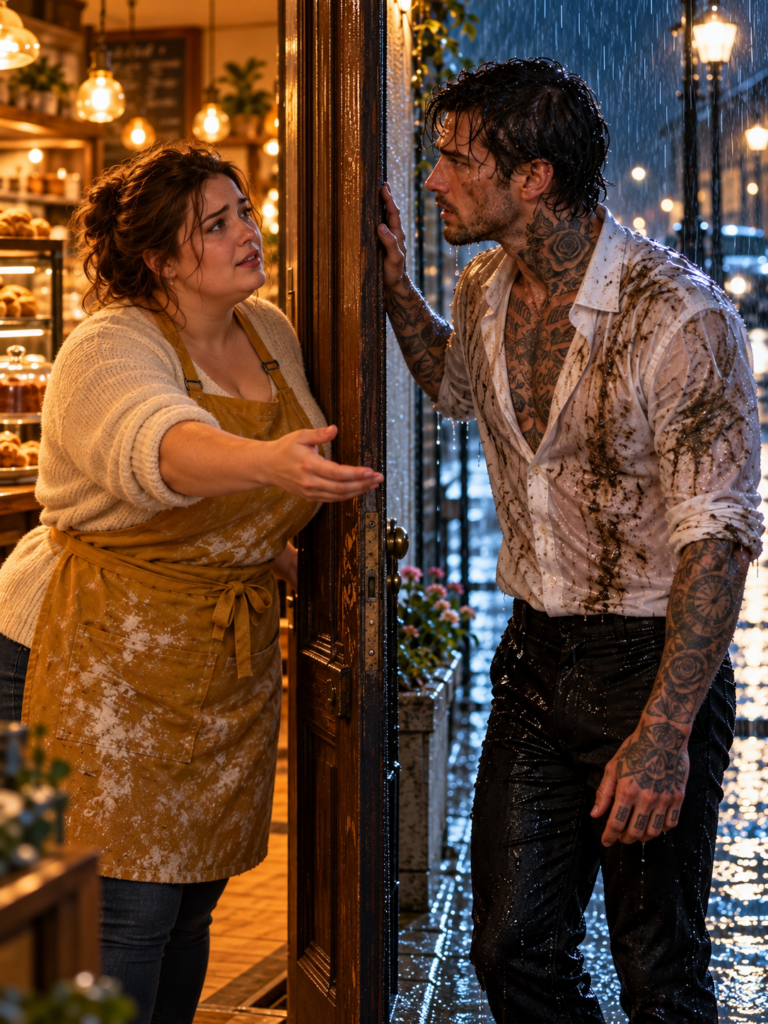
The knock came after closing, when the storm had swallowed the street and Soledad Franco was already counting what little remained in the register.
At first she thought it was debris striking the glass.
Then came another knock.
Three dull taps.
Soledad looked toward the bakery door.
“We’re closed,” she called. “Come back tomorrow.”
A man’s voice answered through the rain.
“I’m not asking for bread.”
She stopped.
“What are you asking for?”
“Somewhere dry until morning.”
Soledad stared through the fogged glass.
The stranger stood beneath the narrow awning, although “stood” was generous. One hand gripped the doorframe. Most of his weight rested on one leg. Water poured from his dark hair and ran down a shirt torn at the shoulder and smeared with mud.
“This isn’t a hotel,” she said.
“I know.”
“Then why are you here?”
“Because I twisted my ankle several blocks back, I can barely walk, and the radio says the storm won’t break before dawn.”
There was no anger in his voice. No demand.
Only exhaustion.
Soledad opened the door a few inches.
Yellow light spilled from the bakery onto him.
He looked worse up close.
His face was pale beneath the rain. His knuckles were scraped. His clothes suggested he had been walking for hours, perhaps longer. He carried no bag. No coat. No wallet that she could see.
Nothing.
Except a watch.
It gleamed on his wrist beneath the mud and rain, so fine and expensive-looking that it seemed to belong to someone else.
Soledad studied him.
Three years earlier she had promised herself never again to mistake a convincing face for an honest one.
Yet she also knew what it looked like when a creature stood outside a door waiting to learn whether anyone would take the risk of letting it in.
She exhaled sharply.
“Get inside before you flood the whole bakery.”
The man blinked.
Then he limped through the doorway.
Soledad shoved the door closed against the wind with both hands.
Warmth wrapped around them.
The bakery smelled of cinnamon, yeast, browned butter, and the last batch of sweet rolls cooling somewhere behind the kitchen doors. The display cases were empty except for crumbs. Metal trays rested in neat stacks beside the ovens.
The stranger remained in the center of the tiled floor, dripping steadily.
“Sit down,” Soledad ordered.
“I’m ruining your floor.”
“The floor will survive. I’m less certain about you.”
He gave a small, startled laugh.
It sounded rusty, as though he had forgotten he could do it.
Soledad pointed to a chair.
“Name?”
He hesitated only briefly.
“Bruno.”
“Bruno what?”
Another hesitation.
“Just Bruno, if you don’t mind.”
“I do mind.”
His expression changed.
“But tonight,” she added, “I mind less than I’d mind explaining to the police how a nameless man collapsed beside my bread counter.”
That earned another laugh.
He sat.
Soledad fetched a towel, then disappeared into the kitchen and returned with a sweet roll left from the previous day.
“It isn’t fresh.”
Bruno looked at it as though she had placed a feast before him.
“I don’t care.”
“That’s obvious.”
He ate slowly.
Soledad pretended not to notice the moment his eyes closed after the first bite.
Something about that bothered her more than it should have.
He did not eat like a beggar desperate to fill his stomach.
He ate like a man who had spent a long time receiving everything he needed and almost nothing that felt freely given.
When he finished, he reached for the watch.
His fingers worked the clasp.
“What are you doing?” Soledad asked.
“Paying you.”
“With that?”
“It’s worth considerably more than a night indoors.”
“I assumed so.”
He held it toward her.
She did not touch it.
“I don’t want your watch.”
Bruno frowned. “You gave me food. You’re giving me shelter.”
“I gave you yesterday’s pastry and a chair.”
“And a roof.”
“So?”
“So people usually expect something.”
Soledad folded her arms.
“I wanted you to eat, not sell me whatever you still have attached to your body.”
His hand remained suspended between them.
There was something almost disoriented in his face.
Finally he withdrew the watch.
Slowly, he fastened it again.
“There’s a room upstairs,” Soledad said. “I don’t use it.”
“I’ve caused enough trouble.”
“Yes, you have.”
A flicker of amusement crossed his face.
She turned toward the stairs.
“But now that you’re here, I’d rather not have you catch pneumonia and die in my bakery. I’ve got enough paperwork already.”
As she climbed, the old wooden steps complaining beneath her feet, Bruno looked around the room.
At the stacked trays.
At the mustard-colored apron hanging beside the oven.
At the old wall clock frozen at 11:20.
At a place where not a single person knew his surname.
He touched the watch on his wrist.
For the first time in years, Bruno Elizalde was inside a room where his name meant nothing.
He should have felt exposed.
Instead, he could breathe.
At four the next morning, the sound of metal trays woke him.
His ankle had swollen purple.
He made his way downstairs gripping the banister and found Soledad already working.
Her dark hair was tied back. Her mustard apron was dusted white. Both arms were buried almost to the elbows in dough.
“You do this every morning?”
“The bread does not care whether I’m tired.”
He leaned against the counter.
“I can leave as soon as I can walk properly.”
She glanced at his ankle.
“That won’t be today.”
“I don’t want to take advantage.”
“Then don’t.”
He waited.
Soledad nodded toward a stack of trays.
“If you’re staying, you can work.”
Bruno stared at them.
“I have absolutely no idea what I’m doing.”
“Nobody is born knowing how to space rolls on a tray.”
She showed him once.
She did not soften the lesson for him.
Too close and the bread would fuse while baking. Too far apart and they wasted oven space. He burned his fingers twice before breakfast and refused to complain either time.
By midmorning, an impatient customer entered demanding a wedding order that was not yet ready.
Don Genaro had the manner of a man who believed volume could shorten time.
“I told you I needed it early.”
“And I told you it would be ready when it was ready,” Soledad answered without looking away from the dough beneath her palms.
“I have people waiting.”
“And I have dough rising.”
“Can’t you hurry it?”
Now she looked up.
“Good dough needs time to rest before it grows. I hand it over early, I sell you unfinished bread.”
Don Genaro muttered something beneath his breath.
Soledad kept working.
A minute later, he left.
Bruno watched from the counter.
“You always speak to customers like that?”
“Only the ones who think everything improves when rushed.”
She wiped flour from her hands.
“Bread doesn’t understand hurry.”
Then, more quietly, she said, “Neither do I anymore.”
Bruno caught the shift.
“Anymore?”
She looked toward the oven.
For several seconds, he thought she would ignore him.
Instead she said, “Three years ago I almost married a man who rushed everything except telling me the truth.”
Bruno said nothing.
“He loved me until his family calculated what I owned.”
Her gaze moved around the bakery.
“This was all I had. Apparently it wasn’t enough.”
“What happened?”
“His mother got involved. Money got counted. Futures got compared. Suddenly their son had made a terrible mistake.”
Soledad gave a humorless little smile.
“I was left wearing the dress in front of forty guests.”
Bruno lowered his eyes.
“I’m sorry.”
“Don’t be. I learned something useful.”
“What?”
She looked directly at him.
“Never trust someone who arrives with empty hands and half a story.”
Bruno looked down at his own hands.
Empty.
His phone vibrated in his pocket.
Once.
Twice.
Three times.
He drew it out just far enough to see the name.
Rogelio.
He switched it off.
Soledad noticed.
“Trouble?”
“Family.”
“They know where you are?”
“They know many things about me.”
His mouth tightened faintly.
“Almost never the right things.”
She could have asked more.
She did not.
Bruno was absurdly grateful.
That afternoon, Doña Amparo arrived carrying groceries.
She had worked beside Soledad for decades and possessed the particular authority of a woman who had watched too many people make the same mistakes under different names.
Her eyes moved immediately to Bruno.
Then to Soledad.
Then back to Bruno.
“Who is this?”
“A guest.”
“Guests usually sit.”
“He’s working.”
Doña Amparo examined Bruno’s hands.
“Very clean hands for a man who injures himself doing manual labor.”
Bruno smiled awkwardly.
“I’m developing blisters.”
“Congratulations.”
She disappeared into the back room.
Bruno looked at Soledad.
“I think she hates me.”
“No.”
“That was her being friendly?”
“That was her gathering evidence.”
Within days, Bruno’s ankle improved.
He did not leave.
Soledad did not ask why.
Something changed between them in increments too small to name.
It happened while decorating a birthday cake when Bruno destroyed the first three letters of a child’s name with icing.
Soledad looked at his work and burst out laughing.
Not politely.
Not delicately.
She laughed until she had to brace one hand against the counter.
Bruno stared at her.
“You could help instead of humiliating me.”
“I am helping. I’m showing you this should never leave the kitchen.”
“I’ve never written with frosting in my life.”
“What did they teach you in school?”
“Numbers.”
“Of course.”
“Contracts.”
She paused.
“Contracts?”
“And other useless things.”
“Contracts are not usually included in basic education.”
Bruno scraped ruined icing from the cake.
“I had a strange education.”
Soledad watched him.
For a moment he looked younger.
Lighter.
Whatever he carried beyond the bakery seemed to loosen whenever he worked with his hands.
Later that day, an urgent order came from a wake nearby.
Fifty loaves.
Before six.
Soledad began calculating aloud.
Bruno stepped beside her without being asked.
He folded wrappers and packed bread with remarkable speed.
She stopped.
“Where did you learn that?”
“Counting money.”
“Money?”
“Fast counting. Fast hands.”
“So your money is finally useful.”
He shook his head.
“That wasn’t money.”
His eyes met hers.
“That was me.”
The words settled between them.
Neither looked away immediately.
They finished with four minutes to spare.
When the customer collected the order, he shook Bruno’s hand and thanked him like any trusted employee.
No recognition.
No calculation.
No change of tone.
After the man left, Bruno looked at his hand.
Soledad noticed.
“What?”
“Nothing.”
“That expression is not nothing.”
He flexed his fingers.
“He didn’t ask who I was.”
“Why would he?”
“I don’t know.”
“In here, people mostly care whether their bread is ready.”
Bruno looked at her.
“It should be like that everywhere.”
She smiled.
“Everywhere doesn’t have me guarding the clock.”
He laughed.
She flicked flour at him.
A white streak landed on his cheek.
Bruno went still.
Soledad’s smile faded slightly.
Not because she regretted it.
Because of the way he was looking at her.
Like someone who had found something without knowing he had been searching.
That evening they sat on the back steps sharing the last loaf.
For several minutes they ate without speaking.
Then Bruno said, “Four days ago, I was supposed to get married.”
Soledad turned.
He kept his eyes on the bread between his hands.
“What happened?”
“I discovered that the entire thing had been arranged by my family.”
“You didn’t know?”
“I knew there were discussions. I didn’t understand how far they’d gone until that night.”
“So you ran.”
“I walked out a back door.”
“In the storm.”
“Yes.”
“And kept walking?”
“Until I stopped knowing whether I was leaving something or looking for something.”
He looked toward the bakery.
“Then I ended up here.”
Soledad rubbed crumbs from her fingertips.
“Did you love her?”
“No.”
“Did she love you?”
“No.”
“Then why marry?”
“Our families needed something from each other.”
“That sounds romantic.”
His mouth curved bitterly.
“It wasn’t supposed to be.”
She studied him.
“So your family trades people like contracts.”
Bruno was silent.
Soledad understood the silence.
“My almost-husband chose me at first,” she said. “Then his mother did the math.”
Bruno looked at her.
“She decided I wasn’t suitable.”
“And he listened?”
“He listened very well.”
She broke the remaining bread in two.
“Money enters a room and people start letting it make decisions for them.”
Bruno’s fingers moved unconsciously toward his expensive watch.
He almost told her.
His surname.
The hotels.
The developments.
The company.
His father.
The uncle hunting him.
The papers waiting at the notary.
Everything.
Instead he swallowed the confession.
Soledad held out the final piece of bread.
“Here.”
Bruno took it.
“Then maybe you should be relieved I have nothing.”
To his surprise, she smiled.
“I am.”
The next morning, Doña Amparo caught them laughing while carrying a heavy tray together.
When Bruno went outside with the trash, the older woman moved close to Soledad.
“That storm didn’t bring him here.”
Soledad rolled her eyes.
“Please.”
“You brought him inside.”
“Because he could barely walk.”
“And now he can.”
Soledad stopped.
Doña Amparo raised one eyebrow.
“You haven’t laughed like that in three years.”
“I know almost nothing about him.”
“Maybe.”
Her gaze moved toward the back door.
“But don’t send him away just because you’re afraid the things you don’t know might be bigger than the things you do.”
That night, Bruno asked if he could stay a few more days.
His ankle barely hurt anymore.
Soledad knew that.
So did he.
She said yes before she could manufacture a reason to say no.
Neither mentioned the fact that by then shelter had very little to do with it.
Part 2
The black car drove past the bakery twice.
The first time, Bruno went still.
The second, he stepped into the back room.
Soledad followed.
“What was that?”
“Nothing.”
“You don’t hide from nothing.”
Bruno leaned against the wall between sacks of flour.
“It looked like a car I know.”
“That is not an explanation.”
He closed his eyes briefly.
For the first time since arriving, he looked truly tired.
Not physically tired.
Older than that.
Soledad crossed her arms.
“You’ve been here nearly a week, Bruno. I still don’t know your last name.”
“It’s easier that way.”
“For whom?”
“For both of us.”
“No. It’s easier for you.”
He had no answer.
Soledad stared at him.
“What are you running from?”
Bruno glanced toward the door.
“On Friday at noon, I’m supposed to sign papers at a notary’s office.”
“What papers?”
“If I don’t show up, my family may lose what little is genuinely left to us.”
“And if you do?”
“I’ll be expected to sign something else.”
“The marriage?”
His silence confirmed it.
Soledad felt old disappointment rise in her chest.
A man.
A deadline.
A secret.
A story delivered only in installments whenever she got close enough to discover the missing pieces herself.
“What kind of family gives you seventy-two hours and no decent choice?”
“The kind that treats family matters like contracts.”
“That phrase again.”
“Soledad—”
“What is your surname?”
He stared at her.
She waited.
“Tell me.”
He looked at the watch on his wrist.
And said nothing.
The hurt came faster than she expected.
Not dramatic.
Not explosive.
Simply familiar.
“You’re afraid I’ll look at you differently,” she said.
“Yes.”
“You’re right.”
His expression tightened.
“I already do.”
She left the room.
That night they ate separately.
Soledad upstairs.
Bruno below beside the cold oven.
He removed his watch and turned it between his hands.
It had belonged to his father.
Bruno remembered receiving it and thinking it was another expensive object meant to stand in for words the two men had never learned to say.
Now, surrounded by flour and steel trays, he understood that the watch was one of the few things he owned that had ever contained affection.
Past midnight, Bruno rose.
He crossed the bakery.
Put his hand on the front door.
Leaving would be clean.
No explanation.
No confrontation.
No moment when Soledad discovered exactly how much he had withheld.
He could disappear before dawn and preserve the memory of being “Bruno” here.
Just Bruno.
He almost turned the handle.
Then he saw her mustard apron hanging beside the oven.
He saw the tray on which he had burned his fingers twice.
The crooked icing scraper.
The bags he had folded for the funeral order.
Evidence of a version of himself no one had demanded, purchased, inherited, negotiated, or arranged.
He released the handle.
He had signed enough bad things in his life.
He would not begin the next chapter by signing his own escape.
When Soledad came downstairs before dawn, she found him sleeping seated against the oven.
She touched his shoulder.
“Bruno.”
His eyes opened.
He looked around, momentarily confused.
Then he saw her.
“I didn’t leave.”
“So I noticed.”
“I almost did.”
Soledad sat on the floor beside him.
“Why didn’t you?”
He rubbed both hands over his face.
“Because this kitchen is the first place I can remember where nobody asked me for anything in exchange for letting me stay.”
She looked at him skeptically.
“I made you work.”
“Yes.”
“You carried trays.”
“Yes.”
“You packed bread.”
“Yes.”
“And ruined a cake.”
“That was involuntary.”
Despite herself, she smiled.
Bruno’s expression softened.
“You asked me to be useful. Not important.”
The smile left her.
He continued.
“You didn’t ask for a surname. Or a promise. Or a signature.”
“I did ask for the surname.”
“Eventually.”
“And you still haven’t given it.”
“I know.”
Outside, dawn thinned the darkness.
Soledad rested her back against the oven.
“I’m afraid Friday will take you away anyway.”
“So am I.”
“If you disappear…”
“I won’t pretend it meant nothing.”
He placed his hand on the floor between them.
“For however long this lasts, you gave me somewhere I could be a man you chose to let inside without knowing what he could do for you.”
His fingers shifted closer.
“That is more than I’ve had in years.”
Soledad looked down.
Then placed her hand in his.
Doña Amparo’s words returned to her.
She almost laughed.
“She says the storm didn’t bring you here.”
“Who?”
“Doña Amparo.”
“That woman terrifies me.”
“She thinks I brought you here.”
Bruno turned toward her.
“What do you think?”
Soledad met his eyes.
“I think I’m glad you knocked on my door instead of somebody else’s.”
They rose without releasing each other.
Bruno drew her closer.
Soledad rested her face against his chest.
His shirt smelled faintly of flour, soap, and the memory of rain.
When they separated, neither moved far.
This time Soledad closed the distance.
Their first kiss was slow.
Careful.
Neither trying to take more than the other was willing to give.
For the rest of the morning, the bakery seemed to operate on a second language.
Hands touching while passing flour.
Eyes lingering across the counter.
A shoulder brushing another shoulder.
Bruno stole a piece of raw dough.
Soledad slapped his hand.
“That is for customers.”
“One bite.”
“You’ll regret it.”
“Worth the risk.”
She shook her head.
“You say that now.”
Bruno smiled at her.
“Lately, most things involving you seem worth the risk.”
When Doña Amparo entered and found them standing far too close to be discussing bread, she set down her groceries and announced that she had forgotten vegetables.
She then disappeared for most of the morning.
That night, Soledad and Bruno did not sleep in separate rooms.
The next morning they woke facing one another in the gray light before the alarm.
Bruno lifted his hand and moved a loose strand of hair from her face.
Soledad allowed herself one dangerous thought.
Perhaps trusting someone did not always end with a white dress and forty people pretending not to stare at you.
Then someone pounded on the bakery door.
Not a customer’s knock.
A demand.
Bruno went rigid.
He dressed quickly and went downstairs.
The man who entered wore a gray suit too expensive and severe for the neighborhood.
His gaze landed on Bruno.
“Two weeks.”
Bruno’s face emptied.
“Rogelio.”
“I’ve spent two weeks looking for you, and this is where I find you?”
Rogelio surveyed the bakery.
The flour.
The trays.
The apron.
His mouth curled.
“Playing baker?”
“Leave.”
“I will. Tomorrow. With you or without you.”
Soledad appeared behind the counter.
“Who are you?”
Rogelio turned.
His interest sharpened.
“Rogelio Elizalde.”
Soledad saw Bruno’s face.
Her stomach dropped.
Rogelio smiled.
“He didn’t even tell you the surname?”
“Stop,” Bruno said.
But his uncle was enjoying himself now.
“This is Bruno Elizalde.”
The name meant something even to Soledad.
Elizalde hotels.
Elizalde developments.
Properties across the city.
Money of the kind ordinary people discussed only when talking about someone else’s life.
Rogelio continued.
“Primary heir to the Elizalde Group since his father died.”
Soledad looked at Bruno.
Then at the watch.
The watch she had refused as payment.
Rogelio followed her gaze.
“He still wears my brother’s watch. How sentimental.”
“Enough.”
“You let him live here believing he was what? Destitute?”
Rogelio laughed.
“He could buy this bakery with what he spends keeping his cars running.”
The words did not make Soledad feel poor.
They made every unfinished answer Bruno had given her suddenly acquire shape.
His clean hands.
Contracts.
Money counting.
The black car.
The arranged marriage.
The surname he would not speak.
She looked at him.
“Which part were you planning to tell me?”
“All of it.”
“When?”
“I don’t know.”
“Before tomorrow?”
“Yes.”
“Before or after the notary?”
“Soledad.”
“Before or after I decided whether I cared about you?”
Bruno took a step toward her.
“There was no version of this where I came out looking good.”
“At least that part is true.”
Rogelio interrupted them.
“Touching. Truly.”
Bruno turned.
His uncle’s expression hardened.
“Tomorrow at noon. The company becomes mine one way or another unless you fulfill the agreement.”
Soledad frowned.
“What agreement?”
“Family business.”
“Using a marriage?”
“Using whatever keeps decades of work intact.”
Bruno’s voice lowered.
“You forged my father’s approval.”
Rogelio’s eyes flashed.
Then he smiled again.
“Prove it.”
He left.
The bell above the bakery door continued trembling after he was gone.
Bruno turned toward Soledad.
“Please.”
She stepped backward.
That hurt him more than if she had shouted.
“I need you to leave.”
“Let me explain.”
“I said leave.”
“Soledad—”
“Tonight.”
Her voice cracked.
She steadied it.
“Please.”
Bruno did not argue.
He packed the few things he had.
There were almost none.
When he stepped through the door, he looked like the same man who had arrived after the storm.
Except his ankle was nearly healed.
And Soledad now knew exactly how wealthy he was.
Neither fact made watching him leave any easier.
Doña Amparo found her later sitting against the sacks of flour.
“So,” Soledad said. “Elizalde.”
“I heard.”
“Of course you did.”
“The entire street has heard.”
“He slept under my roof. Ate my food. Worked beside me.”
Her eyes burned.
“He knew what happened to me before. He knew what secrets did to me.”
Doña Amparo sat beside her.
“Did he lie?”
Soledad looked at her.
“He didn’t tell me who he was.”
“That wasn’t my question.”
“What difference does it make?”
“Tonight? Probably none.”
Doña Amparo squeezed her hand.
“But tomorrow it might.”
Bruno returned the next morning.
He did not knock at first.
He stood outside as if unsure he still possessed the right.
Doña Amparo opened the door.
“You’ll freeze out there.”
She stepped aside.
“Get in.”
Soledad waited by the counter.
“One explanation,” she said.
Bruno nodded.
“My uncle forged my father’s signature after my father died.”
Soledad’s expression changed.
Bruno continued.
“He used it to claim my father had approved a plan to stabilize the company through a marriage alliance.”
“The woman from the arrangement?”
“Yes.”
“And if you refused?”
“Rogelio could use the documents to consolidate control anyway. If I complied, he kept influence through the arrangement. If I vanished, he would claim I had abandoned my responsibilities.”
“So that is why you ran.”
“I ran because I realized everyone had already decided what I would do before anyone bothered asking me.”
He placed both hands on the counter.
“I should have told you.”
“Yes.”
“I didn’t because for eight years I haven’t met anyone who heard my surname before deciding who I was.”
His voice roughened.
“You didn’t know. And for a few days I wanted to know what that felt like.”
“You still took the choice away from me.”
“I know.”
He did not ask forgiveness.
That mattered.
He reached into his coat and removed a worn envelope.
“This is why I came back.”
He placed it on the counter.
“I found it tucked inside my luggage the night I left.”
“What is it?”
“A letter from my father.”
Bruno touched the envelope once.
“It proves Rogelio’s signature is false.”
Soledad stared at him.
“Tomorrow I’m taking it to the notary. There will be witnesses. There will be people from the company.”
“You think it’s enough?”
“I don’t know.”
“And you want me there?”
“No.”
The answer surprised her.
“I came because you deserved the whole truth before someone else delivered another piece of it.”
He stepped away.
“If I win tomorrow, it doesn’t erase what I did to you. If I lose, it still doesn’t.”
His eyes held hers.
“I’m not asking you to come.”
Then he left.
Soledad stood staring at the envelope.
Eventually she opened it.
The handwriting was close and deliberate.
The letter had been written two years earlier by a man who knew he was dying.
Bruno’s father wrote that his son had to be allowed to choose his own future.
The company, he said, was not worth preserving if preserving it required sacrificing Bruno’s freedom.
And if anyone ever attempted to use his name or signature to force Bruno into an agreement, the letter was to serve as evidence of his true wishes.
Soledad read it twice.
It was not really a business letter.
It was an apology.
A father admitting that he had spent too much of his life measuring love in duty, ownership, inheritance, and signatures.
Doña Amparo came beside her.
“Well?”
Soledad folded the page carefully.
“His father wanted him to choose.”
“Then tomorrow he may finally get to.”
“He’ll need witnesses.”
“Maybe.”
“I don’t know whether I count.”
Doña Amparo looked at her.
“You count if you decide to.”
Soledad stared at the envelope.
“I don’t know what I’ll say to him.”
“You don’t need to know tonight.”
The older woman squeezed her hand.
“But remember something.”
“What?”
“Fear already chose for you once.”
Soledad frowned.
“The wedding.”
Understanding came.
Doña Amparo nodded.
“You spent three years living around what another family did to you.”
She rose.
“Don’t let them decide tomorrow too.”
At four in the morning, Soledad kneaded dough alone.
Across the bakery, the wall clock had stopped again.
She looked at its frozen hands and thought of Bruno’s watch.
His father’s watch.
A thing built to measure time that had somehow become proof that time was not what mattered most.
For the first time in three years, Soledad wondered not what she was protecting herself from—
but what kind of life she wanted to walk toward.
And with whom.
Part 3
The notary’s office smelled of fresh paper and cold coffee.
Rogelio Elizalde sat at the head of the table as though the outcome already belonged to him.
Documents had been arranged in perfect stacks.
Lawyers occupied the side chairs.
Several longtime partners of the Elizalde Group sat in silence.
Beside Rogelio was the young woman Bruno had been expected to marry.
She wore an immaculate dress and an expensive ring.
She looked at neither.
Bruno entered alone.
For the first time since the storm, he wore the gray suit he had abandoned when he fled the family celebration.
He carried one thing.
The envelope.
Rogelio looked at it and smirked.
“You finally came.”
“Yes.”
“Then perhaps we can stop embarrassing ourselves.”
Bruno remained standing.
“Before anybody signs anything, this needs to be read.”
He placed the envelope on the table.
One of the oldest partners opened it.
Rogelio shifted in his chair.
“What is that?”
“My father’s answer.”
“Your father is dead.”
“That is why you thought you could speak for him.”
The older partner began reading.
Slowly.
The atmosphere changed line by line.
At first there was confusion.
Then attention.
Then anger.
Not toward Bruno.
Toward Rogelio.
The letter explicitly rejected coercing Bruno into any marriage or agreement to preserve the company.
More importantly, it gave clear instructions regarding the use of the late Elizalde’s authority after his death.
Rogelio interrupted.
“This proves nothing.”
The partner continued.
“This is sentimental nonsense.”
Still the man read.
Finally Rogelio shoved back his chair.
“The signature on the authorization has been authenticated.”
Another board member looked at him.
“No.”
Rogelio stopped.
“We had it independently reviewed after Bruno contacted us last night.”
Bruno looked up.
The man continued.
“The signature is forged.”
The young woman beside Rogelio inhaled.
Rogelio’s face changed.
Only slightly.
But everyone saw it.
“You’re making a mistake.”
“No,” said another partner. “We made the mistake two years ago.”
Rogelio looked around the table.
“You think this company survives on feelings? On letters from dead men?”
“It survives on trust,” Bruno said.
His uncle turned on him.
Bruno did not raise his voice.
“And you spent two years using my father’s name to steal it.”
The young woman at the table stood.
Every head turned.
She removed the ring from her finger.
For one moment she looked at Bruno.
There was no romance between them.
Only recognition.
Two people who had nearly been traded in the same transaction.
She placed the ring beside the documents.
“I never agreed to this either.”
Then she walked out.
No one stopped her.
Rogelio watched the door close.
By late morning, the vote was unanimous.
Rogelio Elizalde was removed from the administration of the company with immediate effect.
He stood.
His face had gone pale.
“You think this ends here?”
Bruno looked at him.
“It already did.”
“You’ll destroy what your father built.”
“No.”
Bruno touched the envelope.
“I finally listened to what he wanted me to build instead.”
Rogelio gathered nothing.
No one helped him.
For the first time in years, he walked from a room without another person rearranging himself to accommodate his anger.
Bruno remained beside the table.
The victory did not feel triumphant.
It felt quiet.
A lock opening after someone had spent so long inside a room he had forgotten there was a door.
He was preparing to leave when the office door opened again.
Every person at the table looked up.
Soledad stood there.
She was still wearing her mustard bakery apron.
There was flour on one sleeve and a pale streak across the back of her hand.
She had not dressed for wealth.
Had not dressed for the board.
Had not dressed for Bruno Elizalde.
She had simply come.
Bruno forgot everyone else in the room.
“Soledad.”
She lifted the envelope copy she had brought.
“I came to serve as a witness if you still needed one.”
His mouth almost formed a laugh.
“It’s over.”
“Already?”
“Rogelio is out.”
She looked toward the empty chair.
“And the marriage?”
“Over.”
“The company?”
“Still standing.”
“And you?”
Bruno considered the question.
“For the first time, I think I am too.”
Several people around the table pretended not to listen.
Soledad nodded.
“Then I suppose I came here for the wrong reason.”
Bruno crossed the room.
“What reason should you have come for?”
She looked at him for a long moment.
He stopped a few feet away.
He did not touch her.
Did not assume.
“Soledad, I’m not going to ask you to forget what I kept from you.”
“Good.”
“I’m not going to tell you I did it for your protection.”
“Even better.”
A small smile appeared.
Bruno breathed.
“I was afraid.”
“I know.”
“I had spent years being Bruno Elizalde before I was ever allowed to be Bruno.”
He glanced down at his hands.
“In your bakery, I was bad at frosting. I burned myself on trays. I wrapped bread. I carried flour.”
“You stole raw dough.”
“I maintain that was research.”
She almost laughed.
He moved one step closer.
“In a handful of days, you gave me something my surname never bought in thirty-four years.”
Her expression softened.
“A job?”
“A place where what mattered was whether I helped.”
Bruno’s voice lowered.
“Whether I made you laugh.”
Soledad’s eyes brightened.
“Whether I stayed when leaving would have been easier.”
He swallowed.
“I love you.”
Nobody at the table moved.
Bruno no longer cared.
“I love you without needing you to approve of the company, the money, the name, or anything else attached to me.”
He looked directly at her.
“If tomorrow I owned half of what I own today, I would still love you.”
A pause.
“If I owned none of it, I would still know exactly which door I’d want to walk through.”
Soledad blinked back tears.
“When I opened that door, I thought you were poor.”
“I know.”
“I thought the most valuable thing you had was that watch.”
Bruno smiled faintly.
“You weren’t entirely wrong.”
“I had no idea who I was helping.”
“You helped Bruno.”
“That’s the problem.”
His smile faded.
Then she stepped closer.
“And now I know the rest.”
She took his hand.
“And I choose you anyway.”
Something in Bruno’s face broke open.
Relief.
Wonder.
Grief for all the years before this one.
He lifted her hand and pressed his forehead briefly against it.
Then he remembered the watch.
Bruno reached for the clasp.
Soledad laughed through her tears.
“Oh, no.”
He looked up.
“What?”
“I already refused that once.”
“You refused it as payment.”
He removed it.
“This isn’t payment.”
The watch lay between his palms.
“My father gave it to me before he died.”
“I know.”
“He once told me that the time that matters most can’t be measured by a watch.”
Bruno looked at the old face of it.
“I thought it was one more thing fathers say when they’re trying not to say what they actually mean.”
He took her wrist gently.
“Now I think I understand.”
Soledad let him fasten the watch around her.
It was too large until he adjusted the strap.
“There.”
She looked at it.
“So what am I supposed to do with this?”
“Keep it moving.”
“That sounds like a lot of responsibility.”
“You’re good at giving things the time they need.”
She looked at him.
“The bread?”
“And me.”
Soledad touched his face.
Then kissed him in front of the entire Elizalde board.
Flour on her apron.
His father’s watch on her wrist.
No contract between them.
No family agreement.
No deadline.
They walked from the notary’s office hand in hand.
Outside, the sky was clear.
For once, there was no rain.
A year later, the bakery had a new name painted by hand above the door.
The Good Bread of Two.
Soledad had objected that the name sounded sentimental.
Bruno had pointed out that she was the woman wearing his dead father’s watch while arguing about sentimentality.
She had thrown flour at him.
The name stayed.
Their mornings still began early.
At four, Soledad worked the dough while Doña Amparo complained that both younger people wasted too much time talking.
Don Genaro still arrived before his orders were ready.
He still asked whether the bread could be hurried.
Soledad still gave him the same answer.
“Anything worth growing needs time.”
He still grumbled.
He still came back.
Bruno helped with the first deliveries before leaving for his own work.
He had kept only the part of the Elizalde inheritance he actually wanted to use.
With it, he opened a small workshop and foundation dedicated to restoring family trades and businesses that larger investors would have discarded for insufficient profit.
Old carpentry shops.
Tailors.
Traditional bakeries.
Repair shops.
Craft workshops passed through generations.
Places that did not look impressive on balance sheets but carried histories no spreadsheet knew how to value.
People occasionally told Bruno he could make considerably more money doing something else.
He always agreed.
Then kept doing it.
Rogelio disappeared from their immediate lives.
Word eventually reached Bruno that his uncle had found work in a smaller company far away.
There was no family empire there.
No inherited authority.
No dead brother’s signature to hide behind.
Whatever mistakes Rogelio made now belonged entirely to him.
Doña Amparo remained unchanged by all of it.
She arrived early.
Criticized everybody.
Knew every neighborhood secret at least two hours before anyone else.
And still behaved as though the bakery would collapse if she took one full day off.
Soledad continued winding the watch each morning.
At first she did it because Bruno had asked.
Later it became part of the rhythm of the bakery.
Tie apron.
Check ovens.
Start dough.
Wind watch.
Time, measured properly.
Not by deadlines or contracts.
By repetition.
By staying.
By the thousand ordinary decisions that came after a dramatic one.
At night, Bruno still helped close.
He still could not decorate cakes properly.
A year of practice had improved him from disastrous to merely unreliable.
One evening, Soledad stood beside him as he attempted to pipe a birthday message.
She stared.
“Is that supposed to be an R?”
“Yes.”
“It looks injured.”
“It has personality.”
“It needs medical attention.”
Bruno added another crooked line.
“There.”
“You made it worse.”
“I disagree.”
“You’re banned from lettering.”
“I own half this bakery.”
“No, you do not.”
“I’m married to the woman who owns it.”
“That gives you access to the bedroom, not creative control over frosting.”
Bruno looked scandalized.
“So many rules.”
“You knew that when you stayed.”
He smiled.
“Yes.”
He set down the piping bag.
That particular argument had begun months earlier when Bruno offered to invest in expanding the bakery.
Soledad had refused.
He suggested new equipment.
She accepted one oven.
He suggested remodeling.
She allowed him to fix the stairs.
He offered to purchase the building outright.
She stared at him until he withdrew the suggestion.
Eventually they learned the shape of compromise.
Bruno could use his wealth to help.
He could not use it to erase what Soledad had built before him.
She would never again allow love to require making herself smaller.
Bruno, of all people, understood.
One rainy evening nearly a year to the day after they first met, they closed late.
The storm was gentler than the one that had brought him there.
Soledad locked the register.
Bruno turned the sign to CLOSED.
Then someone knocked.
Both looked toward the door.
A delivery driver stood outside, soaked and miserable, holding a dead phone.
Soledad and Bruno exchanged a glance.
“No,” she said immediately.
Bruno lifted his eyebrows.
“You’re not opening it?”
“I’m considering.”
Another knock.
The driver pointed helplessly at the rain.
Bruno leaned against the counter.
“This feels familiar.”
Soledad glared at him.
“You were injured.”
“I was.”
“You looked pathetic.”
“Devastatingly so.”
“You were hiding several billion dollars’ worth of complications.”
“That part probably doesn’t apply to him.”
“You don’t know.”
Bruno smiled.
Soledad held out for three more seconds.
Then she unlocked the door.
“Get inside before you soak the floor.”
The driver stumbled in, apologizing.
Bruno fetched a towel.
Soledad brought him bread.
When the stranger offered to pay, she waved him off.
Across the room, Bruno touched the empty place on his wrist where his father’s watch had once rested.
Soledad noticed.
She glanced down at her own wrist.
The watch ticked steadily.
A year earlier, she had opened this same door believing she was allowing a poor, injured stranger inside until the storm passed.
She had been wrong about almost everything that could be measured.
Bruno had not been poor.
The expensive watch had not been his last possession.
The man sleeping over her bakery had not been powerless.
His family had hotels, developments, lawyers, board members, contracts, and more money than Soledad could comfortably imagine.
Yet none of that had been the truth that mattered most.
When Bruno arrived at her door, he had possessed everything people called wealth and almost nothing he could choose freely.
No marriage.
No future.
No name that entered a room without speaking before he did.
Soledad had not rescued a penniless stranger.
She had given a powerful man the first place in years where he did not have to be powerful.
And Bruno had given her something equally difficult.
Not protection from being hurt.
Not a guarantee.
Something better.
A reason to discover that being afraid of an old wound was not the same thing as seeing the future clearly.
The delivery driver finished his bread, thanked them repeatedly, and stepped back into the rain once his ride arrived.
Soledad locked the door again.
Bruno came up behind her.
“Still trusting strangers?”
She leaned back against him.
“On a case-by-case basis.”
“Very prudent.”
“I learned my lesson.”
His arms went around her.
“Which lesson?”
She turned.
“That expensive watches are suspicious.”
Bruno laughed.
“That’s what you learned?”
“Also men who say ‘just Bruno’ are trouble.”
“Unfair.”
“Accurate.”
He kissed her forehead.
Outside, rain drew silver lines down the glass.
Inside, the ovens still held warmth.
The mustard apron hung from its usual nail.
A crookedly decorated cake waited on the counter to be repaired in the morning.
And the wall clock had stopped again.
Neither of them noticed.
The only watch that mattered was ticking against Soledad’s wrist, wound that morning as always.
Not counting down to a deadline.
Not measuring how long something would last.
Simply keeping time with a life neither of them had signed for.
A life they had chosen.

