
Part 1
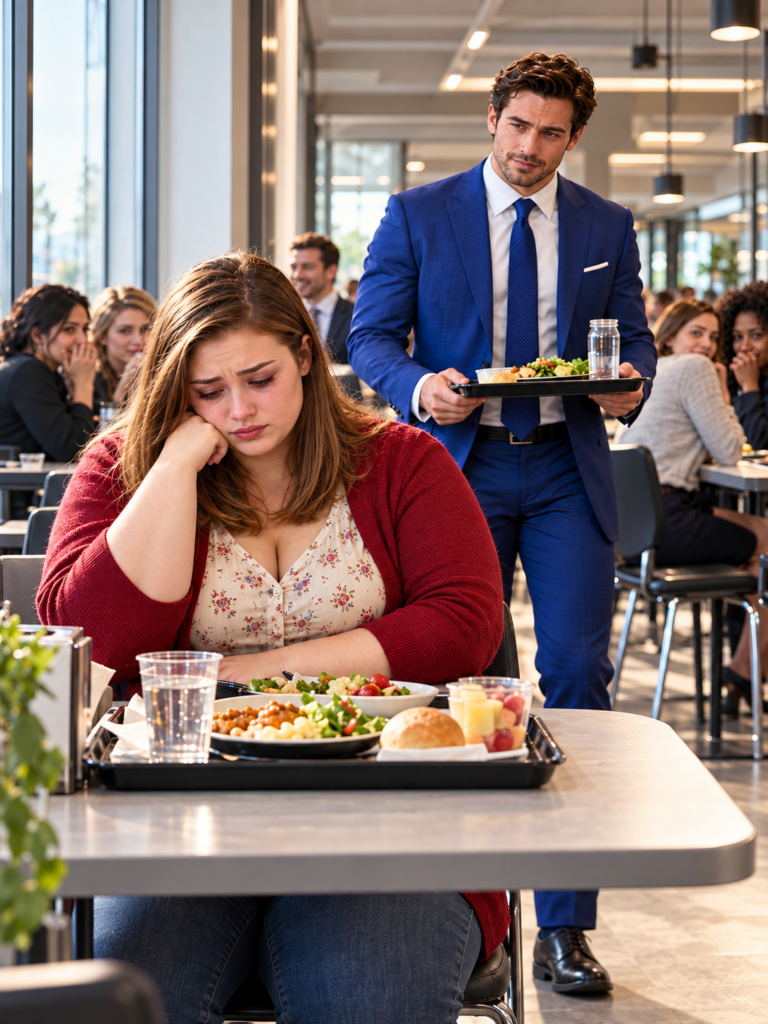
At 11:40 on a Tuesday morning, Boyd Gaines walked into his company’s cafeteria for the first time in four years.
Eighty employees were eating lunch. Twelve chairs surrounded the long table beneath his father’s portrait. One of those chairs had been reserved for him, just as it had been every first-roast celebration since his wife died.
But Boyd never reached it.
Halfway across the cafeteria, he watched a woman approach an empty chair. Another employee immediately placed her handbag on it, blocking the seat without saying a word.
The woman didn’t protest.
She simply turned away, carrying her lunch toward a tiny table beside the window.
Boyd stopped walking.
There was something disturbingly practiced about what he had just witnessed. The handbag had moved too quickly. The woman had retreated too easily. And the people around them had returned to their conversations with the careful indifference of people who had witnessed something they considered perfectly normal.
He looked toward the long table.
Trudy Odom was smiling at him, one hand resting on the back of his reserved chair.
Then he looked toward the woman by the window.
She was sitting alone, carefully unfolding a napkin beside a paperback book.
Boyd changed direction.
By the time he reached her table, the entire cafeteria had gone quiet.
“Excuse me,” he said.
The woman looked up.
“Would you mind if I sat here?”
And in that moment, Rose Carrigan knew that tomorrow was going to be considerably worse than today.
The Gaines Peanut Company had been operating outside Dothan, Alabama, for longer than most of its employees had been alive.
At harvest time, the smell of roasted peanuts drifted across the parking lot before sunrise. Delivery trucks lined up at the weigh station, forklifts moved continuously between the warehouses, and the processing floors vibrated with the steady mechanical rhythm of a business that depended on every shipment arriving at the right time.
For Rose, that rhythm was comforting.
Machines behaved according to rules. Moisture meters gave readings. Laboratory tests could be repeated. A shipment of damaged peanuts didn’t become healthy simply because someone disliked the result.
People were considerably harder to understand.
She had been working in the quality-control laboratory for six weeks.
That was enough time to learn where everything belonged.
Office staff preferred the tables beneath the cafeteria’s tall windows. Production workers occupied the seats near the vending machines. And the long table in the center belonged to a shifting collection of employees whose friendships, family connections, and opinions carried an authority no organizational chart acknowledged.
Trudy Odom sat at its head.
She had worked at Gaines for twenty-seven years. She knew almost everyone, remembered birthdays, organized meals when families suffered losses, and brought boiled peanuts to the cafeteria in an enormous cooking pot whenever the first harvest came in.
She also happened to be Rose’s former mother-in-law.
That was the part everyone remembered.
The rest of the story had apparently been settled before Rose returned to Dothan.
She had married Trudy’s eldest son, Clay Odom, and spent eight years as part of the family. Then she had left him and moved to Montgomery.
The following summer, Clay had died in a terrible accident on Highway 231 during a rainstorm.
People said he had been driving to Montgomery to bring his wife home.
They said Rose had broken his heart.
They said she hadn’t even attended his funeral.
And in a small town, a story repeated often enough could become more durable than the truth.
Rose had stopped correcting people because she had never really begun.
At lunchtime, she generally took her chicken and rice to the small table beside the window.
One leg wobbled whenever she shifted her weight. The view overlooked the parking lot, and the afternoon sunlight could make the tabletop uncomfortably warm.
But nobody bothered her there.
That Tuesday, she had barely opened her paperback when Boyd Gaines appeared beside her chair.
At first she assumed he wanted the table.
He was the chief executive, after all. Perhaps he needed somewhere quiet to discuss business.
She started gathering her things.
“No,” he said gently. “You don’t have to move.”
Rose hesitated.
Boyd was somewhere around forty, with tired eyes and a tie that hung slightly loose beneath his collar. He carried a cafeteria tray with the same indifferent green beans and sliced turkey everyone else had been served.
He didn’t look especially powerful in that moment.
He looked uncomfortable.
“There’s plenty of room elsewhere,” she said.
“I noticed.”
“At the big table, especially.”
“I noticed that too.”
He waited.
Rose looked past him.
Trudy was watching.
So were several dozen other people.
Rose understood exactly what would happen if she agreed. Every gesture would be discussed. Every word would become material for the next break-room conversation.
The new employee and the CEO.
The woman nobody liked and the man who owned the company.
Yet Boyd was standing there with his tray, waiting for an answer rather than acting as if her permission were unnecessary.
Finally, Rose gestured toward the opposite chair.
“Suit yourself.”
“Thank you.”
He sat down.
Across the room, Trudy slowly rose.
Rose saw her coming before Boyd did.
The older woman approached with the composed expression she used when receiving visitors at church: polite, welcoming, and impossible to challenge without looking unreasonable.
“Mr. Gaines,” Trudy said warmly. “We’ve kept your usual place.”
Boyd looked up.
“That’s kind of you, Trudy.”
“There’s no need to eat over here. Your chair’s ready.”
“I’m comfortable, thank you.”
Trudy’s smile remained in place.
Her eyes moved briefly toward Rose.
Eight years.
Rose had spent eight Thanksgivings in that woman’s kitchen. She had helped wash dishes after Sunday dinners, carried groceries into the house, and listened to Trudy complain about her aching knees.
Once, when Rose had been sick, Trudy had driven across town with homemade soup.
Now the older woman looked at her as though they had never met.
“Well,” Trudy said, “I hope you enjoy your lunch.”
She leaned forward to straighten the napkin dispenser.
As her hand brushed the table, her voice dropped.
“Enjoy the attention while you can.”
Then she returned to her place.
Boyd watched her go, puzzled by the tension he couldn’t entirely explain.
He turned back toward Rose.
“Tell me something.”
Rose braced herself.
“Have those green beans been sitting in hot water since breakfast?”
She blinked.
“What?”
“They seem old enough to remember my grandfather.”
Despite herself, she almost smiled.
“They start cooking them around nine. By noon, there’s not much left to save.”
“That explains a lot.”
He picked up his fork.
“So what department are you in?”
“Quality control.”
“What do you handle?”
“Incoming shipments, mostly. Moisture levels. Damaged kernels. Aflatoxin testing.”
He nodded.
“Sounds important.”
“It is.”
“Do you enjoy it?”
Rose considered the question.
“I’m good at it.”
Boyd raised his eyebrows slightly.
“Not quite the same answer.”
“My grandfather had a peanut farm in Headland. When I was fourteen, he taught me to sort the crop by hand. He said you could learn almost everything you needed to know by breaking a peanut open and holding it toward the light.”
“Could you?”
“Usually.”
She looked down at her plate.
“Peanuts are more honest than most people.”
For a moment she wished she could retrieve the sentence.
But Boyd merely nodded.
“That sounds like something my father would have appreciated.”
He asked about her work after that.
Not in the distracted manner of an executive gathering material for a speech, but with genuine curiosity.
Rose explained why the laboratory’s aging moisture meter required recalibration every morning. She described how damaged kernels could appear acceptable from the outside while concealing discoloration within.
He listened.
He didn’t ask about her surname.
He didn’t ask why she was sitting alone.
And when lunch ended, he thanked her for sharing the table.
By two o’clock, every department knew.
By three, people had started finding excuses to walk past the quality-control laboratory.
Rose kept her eyes on her samples and pretended not to notice.
Upstairs, Boyd was less comfortable than he had appeared.
Faye Trimble entered his office shortly after lunch, carrying her clipboard beneath one arm.
Faye had worked for the Gaines family for decades. She had watched Boyd grow from an uncertain young man into the executive responsible for hundreds of employees and thousands of farmers who depended on his company’s contracts.
That history gave her permission to speak plainly.
“You certainly gave people something to discuss.”
Boyd looked up from the harvest projections.
“Apparently.”
“Do you know who you sat with?”
“Rose Carrigan. Quality control.”
Faye lowered herself into a chair.
“Her name used to be Rose Odom.”
Boyd stopped writing.
“Trudy’s family?”
“Clay’s wife. Former wife.”
He leaned back.
Faye explained what people believed had happened.
The separation.
The move to Montgomery.
Clay’s fatal accident.
The funeral Rose supposedly hadn’t attended.
“And Trudy has never forgiven her,” Faye finished.
Boyd said nothing.
Four years earlier, when his wife, Lee, died, the company had organized a memorial luncheon in that same cafeteria.
Boyd remembered the folding tables, the aluminum-covered dishes, and Lee’s photograph beside the coffee urn.
He remembered sitting before a plate of food he couldn’t swallow.
Trudy had brought him something to eat and then quietly pulled up a chair.
She stayed with him for an hour.
She had not demanded conversation. She had not offered explanations for death or promises that grief would soon become easier.
She had simply stayed.
Until that afternoon, Boyd hadn’t returned to the cafeteria.
And the first time he did, he had walked past the chair Trudy had kept for him.
He rubbed his forehead.
“I didn’t know.”
Faye’s expression softened.
“No. You didn’t.”
But knowing the history didn’t erase what Boyd had seen.
Someone had deliberately kept a woman from sitting down.
And everyone had allowed it.
The following afternoon, Boyd appeared at the laboratory doorway.
Rose was cleaning a sample cup.
He remained outside rather than entering her workspace.
“I heard about your connection to Trudy,” he said.
Rose’s shoulders stiffened.
“I see.”
“I thought you should know something.”
She waited.
“If I’d known the whole story yesterday, I still would’ve asked to sit at your table.”
He didn’t linger for her response.
He simply turned and walked away.
Rose stood for a long moment with the sample cup in her hand.
She wasn’t certain whether to feel grateful or afraid.
By Friday, the first accusation arrived.
During the morning quality meeting, the plant manager presented a sealed archival sample.
The lid was cracked.
The label carried Rose’s handwriting.
A retest had produced a higher reading than the original classification.
“Can anyone explain this?”
Every face turned toward her.
Rose examined the jar.
She remembered sealing it. She remembered checking the threads before tightening the lid.
“It must have been damaged after storage,” she said.
Nobody argued.
Nobody needed to.
She could see what they believed.
That evening, Rose drove to her grandmother Wilma’s old house in Headland.
The sun was setting behind the cotton fields when she pulled into the gravel driveway.
Something was wrong.
The porch light was dark.
At first she assumed the bulb had burned out.
Then she noticed it had been loosened.
She approached the rear entrance.
The kitchen door stood open a fraction of an inch.
Rose knew she had locked it.
She always locked it.
Inside, the refrigerator hummed. The clock above the stove ticked. Nothing seemed missing.
That made the house feel more frightening, not less.
She checked each room before opening the hallway closet.
An old cardboard box stood on the floor.
Across its top, in her own handwriting, was one word.
Clay.
The cardboard flaps had been disturbed.
His work shirts had been lifted and replaced unevenly. Photographs lay in an unfamiliar order.
Somebody had searched through his belongings.
Rose knelt beside the box.
She considered calling the sheriff.
Then she imagined the questions. The deputies’ cars outside. The neighbors watching.
By Sunday, everyone in Dothan would know that Rose Carrigan had returned and brought trouble with her.
Instead, she reached beneath the clothing.
The postcard was still there.
She didn’t read it.
She wrapped it inside one of Wilma’s old handkerchiefs and hid it in the round Danish cookie tin her grandmother used for sewing supplies.
Then she placed the tin behind the winter blankets.
That night, she checked the rear door three times.
Monday brought another problem.
Lamar Pettis arrived at the weigh station with a trailer full of peanuts.
Rose knew him.
Everyone knew him.
He had farmed outside Dothan for years, and he was close to the Odom family.
When she collected the sample, she suspected trouble before the instruments confirmed it.
The peanuts were too heavy with moisture.
Several kernels were shriveled or damaged.
She repeated the testing three times.
The results didn’t change.
The lower grade would cost Lamar nearly four thousand dollars.
He stormed into the weigh station with the paperwork clenched in his fist.
“You did this deliberately.”
Rose kept her voice level.
“I recorded the grade supported by the samples.”
“You think I don’t know what you’re doing?”
“I’m following the grading procedure.”
“You already took Clay away from us.”
His voice rose loud enough for the drivers outside to hear.
“Now you’re going after my farm too?”
Rose felt every pair of eyes turning.
Beyond the window, Trudy stood near the loading dock.
She said nothing.
She simply watched.
Later, when Boyd heard about the confrontation, he went directly to Faye and requested the paperwork.
He reviewed the moisture readings, damaged-kernel percentages, and repeated tests.
“All three match?” he asked.
“Exactly.”
“Any problem with the procedure?”
“None.”
Boyd returned the documents.
“Then the grade stands.”
He didn’t change the result as a favor to Rose.
He upheld it because the evidence justified it.
When Faye quietly told Rose, something inside her loosened.
Not completely.
But enough to matter.
For two years, attention had usually meant judgment.
Boyd Gaines had noticed her work and treated it as work.
She had almost forgotten what that felt like.
That afternoon, Colby Odom appeared outside the laboratory.
Clay’s younger brother was thirty now, although his familiar smile sometimes made him look like the boy who had once teased Rose during family dinners.
“Hey, Rose.”
She opened the door.
“Colby.”
“Sorry about Uncle Lamar. You know how he gets.”
“I know.”
He leaned against the frame.
“Listen, I know being back here hasn’t been easy. Mama’s still upset. People talk.”
Rose waited.
“If you ever decide you’d be happier somewhere else, I could help. Maybe Montgomery again. I know people.”
The words were gentle.
His eyes were not.
“I’m fine here, Colby.”
He nodded slowly.
“Just think about it.”
After he left, Rose stared at the laboratory door.
There was a difference between offering someone a way out and telling them they ought to leave.
Colby had managed to do both.
That evening, she sat in her Honda with a resignation email open on her phone.
Three sentences.
A thank-you.
Two weeks’ notice.
A polite closing.
She held her thumb above the send button.
Across the nearly empty parking lot, Boyd sat alone in his truck.
The windows were partially open.
An old Motown song drifted into the evening air.
The Four Tops.
Rose recognized the melody.
Boyd didn’t see her watching.
He looked like a man reluctant to return to an empty house.
For reasons she couldn’t explain, Rose turned off her phone and drove home without sending the message.
The porch light was working.
Both doors were locked.
Then she entered the kitchen.
The sewing tin sat open in the middle of the table.
Wilma’s handkerchief had been unfolded.
And the postcard rested on top, its written side facing upward.
Whoever had entered the house had found it.
They had read it.
And they wanted Rose to know.
Part 2
By the following Tuesday, Rose had paid a locksmith to replace both exterior locks.
She told him the house had been empty for a while and that changing the locks was simply sensible.
She did not mention the postcard.
She had returned it to the sewing tin without reading it herself.
She already knew what it said.
That was precisely why she had avoided looking at it.
Harvest season accelerated.
The factory operated longer hours. Trucks arrived before sunrise. Production schedules grew increasingly tight, and the pressure on the quality-control department rose with every new delivery.
Late one Thursday, an order for eighteen hundred jars of peanut butter destined for school lunches in three states was being prepared.
The shipment had to leave by six the following morning.
Rose’s shift had ended, but she stayed to review the final quality results.
Something bothered her about the numbers.
She preferred verifying a sample herself to trusting that someone else had done the work properly.
At 9:40 that evening, a test strip showed a positive result.
Rose frowned.
She prepared another sample.
The second test confirmed it.
Aflatoxin.
The contamination level was dangerously high.
For a moment, she looked at the scheduled shipment.
Eighteen hundred jars.
Children would be eating sandwiches made from those peanuts.
She pressed the emergency stop button.
The roasting equipment slowed, groaned, and fell quiet.
Workers across the production floor turned in surprise.
Rose stepped into the aisle.
“Batch fourteen is on hold. Nobody moves it.”
The night supervisor hurried over.
“We’re on a deadline.”
“So am I,” Rose answered. “And mine is keeping contaminated food out of schools.”
She pulled the weigh tickets and traced the incoming shipments.
Faye’s careful pencil marks helped her identify the storage bins associated with each load.
Rose worked methodically.
One ticket.
One truck.
One bin.
She repeated tests, compared the readings, and finally isolated the contamination to peanuts stored beneath damaged weatherproofing.
Rain had entered the bin and compromised the product.
The remaining inventory was clean.
That discovery mattered.
They didn’t have to discard the entire order.
They only needed to remove the contaminated material, reorganize production, and keep the roasters working through the night.
At eleven, the elevator opened.
Boyd emerged onto the processing floor with his shirt sleeves rolled to his elbows.
“Why have we stopped production?”
Rose explained the testing results and the affected storage bin.
He listened without interruption.
When she finished, he asked one question.
“What do you need?”
“Two more people to move inventory.”
Boyd glanced toward the pallets.
Then he removed his jacket.
For the next three hours, the chief executive of Gaines Peanut Company worked beside the night crew, hauling fifty-pound sacks and clearing the contaminated inventory.
Sweat soaked the collar of his shirt.
His expensive watch disappeared beneath a layer of peanut dust.
He complained only once, when a sack landed awkwardly against his shoulder.
Rose looked at him.
“Having second thoughts?”
“About several things. Mostly my decision to skip the gym for the last decade.”
She allowed herself a small smile.
Later, while they waited for another pallet, she picked up a peanut.
“Here.”
She split it and held the halves under a work light.
“Look at the center.”
Boyd leaned closer.
“Seems normal.”
“Exactly. Even color. Clean interior.”
She opened another.
A dark streak cut through the center.
“Now compare it with this.”
He examined the kernel.
“That doesn’t look right.”
“It isn’t.”
She dropped it into the rejected sample container.
“That’s what my grandfather meant when he said a peanut could lie to you.”
Boyd laughed softly.
“I thought you said they were honest.”
“Only if you know what to look for.”
By the time the clean batches had been prepared and the production crew had the order back under control, everyone was exhausted.
A worker thanked Rose for catching the problem before the shipment left.
She immediately shook her head.
“Faye’s records made it easy. And the night crew did all the heavy work.”
Boyd waited until they were alone near the loading dock.
“You do that often.”
“Do what?”
“Give everyone else the credit before anyone can give you yours.”
Rose folded her arms.
“They earned it.”
“They did. So did you.”
She looked away.
He leaned against a support beam, wiping his hands with a shop towel.
“There’s a difference between being modest and making yourself disappear.”
Rose studied his dusty shirt.
“Well, somebody around here has to be modest. It certainly isn’t the CEO who spent three hours lifting sacks to prove a point.”
Boyd stared at her.
Then he laughed.
Not the courteous laugh of someone responding to a joke at a business dinner.
A real one.
The sound surprised them both.
Outside, rain-soaked grass and roasted peanuts scented the warm night air.
Crickets chirped in the ditch beside the parking lot.
Boyd walked toward his truck.
Rose followed at a comfortable distance.
Before getting in, he turned.
“I hadn’t eaten in that cafeteria for four years.”
Rose waited.
“Not since Lee died.”
He looked toward the darkened factory windows.
“The memorial luncheon was held there. People brought food. I remember staring at a plate and not being able to pick up a fork.”
His voice remained steady, but Rose heard the effort beneath it.
“Trudy sat with me. Didn’t make me talk. Just stayed until I could get up.”
Rose nodded.
“Then you owe her something.”
“I do.”
“Maybe you should eat lunch with her.”
Boyd considered that.
“I owe her gratitude. I don’t think I owe her the right to decide how somebody else gets treated.”
Rose lowered her eyes.
She could have told him everything.
The truth was there, behind her teeth, waiting to be released.
But she imagined Trudy at the long table, serving boiled peanuts to the people she loved.
She imagined the older woman’s face when she learned what Clay had done.
And once again, Rose kept the secret.
“Good night, Boyd.”
“Good night, Rose.”
That evening, she finally took the postcard from the sewing tin.
On the front was a photograph of the sunset over the Gulf near Panama City Beach.
The postmark was dated one week before Clay’s death.
Rose turned it over.
There were only a few lines.
Thank you for letting her blame you instead of me. I’ll tell her myself. Soon.
C.
She read it aloud.
Her voice broke over the final initial.
Clay had never told his mother.
He had died before he could.
And now somebody else had read those words.
Somebody who knew that the story the town believed was false.
September passed in long, humid weeks.
Boyd began coming downstairs for Friday lunches.
He didn’t make announcements or ask people to notice.
He collected a tray, waited in line with the forklift drivers, and looked for anyone sitting alone.
On the first Friday, he ate with a nineteen-year-old sanitation worker who barely spoke until Boyd asked about the truck he was restoring.
Another week, he joined Mr. Haskew, a retired employee who still visited the cafeteria once a month for fried chicken.
Sometimes he sat with Rose.
They discussed ordinary things.
Rain forecasts.
The differences between the Four Tops and the Temptations.
Whether the cafeteria’s green beans had improved.
They hadn’t.
But Rose began looking forward to those conversations.
Boyd never made her explain her loneliness.
He never asked her to perform gratitude for his attention.
When he sat with her, he was simply there.
And that, more than anything, made the arrangement dangerous.
Because Rose was starting to care whether he appeared.
On the third Friday, Trudy decided she had tolerated enough.
Rose was eating beside the window when she saw the older woman rise from the long table, carrying her cooking pot.
Trudy crossed the cafeteria and set it down beside Rose’s lunch.
The impact rattled her fork.
Boyd started to stand.
Trudy ignored him.
“I’ve kept my mouth shut,” she announced.
Conversations stopped.
Dozens of employees turned.
“For weeks I’ve watched this. I’ve kept quiet because I thought sooner or later somebody would come to their senses.”
Rose’s hands became still.
Trudy pointed toward her.
“That woman walked away from my son after eight years of marriage. Left him with nothing. And when he drove through the rain trying to bring her home, he died on that highway.”
Her voice trembled.
“She couldn’t even come to his funeral.”
Rose’s throat tightened.
She had gone to the funeral.
She had borrowed a black dress and stood at the back of First Baptist Church, partly concealed by a column.
She remembered the preacher speaking Clay’s name.
She remembered the sight of the casket.
And she remembered leaving before the congregation stood because she couldn’t bear the possibility of Trudy seeing her.
But she offered none of those details.
Trudy turned toward Boyd.
“When your Lee died, I was there for you.”
“I remember,” Boyd answered quietly.
“I sat beside you when you couldn’t eat. I never asked you for anything in return.”
Boyd stood.
Trudy lifted her chin.
“Then I’m asking now. Put her on the night shift. Keep her away from us. Or after twenty-seven years, I’m walking out that door.”
Nobody moved.
Rose stared at the table.
She could hear the refrigerator motor behind the serving counter.
She could hear someone breathing too loudly nearby.
Boyd looked at Trudy.
His face was pale.
“I’m grateful for what you did for me after Lee died. More than I’ve ever managed to say.”
Trudy’s expression softened for an instant.
Then Boyd continued.
“But I won’t punish an employee because of whom she married.”
Trudy blinked.
He spoke calmly.
“I would sit with either of you. Both of you, if you’d let me. But I won’t transfer Rose because you’ve asked me to.”
A long silence followed.
Trudy reached behind her waist and untied her apron.
She folded it carefully.
Once.
Then again.
She placed it beside the pot.
And she walked out.
Rose didn’t raise her head.
She didn’t need to.
She could feel the room looking at her.
Until that day, people had blamed her for Clay’s death.
Now they could blame her for driving Trudy Odom from the factory.
That evening, Boyd found Rose in the laboratory.
“Rose.”
She kept her eyes on the moisture meter.
The needle trembled and settled.
“Is there something you want to tell me?”
She thought about Clay’s final telephone call.
His pleading voice.
His desperate request that she allow his mother to believe the separation had been Rose’s choice.
Please. Let her be angry with you. She’ll never look at me the same way.
Rose had agreed.
At the time, she believed it would be temporary.
A few weeks, perhaps.
Long enough for Clay to gather the courage to tell his mother that he had fallen in love with another woman and walked away from his marriage.
Then he died.
And the temporary lie became the foundation of everything that followed.
“Some things aren’t mine to explain,” Rose said.
Boyd watched her.
He could see that she was withholding something important.
But he didn’t force the door open.
“All right.”
He left quietly.
Rose waited for the old instinct to take hold.
To resign.
To disappear.
To let Dothan have whatever version of her it preferred.
It didn’t come.
Instead, she felt an unfamiliar certainty.
She knew why she was silent.
She knew whom she was protecting.
And for the first time, she understood that silence could be a decision rather than surrender.
The following Monday, Trudy’s station on the packing floor was empty.
She had taken accumulated vacation time.
Nobody knew whether she intended to return.
At lunchtime, Rose entered the cafeteria beneath the weight of everyone’s attention.
She walked past the long table.
She sat beside the window.
And she finished every bite of her lunch.
At two o’clock, she went to the archival shelves for the weekly calibration check.
She selected the sample from batch twenty-two.
Her handwriting was on the label.
She remembered grading it personally.
When she unscrewed the lid, the smell reached her before she saw the peanuts.
Musty.
Wrong.
She poured them onto a steel tray.
Several kernels were shriveled. Others were discolored or covered with greenish-gray mold.
Rose stared.
These weren’t the peanuts she had sealed.
Someone had substituted the sample.
Her gaze moved to the roasting schedule.
Batch twenty-two was approved.
Scheduled for six the following morning.
She immediately went to the warehouse and drew a fresh sample from the actual storage bins.
The result was the same.
Contamination.
Somebody had interfered with both the records and the product.
Rose attached red hold tags to the affected bins and removed the batch from the roasting schedule.
Then she photographed the board.
She wasn’t merely protecting her job.
If contaminated peanuts entered the production line under her signed approval, her professional reputation could be destroyed.
And more importantly, people could get sick.
That evening, at home, she kept thinking about the red tags.
Paper.
Nothing more.
Anyone determined enough to replace samples could remove paper.
By ten o’clock, a storm had rolled inland from the Gulf.
Rose climbed into her Honda and drove back to the factory.
The parking lot was nearly empty.
A security light flickered above the loading dock.
Inside the warehouse, she heard the low mechanical sound of a pallet jack moving across concrete.
She followed it between tall stacks of inventory.
And stopped.
Colby Odom was moving one of the quarantined bins toward the roasting line.
A crumpled red hold tag hung from his fist.
For a moment, neither spoke.
Thunder cracked above the metal roof.
“Go home, Rose,” Colby said.
She looked at the bin.
“You know those peanuts are contaminated.”
“Yes.”
“Then why are you moving them?”
His voice sounded strangely empty.
“They’ll roast them in the morning. Somebody will eventually notice the problem. Your initials will be on the paperwork.”
Rose felt cold.
“And then I’ll be finished.”
Colby looked away.
“That’s the idea.”
The truth settled between them.
Rose remembered the broken archival jar.
The loosened porch light.
Clay’s disturbed belongings.
The sewing tin on her kitchen table.
“That was you,” she whispered.
Colby didn’t deny it.
He took out his phone and showed her a photograph.
The postcard lay unfolded on Wilma’s kitchen table.
“I wanted you to leave before you destroyed her.”
Rose stared at him.
“You knew?”
“About Darcy?”
He gave a brittle laugh.
“I’ve known for years.”
Darcy Lynn.
The woman Clay had left Rose for.
The woman living in Panama City Beach.
Colby’s eyes glistened.
“I lied for him too. Every Sunday dinner. Every holiday. Mama would ask how you two were doing, and Clay would smile, and I’d sit there knowing.”
His voice rose.
“She buried Daddy. Then she buried Clay. What do you think finding out the truth about him would do to her?”
Rose stepped closer.
“So you decided to ruin my career?”
“I thought you’d leave!”
“And if a contaminated shipment went out?”
Colby looked at the floor.
He had no answer.
Headlights suddenly swept across the open loading entrance.
A truck door slammed.
Boyd appeared at the end of the aisle, followed by Mr. Felton, the night security guard.
Rain darkened Boyd’s shoulders.
“Felton saw two vehicles where nobody should have been parked,” Boyd said.
His eyes moved from Rose to Colby, then to the quarantined bin.
“What exactly is happening here?”
Colby went still.
Rose looked at him.
She saw Clay’s younger brother.
Trudy’s remaining son.
A frightened man who had done something unforgivable because he couldn’t bear the thought of his mother suffering another loss.
She opened her mouth.
For one second, she considered telling Boyd everything.
Instead, she said, “I made an error with the archival classifications on Friday. Colby was helping me correct it.”
The lie seemed to absorb the sound from the warehouse.
Boyd studied her face.
Then Colby’s.
He knew.
Rose could see it in his expression.
He looked at the red tag and the pallet jack.
“Put the material back under quarantine,” he said.
His voice was controlled.
“Both of you, go home.”
Rose obeyed.
But she understood that something had changed.
Until now, she had been carrying Clay’s secret.
Tonight, she had lied about a safety violation to protect Colby.
And she wasn’t certain how much more of herself she could sacrifice before there was nothing left.
At seven thirty the following morning, Rose entered Boyd’s office.
She placed an envelope on his desk.
“My resignation. Effective Friday.”
Boyd didn’t open it.
He looked at the envelope for a moment, then placed it inside his top drawer.
“I’ll keep this until Friday.”
She said nothing.
“If you still want to leave then, I’ll sign it myself.”
Rose nodded and turned toward the door.
“Rose.”
She stopped.
His voice was quiet.
“I won’t sign my name to a lie.”
She left without answering.
Part 3
That night, the storm returned.
Colby Odom sat alone in his pickup at the edge of a church parking lot near Ross Clark Circle.
Rain hammered the windshield.
He held his phone in both hands.
On the screen was the photograph he’d taken of Clay’s postcard.
He read the words again.
Thank you for letting her blame you instead of me.
For two years, Rose had carried the blame for a marriage she hadn’t destroyed.
And when Colby had tried to destroy her professional future, she had protected him too.
He thought of the warehouse.
Boyd’s expression.
Rose’s voice calmly accepting responsibility for something she hadn’t done.
He thought of his mother sitting alone at home, certain that Rose had ruined her family.
He had spent so long trying to keep her from suffering that he had become the person inflicting the suffering on someone else.
He sat in the rain for a long time.
Then he started the engine.
Near midnight, Rose’s phone rang.
Faye Trimble was calling.
“Honey, I’m sorry it’s so late.”
Rose sat up.
“What’s wrong?”
“My nephew just stopped at the Circle K on 231. He saw Colby’s truck heading south.”
“South?”
“Toward Florida.”
Rose was already throwing aside the blanket.
“Tonight?”
“Driving far too fast in this weather.”
Rose went cold.
Highway 231.
Rain.
A truck traveling south toward Panama City Beach.
The similarities were unbearable.
Clay had died on that highway.
For years, people had believed he was driving toward Montgomery to retrieve his wife.
But the truth was different.
He had been returning from the coast.
Returning to Dothan.
Returning to the life he had abandoned.
Rose called Colby.
No answer.
She tried again.
Then again.
By the sixth call, she was pulling out of Wilma’s driveway.
On the seventh call, she contacted Boyd.
“Colby’s on Highway 231,” she said. “Heading south.”
“Where are you?”
“In my car.”
“I’m coming to get you.”
“No.”
“Rose—”
“I’m driving. But I’d like you to come.”
There was a brief silence.
“Tell me where you are.”
Ten minutes later, Boyd’s headlights appeared in her rearview mirror.
He followed at a careful distance through the storm.
Rose held the steering wheel tightly.
Every drainage ditch frightened her.
Every cluster of brake lights brought a fresh surge of panic.
She searched the darkness for Colby’s truck, terrified of what she might find.
Near the Florida state line, she spotted it.
The pickup was parked beneath the dark canopy of a closed gas station.
Its engine was off.
Rose pulled in.
Boyd stopped behind her.
She hurried through the rain and reached Colby’s window.
He sat with his hands in his lap.
His face was pale.
“I couldn’t keep going,” he said.
Rose’s breath caught.
“Colby.”
“Clay used to stop here.”
He looked toward the empty storefront.
“Every time he went down there. He’d buy a Coke and a bag of boiled peanuts.”
His voice broke.
“I tried, Rose. I kept driving, but I couldn’t make myself go any farther.”
She stood beside the truck, rain soaking through her shirt.
For a moment, neither spoke.
Then Colby lifted his phone.
“I called Darcy.”
Rose stared at him.
“She’s waiting for us.”
They reached Panama City Beach as the sky began turning gray above the Gulf.
Darcy Lynn sat in a corner booth at an all-night diner.
A cardboard box rested beside her.
Rose recognized her immediately, although the woman was younger than she had imagined.
Darcy looked exhausted.
Her eyes were gentle, and there was a nervousness in the way she held her hands together on the table.
When Rose approached, Darcy stood.
“I’m glad you came.”
Rose wasn’t certain what to say.
She had imagined this woman many times.
During the first weeks after Clay left, she had been angry enough to rehearse entire conversations in her head.
Later, after his death, Darcy became less a person than a reminder of everything Rose had agreed to conceal.
Now she was standing before her, wearing a plain blouse and looking as though she hadn’t slept.
Darcy touched the cardboard box.
“I kept his things for about a year. I didn’t know who should have them.”
Rose looked inside.
There were a few personal belongings.
Remnants of a life that had ended before the people involved could understand what it meant.
Darcy watched her carefully.
“I didn’t know what he told his family.”
“He didn’t tell them,” Rose said.
Darcy closed her eyes.
“I’m sorry.”
Rose sat down.
Colby took the seat beside his brother’s former wife.
Boyd remained nearby, offering no suggestions, no instructions, and no attempt to control the conversation.
For the first time in years, all the people who knew the real story were together.
And the truth no longer seemed capable of remaining hidden.
That evening, they returned to Dothan.
Trudy Odom was in her kitchen when Colby and Darcy arrived.
Rose didn’t go inside.
She waited in Boyd’s truck in the driveway, listening to the engine tick as it cooled.
Boyd sat beside her.
Through the kitchen window, Rose could see Trudy’s gray hair and the familiar dining table.
Eight Thanksgivings.
She had eaten at that table for eight years.
She remembered how Trudy used to set out extra dishes even when she claimed nobody was coming.
She remembered Clay laughing in the kitchen.
She remembered Colby carrying in folding chairs from the garage.
Now the house felt as though it belonged to somebody else’s memories.
Boyd didn’t tell Rose that she should go inside.
He didn’t tell her everything would be fine.
He simply stayed.
Inside, Darcy began speaking.
She told Trudy that Clay had been the one who left the marriage.
He had fallen in love with Darcy and moved away from Rose.
He had asked Rose to accept the blame because he couldn’t bear to disappoint his mother.
Rose had agreed because she believed he would eventually find the courage to tell the truth.
But Clay delayed.
And delayed.
Until the night he finally decided to return home.
“He was coming back to Dothan,” Darcy explained through tears. “He wasn’t driving to Montgomery.”
Trudy sat motionless.
“He said he was finished lying,” Darcy continued. “I begged him to wait until the storm passed.”
Her voice failed.
“He wouldn’t wait.”
Then Colby told his mother the rest.
He admitted that he had known about Darcy.
That he had helped Clay conceal the affair.
That he had entered Rose’s house looking for evidence she might reveal the truth.
He told her about the porch light, the cardboard box, and the postcard.
Then he confessed to interfering with quality-control samples at Gaines.
And finally, he told her about the contaminated peanuts in the warehouse.
“Rose caught me,” he said.
His mother looked at him.
“She could’ve ruined me right there. Boyd and the guard saw us. She could’ve told them everything.”
Colby’s eyes filled.
“But she said she’d made a mistake. She took the blame.”
Trudy remained seated.
Her hands rested motionless on the kitchen table.
For years, she had believed that Rose abandoned Clay.
She had believed her son died trying to repair his marriage.
She had believed Rose was too heartless even to attend his funeral.
Now she understood that the only person who had consistently protected Clay’s memory was the woman she had made everyone hate.
Rose had sacrificed her reputation.
She had accepted years of gossip.
She had returned to Dothan and endured the empty chairs, the whispers, and the cold shoulders.
And Trudy had rewarded that sacrifice by making her life miserable.
The truth was almost impossible to bear.
Outside, Rose watched Trudy lower her head.
She couldn’t hear the conversation through the window.
But she saw the moment the older woman’s shoulders began to shake.
Boyd reached toward the truck’s radio and turned it off.
They sat together in silence.
On Friday morning, Rose went to work.
As far as she was concerned, it was her final day.
She completed her laboratory checks carefully, leaving each record in order for whoever would replace her.
At noon, she carried her lunch to the cafeteria.
She brought the same insulated lunch bag.
The same paperback.
She sat at the same small table beside the window.
The long table was crowded and noisy.
Nobody approached.
Rose unfolded her napkin.
She opened her book.
Then the cafeteria doors swung open.
Trudy Odom entered wearing her work apron.
In her hands was a warm brown paper bag.
Rose recognized the smell before Trudy reached her.
Boiled peanuts.
Salt.
Bay leaves.
Trudy passed the long table.
She passed the vending machines.
She walked through the entire cafeteria while employees watched.
And she stopped beside Rose.
The older woman’s eyes were red.
Her hands were trembling.
For several seconds, she seemed unable to speak.
Then she looked at the chair opposite Rose.
“Would it be all right if I sat down?”
Rose stared at her.
The question was so simple.
And yet it carried the weight of everything that had happened.
She remembered Boyd standing in that exact place weeks earlier.
The tray in his hands.
The unfamiliar kindness of being asked instead of dismissed.
Now Trudy stood before her with a bag of peanuts and the same question.
Rose nodded.
Trudy pulled out the chair.
She sat down.
She opened the paper bag and placed it between them.
Neither spoke immediately.
Then Trudy reached across the table.
Her hand settled over Rose’s.
“I never asked you,” she whispered.
Rose looked at her.
“Not once. All that time, I never asked what happened.”
Her voice trembled.
“I decided what I wanted to believe. And I made everyone else believe it too.”
Rose swallowed.
“You were grieving.”
Trudy shook her head.
“So were you, sweetheart.”
The familiar word nearly undid Rose.
Sweetheart.
Trudy hadn’t called her that in years.
Around them, the cafeteria remained unusually quiet.
At the long table, Faye Trimble stood.
She picked up her tray.
Then she walked over to the small table beside the window.
A moment later, another employee did the same.
Then another.
Chairs scraped across the floor.
People moved toward Rose, making room wherever they could.
The woman who had once blocked a chair with her handbag joined them too.
No speeches followed.
Nobody applauded.
There was no grand announcement from management.
Just people bringing their lunches across the room.
For Rose, it was almost unbearable.
Not because she had suddenly been accepted.
But because she had spent so long convincing herself that she no longer wanted to be.
Trudy held her hand a little more tightly.
Rose looked around the crowded table.
And for the first time since returning to Dothan, she didn’t feel compelled to make herself smaller.
That afternoon, Colby went to Boyd’s office alone.
He confessed to altering the archival samples and interfering with the quarantined inventory.
Boyd listened.
Then he asked Colby to repeat the sequence of events so that the company could document exactly what had been compromised.
He reviewed the affected production records and ordered a full quality audit.
Any potentially compromised material would remain quarantined until its status was verified.
The safety procedures were not negotiable.
Colby was dismissed that day.
He was also barred from the factory.
When the question of involving law enforcement arose, Rose asked Boyd not to pursue the matter further through the police.
She didn’t minimize what Colby had done.
She understood the danger better than almost anyone.
But she had seen the frightened man in the warehouse and the broken brother at the gas station.
She asked Boyd to consider whether Colby’s worst month should define the remainder of his life.
Boyd struggled with the request.
He had legal responsibilities, business obligations, and employees who depended on the integrity of the plant.
He couldn’t pretend the sabotage hadn’t happened.
But after ensuring that the internal investigation and safety measures would proceed, he agreed not to initiate a police complaint.
He did not write Colby a recommendation.
When Lamar Pettis called, Boyd gave an accurate account of Colby’s earlier work without concealing the fact that he had been dismissed.
Whatever happened next, Colby would have to earn.
At four o’clock, Boyd entered the laboratory.
Rose was standing near the sink.
He placed an envelope on the worktable.
Her resignation.
Still sealed.
Still unsigned.
“It’s Friday,” he said.
Rose looked down at it.
For several seconds, she didn’t move.
Then she picked it up.
She tore it in half.
And then she tore both halves again.
Boyd released a breath so slowly that Rose almost smiled.
“You were worried?”
“A little.”
“About losing an employee?”
“Among other things.”
She looked at him.
He remained beside the doorway.
“There’s something I’ve wanted to ask you since the first day we met.”
Rose waited.
“But not here.”
“Why not?”
He glanced around the laboratory.
“Because I’m your employer. And because whatever I want to ask, you deserve to answer without feeling that this building has anything to do with it.”
Rose felt warmth rise into her face.
Before she could respond, Boyd gave her a small smile and left.
She stood alone with the shredded resignation in her hands.
For two years, she had wanted somebody to tell her she belonged.
That morning, Trudy had given her something close to an apology.
The cafeteria had offered her a place among the others.
And Boyd had proved, through actions rather than speeches, that he believed in her.
But something even more important had happened.
Rose no longer needed the entire town to give her permission to exist peacefully within it.
She knew her work.
She knew the truth.
She knew the choices she had made and what they had cost.
For the first time in a long time, that was enough.
The only question remaining had nothing to do with the factory.
It had to do with the man who had asked for a chair and never once demanded anything in return.
Boyd waited until a Saturday in October.
He drove to Wilma’s house in Headland and stood on the porch with his hands in his pockets.
Rose came outside wearing jeans and a simple sweater.
“Everything all right?” she asked.
“Yes.”
He seemed almost nervous.
She found that unexpectedly charming.
“I was wondering whether you’d let me take you to dinner.”
Rose studied him.
“Outside the factory?”
“Far outside.”
“Is this some kind of business meeting?”
“No.”
“An employee appreciation dinner?”
“Definitely not.”
He smiled.
“Just dinner. You can say no.”
Rose considered the invitation.
Not what Trudy would think.
Not what the other employees would whisper.
Not what the town would do with the information.
She considered what she wanted.
Finally, she said, “One dinner.”
Boyd nodded.
“One dinner.”
“No promises.”
“None.”
He took her to a catfish restaurant in Headland.
There were paper napkins, sweet tea in plastic cups, and a waitress who seemed to know half the customers by name.
They talked about music.
About grandparents.
About why Boyd worked too much.
About the absurd number of ways peanuts could fail a quality inspection.
Eventually, they spoke about grief.
Boyd told her things he hadn’t been able to say about Lee.
Rose listened without trying to improve his memories or make the loss less painful.
He asked about her marriage only when she brought it up herself.
And when she spoke of Clay, he didn’t ask her to defend every decision she had made.
They stayed until the waitress began stacking chairs.
Outside, the October air was cool.
Boyd walked Rose to his truck.
Neither rushed to define what had begun.
For the moment, one good evening was enough.
Ten months passed.
August returned to Dothan.
At dawn, the first peanuts of the new harvest began roasting at Gaines.
The familiar scent moved through the parking lot and into every corridor.
Rose still worked in the quality-control laboratory.
Same position.
Same title.
Same moisture meter that needed constant attention.
She preferred it that way.
She had never wanted a special promotion or a prestigious office because the CEO cared about her.
She loved her work.
She loved being able to examine a kernel beneath the light and identify a problem before it became someone else’s disaster.
Farmers had begun asking for her by name.
They trusted her grades because she applied the same standards to everybody.
Even Lamar Pettis eventually started requesting her assessments.
Not everything had healed.
Some employees remained distant.
One woman from the packing floor never apologized for how she had treated Rose.
Rose stopped believing that every uncomfortable relationship was hers to repair.
On some days, she ate at the long table.
On others, she carried her paperback to the window because she wanted twenty minutes of quiet.
The important difference was that now she chose.
Trudy returned to work.
She also returned, gradually, to Rose’s life.
For six consecutive Fridays, she brought an extra bag of boiled peanuts and left it beside Rose’s tray.
She offered no explanation.
On the seventh Friday, Rose finally asked, “Are you making too many again?”
Trudy looked mildly offended.
“I make exactly as many as I intend.”
“Then why do I keep getting an extra bag?”
Trudy leaned closer.
“Because I make extra on purpose. Don’t tell anybody.”
Rose laughed.
It was a small moment.
But it mattered.
At Sunday dinners, Rose once again had a place at Trudy’s table.
The conversations weren’t always easy.
Sometimes an old memory brought pain. Sometimes a story about Clay ended in silence.
Twice that winter, Trudy and Rose went together to the cemetery.
They stood beside Clay’s grave without speaking.
They didn’t need to settle whether he had been a good man or a bad one.
He had been someone they loved.
He had made terrible mistakes.
And now he was gone.
At Christmas, a card arrived from Panama City Beach.
It was from Darcy.
Trudy wrote back.
That simple reply represented a change Rose had once believed impossible.
Colby began working on Lamar Pettis’s farm.
He spent long days outdoors, grew quieter, and slowly rebuilt a life away from Gaines.
When the next harvest began, he personally brought the farm’s first trailer to the weigh station.
He approached Rose with the paperwork.
“Figured you ought to grade the first one.”
Rose collected the sample.
She tested it carefully.
The peanuts were sound.
She recorded the result.
And Colby thanked her.
There was no dramatic declaration of forgiveness.
Just a correct grade and an honest exchange between two people who understood what had happened.
For them, that was a beginning.
Boyd changed too.
More slowly than Rose, perhaps.
He still worked later than he should.
He still forgot meals when the harvest projections turned unfavorable.
And he still sometimes treated a problem as something he ought to solve before anybody else had to feel its weight.
But every Friday, he came down to the cafeteria.
He collected his tray.
He looked around.
And whenever he noticed someone sitting alone, he asked whether they wanted company.
He didn’t always sit with Rose.
That was part of what made her love him.
He had never treated kindness as a performance staged for her benefit.
It had become the way he chose to lead.
On Sunday evenings, he often visited Wilma’s porch.
Sometimes the old radio played softly while Rose taught him how to recognize damaged peanuts by touch.
He was a slow learner.
He insisted that she was an unnecessarily demanding teacher.
She insisted that he should stop pretending every peanut felt the same.
They argued about Motown.
About his work schedule.
About whether a peanut could really lie.
They occasionally disagreed about more serious things too.
The disagreements didn’t frighten Rose.
They were honest.
Neither person had to disappear to keep the peace.
Boyd still kept Lee’s photograph in his office.
One March afternoon, Rose noticed it sitting in the shadow of a bookcase.
She picked it up and moved it to the corner beside the window, where the light was better.
Boyd watched her.
He said nothing.
He simply left the photograph where she’d placed it.
Rose understood.
Loving somebody new didn’t require either of them to erase the people who had mattered before.
On the morning of the first-roast luncheon, Rose entered the cafeteria a few minutes late.
It was 11:40.
The room was warm and busy.
Forks scraped against plates. Someone was laughing loudly near the windows. The cooking pot of boiled peanuts was already moving along the long table.
Faye was telling a story that had half the people around her laughing.
Boyd stood in line with several forklift drivers, waiting for his tray.
Rose paused beside the small table at the window.
It was empty.
The uneven leg was still there.
The parking lot looked exactly the same.
One year earlier, that table had seemed like proof that nobody wanted her.
Now it was simply furniture.
A place she could use if she wished.
She looked across the cafeteria.
At the long table, Trudy had reserved two chairs side by side.
One for Rose.
One for Boyd.
On the second chair rested Trudy’s handbag.
Rose recognized the gesture instantly.
The same quiet movement that had once prevented her from sitting with the others.
Except this time, the handbag was saving a place.
Rose crossed the cafeteria.
Trudy looked up and smiled.
Then she lifted the bag from the chair and placed it on the floor.
“Thought you might want to sit with us,” she said.
Rose smiled back.
“I think I would.”
She sat down.
A moment later, Boyd arrived with his tray.
He took the chair beside her.
He didn’t ask permission this time.
He didn’t need to.
His shoulder brushed hers as he settled into his seat.
Across the table, Trudy passed a bowl to Faye.
Someone made a joke about the green beans.
Boyd looked at Rose.
“Still overcooked?”
“Beyond saving.”
“I thought so.”
She laughed.
At the far end of the table, someone lifted a warm brown paper bag filled with boiled peanuts.
It passed from one worker to another.
Past the packing crew.
Past the forklift drivers.
Past Faye.
One pair of hands after another moved it down the table.
And this time, when the bag reached Rose, nobody passed it over her.
It stopped in front of her.
She opened it, took a peanut, and handed the bag to Boyd.
Outside, the trucks continued rolling through the weigh station.
Inside, the factory smelled like roasted peanuts and warm food.
There was no speech, no applause, and no extraordinary announcement.
Just a woman sitting among the people who had once refused to make room for her.
A man beside her who had learned that love didn’t mean rescuing someone from every difficulty.
And a family slowly discovering that grief could never justify cruelty, even when it made cruelty easier to understand.
Rose looked around the table.
For two years, she had carried a truth that wasn’t hers to bury.
For another year, she had learned what it meant to choose her own place in the world.
Now she was surrounded by people who knew her story.
Not all of them liked her.
Not all of them had apologized.
Not everything had been repaired.
But she no longer needed the room’s unanimous approval.
Boyd reached for her hand beneath the table.
Rose took it.
And when Trudy asked whether she wanted another helping of boiled peanuts, Rose answered without hesitation.
“Yes, please.”
Because sometimes, the most meaningful change in a person’s life doesn’t arrive with a grand declaration.
Sometimes it begins with one empty chair.
One simple question.
And someone willing to sit down long enough to listen.


