Part 1
The deed lay on the kitchen table between a sugar bowl and a cup of coffee that had gone untouched.
Elizabeth Hartley had read it three times. Each time she reached the same terrible conclusion.
Her name wasn’t there.
Six years of marriage. Six years of keeping the stove burning through Dakota winters, washing curtains, tending the garden, putting meals on the table, and caring for a husband whose final illness had taken nearly everything out of her.
And the house had never belonged to her.
Not even while Peter was alive.
Two years earlier, when his coughing first became serious, he had gone into Rapid City and quietly transferred ownership of their home to his mother, Susan Hartley. He had come back that evening, eaten the supper Elizabeth prepared, and gone to bed without mentioning what he had done.
Five months ago, Peter had died in the front bedroom. Elizabeth had held his hand while Susan sat on the other side of the bed, praying softly.
Neither had told her.
Now Elizabeth was eight months pregnant, and the truth had finally been placed in front of her.
“I meant to tell you,” Susan said.
Elizabeth kept one hand against the table. The baby had been pressing painfully against her ribs all morning.
“When?”
“After the baby came.”
Elizabeth looked up.
“After?”
Susan smoothed the front of her apron. She was sixty, with neatly pinned gray hair and a way of standing that made even unkind decisions appear respectable.
“I didn’t want to upset you during your confinement.”
“You thought I wouldn’t be upset to learn that my husband gave away our house?”
“It was his property to dispose of.”
Elizabeth stared at the paper again.
Robert, Peter’s brother, stood beside the staircase holding his hat. He had been there since Susan began explaining the arrangement, yet he hadn’t contributed a word.
Outside, snow crossed the street in pale, restless sheets.
“Why are you showing me this today?” Elizabeth asked.
Susan glanced toward Robert.
“Your brother-in-law is bringing his wife from Yankton in the spring. They’ll be making their home here.”
Elizabeth waited.
“There simply isn’t room for everyone.”
Two bedrooms upstairs had been empty throughout the winter.
Elizabeth knew this because she had cleaned them herself.
“So where am I supposed to go?”
Susan’s expression tightened.
“You still have your father’s property, don’t you?”
For a moment Elizabeth could hear nothing but the kitchen clock.
Her father’s property.
Nelson’s Crossing.
Thirty miles east on the Fort Pierre Road, beside the Cheyenne River. A twelve-room road ranch where freight drivers had once eaten hot suppers, changed teams, and waited out storms.
Her father had died there the previous January.
She hadn’t set foot inside the place since.
“The building has been closed for a year,” Elizabeth said.
“Then perhaps you should have attended to it sooner.”
The words were spoken quietly. That made them no easier to bear.
Elizabeth looked at Robert.
“You’re going to let her do this?”
He shifted his hat from one hand to the other.
“Elizabeth…”
She waited.
He studied the floor.
She remembered the evening Peter died, when Robert had leaned against her shoulder in the hallway and cried so hard that his whole body shook. She had held him until he could stand upright again.
Now she was asking for something far smaller than comfort.
One honest objection.
One sentence.
He couldn’t manage it.
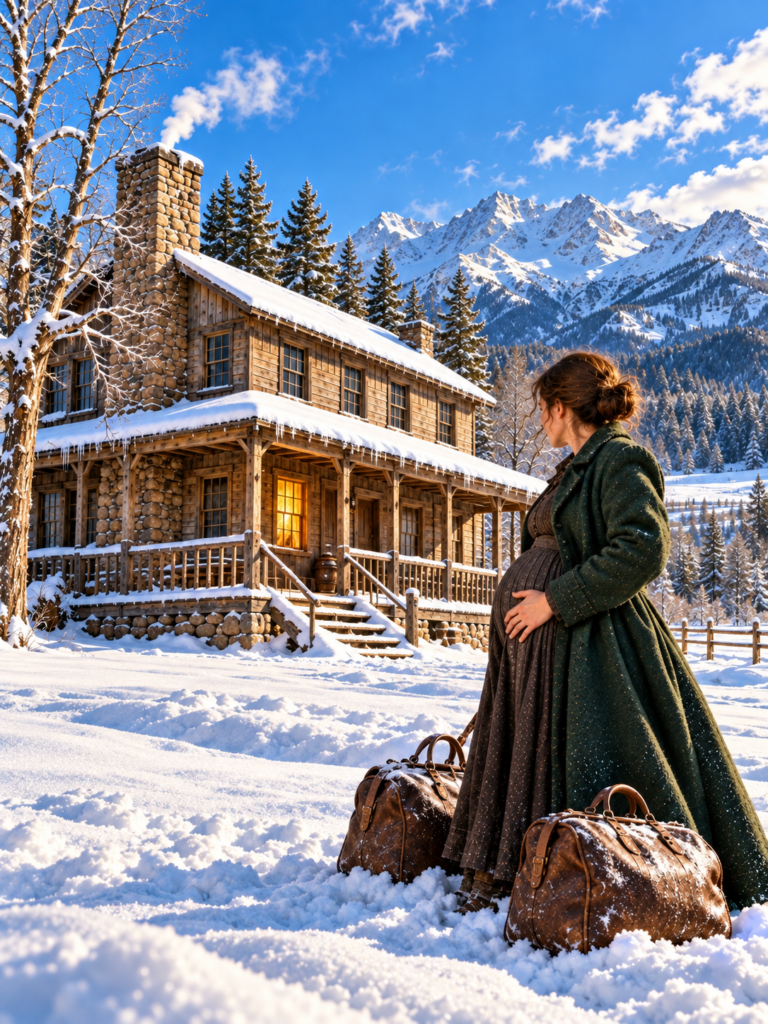
Susan went upstairs. When she returned, she was carrying Elizabeth’s two traveling grips.
She took them onto the porch and set them down carefully, away from the deepest snow.
Elizabeth watched her through the window.
That small consideration somehow made the entire thing worse.
Nobody had raised a voice. Nobody had called her names. They had simply decided that she no longer belonged there and behaved as though the matter were settled.
Elizabeth took the deed off the table, folded it once, and put it down again.
“I hope the extra rooms are worth what you’ve done,” she said.
Susan made no answer.
Elizabeth put on her coat, drew her shawl around her belly, and stepped outside.
The front door closed behind her.
For several seconds she stood motionless on the porch, snow collecting in her hair.
Then the baby moved sharply.
Elizabeth placed a hand against the movement.
“I know,” she whispered. “I’m frightened too.”
She carried her grips to the wagon herself.
By the time she managed to climb onto the seat, her back ached so badly that she had to close her eyes.
There were people in Rapid City who knew her. Women from church, neighbors, shopkeepers who had exchanged pleasant words with her for years.
But knowing someone wasn’t the same as having somewhere to go.
And she couldn’t bear the thought of knocking on another door and explaining what had happened.
She turned the mare east.
The road to Nelson’s Crossing was the only one left.
Her mother had been dead nine years. Her father had died just over a year earlier, and Elizabeth had not been a good daughter to him.
That was the thought that accompanied her out of town.
Not because she hadn’t loved him.
Because she had spent nine years expecting him to understand that love without her having to explain it.
After her mother died, Nelson had become a quieter man. He wrote less, visited less, and seemed to put greater distance between himself and his daughter with each passing season.
Elizabeth had interpreted his silence as indifference.
When she stopped visiting, he didn’t come after her.
She married Peter without her father present. She told herself that if Nelson truly cared, he would have made the journey.
The years passed that way, neither willing to take the first step toward the other.
Then, the previous January, a letter arrived.
Her father’s handwriting covered the envelope.
Elizabeth had put it above the washbasin, intending to open it when she had time to sit down and think about what to say in return.
Three days later, a man came to the door.
Nelson had been found dead in his kitchen, his coffee still warm on the stove.
She never opened the letter.
It was in one of her grips now, its edges softened by a year of being moved from one place to another.
She had carried it without reading it.
As though keeping it close could somehow undo the fact that she had left it unopened when he was alive.
The journey became more difficult after the first few miles.
Snow drifted across the wagon ruts, and the wind came over the open country without a tree or hillside to slow it.
Twice Elizabeth climbed down and led the mare through places where the wheels threatened to stick.
Her skirts became wet almost to her knees.
She talked to the baby to keep her courage.
“I spent summers out there when I was little,” she said. “Your grandfather had a fireplace big enough to stand in, or so it seemed to me then.”
She remembered him kneeling beside the enormous stone hearth, showing her how to build a proper fire.
She had been seven.
He arranged dry twigs carefully, leaving a little space between them.
“Why not put the big logs on first?” she’d asked.
“Because a little flame can’t carry all that weight.”
He had handed her a match.
“Thin wood first, Ellie. Give the fire some air. Then you can ask it to do the bigger work.”
She hadn’t remembered his voice so clearly in years.
By late afternoon the road was disappearing beneath the snow.
The sky darkened before she reached the river.
She was cold, hungry, and beginning to wonder whether her father’s old building would be any safer than the wagon.
Then her lantern caught the outline of a wooden sign.
NELSON’S CROSSING — 1868
The letters had been cut deep into the plank.
Elizabeth stopped.
For six years she’d been Mrs. Hartley.
Now the Hartleys had put her outside, and the only remaining place in the territory where her name belonged was this abandoned house bearing the name she’d been born with.
She urged the mare onward.
The long building stood on a low rise above the river, its wide porch buried in snow. Two cottonwoods lifted their bare branches beside it.
No light showed in the windows.
The old stable was dark.
Elizabeth put the mare under shelter and saw to her as best she could before carrying her grips to the house.
The key her father’s lawyer had given her was still attached to her ring.
She worked it into the lock.
For one frightening moment it refused to turn.
Then the door opened.
Cold air met her.
The sort of cold that settles into wood and stone when nobody has lived in a place for a long time.
Elizabeth raised the lantern.
Long dining tables filled the main room. Chairs rested upside down on the tabletops. Sheets covered two armchairs beside the hearth, and dust lay over everything.
She remembered freight drivers stamping snow from their boots, her mother carrying platters from the kitchen, and her father’s voice rising over the noise as he warned men not to track mud onto the newly scrubbed floor.
The house seemed impossibly empty without them.
She moved toward the fireplace.
And stopped.
Beside the stone hearth was a neat stack of split firewood.
Dry wood.
Freshly prepared and arranged within easy reach.
Someone had taken the trouble to cut it short enough for the old fireplace.
On top rested a folded piece of paper.
Elizabeth set down her lantern and picked it up.
Two words were written on the outside.
For Ellie.
Her knees weakened.
Nobody had called her Ellie since her father.
She lowered herself onto the hearth and unfolded the note.
If you’re reading this, you came back.
Get warm before anything else.
The wood is dry.
There are matches in the blue tin on the mantel.
Elizabeth read the four lines twice.
There was no apology. No long expression of regret.
Only instructions for building a fire.
And yet her father had somehow known that if she returned to this house, the first thing she might need was warmth.
The blue tin sat exactly where he’d said.
The first match broke between her cold fingers. The second went out.
The third caught.
She crouched beside the hearth, arranging the kindling as Nelson had taught her.
Thin wood first.
A little air.
Then the heavier pieces.
The flames crept upward.
She stayed on the floor until the fire had taken hold, watching the frost along the nearest window begin to soften.
Eventually she pulled a sheet off one of the chairs, wrapped it around herself, and ate the bread and boiled eggs she’d brought from town.
The baby shifted beneath her ribs.
“We made it,” Elizabeth murmured.
She had promised herself nothing beyond one night.
One night with a roof overhead.
One night without anyone asking her to leave.
But long after midnight, the unfamiliar sounds of the empty house kept her awake.
The beams creaked as they warmed.
The wind pressed against the shutters.
Then she heard something else.
Three faint taps.
A pause.
Another tap, followed by two more.
The sound came from behind the kitchen.
Elizabeth sat upright.
She told herself it was an old pipe or a loose board.
Still, she couldn’t ignore it.
She lifted the lantern and walked into the pantry.
There were shelves along both walls, with jars and rusty tins left from her father’s time.
At the back stood a large cupboard.
As she approached, she noticed something peculiar.
The floorboards near its right side were clean.
Not completely clean, but free of the settled dust covering everything else.
A curved mark showed where the cupboard had moved across the floor.
Elizabeth held up the lantern.
The tapping came again.
She grasped the cupboard’s edge.
It moved reluctantly.
She shifted it a few inches, rested, and then pushed again, careful not to strain her aching back.
Behind it was a narrow wooden door with an old brass handle.
Elizabeth stared.
She had spent childhood summers exploring this house. She knew where her father kept peppermints and which staircase boards complained under a person’s weight.
She had never seen this door.
The handle turned.
Beyond it, stone steps disappeared into darkness.
A cool, dry smell rose from below.
Stone.
Cedar.
Old paper.
“Elizabeth Hartley,” she said aloud, “this is a foolish thing to do.”
Then she took the lantern and descended.
The steps ended in a small underground room lined with riverstone.
Shelves covered three walls. Wooden boxes filled the spaces beneath them, and an old desk stood in one corner.
There were books everywhere.
Not novels.
Ledgers.
Elizabeth lifted one from the nearest shelf.
On its cloth cover were the words:
Nelson’s Crossing Register, 1876–1880.
She opened it.
Dates. Names. Room numbers. Charges.
Everything recorded in her father’s careful handwriting.
She turned the pages, remembering how strictly Nelson had kept accounts. He weighed coffee, counted nails, and saved bits of string that might be useful again.
Then she noticed a strange entry.
Room 12. No charge.
Farther down:
Room 12. No charge.
On the next page, the same thing appeared twice.
Beside many of these entries, two letters had been written in the margin.
NC.
Elizabeth moved closer to the lantern.
In several places her father had added notes.
Woman with two boys. Keep them until the road clears.
Lost his team at the ford. Feed him twice.
Arrived after midnight. Ask no questions.
She opened another ledger.
More names.
More stays in Room 12.
More entries marked NC.
Hundreds of them, extending across years.
Elizabeth sat in her father’s chair and tried to understand.
Nelson had been cautious with money all his life.
Yet these books suggested that someone had paid to keep one room available for people traveling the road with nothing.
Perhaps a wealthy freight operator had arranged it.
Perhaps some generous stranger had made an agreement with her father.
Whoever it was, the arrangement had lasted nearly twenty years.
And her father had said nothing about it to her.
She found herself unexpectedly angry.
He had devoted years to helping strangers, apparently arranging beds and meals for people whose names she didn’t recognize.
But he hadn’t once come to Rapid City and knocked on her door.
She closed the ledger.
That was when she noticed the wooden box under the desk.
It was about the size of a bread pan, tied with an old cord.
One word was written on its lid.
Ellie.
She crouched beside it for a long time.
Then she lifted it carefully.
Whatever was inside, she couldn’t bear to open it underground in the middle of the night.
She carried the box upstairs, returned to the fireplace, and lay down beneath the sheet.
Sleep took her almost immediately.
Morning arrived beneath a low gray sky.
Elizabeth rekindled the fire, melted snow for water, and placed the wooden box on the floor near the hearth.
The cord loosened easily.
Inside were photographs.
The first showed a little girl with missing front teeth, squinting angrily at the camera.
Herself.
Another photograph showed her at fourteen holding a large catfish.
Behind her stood Nelson, his head thrown back in laughter.
Elizabeth studied his face.
She had forgotten that he could laugh like that.
Under the photographs lay a stack of birthday cards.
One for her twenty-fifth birthday.
Another for her twenty-sixth.
And more after those.
Each signed in her father’s familiar hand.
None mailed.
Beneath the cards were unfinished letters.
She opened one.
Ellie, I nearly wrote you tonight, but I suppose you have enough to carry without hearing from an old man who doesn’t know what to say.
Another began:
I heard you were married last spring. I wish I’d known before it happened. I hope that fellow understands what he has been given.
Elizabeth remembered telling herself that her father didn’t care enough to attend her wedding.
Now she sat among years of proof that he had thought about her far more than she’d imagined.
She read every letter.
Some were long.
Others ended after a sentence or two.
Each seemed to begin with the same intention: to say something loving.
And each stopped just short of it.
At the bottom lay a final envelope.
Dated January 14.
Three days before Nelson died.
Elizabeth’s breath caught.
She went to her grip, found the unopened letter she’d carried for a year, and examined the postmark.
January 14.
He had written twice on the same day.
One letter he’d sent.
The other he’d left behind.
Her hands shook as she opened the one that had waited so long above her washbasin.
Ellie,
I’m going to speak plainly because I don’t believe I have much time left.
Since your mother died, I haven’t known how to be useful to you. I thought leaving you alone was what you wanted. Lately I’ve wondered whether I got that wrong.
Maybe I should have hitched the team and come to Rapid City. Maybe I should have stood at your door until you opened it.
Elizabeth pressed the paper against her chest.
For nine years, that had been precisely what she wanted.
She opened the second letter.
It was shorter.
I’m not asking you to forgive everything I did poorly.
I only want you to know that there is a room in this house that belongs to you.
It will always be yours.
She read the words again.
Her father had given her a place to return to.
And she had spent a year refusing to read the invitation.
Elizabeth bent forward, as far as her belly would allow, and began to cry.
Not the composed tears she’d shed at Nelson’s funeral.
These came from somewhere deeper.
From all the Christmases when she had waited for a card, all the Sundays she’d considered writing, all the conversations that had remained unfinished because two proud people mistook silence for protection.
Eventually the baby kicked.
Elizabeth rested a hand over her daughter.
“I won’t do that to you,” she whispered.
Her voice trembled.
“I won’t make you spend your life guessing whether I love you.”
She looked at the unopened birthday cards scattered around the hearth.
“I’ll tell you. Even when I’m angry. Even when I don’t know how.”
A knock sounded at the front door.
Three hard blows.
Elizabeth stiffened.
It wasn’t yet eight in the morning.
Nobody in Rapid City knew she’d come here.
She rose slowly and opened the door a few inches.
A short, sturdy woman stood on the porch wearing an oversized wool coat. She carried a covered pail and a flour sack.
Her eyes traveled from Elizabeth’s face to her pregnant belly.
“You’re Nelson’s girl.”
Elizabeth tightened her grip on the door.
“Who told you I was here?”
The woman nodded toward the chimney.
“Your smoke did.”
She raised the pail.
“Coffee. And I’ve brought bacon and biscuits.”
Then she stepped closer.
“Adeline Norris. I run the eating house over in Grindstone.”
She glanced into the room.
Her expression changed when she noticed the open ledger beside the fireplace.
“You found his books.”
Elizabeth nodded.
Adeline removed her gloves slowly.
“Well,” she said, “then I believe there’s something about your father you need to understand.”
Part 2
Adeline Norris came inside without waiting to be invited.
She placed the coffee beside the hearth, unwrapped the biscuits, and looked around the long dining room with the familiarity of someone who had once spent a great deal of time there.
Elizabeth watched her.
“Did you know my father well?”
Adeline gave a small, crooked smile.
“Well enough to know he would’ve complained about the state of this roof before he asked whether you’d eaten breakfast.”
She poured coffee into two cups and held one out.
Elizabeth accepted it gratefully.
“I found a room beneath the pantry,” she said.
“Your father kept his private books down there.”
“There are entries in those books I don’t understand.”
Adeline settled into a chair.
“Which entries?”
“Room Twelve.”
The older woman’s expression softened.
Elizabeth retrieved the ledger and opened it to a marked page.
“Look here. These people stayed without paying. Hundreds of people, across almost twenty years. And beside their names, there’s this.”
She pointed.
“NC.”
Adeline examined the entry.
“Yes.”
“Who was he?”
“Who was who?”
“The person who paid.”
Adeline looked up.
Elizabeth felt a rush of embarrassment, but she couldn’t stop.
“My father counted every penny. He charged freight drivers for feed, for meals, for a dry bed. He couldn’t have kept one room available all those years without somebody paying him.”
Adeline said nothing.
“Was it a man from Pierre? Someone connected with the freight companies?”
“No, honey.”
“Then what does NC stand for?”
Adeline turned the ledger around and rested her fingertip beside the two letters.
“No charge.”
Elizabeth waited for the explanation to continue.
It didn’t.
“No charge?”
“That’s what he wrote.”
“But who settled the bill?”
“Nobody.”
Elizabeth frowned.
Adeline leaned back.
“Your father kept that room for people who came to his door with empty pockets. Sometimes they stayed one night. Sometimes they stayed until a road opened or a wagon could be repaired. He fed them, warmed them, and sent them on their way when they were ready.”
“Without payment?”
“Not a cent.”
Elizabeth looked at the dates.
There were hundreds.
“But he was always so careful with money.”
“He had to be. Keeping a place like this running wasn’t cheap.”
“Then why would he do it?”
Adeline’s gaze moved toward the fireplace.
“Because he knew what happened to people who had nowhere to go.”
She fell quiet, studying the worn boards.
“I came up this road thirty-one years ago,” she said. “I had eleven dollars in my pocket, a black eye, and a little boy sleeping in the back of my wagon.”
Elizabeth lowered the ledger.
“I didn’t know that.”
“Most people don’t. And I prefer it that way.”
Adeline adjusted her hands around the warm coffee cup.
“I’d left my husband. I had nowhere sensible to go, and I was frightened of every man I passed along the road. By the time I reached the crossing, my boy was hungry and I could hardly see straight from being awake so long.”
She gave a short laugh without amusement.
“I asked your father how much he wanted for a room. He looked at my face, then at the boy, and handed me a key.”
“What did he say?”
“He told me to get my son warm. Said we could worry about tomorrow when it came.”
Elizabeth stared at her.
“He never asked why I was traveling alone. Never asked where my husband was. And when I tried to give him money, he told me to put it away.”
Adeline’s voice thickened.
“I’ve never forgotten that.”
She glanced at the open ledger.
“People around here called it the mercy room. Your father hated the sound of charity. Said it made decent people feel they had to bow their heads for needing help.”
“So he wrote ‘no charge.'”
“Exactly.”
Elizabeth ran her fingers along the edge of the page.
She remembered the notes she’d read in the cellar.
Woman with two boys.
Lost his team.
Ask no questions.
Those weren’t the records of some anonymous benefactor.
They were instructions Nelson had written for himself.
Small decisions made over and over, year after year.
Elizabeth felt ashamed of how quickly she’d assumed that a stranger must have provided the money.
“My father never told me.”
“Your father was a complicated man.”
Adeline looked at her directly.
“He could argue over the cost of a pound of flour until a storekeeper wanted to throw him out. And then he’d feed a family for a week and act offended if anyone thanked him.”
Despite herself, Elizabeth smiled.
“That sounds like him.”
“He wasn’t always easy to love, was he?”
Elizabeth shook her head.
“No.”
“He wasn’t always easy for other people either.”
Adeline paused.
“But there are people living in this valley today because Nelson opened a door when they had no other one left.”
Elizabeth looked at the letter near her chair.
There is a room in this house that belongs to you.
She had thought those words meant that her father had reserved something special for his daughter.
Now she was beginning to understand that he had been making the same promise to desperate strangers for years.
“Where is Room Twelve?” she asked.
“At the far end of the upstairs hall.”
Adeline’s face softened again.
“He kept it ready until the week he died. There’s something in there I believe he wanted you to see.”
Elizabeth took the stairs alone.
She moved slowly, one hand gripping the banister, the other supporting the weight of her belly.
The upper hallway stretched the length of the house.
Eleven doors stood along it.
The final door, near the north end, carried a tarnished brass number.
12.
She remembered her childhood in the crossing. Guests arriving in the night, unfamiliar voices beyond closed doors, blankets being carried up and down the stairs.
But this room had always seemed separate from the rest.
She turned the knob.
Inside stood a narrow bed beneath the window, a dresser, a rocking chair, and a small iron stove.
Two quilts were folded at the foot of the bed.
Kindling had been arranged carefully in the stove.
Thin pieces first.
A little pocket of air.
Elizabeth crossed the room.
On the bedside table stood an old lamp and a framed photograph.
She lifted the frame.
Her father stood outside Nelson’s Crossing, broad-shouldered and squinting in the sunlight.
A small girl sat high on his shoulders, gripping his hair and smiling as though she possessed the entire world.
Elizabeth remembered the day.
She had demanded that he carry her because the ground was muddy. He had complained about spoiling a perfectly good coat, then lifted her without another word.
On the back of the photograph, in pencil, he’d written:
My Ellie.
The one thing I never did get wrong.
Elizabeth lowered herself into the rocking chair.
For years she had measured her father’s love by the conversations they hadn’t had.
Now she was surrounded by evidence of what he had managed to say through work, through wood kept dry, through beds prepared for people who couldn’t pay.
It didn’t erase the loneliness.
She still wished he’d come to her wedding.
Still wished he’d visited when Peter was ill.
Still wished he’d told her plainly that he missed her.
Knowing that someone loved you didn’t undo the damage of believing for years that they didn’t.
But it changed the shape of the memory.
She rested the photograph against her belly.
“I missed you too, Papa.”
Then she noticed the window frame.
Names had been carved into the soft pine around it.
Dozens of names.
Initials.
Dates.
Brief messages scratched by knife points and nail tips.
Thank you. 1874.
Made it to Oregon.
The children are well.
Near the bottom, where someone had taken particular care, was a longer message:
I came here with nothing, and I left believing I could start again.
Elizabeth traced the letters.
Yesterday she had believed that being turned out of the Hartley house meant she’d lost everything.
But the woman who had come up this road with two grips wasn’t worthless because someone had refused her a room.
The Hartleys had taken a roof from her.
They hadn’t taken her ability to build a life beneath another one.
She looked down at her wedding ring.
Slowly, she worked it over her swollen knuckle.
She didn’t hate Peter.
Whatever his reasons for signing away the house, he had been ill and frightened, and she would never have the opportunity to ask him why he’d done it.
But she could stop treating his family’s judgment as the final word on her own worth.
She placed the ring beside the photograph.
Then she rose, folded one of the quilts more neatly, and went downstairs.
Adeline was waiting by the fire.
Elizabeth stopped beside the table.
“I’m not selling this place.”
Adeline raised her eyes.
Elizabeth swallowed.
“I don’t know how I’m going to afford to keep it. I don’t know what it will cost to repair the roof. But I’m not selling Room Twelve.”
For a moment, Adeline said nothing.
Then she smiled.
“Your father used to talk that way.”
Elizabeth placed a hand over her daughter.
“No,” she said softly. “That was me.”
The next several days taught her how far conviction could carry a person.
And how much farther a person still had to walk.
The north end of the roof leaked whenever snow melted against the shingles. Two front windows refused to close properly. The well froze twice, leaving Elizabeth struggling to get enough water for herself and the mare.
The kitchen stove smoked when the wind came from the river.
She used rags to block the worst drafts and shifted furniture away from the leaking ceiling.
Every repair revealed another.
Then the county notice arrived.
Sixty-one dollars in overdue taxes.
Due by April first.
Elizabeth counted her money twice.
Forty dollars.
That was everything she had.
And the baby was due in three weeks.
She set the coins and the notice on the table, trying to calculate how many meals she could afford before she ran out of money entirely.
Two days later, the mail rider brought another letter.
This one came from a land company in Pierre.
There was talk of a railroad spur following the river. The flat above the ford might become a valuable shipping point, and the company wanted to acquire the crossing before spring.
They offered two thousand dollars.
Cash.
A quick transaction, completed before the roads became muddy.
Elizabeth sat at the table a long time.
The offer was fair.
That was what made it so difficult.
Two thousand dollars would clear the taxes, pay for comfortable lodging in Rapid City, and give her several years in which to raise her child without constantly worrying about money.
She imagined a little rented house.
A stove that worked.
Clean water.
A dry roof.
No endless nights listening for a child to cry while the wind came through broken windows.
She could have all of it.
All she had to do was sign.
Elizabeth folded the letter and placed it on the mantel beside her father’s blue tin.
She didn’t sign.
The following morning, the sound of wagon wheels woke her.
An older man was climbing down in the yard, carrying a toolbox.
He was past sixty, with gray in his beard, a heavy coat worn through at the elbows, and the stiff movements of someone whose joints had survived more winters than they appreciated.
He looked at Elizabeth.
“Nelson’s girl?”
“Yes.”
“Curtis Kimble.”
He glanced at the roof.
“Your father and I argued about this place for thirty years.”
“About what?”
“How to fix things.”
“Who was usually right?”
“I was.”
Elizabeth almost laughed.
Curtis shifted the toolbox.
“He’d tell you different.”
He walked through the building, examining windows, pipes, loose boards, and the old kitchen stove.
Elizabeth followed him, growing increasingly nervous.
He climbed into the attic, inspected the roof, and came down covered in dust.
Finally he set his tools on the dining table.
“Well,” he said, “it’s bad.”
Elizabeth felt her stomach sink.
Curtis rubbed his beard.
“But bad isn’t the same as finished.”
He opened his box, selected a claw hammer, and held it out.
“Ever used one?”
“Not properly.”
“Good. Won’t have to unteach you anything.”
He showed her how to hold it, where to place a nail, and how to strike without wasting effort.
When he left that afternoon, he said he’d be back.
Elizabeth assumed he meant eventually.
He returned the next morning.
This time, he wasn’t alone.
Adeline arrived with covered dishes and a crate of baby clothes.
Behind her came a freighter named Gus, whose wagon was piled with lumber.
Then another wagon.
And another.
Before noon, nine outfits filled the yard.
Men climbed ladders with shingles and hammers. Someone unloaded stovewood. Another began repairing the kitchen pipes.
An older couple brought preserved fruit.
Curtis took charge of the roof with the authority of a man who had been waiting years to fix it properly.
Elizabeth stood on the porch, bewildered.
“I can’t pay you!”
Nobody stopped working.
She tried again.
“I mean it. I don’t have the money.”
Adeline came up beside her.
“We know.”
“Then why are they here?”
Adeline pointed toward Gus.
“He lost his lead team at the ford during the winter of eighty-two. Your father fed him and his men for nine days.”
She nodded toward the elderly couple stacking wood.
“They got lost in a storm. Nelson went looking for them after midnight and brought them here by lantern light.”
Elizabeth turned toward the roof.
“And Curtis?”
“Curtis has his own reasons.”
Adeline took her arm.
“Half these people slept in Room Twelve at some point. The others remember someone who did.”
“But I can’t give them anything.”
“Honey, they’re not asking for anything.”
Adeline looked across the yard.
“Your father settled his accounts with these folks years ago.”
Elizabeth turned away before the men could see her crying.
For nine days, the crossing came back to life.
She couldn’t climb ladders in her condition, but she worked where she could.
She scrubbed floors, washed windows, painted boards within reach, and learned how to use putty to seal a cracked pane.
Neighbors carried in useful things without expecting thanks.
A repaired rocking chair.
A basket of food.
An old cradle that Curtis strengthened with a piece of hickory.
Elizabeth listened as people told stories about her father.
Not grand stories.
Small ones.
A meal offered to a stranded driver.
A blanket brought to a sick child.
A wagon wheel repaired after dark.
Most of the people who told them hadn’t known one another when Nelson helped them.
They had simply remembered.
Elizabeth had wondered whether some secret fortune was hidden beneath the house.
There wasn’t.
No chest of money. No gold concealed behind a wall. No papers promising wealth beyond anything she’d imagined.
What her father left behind was much harder to count.
People who remembered what he’d done when nobody else was looking.
On the ninth evening, Curtis called her into the main hallway.
He was standing near the front desk, holding a dusty envelope.
“Found this behind a loose partition board.”
Elizabeth saw the handwriting.
Ellie.
She opened it carefully.
Inside was a single folded sheet and a brass key.
The number 12 had been stamped into its head.
Her father’s letter contained one sentence.
If you mean to keep that door open, don’t try to carry it by yourself.
Elizabeth closed her hand around the key.
For most of her adult life she had believed that asking for help was another way of admitting she had failed.
Her father’s words made her look differently at the nine days just passed.
He hadn’t expected her to save the crossing alone.
He had spent twenty years making certain that, when the need came, she wouldn’t have to.
Three days later, a black buggy turned into the yard.
Elizabeth recognized it before the driver climbed down.
Robert Hartley.
Curtis was repairing a window when he saw the buggy.
He straightened.
“Want me to stay nearby?”
Elizabeth looked at her brother-in-law.
She remembered the kitchen in Rapid City.
The deed.
Her grips standing in the snow.
The way Robert had studied the floor rather than speak for her.
“No,” she said. “I can manage this.”
Robert approached the porch.
His eyes moved over the fresh shingles, the repaired windows, and the wagon tracks in the yard.
Then he looked at Elizabeth.
“You look tired.”
She waited for him to say something else.
He didn’t.
“What do you want, Robert?”
“I heard about the offer from Pierre.”
Elizabeth felt an old, familiar disappointment.
Not a question about her health.
Not a question about the baby.
The land.
“Yes,” she said. “There’s been an offer.”
“Two thousand dollars is more than that place is worth.”
“Perhaps.”
“You should take it.”
“I’ve decided not to.”
Robert glanced at the old building.
“You can’t run something this size with an infant.”
“I’ll work out what I can do.”
“You’d be better off selling and finding somewhere decent in town.”
Elizabeth folded her hands over her belly.
“Better for whom?”
“Elizabeth, don’t be unreasonable.”
“I’m asking a question.”
Robert drew a breath.
“The family has an interest in seeing you properly settled.”
She looked at him.
“The family?”
“Mother and I are concerned.”
“Where was that concern when she put my bags on the porch?”
Robert shifted his weight.
“You know how upset Mother was.”
“Yes. I know exactly how upset she was.”
“She was thinking about the future.”
“So was I.”
He looked toward the yard.
“There’s no need to turn this into an argument.”
Elizabeth spoke quietly.
“When your mother told me there was no longer room for me, I looked at you.”
Robert’s expression tightened.
“I remember.”
“I gave you time to say something.”
“Elizabeth—”
“You said my name. That was all.”
He lowered his gaze.
She had waited months to understand what hurt most about that morning.
It wasn’t Susan’s coldness.
Susan had made her decision plainly enough.
It was Robert’s silence.
He had allowed her to believe that she might still matter to someone in that house, and then stood by while she was put outside.
“That was her decision,” Elizabeth said. “But doing nothing was yours.”
Robert looked uncomfortable.
“You’re being unfair.”
Elizabeth reached into her coat pocket.
That morning she’d gone into Room Twelve and retrieved Peter’s wedding ring from the bedside table.
She had carried it downstairs without fully understanding why.
Now she opened her hand.
“Give this to your mother.”
Robert stared at the ring.
“Elizabeth…”
She placed it in his palm and closed his fingers around it.
“You didn’t come looking for me when I had nowhere to sleep.”
Robert’s face reddened.
“That’s not the same thing.”
“No,” Elizabeth said. “It isn’t.”
She stepped toward the doorway.
“But don’t come looking for me now because someone has decided this place is worth money.”
Robert made no answer.
She went inside and closed the door.
Not violently.
Not to punish him.
Simply because the conversation was finished.
For the first time in six years, a member of the Hartley family stood outside a door that Elizabeth had chosen to close.
She leaned her back against it.
Her hands were trembling.
She wasn’t triumphant.
She was frightened, exhausted, and still unsure how she would keep the crossing operating once her daughter arrived.
But she hadn’t let Robert make the decision for her.
Across the room, Curtis resumed working on the window.
He didn’t ask what happened.
Elizabeth was grateful.
Outside, the afternoon sky had darkened.
By evening, snow was running sideways through the yard, and the wind had become strong enough to shake the repaired shutters.
Elizabeth laid another log on the fire.
Then someone struck the front door three times.
She looked up sharply.
For one instant she thought Robert had returned.
But beneath the wind she heard a different sound.
A child crying.
Part 3
Elizabeth opened the door.
A young woman stood on the porch with snow tangled in her hair. Her lips had turned pale blue, and she was holding a little boy against her side.
He couldn’t have been more than five.
His thin coat was wet, and his small hands gripped the woman’s skirt.
“Our wagon went off the road,” she said.
Her voice shook so badly that Elizabeth could barely understand her.
“Down below the ford. The wheel went into a washout. We saw your light.”
The child began crying harder.
His mother looked past Elizabeth into the warm room.
“I haven’t got much money,” she whispered. “How much would you want for a bed?”
Elizabeth looked at the woman.
For a moment she saw herself on Susan Hartley’s porch.
Two grips in the snow.
A baby beneath her heart.
A closed door behind her.
Then she remembered Adeline Norris arriving at this same crossing thirty-one years earlier with eleven dollars and a sleeping boy.
She thought of her father putting a key into a frightened woman’s hand.
And suddenly she understood that the choice in front of her was much simpler than all the decisions that had occupied her thoughts for weeks.
“Come inside,” Elizabeth said.
The woman hesitated.
“I don’t know if I can pay.”
“You don’t owe me anything.”
Elizabeth stepped aside.
“There’s a room upstairs. It’s yours for as long as you need it tonight.”
The young woman’s eyes filled.
She brought the boy over the threshold.
Curtis appeared from the back of the house, took one look at their clothes, and went outside to bring in more firewood.
Elizabeth found dry blankets.
She warmed soup on the stove and set two bowls on the table.
The woman told her that her name was Maddie. Her son was Davey.
They had been traveling along the Fort Pierre Road when their wagon struck the washout. In the darkness and snow, Maddie had been unable to get it free.
She had seen the crossing’s chimney and followed the faint light through the storm.
Davey ate his soup quickly, both hands wrapped around the bowl.
Maddie tried to make hers last.
Elizabeth noticed and brought the pot back.
“There’s more.”
Maddie looked embarrassed.
“I don’t want to take too much.”
“Then don’t worry about how much you take,” Elizabeth said. “Eat until you’re warm.”
Later, after the child had grown sleepy, she showed them upstairs.
Room Twelve was small, but the bedding was clean, and the stove held a good fire.
Davey climbed beneath the quilts.
Maddie stood just inside the doorway, looking at the bed as though she expected someone to change their mind.
“Are you sure?”
Elizabeth nodded.
“Rest. We’ll see what can be done about your wagon in the morning.”
Maddie pressed her lips together.
“Thank you.”
Elizabeth remembered Adeline telling her how her father disliked being thanked for things he believed people should never have been denied.
“Good night, Maddie.”
She left the key on the bedside table.
Downstairs, the fire had settled into a steady glow.
Curtis was repairing an old hinge beside the hearth.
“Got them comfortable?” he asked.
“Yes.”
He nodded and returned to his work.
Elizabeth stood looking at the flames.
For the first time since coming to the crossing, she no longer thought of Room Twelve as an obligation she’d inherited.
It was a promise she had chosen to keep.
Her father had opened that door to people whose names he might never know.
Now she had done the same thing.
And while the house still needed repairs, while the taxes were still unpaid, and while she had no certainty about what life would look like once the baby arrived, she felt something she hadn’t felt in months.
That she was exactly where she ought to be.
The pains began on a Thursday evening.
Elizabeth was carrying a pot of soup from the stove when a sudden tightness caught low in her belly.
She stopped.
Waited.
When it passed, she set the pot carefully on the table.
Curtis was sitting nearby with a broken hinge across his knees.
He looked up.
“What’s wrong?”
“Nothing. I think I just moved awkwardly.”
She tried to smile.
Then another pain came.
Stronger.
She gripped the table.
Curtis put down the hinge.
“Elizabeth?”
She closed her eyes until the tightening eased.
When she opened them, he was already reaching for his coat.
“Don’t go climbing about,” he said. “I’m fetching Adeline.”
He was out the door before she could argue.
A moment later, she heard his horse heading up the river road.
Elizabeth lowered herself into a chair.
Her baby wasn’t supposed to come for another three weeks.
She looked at the room around her.
The repaired windows.
The clean tables.
The old fireplace.
Then she looked toward the front door.
Outside was a blizzard.
The road to Grindstone had been nearly impassable earlier that afternoon.
She was afraid.
Not only of the pain, but of everything that might happen if the baby came here, far from a doctor, with snow closing off the road.
She put her hands over her belly.
“Not yet,” she whispered.
Another pain took her breath away.
She gripped the edge of the chair.
And waited.
Adeline arrived forty minutes later with snow clinging to her skirt.
She came through the door, removed her gloves, and went straight to Elizabeth.
“How far apart?”
Elizabeth shook her head.
“I haven’t counted properly.”
“All right. We’ll count together.”
Adeline knelt in front of her and took both her hands.
“We need to get you to the doctor in Grindstone.”
“The road…”
“I know what the road looks like.”
“We can’t get through.”
Adeline held her gaze.
“Elizabeth, look at me.”
She waited until Elizabeth did.
“You aren’t going to face this by yourself.”
Outside, voices sounded.
Elizabeth turned toward the window.
Lanterns appeared in the yard.
One.
Then another.
Then five more.
Curtis hadn’t gone only for Adeline.
He had ridden down the road, calling on the freight drivers and neighbors whose names Nelson had once recorded in his ledgers.
Men were bringing teams.
Scrapers.
Shovels.
Wagons.
They were going to clear the eight miles to Grindstone.
The very road on which Nelson had found travelers stranded in storms was now filled with people working to bring his daughter to safety.
Elizabeth stood at the window with Adeline supporting her.
Through the blowing snow, she could see lanterns swaying as men worked ahead of the wagon.
A narrow path gradually opened.
Curtis came inside, brushing ice from his shoulders.
“We’ve got a team ready.”
Elizabeth looked at him.
“All those people…”
He avoided her eyes.
“Road needs clearing anyway.”
She might have laughed if she hadn’t been close to tears.
He helped her outside.
Adeline climbed into the wagon beside her, carrying blankets and holding tightly to Elizabeth’s hand.
They started toward Grindstone.
The journey was slow.
The wind drove snow against the wagon covers. Every uneven stretch of road sent pain through Elizabeth’s back, and more than once she wondered whether she could endure another mile.
But ahead of them the lanterns kept moving.
Men she recognized from the repairs were working in the darkness.
Gus stood beside a team, calling instructions.
Others shoveled snow away from a drift that had swallowed the road.
Nobody was asking for payment.
Nobody was asking whether this woman deserved the trouble.
They were simply making a way through.
Elizabeth began to cry.
Adeline tightened her grip.
“What’s wrong, honey?”
“My father…”
She couldn’t finish.
Nelson had been dead for more than a year.
Yet the good he’d done was still traveling this road.
It was still finding people.
Still bringing them home.
Halfway to Grindstone, another powerful contraction bent Elizabeth forward.
“I can’t do it,” she gasped.
Adeline drew her closer.
“You don’t have to do the whole thing at once.”
“It hurts.”
“I know.”
“I’m frightened.”
Adeline touched her cheek.
“Your father spent half his life making sure nobody around here reached the end of their rope alone. We’re not going to start leaving people alone with his own daughter.”
Elizabeth leaned against her.
Outside, the lanterns continued forward.
And somewhere beneath the sound of the wind, Elizabeth remembered her father kneeling beside the great stone fireplace.
Thin wood first, Ellie.
Give the flame some air.
Then let it grow.
She closed her eyes.
Another pain came.
She held on.
And when it passed, she opened them again.
They reached Grindstone, where the doctor was waiting.
Elizabeth’s daughter was born a little before sunrise.
She arrived angry and loud, with a face red from the effort of coming into the world.
The doctor placed her against Elizabeth’s chest.
For several seconds Elizabeth could do nothing but look at her.
Ten tiny fingers.
Dark hair damp against her head.
A little mouth opening and closing in protest.
She was real.
After the long months of grief, uncertainty, and fear, here was the child Elizabeth had carried through all of it.
“Hello,” she whispered.
The baby moved against her.
Elizabeth stroked her cheek.
“There are so many things I want to tell you.”
Her eyes filled with tears.
“I suppose I’d better start now.”
She bent down.
“I love you.”
She said it clearly.
No holding back.
No assuming the child would understand someday.
No leaving the most important words unwritten.
Adeline stood beside the bed, wiping her eyes with the corner of her apron.
“What are you going to call her?” she asked.
Elizabeth looked at her daughter’s face.
“Helen.”
After her mother.
Adeline smiled.
“Helen Nelson’s granddaughter.”
Elizabeth nodded.
“Yes.”
She kissed the child’s forehead.
“And she’s going to know exactly how much she’s loved.”
Spring came late that year.
The river ice broke apart with a roar, and the roads gradually turned from frozen ruts into muddy tracks.
Curtis finished repairing the north roof.
Maddie and Davey continued their journey after the weather improved and their wagon could travel safely.
Elizabeth was glad she’d been able to give them a warm night without asking for anything in return.
Life at the crossing was not easy.
There were diapers to wash, fires to tend, food to prepare, and guests arriving at inconvenient hours.
Some days Helen cried while Elizabeth tried to finish her work, and some nights the little girl seemed determined to sleep only while being carried.
Adeline visited often.
Curtis came when something needed fixing, and sometimes when nothing did.
Elizabeth gradually learned which jobs could wait.
She also learned that the crossing could earn its keep without abandoning the promise her father had made.
Curtis suggested allowing freight outfits to leave their night teams at the property for a dollar a head.
The arrangement brought in enough money to pay the county the sixty-one dollars it was owed.
Elizabeth kept the tax receipt in the front desk.
She had looked at that amount during the winter and wondered whether it would force her to abandon everything.
Now it was paid.
Not by selling the crossing.
Not by accepting money from the Hartleys.
But by making the place useful again.
In May, Nelson’s Crossing reopened.
Freight drivers returned to the long dining tables.
Travelers brought stories from distant towns.
The kitchen stove burned throughout the day, and the old building filled with the sounds Elizabeth remembered from childhood.
She put a board beside the front desk listing the room prices.
Every guest room had a charge.
Except one.
Elizabeth took a small pine board upstairs and worked carefully with her tools.
Her lettering wasn’t particularly elegant.
Some cuts were deeper than others.
But when she finished, the sign said exactly what she wanted it to say.
THE MERCY ROOM
For anyone who needs one safe night before tomorrow.
She hung it beside the door to Room Twelve.
Then she stepped back.
The room looked almost exactly as it had when she first opened it.
Narrow bed.
Folded quilts.
Rocking chair.
A small iron stove with kindling ready.
The framed photograph still stood beside the lamp.
She had thought about moving it into her own room.
But she decided it belonged here.
Her father had wanted her to find it in this place.
Perhaps someone else might someday look at the photograph and understand why the room existed.
Downstairs, Elizabeth noticed something on the wall above the fireplace.
A wooden board had hung there since childhood.
She had passed it hundreds of times without giving its lettering much thought.
Now she stood beneath it and read the words her father had burned into the wood:
When a man comes in out of the cold, do not ask what he can pay. Ask what he needs.
She smiled.
“Well, Papa,” she whispered, “I think we’re managing.”
The house answered with the ordinary sounds of an old building settling around a fire.
Elizabeth returned to her work.
The following winter came with familiar cold.
Snow covered the low riverbanks and settled against the wooden sign at the turn.
Nelson’s Crossing remained open.
On a January evening, Elizabeth sat beside the great stone fireplace with Helen sleeping heavily against her shoulder.
The little girl had grown strong and lively, with a determined grip and a talent for making everyone in the house stop what they were doing.
Elizabeth studied her daughter’s sleeping face.
There were still things she wished her father could have seen.
Helen’s first smile.
The crossing filled with guests again.
The pine sign beside Room Twelve.
She wished she could tell him that she understood now.
Not everything.
There were questions he could never answer.
She still missed the years they’d lost.
And she still felt regret when she remembered the unopened letter.
But she no longer mistook the sadness for proof that they had failed to love each other.
She had learned that grief didn’t disappear just because you finally understood the person you had lost.
You simply learned to carry it with greater tenderness.
Helen stirred.
Elizabeth kissed her head.
“I love you,” she whispered.
The child settled again.
Then someone knocked.
Three quiet taps.
Elizabeth lifted her head.
For an instant the sound carried her back to the winter before, when she’d been alone in an empty house, frightened of what another day might bring.
She placed Helen gently into the cradle and crossed the room.
When she opened the door, a young woman stood beneath the porch lantern.
She couldn’t have been twenty-five.
Her coat was thin.
Snow was melting in her hair.
One hand rested protectively on her pregnant belly.
The other held the handle of a worn traveling grip.
Elizabeth stopped.
The woman looked exhausted.
Her face was pale, and she appeared to have used nearly all her courage simply reaching the door.
“I’m sorry,” the stranger said.
She glanced over her shoulder toward the dark road.
“I didn’t know anywhere else to go.”
For a moment Elizabeth couldn’t speak.
She saw a different porch.
A different winter.
Two grips standing in the snow.
She remembered the terrible loneliness of believing there wasn’t one person left who would make room for her.
She remembered arriving at Nelson’s Crossing and finding dry wood beside a cold fireplace.
Her father’s handwriting.
The hidden door.
The ledgers.
The names around the window.
The people who came to repair the house.
The lanterns moving through a blizzard to bring her daughter safely into the world.
All those lives connected by one man who had been unable to write a simple letter telling his daughter that he loved her.
Elizabeth looked at the young woman.
She couldn’t go back and answer her father’s letter while he was still alive.
She couldn’t recover their lost years.
She couldn’t change what the Hartleys had done.
But there was one thing she could do.
She reached forward and gently took the traveling grip from the stranger’s hand.
“Come inside.”
The young woman hesitated.
“I haven’t got any money.”
Elizabeth shook her head.
“You don’t need any tonight.”
The woman’s eyes filled.
“Are you sure?”
Elizabeth stepped aside, allowing the firelight to fall across the snowy porch.
“You and that baby are safe here.”
The young woman crossed the threshold.
Elizabeth closed the door against the wind.
Then she helped her new guest remove her coat and led her toward the warmth of the hearth.
Upstairs, at the end of the hall, Room Twelve was ready.
The quilts were folded.
The bed was made.
The kindling waited in the stove.
And beside the lamp stood a photograph of a little girl riding on her father’s shoulders.
Elizabeth knew that the crossing would never make her wealthy.
There would always be roofs to mend, wood to split, taxes to pay, and winter storms to endure.
She might never stop missing the father who had taught her how to build a fire.
But she had discovered something greater than the fortune she once imagined hidden beneath his house.
Nelson had left her a way of living.
A way of treating people.
A way of making certain that even someone who arrived with nothing could leave believing tomorrow might be better.
And now Elizabeth could pass that inheritance to her daughter.
Not through papers or deeds.
Not through money.
But through the small, repeated decision to leave a place for someone who needed it.
The fire in the great stone hearth burned steadily.
Outside, snow gathered against the porch.
And inside Nelson’s Crossing, a frightened young mother found the same welcome that had been waiting for Elizabeth a year earlier.
The mercy room remained open.
The brass key was where it belonged.
And the fire her father had started, so many years before, was still burning.