
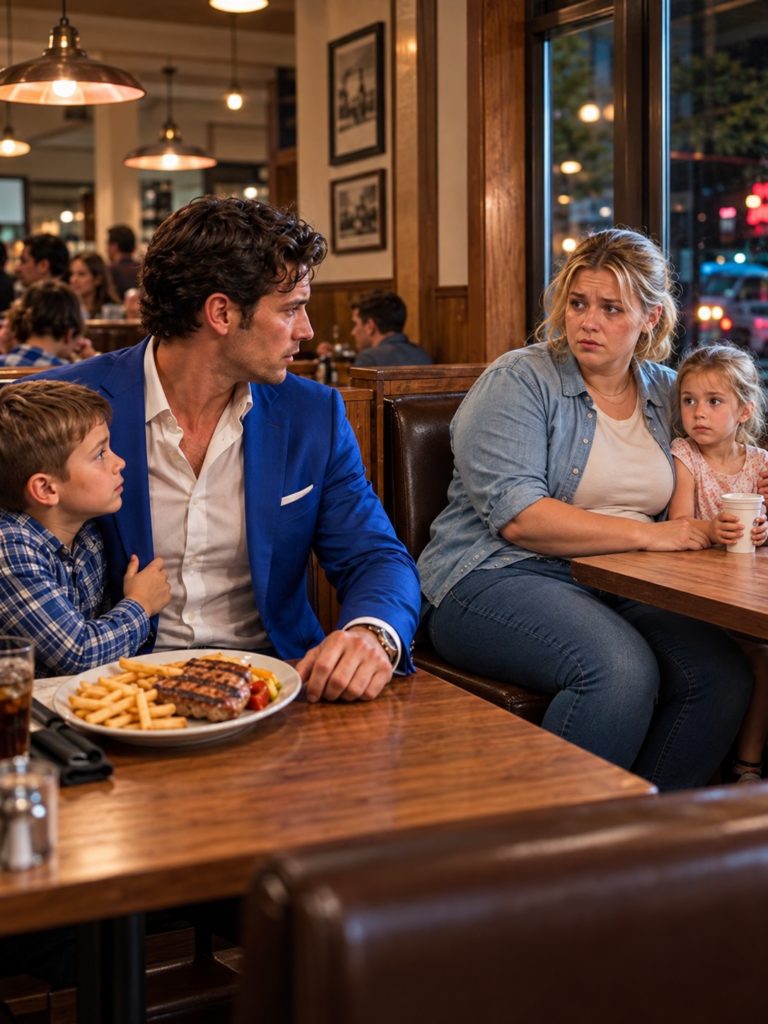
Part 1
The question was so quiet Daniel Hayes almost missed it.
“Dad… can they eat with us?”
Daniel had been reaching for his water when his seven-year-old son spoke. His hand stopped halfway across the table.
“What?”
Noah did not repeat himself immediately. He was staring past Daniel’s shoulder toward the far side of the restaurant, where evening light pressed softly against the windows and every table seemed filled with people talking, eating, laughing, and passing warm plates from one person to another.
Daniel turned.
Near the window sat a woman and a little girl.
They had no food.
That was what he noticed first.
No bread basket. No appetizers. No half-finished plates waiting to be cleared. Only one small drink on the table between them.
The woman’s clothes were clean, but the fabric of her sweater had thinned at the cuffs. Her dark hair was gathered behind her head as if she had fixed it quickly before leaving home. She looked exhausted in the particular way Daniel recognized from people who had not simply had a difficult day, but had been living through too many difficult days in a row.
The girl beside her could not have been much older than Noah.
She was watching the food.
Each time a waiter passed carrying steak, pasta, fries, or a basket of warm bread, the child’s eyes followed the plate. She never complained. Never pointed. Never tugged at her mother’s sleeve.
She only watched until the meal reached someone else’s table.
Then she looked down.
Daniel felt something shift uncomfortably inside him.
Noah leaned closer.
“They look hungry.”
Daniel looked at his son.
There was no judgment in Noah’s face. No childish curiosity about why strangers did not have what he had. He simply seemed puzzled that there were two people sitting in a restaurant without dinner when there was plenty of food all around them.
Daniel glanced down at their own table.
The waiter had already brought bread. Noah had ordered a cheeseburger and fries. Daniel had chosen steak without looking at the price.
For most of his adult life, he had lived in a world where price had gradually stopped mattering.
At thirty-eight, Daniel Hayes was the founder and owner of a technology company whose success had exceeded even his most ambitious predictions. His name appeared in financial magazines. His offices occupied floors in towers of steel and glass. He drove a car expensive enough to make strangers turn their heads, lived in a modern house overlooking the city, and employed people whose job was to make sure inconveniences rarely reached him.
There was almost nothing Daniel could not buy.
But on that Friday evening, he had walked into the neighborhood restaurant feeling as though he had failed at the one thing money could not repair for him.
Being a father.
Three years earlier, Daniel’s wife had died unexpectedly.
Since then, he and Noah had become a family of two.
Daniel loved his son with a fierceness that sometimes frightened him. Yet loving Noah had not stopped Daniel from disappearing into work. If anything, the fear of failing his child had driven him deeper into it.
He worked late because he wanted Noah’s future protected.
He traveled because the company depended on him.
He answered calls during breakfast, reviewed contracts during school events, and sometimes arrived home after Noah had already fallen asleep.
Daniel kept telling himself there would be time later.
After the next acquisition.
After the next launch.
After the next quarter.
But children did not remain seven years old while their fathers finished meetings.
That week, Noah had asked him a simple question.
“Can we have dinner? Just us?”
Daniel had heard something in the boy’s voice that made him close his laptop.
So he had promised.
No calls.
No assistants.
No business dinners disguised as family time.
Just the two of them.
Daniel had even left his phone in his coat pocket.
For the first half hour, he had done well. He listened while Noah told him about school, a science project, and a classmate who had tried to convince everyone that dinosaurs might still be living underground.
Daniel laughed in places he would normally have missed because he was reading an email.
Then Noah noticed the mother and daughter by the window.
Now Daniel looked toward them again.
The woman must have sensed his attention because her gaze lifted.
Their eyes met.
She immediately looked away.
Not angrily.
Not defensively.
With embarrassment.
Daniel knew that look.
The restaurant vanished for a moment.
He was eight years old again.
He could almost see the small apartment where he had lived with his mother after his father walked out. The kitchen light that buzzed faintly above the sink. The cheap table. The refrigerator that sometimes held little more than milk, mustard, and something his mother insisted she was saving for herself.
Only years later had Daniel understood that she had often lied.
She had not eaten earlier.
She was not saving the last piece of bread.
She was hungry.
She had simply decided that her son should be less hungry than she was.
Daniel had built an empire partly because he never wanted to feel powerless like that again.
He had spent decades placing distance between himself and the boy who once knew exactly how much bread remained in the kitchen.
But across the restaurant, sitting beside her daughter, was a woman wearing the same expression his mother once had.
Trying to make scarcity look like a choice.
Noah touched his arm.
“Can they?”
Daniel looked at his son again.
Something in his chest tightened.
“Yes,” he said.
But he did not call the waiter.
He stood.
Noah watched him cross the restaurant.
Several people glanced up. Daniel was used to entering rooms where people recognized him, but in that moment he did not feel like a CEO or a millionaire businessman.
He felt like the eight-year-old son of a tired mother.
As he approached the table, the woman’s shoulders stiffened.
She pulled the small drink closer to her daughter.
“I’m sorry,” she said quickly.
Daniel stopped.
“For what?”
Her confusion was immediate.
She looked toward the staff, then toward him, and Daniel understood.
She thought he had come to complain.
Perhaps she assumed someone had noticed that she and her daughter had been occupying a table without ordering a meal. Maybe she thought the restaurant wanted them to leave.
“You don’t have to apologize,” Daniel said.
The little girl looked up at him.
Daniel softened his voice.
“My son and I were wondering if the two of you would like to join us for dinner.”
The woman stared.
Daniel waited.
Behind him, Noah had turned around in his chair and was watching hopefully.
“I’m sorry?” she said.
“Dinner,” Daniel repeated. “With us.”
Her face changed.
First confusion.
Then understanding.
Then something close to pain.
“That’s very kind, but we can’t.”
“You can.”
“No.” She shook her head. “Thank you, but—”
“Mama?”
The little girl’s voice was barely more than a whisper.
The woman looked at her daughter, then closed her eyes for half a second.
Daniel recognized that too.
Pride was a strange thing when hunger was involved. Sometimes accepting kindness felt more frightening than needing it.
“I’m Daniel,” he said.
The woman hesitated.
“Emily.”
He nodded toward the child.
“And this?”
“Lily.”
At his table, Noah raised his hand as if introductions required formal participation.
“I’m Noah.”
Lily almost smiled.
Daniel pulled out one of the empty chairs at his table.
“There’s enough room.”
Emily looked at the chair.
Then at Lily.
Her daughter’s eyes had returned to the plates around the restaurant.
That was what decided it.
Emily stood.
“Just dinner,” she said quietly.
“Just dinner,” Daniel agreed.
Noah immediately moved his chair to make space for Lily.
“You can sit here,” he said.
Lily sat cautiously beside him while Emily took the chair across from Daniel.
For several seconds, nobody knew what to say.
Then Noah pushed a menu toward Lily.
“The fries are really good here,” he announced with the confidence of a restaurant critic.
Lily opened the menu.
Her expression changed instantly.
Daniel saw Emily notice it too.
The girl’s face came alive.
Noah leaned over, pointing to different items.
“They have chocolate cake too. And ice cream. But Dad says dessert isn’t dinner.”
Daniel raised an eyebrow.
“I said dessert shouldn’t be dinner.”
“That means sometimes it can be.”
For the first time, Emily laughed.
It was small and tired, but genuine.
The waiter arrived.
Daniel did not make a show of ordering. He simply told Lily and Emily to choose whatever they wanted.
Emily immediately shook her head.
“Something small is fine.”
Daniel looked at her.
“You’re having dinner.”
She understood from his tone that he was not going to let the evening become a negotiation about the cheapest item on the menu.
Lily chose a meal after looking at her mother for permission.
Emily eventually ordered too.
When the waiter left, Daniel asked the question carefully.
“You don’t have to tell me anything you don’t want to. But I get the feeling tonight hasn’t gone the way you planned.”
Emily stared at the table.
“No.”
Her fingers closed around the edge of the napkin.
“I lost my job.”
Daniel waited.
“The cleaning company I worked for shut down. Not enough clients, bills piling up. They tried to keep everyone as long as they could, but eventually…” She lifted one shoulder. “Eventually there wasn’t a company anymore.”
“How long ago?”
“A few weeks.”
Daniel saw the immediate correction in her expression.
More than a few weeks, probably.
Long enough for whatever savings she had to disappear.
“I’ve been applying everywhere,” she continued. “Cleaning companies. Hotels. Offices. Care facilities. Anywhere.”
Lily was listening, so Emily lowered her voice.
“I’m behind on things.”
Daniel did not ask which things.
Rent.
Electricity.
Groceries.
There were only so many possibilities.
Emily glanced at her daughter.
“This afternoon, Lily asked if we could have a proper meal somewhere.”
Lily lowered her head.
Emily reached over and brushed the girl’s hair gently from her forehead.
“She’s been very patient about everything. More patient than a seven-year-old should have to be.”
Daniel looked at the lonely drink still sitting on their old table.
Emily noticed.
Her cheeks flushed.
“I had enough for one drink,” she admitted. “I told her we were celebrating getting through another week.”
Daniel said nothing.
“I was going to let her have it,” Emily continued. “Then we were going home.”
“And dinner?”
Emily gave him a look he would remember long after that night.
“I would’ve figured something out.”
Daniel heard his own mother’s voice from thirty years earlier.
I already ate.
I’m not hungry.
You finish it.
He looked down before the emotion reached his face.
Across the table, Noah and Lily were already whispering about which dessert looked best.
Two children.
Same age.
Same restaurant.
Completely different evenings until one of them had noticed the other.
The food arrived.
Lily stared at her plate as if the waiter had placed a gift in front of her.
“Go ahead,” Emily said.
Lily took one bite.
Then another.
Soon Noah was talking so much he nearly forgot to eat.
Daniel listened while the children debated whether ketchup belonged on everything.
For several minutes, the table felt almost ordinary.
Then Daniel noticed Emily’s plate.
Still nearly untouched.
She was cutting pieces from her meal and moving them onto Lily’s plate.
Daniel watched quietly.
A little more meat.
A few vegetables.
Part of her bread.
Emily thought he had not seen.
He had.
He lifted his hand and signaled the waiter.
Emily looked alarmed.
“What are you doing?”
“Ordering another meal.”
“No, Daniel.”
“Yes.”
“I have food.”
“You did.”
Her eyes followed his toward Lily’s plate.
Embarrassment crossed her face.
Daniel leaned forward slightly.
“Tonight, you’re not allowed to worry about tomorrow.”
“That’s easy for you to say.”
The words came out sharper than she intended.
Emily immediately looked ashamed.
“I’m sorry.”
“Don’t be.”
Daniel’s voice stayed calm.
“You’re right.”
She looked at him.
“It is easy for me to say.”
That answer seemed to surprise her.
“I don’t know what tomorrow feels like for you,” Daniel continued. “I’m not going to pretend I do.”
He paused.
“But I know what it looks like when a parent says they aren’t hungry because their child needs the food more.”
Emily’s expression changed.
Daniel did not explain further.
He did not need to.
When the second meal arrived, Emily finally ate.
And for perhaps the first time that evening, Daniel stopped thinking about work entirely.
No numbers.
No contracts.
No deadlines.
Just Noah laughing.
Lily smiling with fries in front of her.
Emily slowly relaxing as she realized nobody was watching her with pity.
Daniel looked at his expensive watch and felt something strange.
For years it had represented everything he had accomplished.
That evening, it seemed like nothing more than a machine measuring all the time he had nearly missed.
Then Noah reached into his pocket.
Daniel knew what was inside before the boy pulled it out.
A small toy car.
Daniel’s breath caught.
It was old enough for some of its paint to have worn away near the wheels.
Noah’s mother had given it to him before she died.
He carried it constantly.
Daniel had offered to buy replacements when the car became scratched. Noah had refused every time.
It was not just a toy.
It was one of the few things Noah still possessed that had come directly from his mother’s hands.
Noah placed the car in front of Lily.
“You can have this.”
Daniel went completely still.
Lily looked at him.
Then at Noah.
“Really?”
Noah nodded.
“Yeah.”
“You don’t want it?”
“I want it.”
Lily frowned.
“Then why are you giving it to me?”
Noah thought about the question.
“Because you like it.”
Daniel swallowed.
Lily picked up the little car with both hands.
“You mean I can keep it?”
Noah nodded again.
Emily looked at Daniel, clearly realizing from his expression that the toy mattered.
“Noah,” Daniel said softly.
His son looked at him.
Daniel almost told him he did not have to do it.
Almost reminded him where the car had come from.
Then he stopped himself.
It was Noah’s gift to give.
Not Daniel’s to protect.
Daniel looked at his son and realized, with painful clarity, that he had misunderstood something fundamental.
He had believed fatherhood meant giving Noah everything he himself had gone without.
Safety.
Money.
Education.
A beautiful home.
Travel.
Opportunities.
But Noah did not need more things.
He needed Daniel.
He needed an example.
And somehow, on this night Daniel had intended to use to become a better father, the lesson was traveling in the opposite direction.
Noah was teaching him.
Wealth meant very little if it could not make another person’s burden lighter.
Daniel looked across the table at Emily.
For the first time that evening, he began thinking about tomorrow.
Not because he wanted to escape the moment.
Because he knew dinner could not be where this ended.
Part 2
By the time the plates had been cleared, Lily no longer looked like the quiet child Daniel had first noticed across the restaurant.
She and Noah had constructed an elaborate game involving the toy car, sugar packets, and several folded napkins that apparently represented mountains.
Noah had appointed himself architect.
Lily had immediately overruled his design.
Daniel watched them negotiate seriously over whether a packet of artificial sweetener could serve as a bridge.
Across from him, Emily smiled.
“You have a good boy.”
Daniel looked at Noah.
“I do.”
There was something different in the way he said it.
Not the automatic pride of a parent receiving a compliment.
Recognition.
Emily seemed to hear it.
“He noticed us before you did,” she said.
Daniel nodded.
“Yes.”
“That’s rare.”
“For him?”
“For anyone.”
Daniel considered that.
In business, he had built his success partly by noticing things other people missed.
Market changes.
Weak competitors.
Opportunities hidden inside problems.
He had been praised for his instincts so many times that he had come to think of attentiveness as one of his greatest strengths.
Yet Noah had looked across a crowded restaurant and noticed something Daniel had not.
Two people who needed a chair at someone else’s table.
Daniel had been trained to look for opportunity.
His son had simply learned to look at people.
“How old is Lily?” he asked, though he already suspected the answer.
“Seven.”
“Same as Noah.”
Emily smiled faintly.
“I figured.”
“They’ve known each other forty minutes and apparently started a transportation company.”
Emily laughed.
The sound came more easily now.
Daniel leaned back.
“What did you do at the cleaning company?”
Emily’s smile faded slightly.
“A little of everything.”
“What does that mean?”
“It means small companies don’t have enough people for everyone to do one job.”
Daniel understood that better than she probably expected.
“What was yours?”
“Officially? Cleaning.”
“And unofficially?”
Emily studied him for a moment.
“I handled schedules when the owner was overwhelmed. Answered calls. Helped keep track of which clients needed what. Dealt with complaints. Trained a few new workers. Covered office buildings when people called in sick.”
“Anything else?”
She looked almost suspicious.
“Why?”
“Curious.”
Emily folded her napkin.
“I also helped with some elderly clients. Shopping, checking in, things like that. Nothing medical.”
“You handled people.”
“I cleaned offices.”
“You did both.”
Her expression suggested she was not accustomed to hearing anyone describe her work as a skill set.
Daniel noticed.
“How many employees?”
“Depends on the month. Fifteen. Sometimes twenty.”
“And clients?”
“More.”
“Who did scheduling?”
“Mostly me.”
“Customer problems?”
“Usually me.”
“And when someone didn’t show up?”
“I found coverage.”
Daniel nodded slowly.
Emily looked uncomfortable.
“This sounds like an interview.”
“Sorry.”
“It’s fine.”
But Daniel was already thinking.
Not about handing her money.
Money would help. Of course it would.
But he had seen enough charitable gestures turn into temporary relief followed by the same crisis weeks later. A check could cover groceries or rent.
What Emily needed was stability.
And from what she had just described, she had been doing far more than cleaning.
She knew how to coordinate.
How to speak with clients.
How to solve immediate problems.
How to work around people’s needs.
Skills were often hidden beneath job titles.
Daniel’s company employed thousands of people, and he had spent years telling his executives to hire for capability rather than prestige.
Yet he also knew offering a stranger a position over dinner simply because he felt guilty would be irresponsible—to her and to everyone else.
He needed to know what she could actually do.
More importantly, she needed to know she had earned whatever came next.
“Do you have a résumé?” he asked.
Emily gave a humorless laugh.
“Technically.”
“Technically?”
“It’s not impressive.”
“That’s not what I asked.”
Her eyes sharpened.
Daniel almost smiled.
There was pride there.
Good.
“Yes,” she said. “I have one.”
“Would you send it to someone in my office?”
Emily sat straighter.
“Why?”
“Because I may know of work that fits what you’re good at.”
Her entire expression closed.
“I don’t want charity.”
Daniel had expected the answer.
“Neither do I.”
“You bought us dinner.”
“My son invited you to dinner.”
“That’s different?”
“Yes.”
Emily waited.
Daniel leaned forward.
“Dinner is kindness. A job is a job.”
She searched his face.
“If someone at my company considers you for a position, you’ll be expected to do it. You’ll be accountable for your work. You’ll have responsibilities. If you’re not qualified, you won’t get it.”
Emily blinked.
Daniel continued.
“I’m not interested in inventing a meaningless position so I can feel generous.”
For the first time since he had approached her table, something in Emily changed.
The vulnerability did not disappear.
But dignity returned.
“What company?”
Daniel told her.
Her eyes widened.
“You’re Daniel Hayes?”
He almost laughed.
Until that moment, she had apparently had no idea.
“That’s what I said.”
“I thought you meant… Daniel.”
“I do mean Daniel.”
“The Daniel Hayes?”
Noah looked up.
“There’s more than one Dad?”
Lily giggled.
Emily covered her mouth, half laughing and half horrified.
“I’ve seen you on television.”
“I’m sorry.”
That made her laugh harder.
Daniel felt something loosen in him.
For most of his adult life, people’s behavior changed when they learned how wealthy he was.
Their tone shifted.
Their attention sharpened.
Some became deferential.
Others suspicious.
Emily seemed mostly irritated that the man who bought her dinner had turned out to be famous enough to complicate the situation.
“I definitely can’t accept a job from you now,” she said.
“That makes no sense.”
“It makes perfect sense.”
“No, it doesn’t.”
“It will look like you felt sorry for me.”
Daniel’s expression became serious.
“Then don’t give anyone a reason to think that.”
Emily stared at him.
It was not the response she expected.
“Show up,” he said. “Do the work. Be better than they expect.”
“That’s your advice?”
“It’s worked for me.”
“You own the company.”
“I didn’t when I started.”
Something passed between them then.
Not romance.
Not rescue.
Recognition.
Daniel knew what it meant to come from very little.
Emily knew what it meant to be underestimated.
For the first time, she was not looking at his suit, his watch, or the bill he would pay.
She was looking at the man.
“Send the résumé,” he said.
Emily nodded once.
“I’ll send it.”
When dinner ended, she thanked him again.
Then again outside the restaurant.
Daniel interrupted gently before she could do it a fourth time.
“You don’t owe me anything.”
“I know.”
“Do you?”
Emily looked at Lily, who was showing Noah how fast the toy car could roll along the edge of the sidewalk.
“No,” she admitted. “But I’m trying to.”
Daniel understood.
They exchanged contact information through his office rather than personally.
Then Emily and Lily left.
Noah watched them walk away.
“Do you think we’ll see them again?”
Daniel put a hand on his son’s shoulder.
“I think so.”
Noah seemed satisfied.
They drove home.
Usually, after dinner, Daniel would have used the ride to check messages.
Instead he left his phone where it was.
Noah sat in the back seat talking about Lily.
“She’s really good at making roads.”
Daniel smiled.
“So I noticed.”
“She didn’t have a toy car.”
“She does now.”
Noah went quiet.
Daniel watched him in the rearview mirror.
“Do you miss it?”
A long pause.
“Yes.”
Daniel felt a sting behind his eyes.
“You didn’t have to give it away.”
“I know.”
“It was from Mom.”
“I know.”
Daniel gripped the steering wheel.
“Why did you give it to her?”
Noah looked out the window.
“Because she didn’t have anything.”
Daniel waited.
Then Noah added, “And I still remember Mom.”
The simplicity of it struck Daniel harder than anything else that evening.
Noah did not believe giving away the car meant giving away his mother.
The memory lived somewhere else.
Daniel had spent three years preserving objects because he was terrified of losing what little remained.
Noah, somehow, understood that love was not stored inside things.
Daniel drove the rest of the way home in silence.
The next morning, his assistant received an instruction unlike anything usually waiting in her inbox.
Find Emily work.
Daniel followed it immediately with a second message.
Not charity. Evaluate her properly.
Then he called.
His assistant answered on the second ring.
“Morning.”
“I sent you something.”
“I saw it.”
“There’s a woman named Emily who’ll send a résumé.”
“All right.”
“I want someone to speak with her today.”
A pause.
“For what role?”
Daniel looked out the windows of his home office.
That was the problem.
He had not yet decided.
His company was preparing to expand one of its charitable programs. The initiative had originally been designed as a relatively conventional community fund, providing money to local organizations that helped families facing temporary hardship.
Daniel had approved it months earlier.
Until last night, he had thought it was enough.
Now it felt incomplete.
“What’s happening with the community support project?” he asked.
“Final structure is still being reviewed.”
“What services are we actually providing?”
His assistant listed them.
Grants.
Partnerships.
Food assistance.
Housing referrals.
Daniel frowned.
“Referrals.”
“Yes.”
“Meaning we give people phone numbers.”
“In some cases.”
“What happens when someone loses a job, can’t pay rent, has no childcare, and needs food at the same time?”
Another pause.
“I assume several organizations coordinate.”
“You assume?”
She understood the shift in his voice.
“I can check.”
Daniel thought of Emily trying to hold together half a dozen problems with no margin for error.
Losing income did not create one problem.
It created ten.
Food.
Housing.
Transportation.
Childcare.
Applications.
Interviews.
Bills.
Emergencies.
And each problem made the others more difficult.
“What if the program coordinated those services?” he asked.
“Internally?”
“Yes.”
“That would be a much larger operation.”
“Good.”
His assistant was silent.
Daniel almost heard her revising her morning schedule.
“We’d need someone to manage case coordination.”
“Yes.”
“Someone experienced.”
“Yes.”
“You’re thinking of the woman from last night.”
“I’m thinking she should be interviewed.”
“That’s not exactly the same answer.”
Daniel smiled slightly.
“No. It isn’t.”
He knew enough to understand his own bias.
One emotional evening did not automatically make Emily qualified to lead a program.
But it did show him something.
People designing support systems rarely understood what it felt like to need five kinds of help at once.
Emily did.
And she also knew how to organize schedules, clients, employees, and competing needs.
“Interview her,” Daniel said. “Properly. If she can’t do it, tell me.”
“And if she can?”
“Hire her.”
By noon, Emily had sent her résumé.
By the following week, she had completed two interviews.
Daniel stayed out of them.
It was harder than he expected.
His assistant told him only that Emily had done well.
Then very well.
Then that the program director wanted to meet her again.
Daniel did not call Emily.
He did not pressure the team.
He waited.
Several days later, his assistant entered his office carrying a folder.
“They want her.”
Daniel looked up.
“For the coordinator position?”
“Actually, they revised the recommendation.”
He frowned.
“She has gaps in formal management credentials,” his assistant said. “But she has practical experience they think we underestimated. Client scheduling, crisis management, elderly support, staff coordination.”
Daniel said nothing.
“They want her helping manage community support services.”
A slow smile crossed his face.
“Salary?”
His assistant told him.
“Benefits?”
She listed them.
“Childcare?”
“Available.”
“Housing assistance?”
“For program employees facing documented temporary hardship, yes.”
Daniel leaned back.
“Offer it.”
His assistant hesitated.
“There’s something else.”
“What?”
“She asked whether you told them to hire her.”
Daniel’s smile faded.
“What did you say?”
“The truth.”
“Which was?”
“You told us to interview her. You also told us not to hire her unless she qualified.”
Daniel nodded.
“How did she react?”
“She asked for twenty-four hours to think.”
That answer made him respect Emily even more.
She did not grab at the position simply because she needed it.
She wanted to know what accepting it meant.
The next afternoon, Daniel received word.
Emily had accepted.
A month later, he saw her again.
This time she was not sitting beside an untouched drink in a restaurant.
She was standing in one of his company’s community offices with a folder beneath one arm and three people waiting to ask her questions.
She wore simple professional clothes.
Her hair was tied back.
She looked busy.
Capable.
Certain.
Daniel watched from the doorway as she helped a father understand a childcare schedule.
She noticed him only after finishing.
“You’re staring.”
“I’m observing.”
“That sounds more expensive.”
Daniel laughed.
“How’s the job?”
“Hard.”
“Good.”
She shook her head.
“You really are terrible at encouragement.”
“You’re still here.”
“I am.”
“Then it’s working.”
Emily looked around the office.
For a moment, her expression softened.
“We helped a woman yesterday. Two kids. Lost her apartment after missing work because one of them was sick.”
Daniel listened.
“She needed temporary housing, food support, and childcare before she could even start interviewing.”
“Did she get it?”
“She did.”
Emily looked back at him.
“If this office had existed a few months earlier…”
She did not finish.
Daniel knew.
“You might have walked in.”
“I would have.”
“Would you have accepted help?”
Emily considered.
“Eventually.”
Daniel smiled.
“Eventually?”
“After making everyone suffer first.”
“That sounds accurate.”
Her mouth curved.
The program grew.
What had started as a corporate charity project became something more practical.
Temporary housing support.
Job training.
Childcare.
Food assistance.
People helping families navigate several crises at once instead of sending them from one office to another.
Emily became central to it.
Daniel did not give her charity.
He gave her a door.
She did the rest.
And while Emily rebuilt her life, something else was changing inside Daniel’s home.
For the first time in years, Daniel began leaving work unfinished.
Part 3
The first time Daniel left an executive meeting because Noah needed him, half the room assumed there had been an emergency.
There had been.
At least according to Noah.
His class presentation had been moved to an earlier time, and Daniel had promised he would attend.
When Daniel’s assistant entered the conference room and quietly reminded him, twelve executives were discussing a contract worth millions.
The old Daniel would have sent a message to the school.
Something came up.
I’m sorry.
I’ll make it up to you.
Instead, he closed the folder in front of him.
“We’ll finish tomorrow.”
The chief financial officer stared.
“Tomorrow?”
“Yes.”
“We’re not done.”
“I know.”
Daniel stood.
Someone asked, “Is everything okay?”
Daniel put on his jacket.
“My son has a presentation.”
The silence that followed amused him.
Three years earlier, he might have found the reaction embarrassing.
Now he found it clarifying.
The company survived.
The contract survived.
The meeting resumed the next morning.
And Noah, standing beside a cardboard model in his classroom, searched the parents in the back of the room until he found his father.
The moment he saw Daniel, his entire face changed.
Daniel understood then how many times he had underestimated the value of simply showing up.
Afterward, Noah ran to him.
“You came.”
Three words.
Daniel heard the accusation hidden inside them.
Not intentional.
Not cruel.
Just truthful.
Of course the boy was surprised.
Daniel knelt.
“I said I would.”
“Yeah.”
Noah hugged him.
Daniel closed his eyes.
Promises mattered most when keeping them cost something.
So he started making different choices.
He still ran his company.
Still worked long days.
Still traveled when necessary.
He did not suddenly become a man without responsibilities.
But work no longer received automatic priority simply because it was loud.
He stopped treating family time as whatever remained after business had taken its share.
Some nights he left the office with emails unanswered.
At first it felt irresponsible.
Then he realized the messages were still there the next morning.
Noah’s childhood would not be.
Emily saw the change from a distance.
Their lives continued to overlap through the community program, though neither of them treated the restaurant dinner like a debt that required permanent closeness.
That mattered to Daniel.
He did not want Emily’s gratitude.
He wanted the program to work.
It did.
Families came through the doors frightened, embarrassed, angry, exhausted.
Emily understood all of those emotions.
When people apologized for needing help, she never told them their problems were small.
She did not offer empty promises.
She asked practical questions.
Where are you staying tonight?
When is the rent due?
Do you have someone who can watch your child during an interview?
When did you last work?
What can you do?
What do you need first?
Daniel listened to her speak with people and gradually understood why she had succeeded at the cleaning company.
Emily saw systems.
But she also saw the human being trapped inside them.
One afternoon, Daniel visited the program and found her arguing with an administrator.
Not shouting.
Emily rarely shouted.
She was more dangerous when calm.
“The application requires proof of permanent residence,” the administrator said.
“The family is applying because they don’t have permanent residence.”
“That’s the requirement.”
“Then the requirement defeats the purpose of the program.”
“It’s for verification.”
“Verify them another way.”
“We can’t change policy every time—”
Emily set a file on the desk.
“Then change it once.”
Daniel stood outside the doorway and listened.
Eventually the administrator noticed him.
The man straightened.
“Mr. Hayes.”
Emily turned.
For a moment, Daniel could see her deciding whether his presence was useful or irritating.
Probably both.
“What’s happening?” Daniel asked.
The administrator began explaining.
Emily let him finish.
Then Daniel looked at her.
“He’s technically correct,” she said.
The administrator seemed relieved.
“The policy requires proof of residence.”
Daniel waited.
Emily continued.
“The policy is also stupid.”
The administrator’s relief vanished.
Daniel covered a smile.
“Why?”
“Because we created housing support for people facing housing instability, then wrote a rule that can exclude them for being unstable.”
Daniel looked at the application.
“Can identity be verified another way?”
“Yes.”
“Then rewrite the rule.”
The administrator blinked.
“Mr. Hayes, legal will need—”
“Then involve legal.”
Emily gathered her folder.
As they walked out, Daniel glanced at her.
“You enjoy this.”
“What?”
“Winning arguments.”
“I enjoy solving problems.”
“That was definitely also an argument.”
“You hired me.”
“I’m beginning to understand the consequences.”
Emily smiled.
Those were the moments Daniel valued most.
Not because she agreed with him.
Because she did not.
His world contained enough people willing to tell him what they believed he wanted to hear.
Emily seemed almost constitutionally incapable of it.
Months passed.
The program expanded.
Lily settled into school with a stability she had not had before.
Emily found a modest apartment and began rebuilding savings.
She refused several times when Daniel’s company offered options she believed she did not need.
“Someone else needs the housing fund more now,” she told him.
“That isn’t how eligibility works.”
“I’m still saying no.”
Daniel did not argue.
Agency mattered.
So did the freedom to stop being helped.
Noah and Lily saw each other occasionally through community events.
The toy car remained Lily’s.
The first time Daniel noticed it again, months after the restaurant dinner, it was sitting on Emily’s desk.
He picked it up carefully.
“You kept this here?”
Emily looked over.
“Lily brings it sometimes.”
Daniel turned it in his hand.
The paint was more scratched than before.
One wheel had been repaired.
“She knows where it came from?”
“Yes.”
“What did you tell her?”
“The truth.”
Daniel looked at her.
“That Noah’s mother gave it to him.”
His thumb passed across the worn roof.
“And?”
“That he chose to give it to her.”
Daniel swallowed.
Emily watched him.
“I offered to give it back.”
Daniel looked up sharply.
“When?”
“A few days after dinner. I realized how important it was.”
“What did Noah say?”
“He told Lily a gift isn’t a gift if you take it back.”
Daniel laughed softly.
“That sounds like him.”
“He’s a remarkable boy.”
“He is.”
Emily leaned against the desk.
“You know what I think?”
“That usually means I’m about to hear it whether I ask or not.”
“Yes.”
Daniel smiled.
“Go ahead.”
“I think you spent a lot of years trying to give Noah the childhood you wanted.”
Daniel’s smile faded.
Emily continued carefully.
“And maybe he just wanted the father he already had.”
The words struck exactly where she intended.
Daniel looked down at the toy.
“That was subtle.”
“I can try again louder.”
“No need.”
Emily watched him.
“You’re doing better.”
Daniel hated how much he needed to hear that.
“Am I?”
“Yes.”
“How do you know?”
“Because the first few weeks I worked here, every time I saw you after six, you were carrying two phones.”
He looked offended.
“I do not carry two phones.”
“You did then.”
“That was temporary.”
“You also answered emails while walking.”
“I’m efficient.”
“You walked into a glass door.”
Daniel stared at her.
Emily smiled.
“I saw it.”
“That information never leaves this office.”
“No promises.”
Daniel shook his head.
But the conversation stayed with him.
That evening, he went home earlier than planned.
Noah was at the kitchen table drawing.
The house was quiet.
For years, Daniel’s home had seemed almost too perfect.
Glass walls.
Clean surfaces.
Art chosen by designers.
Rooms large enough to impress anyone who entered them.
But after his wife died, all that space had made absence louder.
He walked into the kitchen.
Noah looked up.
“You’re home.”
Again.
Those words.
But this time the surprise was smaller.
Daniel considered that progress.
“What are you drawing?”
Noah turned the page.
A picture of four people around a table.
Daniel recognized the restaurant almost immediately.
There was himself.
Noah.
Emily.
Lily.
Daniel sat beside him.
“That was a long time ago.”
Noah shrugged.
“Not that long.”
To a child, perhaps it was not.
Daniel studied the picture.
On Lily’s side of the table, Noah had drawn a tiny red car.
“You still think about it?”
“The car?”
“The dinner.”
Noah nodded.
Daniel waited.
His son kept coloring.
“Why?”
Noah stopped.
Then he looked at his father with the intense seriousness children sometimes carried when they were trying to explain something adults had made unnecessarily complicated.
“Because you got up.”
Daniel frowned.
“What do you mean?”
“When I asked if they could eat with us.”
“Yes?”
“You got up.”
Noah went back to coloring.
Daniel felt something tighten behind his ribs.
He had imagined Noah remembered the food.
The new friendship.
The toy.
Maybe even Daniel helping Emily find work.
But that was not what the boy had remembered most.
He remembered his father standing.
Doing something.
Daniel rested his forearms on the table.
“Can I ask you something?”
Noah nodded.
“Why did you ask me?”
“Ask what?”
“Why did you ask if Emily and Lily could eat with us?”
Noah looked confused by the question.
“They were hungry.”
“Yes.”
“And we had food.”
Daniel waited for more.
There was none.
To Noah, apparently, the equation had been complete.
Need on one side.
Ability on the other.
No philosophical debate required.
Daniel smiled.
“You know, you taught me something that night.”
Noah looked pleased.
“I did?”
“You did.”
“What?”
Daniel considered the answer.
Before he could give it, Noah spoke.
“I think I figured something out too.”
Daniel leaned back.
“This sounds serious.”
“It is.”
Noah put down his crayon.
“A person isn’t rich because they have a lot of money.”
Daniel froze.
Noah looked toward the windows, where the city lights stretched below the house.
Maybe he was thinking of the restaurant.
Maybe Lily.
Maybe the people he had seen coming through the community program during events with his father.
“What makes someone rich?” Daniel asked.
Noah thought for a moment.
Then he said, “How many people don’t feel alone because you’re there.”
Daniel could not answer.
He looked away quickly.
His eyes burned.
He had spent his entire adult life accumulating proof that he had escaped poverty.
Company valuation.
Properties.
Cars.
Investments.
Numbers stacked upon numbers.
He had believed money was the final answer to the fear he carried from childhood.
If he had enough, he would never again become the boy watching his mother pretend she was not hungry.
If Noah had enough, his son would never know that fear at all.
But money had protected Daniel so thoroughly that it had also begun to separate him from the very lessons hardship once taught him.
Pay attention.
Remember people.
Do not mistake comfort for character.
And never become so busy building a life that you are absent from it.
Daniel reached over and pulled Noah into his arms.
His son protested.
“Dad.”
Daniel held him tighter.
“You’re crushing me.”
“I know.”
“I can’t breathe.”
“That sounds dramatic.”
“You always say that.”
Daniel laughed, but tears had already escaped.
Noah pulled back.
“Are you crying?”
“No.”
“You are.”
“Don’t ruin the moment.”
“What moment?”
Daniel laughed again.
There was no executive waiting outside the kitchen.
No meeting.
No cameras.
No shareholders.
Just a father and son sitting at a table.
Daniel looked around the enormous house and understood something with almost painful clarity.
The greatest inheritance he could leave Noah would never appear on a financial statement.
Not the company.
Not the house.
Not the investment accounts.
Those things might make Noah comfortable.
They could not make him good.
Character had to be lived in front of him.
Compassion had to be practiced before it could be inherited.
Years later, Noah would remember almost none of the things Daniel once thought would define his childhood.
He would forget the model names of the luxury cars parked in the garage.
He would struggle to remember which expensive restaurants served which meals.
The vacations blurred together.
The enormous house eventually became simply the place where he had grown up.
But he never forgot the neighborhood restaurant.
He remembered the warm lights.
The crowded tables.
The smell of bread and grilled meat.
He remembered a little girl watching plates pass her because she was hungry and trying not to show it.
He remembered her mother sitting beside her with one drink and no meal.
He remembered leaning toward his father.
Dad, can they eat with us?
And more than anything, he remembered Daniel’s answer.
Not because of what his father said.
Because Daniel stood.
He crossed the room.
He pulled out a chair.
One dinner did not erase Emily’s struggle.
She rebuilt her own life afterward, working, learning, organizing, making decisions, and becoming indispensable to a program that would eventually help families facing the same impossible choices she once faced.
Daniel had not rescued her from having to live her life.
He had simply refused to look away when one evening gave him the chance to help.
Emily turned that opening into stability.
Lily grew up remembering that her mother had endured a frightening season without surrendering her dignity.
Noah grew up understanding that generosity sometimes cost something—the price of a dinner, the surrender of a beloved toy, an unfinished meeting, an hour that could never be recovered once given away.
And Daniel changed in the way powerful people sometimes find hardest.
Not by acquiring more.
By deciding what no longer deserved first place.
The company remained important.
His responsibilities remained real.
But Noah stopped receiving whatever pieces of Daniel were left after everyone else had finished with him.
The community program continued.
Some families needed food.
Others needed childcare.
Others needed training, housing, or simply a person who understood that a crisis rarely arrived one problem at a time.
Emily made sure they were treated as people before they were treated as cases.
Sometimes Daniel visited.
Sometimes Noah came with him.
There were no speeches about the night at the restaurant.
No plaque.
No photograph memorializing it.
Daniel preferred it that way.
The meaning of the night belonged to the people who had been at the table.
A tired mother.
A hungry little girl.
A boy who noticed.
And a father who, after years of measuring success in numbers, finally understood the value of an empty chair.
Whenever Daniel remembered that evening, he thought first of Noah’s voice.
Small.
Uncertain.
Almost lost beneath the noise of the restaurant.
Dad, can they eat with us?
It had seemed like a child’s question.
In truth, it had been something much larger.
A test of whether Daniel still remembered the boy he once was.
A reminder that compassion required more than feeling sorry for someone.
A chance to show his son what a man did when he had the ability to help.
Daniel had spent decades believing wealth meant never having to worry about an empty table again.
Noah taught him a better definition.
Sometimes being rich simply meant noticing who had no place at the table—
and standing up to make room.

