
Part 1
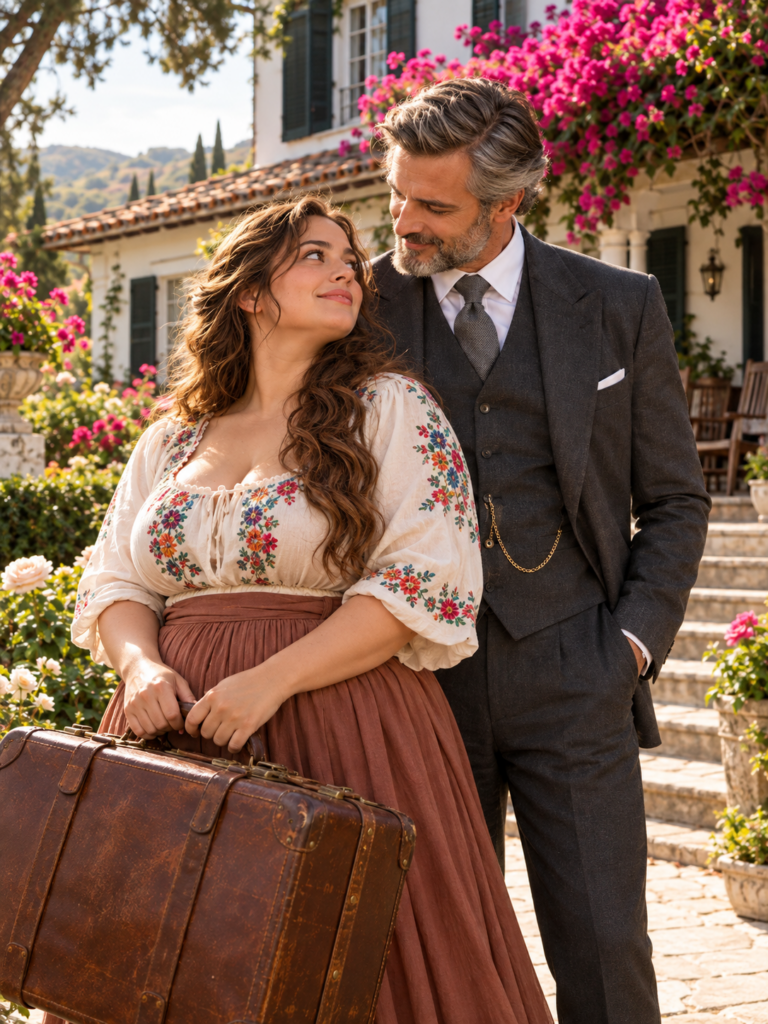
When Elena de la Vega stepped down from the freight truck in San Agustín in March of 1935, everything she still owned fit inside a battered suitcase that had once belonged to her mother.
Three months earlier, she had been the educated daughter of a respected merchant in the capital. She had known piano lessons, French novels, imported fabric, and the quiet certainty that tomorrow would resemble today.
Now she had no home.
No father.
No inheritance.
No certainty at all.
The truck rolled away in a cloud of dust while Elena stood beside the road, twenty-two years old and trying not to look as frightened as she felt.
She had learned quickly that grief did not stop the world from moving.
Her mother, Cecilia, had died of typhus when Elena was fifteen. That loss had drawn Elena and her father, Augusto, even closer. He had poured everything he had into raising his only child, insisting that education would protect her from life’s cruelties.
Then the economic crisis reached his business.
Bills multiplied. Creditors stopped waiting. Furniture vanished from the family house piece by piece.
Augusto tried to hide the truth from her.
He failed.
On the morning of February fifteenth, Elena woke to a strange sound from his study. She found the door locked.
She called his name.
Once.
Twice.
Three times.
There was no answer.
A neighbor eventually forced the door open.
Augusto was dead beside an empty bottle of laudanum and a letter explaining what shame had convinced him he could not face: complete bankruptcy, debts large enough to swallow the house, and an apology to the daughter he loved more than his own life.
Elena did not cry at the funeral.
She cried three days later when creditors came to take what remained.
Doña Marta, the family’s former cook, held Elena by the shoulders and gave her the only practical advice anyone had offered.
“You are alive,” she told her. “That has to mean something.”
Marta had a cousin in the countryside named Josefa. Josefa knew nearly everyone within fifty kilometers of San Agustín and believed she could find Elena respectable work.
Perhaps teaching.
Perhaps housekeeping.
The eventual offer came from Hacienda Tres Arroyos.
Its owner was a widower.
Rafael Almagro.
Serious. Hardworking. Fair.
That was all Elena knew when she accepted.
She was in no position to demand more.
The journey into the interior took two punishing days in the back of a cargo truck beside sacks of flour and tools. By the time Josefa welcomed her into a tiny house near San Agustín’s modest central square, Elena’s entire body hurt from the road.
That night she lay on a thin mattress listening to frogs, insects, wind, and unfamiliar country silence.
She finally let herself weep.
For her mother.
For her father.
For the life that had disappeared.
Then, before dawn, she washed her face and made herself a promise.
She would survive.
She did not yet know how.
But she would.
The following morning Josefa drove her by cart eight kilometers beyond the village toward Tres Arroyos. Fields of corn and beans gave way to open pasture and rolling land.
Josefa talked almost continuously until the conversation turned to Rafael.
Then her voice changed.
“That man is different,” she said.
Elena looked over.
“Different how?”
Josefa kept her eyes on the road.
“Strong enough to frighten most men, but you’d never hear him boast about it. Works harder than anyone he employs. Helps people who can’t repay him. A few years ago old Cristóbal nearly lost his farm to Colonel Damasco. Rafael stood against three armed men and made them leave.”
“Three armed men?”
Josefa nodded.
“And afterward he paid Cristóbal’s debt without telling anyone.”
Elena frowned. “Why?”
“Because Rafael thought it was the right thing to do.”
The simplicity of the answer stayed with her.
Josefa hesitated before adding, “He wasn’t always so quiet.”
Elena understood the shift immediately.
“His wife?”
“Isabel.”
The name entered the morning gently.
“She died four years ago. Wagon accident. A wheel came loose on a descent. Rafael found her.”
Josefa swallowed.
“They say he hardly spoke for three days. Since then he works. Helps people. Protects people. But he doesn’t let anybody close.”
The gate to Tres Arroyos appeared soon afterward, its name carved into plain timber.
Beyond it stretched a well-kept property of pastures, fields, fences, and a sturdy house built of wood and stone.
Nothing was luxurious.
Everything was cared for.
The fences were straight. Tools were organized. Animals looked healthy.
Elena had not yet met Rafael Almagro, but she already knew something about him from the order of his land.
Doña Cándida welcomed them at the house.
She was near sixty, round-faced and warm, with the practical manner of someone who had spent a lifetime making herself useful.
She showed Elena to a small bedroom at the back of the house.
A bed.
An armoire.
A window overlooking the garden.
“It’s yours now,” Cándida said.
The words struck Elena unexpectedly.
Yours.
So little had belonged to her lately.
She placed her mother’s suitcase beside the bed.
“Where is Señor Almagro?”
“Lower pasture. Repairing a fence.”
Cándida smiled.
“He’ll be back at noon. Rafael is more punctual than a church bell.”
He arrived almost exactly when she predicted.
Elena was setting plates on the table when heavy footsteps crossed the porch.
The door opened.
Rafael Almagro stepped inside.
He was taller than Elena expected, broad through the shoulders, his body shaped by years of physical labor rather than vanity. Dust marked his trousers. His dark hair was slightly too long. Several days of beard shadowed his face.
He removed his hat.
Then he saw her.
For a brief instant neither spoke.
His eyes were brown, but that was not what Elena noticed.
She noticed the exhaustion in them.
Not weakness.
Not softness.
Something older.
A man could survive grief, she realized, and still carry evidence of the battle.
“You must be Miss de la Vega.”
His voice was low.
“Elena.”
He gave a small nod.
“Welcome to Tres Arroyos. I hope the room is suitable.”
“It is. Thank you for giving me the position.”
“You’ll earn it.”
There was no insult in the words.
Only fact.
He washed his hands and sat down.
Lunch was nearly silent.
When Rafael finished eating, he addressed her with the same grave politeness.
“Doña Cándida will explain what needs doing. The house requires cleaning, mending, and organization. You eat with us.”
Elena looked up.
“With you?”
“Everyone working here eats at the same table whenever possible.”
His expression suggested the matter was too obvious to debate.
“You aren’t to be treated as lesser because you’re being paid.”
Then he put his hat on and returned to the fields.
Elena watched through the doorway.
Cándida laughed softly.
“Don’t take offense.”
“I didn’t.”
“Good. He has forgotten how conversation works.”
Over the next weeks Elena learned the rhythm of Tres Arroyos.
She rose early.
Helped prepare breakfast.
Cleaned.
Mended work shirts.
Organized supplies.
Assisted in the kitchen.
Her soft city hands blistered and then hardened.
Her back ached.
Yet for the first time since her father’s death, exhaustion came from accomplishing something rather than from grief.
Rafael remained distant.
But distance did not prevent observation.
She saw him pay workers promptly.
She saw him ask after their wives and children.
When Joaquín’s son became ill, Rafael sent for a doctor and quietly paid the bill.
When a neighbor’s fence collapsed during a storm, Rafael spent his Sunday repairing it.
Whenever anyone thanked him, he behaved as though gratitude embarrassed him.
Ten days after Elena’s arrival, the peace of Tres Arroyos fractured.
She was hanging laundry when three mounted men rode onto the property.
They wore guns openly.
Their leader had a narrow mustache and a smile Elena disliked before he spoke.
“Message from Colonel Damasco.”
Rafael had been repairing a gate near the corral.
He set down his tools.
The man’s posture barely changed, yet Elena sensed something inside him become alert.
“The colonel wants the strip of land beside the river. Three thousand pesos.”
Rafael wiped his hands on his trousers.
“It isn’t for sale.”
The rider laughed.
“Colonel Damasco doesn’t enjoy hearing no.”
“Then it’s past time someone taught him.”
The laughter stopped.
Rafael stepped toward them.
“Leave my property.”
No shouting.
No weapon.
No dramatic threat.
Only certainty.
The three men eventually turned their horses.
The leader spat into the dirt.
“You’ll regret this, Almagro.”
Rafael waited until they were gone.
Only then did Elena see him exhale.
That night she confronted him at dinner.
“Those men were dangerous.”
Rafael glanced at Cándida, then back at Elena.
“Damasco is dangerous.”
“Then why provoke him?”
“I didn’t provoke him. I refused him.”
There was a difference, and Rafael clearly considered it important.
“He takes land from people who can’t defend themselves,” he continued. “He uses threats until families sell for almost nothing.”
“And if he tries that here?”
Rafael held her gaze.
“He’ll meet resistance.”
Cándida explained the rest later.
Damasco had already destroyed several small landowners.
Rafael was the only man powerful enough—or stubborn enough—to oppose him consistently.
“He feels fear,” Cándida told Elena. “Don’t imagine otherwise. Courage isn’t the absence of fear. Rafael simply has something in him that’s stronger.”
“What?”
“A need to protect.”
Elena soon noticed that protection appeared in quiet forms as often as dramatic ones.
A broken kitchen bench was repaired after she mentioned it once.
The squeaking hinges on her bedroom window were oiled without explanation.
After Elena casually said she missed the flowers her mother used to keep in their house, wildflowers appeared in a jar on the table.
Rafael never admitted placing them there.
She never asked.
Their eyes began meeting too often.
Across the kitchen.
Across the yard.
Across the dinner table.
Each time Rafael looked away first.
Then came the storm.
One April afternoon, dark clouds consumed the sky so rapidly that Elena barely had time to pull laundry from the line.
Wind slammed a shutter against the house.
She fought to secure it.
The wood tore at her hands.
Suddenly another pair of hands closed around the shutter.
Rafael.
Rain streamed down his hair and face.
Together they fastened one shutter, then another.
By the time the house was secure, both were drenched.
Inside, Elena began trembling.
Rafael noticed instantly.
“You’re freezing.”
Before she could object, he took a blanket from the sitting room and wrapped it around her shoulders.
His fingers brushed the side of her neck.
Both stopped.
For weeks their attraction had existed only in unfinished glances.
Now there was nowhere to hide from it.
Rafael’s hand remained lightly against the blanket.
Elena could hear his breathing.
Something vulnerable surfaced in his face—and disappeared almost immediately.
“You should change,” he said.
“So should you.”
Neither moved.
Then Elena looked around the house that had taken her in when she had nowhere else to go.
“Thank you for helping me.”
Rafael’s expression changed.
“It wasn’t your responsibility to save the shutters.”
“It is my responsibility.”
“Why?”
She answered without thinking.
“Because this is my home now too.”
Rafael went still.
Home.
For him, the word seemed to mean more than she had intended.
He stepped back.
“I should change.”
He left almost too quickly.
Elena remained beneath the blanket with her heart pounding.
That night she decided she needed distance from him.
It was sensible.
He was her employer.
A widower still bound to his grief.
She was a dependent young woman with no fortune and nowhere else to go.
Falling in love with Rafael Almagro would be foolish.
The plan survived until breakfast.
Rafael entered.
Their eyes met.
And Elena understood, with a clarity that terrified her, that caution had arrived too late.
Part 2
By May, Elena and Rafael had become experts at pretending nothing was happening.
Rafael worked longer hours.
Elena found more tasks indoors.
Neither fooled Doña Cándida.
Rafael began lingering at dinner.
Elena began preparing his coffee exactly the way he preferred it.
He left water near her when she worked in the garden.
She mended his shirts with stitches small enough to survive years.
Affection grew through acts so ordinary that either of them could deny their meaning.
Tres Arroyos became busier as winter preparations began. Rafael hired additional workers to strengthen roofs, repair fences, and store firewood.
Among them were Joaquín, young Toño, and Pedro, who had worked beside Rafael for more than a decade.
One morning Elena carried coffee and corn bread to the men repairing the granary roof.
She heard Toño asking why people in the district respected Rafael so fiercely.
Pedro sat back on a beam.
“Three years ago Damasco invented a debt against old Antonio.”
Elena slowed.
“The man could barely read,” Pedro continued. “Damasco’s people showed him papers and claimed his farm belonged to them. They beat him in front of his family.”
Toño stared.
“What happened?”
“The priest came to Rafael.”
“And?”
“Rafael read the papers. Saw they were false. When Damasco’s four men returned, Rafael was waiting on Antonio’s porch.”
“Alone?”
Pedro smiled.
“Alone.”
One of the men had drawn a weapon.
Rafael had disarmed him before the gun could be properly raised.
The remaining three left.
Afterward Rafael returned to work without telling anyone what he had done.
Joaquín added another story.
During a severe drought, three families had nearly starved.
Food appeared at their homes.
Rafael claimed it came through the church.
Eventually everyone learned he had sold livestock he had intended to keep.
“Why would he hide that?” Toño asked.
Pedro looked toward the fields where Rafael worked in the distance.
“Some men need to protect people the way other men need air.”
That sentence stayed with Elena.
She finally understood something important.
Rafael was willing to bleed for everyone around him.
What he did not know how to do was allow anyone to care for him.
So she began.
Not dramatically.
Patiently.
When he returned one evening with a deep cut across his hand from barbed wire, Elena sat beside him with clean water and cloth.
“I can handle it.”
“I know.”
“Then you don’t need to—”
“I want to.”
The words stopped him.
Elena took his rough hand in hers.
She washed the wound.
Rafael’s entire body seemed prepared to retreat, yet he stayed.
She wrapped the cut carefully.
When she finished, neither released the other immediately.
Rafael looked at her as though simple tenderness were something far more dangerous than Damasco’s armed men.
“Thank you.”
“You’re welcome.”
The next evening he remained at the table long enough to join a conversation.
Days later Elena made him laugh.
She had climbed onto a chair to reach a jar on a high shelf when the chair tipped.
Rafael caught her around the waist.
Her feet barely touched the floor before she found herself held against him.
“You’re going to break your neck.”
“I nearly had it.”
“Of course.”
His mouth curved.
Then he laughed.
Not politely.
Not briefly.
A real laugh.
Elena stared.
The sound seemed to alter the entire kitchen.
For years, Cándida later told her, silence had lived in that house like another resident.
Now Rafael was laughing.
Cándida passed Elena afterward and squeezed her shoulder.
“You’re bringing him back.”
Elena wanted to believe it.
But darkness was already moving toward Tres Arroyos.
In June, Joaquín arrived with news that Damasco was attempting to seize three more properties using debts the owners insisted had already been paid.
Rafael went to the city and spoke with the judge.
He returned grim.
The judge was friendly with Damasco.
Legal protection would not come easily.
Rafael visited the threatened families.
They were frightened and poor.
Everything about Damasco’s strategy depended on those two facts.
One night Elena found Rafael alone on the porch.
A cigarette burned forgotten between his fingers.
She sat beside him.
For several minutes they listened to the countryside.
Then Rafael said, “Do you think there’s a limit?”
“To what?”
“How many times someone can fight before he gets tired.”
Elena studied him.
He wasn’t really talking about Damasco.
“That depends on why he fights.”
Rafael looked into the darkness.
“What if everything he loves gets taken from him eventually?”
Elena’s chest tightened.
There it was.
Isabel.
Four years of grief hiding beneath every fence repaired, every neighbor defended, every dangerous confrontation.
“What if,” Rafael continued, “the sensible thing is to stop needing anything?”
“That might be easier.”
He turned toward her.
“But?”
“You’re not a man who chooses something because it’s easier.”
His mouth tightened.
“You choose what you believe is right, even when it costs you. That’s why people trust you.”
Elena reached across the gap between their chairs.
She placed her hand over his.
“It’s not your physical strength they admire most, Rafael.”
His eyes lifted.
“It’s this.”
She touched his chest.
“Your heart.”
His voice was almost inaudible.
“My heart is broken.”
“Broken things can be repaired.”
His fingers turned beneath hers.
Slowly, they intertwined.
“Sometimes,” Elena whispered, “they only need someone patient enough to help put the pieces together.”
For the first time, Rafael did not pull away.
“Thank you.”
“For what?”
“For not giving up on me.”
Elena squeezed his hand.
“I won’t.”
She knew as she said it that the promise was larger than friendship.
So did he.
The conflict with Damasco escalated days later.
His men attacked old Cristóbal’s farm during the night, smashing windows, killing chickens, and leaving a warning.
Cristóbal came to Tres Arroyos the next morning shaking.
Rafael gave him a room immediately.
Then he rode away.
He returned near evening with blood on his knuckles.
Pedro later explained what happened.
Rafael had gone directly to Damasco.
In front of the colonel and his men, he declared that Cristóbal and the threatened families were under his protection.
Damasco warned him he was digging his own grave.
When one of the enforcers shoved Rafael, Rafael broke the man’s nose with one punch and rode home.
Elena found him tending his horse.
“Are you hurt?”
“No.”
“Your hand says otherwise.”
“It’s nothing.”
He would not meet her eyes.
“Did you come to lecture me?”
“No.”
That made him look at her.
“I came because I care whether you’re all right.”
His defenses shifted into place.
“I’m fine.”
“You’re tired.”
“I said—”
“Not physically.”
She stepped closer.
Rafael’s anger disappeared.
What remained was exhaustion.
“I don’t know how to be different,” he admitted. “I can’t watch people suffer when I can help.”
“You shouldn’t.”
“But I’m tired of doing it alone.”
Elena waited.
Rafael stopped himself.
She refused to let him.
“Tired of what?”
His breathing changed.
Finally, the man who could face guns and powerful enemies without hesitation looked frightened.
“Being alone.”
The confession seemed to cost him more than any fight.
“Coming back here every night with nobody waiting. Nobody who cares whether I return.”
“I care.”
The answer left Elena instantly.
Rafael stared at her.
“I care whether you come back. I care when you’re hurt. I care when you’re exhausted. I care when you’re afraid even though you pretend you aren’t.”
Her eyes burned.
“You matter to me, Rafael. Much more than is sensible.”
“Elena…”
“You don’t have to answer.”
She rose onto her toes and kissed his cheek.
It was gentle.
Nothing more.
Yet when she moved back, a single tear had escaped down Rafael’s face.
He closed his eyes.
Then lifted one rough hand and touched her cheek as though she were something sacred.
Elena turned her lips against his palm.
The world around them seemed to narrow to two people who had both lost more than they believed they could survive.
Three nights later, Cristóbal’s property burned.
Elena woke to shouting.
The eastern sky glowed orange.
Rafael was already on horseback.
Men rushed after him.
Elena changed clothes and climbed into the wagon Cándida had filled with water and cloth.
The farmhouse was engulfed when they arrived.
For hours, neighbors fought the flames.
Elena passed buckets until her shoulders screamed.
Rafael organized everyone through the smoke.
At sunrise the house was gone.
So was the barn.
Cristóbal stood staring at the ruins.
Then someone found the note nailed to a fence post.
Rafael read it.
His face changed.
You’re next, Almagro.
Elena watched his fist close around the paper.
“Take Cristóbal back to Tres Arroyos,” he told Pedro.
“What are you doing?” Pedro asked.
“Ending this.”
Elena caught Rafael’s arm.
“Not alone.”
His eyes settled on her.
“I won’t let Damasco destroy anyone else.”
“Then don’t become another thing he destroys.”
By evening Tres Arroyos had filled with frightened families.
Pedro wanted men gathered.
Joaquín knew several who would join them.
Rafael refused.
“If we ride there in force, people die.”
“So you’re going alone?” Elena demanded from the barn doorway.
The men turned.
Rafael’s expression darkened.
“This doesn’t concern—”
“Don’t.”
Elena walked in.
“Do not tell me this doesn’t concern me. Damasco threatened this property. I live here. If you die, do you think he simply disappears?”
Rafael opened his mouth.
Nothing came out.
Elena set down the tray she was carrying.
“We need witnesses.”
Pedro leaned forward.
She continued.
“Not gunmen. Authorities. Father Tomás. The commissioner. The judge.”
“The judge protects Damasco,” Rafael said.
“Then give him a reason not to.”
Elena thought of her old life.
Of her father.
Of the people he had once known.
“My father knew the editor of a newspaper in the capital. I’ll write to him. If Damasco understands that everything becomes public, the judge will understand it too.”
The men exchanged glances.
Rafael stared at her.
“You thought this through.”
“I thought about not losing you.”
The barn became very quiet.
Rafael told the others to leave.
When they were alone, he approached her.
“You can’t say things like that.”
“Why?”
“Because they make me want things.”
“What things?”
His restraint finally cracked.
“You.”
Elena’s breath caught.
Rafael shook his head.
“I lost everyone I loved.”
“That wasn’t your fault.”
“If I love you and lose you too—”
“You could lose me without ever loving me. Refusing happiness doesn’t control death.”
His eyes closed.
When he opened them, they were full of the terror he had hidden for four years.
“I don’t know how to do this again.”
“Then don’t do all of it today.”
Elena put her hand against his chest.
“Just don’t push me away.”
Rafael touched her hair.
“You deserve better than a damaged widower who keeps picking fights with dangerous men.”
“I deserve a good man.”
She smiled through gathering tears.
“And I found one.”
That was when Rafael kissed her.
Not with possession.
Not desperation.
With care.
The first kiss was almost reverent.
When they separated, his forehead rested against hers.
“If something happens tomorrow—”
Elena pressed her fingers to his mouth.
“Nothing is happening tomorrow except you coming home.”
A faint laugh escaped him.
“You’ve become very commanding.”
“I learned from you.”
For the first time since Elena arrived at Tres Arroyos, Rafael looked like a man allowing himself to imagine a future.
Now they had to survive long enough to reach it.
Part 3
Elena’s letter to the newspaper went out the next morning.
It contained names.
Dates.
Accounts from threatened families.
The destruction at Cristóbal’s property.
Rafael, meanwhile, met with Father Tomás.
The priest immediately agreed to help.
The commissioner required more persuasion.
So did the judge.
But once both men understood that a newspaper in the capital might soon ask why local authorities had ignored intimidation, forged debts, and arson, neutrality suddenly became attractive.
A formal meeting was arranged at Damasco’s property.
The night before, Elena barely touched dinner.
Rafael sat beside her afterward.
“I’m afraid,” she admitted.
“So am I.”
She looked at him in surprise.
Rafael gave a tired smile.
“Only fools feel nothing before walking into danger.”
He drew her close.
“But I’m more afraid of the world we’d have if nobody ever resisted men like him.”
His hand moved gently through her hair.
“And now I have something else worth coming home to.”
“Promise me.”
“I promise.”
The following morning Rafael dressed not as a laborer but as the landowner he was.
Clean shirt.
Dark trousers.
Polished boots.
A proper vest.
Pedro, Joaquín, and Toño would ride with him as far as Damasco’s property and wait outside.
Father Tomás arrived in black clerical clothing.
The commissioner followed.
The judge arrived last, visibly unhappy.
Before Rafael mounted, Elena adjusted his vest with trembling fingers.
He caught her hands.
“When I come back, we need to discuss our future.”
Her heart jumped.
“Our future?”
Rafael’s mouth curved.
“Did you think I’d finally let myself love you and then allow you to disappear?”
She tried to smile.
“You’re very certain.”
“No. I’m terrified.”
He kissed her fingers.
“But I want you anyway.”
Then he rode away.
The hours afterward became almost unbearable.
Elena worked badly.
Prayed constantly.
Looked down the road every few minutes.
Cándida prayed the rosary.
Noon passed.
Afternoon stretched on.
Then riders appeared.
Elena ran from the house.
Rafael was in front.
Alive.
Whole.
Before he fully dismounted, Elena reached him.
She threw herself into his arms.
“Are you hurt?”
“No.”
“Are you sure?”
He held her tightly.
“I’m sure.”
His next words were against her hair.
“It’s over.”
Inside, the story came out over coffee.
Damasco had expected intimidation to work.
Six armed men stood around him when Rafael arrived.
Then Damasco saw the priest.
The commissioner.
The judge.
His confidence changed.
Father Tomás presented the allegations.
Damasco denied everything.
Rafael produced the threatening note from Cristóbal’s fence.
He asked the commissioner to compare the handwriting with known documents written by Damasco.
The match was obvious.
Arrogance had betrayed him.
The judge tried calling it a misunderstanding.
Then Father Tomás mentioned Elena’s letter to the capital.
He mentioned public attention.
He mentioned questions that might soon be asked about why local authorities had permitted powerful men to terrorize poor landowners.
The judge reconsidered with impressive speed.
All disputed debts would be reviewed.
No property could be seized until the investigations were complete.
Threats and violence would be examined formally.
Rafael had looked directly at Damasco and stated that if another farmer, home, or field in the region were attacked, authorities already knew precisely where to begin asking questions.
Damasco had not become good.
But he had become visible.
And visibility created consequences.
Later, when Rafael and Elena were alone, she said, “You saved them.”
“No.”
He took her hand.
“We saved them.”
His thumb moved across her fingers.
“My plan would have been to confront him alone.”
“You would have done something reckless.”
“Very likely.”
“Then I’m glad you met me.”
“So am I.”
That evening Tres Arroyos filled with relief.
Cristóbal cried.
Families embraced.
Workers laughed.
For years Rafael’s house had been defined by absence.
Now it was full.
When the last visitors left, Elena stepped onto the porch.
Rafael joined her.
For a while they watched the stars.
Then he spoke.
“I married Isabel when I was twenty-three.”
Elena remained quiet.
“We grew up near each other. She was gentle. We had a good marriage.”
His voice carried no shame now.
No need to pretend the past had not existed.
“When she died, I thought the best part of me had gone with her.”
Elena reached for his hand.
“For four years I worked because work gave me somewhere to put the grief.”
He looked at her.
“Then a frightened young woman arrived here carrying an old suitcase and trying very hard not to look frightened.”
Elena smiled through tears.
“I wasn’t convincing.”
“No.”
His own eyes brightened.
“You were terrible at it.”
She laughed.
Rafael became serious.
“I loved Isabel.”
“I know.”
“And I love you.”
Elena’s breath stopped.
“Not because you replaced her. You couldn’t. I don’t want you to. What I feel for you belongs to the man I am now.”
He touched her face.
“You made me remember that being alive is different from merely continuing to breathe.”
Tears slid down Elena’s cheeks.
“I love you too.”
Rafael reached into his pocket.
A small gold ring lay in his palm.
“It belonged to my grandmother.”
The metal was simple and worn with age.
“I kept it for years.”
He lowered himself onto one knee.
Elena covered her mouth.
“Elena de la Vega, will you marry me?”
She was already crying too hard to answer gracefully.
“Yes.”
Rafael laughed.
“Is that definite?”
“Yes.”
He slid the ring onto her finger.
It fit.
Two months later they married in the church at San Agustín.
Elena wore a simple white muslin dress sewn with Cándida’s help and wildflowers in her hair.
Rafael wore a dark suit made for the occasion.
The church was crowded with people whose lives had touched his.
Cristóbal sat near the front.
Pedro, Joaquín, and Toño stood proudly among the guests.
The families Rafael had defended came with children.
Father Tomás performed the ceremony.
When Rafael kissed his bride, applause filled the church.
Rafael’s face was wet when he lifted his head.
For once, his tears came from joy.
Marriage did not turn life at Tres Arroyos into a fairy tale.
There were crops that failed.
Animals that sickened.
Fences that broke.
Money that had to be stretched.
Damasco remained in the region, though public scrutiny made him more cautious.
But the house changed.
Elena became Rafael’s partner in every practical sense.
She helped with accounts.
Discussed planting decisions.
Cared for workers when they were ill.
Rafael listened to her.
Sometimes reluctantly.
Usually wisely.
Elena also began teaching local women to read.
At first the lessons took place around the kitchen table.
A few women came.
Then more.
Letters became words.
Words became sentences.
Soon Elena added basic arithmetic and household accounting.
Rafael watched the classes with quiet pride.
In return, he began openly teaching smaller farmers cultivation techniques that he once might have simply used on his own land.
Tres Arroyos gradually became more than a ranch.
It became a place where people came for advice, help, learning, and protection.
Eight years after Elena first arrived, she sat on the porch with one hand resting over a belly seven months pregnant.
Two children played in the yard.
Miguel, six, had Rafael’s dark hair and Elena’s endless curiosity.
Clara, four, gathered flowers with complete seriousness.
Rafael came home carrying Miguel on his shoulders while Clara clung to his leg.
There were silver threads in his hair now.
There were also laugh lines around his eyes.
He sent the children inside to wash for dinner, then bent and kissed Elena.
His hand settled over the unborn baby.
A kick answered him.
Rafael smiled.
“Strong.”
“Like the father.”
“Stubborn like the mother.”
Elena raised an eyebrow.
He corrected himself.
“Determined.”
“Better.”
He sat beside her.
“Sometimes I still can’t believe this is mine.”
Elena looked at him.
“What?”
“You. Them. This life.”
Rafael watched their children through the open doorway.
“Eight years ago I thought happiness belonged to somebody I used to be.”
“It still belonged to you.”
“I didn’t know that.”
“You needed reminding.”
He kissed her temple.
“You’ve been reminding me ever since.”
Their third child, a boy they named Tomás, was born healthy.
Years gathered gently afterward.
Miguel grew into a boy who instinctively defended anyone smaller than himself.
Clara developed a tenderness for injured animals and eventually discovered a gift for teaching.
Tomás became fascinated by crops, soil, weather, and every improvement that might make farming more productive.
Elena’s literacy lessons expanded.
Her opinion became respected well beyond Tres Arroyos.
People who once knew her merely as the penniless young woman from the capital began seeking her advice.
Rafael changed too.
He never stopped protecting people.
But Elena had taught him the difference between courage and self-destruction.
He learned to gather witnesses.
Use institutions.
Build alliances.
Let others share the burden.
Damasco’s influence declined over time.
Years later, he died without heirs and with his estate heavily indebted.
Sections of his land were sold.
Rafael bought part of it.
Other portions eventually went to farmers whose families had once lived beneath Damasco’s threats.
Rafael called it poetic justice.
Elena called it overdue.
Doña Cándida lived long enough to watch the house transform completely.
She saw children run through rooms that had once been silent.
She saw Elena’s lessons grow.
She saw Rafael become a husband and father who laughed without guilt.
When Cándida died peacefully at eighty-seven, she was surrounded by people who loved her.
Her absence hurt.
But the kindness she had planted remained everywhere.
Twenty years after Elena first arrived at Tres Arroyos, she sat on the same porch again.
She was forty-two.
A few silver strands had appeared in her hair.
Rafael, now fifty-three, was still broad and strong, though decades of work had marked him.
Their children were grown.
Miguel helped manage the ranch and was preparing to marry.
Clara had become a teacher in the local school, carrying forward her mother’s work.
Tomás studied agronomy and dreamed of bringing modern techniques home.
The property itself had grown.
So had the family.
Miguel already had children of his own, and their voices now drifted from the house.
Rafael sat beside Elena.
“You’re quiet.”
“I was thinking.”
“Dangerous.”
She smiled.
“About how strange life is.”
He took her hand automatically.
She looked down the road she had first traveled with Josefa two decades earlier.
“When my father died, I thought my life was over.”
Rafael’s fingers tightened gently around hers.
“I lost everything. The house. My security. The future I expected.”
She looked at him.
“And losing that life brought me here.”
Rafael was silent.
“Do you believe in fate?” she asked.
He considered it.
“No.”
Elena laughed.
“No?”
“I believe in choices.”
He turned her hand over in his.
“I chose to keep living after Isabel died, even when I wasn’t very good at it.”
“You chose mostly to keep working.”
“That too.”
His smile faded into tenderness.
“You chose to come here. You chose to stay after discovering your employer was unpleasant.”
“You weren’t unpleasant.”
“I barely spoke.”
“You spoke when necessary.”
“I glared a great deal.”
“That is true.”
They both laughed.
Rafael continued.
“You chose to stand beside me when Damasco threatened us. You chose to love me when I gave you no guarantees.”
“And you chose me back.”
“Every day.”
The answer came without hesitation.
Elena leaned against his shoulder.
The setting sun spread orange and rose across the fields.
From inside came voices preparing supper.
Children laughed.
Someone dropped something in the kitchen.
Another voice complained.
Life moved through the house with glorious disorder.
The first time Elena had entered Tres Arroyos, she had noticed its silence.
The walls had felt as though they were waiting for someone.
Now the place contained generations.
Years earlier, Elena had asked Rafael whether he regretted the pain that shaped them.
His answer had stayed with her.
He would always grieve Isabel.
Elena would always miss her father and mother.
Love did not erase earlier love.
Joy did not prove grief had been meaningless.
They had simply learned that a human heart was large enough to hold both.
Rafael had once believed strength meant enduring everything alone.
Elena taught him otherwise.
Elena had once believed losing her old life meant losing her worth.
Rafael gave her a place where she could discover otherwise.
Neither rescued the other completely.
They did something harder.
They remained.
Through fear.
Through disagreement.
Through danger.
Through ordinary years when no dramatic enemy appeared and love had to survive exhaustion, chores, illness, children, money worries, and time.
They chose each other repeatedly.
Long after their hair turned gray, their grandchildren and great-grandchildren would ask how the story began.
The family answer became almost ritual.
She arrived with nothing but an old suitcase.
He had everything except the desire to live fully.
She needed a home.
He needed a reason to open the doors of his heart again.
Between them stood grief, class, fear, and a powerful enemy who believed he could take whatever he wanted.
Yet Elena and Rafael discovered that strength was not measured by how much pain one person could carry alone.
Strength was allowing another person to help.
It was speaking when silence was safer.
Standing beside the vulnerable when powerful men expected obedience.
Coming home when someone waited for you.
And continuing to love even after life had proved how much love could cost.
On the porch at Tres Arroyos, Rafael lifted Elena’s hand and kissed it.
“Then I chose well,” he said.
Elena smiled.
“We chose well.”
The sun sank behind the fields.
The house behind them glowed with lamplight.
And in the place where two broken lives had once met by chance and continued by choice, laughter carried into the night.

