Part 1
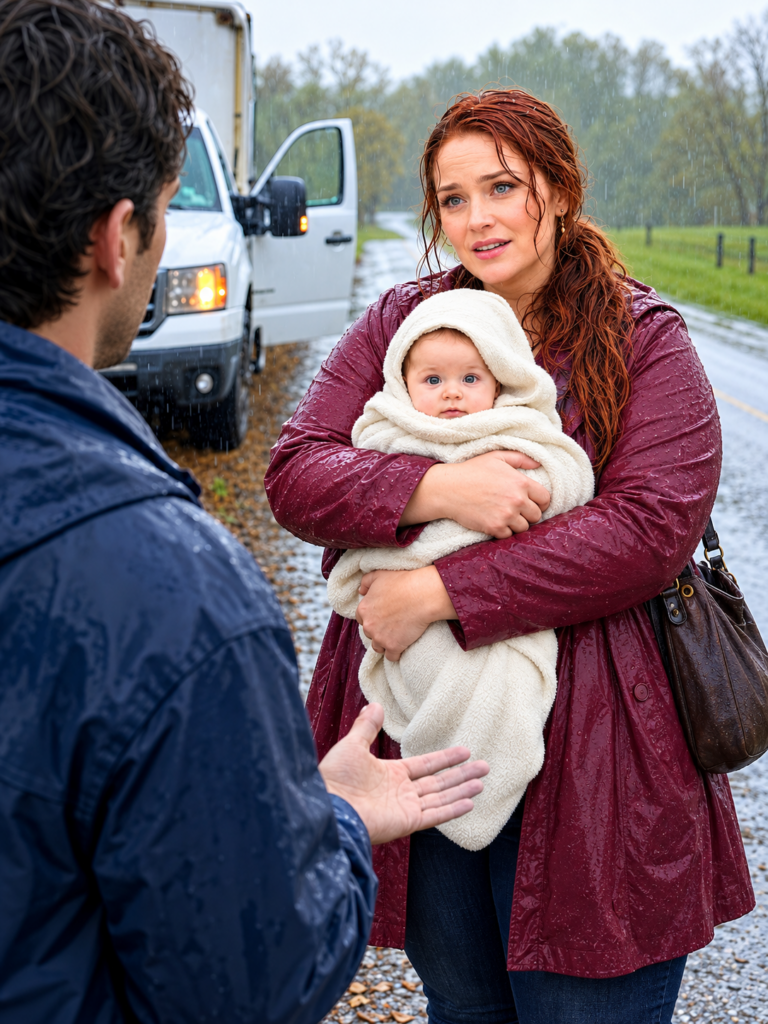
My name is Wyatt Boone. I was thirty years old the night I found Faye Winslow walking down Route 9 with an eight-month-old baby under her jacket and nowhere in particular to go.
I drove feed and supply deliveries out of Hollis Creek, Kentucky, for a co-op that handled the farms too small for the big distributors to care about. Four counties. Gravel roads. Barn lots. Gates that stuck in winter. Farmers who would rather patch a tractor with baling wire than spend money on a new part.
Most nights, mine were the last headlights moving through those roads before everything went dark.
That Tuesday in early March, the rain had started around noon and never worked itself into a proper storm. It just kept falling, steady and cold, until ditches filled and fields shone black under the truck lights.
I was forty minutes past my final delivery when I saw her.
At first I thought she was a road sign distorted by the rain.
Then she moved.
A woman walking the shoulder with no car nearby, no house close enough to explain her being there, and something tucked tightly against her chest.
I slowed before I consciously decided to.
My headlights swept across her.
She flinched.
Not the ordinary startled jump of somebody caught walking at night.
She folded in on herself for half a second, one shoulder coming up and her body turning enough to protect what she carried.
I knew that movement.
My mother had worn it once.
I pulled onto the shoulder well ahead of her, put on my hazards, and got out.
The rain soaked my shirt almost immediately.
I stayed near the front of the truck rather than approaching.
“Ma’am?”
She stopped.
“You need a ride somewhere?”
The bundle against her chest moved, and a thin, unhappy sound came out of it.
A baby.
Her eyes went to my truck, then to the co-op logo on the door, then back to me.
“I’m not coming any closer,” I said. “You tell me what you need.”
“I don’t need anything from you.”
Her voice sounded scraped raw.
I looked at the dark road behind her.
“You’re on a county highway at eleven at night in March with a baby.”
Her face tightened.
“That’s not nothing.”
For a moment I thought she would walk past me.
I was already wondering whether following twenty yards behind in the truck would scare her worse than leaving her when her shoulders sagged.
Only a little.
But I saw it.
“I don’t know where I’m going,” she said.
The rain ran down her face like tears she wasn’t crying.
“I just need somewhere to go.”
I didn’t ask who she was running from.
My mother had taught me something about that without ever meaning to.
When I was four, she had left my father in weather not much different from this. She had me in the backseat and less than fifty dollars in her purse. A trucker outside Bowling Green stopped for us and got us to his sister’s house.
My mother told me later that the first decent thing he did was not ask her to explain herself.
So I didn’t ask Faye.
“I’ve got a house twenty minutes from here,” I said. “Spare room. Door locks from the inside.”
She stared at me.
“I can also call somebody and wait here with you until they come. Sheriff, shelter, hospital, whoever you want. Your choice.”
Her attention dropped to my hands.
I made sure they stayed visible.
The baby began to cry in earnest.
“What’s your name?” she asked.
“Wyatt. Wyatt Boone.”
She looked at the truck again.
Then she stepped toward it.
I opened the passenger door and backed away so she could inspect the cab before getting in.
Clipboard.
Thermos.
Feed invoices.
Nothing hidden.
She climbed inside.
When I got behind the wheel, she had the baby arranged carefully against her despite how badly she was shaking.
I turned the heat high and kept both hands on the steering wheel.
We had gone several miles before she spoke.
“His name is Eli.”
I glanced over.
The baby had one pink cheek visible through the blanket.
“He’s eight months.”
“All right.”
She waited, maybe expecting me to ask her name.
I didn’t.
Instead I explained the house.
“The spare room’s at the end of the hall. Bathroom’s across from it. I sleep on the other side of the place. I won’t come into your room unless you ask me to.”
She looked at me then.
I worried I had overexplained.
Then she said, “Thank you.”
We drove the rest of the way mostly in silence.
My grandfather had built the house decades earlier. Nothing about it was impressive. Two bedrooms, worn hardwood, a kitchen he had remodeled himself badly enough that none of the cabinet doors hung perfectly straight.
I unlocked the front door and let her enter first.
She stood just inside, water dripping from her clothes, studying the room.
I found towels.
She settled Eli at the kitchen table while I got a space heater going in the spare bedroom.
By the time I came back, she was murmuring to him in a low rhythm. He had stopped crying.
I put water on for tea.
When I set a mug near her, she flinched.
Smaller than before.
Still there.
“He never hit me where it would show on shift,” she said.
I didn’t move.
She stared at the steam rising from the mug.
“Dalton. My husband.”
There was something terrible about the calm way she said it.
“He always knew how hard was too hard. Where a bruise could be hidden.”
I pulled out the chair across from her and sat.
“What does he do?”
Her mouth curved without humor.
“State trooper.”
That changed the shape of everything.
“Fifteen years,” she continued. “Two counties over. He knows everybody. Or everybody knows somebody who knows him.”
I understood then why she had chosen an empty highway over a police station.
“Does he know you left?”
“He will in the morning.”
“How’d you get out?”
“He was working nights.”
She rubbed Eli’s back.
“I didn’t take the car. He tracks the mileage.”
I waited.
“I left my phone, too. He put an app on it once. Said he removed it. I never believed him.”
Every answer told me this wasn’t a sudden decision.
She had rehearsed leaving.
Probably dozens of times.
Maybe hundreds.
“Where were you headed before I stopped?”
“Nowhere.”
She looked down at Eli.
“I only knew I needed to be somewhere he wasn’t.”
Close to midnight, after Eli finally slept, she gave me her name.
“Faye Winslow.”
I glanced toward her.
“That’s my name,” she added. “Winslow. I started using it again in my own head before I ever left.”
I nodded.
“Then Faye Winslow it is.”
Something changed in her face.
Not trust.
Not yet.
Maybe simply relief at not having to defend something that belonged to her.
I told her about my mother then.
Not the whole story.
Just enough.
“The man who stopped for us gave my mother a ride. His sister let us stay a week.”
Faye listened without interrupting.
“I was four,” I said. “Don’t remember much. But I grew up hearing it. Figure I’ve owed a debt ever since.”
“That’s why you stopped.”
“That’s why.”
The following morning, I woke to coffee and quiet singing.
It stopped as soon as I entered the kitchen.
Faye stood by the counter with Eli balanced on her hip.
“Sorry.”
“For what?”
“The singing.”
“It wasn’t that bad.”
Her eyebrows lifted.
“All right,” I admitted. “It was bad.”
She laughed.
Just once.
Short and surprised.
But the sound stayed with me during my entire delivery route.
By the second morning Eli no longer cried when I held him.
By the third, he reached for my finger every time I got close.
It was ridiculous how much satisfaction I took from that.
I started rearranging my delivery runs so I could come home earlier.
I told myself Faye needed time to shower.
That Eli needed another adult around.
That there were practical reasons.
Most lies work because there is enough truth inside them.
On the third afternoon, I went to the next county for formula and diapers.
I added a used baby monitor.
Faye found it on the kitchen counter.
“You bought this?”
“I was over there anyway.”
“You didn’t have to.”
“I know.”
She looked at me for a long second.
“I wanted to,” I said.
That night, she left the spare-room door open almost a foot.
I noticed.
I did not mention it.
Trust, I was learning, was easier to damage when you stared directly at it.
Four days after I found her, I damaged it anyway.
Gus at the co-op asked why I kept taking early routes.
Gus had known me since childhood. He had helped bury my grandfather. I trusted him.
So I told him I had a woman and baby staying with me.
I didn’t give names.
I didn’t mention Dalton.
I only said they were getting away from a bad situation and needed privacy.
What I forgot was that Gus talked the same way some people breathed.
What I forgot was that his nephew worked dispatch for state police two counties away.
The next evening, I came home and found Faye standing in the kitchen with her arms wrapped around herself.
“You told people.”
It wasn’t a question.
“One person.”
Her face had gone pale.
“I thought I could trust him.”
“Nobody keeps anything quiet here.”
Her voice was shaking now.
Not fear.
Anger.
“Dalton knows people everywhere. That is the whole reason I didn’t go to my sister. That’s why I didn’t use a shelter he knew I’d heard of. It’s why I walked onto a highway with a baby rather than go somewhere obvious.”
“I know.”
“No, Wyatt.”
Her eyes flashed.
“You didn’t know, because if you knew, you would have asked me first.”
There was an answer available to me.
I could explain Gus.
Defend my intentions.
Tell her I had meant well.
Every one of those things would have been true.
None of them mattered.
“You’re right.”
She stopped.
“That was my mistake.”
I made myself stay where I was.
“Tell me what you want me to do now. I’ll do that. Not what I think is best.”
Some of the anger went out of her.
She looked suddenly exhausted.
“Ask me first.”
“I will.”
“Even about small things.”
“Every time.”
Her chin trembled once.
“I’ve had enough people deciding things around me.”
I understood then that offering Faye safety did not make me entitled to manage it.
That was the first real lesson she gave me.
And maybe the first thing that made whatever came afterward possible.
Part 2
After that, our days settled into a rhythm.
Faye cooked because, as she put it, doing nothing made her thoughts too loud.
I delivered feed.
Eli ruled the house.
He had learned that if he sat on a blanket in the kitchen and yelled experimentally, at least one adult would look at him. He treated this discovery as enormous power.
Some evenings, I opened the door and found him staring at me as if I had been gone for six months rather than nine hours.
Faye would glance over from the stove.
“There’s your audience.”
“He’s got good taste.”
“He eats paper if I don’t stop him.”
“Selective good taste.”
She smiled more by then.
Not constantly.
That would have felt false.
But sometimes.
I bought a proper crib from a town forty minutes away, paying cash because Faye didn’t want any purchase attached to our address.
I asked before I went.
She noticed.
We assembled it together one evening.
She held the flashlight.
I worked the screws.
“Left.”
“I am turning left.”
“Your other left.”
I looked up.
“Do you want to build this?”
“No.”
“Then respect the craftsman.”
“You have three screws left over.”
“Those are confidence screws.”
She laughed.
I looked at her without meaning to.
She noticed.
For one suspended second neither of us said anything.
Then Eli made an offended noise from the portable crib behind us.
Faye turned immediately.
The moment disappeared.
I was grateful.
And disappointed.
That frightened me more than I wanted to admit.
She had been in my home less than two weeks.
Her marriage wasn’t even legally over.
She depended on the roof I was giving her.
Anything romantic from me, spoken or acted upon, could turn shelter into obligation in a heartbeat.
So I kept whatever I was beginning to feel where it belonged.
Inside me.
One night I came home irritated after a delivery went wrong.
A farmer had ordered the wrong supplement, blamed Gus, then blamed me, then discovered his own handwriting on the original form.
By the time I got home I was tired, wet, and annoyed.
I dropped my keys harder than necessary.
“Could one thing in this county work right the first time?”
My voice was sharp enough that Eli startled.
I froze.
Faye looked up.
For one ugly second I thought I saw fear in her face.
Then she walked toward me.
Not away.
“That’s not the same.”
I frowned.
“What?”
“You being tired.”
She stopped a few feet away.
“You being short-tempered for ten seconds is not the same as him being cruel.”
I didn’t know what to say.
She looked straight at me.
“I know the difference now, Wyatt.”
Something pressed painfully behind my ribs.
“I want you to know I see it.”
I sat down at the table.
“Thank you.”
The words felt inadequate.
“I didn’t realize I needed somebody to tell me that.”
“Maybe you did.”
That night changed something.
Until then, I had thought mostly about making sure she never had reason to fear me.
It had not occurred to me that she had started learning me closely enough to know the difference.
After Eli went to sleep, we sometimes sat on the back steps with coffee.
Neither of us drank much of it before it went cold.
One night Faye leaned her head against the porch post.
“I used to imagine leaving would feel dramatic.”
“How?”
“I don’t know. Music. Running. Freedom.”
She looked across the dark pasture.
“Instead it’s coffee going cold and listening to a baby monitor.”
“Disappointing.”
“Very.”
Her mouth tilted.
Then she grew serious.
“It’s better than what I imagined.”
I turned toward her.
“Why?”
“Because this is ordinary.”
The monitor crackled faintly through the open window.
“I forgot ordinary could be good.”
Nine days after I found her, Renata Cruz called.
Faye had contacted legal aid using a prepaid phone I bought for her with cash.
With permission.
I was learning.
Renata had been quietly building a case for an emergency protective order.
When Faye hung up after the call, her fingers were trembling.
“They can file today.”
I waited.
“She thinks we have enough.”
“What do you want to do?”
Faye looked at me.
Maybe she noticed the wording.
“I want to file.”
“All right.”
“I’m tired of being the only person who knows what he is.”
The emergency order was signed that afternoon.
A hearing was scheduled fourteen days later.
Renata warned us that the period immediately after filing could be the most dangerous.
Two days later, Dalton found us.
I saw the cruiser first.
Parked at the end of my road.
Watching.
I had barely gotten out of my truck when he walked toward the porch.
He was broader than I expected.
Badge at his belt despite being off duty.
Confidence in every step.
“Wyatt Boone.”
It wasn’t a question.
“What can I do for you?”
“I hear my wife is staying here.”
I kept my expression flat.
“You can tell her to come home.”
His tone was reasonable.
Almost friendly.
“She isn’t well. Postpartum depression can do things to women. I’m trying to get her help.”
Behind me, the door opened.
Faye stepped onto the porch with Eli on her hip.
“I’m not confused, Dalton.”
Everything in him changed without appearing to.
His posture stayed easy.
His voice stayed controlled.
But I understood her fear immediately.
“Get in the car, Faye.”
She did not move.
“We’ll discuss this at home.”
I shifted sideways.
Not dramatically.
Just enough.
“She’s not going anywhere unless she chooses to.”
Dalton finally looked at me.
His eyes were cold.
“This is a family matter.”
“This is my property.”
I kept my voice level.
“And you’re two counties outside your jurisdiction.”
His attention narrowed.
I continued.
“You drive out here on personal time to order a grown woman into a car, Trooper?”
That gave him pause.
Not because he cared what I thought.
Because I was a witness.
He looked at Faye again.
“This isn’t over.”
She stood straighter.
“It is for me.”
He walked back to his cruiser.
Slowly.
Deliberately.
Only after his taillights vanished did Faye start shaking.
“He’ll come back better prepared.”
I wanted to tell her he wouldn’t.
I knew better than to promise something I couldn’t control.
So I said, “Then we’ll deal with what actually happens.”
She closed her eyes.
“We?”
I could have backed away from the word.
I didn’t.
“We.”
News traveled faster than weather in Hollis Creek.
Soon everyone had a version.
Dalton’s version was that Faye was unstable and I had interfered.
Marlene, who lived two farms away and considered privacy a personal insult, confronted me at the diner.
“Is it true she ran from a trooper?”
“She left her husband.”
“That’s not what people are saying.”
“People enjoy being wrong.”
Marlene studied me.
“Is she scared of him?”
“Yes.”
That was all I gave her.
She nodded.
“I raised three daughters, Wyatt. I know what scared looks like.”
Two days later, she brought a casserole.
Then three women from her church arrived with a secondhand stroller and baby clothes.
Faye stood at the kitchen table touching the small shirts with her fingertips.
Then she cried.
Not quietly.
I didn’t know what to do, so I picked up Eli while she sat down.
When she finally stopped, she rubbed her palms over her face.
“That’s embarrassing.”
“No.”
“It is.”
“You want me to tell everybody you hated the stroller?”
She laughed through another tear.
“Please.”
“Done.”
That night she apologized.
“For what?”
“For dragging you into this. People talking.”
“Faye.”
I waited until she looked at me.
“I’m not ashamed.”
Her face went still.
“Of what?”
“Any of it.”
I shifted Eli higher on my shoulder.
“I’d be ashamed if gossip changed what I knew was right.”
Her eyes held mine.
Something moved between us then, quiet and dangerous.
I felt the pull of her as a woman, not somebody I had stopped for, not Eli’s mother, not a frightened person occupying my spare room.
Just Faye.
She must have felt something too, because she looked down.
Neither of us said it.
There were things more important than wanting.
The sheriff’s office served Dalton with the protective order the following day.
That mattered.
Nine days before the hearing, he came back.
This time I wasn’t home.
My phone rang while I was forty minutes away on a late route.
“Wyatt.”
Faye’s voice told me enough.
“What happened?”
“He’s here.”
My hands tightened on the steering wheel.
“With another officer. They’re calling it a welfare check on Eli.”
I turned the truck around.
“Keep the chain on.”
“I did.”
“Ask for paperwork. Incident number. Supervisor. Don’t let them inside.”
“How far are you?”
I looked at the road.
“Coming now.”
The drive was twelve minutes.
It felt like an hour.
When I reached the house, Dalton had one hand braced on my doorframe.
The chain was still latched.
Faye stood behind the narrow opening with Eli crying against her.
A younger trooper stood on the porch looking increasingly uncomfortable.
“You were served two days ago,” Faye was saying. “You’re violating the order right now.”
Dalton heard my boots on the steps and turned.
For a second, his expression changed completely.
That second was enough.
“Boone.”
“You need to get off my porch.”
“This doesn’t concern you.”
“It concerns me when you violate a court order on my property.”
I looked at the younger officer.
“You have an incident number?”
He hesitated.
“A dispatch record?”
Nothing.
“Supervisor authorization?”
The younger trooper’s eyes shifted toward Dalton.
“Trooper Merrick told me there was concern about a child.”
Faye spoke through the door.
“He was served with an active protective order two days ago.”
The younger man’s face hardened.
“Is that true?”
Dalton didn’t answer immediately.
That was answer enough.
“Trooper Merrick,” the younger officer said. “We need to leave.”
Dalton slowly removed his hand from the frame.
His attention settled on Faye.
“You’ll regret this.”
The younger officer stiffened.
“Now.”
They left.
Faye shut the door.
Then her knees gave out.
She slid down against it, holding Eli.
I sat beside her on the floor.
I didn’t touch her.
Not until she moved first.
Several minutes passed.
Eli’s cries weakened into hiccups.
Then Faye’s hand came across the space between us and wrapped around mine.
I closed my fingers around hers.
That was all.
It felt more intimate than any kiss I’d ever had.
Part 3
Renata came to the house the next morning.
Faye had more evidence than I knew.
Photographs.
Dates.
Messages.
A recipe notebook filled with details Dalton had never thought important enough to fear.
Renata spread copies across my kitchen table.
“This matters.”
Faye looked at the photographs without really looking.
Renata pointed toward the notes from the second visit.
“Especially this. An officer using another officer to conduct an unofficial welfare check without a dispatch record is a serious issue.”
She petitioned for Dalton’s call logs and database activity.
The judge granted it.
Four days later, the records came back.
Dalton had searched Faye’s name.
Twice.
Eli’s too.
No active case justified either search.
Worse, the system had automatically flagged them.
And the supposed welfare-check report had been entered afterward with an earlier time attached to it.
Renata called.
“This may go beyond the protective order.”
Faye stood at the counter listening.
“How far?”
“Professional standards will have questions. Serious ones.”
Faye was silent.
“This could end his career.”
Her eyes closed.
For months, maybe years, I imagined she had been trained to feel responsible for Dalton’s consequences.
I watched that old instinct fight with something new.
Then she opened her eyes.
“Good.”
Her voice was steady.
“Let it matter.”
The hearing came on a gray Thursday.
Faye dressed carefully.
Not because she cared what Dalton thought.
Because she wanted to feel like herself.
She stood in the hallway before we left, smoothing the sleeve of a dark blue blouse.
“Too formal?”
“No.”
“You’d tell me?”
“You’ve seen how I dress.”
That got a small smile.
Marlene kept Eli.
Faye hesitated before handing him over.
Then she kissed his forehead and let him go.
In the truck, she sat with both hands around a paper cup of coffee.
“You don’t have to testify if Renata doesn’t need you.”
“I know.”
“You’ve already done enough.”
I looked at her.
“Do you want me there?”
“Yes.”
“Then I’m there.”
Simple.
That was what she needed.
The courtroom smelled like old wood and paper.
Dalton wore a suit.
Without the uniform, he looked smaller.
Not physically.
The room simply did not bend around him the way people did when they saw a badge.
Judge Priscilla Okonkwo presided.
Renata had warned us she had very little patience for authority used as intimidation.
She listened carefully.
Renata walked through the evidence.
The hidden bruises.
The messages.
The unauthorized searches.
The false report.
The visit after the order had already been served.
Dalton’s lawyer tried to frame it as concern.
A worried husband.
A mother struggling after childbirth.
A misunderstanding made worse by emotion.
Judge Okonkwo looked at him for several seconds.
“A concerned husband contacts his wife through lawful means, counsel.”
Nobody moved.
“He does not misuse restricted databases and generate records after the fact to justify an unlogged visit.”
Dalton stared forward.
Then Faye was asked whether she wanted to speak.
She stood.
Her hands trembled at first.
Her voice didn’t.
“I stayed because I believed the version of him everybody else believed.”
Dalton looked at her.
She didn’t look away.
“The trooper. The calm one. The helpful one.”
Her breathing slowed.
“He knew exactly how to hurt me without leaving something easy to explain.”
The courtroom was so quiet I could hear somebody shifting papers behind us.
“I thought if everybody respected him, then maybe what happened at home couldn’t be what I thought it was.”
She paused.
“Eventually I realized public respect doesn’t make private cruelty less real.”
Dalton’s jaw tightened.
Faye saw it.
She continued anyway.
“I’m not asking the court to punish him for what I think he is.”
Her voice strengthened.
“I’m asking the court to stop him from using his badge, his contacts, and his access to reach me or my son.”
When my turn came, Renata kept it simple.
I described the first visit.
Then the second.
No embellishment.
No speeches.
Dalton’s attorney didn’t cross-examine me.
There wasn’t much he could undo.
Judge Okonkwo granted the extended protective order.
No contact within one thousand feet.
Faye received temporary sole custody pending divorce proceedings.
The judge referred Dalton’s database activity to internal affairs.
Outside the courtroom, Faye stopped beneath the stone steps.
For a second I thought she might cry.
Instead she breathed.
One long breath.
Then another.
“How do you feel?”
“I don’t know.”
“Fair.”
She looked toward the parking lot.
“I kept waiting for somebody to tell me I imagined it.”
I didn’t answer.
“They didn’t.”
“No.”
Her eyes finally met mine.
“You didn’t either.”
“Never.”
She reached for my hand.
Not because she was collapsing.
Not because Dalton was nearby.
Simply because she wanted to.
I held it.
We walked to the truck like that.
Dalton was suspended within a month.
By summer, he resigned rather than face the disciplinary hearing.
The divorce took much longer.
Almost a year.
There were delays.
Filings.
Arguments.
Requests for continuances.
Dalton’s lawyer used every inch of procedure available to him.
Faye never changed her mind.
That was something I admired most about her.
She wasn’t fearless.
She simply stopped letting fear make her decisions.
By then, she and Eli had become part of the shape of my days.
I never asked when she planned to leave my house.
Eventually the spare room became Eli’s room.
That happened so gradually neither of us could name the exact day.
Faye started helping Marlene at the church pantry twice a week.
Then the county library offered her part-time work.
She came home one afternoon carrying a name badge.
FAYE WINSLOW.
She set it on the counter like it was something sacred.
“Look.”
“I see it.”
“My name.”
I understood.
I picked it up carefully.
“Looks good on you.”
She smiled.
By winter, we could talk about the future without Dalton being the center of every sentence.
That mattered more than anything.
Some nights we still sat on the back steps.
Coffee still got cold.
One evening, almost a year after she had arrived, she said, “Do you remember telling me the lock on the spare-room door worked?”
“Yeah.”
“You sounded terrified.”
“I was trying not to sound terrifying.”
“That explains it.”
I laughed.
She looked at me.
“You never asked for anything.”
The words made me careful.
“You didn’t owe me anything.”
“I know.”
She moved her coffee aside.
“That’s why I’m saying it.”
I waited.
“When I first came here, every kindness felt dangerous.”
She looked down at her hands.
“Because Dalton was kind whenever he wanted something afterward.”
My chest tightened.
“So I kept waiting.”
“For what?”
“For the bill.”
There was nothing useful to say.
She looked at me again.
“It never came.”
“No.”
“I know that now.”
The space between us suddenly felt very small.
I could see the faint line near her eyebrow.
I had noticed it months earlier and never asked about it.
Her gaze dropped briefly to my mouth.
Then returned to my eyes.
I still didn’t move.
“If I kissed you,” she whispered, “would you think it was because I’m grateful?”
The truth mattered.
“I’d worry about it.”
Her mouth twitched.
“Of course you would.”
“Faye—”
“So ask me.”
I understood.
My throat went dry.
“Why do you want me to kiss you?”
“Because you irritate me.”
I stared.
She almost laughed.
“Because you make terrible coffee. Because Eli thinks you hung the moon. Because you listen when I tell you no.”
Her voice softened.
“Because I stopped feeling like a guest a long time ago.”
The porch seemed impossibly quiet.
“And because somewhere along the way, you became the person I want to tell things to first.”
I lifted my hand.
Stopped before touching her.
She leaned into it.
That was answer enough.
The kiss was gentle.
Nothing dramatic.
No rush.
No claim.
I kissed her once.
Then pulled back.
She opened her eyes.
“That’s it?”
“I’m trying to be respectful.”
“That’s very annoying.”
This time I laughed before she kissed me again.
After that, we didn’t turn into different people.
There were lunches.
Diapers.
Court dates.
Work.
Bad moods.
Eli learning to walk by throwing himself toward furniture with suicidal confidence.
Romance fit inside those things instead of replacing them.
That made it feel real.
When the divorce was finally granted, Faye came out of the courthouse holding the papers in both hands.
She didn’t celebrate.
Not right away.
We drove home.
Marlene had Eli.
The house was quiet.
Faye stood in the kitchen and looked around.
“It’s done.”
“It’s done.”
She sat at the table.
I sat across from her.
For several minutes neither of us spoke.
Then she laughed.
A shaky sound.
“I thought I’d feel different.”
“Maybe tomorrow.”
“Maybe.”
I reached across the table.
She gave me her hand.
By then Dalton had lost his career.
The divorce court awarded Faye sole legal and physical custody.
Any visitation he sought would be supervised.
He never used it.
Fourteen months after the night on Route 9, I asked Faye to marry me.
I did it on the porch.
I had considered dinner.
Flowers.
Maybe somewhere scenic.
Then I realized the most important things between us had never happened because I planned them beautifully.
They happened because one person offered another a choice.
Faye stepped outside after putting Eli down and found me standing by the porch rail.
“You look guilty.”
“I’m offended.”
“You look exactly like Eli when he hides food under his high chair.”
“That boy is ruining my reputation.”
She smiled.
I reached into my pocket.
The smile vanished.
Not from fear.
Recognition.
“Wyatt.”
“I want to ask you something.”
Tears already filled her eyes.
“You should probably let me finish first.”
“No promises.”
I held the ring but didn’t kneel yet.
There was one thing I needed to say.
“You came here because you needed somewhere safe.”
She watched me.
“And I never want you choosing me because I was the first safe place you found.”
Her lips parted.
“I want you to choose me because you know you can leave and still want to stay.”
Her tears spilled then.
“Wyatt—”
“You don’t owe me yes.”
“I know.”
“You don’t owe me anything.”
“I know.”
I went down on one knee.
“Faye Winslow, will you marry me?”
“Yes.”
“You didn’t let me finish.”
“Yes anyway.”
She was laughing now.
Crying too.
I stood, and she threw her arms around me.
The first night she came through that door, every part of her body had been ready to run.
Now she held me like staying was something she had chosen with her whole heart.
We married the following spring in Marlene’s backyard.
Thirty people.
Maybe thirty-two.
Gus came and spent half the reception apologizing for the mistake that had helped Dalton find us.
Faye forgave him long before I did.
Eli wore a tiny jacket he repeatedly tried to remove.
Halfway through the ceremony, he announced something unintelligible to the entire gathering.
Everybody laughed.
Faye looked at me.
No fear.
No uncertainty.
Just that warm, unguarded look she had taught herself to wear again.
I thought about the trucker who had stopped for my mother outside Bowling Green all those years ago.
I never knew his full name.
I don’t know whether he understood what that ride had done.
Maybe people rarely do.
We imagine saving somebody requires a grand act.
More often, I think, it is smaller than that.
Stopping.
Leaving a door unlocked from one side and locked from the other.
Asking instead of deciding.
Buying formula.
Making bad coffee.
Sitting on a floor beside somebody while they shake.
Letting trust arrive in inches.
Eli calls me Dad now.
It happened naturally enough that none of us remembered the first time until after.
He was running through the kitchen one afternoon, tripped over his own feet, and came straight toward me with both arms raised.
“Dad!”
I caught him.
Faye stopped in the doorway.
Her eyes filled.
“What?”
She shook her head.
“Nothing.”
“You’re crying.”
“I’m aware.”
Eli grabbed my face with both hands.
Faye started laughing.
There had been a time when unexpected things made her afraid.
Now sometimes they made her happy enough to cry.
That may be the change I notice most.
Later that night, after Eli was asleep, we stood together in the kitchen.
Rain tapped against the windows.
Not hard.
Just steady.
Faye noticed it before I did.
“Sounds like that night.”
“Which one?”
She gave me a look.
“I’ve met you in a lot of rain.”
“The first one.”
I knew.
Route 9.
A soaked woman with a baby hidden inside her jacket.
A stranger asking if she needed a ride.
“I really had no idea where I was going,” she said.
“I know.”
“I meant it when I said I just needed somewhere to go.”
I leaned against the counter.
“And now?”
She crossed the kitchen toward me.
“Now I know.”
She put her arms around my waist.
I kissed the top of her head.
“Turns out somewhere was right here the whole time,” she said.
I held her a little tighter.
Outside, rain washed the road dark.
Inside, the baby monitor crackled once from the hall.
The coffee on the counter went cold.
And neither of us moved to warm it.