
Part 1
Arthur Pendleton did not cry when the heavy oak door closed behind him.
He stood on the stone steps of the Carmichael estate and zipped Maya’s coat to her chin, then crouched to fix Leo’s crooked collar. The November wind pushed dead leaves across the circular driveway and cut straight through Arthur’s old denim jacket.
Six years as a Navy SEAL had taught him how to endure cold, hunger, exhaustion, and fear without letting any of them dictate his next move.
None of that training had taught him how to explain homelessness to two six-year-olds.
Behind him rose the brick mansion where his children had lived since their mother died. Through the tall windows, warm yellow light glowed against expensive curtains.
Nobody came to the door to say goodbye.
Barnaby, Arthur’s scruffy terrier-hound mix, stood beside the children with one floppy ear lifted as if he, too, expected somebody to change their mind.
Nobody did.
Ten minutes earlier, Arthur had still been inside.
The Carmichael foyer smelled of lemon oil, polished wood, and the faint artificial fragrance Patricia Carmichael insisted the housekeeper spray before company arrived. Arthur’s scuffed work boots had looked almost offensive against the imported marble.
Richard Carmichael stood opposite him with a cashmere sweater draped over his shoulders. Patricia remained beside her husband, one hand resting near the diamond bracelet on her wrist.
“It’s not working, Arthur,” Richard had said.
He delivered the sentence with the smooth control of a man accustomed to ending other people’s livelihoods from behind a conference table.
“We tried to accommodate you for Claire’s sake. We truly did. But it has been six months.”
Arthur’s chest tightened at his wife’s name.
Six months.
Six months since Claire had left in the rain to pick up groceries and never come home.
A drunk driver crossed the center line on a wet Tuesday afternoon. By the time Arthur reached the hospital, the woman who had defied her wealthy family to marry him was already gone.
Richard continued.
“This house has become a place of mourning. Having you here makes moving forward impossible.”
“You’re kicking us out.”
Patricia stiffened.
“We’re asking you to transition to an independent living situation.”
Arthur looked at her.
She was not looking at his face. Her attention had settled on the fraying edge of his jacket collar.
“The children are loud,” she said. “The dog tracks mud onto the rugs. Everyone is grieving. We need peace.”
“They’re your grandchildren.”
Arthur’s voice remained low.
“They lost their mother.”
Richard’s composure cracked.
“Do not lecture us about losing Claire.”
Arthur saw the anger arrive before the words did.
“If you had been a proper husband instead of dragging her around the country for your military career, perhaps she would still be alive.”
For one dangerous second, Arthur felt every muscle in his body tighten.
Then training took over.
In for three seconds.
Out for three.
He knew what the Carmichaels thought of him. Richard had never hidden his contempt for Claire marrying a man who had grown up with little money and later enlisted. To Richard, service was something wealthy men praised at fundraisers, not something a suitable son-in-law actually did.
Arthur refused to give him the reaction he wanted.
“I’ll have our things in the truck in ten minutes.”
He turned and climbed the mahogany staircase.
The twins had been waiting in the guest room they shared.
Maya was forcing a battered stuffed rabbit into an Elsa backpack. Leo had arranged three toy cars in a perfect row on the windowsill.
Arthur had already told them they were going camping.
It was the best lie he had.
“All right, monkeys. Bags up.”
Maya looked at him.
“Are we coming back?”
Arthur crouched and zipped her backpack.
“No, sweetie.”
Her brown eyes were Claire’s eyes.
“We’re going somewhere new. Just us, Leo, Barnaby, and Dad.”
They walked downstairs in single file.
Richard and Patricia had retreated into the sitting room.
They did not hug Leo.
They did not kiss Maya.
They did not appear at all.
Outside, Arthur opened the rear door of his rusted 2008 Ford F-150. The truck had dents along the bed, a heater that had been dying for years, and an engine that coughed every third morning as if considering retirement.
He buckled in the twins.
Barnaby jumped into the passenger seat.
Arthur checked his bank balance one more time.
Forty-two dollars.
His military pension disappeared almost as soon as it arrived. Claire’s medical bills and the expenses surrounding her death had swallowed whatever small cushion they had once possessed.
Arthur looked at the mansion.
Then he turned the key.
The engine sputtered, coughed, caught.
He drove away without looking back.
An hour later, rain covered the highway.
The temperature dropped with the light, and the rain began to freeze along the edges of the windshield. The truck’s heater pushed out weak, lukewarm air carrying the smell of dust and old exhaust.
“Daddy?”
Leo’s voice came from the back.
“I’m cold.”
Arthur tightened his grip on the steering wheel.
“I know, buddy. We’re almost there.”
That was not entirely true.
Their destination was still hours away.
But there was nowhere else to go.
A week before Claire’s accident, Arthur’s father had died of a heart attack.
Thomas Pendleton had spent his final years alone in the Appalachian foothills, living in a deteriorating hunting cabin surrounded by rusting machinery, tools, tires, and things nobody else would have considered worth keeping.
Arthur had not spoken to him in nearly ten years.
Thomas distrusted banks, institutions, corporations, strangers, neighbors, and, during his worst years, almost everyone. He talked about market collapses, government surveillance, and systems designed to trap ordinary people.
Arthur had spent half his adult life assuming his father had simply gone strange.
Thomas had left him one thing.
The cabin.
Arthur remembered seeing it years earlier and thinking that calling it property was generous.
Tonight, it was still the only roof in the world that belonged to him.
They stopped at a highway gas station.
Arthur counted his money twice before going inside.
He bought two hot dogs, a bag of chips, and two small chocolate milks.
Twelve dollars.
He did not buy anything for himself.
Back in the truck, he handed the food to the twins.
Barnaby watched from the passenger seat.
Arthur broke off a piece of bun and held it out.
“Eat up, Barn.”
The dog took it gently.
Arthur stared at the rain beating against the glass.
“It’s a long way to the bottom.”
Three hours later, the highway became a cracked two-lane road. The road became dirt. The dirt became a washed-out path disappearing between bare trees.
The truck bounced through ruts until its headlights finally illuminated the cabin.
Maya leaned forward.
“Is this the camping place?”
Arthur could hear the doubt in her voice.
He could not blame her.
The porch sagged. One side of the roof dipped lower than the other. Grime covered the windows. Brown weeds surrounded piles of rusted metal and old tires.
“This is it.”
He forced cheer into his voice.
“We’re roughing it.”
Arthur carried Maya inside while Leo held the back of his jacket.
Barnaby immediately began sniffing everything.
The cabin consisted mostly of one room. A cast-iron wood stove stood near the center. Against a wall sat an old metal cot with a stained mattress. Rough shelves held rusted cans, Mason jars filled with nails and screws, and the abandoned clutter of a man who had believed everything might someday become useful.
The air smelled of mildew, dust, old tobacco, and damp wood.
Arthur shone his flashlight around.
“First mission. Fire.”
He found a rotting chair on the porch and broke it apart.
The wood was damp. He burned through match after match before the stove finally caught and produced enough heat to take the edge from the air.
He placed the twins’ sleeping bags near the stove.
Every blanket in the truck went on top.
By the time Leo and Maya fell asleep, Arthur was too tired to pretend he was all right.
He sat on the metal cot with his elbows on his knees.
For months he had survived by handling the next necessary thing.
Hospital.
Funeral.
Bills.
Children.
Food.
Laundry.
School.
Grief came in the spaces between tasks, so Arthur tried not to leave spaces.
But now there was nothing left to do.
His children were asleep on the floor of a freezing shack because he could not afford a motel room.
The thought hollowed him out.
“I’m sorry, Claire,” he whispered.
Something wet touched his hand.
Barnaby.
Arthur rubbed the dog’s head.
“Go lie down.”
Barnaby did not.
He looked toward the rear corner of the cabin and whined.
Then he trotted over to a stack of old firewood.
Scratch.
Scratch.
Scratch.
Arthur raised his head.
“Barn.”
The dog scratched faster.
“Knock it off. You’ll wake them.”
Barnaby barked once.
Arthur stood, crossed the room, and grabbed the dog gently by the collar.
“There’s nothing there except rats.”
His flashlight beam moved across the floor.
Arthur stopped.
One of the floorboards had shifted.
He crouched.
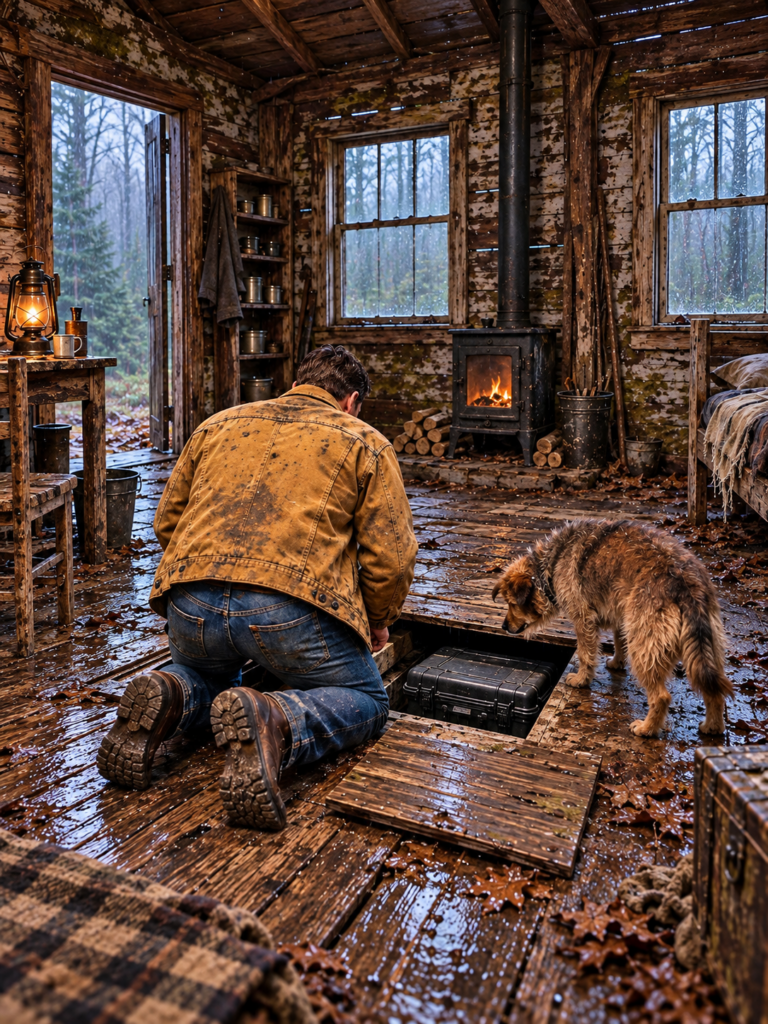
The boards in that particular corner were different from the others. They were fitted together carefully, tongue and groove, but they were not nailed to the joists.
Barnaby had pushed one slightly upward.
Arthur ran his fingers along the edge.
His exhaustion disappeared.
He wedged his fingertips underneath and pulled.
The wood resisted, then came free with a crack.
Maya shifted in her sleeping bag.
Arthur froze.
She settled again.
He turned the light toward the opening.
Beneath the floor was a square cavity lined in black plastic.
Barnaby tried to push his nose inside.
“Back.”
Arthur reached down.
His fingers touched metal.
He found a handle and lifted.
The object was heavier than he expected.
A large Pelican case emerged from beneath the floor, covered in gray dust.
Arthur stared at it.
His father saved broken appliances because he was convinced he might need a heating element or copper wire twenty years later.
He did not buy expensive military-grade waterproof cases for junk.
Arthur opened the latches.
The seal released with a faint hiss.
Inside lay a manila envelope, a black ledger, a handwritten letter, and a velvet box.
No stacks of currency.
No gold bars.
Arthur picked up the letter.
He recognized Thomas’s cramped handwriting immediately.
Arty,
If you’re reading this, I’m dead, and you’re probably cursing me for leaving you that miserable shack.
Good.
Arthur almost laughed.
He kept reading.
Thomas wrote that long before the cabin, before the paranoia and isolation, he had started a small software company.
He had sold it in the 1980s.
Then he invested.
Early technology.
Apple.
Server infrastructure.
Markets Arthur’s father had understood long before Arthur realized the old man understood anything at all.
Thomas had hidden his wealth behind trusts and corporations because, in his words, money ruined people.
He had deliberately refused to make Arthur rich while Arthur was young.
You built your own spine, Thomas had written.
You went to the teams. You became a man without my money.
You don’t need it to be a man.
You might need it to be a father.
Arthur stopped.
He looked toward his sleeping children.
Then he read the next lines.
The trust was in Zurich.
The corporate structure was in Delaware.
A New York law firm called Winston and Hayes managed the blind trust.
The verification word was Barnaby.
Arthur looked at the dog.
Thomas had added one final comment beside it.
I liked your dog more than your in-laws.
Arthur breathed out through his nose.
Then he reached the final figure.
The current valuation, Thomas wrote, was somewhere north of two hundred million dollars.
Arthur read it again.
Two hundred million.
He lowered the letter.
“No.”
Barnaby sat beside him.
Arthur grabbed the ledger.
He expected nonsense.
Instead he found decades of meticulous records.
Dates.
Corporate entities.
Account numbers.
Transactions.
Reinvestments.
Contact names.
Routing information.
The manila envelope held certified statements from a Swiss wealth-management institution.
The latest balance was more precise than Thomas’s letter.
$200,450,000.
Arthur’s hands began to shake.
His children slept ten feet away in secondhand coats.
That morning he had possessed forty-two dollars.
His in-laws had thrown him into freezing rain believing they had cast out a penniless failure.
Under the floorboards of a collapsing cabin sat documentation suggesting Arthur Pendleton was worth more than two hundred million dollars.
He opened the velvet box.
Inside lay a heavy gold Pendleton signet ring and a brass key to a safe-deposit box in Manhattan.
Barnaby nudged his elbow.
Arthur buried a hand in the dog’s fur.
“Good boy.”
He looked again at the papers.
The money did not feel real yet.
What felt real was Leo saying he was cold.
What felt real was Maya asking whether they would ever return.
What felt real was Patricia staring at his frayed collar while discussing her grandchildren as inconveniences.
Arthur carefully repacked the case and lowered it beneath the floor.
Tomorrow he would find out whether Thomas had been a madman or a millionaire.
Either way, Arthur understood something clearly for the first time that night.
The worst day of his life might not have ended the way Richard Carmichael believed it had.
Part 2
Morning came with a dead fire and frost feathering the windows.
Arthur woke before the children.
His breath showed in the cabin.
For several seconds he remained on the cot, staring at the corner where he had replaced the floorboards.
The case was still there.
So were the cuts on his fingers from opening the hiding place.
Not a dream.
He rebuilt the fire, using the last reasonably dry pieces of wood.
Breakfast consisted of stale pretzels and the remaining chocolate milk.
Leo ate without complaint.
Maya watched Arthur carefully, as if six years of life had already taught her that adults smiled differently when they were frightened.
“Boots on,” Arthur said. “We’re heading into town.”
“For what?”
“Real breakfast.”
That earned him two smiles.
The nearest town was Oak Haven, a depleted former mining community forty minutes away.
Boarded storefronts stood between operating businesses. A faded gas-station canopy leaned toward the road. On the main strip, Arthur found a diner called Dottie’s.
The neon sign had missing letters.
Inside, however, there was heat.
And bacon.
Arthur nearly wanted to thank someone just for those two things.
They took a booth.
Barnaby stayed beneath the table on a short leash.
A waitress named Brenda approached with a coffee pot.
“What can I get you?”
“Three short stacks, bacon, two orange juices, black coffee.”
Arthur placed fifteen dollars on the table.
“Can you watch them for five minutes while I make a phone call?”
Brenda looked at the children, then at Arthur.
Whatever she saw in his face stopped her from asking questions.
“Go ahead. I’ve got them.”
Arthur stepped outside.
He carried an old prepaid phone bought months earlier for emergencies and a piece of paper containing a number copied from Thomas’s ledger.
Winston and Hayes.
New York.
Arthur dialed.
A polished receptionist answered.
“Winston and Hayes. How may I direct your call?”
“David Hayes.”
“Mr. Hayes is currently in a partner meeting. May I ask who’s calling?”
“Arthur Pendleton.”
Keyboard clicks.
“I don’t have you on Mr. Hayes’s schedule. If you’d like to leave—”
“Tell him Thomas Pendleton’s son is calling.”
Arthur watched exhaust drift from a pickup parked across the street.
“Tell him I found a Pelican case and a ledger. Tell him the word is Barnaby.”
Silence.
Not hold music.
Not another receptionist.
Just silence.
Arthur counted forty-five seconds.
Then a man came on the line breathing slightly faster than someone at a Manhattan law firm probably preferred to breathe.
“Mr. Pendleton?”
“Yes.”
“This is David Hayes.”
Arthur said nothing.
Hayes continued.
“My God. We’ve been attempting to locate you for eight months.”
“My father left instructions.”
“He left many instructions. One of them specifically prohibited us from hiring investigators. He insisted that when circumstances required it, you would go to the cabin.”
“I went.”
Hayes’s voice became careful.
“I need the verification word.”
“Barnaby.”
A long exhale.
“All right.”
Arthur felt the world narrow to the phone in his hand.
“Tell me if it’s real.”
“It is.”
Arthur closed his eyes.
Hayes offered condolences for Thomas and for Claire.
Arthur interrupted him.
“I don’t need condolences. I need access.”
“Of course.”
Hayes shifted instantly into business.
The trust, he explained, was fully vested. Thomas’s holding structure now belonged to Arthur.
Its valuation that morning was not two hundred million.
It was approximately $214.6 million.
Arthur looked through Dottie’s window.
Leo was pouring far too much syrup on his pancakes.
Maya was laughing while Brenda refilled a glass.
Arthur had spent the previous night wondering how he would feed them after his last few dollars disappeared.
Now a lawyer in New York was telling him he controlled more than two hundred million dollars.
“I need cash today.”
“I can arrange fifty thousand immediately.”
“I’m in Oak Haven. There’s a First National branch.”
Hayes took the details.
“Give me fifteen minutes.”
Arthur ended the call.
When he returned to the booth, Maya had syrup on her cheek.
“Everything okay, Daddy?”
Arthur wiped the syrup away with his thumb.
For six months, fear had lived beneath everything he did.
Fear that the bills would outrun him.
Fear that his grief would hollow him out.
Fear that he would fail Leo and Maya so badly someone might decide they belonged with people who had more money and cleaner houses.
The fear did not disappear completely.
But its practical teeth had been pulled.
“Everything’s okay.”
Arthur drank his coffee.
“Finish breakfast. We have shopping to do.”
Thirty minutes later, he entered First National looking exactly like a man a small-town banker expected to have no money.
The young teller’s expression made that clear.
“Can I help you?”
“Arthur Pendleton. Wire transfer from Winston and Hayes.”
The teller typed.
His bored expression vanished.
He leaned closer to the screen.
“Mr. Pendleton?”
Arthur waited.
“There is a fifty-thousand-dollar transfer here.”
“I want ten thousand in cash. Put the rest into a checking account. No credit lines. No overdraft.”
Within minutes the manager appeared.
Suddenly there were handshakes, smiles, and offers of coffee.
Arthur found the transformation more unpleasant than the suspicion.
Nothing about him had changed between entering the bank and the number appearing on a screen.
He took the money and left.
Their first stop was an outfitter.
Leo received a winter coat so thick he could barely lower his arms.
Maya chose another in a bright color and stood admiring herself in a mirror while Arthur added waterproof boots, wool socks, thermal layers, hats, and gloves.
He bought himself solid boots and a heavy work jacket.
Barnaby got a leather collar and an enormous bag of dog food.
Outside, Leo buried his chin into his new coat.
“Dad, I’m really warm.”
Arthur lifted him into the truck.
“I know.”
His voice almost broke.
He recovered before Leo noticed.
“We’re never going to be cold like that again.”
Arthur did not return the children to the cabin.
Forty miles south, near a ski community, he found a short-term rental agency and paid cash for a month at a secluded timber-frame lodge.
The twins walked through the front door and stopped.
Heated floors.
A stone fireplace.
A real kitchen.
Bedrooms upstairs.
Barnaby wandered onto the living-room rug, circled three times, and collapsed.
“Can we pick our rooms?” Maya asked.
“That’s the mission.”
The twins ran upstairs.
For the first time since leaving the Carmichaels, their laughter filled a house.
Arthur stood alone in the kitchen listening to it.
Then he set a new laptop on the granite island.
Food and shelter were handled.
Now he needed to understand what Thomas had left him.
Over the next week, Arthur treated wealth the same way he had once approached unfamiliar terrain.
He studied it.
David Hayes assembled accountants, trust specialists, investment managers, and attorneys.
Arthur sat through encrypted calls asking question after question.
What did he actually own?
Where was it held?
Who could move it?
What liabilities existed?
What had Thomas structured, and why?
He refused to be impressed by large numbers simply because they were large.
Every morning he made breakfast for the twins.
He bought homeschooling workbooks so they would not fall behind during the transition.
Afternoons belonged to hikes, snow, movies, and Barnaby charging after animals faster than he was.
At night, Arthur worked.
Eventually, one subject kept returning to him.
Richard Carmichael.
Arthur told Hayes, “I want a financial picture of Carmichael Industries.”
Hayes studied him through the screen.
“What kind of picture?”
“Complete.”
“Arthur—”
“Public information. SEC records where applicable. Credit reports we can legally obtain. Liens. Financing. Suppliers. Debt. I don’t want espionage.”
Hayes nodded.
“What are you looking for?”
“The truth.”
Three days later, Arthur received a report thick enough that, printed, it could have stopped a door.
He began reading beside the fire.
By midnight, he understood Richard Carmichael far better than he ever had while living under the man’s roof.
Carmichael Industries was failing.
Its manufacturing operations had lost several major contracts. Competitors had modernized while Richard kept pouring money into maintaining an image of success.
The estate was heavily mortgaged.
The cars were financed.
Lines of credit had been stretched.
The company carried expensive mezzanine debt from a Chicago investment firm called Vanguard Capital.
Arthur read the figures twice.
Twenty-two million dollars.
Callable if Carmichael missed a quarterly revenue target.
The same Richard who had criticized Arthur’s inability to provide had been using borrowed money to maintain a mansion, luxury vehicles, club memberships, jewelry, and social standing.
Arthur sat back.
Then he saw something uglier.
The Carmichaels had not merely found Arthur and the children emotionally inconvenient.
They were trying to reduce expenses.
They were preparing for financial trouble.
And rather than admit that to their widowed son-in-law, they had dressed their decision in the language of grief and thrown two children into winter.
Arthur called Hayes.
“They’re drowning.”
“Yes.”
“And Vanguard can call the note if they miss the next target.”
“Correct.”
“What happens then?”
“Potentially seizure of collateral, restructuring, liquidation. It depends on how aggressively the creditor proceeds.”
Arthur looked at the fire.
“I want their debt.”
Hayes paused.
“You want to invest in Carmichael Industries?”
“No. I want the paper.”
Another pause.
“Arthur, buying distressed debt isn’t a symbolic gesture. You would be purchasing a failing loan.”
“I know.”
“The principal balance is around twenty-two million. Vanguard may demand a premium because removing the exposure cleanly has value.”
“Offer ten percent over what makes them whole.”
Hayes adjusted his glasses.
“You’re talking about roughly twenty-four million dollars.”
Arthur thought of the oak door.
He thought of Patricia’s bracelet.
Most of all, he thought of Leo saying, Daddy, I’m cold.
“Set up Pendleton Holdings. Keep my name away from the negotiation.”
“Arthur.”
“I want to become Richard Carmichael’s primary creditor.”
Hayes was quiet for several seconds.
Then he nodded.
“I understand.”
The acquisition unfolded without drama.
Vanguard did not care who Arthur was.
It cared about cash.
Pendleton Holdings offered a clean exit from a distressed position at a premium, and Vanguard accepted.
Documents moved between lawyers.
Money moved between institutions.
Signatures were applied.
By the end of the month, the twenty-two-million-dollar obligation threatening Richard Carmichael’s company belonged to Arthur.
Arthur did not celebrate.
He took Leo and Maya sledding.
He let Barnaby steal half a sandwich during lunch and pretended not to notice.
Life became steadier.
The twins began sleeping through the night.
Maya stopped asking whether they would have to move again.
Leo started leaving toys scattered around his bedroom, which Arthur considered an encouraging sign. A child who expected eviction packed carefully. A child who felt safe made a mess.
Arthur kept Claire’s photograph in his wallet.
Some nights he sat alone after everyone slept and looked at it.
Money had solved practical problems with almost insulting speed.
It did nothing to fill the empty side of a bed.
It did nothing to answer Maya when she asked whether Mommy would have liked the lodge.
It did nothing when Leo suddenly cried because a movie character sounded like Claire.
Arthur slowly understood why Thomas had warned him.
Money was powerful.
It was not merciful.
Then, on a Tuesday morning, while Arthur helped Maya with subtraction, his phone vibrated.
An email from Hayes.
Carmichael Industries had missed its quarterly target by fourteen percent.
The note was in default.
Pendleton Holdings possessed the contractual right to call the debt.
Hayes’s message ended with two words.
Your orders?
Maya tapped her pencil against the page.
“Dad?”
Arthur looked over.
“What’s seven minus three?”
She frowned.
“Four.”
“That’s right.”
He kissed the top of her head.
Then Arthur typed a one-word answer to Hayes.
Call.
Part 3
Richard Carmichael hated being summoned.
Arthur knew that before he ever entered the conference room.
Richard’s entire life had been built around controlling who waited for whom.
Yet that morning he sat in a downtown corporate law office beside Patricia, checking his Rolex while David Hayes reviewed documents at the opposite end of the table.
Patricia wore a gray designer suit.
Her posture remained perfect.
Her hands did not.
They were locked together so tightly her knuckles had turned white.
“Mr. Hayes,” Richard finally said, “we were told the principal of Pendleton Holdings would attend.”
“He will.”
“We have been sitting here for ten minutes.”
Hayes looked at him.
Richard continued.
“I am not accustomed to being summoned by an anonymous debt purchaser because of one difficult quarter.”
“It is considerably more than one difficult quarter.”
Richard’s expression hardened.
Hayes continued calmly.
“Your company’s financial position has been deteriorating for at least eighteen months. Vanguard had the contractual right to call the note. Pendleton Holdings purchased that right.”
Patricia leaned forward.
“What does your client want?”
“A resolution.”
“We can restructure.”
Hayes closed the folder.
“The principal can discuss that with you.”
Richard looked toward the door.
“Then where is he?”
The door opened.
Arthur entered.
For several seconds, nobody spoke.
He wore dark tailored denim, leather boots, a charcoal merino sweater, and a clean collared shirt.
No suit.
Arthur had spent enough time around powerful men to know clothing did not create authority.
Richard stared at him.
Patricia’s fingers moved to her pearl necklace.
Arthur pulled out the chair opposite them and sat.
Richard looked at Hayes.
Then back at Arthur.
“What is this?”
Arthur said nothing.
“Hayes, why is he here?”
Patricia found her voice.
“Arthur, how did you even get upstairs? This is a private—”
“Security knows me.”
Arthur rested his hands on the table.
Richard’s eyes narrowed.
“Why?”
“Pendleton Holdings acquired the building management company yesterday.”
Richard stopped breathing for a beat.
Arthur watched recognition arrive.
Pendleton.
Richard looked at the folder.
Then at Arthur.
“No.”
Arthur waited.
“No. You don’t have this kind of capital.”
Richard’s voice rose.
“You were broke. You were living in my house.”
“I was surviving in your house.”
“You had nothing.”
Arthur leaned forward slightly.
“That was what you believed.”
Patricia stared at him.
“Where did the money come from?”
“My father.”
Richard’s face changed again.
Arthur did not explain further.
He had not come to satisfy their curiosity.
He pulled a bound document from Hayes’s stack and slid it across the table.
“Your notice of default.”
Richard did not touch it.
Arthur continued.
“You owe roughly twenty-two million dollars under the note, subject to the full amounts and remedies stated in the documents.”
“We don’t have twenty-two million in cash.”
Richard sounded smaller saying it than Arthur expected.
“I know.”
“You know?”
“I reviewed the financials.”
Arthur’s tone remained controlled.
“The factories are losing money. The estate is heavily leveraged. You financed appearances while the business deteriorated.”
Patricia’s eyes filled.
“Arthur, please.”
Arthur looked at her.
“We were grieving.”
“So were my children.”
“We made a terrible mistake.”
“You put six-year-olds outside in November.”
Her lips trembled.
“Claire would hate this.”
The moment her daughter’s name left her mouth, something in Arthur hardened.
“Don’t.”
Patricia fell silent.
“Do not use Claire to negotiate with me.”
“I only meant—”
“You didn’t come downstairs to say goodbye to her children.”
Arthur’s voice never rose.
“You knew they were leaving. You knew I had no money. You knew the truck barely ran. And neither of you walked twenty feet from the sitting room.”
Richard pushed back from the table.
“This is revenge.”
Arthur considered that.
Part of it was.
He knew himself well enough not to pretend otherwise.
But revenge alone would have required less paperwork.
“You signed the contracts,” Arthur said. “You pledged the collateral. Pendleton Holdings purchased the debt lawfully. You defaulted.”
Richard looked at Hayes.
“There must be restructuring options.”
“There are always options,” Hayes said. “The creditor decides which are acceptable.”
Richard looked back at Arthur.
For perhaps the first time since they met, there was no superiority in his expression.
Only fear.
“What do you want?”
Arthur had imagined this moment in colder ways.
He had imagined Richard begging.
He had imagined enjoying it.
Instead he felt tired.
“I’m exercising the rights attached to the debt.”
Arthur indicated the papers.
“Pendleton Holdings will take control of the pledged corporate collateral and begin disposition of the manufacturing assets as legally permitted. Your personal guarantees expose additional pledged property, including the estate.”
Patricia covered her mouth.
Richard looked down.
“The house.”
“Yes.”
“You’re taking the house.”
“I’m taking what the agreements allow the creditor to take.”
“You’re destroying us.”
Arthur looked at the man who had once blamed him for Claire’s death.
“No. Your business failed long before I knew I could afford to buy the debt.”
Richard’s face reddened.
Arthur continued.
“You could have sold the estate. You could have cut expenses. You could have told the truth.”
His gaze moved between them.
“Instead you protected an image.”
Patricia began crying quietly.
Not the controlled tears of a formal funeral.
Messy tears.
Arthur discovered they gave him no satisfaction.
He remembered Thomas’s letter.
Money ruins people.
Maybe this was what his father had meant.
Not merely losing money.
Not merely gaining it.
Believing wealth transformed every human conflict into something you were entitled to win.
Arthur stood.
Hayes remained seated.
“The legal notices contain the timelines and procedures. My attorneys will handle the rest.”
Richard’s eyes lifted.
“Arthur.”
He stopped.
Richard swallowed.
“What are we supposed to do?”
The question struck Arthur with unexpected force.
A month earlier Richard had not asked what Arthur was supposed to do.
He had simply shut the door.
Arthur could have repeated the cruelty.
Part of him wanted to.
Instead he said, “Find somewhere you can afford.”
Richard looked away.
Arthur moved toward the door.
Then he paused.
“I hear independent living situations build character.”
He left before Richard could answer.
The financial dismantling happened more quietly than Arthur had imagined.
There were no dramatic crowds outside the Carmichael estate.
No television cameras.
No public humiliation engineered for his enjoyment.
There were attorneys.
Notices.
Asset schedules.
Negotiations.
Transfers.
Carmichael Industries’ manufacturing assets were liquidated as part of addressing the debt and obligations.
The estate went through foreclosure.
Richard and Patricia moved into a rented two-bedroom apartment on the outskirts of the city.
Their expensive cars disappeared.
Country-club memberships ended when payments stopped.
The life they had spent years presenting as permanent turned out to be a structure supported by debt.
Arthur never went back inside the mansion.
He did not want the furniture.
He did not want Richard’s study.
He did not want the dining room where Patricia had once critiqued the way Leo held a fork.
He did not even want the satisfaction of standing in the foyer as owner.
The property was sold to a developer.
Arthur was told there were plans for condominiums.
He felt nothing when he heard.
The children never asked to return.
That mattered more.
Arthur turned his attention west.
Four months later, winter loosened its hold on Montana.
Morning sunlight spread across a valley surrounded by mountains still capped with snow.
Arthur stood on the porch of a new timber lodge holding a mug of black coffee.
Three thousand acres stretched before him.
Pasture.
Pine.
Open ground.
A working cattle ranch.
He had bought the property in cash and placed the deed into an irrevocable trust for Leo and Maya.
That decision mattered to him more than the acreage.
It meant the home belonged to their future, not his pride.
Across the field, Barnaby was chasing a jackrabbit.
The dog had no chance.
He pursued it anyway.
One floppy ear bounced with every stride.
“Barnaby!”
Leo’s voice echoed across the yard.
“Leave it!”
The twins came running from the house.
Both wore denim overalls and scuffed cowboy boots.
Maya immediately stepped into a puddle.
“Don’t run through the mud,” Arthur called.
“I’m not in the mud!”
She looked down at her boots.
“I’m in the dirt!”
She took another step and splashed brown water to her knees.
Leo laughed.
Maya laughed harder.
Arthur found himself laughing with them.
Months earlier he had watched the same children huddle in sleeping bags beside a weak wood stove.
Now they raced across land where nobody could tell them they were too loud.
Arthur went inside.
The lodge was large without feeling formal.
The fireplace was built from river stone.
Mud appeared regularly near the entrance because Barnaby had never developed Patricia Carmichael’s respect for expensive rugs.
On the mantel sat a photograph of Claire.
She was laughing in the picture, hair blown across her face on a San Diego beach.
Beside the frame rested Thomas Pendleton’s gold signet ring.
Arthur had also preserved his father’s letter.
Their relationship had been too damaged for wealth to repair it retroactively.
Thomas had been difficult, paranoid, absent, and at times impossible.
Arthur did not rewrite those years merely because the man had died rich.
But he understood him differently now.
The old man had spent decades terrified that money would corrupt everyone near it.
So he had hidden himself along with the money.
Arthur thought Thomas had been wrong about many things.
On that point, he was not entirely wrong.
Arthur did not spend the inheritance on yachts or jets.
He invested most of it conservatively across municipal bonds, broad blue-chip and index holdings, and agricultural interests.
He used some of it to quietly pay medical debts carried by five veterans from his former SEAL circle.
None of them were told to thank him publicly.
He wanted it that way.
Money had not made him happier in the simple sense.
Claire was still dead.
Thomas was still dead.
His children still woke some mornings missing their mother.
Arthur still carried anger he suspected might take years to put down.
But money had given him something valuable.
Space.
Time.
Safety.
The freedom to grieve without calculating whether grief itself was affordable.
He walked into the kitchen and began making pancakes.
Real pancakes.
Flour scattered across the counter.
Butter warmed in a pan.
Maple syrup waited near the plates.
The screen door slammed.
“Dad!”
Arthur looked toward the entryway.
Leo and Maya barreled inside.
Barnaby arrived behind them with four paws coated in black mud.
The dog stopped directly in front of the rug.
Arthur pointed at him.
“Don’t.”
Barnaby froze.
“Don’t even think about it.”
The dog took one cautious step backward.
Arthur grabbed the towel kept beside the door for exactly this purpose.
He knelt and wiped Barnaby’s front paws.
“You know better.”
Barnaby licked Arthur’s chin.
A muddy streak appeared across his face.
Maya burst out laughing.
“Dad, you have mud on you.”
“I noticed.”
Leo ran toward the kitchen.
“Can I pour the syrup?”
“I poured it yesterday!” Maya shouted, chasing him.
Arthur stood with the towel in one hand.
For a moment he remained there, listening.
Children arguing about syrup.
Dog breathing beside him.
Pancakes cooking.
A photograph of Claire above the fireplace.
Thomas’s letter beside it.
Nothing about the life in front of him resembled the kind of wealth Richard Carmichael had valued.
There was no marble foyer.
No carefully maintained silence.
No attempt to make children disappear so adults could preserve the appearance of control.
Arthur had spent years believing strength meant needing very little.
Thomas had spent years believing wealth was safest when hidden.
Richard had believed wealth was proof of superiority even while debt consumed him.
Arthur had arrived at a different conclusion.
Money was only a tool.
It could become a disguise.
A weapon.
A wall.
Or, used carefully, a shelter.
The fortune beneath Thomas’s floorboards had changed Arthur’s circumstances overnight.
Barnaby had uncovered it with a few stubborn scratches.
But the real inheritance was more complicated than two hundred million dollars.
Thomas had given his son the ability to decide what kind of man money would make him.
Arthur looked toward the kitchen, where Maya was accusing Leo of stealing her stool.
He smiled and followed them.
Outside, spring sunlight reached farther across the valley.
Inside, Arthur flipped another pancake and listened to his children laugh.
For the first time in a long time, there was nowhere else they needed to go.


